Winning Without Killing
Objectives, obstacles, negotiations, and meaningful victory in Role-Playing adventures.
Imagine that your adventuring party enters an underground fortress and discovers six armed guards standing between them and a heavily reinforced door. The guards draw their weapons, the players roll Initiative, and the fighting begins. Several minutes later, the guards are dead, the adventurers are victorious, and everyone searches the bodies for money, weapons, and anything else worth stealing. Congratulations—you have successfully converted six imaginary people into an equipment donation program.
There’s nothing inherently wrong with that encounter. Fighting dangerous enemies, overcoming seemingly impossible odds, and emerging victorious are among the great pleasures of heroic fantasy. I’ve enjoyed plenty of battles in which the objective was simply to kill a particularly dangerous bastard before he killed everyone else. However, if practically every encounter follows the same pattern, the Game Master is leaving an enormous amount of adventure potential unexplored.
Now consider a different version of that fortress encounter. The guards are protecting a prisoner who possesses information capable of exposing a conspiracy against the kingdom, and an executioner is preparing to kill him. The adventurers must reach the prisoner before the execution takes place, but the guards are perfectly willing to delay them until the executioner finishes his business. Suddenly, killing all six guards is no longer the objective—it is merely one possible means of accomplishing something considerably more important.
The players might attempt to overpower the guards, negotiate with their commander, create a distraction, break through another entrance, or somehow convince the executioner to abandon his orders. Perhaps one adventurer challenges the captain to single combat while another sneaks toward the prisoner. Perhaps the players discover that the guards don’t know the prisoner is innocent, and the entire encounter becomes a desperate attempt to persuade them before time runs out. The situation is interesting because the players have something meaningful to accomplish, and their decisions determine whether they succeed.
That is the distinction I want to explore in this article. Defeating your opponents and winning an encounter are not necessarily the same thing. Sometimes killing everyone is precisely what circumstances demand, but other times it accomplishes nothing—or actually makes the situation worse. A truly interesting encounter asks the adventurers to accomplish something and provides obstacles, opportunities, and consequences that make their choices matter.
Killing Everything Isn’t the Same as Winning
One of the easiest mistakes a Game Master can make is treating the presence of enemies as the entire purpose of an encounter. The adventurers approach a bridge, encounter bandits, and fight them. They enter a crypt, encounter undead creatures, and fight them. They discover a mysterious tower, encounter hostile inhabitants, and fight them. Eventually, the campaign begins resembling a medieval pest-control business whose employees happen to carry swords.
The problem isn’t that these encounters involve combat. The problem is that the enemies have become the encounter, rather than characters or creatures participating in a larger situation. Why are the bandits occupying the bridge? What do the undead creatures protect, and what circumstances might cause them to leave the adventurers alone? What do the tower’s inhabitants want, and could the adventurers accomplish their own goals without destroying everyone inside?
Consider the bandits guarding that bridge. Perhaps they are collecting illegal tolls to finance a rebellion, and killing them might provoke retaliation from an entire insurgent army. Perhaps they are desperate refugees whose families are starving, or mercenaries hired by a nobleman to prevent travelers from discovering an illegal mining operation. The adventurers could fight them, certainly, but investigating their activities, negotiating safe passage, exposing their employer, or recruiting them against a common enemy could become more interesting possibilities.
This approach also gives intelligent opponents reasons to behave like actual people. Most soldiers don’t enthusiastically fight to the death over every disagreement, and ordinary criminals generally prefer spending stolen money to becoming permanently deceased. Guards may surrender when hopelessly outnumbered, mercenaries may abandon an employer who stops paying them, and frightened creatures may retreat when their offspring are no longer threatened. Even a dangerous enemy can possess motivations that extend beyond attacking whatever happens to enter the room.
I explored the importance of varied combat decisions in Why “I Attack” Isn’t Enough, where I discuss how tactical maneuvers and cinematic action can transform otherwise repetitive fighting. Here, I want to take the argument further by examining the objectives that make those maneuvers worth performing. Disarming an opponent becomes particularly meaningful when the adventurers need him alive, while holding a doorway becomes heroic when innocent people are escaping behind the defender.
None of this means every opponent must have a sympathetic backstory or that every battle should conclude with a thoughtful discussion about everyone’s feelings. Some enemies really are murderous monsters, and sometimes the heroic thing to do is draw your sword and put an end to their atrocities. The objective isn’t to eliminate violence from heroic fantasy—it is to make violence serve the adventure rather than allowing it to become the adventure’s only purpose.
This distinction is especially important when designing dungeons. In How to Create a Dungeon Adventure, I discuss creating underground environments that reward exploration, curiosity, and intelligent decisions rather than simply moving adventurers from one monster-filled chamber to another. An interesting dungeon might contain hostile creatures, but its greatest challenges could involve discovering why the dungeon exists, recovering something hidden within it, negotiating passage through occupied territory, or escaping before an ancient mechanism destroys the entire complex.
An encounter becomes considerably more exciting when the players know what they are trying to accomplish but don’t know how they should accomplish it. The Game Master establishes the situation, presents the relevant dangers and opportunities, and allows the players to determine their own course of action. They might fight, negotiate, infiltrate, retreat, investigate, or attempt something the Game Master never anticipated. The important question is whether their decisions can genuinely change the outcome.
What Actually Makes Victory Satisfying?
Before designing better encounters, I think we should examine something more fundamental: What makes a player feel satisfied with what happened during a gaming session? Killing a dangerous opponent can certainly provide that satisfaction, but so can rescuing someone, solving a mystery, winning a competition, becoming famous, gaining an important ally, or accomplishing something that initially appeared impossible. The emotional reward comes from what the experience means to the player, not merely from how many opponents were defeated.
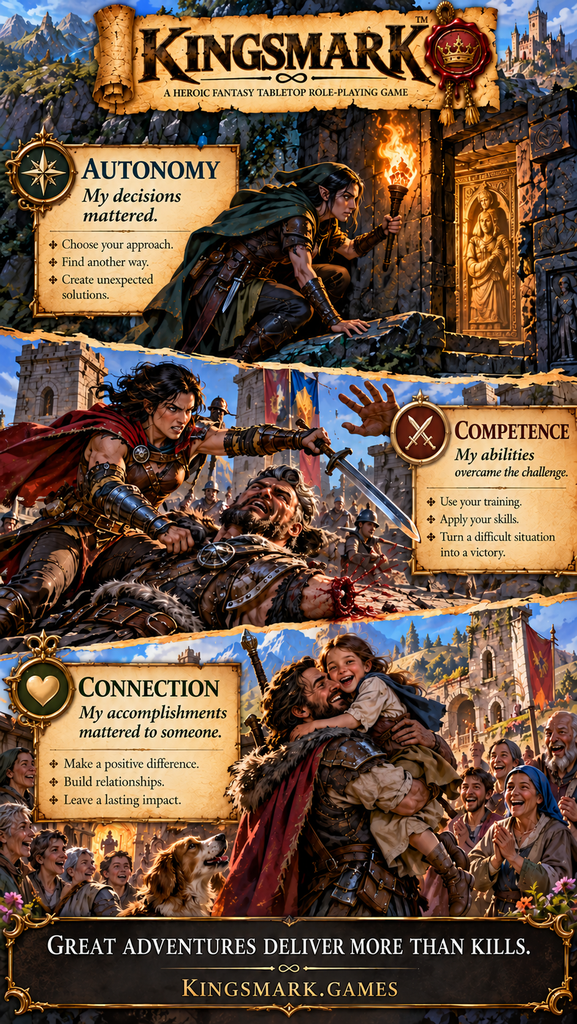
In March 2026, researchers Patrick J. McLaren, Lindsay G. Oades, and Ben Deery published a study in the International Journal of Role-Playing titled How Do Dungeon Masters and Players Contribute to the Needs Satisfaction (or Frustration) in Dungeons & Dragons 5th Edition?. Their qualitative research examined responses from 1,120 participants and identified five important themes involving game worlds, character engagement, player agency, fair adjudication, and social relationships. The researchers interpreted these findings through three psychological needs: autonomy, competence, and relatedness.
These concepts provide a useful foundation for understanding why certain encounters become unforgettable while others are barely remembered the following week. They don’t establish that players prefer diplomacy over fighting, or that every player finds the same activities rewarding. What they do suggest is that Game Masters should pay attention to opportunities for meaningful decisions, successful use of abilities, and personal connections. Those opportunities can emerge from practically any type of encounter.
Autonomy is the satisfaction of making decisions that genuinely matter. Imagine that your adventurers discover a powerful nobleman secretly financing a criminal organization. They might expose him publicly, blackmail him, infiltrate his household, persuade his allies to abandon him, or attempt to assassinate him. If those approaches can produce meaningfully different outcomes, the players have an opportunity to influence the direction of the campaign.
Now imagine that the Game Master has already decided the nobleman must escape, regardless of what the players attempt. Every investigation conveniently fails, every assassination attempt encounters an impossible obstacle, and every successful negotiation somehow becomes irrelevant. The players may spend hours discussing plans and rolling dice, but their choices accomplish nothing because the Game Master is determined to preserve his predetermined storyline.
That isn’t meaningful freedom. Players don’t need unlimited power over the fictional world, but they do need reasonable opportunities to influence events through their decisions and abilities. An adventure becomes much more satisfying when the players can look back and recognize that something happened specifically because of what they chose to do.
Competence is the satisfaction of overcoming a challenge through ability, intelligence, discipline, or determination. A skilled warrior may experience it when he defeats a dangerous opponent through superior tactics, while an investigator experiences the same satisfaction by connecting clues that reveal a criminal’s identity. A magician might employ an unusual Spell to overcome an obstacle, and a thief might accomplish what initially appeared to be an impossible infiltration. The experiences are different, but each allows the player to feel that his character’s capabilities accomplished something worthwhile.
This also explains why challenges should possess genuine difficulty without becoming exercises in arbitrary frustration. Climbing a dangerous mountain is satisfying when the player succeeds through preparation, equipment, sound decisions, and appropriate abilities. It is considerably less satisfying when the Game Master repeatedly invents obstacles until the climber fails because the GM believes success would be insufficiently dramatic. Players should be allowed to earn impressive victories, including victories that turn out to be easier than the Game Master anticipated.
The third psychological need, relatedness, concerns the importance of social connection. Within a role-playing campaign, that can include relationships among the players, their characters, and the fictional people inhabiting the world. Protecting a beloved companion, earning the trust of a suspicious community, reconciling two estranged friends, or sacrificing something valuable for another person can become deeply satisfying experiences. Such encounters often remain memorable because the players care about the individuals involved.
Consider a straightforward rescue mission. A wealthy merchant offers the adventurers a substantial reward to rescue his kidnapped daughter, and the party eventually succeeds. They receive their payment, perhaps celebrate in the local tavern, and continue their travels. This is perfectly serviceable adventure material, but the emotional investment may never extend beyond the agreed-upon reward.
Now imagine that the merchant previously sheltered the adventurers during a terrible winter storm, cared for one of their wounded companions, and defended them when local authorities accused them of a crime. His daughter knows the adventurers personally, and one of the player characters has become something of a mentor to her. When she disappears, the mission is no longer simply a financial opportunity—it is a threat to someone the players have come to value.
The mechanical challenge of rescuing her might remain practically identical, but the emotional stakes have changed dramatically. Players may become more willing to accept danger, sacrifice valuable equipment, negotiate with enemies, or pursue the kidnappers across half the kingdom. They aren’t merely trying to complete an assignment. They’re trying to save someone whose life matters to their characters.
This is one reason I consider character development so important. As I explain in Beyond the Character Sheet and Creating Memorable Fantasy Heroes, a character should become more than a collection of Attributes, Skills, and equipment. His loyalties, ambitions, fears, relationships, and personal history should influence how he approaches the adventures he encounters.
Recognition and reputation provide another powerful source of satisfaction. A warrior might gain a reputation for extraordinary courage after defending a mountain village against overwhelming odds. A negotiator might become respected among rival kingdoms after preventing a disastrous war, while a thief could become infamous for stealing a priceless artifact from a supposedly impregnable fortress. These accomplishments can create opportunities and complications that follow the characters throughout the campaign.
A particularly satisfying form of recognition occurs when the world visibly remembers the adventurers’ deeds. Imagine returning to a village several months after saving it from destruction and discovering that the inhabitants have repaired their homes, established new defenses, and begun celebrating an annual festival commemorating their deliverance. Children might imitate the adventurers with wooden swords, local merchants might offer hospitality, and village leaders could seek their counsel on important matters. The players are witnessing the continuing results of something they accomplished.
Not every memorable victory must be heroic, either. A cunning criminal might experience tremendous satisfaction from outwitting a powerful rival, while a ruthless mercenary might take pride in completing a dangerous assignment that no other company would accept. A politically ambitious character could consider gaining influence at court more rewarding than collecting another magical weapon. What matters is that the encounter creates opportunities connected to the character’s ambitions and the player’s interests.
A Game Master should also remember that different players enjoy different forms of accomplishment. One player may delight in elaborate combat tactics, another may prefer unraveling mysteries, and a third may particularly enjoy conversations with interesting fictional characters. The challenge isn’t to force everyone into the same activity, but to develop situations in which their different abilities and interests can contribute toward a common objective. A rescue mission might simultaneously provide opportunities for fighting, investigation, negotiation, infiltration, and healing.
This philosophy influenced the design of 👑Kingsmark. I wanted a heroic fantasy TTRPG in which adventurers could develop professional abilities and use them to confront a wide variety of challenges, rather than relying entirely upon conventional combat progression. Characters possess 💪Attributes, 🌈Attribute PRISMs, and ⚒Skills that can become relevant in physical confrontations, investigations, social situations, wilderness exploration, and countless other circumstances.
The game’s seventeen 🎭Character Classes also create different opportunities for meaningful contributions. A ⚔️Man-at-Arms may excel at protecting companions and overcoming armed opposition, while a 🏹Ranger can bring expertise to wilderness challenges and a ❤️🩹Healer can become indispensable when lives are endangered. As I explain in Choosing Your Kingsmark Character Class, choosing a profession involves deciding what kinds of challenges and experiences a player wants to pursue. The most useful character isn’t necessarily the one who inflicts the greatest amount of damage.
Ultimately, I believe Game Masters should think beyond the immediate rewards of treasure, experience, and defeated opponents. A great encounter may reward the players with information, reputation, gratitude, personal achievement, political influence, a valued relationship, or the satisfaction of accomplishing something extraordinarily difficult. Those rewards often become more interesting when they create new opportunities in the world.
Ten Ways to Win Without Killing Everyone
Once we understand that victory can mean something beyond defeating opponents, creating interesting encounters becomes considerably easier. Instead of beginning with a collection of monsters and attempting to justify their presence, begin by deciding what the adventurers might need to accomplish. Then consider what makes that objective difficult, who or what opposes them, and how different decisions could influence the outcome. The result might become a battle, an investigation, a negotiation, an obstacle course, or an unexpected combination of several activities.
Rescue encounters are an excellent starting point because they provide an immediately understandable objective. Adventurers might need to free prisoners from a hostile fortress, rescue travelers trapped beneath a collapsed bridge, or recover children abducted by a dangerous creature. Fighting can help remove obstacles, but defeating every opponent may waste precious time or endanger the very people the characters are trying to save. A successful rescue is measured by the fate of those being rescued.
Escape encounters reverse the usual assumption that enemies must be defeated. Perhaps the adventurers are being pursued through a collapsing underground city, escaping an enemy stronghold, or fleeing a supernatural threat they cannot reasonably overcome. Their objective is to reach safety, possibly while protecting wounded companions or carrying something valuable. An apparently terrifying opponent can create an excellent encounter precisely because fighting it is such an unattractive option.
Protection encounters ask the adventurers to preserve a person, location, or valuable possession. They might defend a healer treating casualties, escort refugees through hostile territory, or prevent saboteurs from destroying a critical bridge. A warrior standing his ground against overwhelming odds can experience tremendous satisfaction even if he defeats very few opponents. His achievement comes from buying the time others need to survive.
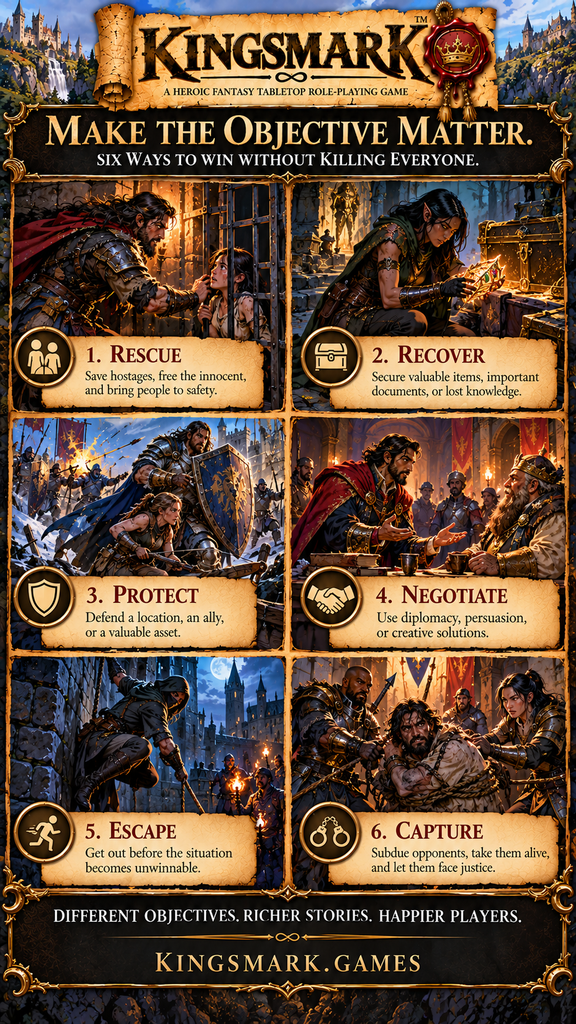
Retrieval encounters involve recovering something important. An adventuring party might steal incriminating letters from a corrupt nobleman, retrieve a stolen family heirloom, or recover medicine desperately needed by an isolated settlement. The difficulty may involve identifying the object’s location, overcoming security, avoiding damage, or escaping with the prize. If the adventurers destroy the object while fighting its guardians, they may defeat the opposition and still fail the mission.
Capture encounters require taking someone alive. Perhaps a notorious criminal possesses information about a larger conspiracy, or a dangerous enemy must be brought before a court to answer for his crimes. Killing the target could eliminate an immediate threat, but it may also destroy an opportunity to uncover information or obtain justice. Grappling, disarming, restraint, intimidation, and surrender become more valuable when the party needs a living prisoner.
Negotiation encounters place conflicting interests at the center of the challenge. Two rival chieftains might be preparing for a war that would devastate both communities, while a suspicious ruler refuses to permit urgently needed supplies through his territory. Adventurers can offer concessions, present evidence, uncover hidden motivations, appeal to loyalties, or threaten consequences. The most interesting negotiations involve people with understandable interests rather than characters who cooperate merely because someone rolls well.
Discovery encounters reward investigation and curiosity. The heroes might need to identify a murderer, discover why livestock are disappearing, or determine whether an ancient ruin contains evidence of a forgotten civilization. The challenge comes from gathering clues, interpreting contradictory information, and deciding whom to trust. Killing every suspicious person would not only be morally questionable—it would make solving most mysteries considerably more difficult.
Sabotage encounters ask the adventurers to disable something dangerous. They might infiltrate an enemy fortress to destroy a siege engine, interfere with a supernatural ritual, or prevent a hostile army from obtaining supplies. Success could require specialized knowledge, careful timing, stealth, or assistance from sympathetic insiders. A small group of adventurers can change the outcome of an entire military campaign without defeating the opposing army themselves.
Survival encounters challenge the party to endure dangerous circumstances long enough to accomplish a broader purpose. They might hold a mountain pass until refugees escape, survive several nights in a haunted wilderness, or keep a damaged vessel afloat during a violent storm. These encounters can involve combat, but fighting is only one of several threats competing for the adventurers’ attention. Weather, exhaustion, dwindling supplies, injuries, and difficult decisions can become equally important.
Persuasion encounters ask the characters to change someone’s mind about an important decision. Perhaps a monarch has ordered the execution of an innocent prisoner, a frightened village is preparing to slaughter a harmless creature, or a religious leader has condemned someone on the basis of fabricated evidence. Success may require discovering the truth, gaining an audience, presenting convincing arguments, or overcoming deeply established suspicions. Unlike ordinary negotiation, the central objective is changing a consequential decision rather than simply reaching an agreement.
These ten objectives aren’t separate categories that every encounter must fit into. A single adventure can combine several of them, and new objectives emerge naturally when the Game Master begins thinking about what characters actually want to accomplish. Protecting a witness might become a rescue mission, followed by an escape, an investigation, and a confrontation with the people trying to silence him.
We should also consider situations in which killing an opponent actively damages the party’s chances of success. A dead conspirator cannot reveal the location of his accomplices, and massacring soldiers who are merely following orders may create a political crisis. Destroying a dangerous creature might seem like an easy solution until the adventurers discover that its offspring are the only surviving examples of a remarkable species. These consequences should arise logically from the circumstances, not from a Game Master arbitrarily punishing players for choosing violence.
The 2024 Dungeon Master’s Guide for Dungeons & Dragons already recognizes the importance of objectives beyond defeating enemies. An official D&D Beyond article on creating combat encounters discusses such possibilities as negotiating peace, recovering important objects, and interrupting dangerous rituals. This isn’t about pretending D&D has never considered alternative objectives, but about encouraging Game Masters to make greater use of them. Whatever system you enjoy, the principle remains useful: Give the adventurers something meaningful to accomplish and allow them to decide how they will accomplish it.
The Burning Archive: One Encounter, Many Victories
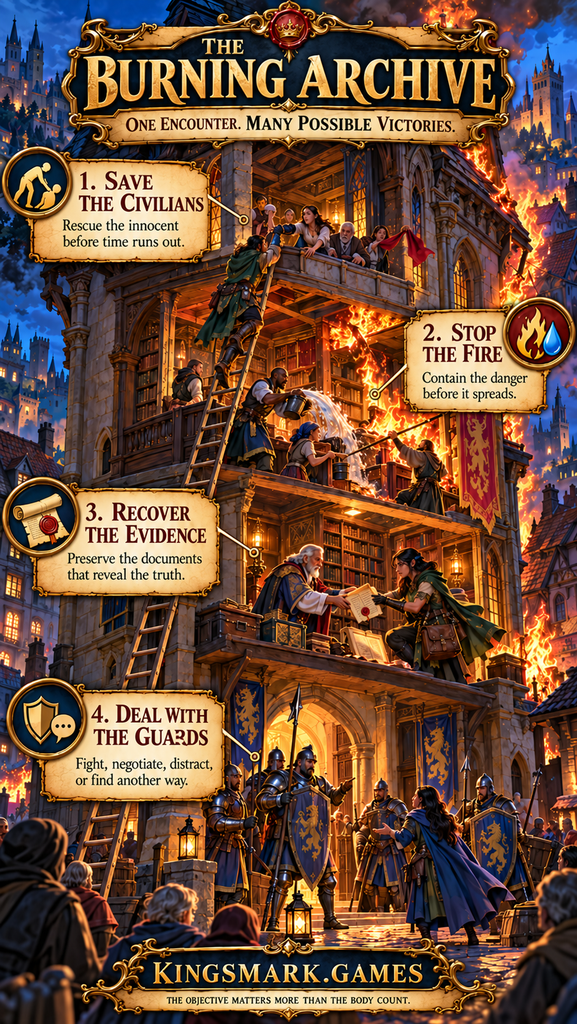
Let’s put these ideas together by designing a single encounter that could become the centerpiece of an entire gaming session. We’ll call it The Burning Archive, and the objective will be more interesting than simply defeating everyone carrying a weapon. The situation involves dangerous enemies, innocent civilians, valuable evidence, a spreading fire, and several opportunities for different characters to demonstrate their abilities. Most importantly, I won’t predetermine how the adventurers are supposed to solve it.
An influential magistrate has secretly ordered the destruction of the city’s judicial archive because it contains documents proving his involvement in a criminal conspiracy. Several armed guards have surrounded the building, claiming they are protecting public safety while refusing to let anyone enter. Inside, an elderly archivist has barricaded himself in the records chamber because he refuses to abandon documents that could expose years of corruption. Several innocent civilians remain trapped upstairs, unaware that the guards have orders to allow the building to burn.
The adventurers arrive as flames begin spreading through the upper floors. Thick smoke pours through shattered windows, terrified citizens are gathering in the street, and someone inside the building is screaming for help. The guards are becoming nervous because the blaze is spreading faster than anticipated, but their captain insists that nobody may cross the cordon. A nearby row of wooden buildings could also catch fire if the flames are not contained.
At first glance, this seems like a straightforward confrontation between adventurers and corrupt guards. However, the players should quickly recognize several competing objectives: Save the civilians, preserve the incriminating documents, protect the archivist, prevent the fire from spreading, and determine what to do about the armed opposition. They might accomplish everything, achieve only some objectives, or fail completely. Their decisions and the circumstances should determine what happens.
One possibility is that the party’s professional warrior confronts the guards while his companions attempt to enter the burning building. He may challenge the captain, block access to a side entrance, or physically prevent soldiers from interfering with a rescue. Perhaps he employs intimidation or attempts to convince the less committed guards that continuing to obey their orders will make them accomplices to murder. Even if fighting begins, his immediate purpose is to protect the other adventurers and give them enough time to work.
Another character might look for a less obvious entrance. An experienced infiltrator could attempt to climb toward an upper window, navigate the interior corridors, and reach the records chamber before the flames consume its contents. A character with relevant ⚒Skills might inspect the building’s construction, identify possible routes, or recognize that certain passages are becoming dangerously unstable. Rather than assuming every adventurer should attack the guards, the Game Master can allow different characters to pursue objectives that match their capabilities.
A knowledgeable magician might possess a 📜Spell that can meaningfully assist with the emergency. Depending on the character’s actual abilities, magic might provide illumination, facilitate movement, protect someone from a particular danger, or accomplish another useful task. The Game Master should apply the existing 📜Magic System and the specific Spell’s limitations rather than inventing a convenient supernatural solution. Magic should expand the players’ possibilities without automatically eliminating every challenge.
Meanwhile, another adventurer might focus on the guards themselves. Perhaps the soldiers were told that the archive was empty and believe they are preventing looters from interfering with an authorized demolition. If the players expose the truth, demonstrate that civilians are trapped inside, or reveal the magistrate’s involvement, some guards may become willing to cooperate. Others could remain loyal to their employer, leaving the captain facing the possibility of a mutiny.
This is where Kingsmark’s rules become particularly useful. Chapter 10 — 🗨️Dialog Scenes establishes procedures for meaningful conversations involving persuasion, negotiation, deception, and the exchange of information. Characters ordinarily resolve attempts to influence another person through opposed Tests involving the Influence & Allure PRISM and Social Skills, with Relationship and Proposal modifiers reflecting the circumstances. Convincing a soldier to rescue trapped civilians should therefore involve different considerations from persuading that same soldier to betray his commanding officer.
The distinction is important because social encounters shouldn’t function like supernatural mind control. A successful appeal must remain believable in light of the other character’s loyalties, motivations, fears, and circumstances. A guard who has just discovered that his employer deliberately endangered innocent people might become willing to cooperate, while a fanatic personally responsible for the conspiracy could be considerably harder to persuade. Players who investigate the situation and develop a convincing approach should have more opportunities than someone who simply demands surrender without offering a reason.
If the guards attack, the encounter can transition naturally into a ▶️Action Scene. Kingsmark uses ⏳Initiative, ⏸Turns, and Action Points to organize dangerous situations, allowing players to combine appropriate maneuvers according to their available time. The 🎬Example Actions provide over a hundred examples of activities characters might perform, while explicitly allowing players to attempt reasonable actions beyond the published menu. This flexibility is particularly valuable when the objective is something other than inflicting damage.
For instance, the 🟠🟠 Bodyguard Action allows a character to actively protect a nearby designated individual, subject to the positioning and interception requirements described in the handbook. A warrior could use it while protecting an injured civilian from an attacker, rather than focusing entirely on offensive attacks. The 🟠🟠 Disarm Action offers another possibility when the adventurers want to neutralize an armed guard without necessarily killing him. Such actions become more meaningful because the encounter provides reasons to use them.
Kingsmark also establishes distinct procedures for Grappling, Restraining, and Binding opponents. An adventurer who wants to capture the guard captain alive can attempt to gain physical control, but accomplishing that objective requires meeting the relevant prerequisites and overcoming resistance. The game doesn’t treat grabbing someone as an automatic victory, nor does it assume that a Grappled opponent becomes helpless. Taking a dangerous adversary alive can therefore become a demanding tactical accomplishment.
Consider what happens when several characters cooperate to rescue someone trapped beneath fallen masonry. Kingsmark’s 🤝 Assisting Another Character rules allow meaningful assistance when another person can logically contribute to a task. Ordinary assistance grants the primary character +2 to the final Test result, with restrictions preventing multiple helpers from endlessly stacking the same bonus. The important detail is that characters must actually contribute something useful, such as lifting debris, stabilizing a dangerous obstruction, or helping move an injured victim.
A ❤️🩹Healer might also become indispensable during this encounter. Rescuing someone from a burning building doesn’t necessarily mean the person is unharmed, and adventurers themselves may suffer injuries while performing dangerous work. Chapter 14 — ❤️Healing Scenes provides the procedures relevant to treating injuries and assisting wounded characters. This allows the aftermath of a rescue to remain an important part of the adventure rather than treating every injured survivor as automatically restored when the immediate danger ends.
The possibility of 🩸Physical Wounds and 🧠Mental Trauma also gives dangerous decisions meaningful consequences. A warrior may be powerful enough to defeat several guards, but fighting them unnecessarily could leave him badly injured while civilians remain trapped upstairs. Characters might experience frightening or psychologically disturbing events while confronting death, destruction, and human cruelty. Kingsmark’s 💥Damage & Defense rules reinforce the importance of preparation, survival, and intelligent choices.
Now consider how differently this encounter might end. In one version, the adventurers rescue every civilian but fail to recover the documents, leaving the magistrate free to deny everything. In another, the evidence survives while the archivist suffers serious injuries, creating an opportunity for the party’s healer to make a meaningful difference. Perhaps the guards surrender, and their testimony becomes even more valuable than the documents the magistrate attempted to destroy.
An especially resourceful party might convince the guards to cooperate, rescue everyone, recover the evidence, and stop the blaze before neighboring buildings catch fire. If the players accomplish all of this through intelligent decisions and successful use of their abilities, let them enjoy the victory. There’s no reason to invent an additional disaster simply because the adventurers performed better than expected.
Failure can also create compelling developments. If the records are destroyed, the party might need to locate surviving witnesses or investigate other sources of evidence. If the magistrate escapes, the adventurers could become involved in pursuing him across the kingdom. If the fire spreads into nearby neighborhoods, the resulting disaster may permanently change the city and create new responsibilities for the heroes.
Notice that I haven’t written a script determining what must happen. I’ve established the location, the people involved, their motivations, several immediate dangers, and possible consequences. The players decide what matters most to them, which risks they’re willing to accept, and how they intend to accomplish their objectives. That is what makes the encounter capable of producing genuinely different stories.
Build Encounters That Change the World
The most encouraging part of this approach is that designing meaningful encounters doesn’t require the Game Master to spend hours developing elaborate plots. In fact, it can make preparation substantially easier because you no longer need to determine exactly how the adventurers will resolve every situation. You establish the circumstances, understand the motivations of the important characters, and prepare enough information to respond intelligently. Then you allow the players to surprise you.
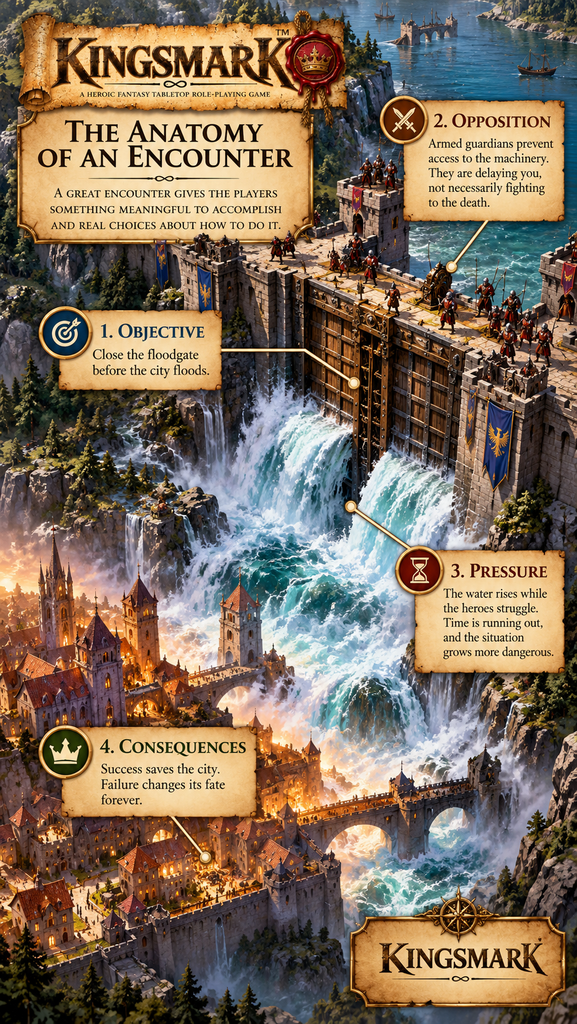
I recommend a straightforward five-question method: What do the adventurers want? What does the opposition want? What makes success difficult? What alternatives might the players attempt? What changes if the adventurers succeed or fail? These questions help identify the essential elements without requiring a predetermined sequence of events. You don’t even need to know every possible answer to the fourth question, because discovering unexpected solutions is part of what makes tabletop role-playing games so enjoyable.
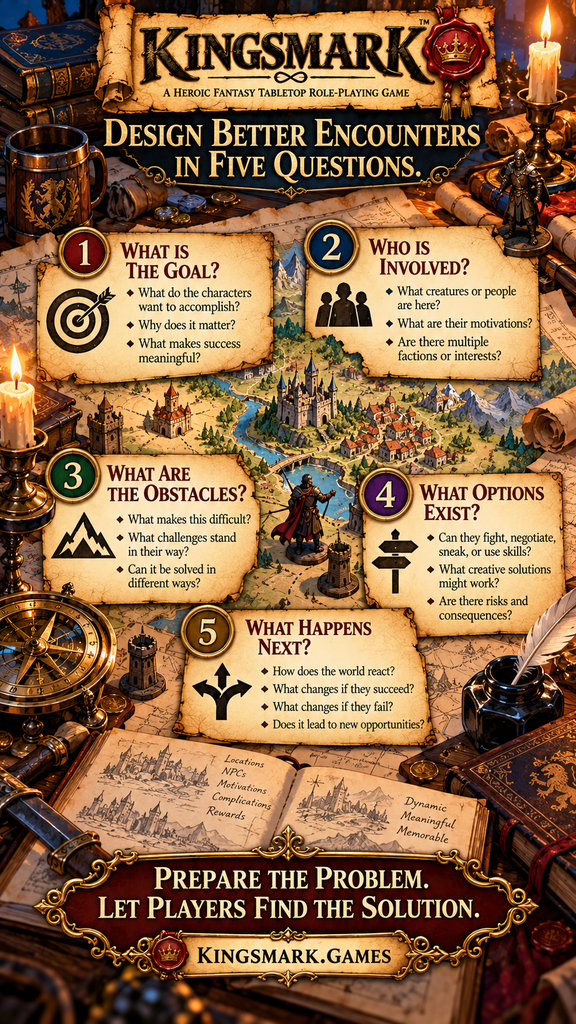
This approach also reduces the temptation to overprepare. Justin Alexander’s influential article Don’t Prep Plots argues for preparing situations rather than predetermined storylines, and Mike Shea offers related practical advice in A New DM’s Guide for Building Encounters. Both reinforce an important principle: The Game Master should understand what is happening in the world without needing to control everything the players decide to do. I discuss the broader challenge of making preparation enjoyable in Is It Fun to Be a Game Master?.
Finally, remember that victory should sometimes leave a permanent mark upon the campaign. The village the heroes saved can become a trusted refuge, a captured criminal might reveal a larger conspiracy, and a former enemy spared in battle may eventually become an ally. The players should have opportunities to encounter the consequences of their actions, including unexpected complications and benefits that emerge long after the original adventure has concluded. Those developments make the fictional world feel responsive rather than merely decorative.
I believe some of the finest adventures emerge when players recognize that their characters have accomplished something worth remembering. They may have defeated a terrifying enemy, but they might also have saved a life, exposed a terrible injustice, discovered a forgotten truth, protected a community, or accomplished something nobody believed possible. The important thing is that their decisions and abilities made a difference.
Years later, your players might forget how many enemies they killed. They are far less likely to forget the people they saved, the impossible decisions they made, or the world they changed.
👑Kingsmark is a heroic fantasy tabletop role-playing game built around cinematic action, meaningful character abilities, and dangerous adventures in a world where decisions have consequences. You can read the complete Player’s Handbook for free at Kingsmark.Games. Support the game by purchasing a digital copy.
About The Author