Magic Is Terrifying
Magic is not a utility or a trick. It is the power to cause something to happen that should not happen—to command fire into existence, speak across impossible distances, step outside the physical body, call unseen beings into the world, close wounds with a touch, or impose the magician’s will upon forces that ordinarily answer to no mortal. Even the smallest working reaches beyond the familiar laws of nature. The greatest are miracles in the fullest sense of the word.
For this reason, magic in Kingsmark should never feel like an ordinary tool that happens to produce extraordinary effects. A magician is doing something fundamentally different from an archer loosing an arrow or a Man-at-Arms swinging a sword. The magician is forcing reality to accommodate something that should not ordinarily happen.
This resistance is described as Consensus Reality: the accumulated expectations of living minds and the apparently stable world they inhabit. People expect stones to fall, wounds to bleed, fire to require fuel, and Human beings to remain firmly attached to the ground. The farther a supernatural manifestation departs from those expectations, the more difficult it becomes to impose upon reality.
The four fixed Power Target Numbers express that increasing resistance. Power 0 Coincidental magic begins at TN 6 because its effects may still resemble luck, intuition, unusual talent, faith, suggestion, or coincidence. Power 1 Lesser magic rises to TN 8 as the supernatural becomes more apparent. Power 2 Greater magic rises to TN 10 as ordinary explanations become increasingly difficult to maintain. Power 3 Supreme magic reaches TN 12 because it represents an unmistakable assertion of supernatural power upon reality.
The existence of magic also does not mean that everyone in Sylva walks around expecting wizards to perform miracles in the street. Much of magic is practiced away from ordinary witnesses: within temples, secluded towers, sacred groves, hidden chambers, wilderness sanctuaries, ritual spaces, and places already associated with supernatural events. Practitioners have good reasons for discretion.
People are also remarkably capable of denying what they have seen. A strange noise becomes the wind. An impossible escape becomes extraordinary luck. A prophetic warning becomes a fortunate guess. Even a person who accepts the existence of goblins, trolls, dragons, or other fantastic creatures does not necessarily believe that another human being can levitate, command fire, see into the Astral Plane, or place a curse upon someone from miles away. A physical creature, however unusual, can still be understood as something that exists in the world. A miracle challenges the rules by which that world is understood. For the magician, however, disbelief is only one reason to be cautious.
Maximum Spell Power
A magical character may normally cast a known Spell at a Power Level no greater than his current ⭐Action Star Level, to a maximum of Power 3.
- ⭐Level 0 permits Power 0.
- ⭐Level 1 permits Power 0–1.
- ⭐Level 2 permits Power 0–2.
- ⭐Levels 3–5 permit Power 0–3.
The character must know the Spell and must satisfy any requirement stated by that Spell. A specific Class ability, magical item, supernatural blessing, or Spell description may create an exception. Maximum Magical Capacity is determined by the character’s permanent 🌈Spirituality PRISM and ⚒Spiritual Practices: Magical Capacity = (🌈Spirituality PRISM + ⚒Spiritual Practices) × 3
Character Class determines which conventional magic the character is eligible to learn. 📖Spell Learning Opportunities determine which individual Spells the character actually acquires. ⭐Action Star Level determines the greatest Power available within Spells already known.
👁Drawing the Enemy’s Eye
Magic can be dangerous even when it succeeds. Every significant supernatural working reveals something about the person responsible. A magician who openly performs miracles demonstrates that they possess access to forces whose limits may be unknown to everyone watching. Intelligent enemies can recognize the danger. Supernatural enemies can recognize something more. Kingsmark calls this 👁Drawing the Enemy’s Eye or 👁Hostile Fixation.
At its most immediate, 👁Hostile Fixation follows ordinary battlefield logic. If a warrior is fighting beside someone who suddenly commands lightning, causes the dead to move, or performs some other impossible feat, an intelligent enemy may conclude that the magician has become the most dangerous person on the battlefield. The enemy may attack the magician, interrupt another action to stop them, order archers to concentrate upon them, seek cover, retreat, send someone else after them, or report what they witnessed to a superior. 👁Hostile Fixation is not mind control. Enemies do not abandon common sense merely because someone cast a spell. A soldier already fighting for his life does not necessarily expose his back and sprint across the battlefield toward a distant wizard. An enemy guarding a gate may remain at the gate. A commander may recognize the magician as the greatest threat and nevertheless decide that completing another objective is more important. The Game Master should simply ask what an intelligent enemy would do after realizing, “That person is much more dangerous than I thought.”
The greater danger, however, comes from the 🪱Gloom.
The supernatural world is not indifferent to the use of supernatural power. Domains affected by the Gloom contain creatures, corrupted people, spiritual influences, and other forces capable of recognizing disturbances that ordinary witnesses cannot. As the Power of a spell increases, the magician becomes progressively more conspicuous to them.
- Power 0 magic ordinarily passes beneath such notice.
- Power 1 may cause knowledgeable or Gloom-corrupted enemies who witness the working to recognize the magician as an important threat.
- Power 2 makes that danger considerably more pronounced. Appropriate enemies who clearly witness such magic have very good reason to take the practitioner seriously.
- Power 3 crosses another threshold entirely. A Supreme Spell can trigger 👁Hostile Fixation even when no mortal enemy witnesses the casting. The Domain determines whether this automatic supernatural response occurs.
An 🌿Edenic −3, 🌿Sacred −2, or 🌿Blessed −1 Domain prevents this automatic response. An Ordinary 0 Domain provides no such protection. Casting Power 3 within an Ordinary 0, 🪱Cursed +1, 🪱Desecrated +2, or 🪱Abysmal +3 Domain triggers 👁Hostile Fixation from the 🪱Gloom. An Ordinary Domain is not itself corrupted or controlled by the Gloom. It simply lacks sufficient Tranquility to conceal a Supreme manifestation from this form of supernatural detection. Likewise, Domain Rating does not increase the Spellcasting Target Number. The Rating instead helps determine what kind of Gloom response can plausibly emerge once 👁Hostile Fixation has been triggered.
A response from the 🪱Gloom arises from creatures, corrupted people, factions, or supernatural forces already capable of acting within the surrounding world. The Game Master considers the strongest relevant Gloom-corrupted Domain capable of responding, and the resulting threat must travel, investigate, communicate, hunt, or otherwise reach the magician through the fiction. A Cursed Domain may provide relatively limited means. A Desecrated Domain can present considerably more dangerous possibilities. An Abysmal Domain may contain something that a sensible magician would desperately prefer never learn of their existence.
The response should reflect what actually inhabits those places and what those forces are capable of doing. A corrupted scout might begin following the adventurers. A goblin might carry word to its master. An occult faction could begin investigating the magician. A creature might emerge from a nearby ruin and follow the supernatural disturbance toward its source. Something within an Abysmal Domain could dispatch a champion specifically capable of hunting a powerful practitioner. Distance matters. Terrain matters. Knowledge matters. The creatures and factions already present in the world matter.
A magician might therefore perform a Supreme miracle inside an apparently abandoned manor and experience no immediate consequence. Twenty minutes later, something from the Abysmal tunnels beneath the estate may reach the cellar stairs. In another adventure, a messenger may spend hours carrying news of the magician toward a distant corrupted stronghold. The adventurers might discover the messenger and pursue it, flee before it reaches its destination, prepare an ambush, seek sanctuary, or decide that whatever is coming must be confronted. The spell has ended. Its consequence has become an adventure.
A magician also cannot avoid this danger simply by using benevolent magic. The Gloom is not concerned only with fireballs, curses, and destructive sorcery. A Supreme act of healing may 👁Draw the Enemy’s Eye. So might purification, protection, resurrection, the restoration of hope to a despairing community, or another tremendous manifestation opposed to the Gloom. What matters is that extraordinary supernatural power has asserted itself within a world the Gloom already seeks to corrupt.
Normally, the first Power 3 spell cast while no previous Gloom response remains unresolved attracts one appropriate Gloom champion, creature, faction, or group. That threat becomes part of the ongoing story. Casting another Power 3 spell does not automatically attract another unrelated threat while the existing response remains unresolved, although repeated or conspicuous magic may give the existing threat more information, greater urgency, or better opportunities to find the magician. Once the threat has been defeated, escaped, appeased, or otherwise resolved, another Supreme manifestation may 👁Draw the Enemy’s Eye again.
This creates an important decision whenever a magician contemplates their greatest magic. Power 3 exists to accomplish extraordinary things. There will be moments when performing such a miracle is absolutely worth the danger. But the magician should understand what they are doing. They are not merely attempting a TN 12 spell that threatens 💀Broken Mental Trauma. They are standing somewhere in Sylva, reaching into forces that most people scarcely understand, and announcing to the unseen world: Someone powerful is here.
Spellcasting Basics
Almost every spell in Kingsmark has four possible Power Levels, from Power 0 to Power 3. The Power Level determines the magnitude of the miracle and establishes its Target Number. As the spell becomes more extraordinary and more openly defies ordinary reality, it becomes increasingly difficult to perform.
Power 0 has TN 6, Power 1 has TN 8, Power 2 has TN 10, and Power 3 has TN 12.
These Target Numbers are deliberately simple and consistent. The magician simply chooses the Power Level of the spell, and that Power Level establishes the Target Number. Very few circumstances modify a spellcasting Target Number: Injury or Distress Modifiers, obstruction of the target, effects created by other spells, magical items, and deviations from the spell’s traditional Casting Methods.
Power should not be understood merely as a measurement of magical energy or damage. Each spell describes what its four Power Levels actually accomplish. A subtle Power 0 working might produce an effect that witnesses can dismiss as coincidence, while the Power 3 version of the same spell might produce an unmistakable miracle. A spell that causes harm may become increasingly destructive at higher Power Levels, while another spell may instead affect greater distances, additional targets, longer durations, larger objects, or accomplish something fundamentally more extraordinary. The spell description determines the effect.
Casting a Power 0 Spell normally costs 🟠🟠 2 Action Points (Swift Action). Casting a Power 1, Power 2, or Power 3 Spell normally costs 🔴🔴🔴🔴 4 Action Points (Starring Action). An individual Spell may establish a different Action Point cost; its specific rule overrides these normal costs.
Once the spell and Power Level have been declared, the magician makes a Spellcasting Test:
1d12 + Spirituality PRISM + Spiritual Practices
If the modified dice result equals or exceeds the spell’s Target Number, the spell succeeds. The magician’s final modified result is called their Hand.
Meeting the Target Number means that the spell accomplishes the effect described for that Power Level. Results above the Target Number may improve the quality of the manifestation and are especially important when the spell causes damage. For a damaging spell, each point above the Target Number increases its Damage Level by 1. The spell itself determines its starting Damage Level. A damaging spell has a 💀Critical Threshold of 12. The modified dice result must reach 12 before the spell’s damage can escalate to 💀Critical, and the spell must still meet its actual Target Number. If circumstances increase the Target Number beyond 12, successfully reaching that higher Target Number also satisfies the Critical Threshold, but damage still escalates only according to the margin above the Target Number. If injuries or other circumstances have increased a spell’s Target Number to 13 or 14, for example, reaching 12 does not somehow transform a failed spell into a Critical success.
Most spells directed against another creature can also be resisted. After the magician successfully casts the spell, the target rolls:
1d12 + Spirituality PRISM + Spiritual Practices
The target rolls against the magician’s Hand (modified dice result), rather than against the spell’s original Target Number. If the target equals or exceeds the magician’s Hand, the spell is nullified against that target. These two numbers serve different purposes. The spell’s Target Number determines whether the magician successfully manifests the miracle and how strongly it manifests. The magician’s Hand (modified dice result) determines how difficult that manifestation is for its intended target to resist.
Only a limited number of circumstances should alter a spell’s Target Number. Injuries can interfere with spellcasting, magical items may make particular workings easier, impaired visibility can hinder spells requiring line of sight, and a magician who abandons the traditional casting methods of a spell may make the working more difficult. These exceptions are explained later in this chapter. The essential procedure remains simple: choose the spell’s Power Level, determine its Target Number, and roll to cast it. Everything else follows from the spell and the result.
The Spellcasting Sequence
Although magic can produce extraordinarily different effects, the basic process for casting a spell remains consistent. The spell’s description establishes what the magic can accomplish at each Power Level, while the following sequence determines whether the magician successfully manifests that effect, whether an intended target resists it, how powerful the resulting effect becomes, and what 🧠Mental Drain the magician suffers afterward.
1. Establish Power & Target Number
The magician declares the spell being cast and its desired Power Level. The Power Level immediately establishes the spell’s Target Number:
Power 0: TN 6
Power 1: TN 8
Power 2: TN 10
Power 3: TN 12
The spell description determines exactly what becomes possible at the selected Power Level. The Target Number may then be modified by a limited number of circumstances, such as injuries, magical items, impaired line of sight, or departing from the spell’s traditional Casting Methods.
When a listed Casting Method is omitted, increase the Target Number by +1 for 🗣Spoken Words, +1 for 👐Gestures, +1 for 🪄Props or Ingredients, and +3 for ⭕Ritual Space. These penalties are cumulative. A method explicitly identified as Required cannot be omitted.
2. Cast the Spell
The magician makes a Spellcasting Test: 1d12 + Spirituality PRISM + Spiritual Practices
If the modified dice result equals or exceeds the Target Number, the spell succeeds. The magician’s final modified dice result becomes their Hand.
The margin above the Target Number matters. Meeting the Target Number produces the spell’s listed effect. For a spell that causes damage, each point above the Target Number increases the Damage Level by 1. For spells that do not cause damage, a greater margin of success may instead represent greater precision, control, elegance, or some other improvement appropriate to the spell and circumstances.
The 💀Critical Threshold for damaging spells is 12. A modified dice result must reach 12 before the Damage Level can escalate to 💀Critical. The magician must also successfully meet the spell’s actual Target Number. If that Target Number is higher than 12, successfully reaching it automatically satisfies the Critical Threshold requirement.
3. Target’s Defense Roll
Not every spell allows a Defense roll. Many spells affect the magician, the environment, a willing recipient, or otherwise function exactly as their descriptions specify. When a spell is directed against an unwilling target and permits supernatural resistance, the target attempts to nullify the magician’s working. The target rolls:
1d12 + Spirituality PRISM + Spiritual Practices
The Target Number for this Defense Test is the magician’s Hand (modified dice result), not the original Target Number of the spell. If the target’s modified dice roll equals or exceeds the magician’s Hand, the spell is nullified against that target. If the target fails, the spell takes effect. This supernatural defense should be understood cinematically rather than as an invisible magical shield that necessarily appears around every character. If a magician supernaturally causes rocks to tumble down a hillside toward an enemy, a successful Defense Test might mean that the target miraculously finds the one safe place between the falling stones. If the magician conjures flames around someone, successful resistance might be narrated as the target escaping the fire at precisely the right instant. Therefore, unless the spell is specifically an illusion, the physical effects created by magic are real. The Defense Test represents the target successfully escaping or nullifying the magician’s supernatural intent.
4. Determine the Spell’s Effect
Once any applicable magical resistance has failed, resolve the effect described by the spell. For damaging magic, begin with the Damage Level listed in the spell description. Then compare the magician’s casting result to the spell’s final Target Number after all modifiers have been applied. Each point above that Target Number increases the Damage Level by 1. Merely meeting the Target Number causes the spell’s listed Damage Level without increasing it.
The target’s Defense result does not determine this escalation. The casting roll has already established the strength of the magical manifestation; the Defense Test determines whether the target successfully nullifies that manifestation.
For nondamaging spells, the spell description governs the result. The Game Master may use the magician’s margin of success when the quality of the casting matters, but should not invent additional mechanical effects merely because the magician rolled particularly well.
5. Absorb & Apply Damage
Magical attacks can produce either tangible or intangible harm, and the distinction determines what can protect against them. A tangible magical effect interacts with the physical world normally. Supernaturally created fire burns. Hurled stones strike with physical force. Ice cuts and crushes. Appropriate physical armor, environmental protection, magical equipment, or other defenses may therefore reduce the resulting Damage Level when they logically protect against that Type of Damage.
Intangible magical forces are different. ☀️Light, 🌑Darkness, and ✨Arcane/Psychic damage attack through supernatural forces rather than ordinary physical contact. Against these Types of Damage, the inverted value of the target’s 🌈Spirituality PRISM functions as an Armor Rating. A character with Spirituality PRISM +2 therefore receives −2 Damage Levels of protection against these intangible magical forces. Specific magical items or supernatural protections may provide additional protection when their descriptions say they do.
6. 🧠Mental Drain
Performing magic places psychological and spiritual strain upon the magician. This is called 🧠Mental Drain, and its potential severity is determined entirely by the Power Level of the spell:
Power 0: 🧠Shaken Mental Trauma — only if the spell fails
Power 1: 🧠Impaired Mental Trauma — Arcane Disorientation
Power 2: 🧠Unstable Mental Trauma — Reality Slippage
Power 3: 💀Broken Mental Trauma — Reality Collapse
The magician does not make another dice roll to resist 🧠Mental Drain. The original Spellcasting Test also determines Mental Drain.
A successful Power 0 spell causes no Mental Drain. If a Power 0 spell fails, the magician suffers 🧠Shaken Mental Trauma. Power 1–3 spells always threaten Mental Drain according to their Power Level. If the spell fails, the magician suffers the full Mental Drain associated with that Power Level. If the spell succeeds, reaching the Target Number reduces the threatened Mental Trauma by 1 Damage Level, and each point above the Target Number reduces it by 1 additional Damage Level.
A sufficiently strong casting result can therefore reduce Mental Drain completely. Powerful magic is not automatically destructive to the magician, but surviving its strain without consequence requires an increasingly accomplished casting.
For example, a Power 3 spell has 𝗧𝗡 𝟭𝟮 and threatens 💀𝗕𝗿𝗼𝗸𝗲𝗻 𝗠𝗲𝗻𝘁𝗮𝗹 𝗧𝗿𝗮𝘂𝗺𝗮. If the magician rolls a natural 12, the die explodes normally, potentially increasing the final result even further. Once the roll is complete and all modifiers have been applied, a final result of 12 or higher successfully casts the spell. Reaching TN 12 also reduces the threatened Mental Drain by 1 Damage Level:
12 — 🧠Unstable Mental Trauma
13 — 🧠Impaired Mental Trauma
14 — 🧠Shaken Mental Trauma
15 or higher — No Mental Drain
If the final result is below TN 12, the spell fails and the magician suffers the full 💀Broken Mental Trauma threatened by the attempt.
The magician may therefore perform an extraordinary miracle and stagger away suffering anything from 🧠Unstable Mental Trauma to comparatively minor 🧠Shaken Mental Trauma—or, with an exceptional casting result, endure the supernatural strain without Mental Trauma at all. Failure, however, risks outright psychological collapse. A sufficiently strong casting result may reduce Mental Drain completely. This does not make powerful magic harmless. It means that on this particular occasion, the magician successfully endured the strain of performing it.
Mental Drain is one of the principal reasons experienced magicians learn restraint. A practitioner may possess the knowledge required to perform another miracle and nevertheless recognize that their mind is already too badly damaged to risk another attempt. The specific symptoms, consequences, and recovery requirements for each level of Mental Trauma are described with the Mental Trauma rules. When somebody eventually assembles the right enchanted equipment, develops tremendous Spirituality and Spiritual Practices, carries Favor, and becomes capable of throwing Supreme miracles with confidence, it feels earned. They have not merely “leveled up enough to cast Power 3.” They have become the kind of magician who has accumulated the knowledge, spiritual strength, providential resources, and supernatural equipment necessary to bend reality at that scale and survive doing it.
Casting a Spell
A spell is traditionally performed through some combination of 🗣spoken words, 👐gestures, 🪄props or ingredients, and a ⭕Ritual Space. These practices give supernatural intent a deliberate form. A magician might trace a symbol in the air while reciting an invocation, scatter herbs into a flame, raise a staff toward the sky, draw a circle upon the ground, or perform a carefully prepared rite within a sacred chamber.
Each spell in The Spellbook uses icons to show its traditional Casting Methods. When the magician performs the spell according to those instructions, no additional calculation is necessary. The spell is simply cast normally. A magician may sometimes attempt a spell without using all of its traditional Casting Methods. Doing so makes the working more difficult and increases its Target Number as indicated by the Casting Method rules. This allows a magician to improvise when circumstances demand it. Someone who has been disarmed might attempt a spell without the customary staff. A prisoner might try to work magic without the freedom to perform the traditional gestures. A magician hiding among enemies might risk an invocation without speaking aloud.
The magician is not forbidden from attempting such things simply because the circumstances are unfavorable. The increased Target Number represents the difficulty of performing the miracle without the practices traditionally used to accomplish it. Some requirements, however, are mandatory. When a spell specifically states that 🗣Spoken Words, 👐Gestures, 🪄Props or Ingredients, a ⭕Ritual Space, or another requirement is necessary for the effect itself, the magician cannot simply accept a higher Target Number and ignore it. The individual spell description determines when a requirement is optional and when it is essential.
Casting Method Modifiers
The icons beside each manifestation identify its traditional Casting Methods. A magician who performs all listed methods casts normally. When one or more listed methods are omitted, increase the Spellcasting Target Number:
🗣 Spoken Words omitted — +1 TN
👐 Gestures omitted — +1 TN
🪄 Props or Ingredients omitted — +1 TN
⭕ Ritual Space omitted — +3 TN
The penalties are cumulative. There is no penalty for a Casting Method the manifestation does not list. The magician decides which optional methods to use when casting begins, and the resulting Target Number applies to that casting attempt. Omitting a method represents deliberately forcing the Spell to manifest without one of the traditional techniques that normally helps shape, direct, or stabilize it.
A manifestation listing no Casting Methods may be performed through 🧠Mind Alone at +0 TN. A magician may also attempt Mind Alone casting by omitting every optional listed method and adding their penalties. Thus, 🗣👐🪄 cast through Mind Alone is +3 TN, while 🗣👐🪄⭕ cast through Mind Alone is +6 TN.
Partial omission is also possible. A magician casting a 🗣👐🪄 manifestation while unable to speak may still use Gestures and Props, accepting only +1 TN for omitting Spoken Words. Likewise, being unable to perform one method does not prevent casting unless that method is specifically Required.
A Casting Method icon alone represents a traditional method that may be omitted at the listed penalty. Anything the individual Spell explicitly identifies as Required cannot be omitted by accepting a higher Target Number. Specific Spell requirements always override these general rules.
🪄Props & Ingredients
Kingsmark does not require players to inventory every ordinary ingredient a magician might reasonably carry. A prepared practitioner may have chalk, herbs, candles, string, powders, incense, oils, bones, stones, parchment, or similar materials appropriate to their tradition without recording each item. A 🪄Prop may be a staff, wand, medallion, holy symbol, ritual blade, instrument, book, or another suitable object. These details are intentionally flexible so players can establish recognizable magical practices.
Two magicians performing the same working need not make it look identical. One casting a ❤Love Magic spell might scatter rose petals while whispering a name; another might tie red yarn while reciting a traditional verse. If both satisfy the spell’s requirements, the difference is descriptive rather than mechanical.
The Game Master should intervene only when possession is genuinely questionable. Ordinary red yarn need not be listed in the 📖Character Bible. The severed finger of a particular dead king, a priceless gemstone, sacred relic, or other rare specific object must actually have been acquired.
⭕Ritual Spaces
Some magic is traditionally performed within a ⭕Ritual Space, while powerful workings may require one. A Ritual Space is a location deliberately prepared for magic: a marked circle, temple altar, woodland shrine, chamber of sacred writing, candle-lit sanctuary, or ancient place of supernatural significance. Preparation time and specific requirements are given by the spell when relevant.
If ⭕Ritual Space is listed but not Required, the magician may cast without one at +3 TN. If the Spell explicitly makes it Required, the space and specified preparation must actually be provided.
Ritual Spaces may also matter in adventures. Magicians may discover places of power, cleanse corrupted sites, establish or defend sanctuaries, or destroy enemy Ritual Spaces. A magical item may function as a portable Ritual Space only when its description explicitly allows it.
Line of Sight
Most spells directed at a particular creature or object require the magician to see the target. A silhouette in torchlight, a figure partly hidden by vegetation, or someone visible through smoke may provide enough visual connection to attempt the spell.
A lightly obscured target, such as one seen through dim light, smoke, foliage, or mist, increases the spell’s Target Number by +1.
A completely or heavily obscured target normally cannot be directly targeted. Knowing that an enemy stands behind a stone wall does not allow supernatural fire to be hurled through it. Arbitrary targeting is never permitted. Magic may transcend ordinary physical limits, but it still requires the perception, connection, symbolism, or other conditions established by the spell.
Some spells permit Unseen Workings, establishing connection through something other than sight. A curse might use a name, possession, symbol, or other meaningful link. A magician following an astral signature may continue tracking something no longer visible. The individual spell determines what connection is sufficient. These Casting Methods are intended to make magic feel like magic without turning spellcasting into bookkeeping. The player describes the magician’s actions, follows the spell’s requirements, and rolls. Only when circumstances force the magician away from traditional practice do those details become an additional mechanical concern.
📜The Spellbook
The rules in this chapter explain how to cast magic, but they do not contain the complete catalog of spells available in Kingsmark. Those are collected in a separate book appropriately titled The Spellbook.
The separation is deliberate. Kingsmark contains the rules every player needs, while The Spellbook provides the extensive material needed primarily by players who create magicians and by Game Masters introducing magic into their adventures. A player does not need hundreds of spell descriptions occupying the Player’s Handbook when their Man-at-Arms, Thief, Brute, or Barbarian may never cast one.
A player who creates a Wizard, Witch, Shaman, Priest, or another character capable of learning magic should have access to The Spellbook. Game Masters should likewise have access to it when preparing magical adversaries, supernatural discoveries, magical treasures, Spell Learning Opportunities, and other situations involving magic.
Each spell is presented as a progression through four Power Levels, representing increasingly extraordinary expressions of the same magical principle. Depending upon the spell, increasing Power may increase damage, range, duration, number of targets, physical scale, supernatural influence, or the fundamental possibilities created by the magic.
A Power 0 working may be subtle enough to resemble coincidence. Power 1 allows a recognizable but relatively limited supernatural effect. Power 2 demonstrates formidable command of the spell. Power 3 represents its Supreme expression: the kind of miracle capable of transforming a scene and Drawing the Enemy’s Eye.
The following examples demonstrate how dramatically a single magical idea can develop across those four Power Levels.
Spell Power Examples
🔥Elemental Magic provides one of the clearest examples of destructive spellcasting. Take, for example, the Fire spell. At its lowest Power, the magician might coax or manipulate a small flame in a manner that could still be dismissed as an unusual natural occurrence. Increasing Power permits increasingly undeniable command over fire until the magician can produce a Supreme manifestation capable of inflicting 🩸Severe Physical Wounds to all targets in a 30-yard radius. The important distinction is that Power determines the scale and base capability of the manifestation, while the Spellcasting Test determines how effectively that manifestation is produced. Raising Power may increase the spell’s Target Number, range, affected area, Damage Level, or other listed effects, depending upon the Spell. A successful low-Power working therefore remains fundamentally different from a successful Supreme manifestation even when both are cast exceptionally well.
Once a damaging Fire spell has been successfully cast, however, the ordinary spellcasting rules apply. If its Power Level establishes TN 10 and the magician achieves 12, the spell was cast two points above its Target Number. Its listed Damage Level therefore increases by two before applicable protection is considered. This means exceptional casting can make an already dangerous manifestation substantially more destructive, but it does not transform one Power manifestation into another or grant effects that only the higher-Power version possesses. Fire created by the spell is physically real. Someone struck by supernatural flame does not use Spirituality as armor merely because magic produced it. Protection capable of resisting Fire Damage applies normally.
🌬Astral Magic demonstrates how Power can increase something other than raw destruction.
Coincidental Animus Force (Power 0, TN 6) briefly allows the magician’s 🦖Animus to nudge the Material world. A small object might shift, a door might rattle, a weapon might jerk slightly off-line, or the magician’s body might become momentarily lighter. The effect is subtle enough that ordinary witnesses can attribute it to wind, bad footing, poor grip, or luck.
Lesser Animus Force (Power 1, TN 8) allows the 🦖Animus to exert deliberate physical force. It can push, pull, brace, catch, drag, or lift something approximately human-sized within the limits established by the spell. The magician might slow a fall, hold a door shut, yank something from danger, or shove an opponent off balance.
Greater Animus Force (Power 2, TN 10) turns the 🦖Animus into a powerful invisible actor upon the Material world. It can lift and carry creatures, move the magician through the air, smash through weak barriers, hurl loose objects, hold barricades, and strike with substantial physical force. Those capable of Astral perception may glimpse the magician’s Animus performing these impossible acts.
Supreme Animus Force (Power 3, TN 12) allows the 🦖Animus to exert tremendous force for the remainder of the Scene. The magician may fly, carry another person, scatter enemies, hurl heavy objects, hold collapsing structures, or smash through weak walls and barricades. At moments of extreme exertion, the Animus may become briefly perceptible even to people without Astral sight.
The progression illustrates what Power means in Kingsmark. What begins as an almost coincidental supernatural nudge eventually becomes sustained flight and the ability to reshape the physical circumstances of an entire 🎬Scene. Throughout 📜The Spellbook, increasing Power expands what becomes possible as the magician attempts progressively greater miracles.
🪄Magical Capacity
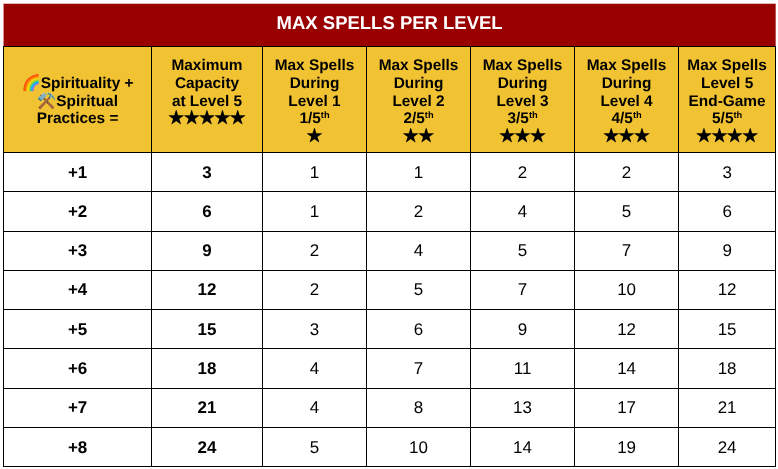
A magical character’s repertoire is determined by 🌈Spirituality PRISM and ⚒Spiritual Practices. At Character Creation, add these two Ratings together. The result is the number of Spells the character begins play knowing.
Starting Spells = 🌈Spirituality PRISM + ⚒Spiritual Practices
A character with 🌈Spirituality PRISM +1 and ⚒Spiritual Practices +2 therefore begins play knowing 3 Spells, while a character with +2 and +2 begins with 4. These starting Spells are selected from the Schools or other categories of magic available through the character’s Class.
The same combined Rating also determines the character’s ultimate Magical Capacity. Multiply the total by 3 to determine the greatest number of conventional Spells the character may eventually know.
Maximum Magical Capacity = (🌈Spirituality PRISM + ⚒Spiritual Practices) × 3
A character who begins with 3 Spells therefore possesses a Maximum Magical Capacity of 9, while a character who begins with 4 possesses a maximum of 12. Maximum Magical Capacity represents potential knowledge rather than Spells automatically granted through advancement. Additional Spells must still be acquired through legitimate 📖Spell Learning Opportunities.
The Game Master is responsible for providing enough appropriate 📖Spell Learning Opportunities that magical characters develop at approximately the intended pace. During ⭐Level 1, the ordinary repertoire benchmark is approximately one-fifth of Maximum Magical Capacity. During ⭐Level 2, approximately two-fifths. During ⭐Level 3, approximately three-fifths. During ⭐Level 4, approximately four-fifths.
By ⭐Level 5, the character should ordinarily possess about four-fifths of Maximum Magical Capacity early in the Level. The remaining fifth belongs to ⭐Level 5 end-game development. The Game Master should normally provide enough appropriate 📖Spell Learning Opportunities for the practitioner to reach full Magical Capacity by approximately the second or third substantial ⭐Level 5 end-game mission.
These fractions are pacing guidelines rather than automatic Spell awards. Reaching another Level never automatically teaches the character additional Spells. Starting Spells are determined separately during Character Creation, and a starting practitioner who already possesses more Spells than an early benchmark would suggest keeps those Spells. Ordinary repertoire growth can simply slow until career progression catches up.
If 🌈Spirituality PRISM or ⚒Spiritual Practices permanently increases, recalculate Maximum Magical Capacity using the new Ratings. The character does not immediately acquire additional Spells simply because more capacity has become available. Later 📖Spell Learning Opportunities allow the repertoire to develop toward the appropriate benchmark for the character’s current ⭐Action Star Level.
Learning Magic
Magicians do not automatically acquire new spells simply because they advance. Knowing how to practice magic and discovering a particular spell are two different things. A Wizard may understand the principles of magic exceptionally well and still need to find someone—or something—capable of teaching a spell they have never encountered. New spells are normally acquired through Spell Learning Opportunities.
A Spell Learning Opportunity is any situation in which a character gains access to previously unknown magical knowledge. A magician might discover a spell recorded in an ancient grimoire, decipher an inscription inside a forgotten temple, receive instruction from another practitioner, recover a scroll from a ruined tower, experience a supernatural vision, earn the teachings of a religious order, or persuade an isolated hermit to reveal a secret known only to their tradition. These opportunities make magical advancement part of the adventure itself.
The Game Master should therefore treat magical knowledge as something that exists within the world rather than as a menu automatically presented to the player. A magician seeking a particular spell may have to discover who knows it, locate that person, earn their cooperation, recover something they demand in exchange, or undertake an expedition to the place where the knowledge was supposedly lost. Another spell may appear unexpectedly among the possessions of a defeated enemy or within a collection of writings the adventurers originally sought for an entirely different reason.
Not every magician can necessarily learn every spell. A character’s Class and magical traditions determine which Schools of Magic are available to them, while The Spellbook identifies the School to which each spell belongs. A character who discovers magic outside their permitted training does not automatically gain the ability to use it merely because they possess the written instructions.
When a legitimate 📖Spell Learning Opportunity provides a magician with access to magic they are capable of learning, the opportunity should reflect something that actually exists within the story: a teacher, grimoire, inscription, revelation, supernatural experience, sacred instruction, martial technique, traditional song, or another believable source of magical knowledge.
When circumstances provide meaningful choice, the Game Master normally presents a constrained selection of 2–4 eligible Spells that the opportunity could reasonably teach. The player chooses which one the character learns. The fiction determines what can actually be offered. A manuscript containing only one Spell teaches that Spell; a teacher who knows only one appropriate working cannot offer four merely because a numerical guideline exists. An extraordinary archive, gathering of masters, initiation, or unusually knowledgeable teacher may justify a broader selection.
The character is never required to learn a Spell merely because it has become available. The player may decline the opportunity. Declining does not consume Maximum Magical Capacity, but the Spell Learning Opportunity itself is not banked. If the teacher leaves, the manuscript is destroyed, the revelation is rejected, the location is abandoned, or circumstances otherwise cause the opportunity to disappear, the player cannot save that opportunity and later exchange it for unrelated magical knowledge.
Once the character chooses an eligible Spell, the character learns it and records it in the 📖Character Bible. The challenge lies in gaining access to magical knowledge through discovery, instruction, bargaining, exploration, revelation, or whatever circumstances created the opportunity.
This also gives magical discoveries value even when the adventurers cannot immediately use them. A recovered grimoire may contain spells none of the current characters can practice but remain valuable to another magician, temple, occult organization, collector, or future Player Character. A captured enemy magician may know something worth bargaining for. A forgotten library can be treasure even when there is not a single coin inside it.
Some spells should be relatively accessible within traditions that commonly practice them. Others may be closely guarded, culturally restricted, forbidden, nearly forgotten, or known only to a handful of practitioners. Particularly extraordinary magic can therefore become the objective of an entire adventure rather than another ability selected between sessions.
The Game Master should provide enough Spell Learning Opportunities for magician characters to develop without making every desired spell immediately available. Players should be able to pursue magical knowledge deliberately, but discovering that knowledge should remain capable of producing journeys, alliances, rivalries, bargains, mysteries, and danger.
In Kingsmark, learning magic is not merely character advancement. It is something worth adventuring for.
🕯Holy Magic and Monotheistic Religions
In Kingsmark, 🕯Holy Magic has a specific meaning. It is the sacred magic associated with Sylva’s three monotheistic traditions: 👁the Covenant, 🔆the Radiant Way, and 🪷the Path of the One. These traditions disagree about many religious matters, but all direct their worship toward one Creator.
Access to 🕯Holy Magic requires both the appropriate religious allegiance and a Character Class or Class tradition that provides access to the School. Religion alone does not grant Holy Magic.
🕯Priests, 🔮Prophets/Prophetesses, and 🛡Holy Knights belong exclusively to these three monotheistic traditions and receive 🕯Holy Magic through their Character Classes. Certain religious forms of other Classes also receive Holy Magic. Covenant, Radiant Way, and Path of the One 🥋Monks possess 🕯Holy Magic when their Monastic Tradition provides it, while 🕯Sacred Healers belonging to those same monotheistic traditions receive Holy Magic through their Healer tradition.
A character belonging to another Class does not gain Holy Magic merely by converting to one of these religions. A Wizard who becomes a sincere follower of the Covenant remains a Wizard and does not acquire 🕯Holy Magic. Likewise, possessing ⚒Spiritual Practices, studying a Holy Spell, owning a sacred text, or finding a willing religious teacher does not by itself create access to the School. The character’s Class and any religious tradition established through that Class must permit it.
A character who abandons the monotheistic allegiance through which 🕯Holy Magic is practiced can no longer cast Holy Spells unless and until the requirements for that sacred relationship are legitimately restored.
This restriction describes the supernatural source and tradition of 🕯Holy Magic rather than the moral worth of characters belonging to other religions. A Witch, Shaman, Wizard, non-monotheistic Monk, non-monotheistic Healer, or another character may be compassionate, righteous, spiritually disciplined, devoted to helping others, or capable of extraordinary supernatural acts without possessing Holy Magic.
The term 🕯Holy Magic therefore identifies a particular sacred supernatural tradition within Sylva. It does not declare every other religion spiritually meaningless, morally inferior, or incapable of producing genuine supernatural practitioners.
The Practice of Magic
Spells can remain in effect for dramatically different lengths of time. Some occur instantaneously, while others last for a specified number of Rounds, minutes, hours, or for the remainder of a 🎬𝗦𝗰𝗲𝗻𝗲. Certain spells may create changes that are effectively permanent. Once successfully cast, a spell remains in effect for the duration given in its description. If a spell requires concentration, permits its duration to be extended, ends under particular conditions, or requires continued effort, those rules appear in the individual spell description.
🚪Summoning
🚪𝗦𝘂𝗺𝗺𝗼𝗻𝗶𝗻𝗴 uses the standard Spellcasting rules. The individual spell determines what can be summoned, how long it remains, what preparation is required, and how much control the magician possesses over what answers. This last distinction can be extremely important. Summoning something does not necessarily mean controlling it.
Some spells may create or command relatively simple supernatural servants. Others contact independent beings possessing their own intelligence, memories, desires, loyalties, and objectives. A magician who calls such an entity into their presence may need to negotiate with it, persuade it, bargain with it, or accept whatever consequences follow from treating it poorly. When a summoning requires a particular invocation, Anchor, Ritual Space, offering, or other condition, that requirement is specified by the spell.
💍Magical Items
Magical items are objects into which supernatural power has been deliberately placed or through which that power can be more effectively directed. They may be created through 💍Enchantment Magic, inherited from earlier practitioners, bestowed by supernatural powers, or discovered among the treasures of people and civilizations long since vanished. For a magician, such an item can be far more important than an ordinary piece of valuable equipment. Magical items may reduce a spell’s Target Number, reduce Mental Drain, assist with a particular spell or School of Magic, provide supernatural protection, contain a magical effect, or possess a limited number of supernatural uses. The item’s description explains exactly what it does.
A staff attuned to the element of fire, for example, might reduce the Target Number of Fire spells by 1. Such an item makes difficult magic substantially more attainable. This becomes particularly important when attempting Power 3 magic at TN 12. Magical items should consequently feel significant when discovered. A magician who finds an object capable of making a particular form of magic easier has acquired something that can change what they are willing to attempt. An item that reduces Mental Drain may allow dangerous magic to be performed with considerably less risk. A relic protecting against Darkness may become invaluable when the adventurers discover what waits beneath a corrupted temple.
💍Magical items remain uncommon because 💍Enchantment Magic establishes meaningful limitations upon what can be created and how readily it can be done. Enchanted weapons, staffs, relics, protective objects, and other supernatural treasures therefore remain significant discoveries rather than ordinary merchandise.
Because Greater and Supreme magic can inflict severe Mental Drain, experienced magicians often become intensely interested in magical equipment. A staff that assists one School of Magic, a ring that reduces Mental Drain, a relic that strengthens supernatural Defense, or an implement attuned to one particular spell may mean the difference between attempting a miracle confidently and deciding that the risk is unacceptable.
Such items are therefore not merely bonuses. For a magician, acquiring the right magical equipment can fundamentally change which miracles they are willing to attempt.
⭕Ritual Spaces
A ⭕Ritual Space is more than somewhere convenient to stand while casting a spell. Some are deliberately prepared by magicians for a particular working, while others are places whose history, purpose, construction, or supernatural significance makes them valuable for magical practice.
A Ritual Space might be a consecrated shrine, ancient stone circle, sacred spring, temple chamber, crypt, astronomical chamber, woodland sanctuary, marked floor, or another place prepared according to a magical tradition. Some are temporary and exist only long enough to perform a particular working. Others may have endured for centuries.
The individual spell determines when a Ritual Space is required and what preparation is necessary. Some magical items may also function as portable Ritual Spaces when their descriptions specifically permit it.
Permanent Ritual Spaces can become important locations within an adventure. A magician may discover an abandoned shrine and attempt to restore it. Adventurers may need to cleanse a place corrupted by the Gloom, reconsecrate a desecrated sanctuary, protect a sacred site from enemies, or destroy a Ritual Space being used for hostile magic.
Control of such places can therefore matter for reasons extending far beyond a single Spellcasting Test. A Ritual Space may attract magicians, spirits, pilgrims, cults, monsters, treasure hunters, or factions that consider the location sacred. Its discovery may reveal forgotten history or provide access to magic that would otherwise be difficult or impossible to perform.
Like Spell Learning Opportunities and magical items, Ritual Spaces turn magic into something that can be found, pursued, protected, stolen, corrupted, restored, and fought over. Magic is therefore not confined to the abilities written in a magician’s 📖Character Bible. It exists throughout the world, giving adventurers additional reasons to explore it.
Performing Casting Methods
Casting Methods are meant to be performed. A magician cannot technically satisfy a Casting Method by reducing it to an action so small, quiet, or inconspicuous that it has effectively disappeared. If the magician wants the benefit of using a traditional Casting Method, that method must be genuinely expressed. If circumstances make that dangerous, the magician may instead omit an optional listed Casting Method and apply its normal penalty: +1 TN for 🗣Spoken Words, 👐Gestures, or 🪄Props or Ingredients, and +3 TN for ⭕Ritual Space.
👐 Gestures
Magical Gestures are deliberate and recognizably unusual movements. They are not ordinary conversational or social gestures such as pointing at someone, waving hello, beckoning someone closer, shrugging, nodding, or casually moving a finger.
An ordinary observer who clearly sees a magical Gesture should recognize that the magician is deliberately performing something unusual. Depending upon the magician’s tradition, the movement might resemble a prayer, a blessing, ceremonial sign language, ritual movement, a spiritual practice, a martial form, or even a strange dance. The observer does not necessarily know that magic is being performed, but should have no difficulty recognizing that the movement is intentional and unusual.
A character with appropriate knowledge of magic or occult practices may be able to recognize such Gestures for what they are, subject to whatever Skill Test the Game Master considers appropriate.
The exact Gestures are left to the player and the magician’s tradition. One magician might trace elaborate symbols through the air. Another might perform a sequence of ritual hand signs. Another might move the arms and body in a manner resembling ceremonial dance. What matters is that the Gesture is substantial enough to be recognizable as an unusual deliberate act.
Wiggling a concealed finger, twitching a hand inside a sleeve, or making some similarly trivial movement does not satisfy 👐 Gestures.
The emotional character of the Gesture should also suit the working. An aggressive spell cast during combat calls for forceful, unmistakable movement. A compassionate healing, blessing, or love working may employ gentler movements appropriate to the intimacy of the Scene. Gentle does not mean imperceptible. Someone watching the magician should still be able to tell that something deliberate is being performed.
If the magician cannot or does not wish to perform such a Gesture, the magician may omit 👐Gestures for +1 TN.
🗣 Spoken Words
Spoken Words must ordinarily be spoken at a normal conversational volume or louder. Whispering merely to prevent nearby people from hearing the invocation does not satisfy 🗣 Spoken Words unless the spell or the nature of its working specifically makes whispered speech appropriate.
The manner of speech should reflect the character of the magic being performed. A compassionate working may be intimate. A healer might quietly reassure a wounded person while invoking a healing miracle. A magician performing a spell of love, mercy, comfort, prayer, or similar gentle magic may speak softly or whisper when doing so is appropriate to the Scene.
Aggressive magic is different. When a magician uses an offensive spell during combat, the Spoken Words must carry the aggression and force of the magician’s intent. The magician is literally attempting to make the target hear the invocation above the din of combat.
The louder and more chaotic the Scene, the louder the magician must speak. In a relatively quiet confrontation, this might mean a forceful, commanding voice considerably stronger than ordinary conversation. During a noisy tavern brawl, the magician may have to shout the invocation at or toward the target as though attempting to intimidate the target through the volume and aggression of the words. Amid screaming warriors, clashing weapons, charging horses, or similar battlefield noise, the magician must project the invocation with enough force that the intended target could reasonably hear it through the surrounding commotion.
Words may be shouted, chanted, intoned, cried aloud, or deliberately vibrated according to the magician’s tradition. The exact performance may differ, but the intent remains the same: when using aggressive magic during combat, the magician attempts to be heard by the target above the surrounding noise.
The target does not actually have to hear or understand the Spoken Words for the spell to function. Distance, deafness, intervening barriers, overwhelming noise, or other circumstances may prevent that. What matters is that the magician genuinely projects the invocation as though attempting to make the target hear it.
The magician therefore cannot hurl destructive magic across a battlefield while whispering, muttering under his breath, silently mouthing the words, or speaking quietly enough to avoid attracting attention. If the magician wants to conceal the invocation, the magician may omit 🗣Spoken Words for +1 TN.
The Game Master does not need to measure volume precisely. The question is practical and cinematic: is the magician genuinely attempting to make the target hear the invocation over whatever noise surrounds them?
🪄 Props & Ingredients
When a spell uses a Prop or Ingredient, the magician must meaningfully employ it as part of casting the spell. Merely possessing an appropriate object somewhere on the magician’s body does not satisfy 🪄 Props & Ingredients.
A magician carrying a staff might raise, point, strike, plant, or otherwise deliberately wield it as part of the working. A ritual blade might be displayed or moved ceremonially. Powder might be cast into the air. Herbs might be crushed, scattered, burned, or held aloft. A holy symbol might be raised or presented. The particular practice depends upon the magician and the spell.
Unless the spell specifically describes a concealed use, the Prop or Ingredient is visibly and deliberately employed. An observer who can clearly see the magician should be capable of recognizing that the object or substance is being used for some deliberate ceremonial, spiritual, occult, or otherwise unusual purpose.
Simply having a staff in one hand, wearing a medallion, carrying a ritual blade, or possessing an Ingredient in a pocket does not count. The magician must make a genuine display of its use.
As with Gestures, an ordinary observer does not automatically know that the object is being used to perform magic. Someone knowledgeable about magic or occult practices may be able to recognize its significance.
If the magician cannot or does not wish to display and employ a listed 🪄Prop or Ingredient, the magician may omit that Casting Method for +1 TN. If the individual Spell explicitly identifies the Prop, Ingredient, or another object as Required, it cannot be omitted.
Seeing a Casting Method Is Not the Same as Recognizing Magic
Casting Methods are conspicuous enough to be observed, but that does not mean every witness immediately understands them.
A farmer might see a Witch trace strange shapes through the air and wonder whether she is praying. A soldier might see a Wizard raise a staff, speak unfamiliar words, and assume that some ceremony is taking place. Someone familiar with magical practice may recognize exactly what is happening.
The Game Master should distinguish between three things: noticing the Casting Method, understanding that the behavior is unusual or ritualistic, and correctly recognizing it as magic.
No Test is normally necessary to notice an openly performed Casting Method when the witness is watching the magician and nothing prevents them from seeing or hearing it. A Test becomes appropriate when circumstances interfere with observation, or when a character attempts to determine what the unusual behavior actually means.
The individual spell always takes precedence. If a spell specifically states that its words are whispered, its Gesture is concealed, an Ingredient is secretly placed, or another Casting Method operates differently from these general rules, follow the spell.
🎬Example — Casting Without the Traditional Methods
A Power 2 manifestation normally has TN 10 and lists 🗣👐🪄 as its Casting Methods. The magician is bound and attempting to remain silent, but still possesses the appropriate Prop. Omitting 🗣Spoken Words adds +1 TN and omitting 👐Gestures adds another +1, producing a final TN of 12 before any other modifiers. If the magician also lacked the Prop and attempted the same working entirely through 🧠Mind Alone, the three omitted methods would add +3 TN, producing TN 13. If the manifestation also listed an optional ⭕Ritual Space and the magician attempted it without one, the additional +3 would bring the total Casting Method penalty to +6. Any element explicitly marked Required could not be omitted at all.
The Astral Plane
The physical world is not the only aspect of reality. Overlapping it is the Astral Plane, an unseen spiritual dimension in which supernatural forces, spiritual beings, magical influences, and the hidden aspects of living souls can be perceived and encountered directly.
The 𝗔𝘀𝘁𝗿𝗮𝗹 𝗣𝗹𝗮𝗻𝗲 exists alongside and overlaps the physical world as its unseen spiritual dimension. Every living person possesses a spiritual existence whether they are capable of perceiving it or not, and places touched by powerful emotions, magic, Tranquility, or the 🪱𝗚𝗹𝗼𝗼𝗺 may possess an Astral character very different from their ordinary physical appearance.
Most people experience none of this consciously. A person may walk through a spiritually disturbed location and feel only unexplained anxiety. Someone entering a sacred place might experience unusual peace without perceiving anything supernatural. A magician capable of Astral perception can look beyond these impressions and perceive something of the spiritual reality producing them.
Entering the Astral
Characters perceive or enter the Astral Plane through appropriate spells, supernatural abilities, magical items, or other effects that specifically grant Astral access.
The Astral Travel / Perception spell provides the principal means by which magicians deliberately explore the Astral. Its four Power Levels represent progressively deeper contact with the Astral Plane.
At Power 0, the magician’s awareness briefly overlaps both worlds, allowing supernatural phenomena normally hidden from ordinary perception to become visible. At Power 1, the magician projects awareness through the 🦖Animus while remaining partially conscious of the physical body. The 🦖Animus can move away from the magician and pass through ordinary physical obstructions, but the divided attention makes the magician less capable of responding to events around the body. At Power 2, the Ruach completely separates from the body and manifests through the 🦖Animus. The physical body becomes unconscious and helpless while the magician travels freely through Astral Space. At Power 3, the magician can lead willing companions into the Astral Plane as a coordinated expedition. The complete capabilities, ranges, requirements, and dangers of these effects are described with the spell in The Spellbook.
Exploring Astral Space
Astral travel follows the strange logic of the spiritual world. Physical distance and physical barriers become considerably less important once the magician has fully entered Astral Space. Walls, doors, floors, darkness, and many other mundane obstacles possess little meaning to a projected spirit.
Astral movement is therefore handled cinematically rather than by calculating ordinary walking speeds. Nearby movement can occur with extraordinary speed, while journeys to spiritually distant locations may follow associations, memories, supernatural pathways, spiritual signatures, or other relationships that do not correspond neatly to physical geography. The Game Master describes such travel according to the supernatural landscape and the purpose of the journey rather than converting it into miles per hour.
The Astral Plane is not empty. Projected magicians may encounter other travelers, Animus forms, supernatural entities, spiritual traces, manifestations of the Gloom, active enchantments, wards, and other phenomena invisible from the physical world. Certain locations may appear radically different when perceived Astrally because the spiritual history of the place has become part of its landscape.
Astral exploration can therefore reveal things that physical investigation cannot. It may expose a hidden supernatural influence, allow a magician to follow a spiritual signature, reveal the presence of an entity, or provide a route through circumstances that cannot be approached conventionally.
It can also reveal the magician to things that were previously unaware of them.
Astral Conflict
Beings capable of acting within the Astral Plane can fight there. When an Astral spell, creature attack, or supernatural ability permits one being to attack another directly through spiritual force, the attacker rolls: 𝟭𝗱𝟭𝟮 + 𝗦𝗽𝗶𝗿𝗶𝘁𝘂𝗮𝗹𝗶𝘁𝘆 𝗣𝗥𝗜𝗦𝗠 + 𝗦𝗽𝗶𝗿𝗶𝘁𝘂𝗮𝗹 𝗣𝗿𝗮𝗰𝘁𝗶𝗰𝗲𝘀
The attacker’s Hand becomes the Target Number the defender must equal or exceed to resist the attack. The spell, creature, or ability being used determines the Base Damage Level and Type of Damage. Purely Astral attacks ordinarily threaten 🧠Mental Trauma or another supernatural Type of Damage rather than ordinary 🩸Physical Wounds, and physical armor applies only when it logically protects against the specified Damage Type. Particular creatures, spells, or supernatural abilities may inflict ✨Arcane, 🌑Darkness, ☀️Light, or another form of damage when specifically stated.
Defeat in Astral Combat does not annihilate the Spirit. Astral effects capable of severing the Ruach from the physical body state that consequence specifically and are resolved according to the 💀𝗗𝗲𝗮𝘁𝗵, 𝗗𝗶𝘀𝘀𝗼𝗹𝘂𝘁𝗶𝗼𝗻, 𝗮𝗻𝗱 𝗥.𝗔.𝗗. rules. A Spirit severed from its living body subsequently passes into the dormancy associated with death rather than being erased from existence.
Between the Two Worlds
As a general rule, Astral beings interact with Astral beings, while physical beings interact with the physical world. Crossing that boundary requires a spell, creature ability, magical item, or supernatural effect that specifically permits interaction between the Astral and Material worlds. This is why spells such as Animus Force and Phase / Intangible are significant. They deliberately allow the spiritual and physical aspects of reality to influence one another in ways that ordinary Astral projection does not. Other spells may reveal, summon, track, repel, or otherwise interact with beings across the boundary according to their descriptions.
Magical barriers may likewise possess both physical and Astral significance. A stone wall might mean nothing to a projected magician, while a consecrated threshold, supernatural ward, corrupted boundary, or other magical defense may remain completely impassable.
The Vulnerable Body
Complete Astral projection leaves the magician’s physical body unconscious and defenseless. Choosing where to leave that body is consequently an important part of Astral exploration.
A magician might secure a room, conceal the body, entrust it to companions, establish a protected Ritual Space, or otherwise prepare before leaving it behind. An Astral expedition may therefore create danger in both worlds simultaneously. While the magician confronts something within the Astral Plane, companions remaining behind may have to protect the bodies of the travelers.
This is part of what makes Astral exploration useful without making it safe. The Astral Plane provides access to information, places, entities, and possibilities unavailable through ordinary exploration, but entering it means exposing the magician to an unseen world while potentially leaving their physical existence vulnerable in the one they left behind.
The Astral Plane is the 𝗵𝗶𝗱𝗱𝗲𝗻 𝘀𝗽𝗶𝗿𝗶𝘁𝘂𝗮𝗹 𝗱𝗶𝗺𝗲𝗻𝘀𝗶𝗼𝗻 𝗼𝗳 𝘁𝗵𝗲 𝘄𝗼𝗿𝗹𝗱 𝘁𝗵𝗲 𝗮𝗱𝘃𝗲𝗻𝘁𝘂𝗿𝗲𝗿𝘀 𝗮𝗹𝗿𝗲𝗮𝗱𝘆 𝗶𝗻𝗵𝗮𝗯𝗶𝘁—another way of exploring Sylva, discovering what is concealed within it, and confronting things that ordinarily remain unseen.
Witnessing Miracles
The people of Sylva live in a world containing monsters, ancient curses, strange creatures, religious traditions, superstition, and stories of supernatural events. This does not mean that the average person expects to encounter a magician performing obvious miracles. Believing in monsters is not the same as believing in magic. A farmer may accept that terrible creatures inhabit a distant forest because people have disappeared there for generations. A soldier may believe stories about something unnatural living beneath an abandoned fortress. Neither person necessarily believes that another human being can raise a hand and command fire, leave their body, place a curse upon an enemy, or perform some other deliberate violation of ordinary reality. Consequently, witnessing magic can be profoundly unsettling.
The Power Level of a spell provides the Game Master with a useful indication of how difficult its manifestation is to dismiss.
Power 0 Coincidental magic is usually subtle. A flame flickers strangely, an object moves slightly, someone experiences an inexplicable sensation, or an unlikely coincidence occurs at precisely the right moment. A witness may notice something peculiar without concluding that magic was responsible.
Power 1 Lesser miracles are more difficult to dismiss. A witness may suspect sorcery, divine intervention, trickery, or some other supernatural explanation, particularly if they already know what to look for. Doubt remains possible, but suspicion has been created.
Power 2 Greater magic seriously challenges ordinary explanations. Witnesses have seen something extraordinary and may struggle to reconcile the experience with what they previously believed. Fear, fascination, religious interpretation, accusations of witchcraft, or desperate attempts to find another explanation are all reasonable reactions.
Power 3 Supreme magical workings are miracles in the fullest sense. Such manifestations can be spectacular, terrifying, beautiful, or horrifying, but they are extraordinarily difficult for direct witnesses to forget or rationalize. Someone who watches a magician perform Supreme magic may remember the event for the remainder of their life.
Witness reactions depend upon the individual, the culture, the circumstances, and the nature of the miracle. A Priest witnessing an apparent miracle may interpret it very differently from a frightened peasant, an educated skeptic, a pagan mystic, or someone who has encountered magic before. The Game Master should portray those differences according to the people involved. Witnesses can also 𝘁𝗮𝗹𝗸. A miracle performed before several people may become a rumor before the adventurers reach the next village. Stories can spread, become exaggerated, attract frightened authorities, inspire pilgrims, provoke religious controversy, or draw the interest of people who understand exactly what the witnesses saw. A magician who repeatedly displays supernatural power in public may eventually acquire a reputation they never intended to create. This is one reason secrecy has always surrounded magical practice. A magician need not fail for magic to create consequences. Sometimes, being seen succeeding is dangerous enough.
✨ Magic Available to Everyone
Most magic in Kingsmark is learned through Character Classes and their available Schools of Magic. A small number of Spells and individual manifestations are exceptions: they are available to every character, including characters who do not otherwise possess access to the School in which the Spell appears.
🙏Prayer is available to every character. Prayer burns 🕊Favor to request providential intervention and requires no Spellcasting Test. The complete rules for 🙏Prayer appear in the 🕊Favor section of this book.
🙏Prayer of Oneness is a Power 1 Spell that may be cast by any character. It allows a character to transfer their own 🕊Favor to another person. The complete rules for 🙏Prayer of Oneness appear in the 🕊Favor section of this book.
🍎Respond to the Gloom may be performed by any character. It requires no Spellcasting Test and represents deliberately opening oneself to corrupt supernatural influence. The complete Spell appears in Chapter 16, 🪱The Gloom.
🍎Soul Offering may be performed by any character who has first fulfilled its prerequisites through 🍎Respond to the Gloom. It requires no Spellcasting Test and represents the character’s deliberate entry into a Gloom Pact. The complete Spell appears in Chapter 16, 🪱The Gloom.
Two additional Spells are reproduced here because their Power 0 Coincidental manifestations may be cast by any character. Their higher-Power manifestations remain ordinary Spells and do not become universally available merely because their Coincidental manifestations are universal.
📖 Bedtime Stories
Universal Manifestation: 0️⃣ Coincidental Bedtime Stories may be cast by any character.
0️⃣ Coincidental Bedtime Stories — 🗣️ Miracle: 058 ❤️🩹Healing Magic
Coincidental Bedtime Stories can be cast by anyone, even if the character does not otherwise know the Spell or possess access to ❤️🩹Healing Magic. As a specific exception to ordinary Coincidental Spellcasting, it requires no Spellcasting Test. A soothing story, memory, rhyme, or gentle conversation eases immediate emotional tension. A nearby willing creature may become calm enough to listen, rest, or attempt sleep normally; a frightened child might stop crying or someone awakened by a nightmare settle back down. This does not remove Mental Trauma or suppress fear mechanically. Skeptics attribute the effect to an assuring voice and a good story.
1️⃣ Lesser Bedtime Stories — 🗣️ Miracle: 059 ❤️🩹Healing Magic
For 1d12 minutes, one willing creature who can hear you gains -1 Advantage on tests to resist fear, panic, nightmares, despair, or emotional distress and on tests where peaceful rest or sleep directly aids recovery. Immediate danger still prevents ordinary restful sleep.
2️⃣ Greater Bedtime Stories — 🗣️👐 Miracle: 060 ❤️🩹Healing Magic
For 2d12 minutes, willing listeners are drawn into a deeply calming narrative atmosphere. They gain -2 Advantage on tests to resist fear, nightmares, despair, emotional exhaustion, or panic, and heal 🧠Shaken Mental Trauma caused by those sources when the Miracle manifests.
3️⃣ Supreme Bedtime Stories — 🗣️👐🪄 Miracle: 061 ❤️🩹Healing Magic
For the 🎬Scene, willing listeners become enveloped by the emotional world of an extraordinary story—traditionally an epic romantic adventure involving a princess, her lantern, and her swashbuckling true love. The surroundings seem warmer, safer, and strangely distant from outside horrors. Listeners gain -3 Advantage on sleep, emotional recovery, and resistance against nightmares, despair, panic, or hopelessness, and may heal 🧠Shaken or 🧠Impaired Mental Trauma caused by fear, grief, nightmares, loneliness, or emotional exhaustion. Hostile supernatural effects attempting to induce nightmares, despair, panic, or hopelessness in a willing listener suffer +3 Disadvantage while the story continues.
❤️ Love the Unlovable
Universal Manifestation: 0️⃣ Coincidental Love the Unlovable may be cast by any character.
0️⃣ Coincidental Love the Unlovable — Miracle: 090 ❤️Love Magic
Coincidental Love the Unlovable can be cast by anyone, even if the character does not otherwise know the Spell or possess access to ❤️Love Magic. As a specific exception to ordinary Coincidental Spellcasting, it requires no Spellcasting Test. You sincerely recognize the worth of a creature others instinctively fear, despise, or reject. A terrifying 🐺Animal, grotesque creature, Gloom-corrupted being, or hated outcast may hesitate, tolerate your presence, or become emotionally exposed when met without disgust or cruelty. This imposes no numerical penalty or forced peace but may create an opportunity to speak, approach, offer aid, or avoid escalation. Skeptics attribute the reaction to calm body language, courage, empathy, or unexpected kindness.
1️⃣ Lesser Love the Unlovable — 🗣️ Miracle: 091 ❤️Love Magic
For the 🎬Scene, you direct sincere compassion toward one creature you can perceive. If its hostility toward you is fueled by hatred, despair, cruelty, predatory malice, or 🪱Gloom corruption, its hostile actions against you suffer +1 Disadvantage. The first time it attempts to terrify, emotionally dominate, psychologically torment, or corrupt you, it suffers 🩸Minor Physical Trauma from ✨Arcane/Psychic force. It also gains -1 Advantage on tests to resist its own destructive impulses or break free from influences driving them.
2️⃣ Greater Love the Unlovable — 🗣️👐 Miracle: 092 ❤️Love Magic
For the 🎬Scene, your compassion shelters nearby willing allies as well as yourself from one creature you sincerely refuse to hate. Fear, intimidation, disgust, terror, and supernatural horror originating from it suffer +2 Disadvantage against those protected. The first time each ▶️Round it deliberately commits cruelty, psychological torment, predatory violence, or corrupt emotional domination in your presence, it suffers 🩸Moderate Physical Trauma from ✨Arcane/Psychic force. The Miracle reacts to deliberate cruelty, not ugliness, disease, undeath, or monstrosity. If you become consumed by hatred, mockery, contempt, or disgust toward the target, the Miracle ends.
3️⃣ Supreme Love the Unlovable — 🗣️👐 Miracle: 093 ❤️Love Magic
You open your Nephesh without hatred to a creature of profound horror, corruption, despair, or spiritual ruin. For the 🎬Scene, it gains no benefit from fear immunity, intimidation, horror effects, despair auras, or 🪱Gloom-fed emotional domination against you or willing allies sheltered by your compassion. The first time each ⏸Turn it willingly attacks you, tortures another creature, spreads despair, attempts corruption, or deliberately inflicts suffering, it suffers 🩸Severe Physical Trauma from ✨Arcane/Psychic force that ignores conventional armor. Buried loneliness, memories, hatred, or grief may surface as the creature confronts being loved despite what it has become. When the Miracle ends, you suffer 🧠Broken Mental Trauma from sharing its suffering; immediate prayer, companionship, emotional restoration, or profound loving support may reduce this to 🧠Unstable.
These are specific exceptions to ordinary magical access. Universal access to a Spell or manifestation does not grant access to the School of Magic in which that Spell is classified, nor does it grant access to the Spell’s other manifestations unless the rules specifically say so. All of these Spells should still be portrayed as events occurring within the 🎬Scene rather than merely as the activation of game mechanics.
🎬 Example — The Price of a Miracle
The bridge at Veyra is collapsing. Below it, black water churns through the gorge. On the far side, a wounded child lies trapped beneath broken masonry while three Gloom-corrupted soldiers close in. Elian, a ⭐Level 3 Wizard, knows the 🔥Fire Spell and could attack safely with a lesser manifestation—but there is no time. He chooses Power 3.
The Supreme manifestation has TN 12. Elian normally performs this working with 🗣Spoken Words, 👐Gestures, and 🪄a Prop. His staff was lost when the bridge buckled, so he omits the Prop for +1 TN, raising the final Target Number to 13.
Elian shouts the invocation over the roaring water and sweeps both hands toward the far end of the bridge. His Spellcasting Test is: 1d12 + 🌈Spirituality PRISM + ⚒Spiritual Practices
After all modifiers, Elian achieves a Hand of 15.
The Spell succeeds by 2. Because it is damaging magic, its listed 🩸Severe Damage increases by two levels before protection. Damage cannot exceed 💀Critical, and Elian’s result has also exceeded the spell’s 💀Critical Threshold of 12, so the soldiers are struck by 💀Critical 🔥Fire Damage unless they successfully resist. Each eligible target makes a supernatural Defense Test against Elian’s Hand of 15, not TN 13. One soldier succeeds and escapes the manifestation entirely. The other two fail. Their ordinary Spirituality provides no armor against physically real flame; only protection applicable to 🔥Fire Damage can reduce it. Then comes the cost.
Power 3 threatens 💀Broken Mental Trauma. Because Elian reached the final TN, Drain falls one level to 🧠Unstable. His two additional points of success reduce it again—first to 🧠Impaired, then to 🧠Shaken. Elian survives the miracle shaken but functional.
The child lives. So do the witnesses.
Farmers on the hillside saw a man command a wall of fire across a collapsing bridge. By nightfall, people will already be arguing about what they witnessed.
Worse, the spell was cast in an Ordinary 0 Domain. The Supreme manifestation has 👁Drawn the Enemy’s Eye. Nothing attacks immediately. But somewhere beneath the ruined monastery upriver, something that understands exactly what happened begins moving toward Veyra.