
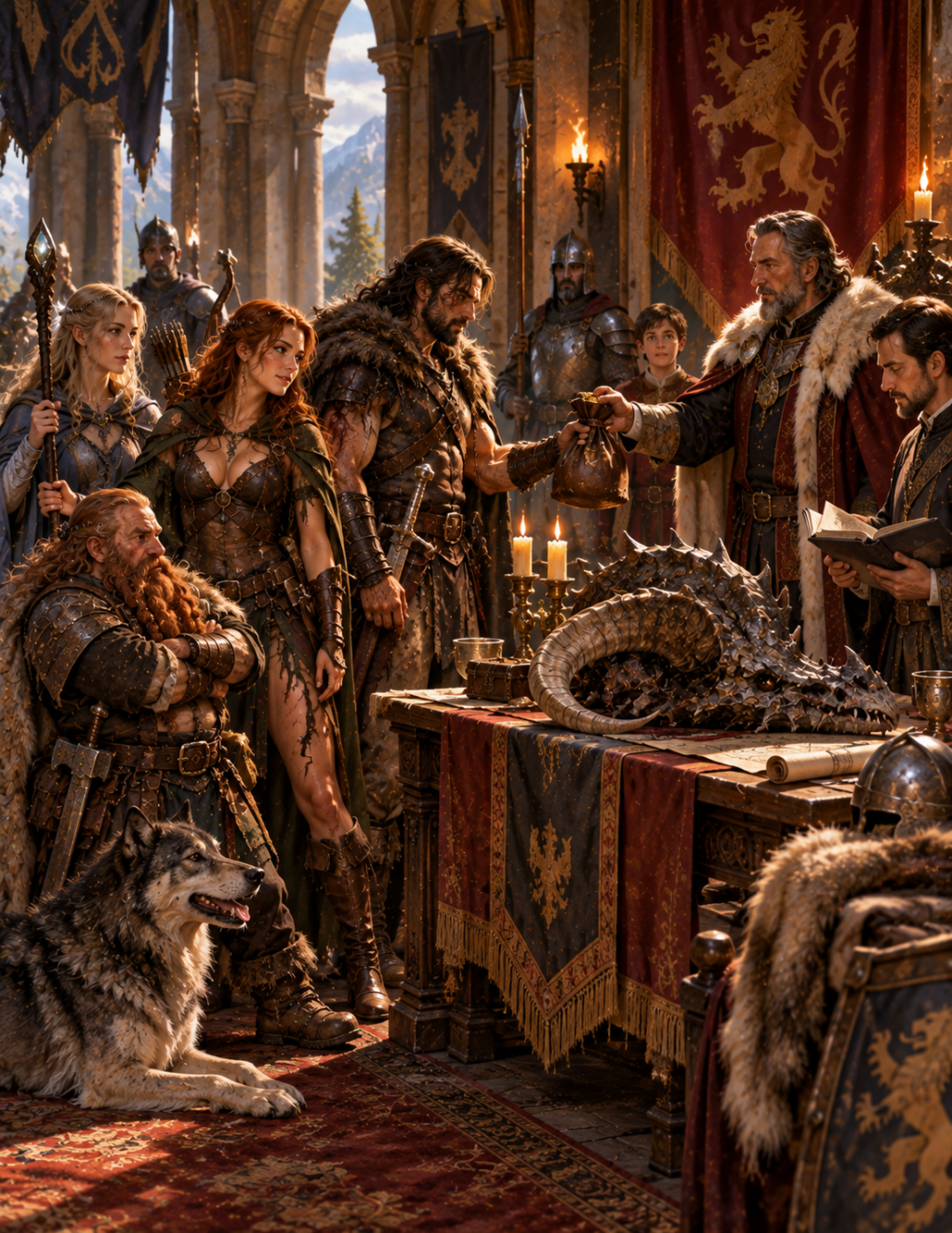
Character growth is measured by accomplishments. During each game session player characters can earn ⭐Experience Points (XP), representing what they have learned through actual adventuring: confronting danger, solving problems, practicing abilities under pressure, making mistakes, and accomplishing meaningful objectives. XP measures earned experience, not the passage of time. A character might earn several XP during a month of intense adventuring and then spend half a year recovering, traveling, studying, working, or training before the next mission. Likewise, two characters with the same amount of XP may have accumulated it across very different periods of their lives. Players invest XP to improve Skills and Attributes. The amount of XP a character has invested also determines his ⭐Action Star Level, representing the broader development of his adventuring career. Action Star Levels are explained in the following chapter.
🎬Earning Experience Points
Experience Points measure the adventures, hardships, discoveries, and victories that gradually transform an inexperienced character into an ⭐Action Star. The system is deliberately simple. At the end of every substantial 3–4 hour game session, each participating character normally earns: ⭐ 1 XP
The Game Master does not need to calculate XP for individual monsters defeated, treasure recovered, clever ideas, successful Tests, or scenes completed. Characters gain experience by actually adventuring. In addition, completing an especially meaningful Mission awards: ⭐⭐⭐ 3 XP
A Mission is more than an ordinary objective or encounter. It represents a major accomplishment in the character’s story: rescuing the missing villagers the party has pursued for weeks, defeating the enemy responsible for a regional crisis, recovering the relic around which an entire adventure has revolved, surviving the expedition into the forbidden ruins, or otherwise reaching an important climax. These 3 XP are awarded in addition to the normal 1 XP earned for the game session in which the Mission is completed.
A typical character should complete about five such Missions during their adventuring career—roughly one major climax for each ⭐Action Star Level. The character’s first true Mission is especially important because its completion marks the transition from ⭐Level 0 to ⭐Level 1. With Kingsmark’s 50 XP lifetime limit, five major Mission awards provide 15 XP, while the remaining XP comes from ordinary play. A party playing one 3–4 hour session each week will therefore normally reach ⭐Level 5 after roughly 35 sessions, or about eight to nine months of weekly play. Reaching ⭐Level 5 does not mean the story must end immediately. A group might play another 4–8 end-game sessions, allowing their veteran characters to confront final enemies, settle unfinished business, enjoy the consequences of their achievements, and complete the last chapter of their careers before the players begin again with new ⭐Level 0 characters. As a general guide:
- 3–4 hour game session: 1 XP
- Major Mission completed: +3 XP (about five major Missions during a character career)
- Approximately 35 sessions to reach ⭐Level 5
- Approximately 39–43 sessions for a complete campaign including the Level 5 endgame
These numbers are guidelines rather than rigid scheduling requirements. Some campaigns will move faster or slower, but the intended rhythm is simple: characters gain XP by playing, and major victories accelerate their rise.
⭐ When XP Is Awarded
XP is awarded for accomplishment, not for killing enemies. A party might earn XP by rescuing prisoners without fighting anyone, discovering what happened to a missing expedition, negotiating a peace, stealing an important document, mapping an unexplored region, surviving a dangerous journey, escorting travelers safely through hostile territory, recovering a lost artifact, or defeating a monster.
What matters is that the characters accomplished something meaningful through play.
For a short adventure, XP is normally awarded when the mission is completed. During a longer adventure, the Game Master may award XP whenever the party reaches a significant milestone rather than postponing all advancement until the campaign is finished.
A failed mission does not automatically mean that nothing was learned, but XP is principally a reward for meaningful accomplishment. The Game Master decides whether a partial success, important discovery, or other achievement during an unsuccessful mission warrants XP of its own.
📈 Investing Experience Points
XP does nothing while it remains uninvested. A player develops his character by investing XP into Skills and Attributes.
⚒️ Skills
Each 1 XP invested in a Skill increases that Skill by +1, subject to its normal maximum. For example, a character with Swimming 2 could invest 1 XP to increase it to Swimming 3. A player may also invest XP in a Skill that his character did not previously possess, provided the improvement is believable within the character’s experiences and training.
💪 Attributes
Each 2 XP invested in an Attribute increases that Attribute by +1, up to the maximum permitted by the character’s humanoid type. For example, increasing Dexterity from 0 to +1 costs 2 XP. Characters already begin their careers with 10 Attribute Points and 12 Skill Points invested during character creation. XP represents the additional development that occurs through the character’s adventuring career. Over that career, no more than 24 of the 50 available XP may be invested in Attributes. Any XP not invested in Attributes may be invested in Skills or new Skills. This preserves meaningful specialization while preventing Attributes from simply absorbing every point of advancement.
📝 The XP Log
Players should keep a simple record of the XP their characters earn and where those points are invested. This makes advancement easy for both the player and Game Master to verify and preserves a small history of the character’s development. For example:
3 XP — Completed the Blackwood Contract. Invested 2 XP to increase Dexterity from 0 to +1 and 1 XP to increase Swimming from 2 to 3.
The log need not be elaborate. It only needs to show where the XP came from and where it went.
🛑 The 50 XP Lifetime Limit
A character may receive a maximum of 50 XP during his entire adventuring career. Once the Game Master has awarded that character his fiftieth XP, he can never earn another XP. This is a deliberate limit. Without a ceiling, a sufficiently long-lived character could continue increasing his numbers until ordinary uncertainty gradually disappeared. Skills could become so reliable that meaningful tests ceased to be tests, while Attributes could continue separating veteran characters from the physical scale upon which the rest of the world operates.
⏳ Time & Training
XP represents what a character has earned through experience, but investing XP does not mean that knowledge or ability magically appears. The character’s development should make sense within his life. Some improvements require little explanation. A Ranger who has spent several adventures swimming rivers, climbing cliffs, and traveling through wilderness might reasonably increase those Skills as a natural consequence of repeatedly using them. A player might also invest XP in an ability that the character could plausibly have possessed all along but that had simply never become important during play.
Other improvements require more time and explanation. A character cannot spend yesterday fighting a troll, invest several XP in Medicine the following morning, and suddenly possess years of medical knowledge. He might instead study under a physician, assist with the treatment of wounded soldiers, undertake an apprenticeship, read medical works, or spend months practicing what he has learned. The greater the improvement, the more substantial its explanation should normally be. This does not require another advancement system. There are no Training Points to earn, nor does every Skill require a predetermined number of weeks before it can increase. Training is part of the character’s story. The Game Master simply determines whether an improvement is believable now or whether some amount of training, practice, study, or experience should occur first.
XP makes an improvement mechanically possible. The character’s life must make it believable.
🪖 Training, Experience & Mastery
Real professions demonstrate why training and experience should not be treated as the same thing. A modern U.S. Army infantry soldier undergoes approximately 22 weeks of initial infantry training before joining the operational Army. More specialized military professions can require substantially longer preparation. The training pipeline for a new U.S. Army Special Forces candidate, for example, can extend well beyond a year before he becomes a qualified Green Beret—and qualification is still the beginning of an operational career rather than its culmination. The same distinction existed long before modern military schools. Medieval warriors who were raised for knighthood could spend years learning riding, weapons, physical skills, military customs, and service before becoming knights, after which actual campaigns and years of professional experience continued their development.
Miyamoto Musashi provides an unusually revealing example of the difference between success and mastery. In his own later account, Musashi claimed more than sixty undefeated contests by his late twenties. Yet he explicitly wrote that he did not regard those victories as proof that he had already mastered strategy. His understanding continued developing long afterward. The lesson for character advancement is straightforward:
Training creates capability. Experience tests it. Mastery develops through both.
XP represents part of that process, but the Game Master should allow the character’s actual life to supply the rest.
📅 Advancing Time
An adventuring campaign does not need to portray every day of a character’s life. After completing a mission, the next adventure might begin the following morning—or the following year.
The Game Master may Advance Time whenever a period between important adventures does not need to be played moment by moment. Several weeks might pass while a wounded character recovers. Winter might pass before mountain roads become usable again. A Wizard might invest six months into studying. A warrior might train with a military order. A party might separate after one adventure and reunite two years later when another contract draws its members back together.
During these periods, characters can train, study, practice professions, earn ordinary livelihoods, travel, recover from injuries, maintain relationships, pursue personal interests, conduct research, or simply live portions of their lives that do not need to occupy a gaming session.
Advancing Time is particularly important for believable character development. Twenty-five gaming sessions do not have to represent twenty-five consecutive days—or even twenty-five consecutive weeks—in Sylva. Those sessions might depict adventures scattered across four, six, or ten years of the characters’ lives.
Game Masters should therefore not be afraid to let time pass. A campaign can skip uneventful periods without diminishing anything important. Doing so allows characters to age, train, recover, change, and accumulate genuine histories while the players invest their gaming time on the parts of those lives worth playing.
🎭 Experience Is Not a Stopwatch
Two characters with 30 XP need not have lived remotely similar lives. One might have accumulated his experience during two years of relentless warfare, surviving battles and dangerous missions with little respite. Another might have accumulated the same 30 XP over ten years, investing months or years between adventures practicing a profession, raising a family, studying, traveling, or pursuing other interests.
Both have earned 30 XP. That does not make their histories identical. XP measures development earned through adventuring. It does not measure age, fame, social position, years alive, or every form of knowledge a person might acquire. Those distinctions become increasingly important as an adventurer’s career develops. Chapter 5: ⭐ Action Star Level explains how invested XP determines a character’s Action Star Level, what each level represents within an adventuring career, and how that career can differ from the character’s age, reputation, or years of experience.