
We Create Characters
In Kingsmark, you do not merely assemble a collection of useful numbers. You create a person who existed before the first adventure begins and whose story may continue long after the first contract is completed. That distinction is important. A mechanical “build” asks which combination of 💪Attributes, ⚒️Skills, Character Class, equipment, and other advantages produces the most effective result. Those things matter, but they describe what a character can do. They do not tell you who he is.
The Hebrew verb יָצַר, yatzar, used in Genesis when God forms man from the dust of the earth, carries the sense of forming or fashioning something, as a potter shapes clay. That is closer to the idea behind Character Creation. The rules provide the material and boundaries, but the objective is a person: someone with a name, abilities, history, relationships, desires, flaws, and somewhere left to go.
You do not need to write a novel before playing. Character Creation is deliberately organized so that the important decisions come first and deeper development emerges quickly. By the end of these six steps, you should have everything necessary to begin adventuring and enough of a life behind your character that he already feels like somebody.
📖 Why a Character Bible?
Kingsmark deliberately uses the term 📖Character Bible rather than character sheet. In television production, writers commonly maintain a series bible: a reference containing the people, relationships, histories, important events, setting information, and other continuity that must remain consistent as a story develops over many episodes and seasons. Kingsmark applies the same basic idea to a Player Character. A character who survives a long campaign gradually accumulates history. The person who begins the first adventure should not be exactly the same person who emerges years later.
A conventional one-page character sheet is excellent at answering one question: What are this character’s statistics right now? A 📖Character Bible is intended to answer a larger question: Who is this character?
The Character Bible may contain several character sheets, loose reference pages, handwritten notebook pages, a binder with removable sheets, or a digital word-processing document. Players should use whatever format is practical. A physical binder is particularly useful because pages can be added, removed, replaced, or reorganized as the character develops. A notebook works well for players who prefer writing freely. Digital players may maintain the entire Character Bible in a cloud-based word processor or similar editable document.
There is no requirement that every page remain on the table during every 🎬Scene. Keep the information presently useful close at hand and leave the rest tucked away until it becomes relevant. A fighter may rarely need to examine his Backstory pages during combat. A magician may keep the Spells pages beside the main character sheet. The Medical Record becomes important when injuries or Mental Trauma occur. Contacts matter when the party returns to civilization. The Bible is a reference about the character, not a stack of paperwork that must constantly be shuffled during play or kept open without a reason.
This greater recordkeeping serves role-playing as well as mechanics. A character becomes more difficult to regard as disposable after accumulating relationships, injuries, enemies, teachers, possessions, unanswered questions, psychological scars, Immunity Badges, learned Spells, accomplishments, and years of personal history. Players naturally have more to lose when the character who may die is not merely “a Level 3 Ranger,” but a particular person whose life has been documented through the campaign. Thorough characters can therefore make danger more frightening because death threatens accumulated history rather than merely a collection of statistics.
Kingsmark also deliberately front-loads much of its mechanical complexity. Creating the character requires work. The twelve 💪Attributes must be established. 🌈Attribute PRISMs must be calculated. Trauma thresholds must be recorded. Armor may require its coverage and protection against numerous Damage Types to be written down. Weapons require their relevant statistics. A magician may summarize four manifestations for every Spell known. Equipment, money, Burdens, Blessings, and other information must be transferred to the appropriate pages.
The purpose of doing that work in advance is to avoid doing it repeatedly during play.
Once an armor profile has been recorded, the player should not need to reconstruct it every time someone swings a sword. Once 🌈PRISM Modifiers have been calculated, the player should normally read them from the Character Bible rather than calculate them again. Once the four manifestations of a Spell have been reduced to useful one-line reminders, the player can usually identify the desired effect immediately and consult The Spellbook only when an exact rule becomes important. The Character Bible places information at the player’s fingertips so that the complexity supporting the character does not continually interrupt the 🎬Scene.
Digital Character Bibles can make this preparation considerably faster. Text may be copied directly from digital editions of the Player’s Handbook, The Spellbook, and The Marketplace into a personal editable document, then shortened or reorganized into whatever reference is most useful to that player. A player does not need to repeatedly type an armor profile, Spell effect, Burden, or equipment description that already exists in the rules.
A new Character Bible may begin relatively thin. It should grow with the character. Additional Spell pages may appear as supernatural knowledge expands. Contacts accumulate. Wounds leave records. Relationships change. Equipment is acquired and lost. Experience reshapes Attributes and Skills. Backstory stops being merely what happened before the campaign and gradually becomes everything that has happened since.
A character sheet records the character’s numbers. A 📖Character Bible records the character.
Game Master Approval
Every character requires Game Master approval. The GM determines whether a character belongs in the campaign, fits Sylva as it is being presented, and can reasonably participate with the adventuring party. Approval should normally be simple. A strange character is not automatically a bad character, nor does everyone in the party need similar beliefs, personalities, or goals. Problems arise when the basic concept makes cooperation nearly impossible, depends upon something that does not exist in the setting, deliberately sabotages the adventure, or demands that one character become the center of everyone else’s game. If something does not fit, the GM and player should adjust the concept rather than discard everything that made it interesting.
🎭Characters People Want to Play With
Interesting characters can be difficult, arrogant, frightening, secretive, eccentric, selfish, or deeply flawed. The important distinction is between a difficult character and a character who makes the game difficult for everyone else.
Avoid the Mary Sue who is inexplicably exceptional at everything, the Edge Lord whose only personality is cruelty and misery, the Walking Trope who never develops beyond a familiar cliché, the Lone Wolf who refuses every reason to cooperate, and the Gimmick whose single joke must carry an entire campaign.
A strong character concept should create opportunities for play rather than constantly shutting them down. A suspicious character can still travel with companions. A selfish character can still recognize mutual benefit. A grim character can still care about something. Even a character who dislikes the rest of the party should possess some believable reason to remain with them. Conflict between characters can produce excellent stories, but constant obstruction, betrayal, pointless hostility, or refusing every adventure eventually stops being characterization and becomes interference with everyone else’s game.
Flaws are useful when they create decisions, consequences, relationships, or opportunities for change. Strengths are useful when they give the character meaningful ways to contribute. Create someone who gives the other players something interesting to interact with and who has a reason to become part of an adventuring party.
Character Creation at a Glance
Character Creation follows six steps:
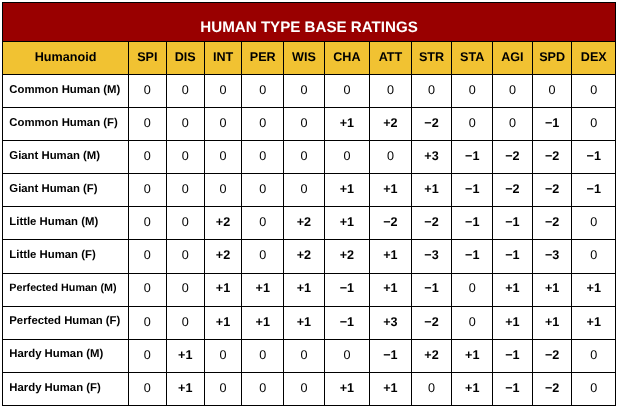
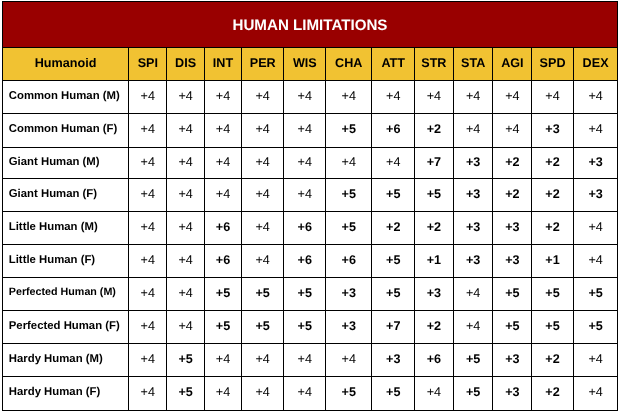
1️⃣ Human Type & Gender — Choose your Human Type and gender, establishing your starting 💪Attribute Ratings and Human Limitations.
2️⃣ Spend 10 Character Points — Improve your starting 💪Attributes and make sure you meet the requirements of the Character Class you intend to choose.
3️⃣ Choose Character Class — Choose your adventuring role and record the requirements, training, and other benefits provided by that Class.
4️⃣ Complete Your Ratings, Burdens & Blessings — Record your Class Skills, spend your additional Starting Skill Points, and optionally choose Burdens and Blessings. Spend any Creation Favor and finalize your starting 💪Attribute and ⚒️Skill Ratings.
5️⃣ Complete Mechanical Statistics — Calculate your 🌈Attribute PRISMs, Trauma Thresholds, Action Points, ⏳Initiative, magic, equipment, starting money, and the other mechanical information needed to begin play.
6️⃣ Create Your Character — Establish your character’s identity and use the Backstory Engine to discover the life, relationships, experiences, ambitions, and unfinished business that brought him to the beginning of the adventure.
1️⃣Step 1 — Human Type & Gender
Every Player Character in Kingsmark is human, but humanity in Sylva includes several distinct Human Types. Your Human Type and gender establish the natural starting point and physical limitations of your twelve 💪Attributes before you spend any Character Points. Choose a Human Type: Common Human (Anashim), Human Giant (Gibborim), Little Human/Qatan (Qetanim), Perfected Human/Elf (Elyonim), or Hardy Human/Dwarf (Tzurim). Then choose whether your character is male or female. Your choice establishes two things: Base Ratings are the 💪Attribute Ratings with which your character begins before spending Character Points. Human Limitations are the highest Ratings those 💪Attributes can normally reach. Character Points, XP, and other ordinary improvement cannot raise an Attribute beyond its Human Limitation unless a rule specifically says otherwise. The full nature, history, cultures, and other characteristics of each Human Type are described in the Human Types chapter. For Character Creation, you only need the following distinctions.
Common Human
Common Humans are the ordinary and most widespread humans of Sylva. They provide the baseline against which the other Human Types are measured and begin without the pronounced natural strengths or weaknesses of the others.
Human Giant
Human Giants are exceptionally large and powerful humans. Their greatest natural advantage is Strength, while their enormous size imposes substantial limitations upon Stamina, Agility, Speed, and Dexterity.
Little Human
Little Humans are exceptionally small humans. Their size greatly limits Strength, Stamina, Agility, and Speed, but they possess strong natural advantages in Intelligence, Wisdom, and Charisma. Their small stature also creates practical advantages and limitations described by their Human Type.
Perfected Human
Perfected Humans favor Intelligence, Perception, Wisdom, Attractiveness, Agility, Speed, and Dexterity, but possess lower Charisma and Strength. Their longevity and distinctive Attribute maximums are described in the Human Types chapter.
Hardy Human
Hardy Humans are naturally robust, durable people whose natural advantages emphasize Discipline and Stamina, with male Hardy Humans also possessing exceptional compact Strength. Their proportions reduce Agility and especially Speed.
Children of Different Human Types
The peoples of Sylva sometimes have children with members of other Human Types. Such children do not constitute separate Human Types, nor are their game statistics created by combining those of their parents.
A child inherits the Human Type of one parent. An Elyon (Elf) and Tzur (Dwarf), for example, may have a child who is an Elf or a Dwarf; a Gibbor (Human Giant) and Qatan (Little Human) may have a child who is a Human Giant or a Little Human. The character uses the normal Attributes, abilities, limitations, and other rules of that Human Type without modification.
Ancestry may influence appearance without affecting game statistics. A Dwarf with an Elven parent might have unusually fine features, while an Elf with Dwarven ancestry might have a stockier build. These details are matters of appearance and family history, not additional rules.
Players should simply choose which parent’s Human Type the character inherited. No fractions, percentages, averaged Attributes, or additional “half” Human Types are used.
Someone can have Elven, Dwarven, Little Human, Giant, or Common Human ancestors scattered throughout the family tree if the player wants. None of it requires bookkeeping. The 📖Character Bible still says one thing under Human Type: Dwarf.
Genetic ancestry equates to freedom of appearance without becoming a mechanical optimization system. These rules prevent “power players” from constructing a pedigree specifically to obtain Giant Strength, Elven advantages, Dwarven advantages, and Qatan advantages simultaneously.
2️⃣Step 2 — Spend 10 Character Points
Now decide how your character differs from the natural starting point established by Human Type and gender.
Every new character receives 10 Character Points to spend on 💪Attributes. Each Character Point raises one Attribute by +1. Begin with the Base Ratings recorded in Step 1 and distribute all 10 points however you wish.
An Attribute cannot be reduced below its Base Rating to gain additional Character Points, and no Attribute can be raised above its Human Limitation.
Before spending your points, look ahead at the Character Class you intend to choose. Some Classes have minimum Attribute requirements. If you want a particular Class, make certain your finished Ratings meet its prerequisites. If you are randomly determining Character Class, make the random Class roll in Step 3 before spending your 10 Character Points. Then spend the points so that the character satisfies the rolled Class’s requirements. Reroll only if the combination is prohibited by Human Type, gender, or a Human Limitation that makes the Class impossible to qualify for.
🎬Example — A male Human Giant begins with Strength +3. His player spends 3 Character Points on Strength, increasing it to +6. He could spend another point to reach +7, his Human Limitation, but could never ordinarily increase his Strength beyond +7. The player spends his remaining 7 Character Points among the character’s other Attributes. Once all 10 Character Points have been spent, record the finished Ratings in the 📖Character Bible.
3️⃣Step 3 — Choose Character Class
Character Class describes the kind of adventurer your character has become. It does not dictate personality, morality, occupation, or backstory. Two characters of the same Class may have almost nothing else in common. Choose one of the seventeen Character Classes.
If you prefer to determine Character Class randomly, make this roll before spending your 10 Character Points. Roll 2d12, add the dice together, and consult the following results:
2 — 🔮Prophet
3 — 🪶Shaman
4 — 🧙Witch
5 — 🧙♂️Wizard
6 — 🕯️Priest
7 — 🛡️Holy Knight
8 — ❤️🩹Healer
9 — 🎶Minstrel
10 — 🥋Monk
11 — 🥷Ninja
12 — 🗝️Thief
13 — ⚔️Man-at-Arms
14 — 🏹Ranger
15 — 🎯Monster Hunter
16 — 😡Barbarian
17 — 🐺Beast Master
18 — 💪Brute
19 — ⚔️Man-at-Arms
20 — 🏹Ranger
21 — 🎯Monster Hunter
22 — 😡Barbarian
23 — 🗝️Thief
24 — ⚔️Man-at-Arms
After determining the Class, spend your 10 Character Points so that the character satisfies its Required Attribute Ratings. Reroll only if the resulting Class is prohibited by the character’s Human Type or gender, or if the character cannot possibly satisfy its Required Attribute Ratings without exceeding a Human Limitation.
Each Character Class has its own requirements and starting benefits. Before choosing a Class, check its entry in the Character Classes chapter and make certain your 💪Attributes meet all prerequisites.
Once you qualify, record everything the Class provides, including any Trained Attribute Bonuses, starting ⚒️Skills, Skill Points, Schools of Magic, special choices, or other Class benefits listed in its entry. Character Class establishes what your character has been trained to do as an adventurer. Your Backstory in Step 6 will establish the life that existed before and around that training.
Magicians and Speed
Magicians who intend to cast powerful spells during Action Scenes should think carefully before reducing Speed below −1. Because a character’s Action Points equal 5 + Speed, very low Speed can leave a magician without enough AP to cast powerful magic quickly when seconds matter.
Speed −1 is a practical minimum for most combat-capable magicians, not a requirement. A slower magician is perfectly legal and may be an excellent character, but the player should understand the tradeoff: Power 1–3 spells normally require 🔴🔴🔴🔴 4 AP and cannot be cast with fewer unless a rule allows it.
4️⃣Step 4 — Complete Your Ratings, Burdens & Blessings
Before calculating your character’s derived statistics, finish the 💪Attributes and ⚒Skills from which those statistics will be calculated. This is also the time to choose any optional Burdens and Blessings and spend any Creation Favor they provide. Once this step is complete, your starting Attribute and Skill Ratings are final.
⚒Skills
Record the starting ⚒Skills listed by your Character Class. These required Skill Ratings represent Skill Points already invested by the Class. Then spend the additional Starting Skill Points listed in the Class entry. Every newly created character begins with exactly 12 Skill Points invested before any additional increases purchased through Creation Favor. A starting Skill cannot normally be raised above +2 during ordinary Character Creation unless a rule explicitly states otherwise. A Skill represents learned ability rather than natural talent, so record every Skill separately from the 💪Attribute associated with it. Your character may know how to perform many ordinary activities without possessing a Skill Rating in them. Skills represent training significant enough to matter under the rules.
🪵Burdens & 🕊️Blessings
Burdens and Blessings are optional. You may create a character without taking any of them. A Burden gives your character a genuine disadvantage, complication, or vulnerability in exchange for Favor that may be spent during Character Creation. More consequential Burdens provide more Favor:
🪵Minor Flaw — 1 Favor🕊
🪵🪵Major Flaw — 2 Favor🕊🕊
🪵🪵🪵Curse — 3 Favor🕊🕊🕊
A character can gain no more than 3 Favor from Burdens during Character Creation and can begin with no more than one Curse. Favor gained from Burdens must be spent before play begins. It is not added to the character’s normal 🕊Favor for use during adventures. Creation Favor may be spent as follows:
1 Favor — Increase one 💪Attribute by +1, without exceeding its Human Limitation.
1 Favor — Increase one ⚒️Skill by +1, subject to the normal restrictions on Skill Ratings.
Listed Cost — Purchase one Blessing for the Favor cost given in its entry.
If a player chooses a Major Flaw worth 2 Favor, for example, he could purchase a 2-Favor Blessing or increase two eligible Ratings by +1.
Burdens should actually matter. Do not select a supposed disadvantage that circumstances make effectively meaningless merely to obtain Favor. Likewise, a Blessing provides only the benefit stated in its description. The complete 🪵Burdens and 🕊️Blessings references appear later in this chapter. Choose from those entries, spend all Creation Favor, and record the results in your 📖Character Bible. When this step is complete, your starting 💪Attribute and ⚒️Skill Ratings are final. Do not calculate your derived mechanical statistics until Step 5.
5️⃣Step 5 — Complete Mechanical Statistics
Your starting 💪Attribute and ⚒️Skill Ratings are now final. Use these finished Ratings to calculate your character’s derived statistics. By the end of this step, the mechanical information needed to begin play should be calculated, recorded in your 📖Character Bible, and ready to use.
🌈Attribute PRISMs
Calculate all five 🌈Attribute PRISMs using your character’s finished 💪Attribute Ratings and the rules in Chapter 2. Add the appropriate Attributes together to determine each PRISM Sum, then use that Sum to determine the PRISM Modifier. Calculate and record:
🌈Physical Performance
🌈Reflexes
🌈Influence & Allure
🌈Spirituality
🌈Mental Performance
Record the final PRISM Modifier for each in your 📖Character Bible.
🩸Physical and 🧠Mental Trauma Thresholds
Your character’s 🌈Physical Performance and 🌈Mental Performance determine how Physical Wounds and Mental Trauma affect him.
After calculating your PRISMs, locate your character’s current 🌈Physical Performance Modifier on the Physical Trauma Threshold and your current 🌈Mental Performance Modifier on the Mental Trauma Threshold. Record the corresponding Pain Modifiers and Distress Modifiers on the appropriate Trauma boxes of your 📖Character Bible. These values determine how increasingly serious Physical Wounds and Mental Trauma affect the character during play. If the character’s 🌈Physical Performance or 🌈Mental Performance later changes permanently, recalculate the appropriate Trauma Threshold information and update the 📖Character Bible.
▶️Action Scene Statistics
Record the character’s normal Action Points and ⏳Initiative formula so they are ready whenever an Action Scene begins. Every character normally receives 5 Action Points each Turn, modified directly by Speed:
Speed −3 = 2 AP
Speed −2 = 3 AP
Speed −1 = 4 AP
Speed 0 = 5 AP
Speed +1 = 6 AP
Speed +2 = 7 AP
Speed +3 = 8 AP
Speed +4 = 9 AP
Therefore: Action Points 🔵🔵🔵🔵🔵 = 5 + Speed
Record the character’s normal AP in the 📖Character Bible. If Speed later changes, recalculate AP accordingly. Also record the character’s ⏳Initiative formula: ⏳Initiative = 1d12 + 🌈Reflexes + Speed. Do not record a permanent ⏳Initiative Score. ⏳Initiative is rolled when an Action Scene begins. Record the formula or its combined modifier so that ⏳Initiative can be calculated quickly during play. Physical Wounds, Mental Trauma, and other circumstances may modify ⏳Initiative during an Action Scene. Apply those effects when they occur rather than incorporating them into the character’s normal starting statistics.
🛡️Equipment
Record the weapons, armor, tools, clothing, and other equipment provided during Character Creation. Your Character Class may provide specialized equipment appropriate to its training. Record the mechanical statistics for weapons and armor that the character carries so they are ready during play, including relevant Damage Types, Damage Levels, Critical Thresholds, Armor Ratings, or other values required by their rules. Ordinary personal possessions do not require exhaustive accounting. A character may reasonably own normal clothing and mundane belongings appropriate to his life unless the GM has a reason to rule otherwise. Equipment that matters mechanically or possesses meaningful value should be recorded.
🪄Spells
If your Character Class does not grant access to conventional magic, skip this section. If your Class grants magical access, record the Schools of Magic or other permitted Spell categories established by the Class. Some Classes require an additional choice before this access is complete. A 🥋Monk selects a Monastic Tradition, which determines the Schools added to the Class’s Martial Adept and Astral foundations. A ❤️🩹Healer selects a Healer Tradition, which determines the Schools available in addition to Healing and Love. Make any such Class-specific choices before selecting Starting Spells.
Add the character’s 🌈Spirituality PRISM and ⚒Spiritual Practices Rating. The result is the number of Spells the character knows at the beginning of play.
Starting Spells = 🌈Spirituality PRISM + ⚒Spiritual Practices
Starting Spells must belong to the Schools or other Spell categories available through the character’s Class and any Class-specific tradition. Most magical characters select their own Starting Spells from among those eligible choices. 🔮Prophets and Prophetesses are an exception. The Game Master determines the Prophet’s individual Spells through revelation, using knowledge of the campaign and events that may lie ahead while remaining within the Prophet’s normal Schools, Magical Capacity, and other restrictions.
The character’s Maximum Magical Capacity is three times the combined 🌈Spirituality PRISM and ⚒Spiritual Practices Rating:
Maximum Magical Capacity = (🌈Spirituality PRISM + ⚒Spiritual Practices) × 3
Record the Starting Spells in the 📖Character Bible. The Spellbook: A Complete Fantasy Magic System contains the complete Spell descriptions, detailed Class-specific magical traditions, and the rules governing later 📖Spell Learning Opportunities.
🪙Starting Money
Every new character begins with 1d12 Silver in addition to the equipment provided by his Character Class. Roll 1d12 once during Character Creation and record that many Silver in the 📖Character Bible. Starting money represents the coin the character has available when play begins and does not replace the weapons, armor, tools, clothing, or other equipment already granted by his Character Class. After recording starting money, your character’s starting mechanical statistics are complete.
6️⃣Step 6 — Create Your Character
You now know your character’s natural abilities, training, Skills, equipment, and any Burdens or Blessings. The final step establishes who this person is and the life that brought him to adventuring.
🎭Your Identity
Record your character’s Name, Age, Home, Physical Appearance, and Present Self.
Give your character a name appropriate to his people, culture, family, and homeland. A nickname, title, family name, or other form of address may also be recorded if appropriate.
Choose your character’s age. His age should make sense for his Human Type, Character Class, training, and the life you imagine he has already lived.
Where does your character consider home? This may be a village, town, city, farm, castle, monastery, forest, mountain settlement, ship, wandering community, or somewhere considerably stranger. Home does not necessarily mean birthplace, nor does your character necessarily still live there.
Describe the physical appearance of your character so that other players can picture him. Consider height, build, hair, eyes, complexion, clothing, grooming, scars, tattoos, posture, distinctive features, or anything else immediately noticeable. You do not need to inventory every physical characteristic.
Finally, decide what first impression your character usually makes when people first meet him. Perhaps he seems confident, quiet, friendly, intimidating, cheerful, suspicious, disciplined, awkward, devout, dangerous, refined, or completely ordinary.
This is the person others encounter. It does not necessarily reveal everything underneath.
📖Your Backstory
By this point, you know who your character is and what he can do. Now discover something about the life that brought him here. The Backstory Engine creates a history with only a handful of rolls. Roll 1d12 for each section and follow any additional roll the result calls for. You may choose a result instead of rolling, combine results that inspire you, or reroll anything that does not fit the character you want to play. Add names, places, and other details wherever you wish. The rolls establish important pieces of your past without writing your entire life for you. What happened is only the beginning. What your character does with that history belongs to you.
🎭Your Backstory Matters
The Backstory Engine provides a foundation, but players may expand its results into a few paragraphs about key events, relationships, hardships, victories, and experiences. A good backstory gives the Game Master material for future adventures and may have limited mechanical effects when justified. If the character endured one or more of the Twelve Horrors, for example, the GM may record 1 or 2 prior Horror experiences on the Medical Record. Backstory may also establish reasonable knowledge, relationships, possessions, reputations, or circumstances, but cannot grant free 💪Attributes, ⚒Skills, 🕊Blessings, Immunity Badges, or other benefits unless a rule allows it. The goal is a character who feels as though he lived in Sylva before his first Contract. Once identity and backstory are recorded, Character Creation is complete.
🌳Backstory Roll 1 — Roots
Roll 1d12 to discover something important about your upbringing.
- Loving Home — You were raised by people who loved you. Despite hardships, home was somewhere you belonged. At least one family member remains important to you.
- Hard but Honest — Your household had little, and everyone helped. You learned work, cooperation, and how to make do.
- Prosperous Household — Your family had land, wealth, influence, a successful trade, or some mix of them. Opportunity likely came with expectations.
- Demanding Household — Much was expected of you. Discipline, achievement, duty, reputation, or obedience mattered. Decide whether this strengthened you, burdened you, or both.
- Raised by Others — Roll 1d12: 1–2 grandparents; 3–4 relatives; 5–6 adoptive family; 7–8 religious community; 9–10 master or mentor; 11 village or community; 12 someone unusual. Decide what you know of your parents.
- Wandering Childhood — Your household rarely stayed in one place. You may have traveled with merchants, performers, herders, sailors, pilgrims, refugees, or restless people. Home may mean people more than place.
- Isolated Childhood — You grew up far from large settlements or with little contact with outsiders. The wider world may have fascinated, frightened, confused, or disappointed you.
- Community Child — Neighbors, relatives, family friends, and others helped raise you. Your childhood gave you connections beyond one household.
- Respected Family — Your family was known for something admirable. Roll 1d12: 1–2 bravery; 3–4 generosity; 5–6 devotion; 7–8 craft; 9–10 learning or wisdom; 11 defending the community; 12 extraordinary deed. Decide how that reputation affected you.
- Disgraced Family — Your family name carries a stain. It may be deserved, partly true, false, or unexplained.
- Religious Upbringing — Faith, ritual, sacred teaching, or service to God shaped your childhood. You may have embraced it, struggled with it, rejected part of it, or still be deciding.
- Unusual Roots — Your upbringing fits none of these. Create it with the GM, alter another result, or roll twice and combine them.
🔨Backstory Roll 2 — Former Life
Before becoming an adventurer, you had another life. Roll 1d12 for its type, then choose or roll 1d12 from that result’s examples.
- Land & Wilderness — Farmer; shepherd; hunter; trapper; forester; woodcutter; gardener; fisherman; beekeeper; charcoal burner; gamekeeper; wilderness guide.
- Craft & Construction — Blacksmith; carpenter; mason; potter; weaver; leatherworker; cobbler; tailor; brewer; baker; wheelwright; apprentice to another craft.
- Commerce — Merchant; shopkeeper; peddler; market seller; clerk; warehouse worker; moneylender’s assistant; caravan worker; innkeeper; tavern worker; factor; unusual trader.
- Arms & Guarding — Soldier; town guard; caravan guard; watchman; castle retainer; archer; scout; mercenary; bodyguard; weapons instructor; army servant; veteran of unusual service.
- Religious Life — Temple servant; religious student; pilgrim guide; holy-site caretaker; scribe; charitable worker; grave tender; Priest’s assistant; missionary; keeper of sacred objects; religious community member; other vocation.
- Learning & Letters — Scribe; tutor; translator; copyist; librarian; student; record keeper; scholar’s assistant; mapmaker; legal clerk; natural philosopher’s assistant; obscure researcher.
- Crime & Underworld — Thief; smuggler; fence; lookout; burglar; pickpocket; swindler; poacher; illicit gambler; gang member; hired muscle; criminal with undisclosed former work.
- Performance & Art — Musician; singer; actor; storyteller; dancer; juggler; painter; sculptor; poet; puppeteer; traveling acrobat; other entertainer.
- Household & Service — Cook; servant; groom; stable hand; messenger; porter; groundskeeper; chamber servant; steward’s assistant; nursemaid; household guard; noble household servant.
- Roads & Water — Sailor; boatman; ferryman; wagoner; caravan driver; courier; dockworker; navigator’s assistant; muleteer; guide; road worker; traveling laborer.
- Healing & Care — Healer’s assistant; herbalist; apothecary’s assistant; midwife’s assistant; caretaker; battlefield attendant; animal healer; bathhouse attendant; infirmary worker; herb gatherer; physician’s assistant; caregiver.
- Unusual Life — You served an unusual master, lived somewhere extraordinary, joined a strange enterprise, or did work not listed above. Create it with the GM or roll twice and combine.
Now roll 1d12 for one detail about your Former Life:
- Loved the Work — You loved what you did.
- Hated the Work — You hated what you did.
- Natural Talent — You were unusually good at it.
- Poor Fit — You were terrible at it.
- Believing Mentor — A master or employer believed in you.
- Disappointment — You failed someone who believed in you.
- Close Friend — You made an important friend there.
- Enemy or Rival — You made an enemy or rival there.
- Forbidden Knowledge — You learned something you should not know.
- Useful Acquaintances — You gained contacts who may still matter.
- Unfinished Business — You left something unfinished.
- Hard Departure — Leaving that life was harder than you expected.
⚡Backstory Roll 3 — Turning Point
Something changed the direction of your life. It may have been wonderful, terrible, frightening, inspiring, or simply impossible to ignore. This was the moment, or series of moments, when the path you had been following no longer seemed sufficient. It may have pushed you toward adventure willingly, forced you away from the life you knew, or left you with a question that could only be answered by leaving home. Roll 1d12.
- Opportunity — Someone offered you an opportunity beyond your former life: an invitation, recruitment, sponsorship, challenge, apprenticeship, responsibility, or unexpected act of trust. Decide why you accepted, or why refusing would have been difficult.
- Success — You accomplished something important and discovered that you were capable of more than you had believed. Success gave you the confidence to seek a larger life and made returning to your old limits harder to imagine.
- Discovery — You discovered a place, object, document, secret, historical truth, creature, or other evidence that changed something you thought you understood. You may still be trying to learn what the discovery truly means.
- Love — Your love for a parent, child, sibling, friend, mentor, beloved, or community changed the direction of your life. That person may be part of the reason you left, part of the reason you intend to return, or someone you are still trying to protect.
- Responsibility — Someone entrusted you with something that matters: a person, promise, duty, object, secret, inheritance, message, or other responsibility. Whether you wanted it or not, abandoning it would say something important about who you are.
- Conflict — A serious conflict made your former life difficult or impossible to continue. Roll 1d12: 1–2 family; 3–4 employer or master; 5–6 authority; 7–8 rival; 9–10 community; 11 religious disagreement; 12 a powerful person who made departure prudent. Decide whether the conflict remains unresolved.
- Failure — You attempted something important and failed. Someone may have been hurt, something may have been lost, or you may simply have discovered the limits of your abilities. The failure changed you, but it did not end your story. You may now seek redemption, mastery, understanding, or simply another chance.
- Betrayal — Someone betrayed you, you betrayed someone else, or both of you believe the other was responsible. The person involved may still be alive and may tell the story very differently. Decide whether you want revenge, reconciliation, distance, or the truth.
- Loss — Something important was taken from your life. Roll 1d12: 1–2 someone died; 3 a relationship ended; 4–5 livelihood or property; 6 your home; 7 your reputation; 8 an important opportunity; 9 a precious possession was stolen; 10 an important place in your community; 11 your faith in someone or something; 12 an unexpected loss determined with the GM. Decide what part of that loss still follows you.
- Moral Choice — Circumstances forced you to choose between things that both mattered: loyalty and justice, safety and duty, mercy and vengeance, honesty and protection, obedience and conscience, or another difficult choice. Decide what you chose and whether you still believe it was right.
- Encounter with the Extraordinary — You encountered something that made the ordinary world impossible to see in quite the same way: unmistakable magic, a supernatural creature, the Gloom, a miracle, an ancient ruin, something believed extinct, or another wonder or horror of Sylva. Decide whether the encounter filled you with wonder, fear, obsession, faith, or unanswered questions.
- Strange Turn — Coincidence, accident, mistaken identity, an unlikely meeting, prophecy, inheritance, unexpected fortune, or some other improbable event redirected your life. Create the event with the GM or roll twice and combine the results. What matters most is not how unlikely it was, but why it changed what you did next.
🧭Backstory Roll 4 — What Did It Mean to You?
Events do not determine who you become. Two people may survive the same disaster, gain the same opportunity, or make the same mistake and learn different lessons. Consider your Turning Point and roll 1d12, choose a result, or write your own. This is what your character believes now, not a rule for how you must play him. Experience may strengthen, complicate, or overturn it.
- I need to become stronger or more capable.
- I cannot do everything alone.
- I owe someone something, whether they know it or not.
- I was wrong about something important.
- I will not make the same mistake again.
- Trust matters, but it must be earned.
- People sometimes deserve another chance.
- Ability and power bring responsibility.
- I have something to prove, perhaps only to myself.
- I discovered what matters most to me.
- The world is stranger and more complicated than I believed.
- I still do not know what it meant.
Make this belief playable. Choose a habit, preference, caution, ritual, attitude, or behavior that grew from it and can appear even when your past does not.
🤝Backstory Roll 5 — Someone Who Matters
Someone from your old life still matters to you, whether the relationship is loving, difficult, competitive, or unresolved. Roll 1d12.
- Parent or Guardian — Someone who raised you remains important.
- Sibling — A brother or sister knows you in ways few others do. You may be close, distant, protective, competitive, or complicated.
- Relative — An aunt, uncle, cousin, grandparent, in-law, or other relative remains important.
- Closest Friend — Someone knew you before you became an adventurer and has seen sides your companions may not.
- Mentor — Someone taught, trained, guided, encouraged, corrected, or challenged you.
- Former Love — You once loved this person, or still do. The relationship may have ended peacefully, painfully, reluctantly, or not quite ended.
- Rival — Someone pushes you to improve through competition, dislike, professional rivalry, or a mixture of them.
- Former Master or Employer — Someone from your Former Life still matters. You may respect, resent, fear, admire, or owe them.
- Someone Who Depends Upon You — A child, relative, friend, apprentice, household, injured companion, or someone else relies on you.
- Someone You Depend Upon — You rely on this person for friendship, advice, shelter, knowledge, influence, guidance, practical help, or trust.
- Someone You Wronged — You hurt, failed, deceived, abandoned, or wronged someone. Decide whether you tried to make amends.
- Unexpected Bond — Someone you never expected to care about became important: perhaps a former enemy, a kind stranger, or someone from a very different people, station, or way of life.
Now roll 1d12 for the present state of the relationship:
1–2. You remain close.
3. Distance separates you, but the affection remains.
4. The relationship has become complicated.
5. You are estranged.
6. You owe this person something.
7. This person owes you something.
8. This person needs your help.
9. You need this person’s help.
10. Something important remains unsaid between you.
11. You have lost contact and do not know where this person is.
12. Roll twice and combine the results.
Someone already created through your Roots, Former Life, or Turning Point may fill this role. If so, use that person instead of inventing another.
🔗Backstory Roll 6 — Unfinished Business
Something from your old life remains unresolved. When possible, connect this result to a person, place, event, or occupation already in your Backstory. It gives the GM a thread that may return later. Roll 1d12.
- Unfulfilled Promise — You promised to do something and have not done it. You may have failed, been prevented, or avoided it.
- Debt — You owe someone money, property, service, gratitude, protection, information, or another obligation.
- Someone Wants Something From You — Someone from your past wants your help, silence, return, forgiveness, property, knowledge, allegiance, or obedience.
- You Want Something From Someone — Someone has something you want: an answer, apology, object, payment, secret, recognition, permission, or forgiveness.
- Someone Is Missing — Someone you knew vanished, failed to return, or stopped sending word. You do not know why.
- Unanswered Question — Something in your past still makes no sense: a lie, secret, strange event, death, object, or discovery.
- Rival or Enemy — Someone has reason to oppose you: a rival, suitor, adventurer, official, associate, relative, or enemy.
- Something Left Behind — You left behind a person, place, possession, duty, opportunity, or unfinished work that still matters.
- Someone Needs Your Help — Someone from your old life faces a problem you could not solve before.
- Reputation — People remember something you did, supposedly did, or are believed to have done.
- Something in Your Possession — You hold an object, document, secret, map, key, inheritance, or keepsake important to someone else.
- The Past Returns — Something you thought finished has resurfaced. Connect it to a previous Backstory result.
⭐Backstory Roll 7 — Direction
Your past explains how you arrived here. Direction establishes what you are trying to do next. It gives your character purpose and helps the Game Master understand what matters to you. Roll 1d12 or choose what your character wants from adventuring.
- Wealth — You want enough money to change your circumstances or those of people you care about. Wealth may mean comfort, freedom, influence, or escape from poverty.
- Home — You want land, a house, workshop, farm, ship, tower, or some other place that truly belongs to you.
- Mastery — You want to become exceptionally capable at something meaningful to you and see how far your abilities can take you.
- Knowledge — There is something you want to understand, discover, study, or learn. The answer may change how you see the world.
- Justice — A wrong should not be allowed to stand. You may seek lawful justice, restitution, exposure, vengeance, or another form of reckoning.
- Reconciliation — You want to repair a relationship with a person, family, friendship, community, or former way of life.
- Recognition — You want your deeds to matter and your name to become known for something worthy of remembrance.
- Security — You want enough strength, influence, wealth, preparation, or powerful allies that you and those you love cannot easily be threatened.
- Service — You want to devote your abilities to God, your people, a community, a ruler, a cause, or something else you believe deserves your effort.
- Protection — There is someone, somewhere, or something you intend to keep safe, even if doing so demands sacrifice.
- Discovery — You want to see what lies beyond the familiar: ruins, distant kingdoms, wilderness, strange peoples, forgotten places, or parts of Sylva few have explored.
- Belonging — You want to find the people, place, purpose, or way of life that allows you finally to say, “This is where I belong.”
Direction is not destiny. Characters change. What matters at the start may fade, while something unexpected becomes worth fighting for. Your Direction may be fulfilled, abandoned, transformed, or replaced. Now roll 1d12 or choose a Possible Self: someone your character can imagine becoming if his life goes well. It is a glimpse of who he hopes to become.
- Someone others can depend upon.
- A leader worthy of being followed.
- A protector with the strength to defend others.
- A master of his chosen abilities.
- Someone capable of making peace with his past.
- Someone who can trust without becoming foolish.
- Someone strong enough to show mercy when it is deserved.
- Someone nobody can easily control or intimidate.
- Someone worthy of another person’s faith.
- Someone whose deeds leave the world better than he found it.
- Someone whose name will be remembered long after his death.
- You do not know yet. Finding out may be part of the adventure.
❤️Relationship Status
Decide your character’s romantic life when the campaign begins. He may be married, courting, unattached, interested in someone, separated from someone he loves, widowed, heartbroken, in a complicated relationship, or uninterested in romance. If someone already created by your Backstory fits this role, use that person.
🎯Immediate Want
In one sentence, state why your character will become an adventurer now and what might keep him accepting dangerous work after his first Contract. He may be eager, practical, reluctant, ambitious, curious, dutiful, or desperate; he simply needs a reason to pursue adventure without being dragged into it. Direction describes a larger life goal. Immediate Want describes what he wants soon: earn enough Silver to pay a debt, find work, buy better equipment, reach a place, speak with someone, learn something, prove himself, help someone, settle a dispute, replace something lost, or complete his first Contract. It gives him something to pursue now while larger ambitions remain ahead.
⚔️Party Connection
After everyone completes the seven Backstory Rolls, connect your character to at least one other party member. Decide the details together. Friendship is not required; respect, obligation, rivalry, necessity, shared interests, or a common enemy may be enough. Choose or roll 1d12.
- You worked together before.
- One once helped the other.
- You share a friend or trusted acquaintance.
- You share an enemy or rival.
- You were once rivals.
- Your families, communities, masters, or former employers know one another.
- You traveled together before becoming adventurers.
- One knows something private about the other.
- Someone you trust recommended the other.
- You survived danger together.
- You recently met, but something the other did earned your respect.
- Roll twice and combine the results.
A good Party Connection works both ways, gives both players something to respond to, and provides a believable reason to cooperate despite disagreements.
✅Character Complete
Your character is ready to play. You now know his Human Type and gender, 💪Attributes, Character Class, ⚒️Skills, equipment, spells, 🪵Burdens and 🕊Blessings, identity, Roots, Former Life, Turning Point, its meaning, someone who matters to him, Unfinished Business, Direction, Immediate Want, and at least one Party Connection. You do not need to know everything else. Some of the most important parts of his story have not happened yet.
🪵Burdens
Burdens are optional disadvantages that make a character’s life more difficult. They may represent physical limitations, troublesome habits, social complications, psychological difficulties, dangerous circumstances, or stranger problems that follow a character into his adventuring career. During Character Creation, accepting a Burden provides Favor according to its severity:
🪵Minor Flaw — 1 Favor 🕊
🪵🪵Major Flaw — 2 Favor 🕊🕊
🪵🪵🪵Curse — 3 Favor 🕊🕊🕊
A character may gain no more than 3 Favor from Burdens during Character Creation and may begin with no more than one Curse. Favor gained this way must be spent during Character Creation as described in Step 4. It does not become 🕊Favor carried into play. A Burden is supposed to be a genuine disadvantage. If circumstances make a particular Burden effectively meaningless to the character, the GM may reject it. Likewise, choosing a Burden means accepting the consequences described in its entry when they become relevant. Burdens come in three degrees of severity.
🪵Minor Flaws are persistent inconveniences or weaknesses. They matter, but ordinarily do not dominate a character’s life. 🪵🪵Major Flaws create substantial disadvantages, recurring difficulties, or serious vulnerabilities. 🪵🪵🪵Curses are the most consequential Burdens. A Curse may significantly shape a character’s adventures, relationships, circumstances, or fate. The following entries provide the complete Burdens available during Character Creation.
🪵Minor Flaws
Minor Flaws are persistent disadvantages worth 1 Favor during Character Creation. They should inconvenience the character when relevant without ordinarily controlling his life.
👓Nearsighted — 🪵
Your distant vision is poor. Apply a +1 Disadvantage to Tests that depend upon clearly seeing distant details, including identifying faraway people, noticing small objects at range, or making attacks where precise distant vision is important.
😬Socially Awkward — 🪵
You have difficulty making a good first impression. Apply a +1 Disadvantage to Social Skills Tests when attempting to charm, impress, or comfortably mingle with unfamiliar people. Once someone knows you well, this Flaw ordinarily ceases to apply to interactions with that person.
🎭Stage Fright — 🪵
Being the center of attention unnerves you. Apply a +1 Disadvantage to Social Skills Tests made when you must address, entertain, or perform before a substantial audience.
🦵Bad Knee — 🪵
An old injury occasionally reminds you that it never healed perfectly. Apply a +1 Disadvantage to Tests involving sustained running, difficult climbing, jumping, or similar strenuous use of your legs.
🩹Old Scar Nerve Pain — 🪵
An old wound sometimes produces sudden pain. When the GM determines that weather, exertion, pressure, or another reasonable circumstance aggravates the injury, apply a +1 Disadvantage to physical Tests substantially affected by the pain until the aggravation passes.
🤧Allergic — 🪵
Choose a reasonably common substance such as a particular animal, plant, food, mold, or type of dust. Significant exposure causes sneezing, itching, watering eyes, irritation, or another appropriate reaction, imposing a +1 Disadvantage on relevant Tests until you escape the exposure and recover.
🤝Code of Courtesy — 🪵
You hold yourself to a demanding standard of courtesy. You avoid needless insults, repay hospitality, respect guests, and attempt to keep your word. Deliberately violating your code requires a successful Discipline Defense Test when the violation would be substantial.
🔍Tempered Curiosity — 🪵
You find mysteries difficult to leave alone. When confronted with something deliberately concealed or inexplicable, such as a sealed chamber, mysterious mechanism, coded message, or unexplained phenomenon, resisting a reasonable opportunity to investigate requires a successful Discipline Defense Test.
🛏️Light Sleeper — 🪵
Small disturbances easily wake you. This makes sleeping in noisy, uncomfortable, or frequently disturbed surroundings difficult. When adequate sleep is genuinely in doubt, the GM may require an appropriate Test to determine whether you receive sufficient rest.
👀Conspicuous Look — 🪵
Something about your appearance makes you unusually memorable: exceptional height, distinctive features, unusual hair, prominent scars, striking clothing, or something similar. Apply a +1 Disadvantage when attempting to avoid later identification by someone who had a reasonable opportunity to see you.
🍲Picky Eater — 🪵
There are broad categories of food you strongly dislike and ordinarily refuse to eat when alternatives exist. When circumstances leave only food you find repulsive, a Discipline Defense Test may be required to eat enough of it without necessity forcing the issue.
🧰Tool Reliant — 🪵
Choose one ⚒️Skill for which you are unusually dependent upon proper equipment. Apply a +1 Disadvantage when using that Skill without the ordinary tools appropriate to the task, even when another character could reasonably attempt it with improvised equipment.
🐌Slow to React — 🪵
You take slightly longer than most people to respond when events suddenly become dangerous. Reduce your ⏳Initiative by 1.
🖐️Rough Hands — 🪵
Your hands are heavily calloused, scarred, stiff, or otherwise poorly suited to delicate work. Apply a +1 Disadvantage to Tests requiring unusually fine tactile sensitivity or extremely delicate manipulation.
😠Short Fuse — 🪵
You anger easily when deliberately insulted, humiliated, or seriously provoked. When keeping your temper matters and the provocation is substantial, the GM may require a Discipline Defense Test. Failure does not dictate a specific action, but you cannot convincingly behave as though the provocation had no effect.
🥶Cold Sensitive — 🪵
Cold affects you more severely than most people. Apply a +1 Disadvantage to Tests made to endure significant cold and to other Tests when prolonged exposure has become severe enough to impair you.
🚬Tobacco Addict — 🪵
You are dependent upon tobacco and become irritable and distracted when deprived of it for an extended period. After going a full day without tobacco, apply a +1 Disadvantage to Tests requiring sustained concentration until you obtain tobacco or the GM determines that the withdrawal has passed.
🤥Terrible Liar — 🪵
Your dishonesty is unusually easy to detect. Apply a +1 Disadvantage to Social Skills Tests when deliberately attempting to convince someone of something you know to be false.
🌅Slow Starter — 🪵
You are sluggish immediately after waking. For the first 30 minutes after rising from normal sleep, reduce your ⏳Initiative by 1 and apply a +1 Disadvantage to Tests requiring alertness or rapid reaction.
🧿Past Superstitions — 🪵
You carry old superstitions that reason has never completely erased. Choose several omens, taboos, or folk beliefs appropriate to your upbringing. When confronted with one under circumstances where ignoring it feels genuinely dangerous, a Discipline Defense Test may be required to proceed without first taking some reasonable precaution.
🕊️ Vow of Mercy — 🪵
You have sworn not to kill any opponent who has genuinely surrendered or lies helpless at your mercy. Deliberately breaking this vow requires a successful Discipline Defense Test and should represent a serious decision rather than a convenient loophole.
💤 Snorer — 🪵
Your snoring is extraordinarily loud. Anyone nearby can easily hear you sleeping, making stealthy camps, concealed lodging, and sleeping near alert enemies harder. Companions may also find it intolerable. Medicinal sleep aids or other circumstances may alter the problem when reasonable.
🪵🪵Major Flaws
Major Flaws are substantial disadvantages worth 2 Favor during Character Creation. Unlike Minor Flaws, these problems can seriously interfere with a character when circumstances bring them into play.
👍Missing Thumb — 🪵🪵
You are missing a thumb or have lost most of its function. Choose the affected hand. Apply a +2 Disadvantage to Tests where a secure two-handed grip, fine manipulation, or the affected hand’s dexterity is important.
🫁Weak Lungs — 🪵🪵
Your lungs cannot tolerate prolonged exertion as well as those of most people. Apply a +2 Disadvantage to Tests involving sustained running, forced marches, extended swimming, prolonged climbing, holding your breath, or similar tests of respiratory endurance.
❤️ Bad Heart — 🪵🪵
Your heart does not tolerate extreme exertion or sudden stress well. Apply a +2 Disadvantage to relevant Tests involving prolonged strenuous activity or extraordinary exertion. The GM may also require a Test when circumstances place exceptional strain upon your heart.
👁️ One-Eyed — 🪵🪵
You have functional sight in only one eye. Apply a +2 Disadvantage when depth perception is important, including judging difficult distances, catching rapidly moving objects, or performing precise actions where binocular vision would help. Apply a +1 Disadvantage in Melee Combat.
⚡ Chronic Pain — 🪵🪵
Persistent pain accompanies an old injury, illness, or other condition. Choose the general source. During a significant flare-up, you suffer a +2 pain modifier until the episode subsides or appropriate pain relief suppresses it. Chronic Pain does not represent a new injury.
😨 Severe Phobia — 🪵🪵
Choose a specific fear such as heights, enclosed spaces, deep water, spiders, snakes, fire, or another reasonably encountered danger. When forced into meaningful confrontation with it, make a Discipline Defense Test. Failure imposes a +2 Disadvantage on relevant Tests until you escape the situation or regain control.
🗣️ Bad Reputation — 🪵🪵
Somewhere that matters, your name carries an ugly reputation. You may deserve it, be partly responsible, or be innocent. Apply a +2 Disadvantage to relevant Social Skills Tests with people who know and believe the reputation.
💘 Disarmed by Attraction — 🪵🪵
People you find intensely attractive can compromise your judgment. Apply a +2 Disadvantage to relevant Tests to recognize manipulation, resist persuasion, or remain emotionally detached when someone you strongly desire uses that attraction against you.
💰 Debt Collectors — 🪵🪵
You owe a substantial debt to someone capable of pursuing repayment. Determine with the GM who is owed and why. The creditor may demand money, property, services, or arrangements and may send representatives when the debt is ignored.
🩸 Anemia — 🪵🪵
Your body tires easily and handles significant blood loss poorly. Apply a +2 Disadvantage to relevant Tests involving prolonged exertion and to Tests made harder by substantial bleeding, weakness, or exhaustion.
😶 Unsettling Presence — 🪵🪵
Something about you makes many people instinctively uncomfortable. It may be your manner, voice, gaze, appearance, or something hard to identify. Apply a +2 Disadvantage to Social Skills Tests when trying to appear harmless, comforting, trustworthy, or likable to strangers.
🪙 Poor Money Management — 🪵🪵
You habitually overspend, gamble, lend unwisely, or make foolish purchases. During meaningful downtime in a settlement, if you possess disposable coin, make a Discipline Defense Test. Failure means you squander 10% of your available money, to a minimum of 1 Silver and maximum of 3 Gold.
🧠 PTSD — 🪵🪵
A past experience left you with persistent traumatic reactions. Define with the GM a specific category of triggers connected to that experience. When a serious trigger recreates important elements of it, make a Discipline Defense Test. Failure causes 🧠Shaken Mental Trauma and a +2 Disadvantage on your next relevant Test involving the trigger.
👂 Partial Hearing Loss — 🪵🪵
Your hearing is significantly impaired. Apply a +2 Disadvantage to Perception Tests and other Tests that depend heavily upon hearing, including detecting quiet sounds, locating their source, or understanding speech in difficult conditions.
🧊 Cold & Calculated — 🪵🪵
You habitually approach people and problems with emotional distance. Apply a +2 Disadvantage to Social Skills Tests when genuine warmth, openness, sympathy, or reassurance is essential.
🌙 Recurring Nightmares — 🪵🪵
Disturbing dreams repeatedly interfere with your sleep. After a frightening, traumatic, or intensely stressful experience, make a Discipline Defense Test the next time you sleep. Failure means the nightmares seriously disrupt your rest: suffer 🧠Shaken Mental Trauma and receive no Mental Trauma recovery from that period of sleep.
🌀 Fractured Attention — 🪵🪵
Maintaining concentration for long periods is unusually difficult. Apply a +2 Disadvantage to Tests requiring sustained attention when distraction, monotony, competing stimuli, or prolonged concentration matters.
🎯 Tunnel Vision — 🪵🪵
Once focused on a goal, you have difficulty noticing what lies outside it. Apply a +2 Disadvantage to relevant Perception Tests while intensely concentrating on another task, target, threat, or objective.
🗡️ Ruthless Aura — 🪵🪵
You readily use intimidation, cruelty, threats, or severe measures when expedient. Others perceive you as a cold-blooded, calculating, manipulative killer, even when you genuinely try to be kind, warm, and sincere. Apply a +2 Disadvantage to Social Skills Tests when trying to convince people that you are safe to trust, merciful, or compassionate.
🧱 Rigid Mind — 🪵🪵
You have difficulty abandoning a firmly held conclusion. When circumstances demand that you admit an important belief, judgment, or plan is wrong, the GM may require a Discipline Defense Test before you reverse course. Failure means you hesitate, rationalize, or resist before accepting the new conclusion.
🪳 Creepy Crawlies — 🪵🪵
You suffer overwhelming fear or revulsion toward small creatures such as spiders, insects, worms, rats, or similar vermin. When confronted with them in significant numbers or disturbing circumstances, make an appropriate Test to remain composed. Failure means your reaction interferes with your actions until you escape or regain control.
🪵🪵🪵Curses
Curses are the most consequential Burdens and are worth 3 Favor during Character Creation. A character may begin with no more than one Curse. Some are physical or psychological conditions; others create supernatural, social, or story complications that may follow a character throughout his adventuring career.
🔥 Burn Victim — 🪵🪵🪵
You survived terrible burns that left extensive permanent scarring. Apply a +3 Disadvantage to relevant Social Skills Tests when strangers react negatively to your appearance. Clothing may conceal some scars, but anyone who sees them can recognize the injuries.
🌑 Gloom Nemesis — 🪵🪵🪵
The Gloom knows your character will be a significant threat if you are allowed to live. All vile creatures and predatory animals that challenge the party will attempt to target you first instead of your teammates—if it is logical to do so—until you reach Level 3.
❄️ Snowflake — 🪵🪵🪵
You are exceptionally sensitive to criticism, ridicule, rejection, or humiliation. When seriously insulted or publicly humiliated, make a Discipline Defense Test to maintain composure. Failure means the incident affects your behavior until you recover.
🏃 Hunted & Harassed — 🪵🪵🪵
Someone dangerous is actively looking for you: a criminal organization, powerful family, offended noble, former employer, religious enemy, rival faction, or other persistent adversary. Determine why with the GM. Pursuers act according to their resources and opportunities rather than a fixed schedule.
⛓️ Spiritual Debt — 🪵🪵🪵
You owe a serious obligation to a supernatural or spiritual power. Perhaps you received aid, inherited an obligation, made a reckless promise, or assumed another person’s unfinished duty. Determine the debt with the GM. Ignoring it may bring increasingly serious consequences appropriate to its source.
👁️ Eyes Upon You — 🪵🪵🪵
A powerful person, organization, supernatural intelligence, or other dangerous force has taken an interest in you. You may not know why. The attention may begin with observation, inquiries, intermediaries, tests, or unexplained encounters. What the watcher wants is determined with the GM. Your character will be ambushed by this Terror Level 3 ★★★ enemy before attaining Level 3.
🩸 Scent of Blood — 🪵🪵🪵
Certain unnatural creatures can detect something distinctive about you. When one capable of tracking this supernatural scent searches for you, it gains a −3 Advantage on relevant Tests to locate or follow you. The GM determines which creatures can perceive it.
💔 Unrequited Love — 🪵🪵🪵
You have 🧠Impaired Mental Trauma because you deeply love someone who does not return that love as you desire, giving you a sense that your life has no meaning. The person need not behave cruelly, reward your devotion, or change his or her feelings. When directly relevant, your attachment may create difficult choices, divided loyalties, jealousy, hope, or vulnerability.
🍂 Blighted Fortune — 🪵🪵🪵
Misfortune seems unusually fond of you. Once per game session, the GM may introduce plausible bad luck affecting your character: a strap breaks, a contact is absent, someone inconvenient recognizes you, weather turns against your plans, or another setback arises. Blighted Fortune cannot directly injure or kill you.
☠️ Marked for Death — 🪵🪵🪵
Death seems especially interested in you. During the campaign, the GM should create three genuine life-threatening situations arising naturally from the story in which your choices can place you in mortal danger. This Curse never forces a RAD merely because the GM activates it; RAD occurs only when normal rules require it. Once all three situations occur, the mark is spent and the Curse fulfilled.
🕊️Blessings
🗣️ Silver Tongue — 🕊️🕊️
You are exceptionally persuasive. Gain a −1 Advantage on Social Skills Tests involving conversation, negotiation, argument, or personal appeal.
🗡️ Giant-Killer — 🕊️🕊️
You excel against much larger foes. Gain a −1 Advantage on attacks against creatures at least twice your height when their size creates exploitable openings.
🧠 Iron Will — 🕊️🕊️
Your mind resists coercion and domination. Gain a −1 Advantage on Discipline Defense Tests against intimidation, supernatural domination, or attempts to force you against your conscious will.
✨ Soul-Bright — 🕊️🕊️
Your spiritual presence is unusually strong. Gain a −1 Advantage on Spirit Tests made to resist hostile supernatural or spiritual influences.
🔮 Sixth Sense — 🕊️🕊️
You sometimes sense danger before understanding it. Gain a −1 Advantage on Perception Tests to detect immediate hidden threats, ambushes, or dangers revealed by subtle environmental clues. Sixth Sense is not prophecy and cannot reveal the imperceptible.
🌑 Shadowborne Eyesight — 🕊️🕊️
You see exceptionally well in poor light. Reduce by 1 any Disadvantage caused specifically by dim natural lighting. You cannot see in complete darkness.
🗡️ Edge-Flow — 🕊️🕊️
Choose one general family of edged melee weapons with which you are trained. Your familiarity with its balance, reach, timing, and cutting angles borders on instinctive. Gain a −1 Advantage on Armed Combat Tests using that family. Record the chosen family when purchased.
🎯 Arc-Mark — 🕊️🕊️
Choose one trained ranged or thrown weapon type, such as longbow, crossbow, sling, javelin, or throwing knife. You judge distance, release, and trajectory with remarkable consistency. Gain a −1 Advantage on attacks with that weapon type.
🩺 True Grit Medic — 🕊️🕊️
You remain effective while treating injuries under extreme pressure, keeping your hands steady while others might panic or lose focus. Gain a −1 Advantage on Medicine Tests during combat, severe weather, immediate danger, or similar conditions that substantially hinder treatment.
⚙️ Practical Genius — 🕊️🕊️
You excel at turning practical knowledge into immediate solutions, often seeing uses for ordinary tools and materials that others overlook. Gain a −1 Advantage on Alchemy, Man Skills, Mechanisms, or Scholarship Tests when improvising with reasonably available knowledge, tools, and materials.
⚗️ Alchemist’s Touch — 🕊️🕊️
You have exceptional instincts for alchemical substances and an intuitive sense for proportion, reaction, preparation, and safe handling. Gain a −1 Advantage on Alchemy Tests involving medicines, acids, incendiaries, smoke compounds, dyes, solvents, poisons, or other substances permitted by the Alchemy rules.
👤 Ghost-Step — 🕊️🕊️
You move without drawing attention, instinctively choosing quiet footing, favorable shadows, and moments when eyes are elsewhere. Gain a −1 Advantage on Cloak & Dagger Tests involving stealthy movement, hiding, remaining unnoticed, or blending into your surroundings.
🛡️ Ward-Bearer — 🕊️🕊️
You are unusually resistant to hostile supernatural influence, as though your spirit naturally refuses forces attempting to invade, corrupt, or bind it. Gain a −1 Advantage on relevant Tests against curses, possession, supernatural corruption, or other hostile magical effects directed at you.
🤝 Old Contacts — 🕊️🕊️
Your former life left you with a broad network of acquaintances scattered among professions, communities, and social circles. When appropriate to your history and location, you may know someone who can provide information, introductions, ordinary professional help, or access to a useful social circle. When gaining that help requires a Test, gain a −1 Advantage on the relevant Social Skills, Scholarship, or Cloak & Dagger Test. Old Contacts does not guarantee loyalty, free services, political power, or implausible connections.
🎒 Always Prepared — 🕊️🕊️
You have developed the habit of thinking ahead and carrying small things that often become useful at exactly the right moment. Once per game session, when a commonplace inexpensive item would be useful, you may declare that you brought one, provided it could reasonably fit among your possessions. This cannot produce weapons, armor, valuables, rare substances, magical items, large equipment, or anything unreasonable to have carried unnoticed.
🕊️Supreme Blessings
Supreme Blessings are extraordinary advantages capable of changing the direction of an entire life. They represent rare fortune, exceptional potential, or providential circumstances far beyond ordinary talent.
✨ Miracle’s Breath — 🕊️🕊️🕊️
Once during your adventuring career, when an injury or physical crisis would otherwise kill you, you survive. Providence, impossible luck, extraordinary resilience, or another fitting explanation carries you through the moment when death should have claimed you. All injuries and other consequences resolve normally, but you survive the immediate mortal crisis. Recovery may still be painful, dangerous, and prolonged. Once Miracle’s Breath saves your life, it is permanently expended.
🌠 Quick Learner — 🕊️🕊️🕊️
You absorb experience with unusual speed and recognize lessons others require much longer to understand. Until you first reach ⭐Action Star Level 2, every XP award earned for completing a Mission is doubled. This XP counts normally toward your 50 lifetime XP maximum. Once you reach Level 2, this Blessing ends. Quick Learner accelerates your growth without increasing your ultimate potential.
👑 Great Inheritance — 🕊️🕊️🕊️
Something extraordinary was passed down to you before your adventuring career began, giving you opportunities few beginning adventurers possess. Choose one inheritance:
🪙🪙🪙 Fortune: Begin play with 30 Gold in addition to your normal starting money. This is ordinary liquid wealth and may be saved, invested, given away, or spent normally.
📜📜📜 Magical Legacy: Begin knowing three additional Spells beyond your normal Starting Spells. They must be Spells your Character Class and tradition can legitimately learn, and you must have sufficient Maximum Magical Capacity to contain them. These Spells count normally toward that Capacity. This Blessing does not increase Maximum Magical Capacity or your eventual repertoire; it simply lets you begin with knowledge another practitioner might spend years acquiring. ⭐Action Star Level still limits which Power manifestations you can use.
🏰 Ancestral Castle: You inherit legal ownership of a neglected small castle and roughly five surrounding acres. Its walled enclosure measures about 60 × 80 yards and includes a 15-foot stone curtain wall, gatehouse, two defensive towers, a three-story 35 × 45-foot keep, courtyard, well or cistern, kitchen, great hall, cellar, storerooms, six modest chambers, and stabling for eight horses.
The property offers a genuine home and defensible base if you can restore it. The stonework remains largely salvageable, but damaged walls, leaking roofs, rotten gates, ruined floors, failing stairs, and neglected outbuildings leave much of the castle unusable. Restoring the entire stronghold to fully habitable and defensible condition costs approximately 120 Gold, though repairs may be undertaken gradually.
Great Inheritance grants property, wealth, or knowledge—not automatic noble rank, political authority, servants, legal privilege, or continuing income beyond what the inherited assets can reasonably produce.
📖Optional Character Depth
Your character is already complete. Nothing in this section is required before play. Some players, however, enjoy beginning a campaign with a clearer idea of the questions their character’s story might eventually explore. These prompts provide that additional depth without determining how the story must end. Answer whichever questions interest you. Ignore the rest. Your answers may change during play.
🚧Line in the Sand
What does your character presently believe he will never do? Perhaps he will never abandon a friend, murder a helpless enemy, betray his faith, serve the Gloom, beg for mercy, forgive a particular person, break his word, sacrifice an innocent, or return to the place he fled. This is not a rule restricting your actions. The interesting moment may come when circumstances finally force your character to decide whether the line still matters.
💰Price of Victory
What is something your character does not want to sacrifice, even to obtain what he wants most? Consider a relationship, moral principle, reputation, homeland, faith, freedom, family, friendship, identity, or other part of his life that success would not be worth losing. You do not need to know whether he would actually pay that price. That question belongs to the story.
🎬Possible Finale
Imagine, very loosely, where this character’s story could someday lead. What might a triumphant ending look like? Perhaps he returns home changed, reconciles with someone, becomes a legendary warrior, establishes a household, builds a stronghold, achieves mastery, saves something he loves, earns a title, discovers the truth he sought, or finally finds somewhere he belongs. Then consider what a darker ending might look like. Perhaps he gains what he wanted but loses what mattered, becomes consumed by an old grievance, repeats the mistake that once changed his life, succumbs to the Gloom, drives away the people who loved him, or discovers too late that he pursued the wrong thing. Neither possibility is a prediction. Do not decide the character’s ending before playing him. These are simply directions his story could travel.
🪝GM Hook
If there is something from your character’s life that you particularly want to encounter during play, tell the GM. It may be a person you want to meet again, a mystery you want answered, an enemy you want confronted, a homeland you want to revisit, an object you want recovered, a promise you want tested, or an ambition you hope the character eventually gets the chance to pursue. One sentence is enough. The GM Hook is an invitation, not a demand that the campaign follow a predetermined storyline. It tells the GM, “If an opportunity arises, this is something I would enjoy seeing become part of the adventure.”
🎬Example — Creating a Character From Beginning to End
The following example creates a character completely enough to begin play, including 💪Attributes, Character Class requirements, ⚒️Skills, 🪵Burdens and 🕊️Blessings, 🌈Attribute PRISMs, Trauma thresholds, Action Points, ⏳Initiative, magic, equipment, starting money, identity, and Backstory.
Daniel decides to create a male Dwarf Ranger. He has only a loose idea at first: a compact, stubborn wilderness traveler who grew up beneath the mountains but became fascinated by the forests and open country of the surface.
1️⃣Human Type & Gender
Daniel chooses a male Tzur, or Dwarf. A male Dwarf begins with: 🌬Spirit 0, Discipline +1, Intelligence 0, Perception 0, Wisdom 0, Charisma 0, Attractiveness −1, Strength +2, Stamina +1, Agility −1, Speed −2, Dexterity 0.
This immediately gives the character real strengths and weaknesses before Daniel spends a single Character Point. He is naturally strong, disciplined, and hardy, but slower, less agile, and somewhat less physically attractive than an average Common Human.
2️⃣Spend 10 Character Points
Daniel already intends to make the character a 🏹Ranger, so before spending anything he checks the Ranger’s Required Attribute Ratings: 🌬Spirit +2, Stamina +1, Perception +2, Agility +1, Dexterity +1, Wisdom +1. His Dwarf already has Stamina +1, but several other requirements must be reached. Daniel spends his 10 Character Points as follows:
🌬Spirit 0 → +2: 2 points
Perception 0 → +2: 2 points
Wisdom 0 → +1: 1 point
Stamina +1 → +2: 1 point
Agility −1 → +1: 2 points
Speed −2 → −1: 1 point
Dexterity 0 → +1: 1 point
Total spent: 10 Character Points. His Attributes are therefore: 🌬Spirit +2, Discipline +1, Intelligence 0, Perception +2, Wisdom +1, Charisma 0, Attractiveness −1, Strength +2, Stamina +2, Agility +1, Speed −1, Dexterity +1.
Daniel checks the Ranger requirements again. Spirit is +2, Stamina +2, Perception +2, Agility +1, Dexterity +1, and Wisdom +1. He qualifies.
3️⃣Choose Character Class
Daniel records 🏹Ranger. The Ranger provides Trained Attribute Bonuses (TAB) in Perception, Wisdom, Stamina, and Agility. A TAB does not increase those Attribute Ratings. It provides the Ranger’s +1 Trained Attribute Bonus when one of those Attributes is used for an appropriate 💪Attribute Defense Test.
The Ranger also requires Survival +2, Archery +1, Armed Combat +1, Infantry Athletics +1, and Cloak & Dagger +1, and provides 6 additional Starting Skill Points.
4️⃣Complete Your Ratings, Burdens & Blessings
Daniel first records the Ranger’s required Skills: Survival +2, Archery +1, Armed Combat +1, Infantry Athletics +1, and Cloak & Dagger +1. These required Skills account for 6 Skill Points already invested through the Ranger Class. He then spends the Ranger’s 6 additional Starting Skill Points. A starting Skill cannot normally be raised above +2, so he spends them as follows:
Archery +1 → +2: 1 point
Armed Combat +1 → +2: 1 point
Infantry Athletics +1 → +2: 1 point
Cloak & Dagger +1 → +2: 1 point
Medicine 0 → +1: 1 point
Mechanisms 0 → +1: 1 point
His important starting Skills are therefore: Survival +2, Archery +2, Armed Combat +2, Infantry Athletics +2, Cloak & Dagger +2, Medicine +1, and Mechanisms +1. The required Ranger Skills account for 6 Skill Points already invested through the Ranger Class, while Daniel’s 6 discretionary Starting Skill Points bring the character to exactly 12 Skill Points invested before Creation Favor.
Daniel next considers Burdens and Blessings.
He chooses 🌙Recurring Nightmares, gaining 2 Creation Favor, and spends that Favor on 🔮Sixth Sense. His Creation Favor is now completely spent.
Because Daniel spends his Creation Favor on a Blessing rather than increasing an Attribute or Skill, none of Torren’s Ratings change. His starting 💪Attribute and ⚒️Skill Ratings are now final.
5️⃣Complete Mechanical Statistics
With Torren’s starting Attributes and Skills finalized, Daniel calculates his derived statistics and records the remaining mechanical information needed to begin play.
🌈Calculate Attribute PRISMs
Daniel calculates all five 🌈Attribute PRISMs from Torren’s finished Attributes.
🌈Physical Performance uses Discipline, Perception, Strength, Stamina, Agility, Speed, and Dexterity: +1 +2 +2 +2 +1 −1 +1 = 8. A Physical Performance Sum of 8 gives Torren 🌈PPP +1.
🌈Reflexes uses Perception, Intelligence, Wisdom, Agility, Speed, and Dexterity: +2 +0 +1 +1 −1 +1 = 4. A Reflexes Sum of 4 gives 🌈Reflexes 0.
🌈Influence & Allure uses Intelligence, Wisdom, Charisma, Attractiveness, and Strength: 0 +1 +0 −1 +2 = 2. An Influence & Allure Sum of 2 gives 🌈Influence & Allure 0.
🌈Spirituality uses Spirit, Discipline, Intelligence, and Wisdom: +2 +1 +0 +1 = 4. A Spirituality Sum of 4 gives 🌈Spirituality +1.
🌈Mental Performance uses Discipline, Intelligence, and Wisdom: +1 +0 +1 = 2. A Mental Performance Sum of 2 gives 🌈MPP +1.
Daniel records all five PRISMs in the 📖Character Bible.
🩸Pain & 🧠Distress Thresholds
Because Torren has 🌈PPP +1, Daniel uses the PPP +1 column of the Physical Trauma Threshold chart. Torren can sustain three 🩸Minor Physical Wounds before suffering a Pain Modifier; filling the fourth Minor box reaches his first +1 Pain Modifier threshold. Torren’s 🌈MPP is also +1, so Daniel records the corresponding +1 column from the Mental Trauma Threshold chart for his Distress Modifiers. These Trauma thresholds are recorded during Character Creation so they do not have to be calculated after somebody gets hurt or psychologically overwhelmed.
▶️Action Scene Statistics
Torren has Speed −1. His normal Action Points are therefore:
Action Points = 5 + Speed
5 + (−1) = 4 AP 🔵🔵🔵🔵
Daniel records 4 AP in Torren’s 📖Character Bible.
Torren has 🌈Reflexes 0 and Speed −1. His normal ⏳Initiative formula is therefore:
⏳Initiative = 1d12 + 🌈Reflexes + Speed
1d12 + 0 − 1 = 1d12 −1
Daniel records ⏳Initiative: 1d12 −1. He will roll it whenever Torren enters an Action Scene rather than recording a permanent Initiative Score.
🪄Starting Spells
The Ranger is a magical Character Class. Torren has 🌈Spirituality PRISM +1 and ⚒Spiritual Practices 0, giving him 1 Starting Spell:
Starting Spells = +1 + 0 = 1 Spell
His Maximum Magical Capacity is:
Maximum Magical Capacity = (+1 + 0) × 3 = 3 Spells
Daniel opens The Spellbook: A Complete Fantasy Magic System and chooses one Spell available to Rangers. He selects 🌿Nature Provides because it fits the wilderness guide he is creating.
🏹Starting Equipment
Daniel records the Ranger’s starting equipment: Hunting bow and quiver with 20 arrows, one practical melee weapon, Hunting knife, Leather armor, 50 feet of rope, Small cooking pot, and Basic hunting and trapping supplies. Beginning characters also possess the ordinary basic equipment assumed by the rules, including a backpack, bedroll, flint and steel, coin purse, and waterskin. The exact ratings, properties, prices, Armor Ratings, Damage Levels, Critical Thresholds, and other statistics for weapons, armor, and equipment are found in Appendix E and ⚖The Marketplace: The Fantasy Adventurer’s Guide to Equipment & Commerce.
🪙Starting Money
Every new character begins with 1d12 Silver in addition to starting equipment. Daniel rolls the d12 and gets a 7, so Torren begins play with 7 Silver. Daniel records the money in Torren’s 📖Character Bible. Torren’s mechanical statistics are now complete.
6️⃣Create Your Character
🎭Your Identity
Daniel names him Torren Ironwood. Torren is a 46-year-old male Dwarf from a mountain settlement whose lower halls descend into ancient mines. He is short even by ordinary human standards but broad through the shoulders, with dark hair, a heavy beard, weathered skin, and hands scarred by stonework and years outdoors. His clothing is practical and repaired rather than decorative. Torren’s first impression is quiet, watchful, and somewhat severe. Strangers often assume he is unfriendly when he is actually deciding whether they are trustworthy.
📖Your Backstory
Daniel now uses the Backstory Engine to discover more about the life that made Torren the person he is.
- 🌳Roots: Daniel rolls Hard but Honest. Torren grew up in a working Dwarven household where everyone contributed.
- 🔨Former Life: Land & Wilderness. Daniel chooses wilderness guide. The additional detail says a master believed in him, so Torren learned surface travel from an aging Dwarven hunter named Durak.
- ⚡Turning Point: Discovery. Torren discovered signs of something unnatural moving through an isolated forest where no known animal should have left such tracks.
- 🧭Meaning: “The world is larger, stranger, and more complicated than I believed.”
- 🤝Someone Who Matters: Mentor. Daniel reuses Durak rather than inventing another NPC. They remain close despite living far apart.
- 🔗Unfinished Business: Unanswered Question. Torren still does not know what made those tracks.
- ⭐Direction: Discovery. He wants to explore wilderness and forgotten places far beyond the mountains of his birth. His Possible Self is someone others can depend upon.
- ❤️Relationship Status: Torren is widowed. His wife died years before he became an adventurer, and he has not sought another relationship.
- 🎯Immediate Want: Torren has reached Willowcreek with 7 Silver and wants to obtain his first worthwhile contract before he has to start spending that money merely to remain in town.
- ⚔️Party Connection: Torren and another Player Character share a trusted acquaintance who independently recommended that each seek work at Rusty’s Tavern.
✅Torren Ironwood
Torren is now ready to play. His 📖Character Bible contains his final 💪Attributes, Ranger requirements, TABs, ⚒️Skills, Burden, Blessing, all five 🌈Attribute PRISMs, Trauma thresholds, Action Points, ⏳Initiative, Starting Spell, Maximum Magical Capacity, equipment, money, identity, Backstory, motivation, important relationship, unfinished problem, and connection to the adventuring party. Character Creation has not merely produced “a Dwarf Ranger.” It has produced a specific Dwarf Ranger whose strengths, weaknesses, mechanical abilities, history, relationships, unanswered questions, and reasons for walking into Rusty’s Tavern already belong to the same person.