Dungeon Masters Should Stop Overpreparing
How to Run Better RPG Sessions With Less Work
Why excessive preparation can make Game Mastering harder — and how to create exciting adventures without writing everything in advance.
Imagine spending six hours preparing your next Dungeons & Dragons adventure. You’ve drawn maps, populated an underground fortress with monsters, written elaborate biographies for twelve Non-Player Characters, developed several interesting encounters, and composed a dramatic revelation that will leave your players speechless. You’ve even decided exactly how the adventure should end — with a confrontation against a villain whose carefully prepared speech would make a Hollywood screenwriter weep with envy.
Then your players arrive, spend fifteen minutes discussing the mission, and decide they’d rather investigate something completely different. Congratulations! You’ve just spent six hours preparing an adventure that nobody intends to play.
This is one of the great frustrations of Game Mastering, and it frequently results from a misunderstanding of what preparation is supposed to accomplish. Many Dungeon Masters and Game Masters approach their responsibilities as though they must write an entire story before their players arrive. They prepare the characters, locations, conflicts, conversations, and sometimes even the sequence of events that they expect everyone to experience.
But tabletop role-playing games aren’t novels, movies, or television shows. The players aren’t there to follow a story that you’ve already written — they’re there to create a story through their decisions. The Game Master presents the world, portrays its inhabitants, adjudicates the rules, and determines how that world responds to the characters. What happens next should remain wonderfully uncertain.
When I Game Master, I generally begin with a sprinkling of interesting characters, a few locations, some potential conflicts, and enough familiarity with the game system to handle whatever happens. I don’t need to know every detail about the environment, and I certainly don’t need to know what the players are going to do. Once everyone begins talking, making decisions, and rolling dice, interesting things start happening — and those developments give me more material to work with.
That’s the fundamental distinction I want to explore: You don’t necessarily need to prepare an entire adventure. You need to be prepared to run an adventure.
Learning the difference can eliminate enormous amounts of unnecessary work while making your campaigns more spontaneous, responsive, and enjoyable.
🎬 The Camera Is on the Characters
When I Game Master Shadowrun, I’m already familiar with the general atmosphere of Seattle as it exists within the Shadowrun universe. I know enough about the city’s corporate influence, criminal organizations, technological environment, and distinctive culture to imagine what the characters might encounter. I don’t need to memorize every street, neighborhood, establishment, or obscure detail from the sourcebooks before running a session.
Suppose the characters decide to visit a nightclub because they’re looking for someone connected to a criminal organization. I might describe the deafening music, the peculiar lighting, the clientele, the intimidating security guards, and the nervous bartender who keeps glancing toward a private room. Perhaps several dangerous-looking individuals are seated at a secluded table, discussing something that clearly isn’t intended for public consumption.
That’s enough to begin playing.
Do I need to know the nightclub’s precise street address? Not necessarily. Do I need to know when the building was constructed, who designed its interior, or how many previous owners the establishment has had? Probably not. Hell, depending upon what happens during the scene, I might not even need to know the nightclub’s name.
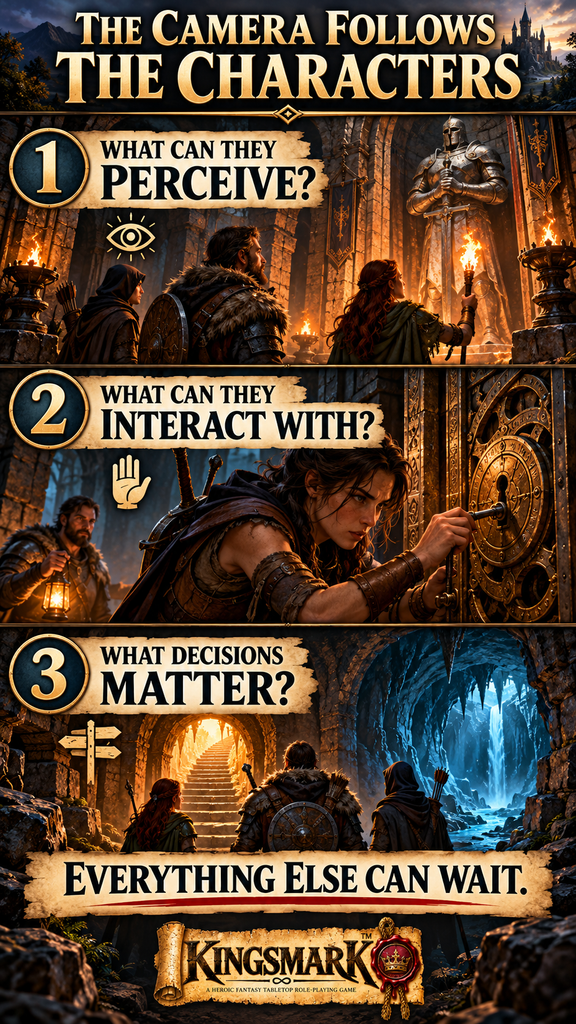
The camera is on the characters. What matters is what they’re experiencing, what they can interact with, and what decisions they can make.
This is how I think about Game Mastering, and it’s one reason I designed 👑Kingsmark around cinematic storytelling. Consider how a movie establishes a nightclub scene. The director doesn’t interrupt the action to explain the building’s architectural history, identify the manufacturer of every piece of furniture, or announce the names of the surrounding streets.
Instead, the audience sees what matters. They hear the music, notice the dangerous individuals standing near the entrance, and recognize the suspicious exchange occurring in the background. A few carefully selected details establish the location’s atmosphere while directing attention toward the developing situation.
Of course, tabletop role-playing games possess something that movies generally don’t: an audience capable of changing the story.
Perhaps one player decides to investigate the nightclub’s ownership. Another wants to climb onto the roof and examine the security systems. A third suspects the bartender is hiding something and decides to question him privately. Suddenly, details that weren’t important a moment ago become relevant.
That’s when I develop them.
If ownership becomes important, I establish who owns the club and how that person acquired it. If the characters investigate the roof, I describe its layout and any security equipment that might reasonably exist. If someone questions the bartender, I determine what the man knows, what he wants, and whether he’s willing to cooperate.
None of those developments requires me to have prepared every possible detail beforehand. They require me to understand the situation, maintain consistency with established information, and respond intelligently to the players.
The same principle applies to medieval fantasy. Imagine four adventurers entering a roadside tavern during a thunderstorm. A frightened courier sits near the fireplace, a heavily armored traveler watches the entrance, and the innkeeper hurriedly conceals something beneath the counter when the party approaches.
Those three observations provide immediate opportunities for investigation, conversation, and speculation. The courier might be carrying a dangerous message, the armored traveler might be waiting for someone, and the innkeeper’s suspicious behavior might have an entirely innocent explanation. The players decide which details interest them, and the Game Master develops the situation accordingly.
Notice something important about this approach. I haven’t described the tavern’s complete floor plan, the ancestry of its owner, the surrounding village’s population, or the local history of brewing. Yet the players already have several things they might want to investigate.
This doesn’t mean environmental details are worthless. A tavern’s name becomes important if the adventurers intend to return, while the location of a staircase matters when armed men begin pursuing someone through the building. The point is that details become valuable when they contribute to atmosphere, interaction, decisions, or consequences.
I recommend asking yourself three questions whenever you prepare or describe a scene: What can the characters perceive? What can they interact with? What information might influence their decisions?
Those questions won’t eliminate every unnecessary detail, but they’ll help you concentrate upon information that contributes directly to gameplay. If an obscure historical fact has no practical relationship to anything the characters are doing, you probably don’t need to develop it right now.
You should, however, maintain continuity. When you invent a character’s name, establish a relationship, or reveal an important fact, write it down. A few brief notes after each session can preserve the developing world’s consistency without requiring an encyclopedia.
🎭 Three People, Two Places, One Problem
One of the greatest mistakes a Game Master can make is preparing a predetermined sequence of events instead of preparing an interesting situation. A sequence assumes that the characters will behave in particular ways, while a situation gives them circumstances to investigate, influence, exploit, or completely ignore. The second approach is generally much more adaptable because it doesn’t depend upon everyone making the decisions you anticipated.
Game designer Justin Alexander explored this distinction in his influential essay, Don’t Prep Plots. His central argument is that Game Masters benefit from preparing situations rather than deciding the narrative sequence through which those situations must unfold. It’s an important observation because player freedom becomes much more meaningful when the world can respond to unexpected decisions.
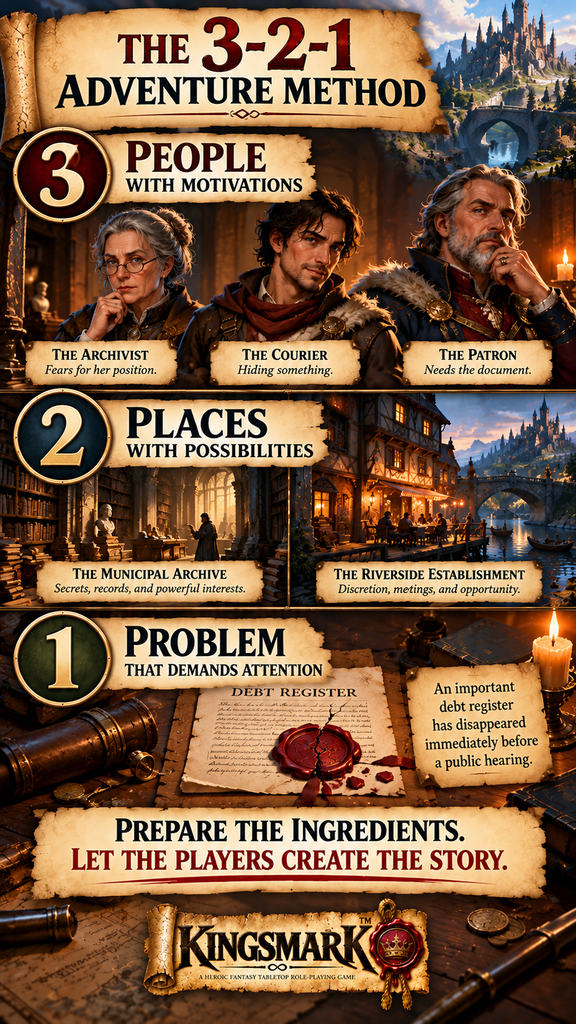
I like to think about this in terms of the smallest collection of ingredients necessary to create an interesting adventure. As a simple preparation exercise, I suggest beginning with three characters, two locations, and one problem. We’ll call this the 3–2–1 Adventure Method.
This isn’t a formal Kingsmark mechanic or an elaborate mathematical formula. It’s simply a way to get your imagination working without convincing yourself that you need to spend the entire afternoon writing a campaign.
Let’s construct an adventure in Sylva, the medieval heroic fantasy setting of 👑Kingsmark.
Our first character is an aging municipal archivist named Marta Veyne. She has spent thirty years maintaining official records and fears that a recent administrative scandal will cost her employment. She is intelligent, stubborn, deeply protective of her reputation, and concealing a mistake that could destroy her career.
Our second character is a young courier named Tomas Renn. He possesses an easy smile, considerable charm, and a reputation for delivering messages quickly. Unfortunately, he has been lying about his movements during the past several days, and someone has begun asking dangerous questions about him.
Our third character is Lord Edric Halden, a wealthy landowner involved in an increasingly bitter dispute over property rights. He desperately needs a particular historical document recovered because its contents could determine who legally controls several valuable estates. He possesses money, political connections, and enough ambition to make his involvement potentially dangerous.
There’s our three characters. Notice that I’ve given each of them a personality, an immediate concern, and a reason to become involved in the same developing situation. I haven’t written their complete biographies, identified their grandparents, or decided how their personal stories must eventually conclude.
Next, we establish two locations.
The first is the municipal archive, a fortified administrative building containing legal records, financial accounts, property documents, and correspondence. Its employees spend their days maintaining records that powerful people would occasionally prefer to see destroyed. There are guards, locked rooms, valuable documents, and considerable opportunities for intrigue.
The second is an elegant riverside establishment frequented by wealthy merchants, officials, and people conducting business that benefits from discretion. It possesses private meeting rooms, excellent food, discreet employees, and a reputation for keeping its patrons’ conversations confidential. That’s enough information for now.
Finally, we introduce one problem: An important debt register has disappeared immediately before a public hearing.
The missing document contains financial obligations and property claims that could ruin several influential families. Marta fears being blamed for its disappearance, Tomas delivered something suspicious on the night it vanished, and Lord Halden has offered a substantial reward for its recovery.
There. We have an adventure.
But what is the story?
We don’t know yet, because the players haven’t done anything.
Perhaps the adventurers accept a Contract to recover the document. They question Marta, investigate the archive, and discover evidence suggesting that someone with access to official records deliberately removed the register. This might become an investigative adventure involving deception, political influence, and dangerous discoveries.
Alternatively, the characters might approach Tomas, suspect that he knows more than he’s admitting, and attempt to negotiate with him. Perhaps they discover that the courier is protecting someone who would be ruined if the document became public. What initially appeared to be a straightforward theft could become a moral dilemma.
A third group might decide that recovering the register isn’t nearly as profitable as acquiring it themselves. They could investigate Lord Halden’s enemies, offer information to rival families, or attempt to sell the document to the highest bidder. Suddenly, the adventurers aren’t solving a political scandal — they’re participating in one.
These possibilities emerge from exactly the same prepared material. I haven’t needed to write three different adventures because the characters, locations, and central conflict provide enough substance to support several possible developments.
And those are only three possibilities that I have imagined. Your players might come up with something completely different, which is precisely what makes the game interesting.
This is where NPC motivations become extraordinarily useful. When you understand what someone wants, what they’re afraid of, and what they’re prepared to do, you can respond to unexpected developments without consulting a detailed script. Lord Halden might threaten the adventurers, attempt to purchase their loyalty, or appeal to their sense of justice depending upon how they approach him.
Likewise, Marta might cooperate with a respectful investigation but become defensive when threatened. Tomas might attempt to flee, admit part of the truth, or seek protection from the very adventurers who originally suspected him. These responses follow naturally from their circumstances and personalities.
You can deepen these characters through play instead of developing every aspect of their lives beforehand. For additional ideas, my article Creating Memorable Fantasy Heroes explores how believable motivations, personalities, and histories contribute to memorable characters. Many of those principles apply equally well to the people Game Masters introduce into their campaigns.
Another advantage of the 3–2–1 approach is that it helps prevent railroading. When you’ve spent twelve hours constructing a specific confrontation, you may feel considerable pressure to make sure the characters experience it. When you’ve only prepared a few people with understandable motivations, you’re free to let events unfold without protecting your investment in a predetermined outcome.
There’s nothing wrong with developing additional material when you enjoy doing so. Perhaps you’re fascinated by medieval architecture, historical politics, or the elaborate structure of a criminal organization. Those interests can produce extraordinary campaigns, provided you recognize that extensive preparation should serve the adventure rather than become an obligation.
The important thing is knowing when you already have enough to begin.
If this style of Game Mastering interests you, the complete 👑Kingsmark Player’s Handbook is free to read online at Kingsmark.Games. Its rules are designed to support creative actions, believable consequences, and adventures that develop through player decisions. Support the game by purchasing a digital copy.
🎲 Know Your Game, Not Every Possible Outcome
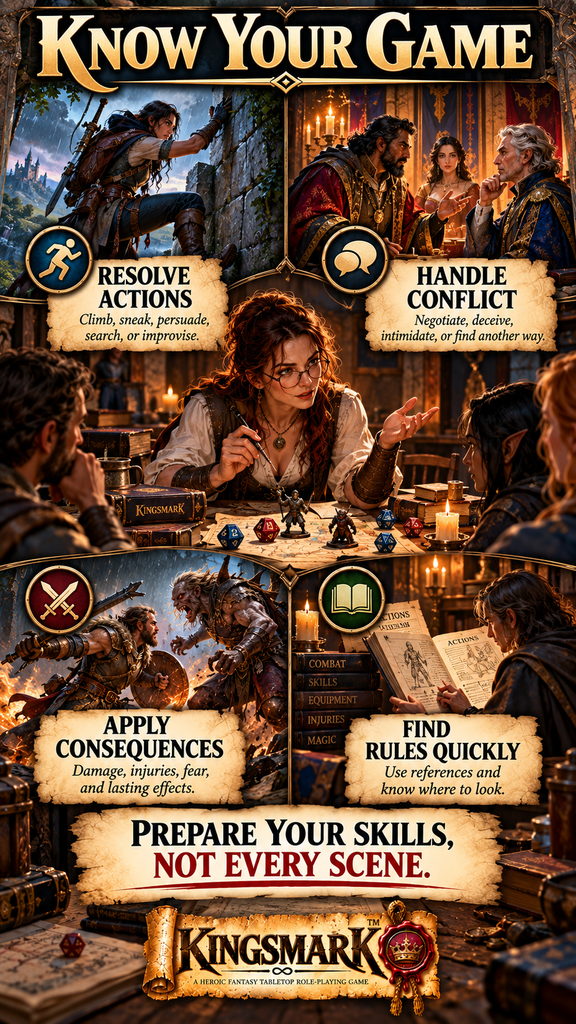
Improvisation becomes considerably easier when you understand the system you’re using. A Game Master who knows how to resolve uncertain actions, establish difficulties, conduct combat, and apply consequences possesses a tremendous advantage over someone who must consult a rulebook every time the players do something unexpected. That familiarity provides the confidence necessary to introduce situations without first writing a detailed explanation of how every possible event will be resolved.
Suppose an adventurer attempts to climb a fortress wall during a thunderstorm. You don’t need a specially prepared climbing encounter if you understand how your game handles physical challenges. You consider the character’s capabilities, the difficulty of the climb, the environmental conditions, and the consequences of failure.
Perhaps the character succeeds, slips while halfway up, or discovers that a section of masonry is unstable. The rules provide a method for determining what happens, while the circumstances provide the dramatic meaning. You can make the situation interesting without having written it down beforehand.
The same principle applies to social encounters. If an adventurer attempts to intimidate a guard, deceive an official, or persuade a merchant to reveal confidential information, you need a method for evaluating the attempt. The encounter doesn’t require a prepared dialogue tree containing fifteen possible responses.
In 👑Kingsmark, ⭐Jack’s Cinematic d12 provides a common foundation for handling uncertain actions. Characters possess 💪Attributes, five 🌈Attribute PRISMs, and twenty-four ⚒Skills, with appropriate Tests resolved through a twelve-sided die and the relevant character capabilities. The Game Master establishes Realism Target Numbers according to the circumstances rather than inventing an entirely new resolution system for every situation.
You can study these procedures in Chapter 1 — 💪Attributes, Chapter 2 — 🌈Attribute PRISMs, and Chapter 3 — ⚒Skills. Understanding these fundamental mechanics provides a foundation for resolving an enormous range of situations. Instead of memorizing hundreds of hypothetical circumstances, you learn how the underlying system works.
Combat requires additional familiarity because events can unfold quickly and mistakes may have serious consequences. You should understand ⏳Initiative, Action Points, attacks, defenses, movement, and the effects of injuries. You don’t need every possible encounter memorized, but you should know enough to make an unexpected fight manageable rather than turning it into a forty-minute rules consultation.
Kingsmark distinguishes between 🗨️Dialog Scenes and ▶️Action Scenes, providing procedures for different kinds of dramatic activity. Its Chapter 11 — ▶️Action Scenes explains combat timing, ⏳Initiative, and Action Points, while Chapter 12 — 🎬Example Actions illustrates the variety of activities characters can attempt. The system includes approximately 108 example Actions, but those examples aren’t intended to become a prison limiting characters to a fixed menu of possibilities.
A warrior might attempt to disarm an opponent, intercept an attack, shove someone through a doorway, or use nearby furniture as an improvised obstacle. If you understand how the established mechanics operate, you can adjudicate creative attempts without preparing each maneuver as a separate encounter. I discuss this philosophy further in Why “I Attack” Isn’t Enough.
Of course, dangerous actions require meaningful consequences. In Kingsmark, characters experience 🩸Physical Trauma and 🧠Mental Trauma rather than conventional pools of Hit Points, and Chapter 13 — 💥Damage & Defense explains how those systems operate. A Game Master who understands injuries, defenses, equipment, and recovery can introduce dangerous encounters with greater confidence.
None of this means you must memorize a 556-page Player’s Handbook before running your first session. Understanding the rules and knowing where to find them are different skills, and both are valuable. Keep useful references available, practice common procedures, and become comfortable applying the system to circumstances you haven’t encountered before.
A particularly effective exercise is to run a short practice encounter involving two characters. Establish ⏳Initiative, determine their Action Points, resolve several Actions, and see how damage influences the confrontation. Repeat the exercise with different circumstances until the underlying procedures begin to feel natural.
Over time, that practical experience becomes a form of preparation you carry into every future session. The better you understand your game, the less additional work you need to perform merely to feel ready.
🔮 Let the Adventure Unfold: Improvisation, Oracles, and Consequences
Something remarkable happens when a group of imaginative people begins playing a tabletop role-playing game. One person says something unexpected, another responds, somebody makes a decision, and the Game Master describes what happens next. Before long, the group has created a developing situation that nobody could have completely anticipated.
This is one of the reasons I enjoy Game Mastering. I don’t have to know the entire adventure in advance because the players are continuously introducing new information through their decisions. Their actions create consequences, those consequences produce additional circumstances, and those circumstances inspire further decisions.
An adventure can generate its own momentum.
Imagine our missing debt register investigation has begun. The adventurers question Marta, examine the municipal archive, and discover that Tomas visited the building shortly before the document disappeared. They follow him through the city, but instead of attempting to capture him, one character offers him money in exchange for information.
Now I need to decide how Tomas responds. He might be frightened, greedy, suspicious, desperate, or surprisingly willing to cooperate. His decision depends upon his established motivations, the circumstances, and what the adventurers have actually said.
Suppose he admits that he delivered a sealed package but insists that he never knew what it contained. He also reveals that the person who hired him was wearing the official insignia of a respected noble household. Suddenly, the investigation has taken a different direction, and the players have several new decisions to consider.
Did I need to write that conversation beforehand? No. I needed to understand Tomas well enough to portray him, recognize the significance of his information, and develop the situation naturally.
The best improvisation isn’t necessarily an endless stream of brilliant inventions. Much of it consists of recognizing the logical implications of information that already exists. If someone steals an important document, somebody wants it, somebody fears its contents, and somebody may be willing to commit further crimes to acquire or suppress it.
Those relationships give you material to develop.
When You Don’t Know the Answer, Ask an Oracle
Sometimes even an experienced Game Master encounters a question that doesn’t have an immediately obvious answer. Perhaps the players ask whether a particular witness is still in town, whether the abandoned building has another entrance, or whether someone has already discovered the hidden evidence. Rather than interrupting the game to construct a complete explanation, the GM can use an oracle.
An oracle is a tool for introducing uncertainty, generating inspiration, or resolving questions that haven’t already been answered by established facts. Some oracles produce simple answers, while others provide prompts that require interpretation. Their purpose isn’t to replace the Game Master’s imagination but to give that imagination something useful to work with.
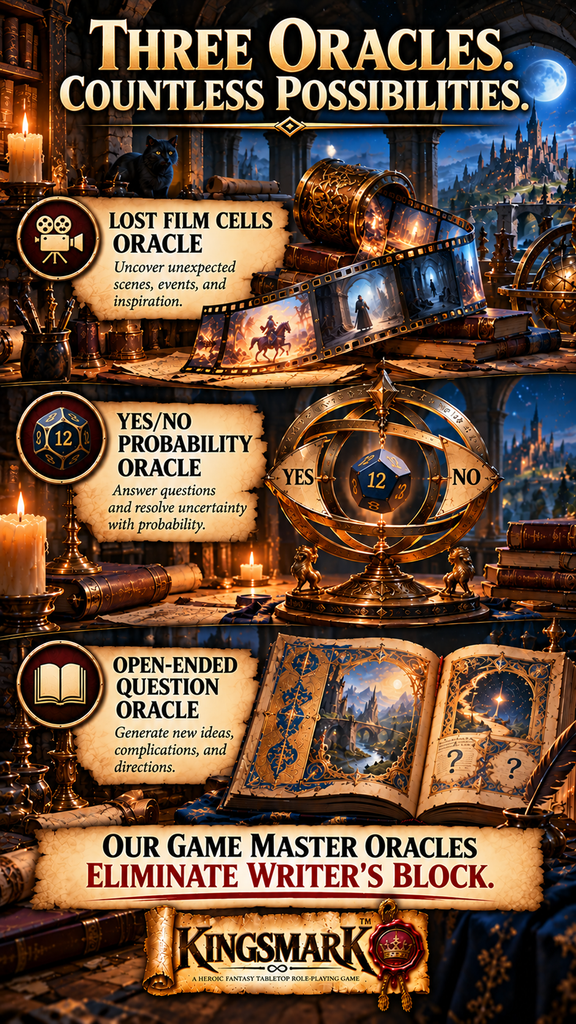
Kingsmark officially employs three such resources: the Lost Film Cells Oracle, the Yes/No Probability Oracle, and the Open-Ended Question Oracle.
Consider the Yes/No Probability Oracle. The adventurers have discovered that Tomas may be hiding from several dangerous people, and one player asks whether the courier is still staying at his usual residence. The GM hasn’t established his current whereabouts and sees no reason that the answer must be predetermined.
Instead of automatically deciding whichever answer seems most convenient, the Game Master considers how likely Tomas is to remain there and consults the oracle. If the answer is yes, the characters might find him packing his belongings. If the answer is no, they may discover that he fled several hours earlier.
Both outcomes create possibilities.
The important distinction is that probability should reflect the circumstances. If Tomas knows that armed men are hunting him, his remaining at home might be unlikely. If he believes nobody suspects him, he may have no reason to leave.
An oracle shouldn’t override something already established as true. If the adventurers personally watched Tomas enter a locked room and nobody has had an opportunity to leave, randomly determining that he has vanished would require an explanation. Randomness should introduce uncertainty where uncertainty belongs, not make the world behave like an idiot.
The Open-Ended Question Oracle serves a different creative purpose. Instead of asking whether something is true, the GM asks a question that invites a broader interpretation. What unexpected complication has arisen? What unusual detail attracts the adventurers’ attention? What has changed since their last visit?
Suppose the adventurers return to the municipal archive and discover that its entrance has been sealed by soldiers. Rather than deciding every detail deliberately, the GM consults the oracle for inspiration about the circumstances. An unexpected prompt might suggest betrayal, interference, secrecy, or some other development that can be interpreted within the existing situation.
Perhaps Lord Halden has convinced an official to secure the building, ostensibly to preserve evidence. Perhaps Marta has been arrested, or someone has accused the adventurers themselves of involvement in the theft. The Game Master uses the inspiration to create a believable development rather than mechanically forcing an unrelated event into the story.
The Lost Film Cells Oracle provides another means of drawing inspiration when the Game Master wants an unexpected development or a fresh perspective upon a scene. Its place within Kingsmark’s cinematic approach is particularly interesting because we can imagine the developing adventure as a collection of moments whose relationships are not always immediately apparent. The GM can use an oracle prompt as creative material, interpreting it in light of the characters and the circumstances already established.
The official Kingsmark oracles are intended to become additional resources at Kingsmark.Games. Their individual instructions should be consulted when available, but the broader principle remains useful regardless of which oracle system you prefer. A random prompt is most valuable when it helps you recognize a possibility you might not otherwise have considered.
This approach isn’t unique to Kingsmark. Systems such as Mythic Game Master Emulator and Ironsworn have explored the use of oracles and interpretive prompts to generate developments during play, including adventures conducted without a traditional Game Master. Their popularity demonstrates the creative possibilities of combining random information with human interpretation.
But here’s something important: You don’t need to consult an oracle every five minutes.
If a situation already has an obvious, reasonable answer, use it. If a character’s established motivations explain how he should respond, portray him accordingly. If you understand the world and can imagine what happens next, continue playing.
Oracles are most useful when you’re uncertain, when several outcomes appear plausible, or when you deliberately want an element of surprise. They should help the game move forward rather than becoming another procedure everyone must endure before anything interesting can happen.
Let Consequences Become Your Next Adventure
One of the most powerful sources of material for a Game Master is the previous session. Everything the characters accomplish leaves some kind of impression upon the world, and those effects can generate future opportunities without requiring the invention of entirely unrelated adventures.
Suppose the adventurers recover the debt register and return it to its rightful custodian. Lord Halden is furious because its contents reveal that several valuable estates were acquired through questionable financial arrangements. One family celebrates, another faces ruin, and a powerful official begins investigating how the document disappeared in the first place.
What happens next practically writes itself.
A grateful merchant offers the characters employment. An embarrassed nobleman attempts to discredit them. Someone who benefited from the original fraud decides that the adventurers know far too much, while a young relative of one disgraced family seeks their assistance for an entirely different reason.
None of these developments requires a predetermined campaign narrative. They emerge from what the characters actually accomplished and how other people reasonably respond.
This is why I consider consequences more valuable than complicated plots. A well-developed campaign gradually accumulates friendships, enemies, debts, reputations, obligations, unfinished business, and opportunities. The longer the characters participate in the world, the more potential adventures that world begins generating.
It also means that player ambitions can contribute directly to your preparation. A Monster Hunter who wants to establish a reputation gives you a reason to introduce dangerous creatures and lucrative Contracts. A ⚔Man-at-Arms seeking a permanent position might become involved with a noble household, while a 🧙♂️Wizard searching for lost knowledge may inspire an expedition into an ancient ruin.
Their desires provide opportunities that are naturally meaningful because those players have already demonstrated an interest in pursuing them. My article Beyond the Character Sheet explores how characters become more interesting when players develop their personalities, relationships, and personal histories beyond numerical statistics.
Naturally, player creativity should influence the story without automatically determining what is true. If a character suspects that the innkeeper belongs to a secret society, that suspicion doesn’t require you to establish that he does. Sometimes an innkeeper is simply an innkeeper, and the mysterious behavior that attracted attention has an entirely ordinary explanation.
The important thing is allowing the players to investigate, draw conclusions, make mistakes, and experience meaningful results. Their decisions should matter even when their assumptions turn out to be wrong.
And what if the session begins losing momentum?
Introduce a development that follows naturally from the circumstances. Someone approaches the characters with an offer, a previously established enemy takes action, an unexpected discovery changes the situation, or a decision from an earlier adventure produces consequences. You might also introduce a dangerous situation that requires immediate attention, provided it makes sense within the world.
Not every complication needs to involve combat. A desperate request for assistance, a public accusation, a stolen possession, a mysterious visitor, or an approaching storm can all create new possibilities. Sometimes the most exciting development is simply the discovery that someone the characters trusted has been lying.
The key is recognizing that you don’t have to force every scene toward an encounter you’ve already prepared. Give the world enough substance to respond to the characters, and allow those responses to inspire whatever happens next.
⏱️ Prepare What You Cannot Easily Improvise
After everything I’ve said about improvisation, I want to make something absolutely clear. There are many situations in which preparation is not only useful but essential to creating a satisfying experience. The objective isn’t to eliminate preparation merely so you can boast about arriving at the gaming table with absolutely nothing prepared.
The objective is to concentrate your preparation upon whatever would be difficult to create convincingly during play.
Consider an elaborate murder mystery involving several suspects, conflicting testimony, and physical evidence. If you invent every clue spontaneously without understanding what actually happened, you may create contradictions that make the mystery impossible to solve. Players can become frustrated when evidence changes unpredictably or the solution appears to depend upon whatever the Game Master happens to invent next.
For mysteries, I recommend studying Justin Alexander’s Three Clue Rule. Its fundamental principle is that important conclusions should generally have several discoverable clues rather than depending upon one easily overlooked piece of information. That kind of preparation creates a more resilient investigation without requiring you to predict exactly how the characters will conduct it.
Complex tactical encounters also deserve attention. If the players are preparing to assault a fortified stronghold, understanding the terrain, defensive positions, available troops, and important environmental features can substantially improve the experience. You don’t need to script every sword stroke, but having usable maps and reliable statistics prevents unnecessary interruptions.
The same principle applies to complicated traps, unusual monsters, unfamiliar magic, and important equipment. Kingsmark provides reference material in 📎Appendix A — Actions, 📎Appendix B — Bestiary, and 📎Appendix E — Equipment. Knowing where to find relevant information helps the GM maintain momentum while resolving unexpected situations consistently.
If you enjoy constructing elaborate dungeons, you should absolutely continue doing so. My article How to Create a Dungeon Adventure examines how meaningful locations, environmental storytelling, mysteries, and danger can make exploration more satisfying. The difference is that you’re developing a place with understandable features and possibilities rather than a mandatory sequence of encounters.
For a practical demonstration of prepared material that preserves substantial uncertainty, examine 📎Appendix D — Dungeon in the Kingsmark Player’s Handbook. Its introductory adventure material establishes locations, characters, Missions, and important procedures while using randomized elements to vary the circumstances. The location is prepared, but the resulting adventure isn’t required to unfold identically every time.
The Fifteen-Minute Adventure Challenge
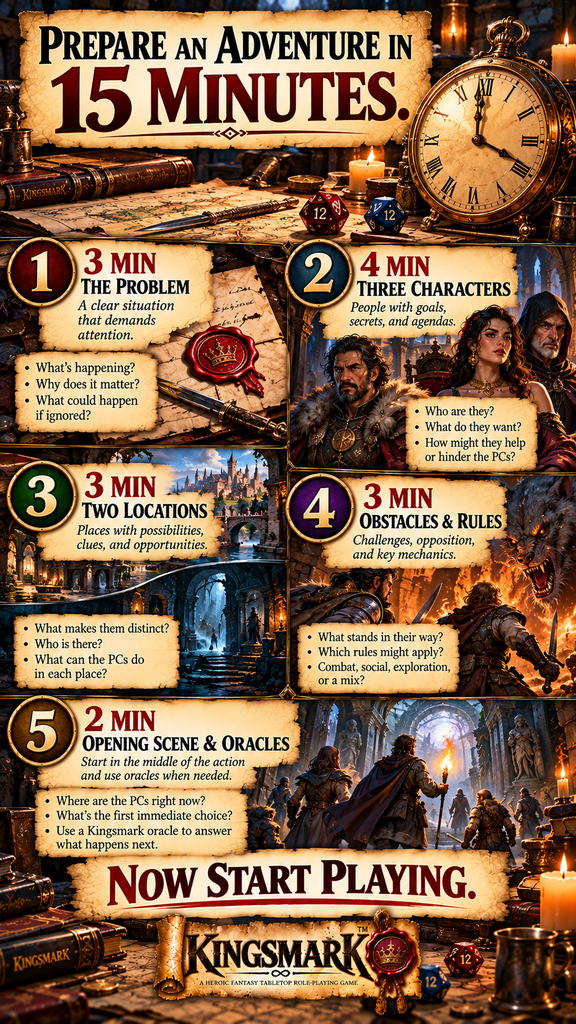
If you’re accustomed to spending several hours preparing every session, I recommend trying an experiment. Give yourself fifteen minutes to assemble the foundation for an adventure, using a game system you already understand. Don’t worry about creating an unforgettable masterpiece — concentrate upon preparing enough useful material to begin playing.
During the first three minutes, establish one immediate problem. Perhaps someone has disappeared, a valuable object has been stolen, travelers are being attacked, or an important agreement has been broken. The problem should provide a reason for the characters to become involved without dictating how they must respond.
Spend the next four minutes creating three characters with distinct motivations. Give each a name, a recognizable personality, and something they want or fear. Remember that a character’s motivation is often much more useful than a long biography because it helps you determine how that person responds when the players do something unexpected.
Use another three minutes to establish two locations where interesting developments might occur. Describe each in a few sentences, concentrating upon atmosphere, useful features, and potential interactions. You don’t need a map of every room unless the location’s layout will be important to the actual gameplay.
Spend three minutes considering likely obstacles and reviewing any rules that might be unfamiliar. Perhaps the adventure could involve a dangerous creature, a difficult negotiation, or an environmental hazard. Prepare the statistics or references most likely to save time if those situations arise.
Finally, spend two minutes creating the opening scene and making your oracle references available. Determine where the characters begin, what immediate situation attracts their attention, and what information they possess. Then you’re ready to introduce the world and ask the players what they want to do.
That’s fifteen minutes of preparation.
Does that guarantee an exciting four-hour adventure? Of course not. The quality of the session will depend upon the people involved, the Game Master’s capabilities, the developing circumstances, and the decisions everyone makes. But it does demonstrate how little written material may be necessary to begin an adventure when you understand the game and can improvise confidently.
If you’re a beginning Game Master, you may need considerably more time to learn the rules and become comfortable handling unexpected events. That’s perfectly reasonable, and there’s no particular virtue in rushing through preparations that would genuinely improve your confidence. The fifteen-minute exercise is a challenge intended to develop your improvisational abilities, not a universal standard by which every GM should be judged.
Experienced Game Masters also differ considerably in their preferences. Some love drawing elaborate maps, researching historical details, designing complicated encounters, or developing entire fictional cultures. If those activities bring you enjoyment, they aren’t wasted merely because every detail doesn’t appear during the next session.
The problem begins when preparation stops being an enjoyable creative activity and becomes an exhausting obligation. I’ve explored the broader pressures placed upon Game Masters in Is It Fun to Be a Game Master?, including the unnecessary responsibilities that can make the position feel more like unpaid employment than a recreational hobby.
Mike Shea, the author behind Sly Flourish, has also spent years developing practical approaches to efficient session preparation. His Return of the Lazy Dungeon Master offers a flexible framework for concentrating preparation upon useful material, including character interests, potential scenes, important NPCs, and information the adventurers might discover. It’s worth examining because effective preparation doesn’t have to mean extensive preparation.
Ultimately, the best method is whatever allows you to run an enjoyable session without unnecessarily exhausting yourself beforehand. A Game Master who requires two hours of preparation to create an excellent experience isn’t doing anything wrong. But if that same GM could create an equally enjoyable experience with thirty minutes of focused work, the additional ninety minutes might be better spent doing something else.
The greatest pleasure of Game Mastering isn’t necessarily watching players experience the adventure you carefully constructed. Sometimes it’s witnessing them do something so unexpected that you suddenly discover an exciting possibility you hadn’t considered. A seemingly insignificant conversation becomes the beginning of a political conspiracy, an ordinary roadside encounter produces a lifelong enemy, or an impulsive decision leads the party into an entirely new adventure.
Those moments remind us that tabletop role-playing is fundamentally different from reading a novel or watching a movie. The story belongs to the people participating in it, and nobody — including the Game Master — needs to know exactly how everything will unfold.
The Game Master’s responsibility is to understand the world, adjudicate the rules, portray believable characters, and ensure that decisions have meaningful consequences. Good preparation makes those responsibilities easier, but excessive preparation can create unnecessary work and make unexpected developments feel like interruptions rather than opportunities.
So before your next session, ask yourself whether you genuinely need another six pages of notes, another dozen character biographies, or a complete architectural survey of the tavern where the adventurers intend to spend the evening. Perhaps you would accomplish more by developing three interesting characters, understanding their motivations, reviewing a few important rules, and trusting your ability to improvise.
You don’t have to know how the adventure ends. Sometimes the most exciting discovery of the evening is the one that surprises the Game Master.
If you’re interested in experiencing a heroic fantasy game built around cinematic action, character freedom, and meaningful consequences, the complete 👑Kingsmark Player’s Handbook is FREE to read online at Kingsmark.Games. Explore the rules, create your characters, gather your companions, and begin your own adventures in the world of Sylva.
Support the game by purchasing a digital copy.
👑 Kingsmark — A World of Danger. A World of Consequence. A World Waiting for Your Legend.
About The Author