Why “I Attack” Isn’t Enough
Reinventing Cinematic Combat in Fantasy TTRPGs
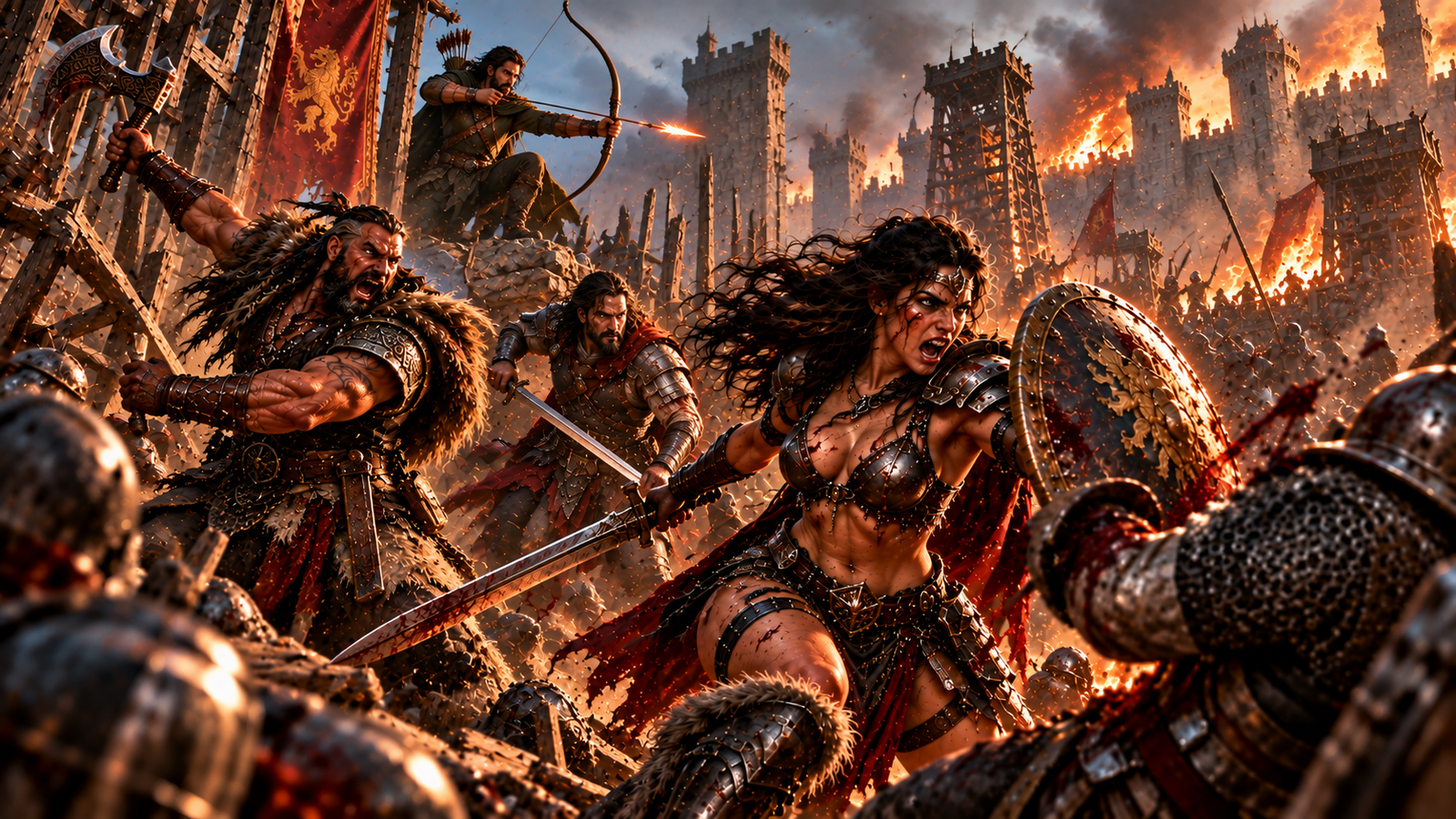
Imagine four adventurers defending the gatehouse of a medieval castle against twenty armed enemies. The attackers have already broken through the outer defenses. Arrows are striking the stonework, smoke is filling the courtyard, and someone is desperately trying to force open the inner gate.
A heavily armored Shield Maiden steps forward to confront the first intruder. Behind her, a Dwarf struggles to secure a damaged barricade. An archer takes position above the courtyard, searching for an opportunity to stop the attackers before they reach the gate. The fourth adventurer, a wounded veteran, realizes that the enemy is preparing to flank them through an adjoining passage. The situation is deteriorating rapidly, and every character has decisions to make.
Now imagine that the Game Master turns to the first player and asks what her character does. She replies, “I attack.” The player rolls a die, announces the result, and waits to hear how much damage the enemy suffers.
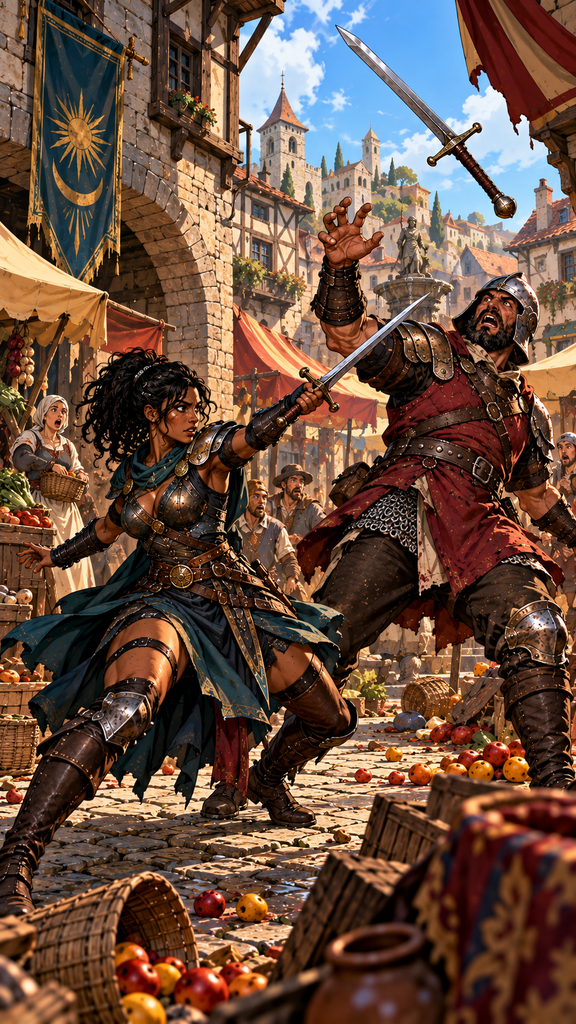
There is nothing inherently wrong with that exchange. Making attacks is an essential part of combat, and a simple attack roll can resolve an exciting moment. But if the entire battle becomes a repeating sequence of attacks, damage rolls, and waiting for another turn, an enormous amount of dramatic potential is being overlooked.
What about driving an enemy backward into his companions, disarming a swordsman rather than attempting to kill him, or using a shield to block a narrow passage? What about distracting an opponent so a companion can escape, diving behind cover before a volley of arrows arrives, or wrestling an enemy to the ground and binding him? What if the warrior could draw her sword, advance toward an opponent, exchange blows, and then scramble behind a barricade during the same Turn?
These were among the questions that shaped the combat system I created for 👑Kingsmark, my heroic fantasy tabletop role-playing game powered by ⭐Jack’s Cinematic d12. I wanted combat to resemble the extraordinary battles depicted in adventure films, historical epics, and heroic fantasy literature.
Characters should be capable of remarkable feats, intelligent opponents should behave like people trying to survive, and the environment should be more than a painted background. Most importantly, I wanted players to think about what their characters were actually doing rather than simply looking for the next opportunity to announce another attack.
Traditional fantasy role-playing games are not necessarily lacking in tactical options. Many provide rules for grappling, shoving, defending, maneuvering, interrupting, and interacting with the environment. Dungeons & Dragons, for example, has developed numerous combat options throughout its history, and its modern rules provide weapon-specific abilities and other tactical possibilities. The deeper question is how naturally those possibilities fit into the ordinary flow of play.
When designing Kingsmark, I wanted the game’s combat procedures to encourage players to imagine an action scene first and then determine how the rules would resolve it. Instead of treating each Turn as a single isolated activity, I wanted players to experience a continuous struggle in which several meaningful actions could occur in rapid succession.
A warrior might begin an encounter with a sword in its scabbard, draw it while advancing toward an opponent, deliver a strike, then retreat behind cover. Another might spend most of his available time preparing a particularly difficult maneuver. Neither character should be forced into the same rigid sequence merely because both are participating in combat. Their choices, physical capabilities, and the immediate circumstances should determine what they can accomplish.
The foundation of this approach is Kingsmark’s Action Point system. Every character normally receives five Action Points during a ⏸Turn, modified directly by their Speed Attribute. A character with Speed +2 receives seven Action Points, while someone with Speed −1 receives four. Characters within the normal Speed range can possess anywhere from two to nine Action Points, making speed and physical responsiveness important considerations when planning combat tactics.
These points are not stamina, magical energy, or a reservoir of effort that becomes depleted through exertion. They represent an abstraction of the limited time a character has to perform activities during a rapidly unfolding encounter.
Kingsmark organizes actions into three general categories: 🟡Flair Actions cost one Action Point, 🟠🟠Swift Actions cost two, and 🔴🔴🔴🔴Starring Actions cost four. Flair Actions are brief activities, such as drawing an accessible weapon, retrieving something immediately within reach, or making a short utterance. Swift Actions occupy a more substantial portion of the Turn and include ordinary melee attacks, aiming, changing stance, and many combat maneuvers.

Starring Actions represent greater commitments of time, such as Sprinting, performing particularly demanding maneuvers, or casting powerful magic. The character may combine actions whose total cost does not exceed their available Action Points, allowing players to construct remarkably varied sequences from a relatively straightforward framework.
Consider a warrior with Speed +2 and seven Action Points. The player imagines drawing a sword, moving toward an enemy, striking him, and then diving behind a nearby stone barricade. Mechanically, drawing the sword costs one Action Point. Ordinary Double-Time movement requires no separate Action Point expenditure because it occurs alongside other activity during the Combat Round.
The melee attack costs two Action Points, and the Dive for Cover action costs another two. The character has spent five of seven Action Points, leaving two available for another suitable action. There is no need to invent a special procedure for this sequence because the player describes what the warrior does, and the established Action Point system accounts for the individual activities.
This produces an important distinction between cinematic freedom and unlimited freedom. A character cannot simply perform anything imaginable without considering time, position, ability, or consequences. Actions still require the necessary physical circumstances and sufficient Action Points.
A character who spends most of their Turn Sprinting cannot necessarily perform an elaborate attack afterward, and someone cannot spend two Action Points upon a maneuver that explicitly requires four. I wanted the rules to establish practical limitations without interfering unnecessarily with the player’s imagination.
Movement deserves particular attention because it is one of the areas where combat systems can unintentionally make characters feel less dynamic than the situations they are supposed to represent. In Kingsmark, Walking and Double-Time movement do not consume separate Action Points because characters are understood to move while performing other compatible activities. Sprinting, by contrast, requires four Action Points because moving at maximum speed demands a substantial commitment of time.
Combat Rounds represent approximately three to ten seconds of cinematic action. Although characters act according to ⏳Initiative, their movements and activities are understood to overlap within the fictional world. The rules organize that chaos into something human players can follow; they do not imply that everyone else freezes while one adventurer performs their actions.
This distinction becomes especially valuable during battles involving several combatants, constantly changing positions, and complicated interactions with the environment. A character may be moving toward an enemy while drawing a weapon, another may be desperately trying to reach a wounded companion, and someone else may be attempting to escape through a crowded passage. Their movements belong to the same unfolding scene rather than existing as unrelated events.
Kingsmark contains well over one hundred example actions, including ordinary attacks, defensive maneuvers, disarming opponents, grappling, throwing, aiming, intercepting movement, assisting companions, and numerous other activities. However, I did not create that extensive collection because I wanted players to memorize a hundred commands. The opposite is true. These actions are examples of what characters can attempt, not an exhaustive list defining the limits of imagination.
A player should be able to describe an entirely reasonable activity that is not specifically named in the Player’s Handbook, and the Game Master can determine its Action Point cost and resolve the attempt through an appropriate Test or established procedure. If a player says, “I want to overturn that table and use it to obstruct the doorway,” the appropriate response is not to search desperately for an ability named Overturn Table.
The Game Master should consider the weight of the table, the character’s Strength, the position of nearby opponents, the available time, and whether anyone is actively resisting. The outcome should emerge from those circumstances.
The player’s imagination supplies the intention, while the rules determine what happens when that intention encounters resistance, uncertainty, and the physical realities of the world.
This philosophy also governs combat maneuvers against other characters. An ordinary melee attack in Kingsmark is resolved through an opposed exchange in which the attacker and defender each roll 1d12 with the appropriate 🌈Attribute PRISM and combat Skill. The defender’s result establishes the attacker’s Base Target Number, which is then modified by relevant circumstances. The resulting margin determines what the attacker can accomplish.
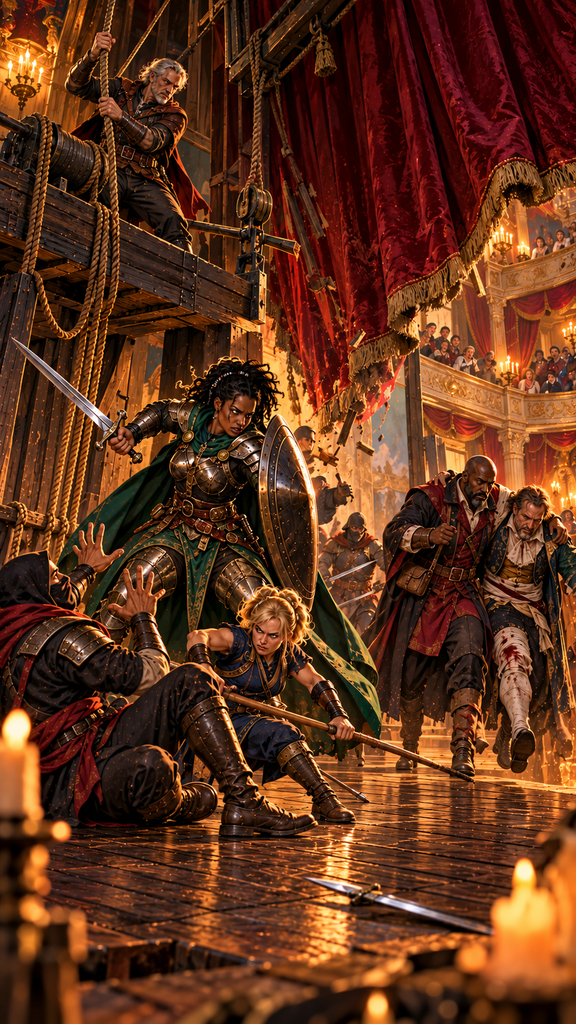
During an ordinary melee exchange, the attacker may choose an eligible strike or maneuver after seeing the opposing results, allowing the outcome to inform whether the combatant delivers a normal blow, attempts to Disarm, forces the opponent backward, or achieves another legal result.
The decision remains limited by the Action Points already spent, the character’s equipment, the available position, and any special prerequisites. An attacker cannot retroactively transform a two-point attack into a four-point maneuver or claim a physical opportunity that did not exist. This approach allows a degree of spontaneity without turning combat into unrestricted improvisation. The dice establish what opportunities the combatant has created, and the player decides how to use an eligible opportunity within the established circumstances.
For example, the 🟠🟠Disarm action requires the attacker to overcome the opponent’s modified defensive result by an additional two points. A successful Disarm knocks the opponent’s weapon from their hand, potentially forcing them to recover it, draw another weapon, or continue fighting unarmed.
The 🟠🟠Push Back maneuver requires an additional one-point margin and can force an opponent five feet backward, with greater margins potentially increasing the distance. If an enemy is standing near an unprotected ledge, that positioning becomes genuinely dangerous. A 🟠🟠Trip, Sweep, or Takedown attempt also requires a greater margin than an ordinary strike and can force an opponent Prone.
These choices change the situation rather than merely changing the quantity of damage inflicted.
A successful Disarm may end an enemy’s immediate threat without killing him. A successful Trip can disrupt movement and require time to stand again. Pushing an enemy backward may open a route through a blocked doorway, create space for an injured companion, or send a combatant into hazardous terrain.
Even when a maneuver inflicts no direct wound, its tactical value can be substantial, particularly when the player understands how the opponent’s position, equipment, and objectives influence the encounter.
Return to our four adventurers defending the castle gatehouse. The first enemy has forced his way through the shattered doorway. He carries a sword and shield, and several other soldiers are pressing forward behind him. The Shield Maiden has an excellent defensive position near the entrance. She could simply attack the intruder and attempt to wound him, but she recognizes that allowing more enemies into the courtyard would expose her companions to overwhelming numbers. Instead, she decides to hold the passage.
On her Turn, she adopts 🟠🟠Defensive Stance, spending two Action Points to concentrate upon resisting incoming attacks. This grants two points of defensive Advantage until the beginning of her next Turn, making her more difficult to overcome when she can perform an appropriate deliberate defense.
She may spend her remaining Action Points upon other legal activities, but the tactical purpose of her choice is clear. She is trying to survive and control the narrow entrance rather than pursue the greatest possible immediate damage. Her actions are influenced by the actual circumstances, and those circumstances give her decisions meaning.
A second enemy attempts to rush past her toward the wounded veteran, introducing another important Kingsmark mechanic: Intercepting Movement. Characters do not automatically become passive merely because another person’s Turn is being resolved. When an enemy actually moves through a position where someone can physically interfere, an eligible character may attempt a FREE Intercepting Action.
A character normally receives one such interception per Combat Round, and depending upon the circumstances, the interception may involve attacking, blocking, tripping, or grabbing the moving character.
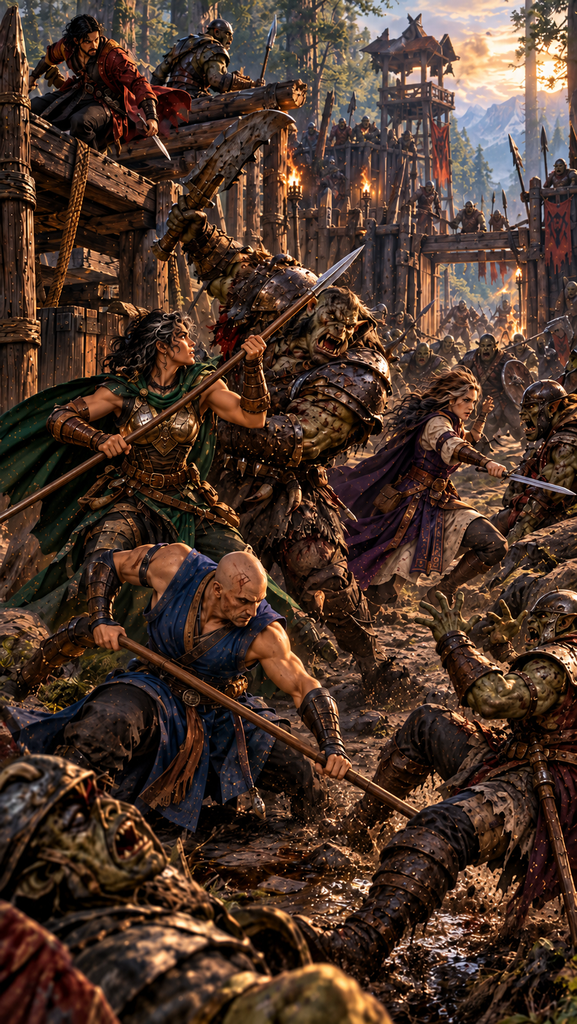
The encounter is resolved through an appropriate Opposed Test, and the interceptor must genuinely occupy a position from which interference is possible. Our Shield Maiden could attempt to Block the rushing enemy with her shield. If successful, she denies that route for the remainder of the moving character’s current Turn, forcing the enemy to stop, find another available path, or spend remaining Action Points upon something else.
Suddenly the physical arrangement of the combatants becomes meaningful. A narrow passage is not merely decorative scenery, and a warrior positioned to defend it possesses advantages that would not exist in an open field.
The Dwarf has been watching this exchange while attempting to secure the damaged gate. She knows the barricade will not survive indefinitely, and instead of continuing an increasingly hopeless effort to hold it together, she calls for the others to withdraw toward a more defensible position inside the passage.
Meanwhile, the archer above the courtyard recognizes an exposed enemy attempting to circle behind the Shield Maiden. He could loose an immediate arrow, but he decides to Aim.
In Kingsmark, the 🟠🟠Aim action allows a combatant to prepare a more precise attack. Each consecutive Aim action provides cumulative Advantage, up to the established maximum, and permits the attacker to select one of the twelve broad 🎯Hit Locations.
The archer notices that the approaching soldier wears a sturdy breastplate but has considerably less protection around his legs. He therefore aims for an exposed location rather than firing indiscriminately at the armored torso. The attack must still succeed, and the actual Wound remains subject to the Damage rules.
Selecting a location does not automatically cripple an enemy or produce a fatal injury. Nevertheless, the choice has a mechanical foundation because armor protects only the locations it covers and only against the Damage Types for which it provides protection.
The wounded veteran sees another enemy approaching the stairway leading to the archer’s position. He has several possible responses, including intercepting the enemy, calling a warning, moving into a defensive position, or engaging him directly. His existing injuries matter because 🩸Pain increases the difficulty of his actions and reduces his ⏳Initiative.
A veteran who recognizes that he is no longer capable of winning a prolonged exchange may decide that buying a few moments for his companions is more important than defeating the opponent outright. He might attempt to Push Back the approaching soldier, forcing him away from the stairs long enough for the archer to reposition.
If the maneuver fails, the enemy remains a threat. If it succeeds, the terrain and the soldier’s resulting position may become more important than the absence of a new injury. Notice what has happened during this encounter: one character is defending a bottleneck, another is working with the environment, a third is preparing a precision attack, and the fourth is attempting to control an enemy’s movement. All four players are participating in the same battle, but none is required to approach the situation as a contest to inflict the greatest amount of damage.
Their individual decisions create opportunities for their companions, and the evolving circumstances continually present new choices.
Cooperation becomes especially important when characters face physically superior opponents or problems that cannot reasonably be solved by one person. Kingsmark includes rules for assisting another character, with ordinary meaningful assistance granting the primary character a +2 bonus to the final Test result, subject to the normal limitations on the task and the assistant’s actual contribution. Specialized physical control uses additional rules for several characters applying force or leverage together.
An adventurer might help a companion lift a fallen beam, steady someone attempting to cross dangerous ground, or physically assist in restraining a struggling opponent. I wanted players to recognize that teamwork involves more than attacking the same enemy.
Cooperation can involve controlling space, manipulating the environment, protecting vulnerable companions, creating openings, and recognizing when one character’s particular talents are more valuable than another’s. Characters who understand their companions’ strengths should be able to develop tactics that reflect those strengths, while inexperienced adventurers may discover through dangerous encounters that charging independently into every confrontation is rarely a sound strategy.
The rules also provide Waiting to Interrupt. A player whose Turn arrives may choose to wait for a later opportunity, potentially declaring a specific trigger. This creates situations in which an adventurer might prepare to act when an enemy enters a passage, reaches for a weapon, or attempts something dangerous. An interruption occurs before the triggering action is resolved, according to the rules governing the declared response.
Imagine an archer watching a doorway through which an enemy is expected to emerge. Rather than firing at an unsuitable target, the archer waits for the appropriate moment. Or consider a warrior positioned beside a prisoner whose captor has threatened to kill him. The possibility of interruption becomes dramatically significant because another character might act before the execution is completed.
These situations should be tense precisely because the dice still matter. A successful interruption might change the entire outcome of an encounter, while a failed attempt could leave the characters facing consequences they had hoped to prevent. Nothing requires the Game Master to secretly guarantee the heroic result, and I believe cinematic combat becomes more exciting when players understand that remarkable victories are possible but not assured.
The same philosophy governs combat injuries. Kingsmark does not use traditional Hit Points. Successful damaging attacks generate 🩸Physical Wounds, with their severity influenced by Base Damage, margin of success, defensive results, Critical Thresholds, and armor. Because attacks can affect twelve different Hit Locations, where a blow lands can be just as consequential as how effectively the attacker struck.
As wounds accumulate, characters can suffer Pain Modifiers that make actions more difficult and reduce Initiative. Severe injuries may require medical attention, prolonged recovery, or leave permanent consequences.
The result is that a battle can change dramatically after a serious injury. A combatant who began the encounter confident of victory may suddenly find himself outmaneuvered and struggling to remain standing. Another might abandon an aggressive attack because protecting an injured companion has become more urgent.
Even a skilled warrior may need to decide whether to continue fighting or retreat while escape remains possible. This relationship between physical consequences and tactical decisions is one of the features I consider essential to Kingsmark, because an encounter should not remain mechanically identical after someone has suffered a disabling injury.
One of the difficulties of designing cinematic combat is deciding how far extraordinary abilities should extend. If characters are too restricted, combat can become an exercise in cautious arithmetic. Players may stop imagining spectacular maneuvers because the system continually discourages anything more complicated than an ordinary attack.
If characters are too powerful, however, combat risks losing its tension. When every hero can effortlessly defeat enormous numbers of enemies, ignore injuries, and escape virtually any predicament, even spectacular action can become predictable.
I wanted Kingsmark to occupy a demanding middle ground. Characters should be capable of fighting against formidable odds, performing heroic maneuvers, exploiting tactical advantages, and accomplishing things that ordinary people would struggle to survive. But those accomplishments should depend upon their actual abilities, intelligent decisions, favorable circumstances, and the results of the dice.
A professional warrior who chooses an excellent defensive position should be significantly more dangerous than the same warrior caught unaware in an exposed courtyard. An archer using terrain intelligently should possess advantages that disappear when forced into close combat. A small adventuring party working together should have opportunities that four isolated individuals would not possess.
Enemies should also behave according to their own capabilities, knowledge, and motivations. Bandits should not willingly charge into an obviously suicidal situation merely because the Game Master wants the encounter to continue. Trained soldiers should recognize dangerous positions and attempt to use their equipment intelligently. A frightened opponent may surrender, flee, or make a desperate decision that creates unexpected complications.
Monsters should be equally affected by their nature. A predatory creature may pursue wounded prey, while a more intelligent supernatural enemy might recognize that the party’s Healer or magician poses a greater threat than the warrior standing nearest to it.
These decisions create encounters that feel like struggles between living participants rather than exchanges of mechanical commands. The battlefield itself should contribute as well. A collapsing staircase, burning roof, narrow bridge, flooded cellar, crowded marketplace, or unstable cliff edge can transform an ordinary fight into a memorable adventure.
The surrounding environment provides both dangers and opportunities, and players who observe their circumstances carefully can discover alternatives to attacking an enemy repeatedly.
The best cinematic battles often contain moments when characters recognize that victory no longer means killing everyone in sight. Sometimes victory means holding a doorway long enough for civilians to escape. Sometimes it means capturing an enemy alive, recovering a stolen object, rescuing a companion, or surviving until reinforcements arrive.
Sometimes the most intelligent decision is retreat. Kingsmark’s combat system is intended to support those objectives because it treats available actions, the physical environment, and the consequences of failure as interconnected elements of the same scene.
Return once more to the battle at the gatehouse. The Shield Maiden has prevented several enemies from breaking through the narrow entrance, but her arm has been wounded and the defenders are becoming exhausted. The Dwarf has discovered that the damaged barricade cannot withstand another assault.
Above them, the archer sees additional attackers approaching from the outer courtyard, and the wounded veteran realizes that their position is becoming impossible to defend. Rather than fighting to the last person, he suggests abandoning the gatehouse and withdrawing into the inner fortress. The archer can provide covering fire while the others retreat, the Dwarf can help obstruct the passage, and the Shield Maiden can remain near the rear long enough to discourage pursuit.
Whether their plan succeeds depends upon the circumstances, the actions available, and the results of the necessary Tests. The Shield Maiden may be forced to defend against another attack before she can escape. The archer may discover that the advancing enemies have shields or cover. The wounded veteran might find that his injuries make a dangerous maneuver more difficult than anticipated, while the Dwarf may discover that the old passage contains another threat nobody had considered.
Yet the players are now engaged in something considerably more interesting than a simple exchange of damage. They are solving a dangerous problem through their characters, using their individual abilities and the opportunities presented by the environment. Perhaps they escape the fortress with their lives, or perhaps one of them falls while protecting the others. Their desperate retreat might even lead them into an abandoned chamber containing something far worse than the soldiers pursuing them.
Whatever happens, the outcome will emerge from their decisions and the rules rather than a predetermined conclusion. That is what I consider the foundation of satisfying cinematic combat: players should feel that the events unfolding around their characters are responsive to what they attempt, while remaining sufficiently dangerous that every victory must be earned.
I have spent many years playing and running tabletop role-playing games, and I have never believed that the Game Master’s job is merely to provide enemies for players to defeat. A compelling encounter should create circumstances in which players must think, adapt, cooperate, take risks, and sometimes accept consequences.
The dice should determine whether uncertain actions succeed, the rules should respect the decisions being made, and the Game Master should portray the world and its inhabitants consistently rather than manipulating events to guarantee a preferred result.
Above all, the players should feel that their characters are actively participating in an unfolding adventure. The extensive action system in 👑Kingsmark exists to make that possible. Its purpose is not to complicate ordinary attacks unnecessarily or require everyone to memorize more than one hundred different maneuvers.
It establishes a consistent foundation for the extraordinary range of activities that adventurers might reasonably attempt. A player should be able to look at a dangerous situation and imagine what their character would actually do, whether that involves drawing a sword, leaping toward cover, blocking a passage, disarming an opponent, helping a wounded companion, seizing an opportunity, retreating from overwhelming danger, or making one final desperate attempt to save someone’s life.
That is ultimately the kind of experience I want Kingsmark to provide. I want players to remember the desperate defense of a castle gatehouse, the clever maneuver that defeated a seemingly invincible opponent, the dangerous leap that saved a companion, and the terrible decision to abandon a position that could no longer be defended.
I want the characters’ abilities to matter, their injuries to matter, and their decisions to influence what happens next.
A good combat system should provide more than a procedure for determining who survives an exchange of attacks.
It should help transform the players’ imaginations into dramatic events governed by consistent rules, genuine uncertainty, and meaningful consequences. An ordinary attack remains a perfectly reasonable choice when the circumstances call for one, but it should be only one possibility among many. In 👑Kingsmark, “I attack” is a perfectly acceptable beginning. It should never represent the limits of what an adventurer can do.
John Alan Martinson is the creator of 👑Kingsmark, a heroic fantasy tabletop role-playing game powered by ⭐Jack’s Cinematic d12. The First Edition Player’s Handbook contains well over one hundred example actions, seventeen Character Classes, and a complete system for cinematic combat, physical and mental trauma, and supernatural magic. Discover Kingsmark at Kingsmark.games.
About The Author