The World is Flat
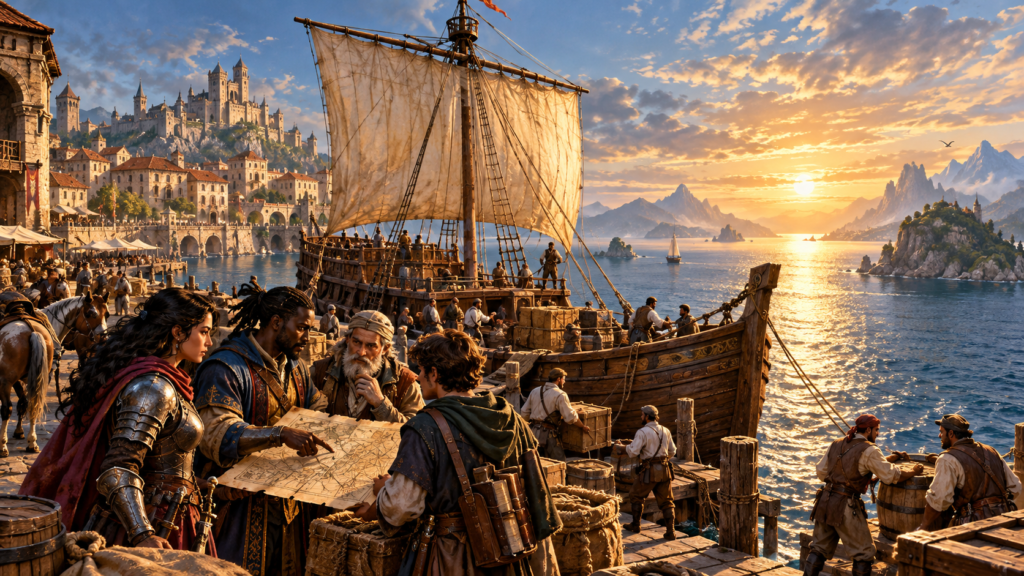
Discover the 7 Continents of Sylva in 👑Kingsmark
Imagine standing upon the bustling waterfront of a medieval city, watching merchants prepare their ships for voyages across an enormous ocean. Sailors shout instructions from the rigging, dockworkers unload strange merchandise from distant kingdoms, and travelers exchange stories about places you have never visited. Somewhere beyond the horizon are civilizations whose languages you do not understand, magnificent cities you have never imagined, and creatures whose existence you might reasonably doubt. You could spend your entire life exploring those distant lands, yet there is no guarantee that you will ever leave the kingdom in which you were born.
Welcome to Sylva, the fantasy world of Kingsmark, a heroic fantasy tabletop role-playing game powered by my original Jack’s Cinematic d12 system. Sylva is a world of kingdoms, empires, oceans, mountains, ancient civilizations, extraordinary creatures, forgotten histories, and countless opportunities for adventure. Its geography is approximately the same size as Earth, with seven major continents and more than 100 nations scattered across an enormous fictional world. The purpose of such an ambitious setting is not to overwhelm players with information, but to make the possibilities for adventure feel almost limitless.
I wanted to create a fantasy world where a Game Master could tell a small, intimate story about ordinary people living in an isolated village, or embark upon an extraordinary campaign that takes the adventurers across oceans and through kingdoms inspired by civilizations from throughout human history. A character might become a famous Monster Hunter, an influential nobleman, a wandering scholar, a celebrated warrior, or simply a hardworking adventurer who earns enough money to purchase a comfortable home. Another might die during his first dangerous expedition, leaving behind little more than a few grieving friends and an unfinished contract. All of these possibilities belong in the same world, and none should be considered a less legitimate way to enjoy the game.
There’s No Place Like Home
Sylva resembles Earth in many familiar respects. Its people build cities, cultivate farmland, establish governments, wage wars, conduct trade, travel across oceans, and attempt to understand the world around them. Its mountains, rivers, forests, deserts, grasslands, and frozen wildernesses provide recognizable environments in which extraordinary adventures can unfold. Although the world contains magic and supernatural creatures, most of its inhabitants spend their lives dealing with ordinary concerns such as earning a living, raising families, obeying or resisting their rulers, and surviving the difficulties of everyday life.
Sylva is a flat world, with a frozen continent at its center and an immense Ice Wall surrounding its outermost regions. Its cosmology draws inspiration from traditional Flat Earth conceptions, including the general arrangement of the heavens above the inhabited world. I have no interest in turning this particular aspect of the setting into an argument about the actual shape of Earth, because Kingsmark is a fantasy game. What matters is that Sylva possesses an internally recognizable cosmology that can accommodate exploration, ancient mysteries, and the unusual geography of a fictional world.
At the center lies Illuliaq Nirivaaq, a vast Arctic continent associated with ancient legends and extraordinary mysteries. Beyond the inhabited regions of the world stands the Ice Wall, an enormous frozen boundary that few adventurers would ever have reason to approach. Between these extremes lie the great continents, oceans, kingdoms, and wildernesses where the overwhelming majority of Kingsmark adventures will unfold. The world is large enough to encourage curiosity, yet familiar enough that Game Masters can draw upon their existing knowledge of geography, history, and medieval life.
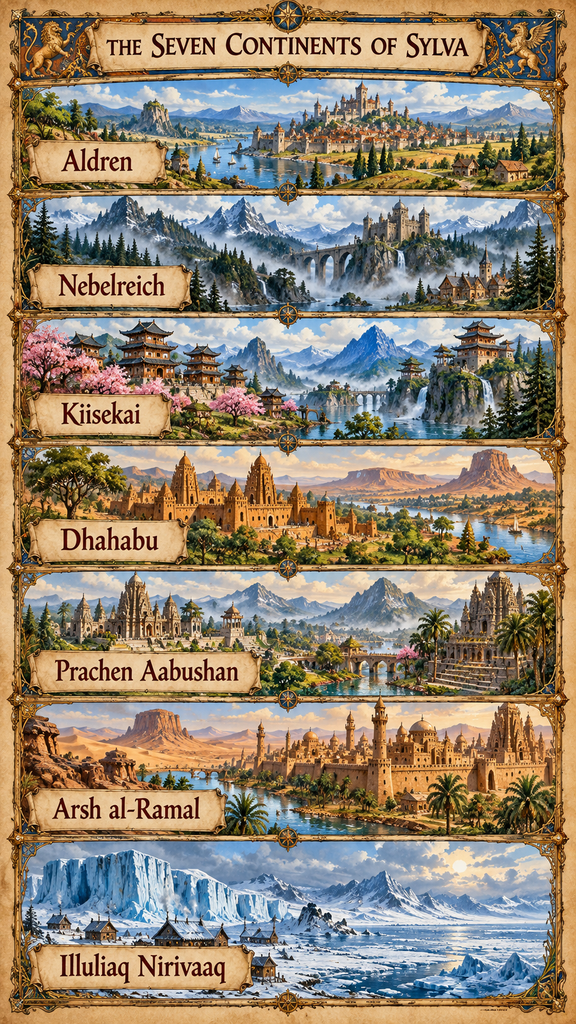
Discover the Seven Continents
The seven continents of Sylva are Aldren, Nebelreich, Kiisekai, Dhahabu, Prachen Aabushan, Arsh al-Ramal, and Illuliaq Nirivaaq. Each draws inspiration from different regions of Earth, although none is intended to reproduce an actual continent or its political boundaries exactly. Instead, they provide geographical and cultural frameworks within which numerous fictional nations can develop their own histories, rivalries, customs, and identities. Some of these nations closely resemble recognizable historical civilizations, while others combine influences that never existed together in our own world.
Aldren
Aldren is the continent that will be most familiar to players beginning their adventures in Kingsmark. Inspired broadly by the Americas, it contains prosperous kingdoms, diverse populations, fertile agricultural regions, tremendous wildernesses, and competing political powers. One of its greatest nations is the Kingdom of Aldren, a powerful monarchy that serves as the principal developed starting location for the game. Its settlements, roads, contracts, and surrounding countryside provide an accessible foundation for adventures that can gradually expand into the wider world.
Nebelreich
Nebelreich draws upon the rich cultural and geographical diversity of northern, central, and eastern Europe. Its kingdoms include influences from Germanic, Slavic, Scandinavian, and neighboring civilizations, providing opportunities to explore mountain fortresses, ancient forests, scholarly institutions, prosperous commercial towns, and rival noble houses. A Game Master might create a nation combining elements of Russia and Poland, or establish an isolated mountain kingdom inspired by several European traditions. These combinations make it possible to create unfamiliar fictional societies while retaining recognizable cultural foundations.
Kiisekai
Kiisekai draws inspiration from the civilizations of East Asia, including Japan, China, Korea, Mongolia, Tibet, and surrounding regions. Its landscapes encompass mountains, agricultural valleys, great cities, sacred places, gardens, and wildernesses that conceal innumerable mysteries. The continent’s Japanese-derived name does not mean that Japan represents every civilization located there, nor does it suggest that one culture is somehow superior to another. It is simply the name I selected for a continent intended to accommodate numerous distinctive societies, each with its own history and traditions.
Dhahabu
Dhahabu is inspired by the extraordinary variety of African civilizations, from ancient river kingdoms and great centers of scholarship to prosperous trading societies, forest kingdoms, savannas, and mountainous regions. Africa possesses an astonishing depth of history and folklore that has often received relatively little attention in mainstream Western fantasy games. I want Dhahabu to provide opportunities to explore powerful kingdoms, remarkable achievements of architecture and learning, unfamiliar mythological traditions, and societies whose inhabitants cannot be reduced to a handful of familiar stereotypes. Some of the most interesting adventures may begin with a legend that visitors from another continent have never heard.
Prachen Aabushan
Prachen Aabushan draws upon the civilizations of South Asia, including India and neighboring regions with their extraordinary diversity of languages, religions, artistic traditions, and historical kingdoms. Its fictional nations may be home to magnificent fortified cities, ancient educational institutions, monumental temples, prosperous agricultural regions, and remote mountain communities. The continent provides opportunities for adventures involving scholarship, diplomacy, commerce, religious mysteries, and long journeys through unfamiliar landscapes. Like every continent of Sylva, it contains multiple cultures rather than a single civilization sharing one uniform identity.
Arsh al-Ramal
Arsh al-Ramal incorporates inspirations from Arabia, Persia, North Africa, the Levant, and neighboring historical civilizations. Although parts of the continent contain enormous deserts, its kingdoms also encompass fertile valleys, mountains, cultivated oases, commercial centers, and regions famous for learning and craftsmanship. Merchants, diplomats, explorers, scholars, and adventurers might find themselves drawn into conflicts involving competing rulers, ancient treasures, valuable trade routes, or mysteries concealed within remote settlements. A land famous for its deserts need not be culturally or geographically monotonous.
Illuliaq Nirivaaq
Illuliaq Nirivaaq occupies the frozen center of Sylva and draws upon the cultures and environments of the Arctic and other circumpolar regions. Its inhabited territories are associated with peoples whose knowledge of ice, weather, hunting, travel, and survival would be indispensable to visiting adventurers. Farther toward the mysterious interior, ancient traditions speak of the Crystal Palace, a legendary place associated with the earliest history of Creation. The immense distances, dangerous weather, and uncertainty surrounding the continent’s most remote regions make it an extraordinary destination for the rare expedition brave enough to undertake such a journey.
Together, these continents provide the geographical foundation for a world containing more than 100 nations, but they should never be regarded as seven enormous countries. Nations rise and fall, borders change, cultures intermingle, and neighboring kingdoms may possess dramatically different traditions despite sharing the same continent. That variety is essential to the kind of world I want to create, because international exploration becomes far more interesting when every new destination offers something genuinely unfamiliar.
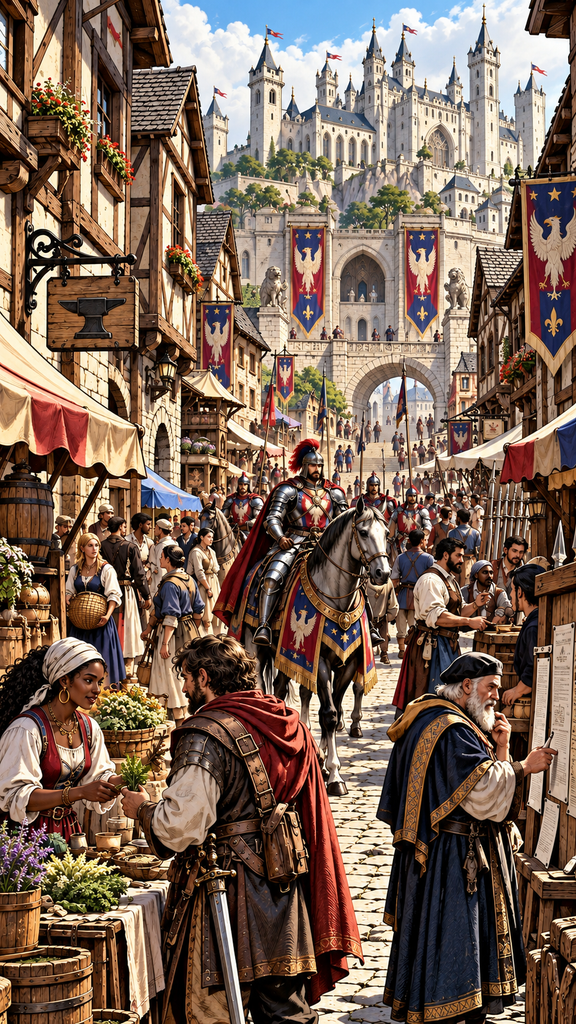
The Kingdom of Aldren: A Familiar Spirit in an Unfamiliar World
The Kingdom of Aldren provides one of the clearest examples of how I approach fictional worldbuilding. Imagine taking certain recognizable characteristics of the United States, including its ethnic diversity as represented in 2026, and transplanting them into a medieval civilization governed by an absolute monarchy. The result would not be the historical United States, nor would it simply be medieval England with a different flag. It would be a new kingdom whose people possess familiar cultural influences while living under political, technological, and social conditions profoundly different from those of modern America.
This approach creates interesting possibilities without requiring me to invent every detail of civilization from nothing. The kingdom can possess recognizably American influences while developing its own hereditary nobility, regional loyalties, religious institutions, military traditions, commercial practices, and royal government. Its people may disagree about political authority, social responsibilities, economic privileges, and the proper relationship between a ruler and his subjects. Those disagreements can become the foundation for adventures without requiring the entire kingdom to participate in one predetermined political storyline.
Aldren is also intended to provide a richly developed starting environment. Game Masters can begin with established locations and gradually introduce additional settlements, important personalities, rivalries, and historical events as they become relevant. A small village might contain enough interesting people and unresolved problems to sustain months of gaming sessions. Meanwhile, the existence of distant kingdoms, oceans, and other continents allows the campaign to expand whenever circumstances make such expansion worthwhile.
Real Cultures, Fictional Nations
Many fantasy settings require their readers to become familiar with enormous collections of invented languages, dynasties, religions, historical events, and cultural traditions. There is nothing inherently wrong with this approach, and I understand why readers enjoy becoming immersed in completely fictional universes. Personally, however, I find the possibility of connecting fantasy adventures with the real history of humanity considerably more exciting. If someone is going to become curious about an unfamiliar civilization, I would like that curiosity to lead occasionally toward an actual civilization as well.
Consider a fictional kingdom inspired by France and portions of Canada, or another that combines Russian and Polish influences. The Game Master might begin by investigating architecture, traditional clothing, local mythology, historical governments, important personalities, and the technological accomplishments associated with those cultures. From that research, the Game Master can construct a fictional nation that feels distinctive without simply reproducing a real historical country. The purpose is not to create a disguised geography textbook, but to allow genuine history to enrich the imagination.
The same principle applies to the cultures represented across Kiisekai, Dhahabu, Prachen Aabushan, and the other continents. Selecting a Japanese-derived name for Kiisekai was a creative decision, not a declaration that every fictional country there must be Japanese-inspired. My choices of names often reflect the sounds, languages, and cultural interests that appeal to me during the creative process. I expect Game Masters to exercise similar freedom, combining cultural influences thoughtfully while giving the fictional people they create their own identities.
Why Kingsmark Uses Real Languages
One important consequence of this design philosophy is that the languages spoken by the ordinary peoples of Sylva are actual languages from Earth. Rather than requiring players to learn an invented fantasy language, I chose to draw upon languages that people can genuinely study, speak, read, and understand. Certain evil creatures, including goblins, may possess their own monstrous languages, but the overwhelming majority of human communication belongs to recognizable linguistic traditions. The rules for languages and character backgrounds are discussed in ⚒Chapter 3: Skills.
This opens interesting possibilities for characterization, travel, and even personal learning. A character who speaks Japanese might discover that this knowledge becomes useful while visiting a particular nation of Kiisekai, whereas another might rely upon Russian, Hebrew, Arabic, Spanish, or another language when dealing with foreign merchants and travelers. Nobody needs to become fluent in a foreign language to play Kingsmark, of course, because characters can possess knowledge their players do not. Nevertheless, players who already enjoy studying languages may find that their interests have a natural place within the game.
Beyond Dragons and Goblins: The Mythological Creatures of Sylva
One of the things I find particularly exciting about international exploration is the tremendous diversity of monsters and supernatural creatures described in the world’s folklore. Most fantasy players are familiar with dragons, goblins, ogres, trolls, giants, and similar creatures that have become staples of the genre. I certainly have no intention of abandoning those traditions, because they are an enjoyable part of heroic fantasy. Nevertheless, there is an astonishing wealth of mythology outside the familiar collections of creatures repeatedly appearing in Western fantasy games.
Some years ago, I read Indaba, My Children, by Vusamazulu Credo Mutwa, a South African Zulu traditional healer and storyteller. The book contains an extraordinary collection of African stories, legends, and mythological traditions that introduced me to ideas considerably different from those ordinarily associated with European fantasy. What fascinated me was not simply the existence of unfamiliar creatures, but the different ways traditional stories connected supernatural beings with human conduct, nature, ancestry, society, and spiritual beliefs. It reminded me that an enormous amount of imaginative material exists beyond the creatures that have become standard entries in fantasy monster manuals.
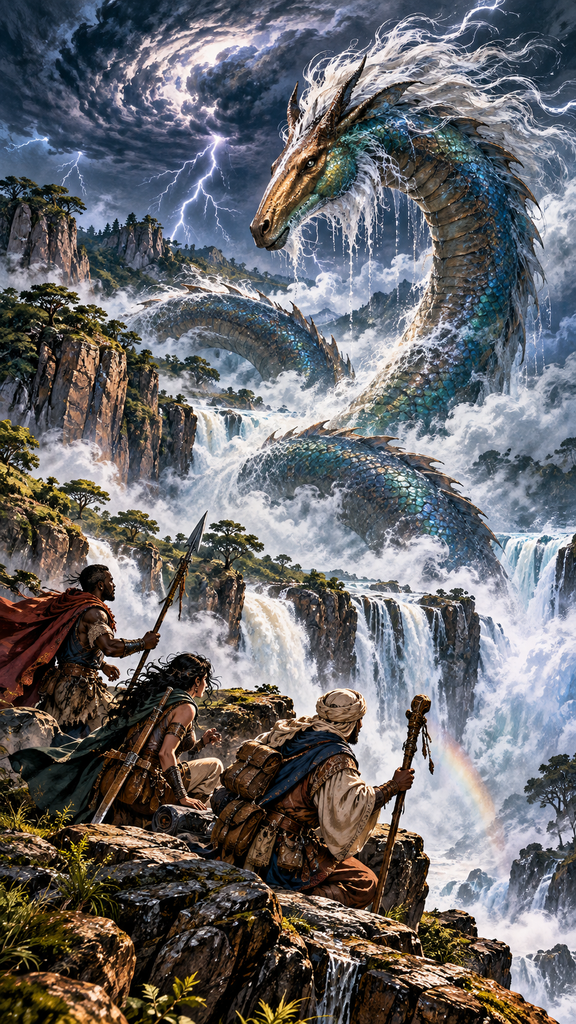
The same opportunity exists when examining the folklore of Southeast Asia, Oceania, northern Europe, the Americas, and countless other regions. Thai folklore, for example, describes the Krasue, a terrifying nocturnal being commonly portrayed as a floating woman’s head with internal organs suspended beneath it. Southern African traditions contain stories associated with Inkanyamba, a powerful supernatural water serpent connected with storms and dangerous waters. In Papua New Guinea, traditions concerning beings called Masalai connect supernatural presences with particular places, communities, and natural landmarks.
Such creatures should not simply be collected, stripped of their cultural associations, and deposited into a generic monster catalog. Their origins can provide inspiration for the environments, beliefs, customs, and mysteries surrounding them. A supernatural creature associated with a waterfall might become the subject of a local tradition whose meaning is not immediately understood by foreign adventurers. An unfamiliar spirit associated with a forest might require investigation, diplomacy, or respect for local customs rather than a sword drawn at the first opportunity.
This is part of the purpose behind 🧌The Bestiary, which offers a sampling of parazoological creatures associated with Sylva’s various continents. The 📎Bestiary appendix in the Player’s Handbook also provides immediately usable creatures and Non-Player Characters, giving Game Masters practical material for ordinary adventures. The broader world provides opportunities to encounter additional creatures whose legends originate in many different cultural traditions. There is no expectation that every creature must appear in a campaign, nor that every supernatural encounter must become a battle.
Mythology as an Invitation to Explore
Imagine a party of adventurers learning that an unfamiliar creature possesses an unusual substance required for an important magical preparation. The information available in their own kingdom is incomplete, and the only reliable accounts originate from travelers who visited a distant continent. The adventurers might need to study a foreign language, locate an experienced guide, obtain passage across the ocean, and investigate the customs surrounding the creature before they can even determine whether their objective is possible. A simple request for an ingredient could become the beginning of an extraordinary international adventure.
Other possibilities involve protecting threatened settlements, investigating supernatural disappearances, recovering forgotten manuscripts, negotiating with intelligent beings, or discovering whether a frightening legend describes something dangerous at all. A Monster Hunter might travel across several countries pursuing one particularly elusive creature, while a Healer might seek an uncommon medicinal plant growing in a remote mountain valley. A Wizard or Shaman might search for a rare magical substance, and a nobleman might commission adventurers to obtain an unusual specimen for study. The variety of possible motivations is almost as great as the number of civilizations and legends available for inspiration.
Adventures That Take You Across the World
Consider a hypothetical adventure involving reports of a powerful supernatural serpent inhabiting a remote region of Dhahabu. A kingdom thousands of miles away has suffered a mysterious illness, and a scholar believes that a rare medicinal ingredient can be obtained somewhere within the creature’s territory. The adventurers receive a contract to investigate, but nobody who hires them possesses firsthand knowledge of the region. What begins as a seemingly straightforward expedition soon requires international travel, unfamiliar customs, local guides, and decisions the characters could never have anticipated when they accepted the assignment.
Upon arriving, the party might discover that local inhabitants regard the creature as a spiritual presence associated with storms and the surrounding waters. Some believe it is dangerous, others insist that its territory must be respected, and still others disagree about whether the creature actually exists. Perhaps the adventurers’ original instructions were based upon a misunderstanding, or the substance they seek has no connection to the creature whatsoever. Instead of discovering a monster that must be killed, the characters might find themselves negotiating with local leaders, investigating the true origins of an illness, or protecting a settlement from outsiders pursuing the same objective.
I find this possibility much more interesting than sending a party across an ocean simply because the next monster happens to be more powerful than the previous one. Travel should introduce unfamiliar circumstances, different ways of understanding the world, and opportunities for characters to adapt their expectations. A warrior who has proven nearly unbeatable in his own kingdom might discover that his combat abilities are of little use during a diplomatic disagreement. Conversely, a quiet scholar who rarely attracts attention at home might suddenly become indispensable because he understands a foreign language or recognizes an obscure historical reference.
Historical personalities also provide wonderful opportunities for adventures. Consider Villard de Honnecourt, a thirteenth-century French figure whose surviving portfolio includes architectural drawings, mechanical ideas, and observations concerning construction and design. A Game Master could invent a fictional engineer inspired by Villard and place him within a French-influenced kingdom of Sylva. Perhaps the engineer disappears while investigating an ancient fortress, leaving behind a collection of drawings that suggest he discovered something remarkable beneath its foundations.
The adventurers might be hired to locate the missing engineer, recover his manuscripts, or investigate a machine whose purpose nobody fully understands. Preparing the scenario could lead the Game Master toward genuine research into medieval architecture, construction methods, manuscripts, and the technological imagination of the period. Yet the resulting adventure would remain a work of fantasy, free to include secret passages, dangerous enemies, supernatural mysteries, or an entirely unexpected explanation for the engineer’s disappearance. The real historical material provides inspiration without dictating the fictional outcome.
Learning About Earth Without Playing an Educational Game
I want Kingsmark to encourage this kind of curiosity because there is so much about the actual world that most of us will never have an opportunity to experience firsthand. Traveling internationally can be extraordinarily rewarding, but money, time, family responsibilities, and countless other circumstances make extensive travel impossible for many people. A tabletop role-playing game offers a different kind of experience, allowing people to imagine unfamiliar landscapes and civilizations together. Although fictional travel can never replace visiting an actual country, it can encourage appreciation for its history, languages, artwork, architecture, and traditions.
That does not mean Kingsmark should become an educational game disguised as entertainment. I have no intention of requiring players to pass history examinations, memorize foreign vocabulary, or endure lectures about the economic development of medieval kingdoms before enjoying an adventure. Rather, I want real-world learning to become an enjoyable consequence of curiosity. A player who becomes fascinated with the mythology behind a particular creature might decide to investigate its actual origins, while a Game Master preparing a foreign city might discover an architectural tradition that inspires an entirely new adventure.
This approach also permits more believable variety within fictional societies. Instead of inventing every cultural detail without reference to anything that has actually existed, Game Masters can draw upon thousands of years of human accomplishments, mistakes, conflicts, customs, and ideas. A fictional kingdom might contain historical influences that never existed together on Earth, and those combinations can create entirely new possibilities. The result should feel imaginative rather than derivative, while retaining enough recognizable humanity to make the people of Sylva interesting.
The Seven Wonders and Nine Abominations of Sylva
Beyond its many kingdoms and ordinary settlements, Sylva contains extraordinary places whose reputations extend far beyond their immediate surroundings. 🧭The World Book introduces the Seven Wonders of Sylva, remarkable locations associated with the achievements, ingenuity, and accumulated history of civilization. It also describes the Nine Abominations, infamous places connected with terrible events, supernatural corruption, and mysteries that many sensible travelers would prefer never to investigate. These locations provide opportunities for adventures that can range from scholarly expeditions to dangerous encounters with some of the darkest secrets of the world.
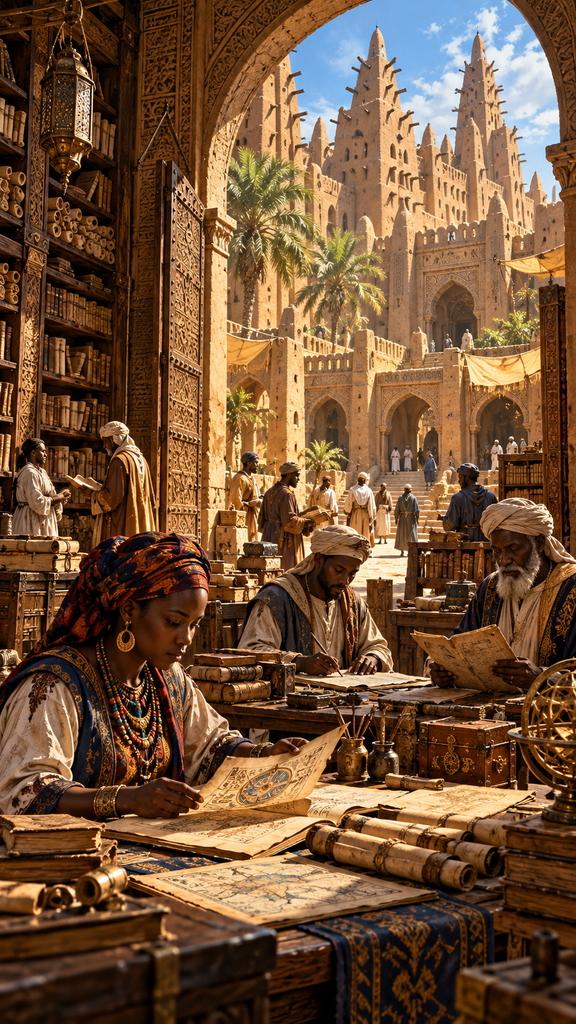
Among the Seven Wonders is the Golden Archive of Dhahabu, an immense repository of manuscripts, maps, genealogies, historical records, scientific writings, and ancient religious texts. Inspired partly by the great traditions of African scholarship, it represents the extraordinary importance of preserving knowledge across generations. A Game Master might build an adventure around a missing manuscript, a disputed historical discovery, or the recovery of records believed destroyed centuries earlier. For the right adventurer, gaining access to an obscure archive could be more exciting than discovering a chest filled with gold.
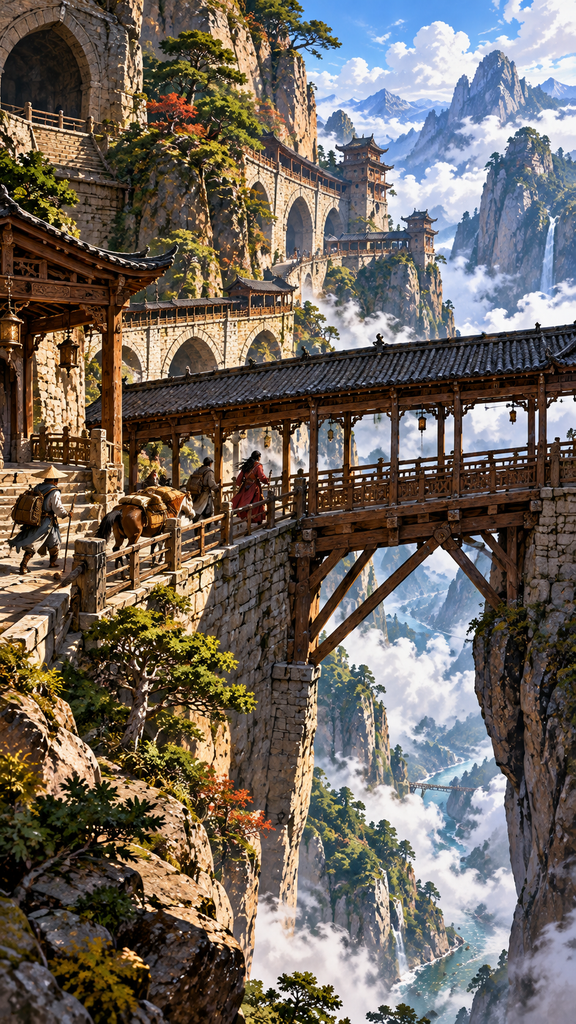
Another Wonder is the Cloud Road of Kiisekai, an astonishing mountain route constructed through a network of bridges, tunnels, cliffside passages, and carefully engineered crossings. Its magnificence lies not merely in its height or danger, but in the ingenuity required to make such a journey possible. Traveling along the Cloud Road might become an adventure involving dangerous weather, diplomatic encounters, unusual local traditions, and settlements built in places that seem almost inaccessible. A journey undertaken for ordinary commercial purposes could become unforgettable simply because of the environment through which the characters must travel.
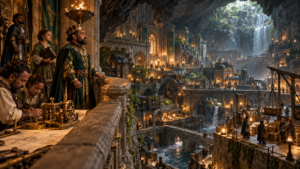
Then there is Luminara, the City of Light, a spectacular urban achievement associated with the continent of Aldren. Its unusual arrangement of mountain districts, lower settlements, and subterranean spaces gives it a character unlike that of an ordinary walled medieval city. Merchants, nobles, laborers, scholars, adventurers, and travelers might inhabit dramatically different parts of the same enormous settlement. Such a city could provide material for an entire campaign without requiring the characters to travel beyond its surrounding countryside.
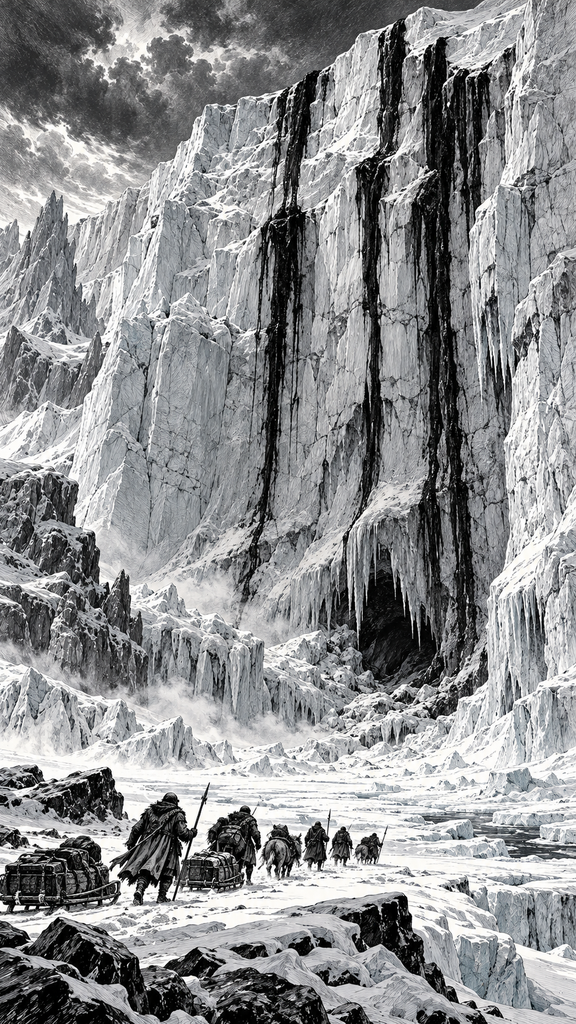
The Nine Abominations represent a different kind of fascination. One is the Weeping Scar, a mysterious location along the eastern Ice Wall where strange dark markings descend across the ancient ice like enormous tears. Its origin is associated with some of the deepest mysteries concerning Sylva’s early history, although the truth is not something ordinary inhabitants of the world can readily explain. An expedition to investigate the Weeping Scar might require months of preparation, experienced Arctic guides, extraordinary endurance, and a willingness to confront discoveries that could challenge everything the adventurers believe about their world.
There are also mysteries associated with Illuliaq Nirivaaq and the legendary Crystal Palace, traditionally remembered as the Eighth Wonder of the World. Its existence and significance belong to the oldest accounts of Creation, and many stories concerning it remain uncertain even among learned people. I particularly enjoy the idea that some locations should remain mysterious rather than becoming ordinary destinations marked on a convenient tourist map. A fictional world becomes more interesting when there are places whose nature even its greatest scholars do not fully understand.
More Than 100 Nations, but Room for Your Imagination
Although Sylva contains more than 100 nations, I have deliberately avoided turning every country into an exhaustively documented collection of official facts. Some kingdoms are described in considerable detail, while others may possess little more than a name, approximate location, cultural background, and a few historical characteristics. That is not an oversight or an indication that the world is incomplete. It is an intentional effort to leave opportunities for Game Masters to develop portions of Sylva according to the needs of their own campaigns.
Suppose the adventurers decide to visit a kingdom that has received only a brief description in the World Book. The Game Master might establish its present ruler, create a rivalry between prominent noble families, invent a commercial dispute, or determine that a particular region possesses valuable natural resources. Those details can become established facts within that campaign without requiring permission from an official setting encyclopedia. I would much rather see Game Masters create memorable fictional history than feel intimidated by the possibility that every interesting question already has an answer written somewhere else.
The Micro Experience Within the Macro Sandbox
One of my strongest convictions about tabletop role-playing games is that the experiences of individual characters matter more than the enormous fictional histories surrounding them. Worldbuilders can spend countless hours inventing kingdoms, imperial dynasties, religious conflicts, military campaigns, and diplomatic relationships, only to discover that their players have little immediate interest in any of it. The problem is not necessarily that the lore is boring or poorly written. Often, it is simply too far removed from the characters’ present experiences to possess any immediate significance.
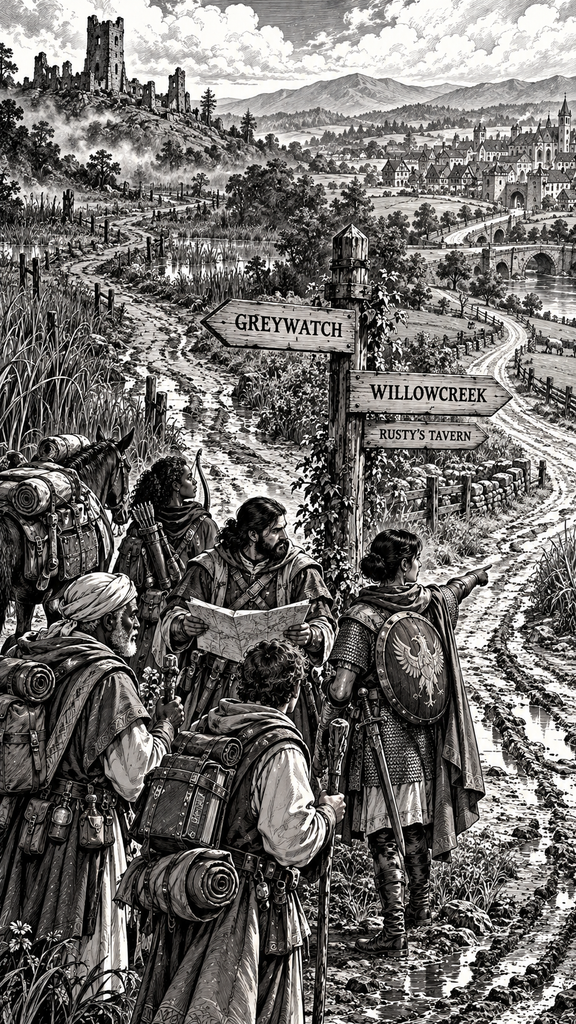
Imagine beginning a gaming session by informing the players that two distant empires are approaching war, explaining the history of their disputed border, and introducing the political ambitions of several royal families. All of this might be interesting background information, but what does it have to do with the adventurer currently sitting in a tavern in Willowcreek? Perhaps very little, at least for the moment. That character may be considerably more concerned with finding employment, purchasing a better weapon, settling a personal disagreement, or discovering why somebody has disappeared from a nearby village.
Now imagine that the distant political conflict begins affecting the town in ways the adventurers can actually experience. Merchants complain that certain goods have become expensive, refugees arrive seeking shelter, soldiers begin questioning travelers, and an unfamiliar nobleman offers an unusually generous contract. Suddenly the larger political situation becomes relevant because it has produced circumstances that directly affect the characters. The players might investigate these developments, ignore them, become entangled in the conflict, or pursue an entirely unexpected course.
The macro world provides context, but the micro experience provides the adventure. That distinction is fundamental to my approach to Kingsmark, because I want the story to emerge from the decisions, experiences, and ambitions of the player characters rather than from a predetermined history that the Game Master expects them to reenact. The game’s 🗨️Dialog Scenes and ▶️Action Scenes provide the basic framework through which these situations unfold. What matters most is what the characters encounter, how they respond, and what consequences follow.
A Sandbox Without an Obligatory Destination
The enormous size of Sylva should never imply that players are expected to travel around the world. A character might be born in a small village, become an adventurer, establish a family, accumulate considerable experience, and eventually die without ever traveling more than five or ten miles from home. His entire career could revolve around local rivalries, dangerous forests, nearby ruins, personal relationships, criminal investigations, and the occasional supernatural encounter. If the campaign produces memorable characters and worthwhile adventures, then it has accomplished exactly what a good role-playing game should accomplish.
Another character might begin in that very same village and eventually travel across every major continent. What begins as a simple contract could lead to opportunities involving distant kingdoms, international commerce, rare creatures, forgotten cities, and historical mysteries. Over the course of several years, that adventurer might progress through the game’s ⭐Action Star Levels until reaching Level 5, representing a legendary career ordinarily requiring at least four years of serious in-world adventuring experience. The progression and its intended significance are explained in ⭐Chapter 5: Action Star Level.
Neither character should feel obligated to follow a particular geographical route or participate in a grand storyline simply because the setting contains spectacular locations. A Game Master might envision a campaign that eventually reaches Kiisekai or Dhahabu, but those ambitions should remain flexible enough to accommodate the players’ decisions. Random events, oracles, unexpected encounters, and the consequences of earlier actions can suggest directions that nobody anticipated when the campaign began. Sometimes the most memorable adventures emerge precisely because the story refuses to proceed according to the original plan.
This is what I mean by a genuine sandbox. The world continues to exist beyond the characters’ immediate experiences, but it does not demand that they participate in every important event occurring within it. A distant kingdom can experience a succession crisis without the adventurers becoming responsible for resolving it, just as a famous monster can exist somewhere in the wilderness without eventually becoming a mandatory opponent. The Game Master creates circumstances and opportunities, while the players determine which ones become part of their characters’ lives.
You Do Not Need to Learn the Entire World
I also want to emphasize something that I consider extremely important for anyone interested in beginning a Kingsmark campaign: you do not need to learn the entire world of Sylva, and you do not need to purchase a collection of supplementary books before playing. The 🕯Introduction to the Player’s Handbook explains how the various Kingsmark publications are intended to function as references rather than mandatory reading assignments. A Game Master should learn the material relevant to the adventure being played, not attempt to memorize an entire fictional universe. In practice, a few carefully prepared characters, a small settlement, and an interesting situation may be sufficient to begin.
The Player’s Handbook already provides character creation, combat, advancement, magic, equipment, example Actions, creatures, and introductory adventure material. Its 📎Characters appendix provides ready-to-use characters, while 📎Appendix D introduces a tutorial dungeon. Additional resources such as the Spellbook, Bestiary, Marketplace, and World Book can expand the possibilities available to a campaign, but they are not prerequisites for enjoying the game. A creative Game Master could run many entertaining sessions using the materials already provided.
There is also no requirement that every adventure involve monsters, magic, or extraordinary international travel. A campaign involving only human characters could revolve around military service, mercenary contracts, criminal investigations, merchant expeditions, political intrigue, wilderness survival, or the ambitions of ordinary people trying to improve their circumstances. These stories can become tremendously interesting when characters possess believable motivations and their decisions have meaningful consequences. The 🎬Example Actions demonstrate the range of situations the system is designed to handle, while the fictional world provides a background for those actions to acquire meaning.
My intention is also to provide substantial free content through Kingsmark.Games, including the complete Player’s Handbook and additional supporting material. I do not want people to feel that enjoying a tabletop role-playing game requires spending a significant portion of their paycheck on supplements. Those who choose to purchase digital editions help support the continuing development of Kingsmark, and I appreciate that support enormously. Nevertheless, I want the ability to play, explore, and create adventures to remain accessible to people who simply cannot justify purchasing numerous books.
The World Is Yours to Explore
Ultimately, the purpose of Sylva is not to provide an enormous fictional encyclopedia for people to memorize. It is to create a world in which people can experience the excitement of exploration, develop an interest in unfamiliar cultures, discover strange mythological traditions, and imagine adventures that may take them far beyond anything they expected when their characters first appeared at the gaming table. The world’s history and geography provide a foundation, but the characters’ decisions determine which parts of that foundation become important. There should always be room for something unexpected to happen.
Return for a moment to the adventurer standing at the harbor, watching a ship prepare for its departure across the ocean. Perhaps he will board that vessel and begin an extraordinary journey toward kingdoms he has never imagined, where he will encounter unfamiliar peoples, ancient mysteries, and creatures whose legends were unknown in his homeland. Perhaps he will remain behind, accept a modest contract in a nearby village, and discover that an equally remarkable adventure has been waiting only a few miles from home. He does not yet know which direction his life will take, and neither should we.
That uncertainty is one of the greatest pleasures of tabletop role-playing games. Sylva offers an entire world to explore, but Kingsmark leaves the adventure in the hands of the people playing it. Whether your story takes you across seven continents or never carries you beyond the next line of trees, I hope it becomes something worth remembering.
Explore the complete Player’s Handbook for free at Kingsmark.Games and begin creating your own adventures in Sylva.
John Alan Martinson
Creator of Kingsmark and Jack’s Cinematic d12
A Heroic Fantasy TTRPG for Mature Players
About The Author