Players may take any action they can think of, no matter how extravagant, absurd, complex or seemingly impossible. The list of actions provided in this chapter are merely examples of what could be done by a character, and are by no means exhaustive.
Action Points
Each character normally receives 5 Action Points during every ⏸Turn. Apply the character’s Speed directly to this number. Positive Speed increases the character’s Action Points, while negative Speed reduces them. Speed −3 provides 2 Action Points, Speed −2 provides 3, Speed −1 provides 4, Speed 0 provides 5, Speed +1 provides 6, Speed +2 provides 7, Speed +3 provides 8, and Speed +4 provides 9. A character can never receive fewer than 1 Action Point during a ⏸Turn. Unspent Action Points do not carry over from one ⏸Turn to the next. Every action normally costs 1, 2, or 4 Action Points according to how much of the character’s available acting time it occupies during the Turn.
These costs are not literal seconds on a clock, but an abstract measure of how much space an action occupies within the ⏸Turn.
Action Points represent time. More specifically, they measure how much of a character’s limited acting time during a ⏸Turn is occupied by what the character does. They do not measure how difficult, dangerous, exhausting, or important an action is. Those considerations are handled by Tests, Target Numbers, Advantage and Disadvantage, and other rules. Every action normally costs 1, 2, or 4 Action Points according to how long it takes to perform within the fast-moving circumstances of an Action Scene. These costs are not literal seconds. A ▶️Combat Round represents roughly 3–10 seconds of cinematic time, and the actions of different characters are understood to occur largely simultaneously. Action Points divide that short span into a practical game abstraction.
When the Game Master assigns an Action Point cost to something not listed in this chapter, the primary question should therefore be: “How much time would this take?” A nearly instantaneous action is generally a 🟡Flair Action costing 1 Action Point. An action requiring a noticeable portion of the character’s available time is generally a 🟠🟠Swift Action costing 2 Action Points. An action occupying most of the character’s available time is generally a 🔴🔴🔴🔴Starring Action costing 4 Action Points.
Movement requires one special consideration. Walking and Double-Time are not literally instantaneous simply because they have no separate Action Point cost. Their listed movement distances represent ordinary locomotion occurring throughout the Combat Round while the character performs other actions. A character may advance while drawing a weapon, speaking, fighting, or performing other activities that realistically permit movement. Sprinting is different: the character devotes most of his available time to moving as quickly as possible, and therefore Sprinting costs 4 Action Points. Action Points are therefore a game tool that allows human players to sequence what would otherwise be chaotic simultaneity into an organized turn order. The Game Master (GM) and players should keep in mind that Turns are not literal “stops in time” but a convenient framework for breaking high-speed cinematic chaos into a form that can be understood, dramatized, and enjoyed at the table.
ACTION COSTS
1 Action Point 🟡 Flair Action
2 Action Points 🟠🟠 Swift Action
4 Action Points 🔴🔴🔴🔴 Starring Action
A character must possess enough Action Points to pay an action’s full cost. Action Points cannot be saved between Turns, and an action cannot ordinarily be divided across several Turns. A character with Speed −2 or Speed −3 therefore cannot perform a 4-Action-Point Starring Action during an Action Scene. This is intentional: such ratings represent extraordinary slowness or physical limitation. Outside the immediate pressure of an Action Scene, the character may perform physically possible activities over the longer period they realistically require.
Learning the Action System
Kingsmark includes well over a hundred example actions. At first glance, that may seem daunting, but players are not expected to memorize them before playing. The Menu of Actions is a reference, not a list of commands that must be learned.
The easiest way to learn the action system is to read through the actions several times so that you become familiar with the kinds of things characters can do. After that, approach each Turn with a much simpler question:
“What makes sense for my character to do right now?”
Imagine the answer happening in slow motion. Break the character’s movement into the individual things he actually does, then identify the actions involved and their Action Point costs.
For example, a character with Speed +2 has 7 Action Points. You imagine him drawing his sword, moving quickly across the room, striking an enemy, and then diving behind a table for protection. Looking at the actions reveals what that means mechanically: 🟡 Draw or Ready Carried Equipment costs 1 Action Point, ordinary Double-Time movement has no separate Action Point cost, 🟠🟠 Unarmed or Melee Weapon Attack costs 2, and 🟠🟠 Dive for Cover costs another 2. The character has spent 5 of his 7 Action Points doing exactly what you imagined him doing.
You do not need to search through the entire catalog deciding which action you are “allowed” to perform. Describe what your character does, break the sequence into its meaningful parts, and use the Menu of Actions to determine their costs.
After several sessions, the actions used most frequently by your character will become second nature. The remaining actions are simply options waiting in the menu until the situation calls for them.
The following examples illustrate the general scale of Flair, Swift, and Starring Actions. They are not a second Menu of Actions and do not replace the specific actions and rules presented later in this chapter.
🟡 Flair Actions — 1 Action Point
Flair Actions are brief actions that can normally be accomplished in a moment without consuming most of the character’s attention. Examples include:
- Draw or ready readily accessible equipment.
- Pick up or retrieve an immediately accessible item.
- Make a Brief Utterance.
- Make a Simple Gesture.
- Perform another similarly brief action permitted by the Game Master.
🟠🟠 Swift Actions — 2 Action Points
Swift Actions represent substantial actions that can be performed quickly during a Turn. Examples include:
- Make an ordinary melee or unarmed attack.
- Aim.
- Grapple or attempt to break a hold.
- Perform an ordinary combat maneuver such as Disarm, Trip, or Push Back.
- Perform a brief athletic maneuver that qualifies as a Swift Action.
- Cast a Spell whose normal casting time is 2 Action Points.
- Perform another action specifically identified as a Swift Action.
🔴🔴🔴🔴 Starring Actions — 4 Action Points
Starring Actions demand substantial commitment, concentration, physical effort, or dramatic attention during the Turn. Examples include:
- Sprint.
- Perform a difficult or extended athletic maneuver identified as a Starring Action.
- Attempt to Restrain an opponent who is already Grappled.
- Bind an opponent who is already Restrained, helpless, cooperative, or otherwise incapable of preventing the binding.
- Perform a complicated combat maneuver specifically identified as a Starring Action.
- Perform another demanding action that the Game Master determines reasonably requires most of an ordinary character’s Turn.
These examples illustrate the general scale of the three Action types. The individual actions described throughout this chapter remain authoritative regarding their exact Action Point costs, requirements, Tests, and effects.
🤝 Assisting Another Character
Characters can cooperate on an action whenever another person could logically make the task easier. An assistant might help lift a gate, boost someone over a wall, steady an injured companion while another character provides treatment, hold equipment for a craftsman, help search a room, or otherwise contribute directly to what the acting character is attempting.
An Assistant normally spends the same number of Action Points as the action being assisted. If the assisted activity is 🟡 1 AP, assisting costs 🟡 1 AP; if it is 🟠🟠 2 AP, assisting costs 🟠🟠 2 AP; and if it is 🔴🔴🔴🔴 4 AP, assisting costs 🔴🔴🔴🔴 4 AP. For activities taking longer than a single action, the Assistant must remain involved for the relevant amount of time. One character remains the Primary Character and makes the Test. Meaningful assistance grants the Primary Character +2 to the final Test result. This is a direct bonus to the result, not Advantage, and therefore does not change the Target Number or cancel Disadvantage.
Ordinary assistance provides a maximum +2 bonus regardless of how many characters assist. Additional people may still be necessary or useful when the circumstances logically require them, but they do not each add another +2. A specific rule may state otherwise. An Assistant must actually be capable of contributing to the task.
The Game Master should ask what the character is doing to help. Holding a lantern while someone searches a dark room may be meaningful assistance; standing beside a locksmith and offering encouragement is not. Likewise, a character normally cannot assist with specialized knowledge or technique they do not possess unless their contribution genuinely helps without requiring that expertise.
Assistance does not erase the circumstances surrounding the task. If someone is attempting a difficult climb during a storm, another character’s assistance provides +2 to the climber’s result; it does not make the rain, darkness, poor footing, or other sources of Disadvantage disappear. Some physical tasks depend upon the combined strength, leverage, or number of several characters rather than one character merely making another’s Test easier. The Game Master may account for additional bodies according to the physical circumstances instead of stacking ordinary Assist bonuses. Assisted Physical Control uses its own rule because several characters physically controlling another creature is specifically affected by the number of characters contributing. A character cannot normally Assist their own action, and the same contribution cannot provide both an Assist bonus and another bonus for performing the same task unless a rule specifically permits it.
Movement
Movement is determined by a character’s Speed Attribute. A ▶️Combat Round lasts about 3–10 seconds and is divided into several overlapping Turns. Movement distances represent the total ground a character covers during one Combat Round. In ordinary Action Scenes, movement is declared and resolved during the character’s ⏸Turn for convenience, although everyone’s actions and movement are understood to overlap within the fiction.
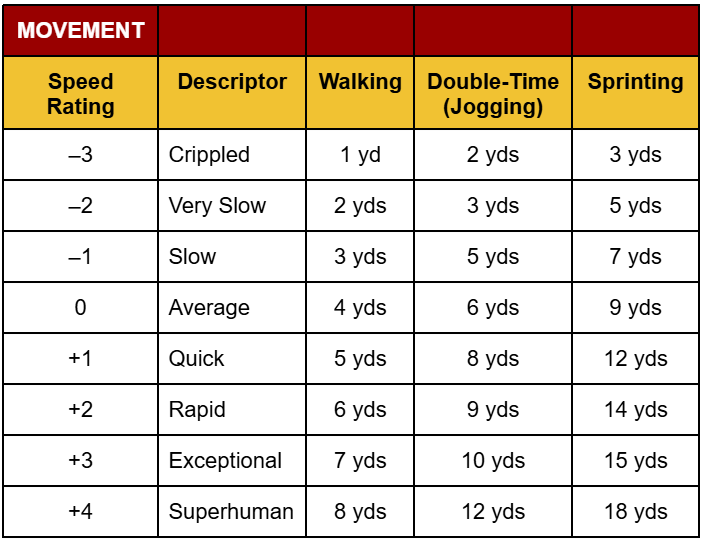
During each Combat Round, a character may Walk, move at Double-Time, or Sprint. Walking and Double-Time have no separate Action Point cost because they represent ordinary movement occurring concurrently with the character’s other activities. This does not mean that walking or jogging takes no time. Their time overlaps the time represented by other actions performed during the Round. Walking represents controlled ordinary movement. Double-Time represents a light jog or rapid advance. Either may be combined with other actions when doing so is physically reasonable: a character might walk while drawing a sword, advance while fighting, or jog while shouting instructions. Actions that logically require the character to remain stationary cannot be performed while moving.
Sprinting represents running at maximum speed. Unlike ordinary movement, Sprinting requires the character to commit most of his available acting time to covering ground. Sprinting therefore costs 4 Action Points and may be performed only once per ⏸Turn. Faster movement reduces precision. Clutter, uneven ground, poor visibility, and other obstacles may impose an additional +1 to +3 Disadvantage when appropriate. Encumbrance, injuries, terrain, magic, and other effects that alter a character’s effective Speed also alter the character’s movement distances. A character must possess at least 4 Action Points to Sprint during an Action Scene. A character with Speed −2 or Speed −3 therefore cannot Sprint during an Action Scene. Outside an Action Scene, the Game Master may allow such a character to attempt strenuous movement over a longer period when the circumstances make it physically possible.
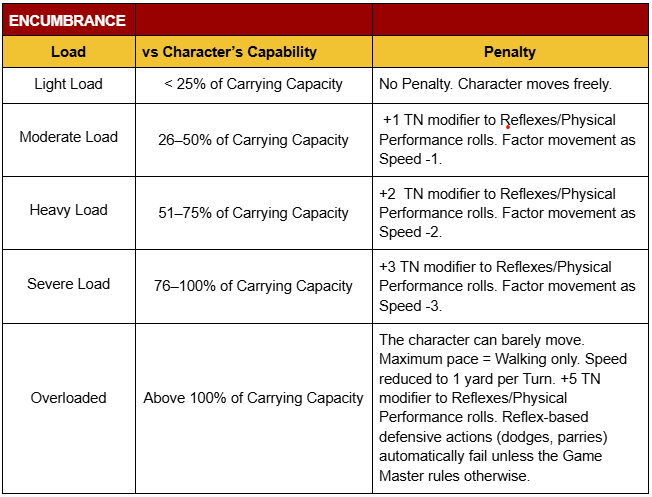
Encumbrance & Movement
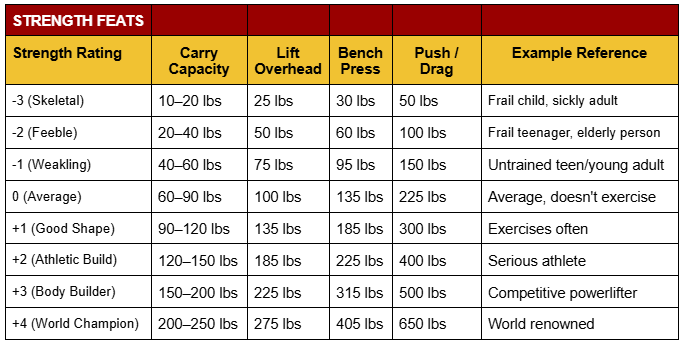
A character’s maximum carrying ability is determined by their Strength. Weight carried is measured in Encumbrance Tiers relative to that capacity.
🎬Example — Encumbrance
Jonathan (Strength +2, Carry 150 lbs) hauls 90 lbs of gear—roughly 60% of his capacity. He is Heavily Loaded. His Speed is +1, but encumbrance reduces it by -2, giving him an effective Speed of –1. He double-times across a narrow alley, boots striking the wet cobblestones, but can only make it 5 yards. He then attempts to vault a waist-high stone wall without slowing down. He rolls 1d12 + Physical Performance PRISM +0 + Infantry Athletics +1 against the Realism TN assigned by the Game Master. Rolling a 6 and adding +1 from Infantry Athletics, he fails. Weighted down and moving too fast, he fails to get himself and his heavy pack over the wall and crashes hard against it before stumbling back, breathless and bruised.
Movement Actions
FREE Do Nothing / Maintain Non-Defensive Stance
The character takes no action or defensive posture, often out of overconfidence or distraction. This is automatic unless the situation demands balance or awareness (such as standing on a ledge or in heavy wind). At the GM’s discretion, remaining still may require concentration. Unlike 🟠🟠 Defensive Stance, this provides no defensive benefit.
FREE Walk
The character advances at normal Walking speed. Walking has no separate Action Point cost because it occurs concurrently with the character’s other activities during the Round; it does not represent movement taking no time. Apply any movement modifiers relevant to actions performed while Walking.
FREE Double-Time
The character moves at a controlled jog at Double-Time speed. Double-Time has no separate Action Point cost because it occurs concurrently with the character’s other activities during the Round; it does not represent movement taking no time. Apply any movement modifiers relevant to actions performed while moving at Double-Time.
🔴🔴🔴🔴 Sprint
The character runs at maximum possible speed, covering the Sprinting distance listed for their effective Speed. Sprinting costs 4 Action Points because the character commits most of his available acting time to running at maximum speed rather than allowing movement to occur concurrently with his other activities. Attacks, spellcasting, and other precision actions performed while Sprinting suffer +8 Disadvantage unless a rule specifically states otherwise. Actions requiring careful footing, prolonged concentration, delicate manipulation, or a stationary position may be impossible while Sprinting. A character cannot Sprint while carrying a Heavy Load, Severe Load, or Overloaded burden, or while otherwise physically incapable of running freely. Injuries may also prevent Sprinting when the recorded injury logically makes running impossible. A character with remaining Action Points may spend them normally after declaring a Sprint.
🟠🟠 Careful Step
Move up to half the character’s Walking distance, rounded up, with deliberate attention to footing, balance, or silence. Careful Step is used when crossing unstable, slippery, trapped, noisy, or otherwise hazardous ground where ordinary movement would increase the danger. When a Test is required, moving carefully may reduce the Target Number or prevent a penalty that would apply to ordinary movement, as determined by the Game Master.
🟠🟠 Change Stance (Standing, Crouching, Prone)
The character deliberately changes between Standing, Crouching, and Prone. One Change Stance action allows any one transition between these stances, including directly from Standing to Prone or Prone to Standing. A stance is a meaningful tactical position of the entire body. Ordinary bodily movements—bending, leaning, shifting the feet, briefly ducking, reaching, or changing posture as part of another action—do not require Change Stance unless the character actually assumes a different tactical stance. Changing stance may alter visibility, available cover, Hit Locations, movement, attacks, defenses, or what the character can physically reach or accomplish according to the circumstances. When another action or effect explicitly places the character into a stance, no additional Change Stance action is required. For example, 🟠🟠 Dive for Cover includes landing Prone, and a character who is knocked down may become Prone without spending Action Points. The character must subsequently use 🟠🟠 Change Stance to deliberately rise or assume another stance unless another action specifically provides otherwise.
🟡 Drop Prone
The character immediately throws himself from Standing or Crouching into the Prone stance. Drop Prone is a faster alternative to 🟠🟠 Change Stance when speed matters, but the sudden fall may make noise and may be dangerous on hard, jagged, burning, or otherwise hazardous ground. The Game Master may require a Test or inflict an appropriate injury when circumstances warrant.
🟠🟠 Dive for Cover
The character explosively dives up to 3 yards toward nearby cover and lands Prone. This movement is in addition to the character’s normal Walking or Double-Time movement for the Round. No Test is normally required when the cover is plainly reachable, although obstacles, dangerous terrain, or a difficult landing may require an Infantry Athletics Test. A particularly hard or hazardous landing may inflict a 🩸Minor Wound from 🪨Concussive Damage. More dangerous circumstances may inflict a more serious Wound at the Game Master’s discretion. After the dive, the character remains Prone and must use 🟠🟠 Change Stance to rise to Crouching or Standing.
Intercepting Movement
Characters do not become passive merely because another character’s ⏸Turn is being resolved. When an enemy’s movement carries them past, through, into, or out of a position a character can immediately and physically interfere with, that character may attempt to intercept the movement. Moving away from an enemy does not by itself permit interception; the interceptor must actually be close enough and positioned to interfere with that movement.
Each character may perform one FREE Intercepting Action per Combat Round. This does not spend Action Points from the character’s own ⏸Turn. Once the FREE Intercepting Action has been attempted, successfully or unsuccessfully, the character cannot perform another FREE Intercepting Action until the next Combat Round unless another rule specifically grants one. An interception must be physically plausible. The interceptor must be aware of the movement, capable of reacting, and positioned so that the moving character actually enters, crosses, or attempts to leave the area the interceptor can immediately threaten. Merely being somewhere nearby does not permit an interception.
Resolve an interception as an Opposed Test using Skills appropriate to what both characters are actually doing. A warrior may use Armed Combat to threaten an enemy with a weapon, Shield Combat to bar or batter through a path, or Unarmed Combat to seize someone. A moving character might use Armed Combat to fend the interceptor away, Shield Combat to force a passage, Unarmed Combat to struggle through, Infantry Athletics to evade through speed and maneuvering, or Cloak & Dagger when crowds, concealment, confusion, terrain, or positioning provide a plausible opportunity to slip past.
The result depends upon the type of interception.
Intercepting Attack: The interceptor makes an immediate close-combat attack. If successful, resolve Damage normally. Being hit does not automatically end the moving character’s Turn or movement. Movement ends only if the resulting Wound, loss of consciousness, forced movement, or another consequence actually prevents the character from continuing.
Block: The interceptor physically denies the intended route with their body, weapon, shield, or position. If the interceptor wins, the moving character cannot pass the interceptor through that threatened route for the remainder of the moving character’s current ⏸Turn. The character may stop, change direction if another route is reasonably available, or spend remaining Action Points upon other actions.
Trip: The interceptor attempts to destroy the moving character’s footing. If the interceptor wins, the target falls Prone and their current movement ends.
Grab: The interceptor attempts to seize the moving character. If the interceptor wins, the target becomes Grappled and their current movement ends. Resolve continued control according to the Grappling rules.
Failing an interception allows the moving character to continue. The interceptor’s FREE Intercepting Action for that Combat Round is nevertheless spent.
An Intercepting Action does not allow a character to teleport, move an unrealistic distance, attack beyond their actual reach, or perform an action they could not physically perform from their present position. A character also cannot use the same enemy movement to obtain multiple FREE Intercepting Actions.
Preventing Interception
The moving character opposes the interception using a Skill appropriate to how they attempt to get through or avoid it. Common choices include:
- Against an Intercepting Attack: Armed Combat, Unarmed Combat, Shield Combat, or another defense permitted by the circumstances.
- Against a Block: Infantry Athletics, Swimming when appropriate, Cloak & Dagger when the environment permits slipping past, Armed Combat, Unarmed Combat, or Shield Combat when physically forcing a passage.
- Against a Trip: Infantry Athletics, Unarmed Combat, Shield Combat, or another method that could realistically preserve footing or defeat the attempt.
- Against a Grab: Unarmed Combat, Armed Combat, Shield Combat, or another method that could realistically prevent the seizure.
🎬 Example — Intercepting Actions
The narrow street erupts into motion as armed men flee through the marketplace. Merchants scramble aside, and every attempt to escape risks confrontation. Each interception is an Opposed Test—both sides roll 1d12 + Attribute PRISM + Skill. The moving character’s result establishes the interceptor’s Base Target Number. Apply Advantage, Disadvantage, Pain, and Distress according to the normal Opposed Test rules. If the interceptor equals or exceeds the final Target Number, the interception succeeds; otherwise, the moving character defeats the interception and continues.
Intercepting Attack
A brigand races toward an alleyway. A mercenary steps into his path and swings his sword, rolling 1d12 + Physical Performance PRISM + Armed Combat. The brigand raises his shield and rolls 1d12 + Physical Performance PRISM + Shield Combat to defend while continuing forward. If the mercenary wins, the blow lands and Damage is resolved normally. The brigand’s movement ends only if the resulting Wound or another consequence of the attack actually prevents him from continuing; otherwise, he may continue toward the alleyway.
Block
A thief rushes through the marketplace toward an open gate. A guard blocks the way with his shield, rolling 1d12 + Physical Performance PRISM + Shield Combat. The thief rolls 1d12 + Reflexes PRISM + Cloak & Dagger to slip around him through the crowd. If the thief wins, he continues forward; otherwise, the guard bars his path.
Trip
A brigand runs past a warrior carrying a shield. The warrior thrusts its lower edge into the brigand’s path, rolling 1d12 + Physical Performance PRISM + Shield Combat. The brigand rolls 1d12 + Physical Performance PRISM + Infantry Athletics to keep his footing. If the warrior wins, the brigand crashes onto the stones—intercepted.
Grab
At the gate, a deserter bolts for freedom. A guard lunges to seize his tunic, rolling 1d12 + Physical Performance PRISM + Unarmed Combat, while the deserter rolls 1d12 + Physical Performance PRISM + Unarmed Combat to break free. If the guard wins, he seizes the deserter, leaving him Grappled and ending his current movement.
🟠🟠 Withdraw
The character deliberately disengages from one or more opponents who are actually positioned to interfere with the character’s intended movement. Use Armed Combat, Shield Combat, Unarmed Combat, Infantry Athletics, or another appropriate Skill according to the method being used.
For the same 2 Action Points, resolve a separate Opposed Test against each opponent physically positioned to intercept that movement. If the withdrawing character wins against an opponent, they successfully disengage and may continue without that opponent using a FREE Intercepting Action against that movement.
If the withdrawing character loses, that opponent may spend an available FREE Intercepting Action to Block, Trip, or Grab without requiring a second Opposed Test, provided the consequence is physically appropriate to the method used in the Withdraw Test. An Intercepting Attack must still be resolved normally. Withdraw affects only opponents actually capable of interfering with the intended movement; merely moving away from a nearby enemy does not require Withdraw.
🏃Chase Scenes
A Chase Scene begins when one character or group attempts to escape and another character or group attempts to catch them. A Chase Scene is a type of Action Scene and continues using the normal rules for ⏳Initiative, ⏸Turns, Action Points, movement, attacks, spellcasting, injuries, Skills, and Interrupting except where the chase rules state otherwise. The character attempting to escape is called the quarry. Characters attempting to catch the quarry are called pursuers. A chase ends when:
- the quarry escapes,
- the pursuers abandon the pursuit,
- or a pursuer catches and successfully stops the quarry.
Not every attempt to flee immediately becomes a Chase Scene. A character who turns and runs while still within an opponent’s reach may be intercepted according to the Intercepting Movement rules. A Chase Scene begins once the quarry establishes meaningful separation but remains close enough to be pursued.
Simultaneous Chase Movement
During ordinary Action Scenes, movement is resolved during each character’s ⏸Turn for convenience. Chase movement is resolved differently because the quarry and pursuers are moving continuously at the same time. During their ⏸Turns, Chase Scene participants declare their movement pace and resolve their actions in ⏳Initiative order. After everyone has completed a ⏸Turn, apply the movement of all chase participants simultaneously.
⏳Initiative determines who acts first, but it does not allow a slower pursuer to catch a faster quarry merely because the pursuer’s ⏸Turn occurred first.
Tracking Chase Distance
A Chase Scene does not normally require a battle map. Track the distance separating the participants in yards. Treat the quarry’s current position as 0 yards. Record every pursuer according to how many yards behind the quarry they are. Example:
Quarry: 0 yards
Carter: 18 yards behind
Valera: 27 yards behind
Town Guards: 35 yards behind
At the end of every Combat Round, compare the quarry’s movement with the movement of each pursuer. If a pursuer moved farther than the quarry, reduce that pursuer’s distance by the difference. If the quarry moved farther, increase the distance by the difference. If participants follow substantially different routes, the Game Master may instead record everyone’s distance from a shared starting point.
If the quarry moves 27 yards and Carter moves 36 yards, Carter gains 9 yards. If Carter began 18 yards behind, he ends the Combat Round 9 yards behind.
Beginning Distance
The Game Master establishes the beginning distance according to what was happening when the chase began. If the quarry broke away during an Action Scene, use the distance already established in that 🎬Scene. If the chase begins from narration, estimate the distance according to the fiction.
A quarry who suddenly bolts from a conversation may begin only a few yards away. A rider spotted fleeing through a distant gate may already possess a considerable lead. Beginning distance should reflect what happened rather than being assigned solely to make the chase longer.
The Chase Round
Every Chase Round follows five steps.
Step 1: Describe the Route
The Game Master briefly describes the route immediately ahead, including relevant terrain, obstacles, crowds, cover, hazards, intersections, changes in elevation, and possible shortcuts. The Game Master does not need to map the entire route in advance.
Step 2: Declare Movement
During their ⏸Turns, participants declare whether they are Walking, moving at Double-Time, Sprinting, or remaining stationary. They may also declare actions that alter their route or manner of movement.
Step 3: Resolve Actions
Participants resolve actions in ⏳Initiative order. They may attack, cast Spells, perform Parkour, create obstacles, open or close barriers, help companions, drop equipment, attempt concealment, change direction, or perform any other reasonable action.
Step 4: Resolve Chase Movement
After every participant has completed a ⏸Turn, apply all chase movement simultaneously. Account for Speed, declared movement, encumbrance, injuries, hazards, shortcuts, actions, and other effects.
Step 5: Check the Chase Results
Determine whether a pursuer has caught the quarry, whether the quarry has an opportunity to escape, and whether anyone must make a Stamina Test. If the chase continues, begin the next Combat Round using the same ⏳Initiative order.
Chase Hazards
Chase Hazards are obstacles or dangerous circumstances that interfere with movement. Examples include fences, market crowds, fallen trees, steep slopes, loose rooftops, closing gates, moving wagons, frightened animals, deep mud, collapsing passages, and sudden changes in elevation. The Game Master selects the Attribute, Skill, and Realism Target Number appropriate to the hazard. Infantry Athletics may govern vaulting or leaping. Agility may govern avoiding falling debris. Survival may identify a safe wilderness route. Riding may control a frightened horse. Cloak & Dagger may navigate a crowd without revealing the intended route. Reactive Tests required to avoid unavoidable Chase Hazards have no Action Point cost. Voluntary maneuvers such as Parkour and deliberate shortcuts retain their normal Action Point costs.
- Minor Hazard: Failure reduces movement by 3 yards.
- Serious Hazard: Failure reduces movement by one pace for that Combat Round. Sprinting becomes Double-Time, and Double-Time becomes Walking.
- Extreme Hazard: Failure prevents movement during that Combat Round and may cause a fall, injury, lost equipment, or another consequence appropriate to the danger.
Success allows the character to maintain their declared movement unless the hazard states otherwise.
Shortcuts
A participant may voluntarily attempt a dangerous shortcut to gain distance. Examples include leaping between rooftops, cutting through a crowded kitchen, diving through a window, sliding beneath a wagon, crossing unstable ice, or descending a steep embankment instead of following the road.
The player describes the shortcut. The Game Master determines the appropriate action, Attribute, Skill, and Realism Target Number.
- A successful modest shortcut grants 3 additional yards.
- A successful dangerous shortcut grants 6 additional yards.
- A successful extraordinary shortcut grants 9 additional yards.
Failure removes the same number of yards from the character’s movement and may cause an additional consequence when the fiction requires it. A character cannot gain distance from several shortcuts during the same Combat Round unless the Game Master determines that they form one appropriate Parkour sequence.
Prolonged Sprinting
Sprinting represents maximum physical effort and cannot be maintained indefinitely. A character may Sprint during three consecutive Combat Rounds without making a Stamina Test. At the end of the fourth consecutive Combat Round spent Sprinting, the character rolls 1d12 + Stamina against TN 6. Increase the Target Number by 1 for every additional consecutive Combat Round spent Sprinting. Failure makes the character Winded. A Winded character cannot Sprint during the next Combat Round and may move no faster than Double-Time. At the end of that recovery round, the Winded condition ends and the character’s consecutive Sprint count returns to zero. Walking or remaining stationary for one complete Combat Round voluntarily resets the consecutive Sprint count. Double-Time does not reset it. Sprinting interrupted by a hazard still counts as Sprinting if the character attempted the Sprint and exerted maximum effort.
Catching the Quarry
A pursuer catches the quarry when simultaneous Chase Movement reduces the recorded distance to 0 yards or less. Reaching the quarry does not automatically capture or stop them. A pursuer who expects to reach the quarry may reserve Action Points during their ⏸Turn. When Chase Movement brings the pursuer into contact, the reserved Action Points may immediately be used to Tackle, Grab, grapple, attack, Block, cast an appropriate Spell, seize an object, or perform another action capable of stopping the quarry. Resolve that action normally. If it successfully prevents further escape, the Chase Scene ends or becomes an ordinary Action Scene. If it fails, the chase continues with the pursuer 1 yard behind the quarry unless the result logically creates a different distance. A pursuer who reaches the quarry without reserving or possessing an appropriate action has reached close pursuit but has not automatically stopped them.
Escaping Pursuit
Distance alone does not always end a chase. A quarry crossing an open field may remain visible at a great distance, while someone fleeing through crowded streets may disappear after turning only a few corners.
The Game Master establishes a Visibility Distance according to the environment:
Tight tunnels or twisting interiors: 10 yards
Dense forest or crowded market: 20 yards
City streets or broken ruins: 30 yards
Sparse woodland or rolling terrain: 60 yards
Open road or open field: No automatic Visibility Distance
Darkness, fog, smoke, or magical concealment: Determine according to actual visibility
Once the quarry moves beyond the Visibility Distance and has plausible concealment, they may attempt to escape using Disappear from Sight, Survival, an appropriate Spell, or another action suited to the situation.
Success ends direct pursuit. The pursuers may subsequently track, search for, investigate, or predict the destination of the quarry, but the Chase Scene has ended.
Complete cover may allow an escape attempt before the ordinary Visibility Distance is reached. Open terrain does not allow a quarry to disappear merely because they have crossed an arbitrary distance.
Actions During a Chase
Participants may attack, cast Spells, create obstacles, use magical movement, or perform other actions during a Chase Scene. Apply all ordinary Action Point costs, ranges, Target Numbers, and movement modifiers.
Walking while attacking or spellcasting imposes +1 Disadvantage when movement affects precision. Double-Time imposes +3 Disadvantage. Sprinting imposes +8 Disadvantage. A Spell or action requiring a stationary position, extended ritual, careful footing, or delicate manipulation may be impossible while Sprinting.
These modifiers apply only when movement would realistically interfere with the action. A magical ability specifically designed for rapid movement may state that it ignores them.
Encumbrance alters effective Speed normally. Dropping a backpack, shield, treasure, weapon, or other carried object may immediately reduce encumbrance. Carrying or dragging another person counts toward carrying capacity and may alter effective Speed.
Mounted participants use the Speed and movement of their mounts. Riders and drivers still use their own Action Points to control the mount, attack, cast Spells, avoid hazards, or perform other actions. Ride or Drive Aggressively retains its normal Action Point cost when dangerous control is required.
A Chase Scene does not have to continue for a predetermined number of Combat Rounds. A successful arrow, Spell, tackle, ambush, collapsing barrier, severed bridge, frightened mount, surrender, or ingenious plan may end the chase immediately. Players should be allowed to win without completing the full chase procedure when their abilities and decisions legitimately resolve the situation.
Combat Actions
Combat in Kingsmark is not limited to repeating a small menu of attacks. Characters may strike, grapple, disarm, sweep, tackle, maneuver for position, exploit the environment, intimidate enemies, protect allies, or attempt whatever else makes physical and dramatic sense in the scene. The actions below provide mechanics for common possibilities without limiting what characters are allowed to attempt.
Combat can also be psychological. Taunts, threatening displays, humiliation, Battle Cries, Intentional Coolness, and similar actions can inflict 🧠Mental Trauma or otherwise affect morale without causing Physical Trauma.
Actions become especially cinematic when combined. A character might sweep an opponent, Grapple him on the ground, slam him back down, rise, and roar at the remaining enemies—or cut a hanging lantern loose, dive behind a table, and emerge to throw a knife across the room. Imagine what the character does first, then use Action Points and the appropriate actions to determine what can fit into the Turn.
ACTION COSTS
1 Point 🟡 Flair Action
2 Points 🟠🟠 Swift Action
4 Points 🔴🔴🔴🔴 Starring Action
Combat Target Numbers
Armed and unarmed combat use opposed tests because the primary factor determining success in close combat is the opponent’s capability. Every strike, block, and counter is a contest of reflexes, skill, and timing. A fighter’s effectiveness changes from moment to moment depending on how well they anticipate, feint, or parry. Because of that, success can’t be measured against a static number—it’s measured against another combatant’s performance in that same instant.
Ranged combat, however, operates under different logic. When using bows, crossbows, or thrown weapons, the primary challenges aren’t the opponent’s immediate actions but environmental conditions: distance, cover, wind, visibility, and movement. These external factors remain constant during the shot, so the Game Master determines a Target Number that represents the difficulty of the shot rather than a reactive contest. In short, melee is relational—your enemy defines your difficulty—while ranged combat is environmental—the world defines it.
Declaring Melee Actions
Before any dice are rolled, the acting character identifies the target, the weapon or combat method being used, and the Action Point cost being committed.
For an ordinary 2-Point melee exchange, the attacker does not have to select the final strike or maneuver until the opposed results are known. After both characters roll, the attacker may select any eligible 2-Point melee action that:
- Can be accomplished with the available margin.
- Uses the declared weapon or combat method.
- Is possible from the established position.
- Does not require equipment, control, preparation, or circumstances the attacker did not possess when the exchange began.
For example, a combatant who begins an ordinary sword exchange might use the resulting margin for a normal strike, Disarm, Trip, Push Back, or another eligible sword maneuver. The combatant cannot retroactively change the sword into a grappling attack, produce equipment that was not ready, or select a 4-Point action after spending only 2 Action Points.
An action with a different Action Point cost or a special prerequisite must be declared before rolling. This includes actions requiring 4 Action Points, an established Grapple, a Lethal Opening, an Execution Position, a particular weapon, or another condition that must exist before the attempt begins.
The defender then identifies the appropriate form of resistance, such as Armed Combat, Unarmed Combat, or Shield Combat. Both characters roll once and resolve the exchange through the Attack Sequence. The margin determines which eligible result the attacker can accomplish; it never grants unspent Action Points or creates a prerequisite retroactively.
🎯Hit Locations
Kingsmark divides the body into twelve broad 🎯Hit Locations used to determine where an attack lands. Unless a rule specifically states otherwise, the attacker does not choose the Hit Location; after a successful attack, roll 1d12 and determine the location according to the Hit Location rules and what is physically possible in the scene. If the rolled location is completely unavailable, obscured, or otherwise impossible to strike, reroll or use another logically available Hit Location as appropriate.
The 🟠🟠 Aim action allows the attacker to deliberately select one of these Hit Locations, such as the Head, Neck, Upper Torso, or an Arm. The attacker may instead Aim generally for an exposed or less-armored location and allow the Game Master to determine which available Hit Location best satisfies that intention. When the desired target is substantially smaller than an ordinary Hit Location—such as an eye, finger, keyhole, narrow helmet slit, armor gap, or thin rope—use the Tiny Targets rules below.
Choosing where an attack is directed determines where it lands, not how severe the resulting injury is. Damage, Wounds, armor, and the normal injury rules determine what actually happens when the attack connects.
Multiple Hit Locations
Most successful attacks affect one Hit Location and cause one Physical Wound. Some unusually broad, massive, or multi-part attacks—such as explosions, collapsing structures, enormous crushing attacks, or certain supernatural effects—may affect more than one Hit Location when their rules or the circumstances specifically establish this. Resolve each affected location separately. Do not divide an ordinary weapon strike into multiple wounds merely because a real injury could involve several anatomical structures; the Physical Wound already represents the significant trauma caused by that hit.
🟠🟠 Aim
The character deliberately studies a particular target and prepares a precise attack. Each consecutive Aim action grants −1 Advantage to the Target Number of the prepared attack, cumulative to a maximum of −3. Aim also permits the player to declare one of the twelve 🎯Hit Locations when making the prepared attack. Without Aim or another action specifically permitting precise placement, determine Hit Location normally. The character may instead describe a reasonable objective such as striking an unarmored, less-armored, or exposed portion of the target. The Game Master determines which available Hit Location best represents that objective according to the target’s actual armor, position, and circumstances.
A Hit Location represents a broad anatomical area. Deliberately targeting something substantially smaller—such as an eye, finger, keyhole, narrow helmet slit, armor gap, small buckle, or thin rope—requires Aim and uses the Tiny Target rules.
A character may Aim across consecutive Turns. The accumulated Advantage applies only to the particular target and attack being prepared. Changing targets, losing the ability to perceive the target, making the prepared attack, or taking an action incompatible with maintaining aim ends the accumulated Aim.
Ordinary movement does not automatically end Aim, but movement may impose its normal Disadvantage upon the eventual attack. Sprinting is incompatible with maintaining Aim unless another rule specifically permits it.
Tiny Targets
After using 🟠🟠 Aim, an attacker may attempt to strike something substantially smaller than one of the normal Hit Locations. Examples include an eyeball, individual finger, keyhole, narrow helmet vision slit, exposed gap in armor, small buckle, thin rope, tiny carried object, or another similarly precise target. A deliberate Tiny Target has a minimum final Realism Target Number of 12.
Calculate the attack’s Realism Target Number normally, including range, movement, visibility, cover, environmental conditions, Aim Advantage, and other applicable modifiers. After all modifiers have been applied, if the resulting Target Number is lower than 12, increase it to TN 12. If the circumstances already produce TN 12 or higher, use the higher Target Number.
Example: An archer has accumulated −3 Advantage through repeated Aim actions and attempts to fire through the narrow vision slit of a knight’s helmet. After all ordinary modifiers, the shot would normally be TN 8. Because the declared target is tiny, the final Target Number becomes TN 12, not TN 8.
If range, movement, darkness, cover, or other circumstances would instead produce TN 14, the attack remains TN 14. Tiny Target does not cap difficulty at 12; it establishes the minimum difficulty for deliberately selecting such a small target.
The Game Master determines whether a declared Tiny Target is physically available at all. A completely concealed eye cannot be targeted merely because the player is willing to accept TN 12. Likewise, no attack can deliberately pass through an armor gap that is not actually exposed from the attacker’s position. Successfully striking a Tiny Target establishes where the attack lands, but does not automatically dictate the severity of the injury. An arrow striking an eye, a blade striking a finger, or a projectile passing through a helmet slit still resolves Damage normally unless another rule specifically states otherwise. The resulting Wound determines whether the injury is superficial, serious, permanently disabling, or fatal.
When the resulting Wound clearly destroys or permanently disables the selected structure, record the appropriate Permanent Injury. A lesser Wound may instead represent a cut across the eyelid, a pierced cheek beside the eye, a wounded finger that remains functional, or another injury appropriate to its actual severity. Tiny Target is about precision, not automatic lethality.
Melee Combat
🟠🟠 Brace
The character plants his feet, lowers his center of gravity, grips something solid, sets a shield or weapon, or otherwise prepares to resist an expected physical impact. Until the beginning of his next ⏸Turn, the character receives +2 on Control Tests and appropriate 💪Attribute Defense Tests made specifically to resist being pushed, pulled, knocked Prone, forcibly moved, overrun, or otherwise displaced by physical force. Brace ends immediately if the character voluntarily moves from the position in which he braced. The Game Master may rule that bracing is impossible when the character lacks suitable footing or positioning. Bracing does not provide a general defensive bonus against ordinary weapon attacks.
🟡 Draw or Ready Carried Equipment
The character draws, unslings, or readies readily accessible equipment normally used together for one immediate activity. This may include drawing a weapon, readying a shield, drawing a sword while bringing an already carried shield into position, unslinging a bow, or taking a carried tool into hand. A weapon, shield, or other item already held and ready requires no action. This action applies only to readily accessible equipment. Retrieving something from a closed backpack, wrapped bundle, locked container, or similarly inaccessible location requires another appropriate action and may take considerably longer. The Game Master should not charge separately for every strap, grip, buckle, or ordinary movement involved in readying a familiar combat configuration.
🟡 Pick Up or Retrieve Accessible Item
The character picks up, grabs, or retrieves one immediately accessible loose object, such as a dropped weapon, key, coin purse, bottle, torch, severed head, or item lying on a table, shelf, floor, or other reachable surface. No Test is normally required. The item must already be within easy reach. Ordinary incidental movement of the hand, arm, or body needed to take hold of it is included in the action, but the action does not include significant movement, searching, opening a container, overcoming resistance, or retrieving something that cannot be readily reached from the character’s current position. If the object is inside a closed backpack, chest, drawer, wrapped bundle, locked container, beneath other objects, or otherwise inaccessible, use whatever additional actions and Tests the circumstances require. Likewise, taking an object from another character who is holding, wearing, guarding, or resisting its removal requires the appropriate combat, theft, Control, or other action rather than Pick Up or Retrieve Accessible Item. The item is in the character’s hand and ready for ordinary immediate use when this action is completed. Any subsequent attack, throw, use of equipment, or other meaningful action requires its normal Action Point cost.
🟠🟠 Unarmed or Melee Weapon Attack (Unarmed Combat, Armed Combat)
The Target Number is the opponent’s roll.
The character attacks with his melee weapon or he uses his fists, feet, elbows, knees, head, or other part of his body to attack his opponent. The type of damage of an unarmed attack is 🪨Concussive.
🟠🟠 Defensive Stance (Armed Combat, Unarmed Combat, Infantry Athletics, Shield Combat)
The character concentrates upon defense until the beginning of his next Turn and gains 2 points of defensive Advantage. During melee, this defensive Advantage increases an attacker’s final Target Number by 2 when the character makes an appropriate deliberate defense. When making a Defense Test against a ranged attack or another effect, this defensive Advantage reduces the character’s Defense Target Number by 2. The character must be capable of performing the selected defense. A shield must be ready and capable of intercepting the attack. A character who cannot perceive an attack or make a deliberate defensive reaction receives no benefit from Defensive Stance against it.
🟠🟠 Disarm (Armed Combat, Unarmed Combat)
The Target Number is the opponent’s modified dice roll +2.
The character is solely focused on knocking their opponent’s weapon out of their hand. If successful, the weapon lands nearby their feet (within their square on a battlemap). Each point beyond the Target Number increases the distance that the weapon will land from the opponent by 5 feet.
🟠🟠 Trip, Sweep or Takedown (Armed Combat, Unarmed Combat)
The Target Number is the opponent’s modified dice roll +2
The character focuses on knocking his opponent to the ground. This is a way of forcing the enemy to use more time and effort on his next turn if he wishes to stand up again, and it can prevent additional attacks or counterattacks.
🟠🟠 Push Back (Armed Combat, Unarmed Combat)
The Target Number is the opponent’s modified dice roll +1.
The character charges into, strikes, or shoves an opponent in an attempt to force the target backward. On success, the target is pushed 5 feet. For every 2 points by which the attacker exceeds the Target Number, the target is pushed an additional 5 feet. If the target is pushed into a solid obstruction before traveling the full distance, movement stops at the obstruction. If the target is pushed into another character, the Game Master may require that character to make an appropriate Test to remain standing or avoid being displaced. If the target reaches a cliff, rooftop, catwalk, pit, fire, hazardous terrain, or similar danger, the movement is real. A character pushed beyond an unprotected edge falls. Push Back cannot move a target that the attacker could not reasonably move by physical force. When unusual size, mass, supernatural strength, multiple attackers, or similar circumstances make the result uncertain, use the Universal Control Test. Assisted Physical Control may be used when several characters physically push the same target.
🟠🟠 Feint (Armed Combat, Unarmed Combat)
The Target Number is the opponent’s result +1.
If the Feint succeeds, the character receives −2 Advantage on the next melee action attempted against that opponent before the end of the character’s next Turn. A feint is a deceptive movement intended to provoke an incorrect reaction. Success does not alter either character’s dice result. Instead, it reduces the Target Number of the beneficiary’s next applicable action by 2. If that action is not attempted before the end of the beneficiary’s next Turn, the opening disappears.
Control States
Close combat may produce four related but distinct conditions: Grappled, Restrained, Bound, and Hostage.
Grappled
A character becomes Grappled when another character succeeds with a Grapple or Hold action.
While Grappled:
- The Grappled character cannot freely move away from the grappler.
- Sprinting is impossible.
- Movement by either character must keep both characters together unless the hold is broken.
- Actions requiring free bodily movement may be impossible or receive Disadvantage according to the hold.
- The Grappled character may attack, attempt Break Hold, or perform another action that remains physically possible.
- Being Grappled does not automatically make the character prone, helpless, restrained, disarmed, or vulnerable to execution.
- The grappler may release the hold at any time without spending Action Points.
The grappler must maintain the physical contact required by the hold. If circumstances make that contact impossible, the Grappled condition ends.
🔴🔴🔴🔴 Restrain Grappled Opponent (Unarmed Combat)
The target must already be Grappled. The character spends 4 Action Points attempting to pin the target or otherwise place the target under substantially greater physical control. Both characters make a Control Test:
1d12 + Physical Performance PRISM + Unarmed Combat + Strength
If the grappler equals or exceeds the Grappled character’s result, the target becomes Restrained. This is an explicit exception to the ordinary Universal Control Test rule that ties favor the character resisting a change in control; an established Grapple has already given the grappler the physical control necessary to attempt the restraint. On a failure, the target remains Grappled; the existing Grapple is not released or strengthened. While Restrained:
- The character cannot move independently.
- Sprinting, ordinary weapon attacks, spell gestures requiring restrained limbs, and other actions requiring bodily freedom are impossible.
- The character may attempt Break Hold or another action that the restraint genuinely permits.
- The restraining character must continue maintaining control.
- Restrained does not automatically mean unconscious, bound, helpless, or placed in an Execution Position.
🔴🔴🔴🔴 Bind Restrained or Helpless Opponent
The character uses rope, manacles, chains, straps, or another suitable restraint to secure a target who is Restrained, unconscious, cooperative, helpless, or otherwise incapable of preventing the binding.
No Test is normally required when the target remains under effective control throughout the action. If circumstances make the binding uncertain, the Game Master may require an appropriate Thievery, Mechanisms, Seamanship, Infantry Athletics, or Unarmed Combat Test.
Once the binding is completed, the target becomes Bound. Record which limbs are bound and what actions remain physically possible. A Bound character may attempt Escape Restraints using the action and Skill appropriate to the restraint. Rope, locks, manacles, chains, and improvised bindings may require different Skills or methods. Cutting, unlocking, breaking, slipping, or receiving outside assistance may all remove the Bound condition.
Hostage
Hostage is a tactical position, not a form of mind control. A character becomes a Hostage when another character possesses sufficient physical control and has placed an appropriate weapon or lethal method against a vulnerable location. Creating a Hostage requires:
- A rear Grapple, Restrained target, Bound target, unconscious target, surrendering target, or another position providing comparable control.
- An appropriate weapon or genuinely lethal method.
- A successful Establish Execution Position action when the target remains capable of resistance.
A Hostage is not automatically obedient. The Hostage may speak, refuse demands, struggle, attempt Break Hold, or accept the danger of resistance. Once an Execution Position is established, the captor may use Execute Helpless Target if the position remains intact. Other characters may attempt to interrupt before the execution is completed. Attacking the captor does not automatically injure the Hostage. If an attack, failed interruption, explosion, forced movement, or other event creates a genuine risk to the Hostage, resolve that danger according to the action and circumstances rather than automatically transferring damage.
Universal Control Test
Whenever one character attempts to establish, strengthen, resist, or break physical control over another character, both characters make a Control Test:
1d12 + Physical Performance PRISM + Unarmed Combat + Strength
Compare the final results after applying all relevant modifiers. The character attempting the maneuver must achieve the required margin listed in the action. Unless an action specifically states otherwise, a tied result favors the character resisting the change in control.
Assisted Physical Control
When several characters physically cooperate in the same Control action, designate one character as the Primary Controller. The Primary Controller makes the Control Test. Each additional character who can physically contribute to that specific maneuver adds +2 to the Primary Controller’s final result. Unlike ordinary 🤝 Assistance, this bonus is +2 per Assistant. Multiple bodies can directly increase the force, leverage, weight, and number of limbs being used to control the opponent; physical positioning and available space determine how many characters can actually contribute. This +2 is a direct bonus to the Control Test; it is not Advantage and does not alter the opponent’s Target Number. Assistants do not roll separately. Each Assistant must spend the same Action Point cost as the Control action being assisted and must be capable of meaningfully contributing through leverage, body weight, pulling, pushing, holding a limb, restricting movement, or another direct physical contribution.
The Game Master determines how many characters can realistically assist. Available space, the target’s size and anatomy, positioning, and the maneuver itself may sharply limit participation. Merely standing nearby does not provide a bonus.
Extraordinary Feats of Strength Against Creatures
Characters possessing extraordinary Strength may attempt physical feats against living opponents that ordinary Humans could not realistically perform. Examples include crushing something in the hands, violently wrenching or breaking a body part, tearing something free, bending armor or restraints, smashing an opponent repeatedly against a surface, or performing another feat whose primary requirement is overwhelming physical power. Against a resisting opponent, the attacker must first have the target Grappled or Restrained. The action costs 🔴🔴🔴🔴 4 Action Points. Both characters make a Control Test. For an extraordinary feat against a Grappled target, the attacker must exceed the defender’s result by 4 or more.
Against a Restrained target, the attacker must exceed the defender’s result by 2 or more.
A helpless target does not make a Control Test. If the character unquestionably possesses sufficient physical power and has the time and position necessary to perform the feat, use the normal rules for executing a helpless target.
Success against a resisting target inflicts 🩸Critical Physical Trauma appropriate to the action. If the result describes destruction or permanent loss of a particular body part and the target survives, record the appropriate Permanent Injury.
The Game Master may rule that a proposed feat is physically impossible because of the target’s size, anatomy, armor, supernatural nature, or comparative Strength. This rule is not limited to Brutes. Any creature or character possessing sufficient extraordinary Strength may attempt such feats. The Brute is simply unusually well suited to them because extraordinary Strength, wrestling, and physical control are central to the class.
🟠🟠 Grapple/Hold (Unarmed Combat)
The character attempts to seize and maintain physical control over an opponent. Both characters make a Control Test:
1d12 + Physical Performance PRISM + Unarmed Combat + Strength
- The required margin depends upon the target’s position relative to the attacker:
- Standing opponent from front: exceed the defender’s result by 3 or more.
Standing opponent from behind: exceed the defender’s result by 2 or more.
Prone opponent: exceed the defender’s result by 1 or more.
Success gives the target the Grappled condition. Grappling does not automatically disarm, Restrain, render helpless, or change the target’s stance. A prone target remains Prone unless another action changes that stance. A successful rear Grapple provides greater control and may create opportunities for choking, disarming, Restraining, using the opponent as a Hostage, or other actions requiring rear control. On a later action, the attacker may use 🟠🟠 Establish Execution Position if the hold prevents meaningful movement of the threatened vital location and the attacker can place an appropriate weapon or lethal method there. Until an Execution Position is established, a resisting target remains capable of resistance and must be dealt with through the appropriate opposed actions. The grappler may subsequently attempt to Restrain, Bind, choke, disarm, move, or otherwise control the target when the circumstances and required prerequisites permit. The opponent may use 🟠🟠 Break Hold to escape.
🟠🟠 Monkey Stomp (Unarmed Combat)
The Target Number is the opponent’s modified defensive dice roll.
A Monkey Stomp is a brutal downward strike against a prone, grappled, or otherwise disadvantaged opponent. The attacker drives a heel or boot downward to injure the ribs, limbs, torso, head, or spine. Against a conscious opponent who can roll, guard the head, seize the attacker’s leg, or otherwise resist, resolve the action as an ordinary 🪨Concussive attack. The Damage Level is determined by the attacker’s Strength rating according to the Unarmed Damage table, and the Critical Threshold is reduced by 4 when the attacker possesses sufficient body weight and leverage. A prone or grappled opponent is not automatically helpless. If the target is unconscious or completely immobilized and the attacker deliberately prepares to crush the unprotected skull or destroy another vital structure, the attacker may establish an Execution Position and use Execute Helpless Target. A deliberate execution is not resolved through Monkey Stomp damage.
🟠🟠 Break Hold (Unarmed Combat)
The character attempts to escape a Grappled or Restrained condition. Both characters make a Control Test:
1d12 + Physical Performance PRISM + Unarmed Combat + Strength
If the escaping character equals or exceeds the controlling character’s result, the hold is broken and the character is no longer Grappled or Restrained. The escaping character remains in the same general location and stance unless the circumstances establish otherwise. On a failure, the existing hold remains. Failure does not strengthen the hold or advance a Grappled character to Restrained. Break Hold cannot remove ropes, manacles, chains, or other completed bindings; use the appropriate Escape Restraints action or method against the Bound condition.
🔴🔴🔴🔴 Pick-Up & Body Slam (Unarmed Combat)
The character attempts to lift an opponent completely off the ground and violently slam or throw them down. Both characters make a Control Test:
1d12 + Physical Performance PRISM + Unarmed Combat + Strength
The required margin depends upon how much control the attacker already possesses:
Free Opponent: The attacker must exceed the opponent’s result by 3 or more. This represents simultaneously gaining sufficient control, lifting the resisting opponent, and completing the slam.
Grappled Opponent: The attacker must exceed the opponent’s result by 1 or more. The existing Grapple provides the control and positioning necessary to attempt the lift, making the maneuver substantially easier.
On a success, the attacker lifts and slams the opponent to the ground. The opponent becomes Prone and suffers a 🩸Moderate 🪨Concussive Wound from the impact.
The Game Master may adjust the resulting Wound when the landing surface or circumstances are substantially more or less dangerous than an ordinary hard fall. Being slammed onto soft bedding, deep mud, or another unusually forgiving surface may reduce the injury, while being slammed onto jagged stone, against a hard obstruction, down a drop, or into another exceptionally dangerous surface may increase it according to the normal rules for environmental injury.
The attacker must actually be capable of lifting the opponent. Extreme differences in Size, weight, Strength, anatomy, footing, or available leverage may impose Disadvantage or make the maneuver impossible regardless of the dice.
🔴🔴🔴🔴 Pick Up & Throw Grappled Opponent (Unarmed Combat)
The target must already be Grappled. Both characters make a Control Test:
1d12 + Physical Performance PRISM + Unarmed Combat + 💪Strength
The attacker must exceed the defender’s result by 1 or more. On a success, the attacker lifts and throws the opponent. The maximum throwing distance is 5 feet for every point of the attacker’s Strength above the target’s Strength, to a maximum of 30 feet. The attacker may always choose a shorter distance. The thrown character becomes Prone and suffers a 🩸Moderate 🪨Concussive Wound from the impact. Particularly forgiving or dangerous landing surfaces may reduce or increase the Wound according to the same principles used for Pick-Up & Body Slam and environmental injury.
A character cannot throw a creature whose Size, mass, anatomy, or relationship to the attacker’s Strength makes the feat physically unreasonable even if the dice would otherwise permit it.
If the attacker deliberately throws the opponent into another character, the second character makes an appropriate Defense Test against the attacker’s Unarmed Combat result. On a failure, both characters suffer a 🩸Moderate 🪨Concussive Wound and the struck character becomes Prone. Armor and other applicable protection function normally.
If the thrown character travels over an unprotected ledge, the character falls and resolves any resulting Falling Damage normally.
🔴🔴🔴🔴 Swing Grappled Opponent as a Weapon (Unarmed Combat)
The attacker must already have the opponent Grappled and must possess enough Strength to lift and swing that opponent bodily. The attacker swings, drags, whirls, or otherwise uses the Grappled opponent as an enormous improvised weapon against another nearby target. Make an Unarmed Combat attack against the second target.
On a success, both the Grappled opponent and the struck target suffer a 🩸Moderate 🪨Concussive Wound, and the struck target becomes Prone. Armor and other applicable protection function normally.
The Game Master may increase or reduce the resulting Wound when extraordinary Size, mass, Strength, velocity, or the nature of the collision clearly makes the impact substantially more or less dangerous than an ordinary Human-sized body being swung into another person.
The original opponent remains Grappled if the attacker can reasonably maintain the hold after completing the maneuver. Otherwise, the Grapple ends and the original opponent falls or lands where the circumstances reasonably place him.
🟠🟠 Wield Incapacitated Body as Improvised Weapon (Armed Combat or Unarmed Combat)
A character with extraordinary Strength may wield the body of a dead, unconscious, helpless, or otherwise completely incapacitated Human-sized creature as an improvised heavy weapon when the character is physically capable of lifting and swinging that weight.
Attacks are made using Armed Combat or Unarmed Combat, whichever reasonably describes the technique.
The attack inflicts 🪨Concussive damage determined normally by the wielder’s Strength.
The Game Master may rule that an especially awkward, enormous, or damaged object cannot continue functioning as a useful improvised weapon. A living helpless creature used in this manner also suffers the attack’s 🪨Concussive damage whenever it is used to strike another target.
🟠🟠 Tackle (Unarmed Combat)
The Target Number is the opponent’s modified defensive roll +2.
The character drives into the opponent with his body, using momentum and weight to knock the target down. On a success, the opponent becomes Prone and suffers 🪨Concussive Damage. Determine the Wound Level and Critical Threshold from the attacker’s Strength using the Unarmed Damage table.
A Tackle does not automatically Grapple or disarm the opponent. If the circumstances make losing a held object especially likely, the Game Master may require an appropriate Test to retain it. The attacker normally remains Standing unless the declared tackle or circumstances reasonably carry both characters to the ground.
🟠🟠 Bodyguard
The character positions himself to actively protect a nearby character designated as the VIP. Bodyguard remains active until the beginning of the bodyguard’s next ⏸Turn and requires the bodyguard to remain close enough and physically capable of intervening.
While Bodyguard is active, an attacker attempting an armed or unarmed attack against the VIP resolves the attack against the bodyguard’s defensive roll +2 instead. The attacker still spends the normal Action Point cost of the attack being performed; attacking the VIP is not a separate action.
The bodyguard must be capable of realistically intercepting the attack. Position, distance, obstacles, awareness, and the nature of the attack may prevent Bodyguard from applying. Taking an action or moving into a position incompatible with actively protecting the VIP ends Bodyguard immediately.
Characters may fight cooperatively through positioning, terrain, shields, reach, mutual protection, and coordinated movement. The Game Master should apply the ordinary rules for cover, interception, Bodyguard, reach, Advantage, and physical positioning rather than requiring a special formation rule. Organized formations such as shield walls, spear formations, wedges, defensive lines, and other small-unit tactics may receive expanded treatment in supplements devoted to warfare and advanced tactics.
🟠🟠 Reposition Behind Opponent (Unarmed Combat)
The character uses close physical maneuvering, hand-fighting, pressure, and body positioning to get behind an opponent who is actively trying to prevent it. Make an opposed Test:
1d12 + Physical Performance PRISM + Unarmed Combat
The opponent defends with an appropriate close-combat Skill or Infantry Athletics according to how they resist. The attacker must exceed the opponent’s result by 2 or more. On a success, the attacker establishes a Rear Position against that opponent. The attacker is now physically behind the opponent for attacks, Grapples, Rear Chokes, and other actions for which rear positioning matters. Rear Position is not a permanent condition. It lasts only while the fiction and physical positions continue to support it. The opponent may turn, move, Change Stance, successfully reposition, force the attacker away, or take another reasonable action that eliminates the positional advantage.
Likewise, the attacker may lose Rear Position by moving somewhere that no longer places them behind the opponent. A successful Reposition Behind Opponent does not itself include an attack, Grapple, Rear Choke, or other follow-up maneuver. Those require their normal Action Point costs.
This is the canonical procedure for Reposition Behind Opponent. Infantry Athletics and Cloak & Dagger provide alternative methods of accomplishing the same positional result.
🟠🟠 Insulting/Embarrassing Strike (Armed Combat, Unarmed Combat)
The Target Number is the opponent’s modified dice roll.
This action aims not to injure but to humiliate and psychologically wound. Its difficulty modifier reflects the need for speed and precision. On a success, the target suffers 🧠Shaken Mental Trauma but the Trauma does not escalate according to the margin of success. It’s a calculated play for bold, cocky, or sadistic characters who want to mock a foe or assert dominance. Sometimes it’s funny, sometimes chilling, but it always sends a message. The message is clear: “You’re not even worth the effort it would take to hurt you.” If the target is certain that you have no means of injuring it, this action does nothing.
Examples of insulting or embarrassing strikes include:
- A deliberate, open-handed bitch slap across the face.
- A sharp flick of the middle finger against the nose, like scolding a child.
- A mock backhand that barely connects, just enough to make the opponent flinch or question their own dignity.
- A knifeman’s flourish: drawing a razor-sharp blade across the opponent’s throat just enough to cause a shaving nick—a thin, bloodied line to prove the point: “I could’ve ended you.”
- A light thwack with the flat of a sword, not the edge—just to say, “You’re not worth dulling the blade.”
- A martial artist who flicks the opponent’s ear with precise control, or lightly taps the forehead with two fingers while smirking.
- A showboating thug who kicks dirt into the enemy’s face, then strikes a pose.
- A duelist who slices off a button, a lock of hair, or a belt loop from the opponent’s clothing with surgical precision.
- A street brawler who uses a quick slap to the groin, not hard enough to disable—but hard enough to enrage.
This action cannot be followed during the same Turn by a physical or magical attack against the same target; immediately attacking the target would defeat the psychological point of the maneuver. Characters with sufficient remaining Action Points often follow an Insulting/Embarrassing Strike with 🔴🔴🔴🔴 Intentional Coolness, 🟡 Brief Utterance, 🟡 Simple Vulgar Gesture, or 🟠🟠 Defensive Stance. The target must have an opportunity to recognize the insult for its psychological effect to matter. The objective is not merely to avoid causing injury, but to demonstrate contemptuous control: the character appears capable of hurting the opponent while deliberately choosing humiliation instead.
Choke or Suffocate
Choking and suffocation are unusually dependent upon anatomy, position, method, and time. Cinema often treats every choke as though squeezing someone’s neck for a few seconds produces the same result. It does not. A technique that substantially interrupts blood flow through the neck can render a person unconscious much faster than one that principally interferes with breathing. Crushing or obstructing the airway is also capable of producing serious injury to the structures of the neck rather than simply causing a clean cinematic blackout. Kingsmark distinguishes three broad methods:
- Rear Choke: A properly secured vascular choke principally interferes with circulation to and from the brain. This is the fastest of these methods and may produce unconsciousness within seconds.
- Crush Windpipe: Frontal compression of the throat principally threatens the airway and vulnerable structures of the neck. It is generally a slower and less efficient way to render a resisting opponent unconscious, while carrying a substantial risk of physical injury.
- Suffocate: Covering or obstructing the mouth and nose prevents effective breathing without necessarily compressing the neck at all. This also normally requires considerably more time than a successful vascular choke.
These distinctions matter both anatomically and cinematically. A rear choke can plausibly end a fight very quickly once completely secured. By contrast, somebody attempting to suffocate a struggling opponent with a pillow, sack, cloth, or similar object may have to maintain control through a prolonged and desperate struggle. A frontal throat choke may likewise become an ugly contest of strength and control rather than an instant knockout.
Translating Real Time into Combat Rounds
A Combat Round in Kingsmark represents approximately 3–10 seconds of chaotic simultaneous activity. Consequently, round counts represent useful cinematic approximations rather than physiological stopwatches.
A 2-Round Rear Choke represents approximately:
2 Rounds × 3–10 seconds = approximately 6–20 seconds.
That is an appropriate cinematic range for a securely established vascular choke capable of producing rapid unconsciousness. The slower 6–12 Round period used for Crush Windpipe and Suffocate represents a much broader period:
6 Rounds × 3–10 seconds = approximately 18–60 seconds.
12 Rounds × 3–10 seconds = approximately 36–120 seconds.
Therefore, 6–12 Rounds represents approximately 18 seconds to 2 minutes of fictional time, depending upon the pace represented by those particular Rounds. The Game Master should not attempt to convert every individual Round into an exact number of seconds. The purpose of the range is to establish an important tactical truth: airway-based strangulation and suffocation ordinarily take much longer than a properly secured vascular choke.
These times assume that the technique remains effectively secured. A successful Break Hold, forced separation, loss of the required position, incapacitation of the attacker, or another event that physically restores the victim’s ability to breathe or breaks the necessary neck control ends the attempt. If the attacker later establishes the technique again, begin its countdown again unless the Game Master determines that unusual circumstances make some lingering effect relevant.
Prolonged Chokes During an Action Scene
Six to twelve Combat Rounds is a long time in a fight. That is intentional. Trying to suffocate or slowly choke someone unconscious while several armed companions are free to intervene is usually a terrible tactical choice. These techniques become much more practical when the target is alone, when his companions have already been defeated, when nobody can physically reach him, when the remaining combatants are locked in a stalemate, when enemies are too frightened to intervene, or under another circumstance in which the attacker can realistically maintain uninterrupted control. The Game Master does not need to play through meaningless Rounds merely because a rule provides a duration. Once the outcome of continued control has become reasonably certain and nothing meaningful can occur during the intervening time, advance the clock. For example, the Game Master might say:
“There’s no realistic way this man is going to break your choke, and nobody is left who can help him. You maintain control. After several more moments of struggling, he loses consciousness.” Likewise, if the victim is unconscious and the attacker announces an intention to kill him, the Game Master may say:
“He is unconscious and helpless, and nobody is presently capable of interfering. You can release him, restrain him, or establish an Execution Position and proceed if you intend to kill him.”
Do not skip time when the intervening Rounds still matter. If the victim can attempt Break Hold, allies are approaching, another combatant might intervene, the attacker is being threatened, a fire is spreading, reinforcements are arriving, or anything else could materially change the outcome, continue resolving the Action Scene normally.
Unconsciousness also does not mean instantaneous death. Once a victim has lost consciousness, deliberately continuing a strangulation or suffocation with the intention of killing the helpless victim enters the Lethal Maneuvers & Executions rules. The attacker must establish the appropriate Execution Position and use Execute Helpless Target. The individual action below determines how long the lethal method must then be maintained when death would not realistically be instantaneous.
🔴🔴🔴🔴 Crush Windpipe (Frontal) (Unarmed Combat)
Crush Windpipe is a frontal strangulation in which the attacker attempts to maintain dangerous pressure against the throat and airway. It is not the same thing as a Rear Choke and should not receive the rapid unconsciousness associated with an effectively secured vascular choke. Both characters make a Control Test:
1d12 + Physical Performance PRISM + Unarmed Combat + Strength
The attacker must exceed the defender’s result by 3 or more when using both arms or 5 or more when attempting to maintain the choke with only one arm. On a success, the target becomes Grappled and the Crush Windpipe is secured. The victim may use Break Hold normally.
Once secured, begin counting uninterrupted Rounds. The victim ordinarily falls unconscious after 6–12 Rounds of continuous effective control. The Game Master determines the exact point within that range according to the effectiveness of the hold, the victim’s resistance and physical condition, the fiction of the struggle, and the approximate amount of time represented by the Rounds. Because 6–12 Rounds represents approximately 18 seconds to 2 minutes, Crush Windpipe is rarely an efficient way to incapacitate an alert enemy during a crowded melee. Its tactical usefulness increases dramatically when the attacker can isolate and control the victim without interference.
Any successful Break Hold, forced separation, loss of effective throat control, incapacitation of the attacker, or other circumstance that physically breaks the choke ends the countdown. Establishing another Crush Windpipe later begins a new countdown unless the Game Master rules that extraordinary circumstances warrant otherwise.
Crush Windpipe is anatomically dangerous even before unconsciousness occurs. The throat contains vulnerable structures, and forceful compression can cause physical injury rather than merely depriving the victim of air. When the fiction establishes particularly violent crushing, exceptional Strength, a natural result, or another circumstance capable of physically damaging the throat, the Game Master may resolve an appropriate 🪨Concussive Physical Wound in addition to the control effect. The maneuver should not, however, become an automatic Critical Wound merely because it is called Crush Windpipe.
Once the target falls unconscious, the target is helpless. The attacker may release the choke without spending Action Points. If the attacker deliberately continues with the intention of killing the victim, use the rules for establishing an Execution Position and Execute Helpless Target rather than continuing to make ordinary attack or Control Tests.
🔴🔴🔴🔴 Suffocate (Unarmed Combat)
Suffocate represents deliberately preventing a victim from breathing by covering or obstructing the mouth and nose with a suitable object or method. A leather sack pulled over the head, heavy cloth held securely across the face, a pillow pressed against the mouth and nose, or another appropriate means may permit this action. The exact method must actually be capable of substantially preventing breathing. The attacker must first possess enough physical control to keep the obstruction in place. Against a conscious resisting target, both characters make a Control Test:
1d12 + Physical Performance PRISM + Unarmed Combat + 💪Strength
The attacker must exceed the defender’s result by 2 or more when using both arms and an appropriate suffocating object or position. The Game Master may require a greater margin, impose Disadvantage, or simply rule the attempt impossible when the proposed method does not provide enough control to keep the victim’s airway obstructed. On a success, the target becomes Grappled and the suffocation is secured. The victim may attempt Break Hold normally.
Once secured, begin counting uninterrupted Rounds. The victim ordinarily falls unconscious after 6–12 Rounds of continuous effective suffocation. Because this corresponds to approximately 18 seconds to 2 minutes of fictional time, Suffocate is a prolonged control maneuver rather than an instant knockout.
Any successful Break Hold, removal or displacement of the obstruction, forced separation, incapacitation of the attacker, restoration of effective breathing, or another circumstance that physically ends the suffocation stops the countdown. If effective suffocation must later be established again, begin a new countdown unless extraordinary circumstances justify another ruling.
Suffocation is particularly useful in situations where the victim has been isolated. A lone guard dragged into a room, an opponent whose companions have already fallen, a prisoner under overwhelming control, or an enemy whose allies cannot safely intervene may plausibly be suffocated without playing through every second of the struggle. When nothing meaningful can change the result, the Game Master may advance time directly to unconsciousness. Once unconscious, the victim is helpless. Releasing the obstruction requires no Action Points. Deliberately continuing to suffocate the unconscious victim with the intention of killing them uses the rules for establishing an Execution Position and Execute Helpless Target.
🔴🔴🔴🔴 Rear Choke (Unarmed Combat)
A Rear Choke represents a securely established choke from behind that principally interferes with circulation through the neck rather than merely crushing the airway. Anatomically, this distinction is important: a properly established vascular choke can produce unconsciousness much faster than ordinary suffocation. Cinematically, this is the familiar rapid choke-out seen in wrestling, grappling, espionage scenes, and close-quarters combat—but Kingsmark does not treat merely touching someone’s neck from behind as an automatic knockout. A Rear Choke requires the attacker to possess a rear position or rear Grapple that allows the neck to be controlled. Both characters make a Control Test:
1d12 + Physical Performance PRISM + Unarmed Combat + 💪Strength
The attacker must exceed the defender’s result by 3 or more when using both arms, or by 5 or more when attempting to secure and maintain the choke with only one arm. On a success, the choke is secured. The target becomes Grappled and may attempt Break Hold normally. If the Rear Choke remains continuously secured through the end of the attacker’s next Turn, the target falls unconscious. This 2-Round period represents approximately 6–20 seconds:
2 Rounds × 3–10 seconds = approximately 6–20 seconds.
Any successful Break Hold, forced separation, loss of the rear position, incapacitation of the attacker, or another circumstance that physically breaks the choke ends it immediately. If another Rear Choke is later established, begin the 2-Round period again unless extraordinary circumstances justify another ruling.
The Game Master may advance directly to unconsciousness when continued resistance no longer presents a meaningful uncertainty. If the attacker has completely secured the Rear Choke, the victim has no realistic means of escaping, and nobody else can intervene, there is no reason to roll through empty Rounds merely to watch a foregone conclusion happen.
For example:
“There’s no realistic way this guy is going to break your choke, and there’s nobody around to assist him. You maintain it. A few seconds later his resistance collapses and he falls unconscious. You can release him, restrain him, or establish an Execution Position and proceed if you intend to kill him.”
Do not use this shortcut while the outcome remains meaningfully uncertain. If the victim can still attempt Break Hold, allies can intervene, or another event might disrupt the choke, continue resolving Turns normally.
Once the target falls unconscious, the target is helpless. The attacker may release the choke without spending Action Points.
If the attacker deliberately intends to kill the unconscious target by continuing the Rear Choke, the attacker must establish the appropriate Execution Position and use Execute Helpless Target. Because strangulation does not ordinarily produce instantaneous death at the moment consciousness is lost, beginning the execution does not immediately kill the victim. The attacker must maintain uninterrupted lethal strangulation for approximately 1 additional minute. If nobody can interfere and the result has become inevitable, the Game Master may advance time rather than resolving meaningless Combat Rounds. If the choke is released or successfully interrupted before the execution is completed, the victim does not suffer 💀Certain Death from the execution.
A Rear Choke against a conscious resisting opponent is never automatically an execution merely because the attacker possesses overwhelming Strength. The attacker must first establish control and render the target helpless according to these rules.
Lethal Maneuvers & Executions
Ordinary combat rules assume that the target can move, defend, resist, spoil the attacker’s aim, or escape the worst of an incoming attack. Those assumptions no longer apply when a helpless person has been placed in a position from which a lethal action cannot realistically fail. At the same time, merely surprising someone, standing behind them, knocking them prone, or aiming at their head does not necessarily make death automatic.
The rules distinguish ordinary attacks, lethal maneuvers, 🩸Fatal Bleeding, and executions. Ordinary attacks use the normal attack, defense, damage, Critical Threshold, and R.A.D. rules. Lethal maneuvers require the attacker to create a genuine opening and succeed with a specialized action. 🩸Fatal Bleeding represents a mortal injury that will kill within several Combat Rounds unless extraordinary intervention occurs. An execution requires an Execution Position and succeeds without an attack test or R.A.D. if nobody prevents the action.
Realism of Allegedly Instant Death Injuries
Movies frequently depict any arrow through the chest, strike to the head, cut across the neck, or twisting of the neck as instantaneous death. Real injuries are less predictable. An arrow or bolt striking “the head” or “the heart” should not universally mean instantaneous death. The declared location is not sufficiently exact. A projectile can penetrate the face, jaw, scalp, chest, lung, or even the heart without making consciousness and life cease at that exact second. Penetrating cardiac injuries are extremely dangerous, but survival is possible when the precise injury permits it and effective treatment arrives quickly.
The same principle applies to blows against the skull. A hard strike can cause unconsciousness, fracture, brain injury, paralysis, or death, but striking an alert opponent in the head does not automatically destroy the brain. Likewise, the human neck cannot ordinarily be broken by casually twisting the head. Muscles, ligaments, vertebrae, posture, and instinctive resistance make the cinematic neck snap extremely difficult. A catastrophic cervical injury is possible, but death is not the automatic result of every broken neck.
Cutting someone’s throat is also rarely silent or instant. A superficial cut may miss the major blood vessels and airway entirely. A successful lethal cut can cause catastrophic blood loss, aspiration, airway damage, panic, and rapid collapse, but the victim may remain conscious and capable of desperate action for several seconds. These distinctions prevent cinematic shorthand from becoming an automatic combat exploit while still permitting genuinely lethal actions when the attacker earns the necessary position.
💀Certain Death, 🩸Fatal Bleeding & 💀R.A.D.
💀Certain Death applies when the described action has destroyed structures necessary for immediate life so completely that survival is no longer reasonably uncertain. Examples include decapitation, catastrophic destruction of the brain or brainstem, or another comparably definitive injury. A character who suffers 💀Certain Death dies. No R.A.D.💀is performed because R.A.D.💀is used only when survival remains uncertain.
🩸Fatal Bleeding applies when a catastrophic injury will cause death within moments but does not necessarily extinguish life immediately. A completely opened major neck vessel, a devastating penetrating injury through the heart or another major vessel, or a similarly catastrophic wound may cause Fatal Bleeding. Fatal Bleeding uses the special rules in Medicine, Field Care & Bleeding. The victim does not perform R.A.D.💀when 🩸Fatal Bleeding is imposed because the injury has already established what will happen without immediate intervention.
When an injury is 💀Critical but neither 💀Certain Death nor 🩸Fatal Bleeding has been established, resolve R.A.D.💀normally. Declaring an attack against “the head,” “the neck,” or “the heart” does not by itself establish 💀Certain Death or Fatal Bleeding. The attack’s actual result, the weapon, the target’s condition, armor, anatomy, and the surrounding fiction determine the consequence.
Execution Position
A character has an Execution Position when all of the following statements are true:
- The target is unconscious, completely restrained, physically immobilized, or controlled by a secure hold that prevents meaningful movement of the selected vital location.
- The attacker possesses a weapon or method realistically capable of causing the declared lethal injury.
- The weapon is already drawn, loaded when necessary, and placed against, aimed at, or positioned over an exposed vital location.
- The attacker has sufficient control, leverage, room, and time to complete the action.
- No armor, barrier, magical protection, unusual anatomy, or other circumstance makes the declared result uncertain or impossible.
Being surprised, prone, kneeling, surrounded, frightened, or within point-blank range does not by itself create an Execution Position. A conscious person who can move, struggle, turn, grab the weapon, spoil the attacker’s aim, or pull the selected body part away is not helpless.
A restrained target is helpless only when the restraints actually prevent the movement that could spoil the execution. A person whose hands are tied but whose head and body remain free may still duck, twist, kick, stand, or throw their weight against the attacker. The Game Master determines what the restraints genuinely prevent.
Armor applies according to the location being attacked. A steel helmet, gorget, supernatural protection, or inhuman anatomy cannot be ignored merely because the target is helpless. If the attacker must remove armor, reposition the target, prepare a weapon, or discover unfamiliar anatomy, those requirements must be completed before an Execution Position exists.
🟠🟠 Establish Execution Position
No test is required if the target is already helpless and nothing interferes with the attacker.
The attacker places a capable weapon against, aims it at, or otherwise prepares it over an exposed vital location. This costs 2 Action Points. A bow must have sufficient room to be drawn and must be readied according to its normal rules. A crossbow must already be loaded or must first be loaded normally. “Establish Execution Position” cannot make a resisting target helpless. The attacker must first render the target unconscious, secure effective restraints, establish an appropriate hold, or otherwise remove the target’s meaningful ability to resist. If the target remains capable of resistance, use the appropriate grapple, lethal maneuver, or ordinary attack instead. An established Execution Position remains in effect only while the attacker maintains the weapon, aim, hold, and control that created it. If the target escapes the hold, moves the threatened location, obtains effective cover, or otherwise disrupts those circumstances, the Execution Position ends.
🟠🟠 Execute Helpless Target
No attack test or R.A.D.💀is performed.
A character who has already established an Execution Position may spend 2 Action Points to complete the declared execution. If the action is completed without interruption, the Game Master applies 💀Certain Death or 🩸Fatal Bleeding according to what the weapon and declared action would realistically accomplish. 💀Certain Death is appropriate when the completed action catastrophically destroys the brain, brainstem, upper spinal cord, heart, or another structure in a manner that leaves no meaningful uncertainty about immediate survival. 🩸Fatal Bleeding is appropriate when the injury is mortal but permits several seconds of consciousness or an extraordinary opportunity for rescue. If the proposed method cannot reliably produce either result, it is not an execution and must be resolved as an ordinary attack. This action applies equally to player characters, allies, enemies, and other NPCs. Importance to the story does not make a character immune to an execution that the character was unable to prevent. A helpless target does not receive an attack or defense roll merely because the victim is important. The uncertain part of an execution scene is whether the attacker obtains the position, whether someone interrupts, and whether the method is capable of producing the declared result.
Examples of Executions
🪨 Deliberately crushing the unprotected skull of an unconscious ordinary Human with a heavy warhammer may cause 💀Certain Death. Swinging that warhammer at the head of an alert or struggling opponent remains an ordinary attack.
🏹 Firing a loaded crossbow into a deliberately selected and exposed vital location of a completely immobilized ordinary Human may cause 💀Certain Death or 🩸Fatal Bleeding. Firing at the head or chest of an alert opponent at point-blank range remains an Archery attack because the opponent can still move and spoil the exact trajectory. A seated archer may shoot an opponent seated across a table if the bow can be drawn and used in the available space. An alert opponent remains entitled to the normal combat resolution. If the opponent is securely tied to the chair, the archer has already readied the bow, and the shot is deliberately aligned with an exposed vital location, the archer may establish an Execution Position.
🗡 A blade drawn across the throat of a helpless target may cause 🩸Fatal Bleeding. It does not ordinarily cause instantaneous death. Decapitation with a weapon and circumstances capable of accomplishing it may cause 💀Certain Death.
🧌 Supernatural creatures, unusually large creatures, animated corpses, beings without ordinary organs, and creatures protected by appropriate armor may require different methods. The Game Master judges executions according to the target’s actual anatomy and nature rather than assuming that every creature dies as a Human would.
Hostages & Execution Threats
A captor who wants to threaten immediate death must first establish an Execution Position. A knife held somewhere near a struggling captive’s neck does not automatically qualify. The captor must possess a secure hold or effective restraints that prevent the hostage from pulling away, and the weapon must be positioned to carry out the stated threat.
After establishing the position, the captor may Lay in Wait and declare a trigger such as, “If anyone advances, attacks, casts a spell, reaches for a weapon, or attempts to free the hostage, I execute the hostage.” Speaking, negotiating, threatening, and responding through Flair do not end Laying in Wait. If someone activates the trigger, the captor may interrupt and take a ⏸Turn according to the Waiting and Interrupting rules. The captor may use Execute Helpless Target during that Turn if the Execution Position still exists.
Another character may interrupt the execution if entitled to do so. The interruption must be declared after the execution is announced but before its consequence is applied. If the interruption incapacitates or disarms the captor, frees or moves the hostage, breaks the captor’s hold, blocks the weapon, destroys the weapon, or otherwise makes the execution impossible, the Execution Position ends and the hostage survives.
Merely damaging, distracting, frightening, or inconveniencing the captor does not automatically prevent the execution. The interrupting action must produce a consequence that logically removes the captor’s ability to complete it. If it does not, the captor completes the execution after the interruption resolves.
🔴🔴🔴🔴 Attempt Neck Break or Catastrophic Cervical Injury (Unarmed Combat)
There are two ways to attempt this maneuver, depending upon whether the opponent is aware of the attacker.
Aware or Resisting Opponent
The attacker must possess an appropriate rear hold or similar physical control. The Target Number is the opponent’s Unarmed Combat defensive roll +5. Because the maneuver depends upon controlling the head, neck, posture, and leverage, the defender normally resists with Unarmed Combat rather than Armed Combat or Shield Combat. On success, resolve the maneuver as a 🪨Concussive attack using the attacker’s normal unarmed Damage Level. The Critical Threshold is reduced by 3. If the attack becomes Critical, resolve R.A.D.💀 normally. Success alone does not automatically kill or incapacitate the target.
Completely Unaware Opponent
If the attacker reaches a completely unaware opponent from behind, no Grapple or rear hold is required first. This represents a sudden attempt to seize the opponent and catastrophically injure the neck before resistance begins. The Target Number is 10. Roll: 1d12 + Physical Performance PRISM + Unarmed Combat + Strength. On success, the victim collapses, is incapacitated, suffers a 💀Critical Wound, and immediately rolls R.A.D.💀 to determine whether the injury is fatal. On failure, the victim becomes aware and the Lethal Opening ends. Any further attempt uses the aware or resisting rules.
Neck Injuries
Breaking a Human neck with one rapid movement is far harder than movies suggest. Muscles, ligaments, vertebrae, posture, and instinctive resistance protect the neck, and even a fracture may not kill immediately. The result may instead be severe spinal injury, paralysis, unconsciousness, or a 💀Critical Wound. A helpless target may be executed only if the attacker has enough strength, leverage, technique, supernatural ability, or equipment to make catastrophic destruction reasonably certain. A casual twist is not enough. If the outcome remains uncertain, use this maneuver and resolve damage normally.
🔴🔴🔴🔴 Cut Throat (Armed Combat)
Against a completely unaware target, the Realism Target Number is 6.
Against an alert target after a successful Reposition Behind Opponent or while controlling the target with an appropriate rear hold, the Target Number is the opponent’s modified defensive roll +3. The attacker must have a sharp blade capable of making the cut, access to the unprotected neck, and a Lethal Opening. A gorget, helmet, mail scarf, supernatural protection, unusual anatomy, or similar obstruction prevents the maneuver unless bypassed first.
A Lethal Opening exists when the attacker has surprised the target and reached from behind undetected, has succeeded with Reposition Behind Opponent and acts before the target’s next Turn, or has secured a rear hold that exposes and controls the neck. A successful Cut Throat causes a 💀Critical Wound and 🩸🩸Fatal Bleeding. Do not roll ordinary weapon damage, compare against the blade’s Critical Threshold, or perform R.A.D.💀; the maneuver has already established a mortal injury whose remaining uncertainty concerns intervention.
Failure does not cause 🩸Fatal Bleeding. The target detects or escapes the lethal motion and the Lethal Opening ends. The GM may allow ordinary blade damage if contact occurred, but failure never grants an automatic second attempt. Another Lethal Opening must be earned first. Cut Throat is not an Execution unless the target is helpless and the attacker has established an Execution Position. Against a helpless target, use Execute Helpless Target instead.
🟠🟠 Backstab / Rear Attack (Armed Combat, Unarmed Combat)
The Target Number is the opponent’s modified defensive roll −3. Critical Threshold is reduced by 3.
A character who possesses a rear position may attempt a forceful attack against a relatively unguarded location, such as stabbing the torso from behind, striking the back of the head, attacking the kidneys, or driving an opponent forward with a sudden blow. The reduced Target Number and Critical Threshold represent the tactical advantage without making death automatic.
A rear attack uses the normal rules for damage, armor, 💀Critical Wounds, and R.A.D.💀It does not become an execution merely because the attacker is behind the target.
If the character wants to cut the throat, use Cut Throat. If the target is helpless and the attacker has established an Execution Position, use Execute Helpless Target.
After resolving a Rear Attack against an opponent who is free to move, the opponent is normally considered to have turned to face the attacker. Remaining behind the opponent requires circumstances that actually prevent the opponent from turning, such as an appropriate rear hold, restraint, helplessness, or the target remaining unaware of the attacker. The opening created by Reposition Behind Opponent therefore permits a Rear Attack before the opponent’s next Turn, but does not ordinarily permit repeated Rear Attacks against the same opponent during the attacker’s Turn without first establishing another rear position.
Point-Blank Projectile Attacks
Point-blank range and helplessness are not the same condition. A bow, crossbow, thrown weapon, or other projectile used against an alert target still requires an attack test, even when the attacker is extremely close. The target may move, grab the weapon, spoil the aim, turn an armored location toward the attack, or force an imperfect trajectory. Declaring the head, neck, or heart as the intended location does not make the attack an execution. Against a target capable of resistance, use Aim and the ordinary Archery rules. The resulting location describes where the projectile visibly enters; it does not guarantee that a particular internal structure was destroyed. If the target is helpless, the projectile weapon is ready, and the attacker establishes an Execution Position over an exposed vital location, use Execute Helpless Target. This replaces the action Shoot Hostage / Point-Blank Execution.
Infantry Athletics
🟠🟠 Tactical Movement / Boxer’s Footwork (requires Infantry Athletics +1, no dice roll)
Enemies incur +4 Disadvantage to hit you if your movement is interrupted by their attack.
The character hustles forward at double-time speed, covering ground quickly while using practiced combat footwork to avoid being hit. Enemies suffer +4 Disadvantage when attempting to strike the character if the movement is interrupted by an attack. The character suffers +2 Disadvantage on attacks made while using Tactical Movement. Tactical Movement costs 🟠🟠2 Action Points and is useful when the character expects to be intercepted, ambushed, or attacked while crossing exposed ground.
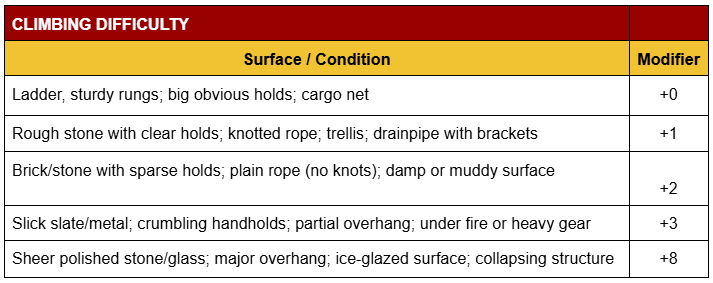
🔴🔴🔴🔴 Climb (Infantry Athletics)
Base TN 4 + climbing difficulty modifier
The character scales a vertical or angled surface such as a wall, ladder, rope, or rocky slope. Difficulty depends on surface, handholds, encumbrance, or being under fire. A typical climb covers 10–12 feet per Turn. Climbing only requires a dice roll if the final Target Number indicates a possibility of failure.
🟠🟠 Reposition Behind Opponent (Infantry Athletics)
The character uses footwork, speed, circling, and athletic movement to get behind an opponent who is actively trying to prevent it. Make an opposed Test:
1d12 + Physical Performance PRISM + Infantry Athletics
The opponent defends with an appropriate close-combat Skill or Infantry Athletics according to how they resist. The attacker must exceed the opponent’s result by 3 or more. On a success, use the Reposition Behind Opponent rules under Unarmed Combat to establish Rear Position. This action changes the Skill and required margin used to obtain that position; it does not change what Rear Position means or how it is lost.
🟠🟠, 🔴🔴🔴🔴 Parkour (Infantry Athletics)
Base Target Number 4 + a modifier of +1 to +8 (see Parkour Table)
The character performs advanced acrobatics—vaults, wall-runs, swings, dives—navigating complex terrain at speed. Difficulty scales by Complexity (Badass or Breathtaking) and by Obstacle Course/Terrain. Badass Parkour (🟠🟠) is a two–points-of-contact sequence, e.g., sprint → vault a waist-high fence, hop a small gap, kick off a wall. Breathtaking Parkour (🔴🔴🔴🔴) is a four–points-of-contact chain, e.g., rooftop sprint → leap a wide alley → roll over a cart → dive through a window. Apply the appropriate Complexity modifier: +2 for Badass Parkour or +4 for Breathtaking Parkour. Then add the appropriate Terrain modifier from the Parkour table. Parkour is especially challenging under fire, while encumbered, or when the route is slick, unstable, or collapsing. Success clears the full sequence; failure may cause slips, shortfalls, or tumbles at the GM’s discretion.
It is up to the Game Master to periodically present parkour challenges that, if completed, will advantageously reposition the player character, but players should also suggest ways they can add parkour into the scene to somehow gain an advantage.
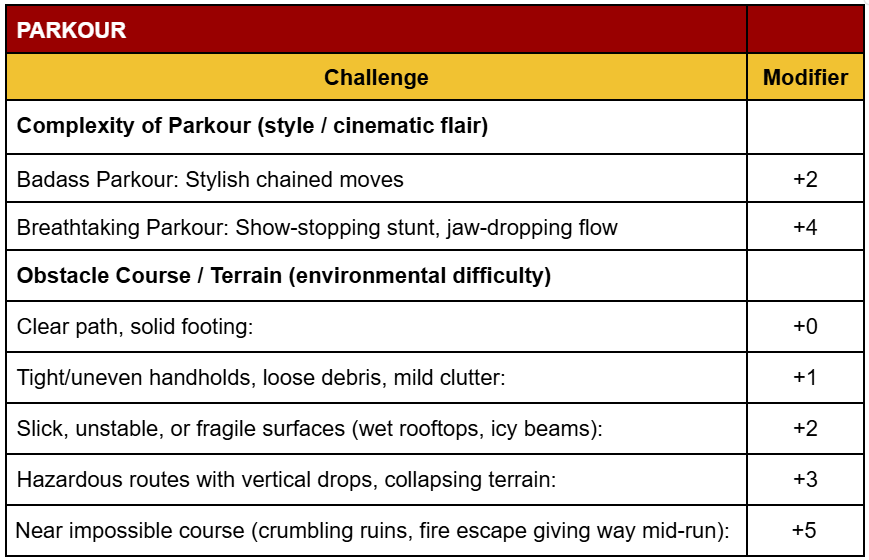
🎬Example — Tactical Parkour
Under arrow fire on rain-slick rooftops, Kael declares Breathtaking Parkour: sprint → leap the alley → shoulder-roll → dive through a dormer window. Breathtaking Parkour has a Complexity of +4 and the GM sets the Obstacle Course Difficulty at +2 (slick, unstable), so TN = 4 + 4 + 2 = 10. Kael rolls 1d12 + Physical Performance PRISM + Infantry Athletics. With +1 Physical Performance PRISM and +1 Infantry Athletics, he has +2 in modifiers. He rolls an 8, producing a final result of 10 and succeeding. Kael explodes from the chimney line, clears the wide gap, tucks into a tight roll across wet tiles, then dives through the dormer glass, skidding to his feet in the attic. The GM grants a clean landing and momentum—Kael reaches +4 cover before the next volley. Had he missed, he’d have slipped on the tiles, hanging by the gutter or crashing short into the alley below.
🎬Example — Badass Parkour Stunts
Rain hammers the cobblestones as arrows strike the walls and street around Kael, forcing him to commit or be cut down where he stands. Another arrow snaps overhead as Kael sprints toward a waist-high fence. He declares Badass Parkour: sprint → vault the fence. The GM starts at Base TN 4, adds +2 for the Badass sequence, and +2 for wet footing under fire, setting the final TN to 8. Kael rolls 1d12 + Physical Performance PRISM +1 + Infantry Athletics +1. He rolls a 6 and with +2 in modifiers the total result is 8. He hits the fence at full speed, plants both hands, and swings his legs through cleanly. He lands in a low stance on the far side without breaking stride, sliding behind a water barrel for cover before the next shot rings out.
🟠🟠 Jump or Leap (Infantry Athletics)
Base TN 4 + Modifier (see Jumping & Leaping Table)
The character attempts a vertical jump to grab a handhold, a hurdle over an obstacle, or a leap across a gap. Apply the appropriate Jumping & Leaping Modifiers category (Jump Up, Jump Over Obstacle, Leap Over a Gap, or Leap Gap from Standing Position). Success clears or secures the target; failure may result in a stumble, shortfall, or fall prone at the GM’s discretion. Minor hops or ordinary changes in stride that present no meaningful difficulty are simply part of normal movement and do not require this action.
🎬Example — Jumping
Pursued through the stone maze, an adventurer reaches a dead end where a narrow beam spans the corridor overhead. He plants his boots, looks up once, and commits. The GM identifies this as Jump Up / Jump Over, aiming for an arm’s reach above head (pull-up level). The Base TN is 4, with a +3 modifier, setting the final TN at 7. The walls are close, slick with moisture, but the beam is solid and clearly within reach if the jump is true. The adventurer rolls 1d12 + Physical Performance PRISM + Infantry Athletics. On a success, he explodes upward, fingers hooking cleanly over the beam as dust and grit rain down below. His body swings once, coat flaring, before he locks his grip and pulls himself out of immediate danger.
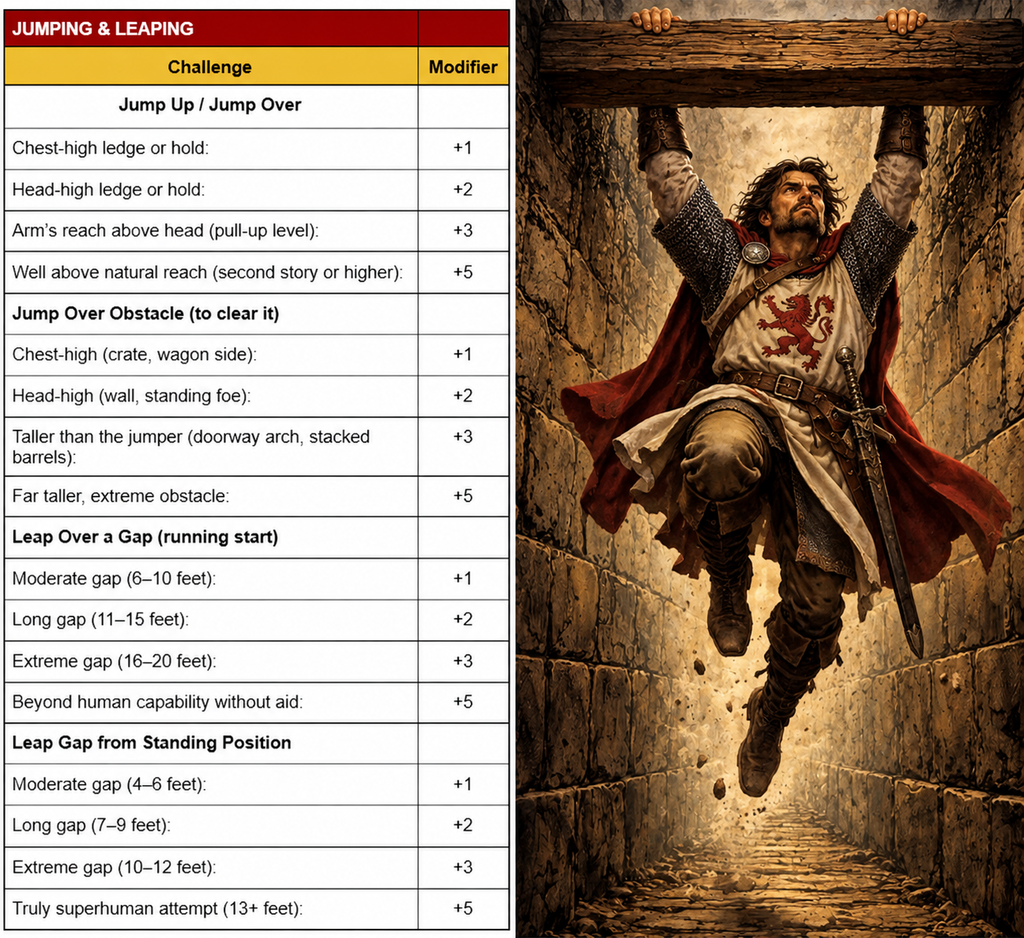
Swimming
Swimming covers any action that involves navigating or reacting to water or other liquid environments—lakes, rivers, oceans, flooded tunnels, sewers, magical waters, cisterns, wells, and more. These actions use the Swimming skill, which is paired with Physical Performance. Swimming takes considerable action points because it is slow, requires the use of the limbs, and considerable concentration on the task. The distance a person can swim is walking speed. No dice roll is required unless the Game Master determines there are significant challenges to complete the swim, such as hauling heavy gear, pulling a rescued person through water, or swimming through powerful waves and currents. A character may stop in the water but must use the Tread Water / Stay Still Underwater unless they can hold onto something.
Breath-Holding
Under calm conditions, an average person with Swimming 0 can normally hold his breath for approximately 30–60 seconds. A trained swimmer with Swimming +1 may manage approximately 1–2 minutes; Swimming +2, approximately 2–3 minutes; Swimming +3, approximately 3–5 minutes; and Swimming +4, approximately 5–7 minutes or longer. These are practical game ranges rather than exact physiological limits. Exertion, panic, injury, cold water, smoke, choking vapors, strenuous underwater activity, or other difficult circumstances may substantially reduce the available time. Calm preparation and favorable circumstances may improve it at the Game Master’s discretion. During ordinary Combat Rounds, exact breath tracking is rarely necessary unless the character is already in danger of running out of air. Longer underwater or hazardous scenes may require tracking elapsed time.
🟡 Take a Deep Breath (Swimming)
The character deliberately fills his lungs in preparation for submersion, smoke, choking vapors, or another situation in which holding his breath matters. Afterward, use the Breath-Holding rules to determine how long the character can remain without breathing.
🔴🔴🔴🔴 Surface Swim (Swimming)
A skill test is unnecessary unless there are powerful waves, the character is fatigued, wearing heavy armor, seriously injured, or there are strong currents. The character swims across a liquid surface—calm water, choppy waves, flooded chambers, or even unnatural pools created by magic or catastrophe. Can be combined with movement, escape, or rescue attempts. Surface swimming assumes steady forward progress at walking speed; distance and endurance matter more than speed, and sudden maneuvers may require a test at the GM’s discretion. Firing weapons, casting spells, or performing fine motor actions while surface swimming is possible but typically incurs Disadvantage.
🔴🔴🔴🔴 Underwater Swim (Swimming)
A skill test is unnecessary unless in low visibility, combat, or if carrying gear. The character propels themselves while fully submerged, navigating with limited vision and breath. Combat Rounds are typically short enough that characters will not have to track how long they’ve been holding their breath, but longer Non-Combat Action Scenes may require tracking breath.
FREE Diving (Swimming)
The character enters the water headfirst as part of normal movement. An ordinary dive into safe, open water requires no Action Points and no Test. A Test may be required when the dive itself is difficult or dangerous because of significant height, a narrow opening, obstacles, poor visibility, moving water, the need for precise entry, or another meaningful hazard. Use Physical Performance PRISM + Swimming against a Target Number appropriate to the circumstances. A significant height may also require Discipline to overcome fear. Success means the character enters the water as intended. Failure may result in a poor entry, lost orientation, impact injury, missed positioning, or another consequence appropriate to the failed dive. FREE Diving covers only the act of entering the water. It does not provide free swimming movement after entry. Any movement through the water requires the appropriate Surface Swim, Underwater Swim, or other Swimming action and its normal Action Point cost. Diving provides no automatic Advantage merely for being performed successfully. Any tactical benefit comes from the position actually achieved—for example, entering beneath incoming fire, passing through a narrow opening, or reaching underwater cover.
🟠🟠 Tread Water / Stay Still Underwater (Swimming)
A skill test is unnecessary unless the character is weighted down or their feet are tied together.
The character maintains his position with his head above water, or if he is underwater he uses his hands and/or feet to maintain his depth and position. Treading water with hands or feet tied requires a Discipline Test to overcome fear.
Man Skills
Though often associated with labor, machinery, and craftsmanship, the Man Skills skill can be a powerful tactical asset in combat—especially when brute force, structural knowledge, or sabotage is involved. This skill represents a character’s understanding of how manmade objects are built, and therefore, how they can be quickly and strategically destroyed.
🔴🔴🔴🔴 Sabotage or Destroy
Realism TN 4 + Modifier dependent upon Tools & Durability of Object/Construct
A character might use Man Skills during a Combat Round to: cut the traces or harness of a wagon or carriage; collapse scaffolding, a wooden platform, or a weakened support beam to drop debris on enemies; pry open a barred door, break through a barricade, or force a jammed gate; sever the ropes of a drawbridge, portcullis, hoist, or pulley system; remove a wheel pin, damage an axle, or break a critical part of a wagon, mill, siege engine, or other mechanism. These actions often qualify as Starring Actions and are especially useful for characters acting as sappers, saboteurs, craftsmen, or siege engineers—those who understand that knowing how something is built also means knowing how to break it quickly and precisely.
Barriers
Barriers represent any obstacle between an attacker and their target—walls, doors, shutters, fences, gates, barricades, or fortified structures. Barriers always have ten boxes of Barrier Durability, which represent damage in increments of ten percent.
An attack must reasonably be capable of inflicting at least five to ten percent damage to the structure to fill a single box. Anything less is cosmetic: cracks, chips, dents, or splinters that do not meaningfully weaken the barrier. Some attacks may therefore never destroy a particular barrier, regardless of how many times they are repeated.
Unlike living characters, barriers do not use stat blocks or Armor Ratings. Their ability to withstand damage is determined by context, material, thickness, and common sense. An arrow striking a thick stone wall accomplishes essentially nothing, while the same arrow might pierce a thin wooden shutter. An axe can quickly damage an ordinary wooden door but is nearly useless against a stone wall. A heavy warhammer might splinter wooden defenses or damage masonry, while a battering ram, siege engine, powerful spell, or Exploding Potion may threaten structures that ordinary weapons cannot.
When resolving an attack against a barrier, first determine whether the attack could reasonably inflict five to ten percent or more damage to the structure. If so, mark one or more Barrier Durability boxes according to the severity of the damage. If not, the effect is cosmetic. Once all ten boxes are marked, the barrier collapses or is destroyed, allowing free passage.
Smaller breaches may occur before the entire barrier is destroyed. A powerful blow might break a hole through a wooden door large enough to see or attack through, while repeated strikes could eventually enlarge it enough for a person to pass. Siege weapons, magic, or Exploding Potions might similarly create localized breaches without destroying an entire wall. The principle is simple: if the attack can credibly damage the barrier, mark the appropriate boxes; if it cannot, the barrier remains structurally intact.
Archery
Archery is more than simply loosing arrows at a target—it is the art of precision, daring, and spectacle. Some of the actions in this section represent extraordinary feats of marksmanship requiring exceptional training, specialized technique, or years of practice. These “trick shots” go beyond mere combat effectiveness. Though they are not always the most tactically intelligent choice—such as attempting to disarm an opponent rather than simply killing them—they can carry tremendous psychological weight. Enemies confronted by incredible displays of marksmanship may falter, suffering Mental Trauma from witnessing an archer accomplish something they believed impossible. Archery actions embrace both the practical and theatrical, rewarding players who bring style and boldness to the battlefield.
Readying & Reloading Ranged Weapons
Drawing a ranged weapon, preparing its ammunition, loading it, and firing it are not necessarily the same action. The required actions depend upon the weapon and its current state.
🟡 Draw or Ready Carried Equipment places readily accessible equipment into the character’s hands or ordinary ready position. Unslinging a bow or bringing a carried crossbow into the hands normally uses this action. A weapon already held and ready requires no such action.
🟠🟠 Ready a Ranged Weapon performs a quick ammunition-preparation step, most commonly drawing an arrow from an accessible quiver and nocking it. Once completed, the bow and arrow are ready to be drawn and fired with 🟠🟠 Loose Arrow or Bolt.
🔴🔴🔴🔴 Reload is used when preparing the weapon requires substantially more effort, such as spanning and loading a crossbow. Reload includes the ordinary handling of ammunition and loading mechanism required for that weapon. A weapon’s equipment entry may specify a different Reload time when its construction makes loading significantly faster or slower.
Some particularly powerful or mechanically elaborate ranged weapons cannot realistically be reloaded within a single Turn. Their equipment entries may therefore give Reload requirements measured in multiple 🔴🔴🔴🔴 Reload actions or in ▶️Rounds. The required time represents the complete loading procedure and must be completed before the weapon can be fired again.
A loaded weapon does not need to be reloaded merely because it was drawn, carried, aimed, or otherwise handled. Thus a character who enters an Action Scene with a loaded crossbow already in hand may immediately use 🟠🟠 Loose Arrow or Bolt. After firing, however, the crossbow must be reloaded according to its own Reload requirement before it can fire again.
Likewise, a character carrying a bow on his back normally spends 🟡 Draw or Ready Carried Equipment to unsling it, 🟠🟠 Ready a Ranged Weapon to nock an arrow, and 🟠🟠 Loose Arrow or Bolt to fire. A character already holding the bow with an arrow nocked has already completed the first two steps and may immediately spend 🟠🟠 Loose Arrow or Bolt.
Mounted & Forearm Ranged Weapons
A ranged weapon already secured to the character’s body, armor, forearm, mount, vehicle, or another usable firing position does not need to be drawn merely to bring it into the hands. If it is already positioned for use, omit 🟡 Draw or Ready Carried Equipment.
Mounting a weapon does not automatically make it faster to reload. A loaded forearm-mounted crossbow, for example, may be immediately available to fire, but after firing it still requires whatever Reload procedure its construction specifies. A compact mechanism designed for rapid loading may have a shorter Reload requirement, while a powerful mechanism requiring substantial spanning may take considerably longer. The equipment entry controls the Reload requirement whenever a particular weapon differs from the ordinary rules.
Siege Weapons
Kingsmark’s Action Point system does not assume that every weapon can be loaded, aimed, and fired within a single Turn. Large siege weapons may require several actions, multiple ▶️Rounds, several crew members, or all three.
A siege weapon’s particular rules determine what must be done to operate it. Depending upon the machine, the process may include resetting or spanning the mechanism, winding a winch, hauling down a throwing arm, preparing a sling, carrying and positioning ammunition, loading the projectile, adjusting elevation or direction, aiming, and finally firing. Several crew members may perform different physically compatible tasks at the same time, while a reduced crew may be forced to perform those same tasks sequentially and therefore operate the weapon much more slowly.
Operating the machinery of a siege engine may call for Mechanisms, while aiming and firing may use Archery, another appropriate Skill, or a procedure specified by the weapon. The Game Master should follow the particular siege weapon’s rules rather than treating 🔴🔴🔴🔴 Reload as a universal four-Action-Point reload for every machine.
Siege weapons are not merely background scenery. Adventurers may help defend a castle, storm its walls, sabotage an enemy trebuchet, seize a ballista and turn it against its former owners, operate a captured engine during a siege, defend a crew while they reload, or desperately bring a massive weapon to bear against something ordinary weapons can scarcely threaten. A ballista or other sufficiently maneuverable engine might even be turned skyward against a dragon or another enormous flying creature.
Large-scale warfare does not replace the ordinary action rules. It creates situations in which those rules matter on a larger battlefield. While armies fight around them, the heroes may be the people cutting through the gatehouse, protecting the engineers, killing the creature attacking the walls, capturing an enemy engine, or firing the shot upon which the battle turns.
🟠🟠 Loose Arrow or Bolt (Archery)
Base TN 4 + appropriate ranged-combat modifiers
The character releases a readied bow or fires a loaded crossbow at a target within range. Unless the character previously used 🟠🟠 Aim, the player does not choose the 🎯Hit Location. On a successful attack, determine Hit Location through the normal 1d12 procedure or according to obvious physical circumstances. Creative descriptions remain encouraged, but narration does not replace the aiming rules. A player may describe firing high, shooting desperately through a doorway, or trying to catch an exposed opponent, but deliberately selecting a particular Hit Location requires 🟠🟠 Aim. Deliberately selecting something smaller than a Hit Location requires Aim and follows the Tiny Target rules.
Point-Blank Archery & Precision Targets
Point-blank range does not automatically make a target helpless. An alert person seated across a table, standing beside the archer, or confronting a loaded crossbow may still duck, twist, grab the weapon, spoil the aim, turn an armored location toward the attack, or otherwise prevent perfect placement.
An ordinary point-blank attack therefore does not allow the player to select the Hit Location. Use 🟠🟠 Aim when deliberately targeting 👨Head, 📿Neck, 👕Upper Torso, or another Hit Location. An eyeball, heart, helmet slit, armor gap, or similarly precise structure is a Tiny Target and follows the Tiny Target rules.
A successful aimed attack establishes where the weapon visibly strikes; it does not automatically establish that a particular internal structure was destroyed. An arrow aimed at the 👕Upper Torso may ultimately pierce the heart if the resulting Wound and circumstances justify that description, but selecting Upper Torso does not mechanically guarantee cardiac destruction.
Likewise, successfully striking a Tiny Target such as an eye establishes that the attack reached that tiny location, but the resulting Damage Level still determines the severity of the injury. Resolve Damage, armor, Critical Threshold, Physical Trauma, Permanent Injury, and R.A.D. normally unless another rule specifically establishes 🩸Fatal Bleeding or 💀Certain Death.
A helpless target is different. When the attacker possesses sufficient time and control to establish an exposed vital location as an Execution Position, use the Lethal Maneuvers & Executions rules rather than treating the situation as an ordinary aimed attack.
🔴🔴🔴🔴 Turning Arrow (Cover) (Archery)
Base TN 4 + appropriate ranged combat modifiers +6 for difficulty
The archer uses an unusual side-angle, curving, or arcing shot to strike an enemy partially obscured by cover, such as a column, tree, or wall edge. This is an intentionally cinematic feat of extraordinary archery rather than an ordinary shot, allowing the archer to exploit a narrow trajectory around the edge of cover that would normally prevent a direct attack.
🔴🔴🔴🔴 Turning Arrow (Rear) (Archery)
Base TN 4 + appropriate ranged combat modifiers +8 for difficulty
Used to target an enemy directly behind the archer, this shot involves a high-level whip or arc technique.
🔴🔴🔴🔴 Rapid Fire (Archery)
Base TN 4 + appropriate ranged combat modifiers +8 for difficulty
The character fires several arrows in exceptionally rapid succession. The number of arrows that may be fired is equal to the character’s Archery Skill + Reflexes PRISM, with a minimum of 2 arrows and a maximum of 4 arrows. Rapid Fire includes the 🟠🟠 Ready a Ranged Weapon actions normally required to retrieve and nock the arrows fired during the sequence; do not pay those Action Point costs separately. The bow itself must already be drawn or otherwise ready for use when Rapid Fire begins.
Make a separate Archery attack roll for each arrow against the Target Number established for that shot. Resolve each successful attack normally, including Hit Location, Damage, armor, and Critical Threshold. If the character shifts between targets, use the Change Target rule when applicable.
Rapid Fire represents sacrificing the deliberate rhythm and precision of ordinary shooting for exceptional speed; it does not allow more than four arrows regardless of exceptionally high Skill or PRISM ratings.
🟡 Change Target
Base TN + appropriate ranged combat modifiers +1 for switching targets
When making multiple ranged attacks as part of the same action or attack sequence, the character may shift aim from one target to another. If acquiring the new target requires moving the weapon’s point of aim more than approximately 12 inches from its previous position, the character must spend 🟡 1 Action Point to Change Target. The 12 inches measures the physical movement of the weapon’s aim—not the distance between the targets in the game world. Two enemies may be many yards apart yet require only a small adjustment of aim when viewed at long range, while two nearby enemies positioned on opposite sides of the character may require a substantial movement of the weapon. Minor adjustments of 12 inches or less are part of ordinary aiming and do not require Change Target. The Game Master should judge this naturally rather than attempting to measure the movement precisely during play.
OPTIONAL DEFENSE Arrow Parry (Archery)
An ability unique to skilled Archers (must be in Defensive Stance)
Any character with an Archery Skill of +3 or +4 may optionally roll 1d12 + Reflexes PRISM + Archery to defend against an incoming arrow or similar projectile attack instead of using the standard 1d12 + Physical Performance PRISM + Infantry Athletics.
The character uses his bow, an arrow, or rapid weapon movement to knock or deflect the incoming projectile away. This defense does not require the character to fire an arrow or expend ammunition. If the defender rolls a natural 12 and successfully defends against the attack, he may instead describe the defense as loosing an arrow that strikes the incoming arrow or projectile out of the air. This cinematic defensive shot requires a bow and usable arrow immediately available and expends one arrow, but costs no additional Action Points because it is part of the defense itself. Any enemies who witness such a feat of frightening skill must resist 🧠Shaken Mental Trauma with a Target Number of 12. This Mental Trauma cannot escalate beyond 🧠Shaken.
OPTIONAL DEFENSE Catch Arrow & Fire Back (Unarmed Combat + Archery)
An ability unique to skilled Martial Artists who are also skilled Archers (must be in Defensive Stance)
Any character with an Unarmed Combat Skill of +3 or +4 and at least Archery +1 may optionally roll 1d12 + Reflexes PRISM + Unarmed Combat to defend against an incoming arrow attack instead of using the standard 1d12 + Physical Performance PRISM + Infantry Athletics.
If the defender rolls a natural 12 and successfully defends against the attack, he catches the incoming arrow out of the air. If he has a bow immediately available for use, he may immediately loose the caught arrow at an enemy as part of the same extraordinary defense. This return shot costs no additional Action Points and uses the character’s normal Archery attack roll, including all applicable ranged-combat modifiers. The caught arrow serves as the ammunition for the return shot.
The return shot is a normal attack and is not automatically successful merely because the arrow was successfully caught.
If the character cannot immediately use a bow, he may still catch the arrow but cannot fire it back.
Any enemies who witness the character catch an arrow and immediately fire it back must resist 🧠Shaken Mental Trauma with a Target Number of 12. This Mental Trauma cannot escalate beyond 🧠Shaken.
🟠🟠 Close-Range Arrow Stab (Armed Combat)
The character uses a loose arrow as an improvised stabbing weapon in close combat. Resolve this as an ordinary melee attack. Treat the arrow as a knife for purposes of Base Damage Level and Critical Threshold, unless the equipment rules for the particular arrow state otherwise.
🔴🔴🔴🔴 Suppressing Volley (Archery)
The character rapidly fires arrows into or across an area to force enemies to keep their heads down rather than carefully aiming at a particular target. Suppressing Volley includes the Ready a Ranged Weapon actions normally required to retrieve and nock the arrows fired during the volley; do not pay those Action Point costs separately. The bow itself must already be drawn or otherwise ready for use when Suppressing Volley begins. The character fires 4 arrows during the volley. A character with Archery +3 or +4 may instead fire 5 arrows. The character must possess enough ammunition to fire the complete volley. Choose a reasonably concentrated area that the character can effectively threaten with those shots. Characters exposed within that area are Heavily Suppressed until the beginning of the archer’s next ⏸Turn and suffer the normal effects of Heavy Suppression. Suppressing Volley does not make normal attack rolls against individual targets. Instead, roll 1d12 once for each arrow fired. On a natural 12, one logically exposed character within the suppressed area is struck. If several characters could reasonably be struck, determine the target randomly among those exposed to the volley. Resolve the hit normally, including Hit Location, armor, Damage, and any applicable Critical or exploding-die rules. A character who is completely protected from the incoming arrows cannot be struck merely because he is within the suppressed area. The Game Master should use the actual positions, cover, and direction of fire when determining who is exposed. Suppressing Volley cannot be used to secretly designate a particular enemy as the target of these incidental hits. A character who wants to deliberately shoot a particular opponent must use an appropriate attack action.
Ranged Combat Modifiers
Weapon ranges reflect practical combat reality, not maximum ballistic distance. Just because a projectile can travel farther does not mean it can be aimed, controlled, or relied upon in battle. Each weapon is therefore divided into Close Range, Effective Range, and Long Range, representing how the weapon performs in real conditions—smoke, stress, movement, and poor visibility. Close Range favors speed and decisiveness. Shots are easier to place, and even crude missile weapons can be deadly. Effective Range is where a weapon can be used reliably in combat. Accuracy, penetration, and lethality remain dependable, provided the attacker has time to aim. Long Range is possible but uncertain. Shots at this distance rely on patience, stable footing, and often luck; penalties stack quickly, and misses are common. Players should think tactically about distance. Closing ground can be as important as loosing the shot, while attacking too early may waste ammunition, reveal position, or invite retaliation.
🎬Example — Calculating Ranged Attacks
From a shattered balcony overlooking the square, Elias steadies his bow and takes aim at a fleeing cultist. The Base Target Number is 4. The GM begins layering modifiers based on the situation. The target is running while Elias is stationary, adding +2 for target movement. The cultist weaves behind a stone fountain, giving him partial cover, for +2 more. A moderate crosswind cuts across the square, adding +1 from the Environment table. It is late evening, with only lantern light and embers illuminating the square, imposing poor light for another +2 from Visibility. Worse still, Elias is under threat. A second cultist loosed an arrow at him before it was his turn, creating an imminent threat and adding +1 from Suppression. Finally, the GM rules the range is Effective Range (40–60 yards), imposing a situational +1 range penalty. The GM totals the modifiers: +2 (movement) +2 (cover) +1 (environment) +2 (visibility) +1 (suppression) +1 (range) +0 (no wounds or mental trauma) = +9 Added to the Base TN of 4, the final Target Number is 13. Elias exhales slowly, knowing this shot will demand precision, luck—or fate itself.
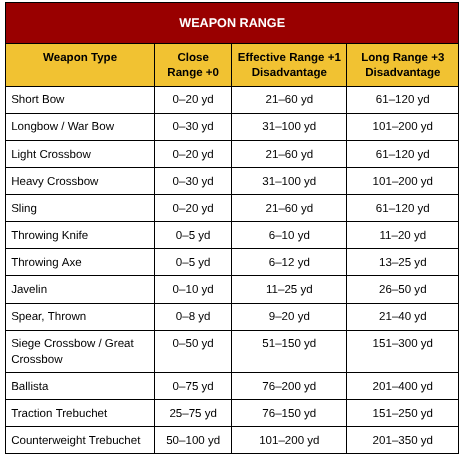
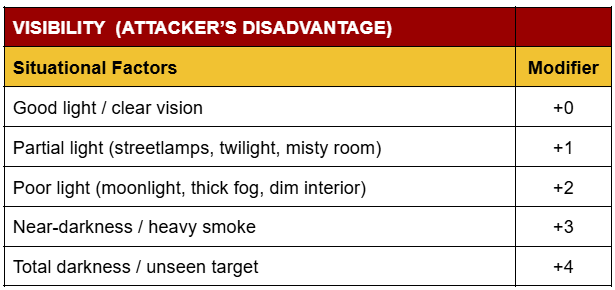
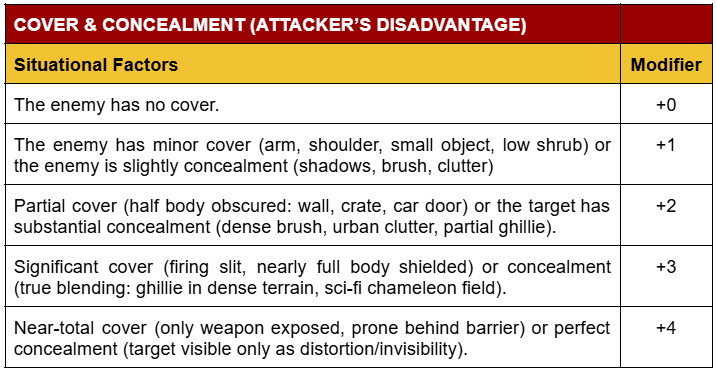
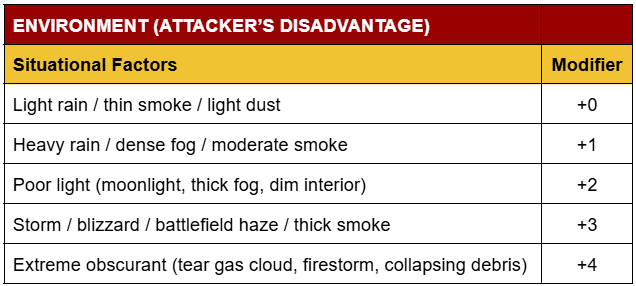
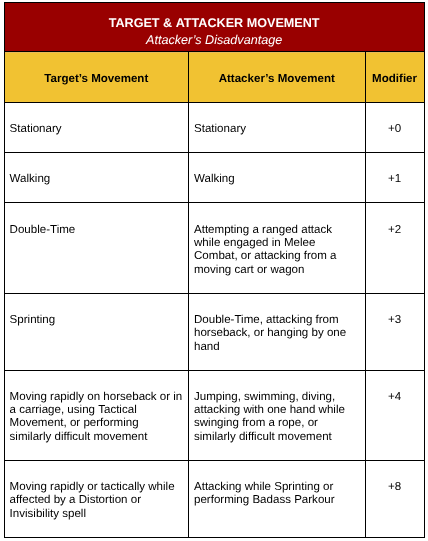
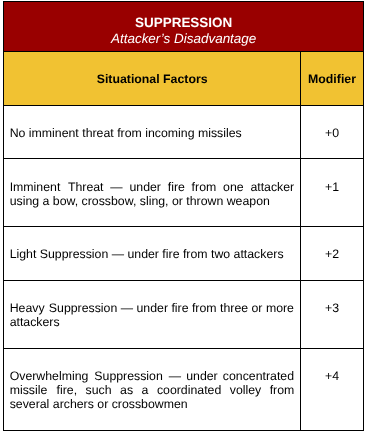
Throwing Weapons
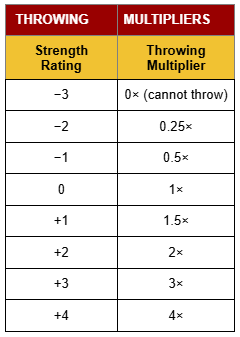
🟠🟠 Throw Weapon or Object (Throwing Weapons)
Base TN 4 + appropriate modifiers
The character hurls a weapon at a target within range. This is the classic throw: fast, direct, and lethal. The player may narrate details such as spinning a knife before launch, hurling it at a vital point, or bouncing it off a shield edge into the throat.
🔴🔴🔴🔴 Activate and Throw Exploding Potion or Drop-and-Roll Exploding Potion (Throwing Weapons)
Base TN 4 + appropriate modifiers +2 to properly aim and time the attack
The character activates an Exploding Potion and throws it toward the intended target, judging its timing so that enemies have little opportunity to escape or throw it back. Depending on the potion, activation might require lighting a wick, breaking a seal, mixing two substances, or exposing the contents to air. A failed roll may result in a short throw, poor placement, premature activation, or dangerously delayed detonation at the Game Master’s discretion. Instead of throwing the potion, the character may roll or slide its container across the ground, beneath obstacles, through openings, or down stairs.
🟠🟠 Ricochet Throw (Knife or Shuriken) (Throwing Weapons)
Base TN 4 + appropriate range modifiers +3 for significant difficulty.
The character intentionally ricochets the weapon off a surface (wall, pole, armor) to hit an opponent behind partial cover or at an unexpected angle.
🔴🔴🔴🔴 Double Throw (Shuriken, Knife) (Throwing Weapons)
Base TN 4 + appropriate range modifiers and +2 for the second target
The character throws two weapons at once, targeting either a single opponent or two adjacent targets. Each weapon is rolled separately.
🔴🔴🔴🔴 Rapid Throw (Shuriken, Throwing Knife) (Throwing Weapons)
Base TN 4 + appropriate ranged combat modifiers +6 for difficulty
The character unleashes several small throwing weapons in exceptionally rapid succession. The number of weapons that may be thrown is equal to the character’s Throwing Weapons Skill + Reflexes PRISM, with a minimum of 2 weapons and a maximum of 4 weapons. The weapons must be immediately accessible upon the character’s body rather than stored inside a backpack, chest, or other container requiring separate retrieval.
Make a separate Throwing Weapons attack roll for each weapon against the Target Number established for that throw. Resolve each successful attack normally, including Hit Location, Damage, armor, and Critical Threshold. If the character shifts between targets, use the Change Target rule when applicable.
Rapid Throw represents sacrificing the deliberate timing and precision of an ordinary throw for extraordinary speed. It does not allow more than four weapons regardless of exceptionally high Skill or PRISM ratings.
🔴🔴🔴🔴 Pin Cloak to Wall (Knife or Axe) (Throwing Weapons)
Base TN 4 + appropriate modifiers +8 for significant difficulty.
The character attempts to pin an opponent’s cloak, robe, loose clothing, equipment, or another suitable material to a nearby wall, floor, piece of furniture, or other fixed surface with an appropriate weapon or object. Resolve the attack normally. On a success, the target is Pinned in place and cannot move farther from the point of attachment until freed. The target may still attack, defend, Change Stance, manipulate equipment, or perform other actions that remain physically possible from that position.
The target may free himself by removing the pinned garment or equipment, removing the object holding it in place, cutting the material loose, tearing free, or using another logically appropriate method. Use the normal Action Point cost of whatever action is attempted, and require a Test only when the method is difficult, resisted, or uncertain.
A character who attempts to tear free by force makes an appropriate Strength Attribute Test against a Target Number determined by the strength of the material and how securely it is pinned. Success tears the character free; failure leaves him Pinned.
The effect ends immediately when the attachment is removed, broken, cut, torn free, or otherwise ceases to restrain the character.
🔴🔴🔴🔴 Volley Toss (Exploding Potions) (Throwing Weapons)
The character rapidly throws multiple suitable explosive or area-effect devices into the same general area, saturating it with enough simultaneous danger to make effective return attacks extremely difficult.
Resolve each thrown device according to its normal throwing, accuracy, blast, Damage, and other applicable rules.
For purposes of the Suppression rules, the affected area counts as being under Overwhelming Suppression until the beginning of the character’s next ⏸Turn. This is a specific exception to the normal sources of Overwhelming Suppression: the effect is created by the concentrated explosions and dangerous projectiles saturating the area rather than by concentrated missile fire.
Characters exposed to the Volley Toss therefore suffer the normal effects of Overwhelming Suppression, including +4 Disadvantage on attacks made in response, for as long as the Suppression lasts. Do not apply an additional +4 for Volley Toss itself; the +4 is the normal effect of Overwhelming Suppression.
A character must actually possess and be capable of throwing enough appropriate devices during the action to create this degree of saturation. A single thrown explosive does not create Overwhelming Suppression merely because it explodes.
🔴🔴🔴🔴 Disarm Throw (Knife or Axe) (Throwing Weapons)
Base TN 4 + appropriate modifiers +4 for significant difficulty.
The throw targets the opponent’s weapon or weapon hand. If successful, the enemy is disarmed and the weapon is knocked away from them. Players may choose to disarm without injury or escalate damage as normal.
Exploding Potions
Exploding Potions are volatile weapons created through the Alchemy Skill. An alchemist may prepare ceramic vessels, glass flasks, sealed pots, or other containers filled with substances that explode, ignite, release dangerous vapors, or scatter harmful compounds when activated or shattered. They are rarely precise, but when properly used they can dominate a small area of the battlefield.
Using an Exploding Potion is a two-step process: first determining where the vessel lands, and then resolving what happens to everyone and everything within its area of effect. The attacker’s goal is simple—get the potion as close as possible to the intended target before it explodes, burns, or shatters. Exploding Potions are normally thrown by hand, although slings and other appropriate methods may extend their range.
To throw an Exploding Potion, the attacker makes a 1d12 + Reflexes PRISM + Throwing Weapons roll against a Realism Target Number determined by distance. Success means the potion lands exactly where intended, while failure results in deviation. When deviation occurs, the Game Master rolls 1d12 to determine its direction as a clock position, with 12 meaning directly forward and 6 meaning directly back toward the attacker. The distance deviated depends upon the particular potion and the degree by which the attacker failed the Test, as described in the potion’s rules. The potion takes effect wherever it lands.
Every Exploding Potion has an Area of Effect in addition to its Damage Level or other effects. Anyone caught within a damaging blast must make a defense roll of 1d12 + Physical Performance PRISM + Infantry Athletics against the potion’s Blast Value as the Target Number. Particularly powerful Exploding Potions may inflict 💀Critical Wounds near the point of detonation, with their Blast Value and Damage Level decreasing with distance. Other concoctions may instead spread fire, acid, choking vapors, irritant powders, adhesive substances, or other alchemical effects.
Exploding Potions can be especially dangerous in confined spaces. Fire, fragments, corrosive liquids, smoke, and vapors may have nowhere to disperse, allowing the Game Master to increase their effects when circumstances warrant. The exact properties of an Exploding Potion depend upon the substances used to create it and the Alchemy Skill required to prepare it.
🎬 Example — Exploding Potion
In the ruins of a shattered temple, Mateo hurls an Exploding Potion toward a cluster of goblins behind a toppled altar. He rolls 1d12 + Reflexes PRISM +2 Throwing Weapons +2 against TN 11 but misses. The Game Master rolls 1d12 for deviation and gets 9, sending the potion to the left, then determines that it lands 4 yards from the intended target. Two goblins remain within the potion’s most dangerous area. Both roll 1d12 + Physical Performance PRISM + Infantry Athletics against its Blast Value of 12 to attempt to reduce the 💀Critical Wound. Both fail and suffer a 💀Critical Wound, requiring each goblin to R.A.D.💀—Roll Against Death.
Whips & Nunchaku
Whips and nunchaku are weapons that demand high coordination, rhythm, and wrist control. Unlike swords or clubs, these tools strike in arcs, often bypassing defenses, tripping limbs, or disarming opponents. A whip might be used to entangle, distract, or lash from a distance, while nunchaku rely on rapid, fluid strikes and rebounds that can daze or overwhelm a target. Attacks with these weapons are made using the Unarmed Combat skill, paired with Reflexes. Characters untrained in this style risk hurting themselves or failing dramatically.
🟠🟠 Standard Strike (Unarmed Combat)
The Target Number is the opponent’s modified dice roll.
A normal attack using the weapon’s reach or motion to land a clean blow. For whips, this includes lashes at skin or armor gaps. For nunchaku, it might be a snapping strike to the shoulder, thigh, or ribs.
🟠🟠 Disarm Snap (Unarmed Combat)
The Target Number is the opponent’s modified dice roll +3 for significant difficulty.
The character aims to knock a weapon from the opponent’s grasp using a quick lash or flick. This is especially effective against long weapons, bows, or when the target is distracted.
🟠🟠 Entangle Limb to Trip or Control (Unarmed Combat – Whip Only)
The character attempts to wrap a flexible weapon around an opponent’s arm, leg, or other appropriate body part and use the entanglement to pull the opponent off balance or restrict that limb. Make the action’s normal opposed Test. On a success, choose one:
Trip: The character yanks the entangled limb out from under the opponent or otherwise pulls him off balance. The target becomes Prone.
Control: The targeted limb remains entangled. The target becomes Grappled for purposes of that limb and cannot freely use it until the entanglement is broken. An entangled arm cannot normally be used to attack, defend, manipulate equipment, or perform actions requiring that arm; an entangled leg prevents normal unrestricted movement and may prevent actions requiring stable footing.
The character must maintain control of the weapon to maintain the entanglement. The target may use the normal Break Hold procedure to escape, substituting whatever Skill or physical method is logically appropriate to breaking or slipping the entanglement. Releasing the weapon or otherwise losing control of it ends the attacker’s control unless the weapon remains physically secured around the target. Any subsequent throw, takedown, disarm, drag, or other maneuver requires its normal Action Point cost.
🟠🟠 Pull Object or Weapon (Unarmed Combat – Whip Only)
The character uses the whip to catch, hook, or wrap around an object and yank it toward himself or away from another character. For an unattended object, make a Reflexes PRISM + Unarmed Combat Test against a Realism Target Number determined by the object’s size, distance, shape, position, and how difficult it is to catch securely with the whip. When attempting to pull an object or weapon from another character’s possession, the Target Number is the opponent’s modified defensive roll +3 for significant difficulty. On a success, the object is pulled free and lands or moves in the direction logically produced by the action. The Game Master may rule that an object cannot be pulled when it is too heavy, firmly secured, impossible to catch with the whip, or otherwise physically unsuitable.
🟠🟠 Whip-Crack Intimidation or Distraction (Unarmed Combat – Whip Only)
The character cracks the whip violently near an opponent to startle, intimidate, distract, or embarrass him without deliberately striking him. Roll: 1d12 + Reflexes PRISM + Unarmed Combat
The target opposes the result with: 1d12 + Discipline
If the character’s result exceeds the target’s result, the target suffers 🧠Shaken Mental Trauma. This Trauma cannot escalate beyond 🧠Shaken. The whip crack does not physically strike the target and causes no Physical Trauma. Any actual attack with the whip requires the appropriate attack action and its normal Action Point cost. This action is Psychological Warfare and is subject to the normal rules governing repeated Psychological Warfare.
🔴🔴🔴🔴 Intimidating Whirling Whip or Nunchaku Flurry (Unarmed Combat)
The character performs a fast, aggressive display with a whip, nunchaku, or another weapon that can logically be flourished around the body in a threatening manner, demonstrating enough control and violence to make nearby opponents hesitate to close with him.
Make one Test using the appropriate weapon Skill. Every opponent who can clearly see the display opposes that result with Discipline. An opponent who rolls less than the character suffers 🧠Shaken Mental Trauma. This Mental Trauma does not escalate if the opponent is already 🧠Shaken.
In addition, until the beginning of the character’s next ⏸Turn, an affected opponent suffers +1 Disadvantage on any action that requires deliberately approaching within the weapon’s immediate striking reach. This represents hesitation about stepping into the violently moving weapon rather than physical prevention; an opponent remains completely free to approach if willing to accept the Disadvantage.
An opponent who equals or exceeds the character’s Test is unaffected by the display.
The flurry does not attack anyone, inflict Physical Trauma, or create Suppression. Deliberately striking an opponent requires the appropriate attack action and its normal Action Point cost. The Game Master may rule that a particular weapon cannot perform this action when its construction or available space makes such a display implausible.
🔴🔴🔴🔴 Neck Catch (Unarmed Combat – Whip Only)
Target Number = opponent’s modified defensive roll +3 for significant difficulty.
The character attempts to cast the whip around an opponent’s neck and pull it tight. This maneuver specifically permits a declared 🎯Hit Location of 📿Neck and therefore does not require a separate Aim action. Because 📿Neck is one of the twelve standard Hit Locations, it is not treated as a Tiny Target.
Resolve the initial attack as an Unarmed Combat attack against the Target Number above. On a successful attack, the whip catches around the target’s neck. Resolve the attack’s Damage normally, including applicable 🛡Armor, Critical Threshold, and 🩸Physical Trauma. Successfully catching the neck does not by itself create a 💀Critical Wound or establish that the throat, spine, major blood vessels, or another particular structure has been destroyed.
If the attacker maintains tension after establishing the Neck Catch, the target is Grappled by the neck and cannot freely move away from the whip wielder. The victim may attempt to escape, relieve the pressure, remove or cut the whip, attack the wielder when physically possible, or receive assistance from another character.
The victim may use 🟠🟠 Break Hold to escape the Neck Catch, using the normal Control Test:
1d12 + Physical Performance PRISM + Unarmed Combat + 💪Strength
The whip wielder opposes this with the same Control Test. If the victim equals or exceeds the wielder’s result, the victim gets the whip off his neck or otherwise relieves the pressure, ending the Neck Catch.
The victim may instead attack the whip, attempt to cut it with an appropriate weapon, attack the wielder if physically able to do so, or take another action that could logically break the strangulation. Another character may likewise use 🟠🟠 Break Hold to help pull the whip free, cut or destroy the whip, force the wielder away, or otherwise intervene. If an attack severs or destroys the whip, the wielder releases it, sufficient slack is created to end the strangulation, or the wielder becomes incapable of maintaining tension, the Neck Catch immediately ends.
A tightened whip around the neck functions as ligature strangulation rather than a Rear Choke. Once the Neck Catch is secured and the wielder deliberately maintains continuous strangulating pressure, use the 6–12 Round unconsciousness period described for Crush Windpipe and Suffocate. Begin counting uninterrupted Rounds from the point at which effective strangulation begins. Any successful Break Hold, release of tension, removal or destruction of the whip, forced separation, incapacitation of the wielder, or other event that restores effective breathing or circulation ends the countdown.
The initial Neck Catch attack still resolves Damage normally. Continued strangulation does not automatically inflict additional Physical Wounds every Round. Particularly violent tightening, extraordinary Strength, dragging or suspending the victim by the neck, or another circumstance capable of physically injuring the neck may produce additional 🪨Concussive Trauma when the ordinary Damage and injury rules justify it.
Once the victim becomes unconscious, continuing deliberately with the intention of killing the helpless victim uses the Lethal Maneuvers & Executions rules. The attacker must establish an appropriate Execution Position and use Execute Helpless Target. Unconsciousness alone is not instantaneous death.
Cloak & Dagger
🟠🟠 Disappear from Sight (Cloak & Dagger)
Variable Modifier (see “Cloak & Dagger — Attempting Concealment” table)
The character slips behind cover, melts into shadows, or takes advantage of distractions to vanish from enemy view. Requires low visibility, chaos, or a physical obstacle. Success removes the character from active targeting until detected again by performing a Surprise Test.
🟠🟠 Move Without Drawing Fire (requires Cloak & Dagger +3, no dice roll)
The character uses careful timing, concealment, distraction, and controlled movement to cross dangerous ground without becoming an easy target. Until the beginning of the character’s next ⏸Turn, attacks made specifically to intercept or strike the character while the character is moving suffer +6 Disadvantage.
Move Without Drawing Fire does not make the character invisible, prevent enemies from perceiving the movement, or protect the character after the movement has ended. It represents making exceptionally difficult use of timing, cover, distraction, and battlefield awareness while actually changing position.
Normal movement remains free. Move Without Drawing Fire costs 2 Action Points because the character is devoting substantial attention to how and when that movement occurs.
The character still suffers the ordinary movement Disadvantage upon actions he performs while moving. Walking therefore normally imposes +1 Disadvantage upon a ranged attack when movement affects precision. The Game Master may rule that Move Without Drawing Fire provides no benefit when the character has no plausible way to exploit timing, distraction, cover, concealment, or enemy attention—for example, when crossing completely exposed ground directly in front of an enemy who is doing nothing except waiting to shoot him.
🟠🟠 Reposition Behind Opponent (Cloak & Dagger)
The character uses distraction, misdirection, deceptive movement, and environmental conditions to maneuver behind an opponent who is actively trying to prevent it.
Target Number = opponent’s modified dice roll +3, further modified by the applicable Cloak & Dagger modifier:
- +3 Significant Disadvantage: Bright light, open ground, exposed position, or enemies targeting movement.
- +2 Substantial Disadvantage: Steady light, limited cover, or enemies alert and watching.
- +1 Slight Disadvantage: Normal light, light cover, or few distractions for the enemy.
- +0 Neutral Conditions: Normal lighting, moderate cover, and average enemy awareness.
- −1 Slight Advantage: Dim light, partial cover, or distracted enemies.
- −2 Substantial Advantage: Deep shadows, heavy clutter, chaotic battle, loud noise, or allies drawing fire.
- −3 Significant Advantage: Smoke, total darkness, explosions, strobe effects, magical concealment, or a perfect route for deceptive movement.
On a success, use the Reposition Behind Opponent (Unarmed Combat) rules to establish Rear Position. This action changes only the method, Target Number, and situational modifiers used to obtain Rear Position; it does not change what Rear Position permits, how long it lasts, or how it is lost.
Reposition Behind Opponent does not itself include an attack or other follow-up maneuver. Any Rear Attack, Cut Throat, Grapple, Rear Choke, or other action performed from Rear Position requires its normal Action Point cost.
🔴🔴🔴🔴 Plant an Item / Tool (Cloak & Dagger)
Make an Opposed Test: 1d12 + Reflexes PRISM + Cloak & Dagger
The opponent establishes the Target Number by rolling 1d12 + Reflexes PRISM + Cloak & Dagger, with any appropriate Cloak & Dagger modifiers applied normally. The character subtly attaches or leaves behind an object—such as a marked token, concealed blade, alchemical device, magical rune, or coded note—on a person, wagon, saddlebag, chest, or other object during close-quarters movement. On a success, the item is planted without the opponent noticing the act as it occurs.
🔴🔴🔴🔴 Escape Restraints / Slipped Grip (Cloak & Dagger)
Escape Restraints is used to slip free from completed bindings such as rope, straps, tied cloth, or similar restraints. It does not escape a Grapple or Restrained condition maintained directly by another character. Use Break Hold against those conditions. Roll: 1d12 + Reflexes PRISM + Cloak & Dagger against a Realism Target Number determined by the quality of the binding:
TN 6 — Loose or Improvised Binding
TN 8 — Secure Ordinary Binding
TN 10 — Professional or Particularly Difficult Binding
TN 12 — Exceptional Binding specifically arranged to prevent escape
These Target Numbers apply when the character is attempting to slip or contort free. Other methods use the action appropriate to what the character is actually doing. Picking the lock of manacles normally uses Mechanisms. Cutting rope requires access to an appropriate cutting tool. Breaking rope, chains, manacles, or another restraint by force normally requires a Strength Test with a Target Number determined by the material and construction. An ally may also cut, unlock, break, or otherwise remove the restraint. The Game Master may apply normal Advantage or Disadvantage for circumstances such as unusually poor knots, wet rope, concealed tools, injured hands, bound legs, hands secured behind the back, specially fitted restraints, or enough freedom to work upon the binding carefully.
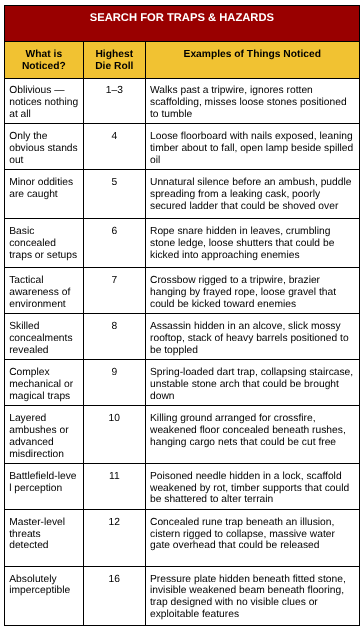
🔴🔴🔴🔴 Search for Traps, Ambushes & Useful Dangers (Cloak & Dagger)
Roll: 1d12 + Mental Performance PRISM + Cloak & Dagger
The Game Master determines the Realism Target Number according to how difficult the danger is to detect. If something has been deliberately concealed by another character, that character’s appropriate concealment result may establish the Target Number instead. The character devotes focused attention to examining the immediate environment for concealed enemies, traps, ambushes, and hazards that could be exploited tactically. This may reveal lurking figures, mechanical or magical traps, unstable structures, suspended objects, dangerous cargo, concealed routes, or similar features relevant to the Action Scene. On a success, the character discovers the danger or useful feature if it is reasonably detectable from the character’s position. A high margin of success may reveal additional useful details at the Game Master’s discretion. Discovering a hazard does not automatically activate or exploit it; the character must use whatever additional action is appropriate to warn allies, avoid it, manipulate it, or turn it against an enemy.
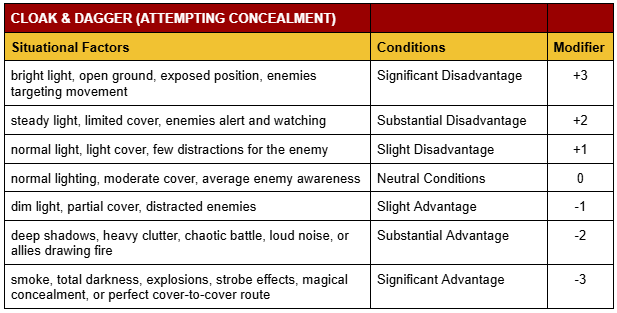
🔴🔴🔴🔴 Feign Retreat / Play Dead (Deceit)
The character pretends to be injured, unconscious, defeated, frightened, dead, or retreating, attempting to lure enemies into a false sense of safety or draw them into a trap. Roll:
1d12 + 🌈Influence & Allure PRISM + Deceit
The result establishes the Target Number for an observer attempting to recognize the deception. An observer who has reason to doubt the performance may attempt an appropriate Test and must equal or exceed that Target Number to recognize the deception before acting upon the false appearance.
Feign Retreat / Play Dead does not compel an enemy to approach, pursue, lower his guard, abandon caution, or otherwise act irrationally. An enemy who believes the deception reacts according to his own knowledge, objectives, personality, training, and circumstances.
Physical circumstances must support the deception. A character cannot convincingly play dead while openly performing unrelated actions, nor can a character convincingly feign a retreat while remaining stationary without some explanation for the apparent withdrawal.
🔴🔴🔴🔴 Switch Identities (Cloak & Dagger)
The character breaks observation long enough to make a rapid change of apparent identity—for example, throwing on a cloak, changing a distinctive garment, donning a mask or helmet, smearing the face, adopting available clothing, or using another plausible disguise.
Make a Cloak & Dagger Test using the appropriate Cloak & Dagger modifier. Any observer attempting to recognize the character must equal or exceed the character’s result with an appropriate perception or recognition Test.
Switch Identities requires a plausible way to break observation and alter the character’s appearance. It cannot make a character unrecognizable while an observer continuously watches the transformation unless another effect, such as smoke, darkness, a crowd, or magic, makes the deception possible.
Success conceals the character’s identity; it does not automatically make the character appear to be a specific known person or cause observers to believe a detailed false identity. Cloak & Dagger governs accomplishing the rapid physical transformation and avoiding recognition during the switch. If the character must subsequently convince someone that the disguise represents a particular person, role, history, allegiance, or other false identity, use Deceit or another appropriate Social Skill according to what the character is attempting to communicate.
Psychological Warfare & Communication
Not all weapons draw blood. Psychological Warfare & Combat Signaling governs deliberate words, gestures, and displays made during an Action Scene to unsettle enemies, harden allies, or reshape the emotional terrain of the battlefield. These actions are not debates or negotiations—they are instinctive, often crude expressions of dominance, contempt, desperation, or resolve performed under extreme pressure. In the chaos of combat, a shout, a gesture, or even deliberate stillness can fracture an opponent’s focus or ignite adrenaline in allies. These maneuvers weaponize morale itself, inflicting 🧠Mental Trauma, provoking reckless responses, or stabilizing a faltering line. They function alongside steel, arrows, and magic, not outside of them, and are resolved with the same seriousness as physical attacks. Just as wounds weaken the body, humiliation, fear, and intimidation can erode an enemy’s will to fight—or shatter it outright.
Repeated Psychological Warfare
Threats, taunts, Battle Cries, intimidating displays, insults, and other forms of Psychological Warfare are common during combat and may be performed whenever the character has sufficient Action Points. A warrior may shout repeatedly throughout a battle; the rules do not limit how often characters may threaten, insult, roar at, or otherwise attempt to intimidate their enemies.
However, repeating substantially the same psychological attack does not continually inflict fresh 🧠Mental Trauma. Once an opponent has resisted or suffered the psychological effect of a particular threat, display, insult, or substantially similar tactic, repeating it against that opponent during the same circumstances has no additional mechanical effect.
A new Psychological Warfare attempt may become effective when something meaningful changes. A warrior who roared at the beginning of battle might roar again after killing the enemy champion, smashing through a shield wall, revealing reinforcements, cornering the enemy, displaying a terrifying transformation, or otherwise giving his opponents a new reason to fear him. The Game Master determines whether the circumstances have changed enough to justify another Test.
Regardless of how many Psychological Warfare actions are attempted, ordinary Psychological Warfare can inflict no more than one 🧠Shaken Mental Trauma upon the same character during a single ⏸Turn. Additional successful Psychological Warfare attacks during that Turn may produce any other effects specifically stated by those actions, but do not inflict additional 🧠Mental Trauma.
Ordinary Psychological Warfare cannot escalate Mental Trauma beyond 🧠Shaken through repeated accumulation. 🧠Impaired, 🧠Unstable, and 💀Broken Mental Trauma require an action, Spell, supernatural effect, Horror, or genuinely traumatic circumstance capable of inflicting that degree of Trauma.
🟡 Brief Utterance
The character says something that can reasonably be spoken in a moment, such as a short warning, command, taunt, question, exclamation, or response. Judge this by the time required to say it rather than by counting words. “Run!”, “Behind you!”, “Drop your sword!”, and “Get behind the wall!” are all reasonable Brief Utterances.
A longer statement, conversation, explanation, speech, prayer, or other sustained use of speech requires whatever Action Point cost or time is appropriate to what the character is actually doing.
🟡 Simple Gesture
A deliberate blink of an eye, nodding the head, using a hand signal or pointing at something can be useful for player characters to communicate between each other to coordinate in the action scene. Communicating with a Simple Gesture is a Flair Action.
🟡 Battle Cry
The character releases a terrifying shout, roar, war cry, threat, or other intimidating vocalization intended to shake the enemy’s nerve. Choose the method appropriate to the Battle Cry:
Psychological Battle Cry: 1d12 + 🌈Influence & Allure PRISM + Social Skills
Physical Battle Cry: 1d12 + 🌈Physical Performance PRISM + Strength
The method must match what the character actually does. Psychological Battle Cries rely upon menace, authority, ridicule, threatening words, or deliberate manipulation. Physical Battle Cries rely upon an intimidating display of raw strength, size, aggression, or obvious physical capability. Every opponent who clearly hears and understands the threatening significance of the Battle Cry makes a Discipline Attribute Defense Test: 1d12 + Discipline + TAB, if applicable
An opponent whose result is lower than the Battle Cry result suffers 🧠Shaken Mental Trauma. This Trauma cannot escalate beyond 🧠Shaken.
🟡 Painful Cry for Help
The wounded character cries out urgently for assistance, potentially shocking allies but driving them to immediate action. Each allied character who clearly hears the cry makes:
1d12 + Discipline vs. Base TN 4 + the caller’s current Physical Wound and Mental Trauma modifiers
An ally who fails suffers 🧠Shaken Mental Trauma from hearing the caller’s distress. This Mental Trauma cannot escalate beyond 🧠Shaken. Until the beginning of the caller’s next ⏸Turn, an ally responding directly to the cry receives −4 Advantage on one action whose immediate purpose is to reach, rescue, defend, treat, free, carry, or otherwise directly aid the caller. This benefit applies when the responding ally performs the action and makes the Test. If the ally instead uses 🤝 Assistance to help the caller perform a Test, use the ordinary +2 Assist bonus instead. The same contribution never receives both benefits. A character can make a mechanically beneficial Painful Cry for Help only once per 🎬Action Scene.
🟡 Insulting Gesture (Social Skills)
The character makes a deliberately insulting, contemptuous, obscene, or mocking gesture toward an opponent—a raised middle finger, stuck-out tongue, mocking expression, dismissive hand motion, vulgar gesture, or another brief visual insult. Roll:
1d12 + 🌈Influence & Allure PRISM + Social Skills
The targeted opponent opposes the result with:
1d12 + Discipline
If the character’s result exceeds the opponent’s result, the opponent suffers 🧠Shaken Mental Trauma. This Mental Trauma cannot escalate beyond 🧠Shaken. The opponent must be capable of seeing and understanding the insulting significance of the gesture. A gesture that has no recognizable insulting meaning to the observer produces no mechanical effect. Insulting Gesture is Psychological Warfare and is subject to the normal rules governing Repeated Psychological Warfare.
🔴🔴🔴🔴 Intentional Coolness (Social Skills)
The character deliberately spends the action appearing completely calm, confident, or contemptuously unconcerned by his enemies. Make one:
1d12 + 🌈Influence & Allure PRISM + Social Skills
Each hostile creature capable of observing and understanding the display opposes the result with: 1d12 + Discipline
If the character’s result exceeds an opponent’s result, that opponent suffers 🧠Shaken Mental Trauma. Intentional Coolness cannot escalate existing Mental Trauma beyond 🧠Shaken. The character may incorporate Brief Utterance, a Minor Gesture or Expression, or the slow drawing, readying, or theatrical handling of one readily accessible item into the performance without paying an additional Action Point cost. Examples include slowly drawing a sword, lighting a pipe, wiping blood from a blade, adjusting a hat, beckoning an opponent forward, smiling, or simply standing motionless.
These incorporated actions must remain purely theatrical. Intentional Coolness cannot be used to conceal another mechanically significant action, attack, Spell, complicated equipment use, or other activity that would ordinarily require a separate action.
🟠🟠 Teabag (Social Skills)
The character repeatedly crouches and rises over the head or body of an unconscious, deceased, helpless, or otherwise immobilized opponent as an intentionally vulgar display of dominance. Make one:
1d12 + 🌈Influence & Allure PRISM + Social Skills
Each hostile creature capable of observing and understanding the insult opposes the result with: 1d12 + Discipline
An opponent whose result is less than the character’s suffers 🧠Shaken Mental Trauma. This Mental Trauma cannot escalate beyond 🧠Shaken. If at least one hostile observer suffers 🧠Shaken from the display, the performing character may remove one 🧠Shaken Mental Trauma caused by the opposing side during the current 🎬Action Scene. One allied character who witnesses and appreciates the humiliation may also remove one such 🧠Shaken Mental Trauma.
Spiritual Practices
Spiritual characters wield powers that reach beyond the physical world—praying for divine intervention, performing sacred practices, or invoking supernatural forces in the middle of chaotic Action Scenes. Whether the character is a prophet crying judgment, a solitary shaman calling upon the unseen world, or a priest whispering holy words beneath a hail of arrows, these actions draw upon the character’s Spirit and Spirituality.
🟠🟠 Pray
Burn 1–3 🕊Favor for providential intervention.
Prayer allows a character to ask for providential help when circumstances have moved beyond what the character can reasonably control. Prayer does not generate Favor. Instead, the character burns 1, 2, or 3 🕊Favor, with greater expenditures allowing progressively greater intervention: 1 Favor permits a Modest Intervention, 2 Favor a Substantial Intervention, and 3 Favor an Extraordinary Intervention.
Prayer is not a shortcut for bypassing ordinary challenges. It is intended for situations in which reasonable courses of action are no longer sufficient and the character genuinely needs help beyond what he can reasonably accomplish for himself. The player describes the character’s prayer, plea, desperate hope, or other appropriate expression.
The Game Master determines whether an intervention consistent with God’s purposes and the circumstances and direction of the adventure is possible before the Favor is burned.
The character does not dictate exactly what happens. Providence instead creates an opportunity, changes circumstances, provides unexpected assistance, reveals a possible way forward, or otherwise allows courageous action to matter again. Even an Extraordinary Intervention does not automatically complete the character’s objective.
Characters may pray whenever they wish without spending Action Points or invoking this mechanic when the prayer is purely expressive. The 🟠🟠 Pray action is used when a character invokes the 🙏Prayer spell and burns Favor to materially alter the circumstances of the 🎬Scene. Prayer is a Coincidental spell available to every character, including characters who are not otherwise spellcasters. See 🕊Favor Points for the complete rules governing Prayer and providential intervention.
🟠🟠 Cast Coincidental Spell — Power 0 (Spiritual Practices)
Base TN 6, modified only by appropriate Pain, Distress, line-of-sight, Casting Method, magical-item, Spell, or other explicitly applicable modifiers. Choose a Spell the character knows and is permitted to cast, satisfy any requirements stated by that Spell or another applicable rule, then resolve its Power 0 manifestation exactly as written. Power 0 does not provide a generic freeform magical effect and is not automatically harmless; the individual Spell determines what the manifestation accomplishes and whether it can inflict Trauma or another mechanical effect. Casting normally costs 2 Action Points. A specific Spell may establish an exception.
🔴🔴🔴🔴 Cast Powerful Spell — Power 1–3 (Spiritual Practices)
Power 1 has TN 8, Power 2 has TN 10, and Power 3 has TN 12, before legitimate modifiers. The character must know the Spell, possess access to it through the appropriate Class or another specific rule, satisfy any requirements stated by the Spell, and possess sufficient ⭐Action Star Level to use the chosen Power. There is no universal 🌬Spirit requirement for casting Power 1–3 magic. A character’s 🌬Spirit requirements ordinarily come from the Character Class or supernatural tradition that grants access to magic.
🔴🔴🔴🔴 Focus (Spiritual Practices)
Requires 🌬Spirit +2.
The character centers themselves amid chaos—drawing calm, reinforcing their resolve, and realigning their spirit. Remove 1 filled box of 🧠Shaken Mental Trauma.
Focus also grants -1 Advantage on the next Spellcasting Test the character makes, cumulative to a maximum of -3 through consecutive uses of Focus. Each additional consecutive Focus action removes another filled box of 🧠Shaken Mental Trauma normally and increases the Spellcasting Advantage by another -1, to the maximum of -3. Casting a Spell ends the accumulated Spellcasting Advantage after that Test is resolved. Until the beginning of the character’s next ⏸Turn,
Focus also grants -2 Advantage on any Attribute Defense Test made to resist supernatural fear, madness, possession, psychic intrusion, or another hostile effect attempting to overwhelm or control the character’s mind or 🌬Ruach. Use whichever Attribute Defense Test the threatening effect normally requires; Focus does not replace that Test or create a separate resistance system.
Focus does not provide immunity to Mental Trauma, possession, fear, or mind control. It strengthens the character’s resistance when an applicable Defense Test is actually permitted.
🟡 Invoke Name of Power / Chant of Judgment (Spiritual Practices) (1 – 2 words)
Can only be used by any character belonging to one of Sylva’s fictional monotheist religions.
The character forcefully invokes a sacred name, commandment, verse, or brief declaration of divine authority against a supernatural evil, spiritually corrupted creature, or other being for whom such an invocation would have genuine spiritual significance. This is not a general fear attack and does not affect every enemy merely because they can hear it. Ordinary soldiers, bandits, animals, political enemies, members of other religions, and other mundane opponents are not supernaturally frightened simply because the character invokes sacred authority. When the invocation is directed against an appropriate supernatural target, make an Opposed Test: 1d12 + Spirituality PRISM + Spiritual Practices against 1d12 + the target’s Spirituality PRISM or appropriate supernatural resistance. On a success, the target recoils, hesitates, or is momentarily checked by the invocation. The target suffers +1 Disadvantage on its next hostile action against the invoking character before the end of its next Turn. On a failure, the invocation produces no mechanical effect. Invoke Name of Power / Chant of Judgment does not normally cause Mental Trauma, stun the target, compel obedience, banish a supernatural creature, or force it to flee. A Spell may produce such effects when appropriate. The Game Master may allow a sacred invocation to produce a purely informational or environmental reaction when the fiction warrants it—a cursed object might tremble, an unclean presence might reveal its discomfort, or a supernatural creature might react visibly to words it recognizes. Such reactions do not automatically inflict Trauma or impose additional mechanical penalties. A particular target can be mechanically affected by Invoke Name of Power / Chant of Judgment only once during the same Scene.
🟠🟠 Channel Aura / Become a Beacon (Spiritual Practices)
Requires 🌬Spirit +1. No Test is required.
You deliberately make your spiritual presence conspicuous, presenting yourself as an obvious source of supernatural resistance and danger. Until the beginning of your next ⏸Turn, enemies who can perceive you and are aware of your hostility recognize you as a particularly important threat.
This is not mind control. An enemy does not abandon cover, ignore orders, expose itself to certain death, surrender an important objective, or otherwise act irrationally merely to attack you. The Game Master continues to use the enemy’s ordinary intelligence, priorities, morale, and tactical judgment. However, when an enemy has several reasonably comparable targets or courses of action, it will normally favor attacking, suppressing, interrupting, surrounding, or otherwise dealing with you.
In territory touched by the 🪱Gloom, supernatural or Gloom-corrupted enemies capable of perceiving spiritual disturbances may also recognize the character as a conspicuous point of resistance even when ordinary appearance alone would not explain the attention. This does not automatically reveal the character’s exact location, compel an attack, or override the normal 👁Hostile Fixation rules.
Channel Aura / Become a Beacon can therefore draw attacks away from companions, encourage enemies to concentrate upon the character, or deliberately attract dangerous supernatural attention. Used at the right moment it can be heroic. Used carelessly it can be suicidal.
Combat First Aid
Combat First Aid represents a character’s ability to treat wounds in the middle of an Action Scene, often while under threat, pressure, or chaos. This includes stopping bleeding, stabilizing a dying ally, applying field dressings, or using bandages, tourniquets, splints, herbal preparations, or healing salves. It is not intended to fully heal a character but to keep someone alive long enough to fight another day.
🔴🔴🔴🔴 Combat First Aid (Medicine)
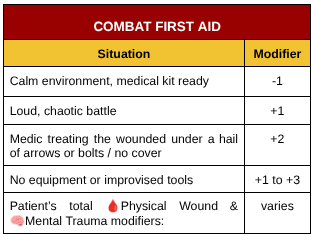
Combat First Aid uses the Field Medicine rules described under ❤️Healing Scenes. Roll:
1d12 + Mental Performance PRISM + Medicine
The Target Number is determined by the Damage Level of the wound being treated:
🩸Minor — TN 6
🩸Moderate — TN 8
🩸Severe — TN 10
💀Critical — TN 12
Combat First Aid can be performed during a Turn, but each Combat Round lasts only a few seconds. Only quick emergency treatment is possible. Successful Combat First Aid can stop 🩸Bleeding, stabilize an injured character, dress or splint wounds, and perform the other emergency treatment permitted by Field Medicine. Combat First Aid does not remove Physical Trauma.
🎬Example — Combat First Aid
Sister Calvia slides beside a wounded cavalryman whose arm is gushing blood from a deep sword wound. She calls to him over the din of battle and quickly opens her 👜Medical Bag. The cavalryman has suffered a 🩸Severe Physical Wound — Deep sword wound through the upper arm, and the wound is 🩸Bleeding. Because this is a 🩸Severe wound, Combat First Aid requires TN 10. Sister Calvia rolls 1d12 + Mental Performance PRISM + Medicine. She has Mental Performance PRISM +2 and Medicine +2. She rolls a 6, producing a modified dice result of 10 and succeeding. Sister Calvia binds the wound tightly, applies the necessary medicinal dressing, and stops the 🩸Bleeding. The cavalryman retains his 🩸Severe Physical Trauma. Combat First Aid has prevented the immediate danger from worsening, but it has not healed the wound. He will still require an appropriate ❤️Healing Scene and its full Recovery Time before the Severe Trauma can be erased.
Alchemy
The Alchemy Skill represents the character’s practical knowledge of substances and their reactions, particularly when they must be prepared or used under pressure. It covers the mixing and application of powders, salts, oils, acids, poisons, tinctures, resins, minerals, and other reagents to produce immediate effects during an encounter.
🔴🔴🔴🔴 Prepare Alchemical Device
The Game Master determines a Realism Target Number according to the complexity of the preparation and the circumstances. TN 4 represents a simple, familiar preparation performed with appropriate materials under manageable conditions. More complicated preparations, missing or improvised equipment, dangerous movement, poor visibility, active combat, contamination, unstable ingredients, or severe time pressure may increase the Target Number or impose appropriate Disadvantage.
The character prepares an alchemical device such as a firepot, smoke vessel, corrosive flask, irritant container, or other prepared concoction. This may involve mixing reagents, sealing a vessel, inserting a wick, or otherwise preparing the substance for use. Failure may waste the ingredients or create an unintended hazard.
🟡 Ignite or Activate Alchemical Device
The character ignites, opens, breaks, or otherwise activates a prepared alchemical device. This might involve lighting the wick of a firepot, exposing one substance to another, opening a container, or deliberately smashing a volatile vessel. Environmental conditions such as wind, rain, dampness, and poor materials may interfere with the result.
🔴🔴🔴🔴 Quick-Craft Alchemical Compound
The Game Master determines a Realism Target Number according to the complexity of the compound, available ingredients, and circumstances. TN 4 represents an extremely simple and familiar mixture made from suitable materials under manageable conditions. More complicated chemistry, improvised ingredients, active combat, movement, poor equipment, contamination, unstable substances, or severe time pressure may increase the Target Number or impose appropriate Disadvantage.
The character rapidly combines known substances carried on their person to create a crude but useful compound. Examples include choking smoke, burning oils, irritant dusts, corrosive splashes, adhesive mixtures, or other unstable alchemical preparations. Such mixtures are generally less reliable than compounds prepared beforehand and may be dangerous to handle.
🔴🔴🔴🔴 Apply Alchemical Agent to Weapon
The Game Master determines a Realism Target Number according to the substance, weapon, application method, and circumstances. TN 4 represents safely applying a familiar prepared substance to an appropriate weapon under manageable conditions. Active combat, movement, poor visibility, an awkward weapon, unstable substances, inadequate tools, or an unusually dangerous agent may increase the Target Number or impose appropriate Disadvantage.
The character coats a blade, arrowhead, bolt, dart, or other weapon with a prepared poison, irritant resin, incendiary compound, corrosive substance, or similar alchemical agent. Improper application may waste the substance or expose the character to it.
🔴🔴🔴🔴 Neutralize Alchemical Hazard
The Game Master determines a Realism Target Number according to the substance, severity of the hazard, available counteragents, and circumstances. TN 4 represents neutralizing a familiar minor hazard with an appropriate counteragent under manageable conditions. An unidentified substance, severe contamination, active exposure, inadequate materials, unstable reactions, active combat, or severe time pressure may increase the Target Number or impose appropriate Disadvantage.
The character identifies and applies an appropriate substance to counteract acid, poison, burning compounds, alchemical corrosion, or another hazardous substance affecting equipment, terrain, or allies. Success depends upon having suitable materials available and understanding the substance being counteracted.
Experts in Alchemy may also throw or smash prepared vessels to produce localized effects such as fire, smoke, choking vapors, corrosive splashes, irritant clouds, or adhesive substances. They may mark enemies with strong dyes, pungent resins, distinctive scents, or other persistent compounds, allowing allies to identify or track them afterward.