⭐Jack’s Cinematic d12
Designed for cinematic storytelling. Written with precision. Built for realism.
What would it take to create a tabletop role-playing game that captures the excitement of an epic fantasy film, the intensity of a martial arts thriller, the intrigue of a dramatic television series, and the believable consequences of real-world action? How could a game allow characters to attempt extraordinary feats without requiring players to memorize hundreds of complicated procedures? How could combat become more interesting than repeatedly declaring, “I attack”? How could magic reflect the beliefs and methods of real-world magical traditions? And how could all these possibilities be represented with minimal mathematics and dice rolling?
These questions helped shape ⭐Jack’s Cinematic d12 (JCd12), the role-playing system created by John Alan Martinson for 👑Kingsmark. JCd12 combines cinematic storytelling, detailed character capabilities, meaningful physical and psychological consequences, and carefully organized rules. Its guiding principle is to represent the important details of a believable adventure without allowing unnecessary complexity to interrupt the experience.
The complete 👑Kingsmark: Player’s Handbook is available to read online for free. Below, discover the philosophy behind the system, then explore the official rules chapter by chapter.
🎬 Every Game Session Is a Collaborative Production
Imagine sitting down with friends to create something resembling an episode of Game of Thrones or an adventure from The Lord of the Rings. Nobody has written the complete screenplay. Nobody knows precisely how the story will end. The characters have ambitions, personalities, strengths, and weaknesses, but their choices and the circumstances they encounter determine what happens. That is the creative foundation of JCd12.
The Game Master establishes 🎬Scenes, portrays the world and its inhabitants, introduces conflicts, and adjudicates the consequences of the Players’ decisions. The Players portray their characters as protagonists, deciding what they say, attempt, risk, and sacrifice. Dice introduce uncertainty, creating developments that nobody at the table could have completely anticipated. Kingsmark distinguishes between 🗨️Dialog Scenes and ▶️Action Scenes, recognizing that different kinds of storytelling require different approaches.
A tense negotiation between rival nobles is not the same kind of scene as a desperate fight on a collapsing bridge. Yet both can have enormous consequences for the characters involved. The aim is not merely to reproduce the appearance of cinematic storytelling. It is to provide rules that help participants create dramatic situations through their own decisions. For the relevant mechanics and examples, see Chapter 10 — 🗨️Dialog Scenes, Chapter 11 — ▶️Action Scenes, and Chapter 12 — 🎬Example Actions.
⚔️ Designing Action Worth Watching
Consider the action found in The Equalizer, Sherlock Holmes, Brotherhood of the Wolf, The Bourne Identity, The Raid, and Ninja Scroll. What makes these confrontations memorable? The combatants do not merely stand in place exchanging identical attacks. They reposition, improvise, exploit their surroundings, defend themselves, manipulate timing, and take advantage of unexpected opportunities. A character might throw an opponent into furniture, intercept an attack, leap over an obstacle, strike a vulnerable target, or use the environment to gain an advantage.
JCd12 was developed by asking what rules would be necessary to support these possibilities. Kingsmark uses Action Points (AP) to represent how much a character can accomplish during a Turn. Different Actions require different amounts of time and effort. The Player’s Handbook provides approximately 108 example Actions, giving players an extensive selection of possibilities while allowing them to attempt actions beyond those explicitly listed.
The system does not require players to choose exclusively from a predetermined collection of commands. Instead, the Game Master can adjudicate unusual actions according to their circumstances and the established rules. A skilled warrior, an agile Ninja, and a powerful Brute may approach the same confrontation very differently. The objective is to make the character’s decisions as interesting as the results of the dice. These possibilities are explored in Chapter 11 — ▶️Action Scenes and Chapter 12 — 🎬Example Actions.
▶️ Researching Real Combat and Human Capabilities
How long does a real fight last? How quickly can a trained combatant draw a weapon, close the distance to an opponent, attack, and defend? How many arrows can an experienced archer release in three seconds? And what happens when the character possesses exceptional speed, strength, or training? The development of JCd12 involved researching real-world combat, historical weaponry, competitive fighting, and the timing of cinematic action sequences.
Professional fighting, mixed martial arts, historical combat, and real-world violent encounters provided different perspectives on human performance. Elite archery demonstrations, including the remarkable techniques of Lars Andersen, offered examples of exceptional speed and proficiency. Historical archery research helped provide additional context concerning trained archers and battlefield conditions. The system also had to address less conventional possibilities.
What if an extraordinarily strong character picks up an unconscious opponent and attempts to use that person’s body as an improvised club? What if a combatant attempts to tear an enemy apart, throw someone across a room, or perform another feat of extraordinary strength? What if a skilled archer attempts to strike a target as small as a finger, or a knife fighter aims for the pupil of an eye?
Rather than assuming that unusual actions must be impossible or handled through arbitrary decisions, JCd12 seeks to provide a consistent framework for determining difficulty and resolving consequences. Research informs the underlying design, while the rules translate those considerations into practical procedures. The objective is efficient realism: representing the factors that matter without requiring players to perform elaborate calculations or reproduce every detail of real-world physics. The relevant procedures appear in Chapter 11 — ▶️Action Scenes, Chapter 12 — 🎬Example Actions, and Chapter 13 — 💥Damage & Defense.
🛡 Armor, Hit Locations, and Precision
A sword striking an unprotected hand should not be treated identically to a sword striking a steel breastplate. Likewise, a dagger aimed at a vulnerable opening in an opponent’s defenses presents different challenges from an ordinary attack against a large target. Kingsmark incorporates 🛡Armor, Hit Locations, Damage Types, and deliberate targeting to represent these distinctions. Armor protects particular regions of the body, and characters can wear layers of protection. The effectiveness of that protection depends upon the nature of the attack and the circumstances of the encounter.
Characters may also attempt carefully aimed attacks against specific body parts. A skilled archer might target an exposed hand. A knife fighter might attempt to exploit a small opening. An exceptionally precise attack could be directed toward a target considerably smaller than the opponent’s body. Such actions present additional difficulty, but the system provides a framework for resolving them.
These considerations encourage players to pay attention to the physical circumstances of combat. Where is the opponent protected? What remains exposed? How is the target positioned? What weapon is being used? How difficult is the intended strike? By accounting for these distinctions, Kingsmark gives tactical decisions greater significance while making armor, weapons, and physical positioning meaningful elements of play. For the full rules on these distinctions, consult Chapter 13 — 💥Damage & Defense.
💥 Physical Violence and Mental Consequences
What happens when a warrior of extraordinary strength crushes an enemy’s skull with his bare fists in front of the enemy’s comrades? What if a terrifying Giant tears an opponent apart on the battlefield? Should nearby enemies continue fighting as though nothing remarkable occurred? Violence can affect more than the body. Witnessing an especially horrifying event may influence a person’s courage, concentration, judgment, or willingness to continue fighting. JCd12 was designed to consider such consequences.
Kingsmark does not use conventional hit points. Instead, characters suffer specific 🩸Physical Trauma representing injuries and their consequences. The system also tracks 🧠Mental Trauma, allowing psychologically overwhelming experiences to influence characters independently of bodily injury. An adventurer might escape a terrifying encounter without a physical wound but remain deeply shaken by what happened. A veteran warrior who witnesses an extraordinarily brutal death may respond differently from an inexperienced recruit. A supernatural horror might threaten a character’s psychological stability even without making physical contact.
The circumstances determine what forms of danger are relevant, while the rules provide procedures for resolving appropriate Tests and consequences. Characters are not merely reservoirs of numerical damage. They are people whose bodies and minds can be affected by the events they experience. This allows a dramatic encounter to have significance beyond determining which side remains standing. The consequences and recovery procedures are addressed in Chapter 13 — 💥Damage & Defense and Chapter 14 — ❤️Healing Scenes.
❤️ Healing Scenes — Recovery Becomes Storytelling
In many fantasy role-playing games, healing is primarily a matter of purchasing and consuming resources. An adventurer buys a Healing Potion, drinks it, and receives a benefit. Money is spent, an item is consumed, time passes, and the character recovers. But why must the process be represented by a bottle? JCd12 approaches healing from a different perspective: What happens in the story, how much does it cost, how long does it take, and what does it accomplish?
Kingsmark uses ❤️Healing Scenes to represent recovery from 🩸Physical Trauma and 🧠Mental Trauma. A Healing Scene is an experience or period of treatment that produces a defined recovery effect. Characters might receive professional medical attention, rest in comfortable surroundings, drink a rare Healing Potion, spend time with loved ones, enjoy a peaceful meal, pray, meditate, or withdraw from adventuring for an extended period. Some Healing Scenes cost money. Others require time, relationships, equipment, professional knowledge, or appropriate surroundings.
🌼 An Example: Friends & Confidants
Imagine an adventurer returning from a terrifying encounter suffering 🧠Shaken Mental Trauma. Rather than visiting a merchant to purchase an enchanted substance, the character seeks out an old friend. They spend an hour together beside a warm fire. Perhaps they discuss the horrors the adventurer witnessed. Perhaps they share memories of happier times, laugh over an old joke, or simply enjoy one another’s company.
Kingsmark provides a specific Healing Scene for this experience: 🌼Friends & Confidants Scene — FREE. Time: 1 hour. Effect: Erase 1 🧠Shaken Mental Trauma.
The character has recovered through an experience that belongs naturally within the story. Other possibilities include 🥰Personal Comfort with a spouse or lover, 🥗Food & Grounding, prayer, meditation, and additional restorative experiences. The rules establish limitations on ordinary Mental Healing Scenes, preventing characters from repeatedly claiming unlimited mechanical benefits merely by combining several comforting activities.
🫙 Healing Potions Still Exist
Kingsmark retains magical and medicinal Healing Potions. However, drinking a potion is itself a Healing Scene. Different potions have different costs and recovery effects. They generally accelerate the body’s healing process rather than instantly reversing every injury or regenerating destroyed anatomy. Professional medical treatment and ordinary convalescence also have defined requirements and Recovery Times.
The underlying principle remains consistent: Choose an appropriate Healing Scene, satisfy its requirements, complete the necessary recovery, and remove the applicable Trauma. The system allows recovery to become an event in the character’s history rather than an invisible adjustment to numerical statistics.
A wounded warrior might spend weeks recovering under a physician’s care. A frightened Ranger could regain composure through the companionship of a trusted friend. A powerful magician might require extended rest after extraordinary supernatural exertion. The mechanics remain clear, but the narrative possibilities are considerably broader. The specific requirements and recovery effects appear in Chapter 14 — ❤️Healing Scenes.
🎲 From Handfuls of Dice to One d12
⭐Jack’s Cinematic d12 did not begin as a single-die system. Its earliest design involved rolling handfuls of twelve-sided dice. That approach offered possibilities for representing character capabilities and uncertain outcomes, but it also introduced additional dice handling, arithmetic, and mechanical complexity. Over time, the design moved toward a more fundamental question: What is the minimum amount of rolling and mathematics necessary to provide a convincing simulation of the situations that matter?
The answer became a system built around a single twelve-sided die, supported by character abilities, Target Numbers, and rules governing relevant circumstances. JCd12 retains distinctions between physical and mental capabilities, different Skills, combat techniques, injuries, defenses, and supernatural effects. But the underlying resolution method remains comparatively simple. The objective was not to eliminate detail merely for the sake of simplicity. It was to make the complexity serve a recognizable purpose.
If a particular calculation or procedure did not meaningfully improve the experience, its inclusion deserved reconsideration. If a distinction helped characters behave more believably or gave players more interesting choices, it could justify additional structure. The result is a game system intended to balance mechanical depth with fast-moving play. The resolution system is explained through Chapter 1 — 💪Attributes, Chapter 2 — 🌈Attribute PRISMs, and Chapter 3 — ⚒Skills.
💪 Twelve Attributes and Five 🌈PRISMs
Human beings possess a wide variety of physical, intellectual, psychological, and social capabilities. Reducing those differences to a very small number of generalized characteristics can make characters easier to describe mechanically, but it can also obscure meaningful distinctions. Kingsmark uses twelve 💪Attributes to represent character capabilities with greater specificity. These Attributes are organized into five 🌈Attribute PRISMs, which bring related characteristics together for practical use. The system also includes twenty-four ⚒Skills.
An important feature of this design is that Skills are not permanently restricted to a single Attribute. Different circumstances may require different kinds of performance, even when a character is applying the same general Skill. A physical activity might demand coordination, strength, endurance, or other capabilities depending upon what the character is attempting. A social interaction might depend upon different personal characteristics according to the situation.
The PRISM system allows related Attributes to contribute to performance without requiring players to recalculate elaborate combinations for every ordinary action. This approach gives character abilities greater nuance while maintaining a manageable resolution system. The twelve Attributes also complement the twelve-sided die at the heart of JCd12. Read Chapter 1 — 💪Attributes, Chapter 2 — 🌈Attribute PRISMs, and Chapter 3 — ⚒Skills for the underlying character mechanics.
📖 Precision Language and Visual Organization
A good rulebook should not require players to repeatedly translate obscure terminology into ordinary language. JCd12 was written with precision, consistency, and ease of reference in mind. Whenever practical, game terminology describes what is actually happening. Consider the expression Attribute Defense Test. The words themselves communicate the essential idea: the character makes a defensive Test involving their Attributes.
Compare that with the traditional role-playing term “Saving Throw,” whose wording does little to explain what is being tested. Experienced players may already know the traditional expression, but a newcomer benefits from terminology that communicates its purpose. The same philosophy influences the organization and presentation of the Player’s Handbook.
🎨 Visual Communication
Kingsmark uses boldface, colors, highlighting, distinctive emojis, and recognizable symbols to make information easier to identify. Important concepts can be located visually without rereading entire passages. For example, 💪Attributes, 🌈Attribute PRISMs, ⚒Skills, 🩸Physical Trauma, 🧠Mental Trauma, and ❤️Healing Scenes each possess distinctive visual identities. The recurring symbols help readers recognize concepts across different chapters.
✍ Concise, Organized Rules
The language of the rulebook is intended to be specific without becoming unnecessarily complicated. Procedures are organized around the information required to resolve the situation. Related rules are grouped together, while explanations and examples provide additional context when necessary.
The goal is to make Kingsmark practical for two different activities: learning the system for the first time and locating a particular rule during an actual game session. Players should be able to understand what an Action does, determine the appropriate Test, identify its consequences, and return their attention to the developing adventure. The complete online Player’s Handbook preserves this approach by allowing readers to navigate directly to the chapters they need.
📜 Magic, Miracles, and the Nature of Reality
Fantasy magic often consists of predefined supernatural effects selected from a catalog. Kingsmark takes a broader interest in the ideas and traditions that might explain how magic operates. The development of its 📜Magic System drew inspiration from real-world magical literature, religious writings, philosophical investigations, and speculative theories concerning reality. Among the influences were the writings of Phil Hine and David Michael Cunningham, Biblical accounts of miraculous events, discussions of miracles within rabbinic literature, Michael Talbot’s writings on the holographic universe, and David Bohm’s explorations of the nature of reality.
These sources approach their subjects from different perspectives, and they do not all make compatible claims. Their significance to Kingsmark lies in the imaginative questions they raise. If supernatural phenomena existed, what would practitioners believe about their causes? Would magic depend upon spiritual authority, personal discipline, ritual, intention, knowledge, unusual states of consciousness, or forces that ordinary people do not understand? How might different traditions interpret similar supernatural events? And what consequences might follow from attempting to exercise extraordinary power?
Kingsmark incorporates these questions into a fictional magic system featuring twenty-four Schools of Magic and a complete collection of 219 Spells. The system includes different levels of Power, casting methods, and 🧠Mental Drain. Magical characters may approach supernatural power through different abilities and traditions, while 🪱The Gloom introduces further dangers associated with forbidden supernatural forces. The objective is to give fantasy magic an underlying conceptual structure rather than treating it exclusively as a collection of spectacular effects. Readers can explore these ideas through Chapter 15 — 📜Magic System and Chapter 16 — 🪱The Gloom, alongside the companion volume 📜The Spellbook.
📚 The Complete Kingsmark Player’s Handbook
First Edition — By John Alan Martinson
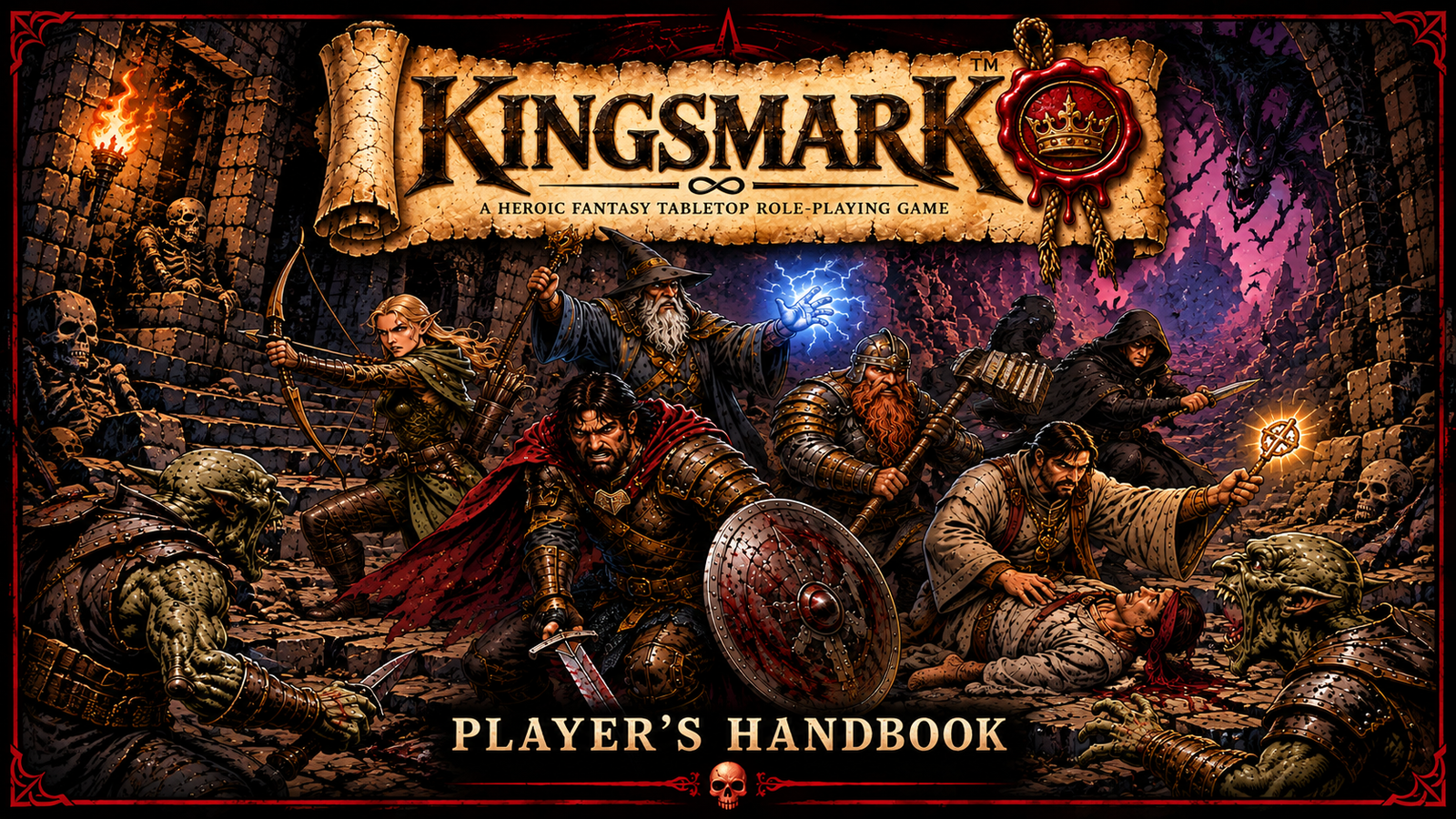
Everything needed to create characters and begin playing Kingsmark is contained in the Player’s Handbook. The complete rulebook is available to read online for free. Select any chapter below to explore its rules, explanations, examples, and reference material. You do not need to read the book from beginning to end before playing. Begin with the subjects that interest you, and consult additional chapters as your experience develops.
📖 Official Table of Contents
Opening Material
The book begins with the Acknowledgements, followed by the 🕯Introduction and 🍺Adventurers’ Tavern, which introduce the game and establish the foundations of play.
Character Abilities and Advancement
The foundational mechanics are presented in Chapter 1 — 💪Attributes, Chapter 2 — 🌈Attribute PRISMs, and Chapter 3 — ⚒Skills. Character development and related resources are explained in Chapter 4 — ⭐Experience Points, Chapter 5 — ⭐Action Star Level, Chapter 6 — 🕊Favor Points, and Chapter 7 — 💰Earnings.
Character Identity and Role-Playing
Characters are further developed through Chapter 8 — 🫀Human Type and Chapter 9 — 🎭Character Class, while Chapter 10 — 🗨️Dialog Scenes explains the procedures associated with conversational and dramatic interactions.
Action, Combat, and Recovery
The mechanics governing physical activity, conflict, and recovery are presented in Chapter 11 — ▶️Action Scenes, Chapter 12 — 🎬Example Actions, Chapter 13 — 💥Damage & Defense, and Chapter 14 — ❤️Healing Scenes.
Magic and the Supernatural
The supernatural aspects of Kingsmark are developed in Chapter 15 — 📜Magic System and Chapter 16 — 🪱The Gloom.
Character Creation
Once you are ready to create your own adventurer, Chapter 17 — ✍Character Creation provides the procedures necessary to assemble a Player Character.
📎 Appendices
The Player’s Handbook also includes extensive reference materials: 📎 Appendix A — Actions, 📎 Appendix B — Bestiary, 📎 Appendix C — Characters, 📎 Appendix D — Dungeon, and 📎 Appendix E — Equipment.
Additional Material
Readers can learn more through 💌 About the Author and view the 🖼 Family Photo: The Four J’s.
🎓 Learning, Referencing, and Owning Kingsmark
📖 Where Should You Begin?
Kingsmark is a substantial game, but you do not need to memorize the entire Player’s Handbook. The most effective approach is to learn the rules relevant to what you want to accomplish.
🎭 New to Tabletop Role-Playing?
Begin with the 🕯Introduction and 🍺Adventurers’ Tavern. These opening sections introduce Kingsmark, explain the roles of Players and the Game Master, and help establish the basic expectations of play. From there, explore the character options that interest you.
⚔️ Experienced Role-Player?
If you already understand tabletop role-playing, begin by examining the mechanics that make JCd12 distinctive. Read Chapter 1 — 💪Attributes, Chapter 2 — 🌈Attribute PRISMs, and Chapter 3 — ⚒Skills to understand the underlying dice system. Then explore Chapter 11 — ▶️Action Scenes, Chapter 12 — 🎬Example Actions, and Chapter 13 — 💥Damage & Defense to see how Kingsmark handles combat and other demanding situations.
🍺 Preparing to Game Master?
Start with 🍺Adventurers’ Tavern and the material explaining the structure of play. Become familiar with Chapter 10 — 🗨️Dialog Scenes and Chapter 11 — ▶️Action Scenes, then study the rules for combat, damage, recovery, and other situations likely to arise in your first session.
You can practice the mechanics using the Player Characters and opponents supplied in 📎 Appendix C — Characters and 📎 Appendix D — Dungeon. Running a few simple encounters can teach the most frequently used procedures more effectively than repeatedly rereading the same explanations.
🔎 Finding Rules During Play
The online Player’s Handbook is designed to serve as a reference as well as a learning resource. When you need a rule, visit the relevant chapter directly. Looking for information about character abilities? Open the 💪Attributes, 🌈Attribute PRISMs, or ⚒Skills chapters. Need to resolve a combat encounter? Consult ▶️Action Scenes, 🎬Example Actions, or 💥Damage & Defense.
Need to determine how a character recovers from an injury or psychological trauma? Visit ❤️Healing Scenes. Playing a magician? Keep the 📜Magic System accessible. The consistent terminology, chapter organization, and visual language are intended to help you locate information and return to the game with minimal interruption.
📝 Official Rules Clarifications and Corrections
As Kingsmark develops through continued play, official clarifications and corrections will be published to help maintain consistency between the written rules and their intended application. Players and Game Masters will be able to consult the latest information concerning the First Edition through official errata, clarifications, and frequently asked questions.
👑 Own the Complete Player’s Handbook
The entire Player’s Handbook is available to read online for free, but readers who prefer a complete downloadable book can purchase the professionally formatted PDF edition. The 556-page 👑Kingsmark Player’s Handbook brings together the core rules, character creation, combat, magic, equipment, example Actions, ready-made characters, Bestiary material, and a playable Dungeon in one volume. Its layout uses color, visual symbols, highlighting, and organized reference material to make the rules easier to study and consult.
The Player’s Handbook contains everything Players and Game Masters need to begin playing. Five additional companion books expand the system with specialized resources for equipment, magic, monsters, the world of Sylva, and Game Mastering.
🎬 The Rules Serve the Adventure
Jack’s Cinematic d12 was developed around a straightforward ambition: to make the fictional events of an adventure feel meaningful, believable, and exciting without allowing the mechanics to overwhelm the participants. Its rules are tools for resolving uncertainty, representing character capabilities, supporting creative decisions, and establishing consequences.
The Game Master presents the world. The Players decide what their characters attempt. The dice help determine what happens. And together, the participants create something that belongs to no single author: an unfolding adventure shaped by imagination, decisions, triumphs, mistakes, and unexpected discoveries.