The Problem With Endless HP ❤❤❤❤❤
Why Numerical Durability Can Undermine Danger
By John Alan Martinson, Creator of 👑Kingsmark
How Many Times Can You Stab a Hero?
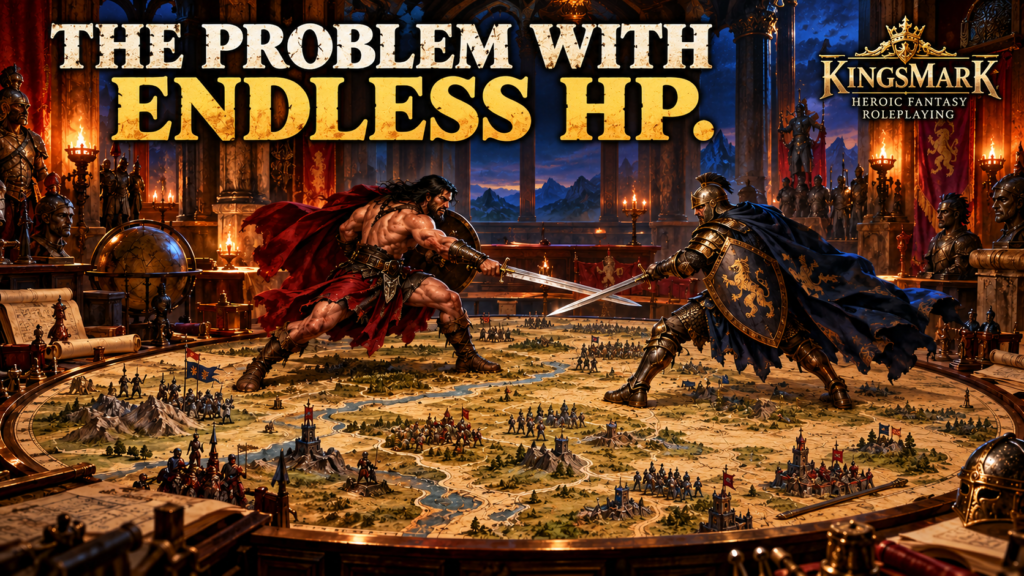
Imagine a warrior standing in the middle of a battlefield, surrounded by enemies. During the last several minutes, an archer has shot him, an axe-wielding barbarian has struck him, and some enormous, ugly bastard with a war hammer has beaten him half to death. His hit points have fallen from 100 to 12, and yet he continues swinging his sword with precisely the same effectiveness he enjoyed before receiving all that punishment.
He moves just as quickly, attacks just as accurately, and possesses essentially the same physical capabilities. His arms haven’t weakened, his legs haven’t become unreliable, and his ability to fight hasn’t deteriorated merely because his hit point total has plummeted. The next attack might reduce him to zero and send him collapsing to the ground, but until that happens, the ordinary rules provide no progressive reduction in his combat performance from hit point loss alone.
Now imagine another warrior who receives a single significant injury to his sword arm. Suddenly, the nature of the fight changes. He must consider how well he can continue using his weapon, whether his armor protected him, whether he should switch tactics, and how dangerous it would be to expose himself to another attack.
Which of these encounters contains more information that could contribute to an interesting action scene?
This question lies at the heart of one of my biggest criticisms of conventional hit points in tabletop role-playing games. It isn’t that hit points cannot work, because they obviously can. Dungeons & Dragons has used them for more than half a century, and millions of players have enjoyed extraordinary adventures using that familiar system.
The problem is that hit points are an abstraction, and abstraction comes at a price. By compressing a character’s ability to withstand danger into a numerical resource, we discard information about what actually happens when that character is injured. The Game Master and players can certainly invent those details, but they are not necessarily established by the damage mechanic itself.
To be fair, Dungeons & Dragons does not claim that every point of damage represents a literal wound. Its official 2024 rules define hit points in terms of durability and the will to live. Earlier editions have likewise explained them through combinations of endurance, luck, combat experience, and the ability to avoid otherwise devastating blows.
That distinction is important because it would be ridiculous to insist that every successful attack mechanically represents a sword carving another enormous hole through the hero’s chest. Sometimes the attack exhausts him, forces him into a dangerous position, or represents a narrowly avoided injury. The abstraction allows the player to imagine a heroic swordsman deflecting attacks and gradually losing his ability to survive the next one.
However, the current D&D rules also establish that losing hit points does not, by itself, diminish the character’s capabilities until that total reaches zero. Even the Bloodied state, which occurs at half hit points or fewer, has no inherent mechanical effect unless another rule specifically invokes it. A character can therefore lose most of his durability while retaining his ordinary offensive and defensive capabilities.
This creates an interesting problem for anyone trying to portray a convincing physical confrontation. We can describe the warrior as battered, exhausted, injured, or practically drowning in his own blood, but those descriptions may have little mechanical significance. Unless another rule introduces a corresponding condition or impairment, the character continues functioning as though the problem were primarily numerical.
The responsibility for making that damage feel interesting frequently falls upon the Game Master. He must invent the details of every blow, describe its consequences, and decide whether those descriptions should influence anything beyond the hit point total. A sufficiently talented Game Master can make almost any combat system exciting, but a good ruleset should help him create that excitement instead of expecting him to manufacture every interesting consequence himself.
This does not mean the Game Master should stop using his imagination. Quite the opposite. I believe the best combat mechanics should provide imaginative people with meaningful information that inspires even more imaginative storytelling.
When designing 👑Kingsmark, I wanted attacks to involve more than subtracting numbers until somebody falls over. I wanted the body itself to matter, the armor protecting that body to matter, and the physical consequences of violence to influence what happens next. More importantly, I wanted those details to contribute to the dramatic choreography of combat rather than transforming every encounter into an exhausting medical examination.
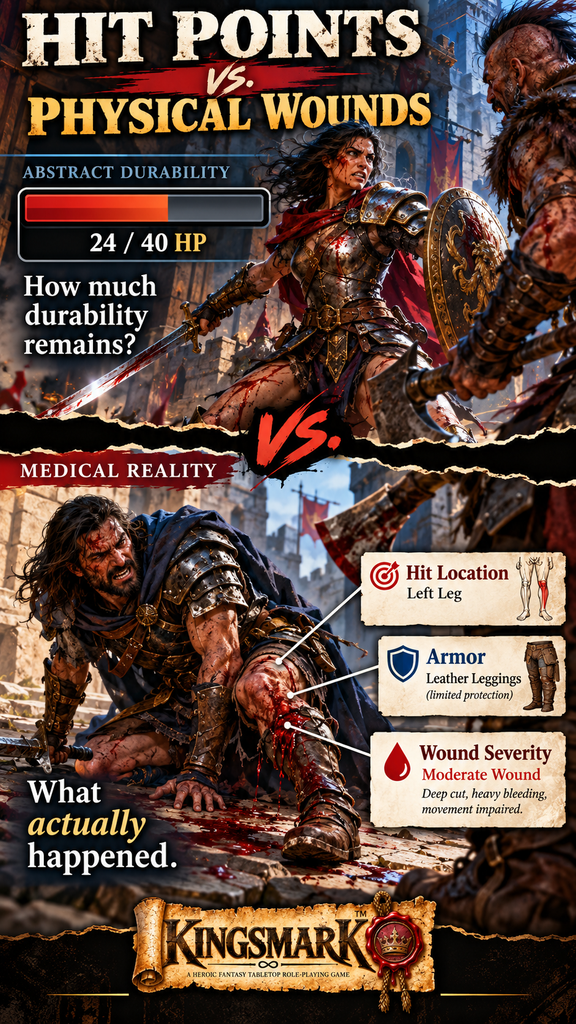
There is a difference between knowing that your character has lost 16 hit points and knowing that your character has suffered a 🩸Moderate wound to his leg. The first describes a reduction in his remaining durability. The second establishes a physical event that can influence his behavior, tactical decisions, and future adventures.
One is not necessarily appropriate for every kind of game, but the second offers possibilities the first does not provide on its own. It gives the Game Master something specific to describe and the player something specific to respond to. When injuries have identities rather than merely numerical values, they can become meaningful parts of the unfolding story.
This is one reason I created 👑Kingsmark, a heroic fantasy TTRPG whose complete Player’s Handbook is free to read online. Its combat rules approach injuries, armor, psychological trauma, and tactical actions as interconnected aspects of portraying an individual adventurer. The intention is to create the kind of action that makes people sit forward in their chairs, excited to discover what happens next.
But understanding why I designed combat this way requires us to examine something that happened long before Kingsmark existed.
The Army Transformed into One Man
Dungeons & Dragons emerged from a tradition of miniature wargaming in which players commanded armies, moved military formations, and resolved battles using established procedures. Rather than controlling one heroic character, a player might command numerous units whose positions, capabilities, equipment, and casualties influenced the outcome of the engagement. The military simulation operated primarily at the level of the battlefield rather than the individual soldier.
Among the important influences was Chainmail, the medieval miniature wargame published by Gary Gygax and Jeff Perren in 1971. Dave Arneson’s developing Blackmoor campaign also played a critical role in turning miniature wargaming into something fundamentally different. Players increasingly became interested in portraying persistent individual characters who could undertake adventures, make personal decisions, and develop identities beyond their role in an army.
This historical transition created a difficult design problem. Rules developed for managing military formations were not necessarily suitable for portraying the adventures of individual human beings. The designers needed a combat system capable of resolving dangers while allowing characters to survive long enough for continuing stories to develop.
In an especially revealing interview published by Game Developer in 2009, Arneson discussed abandoning the Chainmail combat rules because they were designed for mass combat rather than the kind of individual role-playing his group was developing. He explained that he adapted elements from a system he had used for American Civil War ironclad ships, including armor class and hit points. This connection between naval combat and individual fantasy adventurers deserves considerably more attention than it usually receives.
Think about what a hit point system accomplishes when representing a warship. A vessel can receive repeated punishment while retaining enough structural integrity to remain afloat and continue fighting. Its diminishing durability provides a practical way to represent the cumulative effects of enemy fire without requiring players to account for every damaged plank, broken cannon, flooding compartment, or injured sailor.
For a naval wargame, that abstraction makes considerable sense. The object being represented is a fighting vessel whose continued ability to operate is the main concern. The precise injuries suffered by individual sailors are generally less important than whether the ship remains capable of fulfilling its military function.
But a human being is not a warship.
When the subject of the game becomes an individual person, the information that matters can change dramatically. The condition of a man’s legs, arms, hands, torso, and head may directly influence what he can accomplish. Unlike a ship whose damaged compartments can be summarized through an overall durability rating, a person’s injuries can have consequences far out of proportion to their apparent size.
A relatively minor wound in one location might be inconvenient, while a sufficiently serious injury somewhere else could immediately threaten the character’s ability to continue fighting. A combatant whose dominant hand is disabled faces an entirely different problem from one who has suffered a painful wound to his foot. Even when two injuries fall within the same broad severity category, their anatomical locations can produce different circumstances.
This brings us to an intriguing design question that guided my thinking about Kingsmark.
What if we approached individual-character combat using the same general philosophy that wargamers apply to the military units under their command?
Imagine playing a sophisticated military wargame involving twelve different units. Each unit occupies its own position, possesses different capabilities, and may have equipment or protection appropriate to its battlefield role. The commander must consider how those units interact with one another and how their individual conditions affect the broader tactical situation.
An infantry formation might be exceptionally effective when holding a narrow passage but dangerously vulnerable when attacked by cavalry in open terrain. Archers may dominate an exposed field while struggling against enemies who reach them in close combat. A heavily armored formation might withstand ordinary missiles but become less effective when exhausted or forced into unfavorable terrain.
The commander isn’t simply tracking the total number of soldiers who remain alive. He is considering the condition, capabilities, protection, and placement of individual components of his fighting force. Their relationships create the strategic complexity that makes the game interesting.
Now change the scale.
Instead of portraying an army composed of different formations, we are portraying a warrior composed of different anatomical structures. Instead of tracking the protection afforded to individual military units, we track the protection afforded to the various parts of his body. Instead of observing how battlefield casualties change the behavior of an army, we observe how injuries change the behavior of an individual combatant.
The battlefield has become the human body.
This is not a claim that Dungeons & Dragons literally converted a platoon-sized military unit into one person while preserving an identical hit point mechanic. The historical development was more complicated, as Arneson’s own recollections demonstrate. Rather, it is a philosophical comparison between two different scales of simulation and the information each scale might reasonably require.
In a wargame, the various components of an army become the subjects of tactical consideration. In a role-playing game, the various components of an individual person can receive that same attention. The complexity has not necessarily become pointless merely because we have shifted our focus from twelve military units to twelve anatomical regions.
That doesn’t mean every RPG needs an elaborate anatomical system. A game concerned primarily with solving mysteries, political intrigue, or lighthearted adventure may have little reason to distinguish between a wounded shoulder and a wounded foot. The amount of mechanical detail should depend upon the kind of experience the designer intends to create.
I discussed this broader principle in Combat System Considerations in TTRPGs. Before designing a combat system, we ought to consider our intended audience, the amount of tactical decision-making we want, and the experience our rules are supposed to produce. Simplicity is valuable, but simplicity without regard for design objectives can become an excuse for discarding the very elements that would make a particular game compelling.
The important thing is that hit points are not the only possible solution to the problem of representing individual combatants. In fact, the RPG industry has been experimenting with alternatives for decades.
RuneQuest provides a particularly important historical example. In RuneQuest: Roleplaying in Glorantha, characters have hit points associated with specific anatomical locations, and armor protects those locations separately. A sufficiently serious injury to a particular body part can disable it, demonstrating that location-specific consequences have an established place in traditional fantasy role-playing.
GURPS incorporates detailed rules for targeting different parts of the body, injuries, and physical incapacitation. Rolemaster became famous for critical-hit results capable of introducing specific injuries and their consequences. Meanwhile, Blades in the Dark demonstrates that recording descriptive injuries and their severity does not necessarily require a highly detailed anatomical simulation.
These systems differ enormously, and I would not pretend they all solve the same problems in the same way. Some preserve conventional hit points alongside more detailed injury rules, while others approach harm through broader narrative consequences. What they demonstrate collectively is that there has never been a good reason to assume that one numerical pool must serve as the universal foundation of RPG combat.
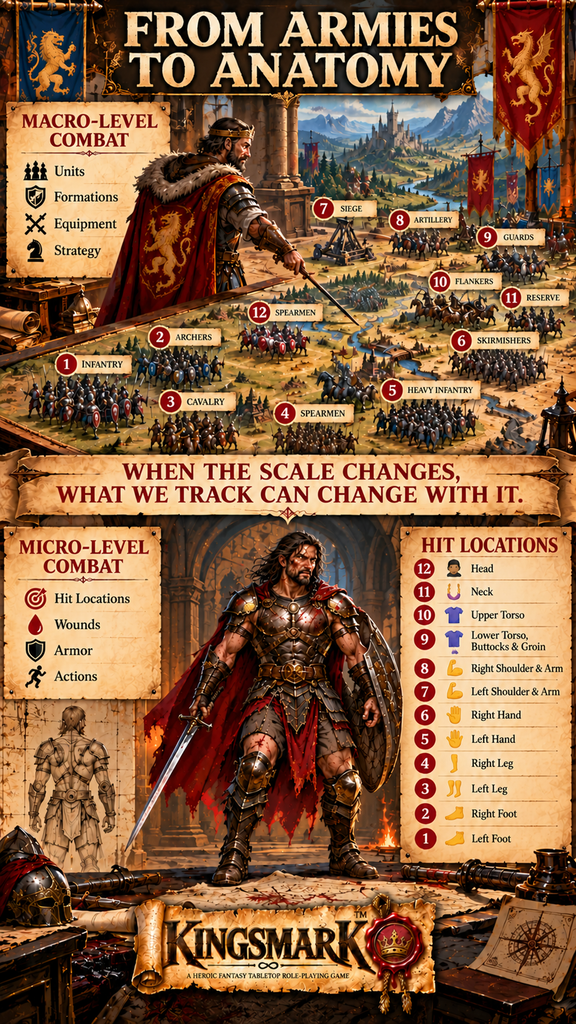
In Kingsmark, I wanted to explore that second scale without transforming the experience into a medical-school examination. The human body would matter, but we wouldn’t need a separate durability score for every finger, bone, muscle, and internal organ. Armor would protect the areas it actually covered, injuries would have identifiable severity, and the rules would provide ways for those consequences to influence play.
I also wanted the system to accommodate the extraordinary variety of dangers encountered in heroic fantasy. Swords, axes, arrows, falls, fire, poison, supernatural forces, and psychological terror are not interchangeable experiences. A character’s protection against one type of danger should not automatically provide the same protection against every other threat.
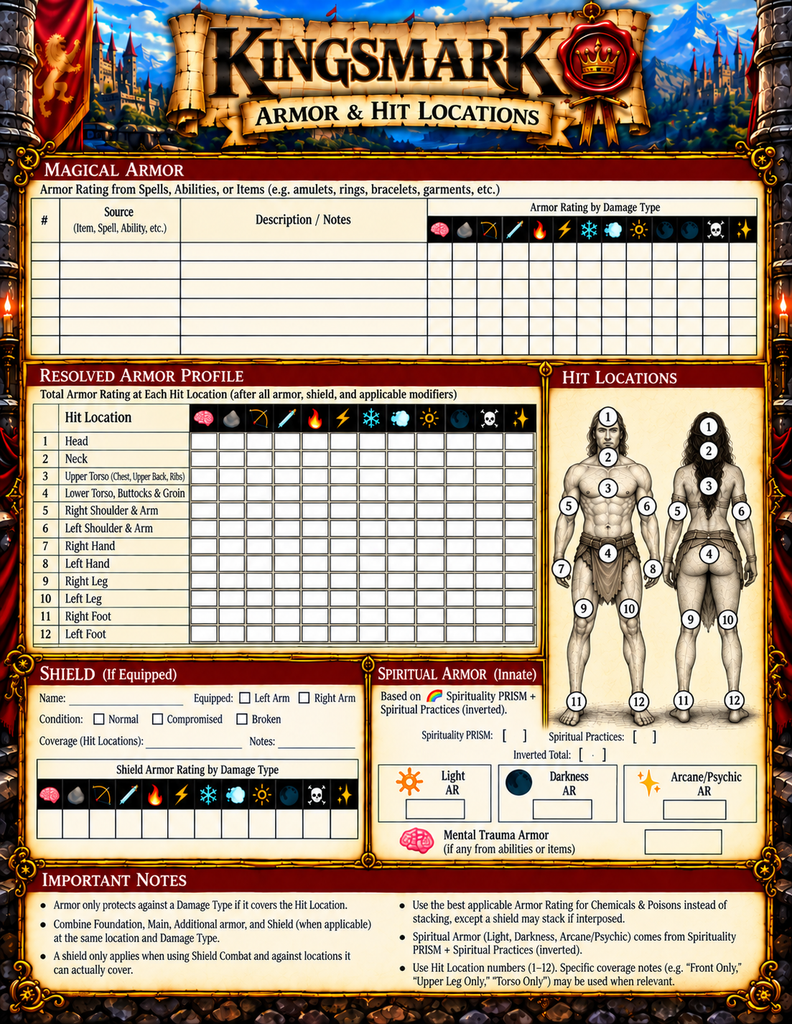
This is why Kingsmark’s 💥 Damage & Defense system distinguishes multiple Damage Types and uses location-specific Armor Ratings. Instead of asking only how many points of durability an attack removes, we can examine what kind of attack occurred, where it struck, what protection existed, and what consequences resulted.
The objective is not to make every attack take forever to resolve. It is to provide enough meaningful information that the people playing the game can understand the physical circumstances of the encounter. Once those circumstances are established, the possibilities for imaginative action become considerably more interesting.
Your Body Is Not a Hit Point Bar
The human body is an extraordinary collection of interconnected structures. Its individual components perform different functions, and damage to those components can produce dramatically different consequences. Anyone who has suffered a sprained ankle, broken finger, painful shoulder injury, or cracked rib understands that physical harm isn’t simply a universal reduction in durability.
The same principle becomes even more important when characters are fighting for their lives. A swordsman depends upon his ability to stand, move, maintain balance, manipulate his weapon, and perceive threats. Injuries that interfere with those functions may change his immediate circumstances even when they do not threaten to kill him.
Kingsmark therefore divides the humanoid body into twelve 🎯 Hit Locations. These include the 👨Head, 📿Neck, 👕Upper Torso, 👕Lower Torso, 💪Right Shoulder & Arm, 💪Left Shoulder & Arm, ✋Right Hand, 🤚Left Hand, 🦵Right Leg, 🦵Left Leg, 🦶Right Foot, and 🦶Left Foot. Each location represents a broad anatomical area whose protection and injuries can matter during play.
Ordinarily, a successful attack determines its Hit Location by rolling 1d12. The Game Master may instead determine the location through obvious physical logic when the circumstances restrict what could reasonably have been struck. An enemy standing behind a high stone wall cannot receive a sword wound to a completely concealed foot simply because a die produced that result.
Characters can also deliberately target locations through appropriate Actions, including 🟠🟠Aim. This permits a combatant to direct his attack toward an exposed or less-protected area rather than striking indiscriminately. Whether that attack succeeds, and how severe the resulting injury becomes, still depends upon the applicable rules.
This is where anatomical detail begins producing interesting tactical choices. Imagine a warrior facing an enemy whose chest is protected by a magnificent steel breastplate, while his legs are protected by much lighter equipment. A conventional attack might strike the armored chest, but a deliberately aimed attack could exploit the weaker protection around a leg.
The player doesn’t need to understand the metallurgy of medieval armor or memorize the mechanical characteristics of every historical weapon. He needs to recognize that different parts of the enemy possess different degrees of protection. That recognition creates a tactical decision that might not exist if the entire opponent were represented by one Armor Class and one hit point total.
Of course, D&D’s Armor Class already incorporates many defensive factors, and its combat rules allow characters to attempt a variety of maneuvers. My criticism is not that D&D contains no tactics whatsoever. It is that anatomical protection and injury consequences are generally not resolved with the same level of mechanical specificity.
Armor becomes especially interesting when its protection is no longer treated as though it uniformly surrounds the entire character. A helmet may protect the head without protecting the neck. A leather glove may protect the hand without providing meaningful protection to the shoulder, and a breastplate may cover the upper torso while leaving other parts of the body comparatively exposed.
Kingsmark’s armor rules therefore concern physical coverage, appropriate layering, and resistance to particular Types of Damage. A piece of armor might protect exceptionally well against 🗡️Blades & Spikes while providing less protection against 🪨Concussive impacts. Different equipment may possess appropriate protection against 🏹Projectiles, 🔥Fire, ❄️Cold, or other dangers according to its construction and properties.
This is not merely an exercise in historical realism. It creates opportunities for characters to make intelligent decisions based upon what they observe. A heavily armored opponent may be exceptionally difficult to wound with one method of attack while remaining vulnerable to another.
The importance of these distinctions becomes clear when considering actual medieval combat. Historical warriors developed different weapons, defensive equipment, and fighting techniques because they were confronting real physical problems. I explore some of those realities in How Did Medieval Sword Fighting Really Work?, including the differences between cinematic swordplay and the practical demands of armed combat.
That historical knowledge can inspire game mechanics without forcing a fantasy game to reproduce every technical detail. A person does not need to become an expert in historical European martial arts to understand that a steel helmet and a leather boot provide different kinds of protection. The rules can translate those understandable differences into useful gameplay.
Now consider what happens after an attack penetrates the available defenses.
Instead of subtracting numerical hit points, Kingsmark records 🩸Physical Trauma according to four levels of severity. These are 🩸Minor, 🩸Moderate, 🩸Severe, and 💀Critical wounds. The character’s Medical Record contains twelve Physical Trauma boxes distributed across these categories, allowing injuries to accumulate and escalate.
A 🩸Minor wound might represent a superficial cut, bruise, or sprain. A 🩸Moderate wound represents a more significant injury, such as a deep cut, cracked bone, or serious bleeding. A 🩸Severe wound may involve disabling trauma, while a 💀Critical wound represents catastrophic physical damage that can threaten survival or produce other devastating consequences.
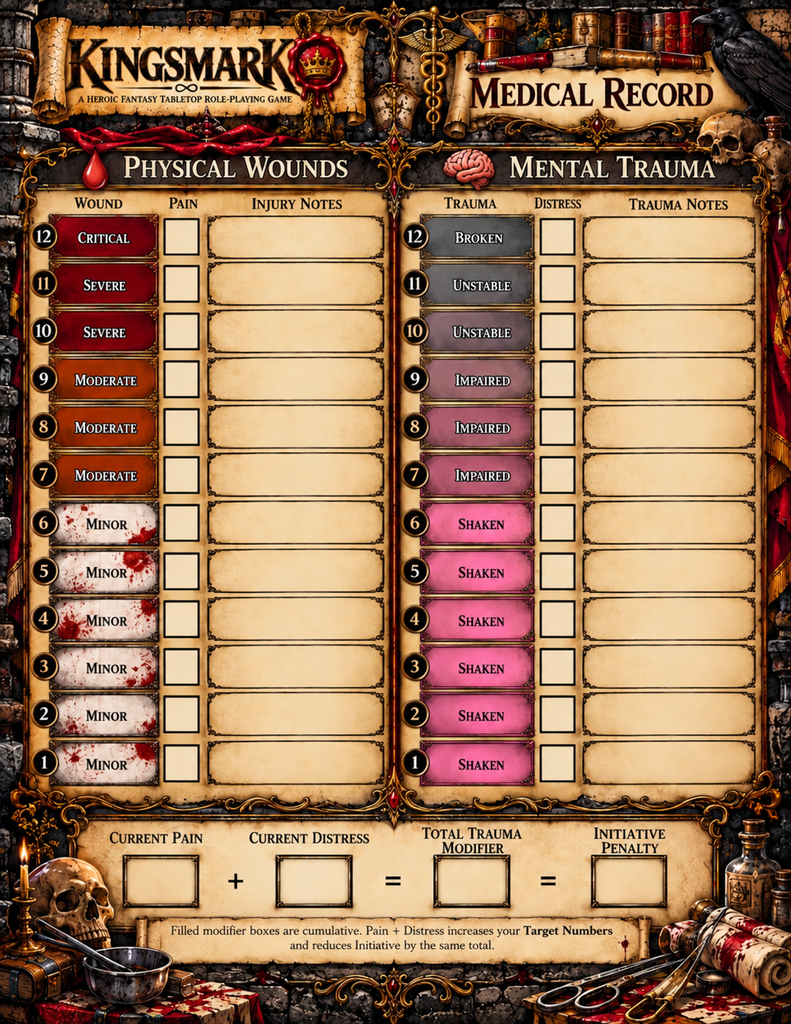
These levels describe the severity of an injury, while its Hit Location establishes where it occurred. They are two different pieces of information, and their combination helps the Game Master determine the nature of the injury. The system does not create twelve independent hit point pools for the different parts of the body.
That distinction is worth emphasizing because some players understandably recoil at the idea of tracking an enormous collection of individual anatomical statistics. They imagine a spreadsheet containing separate numbers for the left kneecap, right kneecap, spleen, liver, and possibly the unfortunate hero’s left testicle. By the time the Game Master finishes calculating the durability of his third molar, everybody has gone home.
That is not the objective of Kingsmark.
The twelve Hit Locations are intentionally broad, while the accumulating Physical Trauma system tracks the increasing seriousness of the character’s injuries. The details of individual wounds help determine what has happened to the character, but the system is not intended to simulate every biological process inside his body. It concentrates upon the physical consequences that can contribute meaningfully to play.
Let’s examine an illustrative combat exchange.
Imagine two professional swordsmen confronting one another in the courtyard of a ruined fortress. One wears a heavy breastplate, articulated protection around his right arm, and a sturdy helmet. His opponent wears lighter armor, relies upon speed and maneuvering, and understands that attacking the heaviest armor is unlikely to produce the desired result.
The lightly armored swordsman studies his enemy’s equipment and recognizes that some locations are better protected than others. He could launch a conventional attack and accept whatever available Hit Location results, or he could use 🟠🟠Aim to deliberately select a more vulnerable area. His decision depends upon the opportunity, available Action Points, and the danger of spending time preparing a more precise attack.
For a simple numerical illustration, imagine an attack whose Base Damage Level is 🩸Minor. Suppose the modified attack result exceeds its final Target Number by one, raising the Damage Level to 🩸Moderate before applicable protective reductions. If the attack strikes a location protected by armor with an applicable AR of 1, that armor reduces the result to 🩸Minor.
Now imagine the same initial attack reaching a different location without applicable armor protection. The resulting 🩸Moderate wound remains, assuming no other defense or circumstance reduces it. These are hypothetical values used to illustrate the relationship between damage escalation and armor, not the fixed statistics of a particular published sword or armor piece.
The two possible outcomes tell different stories. In one, the warrior’s equipment absorbs enough of the attack to substantially reduce the resulting injury. In the other, a more vulnerable part of his body receives a serious wound, creating a new circumstance that both combatants must consider.
The Game Master can now describe an actual injury rather than inventing the meaning of an arbitrary amount of lost durability. Perhaps the blow has seriously damaged the character’s forearm, made a leg unreliable, or caused bleeding that demands attention. The exact description must remain appropriate to the Hit Location, Damage Type, severity, and circumstances rather than being chosen simply because it sounds dramatic.
Kingsmark also introduces mechanical consequences as Trauma accumulates. Depending upon the character’s 🌈Physical Performance PRISM and his Physical Trauma Threshold, accumulated injuries can impose Pain Modifiers that increase Action Target Numbers and reduce ⏳Initiative. Physical circumstances may also justify specific limitations, and permanent injuries are governed by their own rules.
This produces an important relationship between injury and performance. A character with greater physical resilience may withstand more punishment before accumulated wounds begin significantly degrading his abilities. Another combatant may struggle much earlier, while an especially serious injury can create immediate problems regardless of how many previous wounds he has endured.
The consequences aren’t merely punitive. They help explain why experienced fighters value protection, positioning, preparation, teamwork, and sensible retreats. A disciplined warrior may decide that surviving the encounter is more important than making one additional reckless attack.
A character can also behave courageously despite injury. In fact, one of the most dramatic things a hero can do is continue fighting while wounded, understanding that his deteriorating condition makes every additional decision more dangerous. That is substantially different from continuing to fight because a diminishing number has no practical significance until it reaches zero.
Another interesting feature is the distinction between a weapon’s Base Damage Level and its 💀Critical Threshold. In Kingsmark, the margin by which an attack succeeds can increase the resulting Damage Level, but a weapon cannot escalate into a Critical Wound unless its modified attack result also meets the weapon’s Critical Threshold. This helps distinguish a dangerous weapon from an object whose capacity to inflict catastrophic harm is considerably less reliable.
That means a sword, club, spear, and improvised household object need not behave identically merely because an extraordinarily skilled character happens to be using them. The system considers both the effectiveness of the attack and the physical capabilities of the weapon. It also permits extraordinary results when the relevant conditions are satisfied, preserving the unpredictability that makes dice-based combat exciting.
The 💥 Damage & Defense chapter provides the procedures for these outcomes, including Physical Trauma, Armor Ratings, Hit Locations, Critical Thresholds, and the consequences of catastrophic injuries. The related ❤️ Healing Scenes chapter addresses what happens after combat, when characters must deal with the damage they have suffered. Injuries are not simply disposable numerical inconveniences that cease to exist when the immediate encounter ends.
That continuing relationship between combat and recovery is particularly important in an extended campaign. A warrior’s injuries may affect the party’s decision to continue exploring, seek medical treatment, abandon an objective, or change its approach to the next encounter. Such developments can arise directly from the rules rather than requiring the Game Master to invent a new complication whenever the story needs one.
None of this guarantees that Kingsmark will be the ideal combat system for everybody. Some players have no desire to consider anatomical injuries, and others prefer rapid resolution over detailed tactical decisions. Those are legitimate preferences, and I would rather design a game with a clear identity than pretend one ruleset should satisfy every conceivable audience.
But I reject the assumption that adding meaningful detail to individual characters is somehow less reasonable than tracking the many components of a military army. Both approaches involve selecting information that matters to the subject being portrayed. If a wargamer can manage the protection, movement, and condition of twelve separate formations, there is nothing inherently absurd about a role-player considering the protection and injuries of twelve broad anatomical regions.
The important question is whether the additional information contributes to a better experience.
For the kind of heroic fantasy Kingsmark is designed to deliver, I believe it does.
Five Seconds Can Change Everything
Some of my favorite cinematic action sequences are remarkable not because they contain enormous amounts of violence, but because so much happens within a remarkably short period of time. The characters make decisions, exploit opportunities, improvise, and respond to their opponents with extraordinary speed. A single exchange may contain more memorable action than an entire battle in another film.
Consider the 2009 film Sherlock Holmes, starring Robert Downey Jr. and directed by Guy Ritchie. Its famous bare-knuckle fighting sequence presents Holmes mentally analyzing an opponent, identifying vulnerabilities, and planning a series of precise attacks before executing them. The scene is entertaining partly because the audience understands the reasoning behind the violence rather than merely watching two men repeatedly punch one another.
The Bourne films achieve something similar through improvisation and rapid adaptation. Jason Bourne frequently employs ordinary objects, environmental features, positioning, and combinations of physical techniques to overcome dangerous opponents. A memorable confrontation might involve a weapon being redirected, furniture becoming an obstacle, an improvised tool changing the situation, and a combatant exploiting an opportunity that exists for only a moment.
Another favorite is Brotherhood of the Wolf, the 2001 French historical fantasy film. The opening fight involving Mani, portrayed by Mark Dacascos, combines exceptional martial choreography with dramatic movement and visual spectacle. There is a kind of martial beauty to the sequence that goes well beyond the question of how many times somebody gets hit.
But perhaps the clearest example of the philosophy I wanted to bring into Kingsmark appears in The Equalizer, starring Denzel Washington.
Robert McCall evaluates his surroundings, studies his opponents, identifies possible weapons, and estimates how much time he will require to neutralize the danger. The fight becomes a demonstration of deliberate decision-making under extraordinary time pressure. The audience sees a combatant mentally organizing a sequence of actions before carrying them out with ruthless efficiency.
Now imagine translating that general thought process into a tabletop role-playing game.
Your character has only a brief opportunity to act. What can he accomplish before his enemies respond, the situation changes, or the opportunity disappears? Can he draw his sword, attack an opponent, reposition, and dive for cover, or must he sacrifice one of those activities to accomplish something more important?
These questions are the philosophical foundation of Kingsmark’s Action Point economy.
In the ▶️ Action Scenes chapter, characters ordinarily receive five Action Points during each ⏸Turn, modified by their Speed Attribute. Different actions consume different amounts of this limited resource, creating meaningful choices about what a character can accomplish. A faster character may possess additional opportunities, while a slower one must operate within a more restrictive economy.
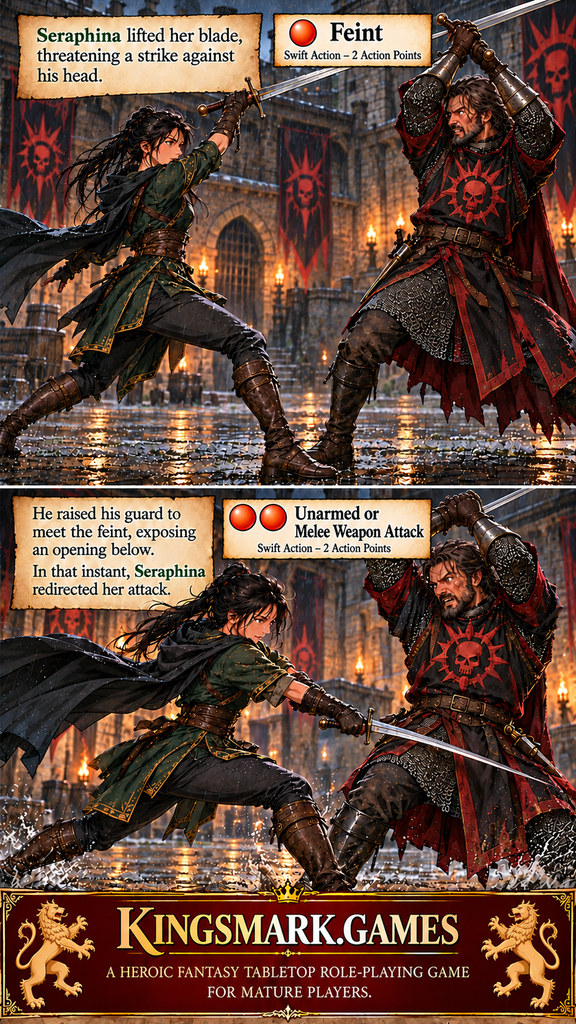
The system distinguishes three primary Action cost categories. A 🟡Flair Action costs one Action Point and represents something relatively brief, such as drawing readily accessible equipment. An 🟠🟠Swift Action costs two Action Points, while a 🔴🔴🔴🔴Starring Action costs four and represents a more substantial commitment of time.
These categories provide a common language for resolving physical activity. Players don’t need to memorize every possible maneuver in advance, and the Game Master doesn’t need to invent an entirely new action economy whenever somebody attempts something unusual. The important thing is understanding approximately how much time an activity requires and applying the appropriate rules.
The 🎬 Example Actions chapter contains well over a hundred example Actions, providing a reference for the kinds of things characters might accomplish. It is a menu of possibilities rather than a mandatory sequence of commands. Players can describe what they want their characters to do, and the Game Master can use the established costs and procedures to determine how those intentions are resolved.
This is especially important because real-world action does not occur in neatly separated blocks. A warrior can move while drawing a weapon, shift his footing while attacking, and react to an opponent without stopping for an imaginary interval between every movement. Kingsmark organizes such overlapping activity into manageable Turns without insisting that the fictional action itself consists of people standing motionless while others perform their assigned animations.
Ordinary walking and Double-Time movement, for example, can accompany compatible actions without consuming separate Action Points. More demanding movement, such as Sprinting, requires a greater commitment. The rules therefore distinguish between movement that can occur naturally alongside other activity and movement that occupies most of a combatant’s available time.
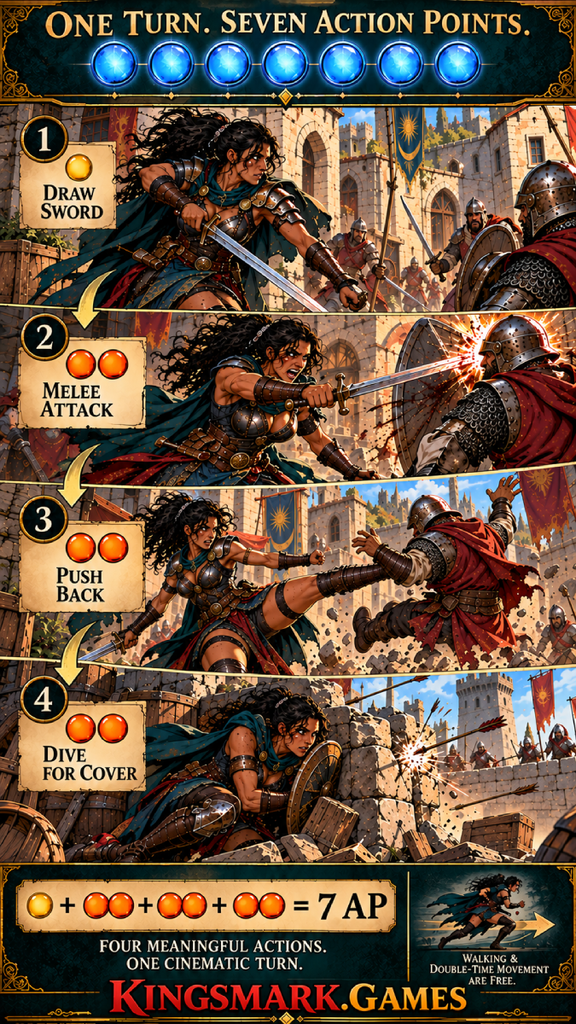
Imagine a swordsman entering a ruined banquet hall where two hostile mercenaries have taken positions around a long stone table. One opponent is approaching with a spear, while the other is preparing to attack from the opposite side. The hero cannot accomplish everything he might want to do, and the first decision is whether to attack immediately, improve his position, or commit time to some other maneuver.
Suppose he has five Action Points available. He spends one on 🟡Draw or Ready Carried Equipment, bringing his weapon into readiness, while moving into a position where the table interferes with one enemy’s approach. He then commits two Action Points to an 🟠🟠Unarmed or Melee Weapon Attack against the nearer opponent.
The attack is resolved, and the result determines what he can accomplish under the relevant combat rules. Perhaps he wounds the mercenary, forces him backward through an appropriate maneuver, or creates some other tactical change that affects the following moments. Depending upon the outcome and available circumstances, the warrior still possesses two Action Points that might be spent upon another eligible action.
He could attempt another attack, use an appropriate defensive maneuver, or dive for cover if the circumstances permit. The decision is important because committing those remaining opportunities to one activity means he cannot simultaneously spend them on something else. His enemies, meanwhile, have their own abilities, positions, intentions, and opportunities.
This example is deliberately simple, but consider how much is happening beneath the surface. The warrior’s available time matters, the positioning of his opponents matters, the battlefield environment matters, and the physical consequences of successful attacks matter. Instead of repeatedly selecting the same attack until an opponent’s hit points reach zero, the player has reasons to think about the choreography of the confrontation.
I explored this broader philosophy in Why “I Attack” Isn’t Enough, where I discussed how tactical maneuvers and varied objectives can create action scenes that go beyond repetitive damage exchanges. Killing an opponent is only one possible outcome of a confrontation. Disarming, repositioning, escaping, protecting someone, or forcing an enemy to surrender can be equally meaningful achievements.
There is also an important distinction between cinematic combat and slow, exhaustive simulation. A system can contain detailed rules without requiring players to calculate every fractional second of movement or consult a dozen charts whenever somebody swings a sword. Good design should concentrate attention upon the choices and consequences that make an encounter exciting.
Real fights also vary enormously in duration. Some violent confrontations end almost immediately, while others continue through prolonged struggles, interruptions, and periods of changing intensity. There is no universal stopwatch that dictates how quickly every fight must end.
What matters for heroic fantasy is that a few seconds can contain an extraordinary amount of meaningful action. A character might make a decision that saves a companion, exploit a momentary weakness, suffer an injury, or accomplish something heroic before his enemies understand what has happened.
That is the kind of combat I want Kingsmark to facilitate. It should feel exciting, dangerous, intelligent, and occasionally spectacular, while preserving enough physical consequence that players understand they are portraying vulnerable beings rather than indestructible collections of numbers.
However, there is another dimension of the individual adventurer that conventional damage mechanics frequently overlook.
The Wounds Nobody Can See
Imagine an adventuring party exploring an ancient underground sanctuary. The warriors are heavily armored, the magician has prepared his spells, and everyone believes they are reasonably equipped to confront whatever dangers might be waiting beneath the earth. Then the chamber begins to tremble, reality distorts, and something emerges through an impossible opening in the darkness.
The thing is not an ordinary monster. Its body appears to possess anatomical structures that should not exist, its movements violate the laws of nature, and its presence fills the chamber with an overwhelming sense of dread. The adventurers are witnessing something that no ordinary human being was ever psychologically prepared to encounter.
Nobody has been stabbed, burned, poisoned, or struck by a weapon. Their armor remains intact, their limbs are functional, and their physical condition may be entirely unchanged. Yet the experience could be devastating.
What happens to the mind when the body remains unharmed?
Dungeons & Dragons does possess fear mechanics, including the Frightened condition, and some creatures possess abilities that can impose that condition without casting a spell. It would therefore be inaccurate to claim that D&D recognizes fear only when a magician casts an appropriate enchantment. The more interesting question is how extensively a game models psychological consequences as part of ordinary adventuring.
Other RPGs have explored this subject for many years. Call of Cthulhu, for example, places enormous importance upon the psychological consequences of encountering incomprehensible supernatural horrors. Its Sanity rules demonstrate how psychological resilience can become a central feature of a role-playing experience rather than a minor narrative consideration.
Kingsmark addresses this dimension through its 🧠Mental Trauma system.
Just as Physical Trauma distinguishes different levels of bodily injury, Mental Trauma distinguishes four levels of psychological harm. These are 🧠Shaken, 🧠Impaired, 🧠Unstable, and 💀Broken. Characters possess twelve Mental Trauma boxes, and accumulating psychological injuries can eventually impose Distress Modifiers that affect their performance.
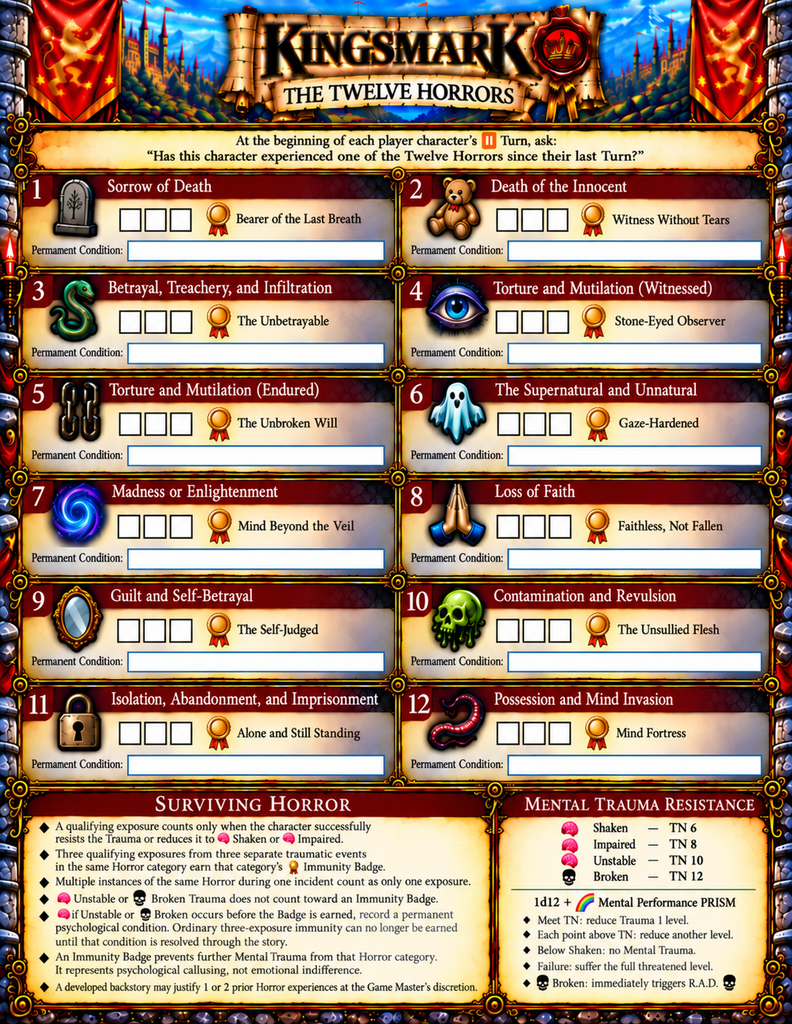
When a character encounters a sufficiently disturbing event, the Game Master determines the threatened Mental Trauma level according to the circumstances. The character then attempts to resist the experience using 1d12 + 🌈Mental Performance PRISM, with the appropriate Target Number and applicable modifiers. Depending upon the result, the character may suffer the threatened Trauma, reduce its severity, or avoid the Trauma entirely.
The standard Target Numbers for 🧠Shaken, 🧠Impaired, 🧠Unstable, and 💀Broken Trauma are 6, 8, 10, and 12 respectively. Meeting the Target Number reduces the threatened Trauma by one level, while each additional point of success reduces it by another. The procedure creates a consistent method for resolving psychological danger without requiring the Game Master to invent an entirely new rule whenever an adventurer witnesses something horrifying.
The system also recognizes that psychological injuries are not interchangeable with ordinary physical damage. A character might endure terrible combat injuries while remaining psychologically composed, or become overwhelmed by a horrific experience without receiving a scratch. Another character might suffer both kinds of Trauma simultaneously, producing a very different set of circumstances.
Consider two adventurers witnessing the same supernatural horror. One is an experienced Holy Knight who has spent years confronting dangerous creatures and believes that protecting his companions is a sacred responsibility. The other is a young Thief who has survived ordinary criminal violence but has never imagined that such a monstrous entity could exist.
Both characters may be threatened by the same psychological danger, but their individual abilities, circumstances, and resistance results may produce different consequences. Even if both suffer 🧠Mental Trauma, their reactions need not be identical. The Holy Knight might plant his feet and prepare to defend his companions, while the Thief might struggle against an overwhelming desire to escape.
The rules do not require every terrified character to react in exactly the same way. Fear can produce hesitation, anger, desperation, retreat, extraordinary courage, or other responses appropriate to the person experiencing it. What matters is that the psychological event becomes part of the character’s circumstances rather than disappearing because nobody suffered physical damage.
That distinction extends beyond supernatural horror. Betrayal, grief, torture, exposure to extreme violence, and other traumatic experiences can influence a character’s psychological condition. Some experiences may produce relatively brief distress, while more serious Trauma can become part of the character’s development over a much longer period.
I believe this is essential to portraying adventurers as more than names and numerical statistics. A character possesses a physical body, a mind capable of extraordinary thought and terrible suffering, and a spiritual dimension that contributes to his identity. The character’s motivations, experiences, abilities, and vulnerabilities combine to produce something much more interesting than a collection of interchangeable combat values.
The subject is related to the ideas explored in Beyond the Character Sheet, where character development involves more than selecting abilities and filling numerical boxes. Players create memorable heroes through choices, relationships, personalities, and the experiences that shape their lives. Game mechanics should help those aspects of characterization emerge during play rather than existing in complete isolation from them.
There is also an important relationship between meaningful danger and the responsibility of the Game Master. The more specifically the rules establish the circumstances of an encounter, the more information the Game Master possesses when describing its consequences. Instead of inventing everything from nothing, he can use established physical and psychological events as the foundation of his narration.
This does not eliminate the need for judgment, creativity, or thoughtful adjudication. Those things remain absolutely essential, and I have no interest in replacing the Game Master with a giant instruction manual. The purpose of the rules is to provide useful structure while preserving the human imagination that makes tabletop role-playing possible.
As I discussed in Early RPG Simplicity or Modern TTRPG Complexity?, complexity should be judged according to what it contributes to the game. Adding rules merely to make a system larger is pointless. Adding carefully designed mechanics that produce meaningful decisions, consequences, and storytelling opportunities can be an entirely worthwhile investment.
Hit points remain a valid design choice. If the objective is fast, abstract heroic combat where characters can absorb considerable punishment without tracking anatomical consequences, they may be precisely the right tool. I have no desire to tell people that they are enjoying their favorite games incorrectly.
But I reject the idea that conventional hit points should be treated as the unquestioned foundation of every fantasy role-playing game.
I wanted Kingsmark to provide another experience—one in which armor has meaningful physical coverage, injuries have locations and severity, seconds contain difficult tactical decisions, and psychological experiences can leave wounds that no physician can see. The goal was never realism at the expense of excitement, but rather to use carefully selected elements of realism to create more exciting, dangerous, and memorable heroic fantasy.
A wargame can tell compelling stories about armies, the movements of military formations, and the genius or foolishness of commanders. A role-playing game can bring that same attention to the individual warrior, whose body, mind, equipment, decisions, and personal courage determine what happens during the most dangerous moments of his life.
Hit points can tell us how close a character is to defeat. A consequential injury system can tell us what happened to him, how the experience changed his circumstances, and what he must do next.
A hero is more than a number. His wounds should tell a story.
If you want to experience a different approach to heroic fantasy combat, the complete 👑Kingsmark Player’s Handbook is FREE to read online at Kingsmark.games. Discover its 🩸Physical Wounds, 🧠Mental Trauma, 🎯Hit Locations, 🛡️Armor, and cinematic Action Point systems, and decide for yourself whether your next adventure deserves something beyond conventional hit points.
Support the game by purchasing a digital copy of the 👑Kingsmark Player’s Handbook.
About The Author