
Beyond the Character Sheet

How to Become a Better Role-Player
Imagine spending three hours creating a character for your next tabletop role-playing game. You carefully assign Attributes, select Skills, purchase equipment, examine your combat abilities, and calculate every relevant modifier. Your character is an impressive warrior, capable of surviving dangerous encounters and defeating formidable opponents. You arrive at the first game session confident that you are ready for anything. Then the Game Master introduces a friendly tavern keeper who asks, “Tell me, stranger, what brings you to our little village?” Suddenly, you realize something: You know everything about what your character can do, but almost nothing about who your character actually is.
This is one of the most common problems in tabletop role-playing games. Players can become so concerned with constructing effective characters that they overlook the personalities, motivations, experiences, and relationships that make those characters interesting. A character sheet is an important tool, but it primarily describes capabilities. It tells you whether your adventurer is strong, intelligent, agile, persuasive, or skilled with a particular weapon. What it cannot tell you, by itself, is how that person behaves when insulted, whether they trust strangers, what they regret about their past, or whom they would sacrifice everything to protect. Those things emerge through the choices you make while portraying the character.
When I designed Kingsmark, I wanted character creation to involve more than assembling an effective collection of numbers. This is why the Player’s Handbook introduces the 📖Character Bible, a continuing record of an adventurer’s abilities, relationships, experiences, injuries, ambitions, and development. A character sheet describes the person at a particular moment. A Character Bible tells the larger story of who that person is and who they are becoming. Although I will use Kingsmark throughout this article, these principles apply to almost any tabletop role-playing game, including Dungeons & Dragons, Pathfinder, Shadowrun, and many others.
🎭 Role-Playing Is Not the Same as Acting
One misconception about role-playing games is that being a good role-player requires theatrical talent. Some players believe they must perform unusual accents, deliver dramatic speeches, adopt distinctive voices, or improvise elaborate conversations to make their characters believable. These techniques can certainly enrich a game, but they are not necessary. A player who speaks with an ordinary voice and describes their character’s decisions can be just as effective as someone with years of theatrical experience. What matters is whether the character behaves like a believable individual rather than simply serving as a vehicle for the player’s tactical decisions.
Consider two players portraying courageous knights. The first speaks in a commanding voice, delivers an impressive speech about honor, and dramatically describes drawing his sword. The second quietly tells the Game Master that his knight refuses to abandon an injured stranger, even though remaining behind could jeopardize the entire mission. Both players may be role-playing effectively, but the second has revealed something particularly meaningful about the knight’s personality. His courage is not merely a trait written on paper; it influences what he is willing to risk. The character’s convictions have become visible through his actions, and the consequences of those actions may influence the story.
Good role-playing is primarily about making decisions from the perspective of the fictional person you are portraying. Acting is simply one possible way to communicate those decisions. You can speak directly as your character, describe what your character says, or combine both approaches. None is inherently superior, and players should feel comfortable choosing whichever method allows them to participate confidently. A shy player should not be discouraged from portraying a charismatic diplomat, inspiring leader, or persuasive merchant merely because delivering an elaborate speech feels uncomfortable.
Kingsmark addresses this distinction explicitly in Chapter 10, 🗨️Dialog Scenes. The player establishes what their character wants and the general approach being attempted, while the character’s actual abilities help determine how effectively that approach succeeds. If your character is an exceptionally persuasive negotiator, you should not need to possess that same talent in real life. After all, nobody expects a player portraying a master swordsman to demonstrate expert swordsmanship before attempting an attack. Social abilities deserve similar consideration.
💪 Learn to Think Like Someone Else
One of the most rewarding aspects of role-playing is the opportunity to experience a fictional world through someone whose personality, beliefs, abilities, and circumstances differ from your own. Perhaps you are naturally cautious but want to portray a fearless explorer. Perhaps you are outgoing but wish to play a reserved scholar. You might be a peaceful person portraying a hardened mercenary, or someone with little practical wilderness experience portraying an accomplished Ranger. The challenge is not to abandon your intelligence or common sense, but to consider how the character’s experiences and values might influence the choices they make.
Suppose your adventuring party discovers that a dangerous creature has captured several villagers. As a player, you recognize that attempting a rescue could be extremely risky. Your character, however, once lost a younger sibling because nobody was willing to intervene. That experience might make the possibility of abandoning the villagers almost unbearable. A convincing role-player considers both realities: the practical danger and the character’s personal reasons for confronting it. Perhaps the character argues passionately for a rescue, insists upon developing a careful plan, or volunteers to undertake the most dangerous part of the operation.
This does not mean that portraying a character requires deliberately making foolish decisions. A disciplined warrior can be compassionate without being reckless. A cautious scholar can be courageous without suddenly forgetting the value of preparation. Indeed, the interaction between personality and practical judgment often makes a character more interesting. The goal is to make decisions that remain understandable within the character’s fictional life, even when another adventurer would approach the same circumstances differently.

📖 Your Character Class Is Not Your Personality
A Character Class establishes what an adventurer has learned to do, but it does not necessarily determine what kind of person that adventurer has become. In Kingsmark, a 🏹Ranger might be a dedicated protector of wilderness communities, a professional scout working for wealthy merchants, an enthusiastic explorer, a ruthless bounty hunter, or a solitary individual attempting to escape a painful past. All might possess similar professional training while having dramatically different personalities. Their abilities establish certain possibilities, but their histories, motivations, and choices determine how they approach those possibilities.
The same principle applies to other Classes. A 🗝️Thief need not be dishonest, and a ⚔️Man-at-Arms need not enjoy violence. A 🧙♂️Wizard might be humble and generous rather than arrogant, while a 🕯️Priest might struggle with resentment, ambition, or personal doubt. A 🛡️Holy Knight could be confident in his duty while privately questioning whether he possesses the wisdom necessary to fulfill it. These contradictions are not defects in character design. They are opportunities to create individuals who feel more believable than familiar fantasy stereotypes.
Chapter 9, 🎭Character Class, describes the mechanical foundations of Kingsmark’s seventeen Classes, while Chapter 17, ✍Character Creation, develops the personal identity that exists beyond those abilities. When creating an adventurer, consider the distinction between profession and personality. Ask what kind of person would pursue that profession, what experiences led them there, and how their beliefs influence the way they practice their abilities. Two people can receive similar training and emerge with entirely different attitudes toward responsibility, authority, wealth, violence, and the people they encounter.
🌳 Give Your Character a Past That Matters
An elaborate backstory can be entertaining to write, but length does not necessarily make it useful. A fifteen-page history filled with names, kingdoms, battles, and distant relatives may contribute less to actual role-playing than three carefully chosen experiences that explain how the character behaves. The purpose of a backstory is not simply to establish what happened before the campaign. It should help you understand why your character thinks, feels, and acts as they do when the campaign begins.
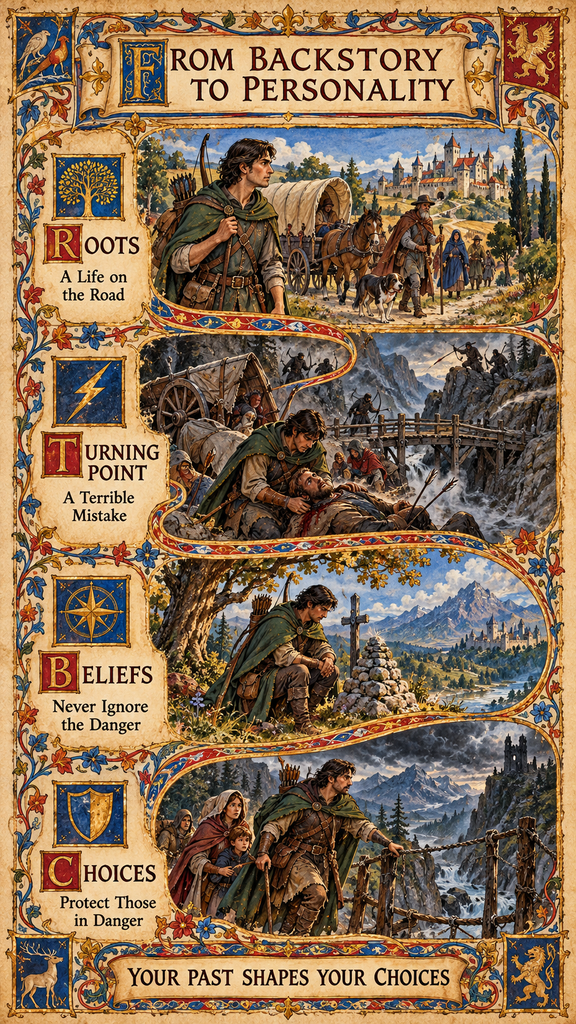
Consider Edran, an Anashim Ranger who once worked as a caravan scout. Years ago, Edran served a wealthy merchant who insisted upon traveling through dangerous mountain territory despite repeated warnings. The merchant wanted to save time and refused to listen to the experienced scouts accompanying him. The caravan was attacked, several travelers died, and Edran narrowly survived. Although he was not responsible for the merchant’s decision, he has never completely forgiven himself for obeying orders rather than refusing to continue.
That single experience can influence Edran’s personality in several ways. He distrusts arrogant employers, carefully examines dangerous routes, dislikes unnecessary risks, and feels an unusually strong responsibility toward inexperienced travelers. He might become irritated when companions neglect their equipment or dismiss reasonable precautions. He could also have difficulty accepting leadership from someone who has not demonstrated practical competence. These characteristics do not require an extensive fictional biography. They emerge naturally from considering what happened to him and how he interpreted the experience.
Kingsmark’s Backstory Engine develops this approach through seven connected elements: 🌳Roots, 🔨Former Life, ⚡Turning Point, 🧭What Did It Mean to You?, 🤝Someone Who Matters, 🔗Unfinished Business, and ⭐Direction. The distinction between the Turning Point and its meaning is particularly valuable. Two people can experience the same tragedy and learn completely different lessons. One might become distrustful and isolated, while another becomes determined to protect anyone facing similar circumstances. The event establishes history, but the character’s interpretation helps establish personality.
🎯 Know What Your Character Wants
A believable person usually wants something. That desire might involve wealth, security, recognition, forgiveness, knowledge, companionship, justice, or simply the freedom to live without interference. Without recognizable motivation, a character often becomes a passive participant who follows the party because the adventure requires it. They accept Contracts, enter dungeons, fight enemies, and collect rewards without possessing a meaningful personal reason for doing so. The adventure may still be entertaining, but the character risks becoming little more than a collection of abilities moving from one encounter to another.
Kingsmark distinguishes between 🎯Immediate Want and ⭐Direction. Immediate Want concerns something the character hopes to accomplish relatively soon, while Direction represents a broader life ambition. Edran’s Immediate Want might be earning enough Silver to repay a debt owed by his family. His Direction, however, is Protection: he wants to become someone capable of keeping vulnerable travelers safe. These motivations can coexist peacefully until circumstances force him to choose between them.
Imagine that a merchant offers Edran a small fortune to escort valuable cargo but refuses to permit the party to rescue stranded villagers along the road. The money could eliminate his family’s debt, yet abandoning the villagers would contradict the convictions that led him into his current profession. Suddenly, the player faces a decision with personal significance. Edran is no longer choosing between arbitrary alternatives. He is deciding which of his responsibilities matters most when circumstances make it impossible to satisfy them all.
A useful practice is to establish what your character wants immediately, what they ultimately hope to become, and what they are unwilling to sacrifice along the way. These answers provide direction without requiring you to predetermine the character’s future. They also give the Game Master meaningful material for developing opportunities, relationships, and conflicts that matter to the person you are portraying.
🪵 Imperfections Make Characters Believable
Perfect characters are not necessarily interesting characters. A fearless warrior who never doubts himself, always makes the correct decision, possesses no meaningful weaknesses, and maintains excellent relationships with everyone may be impressive mechanically, but such a personality offers relatively little room for development. Real people possess contradictions. Someone can be courageous in battle but terrified of disappointing their family. A brilliant scholar might be intellectually confident yet socially insecure. A generous person might struggle with jealousy, while a disciplined soldier might be incapable of admitting that a trusted superior has made a terrible mistake.
These imperfections provide opportunities for meaningful characterization, although there is an important difference between a superficial quirk and a consequential weakness. A character who occasionally complains about the weather has a recognizable habit. A character whose pride prevents them from requesting desperately needed assistance possesses a weakness capable of influencing events. Neither characteristic is inherently undesirable, but the second creates more opportunities for decisions, disagreements, consequences, and eventual development.
Kingsmark includes optional 🪵Burdens and 🕊Blessings during Character Creation. Burdens represent genuine disadvantages, ranging from Minor Flaws to Major Flaws and Curses, while Blessings provide defined benefits. Not every personality weakness requires a mechanical Burden. A character can be impatient, suspicious, vain, stubborn, or overly trusting without purchasing an additional disadvantage. However, when a player selects a mechanical Burden, the Player’s Handbook expects that disadvantage to matter when the relevant circumstances arise. A limitation that never produces meaningful consequences is not much of a limitation.
Edran’s distrust of authority illustrates how a single character flaw can be both helpful and troublesome. His suspicion may lead him to recognize dishonest employers, but it might also prevent him from accepting advice from a genuinely competent leader. Perhaps an experienced captain proposes a reasonable strategy, but Edran rejects it because the captain’s manner reminds him of the merchant whose arrogance caused the caravan disaster. If the resulting disagreement creates tension within the party, the player has an opportunity to portray Edran’s unresolved feelings without necessarily destroying the group’s cooperation.
A compelling character flaw should create interesting complications rather than becoming an excuse to sabotage every adventure. Players should remember that they control their characters and can decide how those characters respond to their imperfections. Edran might initially distrust the captain but reluctantly agree to the plan after hearing a convincing explanation. That decision could reveal both the persistence of his suspicion and his willingness to recognize when someone has earned his respect.
🤝 Relationships Bring Characters to Life
People do not exist independently of their relationships. Family members, friends, mentors, rivals, employers, lovers, children, and enemies influence how individuals understand themselves and make decisions. The same should be true of fictional adventurers. A character might behave differently around an old friend than around a stranger, demonstrate unusual patience toward a younger sibling, or become unexpectedly defensive when someone criticizes a respected mentor. These differences help establish a personality that feels sufficiently complex to belong to a living person.
Imagine that Edran is traveling with a young Elyonim scholar who believes most conflicts can be resolved through patience and understanding. Edran respects her intelligence but considers her excessively trusting. She admires his experience but becomes frustrated by his reluctance to give strangers the benefit of the doubt. Their differences create opportunities for discussion, disagreement, cooperation, and gradual change. Perhaps the scholar convinces Edran to trust someone he initially suspected. Later, Edran’s caution prevents her from being deceived by a dangerous stranger. Neither character must abandon their personality for the relationship to become meaningful.
Kingsmark’s ⚔️Party Connection establishes a relationship between adventurers during Character Creation. Characters might be longtime friends, former rivals, people connected through family, survivors of the same dangerous experience, or individuals who share an obligation. Friendship is not mandatory, but a believable reason to cooperate is important. A complicated relationship can be particularly rewarding when both players understand why their characters remain together despite disagreements.
Once an adventure begins, those relationships should continue developing. Pay attention when another player reveals something about their character, and consider how your own character might respond. A companion’s personal loss could awaken an old memory, while an unexpected act of generosity might challenge a long-held prejudice. Remember promises, insults, favors, and sacrifices rather than treating every conversation as an isolated event. Role-playing becomes much richer when characters react to one another instead of merely waiting for the next opportunity to speak.
🎭 Small Habits Reveal Personality
Not every aspect of characterization requires a dramatic event. Ordinary habits can reveal a surprising amount about a fictional person, particularly when those habits grow naturally from the character’s experiences. A former soldier might automatically examine exits when entering an unfamiliar room. A wealthy noble might struggle with simple household tasks. Someone raised in poverty might carefully preserve leftover food, while a deeply religious adventurer might pause for prayer before beginning a journey.
Edran habitually checks wagon wheels, examines bridges, and ensures everyone has sufficient provisions before departing. These behaviors reflect his Former Life and the tragedy that shaped his outlook. They also allow other players to recognize his personality without requiring lengthy explanations. A companion might eventually tease him about checking the same wagon axle three times, creating an opportunity for humor or a conversation about why he worries so much.
Choose a few habits that emerge naturally from your character’s history, beliefs, or profession, and use them when appropriate. Avoid repeating the same behavior so frequently that it becomes a tiresome gimmick. The purpose is to reveal personality through recognizable patterns, not to interrupt the adventure every time your character enters a room.

🗨️ Conversations Can Be Adventures
Some of the most memorable moments in a tabletop role-playing game occur when nobody draws a weapon. A negotiation with a suspicious merchant, an argument between longtime friends, an interrogation of a captured criminal, or a heartfelt conversation between companions can produce consequences extending far beyond the immediate encounter. The important consideration is whether the conversation has meaning within the fictional situation. Not every casual exchange requires a complicated social challenge, but conversations involving genuine resistance, conflicting interests, or important information can become adventures in their own right.
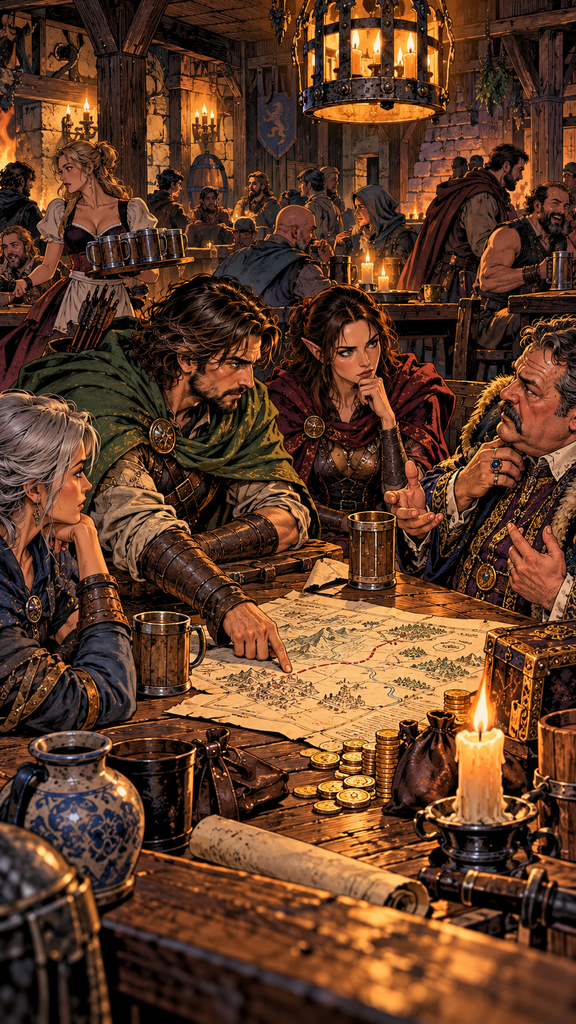
Consider Edran and his companions arriving at Rusty’s Tavern in Willowcreek. A merchant offers them a lucrative Contract to escort several wagons along a dangerous road. He claims the journey should be relatively uneventful, but Edran notices that the merchant’s guards appear unusually anxious. Remembering the disaster that shaped his earlier life, Edran becomes suspicious. The player might politely ask about recent attacks, question the guards about their concerns, examine the merchant’s account for inconsistencies, or demand better payment before accepting the assignment.
Each approach reveals something about Edran’s personality. A hostile interrogation might demonstrate how strongly his past continues to influence him, while a carefully reasoned negotiation could show that he has learned to control his suspicions. His companion might suggest speaking privately with one of the guards, creating an opportunity for cooperation. Another adventurer might argue that the merchant deserves the benefit of the doubt until actual evidence of dishonesty appears. Even before anyone rolls a die, the characters have begun expressing their personalities through meaningful decisions.
Chapter 10, 🗨️Dialog Scenes, gives these interactions mechanical structure when the outcome is genuinely uncertain. Kingsmark uses 🌈Influence & Allure PRISM together with relevant ⚒Skills such as Social Skills and Deceit to resolve appropriate social challenges. Investigation and specialized knowledge can also become important when characters examine evidence or attempt to identify contradictions. Relationship & Proposal Modifiers account for how characters regard one another and what they are being asked to accept. A trusted friend requesting a small favor faces very different resistance from a hostile stranger demanding a dangerous betrayal.
However, the mechanics should support the conversation rather than replace it. A player should explain what their character wants and describe the approach being used before resolving uncertain outcomes. Someone negotiating with a merchant might offer additional protection, explain why the proposed payment is inadequate, or appeal to the merchant’s concern for his employees. The precise wording of the argument is less important than its substance. The player’s decisions establish the approach, while the character’s abilities and the circumstances influence the result.
An equally important principle is that successful persuasion does not grant supernatural control over another person’s mind. A convincing argument may influence an NPC’s willingness to cooperate, but deeply held convictions, serious risks, and established loyalties still matter. When social abilities are used against Player Characters, the Game Master can explain how persuasive or credible an argument appears without taking control of the player’s final decision. This preserves the distinction between portraying someone whose opinions can be influenced and surrendering control of that character’s beliefs or actions.
🤝 Learn to Listen, React, and Share Attention
One of the most useful lessons from improvisational theater is that successful interaction depends upon responding to what others contribute. Players sometimes become so concerned with preparing their next impressive statement that they fail to listen to what another character is saying. The result can resemble several independent performances occurring at the same table rather than a believable conversation between people.
Suppose Edran’s companion admits that she once abandoned someone during a dangerous expedition. Instead of immediately changing the subject or delivering a lengthy account of his own suffering, Edran might ask what happened. He could express sympathy, question her decision, or acknowledge that he has faced something similar. Each response gives the other player an opportunity to develop their character while also revealing something about Edran.
The familiar improvisational principle of accepting and building upon another person’s contribution can help, but it should not be interpreted as a requirement that characters always agree. A skeptical Ranger should remain capable of skepticism, and a principled Holy Knight should be free to oppose actions that violate his convictions. The important distinction is between responding constructively to another player’s contribution and dismissing it simply because you want the conversation to follow your preferred direction.
Good role-playing is collaborative. Sometimes the most valuable contribution you can make is providing another player with an opportunity to reveal something meaningful about their character.
⚔️ Role-Playing Does Not End When Initiative Begins
Many players instinctively divide a tabletop role-playing session into two separate activities. During conversations and exploration, they portray their characters’ personalities. When combat begins, they focus almost exclusively upon mechanical effectiveness, tactical positioning, and maximizing damage. Although combat naturally requires careful attention to rules, it should not require abandoning characterization. Dangerous situations often reveal more about a person’s priorities than comfortable conversations ever could.
Consider four adventurers confronting the same enemy. A professional soldier might concentrate upon positioning, discipline, and protecting vulnerable companions. An ambitious warrior might seek an opportunity to demonstrate extraordinary courage. A frightened scholar might attempt to maintain distance while providing useful information. A compassionate Healer might prioritize reaching an injured ally even when doing so involves personal danger. Their tactical decisions can express their personalities without requiring elaborate speeches between attacks.
Kingsmark’s Chapter 11, ▶️Action Scenes, and Chapter 12, 🎬Example Actions, provide numerous possibilities for movement, defense, attacks, assistance, and other activities during dangerous encounters. These options can support creative characterization because players are not limited to imagining that every combatant stands motionless while exchanging attacks. An adventurer might attempt to protect a companion, exploit terrain, create an opening for an ally, or withdraw from a confrontation that no longer serves the party’s objectives.
Imagine Edran pursuing an enemy who has stolen important documents. During the pursuit, one of his companions suffers a serious injury. The fleeing enemy is almost within reach, and capturing him could provide valuable information. Edran must decide whether to continue the chase or return to assist his companion. His background and Direction suggest that protecting others matters deeply to him, but his commitment to the mission also deserves consideration. Whatever he decides, the choice can reveal something about his personality.
Effective role-playing does not require deliberately incompetent tactics. A disciplined character who prepares carefully, respects danger, and makes sound decisions can be extremely convincing. Sometimes the most authentic response to an extraordinary threat is professionalism rather than recklessness. Characterization becomes meaningful when tactical decisions reflect the individual making them.
🩸 Let Injuries and Experiences Leave Their Mark
One reason I designed Kingsmark without conventional hit points was to give physical danger consequences that players could understand in terms of actual injuries rather than an abstract numerical reserve. Characters experience 🩸Physical Wounds, and frightening or psychologically damaging events can produce 🧠Mental Trauma. These systems make it possible for the consequences of an encounter to remain relevant after the fighting has ended.
From a role-playing perspective, such consequences can provide opportunities for character development. A warrior who suffers a serious injury might become more attentive to protective equipment or more sympathetic toward wounded companions. Someone who survives a terrifying encounter might develop new respect for supernatural dangers. An adventurer who witnesses the death of a trusted friend may reconsider their priorities, seek justice, or struggle with obligations they had previously taken for granted.
However, the consequences of experience should not be reduced to simplistic assumptions about personality. Not everyone responds to frightening events in the same way, and even similar experiences can produce different outcomes. One character might become more cautious, while another becomes more determined to confront the danger. The Player’s Handbook establishes the mechanical consequences of 🩸Physical Wounds and 🧠Mental Trauma, but the character’s broader interpretation of those experiences should remain connected to their established personality and the choices made during play.
Kingsmark’s Twelve Horrors provide particularly dramatic examples of experiences capable of testing an adventurer’s psychological resilience. Repeated confrontations with terrifying events can produce lasting consequences, but those experiences can also become part of a character’s continuing history. A veteran who has repeatedly faced death or supernatural horrors may eventually possess a very different perspective from the inexperienced adventurer who began the campaign.
The important lesson is to remember what your character has experienced. A major defeat, betrayal, rescue, loss, or triumph should not necessarily disappear from their personality simply because the next adventure has begun.
❤️ Healing Scenes Are Role-Playing Opportunities
One of the most neglected opportunities for role-playing occurs between dangerous encounters. Players may spend considerable time portraying combat but quickly summarize recovery with a statement that their characters rest until they are ready to continue. While there is nothing wrong with advancing the story when appropriate, periods of recovery can provide meaningful opportunities for quieter characterization.
Kingsmark’s Chapter 14, ❤️Healing Scenes, recognizes that recovering from injuries can involve more than simply waiting for numbers to improve. Appropriate activities, care, companionship, and other circumstances can become part of the recovery process. The rules include opportunities for characters to spend meaningful time with friends and confidants, allowing relationships to contribute to the larger experience of healing and recovery.
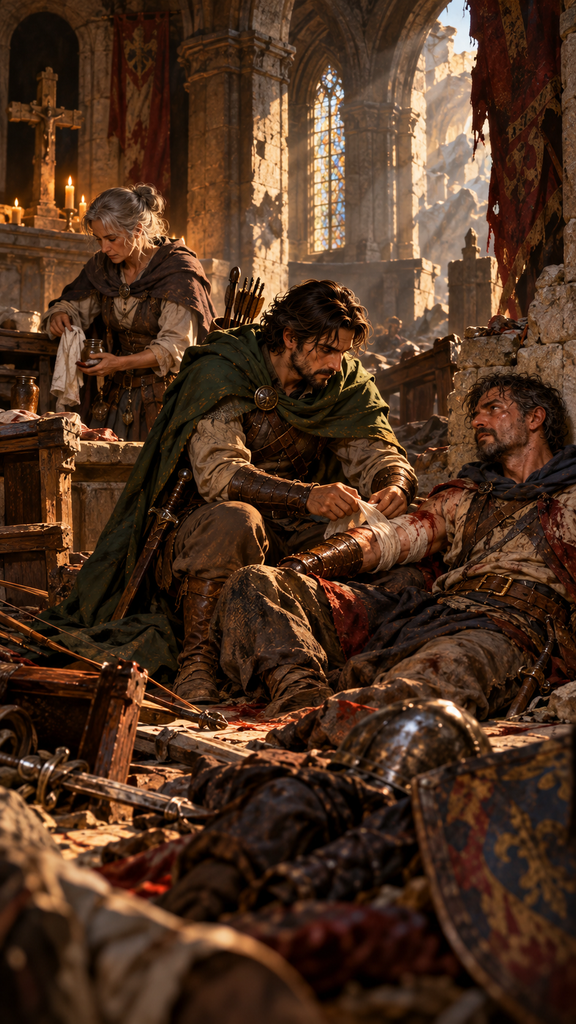
Imagine Edran sitting beside an injured companion after a difficult battle. The companion asks why Edran abandoned his pursuit of an escaping enemy to return and help him. Edran initially dismisses the question, explaining that leaving a wounded adventurer behind would have been tactically irresponsible. Eventually, however, he admits that he once failed to protect people who depended upon him and has spent years wondering whether he could have acted differently.
This conversation might last only a few minutes at the gaming table, yet it can reveal more about Edran’s personality than an entire sequence of combat encounters. The injured companion now understands something important about his friend, while Edran has allowed another person to see a vulnerability he normally conceals. Their relationship can develop because the players recognized that recovery offered an opportunity for meaningful interaction.
🍎 Discover Who Your Character Is When Principles Conflict
It is easy to describe a character as honorable, compassionate, loyal, courageous, or devoted to justice when those qualities demand nothing. Their meaning becomes clearer when circumstances make them difficult to maintain. A character who values honesty may eventually face a situation in which revealing the truth would endanger someone innocent. A loyal soldier might discover that a respected commander has committed a terrible injustice. A devoted parent could be offered an opportunity to protect their family at the expense of strangers who have done nothing wrong.
These situations become interesting because the character’s values are not necessarily compatible. Loyalty and justice can conflict, as can compassion and duty, personal security and responsibility, or vengeance and forgiveness. The strongest moral dilemmas do not require one choice to be obviously righteous and the other obviously foolish. Instead, they present circumstances in which something important may be lost regardless of the decision.
Suppose Edran is offered enough money to eliminate his family’s debts permanently. All he must do is deliver a sealed package to a distant nobleman without asking questions. During the journey, he discovers convincing evidence that the package contains information that will expose several innocent people to persecution. Delivering it would fulfill his Immediate Want, while destroying it might permanently eliminate his opportunity to repay the debt. Refusing the Contract could also place his companions in danger if the employer seeks retaliation.
What should Edran do? His history suggests that he distrusts powerful employers who conceal their intentions, while his Direction emphasizes protecting vulnerable people. Yet his family remains important to him, and breaking his obligations could produce serious consequences. There is no need to predetermine the answer. The value of the situation lies in giving the player an opportunity to decide what matters most to Edran when the consequences are real.
Kingsmark’s Chapter 16, 🪱The Gloom, explores a more sinister form of moral temptation. Through 🍎Temptation, characters can encounter offers that appeal to their existing desires, fears, ambitions, resentments, or desperation. Importantly, accepting or refusing such temptation is a player decision rather than an Attribute Defense Test. The dice do not determine whether the character willingly agrees to commit an evil act. The player must decide.
This illustrates an essential distinction between role-playing and mechanical resolution. A character’s abilities determine what they can accomplish, while their values and decisions determine what they are willing to attempt. The consequences may be resolved through rules, but meaningful choices remain at the heart of characterization.
🏰 Become a Resident of the World, Not Just a Visitor
Believable characters should possess some relationship with the fictional world they inhabit. A person who has lived in Sylva for thirty years ought to possess habits, opinions, assumptions, experiences, and ordinary knowledge shaped by that environment. They might recognize local customs, understand the importance of particular occupations, possess religious convictions, or hold opinions about neighboring communities. Their reactions should reflect their place within the world rather than treating every location as an unfamiliar game environment designed exclusively for the players.
Kingsmark’s five 🫀Human Types provide different physical and historical possibilities for character creation, but Human Type should not be confused with personality. An Elyonim Elf need not be an aloof archer, a Tzurim Dwarf need not be an argumentative miner, and a Gibborim Giant need not be an unintelligent brute. Likewise, Qatan and ordinary Anashim characters can possess tremendous diversity in occupation, temperament, ambition, and personal history.
Consider how Edran’s background as a caravan scout influences his perception of the world. He might understand the practical difficulties of maintaining roads, appreciate the importance of reliable bridges, and recognize how isolated communities depend upon traveling merchants. He may view a prosperous city differently from someone raised within its walls because he understands the dangers and labor involved in supplying it. These perspectives provide opportunities for meaningful characterization without requiring the player to memorize an encyclopedia of fictional history.
⚔️ Remember That You Are Part of an Adventuring Party
One of the least productive habits in tabletop role-playing is using personality as an excuse to undermine the game. A player creates a selfish, antisocial, or hostile character and then repeatedly sabotages the party while insisting that the behavior is justified because it is what the character would naturally do. This confuses portraying a believable individual with refusing responsibility for one’s own choices as a player.
Difficult personalities can make excellent characters. A suspicious adventurer, arrogant noble, morally conflicted mercenary, or socially awkward scholar can contribute tremendously to an interesting campaign. The important consideration is whether the player has provided believable reasons for the character to cooperate with others and participate in the adventure. Characters can disagree, compete, argue, and occasionally become genuinely angry with one another without their players attempting to ruin the experience.
A character who distrusts everyone might reluctantly accept the protection of dependable companions. An arrogant warrior could cooperate because the party’s success benefits his ambitions. A solitary Ranger might discover that his responsibilities cannot be fulfilled alone. Such motivations allow complicated personalities to exist within a shared adventure.
It is also important to distinguish fictional conflict from real disagreements between players. The characters may resent one another while the people portraying them remain friendly and cooperative. Particularly in campaigns involving mature themes, intense emotional scenes, or difficult moral questions, players benefit from understanding one another’s expectations. Good role-playing should enrich the shared experience rather than come at another participant’s expense.

⭐ Allow Your Character to Grow and Change
One of the most satisfying aspects of a long-running role-playing campaign is watching a character develop through experience. The inexperienced adventurer who begins the story should not necessarily possess the same outlook as the veteran who emerges after years of danger, discovery, friendship, and loss. People can change their minds, reconsider their priorities, overcome weaknesses, adopt new convictions, and discover ambitions they never anticipated.
However, meaningful development should not be confused with random inconsistency. A suspicious character should not suddenly become trusting merely because another personality would be more convenient during a particular encounter. There should be some understandable reason for the change. Perhaps a companion repeatedly demonstrates loyalty, or an apparently trustworthy employer betrays the character despite every precaution. Experiences provide the context that makes development believable.
Return to Edran after several adventures. His original distrust of authority has not disappeared, but he has encountered competent leaders who respected his judgment and companions who demonstrated that cooperation need not mean surrendering independence. He may still question questionable orders, carefully examine dangerous routes, and insist upon adequate preparation. The difference is that he has learned to distinguish justified caution from reflexive suspicion. He now judges individuals more carefully rather than assuming that every person in authority resembles the merchant who caused his original tragedy.
Kingsmark’s ⭐Experience Points and ⭐Action Star Level systems represent the development of an adventurer’s professional abilities through actual experience. Characters earn XP through adventuring and invest that experience in their Skills and Attributes. However, mechanical advancement and personal development are not identical. A character can become a better swordsman without becoming a wiser person, just as someone might undergo profound emotional development without acquiring a new combat ability.
This distinction deserves attention because it allows players to recognize forms of growth that no number can adequately measure. A former coward might finally demonstrate courage, a selfish adventurer might learn generosity, or an isolated scholar might discover the value of friendship. These developments do not necessarily require additional mechanical rewards. Their significance lies in how they alter the character’s relationships, priorities, and future decisions.
📖 Practice Becoming a Better Role-Player
Like many other creative skills, role-playing improves through practice. You do not need formal acting lessons or extensive experience with improvisational theater. You can begin by developing a few habits that encourage you to think more consistently from your character’s perspective and pay closer attention to the fictional experiences taking place around you.
Before your next session, spend several minutes considering your character’s motivations. Identify something they want immediately, something they hope to accomplish eventually, and something they would be reluctant to sacrifice. Then imagine a situation in which those priorities conflict. You do not need to decide exactly what your character would do, because the eventual circumstances might change the answer. The exercise simply encourages you to recognize the values that could influence their decisions.
During a conversation, try expressing the same intention in different ways. You might speak directly as your character, describe the general argument they present, or combine both methods. If your character wants to persuade a guard to allow the party through a gate, focus upon understanding the guard’s concerns and choosing an appropriate approach. A nervous player can portray an extraordinarily persuasive character without attempting to perform an extraordinary speech.
Make a deliberate effort to interact with another Player Character during each session. Ask about a personal experience, offer advice, express concern, request assistance, or discuss a disagreement. Try to choose interactions that make sense for both characters rather than forcing artificial drama. You may discover that another player’s response reveals an unexpected aspect of your own character’s personality.
Another useful exercise involves confronting your character with a difficult hypothetical decision. Imagine they discover that a respected friend has committed a serious wrong, or that fulfilling a personal ambition would endanger someone innocent. Consider what the character knows, what they believe, whom they care about, and what consequences they fear. You do not have to produce a perfect moral answer. The purpose is to understand how the character reasons through difficult circumstances.
Finally, spend a few minutes after each session reflecting upon what happened. Consider which experiences mattered to your character, whether any relationships changed, and what they intend to do next. In Kingsmark, the 📖Character Bible provides a natural place to record these developments. A short paragraph about an important conversation or difficult decision may eventually become more useful than pages of history written before the campaign began.
Over time, these practices can make characterization feel increasingly natural. Instead of repeatedly asking yourself what a fictional personality ought to do, you begin developing a clearer understanding of what this particular person might think, fear, desire, or attempt. The character becomes familiar through accumulated experience, much as a fictional protagonist becomes more recognizable to a reader over the course of a novel.
🕯️ Your Character Is the Sum of Their Decisions
A memorable tabletop role-playing character is not necessarily the adventurer with the highest Attributes, the most impressive equipment, the most elaborate history, or the greatest number of victories. Nor does memorable characterization require exceptional acting talent. Some of the most convincing characters are portrayed by quiet players who rarely speak dramatically but consistently make meaningful decisions from their characters’ perspectives.
What makes these adventurers interesting is that their personalities influence what happens. Their motivations lead them into danger, their weaknesses create complications, their relationships give their decisions personal significance, and their experiences gradually influence the people they become. The character sheet remains important, but it is only one part of something much larger.
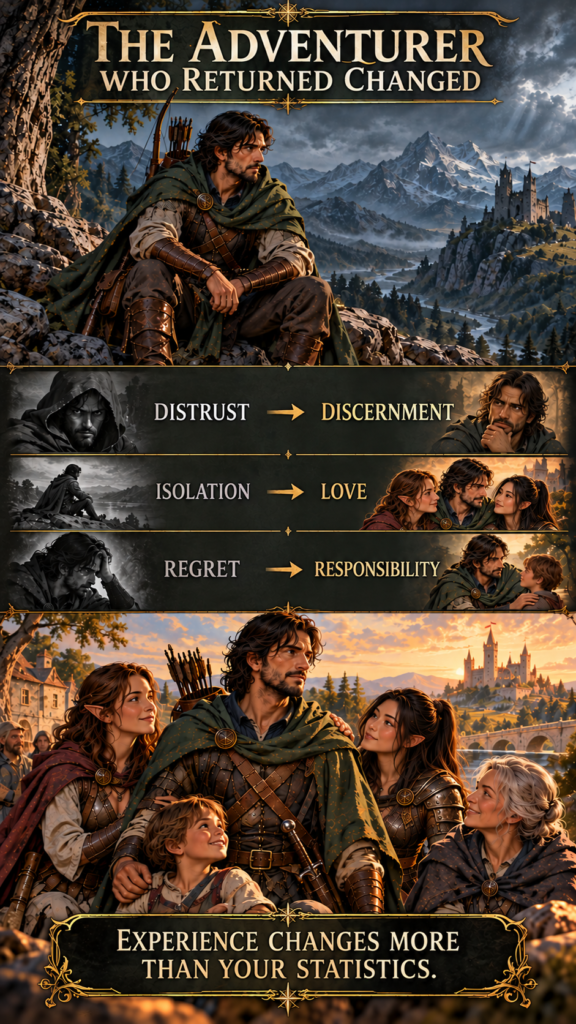
This is the philosophy behind Kingsmark’s 📖Character Bible. I wanted a character record that could grow alongside the adventurer, preserving not merely their current statistics but also the relationships, experiences, accomplishments, injuries, obligations, and memories that make their fictional life meaningful. The person who accepts their first Contract in Willowcreek may be profoundly different from the veteran who returns years later, even if certain qualities remain recognizable.
If you want to become a better role-player, begin by understanding who your character is, what matters to them, and why they make the decisions they do. Listen to your companions, respond to the world around you, allow important experiences to have consequences, and remember that personal growth does not always come from earning another level or improving another Skill.
Above all, allow your character to become a person rather than merely a collection of numbers.
You can explore the complete Kingsmark Player’s Handbook, including its ✍Character Creation rules, 🗨️Dialog Scenes, and 📖Character Bible system, for free at Kingsmark.games. Kingsmark is A Heroic Fantasy TTRPG for Mature Players, designed to support memorable adventures in which the choices characters make can matter just as much as their abilities.
About The Author