The Problems with D&D’s Magic System
—and How Kingsmark Approaches Magic Differently
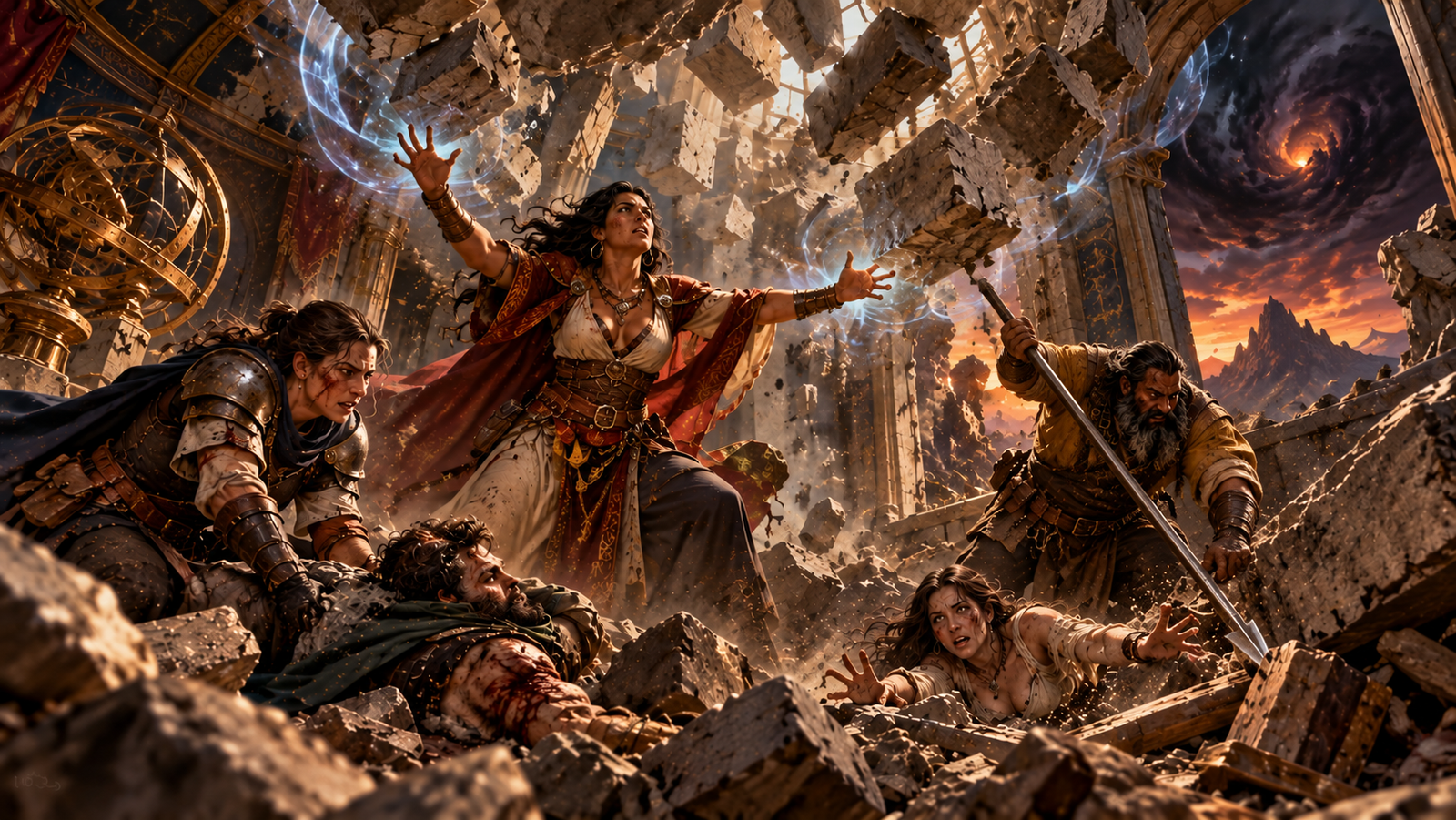
Imagine a magician standing inside an ancient sanctuary as the ceiling begins to collapse. Enormous stones are breaking loose overhead, dust is filling the chamber, and somewhere beyond the shattered doors, a terrible supernatural creature is approaching. Three of her companions are trapped beneath the falling masonry, and the only passage leading outside has been blocked by a massive stone pillar. She understands that her ordinary abilities will not be sufficient to save them. If everyone is going to survive, she must attempt something extraordinary.
In a traditional fantasy role-playing game, the question might be whether the character possesses an appropriate Spell and has the necessary resources remaining to cast it. Perhaps the magician has already exhausted her most powerful Spell Slots. Perhaps the particular ability she needs is unavailable until she rests. Under those circumstances, her options may be limited regardless of how desperate the situation has become. She can attempt something else, use another resource, or hope that her companions discover a solution.
But I wanted a different experience when I designed the magic system for 👑Kingsmark, my heroic fantasy tabletop role-playing game powered by ⭐Jack’s Cinematic d12. I wanted a magician who possesses the necessary knowledge and experience to face a more disturbing question: What happens if I attempt this miracle, and can I survive the consequences? Rather than concentrating primarily upon the number of Spells remaining in a daily allowance, I wanted players to consider the dangers of reaching into supernatural forces that can accomplish the impossible.
Dungeons & Dragons has influenced fantasy role-playing games for more than fifty years, and its magic system remains one of the most recognizable features of the hobby. Thousands of Spells, magical items, supernatural abilities, and extraordinary creatures have emerged through its various editions. Its combination of Spell Slots, character advancement, magical traditions, and powerful supernatural abilities has provided generations of players with countless memorable adventures. Nevertheless, some of its underlying assumptions have always interested me because they represent specific decisions about what magic should feel like during play.
One of the most frequently criticized features is the Spell Slot system. In modern D&D, most leveled Spells require an available Spell Slot, and those slots are ordinarily restored through resting. Cantrips provide an important exception, allowing spellcasters to perform certain magical effects without expending slots. Rituals, magical items, and various Class abilities introduce additional possibilities. Yet the fundamental structure remains largely resource-based: a magician must consider which Spells are available, which slots remain, and whether a particular expenditure is worthwhile before another opportunity to recover those resources.
This produces interesting strategic decisions, especially during adventures involving several encounters before resting becomes possible. However, the resulting experience can sometimes feel more like managing a collection of specialized resources than practicing an unpredictable supernatural art. A magician may possess tremendous knowledge and considerable experience but still be unable to perform a familiar miracle because the appropriate expenditure is no longer available. Conversely, when the necessary Spell is prepared and its requirements are satisfied, the magician can often rely upon the established casting procedure without personally suffering extraordinary psychological consequences from the attempt.
I also find the longstanding discussion about the differences between martial and magical characters interesting. At higher levels, some D&D spellcasters possess supernatural abilities capable of changing terrain, transporting people across enormous distances, overcoming physical obstacles, and resolving problems that ordinary weapons cannot address. Players have debated for years whether the resulting versatility gives spellcasters too many advantages over characters whose principal abilities involve fighting, survival, and physical accomplishments. My own concern is not that magicians should be weak or that supernatural powers should be deliberately unimpressive. I wanted tremendous magical power to exist alongside meaningful consequences, so that possessing an extraordinary ability does not automatically make using it an easy decision.
Magic Should Feel Supernatural
In Kingsmark, magic is the power to cause something to happen that should not ordinarily happen. A magician might command fire into existence, reach across impossible distances, communicate with unseen entities, enter the Astral Plane, heal terrible injuries, or impose supernatural force upon the physical world. Even comparatively modest magic reaches beyond the familiar laws of nature. I wanted these experiences to retain an element of mystery and danger, particularly when a magician attempts something that openly contradicts everything ordinary people understand about reality.
The system approaches this through a concept called Consensus Reality, the accumulated expectations of living minds and the apparently stable world they inhabit. People expect stones to fall, fires to require fuel, injuries to bleed, and ordinary human beings to remain firmly attached to the ground. The more dramatically a magical manifestation departs from those expectations, the more difficult it becomes to impose that manifestation upon reality. This is reflected through four Power Levels, each representing a progressively greater supernatural accomplishment.
At 0️⃣Coincidental Power, the normal Target Number is 6. The effect may be subtle enough to resemble extraordinary luck, intuition, unusual talent, or coincidence. At 1️⃣Lesser Power, the Target Number increases to 8 as supernatural influence becomes more recognizable. At 2️⃣Greater Power, the Target Number rises to 10, representing formidable manifestations that increasingly defy ordinary explanation. Finally, 3️⃣Supreme Power requires TN 12, allowing a magician to attempt miracles of extraordinary magnitude. These are the standard Target Numbers before relevant circumstances and modifiers are applied.
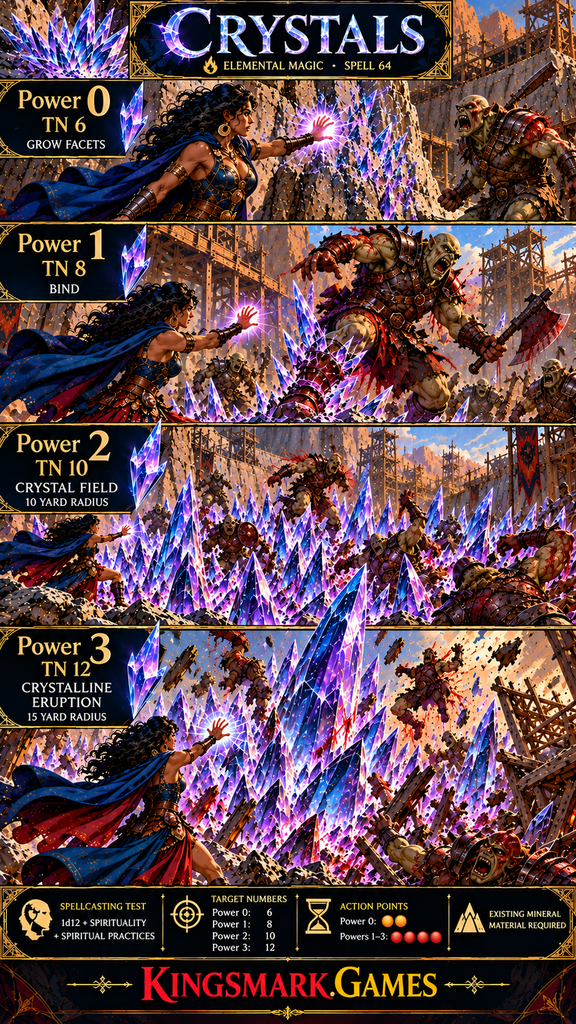
The difference between these Power Levels is not merely the amount of damage produced. Every Spell describes what becomes possible at each level of manifestation. A higher Power might permit additional targets, greater distances, longer durations, larger objects, or entirely new applications of the same supernatural principle. This means that one Spell can develop dramatically as its practitioner becomes more accomplished, allowing a familiar magical technique to remain relevant throughout the character’s career.
Consider the Spell known as Animus Force, which allows a magician’s spiritual existence to exert force upon the physical world. At Coincidental Power, the effect may be little more than a small object moving unexpectedly or a door rattling in a manner that witnesses attribute to the wind. At Lesser Power, the magician can exert deliberate physical force sufficient to push, pull, catch, or lift something approximately human-sized within the Spell’s limitations. Greater Power allows considerably more substantial manipulation, including lifting creatures, moving the magician through the air, and breaking through certain physical barriers.
At Supreme Power, Animus Force becomes something extraordinary. The magician may fly, carry another person, scatter enemies, hurl heavy objects, or hold collapsing structures through supernatural force. The same magical principle that once caused an insignificant object to move can eventually alter the circumstances of an entire adventure. The magician has not merely acquired a larger numerical bonus. They have developed the capacity to accomplish things that were previously impossible.
In Kingsmark, gaining magical power means expanding what a character can accomplish, not simply increasing the amount of damage a Spell inflicts.
The procedure for performing these miracles remains comparatively straightforward. The magician selects a known Spell and an available Power Level, determines the appropriate Target Number, and rolls 1d12 plus their 🌈Spirituality PRISM and ⚒Spiritual Practices Skill. If the modified result equals or exceeds the Target Number, the Spell manifests successfully. A natural 12 explodes according to Kingsmark’s ordinary dice rules, making exceptional results possible even when the initial situation appears extremely difficult.
The magician’s final modified result is called their Hand. When a Spell permits supernatural resistance, its intended target attempts to equal or exceed that Hand using the appropriate resistance Test. The magician’s Target Number establishes whether the miracle manifests, while the Hand establishes how difficult that manifestation is for its target to resist. Not every Spell allows such resistance, because some affect the magician, the environment, or a willing recipient. When a damaging Spell succeeds, its listed Damage Level can also increase according to the margin by which the magician exceeds the final Target Number.
Spellcasting takes time within Kingsmark’s Action Point system. A Power 0 Spell ordinarily costs two Action Points, while Powers 1 through 3 ordinarily require four. Individual Spell descriptions may establish exceptions. This means a magician must consider what else is happening during the same Turn. Performing a powerful miracle may prevent the character from accomplishing other activities that require substantial time, while a more modest working may leave opportunities for movement, defense, or other actions. The magician participates in the same cinematic combat system as everyone else rather than operating through an unrelated sequence of turns.
The Real Price of Magic
The most significant difference between Kingsmark and D&D is what happens after a magician attempts to perform supernatural magic. Kingsmark does not restrict ordinary Spell use through conventional daily Spell Slots. Instead, increasingly powerful workings threaten 🧠Mental Drain, representing the psychological and spiritual strain of forcing reality to accommodate the magician’s will. A practitioner may possess the knowledge necessary to attempt another Spell while recognizing that another failure could destroy their ability to function.
The threatened Mental Trauma depends upon the selected Power Level. A successful Coincidental Spell causes no Mental Drain, while a failed attempt produces 🧠Shaken Mental Trauma. A Lesser Spell threatens 🧠Impaired, a Greater Spell threatens 🧠Unstable, and a Supreme Spell threatens 💀Broken. These are not ordinary pools of magical energy or points subtracted from a reserve. They are increasingly severe forms of Mental Trauma recorded upon the character’s Medical Record, where their accumulation can produce Distress and other consequences.
The magician’s original Spellcasting Test also determines how much Mental Drain is actually suffered. There is no separate resistance roll. If a Power 1, 2, or 3 Spell fails, the character suffers the full threatened Trauma. If the Spell succeeds, reaching its Target Number reduces the threatened Trauma by one level, with every additional point of success reducing it by another level. An exceptionally successful casting can therefore eliminate Mental Drain entirely, although achieving that result becomes increasingly demanding when attempting Supreme magic.
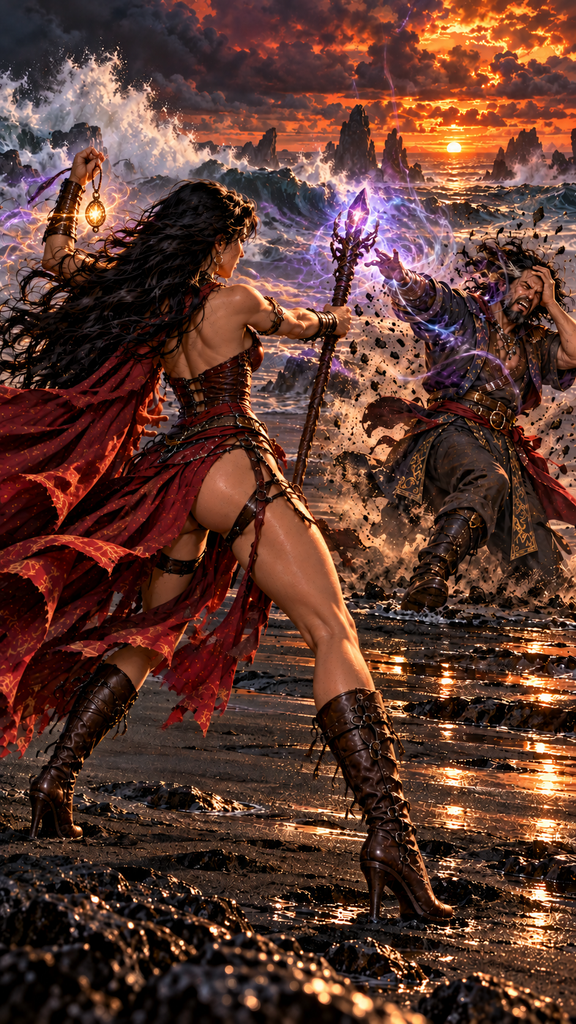
Consider a magician attempting a Supreme Spell at its normal Target Number of 12. If the final result is 11, the Spell fails and the character suffers 💀Broken Mental Trauma. A result of 12 successfully manifests the miracle but leaves the magician 🧠Unstable. A result of 13 reduces the consequence to 🧠Impaired, while 14 produces only 🧠Shaken. A final result of 15 or higher allows the magician to accomplish the extraordinary feat without suffering Mental Drain. The difference between these outcomes may determine whether the character remains capable of continuing the adventure.
A Spell can succeed spectacularly and still leave its caster struggling to survive the consequences.
Return to the magician standing beneath the collapsing sanctuary. She possesses the necessary experience to perform Supreme Animus Force, but her mind has already been strained by earlier supernatural encounters. One of her companions is trapped beneath a broken pillar, another is attempting to reach an unconscious adventurer, and the entire structure threatens to collapse. She understands that failing to perform the miracle may condemn her companions to death. She also understands that attempting it could leave her suffering catastrophic Mental Trauma at precisely the moment when everyone desperately needs her help.
That is the decision I wanted the player to experience. The magician cannot solve the problem by simply asking whether a Supreme Spell Slot remains available. She must consider the danger of attempting the miracle, the condition of her own mind, the possibility of failure, and whether another solution exists. Perhaps she chooses to attempt a Lesser manifestation that is more likely to succeed but cannot accomplish everything required. Perhaps her companions try to reduce the danger through ordinary physical actions. Perhaps she decides that only Supreme magic offers a reasonable chance of saving everyone.
I particularly appreciate how this relationship between power and consequences encourages magical characters to develop judgment. A highly accomplished practitioner may know many Spells and possess the ability to perform extraordinary miracles without using that power recklessly. Experienced magicians have reasons to seek enchanted equipment, improve their Spiritual Practices, protect their mental condition, and consider the circumstances surrounding a difficult working. A magical item capable of reducing Mental Drain or lowering a Spellcasting Target Number can become tremendously valuable because it changes what the practitioner is reasonably prepared to attempt.
Magic also becomes more interesting when the physical act of casting matters. In Kingsmark, Spells traditionally involve some combination of 🗣Spoken Words, 👐Gestures, 🪄Props or Ingredients, and a ⭕Ritual Space. These methods give supernatural intent a deliberate form. A Witch might scatter herbs into a flame, a Wizard might raise a staff while reciting an invocation, and a Priest might perform a working within a consecrated sanctuary. Different practitioners can express the same magical principle through different traditions, provided they satisfy the Spell’s actual requirements.
The particularly interesting situations arise when circumstances prevent the magician from performing those traditional methods. Omitting optional Spoken Words, Gestures, or Props increases the Target Number by one for each omitted method. Omitting an optional Ritual Space increases it by three. These penalties accumulate, allowing magicians to improvise when they have been captured, disarmed, silenced, or deprived of their normal implements. However, a method explicitly identified as Required cannot be omitted merely by accepting a higher difficulty.
Imagine a Witch imprisoned beneath a fortress. Her hands are bound, the guards have confiscated her magical implements, and she cannot risk speaking aloud. She knows a Spell that might help her escape, but its ordinary manifestation calls for words, gestures, and a prop. If those methods are optional, she may attempt the working through Mind Alone, accepting a cumulative increase of three to the Target Number. The same magician performing the Spell under ordinary circumstances would face a considerably easier challenge. Captivity has not automatically made magic impossible, but it has transformed a familiar working into a dangerous undertaking.
This is the kind of mechanical relationship between storytelling and Spellcasting that I wanted to establish. Being bound, silenced, or separated from one’s belongings should matter without necessarily making a magician completely powerless. Similarly, a carefully prepared Ritual Space or suitable magical implement should be valuable because it assists with something the practitioner is genuinely attempting to accomplish. Magical traditions should influence the decisions characters make during adventures instead of existing solely as decorative descriptions attached to otherwise identical procedures.
Magical Knowledge Should Be Worth Discovering
Another aspect of traditional fantasy role-playing games that I wanted to approach differently was the acquisition of magical knowledge. In many character advancement systems, new abilities become available through an established progression. Upon gaining another Level, a character may select new Spells from an eligible list or acquire additional magical options through Class features. This creates a predictable relationship between experience and increasing capability, but I wanted learning magic itself to become a meaningful part of an adventurer’s life.
Kingsmark’s complete magical collection contains 219 Spells expressed through 872 individual Miracles across 24 Schools of Magic. Each Spell can develop through its available Power Levels, creating numerous possibilities from a comparatively manageable number of underlying magical principles. The complete catalog appears in the companion volume, 📜The Spellbook, while the Player’s Handbook explains the system and provides everything necessary to begin playing, including introductory examples and available Spells.
A magician’s starting repertoire is determined by adding their 🌈Spirituality PRISM and ⚒Spiritual Practices Skill. Multiplying that combined Rating by three establishes their Maximum Magical Capacity, which represents the greatest number of conventional Spells they may eventually know under ordinary circumstances. But Maximum Magical Capacity is potential knowledge, not a collection of Spells automatically awarded when a character gains experience. The character must actually discover or learn additional magic through appropriate 📖Spell Learning Opportunities.
These opportunities might involve recovering an ancient grimoire, deciphering forgotten inscriptions, finding a knowledgeable teacher, receiving sacred instruction, exploring a supernatural location, or encountering a tradition that preserves knowledge unavailable elsewhere. A magical character can deliberately pursue particular kinds of knowledge, but the acquisition of new Spells remains connected to the people, places, discoveries, and adventures through which that knowledge becomes accessible. Character Class and magical tradition also establish which Schools a practitioner is permitted to learn.
Imagine a Wizard who discovers that an ancient monastery once possessed a Spell capable of allowing travel through the Astral Plane. The monastery has been abandoned for centuries, its library is believed destroyed, and the surrounding mountains are inhabited by creatures that prey upon travelers. Nevertheless, scattered accounts suggest that one surviving manuscript may remain hidden beneath its ruins. The magician now possesses a compelling reason to undertake an expedition, persuade companions to assist, and risk encountering whatever still inhabits the abandoned sanctuary.

If the adventurers recover the manuscript, the discovery becomes part of their shared history. The new Spell is not merely another entry selected from a character advancement menu. It is knowledge they traveled across dangerous country to obtain. Perhaps the expedition also uncovers an ancient enemy, an unexpected ally, or evidence that the original practitioners concealed something more dangerous than the Spell itself. One magical discovery can lead naturally into another adventure.
The most valuable magical treasure may be the knowledge of an impossible thing someone else has learned to do.
I also wanted magic to carry consequences beyond the magician’s immediate physical and psychological condition. In Kingsmark, performing a spectacular miracle can reveal the practitioner’s existence to people and supernatural forces that would otherwise remain unaware of them. The system calls this 👁Drawing the Enemy’s Eye, or Hostile Fixation. A soldier who witnesses someone command lightning or cause the dead to move may recognize that the magician is an unusually dangerous opponent. An enemy commander might order archers to concentrate upon the practitioner, or an occult faction might begin investigating reports of extraordinary magic.
Supreme manifestations introduce an additional danger involving the 🪱Gloom, the corrupting supernatural force threatening Sylva. Performing Power 3 magic in an Ordinary or Gloom-affected Domain can attract an appropriate supernatural response. Sacred, Blessed, and Edenic Domains provide protection against that automatic response, but other places may leave the magician conspicuous to hostile forces capable of recognizing the disturbance. This does not mean that a monster immediately materializes whenever someone performs a miracle. The threat must emerge through creatures, individuals, or factions that can plausibly respond from within the surrounding world.
A corrupted scout might begin following the adventurers, a messenger might carry reports toward a distant stronghold, or something inhabiting an ancient ruin might investigate the supernatural disturbance. The response could take minutes, hours, or considerably longer depending upon the circumstances. Furthermore, the Gloom does not concern itself exclusively with destructive sorcery. A Supreme act of Healing, purification, or protection may be just as significant because it represents extraordinary supernatural power being exercised within a world the Gloom seeks to corrupt.
Sometimes the most dangerous consequence of a miracle is that something notices who performed it.
Return one final time to the collapsing sanctuary. The magician makes her decision and attempts Supreme Animus Force. Her dice explode, her final result exceeds the Target Number by a remarkable margin, and an enormous section of the collapsing ceiling stops in midair. Her companions scramble toward safety as shattered stones float above their heads. A broken passage opens, the trapped adventurers escape, and the magician staggers outside exhausted but alive. Against extraordinary odds, she has accomplished exactly what everyone desperately needed.
Yet far beneath the sanctuary, something ancient has felt the supernatural disturbance. Perhaps the creature approaching the ruined temple was not the greatest danger lurking nearby. Perhaps a servant of the Gloom has recognized the magician’s power and begun following her companions. The miracle has saved lives, but its consequences may follow the adventurers into another kingdom, another mystery, or an entirely unexpected confrontation. Their survival has not ended the story. It has changed the direction in which that story may develop.
That is what I wanted magic to accomplish in Kingsmark. I wanted magical knowledge to be worth discovering, extraordinary power to be worth respecting, and supernatural accomplishments to feel genuinely miraculous. I wanted a magician’s choices to matter not only because of which Spell they cast, but because of how much Power they attempted, the circumstances under which they performed it, and the consequences they were prepared to accept. Above all, I wanted a system where the greatest miracles could produce both unforgettable triumphs and equally unforgettable dangers.
In 👑Kingsmark, the question is not merely whether a magician possesses the resources to cast another Spell. It is whether they possess the knowledge, ability, determination, and courage to attempt the impossible—and what they are willing to risk to accomplish it.
John Alan Martinson is the creator of 👑Kingsmark, a heroic fantasy tabletop role-playing game powered by ⭐Jack’s Cinematic d12. The First Edition Player’s Handbook includes the complete core Spellcasting rules, while the companion volume 📜The Spellbook expands the system with 219 Spells across 24 Schools of Magic. Discover Kingsmark at Kingsmark.games.
About The Author