Why Dungeon Masters Burn Out
The Hidden Responsibilities of Running Fantasy Campaigns—and Why Game Masters Deserve Better Support
By John Alan Martinson, Creator of 👑Kingsmark
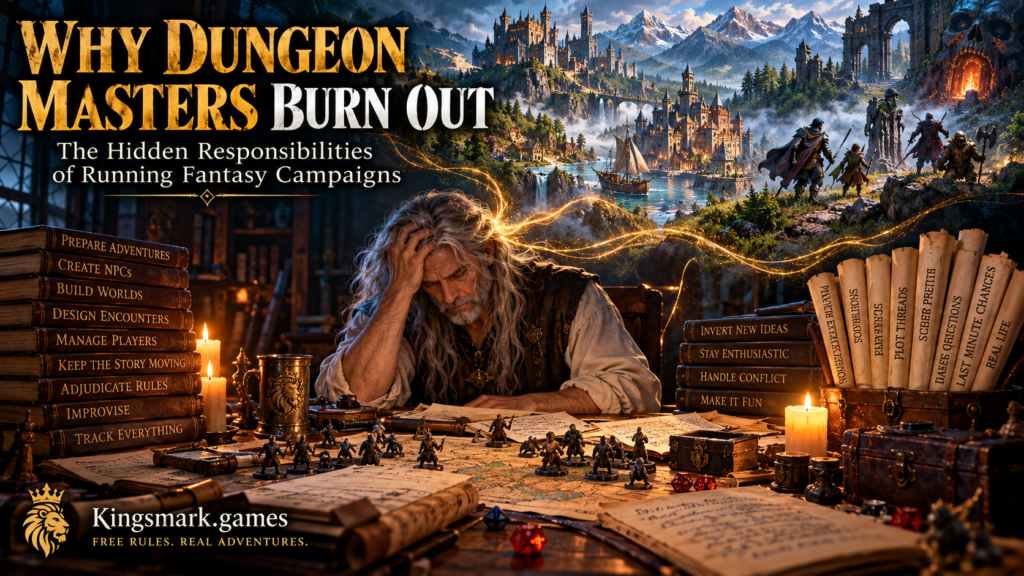
It’s Thursday evening, and somewhere a Dungeon Master is sitting at his desk preparing another fantasy adventure. He has spent several nights reviewing rules, developing encounters, drawing maps, and figuring out what happens when the adventurers finally reach the abandoned fortress. He has prepared several interesting characters, established the motivations of the villains, and even purchased a few miniature figures to make the next battle more exciting. Everything is almost ready for Friday night’s game.
Meanwhile, his friends have been preparing for the same adventure in a somewhat different fashion. One has been looking forward to trying out his character’s new sword, another has been discussing what his Wizard might do next, and someone has promised to bring pizza. A third player has spent the evening watching television, which is perfectly reasonable considering that tabletop role-playing games are supposed to be a recreational activity.
Then the messages begin. One player cannot attend, another forgot to update his character sheet, and a third wants to introduce an entirely new character with a complicated backstory. Someone suggests postponing the adventure until next weekend, when everyone should theoretically be available—assuming the planets align, the gods are merciful, and nobody’s mother-in-law decides to visit.
The Dungeon Master looks at the mountain of preparation scattered across his desk and wonders why the hell he’s doing this.
This situation illustrates a problem that experienced Dungeon Masters and Game Masters know remarkably well. For most players, the game begins when everyone sits down at the table. For the Game Master, the game may have begun several evenings earlier. What should be a few hours of enjoyable fantasy adventure can gradually become a second job—one that requires considerable creativity, preparation, administrative work, and occasionally financial expense.
There is nothing inherently wrong with these responsibilities. Many Game Masters genuinely love worldbuilding, storytelling, designing dungeons, and watching their friends experience extraordinary adventures. The problem begins when the responsibilities accumulate until the person running the game is no longer having nearly as much fun as the people playing it.
Why does this happen, and what can players, Game Masters, and game publishers do about it?
🎭 The Hidden Jobs of a Game Master
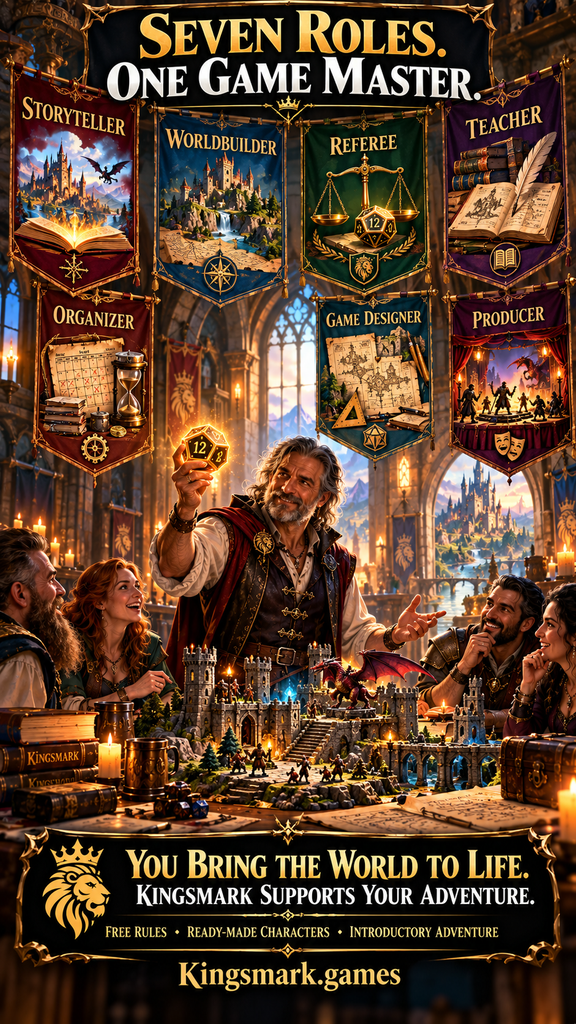
When someone volunteers to become a Dungeon Master, he might imagine himself describing mysterious forests, portraying colorful characters, and unleashing terrifying monsters upon an unsuspecting party of adventurers. Those activities are certainly part of the experience, but they represent only a portion of the responsibilities traditionally associated with running a tabletop role-playing game. Depending upon the campaign, the Game Master may simultaneously function as a storyteller, worldbuilder, referee, teacher, game designer, administrator, and entertainment producer.
Consider something as ordinary as an adventuring party entering a medieval city. The Game Master must describe the settlement, portray its inhabitants, understand its political circumstances, and respond when the players begin investigating whatever interests them. Perhaps one adventurer visits a merchant, another seeks employment, and a third decides to question the city watch about rumors of a missing nobleman. Within minutes, the Game Master may be portraying several different personalities, interpreting the rules, inventing information, and keeping track of decisions that could influence the campaign for months.
What the players experience as an entertaining conversation may involve several different kinds of work happening simultaneously. The GM must determine what each character knows, what each character wants, and how that person would reasonably respond to the adventurers. If the players attempt deception, intimidation, bribery, or negotiation, the GM may also need to resolve appropriate Tests and interpret their consequences. This is why games benefit from clear procedures for social interaction, such as those provided in Chapter 10 — 🗨️Dialog Scenes of the Kingsmark Player’s Handbook.
The responsibilities become even more complicated when the party decides to do something completely unexpected. The adventurers might ignore the missing nobleman, purchase a fishing boat, and investigate mysterious lights reported along the coastline. Suddenly, the Game Master must determine whether the boat is available, how much it costs, what equipment might be necessary, and what actually caused those lights. The adventure has moved into territory that nobody prepared, but the Game Master is still expected to make the imaginary world respond convincingly.
This ability to improvise is one of the most enjoyable aspects of Game Mastering. Watching players exercise genuine creative freedom can produce moments that no author could have anticipated, and the resulting adventures often become considerably more memorable than anything originally planned. Nevertheless, improvisation requires familiarity with the setting, understanding of the rules, and enough confidence to make reasonable decisions without bringing the game to a halt.
Unfortunately, the Game Master’s responsibilities frequently extend well beyond the imaginary world. Somebody must organize the gaming sessions, determine everyone’s availability, communicate changes, remind people about appointments, and decide whether an adventure can continue when a participant cancels. In many groups, all these administrative responsibilities automatically fall upon the same individual who is already preparing the campaign.
Scheduling can become particularly exhausting when the participants are adults with careers, families, romantic relationships, and competing responsibilities. Organizing a weekly game for six people can resemble coordinating a small business meeting, except the participants are considerably less likely to receive angry emails from management when they fail to attend. Instead, the person who prepared the adventure must decide whether to reschedule, remove an absent character from the action, or somehow reorganize the evening.
And then there is the expectation that the Game Master should keep everyone entertained. The GM may feel personally responsible whenever someone becomes bored, an encounter takes too long, a mystery proves difficult, or the adventurers become uncertain about what to do next. Some people internalize this responsibility so completely that they begin measuring the success of every session by how much enjoyment everyone else experienced.
That expectation deserves examination because the Game Master is also a participant in the game. He deserves opportunities to laugh, be surprised, exercise his imagination, enjoy the company of his friends, and discover unexpected developments. His role is different from that of the other participants, but his enjoyment should not be treated as an optional consideration.
An August 2026 discussion on Reddit raised precisely this concern. The author questioned whether modern tabletop gaming increasingly expects GMs to deliver elaborate plots, emotional storylines, and surprising developments while players contribute comparatively little beyond showing up. The discussion attracted considerable attention, although contributors expressed different opinions about whether these expectations are widespread or largely dependent upon individual gaming groups.
That distinction is important. Not every Game Master is overworked, and not every group contains passive players who expect someone else to do all the entertaining. Some groups distribute responsibilities beautifully, while others are fortunate enough to contain several enthusiastic Game Masters who regularly take turns running adventures.
Nevertheless, the problem is recognizable enough that expressions such as forever GM have become part of the hobby’s vocabulary. My earlier article, Is It Fun to Be a Game Master?, examines the related problem of why some groups struggle to find anyone willing to take the position. The simplest explanation is that people sometimes recognize the responsibilities involved and reasonably wonder whether they want to accept them.
The solution is not to convince Game Masters that they should stop enjoying creative work. Some people genuinely love spending their weekends drawing maps, constructing imaginary civilizations, painting miniature figures, or designing elaborate adventures. For these individuals, preparation is a rewarding hobby in its own right, and there is no reason to discourage it.
The problem begins when enjoyable creative work becomes an obligation that the Game Master no longer controls.
⏳ When Preparation Becomes a Trap
One of the most common mistakes Game Masters make is attempting to prepare everything that might happen during the next adventure. They create extensive maps, detailed histories, complicated encounters, elaborate NPC biographies, and contingency plans for nearly every decision the players could make. Some prepare entire kingdoms before the adventurers have finished exploring their first village, while others spend hours balancing encounters that may never occur.
The motivation is understandable. A Game Master wants to provide a convincing fantasy world and avoid situations in which the adventure stalls because something important has not been prepared. Unfortunately, the attempt to eliminate uncertainty can generate an almost unlimited amount of additional work.
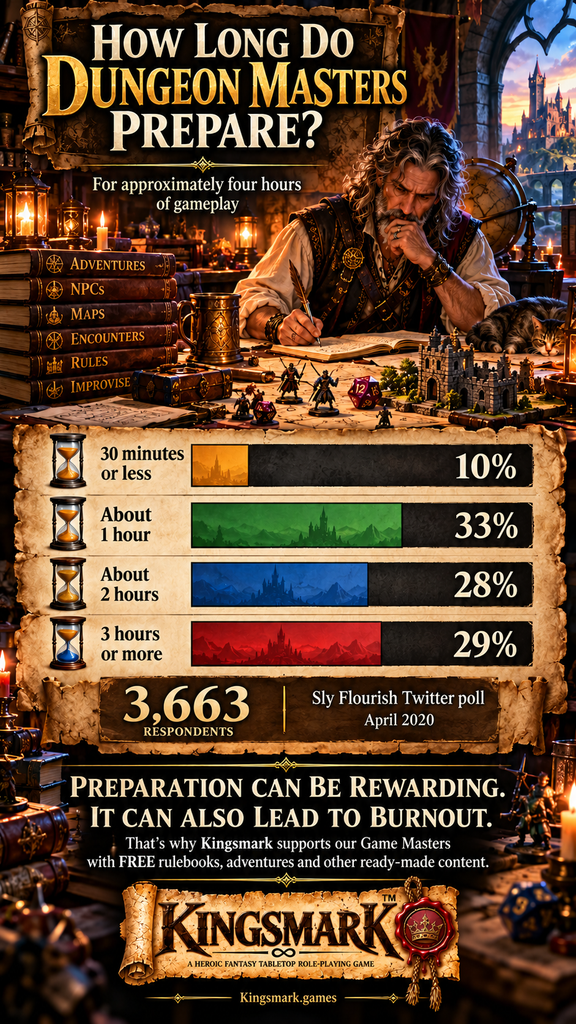
How much time do Dungeon Masters actually spend preparing their games? RPG author Michael E. Shea, better known as Sly Flourish, examined the question in an article about Dungeon Master preparation time. In April 2020, he conducted a Twitter poll asking how much preparation respondents performed for approximately four hours of D&D gameplay.
The poll received 3,663 responses. Approximately 10% reported spending thirty minutes or less preparing, 33% spent about one hour, 28% spent about two hours, and 29% spent three hours or more. These figures represent a self-selected group of respondents rather than a scientifically representative measurement of the entire hobby, but they illustrate how substantially preparation habits can differ.
Think about the implications for someone running a campaign over thirty sessions. A Game Master spending three hours preparing every session will invest ninety hours in preparation alone, without counting the actual gameplay. If each session lasts four hours, the complete commitment becomes 210 hours—more than five forty-hour working weeks devoted to one campaign.
Of course, these hours are not automatically wasted. Someone who genuinely loves developing fantasy settings may find tremendous pleasure in spending an entire weekend constructing a believable medieval city. Another Game Master might enjoy painting miniatures more than actually playing, and a third might consider the creation of fictional religions, political relationships, and historical timelines a fascinating intellectual exercise.
The real question is whether the preparation produces sufficient enjoyment or practical value to justify the time invested. If a Game Master spends six hours preparing an elaborate encounter that the players bypass in ten minutes, those hours might still have been worthwhile. But if the GM feels frustrated because the players failed to follow the expected storyline, something has gone wrong.
This is where preparation can become a trap. The more time someone invests in a particular sequence of events, the more emotionally invested that person may become in seeing those events unfold. Player freedom begins to feel like interference with the adventure rather than the very reason the adventure exists.
Experienced Game Master and author Justin Alexander addresses this problem in his influential essay Don’t Prep Plots. His central recommendation is to prepare situations rather than predetermined sequences of events. Instead of writing an adventure in which the characters must accomplish a specific series of objectives in a particular order, the GM establishes interesting circumstances and allows the players to determine how events develop.
Consider a village whose inhabitants have begun disappearing. An unimaginative adventure might require the party to interview the village priest, discover a hidden clue, enter an abandoned crypt, defeat a monster, and recover a stolen relic. Each scene depends upon the players making the decisions necessary to reach the next scene, which becomes inconvenient when they decide to investigate the local nobility instead.
A better approach is to establish the actual situation. Perhaps a nobleman’s servants have been kidnapping villagers to satisfy the demands of a supernatural creature beneath the family estate. The priest suspects something terrible but fears the nobleman’s influence, several villagers have discovered suspicious evidence, and the creature has begun making demands that its servants cannot satisfy.
The Game Master now knows what is happening, who is involved, what the participants want, and what might occur if nobody intervenes. The adventurers can question witnesses, investigate the estate, follow the servants, negotiate with the creature, or devise another strategy entirely. Their decisions become meaningful because the GM understands the situation rather than merely remembering the order of scenes in a prepared storyline.
This philosophy is central to How to Create a Dungeon Adventure, which examines the importance of constructing believable places rather than arbitrary collections of encounters. A dungeon should possess an understandable purpose, history, environment, and relationship with its inhabitants. Those details make improvisation easier because the Game Master can reason about the location instead of inventing every answer independently.
Another useful technique is to limit preparation to the information most likely to matter during the next session. The GM might need to understand three important NPCs, several interesting locations, a handful of potential threats, and the consequences of whatever happened previously. There is usually no pressing reason to finish writing the royal genealogy of an empire on the opposite side of the continent.
Players can help by maintaining their own records. Someone should remember what happened during previous sessions, keep track of important discoveries, and record the names of people the party encounters. Players who take their characters seriously can develop meaningful ambitions and relationships without expecting the Game Master to invent their entire personalities for them.
This is one reason I emphasize the value of developing a character beyond a few mechanical statistics. My article Beyond the Character Sheet discusses how a character’s personality, ambitions, relationships, and experiences can contribute to the campaign. Players who bring their own ideas into the adventure give the GM something to respond to, reducing the pressure to manufacture every interesting situation personally.
A final consideration is that preparation should produce material the Game Master can reuse. A well-developed merchant might appear in several adventures, a believable village can serve as the setting for an entire campaign, and an interesting adversary might survive one encounter to become a recurring problem. These investments grow increasingly valuable when they support multiple sessions rather than disappearing immediately after a particular scene concludes.
Good preparation creates possibilities. Excessive preparation creates obligations.
💰 The Price of an Extraordinary Adventure
There is an economic principle worth considering whenever we discuss the responsibilities of running a tabletop role-playing game. Time has value, even when nobody receives a paycheck for spending it. A Game Master who devotes hundreds of hours to preparing a campaign is investing something that cannot be replaced, regardless of whether he happens to enjoy the work.
This does not mean that every recreational activity needs to be converted into a monetary calculation. People spend time gardening, exercising, restoring automobiles, playing musical instruments, and pursuing countless other hobbies without expecting financial compensation. Nevertheless, time becomes an important consideration when someone feels compelled to invest more of it than he would otherwise choose.
Game Masters can also accumulate considerable direct expenses. Rulebooks, supplemental materials, printed maps, miniature figures, scenery, digital subscriptions, software, and specialized equipment can become expensive over the course of a long-running campaign. None of these purchases is necessarily unreasonable, but the financial commitment can grow significantly when someone wants to create something extraordinary.
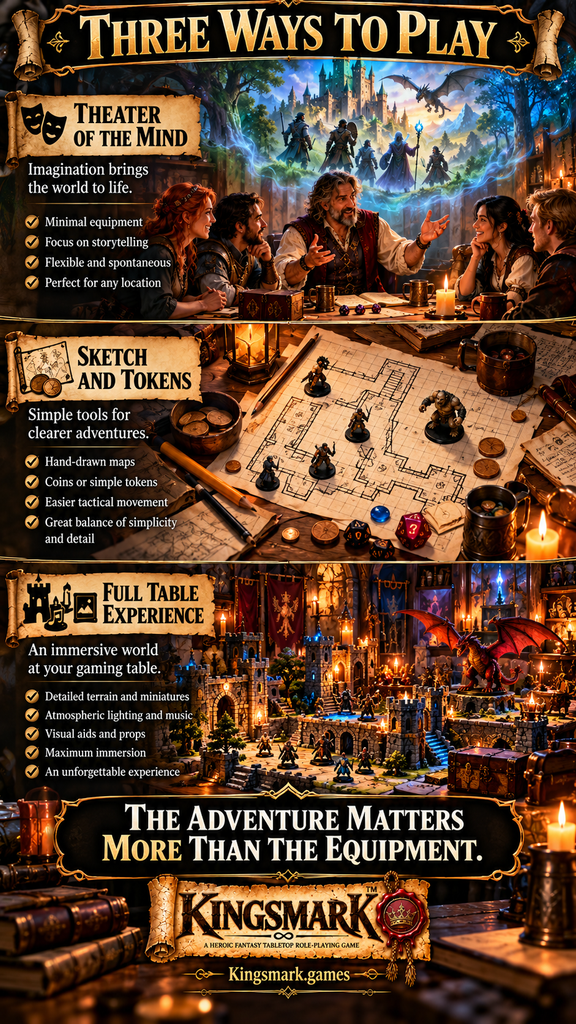
This brings us to a distinction established in the 🕯Introduction to Kingsmark. The Player’s Handbook recognizes three general approaches to presenting a tabletop role-playing adventure—🎭Theater of the Mind, ✍️🪙🧌Sketch and Tokens, and 🗺🧌🏰🕯🎵🖼 Full Table Experience.
The simplest approach, 🎭Theater of the Mind, requires very little physical equipment. Friends gather around a table, the Game Master describes the fictional world, and the players explain what their characters attempt to accomplish. Dice determine uncertain outcomes, while imagination provides nearly everything else.
There is something remarkably satisfying about this approach. An experienced storyteller can describe a terrifying creature emerging from a mist-covered forest, and everyone around the table may imagine something slightly different. The absence of a miniature figure allows each participant’s imagination to supply details that would be difficult to reproduce physically.
The second approach, ✍️🪙🧌Sketch and Tokens, introduces simple visual references. A hand-drawn map can clarify the dimensions of a room, while coins, tokens, or miniature figures represent the positions of characters and opponents. Such resources are particularly useful when tactical movement, obstacles, elevation, or environmental hazards become important.
The third approach, the Full Table Experience, embraces the theatrical possibilities of tabletop gaming. Beautiful maps, detailed terrain, painted miniatures, atmospheric lighting, music, sound effects, props, and elaborate gaming furniture can transform an ordinary room into something resembling a miniature fantasy world. When combined with an imaginative Game Master and enthusiastic players, the result can be extraordinary.
The possibilities have become impressive enough to support businesses specializing in furniture and spaces designed specifically for gaming. Wyrmwood Gaming manufactures sophisticated gaming tables with recessed play surfaces, removable tops, and customizable accessories. Its six-player modular gaming-table bundles have been advertised starting at approximately $2,625, illustrating how substantial an investment specialized gaming furniture can become.
Another company, Rathskellers, produces elaborate handcrafted gaming tables that resemble pieces of luxury furniture. Some feature specialized Game Master stations, lighting, storage, and optional electronic capabilities. These are not necessities for enjoying a tabletop RPG, but they demonstrate how seriously some enthusiasts approach the creation of an immersive gaming environment.
The possibilities extend beyond furniture. Interior designer Erika Conner of Olive & June Home documented the transformation of an ordinary basement into the D20 Dungeon, a fantasy-themed gaming space featuring dramatic architectural elements and carefully designed rooms. The project demonstrates that tabletop gaming can inspire the same enthusiasm for interior design that other people devote to home theaters, libraries, or elaborate entertainment spaces.
For another example, consider The Ivory Ferret, a fantasy-tavern-themed gaming room operated by The Arena in Falkirk, Scotland. The room features atmospheric decoration, a custom digital map table, and a supplementary display for presenting images of the fictional world. Rather than purchasing and maintaining an elaborate gaming room, visitors can rent an immersive space for their adventures.
These businesses illustrate something important about the tabletop hobby. A person might spend thousands of dollars building an extraordinary gaming environment, just as another enthusiast might invest heavily in a home theater, musical instruments, or a collection of motorcycles. There is nothing wrong with such investments when they provide genuine enjoyment.
The mistake is assuming that an extraordinary gaming experience must require extraordinary expenditure. Beautiful equipment can enhance an adventure, but it cannot replace imagination, interesting decisions, believable consequences, or the enjoyment of spending time with friends. An exciting adventure conducted around a coffee table can be considerably more memorable than a boring adventure played upon a piece of furniture costing more than someone’s automobile.
Game Masters should feel free to pursue whatever level of presentation inspires them, without feeling obligated to reproduce the production values of professional entertainment programs. Shows such as Critical Role and Dimension 20 demonstrate what talented performers can accomplish with elaborate production resources, but an ordinary household campaign has no reason to compete with them. Michael E. Shea makes a similar observation in his article Are Actual Play Games Hurting Home-Game GMs?, emphasizing that ordinary players frequently enjoy games without professional presentation.
Ultimately, the purpose of a Full Table Experience is to make the adventure more enjoyable. If achieving that presentation requires so much preparation that the Game Master becomes exhausted, the benefits deserve reconsideration.
There is also a distinction between spending money on an experience and being required to spend money simply to access the rules necessary to enjoy it. A Game Master might reasonably decide to invest hundreds of dollars in miniatures, terrain, or gaming furniture while preferring not to purchase another expensive collection of books. In my opinion, publishers should respect that decision.
That philosophy is one of the reasons I created 👑Kingsmark as a game people can begin learning and playing without purchasing its Player’s Handbook.
📖 Game Masters Deserve Better Games
Tabletop game publishers cannot eliminate every source of Game Master burnout. They cannot force unreliable players to attend scheduled sessions, prevent disagreements between friends, or guarantee that someone will always feel inspired to create another adventure. However, publishers have considerable influence over how much work people must perform simply to learn and operate their games.
One responsibility is especially important—writing rulebooks that communicate their rules effectively.
This sounds obvious, but anyone who has spent enough time examining tabletop role-playing games knows how frustrating poorly organized rules can become. Important procedures may be scattered across multiple chapters, terminology may be inconsistent, and essential information can disappear inside lengthy explanations. A Game Master who cannot remember how something works must interrupt the adventure, locate the appropriate material, interpret the language, and explain the result to everyone else.
Sometimes the problem is unnecessary mechanical complexity. Other times, perfectly reasonable rules are explained so poorly that readers struggle to understand them. Neither situation benefits from additional illustrations, decorative borders, or pages of elaborate prose that fail to explain what someone actually needs to do.
I discussed these considerations in Early RPG Simplicity or Modern TTRPG Complexity?. A short rulebook is not automatically simple, and a large rulebook is not automatically complicated. What matters is how much information participants must learn before they can begin playing and how easily they can locate additional instructions when necessary.
Consider the original Dungeons & Dragons, which Gary Gygax and Dave Arneson published in 1974. Those early rules helped establish an extraordinary hobby despite their relatively modest length, but they also relied heavily upon players’ familiarity with miniature wargaming and required considerable interpretation. The lesson is not that old games were perfect or that every modern rulebook should contain fewer pages.
Rather, game designers should distinguish between the essential mechanical principles of their systems and the additional material provided to expand the experience. A Game Master should not have to memorize hundreds of pages before running an introductory adventure, even when those pages contain valuable information for future campaigns.
This distinction influenced the development of the 👑Kingsmark Player’s Handbook. The First Edition contains 556 PDF pages, including seventeen chapters and five appendices, but I did not design it with the expectation that someone would read the entire book before running his first adventure. I wanted the necessary instruction to be available when needed, organized in a manner that would make learning and referencing the system as practical as possible.
The foundation is ⭐Jack’s Cinematic d12 (JCd12), the original role-playing system I developed for Kingsmark. Its basic resolution procedures use a twelve-sided die, relevant character abilities, and Target Numbers determined by the circumstances. The system possesses considerable mechanical detail, particularly concerning combat and injury, but its underlying procedures are intended to remain recognizable across different situations.
For example, the Player’s Handbook introduces twelve 💪Attributes in Chapter 1 — 💪Attributes, organizes them into five 🌈Attribute PRISMs in Chapter 2 — 🌈Attribute PRISMs, and develops the character’s trained capabilities through Chapter 3 — ⚒Skills. These concepts work together rather than requiring players to learn an entirely unrelated method of resolving every ordinary activity.
One deliberate decision concerns terminology. Dungeons & Dragons traditionally uses expressions such as Ability Score and Saving Throw, which experienced players understand because they have encountered them repeatedly. However, those expressions do not immediately communicate their relationship to someone unfamiliar with the game’s conventions.
Kingsmark uses terms such as 💪Attribute, 💪Attribute Test, 💪Attribute Defense Test, and Trained Attribute Bonus. The relationships between these concepts are easier to recognize because their names share meaningful language. A 💪Attribute Defense Test identifies a defensive procedure involving an Attribute, while the Trained Attribute Bonus identifies an additional benefit associated with training in that Attribute.
Even the abbreviation ADT offers a convenient memory association for readers familiar with ADT, the home-security company. A home-security company specializes in defense, while an Attribute Defense Test represents a character’s attempt to resist or withstand an unwanted effect. It is a small mnemonic device, but small decisions can accumulate into a more approachable learning experience.
Visual communication also matters. I have deliberately used bold text, highlighted information, recognizable symbols, consistent formatting, and carefully selected emojis to help readers identify important concepts without searching through dense passages of prose. 💪Attributes, 🌈Attribute PRISMs, ⚒Skills, 🩸Physical Trauma, 🧠Mental Trauma, and ❤️Healing Scenes have distinctive visual identities that remain recognizable across the book.
My objective was not simply to produce another attractive fantasy rulebook. Fantasy illustrations are wonderful, and I certainly appreciate a beautifully designed publication, but readers must be able to find the information they need. A gorgeous book that requires fifteen minutes of searching every time someone asks a question is not doing the Game Master any favors.
One of my inspirations was Shadowrun Second Edition, published by FASA in 1992. I spent considerable time with that game’s relatively straightforward, largely black-and-white presentation, and I appreciated the practical experience of learning from it. Shadowrun itself could be mechanically demanding, so I would not suggest that every aspect of its rules was simple, but the experience reinforced my interest in making rulebooks useful rather than merely decorative.
I have also tried to avoid writing in unnecessarily elaborate language. Gary Gygax was an enormously important figure in the history of tabletop gaming, but I have never believed that understanding a fantasy game’s rules should require a reader to possess the vocabulary of a nineteenth-century Oxford professor. There is a time for literary expression, and there is a time to tell someone how many dice to roll.
Kingsmark’s Chapter 11 — ▶️Action Scenes and Chapter 12 — 🎬Example Actions provide another illustration of this approach. The game uses Action Points to represent what characters can accomplish during their Turns, and the handbook includes approximately 108 example Actions demonstrating different possibilities. These examples include tactical movement, attacks, defensive maneuvers, and other activities that might arise during an adventure.
The examples are not intended to become an exhaustive menu of everything characters are permitted to do. Players can attempt reasonable actions beyond those specifically described, and the Game Master interprets them using the established procedures. My article Why “I Attack” Isn’t Enough explores the importance of making fantasy combat more interesting than repeatedly announcing the same attack.
Likewise, Chapter 13 — 💥Damage & Defense replaces conventional hit-point attrition with rules that address bodily injury, protection, damage, and the consequences of violence. Kingsmark includes 🩸Physical Trauma and 🧠Mental Trauma, allowing dangerous situations to affect characters physically and psychologically. Chapter 14 — ❤️Healing Scenes then provides procedures for recovery that can become part of the unfolding adventure.
These additional systems introduce mechanical detail, and that detail is not appropriate for every player’s preferences. I designed it for people who want tactical choices, meaningful consequences, and a degree of physical plausibility without requiring elaborate mathematics for every ordinary action. My objective was to give Game Masters useful tools while preserving their authority to interpret the circumstances of their adventures.
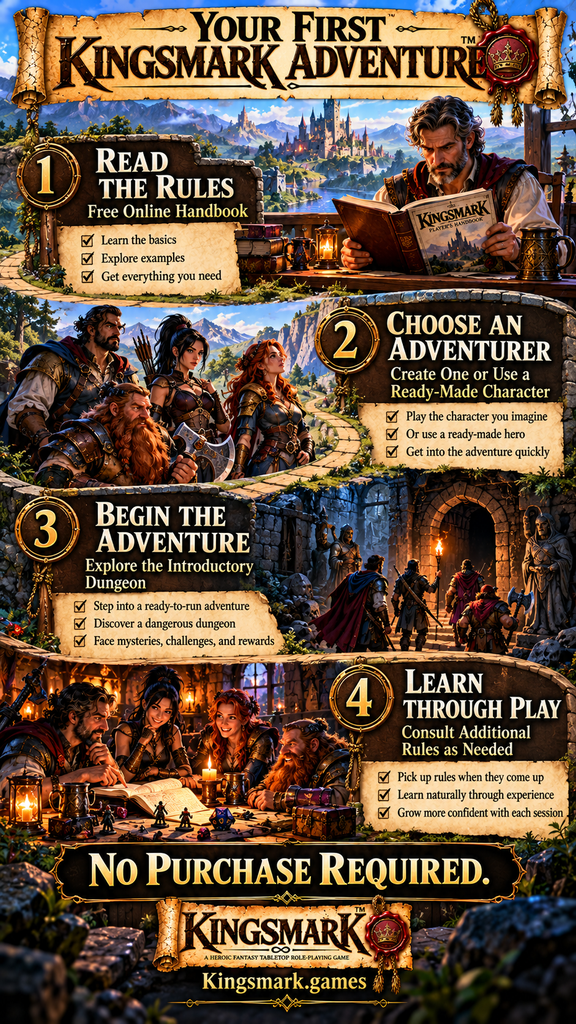
Perhaps the most important practical consideration is how someone actually begins playing. Chapter 17 — ✍Character Creation provides the procedures for creating original adventurers, while 📎Appendix C — Characters includes four ready-made Player Characters. A group can use those characters to begin learning the game without spending its entire first session developing individual heroes.
📎Appendix D — Dungeon provides an introductory adventure set around Willowcreek, Rusty’s Adventurers’ Tavern, and the ruins of Greywatch. The material includes ready locations, characters, Missions, dangers, and opportunities for exploration, with several details determined through twelve-sided dice rolls. Game Masters can use the adventure to practice the rules in an actual gaming situation rather than attempting to learn every possible procedure in isolation.
The introductory material is deliberately intended to serve as a starting point rather than a complete multi-year campaign. A new GM can become familiar with the ordinary procedures of gameplay, practice resolving encounters, and consult additional chapters as situations arise. More extensive adventures and reference material can then expand the experience without being prerequisites for those first sessions.
All this brings me to a decision that I consider particularly important for the future of Kingsmark. The complete Player’s Handbook is available to read online for free. A Game Master can examine the rules, learn the system, create characters, and begin playing without purchasing the PDF or another book.
This is not merely a temporary giveaway intended to persuade people to buy something later. As I explained in Kingsmark Is FREE?!, free online access is a deliberate part of my publishing philosophy. My ambition is to build an extensive collection of role-playing books, adventures, reference material, and other digital resources that people can explore without being excluded because they cannot afford a particular purchase.
The wider Kingsmark publishing project includes five specialized companion volumes. ⚖️The Marketplace expands equipment and commerce, 📜The Spellbook develops the magic system, 🧌The Bestiary focuses on fantastic creatures, 🧭The World Book explores the medieval fantasy world of Sylva, and 🍺The Tavern serves as the dedicated Game Master’s Guide. These volumes are intended to provide substantially greater depth for people who want to expand their adventures, but they are not required to begin playing with the current handbook.
The long-term business philosophy is straightforward. I want people who enjoy Kingsmark to purchase beautifully printed books, convenient digital editions, miniatures, and other physical merchandise because they appreciate the game and want to support its continued development. I do not want someone to feel that purchasing a collection of expensive books is the price of admission.
There is something satisfying about owning an impressive hardcover rulebook that has accompanied years of memorable adventures. Miniatures, terrain, collectible artwork, and other merchandise can also provide real enjoyment. I would love to see enthusiastic supporters proudly wearing shirts proclaiming Proud Kingsmark Game Master, and I intend to make physical products another way people can celebrate their enjoyment of the game.
But those purchases should be voluntary expressions of enthusiasm rather than financial obstacles preventing newcomers from participating. A Game Master who cannot afford a new book should still be able to learn the rules, introduce friends to the game, and enjoy an adventure. If someone discovers Kingsmark through a freely shared digital copy and eventually becomes an enthusiastic Game Master, I consider that a meaningful success.
Readers who prefer the convenience of a self-contained PDF can support the project by purchasing the official digital edition. Those who prefer free online reading can enjoy the game through the website, while the broader digital library develops alongside future publications.
Explore the complete Kingsmark Player’s Handbook for free at Kingsmark.games. The rules, introductory adventure, character creation material, and existing reference resources are available without requiring a purchase.
⚔️ A Better Gaming Table Starts With Better Expectations
Accessible rules and useful resources can reduce some of the work associated with running an adventure, but they cannot replace the cooperation of the people participating in it. A Game Master can possess an excellent rulebook, beautifully prepared maps, and an entire library of fantasy material while still becoming exhausted by unreliable players. The social expectations surrounding a campaign matter just as much as the game system.
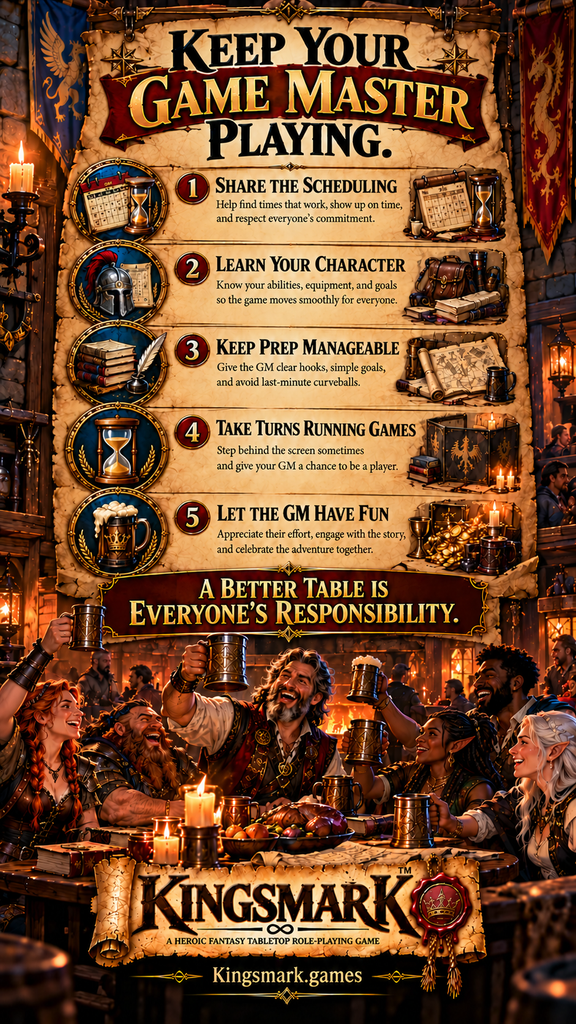
One of the simplest ways to improve a gaming group is to distribute responsibilities that do not actually require the Game Master’s attention. Someone else can coordinate schedules, maintain a campaign journal, organize snacks, or remind participants about upcoming sessions. Each player can become familiar with his own character’s abilities, keep track of equipment, and maintain whatever records are necessary for the game.
Players can also contribute by developing meaningful objectives for their characters. A warrior seeking to avenge his murdered brother, a priest investigating a desecrated sanctuary, or a mercenary hoping to establish his own company already possesses motivations that can inspire adventures. The Game Master can present opportunities, conflicts, and consequences without having to invent every reason the characters might care about what happens.
The kind of experience participants expect is equally important. Some people want gentle, lighthearted adventures filled with amusing characters and relatively harmless challenges, while others want dangerous exploration, brutal combat, difficult decisions, and serious consequences. Neither preference obligates everyone else to adopt it, but mixing incompatible expectations can create considerable frustration.
👑Kingsmark identifies itself as A Heroic Fantasy TTRPG for Mature Players for precisely this reason. The world of Sylva is intended to support heroic adventures involving danger, violence, political intrigue, supernatural horrors, and circumstances in which courage matters because genuine failure is possible. Its tone can support everything from PG-13 adventure to considerably more intense R-rated fantasy storytelling.
The influence of heroic fantasy traditions associated with characters such as Conan the Barbarian should be apparent. The world is intended to feel dangerous, often violent, and sufficiently believable that victory requires courage, judgment, skill, and occasionally restraint. A wounded adventurer cannot necessarily shrug off terrible injuries simply because he possesses an impressive character level.
The same principle applies to psychological consequences. Witnessing horrifying events, experiencing overwhelming fear, or enduring extraordinary supernatural threats can produce 🧠Mental Trauma, just as dangerous combat can produce 🩸Physical Trauma. Those rules are part of establishing the kind of fantasy experience Kingsmark is intended to provide.
There is an important distinction between mature content and mature behavior, however. A person who wants to experience dangerous adventures should also understand the responsibilities of participating in a cooperative game. Reliability, respect for the other participants, willingness to learn the rules, and the ability to distinguish an imaginary disagreement from a personal argument are all signs of maturity.
A clearly established game identity helps attract people interested in a particular kind of adventure. It also makes the opening conversation about campaign expectations considerably easier. The GM should explain the intended tone, discuss how frequently the group wants to meet, establish reasonable expectations for participation, and make sure everyone understands the responsibilities involved.
Another valuable solution is allowing Game Masters to take breaks. A campaign can pause between major adventures, another participant can temporarily run a one-shot, or the group can experiment with a different system for several sessions. A GM who spends years occupying the same position might discover that playing an individual character restores the enthusiasm that originally inspired him to run adventures.
An interesting January 2026 Reddit account illustrates how burnout can occur even among supportive friends. The author described running a D&D Fifth Edition campaign for more than 150 sessions and eventually becoming exhausted by the mechanical demands of high-level encounters. Rather than abandoning the group, the GM discussed the problem openly with the players, who responded constructively and helped develop a different plan for continuing their gaming activities.
This example is valuable because it demonstrates that burnout does not necessarily indicate a bad Game Master, an unsuccessful campaign, or a group of inconsiderate players. Sometimes a particular system becomes more demanding than someone enjoys, life circumstances change, or a person simply wants to experience something different. An established gaming group should be capable of discussing such concerns without treating the situation as a personal failure.
Game Masters should also recognize when their own expectations have become unreasonable. Not every NPC needs an elaborate biography, every dungeon needs a three-dimensional model, or every session needs a climactic battle worthy of a major Hollywood production. A straightforward adventure involving interesting people, meaningful decisions, and believable consequences can be enormously entertaining without exhausting the person responsible for running it.
At the same time, players should remember that appreciation involves more than occasionally telling the GM that the campaign is wonderful. Showing up reliably, participating enthusiastically, learning the rules, and helping the group remain organized demonstrate that appreciation through action. Someone who repeatedly neglects these responsibilities should not be surprised when the person doing all the work eventually becomes less enthusiastic about continuing.
The purpose of these expectations is not to transform tabletop gaming into another collection of rigid obligations. It is to preserve the activity as something everyone genuinely enjoys. If people want the Game Master to remain enthusiastic about running adventures, they should help create circumstances in which doing so remains rewarding.
Ultimately, the Game Master is not an employee of the adventuring party. He is another participant in a shared imaginative experience, entrusted with responsibilities that differ from those of the other players. His contribution deserves appreciation, cooperation, and the freedom to enjoy the world he is helping bring to life.
The tabletop industry also has responsibilities. Publishers should strive to provide clear rules, accessible learning materials, practical examples, and useful resources rather than expecting GMs to resolve every deficiency through additional unpaid labor. Comprehensive games can be complicated when that complexity serves a meaningful purpose, but needless confusion should never be mistaken for sophistication.
That is the philosophy I want to continue developing through Kingsmark. I want Game Masters to possess the tools necessary to create extraordinary adventures while retaining the freedom to make their own decisions, explore their own ideas, and build campaigns suited to their particular interests. The system should support their imagination rather than competing with it.
And perhaps most importantly, I want people to feel that becoming a Kingsmark Game Master is something worth being proud of.
The fantasy role-playing hobby exists because people are willing to transform collections of rules, dice, maps, and imaginary characters into experiences that other human beings remember for years. A good Game Master might introduce someone to a lifelong hobby, inspire an interest in history or mythology, or create adventures that become cherished memories among friends.
The players may remember the dragon they defeated, the kingdom they saved, the companion they lost, or the villain who escaped to threaten them another day. They may talk about these events for years, retelling their adventures as though they actually happened. Somewhere behind those memories was a Game Master who helped make them possible.
That person deserves more than another mountain of unnecessary work.
👑Kingsmark is free to read and play at Kingsmark.games. Explore the Player’s Handbook, learn the rules, create your adventurers, and begin your own heroic fantasy campaign.
Support the game by purchasing a digital copy of the Player’s Handbook.
The adventure belongs to everyone at the table. Let’s make sure the Game Master gets to enjoy it, too.
John Alan Martinson is the creator of 👑Kingsmark and ⭐Jack’s Cinematic d12 (JCd12), an original tabletop role-playing system designed for cinematic action, meaningful character development, and dangerous heroic fantasy adventures. The complete Kingsmark Player’s Handbook is available to read online for free at Kingsmark.games.
About The Author