Building 👑Kingsmark from the Ground Up
When designing a new TTRPG, what’s the very first mechanical element you would decide on? Quora.com
The first mechanical element I would decide upon is the character’s fundamental Attributes, but before doing that, I would establish what I want the game system to accomplish. In my case, when I began designing ⭐Jack’s Cinematic d12 (JCd12), the underlying system that powers my heroic fantasy TTRPG, 👑Kingsmark, I had a fairly straightforward ambition: I wanted one storytelling system that I could use across multiple fictional worlds and historical periods. I didn’t want to learn an entirely different set of rules every time I decided to play a medieval fantasy adventure, a modern crime thriller, or a science-fiction campaign. I wanted a flexible mechanical foundation that could accommodate different settings without requiring me to reinvent the game each time.
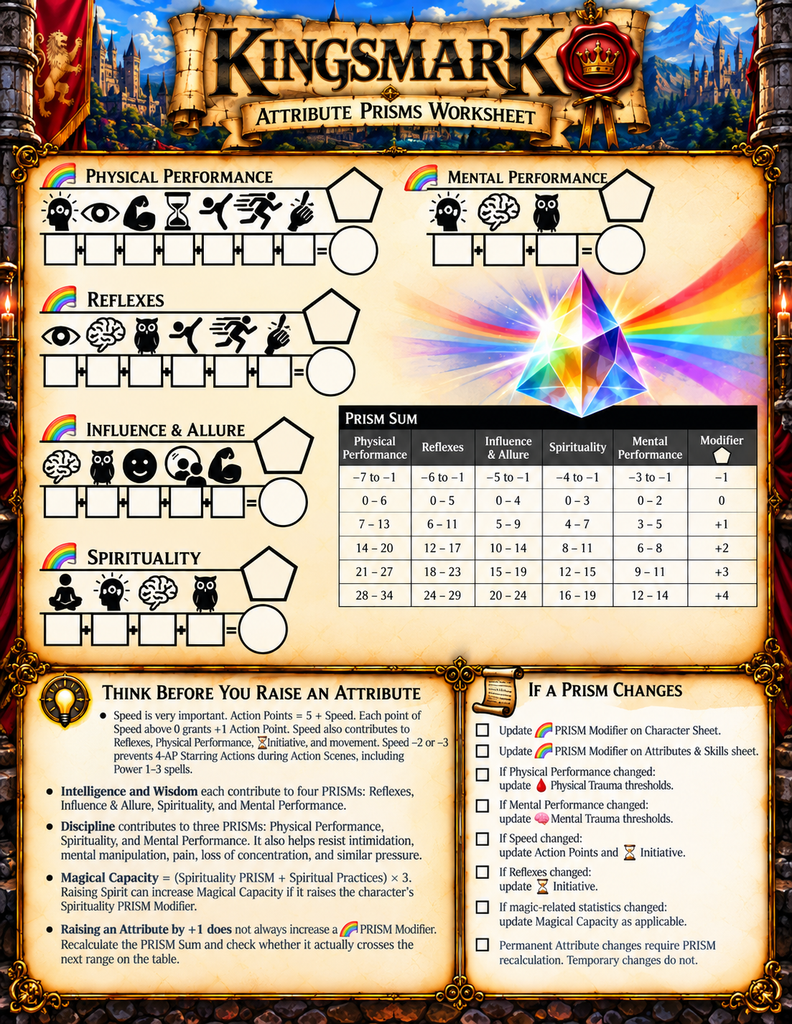
Once I had established that objective, I began asking what characteristics fundamentally describe a human being. Dungeons & Dragons calls these Ability Scores, while Kingsmark calls them 💪Attributes. I wanted enough Attributes to distinguish meaningful differences between individuals, but I didn’t want an exhaustive simulation of human biology and psychology. I eventually settled on twelve Attributes, representing characteristics such as Strength, Stamina, Agility, Dexterity, Speed, Intelligence, Wisdom, Perception, Discipline, Charisma, Attractiveness, and Spirit. These became the foundation upon which the rest of the character mechanics would be constructed. You can examine them in Chapter 1 — 💪Attributes.
The next question concerned ⚒Skills. What are the minimum number of Skills necessary to represent the activities that characters might reasonably attempt during an adventure? My objective was to strike a balance between realism and practicality, because I wanted more meaningful distinctions than some traditional TTRPGs provide without creating an enormous catalog of specialized Skills. Kingsmark eventually settled upon twenty-four Skills, representing broad areas of training, knowledge, and practical competence. However, this raised another interesting design problem: how should Skills interact with Attributes?
Traditionally, a game might associate a particular Skill with a particular Attribute, but human performance is rarely that simple. Consider swordsmanship, which involves much more than Strength or Agility alone. A skilled swordsman also benefits from coordination, stamina, perception, speed, discipline, and other capabilities. Likewise, successfully negotiating with someone might involve intelligence, wisdom, charisma, physical presence, and specialized social experience. It seemed unrealistic to assume that a single Attribute could adequately represent all the natural characteristics contributing to a complicated activity.
This realization led me to develop what I call 🌈Attribute PRISMs, which are groups of related Attributes that produce broader measurements of a character’s capabilities. Instead of forcing every Skill to depend upon one isolated characteristic, I could use an Attribute group to represent the natural abilities that contribute to a particular kind of performance. The group produces a modifier that can then be combined with the appropriate Skill Rating when resolving an action. I eventually developed five PRISMs: Physical Performance, Reflexes, Influence & Allure, Spirituality, and Mental Performance. Interestingly, their initials spell PRISM, which fit the concept so naturally that I retained it as the system’s terminology. The complete mechanics are explained in Chapter 2 — 🌈Attribute PRISMs.
With 💪Attributes, 🌈Attribute PRISMs, and ⚒Skills established, I then needed to determine what their numerical ratings would actually represent. This is another fundamental decision that every game designer needs to consider. In a dice-pool system, a rating of five might represent five dice that the player rolls. In a percentile system, a rating of 62 might represent a percentage-based measure of competence. In Jack’s Cinematic d12, the Attribute Ratings, PRISM modifiers, and Skill Ratings all function as numerical modifiers within the resolution system, although the PRISM modifier itself is derived from a group of Attributes.
The basic Skill Test in Kingsmark is straightforward: 1d12 + 🌈Attribute PRISM + ⚒Skill against a Target Number (TN). The player rolls a twelve-sided die, adds the appropriate modifiers, and determines whether the result meets or exceeds the difficulty established for the action. The system also features exploding dice, allowing exceptional outcomes when a natural 12 is rolled. Not every Test uses exactly the same combination of modifiers, because some situations call for individual Attribute Tests or other appropriate variations, but the fundamental resolution philosophy remains consistent. You can read more about this in Chapter 3 — ⚒Skills.
Only after establishing how characters were represented numerically could I begin working through how those characteristics would function during actual gameplay. Suppose a character wants to attack an enemy with a sword. What does that action mean mechanically? What characteristics should influence the attacker’s performance, how should the defender’s capabilities matter, and what happens when the sword actually strikes its target? How should armor, injuries, physical limitations, and combat experience influence the outcome? These questions became the foundation for developing the rules governing ▶️Action Scenes and 💥Damage & Defense.
My approach has always been to pursue a believable degree of realism without allowing the rules to become an unnecessarily complicated simulation. For example, Kingsmark does not use traditional Hit Points. Instead, its 🩸Physical Wounds system attempts to represent the consequences of injuries more meaningfully, while 🧠Mental Trauma provides a separate way to address psychological consequences. Once the basic mechanics for resolving actions were established, I could begin developing additional procedures governing initiative, movement, available combat Actions, dialogue, social interaction, healing, and supernatural abilities. The important thing was that these additional mechanics grew from the same underlying system rather than behaving like unrelated collections of rules.
Naturally, another game designer might make completely different choices. A minimalist storytelling game might need only three Attributes and a handful of Skills, while a more simulation-oriented game might use dozens of specialized characteristics and procedures. Neither approach is inherently wrong, provided the mechanics serve the intended experience. What matters is determining the level of complexity, realism, and detail appropriate for the kind of game you are attempting to create, then building a consistent system around those decisions.
My advice is to begin with the smallest coherent mechanical foundation capable of supporting your design goals, and build outward from there. Determine what characteristics define a character, decide how those characteristics are measured, establish how they interact, and then create procedures for resolving the actions your characters will actually attempt. You can always introduce greater complexity where it produces meaningful benefits, but every additional rule should have a reason to exist.
That is essentially how ⭐Jack’s Cinematic d12 developed, and how it eventually became the foundation of 👑Kingsmark. Although Kingsmark is a medieval heroic fantasy TTRPG, I designed its underlying storytelling system with the intention of adapting it to other worlds and historical periods. If you are interested in seeing how these ideas developed into a complete game, I have made the entire Kingsmark Player’s Handbook available to read for free at Kingsmark.Games. It is a heroic fantasy tabletop role-playing game for mature players, and I hope other game designers find some useful ideas in its mechanical approach.
About The Author