Why Did D&D Create So Many Worlds
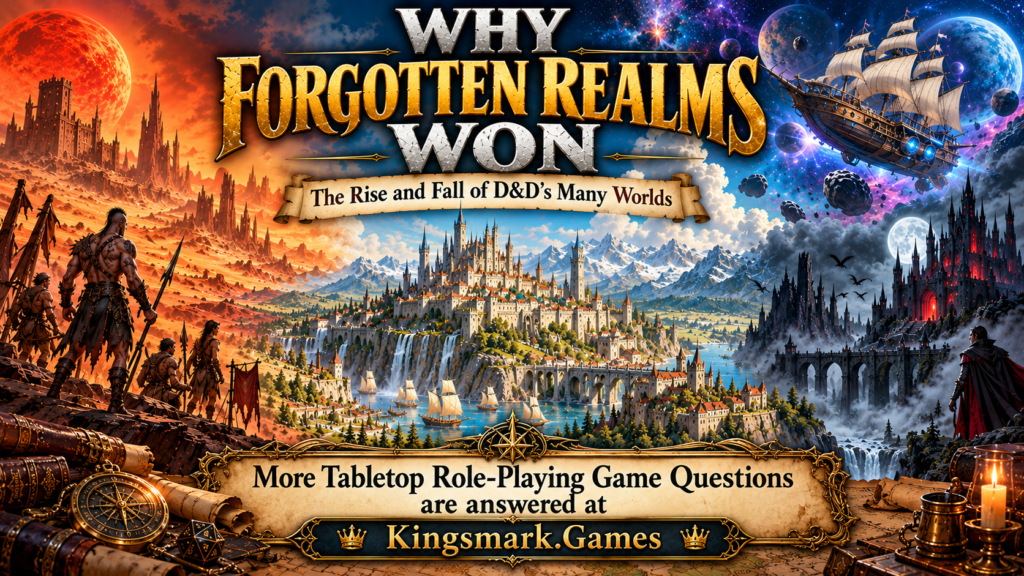
—and Why Did Forgotten Realms Win?
The fascinating history of Dark Sun, Spelljammer, Dragonlance, and the campaign settings that helped build—and nearly bankrupt—Dungeons & Dragons.
Imagine playing Dungeons & Dragons in a world where magic destroys the environment, metal weapons are rare, and survival is a daily struggle. Now imagine abandoning that world to sail through outer space aboard a magical wooden ship, only to arrive in another dimension ruled by vampires, or a sprawling fantasy continent filled with warring kingdoms and ancient civilizations. These were not competing role-playing games—they were all official campaign settings for Dungeons & Dragons.
Throughout the 1980s and 1990s, TSR produced an extraordinary collection of fantasy worlds, including Greyhawk, Dragonlance, Forgotten Realms, Spelljammer, Ravenloft, Dark Sun, Planescape, and Birthright. Each promised a different experience, yet Forgotten Realms eventually became the most enduring and commercially prominent setting associated with D&D. Understanding why requires examining the creative ambitions of TSR’s designers, the commercial pressures facing the company, and a particularly important distinction between developing an unusual fantasy world and building one that can accommodate almost any adventure.
Why TSR Kept Inventing New Campaign Settings
When Gary Gygax and Dave Arneson introduced Dungeons & Dragons in 1974, the idea of a published campaign setting was still developing. Early Game Masters frequently created their own fictional worlds, drawing maps, inventing kingdoms, populating dungeons, and borrowing freely from mythology, history, and fantasy literature. Gygax’s Greyhawk was one of the most influential examples, eventually becoming a commercially published setting that other people could use for their own adventures.
The important development came when publishers recognized that a fictional world could become much more than a collection of maps and adventure locations. A successful campaign setting could become an entire entertainment franchise, supported by adventures, supplements, novels, artwork, merchandise, and eventually computer games. The same imaginary geography could provide the foundation for thousands of different stories, created by professional writers and ordinary gaming groups alike.
Dragonlance demonstrated the enormous possibilities of this approach when TSR introduced it in 1984. Developed around an interconnected series of adventures and novels, its War of the Lance presented an epic fantasy narrative involving dragons, powerful villains, memorable heroes, and world-changing events. The accompanying novels by Margaret Weis and Tracy Hickman achieved considerable popularity, demonstrating that readers could become emotionally invested in a D&D world without necessarily playing the game themselves.
TSR subsequently pursued different audiences by developing settings with increasingly distinctive identities. Why limit the possibilities of fantasy adventure to medieval kingdoms when players might also enjoy gothic horror, post-apocalyptic survival, cosmic exploration, or political struggles between hereditary rulers? The company’s designers had legitimate creative ambitions, but its executives also recognized the opportunities to sell additional products.
This created a commercially attractive proposition: Every new world could potentially attract new players while giving existing customers another reason to purchase D&D products.
The difficulty was determining whether those worlds actually attracted new customers—or merely divided the spending of people who were already playing.
Dark Sun, Spelljammer, and the Worlds That Broke the Rules
Some of TSR’s most interesting settings emerged from designers asking a simple question: What else could Dungeons & Dragons become?
Consider Spelljammer, originally released in 1989. Designer Jeff Grubb imagined something magnificently ridiculous—a knight wearing plate armor aboard a wooden sailing vessel traveling through outer space. Instead of dismissing the idea as nonsense, he developed an entire cosmology involving magical spacecraft, unusual gravitational behavior, breathable air surrounding ships, and extraordinary civilizations scattered throughout the heavens.
In a 2012 interview, Grubb explained how that original image inspired Spelljammer’s distinctive physics. The setting also provided a means of traveling between established D&D worlds, allowing adventurers to leave one familiar campaign environment and explore another. It was a remarkable expansion of what fantasy exploration could mean, even if the underlying concept sounded like somebody had mixed medieval knights with Star Trek after drinking too much ale.
Ravenloft offered almost the opposite experience. Originally introduced through a 1983 adventure and expanded into a campaign setting in 1990, it drew inspiration from gothic horror, supernatural curses, haunted castles, and terrifying villains. Rather than concentrating primarily on heroic conquest and treasure hunting, Ravenloft encouraged stories involving fear, moral temptation, sinister mysteries, and survival against powerful supernatural enemies.
Then came Dark Sun in 1991, perhaps the clearest example of TSR’s willingness to challenge the established conventions of D&D. Its designers, including Tim Brown and Troy Denning, created Athas—a dying desert world devastated by magical exploitation and ruled by tyrannical sorcerer-kings. Familiar assumptions about abundant metal equipment, benevolent civilization, conventional fantasy species, and ordinary magic no longer applied.
Arcane spellcasting could drain life from the surrounding environment, making magic an important part of the world’s ecological catastrophe. Psionics occupied a prominent role, while characters encountered unusual playable peoples, monstrous dangers, brutal political systems, and survival challenges considerably different from those found in conventional fantasy campaigns. Even the artwork was extraordinary, with Gerald Brom establishing a powerful visual identity that distinguished Dark Sun from nearly everything else on TSR’s shelves.
In a fascinating 2021 interview with Dark Sun’s creators, Brown, Denning, and Brom discussed how the project developed. One particularly revealing detail concerns Brom’s artwork, which helped the designers recognize the visual identity they wanted for their setting. Dark Sun was not merely another fantasy world with different geography—it was a deliberate effort to make D&D look, feel, and play differently.
Planescape, released in 1994, pushed experimentation even further. Its extraordinary city of Sigil, interplanar factions, philosophical conflicts, and bizarre environments transformed the multiverse into a setting where beliefs and cosmic principles could become as important as swords and spells. Birthright followed in 1995, emphasizing bloodlines, political authority, kingdoms, and large-scale struggles for territorial power.
What made these settings valuable was not simply their originality. They encouraged different kinds of adventures and different approaches to the rules, demonstrating that the fundamental structure of a tabletop role-playing game could support substantially different experiences.
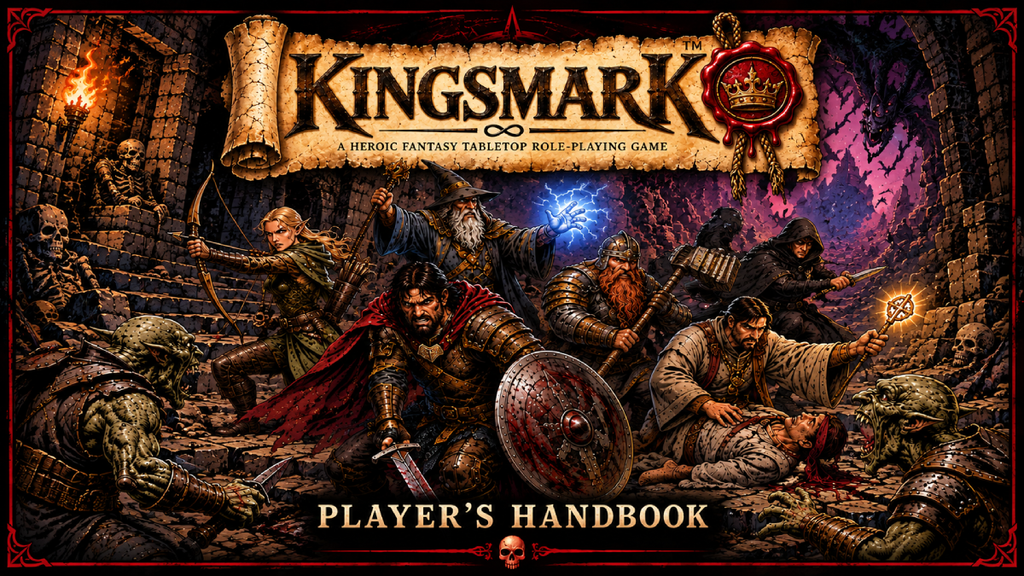
This remains an important lesson for modern designers. When developing ⭐Jack’s Cinematic d12 and the foundations of 👑Kingsmark, I pursued a similar objective from the opposite direction—creating a flexible underlying game engine that could eventually support different fictional worlds and historical periods without requiring an entirely new rules system.
Why Forgotten Realms Became D&D’s Most Enduring World
Forgotten Realms possessed an advantage that many competing settings lacked: It was already an extensively developed fantasy world long before TSR acquired it.
Its creator, Ed Greenwood, began imagining the Realms in 1967, initially as a setting for his fiction. He adapted the world for his own D&D campaigns in 1975, gradually developing its geography, civilizations, history, important personalities, religions, and political relationships. By the time TSR purchased the setting in 1986, Greenwood had accumulated nearly two decades of material that could provide the foundation for a remarkably detailed commercial product.
TSR published the original Forgotten Realms Campaign Set in 1987, with Jeff Grubb helping transform Greenwood’s extensive manuscripts and maps into something practical for publication. Grubb later revealed an especially important aspect of the project in a 2020 interview with Grognardia. Rather than treating every previously published adventure as belonging to an unrelated world, the designers deliberately incorporated existing TSR projects into Forgotten Realms.
The Bloodstone adventures helped establish Vaasa and Damara, while previously developed material found a home in other parts of the setting. Douglas Niles had already been developing a novel for a canceled project, and that material was adapted into the first Forgotten Realms novel. This wasn’t simply a matter of Greenwood having invented an interesting continent—it demonstrated TSR’s intention to create an expansive environment that could accommodate an enormous variety of material.
Grubb summarized that ambition perfectly: “We wanted the Realms to be a place where you could put just about everything.”
That philosophy explains much of Forgotten Realms’ extraordinary durability. A Game Master could conduct an adventure involving political intrigue in Waterdeep, a dangerous wilderness expedition, the investigation of ancient magical ruins, or a military campaign involving rival kingdoms. Another could concentrate upon criminal organizations, forbidden magic, supernatural mysteries, religious conflicts, or ordinary adventurers struggling to survive.
Compare that versatility with the distinctive identities of TSR’s more specialized settings. Dark Sun was built around the harsh realities of Athas, while Ravenloft emphasized gothic horror and Spelljammer encouraged exploration through fantastical space. Those identities were tremendous creative strengths, but they also established particular expectations about the kinds of adventures players would experience.
Forgotten Realms could accommodate many of those same storytelling elements without requiring the Game Master to abandon the setting’s established foundation. It offered enough geographical and cultural diversity to support numerous genres, while providing the familiar infrastructure of medieval fantasy—kingdoms, cities, castles, wildernesses, powerful organizations, and ancient civilizations. Greyhawk also offered considerable flexibility, but the Realms increasingly benefited from extensive publishing support and widespread recognition.
This kind of versatility is something I consider particularly important when developing a campaign world. In The World is Flat: Discover the Seven Continents of Sylva, I explain why the world of 👑Kingsmark contains more than 100 nations distributed across seven continents. My objective is not to dictate what adventures every Game Master must conduct, but to provide enough geographical and cultural variety that radically different stories can emerge within the same fictional world.
A believable setting also benefits from locations that possess histories independent of the adventurers. An ancient fortress should exist because somebody once needed a fortress, not merely because the Game Master wanted a convenient place to put six monsters and a treasure chest. This principle is explored in How to Create a Dungeon Adventure, where the history and purpose of a location become foundations for meaningful exploration.
Yet geography and flexibility alone do not explain the Realms’ success. TSR also developed an extraordinary network of novels, characters, and computer games that helped make the setting familiar to people who had never purchased a campaign guide.
Douglas Niles’s Darkwalker on Moonshae appeared in 1987, even before the original Forgotten Realms boxed set reached stores. R. A. Salvatore’s The Crystal Shard followed in 1988, introducing Drizzt Do’Urden, who would become one of the most recognizable characters associated with Dungeons & Dragons. Elminster, the Harpers, and other personalities and organizations further established the Realms as a living fictional environment with stories extending beyond the adventures of individual gaming groups.
Computer games reinforced this popularity. Pool of Radiance brought the Realms to personal computers in 1988, while BioWare’s Baldur’s Gate introduced another generation of players to the Sword Coast in 1998. The extraordinary success of Baldur’s Gate 3 in 2023 demonstrated that the setting could remain commercially relevant decades after its original publication.
This produced a powerful cycle: Established popularity encouraged additional development, and additional development made the setting even more familiar.
Forgotten Realms did not necessarily possess better game design, more interesting cultures, or superior storytelling than every competitor. Dragonlance also produced exceptionally successful novels, while Dark Sun and Planescape offered creative experiences that the Realms did not necessarily reproduce with equal effectiveness. What distinguished Forgotten Realms was the combination of an accessible fantasy foundation, extraordinary versatility, accumulated worldbuilding, recognizable characters, and sustained commercial exposure across multiple forms of entertainment.
The Business Problem That Helped Destroy TSR
There was, unfortunately, a serious problem with TSR’s enthusiasm for producing new campaign settings. Creating more products does not automatically create more customers, and a publisher can expand its catalog while making its business increasingly difficult to sustain.
Imagine a Game Master with enough disposable income to purchase three D&D books during a particular month. If TSR releases a new Forgotten Realms supplement, he might purchase it immediately, but perhaps Dark Sun attracts his attention instead. He buys the Dark Sun material, enjoys it enormously, and consequently spends less money on Forgotten Realms.
TSR has not necessarily acquired a new customer. It may simply have persuaded an existing customer to divide his purchases between two competing product lines, both of which require writers, editors, artists, printing, advertising, inventory, and distribution. Multiply that problem across Dragonlance, Greyhawk, Ravenloft, Spelljammer, Planescape, Birthright, and other settings, and the commercial challenge becomes increasingly serious.
Historian Ben Riggs explored this problem extensively in Slaying the Dragon: A Secret History of Dungeons & Dragons, drawing upon financial records, correspondence, and interviews with former TSR employees. His research demonstrates how the company’s remarkable creativity existed alongside increasingly dangerous business decisions. TSR produced numerous beautiful and ambitious products, but the cost of creating and distributing those products could overwhelm the revenue they generated.
One of Riggs’s most revealing examples concerns Planescape. In a 2022 interview with WIRED, he explained that the entire original Planescape product line reportedly failed to generate a profit, despite its exceptional artistic and creative reputation. Riggs also described how some elaborate Dark Sun adventures were produced with expensive presentation features that made them financially unsustainable at their selling prices.
This is a particularly painful lesson because the problem wasn’t necessarily that customers disliked the products. Some of TSR’s most imaginative creations became commercially troublesome precisely because the company invested so heavily in making them extraordinary. Beautiful illustrations, elaborate maps, specially designed booklets, and unusual accessories cost money—and somebody has to pay for all that magnificent stuff.
Of course, TSR’s eventual financial crisis involved considerably more than an excessive number of campaign settings. Its problems included questionable management decisions, substantial debt, distribution arrangements, product returns, inventory difficulties, and unsuccessful commercial ventures. By 1997, the company was in serious financial trouble, and Wizards of the Coast acquired TSR and its properties.
The broader issue was that TSR had increasingly confused publishing more material with growing a sustainable audience. New settings could produce enthusiasm, but enthusiasm did not guarantee profitability, particularly when existing customers were expected to support numerous competing product lines.
This distinction remains relevant to independent tabletop designers. A game system needs sufficient depth to support interesting adventures, but that does not necessarily mean producing a separate rulebook for every possible situation or requiring customers to purchase an entire library before they can enjoy the game. As discussed in Early RPG Simplicity or Modern TTRPG Complexity?, the important question is not how many pages or products a designer creates, but whether those materials genuinely improve the experience.
What Wizards of the Coast Learned
When Wizards of the Coast acquired TSR in 1997, it did not immediately abandon the idea of multiple campaign settings. Third Edition, released in 2000, used Greyhawk as its implied default setting, and Wizards published an updated Forgotten Realms campaign book in 2001. The company also remained interested in developing completely new fantasy environments.
In 2002, Wizards announced its Fantasy Setting Search, inviting proposals from both professional designers and ordinary enthusiasts. The initiative attracted approximately 11,000 submissions and ultimately produced Keith Baker’s Eberron, published in 2004. Eberron introduced a distinctive combination of pulp adventure, intrigue, magical technology, and noir-inspired storytelling while remaining compatible with the broader D&D rules framework.
In a 2019 interview published by Keith Baker, former D&D research and development director Bill Slavicsek explained that Wizards wanted something genuinely new while retaining enough familiar D&D elements to make the setting accessible. Eberron demonstrated that commercial publishers could continue experimenting creatively without necessarily abandoning their established mechanical foundations.
Forgotten Realms nevertheless remained one of D&D’s most prominent settings, particularly throughout Fifth Edition. Wizards reinforced that position in November 2025 with Forgotten Realms: Heroes of Faerûn and Forgotten Realms: Adventures in Faerûn, demonstrating the world’s continued importance nearly four decades after its original commercial publication. Other settings remain part of D&D, but the Realms have achieved a particularly durable position within the franchise.
There is a valuable distinction between having one adaptable game engine and insisting that every campaign must take place in exactly the same fantasy world. A flexible game system can support numerous environments, and an expansive campaign setting can accommodate dramatically different adventures. The important thing is to understand what players actually gain from that flexibility.
For example, 👑Kingsmark’s ▶️Action Scenes, 🗨️Dialog Scenes, and 📜Magic System provide procedures that can support different kinds of challenges without requiring a completely different game engine for each fictional environment. Meanwhile, 🪱The Gloom introduces supernatural conditions that can influence the atmosphere and dangers of particular locations, allowing elements of horror to emerge naturally within a larger heroic fantasy world.
Why One World Endured
TSR deserves considerable recognition for the extraordinary range of experiences its designers brought to Dungeons & Dragons. Dark Sun challenged familiar fantasy conventions, Spelljammer opened the heavens to exploration, Ravenloft embraced gothic horror, and Planescape demonstrated how philosophy and cosmology could shape entire adventures. These worlds were not necessarily inferior to Forgotten Realms—they were attempting to accomplish different things.
Forgotten Realms became exceptionally successful because it combined the depth of an established fictional world with the flexibility to accommodate countless stories, designers, Game Masters, and players. Its geography, history, recognizable characters, novels, and computer games reinforced one another over decades, creating an entertainment property whose reputation extended far beyond tabletop gaming.
The most enduring fantasy world isn’t necessarily the strangest, the largest, or the most original. Sometimes it’s the world that gives the greatest number of people the greatest number of opportunities to create their own adventures.
That is an important principle behind my own ambitions for 👑Kingsmark and the world of Sylva. I want players to experience extraordinary heroic adventures within an expansive, believable setting, supported by a game system capable of handling meaningful decisions, dangerous combat, supernatural mysteries, and the countless unpredictable situations that make tabletop role-playing games so entertaining.
👑Kingsmark is FREE to read online at Kingsmark.games. Support the game by purchasing a digital copy.
About The Author