💋 The Hotness Bonus
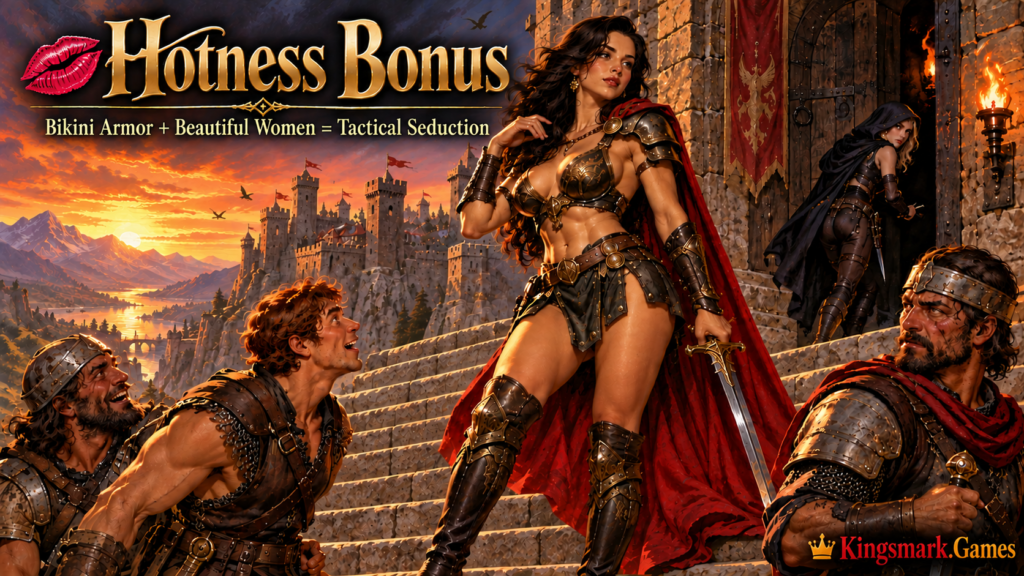
Bikini Armor, Beautiful Women, and the Logic of Fantasy
A look at the history of beautiful women in fantasy art, the absurdity of bikini armor, psychological warfare, and why Kingsmark gives provocative clothing an actual purpose.
By John Alan Martinson — Creator of Kingsmark
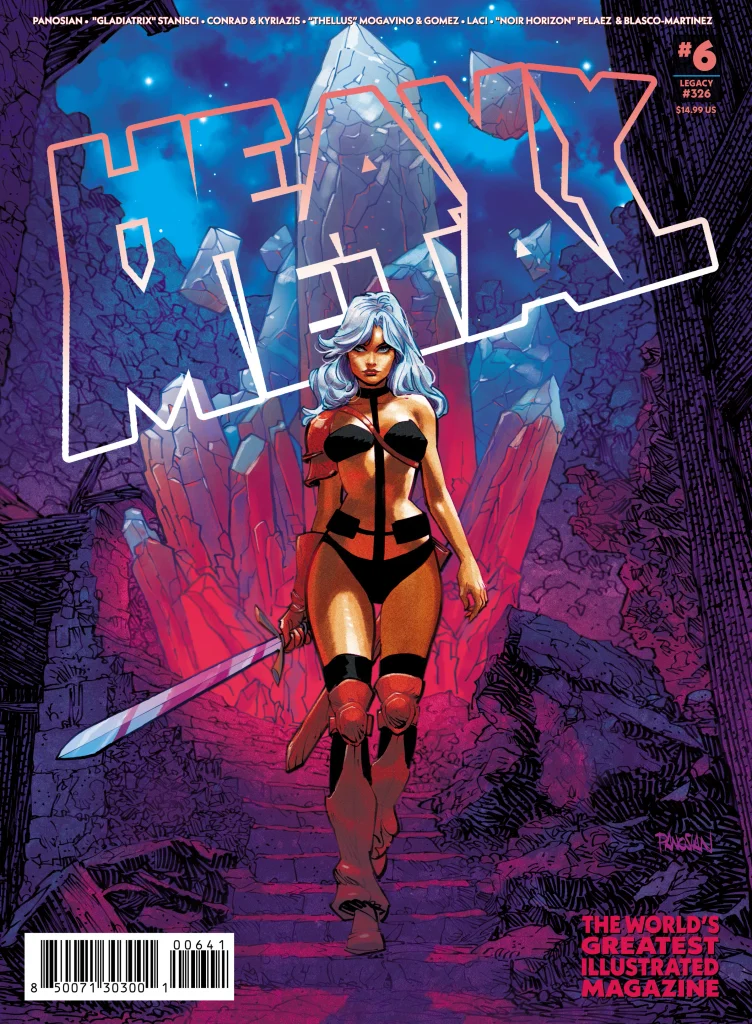
I remember being about eleven years old, visiting a little bookstore in downtown Toledo, Ohio, and discovering something that immediately captured my imagination: Heavy Metal magazine. The covers featured extraordinary fantasy and science-fiction artwork, frequently depicting beautiful women in wonderfully improbable outfits, surrounded by monsters, warriors, futuristic machinery, and strange worlds. Naturally, I wanted a copy. Unfortunately, acquiring one required convincing my mother that purchasing this particular magazine was a perfectly reasonable investment in her son’s artistic and literary education.
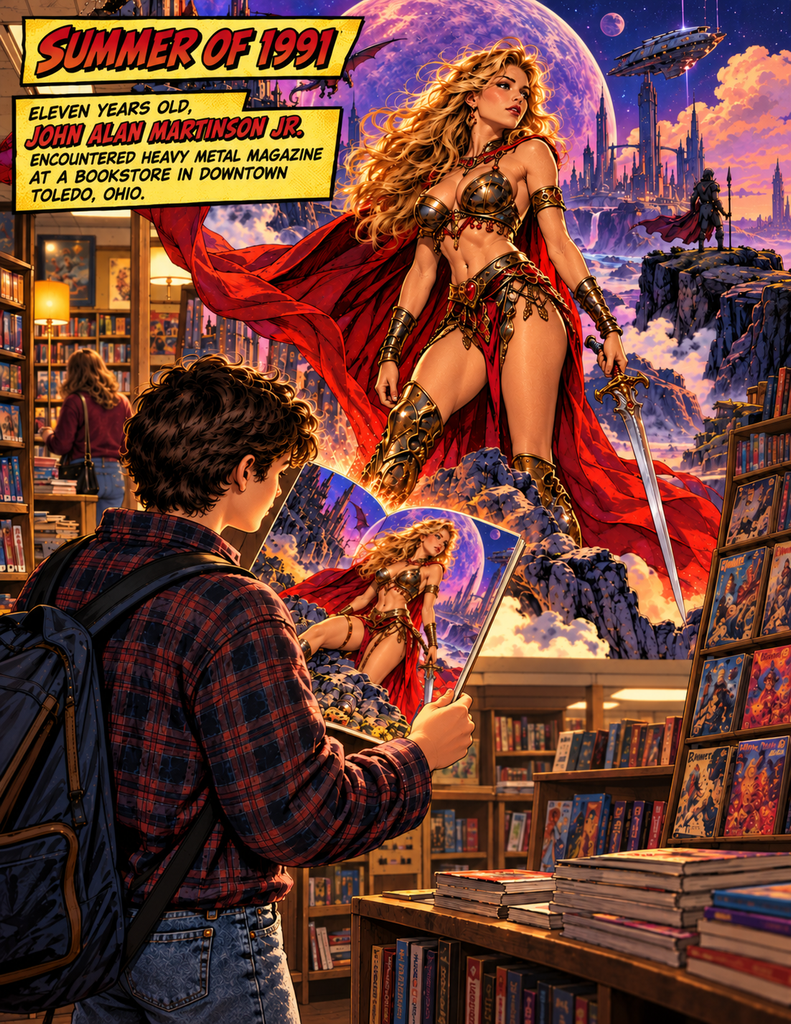
I don’t remember whether my arguments were especially persuasive. I suspect they weren’t. But I remember the artwork, and I remember wanting to explore the worlds those illustrations suggested.
Decades later, I’m designing Kingsmark, a heroic fantasy tabletop role-playing game for mature players, and that artistic tradition remains an important influence. I love beautiful women, fantastic costumes, dangerous monsters, muscular warriors, mysterious sorceresses, and the kind of spectacular fantasy imagery that makes someone stop and examine a painting rather than casually scroll past it.
I make no apologies for those preferences. However, as a game designer, I also have a habit of examining familiar fantasy conventions and asking a rather inconvenient question: Why?
Why do adventurers always meet in taverns? Why are fantasy worlds riddled with underground tunnels and enormous dungeons? Why do dragons collect treasure? And why, in the name of all that is reasonable, would a beautiful warrior woman charge into battle wearing a metal bikini?
That last question deserves more consideration than it usually receives. In Kingsmark, I’ve attempted to give the legendary bikini-armored warrior something that many fantasy games have neglected to provide: a logical reason for dressing that way, along with meaningful mechanical consequences.
I call it the 💋 Hotness Bonus.
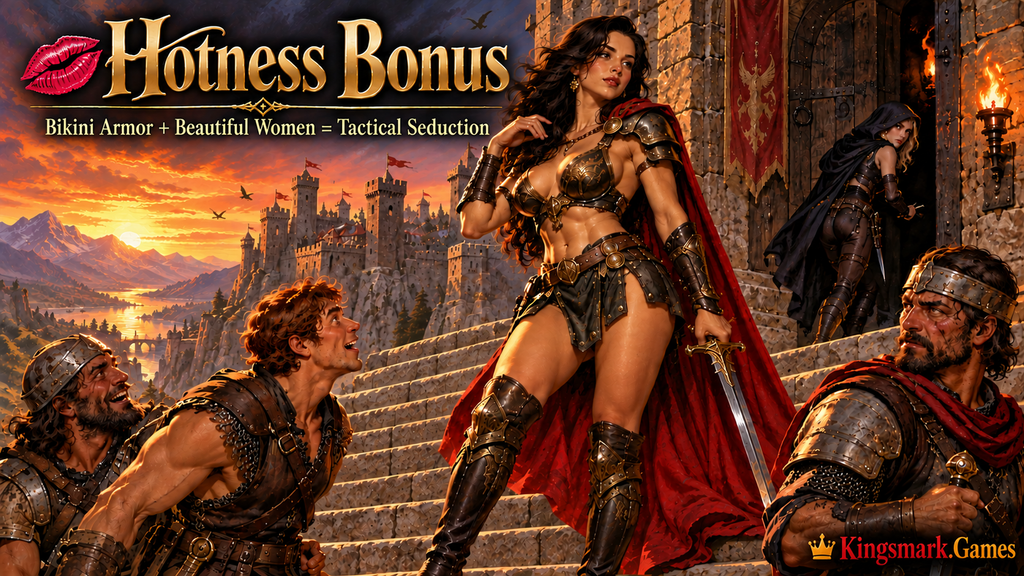
Beautiful Women, Dangerous Worlds, and the Art That Made Fantasy Famous
Fantasy literature is considerably older than modern role-playing games, pulp magazines, or even the modern novel. Ancient civilizations told stories about gods, monsters, supernatural creatures, enchanted weapons, heroic journeys, and extraordinary women. Greek mythology gave us Amazons, goddesses, enchantresses, and formidable female figures such as Circe and Medea. Medieval literature introduced generations of readers to supernatural temptresses, dangerous enchantresses, warrior women, and mysterious queens.
The modern fantasy genre emerged gradually from these older traditions, drawing upon mythology, folklore, Gothic literature, Romanticism, adventure fiction, and nineteenth-century supernatural storytelling. Writers such as William Morris, George MacDonald, and Lord Dunsany helped establish the literary foundations of modern fantasy long before Dungeons & Dragons existed.
But the particular combination of beautiful women, scanty costumes, monsters, swords, sorcery, and spectacular violence that many of us associate with fantasy artwork owes an enormous debt to the illustrated pulp magazines of the early twentieth century.
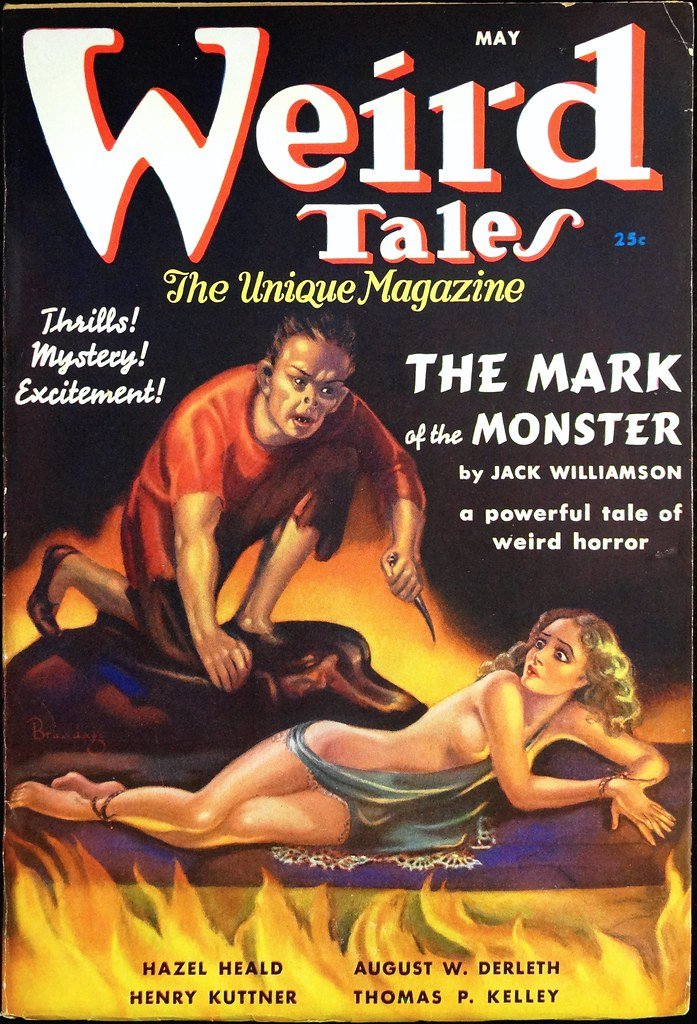
Weird Tales, first published in 1923, became one of the most important American magazines devoted to supernatural horror and fantasy. Its pages introduced readers to stories by Robert E. Howard, H. P. Lovecraft, Clark Ashton Smith, and other influential writers. Howard’s Conan stories, beginning with “The Phoenix on the Sword” in 1932, helped establish the sword-and-sorcery tradition that would influence fantasy fiction, comics, films, and tabletop gaming for generations.
The magazine’s covers were almost as important as its stories. They promised strange civilizations, sinister rituals, supernatural dangers, beautiful women, and adventures that respectable literary establishments might have considered somewhat disreputable.
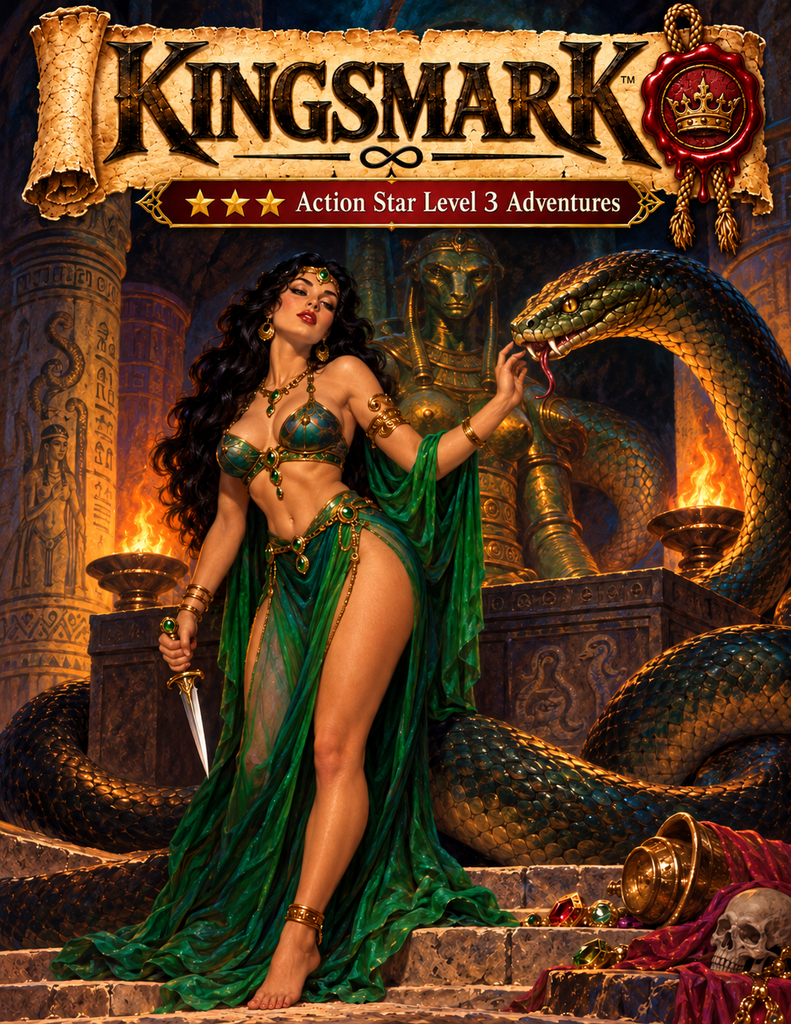
One of the most significant artists was Margaret Brundage, whose illustrations became closely associated with Weird Tales during the 1930s. Brundage frequently depicted beautiful, partially clothed or nude women in scenes of supernatural danger, captivity, and mystery. Her artwork helped establish the magazine’s visual identity.
There is something wonderfully inconvenient about this historical fact for anyone inclined to assume that provocative fantasy artwork was exclusively invented by men for male audiences: one of the genre’s most influential early illustrators was a woman.
Brundage was not alone. J. Allen St. John, Virgil Finlay, Hannes Bok, and other artists helped develop the visual language of pulp fantasy. Their illustrations combined danger, mystery, erotic suggestion, extraordinary architecture, and fantastic creatures into something instantly recognizable.
Later generations took these traditions much further.
Frank Frazetta became one of the defining fantasy artists of the twentieth century. His paintings featured powerful barbarians, monstrous creatures, beautiful women, dramatic landscapes, and an almost physical sense of danger. His characters looked capable of violence, desire, triumph, and catastrophe. Frazetta’s fantasy was rarely polite, and it certainly wasn’t designed to resemble an employee handbook.
Artists such as Boris Vallejo, Julie Bell, and Luis Royo continued developing their own interpretations of heroic and sensual fantasy. Their work celebrated the human body, often combining idealized physical beauty with fantastic armor, supernatural creatures, and dramatic adventure.
Then came Heavy Metal.
The American magazine debuted in April 1977, drawing heavily from the French illustrated science-fiction and fantasy magazine Métal Hurlant. Its pages introduced American audiences to extraordinary European comics and artists, including Jean Giraud, better known as Mœbius, Philippe Druillet, and others whose work expanded the possibilities of illustrated fantasy.
Heavy Metal was not merely a magazine featuring attractive women. It presented elaborate imagined civilizations, philosophical science fiction, bizarre humor, horror, violence, eroticism, and visual experimentation. Some stories were profound. Others were outrageous. Occasionally, a story seemed to exist primarily because an artist had imagined a magnificent spaceship, an astonishing monster, or a beautiful woman wearing something that would make a medieval tailor question his career choices.
I loved that tradition, and I still do.
It is also worth remembering that fantasy artwork has always celebrated idealized men. Frazetta’s barbarians were not generally middle-aged accountants with poor posture and modest upper-body strength. They were powerful, muscular, dangerous men, frequently wearing very little clothing themselves.
I have never felt personally victimized because Conan possesses better abdominal muscles than I do. I understand that I’m looking at heroic fantasy, not a documentary about ordinary human anatomy.
The same principle applies to beautiful fantasy women. Their appearance can be exaggerated, romanticized, sensual, theatrical, or completely impractical without automatically making the artwork worthless. A fantasy painting is allowed to celebrate beauty. It is allowed to be extravagant. It is even allowed to be sexy.
Of course, appreciating an illustration and designing a functioning game system are two different things. The moment that magnificent warrior woman steps out of the painting and onto the battlefield, the game designer has some questions to answer.
Bikini Armor: Apparently, Nobody Thought to Ask Why
Consider a familiar fantasy scene. A beautiful warrior woman stands before an enormous dragon. She wears an armored bra, a leather thong, tall boots, perhaps a pair of shoulder guards, and a sword that looks capable of cutting through a small tree.
She looks magnificent.
She also appears to have forgotten approximately eighty percent of her armor.
Now, fantasy fiction does not have to obey every principle of historical military equipment. We are dealing with dragons, wizards, enchanted weapons, and civilizations that may possess magical technologies unavailable to medieval Europeans. There is plenty of room for imagination.
Nevertheless, I believe a fantasy world becomes more interesting when its extraordinary elements have understandable consequences.
In many role-playing video games, armor becomes particularly absurd. A male warrior might equip an enormous steel breastplate that covers his entire torso, while the equivalent equipment for a female character resembles something purchased from an unusually aggressive swimwear manufacturer. Both receive comparable protective statistics.
Some games go further by allowing characters to retain a chosen cosmetic appearance while equipping completely different protective equipment. Cosmetic systems are useful for players who want to control their characters’ appearance, but they also demonstrate how easily physical protection can become disconnected from what the character visibly wears.
There is nothing inherently wrong with magical armor, cosmetic customization, or exaggerated fantasy costumes. The problem arises when the game asks us to treat a few decorative pieces of metal as though they provide the same physical protection as a complete suit of armor, without offering any explanation.
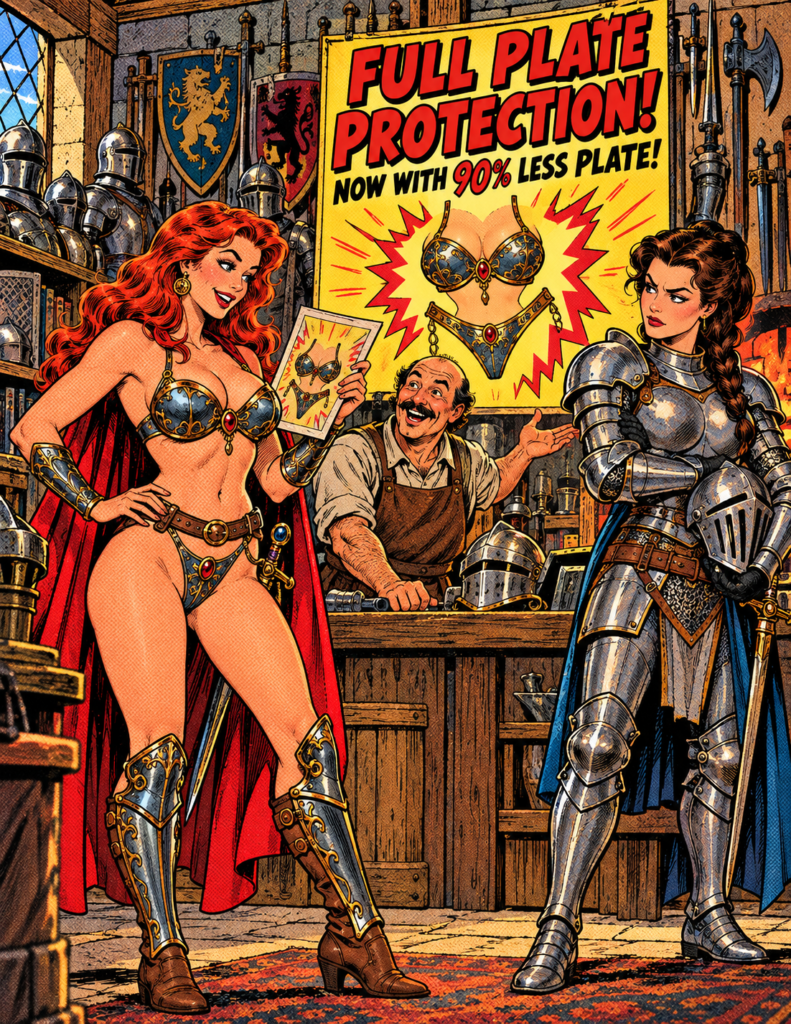
In Kingsmark, exposed flesh remains exposed.
The game’s armor system recognizes twelve 🎯 Hit Locations, and equipment protects the portions of the body that it actually covers. A steel plate over a woman’s breasts can protect those areas against certain attacks. It cannot simultaneously protect her abdomen, back, thighs, and neck through the mysterious defensive properties of wishful thinking.
An arrow striking her unprotected abdomen does not become less dangerous because her outfit looks spectacular.
This is part of a larger design philosophy running throughout Kingsmark. I enjoy examining established fantasy conventions and asking how they might function in a world with believable institutions, histories, and consequences.
Take the classic Adventurers’ Tavern. In countless fantasy adventures, a group of armed strangers meets in a tavern, accepts a dangerous assignment, and begins traveling together. There is nothing particularly mysterious about adults gathering in drinking establishments. People have been doing that for thousands of years, frequently making questionable decisions afterward.
But why would professional adventurers consistently find employment in such places?
Kingsmark develops the 🍺 Adventurers’ Tavern into an established institution, giving this familiar fantasy meeting place a recognized function within society. Rather than merely assuming that every tavern conveniently contains unemployed monster hunters, the world provides a reason for adventurers and prospective employers to gather there.
The same reasoning helps explain the prevalence of underground construction throughout Sylva. In a world where dangerous flying creatures occasionally threaten settlements, subterranean passages, shelters, storage facilities, and defensive structures become more than convenient locations for dungeon adventures. They are understandable responses to the dangers of the environment.
If dragons and other aerial predators can attack from above, people eventually begin thinking seriously about roofs, tunnels, and places where enormous flying monsters cannot easily reach them.
Not every fantasy convention requires an elaborate explanation. Sometimes a dragon hoards gold because dragons have always hoarded gold, and that is perfectly sufficient for the story being told. But asking why a dragon desires treasure might lead to an interesting discovery about its intelligence, instincts, culture, or supernatural nature.
This brings us back to bikini armor.
Instead of simply eliminating revealing armor from the game, I decided to ask whether a woman might have a legitimate reason to wear it. Could her appearance influence the behavior of other characters? Could provocative clothing create opportunities that conventional armor would not? Could an attractive woman deliberately exploit an opponent’s assumptions, desires, or weaknesses?
And, perhaps most importantly, could those advantages be represented mechanically without pretending that sexual attractiveness makes swords bounce harmlessly off exposed skin?
I believe the answer is yes.
But the answer requires understanding that not every confrontation is won by killing the enemy.
💋 The Hotness Bonus: When Looking Good Becomes a Tactical Decision
One of my favorite examples of unconventional battlefield tactics comes from the original Rome: Total War, released in 2004.
Players commanding the Germanic faction can recruit a unit called Screeching Women. These women carry weapons and can participate in combat, but their real value lies in their psychological effects upon the battlefield. Their screams can undermine enemy morale, while their presence and encouragement contribute to the fighting spirit of their own warriors.
They are poorly protected and generally unsuitable for prolonged combat against heavily armed opponents. Their effectiveness comes primarily from what they do to the minds of the soldiers around them.
Interestingly, this idea has an ancient historical foundation.
The Roman historian Tacitus, writing in Germania around AD 98, described Germanic warriors fighting with their families nearby. He wrote about women encouraging their men, attending to wounded warriors, and, according to traditions he recorded, helping rally armies that were beginning to retreat.
Tacitus even described women exposing their breasts while pleading with retreating warriors and reminding them of the horrors of captivity. His account was not a description of women using sexual seduction against enemy soldiers. Rather, it concerned family loyalty, shame, courage, and the psychological consequences of defeat. As with any ancient ethnographic account, his descriptions should be read critically rather than treated as a precise military field report.
Nevertheless, the underlying principle is important: the behavior of people who are not directly killing enemies can influence the outcome of a battle.
Military history provides countless examples of psychological influence. Armies have employed terrifying masks, intimidating uniforms, banners, drums, horns, battle cries, elaborate demonstrations of strength, and deliberate deception. Commanders have attempted to frighten enemies into retreating, encourage their own soldiers to stand firm, or convince opponents that resistance is hopeless.
A soldier who abandons his position because he believes he is surrounded has been defeated even if nobody has wounded him. A frightened guard who runs away may be just as useful to an infiltrator as a dead guard, and considerably less troublesome afterward.
In modern warfare, suppressing fire provides another example of how battlefield effectiveness extends beyond directly inflicting casualties. A machine gun can prevent enemy soldiers from moving freely, observing their surroundings, or returning effective fire. The psychological and tactical consequences of being under fire can matter as much as the injuries inflicted.
Kingsmark takes these possibilities seriously. An ▶️ Action Scene is not merely an exercise in reducing opponents to zero Hit Points. Characters can employ intimidation, deception, positioning, magic, social manipulation, and other tactics to influence the outcome.
Magic itself does not need to cause physical damage to be decisive. A spell that conceals an approaching party, obstructs a passage, frightens an opponent, or otherwise changes the circumstances of an encounter may accomplish more than a spectacular explosion.
Likewise, a beautiful woman can sometimes accomplish something that a heavily armored warrior cannot.
How the Hotness Bonus actually works
The 💋 Hotness Bonus represents the situational social advantage an attractive adult woman may gain by deliberately using provocative clothing, revealing armor, flirtation, or sexually suggestive presentation to influence someone who finds her attractive.
It is not mind control. It does not automatically affect every man, and it does not make enemies incompetent merely because an attractive woman enters the room.
Kingsmark distinguishes between appearance and the ability to influence other people. Attractiveness describes how a character looks, while Social Skills determine how effectively she attempts to influence someone. The Hotness Bonus modifies appropriate interactions when the circumstances support it.
The system provides four degrees of provocative presentation:
💋 −1 Advantage — Provocative. An armored bra, revealing warrior harness, skimpy armored skirt, or similarly provocative outfit can provide a modest advantage when deliberately used to influence a susceptible observer.
💋 −2 Advantage — Extremely Revealing. An armored bikini bottom, complete armored-bikini outfit, or similarly revealing presentation can provide a stronger situational advantage.
💋 −3 Advantage — Scandalously Revealing. Clothing so minimal that the wearer appears almost disrobed can provide the maximum Hotness Bonus obtainable from garments.
💋 −4 Advantage — Disrobed. Deliberately disrobing to exploit sexual attraction represents an exceptional circumstance that can provide an even greater advantage against a genuinely susceptible target.
These ratings use Kingsmark’s existing Advantage mechanics. They do not represent a universal penalty imposed upon every opponent who happens to look at the woman.
The distinction is essential.
A beautiful warrior approaching an inexperienced guard might persuade him to open a gate, reveal information, approach her, lower his suspicions, or become distracted while another adventurer moves into position. An arrogant fighter might underestimate her because of her appearance. A boastful mercenary might accept a foolish challenge to impress her.
A disciplined veteran, however, might recognize the manipulation immediately.
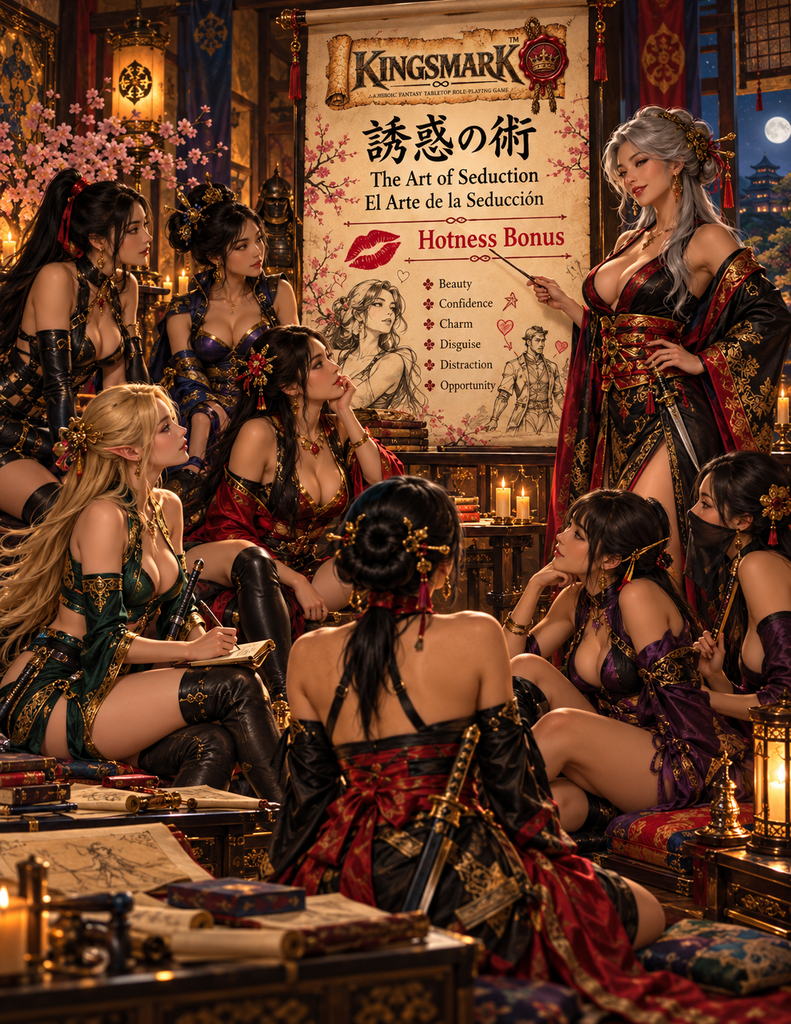
Under Kingsmark’s rules, opponents of Level 3 / Terror 3 or higher are normally too experienced or disciplined to be affected merely because an attractive woman wears provocative clothing. Individual exceptions are possible, but they must arise from the character’s established personality or circumstances.
Personal loyalty, religious conviction, professional training, sexual preference, immediate danger, or simple lack of interest may also render the tactic ineffective.
A deeply religious guard might regard a woman’s deliberate disrobing as disgraceful rather than enticing. Another guard might become so distracted that he forgets why he was standing beside the gate in the first place.
The Game Master determines how the individual responds.
This is an important limitation because I have no interest in creating a rule that assumes every man is a helpless fool who loses his intelligence whenever he encounters an attractive woman. Such a mechanic would be as ridiculous as the imaginary armor protection I am attempting to avoid.
The equipment is real, and so are its limitations
Kingsmark’s equipment chapter contains an assortment of deliberately provocative armor. Some items are practical within their limited Coverage, while others are extravagant enough to make a respectable armorer reconsider his professional reputation.
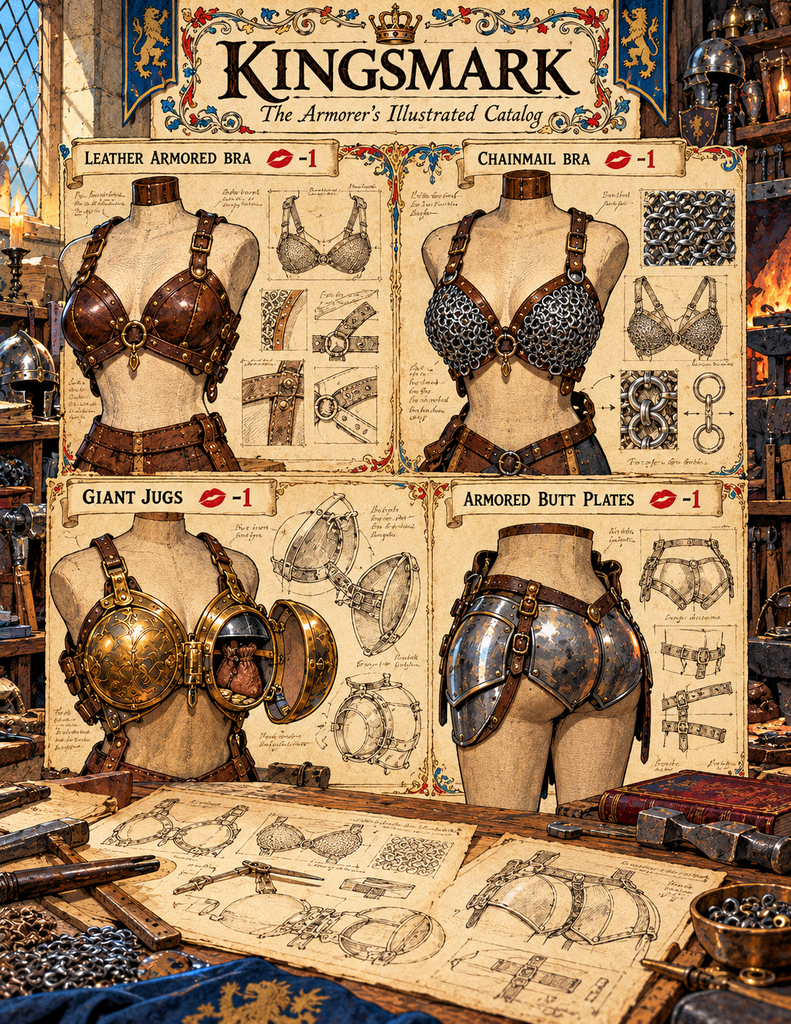
The 👙 Leather Armored Bra, costing 5 Silver, provides genuine leather protection to the front of the Upper Torso where it covers the breasts. It also carries a 💋 −1 Hotness rating. The 👙 Chainmail Bra, costing 1 Gold, provides stronger protection against certain attacks, particularly blades, while retaining the same Hotness rating.
Neither protects the woman’s uncovered abdomen, back, shoulders, or arms.
Other equipment includes 🍑 Armored Butt Plates, costing 2 Gold, which protect the buttocks while leaving surrounding areas exposed. They also carry a 💋 −1 rating.
Then there are 🍈 Giant Jugs, an especially ridiculous piece of equipment that I included because fantasy should occasionally be allowed to enjoy itself. These are oversized armored false breasts with concealed storage compartments capable of carrying up to four pounds of small items. They provide additional protection where the plates actually cover the body and carry a 💋 −1 Hotness rating.
Yes, a woman can conceal coins, potions, or other small equipment inside her armored breasts.
I realize this may offend the solemn dignity of certain fantasy purists. I trust they will eventually recover.
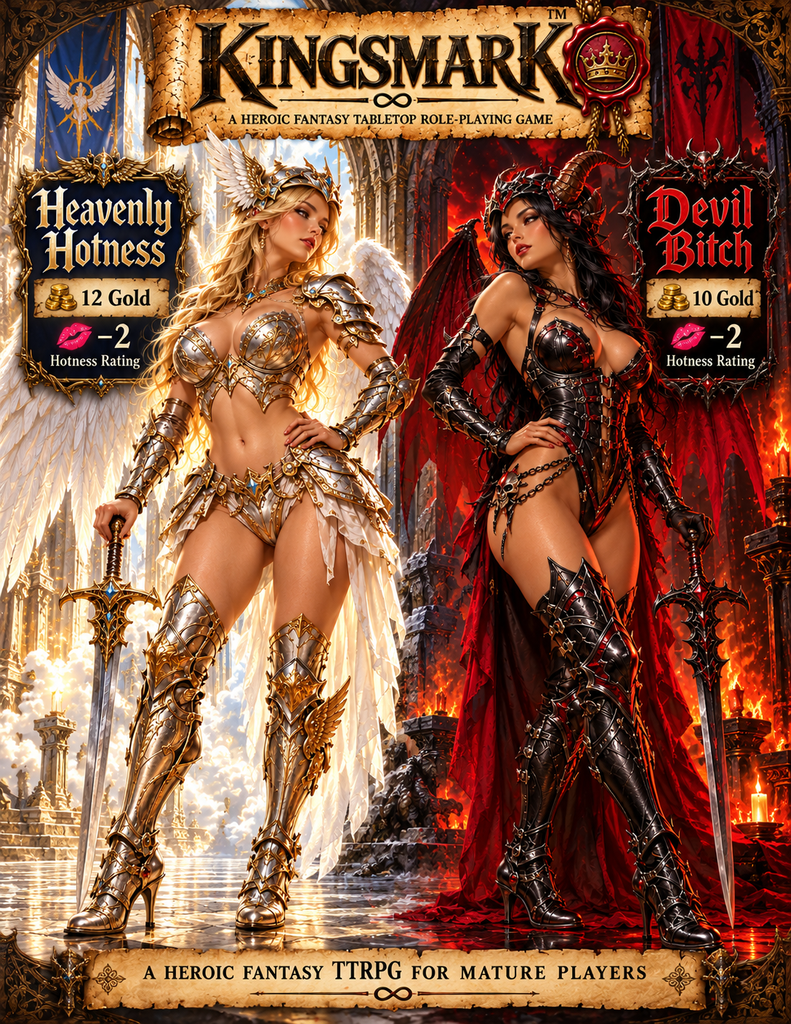
Two particularly elaborate outfits are 😇 Heavenly Hotness and 😈 Devil Bitch.
Heavenly Hotness, costing 12 Gold, is an ornate ensemble associated with some female Holy Knights and Shield Maidens. It combines polished breast plates, shoulder and forearm protection, groin and buttock armor, shin guards, armored boots, and a small open-faced helmet. Its white, silver, and gold styling creates a radiant, heroic appearance, while substantial portions of the body remain exposed.
Devil Bitch, costing 10 Gold, takes a darker approach, combining black leather, metal plates, spikes, and an intimidating appearance. It offers a different arrangement of protective components and a considerably more sinister aesthetic.
Both carry a 💋 −2 Hotness rating.
Neither outfit is an invisible force field. The armor protects the locations and surfaces identified in its equipment description, while uncovered areas remain vulnerable.
This creates an actual choice. A warrior can prioritize comprehensive protection, or she can sacrifice some Coverage in exchange for mobility, visual presentation, and opportunities for social or psychological manipulation.
Those opportunities are situational, and the risks are real.
Winning the encounter without drawing blood
Imagine a beautiful Kunoichi approaching a guarded fortress entrance. She wears a revealing outfit and carries herself with apparent confidence and innocence. Two guards stand beside the gate.
One is an inexperienced young soldier who finds her extremely attractive. The other is a suspicious veteran who has spent twenty years dealing with smugglers, thieves, and people whose explanations become increasingly elaborate when questioned.
The Kunoichi begins flirting with the younger guard, encouraging him to boast about his responsibilities and the importance of the fortress. He enjoys the attention and begins talking more freely than he should.
The Game Master determines that her 💋 Hotness Bonus applies to an appropriate social interaction because the guard is genuinely susceptible.
Meanwhile, another adventurer quietly moves toward an alternate entrance.
The veteran is not impressed. He recognizes that something is wrong and begins questioning the woman more aggressively. The Kunoichi must now decide whether to continue the deception, retreat, change tactics, or risk escalating the encounter.
Nothing about her appearance guarantees success. Her clothing has not disabled the guards, and the veteran has not forgotten his duties.
Nevertheless, she has created a tactical opportunity.
Perhaps the younger guard reveals information that helps the party avoid a dangerous confrontation. Perhaps he moves away from his assigned position, allowing an accomplice to pass unnoticed. Perhaps the Kunoichi deliberately encourages him to underestimate her, placing herself in a favorable position if violence becomes unavoidable.
The encounter might be won without anyone drawing a weapon.
This is the kind of possibility I want Kingsmark to encourage. Intelligence, creativity, social manipulation, and psychological tactics should matter alongside courage, physical strength, and magical ability.
A beautiful woman wearing provocative armor can be an intelligent, dangerous, highly capable adventurer. Her appearance is one characteristic among many, and using it effectively requires judgment.
Of course, revealing clothing can also attract unwanted attention. Kingsmark acknowledges that a provocatively dressed woman may be approached, remembered, underestimated, challenged, or bothered by people whose interest she never intended to encourage.
Those consequences create role-playing possibilities. They do not give the Game Master permission to take control of her character or dictate how she responds. She remains free to ignore an admirer, humiliate him, threaten him, or, should circumstances justify it, introduce him to the business end of her sword.
The important point is that the game recognizes both advantages and disadvantages without pretending that either exists independently of the situation.
Fantasy for Mature Players, Not the Professionally Offended
There is another reason I included the Hotness Bonus in Kingsmark: I have no desire to pretend that beautiful women, sexual attraction, and provocative artwork are somehow foreign to fantasy.
They have been part of the genre’s artistic tradition for generations. I grew up admiring that artwork, and I intend to preserve its influence in my own game.
That does not mean every woman in Kingsmark wears an armored bikini. Female characters can wear ordinary clothing, practical traveling equipment, complete suits of armor, religious garments, or whatever else is appropriate to their circumstances and personalities. Their intelligence, courage, competence, and moral character are not determined by how much skin they expose.
It simply means that a woman who wishes to dress provocatively can do so, and the game acknowledges that her appearance may influence other people.
Apparently, even that modest proposition has become controversial in some corners of modern fantasy publishing.
One illustration associated with the discussion is Clyde Caldwell’s famous Azure Bonds artwork, originally painted for the 1988 fantasy novel by Kate Novak and Jeff Grubb. Caldwell’s painting belongs to the same tradition of beautiful, daringly dressed fantasy heroines that helped define the visual identity of TSR-era fantasy publishing.
Recent arguments about altered presentations of older fantasy artwork illustrate a larger disagreement: should established fantasy imagery be preserved as originally created, or modified to conform to changing editorial expectations?
I favor preserving original artwork wherever practical. If a publisher wants a new artistic interpretation of an established character, commission a new illustration and allow that artist to create something distinctive. I have much less enthusiasm for quietly modifying another artist’s work because somebody in an office has decided that an illustrated woman’s cleavage has become an administrative emergency.
Similar cultural changes have occurred outside fantasy publishing.
During World War II, American military aircraft frequently displayed elaborate nose art, including beautiful pinup girls. Such illustrations became an enduring part of military aviation culture, appearing alongside mascots, cartoons, slogans, and other personal expressions of identity.
In 1993, the United States Air Force’s Air Mobility Command adopted a gender-neutral nose-art policy. Contemporary reporting documented the replacement of pinup-style artwork on Utah Air National Guard aircraft, including an image of Marilyn Monroe.
The military has legitimate reasons to maintain professional standards, particularly in workplaces shared by men and women. I recognize that. Nevertheless, I also understand the appeal of those old aircraft paintings. They reflected humor, individuality, longing, beauty, and reminders of the civilian world that servicemen hoped to return to.
For many men, beautiful women represent something worth coming home to. Romantic love, marriage, family, and the desire to protect loved ones have motivated soldiers throughout history. A pinup painting is not a complete explanation of military service, but neither is it automatically a disgraceful expression of masculine desire.
I also find some contemporary arguments about objectification remarkably selective.
Romance novels have spent decades featuring extraordinarily handsome, muscular men with broad shoulders, powerful arms, and abdominal muscles apparently carved from expensive marble. Nobody should be surprised that these images appeal to their intended audiences.
I do not object to them. I don’t require romance publishers to replace every magnificent shirtless gentleman with an average-looking man in sensible trousers merely to protect my self-esteem.
Why should fantasy publishers be expected to abandon beautiful female warriors?
Of course, there is a difference between depicting an attractive character and reducing that character to nothing more than decoration. A story that gives women no intelligence, agency, personality, or meaningful role deserves criticism on those grounds.
But a beautiful woman does not become less intelligent because she is beautiful. She does not become less courageous because she enjoys displaying her figure. Nor does a female warrior somehow lose her dignity because an artist depicts her wearing revealing armor.
Beauty and competence are not mutually exclusive.
I also recognize that tabletop role-playing games have historically attracted a substantial male audience. My own interests reflect the heroic adventure fiction, action films, fantasy illustrations, and masculine recreational culture that shaped my imagination.
I enjoy having a space where those interests can flourish without constant demands that every artistic preference be justified to people who dislike it.
Women are welcome in that space. Indeed, many women enjoy heroic fantasy, beautiful female characters, romantic adventures, and extravagant costumes. Others prefer very different artistic approaches. There is room in the broader hobby for all of them.
What I reject is the assumption that every fantasy game must adopt the same aesthetic priorities, or that enjoying sensual artwork automatically indicates hostility toward women.
A creator should be allowed to have an identifiable artistic vision. A game designed to appeal to absolutely everyone often risks becoming a game with no particular personality at all.
Kingsmark is not intended to be that game.
Its official description is A Heroic Fantasy TTRPG for Mature Players. That does not mean it is an explicitly sexual game. Much of its material would fit comfortably within the broad territory of PG-13 fantasy entertainment, although its violence, horror, and other themes can become considerably darker depending on the adventure.
It means I expect players to approach the game with a degree of maturity. Kingsmark can depict frightening monsters, terrible wounds, moral corruption, romance, beautiful women, seductive characters, and dangerous adventures without treating every potentially uncomfortable subject as something that must be removed.
I also believe maturity includes the ability to recognize humor. A fantasy game that contains enchanted swords, enormous monsters, murderous sorcerers, and supernatural horrors can surely survive the existence of an armored bra with concealed storage compartments.
The Hotness Bonus is one small expression of this larger philosophy.
I did not create it merely to provoke an argument. I created it because I enjoy classic fantasy artwork, because I believe physical attractiveness can sometimes influence human behavior, and because I want Kingsmark’s rules to acknowledge possibilities that other games frequently ignore.
The result is a system in which a beautiful warrior can deliberately use her appearance to create opportunities, manipulate susceptible opponents, or influence the course of an encounter. She gains no imaginary protection from exposed armor, and her beauty does not automatically overcome an opponent’s discipline, loyalty, or judgment.
Her appearance is a potential advantage, not a substitute for intelligence or ability.
That is what makes the mechanic interesting to me. Kingsmark doesn’t have to eliminate the extravagant imagery of classic fantasy in order to take its fictional world seriously. Instead, I can ask how that imagery might function within the world’s social relationships, tactical encounters, and physical realities.
Sometimes the answer involves elaborate historical institutions. Sometimes it involves underground defenses against flying monsters. And sometimes it involves a beautiful warrior woman discovering that the right smile, the right outfit, and a little strategic deception can accomplish something that an enormous battleaxe cannot.
I think fantasy is better when it makes room for all of those possibilities.
If you appreciate classic sword-and-sorcery artwork, cinematic action, meaningful tactical decisions, and fantasy rules that attempt to give familiar conventions a believable purpose, I invite you to explore Kingsmark at Kingsmark.Games.
You can read the game online, explore its rules, and discover a heroic fantasy world built for players who want imagination, danger, beauty, and meaningful consequences.
And yes, the armored bikinis are staying.
— John Alan Martinson
Kingsmark — A Heroic Fantasy TTRPG for Mature Players.
About The Author