Kingsmark’s “Little Humans” Are Not Hobbits
The Secret Kingdoms of the Qetanim
Hidden monarchies, extraordinary engineering, and the remarkable civilizations of Sylva’s smallest Human Type.
The Qetanim Are Little Humans, Not Hobbits
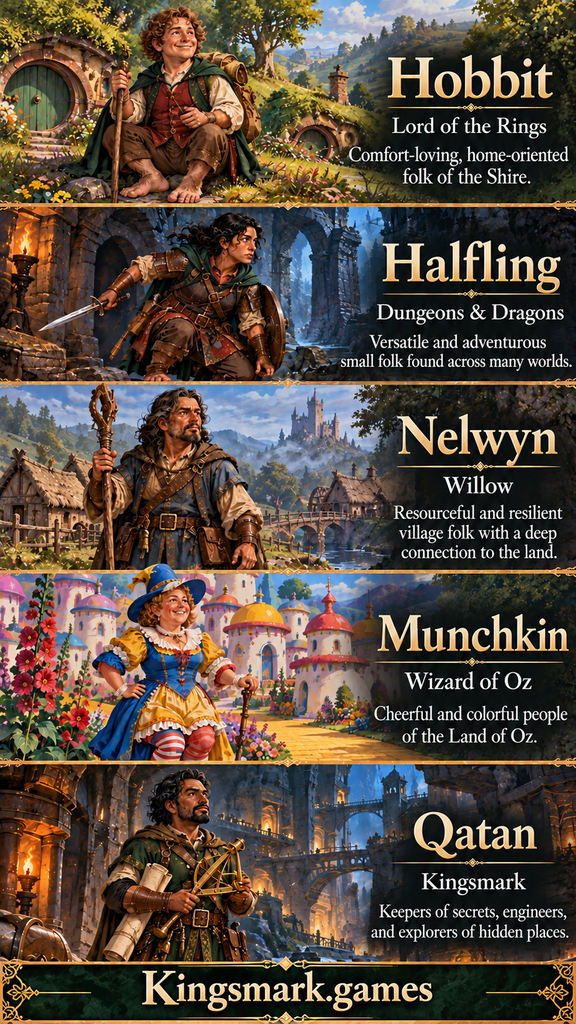
When people encounter little humans in a fantasy setting, they tend to think of Hobbits, Halflings, the Nelwyns from the 1988 film Willow, or perhaps the Munchkins from The Wizard of Oz. These familiar characters have shaped our expectations of what diminutive fantasy peoples should look like, how they should behave, and what roles they should occupy in an adventure. When I developed Kingsmark, however, I wasn’t particularly interested in creating another variation of Tolkien’s Hobbits or Dungeons & Dragons‘ Halflings. My inspiration came from something much closer to reality: actual human beings of unusually small stature, and the question of how an entire civilization of such people might develop in a dangerous medieval fantasy world.
In Kingsmark, these people are known collectively as the Qetanim, while an individual is called a Qatan (Hebrew, meaning: little). They are one of the five 🫀Human Types described in the Kingsmark Player’s Handbook, alongside the Anashim (Common Humans), Tzurim (Dwarves), Elyonim (Elves), and Gibborim (Giants). I deliberately chose the classification Human Type because I wanted to emphasize their shared humanity rather than categorize them as separate species or rely on the familiar fantasy convention of calling everything a different “race.” These peoples can interbreed, belong to the same families, and share the ordinary experiences of human life despite their considerable differences in physical appearance and natural capabilities.
The Qetanim generally stand between three and four and a half feet tall, making them substantially smaller than ordinary Anashim (Common Humans) and generally smaller and more lightly built than the Tzurim (Hardy Humans, Dwarves). Unlike the stocky, heavily muscled Dwarves of Kingsmark, the Qetanim (Little Humans) possess comparatively delicate physiques, with ordinary human anatomy scaled to their smaller stature. They are not intended to possess the characteristic skeletal abnormalities or medical complications associated with certain forms of real-world dwarfism. They are naturally small human beings whose bodies are entirely normal for their particular Human Type, although their reduced size still presents significant practical disadvantages when interacting with a world largely constructed for much larger people.
There is an important distinction here between fantasy and medicine. According to the U.S. National Library of Medicine, dwarfism is a general classification encompassing more than 300 conditions, usually involving an adult height below four feet ten inches. Some conditions produce disproportionate body development, while others involve proportionate short stature, and the medical complications vary considerably depending upon the underlying cause. People with dwarfism generally possess ordinary intelligence, and their capabilities, personalities, professions, and experiences are every bit as varied as those of other human beings. The Qetanim are fictional, but the human reality that inspired their inclusion in Kingsmark deserves to be understood accurately.
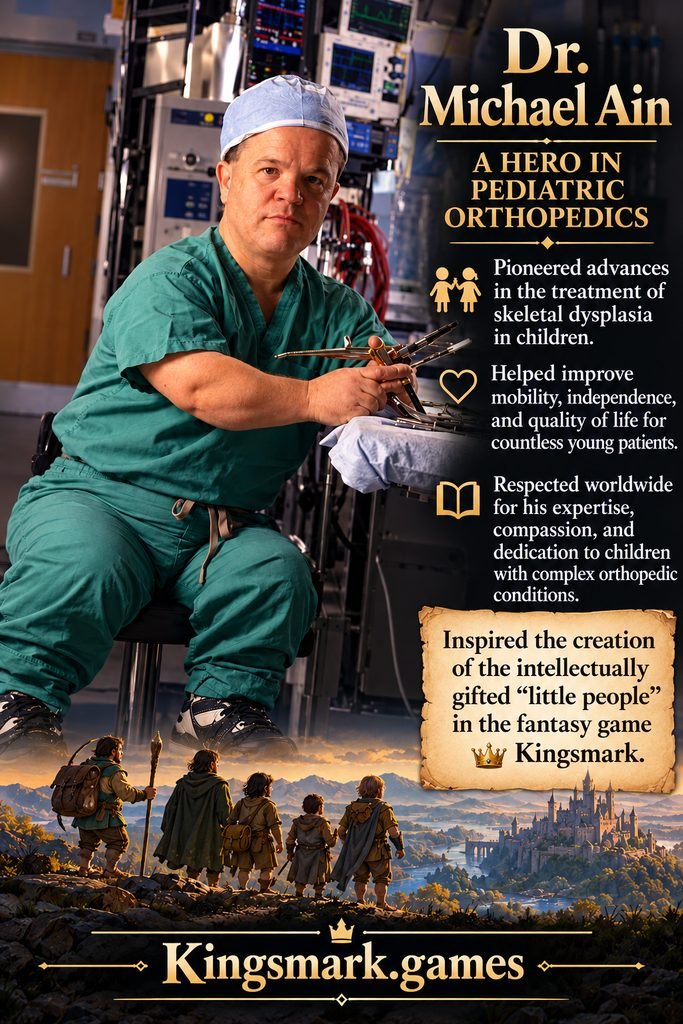
One individual I find particularly inspiring is Dr. Michael Ain, an orthopedic surgeon who has achondroplasia and devoted an important part of his professional career to helping children and adults with skeletal dysplasias. His work at Johns Hopkins included treating patients with complex orthopedic conditions, some of whom experienced difficulties similar to those he personally understood. The Johns Hopkins article Answers for Achondroplasia discusses his work and the importance of medical expertise in treating complications associated with the condition. His accomplishments illustrate something that ought to be obvious but historically hasn’t always been appreciated: a person’s physical stature tells us very little about the extent of their intelligence, knowledge, determination, or potential contribution to humanity.
Another famous example is Peter Dinklage, whose extraordinary portrayal of Tyrion Lannister in Game of Thrones helped establish one of the most complex and memorable characters in modern fantasy television. Tyrion is intelligent, articulate, politically sophisticated, frequently courageous, and capable of extraordinary insight, yet he also possesses serious personal weaknesses. His stature influences how others perceive and treat him, but it doesn’t define the entirety of his character. In many respects, that is precisely the kind of human complexity I want players to appreciate when portraying the Qetanim.
Dinklage has also been at the center of a disagreement concerning how people with dwarfism should be represented in entertainment. In 2022, he criticized Disney’s plans to revisit Snow White and the Seven Dwarfs, arguing that the traditional characterization of the dwarfs perpetuated outdated stereotypes. Other performers with dwarfism strongly disagreed, including actor and former professional wrestler Dylan Postl, who argued that eliminating or replacing such characters could deprive performers of rare professional opportunities. As reported by The Independent, the disagreement revealed that even accomplished people who share similar physical characteristics may hold sharply different opinions about representation and employment.
I think there’s something worth learning from both sides of that controversy. Entertainment can certainly perpetuate degrading stereotypes, particularly when a person’s unusual appearance becomes the entire reason for including the character. On the other hand, removing opportunities to portray characters of unusual stature can create another problem, especially when those roles might otherwise provide meaningful work for actors who rarely receive comparable opportunities. My own approach is to create fully developed human characters whose physical characteristics matter without allowing those characteristics to become the whole of their existence.
In Kingsmark, a Qatan might become a scholar, merchant, priest, physician, criminal, explorer, musician, engineer, or ruler. Their smaller bodies do not automatically make them cheerful, timid, mischievous, greedy, or morally virtuous, and I have no interest in assigning an entire population a single personality. Nevertheless, their physical characteristics have important consequences for how they experience the world, which is why their 💪 Attributes differ from those of other Human Types. The Qetanim possess exceptional Intelligence and Wisdom ratings, but they are comparatively disadvantaged in Strength and Speed, making it necessary for them to approach certain physical challenges differently.
Consider an ordinary adult Qatan confronted by a heavily armed human warrior twice his height and several times his weight. Intelligence doesn’t magically increase the Qatan’s reach, physical mass, or ability to withstand a powerful blow, and even considerable skill may not eliminate the dangers of fighting such an opponent directly. A smaller person’s reduced weight and reach can also make ordinary obstacles, large animals, heavy equipment, and difficult terrain considerably more troublesome. Consequently, a Qatan who expects to survive a dangerous encounter must often rely upon preparation, cooperation, appropriate equipment, favorable terrain, deception, or a carefully executed strategy rather than attempting to match a larger opponent through raw strength.
This becomes especially important when we consider the world in which these people live. Sylva is not a peaceful modern society protected by effective national police forces, reliable emergency services, and advanced communication systems. It is a medieval fantasy world populated by dangerous criminals, predatory armies, goblins, orcs, supernatural horrors, dragons, and numerous other creatures described in the game’s 📎 Bestiary. If an ordinary farming village can fall victim to a band of marauders, imagine the potential consequences for an isolated Qetanim community discovered by enemies who possess overwhelming advantages in physical strength and numbers.
The danger would be particularly serious for vulnerable civilians, including children and people unable to fight, and for anyone whom violent criminals considered an easy target for kidnapping, enslavement, or exploitation. This isn’t because Qetanim are inherently cowardly or incapable of defending themselves, but because the physical realities of the world are unforgiving. Even a courageous population can be destroyed if it repeatedly confronts vastly superior force on unfavorable terms. I therefore asked myself what such a people would do if they had possessed centuries to develop an effective response to these dangers, and the answer became one of the most interesting civilizations in Kingsmark.
The Hidden Kingdoms That the World Cannot See
The Qetanim have survived by becoming extraordinary masters of concealment, intelligence gathering, engineering, and defensive preparation. Their greatest fortifications are not necessarily tremendous stone walls or towering castles, because such structures would advertise their existence to enemies who might otherwise pass them by. Instead, many of their communities are designed to disappear into the natural environment, concealing their homes, workshops, roads, defensive positions, and sometimes entire villages from the casual observer. In certain regions, an ordinary traveler might pass within a few hundred feet of a Qetanim settlement without ever realizing that hundreds of people live nearby.
Imagine a wooded hillside that appears to contain nothing but enormous trees, weathered rocks, dense undergrowth, and fallen branches. A particularly observant traveler might notice an unusual arrangement of stones, a patch of vegetation whose shadows don’t quite match its surroundings, or a narrow opening concealed beneath the roots of an ancient tree. What looks like a natural bank may contain a carefully constructed entrance, while a wall covered with foliage may actually be a lightweight screen designed to conceal a passage or dwelling. These structures are maintained by people who understand how easily regular patterns, unnatural edges, repeated movement, and poorly concealed entrances can reveal a settlement’s existence.
The clothing of Qetanim scouts and defenders often reflects the same practical understanding. In a forest, their garments might incorporate irregular patches of green and brown fabric, pieces of bark, leaves, moss, or other materials that help disrupt the familiar outline of a human body. They understand that convincing camouflage depends upon the environment, movement, light, shadow, and the observer’s position, rather than simply wearing something green and assuming nobody will notice. Of course, not every Qatan dresses like a woodland scout, and a Qatan living in a large Anashim city may look entirely indistinguishable in clothing and manner from the surrounding population.
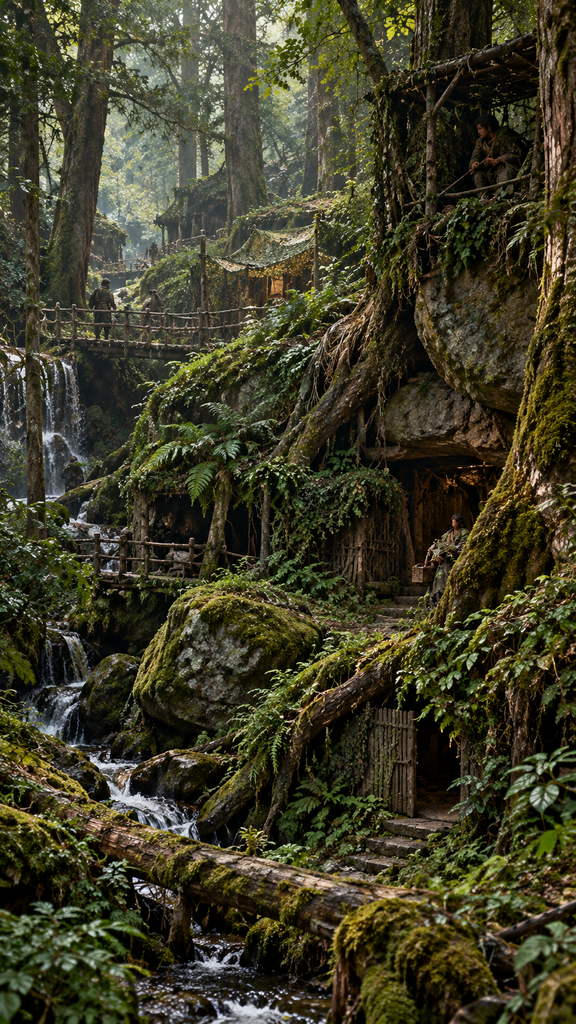
Concealment is only one element of their defensive strategy. Qetanim settlements may possess concealed observation positions, alternate approaches, carefully controlled entrances, hidden storage chambers, escape routes, and defensive mechanisms that can be activated when danger approaches. Their small stature allows them to use spaces and passages inaccessible to larger humans, while their familiarity with local terrain makes it difficult for unfamiliar enemies to pursue them. A determined invading force might discover the entrance to a village only to find that its inhabitants have already evacuated through passages leading to concealed locations far beyond the invaders’ reach.
These methods require considerable labor and organization, which leads to an important feature of Qetanim society: they possess genuine kingdoms governed by hereditary monarchs. Their civilizations are not simply scattered communities of charming woodland people who happen to cooperate whenever danger appears. They have royal dynasties, laws, noble families, courts, magistrates, soldiers, engineers, religious authorities, and institutions responsible for preserving their national identity across generations. Their monarchs exercise genuine political authority, and the survival of their subjects is one of the principal responsibilities of the Crown.
What makes these kingdoms unusual is their geography. An ordinary medieval king generally claims a recognizable territory, defending its borders through fortifications, military patrols, political agreements, and the occasional war. A Qetanim king might instead govern dozens of settlements separated by forests, rivers, mountains, and territories claimed by entirely different monarchs. His sovereignty extends over the villages and their immediate territories without necessarily including every acre of land lying between them, producing a kingdom that appears on no ordinary map because its holdings are geographically dispersed and deliberately concealed.
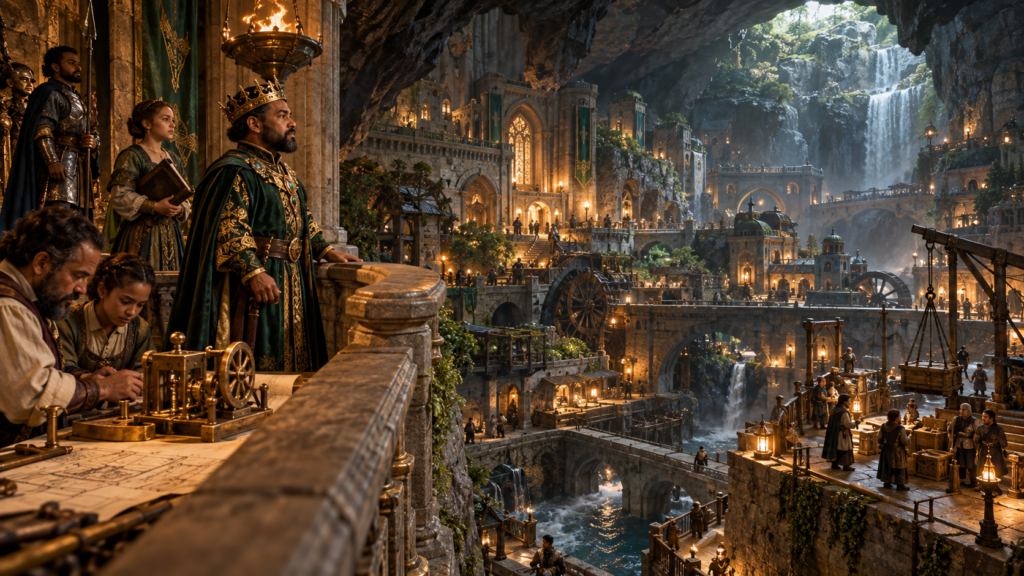
Such a kingdom might consist of fifty villages, several fortified towns, an underground royal capital, and a network of smaller communities whose inhabitants recognize the same monarch and laws. The king’s authority would be exercised through appointed governors, village magistrates, military commanders, and officials responsible for maintaining communication between settlements. Taxes might be collected in goods, labor, or currency, while royal engineers inspect infrastructure and local courts administer justice according to the kingdom’s laws. A settlement could therefore exist inside the geographical boundaries of a much larger Anashim kingdom while remaining politically loyal to a Qetanim monarch unknown to the Anashim authorities.
I find this considerably more interesting than simply creating another race of small people who live in cozy little cottages and enjoy comfortable rural lives. These are sovereign civilizations that must continually balance their desire for peace and independence against the practical danger of discovery. Their monarchs may disagree with one another, their nobles may compete for influence, their merchants may engage in profitable secret trade, and their rulers may pursue alliances or political intrigues that outsiders scarcely suspect exist. Like other human peoples, the Qetanim are capable of generosity, wisdom, corruption, ambition, treachery, and remarkable devotion to duty.
A kingdom organized in this manner requires an extraordinary communication and transportation system. Qetanim settlements possess underground passages connecting individual homes, public buildings, workshops, storage chambers, and defensive positions, while larger networks extend between neighboring villages. Some passages are little more than narrow crawlways through which an adult Qatan can move comfortably, while others are substantial engineered corridors suitable for moving goods, equipment, and groups of travelers. Where geography permits, concealed waterways provide another means of transportation, allowing people to move supplies without leaving the obvious trails associated with overland traffic.
I don’t imagine that every Qetanim village is connected to every other settlement through a single continuous tunnel system stretching thousands of miles. Such a project would require extraordinary resources, create enormous maintenance problems, and often be unnecessary when rivers, forests, and remote mountain routes could serve the same purpose. Instead, their networks vary according to terrain, population, wealth, and the engineering traditions of the particular kingdom. Some settlements maintain extensive subterranean systems, while others rely upon concealed roads, carefully managed waterways, or isolated surface routes known only to trained guides.
The concept of underground civilization has a remarkable historical precedent in the ancient subterranean settlements of Cappadocia, particularly the underground city of Derinkuyu in present-day Türkiye. Archaeologists have documented underground chambers, narrow passages, ventilation shafts, wells, storage areas, and defensive features that allowed entire communities to take refuge beneath the earth. Derinkuyu was developed and expanded over many generations, demonstrating that sophisticated underground settlements were possible long before the invention of modern excavation machinery. If real human beings could construct such elaborate facilities, I see no reason why a fictional civilization especially devoted to underground engineering couldn’t develop something even more remarkable within the technological possibilities of Sylva.
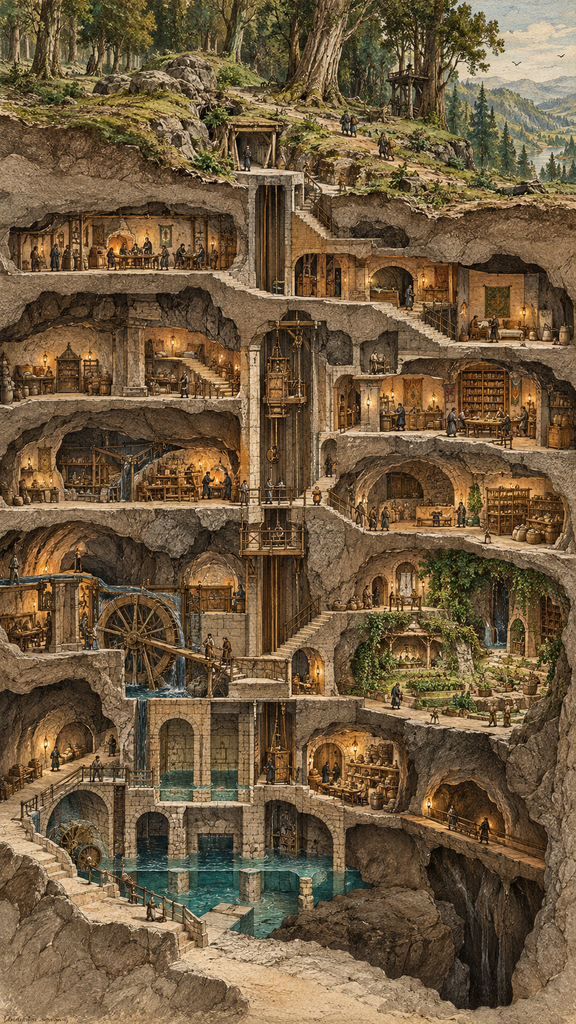
A large Qetanim underground settlement would require considerably more than tunnels and sleeping chambers. Its inhabitants would need reliable drinking water, ventilation, drainage, sanitation, food storage, workshops, places of worship, and facilities suitable for raising children and maintaining ordinary family life. Agriculture would remain essential, meaning that many underground communities would depend upon carefully concealed surface farms, orchards, animal husbandry, fishing, or trade with neighboring populations. A great subterranean city might therefore be supported by dozens of smaller settlements whose inhabitants contribute food, manufactured goods, specialized labor, and other resources necessary for its survival.
There are traditions throughout Sylva concerning at least three great secret underground Qetanim cities, although the truth behind some of these accounts remains uncertain. One is situated beneath the continent of Aldren, and its location is known to a carefully limited number of individuals, including certain outsiders who have earned the confidence of its inhabitants. Another is believed to exist somewhere within or near Kiisekai, the continent whose civilizations draw broadly upon the historical cultures of East Asia. A third city survives chiefly through rumors and ancient accounts, and nobody can say with certainty whether it still exists, where it might be located, or whether it ever existed at all.
I don’t intend these cities to be interchangeable. A royal city beneath Aldren might have different architectural traditions, political institutions, religious practices, and technological priorities from one beneath Kiisekai. The Qetanim are not one homogeneous worldwide nation merely because they share a Human Type and certain historical traditions. Their kingdoms have developed independently, and some might possess sophisticated diplomatic relationships while others have remained isolated for centuries.
Nor should every Qetanim community be expected to live underground. A population of small humans living openly among Anashim in a prosperous kingdom would face different concerns from one inhabiting a remote forest surrounded by dangerous monsters. A Qatan born in a merchant household might grow up familiar with public markets, ordinary roads, and the languages of several nations, while another raised in a concealed mountain settlement might regard the arrival of an unfamiliar traveler as a possible threat to the entire community. This cultural diversity is essential because I want Qetanim characters to remain believable individuals whose experiences depend upon their particular upbringing.
The Qetanim also use ordinary human languages rather than possessing a single invented language that every member of their Human Type automatically speaks. As I explained in my article Elves Speak Hebrew, I prefer to draw upon actual human languages where appropriate, allowing Kingsmark to incorporate real linguistic and cultural material instead of requiring players to learn elaborate fictional vocabularies. The Common Tongue, represented by English, facilitates communication among people from different regions, but a Qatan living near Kiisekai may speak very different native languages from one raised beneath Aldren. Many hidden communities undoubtedly preserve inherited linguistic traditions, while merchants, diplomats, and intelligence gatherers may become accomplished multilingual speakers through necessity.
It is difficult to determine precisely how numerous the Qetanim should be throughout Sylva, particularly because their concealment makes an accurate census almost impossible for outsiders. The U.S. Census Bureau’s historical population estimates place Earth’s population around the year 1200 somewhere between approximately 360 and 450 million people, so we’ll say that Sylva has a total of 420 million humans. That means scholars estimate that there are two to four million Qetanim distributed across the continents of Sylva. With such numbers, the Qetanim have numerous villages, several kingdoms, specialized institutions, and a handful of substantial cities.
The Secrets They Keep and the Heroes They Become
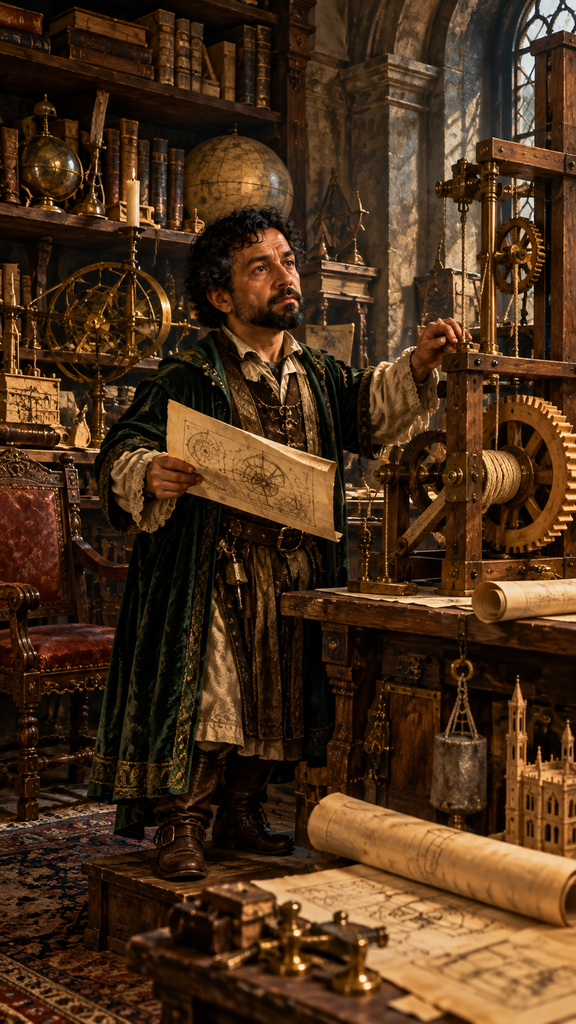
The survival of these kingdoms depends upon more than camouflage and secrecy. Over many generations, the Qetanim have developed an extraordinary appreciation for ⚒Mechanisms, including the principles of leverage, gears, pulleys, counterweights, mechanical advantage, hydraulic systems, and precision construction. A single Qatan might be physically incapable of lifting a heavy stone gate, but an appropriately designed arrangement of counterweights and lifting mechanisms could allow that same individual to operate equipment far beyond his unaided physical strength. Their greatest achievements arise not from possessing mysterious powers unavailable to other humans, but from applying accumulated knowledge with exceptional precision and ingenuity.
The engineering traditions of the Qetanim are represented in the ⚒ Skills chapter of Kingsmark, where Mechanisms covers the understanding and operation of relevant devices. I imagine their most accomplished engineers as the intellectual heirs of generations of practical inventors, master craftsmen, mathematicians, architects, and builders whose work is preserved through carefully organized institutions. These people do not necessarily possess machinery that would look futuristic to a modern observer. Instead, they have refined techniques appropriate to the medieval technological environment to a degree that ordinary human kingdoms might consider extraordinary, and likely a few decades beyond their capability.
Among the most important Qetanim institutions are their Royal Engineering Guilds, organizations responsible for preserving mechanical knowledge, educating apprentices, maintaining public works, and ensuring that sensitive inventions do not fall into dangerous hands. Their guilds may operate under royal charters, with masters who possess substantial professional authority while remaining subjects of their respective monarchs. Certain technological secrets are guarded so carefully that even influential nobles may not know the complete details of their operation. The secrecy is not merely a commercial arrangement, however, because many Qetanim consider the preservation and responsible development of mechanical knowledge a sacred obligation entrusted to their ancestors by God Himself.
This belief introduces an important spiritual dimension to their civilization. Some Qetanim traditions hold that the Creator granted their people an unusual responsibility to develop technology and employ it wisely, particularly because their comparatively small bodies required them to survive through knowledge rather than overwhelming physical strength. Other Qetanim may interpret this responsibility differently, question the authority of particular guilds, or reject the religious explanation altogether. A monarch might believe that revealing certain inventions would endanger his subjects, while an engineer might argue that refusing to share a life-saving discovery with suffering neighbors would itself be morally indefensible.
One particularly important tradition concerns the first dragon humanity ever successfully killed. According to certain accounts, Qetanim engineers played a significant role in developing or perfecting an enormous bolt-throwing weapon capable of defeating a creature that ordinary soldiers could scarcely hope to overcome. Historical ballistae and springalds provide useful comparisons, since such engines employed sophisticated mechanical arrangements to launch large projectiles with tremendous force. The dragon-slaying weapon of Sylva would represent an exceptional achievement, involving innovations that many ordinary military engineers of the period had not yet mastered in the 8th century on Earth.
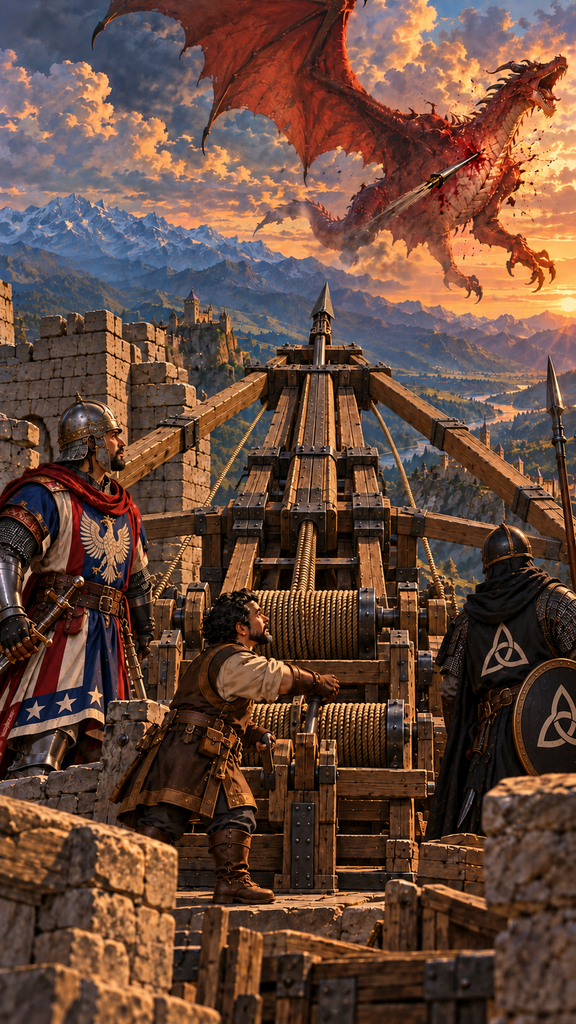
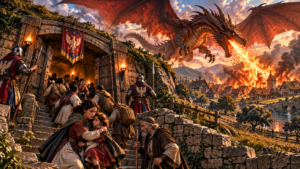
The history of Sylva changed forever in the year 718, when humanity accomplished what had previously been considered impossible: the killing of a dragon. The creature was known as Lahav (לַהַב), a name derived from Biblical Hebrew meaning Flame, an appropriate designation for the enormous crimson dragon whose fiery destruction had terrorized human settlements for generations. The victory resulted from an extraordinary alliance involving warriors from the ancient realms that would eventually become the Kingdom of Aldren and the Kingdom of Cárdena, members of the Black Brotherhood, and master engineers of the Qetanim. The Qetanim had developed an immense mechanical bolt-thrower, a sophisticated weapon capable of launching an enormous iron-tipped projectile with sufficient force to penetrate the dragon’s natural armor. During the climactic confrontation, the weapon struck Lahav near the base of his wing, inflicting a mortal wound. For the first time in recorded history, humanity had demonstrated that even the most formidable creatures of Sylva were not invincible.
Only fourteen years later, in 732, a second dragon fell. This creature was remembered as Ra’am (רַעַם), meaning Thunder in Biblical Hebrew, a name associated with the tremendous roar and violent storms that accompanied the great gray dragon’s appearances. Ra’am was defeated through a combination of coordinated military tactics and further refinements of the Qetanim’s mechanical artillery.
Although these two victories are firmly established in the historical traditions of Sylva, their precise circumstances remain disputed. More than seven centuries separate these events from the customary starting year of 1200, and surviving chronicles disagree concerning the commanders involved, the locations of the battles, and which individuals deserve the greatest recognition. Some accounts credit the Qetanim almost exclusively, while others glorify the monarchs, soldiers, or religious warriors who participated. Even the names Lahav and Ra’am may be the names bestowed upon these creatures by ancient human chroniclers rather than the names by which the dragons called themselves.
The consequences of these victories unfolded gradually over the following centuries. Dragons had once threatened entire civilizations with destruction, compelling countless communities to construct extensive underground refuges, fortified chambers, and subterranean settlements. After the deaths of Lahav and Ra’am, surviving dragons became increasingly cautious about attacking organized human populations, apparently recognizing that humanity now possessed weapons capable of killing them. As generations passed without the same frequency of catastrophic attacks, Common Humans, Perfected Humans (Elves), and Human Giants increasingly established permanent settlements above ground, eventually developing the sprawling kingdoms, cities, farms, and commercial networks familiar to adventurers in the year 1200. The Tzurim and Qetanim, however, largely preserved their ancient subterranean traditions, regarding their underground civilizations as matters of security, cultural identity, and practical advantage. Thus, when adventurers explore the forgotten dungeons of Sylva, they may be entering structures originally constructed during an age when humanity survived by hiding beneath the earth, long before two legendary dragons fell and changed the course of history.
Of course, their technological traditions are not restricted to extraordinary military inventions. A Qetanim community also requires efficient grain mills, reliable water supplies, agricultural equipment, building systems, transportation mechanisms, and practical devices that make ordinary labor safer and less physically demanding. Small people working with smaller equipment can sometimes achieve considerable efficiency, but that doesn’t eliminate the need for careful engineering when lifting heavy materials, constructing large structures, or transporting substantial quantities of goods. Their expertise is therefore deeply integrated into everyday life, from the simplest household mechanism to the great public works maintained by royal engineers.
These traditions create intriguing opportunities for players who choose to portray a Qatan adventurer. The 🎭 Character Class chapter establishes that Qetanim cannot select Man-at-Arms or Holy Knight under the existing rules, reflecting their physical characteristics and the military traditions associated with those professions. Yet many other paths remain open, including intellectually demanding magical classes, Healers, Minstrels, Rangers, Monster Hunters, Thieves, and Monks, provided the character satisfies the normal requirements. I wanted their smaller size to create meaningful gameplay considerations without preventing players from developing capable, interesting, and genuinely heroic characters.
The Thief Class is particularly interesting because Kingsmark does not assume that every character bearing that designation is necessarily a professional criminal. Among the Qetanim, a Thief might be a respected specialist in locks, defensive mechanisms, concealed entrances, security systems, and the detection of weaknesses in fortifications. Such an individual could serve the Crown as an engineer, investigator, or specialist entrusted with maintaining the kingdom’s defenses. A Qatan Monster Hunter, meanwhile, might become exceptionally accomplished at understanding the behavior of dangerous creatures, constructing traps, selecting advantageous terrain, and planning encounters so that physical size becomes less decisive.
Qetanim Monks provide another interesting possibility, particularly because the martial traditions of the Class include the use of staffs, leverage, precision, and supernatural disciplines. Their comparatively short reach creates obvious limitations in unarmed combat, but a skilled Qatan might employ a staff to control distance, redirect force, or exploit an opponent’s balance. The Ranger presents another valuable path for those raised among the hidden settlements, where careful reconnaissance, familiarity with terrain, archery, and concealed movement may be essential to the defense of the kingdom. These characters must still abide by the same mechanical requirements as everyone else, but their culture offers distinctive explanations for how they acquired their training.
Perhaps the most unusual partnership involving Qetanim is the ancient relationship between certain Qatan adventurers and the enormous Gibborim (Human Giants). The Player’s Handbook describes how a purpose-built basket, saddle, or harness can allow an adult Qatan to ride securely upon the back of a Giant Brute, creating possibilities for cooperation between two Human Types whose physical capabilities are almost completely opposite. A Qatan Ranger might employ a bow from an elevated position, while a magical practitioner could provide supernatural assistance as the Giant supplies mobility and physical protection. This relationship embodies one of the central ideas behind Kingsmark’s character system: different people possess different capabilities, and intelligent cooperation can achieve things that neither individual could accomplish alone.
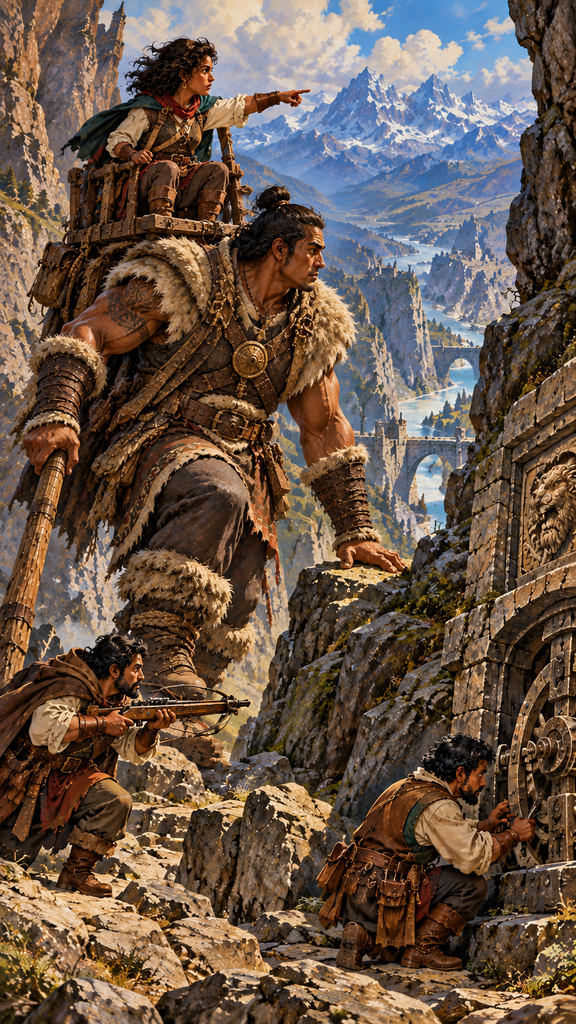
I also want players to appreciate that the Qetanim are capable of extraordinary courage even when they possess little hope of defeating a particular enemy through direct physical violence. A Qatan who ventures into a dungeon to rescue a kidnapped child is undertaking a dangerous mission regardless of whether he carries a sword, a staff, a bow, or a spellbook. A Qetanim physician who remains behind to care for wounded villagers while monsters threaten the settlement may demonstrate courage equal to that of a heavily armored knight. Heroism should not be measured exclusively by the amount of damage a character can inflict upon an enemy, and the game’s ▶️ Action Scenes are designed to accommodate a much wider range of meaningful decisions than simply exchanging attacks.
The Qetanim also introduce possibilities for adventures that extend beyond conventional dungeon exploration. A party might discover an apparently abandoned forest settlement only to learn that its inhabitants have withdrawn into a sophisticated underground refuge. A Qatan prince could seek assistance in recovering a stolen engineering manuscript, while a royal guild might secretly approach adventurers to investigate rumors that a neighboring monarch has obtained forbidden technology. An entire campaign could revolve around protecting a hidden kingdom, negotiating between rival Qetanim dynasties, or uncovering the truth behind the third legendary underground city.
Not every such adventure needs to involve a crisis, either. A Game Master might introduce a concealed Qetanim marketplace, a royal wedding, a diplomatic celebration, an engineering competition, or a scholarly gathering attended by visitors from several kingdoms. A Qatan raised openly among Anashim could discover that an entire hidden monarchy claims historical ties to his family, while a traveler who has spent years exploring Sylva might accidentally enter a community that has never welcomed an outsider. The possibilities become particularly interesting when we remember that these are living civilizations with ordinary human concerns, not merely elaborate defensive installations waiting to be discovered by adventurers.
That is ultimately what distinguishes the Qetanim from the familiar little peoples of other fantasy worlds. I didn’t create them simply to fill an expected fantasy archetype or to provide a smaller character option for people who enjoy playing unconventional heroes. I wanted to consider how a physically vulnerable but highly intelligent branch of humanity might survive, organize itself, develop technology, preserve its independence, and contribute to the history of a world far more dangerous than our own. Their kingdoms reflect the extraordinary accomplishments that human beings can achieve when necessity, intelligence, cooperation, craftsmanship, and centuries of accumulated experience are brought together.
Imagine an army marching through an ancient forest, its commanders confident that the surrounding wilderness contains nothing of importance beyond trees, animals, and perhaps a few scattered hunters. Beneath their feet, unknown to every soldier in the formation, lies a prosperous kingdom governed by a hereditary monarch whose subjects maintain schools, workshops, temples, libraries, courts, and extraordinary underground machinery. Its inhabitants hear the distant passage of the army through concealed observation chambers, quietly continue their daily activities, and allow the intruders to disappear beyond the horizon without ever revealing themselves. The soldiers believe they have crossed an empty wilderness, never realizing that they have passed through the hidden heart of a civilization.
The Qetanim have no need to conquer the world to demonstrate their significance. Their existence is proof that physical greatness and human greatness are not necessarily the same thing, and that a civilization can possess extraordinary power without constantly advertising its presence. Somewhere beneath the kingdoms, forests, and mountains of Sylva, the hidden monarchs of the Qetanim continue ruling peoples whom much of the world scarcely knows exist, preserving knowledge that might someday change the course of human history.
And if you ever find yourself traveling through a particularly quiet stretch of woodland, where the stones seem strangely arranged and the trees conceal more shadows than they should, you might do well to remember that the absence of visible civilization doesn’t necessarily mean that nobody is watching.
You can read the entire 👑Kingsmark rulebook for FREE on this website, or support the game by purchasing a digital copy.
About The Author