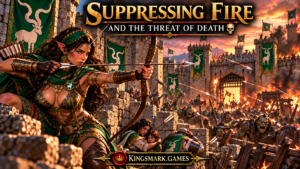
🏹 How to use Suppressing Fire 💀 (The Threat of Death)
Suppressive Fire: Real Military Tactics, Historical Archery, and Kingsmark Combat
How warriors throughout history have used the threat of death to control enemy movement, disrupt attacks, protect their companions, and win battles—and how ⭐Jack’s Cinematic d12 brings those same principles to the battlefields of 👑Kingsmark.
When “Cover Me!” Meant Two Very Different Things
In 1992, during the Los Angeles riots, a squad of United States Marines accompanied two Compton police officers responding to a domestic disturbance. The officers approached a residence and knocked on the door. Suddenly, someone inside fired shotgun birdshot through the door, striking one of the officers. His partner grabbed him, began pulling him away from danger, and shouted two words toward the Marines: “Cover me!” What happened next became a memorable example of the dangers of miscommunication between military personnel and law enforcement.
To the police officer, the command meant that the Marines should aim their weapons toward the threat, remain alert, and fire if necessary. To the Marines, however, those same words meant something considerably more aggressive. They immediately opened fire on the residence, interpreting the command according to the military training they had received.
According to retired California Army National Guard Major General James Delk, who subsequently described the incident in a military case study, the Compton Police Department reported more than 200 bullet holes in the house. Inside were two adults and three children. Remarkably, none of the occupants was struck by the Marines’ gunfire. The incident was also documented by Lieutenant Colonel Christopher M. Schnaubelt in Parameters, the professional journal of the U.S. Army War College, in 1997. His article, Lessons in Command and Control from the Los Angeles Riots, examined the problems that arise when military and civilian agencies employ similar terminology but understand it differently.
The Marines had responded with the kind of firepower they associated with protecting comrades under enemy fire. The police officers, however, had not requested that degree of force. Whatever the soldiers’ intentions, opening fire on an occupied residence created an extraordinary danger to civilians and demonstrated why military practices cannot simply be transferred into law enforcement without understanding the mission and consequences.
For our purposes, the incident introduces an important military concept: suppressive fire. Why might a trained soldier send numerous rounds toward an enemy without carefully selecting a particular individual as his intended target? Why does incoming gunfire change a soldier’s behavior even when none of the bullets actually strikes him? And how could a medieval adventurer armed with nothing more than a bow accomplish something similar? To answer those questions, we will examine genuine military history and see how its underlying principles can be represented through the rules of 👑Kingsmark.
⭐Jack’s Cinematic d12: Where History Meets Game Mechanics
👑Kingsmark is a heroic fantasy tabletop role-playing game set in the medieval world of Sylva. The game uses ⭐Jack’s Cinematic d12 (JCd12), a rules system designed to translate physical capabilities, professional training, environmental conditions, injuries, and extraordinary feats into understandable game mechanics. Kingsmark is the fantasy game and setting. JCd12 is the underlying rules system.
This distinction becomes useful when examining military history because the same basic principles governing an adventurer’s actions can help us understand the difficulties faced by real soldiers, even when their equipment and circumstances differ dramatically. Consider the basic JCd12 Test:
🎲1d12 + the appropriate 🌈Attribute PRISM + ⚒Skill, measured against a Target Number (TN).
Circumstances can make the task easier or harder. An opponent’s cover, movement, distance, visibility, and incoming enemy fire may increase the Target Number, while the acting character’s capabilities contribute to the dice result. A combatant who is wounded, distracted, or struggling to survive does not necessarily perform as effectively as someone operating under ideal conditions.
JCd12 also incorporates Exploding 12s. When the die produces a natural 12, another d12 is rolled and added to the result. This allows extraordinary accomplishments to remain possible even when the required Target Number exceeds what a single ordinary roll could achieve.
Of course, assigning a historical soldier a fictional ⚒Skill Rating or Target Number cannot reconstruct the actual mathematics of a battle. Nevertheless, these comparisons can help us understand why some achievements were ordinary, others exceptionally difficult, and still others almost unbelievable. The following discussion occasionally applies JCd12 mechanics hypothetically to historical events. These examples illustrate the system’s design principles rather than claiming that historical soldiers possessed literal character statistics.
Readers new to the system can explore ⏳Learn Kingsmark in Ten Minutes and the free online Player’s Handbook and its introductory material.
What Is Suppressive Fire?
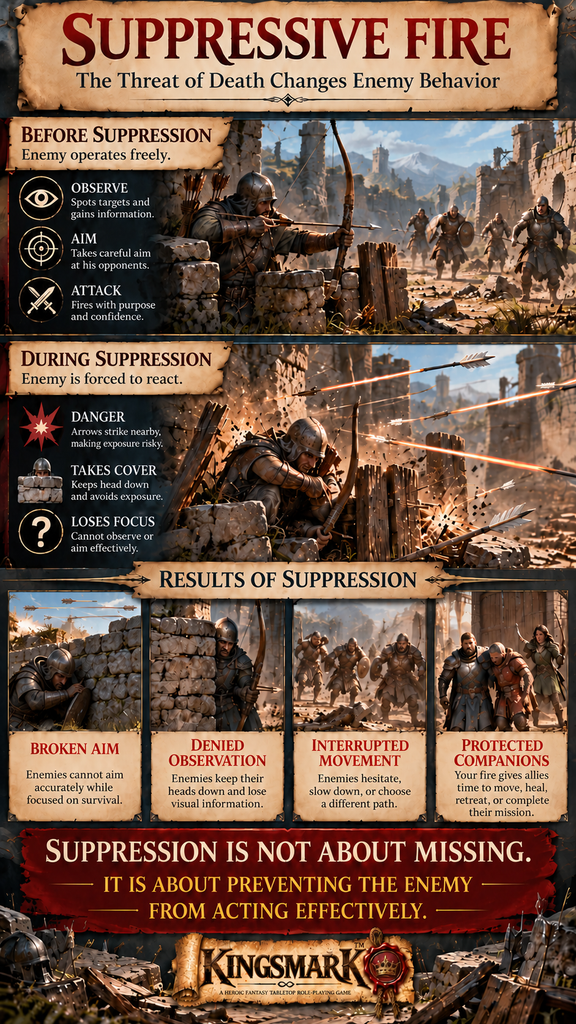
Suppressive fire is the use of gunfire, artillery, arrows, or other dangerous projectiles to interfere with an enemy’s ability or willingness to perform particular actions. Although the methods differ between modern military units and historical armies, the underlying concept is relatively straightforward. A combatant who believes he might be killed if he exposes himself may become reluctant to move, observe, aim, communicate, or attack. NATO military terminology defines suppression in terms of temporarily degrading a target’s performance below the level required to accomplish its mission. In other words, the purpose is not necessarily to destroy an enemy but to interfere with his effectiveness.
Imagine two soldiers facing each other across a ruined street. One is behind a stone wall, occasionally exposing himself to take carefully aimed shots. The other begins sending dangerous fire toward the wall and the positions from which his opponent has been shooting.
The soldier behind the wall now faces a difficult decision. Every time he exposes his head or shoulders to observe the battlefield or aim his weapon, he risks being struck. He might be a fearless veteran who has survived a hundred firefights, but courage cannot prevent a bullet from passing through his skull. Rather than concentrating exclusively upon killing his opponent, he must now devote greater attention to avoiding injury himself.
This is the essential purpose of suppressive fire. It compromises the enemy’s ability to conduct his intended actions by making those actions dangerous. A crucial distinction must be understood: suppressive fire is not necessarily wild, random, or deliberately inaccurate shooting. Properly directed suppressive fire threatens an area where enemies are present or reasonably expected to appear. The soldier may not be carefully aiming at a particular person’s chest or head, but the projectiles are real, their potential lethality is real, and the enemy has good reason to take them seriously.
Military fire is frequently coordinated with the movement of friendly troops. While one element keeps enemy fighters from responding effectively, another moves to accomplish its objective. Success may be measured not in enemy casualties, but in whether friendly soldiers reached safety, obtained a better position, or completed their mission.
Suppression Can Be an Action—or the Consequence of Other Actions
One important feature of JCd12 is that suppressive fire does not always require a character to declare a special Suppressing Volley action. Suppression can arise naturally from the combined actions of combatants during an ordinary ▶️Combat Round.
Imagine an enemy archer preparing to shoot at your adventuring party. Before his ⏸Turn arrives, three of your companions have already fired arrows toward him. They may have been making ordinary ranged attacks, intending to strike him directly rather than attempting any special maneuver. Perhaps every arrow missed. One struck the wooden barricade beside him, another buried itself in a tree behind his shoulder, and the third passed dangerously close to his face. When that enemy’s ⏸Turn arrives, he still has his 🔵Action Points. He remains free to attempt appropriate actions. However, the Game Master must recognize that he has just been exposed to dangerous incoming missiles.
He cannot reasonably behave as though he were standing in a peaceful meadow practicing archery against a stationary target. The official Kingsmark suppression rules represent these circumstances by increasing the Target Numbers of the affected character’s attacks.
The Official Kingsmark Suppression Modifiers
| Suppression Situation | Attacker’s Disadvantage |
|---|---|
| No imminent threat from incoming missiles | +0 |
| Imminent Threat — under fire from one attacker | +1 |
| Light Suppression — under fire from two attackers | +2 |
| Heavy Suppression — under fire from three or more attackers | +3 |
| Overwhelming Suppression — under concentrated missile fire, such as a coordinated volley from several archers or crossbowmen | +4 |
These modifiers represent Disadvantage applied to the attacker’s Target Number, rather than penalties subtracted from the dice roll. They are also alternatives reflecting the applicable suppression situation, not cumulative penalties to be stacked together. For example, a character suffering Overwhelming Suppression receives +4 Disadvantage, not +1, +2, +3, and +4 added together.
The number of attackers matters under the ordinary suppression table. Three arrows fired by one archer do not automatically count as three separate attackers. However, specialized actions can establish their own effects, as we will see with 🔴🔴🔴🔴Suppressing Volley.
🎲 What Does Suppression Actually Do to a Dice Roll?
Suppose an archer is attempting an attack that would ordinarily require TN 8. If he is currently facing an Imminent Threat from one opposing archer, the applicable +1 Disadvantage raises the required Target Number to 9. If he is being suppressed by two attackers, the +2 modifier raises it to TN 10.
Under Heavy Suppression, that same attack requires TN 11. Under Overwhelming Suppression, it requires TN 12. These increases can be extremely consequential, particularly when combined with unfavorable range, partial cover, poor lighting, or other difficulties. Now imagine a particularly difficult ranged attack with a Base TN of 4, partial cover adding +2, poor visibility adding +2, range adding +1, and Overwhelming Suppression adding +4. The final Target Number becomes TN 13. A character with a combined 🌈PRISM and ⚒Skill bonus of +2 would need an unmodified dice result of at least 11 to succeed. A character with weaker bonuses might need an Exploding 12. This is how ⭐JCd12 represents the difficulty of performing an otherwise familiar action while death is raining down around the character.
Importantly, suppression does not automatically take away Action Points, immobilize enemies, or require them to flee. The modifier specifically affects their ability to attack effectively. Their actual decisions remain dependent upon their circumstances, available cover, motivations, and the other rules governing their actions.
For a fuller explanation of ⏳Initiative, 🔵Action Points, and ⏸Turn Order, see ▶️Combat Round Sequence in Kingsmark.
Why Missile Fire Is Different from Melee Combat
In ordinary melee combat, a warrior can often respond directly to an incoming attack. A swordsman might parry an opponent’s blade, intercept his movement, shove him backward, or strike during an opening. The adversaries are operating within immediate physical reach of one another. Their weapons, positions, and movements directly influence their ability to respond.
Missile combat is different. When arrows begin striking the ground around a warrior, he ordinarily cannot reach across the battlefield and block the archer’s next movement with his sword. Nor can he simply strike the attacking archer in retaliation if the enemy is standing fifty yards away. He may have to find cover, raise a shield, maneuver out of the line of fire, or endure the threat while attempting to accomplish his objective.
For an inexperienced soldier, those choices can be terrifying. For an experienced veteran, they can be equally dangerous, even when he remains mentally composed. Kingsmark does provide exceptional defensive techniques for highly skilled archers, including specialized Arrow Parry and Catch Arrow abilities. These represent extraordinary training rather than an ordinary warrior’s effortless response to incoming missiles.
For most combatants, however, the difference between being attacked in melee and being threatened by incoming arrows is substantial.
The Psychology of Suppression: Making Survival More Important Than Victory
Suppressive fire can influence decision-making without necessarily inflicting physical injury. A man can be extraordinarily brave and nevertheless understand that standing upright while arrows pass around his head is dangerous. A veteran may recognize that remaining behind cover is the intelligent response to incoming fire. A frightened recruit might react to the same threat with confusion, hesitation, or panic.
These reactions are not identical. Suppression and fear are closely related, but they are not interchangeable. An enemy who remains mentally composed may still be unable to attack effectively because exposing himself invites injury or death.
Military historian Trevor N. Dupuy examined suppression as an important manifestation of the psychological effects of combat. In Understanding War: History and Theory of Combat, he emphasized how incoming fire can reduce or inhibit the performance of combat duties. His analysis helps explain why suppressive fire can influence a battle even when relatively few casualties result.
There is also the concern combatants feel for their companions. Suppose one soldier is wounded and collapses where his comrades can see him. They may become distracted by his suffering, abandon their positions to help, or hesitate because continued exposure could endanger both themselves and their wounded friend.
These responses are possibilities rather than inevitable results. Disciplined combatants may maintain their positions despite severe losses, while others may lose their resolve before anyone is injured. This is precisely why suppression belongs in a role-playing game that attempts to portray more than a contest of damage totals. Combatants are people—or creatures—with objectives, responsibilities, fears, loyalties, and instincts for self-preservation.
Kingsmark’s approach to meaningful battlefield decisions is explored further in Why “I Attack” Isn’t Enough.
Suppressive Fire: Courage and Battlefield Control Across Nations
Throughout history, soldiers from many nations have demonstrated extraordinary courage and tactical ingenuity through suppressive fire and related forms of battlefield control, including area denial and interdiction. Although these tactics differ in their execution, they share an important strategic principle: defeating an enemy does not necessarily require killing every soldier. Sometimes preventing an opponent from accomplishing his mission is enough. The following historical examples demonstrate how individuals and entire armies have applied this principle.
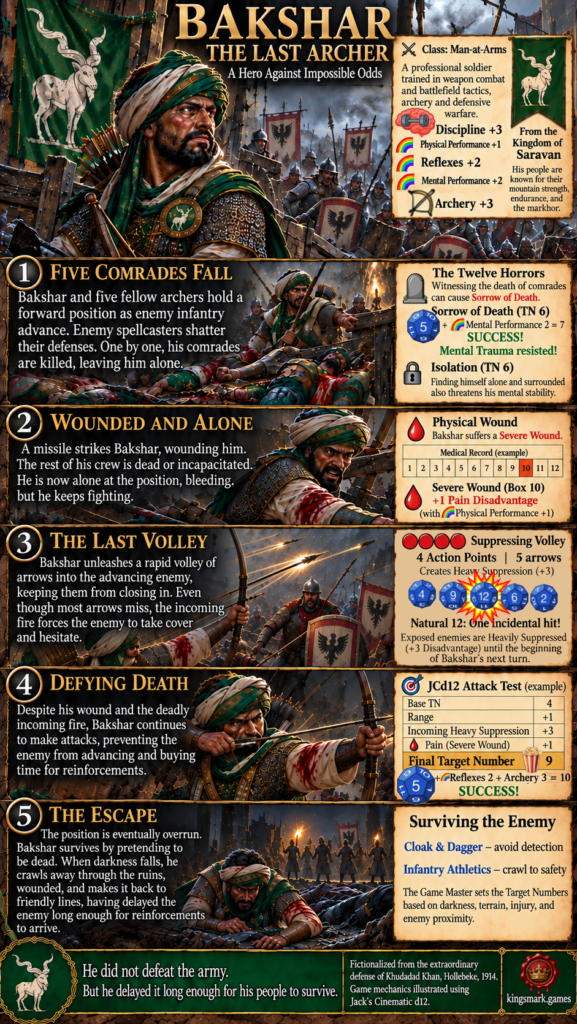
Khudadad Khan: An Indian Machine Gunner Holds the Line
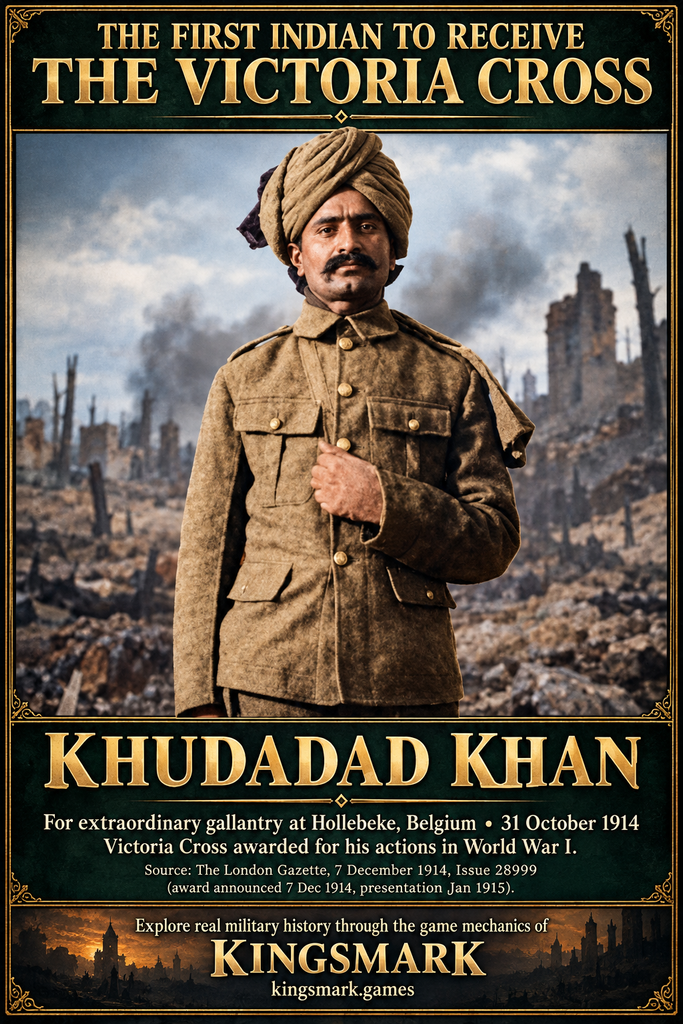
On October 31, 1914, during World War I, Sepoy Khudadad Khan of the 129th Baluchis fought against advancing German forces near Hollebeke, Belgium. Born in the Punjab region of British India, in what is now Pakistan, Khan served as a machine gunner in the British Indian Army. His regiment was outnumbered approximately five to one, and the battlefield conditions were dreadful, with waterlogged trenches, inadequate defensive equipment, and German infantry threatening to overwhelm the Indian positions.
As the German assault intensified, one of the detachment’s two machine guns was knocked out by artillery, and the British officer commanding the detachment was wounded. Khan and his remaining comrades continued firing, refusing to surrender their position despite the increasingly desperate circumstances. One by one, the five other members of his machine-gun crew were killed, leaving Khan wounded and operating the weapon alone. Imagine standing in that trench, surrounded by the bodies of your companions, knowing that the enemy is approaching and that no one remains to help you operate your weapon.
Khan continued resisting until German attackers overran the position. He survived by pretending to be dead and eventually crawled back to friendly lines under cover of darkness. His resistance helped delay the German advance, buying precious time for British and Indian reinforcements to arrive. Khan became the first Indian soldier awarded the Victoria Cross, Britain’s highest military decoration for valor.
His achievement is documented in the British government’s historical account, the National Army Museum, and the original award citation preserved by The National Archives.
🎲 How Would JCd12 Represent Khan’s Achievement?
Khan’s extraordinary resistance illustrates several Kingsmark mechanics working together: 🧠Mental Trauma, 🩸Physical Wounds, suppression, ⚒Skills, 🌈Attribute PRISMs, and exceptionally difficult Tests. Rather than simply declaring that Khan possessed hundreds of Hit Points or some supernatural resistance to injury, ⭐Jack’s Cinematic d12—the system of dice rules used for Kingsmark—provides a framework for examining the specific difficulties he overcame. We can even construct a hypothetical character whose capabilities resemble those Khan demonstrated.
🪦 The Twelve Horrors: Watching His Comrades Die
The first obvious comparison is with 🪦Sorrow of Death, the first of Kingsmark’s Twelve Horrors. The Player’s Handbook identifies witnessing a comrade killed in combat as an event that can threaten 🧠Shaken Mental Trauma, requiring a resistance Test against TN 6. Khan witnessed the destruction of his gun crew, with all five of his fellow machine gunners killed around him. An experienced soldier might be accustomed to battlefield deaths, but watching an entire crew perish while continuing to fight presents an extraordinary psychological challenge.
Under JCd12, the Game Master would consider whether this experience qualified for a Mental Trauma Test at the beginning of Khan’s next ⏸Turn. Suppose Khan possessed 🌈Mental Performance PRISM +2, reflecting unusually strong mental capabilities under pressure. His player rolls 1d12 +2 against TN 6, obtaining a natural 5 for a total of 7. Because his result exceeds the Target Number, the threatened 🧠Shaken Trauma is completely resisted, allowing him to continue without acquiring that psychological injury.
There is a second applicable Horror: 🔒Isolation, Abandonment, and Imprisonment, the eleventh of the Twelve Horrors. Its 🧠Shaken category, also TN 6, specifically includes becoming unexpectedly isolated from allies while threatened or otherwise vulnerable. When Khan found himself alone, wounded, and surrounded by advancing enemies, his circumstances closely resembled this situation. A Game Master could reasonably evaluate this as a separate psychological threat, although the deaths of five comrades during one engagement would not automatically produce five separate Sorrow of Death Tests.
This also raises the possibility of Khan possessing the 🏅Bearer of the Last Breath Immunity Badge, which represents having repeatedly confronted and successfully endured 🪦Sorrow of Death. The important point is that JCd12 provides a way to represent the psychological ordeal separately from the physical danger. A warrior can witness terrible events, resist psychological collapse, and continue fighting without pretending that those events were insignificant.
🩸Physical Wounds: Fighting While Injured
Khan was wounded during the engagement, and his injuries were serious enough to require subsequent hospital treatment in England. The historical accounts do not specify enough about their anatomical severity to establish an exact Kingsmark wound category, but 🩸Moderate would be a plausible interpretation, with 🩸Severe also possible if the injuries substantially disabled normal physical functioning. In Kingsmark, a Moderate Wound represents a serious injury such as a deep cut, cracked bone, or heavy bleeding, while a Severe Wound represents disabling trauma such as a broken limb, punctured organ, or massive blood loss.
Consider a hypothetical version of Khan who has suffered one 🩸Severe Wound and possesses 🌈Physical Performance PRISM +1. Under the Physical Trauma Threshold example, a Severe Wound occupying box [10] imposes +1 Pain Disadvantage for a character with this PRISM. His attacks and other Tests would consequently become more difficult, with their Target Numbers increasing by +1, and his ⏳Initiative would also decrease by -1. Any additional wounds could compound those effects according to their positions on his Medical Record.
The distinction matters because Khan’s continued resistance would not erase his injury or its effects. A character who keeps fighting through 🩸Severe Trauma is demonstrating extraordinary resolve precisely because his body has been damaged and his circumstances have become more difficult. His accomplishments become more impressive when we account for that difficulty rather than simply granting him a large reserve of imaginary health.
⚒Skills and 🌈PRISMs: What Kind of Soldier Was Khan?
Operating a machine gun effectively requires specialized training, mechanical familiarity, coordination, and the ability to maintain control under stressful circumstances. In a First World War adaptation of JCd12, we might introduce a hypothetical ⚒Machine Gunnery Skill, perhaps assigning Khan +3 to represent his demonstrated competence.
Khan might reasonably possess 🌈Reflexes PRISM +2, reflecting coordination, responsiveness, and precision under pressure. His 💪Discipline might be +3 or even +4, representing exceptional mental fortitude and the ability to continue performing despite pain, danger, and the deaths of his companions. His 💪Stamina might also be unusually high, perhaps +3, reflecting his capacity to sustain physical effort under terrible conditions.
🎲 Suppression: Continuing to Fire While the Enemy Fires Back
Now consider the suppression Khan himself would have experienced. German soldiers were attacking his position, and under ordinary Kingsmark rules, incoming missiles from three or more attackers can produce Heavy Suppression, imposing +3 Disadvantage upon attacks made by the exposed defender. Concentrated fire from several attackers might instead qualify as Overwhelming Suppression (+4).
Suppose Khan attempts a machine-gun attack with a Base TN of 4, a +1 range modifier, +3 Heavy Suppression, and +1 Pain from his wound. His final Target Number would be TN 9. Using a hypothetical 🎲1d12 + 🌈Reflexes PRISM + ⚒Machine Gunnery Test, with Reflexes +2 and Machine Gunnery +3, Khan rolls a natural 5. The resulting total of 10 succeeds despite the dangerous conditions, illustrating how a trained combatant can remain effective under fire even while wounded.
Meanwhile, the Germans advancing toward Khan’s position were exposed to a functioning machine gun capable of sustained fire. Although the medieval suppression table normally distinguishes incoming fire by the number of attackers, the official 🔴🔴🔴🔴Suppressing Volley action demonstrates that one combatant can create Heavy Suppression through a specialized technique. A modern JCd12 adaptation could apply similar principles to sustained machine-gun fire, representing its ability to threaten a concentrated area and disrupt enemy attacks. The actual effects would require appropriate modern weapon rules, but the underlying relationship between dangerous incoming fire and impaired enemy performance is already established.
💪Discipline: An Almost Impossible Test of Determination
Perhaps the most remarkable element of Khan’s achievement was his continued determination after his gun crew had been destroyed. Imagine a Game Master representing the difficulty of remaining at the machine gun, wounded and alone, while enemy soldiers close upon the position. A 💪Discipline Test would be an appropriate way to portray exceptional mental fortitude when the decisive question is whether a character can maintain his resolve under almost unbearable pressure.
Suppose the Game Master establishes TN 12, a Virtually Impossible challenge, and Khan’s existing wound adds +1 Pain Disadvantage, increasing the required result to TN 13. If Khan possesses 💪Discipline +3, a natural roll of 10 produces a final result of 13, just enough to succeed. A weaker character might require an Exploding 12, while a more accomplished hero could have a better chance through superior ratings.
Finally, Khan’s escape presents another remarkable challenge. Wounded and alone, he survived by pretending to be dead before crawling through dangerous territory under cover of darkness. In JCd12, the physical effort of that escape might involve 🌈Physical Performance PRISM + ⚒Infantry Athletics, while avoiding detection might involve 🌈Reflexes PRISM + ⚒Cloak & Dagger. A Game Master would assign difficult Target Numbers according to his injuries, available cover, darkness, distance, and enemy proximity.
Khan’s historical achievement therefore illustrates something fundamental about the philosophy of Kingsmark. His heroism was not one miraculous attack or an enormous capacity to absorb wounds, but a succession of extraordinarily difficult actions performed while physically injured, psychologically threatened, isolated from his comrades, and facing overwhelming enemy strength. JCd12 provides ways to represent those separate challenges, allowing players to appreciate the physical skill, mental endurance, tactical effectiveness, and extraordinary determination that made his actions worthy of remembrance.
The Battles of Celaya: Mexican Machine Guns Against Cavalry
During the Mexican Revolution in April 1915, two powerful Mexican armies confronted one another near Celaya, Guanajuato. General Francisco “Pancho” Villa commanded forces renowned for their aggressive cavalry tactics, while General Álvaro Obregón prepared defenses incorporating trenches, barbed wire, artillery, and machine guns.
Villa’s cavalry had achieved remarkable successes in earlier campaigns. The sight of hundreds of mounted warriors charging across open ground could be terrifying, particularly for defenders unprepared to receive them. But Obregón understood how concentrated defensive fire, carefully prepared terrain, and disciplined soldiers could neutralize those advantages.
As Villista forces repeatedly attacked during the engagements of April 6–7 and April 13–15, Obregón’s machine guns and prepared defenses made the approaches extraordinarily dangerous. The attackers suffered devastating casualties, their assaults lost momentum, and the defenders preserved their positions long enough to exploit Villa’s increasingly unfavorable situation. Obregón subsequently committed his cavalry reserves to a decisive counterattack, helping transform a successful defense into victory. The battles became a turning point in the Mexican Revolution, demonstrating how preparation, tactical judgment, and coordinated defensive fire could overcome previously successful cavalry tactics.
The Library of Congress documents these battles and explains how Obregón employed trenches, barbed wire, and machine guns against Villa’s famous cavalry charges.
🎲 How Would JCd12 Represent the Battles of Celaya?
Imagine a similar conflict unfolding in the Kingdom of Cárdena, a nation in Sylva inspired by Mexico. At the Battle of Llanura, Mariscal Álvar Orellán, a fictional counterpart of General Álvaro Obregón, faces an enormous cavalry force commanded by a rival Cárdenan general. Orellán’s soldiers wear green, white, and red and carry banners bearing a white donkey, while the opposing cavalry carries red banners displaying a white tower.
Orellán prepares his defenses along irrigation ditches, erecting barriers and concealing his cavalry reserves among nearby groves. A practitioner uses an 🔥Elemental Magic spell—specifically an Earth Spell—to quietly reinforces a vulnerable section of the defenses, contributing to preparations that otherwise depend upon ordinary military engineering. The opposing army advances with considerable confidence, expecting its celebrated horsemen to overwhelm the defenders. Instead, the attackers discover that trenches, difficult ground, and concentrated missile fire have turned the battlefield against them.
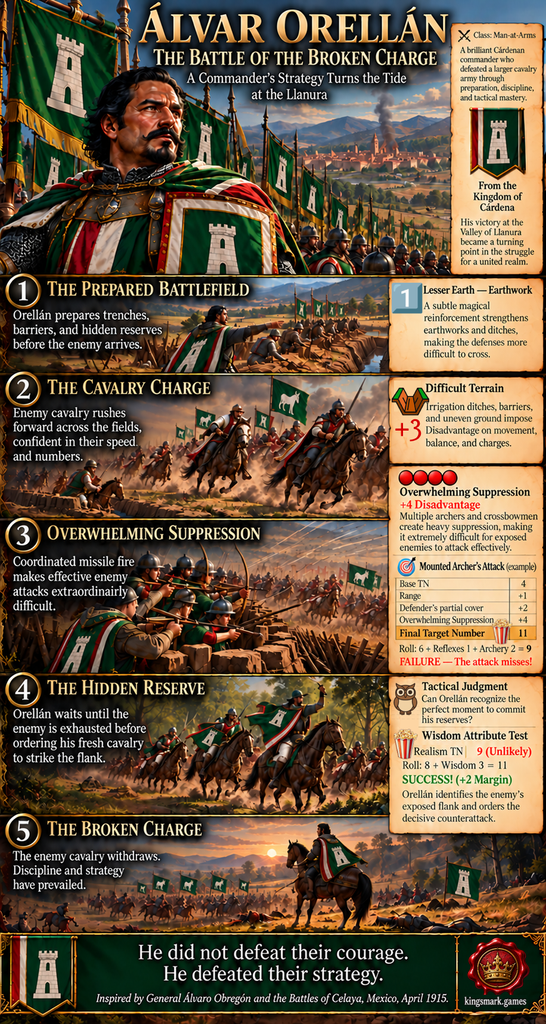
Overwhelming Suppression (+4 Disadvantage) represents the coordinated volleys unleashed by Orellán’s archers and crossbowmen. The defending soldiers maintain their positions behind protective earthworks while the attacking horsemen struggle to maneuver and return effective fire. The mechanics demonstrate how a disciplined formation can make an enemy’s actions extraordinarily difficult without requiring every incoming arrow to strike its target.
Consider an enemy mounted archer attempting to attack Orellán’s defenders. His Base TN is 4, with an additional +1 for range, +2 because his target has partial cover, and +4 from Overwhelming Suppression. His Final Target Number is 11.
The mounted archer rolls a 6 on his JCd12, adding 🌈Reflexes +1 and ⚒Archery +2 for a total of 9 — FAILURE! The arrow misses, demonstrating how the combined effects of defensive positioning and suppression can defeat an otherwise capable attack. Meanwhile, the irrigation ditches and barriers create separate difficulties for the attacking cavalry’s movement and charges.
💪 Tactical Judgment: The Wisdom of a Great Commander
The most important decision comes when Orellán must determine when to commit his hidden cavalry reserves. Attacking too early could expose his troops to destruction, while waiting too long could allow the enemy to recover or overwhelm his defenders. The commander must recognize the moment when the enemy has exhausted its strength and become vulnerable to a counterattack.
This presents an excellent opportunity for a 💪Wisdom Attribute Test, demonstrating how Kingsmark allows players to portray characters possessing greater tactical judgment than their players. Unlike a Strategic Insight Test, which can involve developing an ingenious new military plan, Wisdom determines whether Orellán correctly recognizes the moment to execute a strategy already prepared. The Game Master evaluates the difficulty using the Realism Table and assigns TN 9 — Unlikely, representing the challenge of recognizing the decisive opportunity amid the confusion of battle.
Orellán rolls 1d12 + 💪Wisdom:
Roll: 8 + Wisdom 3 = 11
SUCCESS! (+2 Margin)
Orellán recognizes that the opposing cavalry has become exhausted and that its flank is exposed. His successful Wisdom Test reveals the opportunity, while his +2 margin represents a particularly insightful assessment of the enemy’s position. He orders his concealed reserves forward, striking the vulnerable flank at the moment when the enemy is least prepared to resist. Whether his troops successfully execute the maneuver depends upon the circumstances and any additional Tests the Game Master considers necessary.
The Game Master can interpret different margins of success to determine the quality of the commander’s tactical realization. A narrow success might reveal a promising opportunity, while a substantial margin could identify an exceptionally favorable moment to act. When the challenge instead involves devising an ingenious new strategy, the Game Master may call for a ⚔️Strategic Insight Test, using 1d12 + 🌈Mental Performance PRISM + ⚒Scholarship when relevant military education applies.
This is one of Kingsmark’s strengths as a collaborative storytelling game. A player does not need to possess the tactical knowledge of Álvaro Obregón to portray a commander of comparable brilliance. The character’s abilities help determine what he recognizes, and the player decides how to act upon that knowledge.
Orellán’s victory at Llanura demonstrates that heroic achievement is not measured solely by individual combat prowess. His soldiers possess courage, his archers demonstrate discipline, and his cavalry executes a decisive maneuver, but it is his wisdom that brings those elements together. As the story’s closing words declare:
“He did not defeat their courage. He defeated their strategy.”
Audie Murphy: One American Soldier Against a German Assault
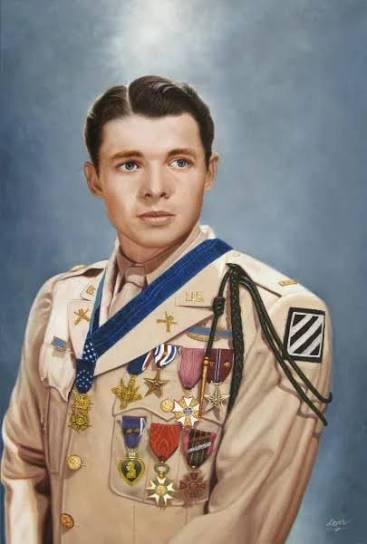
On January 26, 1945, near Holtzwihr, France, Second Lieutenant Audie L. Murphy commanded an American infantry unit facing an assault by six German tanks and accompanying infantry. Recognizing the danger, Murphy ordered his soldiers to withdraw into prepared defensive positions while he remained forward to direct artillery fire.
When a nearby American tank destroyer was struck and caught fire, Murphy climbed onto the burning vehicle and operated its .50-caliber machine gun despite the possibility that the ammunition aboard might explode. For approximately an hour, he resisted German infantry attacking from several directions. German soldiers approached dangerously close to his position. Although wounded in the leg, Murphy continued fighting until his ammunition was exhausted.
His fire inflicted significant casualties, disrupted the German advance, and helped force the supporting tanks to withdraw when their infantry support faltered. Murphy subsequently returned to his soldiers and organized a successful counterattack. His actions earned him the Medal of Honor, the highest American military decoration for valor. His official citation is preserved by the Congressional Medal of Honor Society.
🎲 How Would JCd12 Represent Murphy’s Extraordinary Performance?
Murphy’s achievement offers an especially interesting opportunity to consider ⚒Skills, ⭐Action Star Levels, 🩸Physical Wounds, and Exploding Dice. First, Murphy was not an inexperienced recruit who suddenly became effective because fate favored him. By January 1945, he had accumulated substantial combat experience. His military rank alone would not determine his ⭐Action Star Level, but his career and achievements suggest an experienced combat character rather than an untested beginner.
Under JCd12, an extraordinarily accomplished combatant might possess advanced combat Skills, strong supporting 🌈PRISMs, and a high ⭐Action Star Level. These ratings represent different aspects of the character: what he knows, what he can physically accomplish, and the development of his adventuring career. For comparison, Murphy might inspire the creation of a ⭐Level 4 or ⭐Level 5 military hero, although historical evidence cannot tell us how much fictional XP he would have invested.
Second, Murphy was operating under exceptionally dangerous circumstances. He was exposed to enemy fire, physically wounded, and fighting from a burning vehicle that might explode beneath him. Imagine a JCd12 combatant attempting a difficult attack with a final TN 16. If his combined bonuses amounted to +3, even an ordinary maximum roll of 12 would produce only 15. He would need an Exploding 12 to have any chance of succeeding.
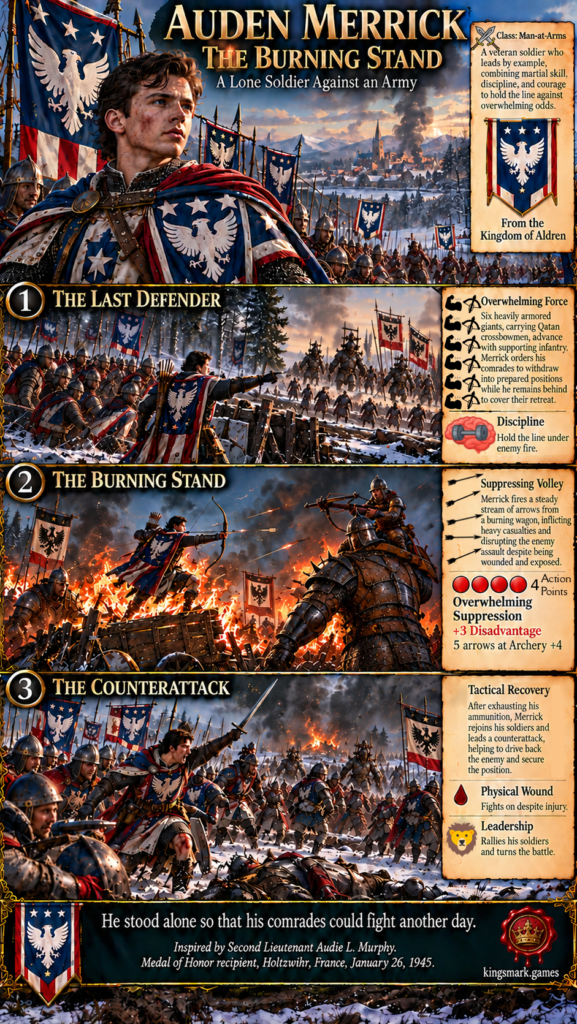
This hypothetical roll is not a reconstruction of Murphy’s individual shots. Rather, it illustrates why the rules permit exceptional results when ordinary success would be impossible. Third, Murphy’s machine gun and the artillery he directed helped disrupt the German attack. Those effects went beyond one man firing a medieval bow. They included substantial casualties, concentrated fire, and the loss of effective infantry support for the German tanks.
The relevant JCd12 lesson is that a highly capable character can influence an entire battle through an extraordinary action without personally defeating every enemy. Murphy’s actual achievement was not merely surviving against impossible odds. He protected his comrades, disrupted a coordinated assault, and subsequently helped organize the counterattack that secured the position.
Điện Biên Phủ: Vietnamese Firepower Denies the French Their Advantage
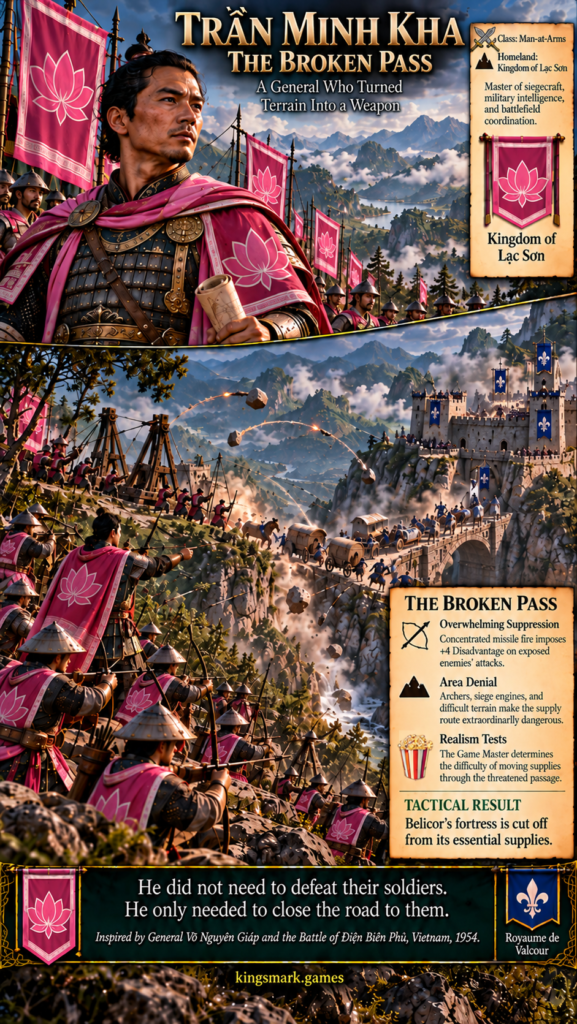
In 1954, during the First Indochina War, Vietnamese forces under General Võ Nguyên Giáp besieged the French stronghold at Điện Biên Phủ. The French depended heavily on aircraft to deliver ammunition, food, reinforcements, and other essential supplies to their increasingly isolated garrison.
Rather than allowing the French to exploit their advantage in aviation, the Viet Minh positioned artillery and antiaircraft weapons around the valley. Their concentrated fire made low-altitude flights increasingly dangerous and helped deny the French the reliable aerial access they desperately needed.
By the end of March, Viet Minh artillery had rendered the airstrips unusable, and French resupply depended upon parachute drops. Increasingly dangerous approaches forced aircraft to operate under unfavorable conditions. Supplies dropped from greater heights could land outside French positions, sometimes falling directly into Vietnamese hands.
The French needed those aircraft to sustain their defense. Every failed shipment brought the garrison closer to defeat. The impact of Vietnamese artillery on French resupply is documented in the U.S. Department of State’s contemporary diplomatic records.
The Viet Minh did not need to destroy every French aircraft to accomplish their objective. By making essential operations dangerous and unreliable, their firepower helped deprive the French garrison of the support it needed to continue fighting effectively.
🎲 How Would JCd12 Represent the Vietnamese Strategy?
Điện Biên Phủ illustrates the relationship between suppression, area denial, and the broader concept of controlling an opponent’s options. The medieval suppression table specifically concerns attacks made under incoming missile fire. It does not automatically assign +4 to every task performed within a dangerous area.
Nevertheless, JCd12’s wider approach to Target Numbers provides a useful framework for representing difficult operations. Imagine a fantasy fortress surrounded by enemies who have positioned archers and siege engines upon the surrounding heights. The defenders depend upon flying messengers, supply deliveries, or allied creatures capable of carrying essential materials into the fortress.
The attackers need not destroy every approaching target. They may accomplish their strategic purpose simply by making the approach sufficiently dangerous that deliveries become unreliable. The Game Master could determine appropriate Tests for a difficult approach or supply delivery according to the circumstances. The suppression modifiers would apply when their actual conditions are met, while other dangers would require their own appropriate adjudication.
This is a valuable distinction: suppressing enemy attacks and denying enemy access are related tactical achievements, but they are not identical game mechanics. A skilled commander understands that controlling what an enemy can accomplish may be more important than defeating him through direct attacks.
Heroism Is Not the Exclusive Possession of Any Army
These four historical examples involve different nations, different conflicts, and dramatically different military circumstances. Some celebrate individual courage, while others demonstrate collective discipline, tactical innovation, and battlefield coordination. They also remind us that courage, determination, and military competence are not exclusive possessions of any particular nation or army.
Recognizing the bravery or ingenuity of a combatant does not require endorsing every decision made by his commanders, government, or political cause. A worthy opponent can be courageous, resourceful, and extraordinarily difficult to defeat. Indeed, recognizing those qualities often makes a military victory more meaningful and a fictional conflict more compelling.
For Kingsmark players and Game Masters, the central lesson is that the significance of an action should not be measured exclusively by the injuries it inflicts. A character who prevents enemies from advancing, protects retreating companions, denies an opponent a tactical advantage, or buys enough time for an ally to complete an important objective might accomplish something far more consequential than simply striking another enemy. That is the difference between treating combat as an exercise in accumulating casualties and understanding it as an unfolding story in which courage, judgment, teamwork, and tactical decisions determine the outcome.
Historical Archery: The Forgotten Art of Rapid Fire
Modern soldiers possess weapons capable of firing dozens or even hundreds of rounds in a relatively short period. A medieval archer has no such luxury. Every arrow must be prepared, nocked, drawn, and released through human effort.
Nevertheless, historical archers developed remarkable techniques for shooting rapidly, particularly in traditions where mobility and repeated shots were essential. The popular image of an archer slowly removing one arrow from a quiver, carefully aiming, and releasing it represents only one approach to the weapon.
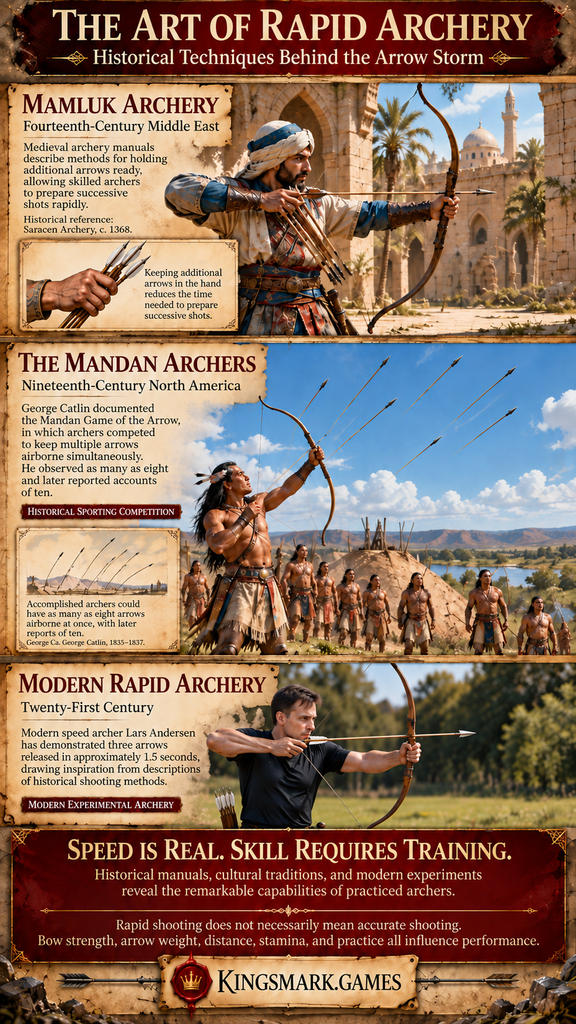
Medieval Islamic archery manuals document techniques for preparing and shooting arrows in rapid succession. The fourteenth-century Mamluk treatise commonly known as Saracen Archery, attributed to Taybugha al-Ashrafi, reflects an established tradition of sophisticated military archery training. Another important manuscript, translated into English as Arab Archery, describes techniques for holding additional arrows ready in the hands. The historical importance of Taybugha’s treatise is discussed in Who Wrote the First “Useful” Archery Manual?.
Such techniques become particularly interesting when considering mounted archery. A horseman passing an enemy at speed might have only a brief opportunity to fire. Rapidly releasing several arrows during that opportunity could be considerably more useful than spending the same interval preparing one perfectly aimed shot.
Effectiveness depended upon more than speed, however. Bow strength, arrow weight, range, accuracy, fatigue, and the ability to achieve a proper draw all mattered. A person capable of performing a spectacular rapid-fire demonstration with a relatively light bow might not achieve the same results with a substantially heavier military weapon.
This distinction becomes especially relevant when examining the work of modern Danish archer Lars Andersen.
Lars Andersen and the Rediscovery of Rapid Archery
Lars Andersen became internationally known for demonstrations of extraordinary archery speed, unusual shooting techniques, and the ability to release arrows while moving. His work attracted considerable attention following the release of Lars Andersen: A New Level of Archery in 2015.
Andersen has demonstrated sequences involving several arrows released in rapid succession and explored historical techniques that allow an archer to hold additional arrows ready for immediate use. On his website, he discusses demonstrations involving three arrows in approximately one and a half seconds. His video archive also documents a demonstration in which he launched eleven arrows upward before the first returned to the ground.
His historical interpretations have sometimes been disputed, and modern demonstrations should not automatically be treated as proof that particular medieval warriors fought in precisely the same manner. Nevertheless, Andersen’s experiments demonstrate that human archers can develop much greater rates of fire than many casual observers would expect. There is also a fascinating North American historical account that helps place these achievements into perspective.
The Mandan Archers and the Game of the Arrow
During the nineteenth century, American painter and traveler George Catlin observed archery competitions among the Mandan people of the northern Great Plains. He described an activity known as the Game of the Arrow, in which participants attempted to launch as many arrows into the sky as possible before the first arrow returned to the ground.
In his later exhibition catalog, Catlin reported instances involving as many as ten arrows airborne simultaneously. His observations were accompanied by artwork depicting the competition, including Archery of the Mandan, preserved by the Smithsonian American Art Museum, and Game of the Arrow — Mandan, preserved by the National Gallery of Art.
This was a competitive demonstration rather than a documented example of suppressive fire in combat. The archers deliberately shot their arrows upward, allowing more time before the first arrow descended. Nevertheless, the achievement reveals considerable skill in handling a bow and preparing successive arrows rapidly.
There is something remarkable about imagining an archer sending one arrow skyward, immediately preparing another, and continuing until the sky contains a succession of projectiles from his single bow. Even without assuming that the same rate could be maintained in battle, it challenges the notion that rapid-fire archery must be a modern fantasy invention.
In Kingsmark, these historical traditions help establish a believable foundation for exceptional archers. Their abilities can be extraordinary without requiring supernatural powers. Training, experience, physical coordination, and specialized technique can produce feats that appear almost impossible to ordinary observers.
Suppressive Archery on the Battlefields of Sylva
The world of Sylva offers numerous opportunities for the tactical use of suppressive archery. Imagine a castle courtyard where several defenders stand behind the battlements, shooting at warriors attempting to cross the open ground below. The attackers possess shields, swords, and axes, but have difficulty approaching because the defenders can observe their movements and strike whenever they emerge from cover.
Now imagine that an exceptionally skilled archer among the attackers begins rapidly sending arrows toward the exposed portions of the battlements. An arrow strikes the wooden parapet inches from a defender’s face. Another passes over the wall just as an enemy archer prepares to rise and take aim. Suddenly, leaning over those battlements is no longer a comfortable way to pick off approaching enemies. Every exposed head and shoulder becomes a potential target.
The attacking warriors may now have an opportunity to cross the courtyard, approach the walls, or withdraw from a dangerous position. The suppressing archer has changed the battle without necessarily striking a single defender.
The same principle applies in forests, ruined temples, narrow streets, mountain passes, and underground fortifications. A small number of arrows directed toward a narrow doorway may represent a serious danger to anyone attempting to pass through it. Those same arrows scattered across an enormous open field would produce a much less convincing threat.
Cover also matters. An arrow cannot injure someone through a sufficiently thick stone wall merely because the archer is using suppressive fire. The danger exists where projectiles can actually reach the enemy or where an opponent must expose himself to accomplish something.
This is particularly relevant in Kingsmark because the game does not treat combat as an exchange of abstract Hit Points. Positioning, physical injuries, defensive choices, and tactical opportunities all possess importance independent of an opponent’s accumulated damage. The relationship between injuries and protection is explored in 💥Damage & Defense in Kingsmark, which explains how 🎯Hit Locations, 🛡Armor Ratings, 🩸Physical Wounds, and 🧠Mental Trauma influence combat. A character who prevents an enemy from attacking may protect his companions more effectively than one who inflicts a wound but allows that enemy to continue fighting.
🔴🔴🔴🔴Suppressing Volley: The Official Kingsmark Rules
Kingsmark provides a dedicated ⚒Archery action called 🔴🔴🔴🔴Suppressing Volley, described in the Player’s Handbook. For 4 🔵Action Points, the archer rapidly fires multiple arrows into or across a reasonably concentrated area, attempting to make it dangerous for enemies to expose themselves and fight effectively. The action is specifically distinguished from carefully aiming at individual targets.
An ordinary character using Suppressing Volley fires four arrows. A character possessing ⚒Archery +3 or +4 may instead fire five arrows. The character must have sufficient ammunition for the complete volley, and the bow must already be ready when the action begins.
The action incorporates the necessary preparation of the individual arrows during the volley. In other words, the character does not pay additional Action Points to retrieve and nock each arrow. The complete sequence is covered by the four-Action-Point expenditure.
Characters exposed within the threatened area become Heavily Suppressed (+3 Disadvantage) until the beginning of the archer’s next ⏸Turn. This is a specific action-based effect. It applies even when only one archer performs the volley, unlike the ordinary suppression table’s requirement for three or more separate attackers to produce Heavy Suppression through their combined fire.
This is an intentional distinction between suppression produced by ordinary attacks and suppression created by a dedicated specialized action. Interestingly, Suppressing Volley does not require a normal ⚒Archery attack roll against each individual enemy. The archer is not attempting to strike a carefully selected opponent with every arrow.
Instead, the player rolls 1d12 for each arrow fired. Whenever one of those dice produces a natural 12, an exposed character within the threatened area is struck. If several enemies could reasonably have been hit, the Game Master determines the victim randomly rather than allowing the archer to choose.
These incidental hits are genuine attacks, not merely frightening near misses. The Game Master resolves the resulting 🎯Hit Location, 🛡Armor, 💥Damage, and any applicable Critical or exploding-die rules normally.
The distinction between exposure and protection is essential. A character completely protected from the incoming arrows cannot be struck merely because he occupies the general area being suppressed. Furthermore, Suppressing Volley cannot be exploited as a substitute for choosing a particular enemy as the intended target. If the archer wishes to strike one specific opponent, he must use an appropriate attack action rather than disguising a precision attack as suppression.
The full action appears in Chapter 12 — 🎬Example Actions of the Player’s Handbook. It also appears in the concise 📎Appendix A — Actions reference.
Suppressing Volley Versus Rapid Fire
Kingsmark also provides the 🔴🔴🔴🔴Rapid Fire action, which allows an exceptionally fast archer to make several attacks during one sequence. Although both actions involve rapid shooting, they serve fundamentally different purposes.
Rapid Fire allows the archer to make separate ⚒Archery attack rolls against intended targets. The number of arrows depends upon the character’s ⚒Archery Skill and 🌈Reflexes PRISM, subject to the action’s minimum of two and maximum of four arrows.
Rapid Fire has a Base TN of 4, plus appropriate ranged-combat modifiers, with an additional +8 reflecting the maneuver’s substantial difficulty. Each arrow is resolved separately.
Suppressing Volley, by comparison, exchanges deliberate individual attacks for the ability to threaten a concentrated area. The archer accepts that most arrows may strike nothing of significance because the principal objective is not to defeat one particular enemy through precision.
This difference reflects the military distinction between trying to kill an opponent and attempting to prevent several opponents from fighting effectively. An archer using Rapid Fire hopes that his arrows strike their intended targets. An archer using Suppressing Volley wants his enemies to recognize that remaining exposed could get them killed. Both actions have their place, and the circumstances should determine which is more valuable.
Which Kingsmark Characters Benefit Most?
The Ranger is an obvious candidate for using Suppressing Volley. A Ranger who understands forests, terrain, movement, and the importance of ranged combat can use archery to support companions while remaining some distance from the enemy. Protecting a retreat, disrupting hostile archers, or preventing enemies from advancing through a narrow passage are all natural applications.
Monster Hunters may find similar opportunities when confronting dangerous creatures whose movements must be controlled. A Man-at-Arms trained in ⚒Archery might employ suppressive fire as part of a coordinated attack or withdrawal. Other characters possessing the necessary Skill can also use the action when circumstances permit.
The important distinction is that Suppressing Volley is an Archery action rather than an exclusive supernatural ability or Class power. Its effectiveness derives from the character’s training, available ammunition, position, and the realistic danger presented to nearby enemies. Players unfamiliar with the different professions can explore Chapter 9 — 🎭Character Class, which introduces the seventeen playable Classes.
Suppressive fire also gives non-archer companions meaningful opportunities to cooperate. A Holy Knight might advance while an archer threatens enemy positions. A Thief could escape with important information, or a Healer might reach an injured companion without being subjected to the same degree of effective enemy fire.
Suppression is therefore not simply a way to make an archer more dangerous. It gives the archer a means of making the entire party more effective.
A Game Master’s Responsibility: Fear, Courage, and Realistic Reactions
The rules establish mechanical consequences, but the Game Master must still portray enemies as believable participants in the battle. Not every enemy should automatically flee because arrows begin falling around him. Some opponents will seek cover, others will continue their attacks despite the danger, and particularly disciplined or fanatical warriors may accept the risk of being struck. Their decisions should reflect their objectives, experience, circumstances, and personalities.
A hardened mercenary might keep fighting because surrender would mean forfeiting his payment. A frightened conscript might abandon his position before suffering a single wound. A loyal warrior may expose himself to tremendous danger because his injured brother is lying helpless a few yards away.
These differences make combatants believable. They also make encounters more interesting because the characters are confronting opponents who possess motives and personalities rather than disposable targets waiting to be defeated.
Likewise, suppressive fire should not automatically inflict 🧠Mental Trauma merely because enemies are frightened by incoming arrows. Ordinary suppression and recorded Mental Trauma are separate concepts, and their mechanics should not be casually combined without a rule or circumstance that justifies doing so.
The Game Master should also understand that suppression does not make the affected enemies helpless. An enemy who enjoys complete cover may remain safe, while one who attempts to expose himself may still decide that the risk is worthwhile. What matters is that the danger is represented consistently and the characters’ decisions remain meaningful.
The strongest encounters are not those where the Game Master mechanically forces enemies to behave like frightened targets. They are those where the battlefield creates believable dangers, and intelligent combatants respond to those dangers in ways that shape the unfolding story.
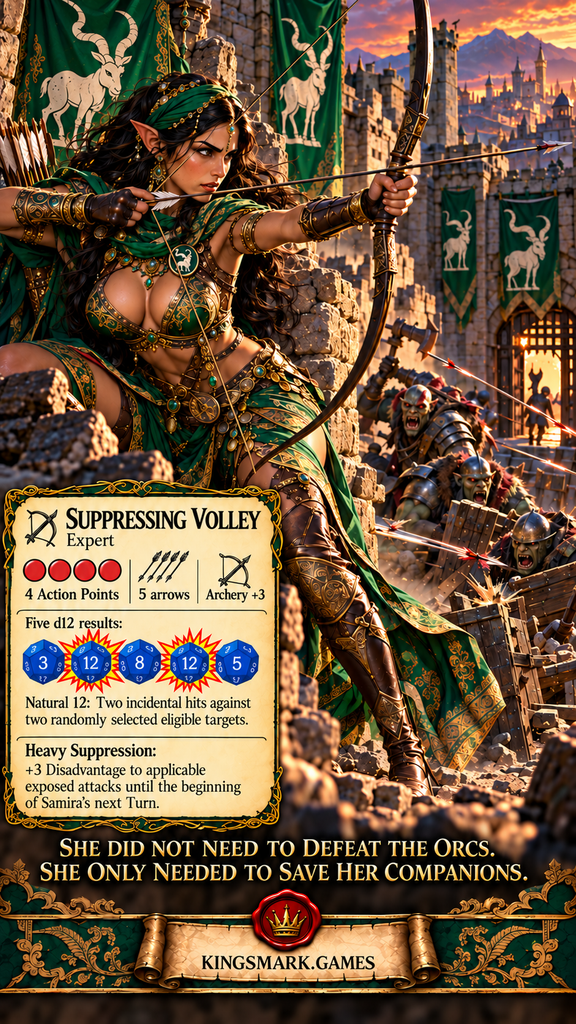
🎬Example — The Ranger Who Saved Her Companions
Samira, an Elven Ranger, crouches behind the broken remains of a stone wall as three orcs advance through a ruined courtyard. Her companions are attempting to retreat through a narrow gate. One of them, a wounded Man-at-Arms named Garrick, can barely walk, and another warrior has wrapped an arm around him to keep him moving. The orcs realize that the injured man is slowing the retreat. Two advance with weapons ready, while the third prepares to move around a collapsed section of masonry to cut off the party’s escape. Samira understands that carefully shooting one opponent may not be enough to prevent the others from reaching her companions. Her bow is already ready, and her quiver contains sufficient ammunition. She possesses ⚒Archery +3, enabling her to use the expert version of 🔴🔴🔴🔴Suppressing Volley. Spending 4 🔵Action Points, she rapidly looses five arrows toward the concentrated area occupied by the advancing orcs.
The first arrow strikes the ground near an orc’s feet. Another passes close to a broken stone pillar. A third hits the edge of a damaged wooden barricade, while the remaining arrows cut dangerously through the openings and exposed ground occupied by the advancing enemies. The Game Master establishes that the exposed orcs are Heavily Suppressed until the beginning of Samira’s next ⏸Turn. The player then rolls five d12s, one for each arrow, obtaining 4, 9, 12, 6, and 2. One die has produced a natural 12, meaning one logically exposed enemy has been struck.
Two orcs are sufficiently exposed to be eligible for the incidental hit. The Game Master determines the victim randomly, then resolves 🎯Hit Location, 🛡Armor, 💥Damage, and any applicable additional effects according to the normal rules. The remaining arrows create no additional incidental hits, but the suppression still affects the exposed enemies. When the orcs attempt to continue their pursuit, the Game Master considers the ongoing threat. One crouches behind the masonry, refusing to expose his face while arrows threaten the opening. Another hesitates before advancing, unwilling to rush directly into danger.
The third attempts to continue the pursuit, but any attack he makes while exposed remains subject to the applicable +3 Heavy Suppression Disadvantage. Suppose he attempts an attack that would ordinarily require TN 8. Heavy Suppression raises the required Target Number to TN 11. The orc is not incapable of attacking. He must simply overcome a more difficult Target Number because of the dangerous circumstances created by Samira’s action.
Behind them, Garrick stumbles. His companion catches him beneath the arms, struggling to keep the wounded warrior upright. There is no time to bandage his injuries, no opportunity to stop and rest, and no guarantee that the orcs will abandon their pursuit.
Fortunately, Samira has given them something more valuable than another dead enemy: a few precious moments. These moments are enough. Garrick’s companion drags him through the gate, and the party begins closing the heavy wooden doors behind them. Samira withdraws from her position and follows, already considering how many arrows remain in her quiver.
Her companions have escaped. Whether the incidental hit inflicted a serious wound or merely damaged the enemy’s ability to continue fighting, the central achievement remains unchanged. Samira did not need to kill all three orcs. She needed to prevent them from stopping her companions long enough for the wounded man to reach safety.
Her decision illustrates the same tactical principle demonstrated by soldiers in several of the historical engagements discussed earlier.
The Battlefield Is More Than a Collection of Targets
Many fantasy combat systems encourage players to measure effectiveness primarily through the amount of damage they inflict. The strongest warrior is often assumed to be the one who causes the greatest loss of Hit Points, while other battlefield contributions become secondary considerations.
Kingsmark approaches combat differently. Positioning, defensive decisions, psychological pressure, injuries, movement, and cooperation can matter just as much as a successful attack. Suppressive fire is one example of how a character can influence an encounter without relying entirely upon the number of opponents he injures.
The history of warfare demonstrates that controlling enemy actions can be extraordinarily important. Soldiers from different nations and historical periods have risked their lives to protect comrades, interrupt advances, deny enemy advantages, and provide the moments necessary for others to reach safety. Historical archers developed remarkable techniques for releasing arrows rapidly, while modern military forces refined the use of concentrated fire to interfere with hostile operations.
JCd12 translates some of those realities into mechanics that Players and Game Masters can understand and apply. An extraordinary warrior might possess ⚒Archery +4, but his expertise does not make him immune to dangerous circumstances. A courageous fighter might possess considerable experience and determination, but he can still suffer 🩸Severe Wounds. A well-trained soldier might have little difficulty striking a stationary opponent under ideal circumstances, yet struggle to accomplish the same action while under Overwhelming Suppression. And sometimes even the greatest heroes must depend upon an Exploding 12 to accomplish something truly extraordinary.
This balance between realistic consequences and cinematic possibilities is central to Kingsmark’s design. The system does not require players to choose between believable combat and exciting heroism. Rather, it attempts to make extraordinary achievements more meaningful by acknowledging the dangers and difficulties that made those achievements extraordinary in the first place.
A skilled Game Master can bring these ideas into fantasy adventures without losing the excitement of combat. Indeed, they create more opportunities for heroism because a character’s courage and tactical intelligence can accomplish something greater than merely defeating the enemy directly. Readers interested in developing characters whose decisions and personalities matter beyond the battlefield can explore Creating Memorable Fantasy Heroes and Winning Without Killing.
Ultimately, the most compelling victories are not always those achieved by the strongest combatant or the deadliest weapon. A battle might be remembered because a frightened young archer found the courage to stand his ground, because an exhausted warrior held a doorway against overwhelming numbers, or because someone recognized that saving a wounded companion mattered more than pursuing a fleeing enemy.
Sometimes the greatest warrior on the battlefield is not the one who kills the most enemies. He is the one whose actions make it possible for his companions to survive.
Historical Sources
The principal historical references for this article include James Delk’s account of the 1992 Los Angeles riots, Christopher M. Schnaubelt’s military analysis, Trevor N. Dupuy’s Understanding War: History and Theory of Combat, the British government’s records concerning Khudadad Khan, the Library of Congress’s research on the Battles of Celaya, Audie Murphy’s official Medal of Honor citation, contemporary diplomatic and military records concerning Điện Biên Phủ, medieval Islamic archery treatises, Lars Andersen’s documented demonstrations, and George Catlin’s descriptions of the Mandan Game of the Arrow. Relevant historical documents and institutional sources are linked throughout the article.
All specifically identified Kingsmark rules are drawn from the published Kingsmark Player’s Handbook, First Edition, including its Suppression table, Chapter 11 — ▶️Action Scenes, Chapter 12 — 🎬Example Actions, and the Archery actions Rapid Fire and Suppressing Volley. Modern-firearms and historical dice comparisons are illustrative applications of JCd12 principles, not additional official Kingsmark rules.
👑Kingsmark — A Heroic Fantasy Tabletop Role-Playing Game for Mature Players.
About The Author