🧠What IQ Do You Need to Be a Kingsmark Game Master?
Is Kingsmark too complicated, or is investing in learning a more realistic RPG Part of the Fun?
By John Alan Martinson, Creator of 👑Kingsmark
Someone recently criticized 👑Kingsmark’s combat system for having too much crunch, particularly because it uses Physical Wounds instead of conventional Hit Points. Apparently, recording an actual injury is more complicated than subtracting numbers from an imaginary reservoir of bodily durability. There is some truth to the criticism, because Kingsmark deliberately represents physical consequences that simpler combat systems leave abstract. But that raises an interesting question about tabletop role-playing games: How intelligent does someone actually need to be to run Kingsmark competently?
After examining the game’s mathematics, terminology, memory requirements, and combat procedures, we can make a reasonable attempt to answer that question. More importantly, we can investigate whether Kingsmark’s additional mechanics represent needless complication or meaningful depth. A game can contain more rules without necessarily being more difficult to understand, particularly when those rules follow consistent principles that players can recognize and remember.
How Smart Do You Have to Be to Game Master Kingsmark?
First, let’s establish what IQ, or Intelligence Quotient, actually measures. Standardized intelligence tests assess abilities associated with reasoning, comprehension, problem-solving, memory, and processing information, with an average IQ conventionally established at 100. Intelligence can influence how quickly someone learns unfamiliar material, but it does not directly measure creativity, patience, leadership, or practical Game Mastering experience. Running a tabletop RPG requires several kinds of mental activity, and no single intelligence score captures all of them.
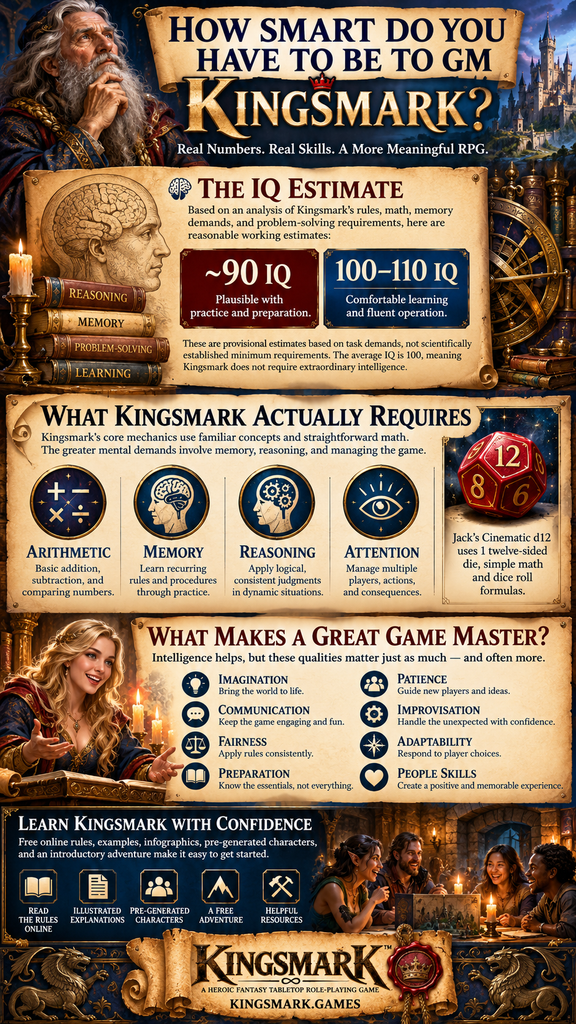
An examination of Kingsmark’s rules suggests that an IQ around 90 may be sufficient to become a competent Game Master through preparation and practice, while an IQ of approximately 100–110 represents a reasonable working estimate for comfortable, independent learning and fluent operation. An IQ of 90 falls around the 25th percentile of the population, while 100 represents the average and 110 approximately the 75th percentile. These figures are provisional estimates based on the game’s cognitive demands, not scientifically established minimum requirements or the results of IQ-testing Kingsmark Game Masters. They suggest that extraordinary intelligence is unnecessary, although someone with a lower score could certainly become an excellent GM through experience and effective preparation.
The mathematics itself is surprisingly straightforward. Kingsmark primarily requires basic addition, subtraction, comparisons, and familiarity with small positive and negative numbers, while its 🌈Attribute PRISMs consolidate related abilities into useful ratings. The harder intellectual work involves remembering procedures, recognizing which modifiers apply, following conditional rules, and managing several participants simultaneously. In other words, working memory and procedural knowledge present greater challenges than mathematical ability, especially during complicated combat encounters.
Research supports distinguishing intelligence from learned expertise. A 2026 meta-analysis involving 109,396 participants found that general mental ability was positively associated with occupational performance, but intelligence explained considerably less performance variation than some earlier estimates suggested. Meanwhile, cognitive load research explains how examples, organized instruction, and familiar procedures help people manage intellectually demanding tasks. Someone who has Game Mastered Kingsmark for fifty sessions may therefore run combat much more smoothly than an exceptionally intelligent newcomer encountering the rules for the first time.
Is Kingsmark Too Crunchy, or Does It Simply Make Sense?
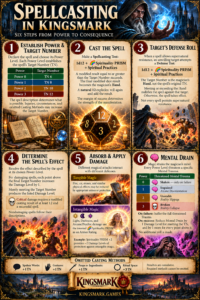
In tabletop gaming, crunch generally refers to mechanical complexity, particularly rules involving calculations, detailed procedures, tactical choices, and bookkeeping. Kingsmark certainly contains more mechanical detail than many rules-light RPGs, and I have no intention of pretending otherwise. With twelve 💪Attributes, multiple 🌈PRISMs, a structured Action Point economy, location-specific armor, and Physical and Mental Trauma, there is a substantial system to learn. The important question is whether these mechanics create meaningful gameplay or merely give everybody more homework.
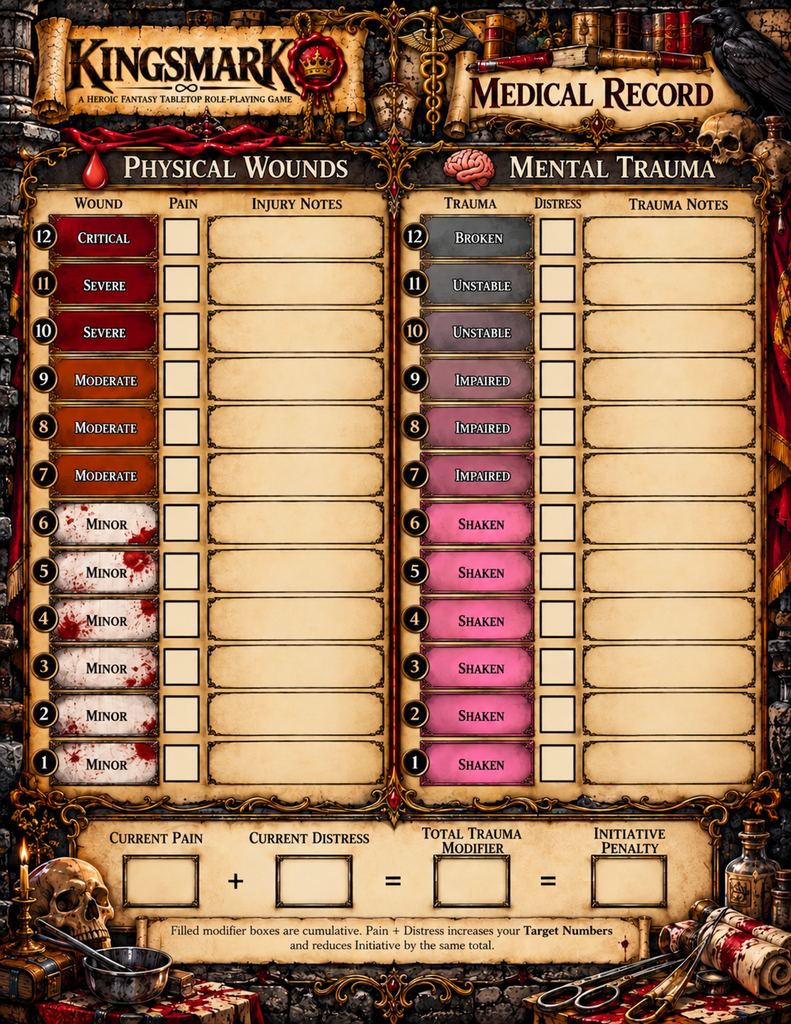
Consider a swordsman who receives a serious injury to his right arm. In conventional Hit Point combat, that event might simply subtract eight points from a character’s remaining durability, with no immediate effect upon his ability to fight. Kingsmark instead considers the injury’s anatomical location, severity, armor protection, and possible physical consequences. A wounded sword arm can become an interesting tactical problem rather than another subtraction exercise, an argument explored more extensively in The Problem With Endless HP.
This additional detail does require more attention, but it also provides information that players can immediately understand. A helmet protects someone’s head, a wounded leg can make movement difficult, and a sufficiently serious injury may change how an adventurer approaches danger. Kingsmark’s twelve Hit Locations represent broad anatomical regions rather than dozens of individually tracked bones and organs, while its four wound severities are 🩸Minor, 🩸Moderate, 🩸Severe, and 💀Critical. The objective is not to simulate every biological detail, but to make injuries believable enough to influence meaningful decisions.
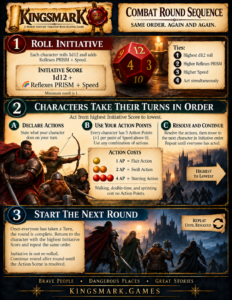
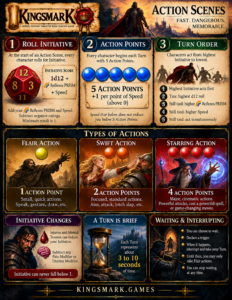
Kingsmark also deliberately simplifies other aspects of gameplay through consistent mechanical design. Players use one die type, ⭐Jack’s Cinematic d12, rather than requiring an assortment of differently shaped dice, while ordinary Skill Tests follow the familiar structure of adding a PRISM and Skill rating to a d12 result. Its ▶️Action Scenes organize activities into recognizable Action Point categories: 🟡Flair Actions cost 1 AP, 🟠Swift Actions cost 2 AP, and 🔴Starring Actions cost 4 AP. These predictable foundations allow players to learn recurring principles instead of treating every situation as an entirely new mathematical problem.
Of course, Kingsmark’s 💥Damage & Defense procedures involve more steps than ordinary HP subtraction, especially when attacks, defenses, armor, and wound escalation interact. That is a legitimate learning challenge, but mastering those procedures can be satisfying in much the same way that learning chess, a strategy game, or a new sport becomes satisfying. Once familiar, the mechanics can help players recognize tactical possibilities and understand why their decisions matter. A good system should reward the effort required to learn it, and Kingsmark’s ambition is to make that effort enjoyable rather than exhausting.
What Actually Makes a Great Game Master?
Intelligence matters, but a Game Master needs considerably more than an impressive ability to solve puzzles or remember numerical formulas. A successful GM must communicate clearly, listen attentively, exercise good judgment, improvise convincingly, maintain continuity, and treat the players fairly. Research examining creativity among tabletop Game Masters also emphasizes collaborative storytelling and the importance of group dynamics. A brilliant person who refuses to listen to players may be considerably less enjoyable than someone of ordinary intelligence who knows how to run an exciting adventure.
Memory is particularly valuable because constantly consulting a rulebook can interrupt the experience, but preparation should not become an obsession. Experienced Game Masters learn which procedures appear frequently, keep useful references available, and develop enough confidence to make reasonable decisions when unusual circumstances arise. I explore that balance in Dungeon Masters Should Stop Overpreparing, because excessive preparation can consume time that would be better spent actually playing. The objective is not to memorize every rule, but to become sufficiently familiar with the system that its mechanics support the adventure rather than interrupt it.
Kingsmark was developed with that learning process in mind. The complete 📖Player’s Handbook is available online for free, organized into individual chapters with consistent terminology, illustrated explanations, recognizable emojis, and instructional examples. The free Resources section also provides access to character records, rules references, four ready-made Player Characters, and an introductory Dungeon, while additional downloadable tools continue to be developed. Players can begin with basic Skill Tests, introduce combat gradually, and learn more advanced procedures as their adventures demand them, without memorizing an entire 556-page handbook before their first session.
The most important quality of a Game Master may ultimately be the willingness to keep learning while giving other people opportunities to enjoy themselves. Kingsmark offers a mechanically detailed approach to heroic fantasy because I believe believable consequences, meaningful choices, and cinematic action are worth the effort of learning a few additional procedures. You do not need an exceptional IQ, a mathematical education, or an encyclopedic memory to begin that journey, although curiosity, discipline, imagination, and practice will serve you exceedingly well. If you enjoy learning a system whose mechanics are designed to make sense, explore 👑Kingsmark at Kingsmark.games and discover how satisfying a thoughtfully developed fantasy RPG can be.
About The Author