💲Make Money with Tabletop Role-Playing Games

Why Tabletop Role-Playing Games May Be One of Entertainment’s Most Undervalued Investments
Tabletop Role-Playing Games Are Serious Business — And There’s Room for You
Someone once left a comment on one of my TikTok videos that went something like this: “My teenage son makes games. Get a real job.” I found that attitude fascinating because it reveals how easily people dismiss creative work when they do not understand its commercial possibilities. Teenagers also write computer programs, draw comic books, make movies, compose music, and play sports, yet nobody seriously argues that those activities cannot become legitimate professions. The fact that somebody participates in an activity as a hobby tells us nothing about what a talented, disciplined professional might accomplish with it.
A young person designing a game might be learning mathematics, probability, creative writing, graphic design, psychology, economics, or computer programming. He might also be discovering how to organize complicated ideas, communicate instructions, entertain an audience, and manage a project from conception to completion. Those are valuable abilities even if his first game never earns a dollar, and they become considerably more valuable when combined with experience, discipline, and an understanding of what customers want. Some of those young designers may eventually create successful businesses, just as aspiring musicians, writers, filmmakers, and software developers sometimes turn their childhood interests into careers.
I believe tabletop role-playing games, commonly called TTRPGs, represent one of the most interesting and underestimated business opportunities in modern entertainment. The opportunities extend far beyond game design, encompassing artists, writers, actors, musicians, professional Game Masters, programmers, miniature sculptors, carpenters, event organizers, and entrepreneurs. You do not have to invent the next Dungeons & Dragons to build a worthwhile business in this industry, nor do you have to become a millionaire for your work to constitute a success. You simply need to discover something people value, develop the ability to provide it, and find a way to reach the customers who want it.
The Money Is Already There
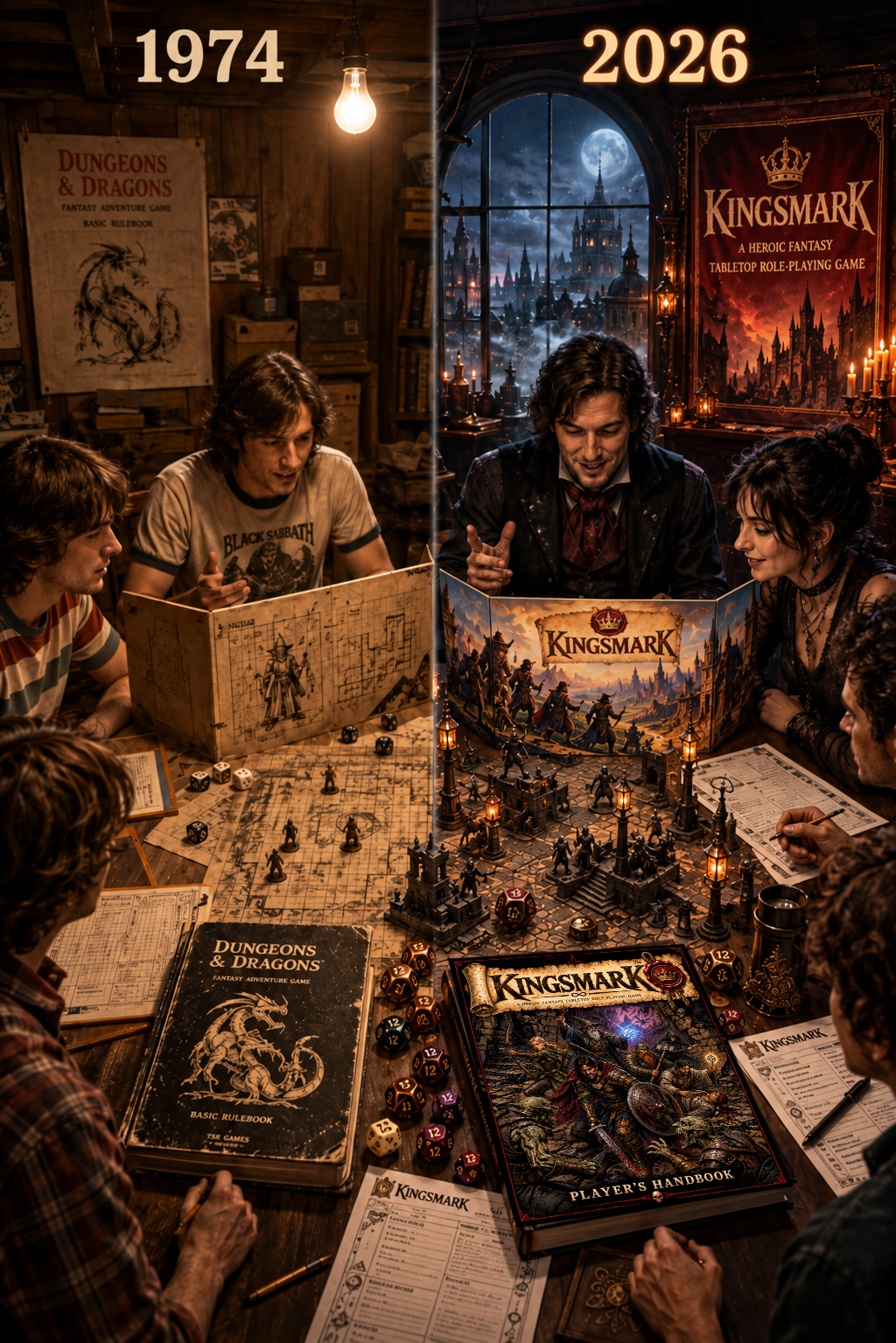
Modern commercial tabletop role-playing is generally traced to the publication of Dungeons & Dragons in 1974. Gary Gygax and Dave Arneson helped establish a form of entertainment in which players could inhabit imaginary characters, explore fictional worlds, and influence developing stories through their decisions. Unlike conventional board games, tabletop role-playing allows participants to attempt an extraordinary range of actions because a human Game Master can interpret their intentions and determine how the fictional world responds. What began within the tabletop wargaming community eventually developed into an international hobby supporting publishers, conventions, entertainers, software companies, manufacturers, and countless independent creators.
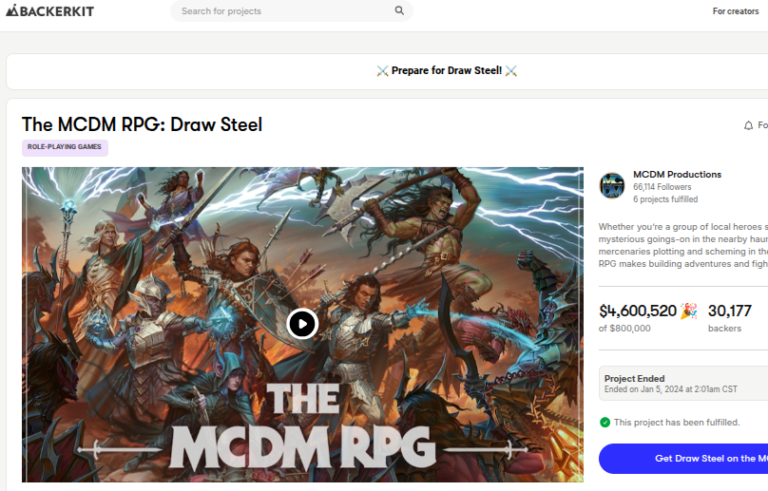
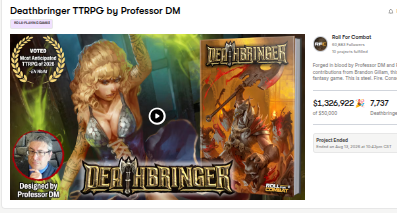
The financial potential is no longer theoretical, and crowdfunding provides particularly visible evidence of what customers are willing to spend. MCDM Productions’ original Draw Steel campaign concluded in January 2024 with $4,600,520 pledged by 30,177 backers, demonstrating substantial demand for an independently developed fantasy role-playing system. Another example is Deathbringer, created by Professor Dungeon Master and Roll For Combat, whose 2026 campaign attracted $1,326,922 from 7,737 backers. Professor Dungeon Master had spent years developing a recognizable public identity through his Dungeon Craft YouTube channel, illustrating how reputation, an established audience, and a distinctive philosophy of gaming can support commercial success.
These figures represent crowdfunding pledges rather than personal profits, since artwork, editing, manufacturing, distribution, taxes, fulfillment, and other expenses consume substantial portions of revenue. Nevertheless, the campaigns demonstrate that thousands of customers are willing to invest their money in tabletop games created outside the industry’s largest established publishers. They also demonstrate the importance of cultivating an audience before launching an expensive product, since both projects benefited from creators who already had substantial public recognition. A promising design becomes much more commercially valuable when the designer has earned the attention and trust of people interested in purchasing it.
The surrounding economy can be even larger than the market for rulebooks themselves. In 2025, Gen Con, a major convention serving the broader tabletop gaming industry, attracted nearly 72,000 attendees and generated an estimated $82 million in economic activity for Indianapolis businesses. Hotels, restaurants, transportation services, retailers, and other establishments benefited because people wanted to gather around games. Those businesses did not need to invent a role-playing system to participate in the economic activity generated by the hobby.
Not every successful creator will raise millions of dollars, and that is an important distinction for anyone considering entering the industry. An independent publisher generating a dependable profit from adventures and supplements is operating a genuine business, as is an illustrator earning money from character commissions or a professional Game Master developing a regular clientele. A modest but profitable creative business may be precisely what somebody needs to supplement his income, support his family, or eventually replace conventional employment. There is an enormous range between becoming a millionaire and earning nothing, and much of that territory is available to people willing to develop useful skills and serve a particular audience.
The Economy Extends Far Beyond the Rulebook
When people imagine earning money in tabletop gaming, they usually think of writing a 📖rulebook and convincing customers to purchase it. Publishing is certainly one opportunity, but the game itself is often only the beginning of the customer’s spending. A group might purchase one rulebook and subsequently invest in adventures, miniatures, custom dice, maps, digital services, artwork, and physical accessories over several years. The continuing desire to improve the experience creates opportunities for people whose abilities have little to do with designing game mechanics.
Independent publishing remains one of the most accessible starting points because creators can now sell digital products without financing large print runs. Marketplaces such as itch.io and DriveThruRPG allow designers to distribute original games, adventure modules, fictional settings, equipment guides, and other useful resources. A creator does not necessarily need to begin with a massive handbook when a well-designed adventure, an interesting collection of encounters, or a detailed fictional village might attract customers. A designer who releases several worthwhile products can gradually establish a recognizable catalog, reinvest earnings into better production, and develop an audience interested in future publications.
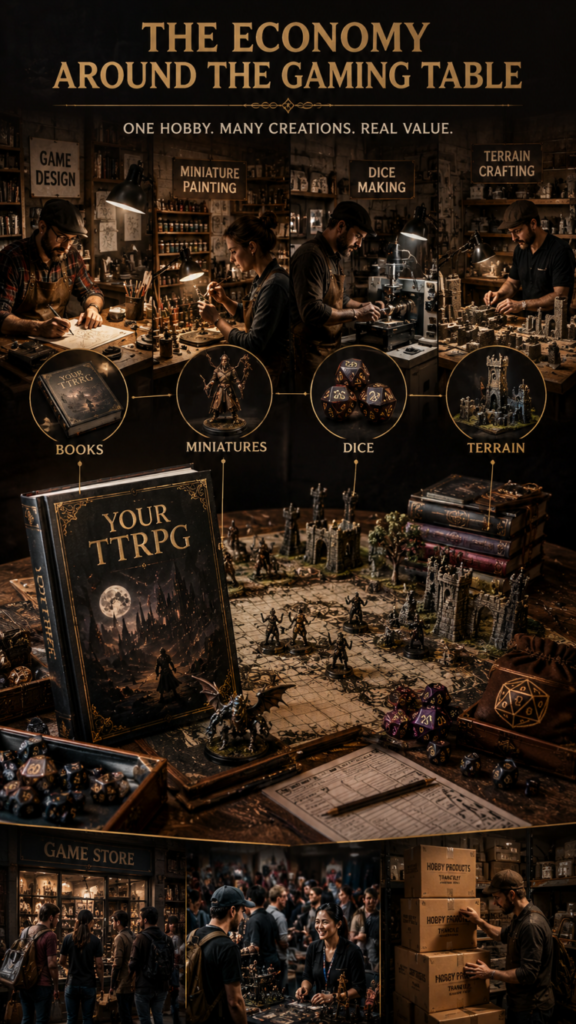
I find the possibilities surrounding original intellectual property particularly interesting because a successful fictional world can support more than one type of product. A distinctive monster might eventually become a miniature, while a memorable city could inspire maps, adventures, illustrations, or novels. Characters, organizations, symbols, and fictional histories can develop recognizable identities that make additional products commercially interesting to the people who enjoy that world. The challenge is creating something sufficiently compelling that customers want to explore it beyond the original publication.
Artists and sculptors have tremendous opportunities because tabletop games depend so heavily upon imagination. Illustrators can create character portraits, book covers, monsters, maps, and promotional artwork, while graphic designers can produce attractive rulebook layouts, character sheets, and other materials. Digital sculptors can design printable miniatures, terrain, furniture, and monsters for customers who own 3D printers, while traditional sculptors and miniature painters can sell finished physical products. Someone who loves fantasy artwork might spend an entire professional career serving tabletop customers without ever designing a role-playing game.
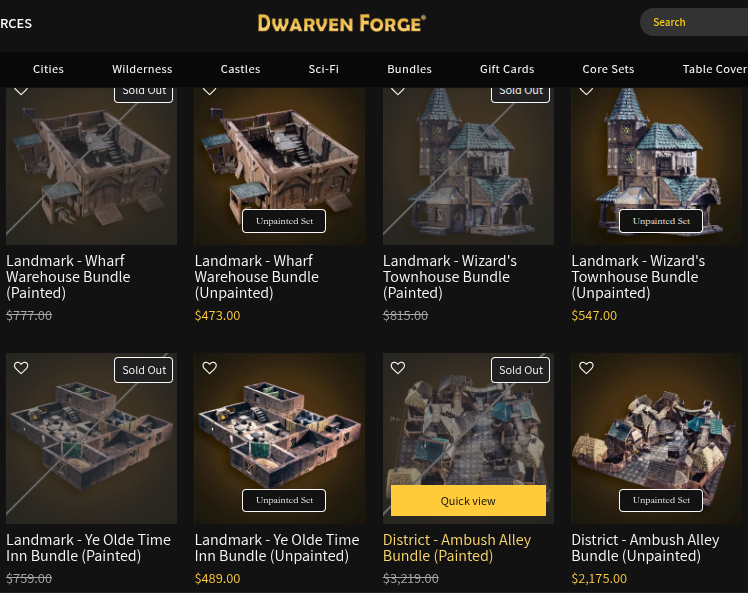
Consider Dwarven Forge, a business specializing in elaborate modular terrain for tabletop gaming. Its Cities Untold: Lowtown Kickstarter campaign raised approximately $3.5 million in 2023, demonstrating substantial demand for the physical environments surrounding tabletop play. Customers were not purchasing a new role-playing system; they were purchasing beautiful scenery that could make games they already enjoyed more immersive. That distinction is economically important because it reveals how a comparatively inexpensive rulebook can stimulate demand for considerably more expensive supporting products.
Gaming furniture illustrates the same principle at an entirely different scale. A carpenter can build custom gaming tables with recessed playing surfaces, dice trays, storage compartments, cup holders, integrated displays, and removable dining surfaces. Interior designers, electricians, metalworkers, and other craftspeople can contribute to elaborate gaming rooms designed around medieval fantasy, science fiction, horror, or other imaginative themes. Nobody needs a dedicated gaming room to enjoy tabletop role-playing, just as nobody needs an elaborate home theater to watch movies, but customers frequently spend money making their favorite activities more enjoyable.
The hobby also creates opportunities for programmers, musicians, writers, and other specialists. Software developers can produce virtual tabletop tools, character-management applications, campaign organizers, mapmaking software, and digital resources that simplify preparation or play. Musicians and sound designers can create atmospheric recordings, while leatherworkers, costume designers, prop makers, and jewelers can manufacture objects associated with fictional worlds. Even photographers, videographers, editors, and marketing professionals can develop specialized services for publishers, performers, and event organizers working within the tabletop industry.
Another growing opportunity involves actual-play entertainment, in which gaming sessions become performances for audiences. Critical Role demonstrates what talented performers can accomplish when tabletop gaming develops into a recognizable entertainment property, supporting streaming productions, publishing, merchandise, and animated stories. Its 2019 Kickstarter for The Legend of Vox Machina raised more than $11 million, showing that an audience originally attracted to a role-playing campaign could support an entirely different form of entertainment. Smaller creators can pursue their own approaches through YouTube channels, podcasts, livestreams, tutorials, performances, or discussions about the hobby without attempting to imitate a production of that size.
The hospitality industry offers another fascinating possibility because tabletop gaming naturally encourages people to gather together. Restaurants, taverns, hobby stores, hotels, and event organizers can attract customers through regularly scheduled campaigns, tournaments, demonstrations, and premium gaming experiences. D&D in a Castle, for example, has offered luxury tabletop gaming retreats at historic properties, with its 2026 flagship registration priced at $3,400 per player before separately purchased accommodations. The customers are buying considerably more than access to a set of rules: they are purchasing professional entertainment, atmosphere, hospitality, companionship, and an immersive experience.
A local entrepreneur does not need to own a castle or organize an international convention to apply the same principles. A restaurant could become known for its Friday evening fantasy campaigns, a hobby store could offer professionally hosted adventures, or an inn could arrange weekend events for enthusiasts. The economic value may come from admission fees, refreshments, accommodations, gaming products, or partnerships with entertainers who attract customers. The larger lesson is that tabletop role-playing is an entertainment ecosystem in which many different businesses can profit from helping people enjoy their favorite hobby.
Professional Game Masters Are Entertainers
Of all the opportunities surrounding tabletop role-playing, I find professional Game Mastering particularly interesting because the Game Master has traditionally performed an extraordinary amount of work without expecting compensation. He may study hundreds of pages of rules, prepare adventures, construct fictional locations, portray numerous characters, interpret unexpected situations, and keep several players entertained for hours. Performing those responsibilities well requires storytelling ability, creativity, organization, improvisational talent, social awareness, and considerable patience. An exceptional Game Master can create experiences that players remember and discuss for years, even when the adventure exists nowhere outside their collective imagination.
There is nothing wrong with running games for free, since friendship and shared recreation are valuable in their own right. However, enjoying an activity does not mean the activity lacks commercial value, and increasingly players are demonstrating a willingness to pay for professionally organized sessions. StartPlaying has helped establish an online marketplace connecting players with professional Game Masters, with published 2026 guidance placing typical prices around $15–$20 per player per session. A Game Master running a campaign for five players paying $20 each generates $100 in gross session revenue, which could become $400 across four weekly sessions before fees, taxes, preparation costs, and other expenses.
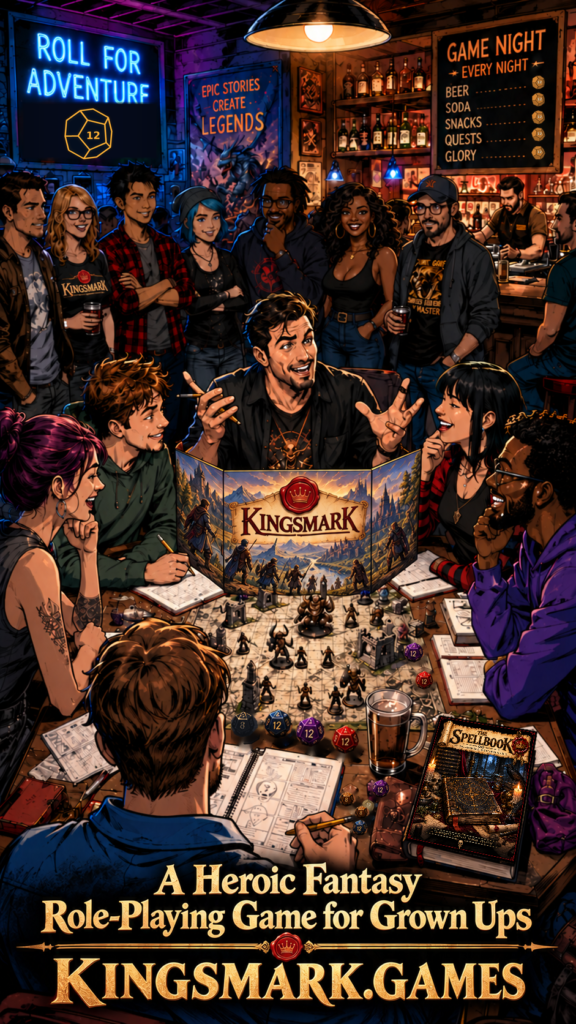
Those figures do not imply that every professional Game Master can immediately support himself through paid sessions. Finding customers, maintaining a dependable schedule, delivering consistently enjoyable experiences, and developing a favorable reputation require serious effort. However, a talented professional who establishes recurring campaigns, offers specialized adventures, and develops strong customer relationships may eventually create a worthwhile service business. Some Game Masters might also expand into private events, premium experiences, public performances, streaming productions, and partnerships with businesses seeking entertainment.
I understand this opportunity partly because I have worked professionally as a DJ, where my value was determined by more than the equipment I owned or the music I played. A successful entertainer gives customers a reason to visit an establishment, remain there, purchase refreshments, invite friends, and return for future events. Nightclubs understand that a talented DJ, band, comedian, or other performer can create economic value far beyond the physical space occupied by the performance. I believe an exceptional Game Master can sometimes provide a similar benefit to a tavern, game store, restaurant, or other establishment interested in attracting customers.
Imagine a talented Game Master running a spectacular fantasy campaign at a local tavern every Friday evening. The players enjoy themselves, other customers become curious, spectators begin following the developing story, and the establishment acquires a reputation for offering something unusual. Some spectators may become paying players, while others might purchase refreshments, attend future performances, or introduce friends to the venue. Under the right circumstances, the Game Master becomes an attraction who helps generate business rather than merely another customer occupying a table.
Naturally, gaming establishments must account for rent, staffing, equipment, insurance, and operating expenses, so charging for private rooms or reserved tables can be entirely reasonable. The more interesting business opportunity emerges when a venue recognizes that a skilled Game Master might attract enough additional customers to justify compensation, a partnership, or a revenue-sharing arrangement. The same principle applies online, where a professional can build a reputation through regular sessions, public demonstrations, and satisfied customers recommending his work. Game Mastering deserves to be considered a genuine entertainment profession, not merely a hobby that occasionally happens to generate income.
Independent Creators Have More Opportunities Than Ever
One of the reasons I am enthusiastic about independent tabletop gaming is that the barriers separating creative people from potential customers have changed dramatically. In the 1970s, publishing a role-playing game generally required access to printing, distribution, retailers, and enough money to manufacture physical products before knowing whether customers would purchase them. Today, a designer can write a manuscript on an ordinary computer, prepare a digital publication, establish a website, and offer that product to customers around the world. Print-on-demand, digital marketplaces, crowdfunding, and inexpensive publishing software have made opportunities available to individuals who could never have afforded traditional manufacturing and distribution.
The internet also allows independent creators to build relationships with customers without relying entirely upon established publishers. A designer can publish articles explaining his philosophy, release playable demonstrations, organize public sessions, share development updates, and develop a community interested in his work. A musician, artist, or professional Game Master can similarly demonstrate his abilities before asking customers to purchase something. Instead of waiting for somebody else to decide whether a project deserves attention, creators can begin presenting their work directly to the public and gradually develop an audience.
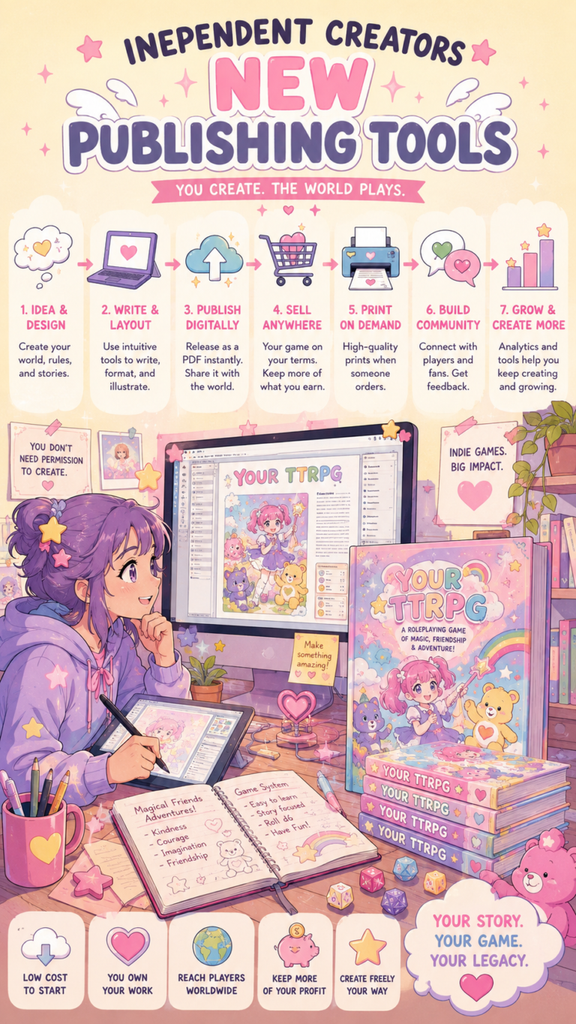
These advantages come with increased competition because publishing something has become considerably easier than persuading strangers that it deserves their attention. Customers can choose among enormous quantities of books, videos, illustrations, adventures, and other products, which makes quality, trust, and reputation especially important. A creator who consistently delivers useful, enjoyable material gives customers a reason to return, whereas somebody releasing poorly considered products may damage his reputation faster than he can build it. Independence provides tremendous freedom, but it also places responsibility for production quality, marketing, customer satisfaction, and financial decisions upon the creator.
Artificial intelligence may expand these opportunities further by helping independent creators organize research, analyze complicated information, experiment with prototypes, and complete certain production tasks more efficiently. I am particularly interested in the possibility that recorded tabletop sessions will eventually provide material for illustrated stories, animated episodes, and increasingly sophisticated cinematic adaptations. Imagine completing a campaign and later watching a movie based on the adventure your party actually experienced, including the unexpected decisions, victories, failures, and relationships that emerged during play. Although present technology cannot reliably transform an entire recorded campaign into a polished feature film through a simple automated process, the possibility represents an exciting direction for future entertainment.
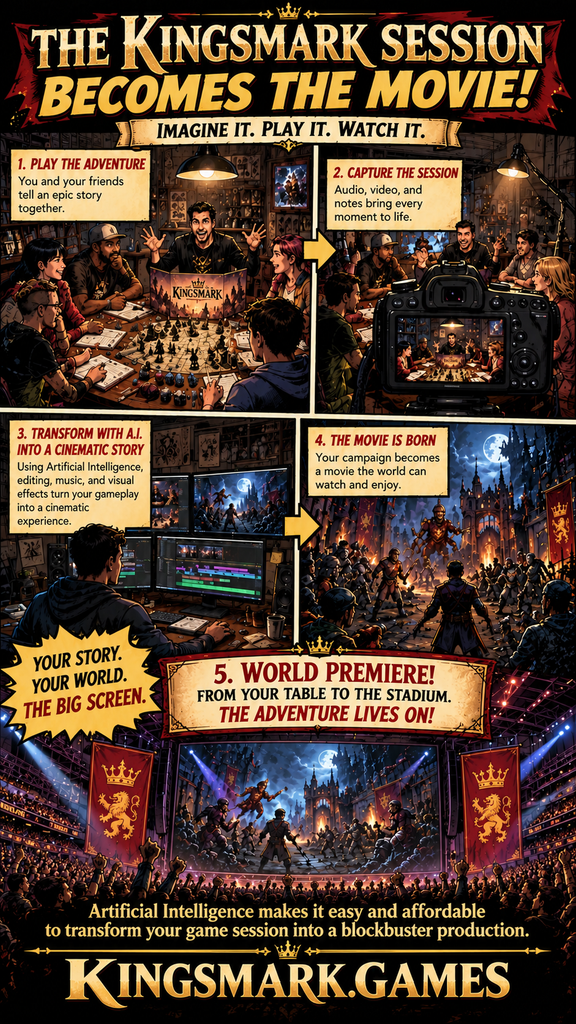
I also believe technological progress makes the human experience underlying tabletop gaming more valuable rather than less. Artificial intelligence can generate tremendous quantities of written and visual material, but friendship, companionship, social interaction, and shared experiences remain things people must actually participate in to enjoy. Tabletop role-playing brings people together to exercise their imaginations, solve problems, laugh, argue, cooperate, and create stories that none of them completely controls. Technology can support those experiences, but the relationships among the participants remain central to what makes the hobby enjoyable.
For independent creators, I believe the most sensible strategy combines modern publishing technology with traditional business principles. Build a recognizable identity, maintain a website, establish direct relationships with customers, develop useful intellectual property, and avoid depending entirely upon social platforms whose policies or algorithms may change. Most importantly, finish projects and allow other people to experience them, because an endlessly revised manuscript cannot generate customer feedback or revenue while it remains unpublished. Believing in yourself matters, but confidence becomes commercially meaningful when it produces work that other people actually value.
Why I’m Building Kingsmark
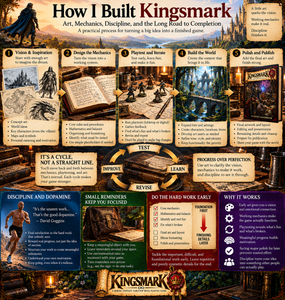
My own attempt to participate in this industry is Kingsmark, an original heroic-fantasy tabletop role-playing game for mature players, set in the fictional world of Sylva. I have spent years thinking about what makes tabletop gaming entertaining, what frustrates players and Game Masters, and how I could design a system that better reflects my philosophy of adventure. I want exciting action, meaningful decisions, memorable characters, believable consequences, and rules that support the unfolding story rather than constantly interrupt it. Kingsmark is my attempt to bring those ideas together in a complete game that other people can enjoy.
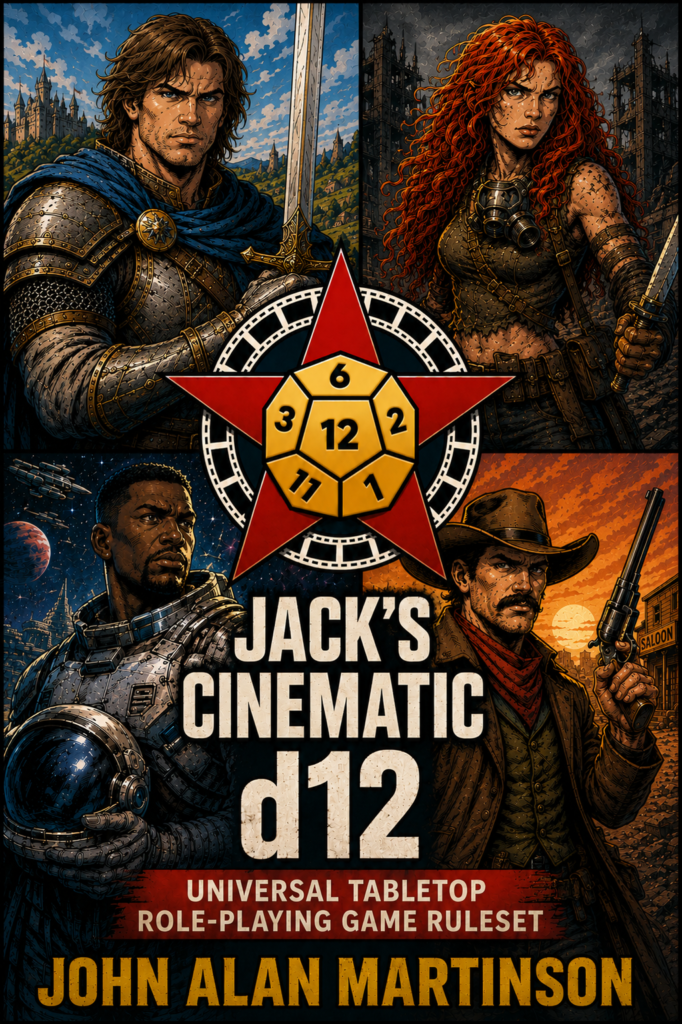
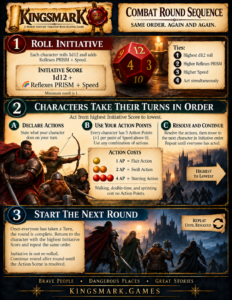
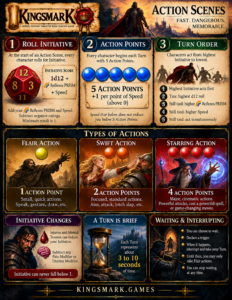
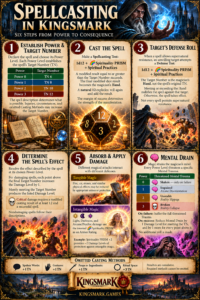
The underlying system is Jack’s Cinematic d12, or JCd12, which uses a single twelve-sided die, straightforward mathematics, and consistent dice-roll formulas to resolve uncertain actions. Kingsmark also approaches physical injuries and psychological consequences differently from many traditional fantasy games, using 🩸Physical Wounds and 🧠Mental Trauma instead of conventional hit points. I believe a character suffering a serious wound, struggling with fear, or overcoming a traumatic experience can contribute more to a memorable story than simply subtracting another number from an enormous pool of abstract health. The intention is to make the consequences of adventuring meaningful while preserving the excitement and cinematic possibilities of heroic fantasy.
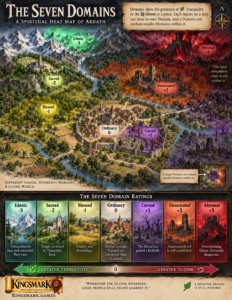
Kingsmark’s setting also reflects my interest in developing fictional worlds that possess believable cultures, institutions, economies, religions, histories, and inhabitants. Its medieval fantasy world provides opportunities for exploration, dangerous combat, diplomacy, romance, intrigue, magic, and the difficult choices that make role-playing memorable. Jack’s Cinematic d12 may eventually serve as the mechanical foundation for other game systems, but Kingsmark is the project through which I am presently developing and demonstrating that philosophy. Readers interested in the game can explore its rules and setting through Kingsmark.Games.
My ambition extends beyond selling a 📖Player’s Handbook because I want to develop original intellectual property that people enjoy playing, discussing, sharing, and returning to. A successful game can support adventures, additional publications, useful resources, performances, merchandise, and other creative opportunities, although each expansion should be justified by genuine customer interest. I want Kingsmark to become a recognizable property associated with thoughtful design, substantial worldbuilding, and memorable entertainment. If I can create something that supports my family, provides worthwhile work for other creative people, and continues entertaining players for years, that will constitute a meaningful accomplishment.
I have worked conventional jobs, including driving a semi-truck, and I understand the dignity of earning a living through difficult physical work. I have also worked in entertainment and publishing, so I understand that imagination, craftsmanship, and intellectual property can possess genuine economic value when combined with sound business judgment. I do not consider designing a game inherently less serious than writing a novel, composing music, developing software, or producing other forms of entertainment simply because the finished product invites people to play. My responsibility is to make Kingsmark worth purchasing, continue improving my abilities, and build an audience that appreciates what I create.
That conviction is something I hope other creative people will recognize in their own ambitions, whether they want to publish a role-playing game, become professional Game Masters, sculpt miniatures, compose music, organize gaming events, or build businesses serving the hobby. Not everyone will become wealthy, and some projects will fail despite considerable effort, but neither possibility makes the pursuit inherently foolish. A modest business that provides dependable income, creative satisfaction, and greater independence can be an extraordinary achievement in its own right. The important thing is to approach the opportunity seriously enough to learn the necessary skills, understand customers, manage expenses, and complete work that deserves their support.
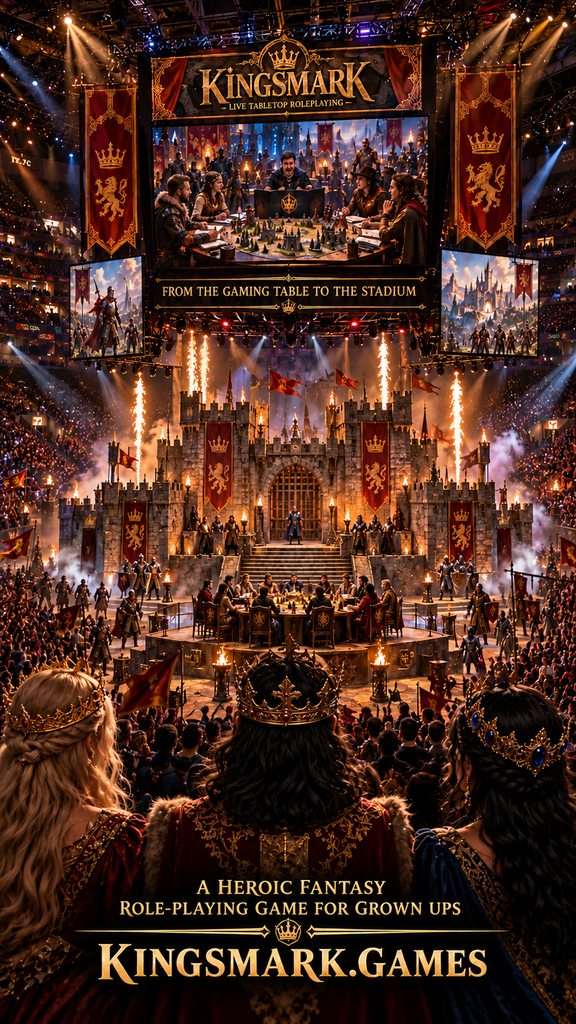
I find it unfortunate that people sometimes discourage creative ambitions simply because they cannot immediately imagine how those ambitions might become commercially successful. The teenager designing a game today might eventually become a publisher, the amateur Game Master entertaining his friends might develop into an exceptional professional performer, and the young artist drawing fantasy monsters could someday operate a thriving creative business. None of those possibilities guarantees success, but dismissing them before they have been seriously explored accomplishes nothing worthwhile. We should be encouraging people to develop their talents, understand the business opportunities surrounding those talents, and discover what disciplined effort can achieve.
Tabletop role-playing offers an unusual combination of imagination, technology, craftsmanship, entrepreneurship, and human companionship, and I believe its future will present opportunities that many of us have not yet imagined. The industry has already grown far beyond the stereotype of a few teenagers rolling dice in a basement, and there is plenty of room for ambitious people who have something worthwhile to contribute. If you have an idea for a game, an adventure, a performance, a product, or a business, take that ambition seriously enough to investigate it, develop your abilities, and bring something meaningful into the world. You do not need anybody’s permission to begin building something extraordinary; you need the determination to begin, the discipline to finish, and the courage to discover how far your abilities can take you.
About The Author