⚒Skills in Kingsmark
How to Make a Skill Test
In Kingsmark, a character’s abilities are shaped by three interconnected systems: 💪Attributes, 🌈Attribute PRISMs, and ⚒Skills. Together, these determine what a character can realistically accomplish, how effectively they perform under pressure, and how training can transform ordinary potential into extraordinary competence. Whether climbing a castle wall, repairing a broken wagon, deciphering an ancient manuscript, or negotiating with a suspicious nobleman, the same underlying dice system resolves uncertain actions.
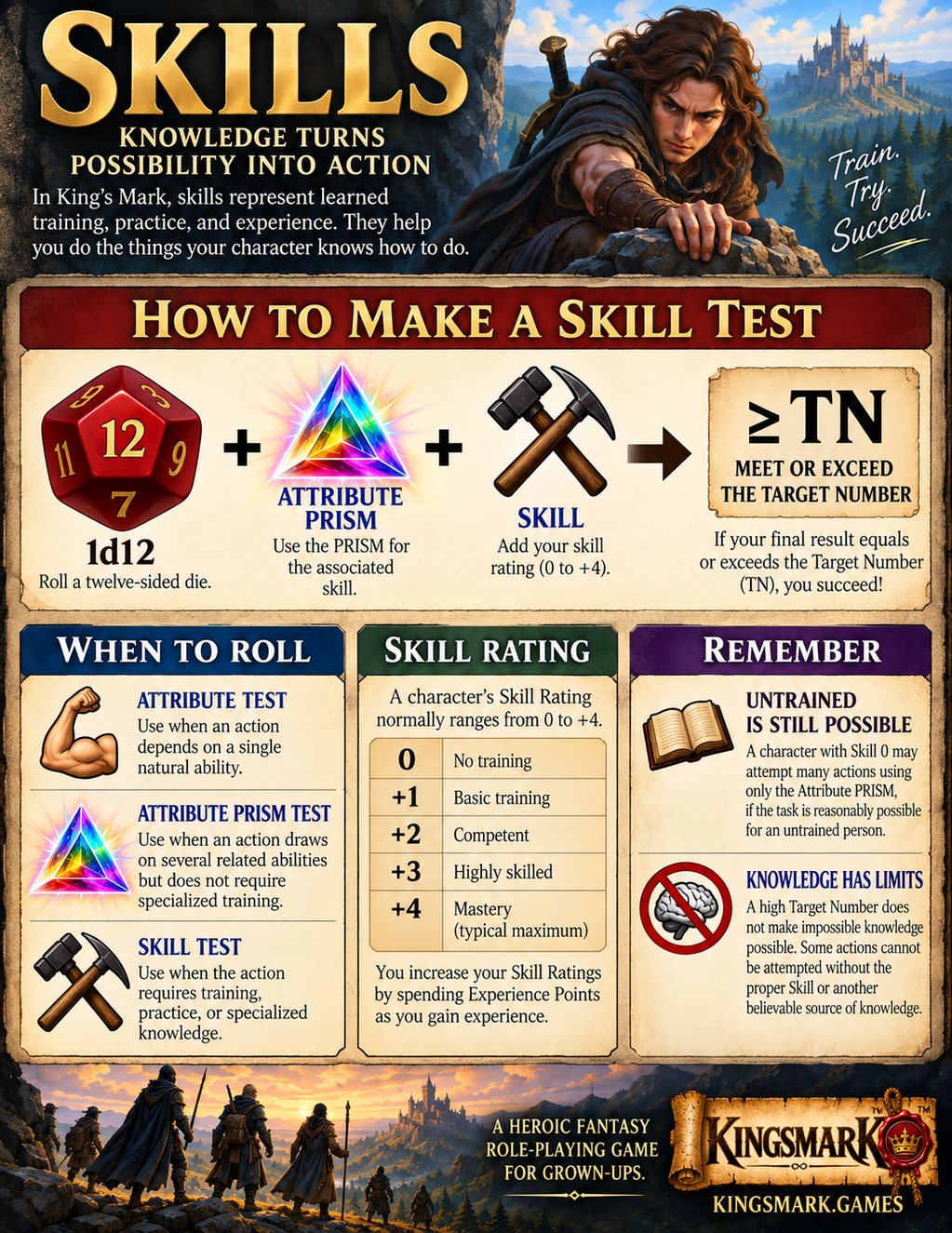
The infographic illustrates the fundamental formula for a Skill Test: 1d12 + 🌈Attribute PRISM + ⚒Skill Rating. The final modified result must equal or exceed the Realism Target Number (TN) established by the Game Master. This deceptively simple calculation combines natural aptitude, learned expertise, and the difficulty of the circumstances into one resolution mechanic. For the complete explanation, consult Chapter 3: ⚒Skills.
💪Attributes, 🌈PRISMs, and ⚒Skills
The distinction between these three systems is important. A 💪Attribute represents an individual natural capability, such as Strength, Dexterity, Intelligence, or Perception. When an action depends primarily upon one such capability, the Game Master may call for an Attribute Test: 1d12 + Attribute Rating. For example, noticing a suspicious movement in the darkness might require a Perception Test, while forcing open a heavy door might require Strength.
A 🌈Attribute PRISM combines several related Attributes into a broader measure of performance. Kingsmark has five Attribute PRISMs: Physical Performance, Reflexes, Influence & Allure, Spirituality, and Mental Performance. Their modifiers are calculated from the character’s underlying Attributes using the PRISM Modifier Table. When an activity draws upon several natural abilities without requiring specialized training, the Game Master may call for a PRISM Test: 1d12 + the appropriate PRISM modifier. See Chapter 2: 🌈Attribute PRISMs.
⚒Skills represent acquired knowledge and practical expertise. A character’s Skill Rating ordinarily ranges from 0 to +4, progressing from no meaningful training at 0 through basic training (+1), competence (+2), and high proficiency (+3), to mastery (+4). Each Skill belongs to a particular 🌈Attribute PRISM, allowing natural capability and training to complement one another.
For example, two warriors might possess identical 🌈Physical Performance modifiers, yet the one trained in Armed Combat would generally possess a significant advantage in swordsmanship. Likewise, someone with exceptional natural intelligence may still lack the specialized knowledge possessed by a trained physician.
Training, Experience, and the Limits of Knowledge
Characters with Skill 0 can still attempt many tasks using the associated 🌈Attribute PRISM alone, provided an untrained person could reasonably perform the action. However, rolling exceptionally well does not grant knowledge that a character could not plausibly possess. An inexperienced adventurer might improvise a simple repair, but performing complicated surgery requires genuine medical knowledge or another believable source of expertise.
Characters improve their capabilities by investing ⭐Experience Points earned through adventuring. Each XP invested in a Skill raises its Rating by +1, subject to the normal maximum, provided the improvement makes sense within the character’s experience and training. Chapter 4: ⭐Experience Points explains how this development works.
Ultimately, Skills make characters meaningfully different without requiring complicated dice mechanics. A seasoned sailor, knowledgeable scholar, veteran warrior, and talented healer can approach the same problem with dramatically different capabilities. Their expertise opens possibilities, creates opportunities, and gives players satisfying reasons to develop their characters beyond combat alone.
🎬Example: The Watchtower of Blackthorn
Three adventurers explore an abandoned watchtower, searching for a missing merchant. Beyond a collapsed staircase, they discover a narrow passage leading toward an ancient mechanical gate. The stonework is cracked, the air smells of damp timber, and something metallic glimmers beneath the accumulated dust.
Talia notices a peculiar arrangement of scratches beside the doorway. The Game Master calls for a 💪Perception Test with TN 8, representing a subtle detail that an attentive person might recognize. Talia possesses Perception +1 and rolls 7 on her d12. Her final result is 7 + 1 = 8, meeting the Target Number exactly. She notices that a nearly invisible wire runs between two stones.
The party carefully avoids the wire, but the decaying passage begins collapsing as they advance. Talia attempts to brace a falling timber long enough for her companions to escape. Because this improvised effort depends on several physical capabilities rather than a specialized technique, the Game Master calls for a 🌈Physical Performance PRISM Test at TN 8. Talia possesses Physical Performance +2 and rolls 6, achieving 6 + 2 = 8. She holds the timber long enough for everyone to scramble to safety.
Finally, the adventurers encounter a rusted winch controlling the gate. Talia’s companion, Mara, possesses 🌈Reflexes PRISM +2 and ⚒Mechanisms +2. The Game Master assigns TN 9, reflecting the difficulty of manipulating the damaged mechanism. Mara rolls 5, producing 5 + 2 + 2 = 9. Success! She carefully adjusts the counterweight, releases a corroded locking pin, and slowly raises the gate without triggering its remaining traps.
The three successful Tests demonstrate something fundamental about Kingsmark: natural perception, broader physical performance, and specialized mechanical training represent different kinds of competence, even though all three challenges use the same twelve-sided die.
About The Author