Combat System Considerations in TTRPGs
What should you consider about your target audience when designing a combat system for an RPG? — asked on Quora.com
When designing a combat system for a tabletop role-playing game, I believe the first question you should ask is not what dice to use, how damage should work, or how many combat maneuvers characters should have. The first question should be: Who am I designing this game for, and what kind of experience am I promising them?
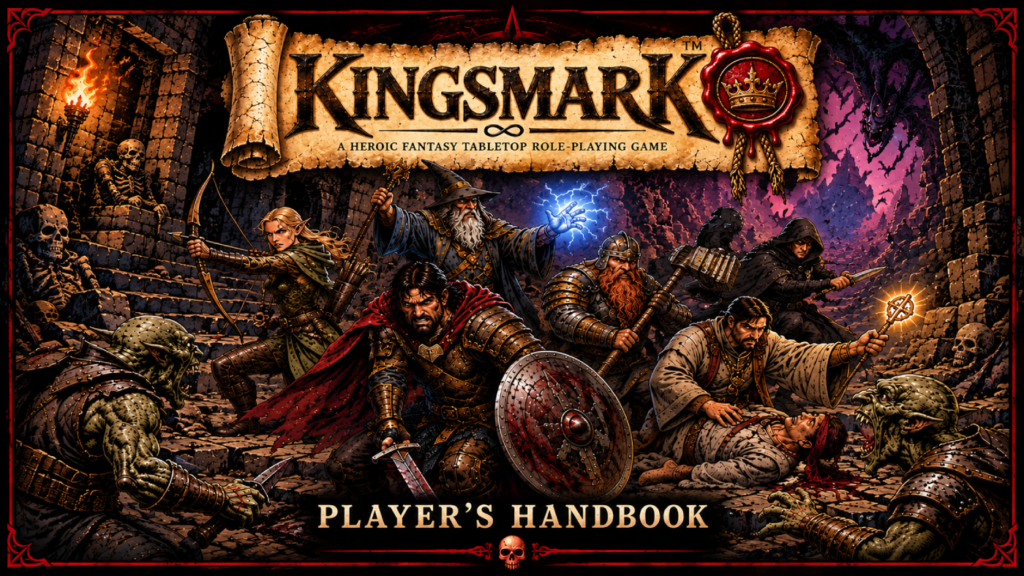
That question influenced practically every decision I made when developing 👑Kingsmark, my own heroic fantasy tabletop role-playing game for mature players.
Age is certainly one consideration. If you’re designing a game primarily for children, you probably want straightforward mathematics, relatively few rules to remember, and combat situations that can be resolved quickly. Younger players generally benefit from immediate feedback, clearly presented choices, and mechanics that don’t require lengthy calculations. If you’re designing for adults, you may have more freedom to introduce detailed tactical decisions, complicated consequences, and systems that reward patience and planning.
However, age is only a starting point. Some children are remarkably capable tactical thinkers, while plenty of adults would rather enjoy a fast-moving adventure than spend twenty minutes calculating the optimal combat maneuver. Experience, personal interests, and expectations are often better predictors of what players will enjoy than age alone.
Another important question is what kind of combat experience you’re trying to reproduce. Are you creating something resembling a superhero movie, where characters endure extraordinary punishment and survive spectacular battles? Are you designing a gritty medieval fantasy where a single sword thrust can end someone’s life? Perhaps you’re developing a tactical military game where positioning, cover, equipment, and coordinated maneuvers determine who survives.
Each approach can be excellent, but they require different design decisions. A combat system that works beautifully for a superhero adventure might be completely inappropriate for a game promising realistic medieval warfare.
You should also consider how much time players want to spend fighting. Some audiences love tactical encounters that occupy an entire gaming session. Others prefer combat to be resolved in a few minutes so they can return to exploration, investigation, and character interaction. Neither preference is inherently superior. The designer’s responsibility is to understand the intended audience and provide the experience promised.
One consideration that I believe deserves far more attention is how much work the combat system places upon the Game Master.
Consider a typical encounter in Dungeons & Dragons. A Fighter attacks an enemy with his sword, hits, and inflicts six points of damage. What actually happened?
Well, that’s an interesting question because D&D’s hit points don’t exclusively represent physical injuries. They also represent things such as durability, determination, and, traditionally, even luck. Consequently, losing six hit points doesn’t necessarily mean that the character was physically wounded at all!
That’s always struck me as a somewhat peculiar abstraction, although I understand why it exists. Hit points are convenient, easy to track, and support the heroic combat experience D&D is designed to provide.
But imagine you’re a Game Master who wants to narrate a spectacular sword fight. One character attacks and inflicts four points of damage. Another attacks and inflicts seven. The monster retaliates and inflicts eleven. The Game Master can certainly invent colorful descriptions for each exchange, but the actual mechanics provide relatively little information about what physically happened.
Was someone struck in the arm? Did the sword glance off a helmet? Was a shield damaged? Did someone suffer a deep wound that interferes with his ability to fight?
The Game Master can invent these details, but unless additional mechanics are involved, they’re generally narrative embellishments rather than consequences established by the damage system.
What if the combat mechanics themselves could help generate those cinematic details?
That question became central to my work on Kingsmark.
I came into tabletop role-playing games through systems such as Shadowrun, where physical damage is represented more directly through wound and condition mechanics. I was accustomed to the idea that characters could actually suffer injuries rather than simply lose an abstract collection of points. However, I wanted to develop something considerably different from Shadowrun.
My ambition was to create a game engine that could help generate action scenes with the richness and variety of a Hollywood production.
I often think about tabletop role-playing sessions as improvised television series. Characters develop over multiple adventures, relationships evolve, and individual sessions become something resembling episodes. Nevertheless, I wanted the production ambitions of a big-budget motion picture: spectacular action, memorable confrontations, dramatic reversals, and scenes filled with meaningful physical details.
In other words, I wanted a combat system that could help the participants create something resembling a movie script as they played.
That doesn’t mean replacing imagination with mechanics. It means providing enough mechanical information that the Game Master has something interesting to narrate without constantly inventing every detail from nothing.
In 👑Kingsmark, I developed a system called ⭐Jack’s Cinematic d12 (JCd12). It uses a single twelve-sided die as its fundamental resolution mechanic, supported by character abilities, Target Numbers, and the circumstances surrounding an action.
Instead of conventional hit points, Kingsmark uses 🩸Physical Wounds classified as Minor, Moderate, Severe, and Critical. Attacks can also determine Hit Locations, and different forms of damage interact with the armor protecting those locations. Injuries may cause Pain Modifiers, interfere with physical performance, and require meaningful medical treatment.
Imagine a swordsman attacking an armored opponent. Instead of simply announcing that the opponent loses eight hit points, the system can establish whether the attack penetrated his defenses, where it struck, how serious the resulting injury was, and whether his armor protected him.
The Game Master now has concrete information from which to construct the narration. Perhaps the sword strikes an armored shoulder without causing injury. Perhaps it slips past the defender’s protection and produces a Moderate Wound to his sword arm. That injury might make his subsequent actions more difficult.
Suddenly, the confrontation develops its own character. The injured swordsman might need to retreat, change tactics, or rely upon a companion. The injury isn’t merely decorative narration. It actually matters.
This leads to another important consideration when designing for your audience: How much tactical freedom should the players possess?
I wanted Kingsmark to reward people who possess genuine tactical knowledge. Someone with military experience, police training, professional security experience, martial arts knowledge, or an understanding of historical combat should be able to apply that knowledge in meaningful ways.
For example, an experienced fighter understands that positioning, timing, distance, protection, and controlling an opponent’s available options can be more important than simply attacking harder. I wanted those considerations to matter in Kingsmark without requiring every player to become an expert in medieval warfare.
The system uses Action Points to govern what characters can accomplish during their Turns, and the Player’s Handbook provides approximately 108 example Actions. These include different forms of movement, attacks, defenses, maneuvers, and other activities.
However, these Actions are examples, not an exhaustive list of everything a character is permitted to attempt. Players can improvise, and the Game Master can interpret their intentions using the established mechanics.
A player who understands tactics should find opportunities to benefit from that knowledge. A player who doesn’t understand tactics should still be able to enjoy the game by making straightforward decisions.
To me, that’s an important balance. A tactical combat system should reward tactical intelligence without making tactical expertise a prerequisite for participation.
Of course, greater detail comes with costs. Hit Locations, armor interactions, wound severity, and tactical maneuvers introduce procedures that simpler games don’t require. The question is whether those procedures contribute enough excitement, meaningful choice, and narrative detail to justify the additional effort.
That is something designers must discover through playtesting rather than simply assuming their preferred approach will appeal to everyone.
I would strongly encourage anyone designing an RPG combat system to test it with people who are not already familiar with the rules. Observe how often players hesitate, how frequently the Game Master must consult the rulebook, whether players understand their tactical options, and whether the resulting combat is genuinely exciting.
Most importantly, pay attention to whether the mechanics produce the experience you promised. A supposedly cinematic combat system that repeatedly interrupts dramatic action with lengthy calculations has a design problem. Likewise, a supposedly realistic combat system in which positioning and injuries have no meaningful consequences may not be delivering the experience its audience expects.
Interestingly, Kingsmark’s First Edition Player’s Handbook contains 556 pages, yet the underlying dice resolution system is relatively straightforward. Much of the book is dedicated to explaining situations, providing examples, presenting character options, and establishing procedures for the extraordinary variety of things adventurers might attempt.
The objective isn’t to make players memorize hundreds of pages before they can enjoy a sword fight. It’s to provide a comprehensive set of tools they can learn and consult as necessary.
Ultimately, I believe the greatest mistake a combat designer can make is trying to please everyone. Some audiences want the simplicity of a few dice rolls and a short description. Others want detailed tactical encounters, believable injuries, and meaningful consequences. Still others want wildly exaggerated cinematic action that prioritizes spectacle over realism.
Determine your audience, decide what experience you’re promising, and make every major mechanical decision serve that experience.
For Kingsmark, my goal was to combine cinematic action, believable consequences, tactical freedom, and rules that help the Game Master create memorable scenes. Whether I’ve achieved that balance is ultimately for players to judge.
If those ideas interest you, I invite you to explore 👑Kingsmark: A Heroic Fantasy TTRPG for Mature Players. The complete 556-page First Edition Player’s Handbook is available to read online for free at https://kingsmark.games or support the game by purchasing a digital copy.
I’d particularly recommend exploring the chapters on ▶️Action Scenes, 🎬Example Actions, and 💥Damage & Defense to see how I’ve approached these design challenges.
— John Alan Martinson Jr.
Creator of Kingsmark
About The Author