Elves Speak Hebrew
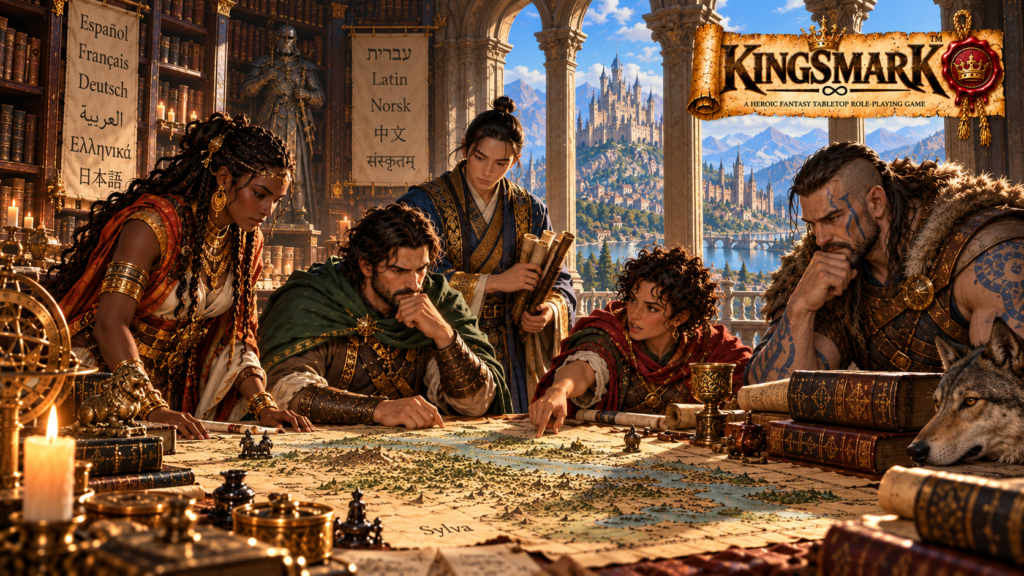
Why Kingsmark Uses Real Languages
By John Alan Martinson, Creator of 👑Kingsmark
What language do Elves speak? If you are familiar with the works of J. R. R. Tolkien, you might immediately think of Quenya or Sindarin, two of the elaborate fictional languages he created for Middle-earth. Other fantasy settings have their own versions of Elvish, Dwarvish, and countless additional languages invented specifically for their imaginary worlds.
In 👑Kingsmark, however, an Elf might speak Biblical Hebrew or Aramaic. A Dwarf might speak Old Norse, German, or any number of other historical or modern languages. A traveler entering a foreign kingdom might discover that its inhabitants speak Spanish, French, Arabic, Japanese, or another language that actually exists on Earth. This is because I made a deliberate worldbuilding decision: nearly all the languages spoken in Sylva, the fictional world of Kingsmark, are real languages from Earth. The principal exceptions are the fictional languages of wholly evil creatures, such as Goblins.
There is a practical philosophy behind this decision. If players are going to devote hundreds of hours to exploring an imaginary world, why not give them opportunities to learn something valuable about the real one? I believe fantasy role-playing can provide considerably more than entertainment without sacrificing any of the qualities that make it entertaining in the first place.
🧝 Tolkien, Hebrew, and the Languages of Fantasy
Tolkien was not merely a novelist. He was a philologist with an extraordinary interest in languages, their histories, and their development. His linguistic inventions are among the most remarkable achievements in fantasy literature, and the languages of Middle-earth contributed enormously to the apparent depth and authenticity of his fictional civilizations.
Interestingly, Tolkien’s Dwarves had a linguistic connection to Hebrew. Their secret language, Khuzdul, was an invented language influenced by Hebrew and other Semitic languages, particularly in its use of consonantal roots. Meanwhile, many familiar Dwarven names, including those of characters appearing in The Hobbit, came from Old Norse sources. Tolkien drew heavily upon historical languages and mythology when constructing his fictional world.
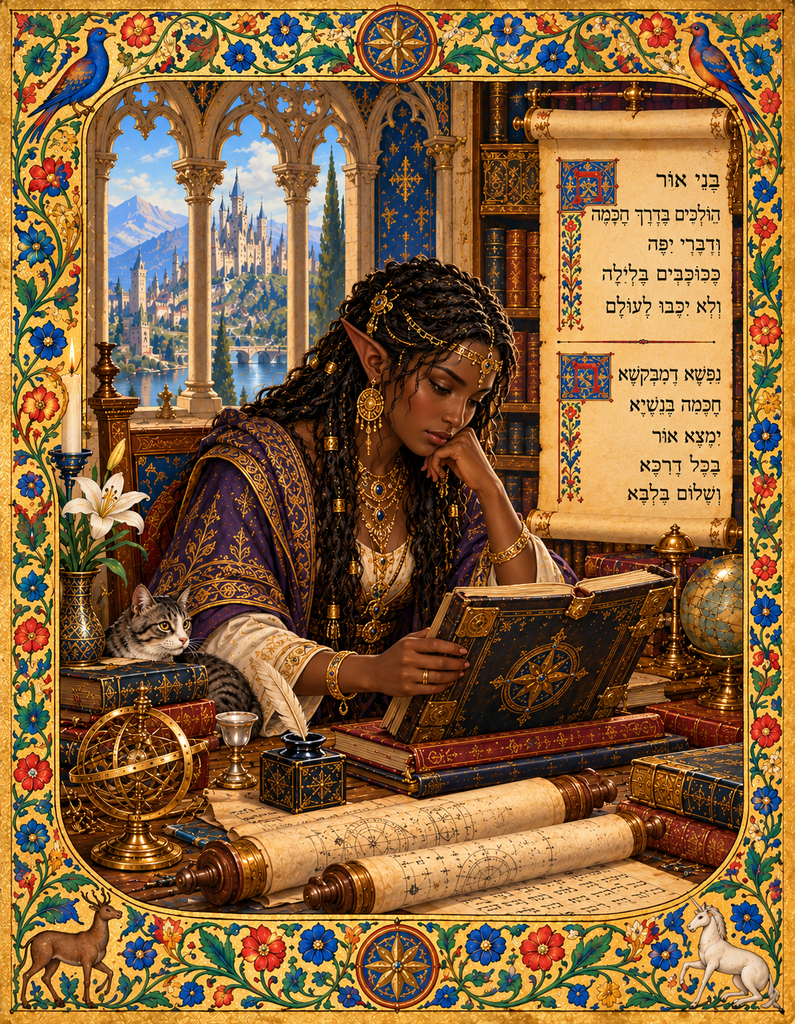
I find this particularly interesting because it demonstrates how even the most imaginative fictional languages can draw upon genuine human linguistic traditions. Nevertheless, I chose a different approach for Kingsmark. Rather than inventing an entirely new language inspired by Hebrew, why not use Hebrew itself? Instead of constructing a fictional tongue loosely modeled upon Old Norse, why not allow an ancient Dwarven civilization to preserve Old Norse as a living language?
This does not diminish Tolkien’s accomplishment, and invented languages can contribute tremendously to fantasy worldbuilding. My interest, however, lies in creating a different relationship between fantasy immersion and real-world learning. If someone becomes fascinated with the language spoken by an Elf in Kingsmark, I want that curiosity to have somewhere meaningful to go. Instead of memorizing vocabulary that exists exclusively within a fictional setting, the player could begin studying a genuine language with thousands of years of history, literature, and cultural significance.
🗣️ Languages Are Not Written in Stone
Although Kingsmark associates certain languages with particular peoples and ancient civilizations, these associations are not intended to become inflexible restrictions. The Elyonim, the Elves of Sylva, have ancient linguistic traditions that include Biblical Hebrew and Aramaic. Other historical languages, such as Ugaritic, Sumerian, and Ancient Egyptian, offer possibilities for ancient scholarship and worldbuilding. The Tzurim, the Dwarves, might preserve languages associated with ancient northern European or Near Eastern civilizations, while the Qatan, or Little Humans, likewise possess their own histories and linguistic traditions.
However, I have no intention of declaring that every Elf must speak Hebrew or that every Dwarf must speak Old Norse. Such rigid classifications would actually work against the flexibility I want Kingsmark to provide. Suppose a player is studying Japanese and French. If that player wants to create an Elven Hero whose native language is Japanese and whose second language is French, I see absolutely no reason to discourage it. Perhaps the character comes from an Elven kingdom whose linguistic history resembles that of Japan, or a cosmopolitan city where several languages are commonly spoken.
The important thing is that the choice makes sense within the particular version of Sylva being explored by the adventuring party. In Chapter 8 — 🫀Human Type, Kingsmark establishes the different Human Types, but ancestry does not have to dictate a person’s language, nationality, personality, or cultural identity. An Elf raised in a predominantly Spanish-speaking kingdom might naturally speak Spanish, while a Dwarf who grew up among French-speaking merchants might consider French his native language. Languages belong to living cultures and communities, not to biological categories, and characters should reflect the diversity that naturally develops when different peoples interact over generations.
The established rules also keep languages reasonably simple. As explained in Chapter 3 — ⚒Skills, languages are determined primarily by a character’s background rather than purchased as separate Skills. A character who knows a language can ordinarily speak and understand it without repeatedly making Skill Tests. This approach encourages believable character histories without burdening players with unnecessary mechanics, and it leaves considerable freedom for Game Masters to develop their own linguistic traditions.
🗣️Choosing Languages for a Reason
Freedom to choose languages does not mean that every choice should be arbitrary. When I establish the cultures of Sylva or write adventure modules for Kingsmark, I intend to select languages for recognizable practical, historical, and educational reasons. Some languages are particularly useful because of their widespread contemporary use, while others provide valuable connections to ancient civilizations, historical literature, religion, and philosophy.
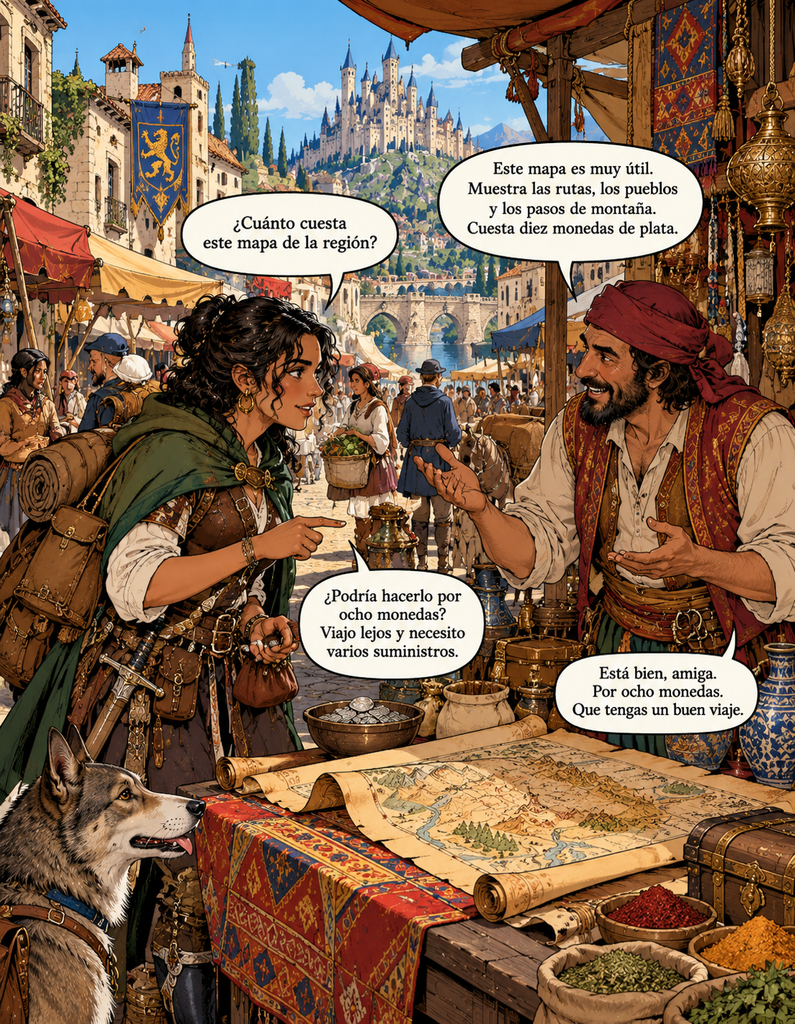
Consider Spanish, for example. Much of Kingsmark’s intended audience lives in the United States, where Spanish is widely spoken, and Mexico is the country’s southern neighbor. Spanish is also spoken throughout much of Latin America and in Spain, making it an enormously useful language for communication, travel, commerce, and cultural understanding. For an American player, acquiring even a modest Spanish vocabulary could have considerable practical value.
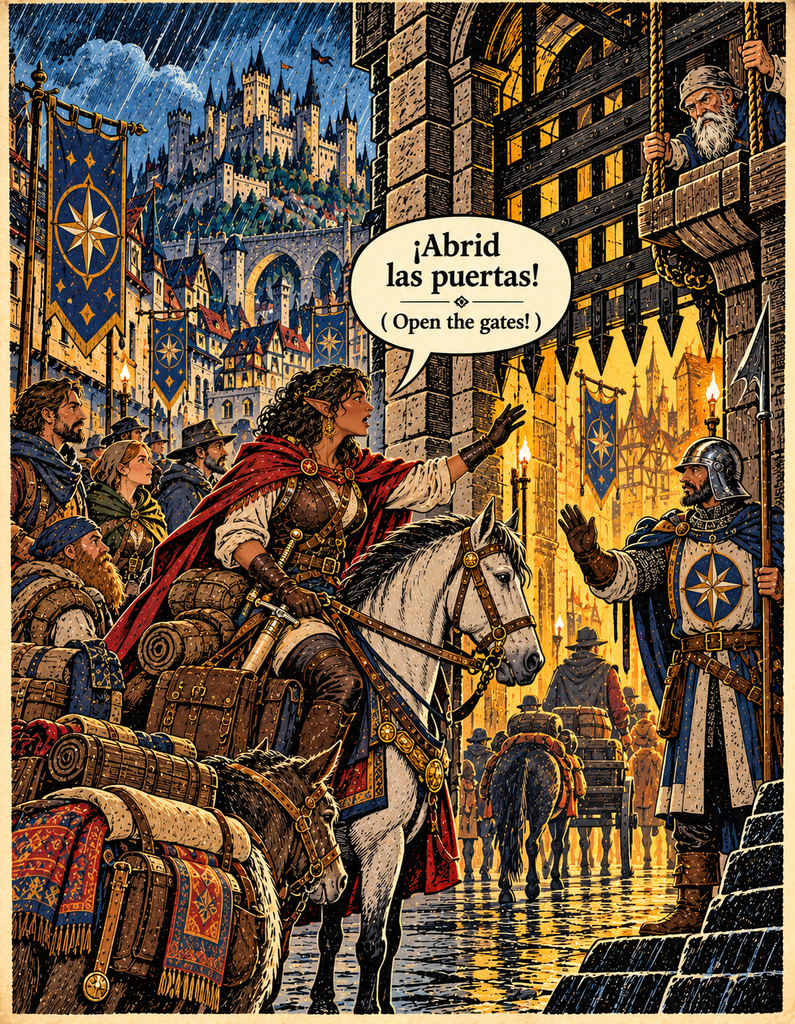
Consequently, I see good reasons to introduce Spanish into adventures. An adventuring party might visit a kingdom where Spanish is the predominant language, negotiate with local merchants, read public notices, or encounter unfamiliar expressions. The Game Master could introduce a few words or short sentences during play, giving interested players an opportunity to learn and remember them. As those expressions become familiar, players might begin recognizing Spanish vocabulary outside the game, which is precisely the kind of incidental learning I would like Kingsmark to encourage.
Biblical Hebrew and Aramaic offer a different kind of opportunity. These languages are particularly interesting to people who study the Bible, Judaism, Christianity, ancient Israel, or the history of the Near East. Biblical Hebrew opens a window into the language of much of the Tanakh, while Aramaic played an important role throughout the ancient Near East and in Jewish history. A player who becomes interested in an Elyonim scholar, Priest, or ancient manuscript might eventually become interested in reading actual historical texts. Even recognizing a handful of Hebrew words could provide a meaningful introduction to a much larger field of study.
Other languages provide their own opportunities. Old Norse introduces readers to medieval Scandinavian literature and mythology, while Latin offers access to an enormous body of European historical writing. Arabic, Greek, Sanskrit, Chinese, and countless other languages open doors to civilizations whose intellectual and cultural achievements have influenced the world. Not every language must be immediately useful in everyday life, because historical, literary, religious, and cultural value are also perfectly legitimate reasons to study a language. The objective is to make thoughtful choices that encourage curiosity while leaving players and Game Masters free to pursue their own interests.
🏰 The Thirteenth Century Is Already Fascinating
Languages are only one aspect of a much larger design philosophy. Sylva is a medieval heroic fantasy world whose general technological environment resembles the thirteenth century, the 1200s. Naturally, it also contains magic, supernatural creatures, fictional kingdoms, and historical developments that never occurred on Earth. Nevertheless, real medieval history provides an enormous foundation upon which believable fantasy adventures can be constructed.
Consider how much useful information exists about medieval architecture, agriculture, medicine, commerce, navigation, metallurgy, military organization, and everyday life. Rather than inventing everything from nothing, a Game Master can investigate how actual societies confronted practical problems and adapt those discoveries to the fictional circumstances of Sylva. A player portraying a Holy Knight might become interested in medieval armor, horsemanship, military orders, or the obligations of knighthood. A player portraying a merchant might investigate historical trade routes, currencies, taxation, and the transportation of valuable goods. Someone portraying a Healer could explore historical medical traditions, medicinal plants, and the differences between ancient medical theories and modern scientific understanding.
These interests can make adventures more believable because they provide real information about how people lived, worked, struggled, and solved problems. A castle becomes more interesting when players understand how its fortifications function, and a long-distance journey becomes more meaningful when they appreciate the difficulties of transportation, navigation, weather, and obtaining provisions. Historical knowledge can also challenge assumptions inherited from popular fantasy, where medieval societies are frequently portrayed through a relatively narrow collection of familiar conventions.
Of course, the thirteenth century was not limited to Western Europe. The Mongol Empire connected enormous regions of Eurasia, Islamic civilizations maintained important centers of scholarship and commerce, and powerful societies flourished throughout Africa and Asia. Medieval history contains far more variety than the familiar image of a European castle surrounded by peasants. Kingsmark’s fictional nations reflect this diversity of historical inspiration, with some resembling recognizable countries and others combining elements of several societies or developing in substantially different directions. Real history provides the raw material, but Sylva remains a world in which imagination determines what becomes possible.
📜 Learning Through Adventure Instead of Homework
One of the most promising applications of this philosophy concerns the adventures themselves. Imagine that an adventuring party enters a prosperous foreign city whose streets are crowded with merchants, travelers, guards, craftsmen, and entertainers. The local language is Spanish, and the Game Master introduces a few Spanish expressions during conversations with the inhabitants. Perhaps a shopkeeper greets the adventurers with Buenos días, or a guard calls ¡Alto! when he wants them to stop. Players unfamiliar with Spanish can understand these expressions through context or explanation, and over time, they might recognize the words without assistance.
There is no examination, mandatory vocabulary list, or requirement that players actually learn Spanish before their characters can communicate. The fictional characters possess whatever language abilities their backgrounds reasonably establish, while the real players simply have an opportunity to pick up something useful along the way. The Game Master might occasionally introduce a new expression, repeat an earlier one in an appropriate situation, or incorporate written Spanish into signs, letters, and other materials that the characters encounter. These details can make a fictional culture more convincing while simultaneously exposing players to a language they might find useful in everyday life.
Consider another adventure involving an ancient Elven temple. The party discovers a weathered inscription written in Biblical Hebrew, and the Game Master might present an actual Hebrew phrase, explain its significance, or allow interested players to investigate the text between sessions. A player studying Hebrew might recognize part of the inscription and enjoy applying that knowledge, while another player might rely upon a character whose background establishes familiarity with the language. An adventurer unfamiliar with Hebrew might seek a translator or investigate other clues, allowing the mystery to proceed without requiring anyone at the table to possess specialized linguistic knowledge.
Kingsmark’s rules already provide a sensible framework for these situations. Ordinary communication in a known language does not require a dice roll, but a particularly difficult inscription, unfamiliar dialect, or obscure historical document might justify a Scholarship Test using the character’s 🌈Mental Performance PRISM. The distinction is important because a player should not be penalized for lacking knowledge that their fictional Hero reasonably possesses. At the same time, someone who enjoys studying languages can bring that personal enthusiasm into the adventure without gaining an unfair mechanical advantage over everyone else.
The same principle applies beyond language. An adventure involving a fortified castle might inspire someone to investigate actual medieval siege warfare, while a journey through unfamiliar wilderness might introduce geographical or navigational concepts. An investigation involving a suspicious merchant could encourage players to think about economics, contracts, or trade practices. When players participate in Chapter 10 — 🗨️Dialog Scenes, conversations can become opportunities to explore the social customs, languages, and expectations of unfamiliar cultures.
The key is moderation, because a few meaningful details can enrich an adventure enormously while turning every encounter into a classroom exercise would quickly become tiresome. The adventure must remain enjoyable whether the players choose to pursue the educational opportunities or ignore them entirely. Learning should emerge naturally from curiosity, exploration, and participation in the fictional world rather than becoming another obligation imposed upon the players.
🫀 Real Cultures Without Racial Caricatures
Because Sylva draws heavily upon actual nations and civilizations, I also consider it important to distinguish historical inspiration from racial or cultural stereotyping. The peoples of Kingsmark are not intended to be simplistic caricatures of real human populations. A civilization inspired by medieval Japan, for example, should not be reduced to a population of identical sword-wielding warriors, nor should a kingdom inspired by medieval Europe be populated exclusively by knights, peasants, and religious fanatics.
Actual civilizations contain extraordinary internal diversity. Their inhabitants disagree about religion, politics, economics, morality, and countless other subjects, and they possess individual personalities, competing ambitions, different loyalties, and widely varying degrees of virtue and wickedness. I want the civilizations of Sylva to possess comparable complexity, allowing characters to develop their own convictions and identities rather than simply conforming to expectations associated with their ancestry or nationality.
The same principle applies to the different 🫀Human Types. Elves, Dwarves, Qatan, Gibborim, and Anashim are not intended to represent real-world ethnic stereotypes. They are fantasy peoples who can inhabit diverse societies and participate in many different cultural traditions, with individuals who possess their own strengths, weaknesses, ambitions, prejudices, and moral convictions.
There is a deliberate exception concerning certain monstrous creatures. Goblins and related wholly evil creatures belong to the supernatural horrors of Kingsmark, and their languages may be entirely fictional, reflecting their existence outside the ordinary civilizations of Sylva. These monsters are not allegories for actual ethnic groups, nationalities, or religions, and their fictional evil should never be interpreted as a judgment upon any population of real human beings. Their purpose is to provide terrifying supernatural adversaries within a fantasy setting, not to make statements about real cultures or human ancestry.
🎲 I Didn’t Want to Make a Lame Educational Game
I should clarify something about this entire philosophy: I did not create Kingsmark because I wanted to produce a lame educational game. I created Kingsmark because I wanted an exciting, immersive, sometimes frightening, and intellectually engaging heroic fantasy tabletop role-playing game for mature players. I wanted cinematic action, believable consequences, meaningful character development, memorable adventures, and a vast fictional world worth exploring. Nevertheless, I have never understood why entertainment and intellectual development should be treated as mutually exclusive pursuits.
Traditional tabletop role-playing games already exercise several useful mental abilities. Players perform simple arithmetic, evaluate probabilities, manage limited resources, solve problems, interpret information, negotiate with fictional characters, and cooperate with other people to accomplish complicated objectives. Kingsmark’s original Jack’s Cinematic d12 system uses a twelve-sided die, encouraging straightforward mathematical calculations during gameplay. Its emphasis on realism also challenges players to think about the practical consequences of their decisions rather than assuming that every problem can be solved by selecting an ability from a character sheet.
The rules governing ▶️Action Scenes encourage tactical decisions, while ❤️Healing Scenes give injuries and recovery greater significance. These mechanics serve entertainment first, but they also encourage planning, judgment, and attention to consequences. Adding genuine languages, historical information, and occasional opportunities for further study is simply another way to enrich the experience without transforming the game into a formal educational program.
I do not expect players to become fluent in Biblical Hebrew because they created an Elf, nor do I expect someone to become an expert medieval historian after completing a few adventures. Those would be unreasonable expectations, and attempting to force such outcomes would undermine the freedom and enjoyment that make tabletop role-playing games worthwhile. But if a player learns twenty Spanish words, develops an interest in medieval architecture, or becomes curious enough about ancient Israel to read a history book, I consider that a worthwhile additional benefit. The player has enjoyed a fantasy adventure while acquiring knowledge or discovering an intellectual interest that might remain valuable long after the gaming session concludes.
👑 Fantasy Can Inspire Real Knowledge
I believe imaginative entertainment can offer more than temporary amusement. A good story can inspire someone to explore history, investigate another culture, learn a language, or become interested in a subject they had previously ignored. That is the larger idea behind Kingsmark’s use of real languages and historical inspiration, and it is one of the reasons I believe tabletop role-playing games possess considerable intellectual potential.
I want players to enjoy their adventures without feeling obligated to study anything. At the same time, I want those who become fascinated with Sylva to discover that their curiosity can lead toward genuine knowledge. An Elf who speaks Biblical Hebrew might inspire someone to study the language of ancient Israel, while a Dwarf associated with Old Norse traditions might introduce someone to medieval Scandinavian literature. An adventure set in a Spanish-speaking kingdom might encourage a player to practice Spanish in everyday life, and a campaign involving medieval politics might inspire someone to investigate the histories of actual kingdoms and empires.
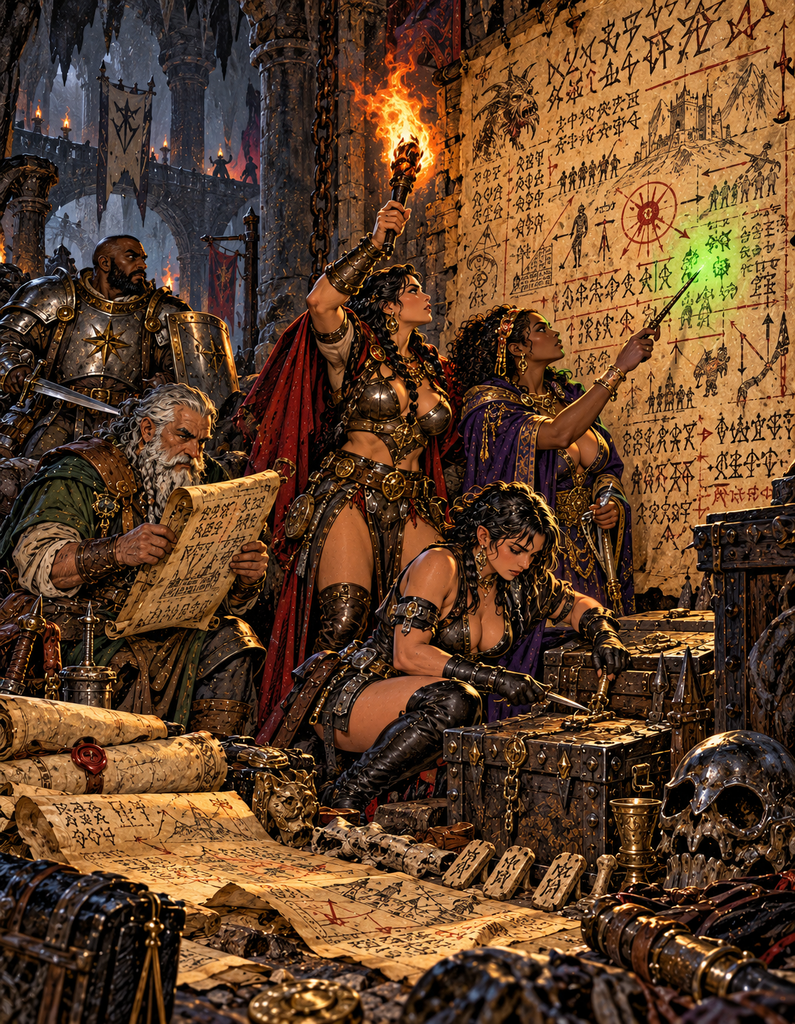
None of these possibilities requires Kingsmark to become an educational curriculum. They simply require a fictional world built with enough thoughtful connections to reality that players can follow their curiosity beyond the gaming table. Fantasy gives us extraordinary freedom to imagine worlds that never existed, and I see no reason why those imaginary worlds cannot also help us better understand the one we actually inhabit. That is one of the reasons I designed 👑Kingsmark the way I did.
Kingsmark is a heroic fantasy TTRPG for mature players, offering a vast medieval world, cinematic action, meaningful choices, and opportunities for exploration and discovery. You can learn more about its peoples and cultures in Chapter 8 — 🫀Human Type and explore its character-building possibilities in Chapter 17 — ✍Character Creation. The complete Player’s Handbook is available to read for free at Kingsmark.Games, allowing you to discover the game and begin exploring Sylva without purchasing anything.
About The Author