Should You Create Art or Game Rules First?
What Creating a Tabletop RPG Taught Me About Game Development
The importance of artwork, functional game mechanics, discipline, dopamine, and staying motivated long enough to finish your game.
On the website Quora.com someone asks, “Do you prefer to start a new game project with the art or with the code?”
If you’ll permit me to intrude upon a question intended for video game developers, I’d like to offer the perspective of a tabletop role-playing game designer. I’m the creator of Kingsmark, a fantasy tabletop RPG, so I don’t write video game code. However, tabletop games also require artwork, and our rules and mechanics serve a purpose somewhat similar to computer code. We must design systems, work through mathematics, test functionality, correct problems, and ultimately create something people genuinely enjoy playing.
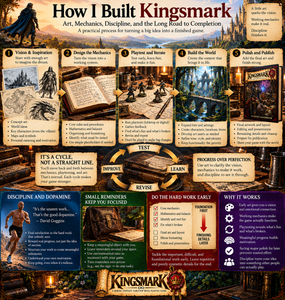
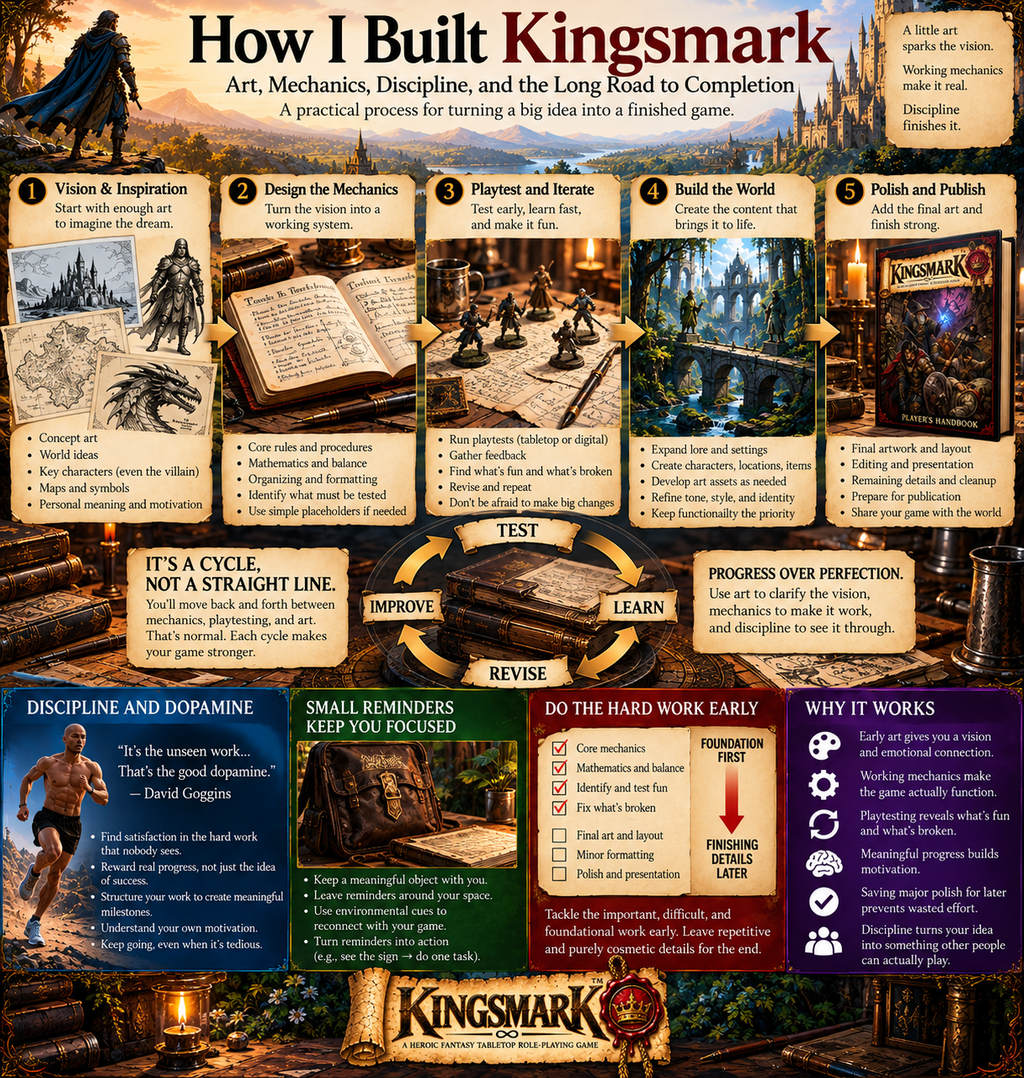
My philosophy is to begin with enough artwork to visualize the dream, concentrate on making the game functional, and save most of the artistic polish for later. However, there’s a psychological element to this approach that I believe is worth exploring.
Artwork Helps You Believe in What You’re Creating
Artwork is tremendously important to game development, and I’m certainly not suggesting that creating artwork is easy. A single beautiful illustration can communicate a game’s atmosphere, introduce its characters, establish its identity, and inspire the creator to keep working. Sometimes, developing a small collection of visual assets early in the project helps transform a vague idea into something you can meaningfully imagine.
I also believe artwork can serve a personal, symbolic purpose for its creator. Perhaps you create an illustration of the principal villain before designing the heroes because that villain represents the challenges you intend to overcome. Perhaps a map symbolizes the enormous world you’re determined to build, or an early storyboard of the final cinematic reminds you what completing your game would mean. You might even embed private symbols representing your aspirations, ambitions, or personal history into artwork that other people will never fully understand.
These aren’t necessarily assets that need to appear in the final product. Sometimes their purpose is to help you, the creator, maintain focus and remember why you began this enormous undertaking.
However, artwork can also become a very attractive form of procrastination.
Make the Game Work Before Making It Beautiful
One habit I’ve developed as an author is deliberately postponing the creation of a book cover. Designing a beautiful cover can be enormously satisfying, but that satisfaction can arrive long before I’ve completed the manuscript. I don’t necessarily want to reward myself with the emotional experience of having finished a book when I’ve barely begun writing it.
That doesn’t mean I refuse to create a cover until the final page is written. If I’ve developed a substantial outline and established a solid foundation, creating the cover might be a perfectly reasonable step. The important thing is recognizing when I’m doing something because it advances the project and when I’m doing it because it’s more pleasurable than the work I really ought to be doing.
Video game developers face a similar problem. The Godot Engine’s development guide recommends using placeholder artwork while developing gameplay, allowing mechanics to be tested and revised without repeatedly discarding expensive finished assets. Interestingly, Unity has also argued that excessively crude placeholder graphics can undermine playtesting because visual feedback influences how players perceive a game. Both perspectives suggest something useful: create the artwork necessary to develop and evaluate your game, but don’t mistake visual polish for functional progress.
In tabletop design, much of my work involves mathematics, balancing mechanics, writing procedures, organizing information, and repeatedly playtesting rules. Some of this is intellectually rewarding, but other parts are tedious. Nevertheless, a magnificent illustration won’t repair a broken combat system, just as beautiful character models won’t rescue a video game that isn’t enjoyable to play.
Incidentally, video game developers can sometimes test mechanics without programming anything. At GDC Europe 2011, Rob Davis of Playniac described using a tabletop prototype to test the mechanics of International Racing Squirrels before writing code. That’s a wonderful demonstration that game design begins with understanding how a game works, regardless of its eventual medium.
Discipline, Dopamine, and Rewarding Real Progress
I believe serious creative work requires understanding your own psychology. You need to recognize what motivates you, what distracts you, and how to organize your work so that you’re rewarding genuine achievements rather than merely entertaining yourself with the idea of success.
David Goggins discussed something relevant during his interview with Andrew Huberman. Speaking about the satisfaction he derives from difficult accomplishments achieved without public recognition, Goggins emphasized “the unseen work” and described obtaining “the good dopamine.” His larger point was that he didn’t need other people constantly congratulating him because he knew what he had accomplished through his own effort.
I find that philosophy particularly valuable for game development. Nobody necessarily applauds when you spend hours correcting mathematical inconsistencies, eliminating exploits, or rewriting an incomprehensible rule. Nevertheless, those accomplishments matter, and learning to appreciate them helps sustain the discipline required to complete an ambitious project.
The scientific picture of dopamine is considerably more complicated than simply calling some rewards good and others bad. Dopamine participates in motivation, learning, and our willingness to exert effort; it isn’t merely a pleasure chemical. However, psychological research does support the importance of meaningful progress. Teresa Amabile and Steven Kramer, for example, found that progress on meaningful work was a powerful contributor to positive work experiences and motivation.
This is one reason I divide enormous projects into manageable chunks. I also organize my priorities somewhat like an inverted pyramid, tackling consequential foundational work before increasingly minor details. I want achievable objectives along the way, with each accomplishment providing another reason to continue. The trick is to arrange those milestones so that your satisfaction comes from actually advancing the project.
There’s also a difference between difficult foundational work and tedious finishing work. I’ll tackle challenging mechanical problems early because postponing them could undermine everything built upon them. But repetitive formatting, minor presentation adjustments, and other finishing details can often wait until the underlying material is stable.
How I Applied These Ideas to Kingsmark
My tabletop RPG, Kingsmark, uses a system I call Jack’s Cinematic d12. Because the twelve-sided die is fundamental to the game, I began incorporating these dice into my everyday surroundings. I might carry one in my pocket, keep another in my backpack, or leave a couple inside a dresser drawer.
The idea is that I continually encounter little reminders of the world I’m creating. Opening a drawer and unexpectedly seeing a twelve-sided die reconnects me with my project, even when I’m occupied with something entirely unrelated. The object has meaning beyond its practical function as a gaming tool because it symbolizes a long-term creative ambition.
I also use artwork to help maintain that connection, but I try to remain conscious of what the artwork accomplishes. An illustration might establish the atmosphere of my fantasy world, develop a character’s identity, or provide inspiration for an adventure. However, none of those beautiful illustrations eliminates the need to sit down and make the rules work.
Kingsmark has now been created and published, and I continue expanding it. That accomplishment didn’t come from artwork alone or from mechanics alone, but from persistently working through the many different problems involved in producing a complete role-playing game. I still have plenty of work ahead of me, which makes maintaining these habits especially important.
So, Art or Code First?
My answer is to create enough art to establish your vision, then prioritize whichever systems must function before the rest of the project can succeed. Work in meaningful chunks, test your mechanics early, use personally significant imagery to maintain motivation, and reserve most of the final artistic polish for when the game is ready for it.
Above all, develop the discipline to find satisfaction in the difficult work that nobody sees. Beautiful artwork can help you imagine an extraordinary game, but it’s the work you consistently accomplish that turns your imagination into something other people can actually play.
— John Alan Martinson, creator of Kingsmark, a heroic fantasy tabletop role-playing game for mature players.
About The Author