⚔How Did Medieval Sword Fighting Really Work?
Separating Hollywood Fantasy from Historical Combat
Anyone who has watched a medieval fantasy movie has probably seen two swordsmen exchanging enormous swings, smashing their blades together, spinning around unnecessarily, and somehow continuing their duel for several minutes without suffering a serious injury. Sometimes they pause to exchange insults, deliver speeches, or perform acrobatic maneuvers that would make a professional gymnast jealous. It is exciting entertainment, but how closely does any of this resemble the way medieval warriors actually fought?
Real medieval sword fighting was often more practical, calculated, and physically complicated than Hollywood suggests. A skilled combatant needed to understand distance, timing, balance, defensive positioning, and the intentions of his opponent. The sword itself was only one part of the equation, and understanding that distinction reveals something fascinating about historical warfare and how we might represent it in tabletop role-playing games.
Medieval Swordsmanship Was More Than Swinging a Sword
One of the most persistent misconceptions about medieval warfare is that sword fighting was largely a matter of strength, aggression, and swinging a sharp weapon until someone fell over. In reality, surviving historical documents reveal sophisticated systems of martial instruction that treated fighting as a discipline requiring considerable knowledge and practice. Modern researchers study many of these traditions through Historical European Martial Arts (HEMA), which involves interpreting surviving manuals, examining historical weapons, and experimentally reconstructing fighting techniques.
Among the most remarkable surviving sources is Royal Armouries MS I.33, a German fencing manuscript dating to approximately 1330. Considered the oldest surviving European fencing manual, it illustrates techniques involving a one-handed sword and a small shield known as a buckler. Its pages depict guards, attacks, defensive responses, and the coordinated manipulation of both weapons. The manuscript demonstrates that medieval swordsmanship could be taught as a systematic martial discipline rather than an assortment of improvised sword swings.
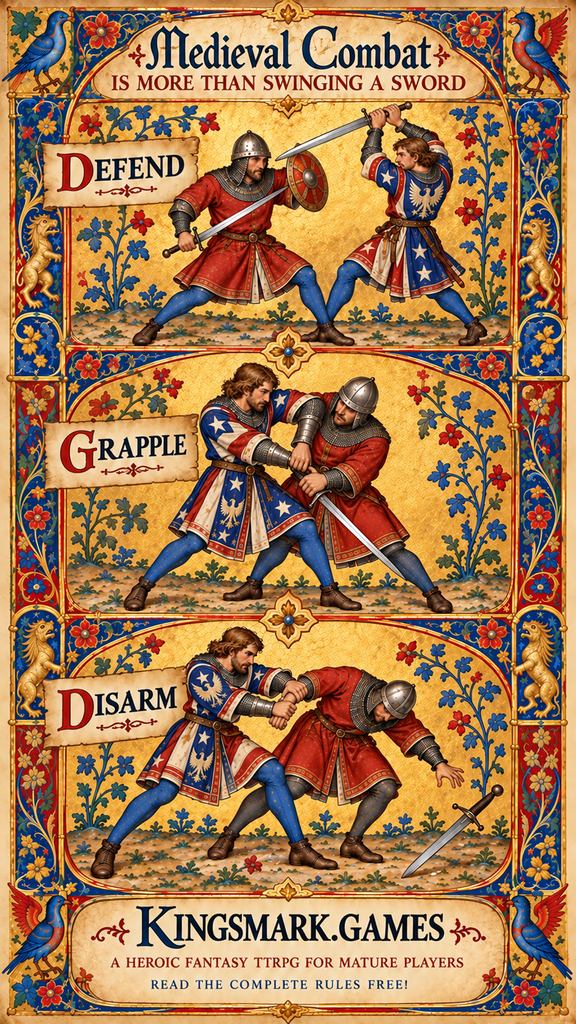
Another extraordinary historical source is the Fior di Battaglia, or The Flower of Battle, produced around 1410 by the Italian fighting master Fiore dei Liberi. Fiore’s work describes an extensive martial system encompassing unarmed grappling, daggers, swords, poleaxes, spears, armored fighting, and mounted combat. His teachings are particularly interesting because they demonstrate how one fighting technique could lead into another. A defensive movement might create an opportunity to control an opponent’s weapon, strike him with the sword’s pommel, throw him to the ground, or disarm him entirely.
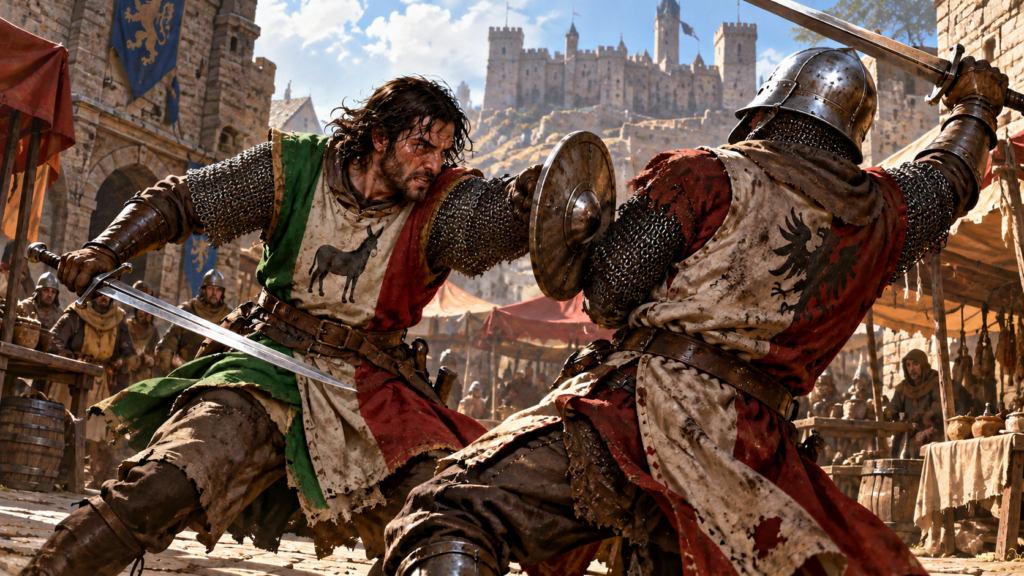
Fiore’s discussion of close-range swordsmanship, sometimes called narrow play, explicitly includes grappling, joint manipulation, disarming techniques, and throws. The surviving instructions can be explored through Wiktenauer’s collection of Fiore’s fighting techniques. These illustrations make something clear that Hollywood frequently overlooks: a sword fight could become a wrestling match without either combatant putting down his weapon. Once two fighters closed the distance between themselves, the possibilities changed dramatically.
I once encountered an interesting distinction between a knife fighter and a fighter who knows how to fight with a knife. The distinction is largely philosophical, but it expresses something important. The knife fighter, in this formulation, thinks primarily in terms of his chosen weapon, whereas the more complete fighter recognizes that the knife is merely one tool within a larger collection of abilities. He understands movement, balance, positioning, physical control, and how to adapt when circumstances make his weapon less useful.
The same principle applies to medieval swordsmanship. A warrior might use his sword to threaten an opponent, his shield to protect himself, his body to force the opponent backward, and his hands to control an enemy who has moved too close for an ordinary sword strike. Sometimes the most effective decision would be to disengage, retreat behind an ally, or refuse a confrontation under unfavorable circumstances. Competence was not simply about knowing how to swing a sword; it involved understanding the broader problem of fighting.
There is an important historical qualification here. Fiore’s manuscripts date from the early fifteenth century, considerably later than the period around 1200 that provides the initial medieval foundation for Kingsmark’s fantasy setting. We should not assume that every technique documented by Fiore was practiced identically two centuries earlier, or that every soldier belonged to a formal school of fencing. Nevertheless, these surviving sources establish that medieval European martial traditions could encompass much more than the straightforward exchange of sword blows.
Five Hollywood Myths About Medieval Sword Fighting
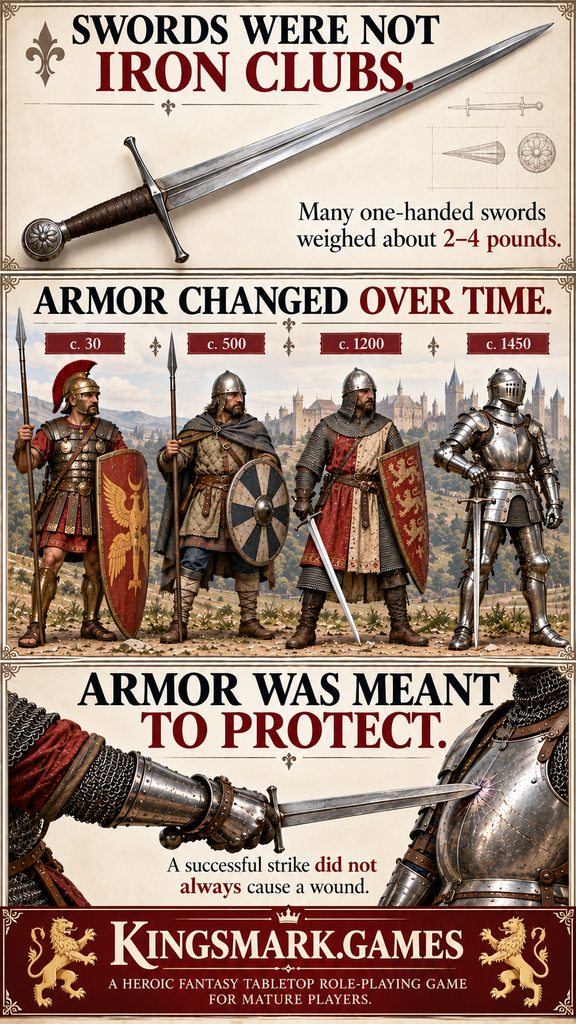
Hollywood has helped preserve several misconceptions about medieval weapons and combat, beginning with the notion that swords were enormous, cumbersome objects requiring extraordinary strength to wield. According to the Metropolitan Museum of Art’s examination of common misconceptions about arms and armor, most historical one-handed swords weighed approximately two to four pounds. Their balance, blade geometry, and construction were deliberately engineered to make them effective weapons. A properly constructed sword was not an oversized iron club, and its effectiveness depended on considerably more than the muscular strength of its wielder.
Another familiar misconception concerns the armored knight who can barely move under the weight of his equipment. In reality, well-fitted late-medieval plate armor permitted considerable mobility, including running, climbing, mounting horses, and rising after falling. The Metropolitan Museum reports that a typical complete field harness weighed approximately 45–55 pounds, with the weight distributed around the body rather than concentrated in one location. Armor was certainly tiring to wear, especially during sustained physical exertion, but it did not ordinarily transform an experienced warrior into a helpless metal statue.
We must also distinguish between different medieval periods. Around 1200, a well-equipped European knight might wear mail over protective textile garments, along with a helmet and shield. The extensive articulated plate armor commonly associated with the late-medieval knight developed progressively over subsequent centuries. The Metropolitan Museum’s history of medieval arms and armor explains these technological developments, which matter when trying to distinguish a thirteenth-century soldier from a fifteenth-century man-at-arms.
A third misconception is that swords could casually slice through solid armor. Although a sword was a dangerous weapon, sound protective equipment could greatly reduce the effectiveness of an attack, and a well-made plate breastplate was not something an ordinary sword stroke could simply cut apart. Combatants facing effective armor had to consider more suitable weapons, close-range techniques, and opportunities to exploit areas that were less thoroughly protected. That difference between an impressive-looking attack and an actually effective one is important when imagining realistic combat.
A fourth misconception is that every successful sword attack must necessarily produce a major wound. An opponent might block the strike, deflect it, move away, or absorb part of its force through protective equipment. Even when a weapon made contact, the result depended on numerous circumstances, including the type of weapon, the protection worn, and the nature of the impact. Conversely, a genuinely serious injury could produce consequences that affected the fighter immediately, rather than merely contributing to some invisible accumulation of damage.
The fifth misconception is perhaps the most important for tabletop role-playing games: the assumption that medieval fighting primarily consisted of extended, honorable duels between individual swordsmen. Actual warfare involved groups of combatants pursuing practical objectives, often under chaotic and dangerous circumstances. Soldiers defended passages, protected commanders, advanced together, held formations, attempted to break enemy positions, and withdrew when continuing the fight became untenable. Spears, axes, polearms, shields, bows, and other weapons all had important roles, and the sword was not necessarily the preferred tool for every situation.
Even the duration of a historical fight cannot be reduced to a universal rule. An encounter between two lightly armored opponents might develop very differently from an armored confrontation, a judicial duel, or an engagement involving several soldiers. Some struggles could end abruptly, while others involved prolonged exchanges, defensive movement, and repeated attempts to gain an advantage. Claims that every real sword fight ended within a particular number of seconds simply replace one cinematic misconception with another.
What emerges from the historical evidence is a more interesting understanding of combat. Survival depended upon judgment, equipment, training, circumstances, and sometimes simple fortune. The opponent who controlled distance, exploited terrain, maintained his defenses, or fought cooperatively with companions might possess a considerable advantage over someone who merely attacked with greater aggression. Those principles are worth remembering whenever we try to portray medieval combat convincingly.
How Much Realism Does a Sword-Fighting Game Actually Need?
Representing sword fighting in a tabletop role-playing game introduces an interesting problem. Actual fighting involves continuous movement, reflexes, changing distances, physical resistance, and decisions made in fractions of a second. A tabletop game must represent some of these processes through rules, dice, and decisions made by players sitting around a table. The more details a designer attempts to simulate, the greater the potential complexity, but eliminating too many details can leave combat feeling like a repetitive contest of attack rolls.
Some tabletop RPGs have approached this challenge with extraordinary ambition. One particularly interesting example is The Riddle of Steel, designed by Jacob Norwood and published in 2002. The game famously promoted its combat mechanics as exceptionally realistic, drawing upon historical martial arts and emphasizing tactical decisions, weapon techniques, and dangerous consequences. Its system gave considerable attention to how combatants committed themselves to attacks and defenses rather than treating each exchange as an isolated opportunity to subtract damage from an opponent.
Other games explored similar territory through different methods. HârnMaster became known for a combat system involving anatomical hit locations, injuries, armor protection, and the potential for lasting medical consequences. Song of Swords emphasizes tactical choices through its Combat Pool, requiring players to decide how much of their available capability to commit to offense and defense. Its combat system also treats actual wounds and their consequences as central elements rather than relying on conventional hit-point depletion.
These games deserve recognition because they demonstrate that serious attempts to represent the realities of fighting have existed in tabletop gaming for decades. Some players genuinely enjoy the detailed decisions that such systems offer, and there is nothing inherently wrong with designing a game around intricate martial simulation. The question I found most interesting was whether I could preserve a meaningful range of tactical possibilities while creating something broader than a specialized sword-fighting game. I wanted combat to support the adventure rather than become an entirely separate exercise that interrupted it.
Consider the familiar hit-point system used by Dungeons & Dragons. According to the official 2024 D&D Basic Rules, hit points represent durability and the will to live, and losing them does not ordinarily impair a character’s capabilities until the character reaches zero. This is an intentional abstraction, not a claim that adventurers possess enormous reserves of blood or can survive any number of literal sword wounds. The system serves a legitimate purpose by allowing heroic characters to endure dangerous encounters without requiring the game to track every physical injury.
Nevertheless, this approach can produce a peculiar narrative problem. Imagine a warrior receiving what the Game Master describes as a tremendous battle-axe blow to the shoulder, followed by another devastating attack across the torso. If the warrior merely loses hit points and continues fighting at full effectiveness, the description and mechanical result may seem inconsistent. The Game Master can preserve the abstraction by describing glancing blows, strained defenses, damaged equipment, and the gradual exhaustion of the character’s ability to avoid a decisive injury, but not every group narrates combat that way.
There is also a distinction between making combat dangerous and making every successful attack immediately fatal. Realistic consequences do not require a system in which one lucky strike automatically kills the strongest adventurer regardless of circumstances. Armor, defense, physical capability, the type of attack, and the location and severity of an injury should all have meaningful influence. The challenge is producing outcomes that can be explained through the events of the Scene without forcing everyone to consult an elaborate collection of anatomical charts after every sword swing.
This was one of the problems I wanted to address when developing Kingsmark. I wanted players to think about defending themselves, protecting companions, manipulating opponents, and choosing the right moment to attack. I also wanted injuries to matter, sometimes for the remainder of the adventure, without creating a combat simulator so elaborate that the players lost sight of the story they were supposed to be experiencing. The historical details were valuable, but the ultimate objective was an exciting heroic fantasy game.
Kingsmark: The Art of Fighting Without a Sword-Fighting Simulator
When I designed Kingsmark, I wanted combat to provide the kinds of meaningful decisions that make historical fighting interesting, while remaining suitable for an ambitious fantasy adventure. I did not want players memorizing an encyclopedic catalog of sword grips or calculating the exact angle of every attack. Nor did I want the combat experience reduced to standing beside an opponent and repeating the same attack until someone ran out of hit points. My objective was to create a flexible system in which a character’s choices could produce believable, dramatic, and sometimes unexpected consequences.
Kingsmark uses Action Points to represent what a character can accomplish during a ⏸Turn. Different Actions require different amounts of time and effort, creating opportunities to combine attacks, defensive maneuvers, movement, communication, and other activities. The complete system is explained in Chapter 11 — ▶️Action Scenes, while Chapter 12 — 🎬Example Actions demonstrates the range of possibilities available to adventurers. The Player’s Handbook includes approximately 108 example Actions, but players are not restricted to those examples; the Game Master can adjudicate other reasonable attempts using the established rules.
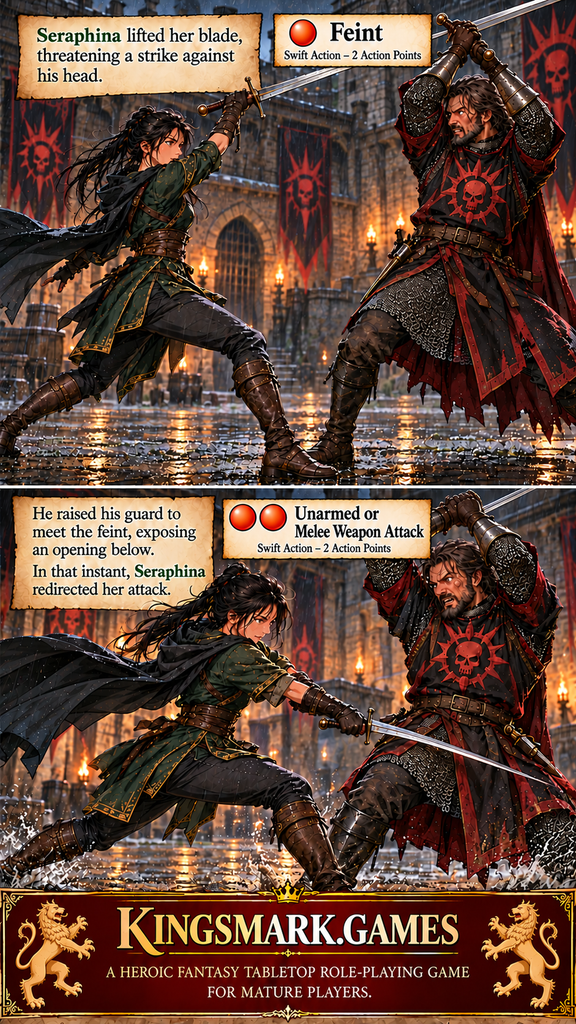
Consider the difference between attacking an opponent and adopting 🟠🟠Defensive Stance. The former attempts to harm or overcome the adversary, while the latter concentrates on protection and grants defensive Advantage under the appropriate conditions. A fighter can also attempt 🟠🟠Feint to deceive an opponent and create an opening, 🟠🟠Disarm to deprive him of his weapon, or 🟠🟠Trip, Sweep or Takedown to force him to the ground. These are different tactical objectives, each potentially valuable depending upon what the combatant is trying to accomplish.
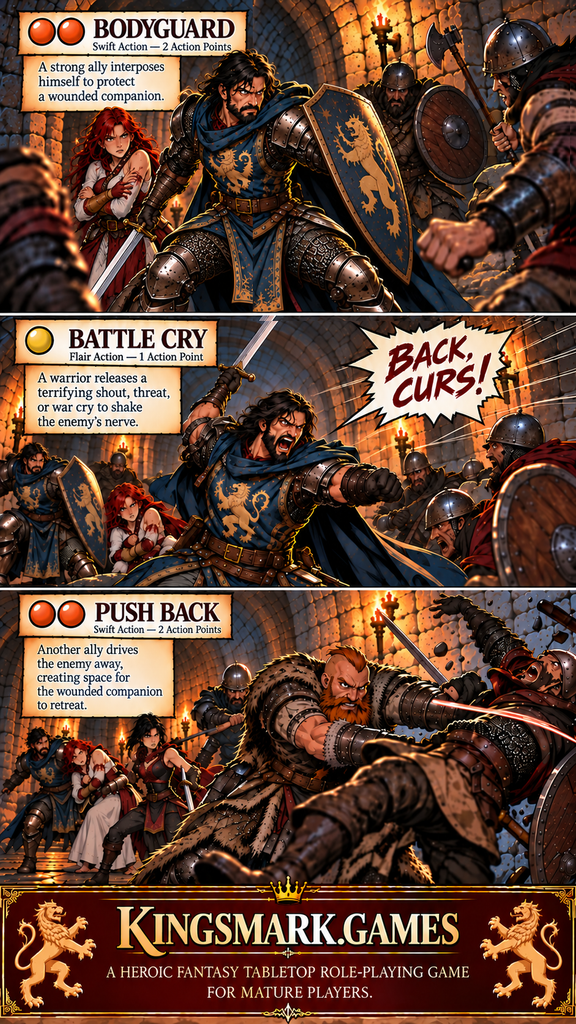
Other Actions emphasize cooperation and controlling the battlefield. Through 🟠🟠Bodyguard, a character can actively protect a nearby companion by positioning himself to intervene against qualifying attacks, although the protection depends upon the circumstances and his ability to intercept the threat. 🟠🟠Push Back allows a combatant to force an opponent away through a suitable physical maneuver, making distance and terrain important considerations. A successful push might drive an enemy away from a wounded companion, disrupt his position, or force him toward an obstruction that changes the course of the encounter.
I also wanted combatants to have options that involved psychological pressure rather than physical injury. Kingsmark includes such possibilities as 🟡Battle Cry, deceptive fighting, insulting gestures, and even deliberate demonstrations of confidence through Intentional Coolness. These Actions can influence opponents through the game’s 🧠Mental Trauma system, with appropriate limitations to prevent every repeated insult or intimidating display from becoming an endlessly escalating psychological weapon. A fighter who understands intimidation, discipline, deception, and morale possesses options that go beyond inflicting physical damage.
The consequences of actual injury are equally important. Kingsmark does not use conventional hit points; instead, its Chapter 13 — 💥Damage & Defense addresses 🩸Physical Wounds through categories of Minor, Moderate, Severe, and Critical injuries. Protective equipment, defensive capability, and the circumstances of an attack influence its outcome, while serious wounds can have consequences beyond the immediate exchange. Injury and recovery also become part of the continuing adventure through Chapter 14 — ❤️Healing Scenes.
The importance of these mechanics becomes clearer when we imagine them working together. Suppose three adventurers are attempting to protect a wounded companion while retreating through a narrow stone passage. A powerful enemy advances toward the injured man, but a shield-bearing warrior moves into position and employs Bodyguard to protect him. Another adventurer uses a Feint to create an opening against an approaching opponent, while a third attempts to Push Back an enemy who threatens to break through their defensive position.
The encounter now becomes something much more interesting than a series of attacks. The shield-bearing warrior must decide whether to maintain his protection or abandon his position to attack more aggressively. The swordsman’s deceptive maneuver may create an opportunity, but he still has to exploit it before his opponent recovers. Meanwhile, the third adventurer might prevent the enemy from advancing, allowing the wounded companion to reach safety without anyone necessarily having to kill every opponent.
These decisions do not need to be represented through an exhausting collection of specialized sword-fighting rules. The players describe what they want to accomplish, the Game Master considers the circumstances, and the established mechanics determine what happens. Characters must still respect the limitations of their abilities, available Action Points, positions, equipment, and the physical situation. What matters is that the players have meaningful choices, and that those choices produce consequences which make sense within the developing Scene.
This connects to a larger principle of Kingsmark’s design philosophy. Individual Actions occur during ⏸Turns, the Turns of participating characters form Rounds, and those Rounds unfold within a 🎬Scene. Scenes contribute to Adventures, and I envision each Adventure as an episode in an ambitious, high-budget fantasy television drama, with the continuing Campaign providing the larger serialized story. Every confrontation should contribute something to that story, whether it ends in triumph, retreat, injury, surrender, sacrifice, or an entirely unexpected development.
My objective was never to create a perfect simulation of medieval swordsmanship. Kingsmark is a heroic fantasy game, and cinematic adventure sometimes permits extraordinary feats that ordinary historical combatants could never accomplish. However, I wanted enough realism and tactical structure that the extraordinary moments would have a believable foundation. When a character survives a devastating attack, accomplishes something remarkable, or defeats a seemingly superior opponent, the Game Master should have enough mechanical and narrative information to explain why it happened.
The surviving medieval fighting manuals remind us that swordsmanship was never merely a matter of swinging a blade. Skilled fighters studied their opponents, managed distance, protected themselves, exploited opportunities, and employed whatever appropriate techniques might help them survive. The sword was important, but the person wielding it—and the decisions he made—was ultimately more important.
That is the philosophy I wanted to bring into Kingsmark. I believe combat becomes more memorable when the players can do more than repeatedly attack, when tactical intelligence matters, and when the consequences of violence remain part of the story. A great combat system does not need to simulate every physical movement; it needs to provide the possibilities from which great combat Scenes can emerge.
Kingsmark is a Heroic Fantasy TTRPG for Mature Players. The complete Player’s Handbook is available to read for free at Kingsmark.games, where you can explore the combat system, character creation, magic, and the world of Sylva before deciding whether it belongs at your gaming table.
About The Author