☠️ Why Evil Must Exist in 👑Kingsmark
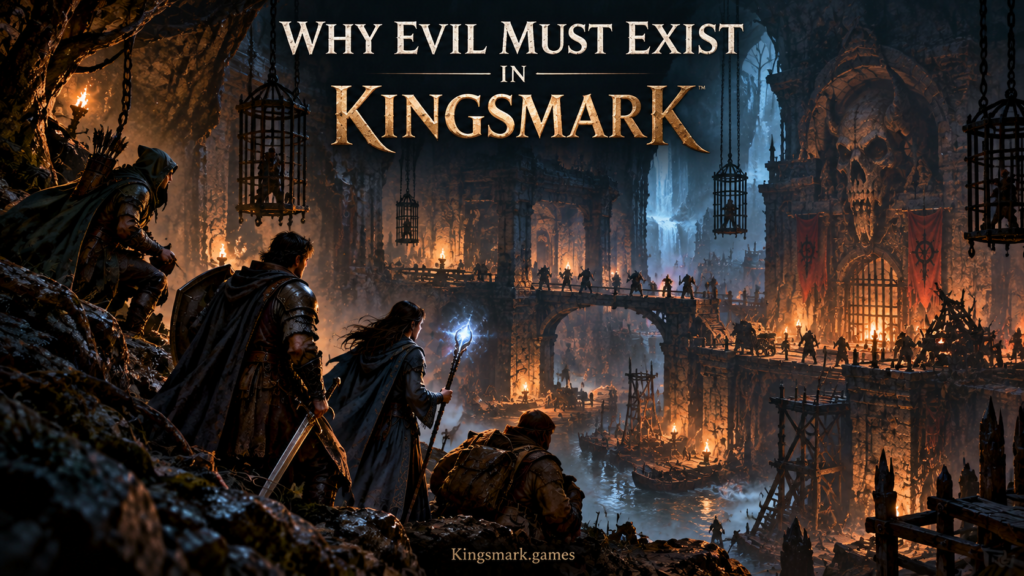
The Gloom, Human Cruelty, and the Meaning of Heroism in Mature Fantasy
Content Advisory: This article discusses historical atrocities, torture, kidnapping, slavery, sexual violence, psychological cruelty, warfare, and other disturbing aspects of human behavior. If you are uncomfortable with the subject matter of R-rated horror movies or serious historical accounts of human brutality, this article may not be for you.
What Was Really Waiting in Those Dungeons?
When I was approximately twelve or thirteen years old, I became fascinated with HeroQuest, the fantasy adventure board game originally published in 1989. There was something extraordinary about gathering a party of adventurers, opening mysterious doors, discovering underground chambers, and confronting whatever monsters happened to be waiting inside. The game was relatively simple, but my imagination was doing considerably more work than the rules required.
I remember wondering about the Orcs and Goblins inhabiting those underground places. Where did they sleep? What did they eat? What were they doing when the heroes weren’t around? More importantly—and this is where my childhood imagination began exploring some rather disturbing territory—what would happen if these creatures captured an adventurer alive?
Imagine being dragged into one of those dungeons, imprisoned somewhere underground, and discovering that nobody knows where you are. Your captors aren’t interested in negotiating a reasonable ransom or exchanging prisoners according to some mutually recognized code of honor. They’re intelligent, cruel, and perfectly willing to do horrible things to you because they enjoy exercising power over someone who cannot resist them.
That changes the entire meaning of entering a dungeon. You’re no longer exploring a convenient collection of rooms populated by monsters patiently waiting to be attacked. You’re entering a hostile world inhabited by creatures whose activities may be considerably more terrifying than anything represented by the original board game.
That childhood fascination eventually contributed to the creation of 👑Kingsmark, my heroic fantasy tabletop role-playing game. I wanted to capture the adventurous spirit of The Lord of the Rings, Willow, The Dark Crystal, Labyrinth, The Princess Bride, and, of course, HeroQuest. I love the wonder, romance, humor, friendship, courage, and larger-than-life adventure found in those stories.
But I also wanted something more—something that takes the terrifying implications of their worlds seriously. Kingsmark is, in many respects, HeroQuest for grown-ups, with a greater degree of realism, psychological depth, moral complexity, and consequences. If heroes are going to venture into terrible places and confront extraordinary evil, I want that evil to mean something.
Why My Orcs and Goblins Are Evil
One of my favorite tabletop role-playing games is Shadowrun, which combines cyberpunk science fiction with fantasy. In Shadowrun, orks and trolls are metahumans, possessing the same broad range of moral possibilities as other human beings. An ork might be a devoted father, a police officer, a corporate executive, a criminal, or someone simply trying to survive in a society that discriminates against him.
I appreciate that approach, and it works particularly well for Shadowrun. Its setting explores prejudice, inequality, corporate exploitation, cultural conflict, and the moral compromises people make while navigating a dystopian society. Portraying entire metahuman populations as inherently wicked would undermine much of what makes that world interesting.
Dungeons & Dragons has also moved toward portraying traditionally monstrous peoples as morally diverse. Its 2024 Player’s Handbook includes Orcs among the core playable species, continuing a development that began in earlier editions. Players can portray Orcs with individual personalities, convictions, relationships, and moral ambitions rather than treating them as automatically evil.
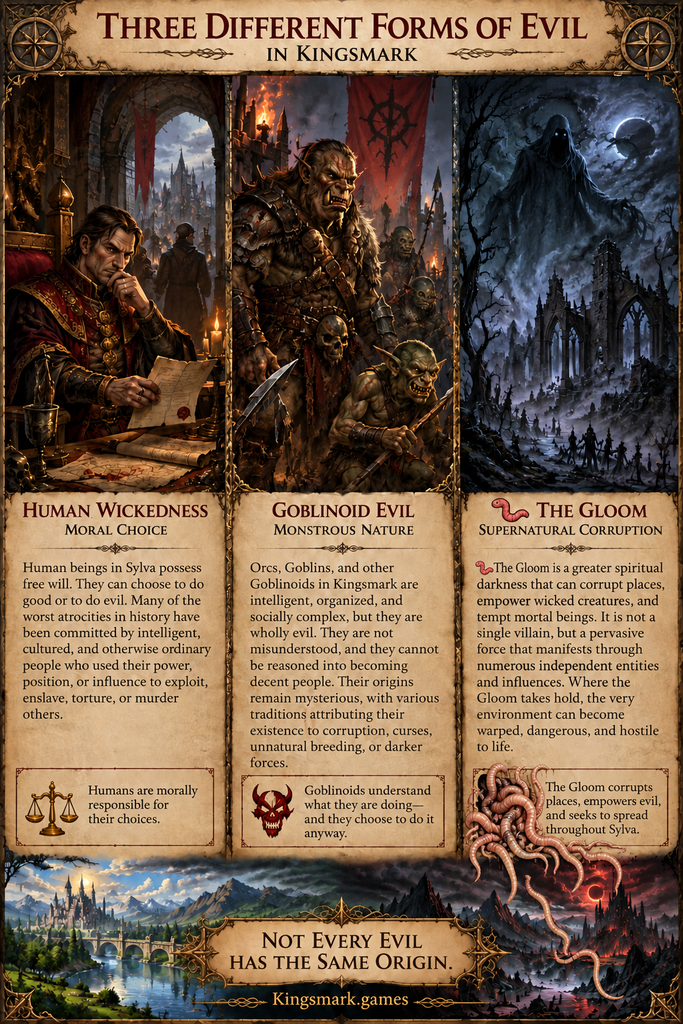
I understand the appeal, although I made a different decision for Kingsmark. My Goblins and Orcs are wholly evil because they serve a particular purpose in the world and in the experiences I want players to have. I want there to be intelligent enemies whose wickedness is not the result of a misunderstanding, whose cruelty cannot simply be explained away, and whose commitment to doing evil presents a genuine challenge to those who confront them.
Interestingly, J. R. R. Tolkien wrestled with this very problem. He considered different explanations for the origins of Orcs, including the corruption of preexisting beings, while struggling with the moral implications of an intelligent people apparently incapable of redemption. In Letter 269, written to W. H. Auden in May 1965, Tolkien acknowledged the difficulty of reconciling irredeemably wicked Orcs with his broader theological understanding.
Kingsmark approaches the problem somewhat differently. According to the Player’s Handbook, Goblinoids are wholly evil, although their original creation and ultimate nature remain mysterious. Some traditions attribute their existence to 🌑Dark Magic, curses, corruption, or unnatural breeding, but no universally accepted account establishes precisely where they came from.
An Orc can negotiate, retreat, surrender, cooperate with companions, maintain loyalties, and demonstrate considerable intelligence. It might protect an ally, honor an agreement, or temporarily refrain from violence because doing so serves its interests. Nevertheless, these behaviors should not automatically be interpreted as genuine moral goodness, particularly when the creature’s underlying motives remain predatory.
This is an important distinction because intelligence does not guarantee benevolence. A creature capable of understanding you may also be capable of understanding exactly how to exploit your weaknesses, manipulate your sympathies, and inflict the greatest possible suffering. Sometimes a monster knows perfectly well that what it is doing is terrible—and that’s precisely why it enjoys doing it.
I’m not arguing that every opponent in Kingsmark should be irredeemable. Human beings possess moral freedom, and the game provides opportunities for negotiation, mercy, repentance, reconciliation, and personal transformation. But I also want players to encounter enemies who cannot be persuaded to become decent people simply because someone delivers an inspiring speech and succeeds at a 🗨️Dialog Scene.
Evil Is Not Merely Something We Invented for Fantasy
The disturbing reality is that some of the worst things imaginable in a fantasy dungeon have recognizable counterparts in actual human history. Torture, slavery, mass murder, forced captivity, systematic sexual violence, and the deliberate terrorization of vulnerable populations are not inventions of fantasy authors. These things have been committed by intelligent human beings—sometimes by people operating within elaborate political, military, religious, or economic institutions.
The facts of real atrocities that have occurred over the course of human existence matter because they demonstrate something deeply uncomfortable about human behavior. People do not necessarily become compassionate simply because they are educated, intelligent, socially accomplished, or capable of recognizing the humanity of their victims. A person may possess substantial intellectual abilities while using those abilities to plan, rationalize, or conceal extraordinary cruelty.
The exploitation of vulnerable people also continues in contemporary criminal activity. Human trafficking can involve forced labor, sexual exploitation, coerced criminal activity, and, in relatively uncommon documented cases, trafficking for organ removal. These crimes do not always resemble sensational horror movies; perpetrators frequently use deception, economic vulnerability, threats, and coercive control to exploit their victims.
I don’t present these historical realities to suggest that actual human populations are equivalent to inherently evil fantasy creatures. Quite the opposite—human beings retain moral responsibility for their choices, and participation in an atrocity cannot be explained away by pretending that its perpetrators belong to some separate species of monster. The comparison concerns the reality of deliberate cruelty and the terrible consequences that follow when people are permitted to exercise power over defenseless victims.
It also explains why I’m unwilling to construct a fantasy world in which every intelligent being secretly wants to become your friend. There are real people who will steal from you, exploit you, imprison you, or destroy your life if they believe doing so benefits them. Others may inflict suffering for ideological reasons, personal satisfaction, hatred, or the desire to dominate.
A believable fantasy world should possess enough moral seriousness to acknowledge that reality.
Psychopathy, Sociopathy, and the Benevolent Sociopath
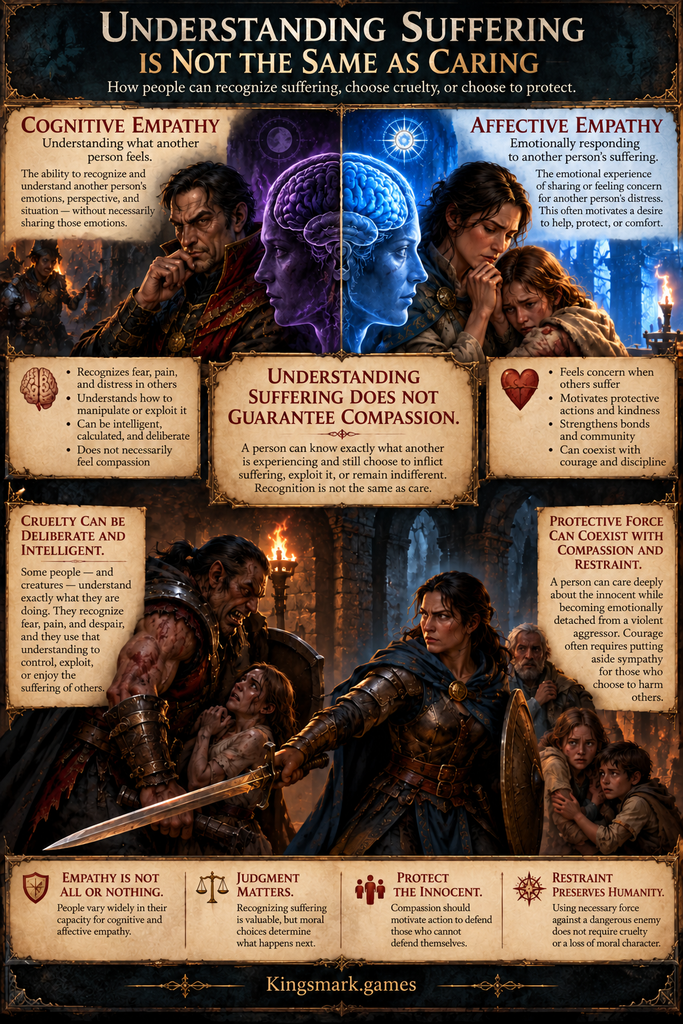
Psychologists distinguish between different aspects of empathy, particularly cognitive empathy and affective empathy. Cognitive empathy concerns the ability to recognize and understand what another person is experiencing, while affective empathy involves an emotional response to that experience. Someone may understand that another person is frightened, grieving, or suffering without necessarily sharing that person’s distress or feeling motivated to alleviate it.
This distinction becomes particularly interesting when examining psychopathy. A 2022 meta-analysis involving 477 research records and more than 142,000 participants found different patterns of empathy impairment associated with psychopathic traits and antisocial behavior. Higher psychopathy scores were associated more strongly with deficits in affective empathy, while the antisocial groups studied showed comparatively greater impairment in cognitive empathy.
The findings do not mean that everyone displaying psychopathic traits is violent, criminal, or incapable of moral conduct. Psychopathy, sociopathy, antisocial personality disorder, sadism, and ordinary selfishness are not interchangeable concepts. However, the research helps explain why 🧠understanding another person’s suffering and ❤caring about that suffering are two entirely different matters.
Now, I’m going to introduce a description of myself that some readers may find provocative: I consider myself a benevolent sociopath.
I use that expression loosely, not as a psychiatric diagnosis, but as a way of describing a particular moral and psychological attitude. In the simplest terms, I mean that I am capable of feeling deep compassion for innocent people while deliberately reducing my sympathy toward those who knowingly victimize others. When someone is actively being evil to another person without justification, I simply care nothing for the aggressor, to the point that reading their obituary would cause either no emotional response or a laugh at best.
This is related to something I find fascinating about military and police training. Soldiers and law enforcement officers sometimes face situations in which hesitation, panic, or uncontrolled emotion can endanger innocent people and their fellow personnel. Their preparation therefore includes learning to function under stress, exercise judgment, and act decisively when circumstances demand it.
That does not mean the purpose of military training is to produce literal sociopaths, nor should it be. A disciplined soldier may need considerable emotional control while also remaining committed to the humane treatment of prisoners, civilians, and wounded opponents. Professional restraint is part of the moral distinction between someone who uses force to protect others and someone who uses it merely to dominate.
My concept of the benevolent 🤖❤ sociopath is therefore better understood as selective emotional detachment in the service of protecting others. I can recognize the humanity of a dangerous person without permitting that recognition to paralyze me when someone else needs protection. Compassion is a virtue, but compassion without judgment can become dangerous when it continually excuses the conduct of someone who refuses to stop harming others.
This creates interesting possibilities for Kingsmark characters. A courageous ⚔️Man-at-Arms, 🎯Monster Hunter, or 🛡Holy Knight need not be emotionally numb, bloodthirsty, or indifferent to suffering. The character may simply recognize that an enemy has presented a grave threat and that effective intervention is necessary.
On Killing: What Does It Take to Confront Violence?
One of the most interesting books on the psychology of violence is On Killing: The Psychological Cost of Learning to Kill in War and Society, first published in 1995–1996 by retired U.S. Army Lieutenant Colonel Dave Grossman. Grossman was an Army Ranger and former psychology instructor at West Point, and his work examines psychological resistance to killing, military training, combat conditioning, and the emotional consequences of lethal violence. His central questions are relevant to anyone interested in depicting realistic characters confronting mortal danger.
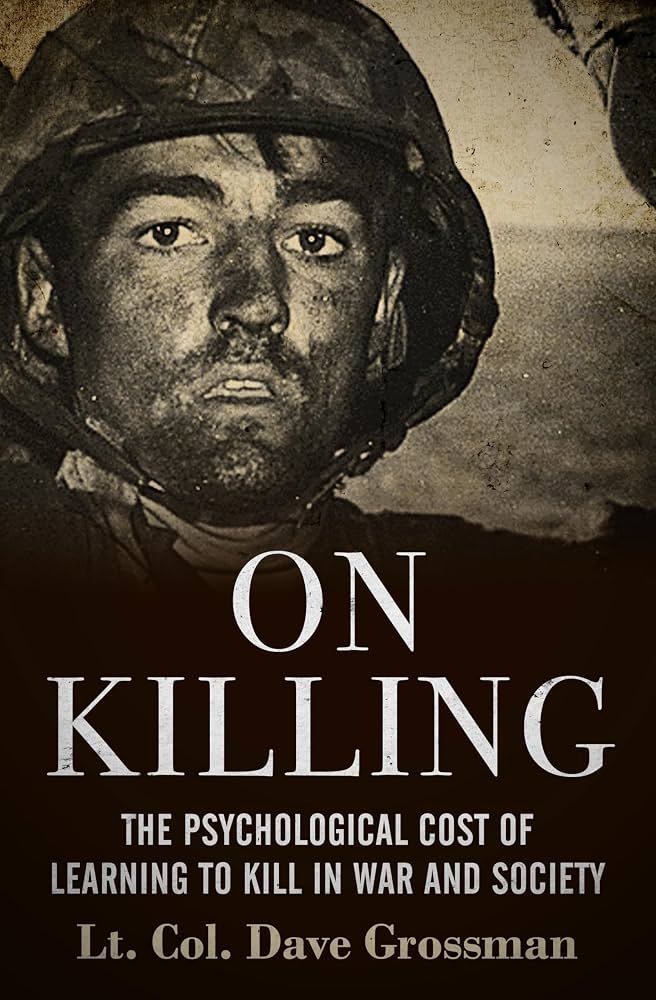
A major theme of Grossman’s book is that killing another human being may involve profound psychological difficulties, even when the circumstances involve legitimate combat. Training, repetition, social expectations, leadership, and the immediate pressures of survival can influence how soldiers respond. Yet the consequences of violence do not necessarily disappear simply because a person has been trained to act decisively.
Some of Grossman’s historical claims have been challenged, particularly those inherited from military historian S. L. A. Marshall. Marshall argued that only a small percentage of American infantrymen fired their weapons during World War II, but the underlying evidence and its interpretation remain disputed. Canadian military historian Robert Engen examines these problems in Killing for Their Country: A New Look at Killology and his scholarly analysis of Marshall’s firing-rate claims.
The historical controversy is important, but it does not eliminate the broader questions. How do people prepare themselves to function under mortal threat? What enables someone to overcome terror, confusion, and hesitation while retaining enough judgment to distinguish necessary force from unnecessary violence? How does a person live afterward with memories of actions that may have been necessary but remain emotionally disturbing?
The International Committee of the Red Cross provides a useful reminder that military effectiveness and humane treatment are not opposing goals. The laws of armed conflict require the humane treatment of prisoners and prohibit torture, mutilation, and other abuses. Someone may fight an enemy while that enemy remains dangerous and nevertheless recognize the obligation to protect him once he becomes a prisoner.
This psychological complexity belongs in heroic fantasy. An adventurer might begin a campaign with romantic notions about battle, then discover that witnessing a companion’s serious injuries or confronting a truly horrifying enemy changes those expectations. The character may become more disciplined, more cautious, more courageous, or more troubled by the consequences of violence.
Kingsmark’s systems of 🩸Physical Wounds and 🧠Mental Trauma exist partly because I want dangerous experiences to have recognizable consequences. I don’t want every violent encounter to become an exercise in subtracting numbers from an enormous pool of Hit Points. The decisions characters make during a ▶️Action Scene should matter, and the people who survive those experiences should have something worth remembering.
Tunnel Rats and the Horrors Beneath the Earth
One of the most fascinating historical comparisons with fantasy dungeon exploration comes from the American soldiers known as tunnel rats during the Vietnam War. These soldiers volunteered to enter underground tunnel networks used by Viet Cong forces for transportation, storage, concealment, medical facilities, and military operations. The tunnels were often narrow, dark, unfamiliar, and potentially dangerous in ways that could not be determined from the surface.
The National Museum of the United States Army explains that some tunnel networks extended thousands of feet and incorporated multiple levels, interconnected passages, and specialized chambers. Entrances could be carefully concealed, while the interior might contain defensive obstacles, traps, equipment, or enemy personnel. Exploring these environments required unusual composure because a soldier could not reliably know what waited beyond the next passage.
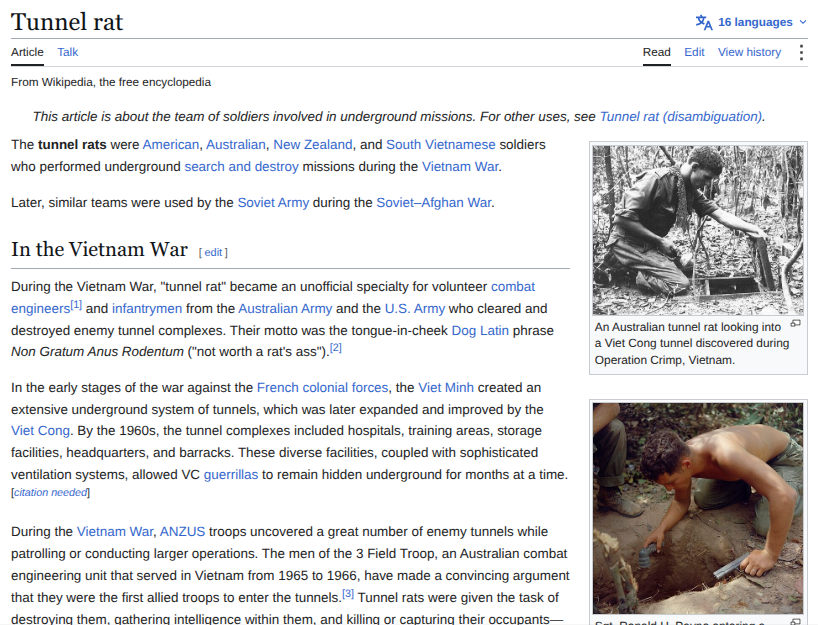
The psychological implications are remarkable. Imagine crawling through a narrow underground corridor with limited visibility, uncertain ventilation, and almost no knowledge of the surrounding structure. You may hear movement somewhere nearby, but you cannot tell whether it comes from another soldier, an enemy combatant, an animal, or something shifting in the earth.
Historical context matters here. Vietnamese soldiers occupying those tunnels were human military opponents with their own reasons for fighting, not fantasy monsters or moral equivalents of Goblinoids. Nevertheless, the experience of entering an unfamiliar, hostile underground environment provides an extraordinary foundation for understanding what a fictional dungeon expedition might feel like.
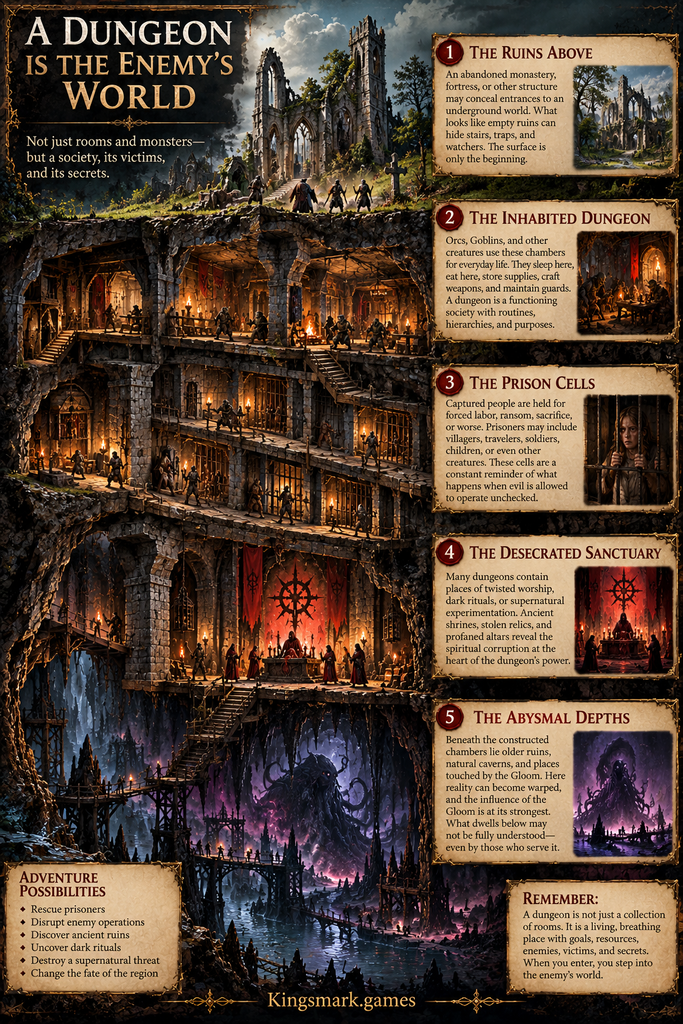
In Kingsmark, a dungeon may be an entire inhabited subterranean world. The creatures living there may maintain storage chambers, kitchens, workshops, living quarters, guard posts, prisons, shrines, and underground roads connecting places that surface dwellers barely know exist. Some chambers might contain ancient ruins predating the current inhabitants, while others reveal the activities of whatever cruel society has taken possession of the place.
I’ve explored these principles further in How to Create a Dungeon Adventure, where I discuss designing environments that possess believable purposes, inhabitants, and consequences. A dungeon becomes more interesting when the creatures living inside it behave as though they actually inhabit the place, rather than waiting indefinitely for adventurers to open the next door. Their activities, relationships, resources, and reactions should help create a world that responds to what the players do.
Now consider a dungeon controlled by Orcs who keep prisoners for forced labor, ransom, exploitation, or sadistic amusement. The adventurers entering that place are not merely hunting monsters for treasure; they may be the only hope for people who have already endured terrible suffering. The stakes become considerably more meaningful when players understand what might happen if their characters fail.
What Does It Actually Mean to Confront Evil?
Philosophers have spent centuries trying to explain why human beings commit terrible acts, what distinguishes evil from ordinary wrongdoing, and how societies should respond. Some emphasize ignorance, selfishness, social conditions, or the abuse of power, while others focus upon deliberate moral choices or defects of character. The disagreements are interesting because each perspective illuminates a different aspect of the conflicts that heroic fantasy can explore.
Thomas Hobbes, particularly in his 1651 work Leviathan, examined how insecurity and competition can make peaceful human life difficult without effective political authority. His ideas help explain why laws, institutions, guards, and legitimate government are important in societies threatened by violence. A medieval village without the means to defend itself may become vulnerable to bandits, raiders, predatory nobles, and other people willing to exploit its weakness.
Philosopher Claudia Card, in The Atrocity Paradigm: A Theory of Evil, developed an approach emphasizing culpable wrongdoing and intolerable harm. Her perspective is particularly useful when considering the victims of organized cruelty rather than concentrating exclusively upon the personalities of perpetrators. Readers interested in these philosophical disagreements can explore the Stanford Encyclopedia of Philosophy’s examination of evil, which surveys several competing traditions.
Another perspective comes from Aleksandr Solzhenitsyn, whose The Gulag Archipelago examines the Soviet system of imprisonment, repression, and terror. Solzhenitsyn famously argued that the boundary between good and evil passes through the human heart. His observation challenges the comfortable assumption that wickedness belongs exclusively to some identifiable category of other people.
That insight is particularly appropriate for the human inhabitants of the fictional world of Sylva. A corrupt nobleman was not necessarily born a tyrant, and an evil sorcerer may once have possessed honorable ambitions before surrendering to resentment, greed, or the desire for power. Human beings possess the capacity to choose their conduct, rationalize their mistakes, and potentially change direction.
The Tanakh contains several passages that speak directly to these questions. In Genesis 4:7, Cain is confronted with the danger of sin and the possibility of mastering it rather than surrendering to it. Deuteronomy 30:19 presents life and death as alternatives and calls upon people to choose life.
The implications extend beyond religious doctrine. These passages describe moral responsibility as something that demands action rather than merely expressing desirable attitudes. A person confronted with temptation is not automatically excused because resisting it would have been difficult, while someone who claims to value goodness must eventually demonstrate that commitment through choices.
Other passages concern the responsibility to protect vulnerable people. Psalm 82:3–4 calls for justice for the weak, poor, and oppressed and for their deliverance from wicked hands. Proverbs 24:11–12 likewise describes a duty to intervene when people face destruction rather than pretending ignorance of their plight.
These ideas resonate strongly with heroic fantasy because they distinguish passive harmlessness from active goodness. A person may never commit an act of cruelty and nevertheless refuse to help someone in terrible danger. Sometimes doing what is right means accepting inconvenience, sacrificing personal comfort, risking one’s safety, or confronting someone who possesses considerable power.
The Tanakh also contains an interesting tension concerning what people should feel when wickedness is defeated. Proverbs 11:10 describes public rejoicing when the righteous prosper and the wicked perish, while Proverbs 24:17 warns against rejoicing over an enemy’s downfall. These passages express different concerns, and both deserve consideration rather than pretending that one simply cancels the other.
There is a meaningful distinction between celebrating someone else’s suffering and celebrating liberation from that person’s cruelty. A community may rejoice when a tyrant loses power because families can finally live without fear, prisoners are released, and victims no longer face persecution. The celebration concerns the restoration of justice and safety, even when the tyrant’s defeat involved violence.
Likewise, Ezekiel 33:11 expresses the divine preference for the wicked to turn away from wrongdoing and live. That passage reflects an important principle of repentance, known in Hebrew as teshuvah (תשובה), or turning back. It acknowledges the possibility of moral transformation without suggesting that wrongdoing has no consequences.
I find these ideas useful because they reflect a real tension that confronts people who must exercise authority or protect others. Mercy is valuable, and persuading someone to abandon wicked behavior can be a tremendous accomplishment. Yet repeatedly allowing an unrepentant aggressor to continue victimizing innocent people is not automatically the morally superior choice.
This is also why distinctions between lawful punishment, necessary defensive force, surrender, and revenge matter. In the real world, the use of force must be governed by applicable law, necessity, proportionality, and the circumstances of the threat. In heroic fiction, supernatural monsters may present situations far beyond ordinary human experience, but the moral difference between protecting someone and indulging in cruelty remains important.
Heroism is not the refusal to confront evil. It is the willingness to confront evil without surrendering the very principles that make the hero worth admiring.
🪱 The Gloom: When Evil Corrupts the World Itself
Kingsmark’s world of Sylva contains countless forms of wickedness. Murderers, tyrants, predatory creatures, corrupt magicians, demonic entities, sinister cults, and powerful supernatural monsters threaten its inhabitants. These enemies do not belong to a single organization, and many possess conflicting ambitions or even regard one another as enemies.
Behind their activities, however, exists a greater spiritual reality known as the 🪱Gloom. Ancient scholars sometimes call it Arafel (עֲרָפֶל), a Hebrew expression associated with thick darkness or deep gloom. The Gloom is not simply another evil deity commanding an army of monsters, but a pervasive supernatural darkness capable of taking hold within the world itself.
The distinction is important because ordinary human wickedness does not require the Gloom. A greedy merchant can cheat his customers without supernatural assistance, and an ambitious nobleman can become a murderous tyrant through his own choices. Nevertheless, generations of cruelty, despair, desecration, and deliberate evil can help create conditions in which supernatural corruption becomes increasingly established.
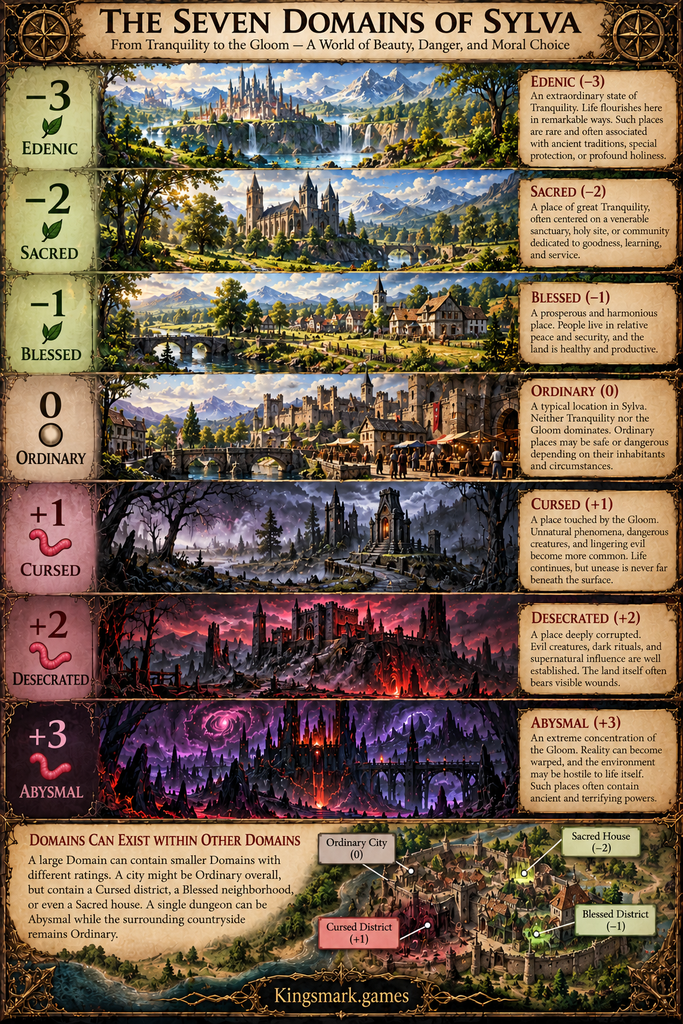
This idea is expressed through Kingsmark’s ⚖️Domain system, explained in Chapter 16 of the Player’s Handbook. Every Domain represents a defined location possessing a particular degree of spiritual Tranquility or Gloom. Domains can encompass entire kingdoms, individual villages, forests, castles, streets, houses, or even single rooms.
The ratings extend from 🌿Edenic −3, 🌿Sacred −2, and 🌿Blessed −1 through Ordinary 0, followed by 🪱Cursed +1, 🪱Desecrated +2, and 🪱Abysmal +3. These ratings describe the spiritual condition of a place and help the GM understand its atmosphere, inhabitants, supernatural influences, and plausible dangers. They do not automatically function as bonuses or penalties to ordinary Tests.
An 🌿Edenic Domain represents an extraordinary concentration of Tranquility, while a 🌿Sacred Domain might encompass an ancient sanctuary where generations of righteous conduct and devotion have established lasting spiritual protection. A 🌿Blessed village may enjoy an unusually healthy and harmonious environment without being entirely free from ordinary misfortune. These places provide examples of the goodness that exists within Sylva and the kinds of communities that its heroes may wish to preserve.
Most of the world remains Ordinary, meaning that neither Tranquility nor the Gloom dominates the surrounding environment. An Ordinary forest might contain bandits, dangerous animals, or even a cruel human ruler without becoming supernaturally Cursed. Human beings remain responsible for their conduct regardless of whether supernatural forces are influencing the location.
The 🪱Gloom becomes increasingly apparent as a Domain moves through Cursed, Desecrated, and Abysmal conditions. Travelers entering a Cursed forest may encounter unsettling warnings, unexplained disappearances, strange behavior among animals, or occasional supernatural disturbances. Within a Desecrated Domain, monsters and supernatural corruption may become established features of the environment rather than uncertain rumors.
An 🪱Abysmal Domain represents the most extreme concentration of supernatural evil. Such a place might contain an ancient subterranean kingdom ruled by something horrifying, a forgotten stronghold whose inhabitants practice terrible rituals, or a region where the surrounding environment has become profoundly hostile to ordinary life. The exact manifestations depend upon the location, its history, and the creatures or supernatural forces inhabiting it.
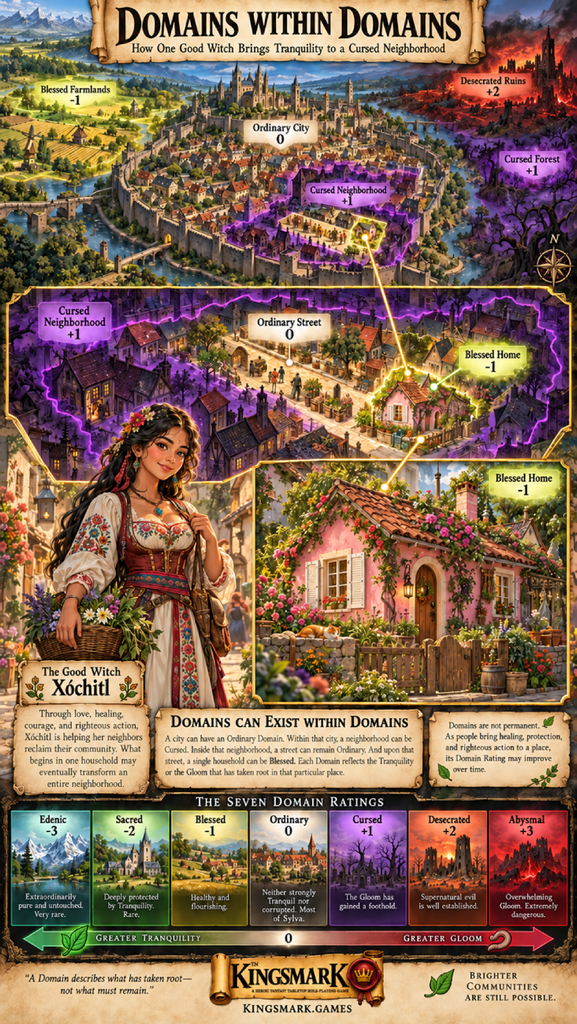
Domains can exist within larger Domains possessing different ratings. An Ordinary city might contain a Cursed neighborhood, while a single 🌿Blessed household survives within that neighborhood. Likewise, a ruined monastery surrounded by Desecrated wilderness could conceal an Abysmal dungeon far beneath its foundations.
This creates interesting possibilities for adventure design because the world does not need to be divided into simplistic geographical territories labeled good and evil. A place of remarkable goodness might endure in the middle of a corrupted region, while a prosperous kingdom might conceal terrifying supernatural horrors beneath its most respectable institutions. Adventurers may discover that preserving a tiny sanctuary is every bit as important as defeating a powerful monster.
The Gloom also interacts with the moral decisions made by characters. Kingsmark provides a supernatural path through which someone may deliberately 🍎Respond to the Gloom, accept a Temptation, and ultimately make a Soul Offering. This establishes a Gloom Pact involving the sacrifice of 🕊️Favor and access to ❌Forbidden Magic, with consequences for the character’s relationship to beneficial supernatural powers.
Importantly, this allegiance is a deliberate decision rather than an automatic punishment assigned whenever a character commits an ordinary wrongdoing. The Player’s Handbook also recognizes ↩️Teshuvah, through which a character can genuinely reject the Gloom and return to the side of good. The possibility of repentance exists precisely because human moral choices remain meaningful.
This is what makes the Gloom more interesting than a generic collection of evil monsters. It gives supernatural consequences to a world already populated by morally responsible beings capable of choosing what they will do. Ordinary wickedness can create opportunities for corruption, while the spread of corruption may produce dangers that exceed anything ordinary human beings can accomplish alone.
A group of adventurers may never fully understand the great spiritual struggle occurring throughout Sylva. They might simply accept a Contract to investigate disappearances, rescue prisoners, protect a caravan, destroy a dangerous creature, or investigate a haunted ruin. Nevertheless, their actions can contribute to the larger struggle by protecting people and denying supernatural evil another opportunity to spread.
Sometimes the Monsters Must Be Destroyed
I enjoy role-playing games that allow players to negotiate, investigate, persuade, retreat, form alliances, and solve problems without automatically resorting to violence. Those possibilities are important in Kingsmark, particularly because its 🗨️Dialog Scenes and ▶️Action Scenes encourage players to approach situations according to their characters’ abilities, personalities, and circumstances. A group that survives through intelligence and diplomacy can be every bit as impressive as one that defeats an enemy through extraordinary combat.
But there is something I fundamentally reject about the idea that every intelligent adversary can be reasoned with. Some enemies are not interested in peace, reconciliation, or mutual understanding. They may possess extraordinary intelligence and recognize precisely what you are asking of them, yet remain determined to continue doing wicked things.
This is particularly important when confronting Kingsmark’s Goblinoids and other thoroughly malevolent supernatural creatures. An Orc warlord who maintains a dungeon filled with tortured captives is not necessarily waiting for someone to explain that suffering is unpleasant. He may understand that suffering perfectly well, recognize the opportunities available for changing his behavior, and deliberately reject them.
Of course, intelligent enemies can still retreat, bargain, surrender, or cooperate when doing so serves their interests. The fact that an Orc is wholly evil does not require it to become a mindless berserker who fights until destroyed. Indeed, a calculating enemy capable of strategic restraint can be considerably more frightening than one that attacks everything indiscriminately.
The essential difference is that a negotiated agreement does not automatically represent moral transformation. An evil creature might spare a prisoner because the prisoner possesses useful information, abandon an attack because its forces are outnumbered, or honor a bargain because breaking it would threaten future opportunities. These are tactical decisions, not necessarily expressions of compassion.
Sometimes the appropriate response is escape, imprisonment, containment, or an agreement that prevents further violence. In other circumstances, particularly when a dangerous supernatural creature continues attacking innocent people and no safer means can stop it, the heroes may have to destroy the threat. The fantasy is not obligated to pretend that every confrontation possesses a peaceful solution.
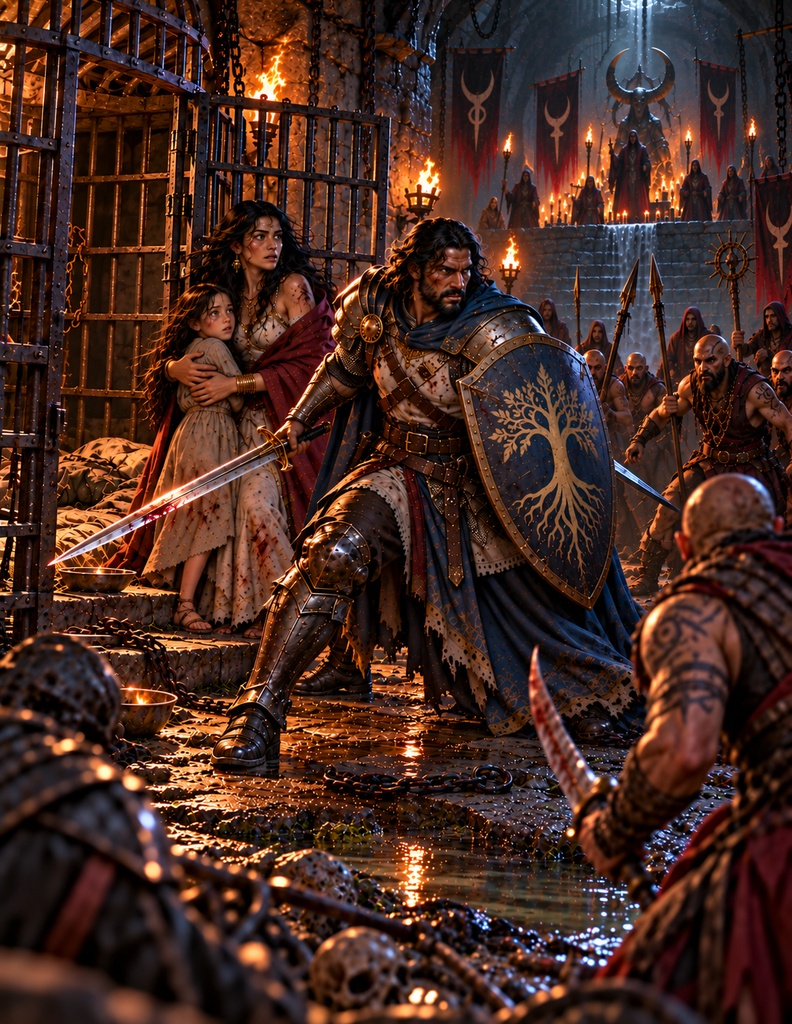
And yes, I want players to enjoy defeating genuinely monstrous enemies. When a Goblin murderer, a predatory demon, a sadistic Orc warlord, or some horrifying supernatural creature has been terrorizing innocent people, finally destroying it can be extraordinarily satisfying. The battle can be cinematic, violent, dramatic, and even exhilarating—because the players understand precisely what their characters are fighting to stop.
That satisfaction is not the same as celebrating real human suffering. We can enjoy a terrifying fictional monster being hacked to pieces in a climactic battle without believing that real prisoners, wounded enemies, or helpless human beings should be treated cruelly. Fantasy gives us the opportunity to dramatize moral conflicts through creatures and circumstances that do not correspond neatly to ordinary human life.
The emotional climax should also extend beyond the monster’s destruction. Consider the imprisoned villagers who emerge into daylight, the exhausted parents reunited with their missing children, and the frightened community discovering that the terrible thing haunting its countryside will never return. Their relief and happiness provide a much stronger reason to celebrate than the mere accumulation of defeated enemies.
I want those consequences to become visible during play. The village that once locked its doors before sunset might eventually host a festival, and the children who were forbidden to leave their homes might once again play outside. Perhaps the heroes return months later and discover that a formerly abandoned road now carries merchants, pilgrims, farmers, and travelers going about their ordinary lives.
That’s what makes a victory worth celebrating. The adventurers did not merely kill a monster; they made the world a better place.
Heroic Fantasy for Mature Players
The tagline for Kingsmark is “A Heroic Fantasy TTRPG for Mature Players.” I chose that language deliberately because I want the game to explore subject matter that deserves adult consideration. Violence, romance, sexuality, sacrifice, injustice, supernatural corruption, psychological trauma, and difficult moral choices can all have legitimate places in an ambitious fantasy campaign.
Mature storytelling does not mean filling every adventure with brutality or attempting to shock players with the most disgusting material imaginable. It means recognizing that serious subjects exist and allowing them to matter when appropriate to the story. A frightening dungeon becomes more meaningful when the GM understands what makes it frightening, rather than relying upon gratuitous descriptions of suffering.
It also means that players and Game Masters should communicate about the experiences they want to create together. A group interested in political intrigue, wilderness exploration, romance, heroic warfare, supernatural horror, or morally complicated investigations may approach Kingsmark very differently from another group. Mature players can discuss those expectations and establish reasonable boundaries without requiring the fictional world itself to become harmless.
I also want a great deal of beauty in Kingsmark. I love the warmth and humor of The Princess Bride, the adventurous spirit of Willow, the friendships and sacrifices of The Lord of the Rings, and the strange wonder found in The Dark Crystal. A fantasy world containing extraordinary evil becomes considerably more meaningful when it also contains people, places, relationships, and experiences worth protecting.
The same principle applies to character development. In Beyond the Character Sheet, I discuss how characters can become more than collections of Attributes, Skills, and mechanical abilities. Their decisions, relationships, ambitions, and experiences help establish who they are and what they may eventually become.
A character who has confronted terrible evil may come away with a greater appreciation for ordinary life. Perhaps the adventurer once cared only about wealth and glory but eventually discovers that protecting a small village provides a deeper sense of accomplishment. Another character might become disillusioned, hardened, spiritually troubled, or determined to confront increasingly dangerous threats.
These possibilities become particularly interesting when we remember that tabletop role-playing can also be educational. A 2026 scoping review of research into tabletop roleplaying and adult learning examined sixteen empirical studies and found promising evidence involving collaboration, communication, empathy, and leadership. The research has limitations, but it supports the idea that participating in shared fictional experiences can encourage meaningful learning and reflection.
My ambitions for Kingsmark extend into history, geography, languages, mythology, philosophy, and cultural exploration. Someone preparing a medieval adventure might investigate historical fortifications, discover the origins of an unfamiliar weapon, learn a little Biblical Hebrew, or research an actual civilization whose history inspires part of the fictional world. A player might decide to portray a character who speaks Spanish or Japanese and use the experience as an excuse to begin learning that language.
I’ve discussed the importance of meaningful creative choices in Building Kingsmark from the Ground Up and the relationship between simplicity and mechanical depth in Early RPG Simplicity or Modern TTRPG Complexity?. My intention is not to make Kingsmark an unnecessarily complicated intellectual exercise, but to create a game whose systems and fictional world reward curiosity, judgment, preparation, and imagination. Players should be able to enjoy an exciting adventure while occasionally discovering something worth thinking about afterward.
The world of Sylva is enormous, and its inhabitants possess ambitions that extend far beyond whatever happens to concern the adventuring party. Its kingdoms, wildernesses, cities, ruins, and supernatural territories provide opportunities for countless kinds of stories. Some will be lighthearted, some romantic, some deeply mysterious, and others genuinely horrifying.
I often return in my imagination to that boy playing HeroQuest, opening another dungeon door and wondering what might be waiting on the other side. At the time, I was fascinated by the monsters, treasures, hidden passages, and possibilities of adventure. Today, I find myself thinking just as much about the people whose lives might depend upon whether those adventurers survive.
The 🪱Gloom exists because evil must possess real meaning within Kingsmark. Its monsters are frightening because of what they can do to the world, and its heroes are admirable because of what they are willing to confront. The darkness makes the journey dangerous, but the people, places, and lives worth protecting are what make that journey heroic.
And sometimes, after descending into the most terrible depths imaginable, defeating some unspeakably wicked creature, and finally dragging its prisoners back into the sunlight, the heroes deserve to celebrate.
Because the world really is a better place with that particular monster gone.
Welcome to 👑Kingsmark—A Heroic Fantasy TTRPG for Mature Players.
Explore the complete Kingsmark Player’s Handbook and the world of Sylva at Kingsmark.games.
About The Author