💀The Twelve Horrors that can Shatter Your Mind🧠
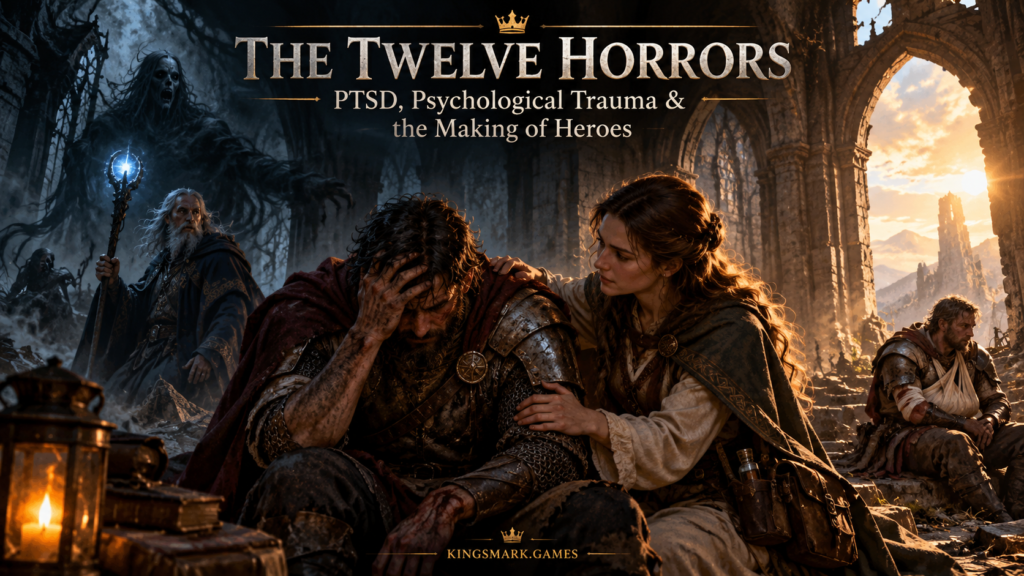
PTSD, Psychological Trauma & the Making of Heroes
How Kingsmark Game Masters Can Turn Psychological Trauma into Powerful Stories of Courage, Recovery, and Transformation
The Dungeon Doesn’t End When You Leave It
Four adventurers emerge from a ruined monastery after surviving a terrible encounter. The Man-at-Arms has a broken arm, the Healer is exhausted from tending to the wounded, and the Wizard has witnessed something that fundamentally challenges his understanding of reality. Their enemy is defeated, their mission is accomplished, and the survivors return home. Yet months later, the Wizard still cannot sleep without a candle burning, and he refuses to enter a room whose corners he cannot clearly see.
In a conventional fantasy adventure, this might be where the Game Master tells everyone to rest, restore their Hit Points, recover their abilities, and prepare for the next dungeon. Perhaps the party visits a tavern, sells its treasure, purchases better equipment, and finds another dangerous assignment. The Wizard watched an abomination crawl out of a dead man’s body and heard it speak in his mother’s voice, but apparently a good night’s sleep and a hearty breakfast were enough to put that behind him.
I have always found that approach rather unsatisfying.
When I designed 👑Kingsmark, I wanted a tabletop role-playing game capable of supporting adventures with the depth, emotional consequences, and character development found in great literature and cinema. The objective wasn’t simply to make combat more dangerous or to introduce another collection of penalties. I wanted a system in which characters could experience extraordinary events and emerge as believable people whose personalities, relationships, convictions, and decisions had been shaped by what happened.
That’s why Kingsmark includes the Twelve Horrors, a system for representing psychologically overwhelming experiences and their potential consequences. The rules distinguish between Mental Trauma that can recover through ❤️Healing Scenes and Permanent Psychological Conditions that may require substantial character development to overcome.
Defeating a monster can take a few minutes. Learning to live with what that monster did to you might become the story of an entire campaign.
Why Psychological Trauma Makes Better Characters
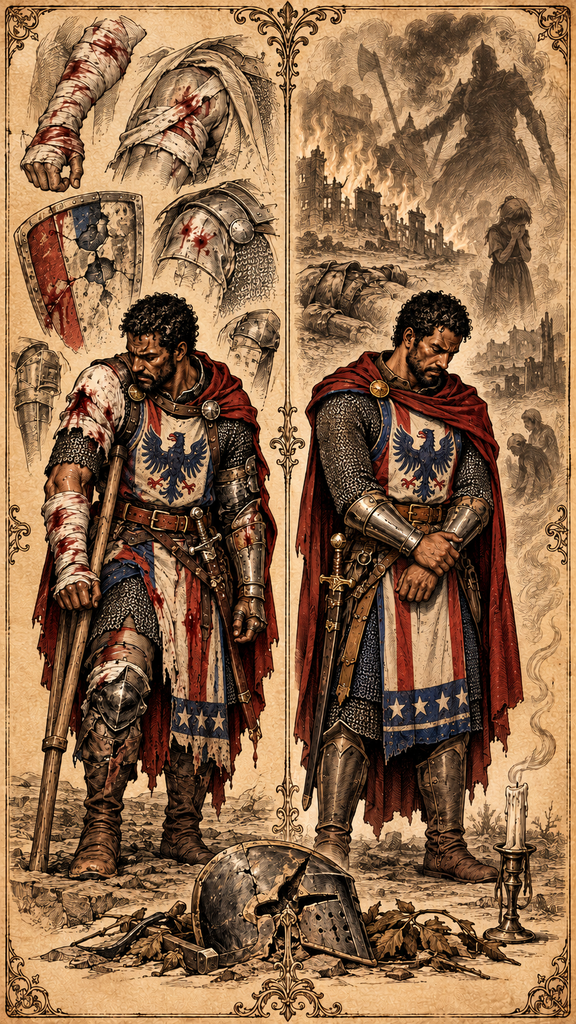
Consider the fictional characters who have remained memorable long after their stories ended. Their physical abilities and impressive accomplishments certainly contribute to their appeal, but their fears, regrets, loyalties, sacrifices, and personal struggles often make them unforgettable. A hero who can defeat every opponent but cannot forgive himself for a terrible mistake may be considerably more interesting than someone whose only ambition is acquiring another magical weapon.
Real people carry psychological baggage. Experiences shape how they interpret danger, decide whom to trust, express affection, confront injustice, and understand their own identities. Some experiences make people more confident or compassionate, while others produce anxiety, bitterness, distrust, or an overwhelming sense of responsibility. Many people experience several of these changes simultaneously.
For real-world comparisons, consider soldiers, firefighters, police officers, paramedics, emergency physicians, and disaster-response workers. These professionals regularly encounter situations resembling the responsibilities of fantasy adventurers: protecting civilians, confronting dangerous individuals, treating catastrophic injuries, witnessing death, and making difficult decisions under pressure. Professional training may help them function during emergencies, but the psychological consequences of their experiences can continue long afterward.
The same principles can enrich virtually every Kingsmark Character Class. A Holy Knight may struggle with guilt after obeying an unjust command, a Healer may be devastated by failing to save a child, and a Monster Hunter may discover that the creatures he has been killing possess a degree of intelligence and emotional complexity he never suspected. A Priest might experience a profound spiritual crisis, while a Thief who has survived years of betrayal may find genuine friendship more frightening than confronting an armed guard.
These experiences give the Game Master opportunities to create adventures that challenge the character’s inner life as well as their physical abilities. Importantly, such stories need not always be grim or tragic. Friendship, romance, humor, reconciliation, forgiveness, spiritual discovery, and triumphant personal growth can be just as important as suffering.
PTSD: When Danger Continues After the Danger Is Gone
Post-Traumatic Stress Disorder, commonly called PTSD, provides an important real-world foundation for understanding certain psychological consequences of extraordinary experiences. PTSD can develop after someone experiences or witnesses a traumatic event, particularly when the experience involves actual or threatened death, serious injury, or sexual violence. Not everyone exposed to trauma develops PTSD, and people can experience significant distress without meeting the diagnostic criteria for the disorder.
According to the National Institute of Mental Health, PTSD involves four principal categories of symptoms: intrusive memories, avoidance, heightened arousal or reactivity, and negative changes in thoughts or mood. These symptoms can include recurring nightmares, unwanted memories, difficulty sleeping, persistent vigilance, emotional withdrawal, exaggerated guilt, and avoidance of situations associated with the original experience. PTSD symptoms persist for more than a month and interfere significantly with everyday functioning.
Imagine a veteran Man-at-Arms who returns from a campaign after witnessing several companions die in an ambush. He becomes uncomfortable sitting with his back toward a doorway, reacts defensively when someone approaches unexpectedly, and repeatedly checks that his weapons are within reach. His wife notices that he has become increasingly distant, while his children cannot understand why their father sometimes becomes angry at harmless noises.
None of these reactions requires another battle to become relevant to the story. A family dinner, a crowded marketplace, a romantic encounter, or an apparently innocent misunderstanding might reveal how deeply the experience affected him.
Other survivors experience more extensive disturbances following prolonged suffering. The World Health Organization’s ICD-11 recognizes Complex PTSD, which includes additional difficulties involving emotional regulation, relationships, and self-perception. This is particularly relevant when imagining characters who have survived prolonged captivity, repeated torture, or sustained interpersonal abuse.
Kingsmark’s 🧠Mental Trauma rules are not intended to reproduce clinical diagnoses. They provide a dramatic framework through which the consequences of disturbing experiences can become part of a character’s continuing story. Understanding real psychological phenomena helps Players and Game Masters portray those consequences with greater imagination, consistency, and realism.
Beyond PTSD: Moral Injury and Spiritual Crisis
Not every psychological wound originates in fear. Some of the most devastating experiences involve guilt, betrayal, shame, responsibility, or discovering that one’s understanding of right and wrong can no longer adequately explain what has happened. These experiences are especially important for stories involving soldiers, religious figures, Healers, leaders, and people whose identities depend upon strong moral convictions.
Researchers use the term moral injury to describe lasting psychological, spiritual, and social consequences associated with actions or events that profoundly violate a person’s moral beliefs. The U.S. Department of Veterans Affairs identifies experiences such as perpetrating, witnessing, or failing to prevent morally troubling events, as well as betrayal by trusted authorities, as potential sources of moral injury. Such experiences may overlap with PTSD, but they are not the same phenomenon.
Consider a Holy Knight who participates in an attack against a village after receiving orders from a respected religious leader. Later, he discovers that the accusations against the villagers were fabricated and that innocent people died because he failed to question his commander. His suffering may have less to do with fear of battle than with the recognition that he participated in something fundamentally contrary to his principles.
What could restore his sense of honor? Would confessing his actions bring relief, or would it simply expose him to punishment and disgrace? Could he make meaningful restitution to the surviving families, and what would he do if forgiveness were never offered?
These are powerful storytelling questions because they cannot be answered merely by defeating another enemy. They involve conscience, personal responsibility, reconciliation, and the difficult process of deciding what kind of person one intends to become.
Spiritual experiences present equally interesting possibilities. A real-world religious practitioner may encounter something interpreted as supernatural, while another person may experience an event that challenges previously unquestioned beliefs about divine protection, death, evil, or the afterlife. In Kingsmark’s world of Sylva, where supernatural entities and magical phenomena are genuine aspects of reality, these questions can become even more complicated.
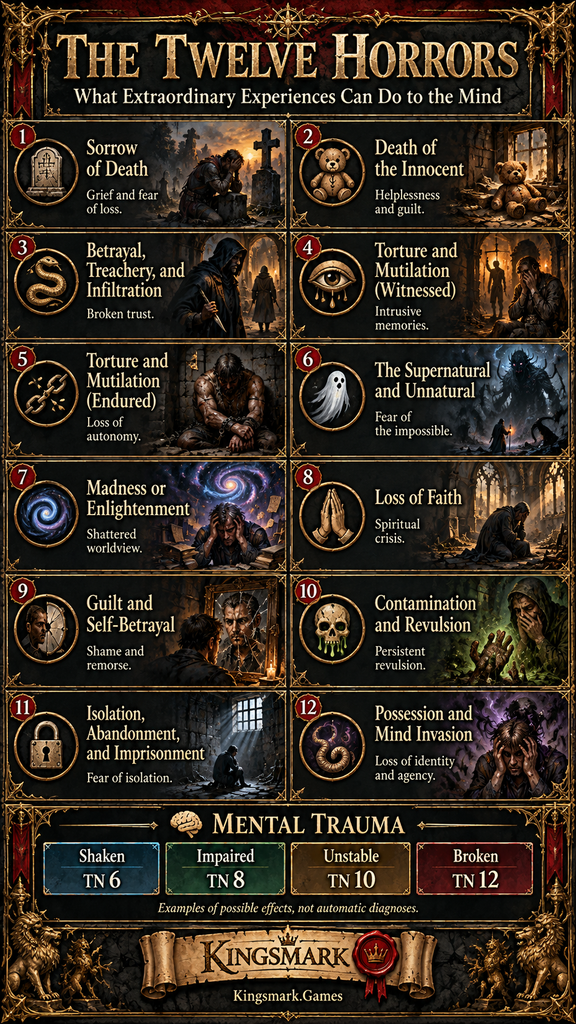
How the Twelve Horrors Work in Kingsmark
Kingsmark replaces conventional Hit Points with systems for tracking 🩸Physical Trauma and 🧠Mental Trauma. Psychological injury is recorded on the character’s Medical Record, while experiences involving the Twelve Horrors contribute to the history of what the character has endured. The relevant mechanics appear in Chapter 13 — 💥Damage & Defense, with recovery procedures explained in Chapter 14 — ❤️Healing Scenes.
When an event threatens Mental Trauma, the Game Master judges its severity. The four established levels are 🧠Shaken (TN 6), 🧠Impaired (TN 8), 🧠Unstable (TN 10), and 💀Broken (TN 12). The threatened character rolls 1d12 + 🌈Mental Performance PRISM, applying other relevant modifiers according to the ordinary rules.
Meeting the Target Number reduces the threatened Trauma by one Damage Level, while each point above the Target Number reduces it by another Level. A sufficiently successful resistance Test can eliminate the threatened Trauma entirely. Failing the Test means the character suffers the original threatened Trauma Level.
The Twelve Horrors introduce two particularly significant long-term possibilities. Characters who successfully withstand three separate qualifying experiences belonging to the same Horror can earn the corresponding 🏅Immunity Badge. This represents psychological hardening: the character may continue to experience grief, disgust, or moral outrage, but that category of Horror no longer inflicts Mental Trauma.
There is another possible outcome. A character who suffers 🧠Unstable or 💀Broken Trauma from a Horror before earning its Immunity Badge develops a Permanent Psychological Condition associated with the experience. The character can no longer earn ordinary immunity to that category simply by accumulating three subsequent exposures, and ordinary Healing Scenes cannot automatically remove the lasting condition.
This distinction is central to the design. A character may eventually recover from active Mental Trauma while continuing to experience nightmares, damaged relationships, persistent fears, guilt, or altered beliefs. Resolving those lasting psychological consequences becomes a matter of meaningful character development rather than merely allowing enough days to pass.
Twelve Horrors, Twelve Opportunities for Character Development
The official Twelve Horrors describe different categories of psychological experiences, ranging from grief and betrayal to supernatural revelations and the violation of personal identity. Each can inspire adventures that involve much more than surviving the original danger. The following examples illustrate possible Permanent Psychological Conditions and meaningful ways a character’s story might develop toward recovery.
🪦 Sorrow of Death
A seasoned Man-at-Arms witnesses the death of his closest companion and subsequently refuses to form meaningful relationships with anyone. He insists that emotional attachment is a weakness because everyone he loves will eventually be taken from him. His recovery might involve mourning openly, supporting another grieving person, or gradually developing a new relationship despite knowing that loss will always remain possible. The essential transformation occurs when he discovers that accepting the possibility of grief is part of accepting love and companionship.
🧸 Death of the Innocent
A Holy Knight fails to rescue several children during an attack and becomes consumed by the belief that their deaths were entirely his responsibility. She begins accepting increasingly dangerous assignments, convinced that saving enough people might somehow compensate for those she lost. A meaningful character arc could involve rebuilding the devastated community, developing relationships with surviving families, and recognizing the difference between genuine responsibility and impossible expectations. Her greatest achievement might be learning to protect others without sacrificing her own humanity to an endless pursuit of redemption.
🐍 Betrayal, Treachery, and Infiltration
A Ranger discovers that a trusted companion secretly provided information to an enemy, resulting in the capture of several friends. He becomes suspicious of every new acquaintance, interprets harmless mistakes as signs of treachery, and repeatedly sabotages promising relationships. His recovery might unfold through cooperation with trustworthy allies, gradually accepting reasonable risks, and learning that discernment is different from universal distrust. The Game Master could make his most difficult decision one in which trusting another person is necessary to save someone he cares about.
Torture and Mutilation (Witnessed)
A Healer is forced to witness prisoners being tortured and remains haunted by memories of their suffering. She develops an overwhelming need to intervene whenever someone appears helpless, sometimes placing herself and others in unnecessary danger. Her story might involve treating survivors, investigating those responsible, providing testimony, or establishing a refuge where former prisoners can receive care. Through these experiences, she may begin replacing a sense of helplessness with a renewed appreciation for what her knowledge and compassion can accomplish.
⛓️ Torture and Mutilation (Endured)
A former prisoner escapes after months of brutal interrogation but cannot tolerate confinement, restraint, or circumstances in which someone else controls his movements. Even ordinary medical examinations or sleeping behind a locked door provoke intense distress. His recovery could involve rebuilding trustworthy relationships, learning to establish personal boundaries, receiving appropriate care, and gradually experiencing situations in which he retains meaningful control over his decisions. The defining achievement is not learning to endure further torture, but recovering a sense of personal autonomy that his captors attempted to destroy.
👻 The Supernatural and Unnatural
A Wizard encounters an entity that appears to violate every known principle of nature. Although he survives, he begins questioning his senses, refusing to investigate unfamiliar magical phenomena, and obsessively checking his surroundings for signs of the creature’s return. Research into the entity, discussions with knowledgeable mentors, supportive companionship, and carefully chosen encounters might help him regain confidence. His eventual willingness to investigate another supernatural danger could demonstrate that he has learned to live with uncertainty without allowing it to govern every decision.
🌀 Madness or Enlightenment
A scholar discovers evidence that the world is profoundly different from everything she has previously believed. The revelation undermines her understanding of history, morality, existence, and her own place within creation. Rather than merely becoming frightened of strange knowledge, she might experience an extended existential crisis in which ordinary ambitions and relationships lose their meaning. Her recovery could involve further scholarship, philosophical dialogue, contemplation, spiritual experiences, and the difficult construction of a worldview capable of incorporating what she has discovered.
🙏 Loss of Faith
A Priest survives a catastrophe during which countless innocent people suffer despite his fervent prayers for divine intervention. He begins questioning whether the divine powers he serves are benevolent, indifferent, absent, or fundamentally misunderstood. His story could involve examining religious teachings, encountering competing theological traditions, helping people whose convictions differ from his own, and confronting the question of whether moral responsibility depends upon supernatural reassurance. His eventual transformation might involve renewed faith, substantially altered beliefs, or discovering that compassion and purpose remain possible even after abandoning former certainties.
🪞 Guilt and Self-Betrayal
A Man-at-Arms kills an innocent person after misinterpreting a dangerous situation. Although his companions insist that the mistake was understandable, he knows that someone died because of his decision. His recovery might involve confession, accepting proportionate accountability, assisting the victim’s family, and developing a greater commitment to restraint and careful judgment. Forgiveness may be offered or withheld, but genuine development becomes visible when he stops treating remorse as a substitute for responsible action.
🤢 Contamination and Revulsion
An adventurer survives an infestation involving grotesque parasites and becomes convinced that something remains inside his body. He repeatedly examines himself for signs of infection, avoids ordinary food, and refuses physical contact with companions who previously shared his closest friendships. Medical examination, reliable information, restorative care, and supported experiences with genuinely safe environments may help him regain confidence in his bodily health. In a world containing real supernatural corruption, the Game Master can also develop a mystery in which distinguishing an actual continuing threat from the psychological aftermath becomes essential.
🔒 Isolation, Abandonment, and Imprisonment
A Thief survives prolonged solitary confinement and becomes distressed whenever separated from other people. She struggles to sleep alone, fears being abandoned, and interprets ordinary departures as evidence that her companions intend never to return. Developing stable friendships, establishing reliable routines, and gradually experiencing periods of safe independence can become meaningful parts of her recovery. A particularly satisfying turning point might occur when she voluntarily undertakes a brief solitary mission while trusting that her companions will be waiting when she returns.
🪱 Possession and Mind Invasion
A character survives an encounter with a possessing entity associated with the 🪱Gloom but becomes uncertain whether his thoughts and desires still belong entirely to him. He fears that ordinary impulses are evidence of renewed supernatural influence, and he begins relying excessively upon others to decide whether his judgments can be trusted. Spiritual protection, investigation, trusted relationships, and evidence that the original invasion has ended may help restore confidence in his personal identity. His recovery becomes especially meaningful when he can once again make independent choices without surrendering his judgment to either fear or another person’s authority.
These twelve examples represent possible stories, not mandatory psychological reactions or new game mechanics. Two characters who experience the same Horror might respond very differently depending upon their personalities, histories, beliefs, relationships, and circumstances. The objective is to give Players and Game Masters enough concrete inspiration to develop believable consequences rather than reducing psychological suffering to an arbitrary label on a character sheet.
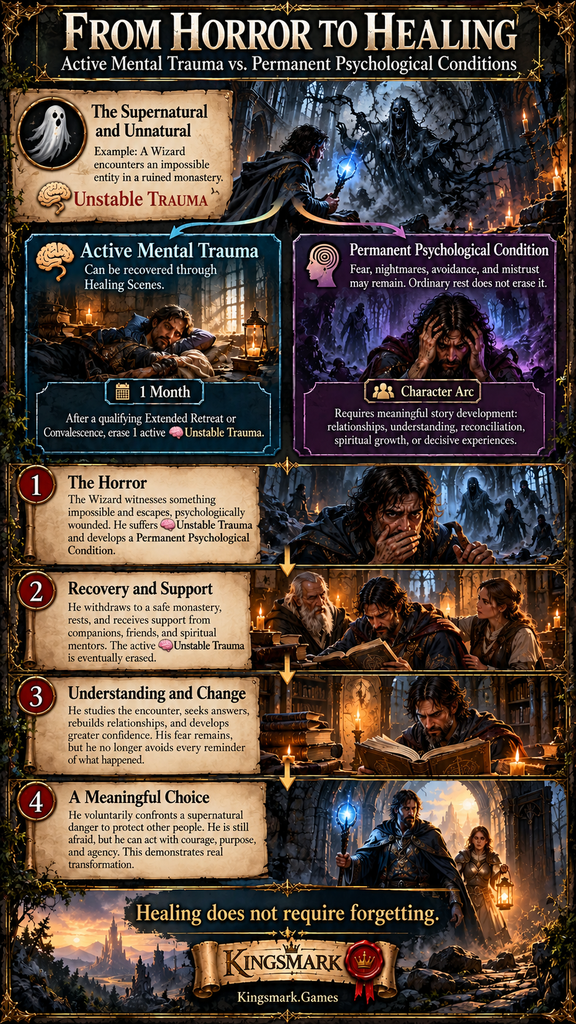
Healing Is a Story, Not a Reset Button
The official ❤️Healing Scenes provide several ways for characters to recover from active Mental Trauma. These include 🌼Friends & Confidants, 🥰Personal Comfort, 🥗Food & Grounding, 🧘Meditation or Prayer, restorative physical care, and longer periods of rest or convalescence. Each represents an actual experience within the story rather than an invisible mechanical adjustment.
A character suffering 🧠Shaken Trauma might recover through meaningful companionship or an appropriate period of rest. More serious conditions require greater recovery time, with 🏡Extended Retreat or Convalescence allowing one active 🧠Impaired Trauma to be erased after seven days, one 🧠Unstable Trauma after one month, and qualifying 💀Broken Trauma after three months following survival of R.A.D. — Roll Against Dissolution. These periods follow the requirements and limitations established in Chapter 14 — ❤️Healing Scenes.
However, a Permanent Psychological Condition is a separate matter. A character might spend several months recovering in a peaceful monastery, return physically healthy, and still avoid situations associated with a traumatic experience. The character’s immediate psychological crisis may have passed, while the deeper consequences remain unresolved.
Real-world PTSD treatment provides useful inspiration for understanding this distinction. The Department of Veterans Affairs identifies Cognitive Processing Therapy, Prolonged Exposure, and Eye Movement Desensitization and Reprocessing among the best-supported treatments for PTSD. These approaches help people process traumatic experiences, address distressing beliefs, and change their responses to traumatic memories and reminders.
Game Masters need not reproduce clinical treatment procedures to create believable recovery stories. Instead, they can develop opportunities for meaningful relationships, supportive environments, personal insight, accountability, and decisions that allow a character to demonstrate genuine change. An especially useful technique is to identify how a condition currently affects the character, establish what meaningful improvement would look like, and then allow subsequent adventures to provide opportunities for that improvement.
For example, a character who fears abandonment might gradually develop the ability to trust a companion who temporarily departs on an important mission. A character overwhelmed by guilt might begin making responsible decisions without treating every new failure as proof of personal worthlessness. A former prisoner might regain the confidence to enter enclosed spaces voluntarily, while a religious character might reach a more coherent understanding of faith after confronting previously unbearable questions.
Such changes need not occur in a predictable sequence, and dramatic setbacks may be appropriate when the story supports them. What matters is that the condition’s eventual resolution reflects the character’s actual experiences rather than an arbitrary declaration that enough time has passed.
A Complete Example: The Wizard Who Feared the Supernatural
Consider a Wizard named Matthias who accompanies several adventurers into an abandoned monastery. Deep beneath the ruins, the party encounters an entity whose appearance, behavior, and knowledge appear impossible according to everything Matthias understands about magic. During the encounter, the Game Master determines that the experience threatens 🧠Unstable Trauma from 👻The Supernatural and Unnatural, and Matthias fails the resistance Test.
Because Matthias has not earned the appropriate 🏅Immunity Badge, the experience also creates a Permanent Psychological Condition. The player and Game Master establish that Matthias becomes deeply suspicious of unfamiliar supernatural phenomena, suffers recurring nightmares, and avoids locations associated with the original encounter. His companions eventually persuade him to withdraw from adventuring and spend a month recovering in a peaceful monastery.
After completing the qualifying recovery period, Matthias erases one active 🧠Unstable Trauma according to the ordinary rules. Nevertheless, the Permanent Psychological Condition remains, and his return to adventuring is difficult. He refuses invitations to investigate magical mysteries, reacts anxiously when companions mention ghosts, and begins questioning whether his abilities are sufficient to protect anyone.
Over several adventures, Matthias studies the entity’s origins, consults experienced spiritual practitioners, and confides in a companion whom he gradually learns to trust. His understanding of the original encounter changes, although he continues to experience fear. Eventually, the party discovers that several villagers have disappeared inside another supposedly haunted building, and Matthias must decide whether to participate in the rescue.
He enters the building voluntarily, accompanied by people he trusts and equipped with knowledge he did not possess during the original encounter. The experience is frightening, but he remains capable of making deliberate decisions, protecting his companions, and applying his magical abilities effectively. When he returns, the player and Game Master can reasonably consider whether this achievement, together with the preceding development, represents a sufficient transformation to resolve or substantially change his Permanent Psychological Condition.
The distinction is that Matthias has not necessarily become immune to supernatural horror. He has recovered a measure of confidence, understanding, and personal agency that the original experience had taken from him.
Joseph Campbell, the Hero’s Journey, and the Return Home
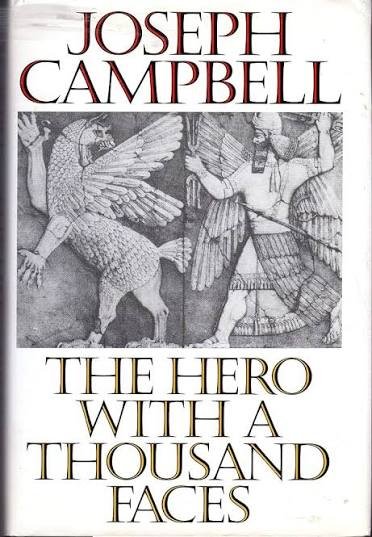
My interest in psychological storytelling also connects with the work of comparative mythologist Joseph Campbell, particularly his exploration of the Hero’s Journey in The Hero with a Thousand Faces. Campbell identified recurring patterns in mythological adventures involving separation from the familiar world, initiation through extraordinary trials, and eventual return. These patterns can be interpreted not only as physical journeys, but also as symbolic processes of personal transformation.
The dungeon is an especially powerful setting for this kind of storytelling. Whether it is an underground ruin, a haunted castle, a forbidden forest, a remote desert, or an apparently ordinary house concealing something terrible, the location can represent more than a geographical challenge. It may become a place where characters confront mortality, temptation, spiritual uncertainty, personal weakness, or aspects of themselves they would rather avoid.
The most interesting part of the journey is sometimes the return. What happens when a person who has encountered extraordinary evil must resume ordinary life? How does someone who has witnessed profound suffering relate to friends and family members who cannot fully understand what happened?
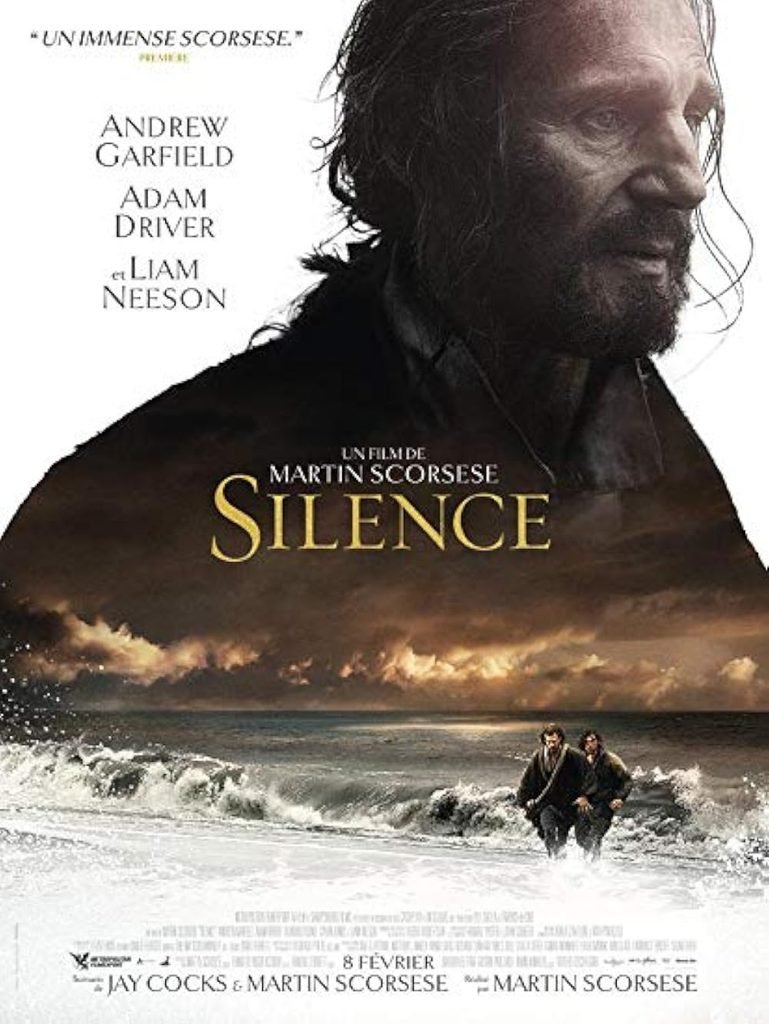
Martin Scorsese’s Silence (2016) offers a particularly powerful example of spiritual and moral conflict. Set in seventeenth-century Japan, the film follows Portuguese missionaries whose religious convictions are tested by persecution, suffering, and agonizing moral dilemmas. As discussed in the British Film Institute’s examination of the film, its deepest drama concerns faith, doubt, spiritual identity, and the difficult relationship between religious conviction and compassion.
The Lord of the Rings provides another remarkable example, particularly through Frodo Baggins. His mission succeeds, and the world is saved from a terrible evil, but his experiences leave him unable to return comfortably to the life he once knew. His story has even received scholarly examination through the framework of PTSD, including Bruce D. Leonard’s article, The Posttraumatic Stress Disorder of Frodo Baggins, published in Mythlore.
These stories demonstrate why personal transformation deserves attention alongside physical victory. A hero may overcome extraordinary dangers yet find that the greatest remaining challenge involves understanding what happened and discovering how to continue living afterward.
Why Kingsmark Takes a Different Approach
I came to tabletop role-playing games with considerable appreciation for Shadowrun and the kinds of cinematic action and consequential storytelling its mechanics can encourage. Different game systems naturally emphasize different aspects of an adventure, and those priorities influence what Players and Game Masters tend to notice. Kingsmark developed partly from my desire for a system that could support exciting action without treating injuries and psychological consequences as temporary inconveniences.
Consider the familiar Dungeons & Dragons approach. Under the 2024 D&D rules, losing Hit Points ordinarily does not diminish a creature’s abilities until those Hit Points reach zero, and a completed Long Rest restores all lost Hit Points. That abstraction supports the fast-moving heroic adventures for which the game is known.
It also produces some rather amusing possibilities when interpreted literally. An adventurer might be struck repeatedly by swords, survive an explosion, fall from a considerable height, and stagger out of a dungeon with barely any Hit Points remaining. After eight hours of rest, however, he may be completely restored and ready to repeat the experience.
Naturally, skilled Dungeon Masters can create excellent dramatic stories with D&D, but the mechanics themselves emphasize a particular rhythm of danger, recovery, and renewed adventure. Kingsmark takes a different approach by using specific 🩸Physical Wounds, 🧠Mental Trauma, and ❤️Healing Scenes to represent consequences that can remain relevant long after a battle ends.
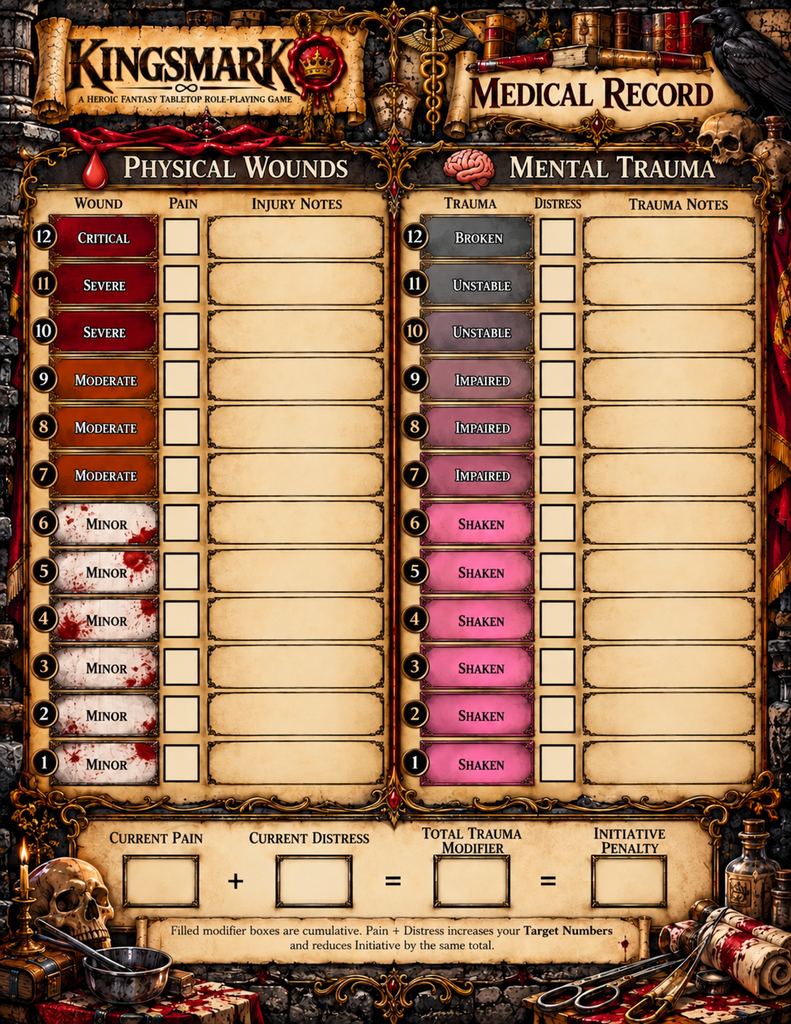
The intention is not to make every adventure an exercise in misery. I want Kingsmark to support courageous heroes, extraordinary victories, romance, humor, exploration, friendship, and the excitement of cinematic fantasy. But I also want a player’s decision to enter a haunted dungeon, confront a murderous enemy, or sacrifice something precious to have the potential for lasting significance.
A memorable adventure should give the characters something more substantial than another collection of coins and experience points.
Let Players Shape Their Own Recovery Stories
Psychological character development works best when the Player participates meaningfully in determining how the character responds to extraordinary experiences. The Game Master establishes the circumstances and applies the official rules, but the Player should have substantial influence over how the resulting psychological condition manifests through personality, behavior, relationships, and decisions. The objective is collaborative storytelling rather than forcing someone to portray a particular diagnosis or emotional reaction.
This is especially relevant when adventures involve torture, abuse, persecution, or other intensely disturbing subjects. A mature campaign can explore difficult material without requiring graphic descriptions or personally uncomfortable performances. The Game Master can establish the consequences of an event through implication, aftermath, testimony, and character reactions, allowing the story to remain serious without making every disturbing experience explicit.
A useful resource for establishing expectations is Consent in Gaming, published by Monte Cook Games. The underlying principle is straightforward: Players and Game Masters should understand what kinds of experiences belong in their shared story and how they want those experiences portrayed.
For Kingsmark, this also means that a recovery arc should offer genuine decisions rather than impose a predetermined emotional outcome. A character might reconcile with an enemy, reject reconciliation, renew religious commitments, change beliefs, find companionship, or choose a quieter life. The choices and their consequences should determine the story, rather than the Game Master deciding in advance what the character must become.
The Hero Who Returns Is Not the Hero Who Left
One of the most rewarding aspects of a long-running role-playing campaign is watching a character change over time. The inexperienced adventurer who accepts a first assignment at a local tavern may eventually become a respected warrior, a wise Healer, a deeply troubled veteran, a spiritual leader, or someone who decides that a peaceful life is worth more than another dangerous adventure. Their history should consist of more than improving ⚒Skills, acquiring equipment, and accumulating ⭐Experience Points.
Some characters will overcome their deepest fears, rebuild damaged relationships, discover renewed faith, or achieve reconciliation after terrible mistakes. Others will carry lasting psychological scars, and some may die before resolving the struggles that defined their lives. Within Sylva, where reincarnation is part of the world’s supernatural reality, questions of death, memory, and the continuity of existence can introduce still deeper possibilities for storytelling.
I designed the Twelve Horrors to help make those experiences possible within Kingsmark’s existing rules. They give Players and Game Masters opportunities to explore courage, grief, responsibility, betrayal, redemption, faith, love, and psychological recovery through the consequences of actual adventures. The goal is not merely to create characters who survive extraordinary dangers, but to create people whose lives are meaningfully changed by having faced them.
Sometimes the greatest victory in a heroic adventure isn’t defeating the monster waiting at the bottom of the dungeon. It’s discovering that the person who survived that encounter can still find the courage, wisdom, and hope to build a life worth living.
👑Kingsmark — A Heroic Fantasy TTRPG for Mature Players
Explore the complete First Edition Player’s Handbook, including the Twelve Horrors and ❤️Healing Scenes, at Kingsmark.Games.
About The Author