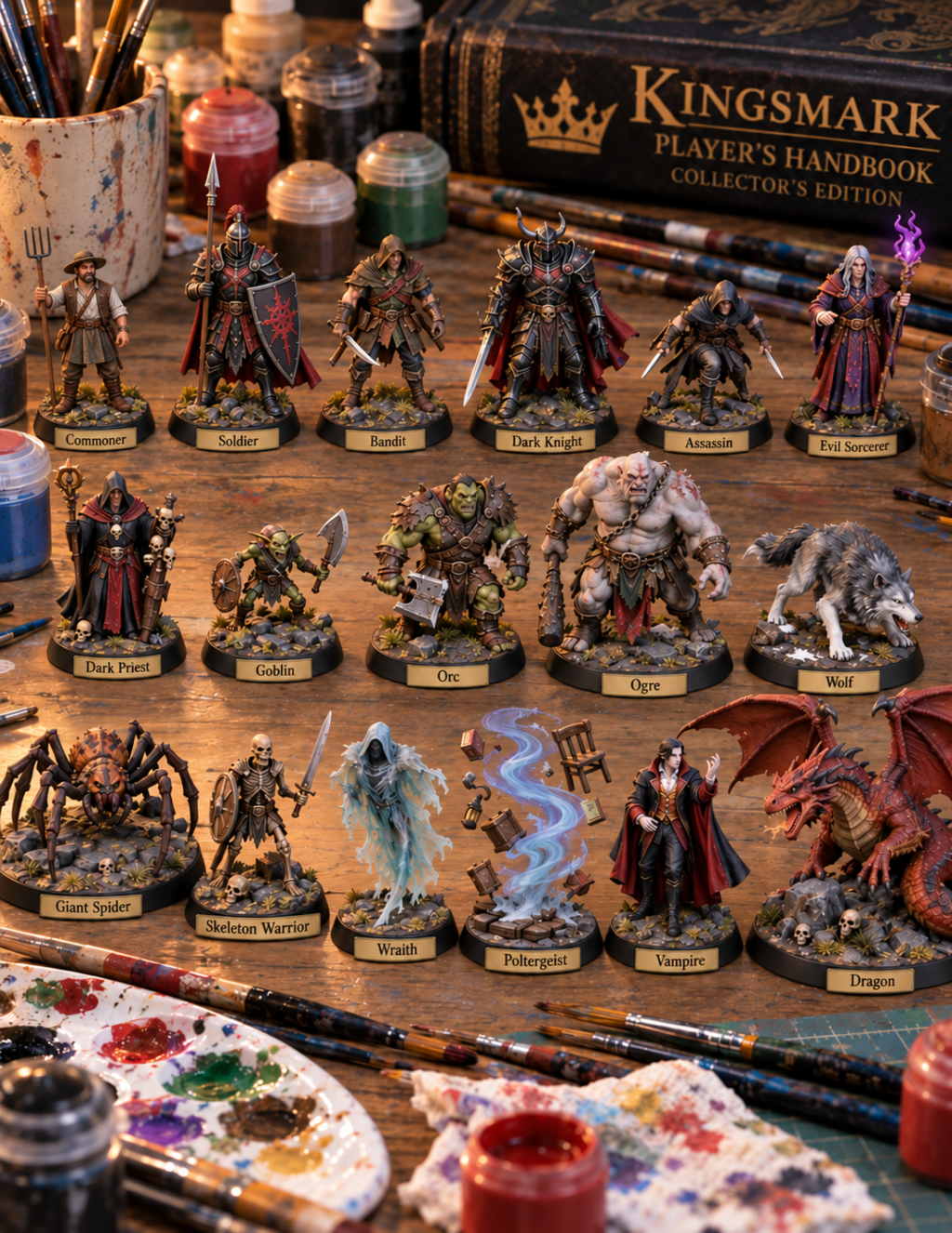
The following entries provide ready-to-use Non-Player Characters and creatures for the Game Master. They are included primarily as practical examples and “playtest dummies” for learning the rules, building adventures, and putting adventuring parties against a variety of human, monstrous, and supernatural opposition. This is not the complete collection of creatures found in Sylva. 🧌The Bestiary: Encyclopedia of Fantasy Monsters contains many more monsters, animals, supernatural beings, and other adversaries drawn from regions and cultures across the entire world. Appendix B provides a useful selection for immediate play and, just as importantly, demonstrates how NPCs and creatures are rated.
👹 TERROR RATING AND NPC LEVEL
Player Characters have Action Star Levels. NPCs and creatures use Terror Rating. For rules purposes, an NPC or creature’s Terror Rating is also its Level.
★ Level 1 — Intimidating
★★ Level 2 — Frightening
★★★ Level 3 — Terrifying
★★★★ Level 4 — Horrifying
★★★★★ Level 5 — Paralyzing
This means that a ★★★ creature is a Level 3 creature, while a ★★★★★ creature is a Level 5 creature.
This Level is especially important when an NPC or creature can use magic. A spellcasting NPC or creature may cast spells up to the Power Level permitted by its Terror Rating, just as a Player Character is limited by Action Star Level. Thus, a ★★★ Terrifying Evil Sorcerer, undead creature, or other supernatural spellcaster may possess and cast Power Level 3 spells. A ★★★★★ Paralyzing creature capable of magic may possess Power Level 3 spells.
Terror Rating also gives the Game Master a quick indication of the general magnitude of an adversary. It does not mean that every creature of the same Terror Rating is equally dangerous in every situation, nor does it guarantee a balanced encounter. Numbers, terrain, surprise, equipment, special abilities, resistances, preparation, and the circumstances of the Scene can radically change how dangerous an adversary actually becomes.
The ratings presented here describe representative examples. Individual Attributes, Skills, equipment, weapons, armor, behavior, and other characteristics may be changed whenever the story requires it. Some creatures also possess specialized Skills or abilities that do not appear among the Skills available to Player Characters. These represent natural, supernatural, or anatomical capabilities and are defined within the creature’s entry.
Appendix B is therefore both a collection of ready-to-use adversaries and a working introduction to the Level system used for the inhabitants and monsters of Sylva. For a much larger selection of creatures from across the world, consult 🧌The Bestiary.
👨 Commoner
★ INTIMIDATING • Human • Ordinary Domain
The Commoner represents an ordinary healthy adult: farmer, laborer, craftsman, tavern patron, merchant, servant, traveler, villager, or other person without specialized combat training. A Commoner is not helpless. An angry adult armed with a club, knife, farm implement, or other weapon can seriously injure or kill someone, particularly through surprise or superior numbers. The statistics below represent an ordinary adult male in reasonably good health. The Game Master may alter individual Attributes to represent age, sex, occupation, health, or unusual personal characteristics.
🎭 Playing a Commoner
A Commoner behaves like an ordinary person rather than a combatant. Most will avoid obviously lethal combat when escape, surrender, negotiation, hiding, or calling for help remains possible. A Commoner defending family, home, livelihood, or another deeply important interest may nevertheless fight with considerable determination. Surprise, anger, intoxication, desperation, mob behavior, or the belief that an opponent is vulnerable can also make an otherwise ordinary person unexpectedly dangerous. Commoners do not ordinarily fight to the death merely because combat has begun.
💪 Commoner’s Attributes
🌬 Spirit 0
Discipline 0
Intelligence 0
Perception 0
Wisdom 0
Charisma 0
Attractiveness 0
Strength 0
Stamina 0
Agility 0
Speed 0 (Action Points: 5) 🔵🔵🔵🔵🔵
Dexterity 0
⏳ Initiative: 1d12 + Reflexes 0 + Speed 0
🌈 Commoner’s Attribute PRISMs
🌈 Physical Performance 0
🌈 Reflexes 0
🌈 Influence & Allure 0
🌈 Spirituality 0
🌈 Mental Performance 0
🩸Commoner’s Pain Modifiers 🌈PPP 0
Box 1 [🩸Minor]
Box 2 [🩸Minor]
Box 3 [🩸Minor] +1 Pain / -1 Initiative
Box 4 [🩸Minor]
Box 5 [🩸Minor] +1 Pain / -1 Initiative
Box 6 [🩸Minor]
Box 7 [🩸Moderate] +1 Pain / -1 Initiative
Box 8 [🩸Moderate] +1 Pain / -1 Initiative
Box 9 [🩸Moderate] +1 Pain / -1 Initiative
Box 10 [🩸Severe] +2 Pain / -2 Initiative
Box 11 [🩸Severe] +2 Pain / -2 Initiative
Box 12 [💀Critical] R.A.D.💀
🧠Commoner’s Distress Modifiers 🌈MPP 0
Box 1 [🧠Shaken]
Box 2 [🧠Shaken]
Box 3 [🧠Shaken]
Box 4 [🧠Shaken]
Box 5 [🧠Shaken] +1 Distress / -1 Initiative
Box 6 [🧠Shaken]
Box 7 [🧠Impaired]
Box 8 [🧠Impaired] +1 Distress / -1 Initiative
Box 9 [🧠Impaired] +1 Distress / -1 Initiative
Box 10 [🧠Unstable] +1 Distress / -1 Initiative
Box 11 [🧠Unstable] +2 Distress / -2 Initiative
Box 12 [💀Broken] R.A.D.💀
🏃 Commoner’s Likelihood to Flee
High. A Commoner normally attempts to escape, surrender, hide, negotiate, or call for help once a confrontation becomes obviously life-threatening. Suffering a 🩸Moderate or worse Wound, seeing an ally seriously wounded or killed, becoming 🧠Impaired or worse, confronting obviously superior opposition, or witnessing a terrifying Power 2 or Power 3 supernatural manifestation may be enough to cause a Commoner to flee or surrender. A Commoner defending family, home, livelihood, or another deeply important interest may stand his ground considerably longer. These are guidelines for portraying an ordinary person rather than compulsory triggers.
⚒ Commoner’s Skills
No specialized Skills are assumed. A Commoner’s occupation may justify a relevant Skill of +1. A farmer might possess Survival +1 or Man Skills +1; a craftsman might possess Mechanisms +1; a merchant might possess Social Skills +1. When attempting something for which he has no genuine training, use the appropriate Skill at 0.
⚔️ Commoner’s Weapons
🔱 Pitchfork
Damage Type: 🗡️Blades & Spikes
Base Damage: 🩸Moderate
Critical Threshold: 10
Hands: Two
A sturdy agricultural pitchfork can be thrust like a crude spear, and its long tines are capable of causing deep penetrating wounds. It is not constructed or balanced as a dedicated weapon, however, and its tines, shaft, and fittings are less dependable in combat than those of a military spear.
🔨 Improvised Club / Blunt Object
Damage Type: 🪨Concussive
Base Damage: 🩸Minor
Critical Threshold: 12
Hands: One
This includes a heavy stick, table leg, crude cudgel, stout piece of firewood, or similar improvised striking object.
👊 Unarmed Strike
Damage Type: 🪨Concussive
Base Damage: determined normally by Strength 0
Critical Threshold: 18
Hands: One or Two, as appropriate
A Commoner may instead possess a knife, axe, pitchfork, hammer, sickle, or other ordinary tool. Use that weapon’s normal statistics.
🛡 Commoner’s Armor
None. Ordinary clothing provides no meaningful Armor Rating.
🎒 Commoner’s Equipment
Whatever ordinary clothing, tools, possessions, money, provisions, occupational equipment, and personal effects are appropriate to the individual.
⚔️ Commoner’s Tactics
A Commoner fights with whatever weapons or tools are available, relying on numbers, familiar terrain, and improvised defenses rather than combat training. When outmatched, he generally seeks escape, surrender, or assistance, although defending his family or home may drive him to fight with surprising determination.
⚔ Soldier
★★ FRIGHTENING • Human • Ordinary Domain
The Soldier represents a trained fighting man accustomed to weapons, armor, formations, discipline, violence, and functioning under dangerous conditions. He may be a professional guardsman, household soldier, experienced infantryman, mercenary, retainer, or similarly trained warrior. This is not a ceremonial watchman or an inexperienced levy. He knows how to fight. An untrained civilian should have very good reason before deliberately engaging him in violence. A single Soldier is rated ★★ Frightening. A disciplined group of soldiers can constitute a substantially greater encounter than the Terror Rating of any individual member.
🎭 Playing a Soldier
A Soldier fights deliberately. He seeks useful terrain, maintains his defense, protects nearby allies, uses cover against missiles, prevents enemies from easily passing him, and attempts to fight alongside other soldiers rather than scattering into isolated duels. He understands retreat, surrender, regrouping, protecting a superior, holding a doorway, covering another soldier, and withdrawing an injured ally. He does not normally fight to the death without a reason. A Soldier ordered to hold a strategically critical position may remain despite serious injury. A mercenary whose employer has fled may surrender. A town soldier facing an obviously supernatural creature may retreat and raise the alarm. A professional who realizes that continued resistance accomplishes nothing may yield rather than die pointlessly. His training makes him considerably harder to panic than an ordinary civilian in familiar forms of violence, but training does not make him immune to Mental Trauma, magic, or genuinely extraordinary terror.
💪 Soldier’s Attributes
🌬 Spirit 0
Discipline +2
Intelligence 0
Perception +1
Wisdom 0
Charisma 0
Attractiveness 0
Strength +2
Stamina +2
Agility +1
Speed 0 (Action Points: 5) 🔵🔵🔵🔵🔵
Dexterity +1
⏳ Initiative: 1d12 + Reflexes 0 + Speed 0
🌈 Soldier’s Attribute PRISMs
🌈 Physical Performance +1
🌈 Reflexes 0
🌈 Influence & Allure 0
🌈 Spirituality 0
🌈 Mental Performance +1
🩸 Soldier’s Pain Modifiers 🌈PPP +1
Box 1 [🩸Minor]
Box 2 [🩸Minor]
Box 3 [🩸Minor]
Box 4 [🩸Minor] +1 Pain / -1 Initiative
Box 5 [🩸Minor]
Box 6 [🩸Minor] +1 Pain / -1 Initiative
Box 7 [🩸Moderate]
Box 8 [🩸Moderate] +1 Pain / -1 Initiative
Box 9 [🩸Moderate] +1 Pain / -1 Initiative
Box 10 [🩸Severe] +1 Pain / -1 Initiative
Box 11 [🩸Severe] +2 Pain / -2 Initiative
Box 12 [💀Critical] R.A.D.💀
🧠 Soldier’s Distress Modifiers 🌈MPP +1
Box 1 [🧠Shaken]
Box 2 [🧠Shaken]
Box 3 [🧠Shaken]
Box 4 [🧠Shaken]
Box 5 [🧠Shaken]
Box 6 [🧠Shaken] +1 Distress / -1 Initiative
Box 7 [🧠Impaired]
Box 8 [🧠Impaired]
Box 9 [🧠Impaired] +1 Distress / -1 Initiative
Box 10 [🧠Unstable] +1 Distress / -1 Initiative
Box 11 [🧠Unstable] +1 Distress / -1 Initiative
Box 12 [💀Broken] R.A.D.💀
🏃 Soldier’s Likelihood to Flee
Moderate. A Soldier is used to bloodshed, injury, and battle and does not normally flee merely because combat turns violent. He is more likely to withdraw, surrender, or regroup after a 🩸Severe Wound, becoming 🧠Impaired or worse, losing nearby comrades, suffering a broken formation or failed command, becoming surrounded or clearly outmatched, or witnessing a terrifying Power 2 or 3 supernatural manifestation beyond his training. Orders, discipline, comradeship, duty, and what he is defending matter greatly. A Soldier protecting family, comrades, sovereign, fortress, or a critical position may fight on when another would withdraw. These are guidelines, not compulsory triggers.
⚒ Soldier’s Skills
Armed Combat +2
Shield Combat +2
Infantry Athletics +2
Unarmed Combat +1
Archery +1
Man Skills +1
⚔️ Soldier’s Weapons
⚔️ Shortsword
Damage Type: 🗡️Blades & Spikes
Base Damage: 🩸Moderate
Critical Threshold: 9
Hands: One
🗡️ Dagger
Damage Type: 🗡️Blades & Spikes
Base Damage: 🩸Moderate
Critical Threshold: 9
Hands: One
👊 Unarmed Strike
Damage Type: 🪨Concussive
Base Damage: determined normally by Strength +2
Hands: One or Two, as appropriate
🛡 Soldier’s Armor
🧥 Padded Armor / Gambeson
Layer: Foundation Armor
Hit Locations: 👕[10]Upper Torso, 👕[9]Lower Torso, Buttocks & Groin, 💪[8]Right Shoulder & Arm, 💪[7]Left Shoulder & Arm
Armor: 🧠Mental Trauma: 0, 🪨Concussive: -1, 🏹Projectiles: -1, 🗡️Blades & Spikes: -1, 🔥Fire: -1, ⚡Electric: 0, ❄️Cold: -1, 💨Sonic: 0, ☀️Light: 0, 🌑Darkness: 0, ☠️Chemicals & Poisons: -1, ✨Arcane/Psychic: 0
⛓️ Mail Hauberk
Layer: Main Armor
Hit Locations: 👕[10]Upper Torso, 👕[9]Lower Torso, Buttocks & Groin, 💪[8]Right Shoulder & Arm, 💪[7]Left Shoulder & Arm, 🦵[4]Right Leg (Upper Leg Only), 🦵[3]Left Leg (Upper Leg Only)
Armor: 🧠Mental Trauma: 0, 🪨Concussive: -1, 🏹Projectiles: -1, 🗡️Blades & Spikes: -2, 🔥Fire: 0, ⚡Electric: 0, ❄️Cold: 0, 💨Sonic: 0, ☀️Light: 0, 🌑Darkness: 0, ☠️Chemicals & Poisons: 0, ✨Arcane/Psychic: 0
🪖 Open Helmet
Layer: Additional Protection
Hit Locations: 👨[12]Head
Armor: 🧠Mental Trauma: 0, 🪨Concussive: -2, 🏹Projectiles: -2, 🗡️Blades & Spikes: -2, 🔥Fire: 0, ⚡Electric: 0, ❄️Cold: 0, 💨Sonic: 0, ☀️Light: 0, 🌑Darkness: 0, ☠️Chemicals & Poisons: 0, ✨Arcane/Psychic: 0
🛡️ Medium Shield
Armor: 🧠Mental Trauma: 0, 🪨Concussive: -2, 🏹Projectiles: -2, 🗡️Blades & Spikes: -2, 🔥Fire: -1, ⚡Electric: 0, ❄️Cold: -1, 💨Sonic: 0, ☀️Light: 0, 🌑Darkness: 0, ☠️Chemicals & Poisons: -1, ✨Arcane/Psychic: 0
Equipped: Left Hand Hands: One
Hit Locations: 👨[12]Head, 📿[11]Neck, 👕[10]Upper Torso, 👕[9]Lower Torso, Buttocks & Groin, 💪[8]Right Shoulder & Arm, 💪[7]Left Shoulder & Arm, ✋[6]Right Hand, 🤚[5]Left Hand, 🦵[4]Right Leg, 🦵[3]Left Leg
The Medium Shield provides protection according to the normal Shield Combat, Coverage, and opposite-side rules.
🎒 Soldier’s Equipment
Ordinary military clothing, Heavy cloak, and appropriate personal or campaign equipment.
⚔️ Soldier’s Tactics
A Soldier fights to control the ground, protect nearby allies, and achieve an objective, not to win a series of isolated duels. With Armed Combat +2, Shield Combat +2, and Infantry Athletics +2, he is proficient at holding a doorway, defending a narrow street, advancing beside another Soldier, or preventing an enemy from reaching a vulnerable companion. Strength +2 and Stamina +2 make him capable in close combat, while his gambeson, mail, helmet, and Medium Shield reward disciplined positioning.
The Soldier has Speed 0 and therefore receives 5 Action Points each Turn. A reliable sequence is 🟠🟠 Defensive Stance (2 AP), 🟠🟠 Unarmed or Melee Weapon Attack with his Shortsword (2 AP), and 🟡 Brief Utterance (1 AP) to warn an ally or issue a concise order. Defensive Stance grants 2 points of defensive Advantage until the beginning of his next Turn, so it is particularly useful when enemies must come through a doorway or fight him face-to-face. Alternatively, two 2-AP melee attacks leave 1 AP for a command or 🟡 Battle Cry. His Physical Battle Cry uses 🌈Physical Performance + Strength to threaten the enemy with 🧠Shaken Trauma. Against superior opposition, defense may be wiser than another strike.
Against a melee attack, he can use Shield Combat +2 for an appropriate Defense Roll; if his readied shield actually intercepts a hit, its applicable Armor Rating reduces Damage in addition to the protection of his worn armor. That protection depends on Coverage, the shield’s equipped side, and the direction of attack. Turn the shield toward the threat, guard exposed flanks, and avoid encirclement. Against arrows or bolts, use cover whenever possible, with Shield Combat available for a permitted ranged Defense Roll when he can see and intercept the attack.
The Soldier’s most useful battlefield advantage may be his ability to deny passage. Once per Combat Round, he may attempt one FREE Intercepting Action against an enemy whose movement genuinely crosses his threatened position. A Block can stop the enemy from passing, a Trip can knock him Prone, and a Grab can start a Grapple. An Intercepting Attack can cause Damage but does not automatically stop movement. Two Soldiers at a narrow entrance can protect each other and prevent enemies rushing through to a magician or healer. Interceptions require awareness and plausible positioning; standing somewhere nearby does not grant unlimited free attacks.
When guarding a commander, wounded ally, or other vulnerable person, 🟠🟠 Bodyguard (2 AP) can redirect qualifying armed or unarmed attacks against that person to the Soldier’s defensive roll +2 while he remains close enough to intervene. He still has 3 AP available, enough for one 2-AP melee attack and a brief order. Against a charging enemy, 🟠🟠 Brace grants +2 on appropriate Tests against forced movement; it does not improve ordinary weapon defense. To break an enemy’s advance, 🟠🟠 Push Back or 🟠🟠 Trip, Sweep or Takedown may be more valuable than causing another Wound.
A Soldier withdraws deliberately when the position is lost. 🟠🟠 Withdraw costs 2 AP when opponents are physically positioned to intercept his departure; ordinary movement otherwise follows the normal free Walk or Double-Time rules. He may fall behind allies, protect a retreating superior, or surrender when resistance serves no purpose. Severe injury, a collapsing formation, overwhelming numbers, or terrifying supernatural opposition may shake his resolve, but professional discipline usually keeps him fighting long enough to make a deliberate decision.
🗡️ Bandit
★★ FRIGHTENING • Human • Ordinary Domain
The Bandit represents an experienced criminal, highwayman, brigand, hired enforcer, outlaw, robber, or armed henchman. He is accustomed to threatening people and has probably participated in real violence, but he is not a professional soldier. Bandits favor easy victories, vulnerable victims, ambushes, superior numbers, and escape routes. A Bandit is considerably more dangerous than an ordinary Commoner but usually lacks the discipline, formation training, and determination of a Soldier.
🎭 Playing a Bandit
Bandits prefer unfair fights. They surround isolated opponents, threaten weaker targets, attack distracted enemies, use missile weapons from cover, and exploit opportunities to flee. Several Bandits may cooperate against one dangerous opponent rather than politely dividing themselves among the adventuring party. Bandits frequently begin with threats because getting what they want without risking injury is preferable to fighting. Once violence begins, they exploit numbers, surprise, terrain, intimidation, and vulnerable opponents rather than seeking honorable contests. Most Bandits value survival more than loyalty. They may abandon companions, bargain for their lives, surrender, betray an employer, or run when a profitable crime turns into a battle they are unlikely to survive. A fanatic, unusually loyal henchman, desperate outlaw, or Bandit defending someone he genuinely loves may behave very differently.
💪 Bandit’s Attributes
🌬 Spirit 0
Discipline +1
Intelligence 0
Perception +1
Wisdom 0
Charisma 0
Attractiveness 0
Strength +1
Stamina +1
Agility +1
Speed 0 (Action Points: 5) 🔵🔵🔵🔵🔵
Dexterity +1
⏳ Initiative: 1d12 + Reflexes 0 + Speed 0
🌈 Bandit’s Attribute PRISMs
🌈 Physical Performance 0
🌈 Reflexes 0
🌈 Influence & Allure 0
🌈 Spirituality 0
🌈 Mental Performance 0
🩸 Bandit’s Pain Modifiers 🌈PPP 0
Box 1 [🩸Minor]
Box 2 [🩸Minor]
Box 3 [🩸Minor] +1 Pain / -1 Initiative
Box 4 [🩸Minor]
Box 5 [🩸Minor] +1 Pain / -1 Initiative
Box 6 [🩸Minor]
Box 7 [🩸Moderate] +1 Pain / -1 Initiative
Box 8 [🩸Moderate] +1 Pain / -1 Initiative
Box 9 [🩸Moderate] +1 Pain / -1 Initiative
Box 10 [🩸Severe] +2 Pain / -2 Initiative
Box 11 [🩸Severe] +2 Pain / -2 Initiative
Box 12 [💀Critical] R.A.D.💀
🧠 Bandit’s Distress Modifiers 🌈MPP 0
Box 1 [🧠Shaken]
Box 2 [🧠Shaken]
Box 3 [🧠Shaken]
Box 4 [🧠Shaken]
Box 5 [🧠Shaken] +1 Distress / -1 Initiative
Box 6 [🧠Shaken]
Box 7 [🧠Impaired]
Box 8 [🧠Impaired] +1 Distress / -1 Initiative
Box 9 [🧠Impaired] +1 Distress / -1 Initiative
Box 10 [🧠Unstable] +1 Distress / -1 Initiative
Box 11 [🧠Unstable] +2 Distress / -2 Initiative
Box 12 [💀Broken] R.A.D.💀
🏃 Bandit’s Likelihood to Flee
High. A Bandit is accustomed to threats and ordinary violence, but usually has little interest in dying for loot, an employer, or fellow criminals. Suffering a 🩸Moderate or worse Wound, becoming 🧠Impaired or worse, losing the advantage of surprise or superior numbers, seeing a leader defeated, being cut off from an escape route, or realizing that the intended victims are substantially more dangerous than expected may cause a Bandit to flee, surrender, hide, bargain, or turn against his allies. An unmistakably dangerous Power 2 or Power 3 supernatural manifestation may break a group of ordinary Bandits particularly quickly unless they expected supernatural opposition. Bandits who believe surrender will result in execution, or who are defending family, comrades, or something more important to them than profit, may stand considerably longer. These are guidelines rather than compulsory triggers.
⚒ Bandit’s Skills
Armed Combat +2
Archery +1
Cloak & Dagger +1
Infantry Athletics +1
Underworld +1
Social Skills +1
Deceit +1
Other Skills are 0 unless the Game Master gives the Bandit a particular specialty.
⚔️ Bandit’s Weapons
🗡️ Shortsword
Damage Type: 🗡️Blades & Spikes
Base Damage: 🩸Moderate
Critical Threshold: 9
Hands: One
🔪 Fighting Knife
Damage Type: 🗡️Blades & Spikes
Base Damage: 🩸Moderate
Critical Threshold: 10
Hands: One
🏹 Hunting Bow
Damage Type: 🏹Projectiles
Base Damage: 🩸Moderate
Critical Threshold: 10
Hands: Two
Effective Range: approximately 100 yards
Ammunition: Arrows
Quiver: 20 arrows
The Bandit normally carries either a bow or additional melee equipment rather than every listed weapon.
🛡 Bandit’s Armor
🧥 Leather Warcoat
Layer: Main Armor
Hit Locations: 👕[10]Upper Torso, 👕[9]Lower Torso, Buttocks & Groin
Armor: 🧠Mental Trauma: 0, 🪨Concussive: -1, 🏹Projectiles: 0, 🗡️Blades & Spikes: -1, 🔥Fire: -1, ⚡Electric: 0, ❄️Cold: -1, 💨Sonic: 0, ☀️Light: 0, 🌑Darkness: 0, ☠️Chemicals & Poisons: -1, ✨Arcane/Psychic: 0
Some better-equipped Bandits instead wear:
🛡️ Hardened Leather Cuirass
Layer: Main Armor
Hit Locations: 👕[10]Upper Torso, 👕[9]Lower Torso, Buttocks & Groin (Torso Only)
Armor: 🧠Mental Trauma: 0, 🪨Concussive: -1, 🏹Projectiles: -1, 🗡️Blades & Spikes: -1, 🔥Fire: -1, ⚡Electric: 0, ❄️Cold: -1, 💨Sonic: 0, ☀️Light: 0, 🌑Darkness: 0, ☠️Chemicals & Poisons: -1, ✨Arcane/Psychic: 0
🎒 Bandit’s Equipment
Shortsword, Fighting Knife, Leather Warcoat or Hardened Leather Cuirass, ordinary clothing, belt pouch, waterskin, and whatever rope, stolen goods, provisions, tools, coins, or personal possessions suit the individual. A Bandit equipped for ranged combat commonly carries a Hunting Bow and quiver with 20 arrows.
⚔️ Bandit’s Tactics
A Bandit fights for profit and survival, not honor. His preferred encounter begins before the victims know they are in danger: an overturned wagon blocking the road, archers concealed beside a trail, or accomplices emerging behind travelers who have already been stopped by threats. With Armed Combat +2, Archery +1, Cloak & Dagger +1, Deceit +1, and Underworld +1, he is competent at dirty fighting, concealment, intimidation, and judging whether a target is worth robbing. He is no soldier, however, and usually avoids a fair fight against disciplined opposition.
Speed 0 gives the Bandit 5 Action Points each Turn. In melee, his Shortsword is his best weapon: 🩸Moderate Base Damage and Critical Threshold 9. A straightforward sequence is 🟠🟠 Feint (2 AP), followed by 🟠🟠 Unarmed or Melee Weapon Attack (2 AP), leaving 🟡 1 AP for a Brief Utterance or Battle Cry. A successful Feint grants −2 Advantage on his next melee action against that opponent. Alternatively, two 2-AP attacks leave 1 AP for a shouted threat. Do not have every Bandit trade blows automatically; a successful 🟠🟠 Disarm, 🟠🟠 Trip, Sweep or Takedown, or 🟠🟠 Push Back may put a victim in a worse position than another wound.
Bandits work especially well in pairs or small groups. One threatens a traveler from the front while another moves around the side or blocks the escape route. Use FREE Intercept when someone actually crosses a Bandit’s threatened position; a successful Block or Trip can stop a fleeing victim, whereas an Intercepting Attack does not automatically halt movement. A second Bandit can exploit a fallen or isolated opponent. Their advantage comes from creating unfair circumstances, not from imaginary flanking bonuses: apply only the positioning and assistance rules that the situation genuinely supports.
A Bandit with a Hunting Bow should shoot from cover instead of standing exposed in a missile duel. If his bow is slung, 🟡 Draw or Ready Carried Equipment (1 AP), 🟠🟠 Ready a Ranged Weapon (2 AP), and 🟠🟠 Loose Arrow or Bolt (2 AP) consume all 5 AP. If the arrow is nocked, 🟠🟠 Aim (2 AP) followed by 🟠🟠 Loose Arrow or Bolt (2 AP) permits selection of a Hit Location and gains −1 Advantage from Aim. Concealed archers should prepare before revealing themselves, use the Surprise rules when appropriate, and target exposed opponents. 🔴🔴🔴🔴 Rapid Fire is usually a poor choice for this Bandit: Archery +1 and Reflexes 0 permit only two arrows, and the action carries +8 difficulty.
Cloak & Dagger +1 permits 🟠🟠 Disappear from Sight when shadows, cover, or confusion make concealment possible. A useful melee combination is a 2-AP strike followed by 2 AP to vanish behind an obstacle, provided the Bandit can actually break enemy sight. He can also attempt 🟠🟠 Reposition Behind Opponent and follow with 🟠🟠 Backstab / Rear Attack, but his modest skill makes that difficult against alert fighters. He does not qualify for Move Without Drawing Fire, which requires Cloak & Dagger +3. He does qualify for 🟠🟠 Tactical Movement through Infantry Athletics +1, using it to cross threatened ground when the situation permits.
His leather torso armor offers limited protection and leaves many Hit Locations exposed. Once a robbery fails, a leader falls, or a serious Wound is suffered, bandits should reconsider immediately. 🟠🟠 Withdraw helps disengage from someone positioned to intercept an escape; otherwise ordinary movement is free, and 🔴🔴🔴🔴 Sprint costs 4 AP when a fast retreat is possible. Some surrender, bargain, scatter, or abandon the loot. A Bandit who survives to rob another traveler has succeeded at something important.
🛡️ Dark Knight
★★★ TERRIFYING • Human • Commonly encountered in Cursed or Desecrated Domains
The Dark Knight is a corrupted warrior who combines elite martial training with supernatural disciplines. He is the sinister counterpart of the Holy Knight: disciplined, heavily armed, spiritually powerful, and willing to use Dark and Psychic Magic alongside trained violence. A Dark Knight is not merely an armored thug. He understands battlefield positioning, magical resistance, intimidation, and the deliberate use of supernatural power to destabilize opponents before closing for the kill.
🎭 Playing a Dark Knight
The Dark Knight fights like an intelligent professional. He uses his shield, armor, terrain, and magic together rather than treating spellcasting and physical combat as separate activities. He may use supernatural power to prepare the battlefield, protect his mind, disrupt the heroes, or establish a tactical advantage before committing himself to close combat. He attempts to identify the most dangerous member of the party rather than simply attacking whoever stands closest. Spellcasters, healers, obvious Holy characters, commanders, and opponents capable of bypassing his armor may receive priority. The Dark Knight is corrupted, not stupid or berserk. He remains capable of retreating, negotiating, deceiving, commanding others, conserving magical power, surrendering when doing so serves a larger purpose, and recognizing when a tactical position has become untenable. If his mission genuinely requires his death, however, he is capable of deliberate suicidal resistance rather than panicked desperation.
💪 Dark Knight’s Attributes
🌬 Spirit +2
Discipline +3
Intelligence 0
Perception +2
Wisdom +1
Charisma +1
Attractiveness 0
Strength +3
Stamina +2
Agility +2
Speed 0 (Action Points: 5) 🔵🔵🔵🔵🔵
Dexterity +1
⏳ Initiative: 1d12 + Reflexes +1 + Speed 0
🌈 Dark Knight’s Attribute PRISMs
🌈 Physical Performance +1
🌈 Reflexes +1
🌈 Influence & Allure +1
🌈 Spirituality +1
🌈 Mental Performance +1
🩸 Dark Knight’s Pain Modifiers 🌈PPP +1
Box 1 [🩸Minor]
Box 2 [🩸Minor]
Box 3 [🩸Minor]
Box 4 [🩸Minor] +1 Pain / -1 Initiative
Box 5 [🩸Minor]
Box 6 [🩸Minor] +1 Pain / -1 Initiative
Box 7 [🩸Moderate]
Box 8 [🩸Moderate] +1 Pain / -1 Initiative
Box 9 [🩸Moderate] +1 Pain / -1 Initiative
Box 10 [🩸Severe] +1 Pain / -1 Initiative
Box 11 [🩸Severe] +2 Pain / -2 Initiative
Box 12 [💀Critical] R.A.D.💀
🧠 Dark Knight’s Distress Modifiers 🌈MPP +1
Box 1 [🧠Shaken]
Box 2 [🧠Shaken]
Box 3 [🧠Shaken]
Box 4 [🧠Shaken]
Box 5 [🧠Shaken]
Box 6 [🧠Shaken] +1 Distress / -1 Initiative
Box 7 [🧠Impaired]
Box 8 [🧠Impaired]
Box 9 [🧠Impaired] +1 Distress / -1 Initiative
Box 10 [🧠Unstable] +1 Distress / -1 Initiative
Box 11 [🧠Unstable] +1 Distress / -1 Initiative
Box 12 [💀Broken] R.A.D.💀
🏃 Dark Knight’s Likelihood to Flee
Low to Moderate. A Dark Knight is accustomed to battle, injury, supernatural violence, and frightening opponents. Ordinary bloodshed, the death of a lesser ally, or the display of a Power 2 or Power 3 Spell will not normally cause him to flee merely because it is spectacular. He is more likely to withdraw when suffering a 🩸Severe Wound, becoming 🧠Unstable, losing the objective he was sent to protect or capture, discovering that the heroes possess a specific power capable of overcoming his defenses, being isolated against overwhelmingly superior opposition, or recognizing that survival will allow him to complete the larger mission later. Mission and conviction matter more than personal courage. A Dark Knight carrying critical information may retreat early because survival is strategically necessary. One ordered to hold a gateway until reinforcements arrive may continue fighting despite catastrophic injuries. One whose purpose requires deliberate sacrifice may knowingly fight to the death. These are guidelines rather than compulsory triggers.
⚒ Dark Knight’s Skills
Armed Combat +3
Shield Combat +3
Infantry Athletics +2
Unarmed Combat +2
Spiritual Practices +3
Occult Knowledge +2
Social Skills +1
Other Skills are 0 unless the Game Master gives the Dark Knight a particular specialty.
⚔️ Dark Knight’s Weapons
⚔️ Longsword
Damage Type: 🗡️Blades & Spikes
Base Damage: 🩸Moderate
Critical Threshold: 8
Hands: One or Two
The Dark Knight normally wields the Longsword one-handed while using his shield. He may use both hands when circumstances make the shield unavailable or unnecessary.
🛡 Dark Knight’s Armor
🧥 Padded Armor / Gambeson
Layer: Foundation Armor
Hit Locations: 👕[10]Upper Torso, 👕[9]Lower Torso, Buttocks & Groin, 💪[8]Right Shoulder & Arm, 💪[7]Left Shoulder & Arm
Armor: 🧠Mental Trauma: 0, 🪨Concussive: -1, 🏹Projectiles: -1, 🗡️Blades & Spikes: -1, 🔥Fire: -1, ⚡Electric: 0, ❄️Cold: -1, 💨Sonic: 0, ☀️Light: 0, 🌑Darkness: 0, ☠️Chemicals & Poisons: -1, ✨Arcane/Psychic: 0
⛓️ Mail Hauberk
Layer: Main Armor
Hit Locations: 👕[10]Upper Torso, 👕[9]Lower Torso, Buttocks & Groin, 💪[8]Right Shoulder & Arm, 💪[7]Left Shoulder & Arm, 🦵[4]Right Leg (Upper Leg Only), 🦵[3]Left Leg (Upper Leg Only)
Armor: 🧠Mental Trauma: 0, 🪨Concussive: -1, 🏹Projectiles: -1, 🗡️Blades & Spikes: -2, 🔥Fire: 0, ⚡Electric: 0, ❄️Cold: 0, 💨Sonic: 0, ☀️Light: 0, 🌑Darkness: 0, ☠️Chemicals & Poisons: 0, ✨Arcane/Psychic: 0
🪖 Reinforced Helmet
Layer: Additional Protection
Hit Locations: 👨[12]Head
Armor: 🧠Mental Trauma: 0, 🪨Concussive: -2, 🏹Projectiles: -3, 🗡️Blades & Spikes: -3, 🔥Fire: -1, ⚡Electric: 0, ❄️Cold: -1, 💨Sonic: 0, ☀️Light: 0, 🌑Darkness: 0, ☠️Chemicals & Poisons: -1, ✨Arcane/Psychic: 0
✋ Plate Gauntlet — Pair
Layer: Additional Protection
Hit Locations: ✋[6]Right Hand, 🤚[5]Left Hand
Armor: 🧠Mental Trauma: 0, 🪨Concussive: -2, 🏹Projectiles: -2, 🗡️Blades & Spikes: -3, 🔥Fire: -1, ⚡Electric: 0, ❄️Cold: 0, 💨Sonic: 0, ☀️Light: 0, 🌑Darkness: 0, ☠️Chemicals & Poisons: -2, ✨Arcane/Psychic: 0
🛡️ Heavy Reinforced Shield
Equipped: Left Hand
Hands: One
Hit Locations: 👨[12]Head, 📿[11]Neck, 👕[10]Upper Torso, 👕[9]Lower Torso, Buttocks & Groin, 💪[8]Right Shoulder & Arm, 💪[7]Left Shoulder & Arm, ✋[6]Right Hand, 🤚[5]Left Hand, 🦵[4]Right Leg, 🦵[3]Left Leg, 🦶[2]Right Foot, 🦶[1]Left Foot
The Heavy Reinforced Shield uses its normal Appendix E Armor Ratings, Shield Combat rules, Coverage rules, and opposite-side protection rules.
🎒 Dark Knight’s Equipment
Longsword, Heavy Reinforced Shield, Padded Armor / Gambeson, Mail Hauberk, Reinforced Helmet, Pair of Plate Gauntlets, heavy cloak, backpack, waterskin, whetstone, and whatever military, ritual, personal, or mission-specific equipment is appropriate.
🌑 Knight’s Special Characteristics
Corrupted Discipline: The Dark Knight is not berserk or mindlessly evil. He remains capable of retreating, negotiating, deceiving, commanding others, conserving magical power, and recognizing when a tactical position has become untenable.
Supernatural Warrior: The Dark Knight treats magic as part of combat rather than as a separate phase of battle. He may use supernatural power before engaging, combine magic with battlefield positioning, or protect himself against supernatural opponents while continuing to fight conventionally.
📜 The Dark Knight’s Magic
The Dark Knight combines martial discipline with supernatural power and knows Spells drawn from the magical traditions represented in the Spell list below. His magic is intended to function alongside his weapons, armor, positioning, and tactical judgment rather than as a separate mode of play. Use the following Spellcasting statistics and Spell list when running the Dark Knight. The Dark Knight knows the following spells and can cast them up to Power Level 3:
Control Zone 101
👐 Stance Required: Control Zone requires you to physically occupy and threaten the space being controlled through stance, positioning, weapon reach, grappling range, or equipment readiness.
0️⃣ Coincidental Control Zone — 👐 Miracle: 398 🥋Martial Adept Magic
Until the beginning of your next ⏸Turn, the first Intercepting Action you make against a hostile creature attempting to move through, disengage from, rush past, or otherwise cross your immediate threatened space gains -1 Advantage. You must remain physically capable of contesting the route. To observers, this appears to be disciplined stance, reach, and timing.
1️⃣ Lesser Control Zone — 👐 Miracle: 399 🥋Martial Adept Magic
For 1d12 ▶️Rounds, hostile creatures suffer +1 Disadvantage on Tests made to reposition, disengage, flank, rush past, or otherwise move through your immediate threatened space while you remain capable of contesting them.
2️⃣ Greater Control Zone — 👐🪄 Miracle: 400 🥋Martial Adept Magic
For the 🎬Scene, hostile creatures suffer +2 Disadvantage on Tests made to reposition, disengage, flank, rush past, or move through your immediate threatened space. The first hostile creature each ▶️Round that fails such a Test must stop before completing the contested movement.
3️⃣ Supreme Control Zone — 👐🪄 Miracle: 401 🥋Martial Adept Magic
For the 🎬Scene, hostile creatures suffer +3 Disadvantage on Tests made to rush past, disengage from, cross directly through, or otherwise violate your immediate threatened space. On a failure, the contested movement stops.
Control Zone does not create a magical wall. You must remain physically capable of threatening and contesting the route.
Mind Shield 159
0️⃣ Coincidental Mind Shield — Miracle: 628 🧠Psychic Magic
You instinctively brace your mind against intrusion. Until the beginning of your next ⏸Turn, the next supernatural Defense Test you make against psychic influence, emotional manipulation, hostile Telepathy, memory alteration, supernatural fear, or another effect directly attacking thought or emotion gains -1 Advantage. To observers, nothing visible necessarily occurs.
1️⃣ Lesser Mind Shield — 👐 Miracle: 629 🧠Psychic Magic
For 1d12 ▶️Rounds, you gain -1 Advantage on resistance against psychic influence, emotional manipulation, hostile Telepathy, memory alteration, psychic fear, and 🧠Mental Trauma directly caused by Psychic Magic.
2️⃣ Greater Mind Shield — 👐 Miracle: 630 🧠Psychic Magic
For the 🎬Scene, you gain -2 Advantage on resistance against Psychic Magic that manipulates thought, emotion, memory, perception, or mental communication. Once per ▶️Round, when Psychic Magic would inflict 🧠Shaken or 🧠Impaired Mental Trauma upon you, reduce that Trauma by 1 Damage Level.
3️⃣ Supreme Mind Shield — 👐 Miracle: 631 🧠Psychic Magic
For the 🎬Scene, you gain -3 Advantage on resistance against hostile Psychic Magic. Compulsion, memory alteration, forced emotional states, invasive Telepathy, and other direct mental control must overcome this resistance normally. The first hostile psychic effect each ▶️Round that fails against your Mind Shield causes its caster to suffer 🧠Shaken Mental Trauma from psychic recoil.
Shadowed Presence 136
Shadowed Presence causes attention and memory to refuse to hold firmly upon you. It does not make you physically quieter, erase tracks, or prevent an attentive creature from seeing you while directly watching.
0️⃣ Coincidental Shadowed Presence — Miracle: 536 🌑Dark Magic
For 1 minute, one ordinary identifying detail about you refuses to register clearly during casual observation. Choose a detail such as the color of your clothing, whether you wore a hat, which direction you turned, or one ordinary feature of your face. A creature that observes you only casually cannot afterward recall that chosen detail with confidence. A creature deliberately studying you or maintaining direct attention sees you normally. Shadowed Presence does not prevent immediate detection or physically conceal you.
1️⃣ Lesser Shadowed Presence — Miracle: 537 🌑Dark Magic
For 1d12 minutes, creatures who casually observe you struggle to retain a clear impression of your identity. Attempts made afterward to recognize, identify, accurately describe, or recall specific details about you suffer +1 Disadvantage. A creature directly watching you sees you normally, and the Spell does not interfere with attacks, pursuit, or other actions taken while that attention remains fixed upon you.
2️⃣ Greater Shadowed Presence — 👐 Miracle: 538 🌑Dark Magic
For 1d12 × 5 minutes, your identity becomes difficult to maintain in conscious attention. Attempts to recognize, identify, remember, describe, or distinguish you from other plausible people suffer +2 Disadvantage. When a creature’s direct attention leaves you, attempts to reacquire you in a crowd, confusion, darkness, or another environment containing plausible alternatives also suffer +2 Disadvantage. A creature maintaining uninterrupted direct observation may continue watching and targeting you normally. Shadowed Presence does not silence footsteps, conceal tracks, or create physical cover.
3️⃣ Supreme Shadowed Presence — 👐 Miracle: 539 🌑Dark Magic
For the 🎬Scene, memories and attention repeatedly fail to form a stable mental image of you. Attempts to identify, recognize, describe, remember, or later reconstruct your appearance and actions suffer +3 Disadvantage. Once direct attention is broken, attempts to reacquire you among plausible people, movement, crowds, confusion, darkness, or other distractions also suffer +3 Disadvantage. Witnesses remember that events occurred and may remember interacting with someone, but details concerning your appearance, clothing, position, timing, and identity become fragmented and uncertain. A creature currently watching you may still attack, speak to, follow, or otherwise interact with you normally. Supreme Shadowed Presence alters attention and memory; it is not invisibility and does not replace physical Stealth.
🎭 Behavior & Morale
The Dark Knight fights like an intelligent professional. He uses his shield, armor, terrain, and magic together. He attempts to identify the most dangerous member of the party rather than simply attacking whoever stands closest. Spellcasters, healers, obvious Holy characters, and opponents capable of bypassing his armor may receive priority. He does not automatically fight to the death. A Dark Knight may withdraw to complete a larger objective, preserve information, protect a superior, or return with reinforcements. If his mission requires sacrifice, however, he is capable of deliberate suicidal resistance rather than panicked desperation.
⚔️ Dark Knight’s Tactics
A Dark Knight fights as an intelligent professional, combining armor, shield work, positioning, and magic rather than separating them. He should identify the party’s most dangerous member—especially a spellcaster, healer, Holy character, commander, or opponent capable of bypassing his defenses—and pressure that target. He prefers narrow approaches where enemy numbers count for less, and he watches for openings created by divided attention, poor footing, or an overextended attacker. Use Control Zone to restrict movement and Mind Shield when psychic or supernatural intrusion threatens him. Shadowed Presence can complicate identification and pursuit after observers lose direct attention, but it does not render him invisible. His Longsword and Heavy Reinforced Shield make him formidable in close combat. He may exploit a doorway, staircase, or ruined corridor to isolate opponents rather than allowing the entire party to surround him. If the party relies on ranged attacks, he can use cover and intervening architecture to deny clean lines of fire, forcing opponents to reposition before they can engage him effectively. Against multiple melee fighters, he attempts to prevent flanking, protect his exposed side, and keep enemies approaching from directions his shield can cover. He may deliberately threaten a vulnerable companion to force the party’s strongest warriors into abandoning favorable positions. When supported by allies, he coordinates their movements to create overlapping threats, obstruct escape routes, and prevent enemy spellcasters from acting without interference. If wounded, he becomes more cautious about exposing himself, using defensive positioning and calculated pressure to preserve his remaining strength rather than recklessly pursuing an uncertain victory. When the situation changes, he reassesses his objective instead of fighting out of pride. He withdraws only when the mission, overwhelming opposition, or survival makes retreat strategically necessary.
🗡️ Assassin
★★★ TERRIFYING • Human • Any Domain
The Assassin is an elite human ambush predator trained to kill selected targets rather than win fair battles. He relies upon concealment, surprise, patience, poison, escape routes, darkness, architecture, and precise violence. A prepared Assassin may stalk an adventuring party through a castle, ruin, city district, forest, or underground complex without remaining in continuous combat. He strikes suddenly, disappears, changes position, waits, and attacks again. His ★★★ Terror Rating reflects what he can accomplish when allowed to choose the circumstances. In a brightly lit empty courtyard with nowhere to hide, his advantage is greatly reduced.
🎭 Playing an Assassin
The Assassin does not behave like a conventional combatant. He tries to begin with Surprise, strike an isolated or important target, and leave before the entire party can concentrate upon him. He prefers darkness, concealment, crowds, vertical terrain, and complicated architecture. In a castle he may strike from a doorway, vanish down a servant’s corridor, climb to another floor, let pursuit divide the party, and attack again. In a forest he may fire from concealment, relocate while the heroes search his previous position, and attack from another direction. The Assassin chooses targets according to the mission, not simple proximity. If hired to kill one hero, killing that person and escaping may be a complete victory even if the rest survive. He does not remain in a losing melee merely because ⏳Initiative has been rolled. If exposed without a strong advantage, he normally escapes, hides, and repositions.
💪 Assassin’s Attributes
🌬 Spirit 0
Discipline +2
Intelligence +1
Perception +2
Wisdom +1
Charisma 0
Attractiveness 0
Strength +1
Stamina +1
Agility +2
Speed +2 (AP: 7) 🔵🔵🔵🔵🔵🔵🔵
Dexterity +3
⏳ Initiative: 1d12 + Reflexes +1 + Speed +2
🌈 Assassin’s Attribute PRISMs
🌈 Physical Performance +1
🌈 Reflexes +1
🌈 Influence & Allure 0
🌈 Spirituality +1
🌈 Mental Performance +1
🩸 Assassin’s Pain Modifiers 🌈PPP +1
Box 1 [🩸Minor]
Box 2 [🩸Minor]
Box 3 [🩸Minor]
Box 4 [🩸Minor] +1 Pain / -1 Initiative
Box 5 [🩸Minor]
Box 6 [🩸Minor] +1 Pain / -1 Initiative
Box 7 [🩸Moderate]
Box 8 [🩸Moderate] +1 Pain / -1 Initiative
Box 9 [🩸Moderate] +1 Pain / -1 Initiative
Box 10 [🩸Severe] +1 Pain / -1 Initiative
Box 11 [🩸Severe] +2 Pain / -2 Initiative
Box 12 [💀Critical] R.A.D.💀
🧠 Assassin’s Distress Modifiers 🌈MPP +1
Box 1 [🧠Shaken]
Box 2 [🧠Shaken]
Box 3 [🧠Shaken]
Box 4 [🧠Shaken]
Box 5 [🧠Shaken]
Box 6 [🧠Shaken] +1 Distress / -1 Initiative
Box 7 [🧠Impaired]
Box 8 [🧠Impaired]
Box 9 [🧠Impaired] +1 Distress / -1 Initiative
Box 10 [🧠Unstable] +1 Distress / -1 Initiative
Box 11 [🧠Unstable] +1 Distress / -1 Initiative
Box 12 [💀Broken] R.A.D.💀
🏃 Assassin’s Likelihood to Flee
High once his advantage is lost. An Assassin’s willingness to initiate an extremely dangerous attack should not be mistaken for a willingness to stand in open combat and die. Escape is part of his profession. An Assassin is particularly likely to disengage after suffering a 🩸Severe Wound, becoming 🧠Impaired or worse, losing Surprise and concealment, exhausting his useful poison, becoming trapped where he cannot reposition, or discovering that his intended target is substantially better protected than his intelligence suggested. Even before suffering serious injury, he may retreat simply because the tactical situation has become unfavorable. Escaping does not necessarily mean abandoning the mission: an Assassin may disappear for minutes, hours, or days and attempt the killing again under better circumstances. Fanaticism, personal hatred, extraordinary payment, coercion, or a mission for which his own survival is irrelevant may cause a particular Assassin to remain when a professional killer normally would withdraw.
⚒ Assassin’s Skills
Cloak & Dagger +4
Armed Combat +3
Archery +2
Infantry Athletics +3
Alchemy +2
Underworld +2
Mechanisms +2
Deceit +1
Other Skills are 0 unless the Game Master gives the Assassin a particular specialty.
⚔️ Assassin’s Weapons
🔪 Fighting Knife
Damage Type: 🗡️Blades & Spikes
Base Damage: 🩸Moderate
Critical Threshold: 10
Hands: One
🏹 Blowgun
Damage Type: 🗡️Blades & Spikes
Base Damage: 🩸Minor
Critical Threshold: 12
Hands: Two
Ammunition: Blowgun Darts
The dart is primarily a delivery mechanism for poison rather than a killing weapon by itself. The Assassin normally begins a prepared encounter with six poisoned darts.
☠️ Assassin’s Poison
The Assassin normally carries enough prepared poison for six blowgun darts and three applications to a Fighting Knife or similar weapon. A target exposed through a wound must make a Stamina Defense Test against TN 10.
Success: The target resists the poison.
Failure: The target suffers 🩸Minor ☠️Chemicals & Poisons Damage.
Failure by 3 or more: The target suffers 🩸Moderate ☠️Chemicals & Poisons Damage instead. The poison’s Damage is applied separately from the physical Wound that delivered it and may therefore be reduced by appropriate ☠️Chemicals & Poisons Armor. One successful poisoned attack expends the toxin on that dart or weapon application.
🛡 Assassin’s Armor
🧥 Leather Warcoat
Layer: Main Armor
Hit Locations: 👕[10]Upper Torso, 👕[9]Lower Torso, Buttocks & Groin
Armor: 🧠Mental Trauma: 0, 🪨Concussive: -1, 🏹Projectiles: 0, 🗡️Blades & Spikes: -1, 🔥Fire: -1, ⚡Electric: 0, ❄️Cold: -1, 💨Sonic: 0, ☀️Light: 0, 🌑Darkness: 0, ☠️Chemicals & Poisons: -1, ✨Arcane/Psychic: 0
🧤 Leather Gloves
Layer: Additional Protection
Hit Locations: ✋[6]Right Hand, 🤚[5]Left Hand
Armor: 🧠Mental Trauma: 0, 🪨Concussive: -1, 🏹Projectiles: 0, 🗡️Blades & Spikes: -1, 🔥Fire: -1, ⚡Electric: 0, ❄️Cold: -1, 💨Sonic: 0, ☀️Light: 0, 🌑Darkness: 0, ☠️Chemicals & Poisons: -1, ✨Arcane/Psychic: 0
The Assassin deliberately sacrifices heavy protection for speed, silence, climbing ability, concealment, and freedom of movement.
🎒 Assassin’s Equipment
Fighting Knife, Blowgun, 6 poisoned Blowgun Darts, poison sufficient for 3 additional weapon applications, Leather Warcoat, pair of Leather Gloves, hooded dark clothing, soft footwear, rope, lockpicks and other appropriate tools, and whatever mission-specific equipment the Assassin prepared before the encounter.
⚔️ Assassin’s Tactics
Disappear from Sight
The Assassin may use the normal Cloak & Dagger action whenever sufficient darkness, cover, confusion, or obstruction exists. Once successfully hidden, he is removed from active targeting until detected again through the normal rules.
Move Without Drawing Fire
Cloak & Dagger +4 qualifies the Assassin for Move Without Drawing Fire. He can use careful tactical movement to reposition while making himself substantially harder to target.
Laying in Wait
The Assassin frequently gives up his immediate Turn to Lay in Wait for a better target or a specific trigger. Examples include waiting for the healer to become isolated, waiting for someone to pass a doorway, waiting for a torch to be extinguished, or waiting until another enemy engages the party.
Calculated Killer
The Assassin should be played as a hunter, not a duelist. He studies the party, chooses a victim, prepares poison, notes escape routes, and attacks when conditions favor him. Darkness, smoke, doorways, crowds, rooftops, vegetation, noise, and battles already in progress help create concealment. His Surprise modifier is excellent, so the Game Master should seek believable chances for him to begin unseen. If hidden, the Assassin normally attacks the mission target rather than the nearest opponent. A poisoned blowgun dart works well when distance and silence matter. 🟠🟠 Aim is useful when he has time to prepare, improving the attack and allowing him to select an exposed Hit Location. Against someone he can approach from behind, the Fighting Knife becomes much more dangerous.
In close combat, 🟠🟠 Reposition Behind Opponent is one of his best tools. Cloak & Dagger +4 makes darkness, clutter, distraction, and confusion useful for gaining Rear Position. Once behind the victim, 🟠🟠 Backstab / Rear Attack is the fast option: the opponent’s defensive result is reduced by 3 and the Fighting Knife’s Critical Threshold falls from 10 to 7. If the Assassin has a Lethal Opening and access to an unprotected neck, 🔴🔴🔴🔴 Cut Throat is slower but far deadlier, causing a 💀Critical Wound and 🩸🩸Fatal Bleeding on success. The Assassin has 7 Action Points, so combinations matter. 🟠🟠 Reposition Behind Opponent followed by 🟠🟠 Backstab / Rear Attack costs 4 AP, leaving room for escape or concealment. 🟠🟠 Reposition Behind Opponent followed by 🔴🔴🔴🔴 Cut Throat costs 6 AP and commits most of the Turn to the kill. If exposed, survival takes priority. 🟠🟠 Move Without Drawing Fire lets him cross dangerous ground while attacks made to intercept or strike him suffer +6 Disadvantage. 🟠🟠 Disappear from Sight lets him vanish again when darkness, cover, confusion, or obstruction makes concealment plausible. Laying in Wait gives up the current Turn rather than spending AP, allowing him to act when a chosen trigger occurs. Use it when a healer separates, a torch goes out, a doorway opens, or pursuit divides the party. A professional Assassin does not trade blows. He strikes, disappears, changes position, and tries again.
🧙♂️ Evil Sorcerer
★★★ TERRIFYING • Human • Action Star Level 3 • Any Domain
The Evil Sorcerer is an accomplished magician who knowingly uses forbidden supernatural power for domination, advancement, cruelty, or service to the Gloom. He is physically human and far easier to kill than a heavily armored warrior, but time, distance, and battlefield control can quickly turn an ordinary confrontation into disaster. His ★★★ Terror Rating reflects supernatural versatility rather than durability: if warriors reach him and prevent him from controlling the encounter, he remains vulnerable.
🎭 Playing an Evil Sorcerer
The Evil Sorcerer wants distance. If prepared, he uses concealment, minions, terrain, corpses, locked doors, darkness, traps, and expendable followers to keep enemies away. He usually opens with whichever Spell most disrupts the heroes’ plan rather than simply choosing the most damaging effect. Against a powerful warrior he may attack courage or cognition; against another magician he may interfere with supernatural workings; against an advancing group he may alter the battlefield. Power 3 magic carries serious Mental Drain, so an intelligent Sorcerer uses the lowest Power sufficient for the task unless desperation, opportunity, or overwhelming effect justifies greater risk. If surrounded, he seeks escape rather than proving himself in melee. Most prefer survival, deception, bargaining, false surrender, and revenge later.
💪 Evil Sorcerer’s Attributes
🌬 Spirit +3
Discipline +2
Intelligence +3
Perception +1
Wisdom +1
Charisma +1
Attractiveness 0
Strength -1
Stamina 0
Agility 0
Speed 0 (Action Points: 5) 🔵🔵🔵🔵🔵
Dexterity +1
⏳ Initiative: 1d12 + Reflexes +1 + Speed 0
🌈 Evil Sorcerer’s Attribute PRISMs
🌈 Physical Performance 0
🌈 Reflexes +1
🌈 Influence & Allure 0
🌈 Spirituality +2
🌈 Mental Performance +2
🩸 Evil Sorcerer’s Pain Modifiers 🌈PPP 0
Box 1 [🩸Minor]
Box 2 [🩸Minor]
Box 3 [🩸Minor] +1 Pain / -1 Initiative
Box 4 [🩸Minor]
Box 5 [🩸Minor] +1 Pain / -1 Initiative
Box 6 [🩸Minor]
Box 7 [🩸Moderate] +1 Pain / -1 Initiative
Box 8 [🩸Moderate] +1 Pain / -1 Initiative
Box 9 [🩸Moderate] +1 Pain / -1 Initiative
Box 10 [🩸Severe] +2 Pain / -2 Initiative
Box 11 [🩸Severe] +2 Pain / -2 Initiative
Box 12 [💀Critical] R.A.D.💀
🧠 Sorcerer’s Distress Modifiers 🌈MPP +2
Box 1 [🧠Shaken]
Box 2 [🧠Shaken]
Box 3 [🧠Shaken]
Box 4 [🧠Shaken]
Box 5 [🧠Shaken]
Box 6 [🧠Shaken]
Box 7 [🧠Impaired] +1 Distress / -1 Initiative
Box 8 [🧠Impaired]
Box 9 [🧠Impaired]
Box 10 [🧠Unstable] +1 Distress / -1 Initiative
Box 11 [🧠Unstable] +1 Distress / -1 Initiative
Box 12 [💀Broken] R.A.D.💀
🏃 Evil Sorcerer’s Likelihood to Flee
Moderate to High. The Evil Sorcerer may willingly confront extremely dangerous opponents when he believes preparation, magic, followers, or terrain give him control of the encounter, but he has little reason to die merely to demonstrate courage. He is particularly likely to retreat after suffering a 🩸Moderate or worse Wound, becoming 🧠Impaired or worse, losing the minions or barriers keeping enemies away from him, being deprived of useful spellcasting opportunities, or discovering that the heroes possess an effective counter to his magic. Because he understands supernatural power, merely witnessing a spectacular Power 2 or Power 3 Spell does not normally frighten him into fleeing. What matters is what the manifestation demonstrates. Seeing an enemy casually overcome one of his strongest workings, destroy his defenses, or reveal a supernatural capability for which he has no answer may convince him to escape immediately. An Evil Sorcerer serving a specific supernatural purpose, protecting an irreplaceable ritual, fearing his master more than the heroes, or believing death preferable to capture may stand much longer.
⚒ Evil Sorcerer’s Skills
Spiritual Practices +3
Occult Knowledge +3
Scholarship +2
Deceit +1
Cloak & Dagger +1
Armed Combat +1
Other Skills are 0 unless the Game Master gives the Evil Sorcerer a particular specialty.
⚔️ Evil Sorcerer’s Weapons
🗡️ Dagger
Damage Type: 🗡️Blades & Spikes
Base Damage: 🩸Moderate
Critical Threshold: 9
Hands: One
The Dagger is a last resort. The Evil Sorcerer should not willingly trade weapon attacks with trained warriors.
🛡 Evil Sorcerer’s Armor
None. Ordinary clothing or robes provide no meaningful worn Armor Rating.
🍎 Servant of the Gloom
The Evil Sorcerer has knowingly entered the service of the Gloom.
He cannot earn 🕊Favor and no longer receives opportunities to learn 🕯Holy, ❤️🩹Healing, or ❤️Love Magic. His repertoire may include ❌Forbidden Magic appropriate to his history and supernatural development. This does not make him mindless. He may lie, bargain, retreat, conceal his allegiance, cooperate with others, or pretend to be a respectable magician when doing so serves his interests.
🎒 Evil Sorcerer’s Equipment
Dagger, ordinary clothing or robes, ritual implements, writing materials, occult notes, spell components and props appropriate to his known magic, and whatever personal or mission-specific equipment suits the individual.
📜 Evil Sorcerer’s Magic
The Evil Sorcerer is an ⭐Action Star Level 3 magician and can therefore use Power 0, Power 1, Power 2, and Power 3 manifestations of the Spells in his repertoire. He uses magic intelligently, selecting the manifestation appropriate to the situation rather than automatically using the greatest Power available. Use the following Spellcasting statistics and Spell list when running the Evil Sorcerer.
Fear 133
Fear is not automatically ❌Forbidden when used against cruel, predatory, or evil creatures in defense of others. Deliberately terrorizing innocents is Forbidden.
0️⃣ Coincidental Fear — Miracle: 524 🌑Dark Magic
You seed one brief instinctive warning in a visible creature within 10 yards. On failed resistance, the creature suffers +1 Disadvantage on its next Action before the end of its next ⏸Turn if that Action directly attacks you, advances closer to you, or otherwise requires it to confront the source of its supernatural unease.
1️⃣ Lesser Fear — 👐 Miracle: 525 🌑Dark Magic
One visible creature must resist or suffer 🧠Shaken Mental Trauma. On failed resistance, the target chooses one of two responses on its next ⏸Turn: move away from you by up to its ordinary Walk distance before taking a hostile Action, or remain where it is and suffer +1 Disadvantage on its hostile Actions until the end of that Turn.
2️⃣ Greater Fear — 🗣️👐 Miracle: 526 🌑Dark Magic
Fear radiates through a 5-yard radius around you. Chosen hostile creatures that fail resistance suffer 🧠Impaired Mental Trauma and cannot willingly advance closer to you for 1d12 ▶️Rounds without resisting again. Each deliberate attempt to advance requires resistance with +2 Disadvantage; on failure, the movement cannot bring the creature closer.
3️⃣ Supreme Fear — 🗣️👐 Miracle: 527 🌑Dark Magic
You expose chosen hostile creatures within 10 yards to an overwhelming certainty of annihilation, helplessness, or absolute defeat. A creature that fails resistance suffers 🧠Unstable Mental Trauma. Resolve the consequences of that Trauma normally.
Darkness 130
Darkness concentrates the radiological supernatural phenomenon underlying 🌑Dark Magic into visible or perceptible darkness. Ordinary darkness is harmless. The Darkness Spell creates something different: an unnatural concentration of dark energy capable at greater Powers of producing genuine ☢Radiation exposure. The caster is not immune to this radiation merely because he created it. Experienced sorcerers therefore usually manifest Darkness directly in front of themselves, between themselves and an enemy, across an approach, around a distant position, or somewhere else they do not intend to occupy. A sorcerer who surrounds himself with his own Greater or Supreme Darkness receives its concealment but also risks its radiological effects like anyone else.
0️⃣ Coincidental Darkness — Miracle: 512 🌑Dark Magic
You subtly deepen existing shadows. A doorway becomes harder to inspect, a corner seems darker than expected, or movement briefly disappears against poor lighting. This may conceal a minor detail or create a momentary opportunity but grants no numerical modifier. The radiological manifestation is too weak and brief to cause harmful exposure. Skeptics blame shifting light, clouds, or eye strain.
1️⃣ Lesser Darkness — 👐 Miracle: 513 🌑Dark Magic
For 1d12 minutes, existing darkness thickens within a 5-yard radius centered upon a visible point you choose. Sight-based Perception and attacks relying primarily upon vision suffer +1 Disadvantage inside or through the affected darkness. The Spell does not create darkness where the area is brightly illuminated; it strengthens shadow already present. The concentration remains below the threshold normally required to inflict recorded 🌑Darkness Damage, although prolonged proximity may produce metallic taste, prickling skin, mild nausea, static sensations, or other transient signs of low-level ☢Radiation exposure.
2️⃣ Greater Darkness — 👐 Miracle: 514 🌑Dark Magic
For the 🎬Scene, unnatural darkness fills a 10-yard radius centered on a visible point, swallowing ordinary light and disrupting distance, movement, and orientation. Sight-dependent attacks, Perception, navigation, and coordination within or through it suffer +2 Disadvantage. A creature first exposed to the blackness may resist; failure inflicts 🧠Shaken Mental Trauma from claustrophobia, disorientation, or primal fear. Greater Darkness also produces hazardous ☢Radiation. Any living creature remaining inside for one full ▶️Round must resist the Spell’s Hand; failure inflicts 🩸Minor 🌑Darkness Physical Trauma. Repeat the test after each additional full Round of continuous exposure. Symptoms may include nausea, weakness, reddened skin, bleeding gums, metallic taste, darkened veins, hair loss, or strange sensory disturbances. Leaving ends exposure, not Trauma already suffered.
3️⃣ Supreme Darkness — 🗣️👐 Miracle: 515 🌑Dark Magic ❌Forbidden 🪱Serves the Gloom
You open the darkness toward the 🪱Gloom, filling a 20-yard radius centered on a visible point with alien blackness for the 🎬Scene. Sight-dependent attacks, Perception, navigation, coordination, and emotional composure within it suffer +3 Disadvantage. Each creature resists once upon first exposure; failure inflicts 🧠Unstable Mental Trauma as orientation and the expectation of safety collapse beneath hostile darkness. The 🌑Dark Magic is dangerously radioactive. Any living creature remaining inside for one full ▶️Round must resist the Spell’s Hand; failure inflicts 🩸Moderate 🌑Darkness Physical Trauma. Repeat the test after each additional full Round of continuous exposure. Effects may include blistering without heat, spontaneous bleeding, blackened veins, temporary skin luminescence, vomiting, sudden hair loss, tissue discoloration, strange growths, or supernatural radiation sickness. Extreme exposure may contribute to mutation when another rule provides for it.
Animate Corpse 138 ❌Forbidden
Animate Corpse forces dead remains into supernatural motion. The animated dead possess no returned Ruach, personality, memory, or true intelligence; Necromancy moves remains rather than resurrecting the person. Lesser manifestations create temporary servants, while Supreme Animate Corpse maintains a small retinue of skeleton warriors, walking dead, or similar undead.
🦴 Remains Required: Every manifestation requires an actual corpse, skeleton, sufficiently complete remains, or severed body part capable of the attempted movement. Animate Corpse does not create bodies or bones.
🗣️ Command Required: Powers 1–3 require understandable commands for particular actions. Commands may persist until completed or replaced, including “follow me,” “guard this doorway,” “carry these supplies,” or “attack anyone who attacks us.”
0️⃣ Coincidental Animate Corpse — Miracle: 544 ☠Necromancy ❌Forbidden
Force a recently dead body, skeleton, loose bones, or severed body part to make one brief, simple movement. A hand may close around or push an object, a finger point, a skull turn, bones shift aside, or a corpse twitch enough to disturb something nearby. The remains cannot attack, walk, use complex tools, repeat movements continuously, or perform tasks requiring intelligence or sustained strength. Witnesses may dismiss the motion as postmortem movement, settling bones, gravity, animals, or imagination.
1️⃣ Lesser Animate Corpse — 🗣️👐 Miracle: 545 ☠Necromancy ❌Forbidden
For 1d12 minutes, one corpse or sufficiently complete skeleton becomes a shambling servant capable of walking, grasping, dragging, carrying, pushing, following you, or obeying simple literal commands such as “stand here,” “carry this,” or “block the doorway.” It cannot fight with meaningful skill or perform complex tool use and possesses no fear, pain, morale, or instinct for self-preservation.
2️⃣ Greater Animate Corpse — 🗣️👐 Miracle: 546 ☠Necromancy ❌Forbidden
For 1d12 × 5 minutes, animate up to your positive 🌬Spirit rating in corpses, skeletons, or sufficiently complete skeletal remains. They may follow you, surround a target, carry loads together, advance as a barrier, guard a position, drag objects, or obey other simple coordinated commands. They may also fight using fists, claws, crude weapons, or simple weapons already available to them. Their attacks may inflict 🩸Minor Physical Trauma, but attack tests suffer +1 Disadvantage from their crude supernatural coordination. When the Spell ends, the animated dead immediately collapse.
3️⃣ Supreme Animate Corpse — 🗣️👐🪄 Miracle: 547 ☠Necromancy ❌Forbidden
Animate up to twice your positive 🌬Spirit Rating in corpses, skeletons, or sufficiently complete skeletal remains within 10 yards. They remain animated for up to 24 hours and may accompany you beyond the original casting area. They can follow formation commands, guard people or places, carry equipment, operate simple objects, and fight with weapons their bodies can physically use. Successful attacks may inflict up to 🩸Moderate Physical Trauma according to the weapon or method used. You may never control more undead through Supreme Animate Corpse than twice your positive 🌬Spirit Rating. Recasting may replace destroyed servants or renew existing animation but cannot exceed this maximum. When an animated corpse leaves your control, it collapses unless another supernatural effect continues animating it.
Blood Control 148
Blood Control manipulates the circulation and movement of living blood. Powers 1–3 are ❌Forbidden because they deliberately seize control of another creature’s body from within.
0️⃣ Coincidental Blood Control — Miracle: 584 🩸Blood Magic
You briefly attune yourself to nearby living circulation. Within 5 yards, you may recognize that one or more blood-bearing living creatures are present through faint impressions of warmth, pulse, or pressure. You do not learn identity, exact location, health, thoughts, or intentions. Creatures without living circulation cannot be sensed.
1️⃣ Lesser Blood Control — 👐 Miracle: 585 🩸Blood Magic ❌Forbidden
You momentarily interfere with the circulation of one visible blood-bearing creature within 5 yards. On failed resistance, its next physical action suffers +1 Disadvantage as a limb stiffens, muscles tremble, vision swims, or circulation briefly falters. This manifestation inflicts no recorded Physical Trauma.
2️⃣ Greater Blood Control — 👐 Miracle: 586 🩸Blood Magic ❌Forbidden
For 2d12 ▶️Rounds, you exert forceful influence over the circulation of one blood-bearing creature within 10 yards. On failed resistance, its physical actions suffer +2 Disadvantage as blood flow, balance, muscle control, and coordination fight against it. Once during the duration, you may completely immobilize one arm or leg until the end of the target’s next ⏸Turn.
3️⃣ Supreme Blood Control — 🗣️👐 Miracle: 587 🩸Blood Magic ❌Forbidden
You violently seize the circulation of one blood-bearing creature within 15 yards. On failed resistance, the target suffers 🩸Severe Physical Trauma from ☠Chemicals & Poisons Damage as circulation stops, vessels rupture, or organs become starved of blood. Until the end of its next ⏸Turn, its physical Actions also suffer +3 Disadvantage. Creatures without functioning blood circulation are immune.
Mind Attack 158
Mind Attack directly weaponizes psychic force against another creature’s cognitive and emotional functions. Like physical attack magic, the Spell is not inherently ❌Forbidden merely because it can cause injury. Its moral character depends upon why and against whom that force is used. Using Mind Attack for torture, cruelty, persecution of innocents, or comparable wicked purposes may itself be Forbidden or serve the 🪱Gloom without making the Spell universally Forbidden.
0️⃣ Coincidental Mind Attack — Miracle: 624 🧠Psychic Magic
You strike one nearby mind with a momentary psychic sting. The target may lose its train of thought, experience sudden mental pain, hear an intrusive burst of noise, or become briefly disoriented, but suffers no recorded Mental Trauma or numerical penalty. There is no visible source for the disturbance.
1️⃣ Lesser Mind Attack — 👐 Miracle: 625 🧠Psychic Magic
On failed resistance, one target suffers 🧠Shaken Mental Trauma as you disrupt concentration with intrusive thoughts, mental noise, or psychic pain. For 1d12 ▶️Rounds, actions requiring sustained concentration or careful decision-making also suffer +1 Disadvantage.
2️⃣ Greater Mind Attack — 👐 Miracle: 626 🧠Psychic Magic
You directly assault one target’s cognitive and emotional integrity. On failed resistance, it suffers 🧠Impaired Mental Trauma as thought fragments, memory cohesion weakens, emotions destabilize, or psychic pain overwhelms normal concentration. The Trauma follows its normal rules and does not automatically escalate merely because the target was previously injured.
3️⃣ Supreme Mind Attack — 🗣️👐 Miracle: 627 🧠Psychic Magic
You unleash overwhelming psychic force against one target’s cognitive and emotional integrity. On failed resistance, it suffers 🧠Unstable Mental Trauma as thought, memory, emotion, and identity become dangerously disorganized. The Trauma follows its normal consequences rather than imposing a separate mandatory behavior.
Suppress Magic 42
Suppress Magic weakens magic that has already manifested or creates conditions hostile to further casting. Unlike Counterspell, it does not require reacting during the instant another Spell is being cast.
Suppress Magic can suppress a Spell or magical effect only when the Power of the chosen Suppress Magic manifestation equals or exceeds the Power of the effect being suppressed. If a magical effect has no listed Power, the Game Master assigns it an equivalent Power from 0–3 according to its supernatural magnitude before the casting roll is made. When an effect is actively sustained or controlled by another creature, that creature may make the ordinary supernatural Defense Test against your Hand. Apply any Disadvantage stated by the manifestation to that Defense Test. An unattended, autonomous, abandoned, or otherwise uncontrolled magical effect receives no separate Defense Test unless its own rules specifically provide one.
0️⃣ Coincidental Suppress Magic — Miracle: 162 🛡Abjuration Magic
Choose one Power 0 Spell or equivalent minor ongoing magical effect you can perceive. Until the beginning of your next ⏸Turn, its supernatural function becomes dormant. Its duration continues normally. If another creature actively controls or sustains the effect, that creature may resist normally. To observers, the magic may simply flicker, dim, falter, distort, or momentarily cease.
1️⃣ Lesser Suppress Magic — 👐 Miracle: 163 🛡Abjuration Magic
Choose one active Power 0 or Power 1 Spell or magical effect you can perceive. Its caster or controller resists with +1 Disadvantage. On failed resistance, or automatically if no creature actively controls the effect, it is suppressed for 1d12 ▶️Rounds. Its mechanical effects cease during the suppression, but its duration continues normally and it returns when the suppression ends if time remains.
2️⃣ Greater Suppress Magic — 🗣️👐🪄 Miracle: 164 🛡Abjuration Magic
For 2d12 minutes, you establish a field hostile to magic within an 8-yard radius. Spellcasting performed within, into, or through the area suffers +2 Disadvantage. When the field manifests, or when an ongoing Power 0–2 magical effect first enters the field, its caster or controller must resist with +2 Disadvantage. On failed resistance, the effect becomes dormant while it remains inside the field. An uncontrolled Power 0–2 effect is automatically suppressed while inside. Power 3 effects are not suppressed by Greater Suppress Magic, although casting Power 3 magic within, into, or through the field still suffers the +2 Disadvantage. A suppressed effect resumes normally when it leaves the area or the field ends, provided its normal duration has not expired.
3️⃣ Supreme Suppress Magic — 🗣️👐🪄⭕ Miracle: 165 🛡Abjuration Magic
For the 🎬Scene, you create a crushing anti-magical field within a 15-yard radius. Spellcasting performed within, into, or through it suffers +3 Disadvantage. When the field manifests, or when an ongoing Power 0–3 magical effect first enters it, its caster or controller must resist with +3 Disadvantage. On failed resistance, the effect becomes dormant while it remains inside. An uncontrolled magical effect of ordinary Power 0–3 is automatically suppressed. A caster whose attempt to force a Spell through the suppression consequently fails its own Casting Target Number suffers 🧠Unstable Mental Trauma from supernatural rebound in addition to resolving ordinary 🧠Mental Drain. Suppressed effects are not destroyed and resume normally when they leave the field or the field ends if their duration remains. Divine interventions, artifacts, or effects explicitly established as immune to ordinary magical suppression retain that protection.
⭕ Ritual Space: Establish the boundary of the anti-magical field with appropriate abjurative markers, symbols, tools, or other accoutrements. Preparation normally requires about 30 minutes.
🎭 Behavior & Morale
The Evil Sorcerer wants distance. If prepared, he uses concealment, minions, terrain, corpses, locked doors, darkness, and expendable followers to prevent enemies from reaching him. He normally opens with whichever Spell most disrupts the party’s immediate plan rather than automatically selecting the most damaging effect. Against a strong warrior he may use Fear or Mind Attack. Against another magician he may use Suppress Magic to shut down an existing working or make further spellcasting more difficult. If surrounded, he looks for escape rather than attempting to prove himself in melee combat. A Sorcerer who believes capture will expose dangerous secrets may fight desperately, but most prefer survival, deception, bargaining, and revenge later.
⚔️ Evil Sorcerer’s Tactics
The Evil Sorcerer fights by controlling distance, attention, and access rather than trading blows. He uses minions, doors, terrain, darkness, and other obstacles to keep warriors away while attacking the party’s weakest point. Fear or Mind Attack can disrupt dangerous fighters; Suppress Magic can hinder rival magicians; Darkness can divide the battlefield or cover retreat. He should use the lowest Spell Power likely to accomplish the task, preserving himself from needless Mental Drain. If enemies break through his defenses, he retreats, bargains, deceives, or escapes rather than drawing his dagger. Power 3 magic is reserved for decisive opportunities, desperation, or overwhelming effect.
☠ Dark Priest
★★★ TERRIFYING • Human
The Dark Priest is a religious leader who has knowingly answered the Gloom and leads others into its service. He may head a secret cult, preside over desecrated rites, advise a wicked ruler, command fanatics, or serve as the human intermediary between a community and something worse. Unlike the Evil Sorcerer, his strength is not merely supernatural power. He combines magic with conviction, authority, manipulation, occult knowledge, followers, and the ability to persuade others to participate willingly in evil.
🎭 Playing a Dark Priest
The Dark Priest rarely fights at the front. He directs followers, protects important ritual sites or objectives, uses magic against key targets, manipulates uncertain characters, and tries to maintain control of whatever ritual, prisoner, relic, entity, congregation, or location matters most. Words can be as useful as Spells: he may bargain, threaten captives, offer information, exploit guilt or fear, divide the heroes morally, or claim that killing him will make matters worse. His followers are part of his control. He may place them between himself and the heroes, order someone to complete a ritual while he distracts the party, sacrifice expendable servants for time, or exploit the heroes’ reluctance to harm deceived or coerced followers. The Dark Priest is most dangerous when reaching him and inflicting Damage does not solve the encounter.
💪 Dark Priest’s Attributes
🌬 Spirit +3
Discipline +2
Intelligence +2
Perception +1
Wisdom +3
Charisma +2
Attractiveness 0
Strength 0
Stamina +1
Agility 0
Speed 0 (Action Points: 5) 🔵🔵🔵🔵🔵
Dexterity 0
⏳ Initiative: 1d12 + Reflexes +1 + Speed 0
🌈 Dark Priest’s Attribute PRISMs
🌈 Physical Performance 0
🌈 Reflexes +1
🌈 Influence & Allure +1
🌈 Spirituality +2
🌈 Mental Performance +2
🩸 Dark Priest’s Pain Modifiers 🌈PPP 0
Box 1 [🩸Minor]
Box 2 [🩸Minor]
Box 3 [🩸Minor] +1 Pain / -1 Initiative
Box 4 [🩸Minor]
Box 5 [🩸Minor] +1 Pain / -1 Initiative
Box 6 [🩸Minor]
Box 7 [🩸Moderate] +1 Pain / -1 Initiative
Box 8 [🩸Moderate] +1 Pain / -1 Initiative
Box 9 [🩸Moderate] +1 Pain / -1 Initiative
Box 10 [🩸Severe] +2 Pain / -2 Initiative
Box 11 [🩸Severe] +2 Pain / -2 Initiative
Box 12 [💀Critical] R.A.D.💀
🧠 Priest’s Distress Modifiers 🌈MPP +2
Box 1 [🧠Shaken]
Box 2 [🧠Shaken]
Box 3 [🧠Shaken]
Box 4 [🧠Shaken]
Box 5 [🧠Shaken]
Box 6 [🧠Shaken]
Box 7 [🧠Impaired] +1 Distress / -1 Initiative
Box 8 [🧠Impaired]
Box 9 [🧠Impaired]
Box 10 [🧠Unstable] +1 Distress / -1 Initiative
Box 11 [🧠Unstable] +1 Distress / -1 Initiative
Box 12 [💀Broken] R.A.D.💀
🏃 Dark Priest’s Likelihood to Flee
Variable. A Dark Priest’s willingness to remain in danger depends heavily upon what he believes the confrontation means. A calculating Dark Priest is likely to flee, bargain, surrender, deceive, or sacrifice followers once his cult collapses, his supernatural defenses fail, or the heroes gain a clear path to him. Suffering a 🩸Moderate or worse Wound, becoming 🧠Impaired or worse, losing control of the ritual site, or seeing his principal supernatural defense decisively overcome may convince him that survival is more useful than martyrdom. A fanatic may react in exactly the opposite way. If he believes his death will complete a ritual, protect the Gloom’s purpose, inspire his followers, or accomplish something spiritually significant, mortal danger may make him more determined rather than less. Such a Dark Priest may attempt one final Power 3 manifestation or deliberately die completing his objective.
Merely witnessing powerful magic does not normally cause a Dark Priest to flee. He understands supernatural power. What matters is whether the heroes demonstrate something that destroys his plan, defeats a power upon which he relied, or convinces him that his position has become hopeless.
⚒ Dark Priest’s Skills
Spiritual Practices +4
Occult Knowledge +3
Social Skills +3
Scholarship +2
Deceit +2
Armed Combat +1
Other Skills are 0 unless the Game Master gives the Dark Priest a particular specialty.
⚔️ Dark Priest’s Weapons
🗡️ Ritual Dagger
Damage Type: 🗡️Blades & Spikes
Base Damage: 🩸Moderate
Critical Threshold: 10
Hands: One
The Dark Priest carries the Dagger principally as a ritual implement and emergency defense. He should not willingly trade weapon attacks with trained warriors.
🛡 Dark Priest’s Armor
None. Ceremonial robes and ordinary clothing provide no meaningful worn Armor Rating.
🍎 Servant of the Gloom
The Dark Priest has knowingly entered the service of the Gloom. He cannot earn 🕊Favor and no longer receives opportunities to learn 🕯Holy, ❤️🩹Healing, or ❤️Love Magic. His repertoire may include ❌Forbidden Magic appropriate to his religious practices, supernatural development, and relationship with the Gloom. This allegiance does not make him irrational. He may lie, bargain, retreat, conceal his beliefs, cooperate temporarily with enemies, maintain a respectable public identity, or manipulate others into serving purposes they do not fully understand.
👥 Followers
A Dark Priest frequently operates through cultists, fanatics, servants, guards, converts, or other followers. These should normally be represented by appropriate NPC statistics rather than treated as an inherent supernatural ability of the Dark Priest. His followers may nevertheless be central to the encounter. They may defend him, maintain a ritual, guard prisoners, carry important objects, infiltrate respectable institutions, provide information, or create moral complications when some followers are frightened, deceived, coerced, or capable of abandoning the cult.
🎒 Dark Priest’s Equipment
Ritual Dagger, ceremonial robes, cult insignia, ritual implements, occult or religious texts, magical components and props, and appropriate personal or mission-specific equipment.
📜 Dark Priest’s Magic
The Dark Priest is an ⭐Action Star Level 3 magician and may use Power 0–3 manifestations of his Spells. His magic supports his role as leader, manipulator, ritualist, and corrupter by controlling people and places, protecting objectives, weakening resistance, and advancing his cult.
Force Bolt 215
0️⃣ Coincidental Force Bolt — 👐 Miracle: 852 ✨Arcane Magic
Release a brief invisible pulse at one visible target. It may cause a flinch, disturb balance, topple a fragile object, rattle a door, scatter papers, or knock a small object aside. It causes no recorded Physical Trauma and may appear to be wind, vibration, or an unseen impact.
1️⃣ Lesser Force Bolt — 👐 Miracle: 853 ✨Arcane Magic
Strike one visible target with concentrated force. On failed resistance, it suffers 🩸Minor ✨Arcane Physical Trauma and may be staggered or pushed. Collisions produce consequences through ordinary impact rules rather than automatically adding Trauma.
2️⃣ Greater Force Bolt — 👐 Miracle: 854 ✨Arcane Magic
Strike one visible target with powerful arcane force. On failed resistance, it suffers 🩸Moderate ✨Arcane Physical Trauma and may be knocked backward, thrown off balance, or driven into nearby surroundings.
3️⃣ Supreme Force Bolt — 🗣️👐 Miracle: 855 ✨Arcane Magic
Strike one visible target with overwhelming arcane force. On failed resistance, it suffers 🩸Severe ✨Arcane Physical Trauma and may be hurled away. Nearby unsecured objects may scatter, but this remains a focused attack rather than an area explosion.
Curse 129
Curse inflicts supernatural misfortune through the same dark radiological phenomenon underlying 🌑Dark Magic. Its ☢Radiation is normally too weak to inflict 🌑Darkness Damage directly, though physical and environmental signs increase with Power. Supernatural senses or instruments capable of detecting ☢Radiation may reveal the residue. Cursing a genuinely vile creature as punishment or protection is not automatically ❌Forbidden; cursing an innocent is Forbidden.
0️⃣ Coincidental Curse — Miracle: 508 🌑Dark Magic
Attach a tiny stroke of misfortune to one visible creature. A strap catches, footing slips, an object is misplaced, a door sticks, or timing turns against the target. The effect creates a minor complication but no numerical penalty or Trauma. The target may briefly feel a metallic taste, static, warmth beneath the skin, or another easily dismissed sensation. Skeptics see ordinary bad luck.
1️⃣ Lesser Curse — 🗣️ Miracle: 509 🌑Dark Magic
For 1d12 minutes, one creature suffers +1 Disadvantage on movement, balance, and decisive actions as hesitation, heaviness, and bad timing repeatedly interfere. If the target deliberately commits a selfish or cruel act while cursed, the duration may extend by another 1d12 minutes. Subtle radiological symptoms accompany the Curse. The target may experience metallic taste, prickling skin, brief nausea, unexplained warmth, tiny spontaneous nosebleeds, static in the hair, or shadows that seem momentarily burned against nearby surfaces. These symptoms cause no additional Trauma.
2️⃣ Greater Curse — 🗣️👐 Miracle: 510 🌑Dark Magic
For 1d12 × 5 minutes, one creature suffers +2 Disadvantage on movement, balance, decisive actions, and attempts to recover from mistakes as its fortune repeatedly turns against it. Failures manifest through plausible but increasingly improbable mishaps appropriate to the situation. The radiological contamination becomes harder to dismiss. Plants handled by the target may wilt prematurely, small Animals may become uneasy nearby, skin may develop temporary discoloration, hair may acquire an unnatural streak, or the target may leave faint supernatural afterimages upon objects or surfaces. Instruments or supernatural abilities capable of detecting 🌑Dark Magic or ☢Radiation can reliably identify the target as contaminated while the Curse remains. These manifestations do not themselves inflict additional Trauma.
3️⃣ Supreme Curse — 🗣️👐🪄 Miracle: 511 🌑Dark Magic
For the 🎬Scene, one creature suffers +3 Disadvantage on rolls directly opposing you or your allies as misfortune relentlessly favors its defeat. The Curse does not predetermine failure or create impossible accidents; it makes every existing weakness, uncertainty, and unfortunate possibility more likely to matter. The victim becomes surrounded by unmistakable supernatural contamination. Blood vessels may darken visibly beneath the skin, wounds may glow faintly in darkness, hair may shed in small clumps, nearby insects may die or flee, reflections may retain the victim’s image for a heartbeat after he moves, and objects handled for prolonged periods may retain detectable traces of ☢Radiation. These effects are manifestations of the Curse rather than additional Damage unless another rule specifically says otherwise.
🗣️ Pronouncement Required: You must articulate the doom being laid upon the target. 🪄 is optional and may be an object associated with the creature or declared doom, such as hair, clothing, a written name, effigy, weapon, or soil from its home.
False Intimacy 132 ❌Forbidden
False Intimacy is ❌Forbidden because it counterfeits trust, affection, vulnerability, and emotional safety for the purpose of manipulation. It never creates genuine love, friendship, loyalty, or consent.
0️⃣ Coincidental False Intimacy — 🗣️👐 Miracle: 520 🌑Dark Magic ❌Forbidden
One creature briefly experiences an inexplicable sense of familiarity and emotional ease with you. An unwilling creature may resist. On failed resistance, the next Social Skills or Deceit Test you make against that creature before the beginning of your next ⏸Turn gains -1 Advantage when the approach relies upon trust, familiarity, sympathy, vulnerability, seduction, or apparent understanding.
1️⃣ Lesser False Intimacy — 🗣️👐 Miracle: 521 🌑Dark Magic ❌Forbidden
For 1d12 minutes, one creature experiences a counterfeit sense of emotional connection with you and suffers +1 Disadvantage when resisting your persuasion, manipulation, intimidation, seduction, or attempts to create emotional dependency. The creature remains capable of refusal and retains its actual beliefs and loyalties.
2️⃣ Greater False Intimacy — 🗣️👐 Miracle: 522 🌑Dark Magic ❌Forbidden
For the 🎬Scene, chosen creatures within a 10-yard radius experience a corrosive false bond with you and suffer +2 Disadvantage against manipulation, coercion, emotional compromise, betrayal, or dependency involving you. The first time you deliberately exploit the false bond through humiliation, abandonment, or betrayal, each affected victim must resist or suffer 🧠Shaken Mental Trauma.
3️⃣ Supreme False Intimacy — 🗣️👐 Miracle: 523 🌑Dark Magic ❌Forbidden
For the 🎬Scene, chosen creatures within a 20-yard radius experience an overwhelming illusion of emotional safety, understanding, and closeness. They suffer +3 Disadvantage against coercion, seduction, deception, guilt, betrayal, confession pressure, or emotional domination involving you or allies deliberately participating in the manipulation. When the counterfeit bond is deliberately shattered, affected creatures must resist or suffer 🧠Impaired Mental Trauma from shame, grief, humiliation, rage, or emotional devastation.
Psychic Influence 160
Psychic Influence applies supernatural emotional or behavioral pressure to another mind. A willing creature may accept the effect freely. Imposing Powers 1–3 upon an unwilling creature is ❌Forbidden because it intrudes upon that creature’s freedom of choice. Psychic Influence controls how a creature spends its own Actions; it never grants extra AP or Actions.
0️⃣ Coincidental Psychic Influence — 🗣️ Miracle: 632 🧠Psychic Magic
Press one faint emotional suggestion toward one nearby creature: calm down, hesitate, pay attention, look away, feel uneasy, trust this moment, doubt yourself, or reconsider. An unwilling creature may resist. On failed resistance, its next Test before the end of its next ⏸Turn that directly opposes the suggested state suffers +1 Disadvantage. This cannot compel a specific Action, force suicidal behavior, or seize bodily control. Skeptics may interpret it as tone, presence, suggestion, or ordinary social influence.
1️⃣ Lesser Psychic Influence — 🗣️👐 Miracle: 633 🧠Psychic Magic
For 1d12 ▶️Rounds, impress one emotional state—fear, calm, guilt, trust, doubt, anger, shame, hesitation, or similar—upon one creature within 10 yards. A willing creature may accept without resistance. An unwilling creature may resist; imposing the effect is ❌Forbidden. On failed resistance, Tests directly opposing that state suffer +1 Disadvantage.
2️⃣ Greater Psychic Influence — 🗣️👐 Miracle: 634 🧠Psychic Magic
Give one visible creature within 15 yards a simple command such as drop the weapon, step back, stop shouting, open the door, look behind you, or follow me. A willing creature may accept freely. An unwilling creature may resist; compelling it is ❌Forbidden. On failed resistance, the command governs its next eligible Action and costs the normal AP. If insufficient AP remain, it applies to the first eligible Action next Turn. Commands requiring obvious self-destruction, profound betrayal of loyalty, or fundamentally alien behavior automatically fail.
3️⃣ Supreme Psychic Influence — 🗣️👐 Miracle: 635 🧠Psychic Magic
For the 🎬Scene, once during each of your ⏸Turns you may give one short command to up to three visible creatures within 20 yards. Each unwilling target resists independently with +3 Disadvantage. On failure, its next eligible Action carries out the command using normal AP. Supreme Psychic Influence cannot compel obvious suicide, abandonment of core identity, or profound betrayal of loyalty, but may compel hesitation, retreat, surrender, silence, relinquishing an object, opening or closing something, or moving to a specified place.
Blood Rune 150
👐 Inscription Required: Every Blood Rune must actually be drawn, carved, or marked.
🪄 Blood Required: Actual blood must form part of every Rune. Blood freely given may be used for protective or covenantal workings; coercive or malicious applications may be ❌Forbidden according to their purpose.
0️⃣ Coincidental Blood Rune — 👐🪄 Miracle: 592 🩸Blood Magic
You inscribe a simple blood mark upon an object, container, surface, or threshold. Until the end of the 🎬Scene, you immediately know if the marked object is opened, moved, crossed, broken, or deliberately disturbed while you remain within the same general location. The Rune warns you of the disturbance but does nothing to prevent it.
1️⃣ Lesser Blood Rune — 👐🪄 Miracle: 593 🩸Blood Magic
For 1d12 hours, you inscribe a blood Rune upon one object, doorway, container, oath document, ward marker, or similar subject and define who or what is permitted to violate it. An unauthorized creature deliberately attempting to break, erase, open, dispel, cross, or otherwise violate what the Rune protects must resist the Rune with +1 Disadvantage. On failed resistance, that attempt fails and the creature cannot attempt the same violation again until its next ⏸Turn. The Rune protects a clearly defined object, boundary, or commitment. It cannot interpret vague morality or unknowable intentions.
2️⃣ Greater Blood Rune — 🗣️👐🪄⭕ Miracle: 594 🩸Blood Magic
For 2d12 hours, you seal one doorway, container, ritual boundary, or similarly defined point of passage with a blood sigil. A creature not designated as permitted that attempts to force, bypass, dispel, erase, open, or cross the seal must resist with +2 Disadvantage. On failed resistance, the attempted violation fails and the creature suffers 🩸Moderate Physical Trauma from 🌑Darkness damage as the Rune violently rejects it.
⭕ Ritual Space: Prepare and inscribe the relevant points of the doorway, container, circle, or boundary. Preparation normally requires about 15 minutes.
3️⃣ Supreme Blood Rune — 🗣️👐🪄⭕ Miracle: 595 🩸Blood Magic
You establish one clearly stated blood-written law over a defined location or object for the 🎬Scene. The law must concern an action or condition the Rune can directly recognize, such as “No weapon may be drawn within this chamber,” “No undead may cross this threshold,” or “Only those bearing this blood mark may open the chest.” A creature attempting to violate the law must resist the Rune with +3 Disadvantage. On failed resistance, it suffers 🩸Severe Physical Trauma from 🌑Darkness damage and the prohibited action fails. The Rune cannot enforce vague morality, read hidden motives, recognize facts it has no supernatural means of knowing, or impose broad commands requiring omniscient judgment.
🗣️ Law Required: The restriction must be clearly stated when the Rune is completed.
⭕ Ritual Space: Define the affected object or location and inscribe the blood markings through which the law operates. Preparation normally requires about 30 minutes.
Drain Life 142 ❌Forbidden
Drain Life steals vitality from a living creature and transfers part of that stolen strength to the caster.
0️⃣ Coincidental Drain Life — 👐 Miracle: 560 ☠Necromancy ❌Forbidden
Through touch or extremely close proximity, you siphon a trace of vitality from one living creature. On failed resistance, the victim suffers +1 Disadvantage on its next Stamina, 🌈Physical Performance, or endurance-related Test before the end of its next ⏸Turn. You gain -1 Advantage on your next Stamina, 🌈Physical Performance, or endurance-related Test before the end of your next ⏸Turn as the stolen vitality briefly invigorates you. This manifestation neither inflicts nor heals recorded Trauma.
1️⃣ Lesser Drain Life — 👐 Miracle: 561 ☠Necromancy ❌Forbidden
You siphon vitality from one living creature within reach. On failed resistance, the target suffers 🩸Minor Physical Trauma from 🌑Darkness damage. You may immediately heal one 🩸Minor Physical Trauma or reduce one current 🧠Mental Trauma by 1 Damage Level as the stolen vitality enters your Nephesh.
2️⃣ Greater Drain Life — 👐 Miracle: 562 ☠Necromancy ❌Forbidden
You violently drain one living creature within 5 yards. On failed resistance, it suffers 🩸Moderate Physical Trauma from 🌑Darkness damage. You may either heal one 🩸Moderate or lesser Physical Trauma or gain -2 Advantage on your next physical or magical Test during the 🎬Scene as the stolen vitality temporarily empowers you.
3️⃣ Supreme Drain Life — 🗣️👐 Miracle: 563 ☠Necromancy ❌Forbidden
You tear vitality from one primary living creature and up to two additional living creatures within 5 yards. On failed resistance, the primary target suffers 🩸Severe Physical Trauma from 🌑Darkness damage. Each secondary target that fails resistance suffers 🩸Minor Physical Trauma from 🌑Darkness damage. You may immediately heal all of your 🩸Minor, 🩸Moderate, and 🩸Severe Physical Trauma, although 💀Critical Physical Trauma remains. You may also suppress the Distress Modifier from one current 🧠Mental Trauma for the remainder of the 🎬Scene. The act is unmistakably predatory to spiritual perception.
Telepathy 162
Telepathy transmits thought between minds. Reading another creature’s thoughts without consent is generally considered ❌Forbidden by holy and right-hand-path traditions even when voluntary telepathic communication is not.
0️⃣ Coincidental Telepathy — Miracle: 640 🧠Psychic Magic
Choose one thinking creature within 10 yards. A willing creature may deliberately offer one brief surface thought, emotion, word, or mental image for you to perceive. An unwilling creature may resist. On failed resistance, you receive one uncontrolled impression already prominent in its surface consciousness: fear, suspicion, recognition, surprise, a half-formed word, a vivid image, or something similarly immediate. You cannot choose what you receive, search memory, or ask the mind a question. Reading an unwilling creature in this manner is ❌Forbidden.
1️⃣ Lesser Telepathy — Miracle: 641 🧠Psychic Magic
For 1d12 minutes, establish a one-way mental channel with one creature within 20 yards. You may transmit short thoughts, words, emotions, or images directly to the target without speaking. A willing target may deliberately send simple responses back through the connection. Attempting to extract an unspoken surface thought from an unwilling target requires resistance and is ❌Forbidden. Even on failed resistance, you receive only current surface thought rather than memories or hidden knowledge.
2️⃣ Greater Telepathy — Miracle: 642 🧠Psychic Magic
For the 🎬Scene, you and one willing creature establish a clear two-way telepathic connection while remaining within 100 yards of one another. Ordinary walls, doors, darkness, noise, and lack of line of sight do not interrupt the link, although supernatural wards or other effects specifically capable of blocking Psychic Magic may do so. Thoughts, emotions, sensory impressions, images, and concepts may be deliberately transmitted without spoken language. Neither participant automatically reads thoughts the other chooses not to send, and Telepathy is not a lie detector. Strong emotion may still leak through as a broad impression even when the associated thought remains private.
3️⃣ Supreme Telepathy — 👐 Miracle: 643 🧠Psychic Magic
For the 🎬Scene, create a shared telepathic channel linking yourself and up to three willing creatures initially within 1 mile of you. The connection persists while each participant remains within 1 mile of you. Ordinary physical barriers do not interrupt the link, although supernatural effects specifically capable of blocking Psychic Magic may do so. Participants may deliberately exchange thoughts, images, warnings, sensory impressions, and complex concepts without speech. Private thoughts remain private unless intentionally transmitted, although powerful fear, agony, or psychic shock may involuntarily echo through the link. When one participant suffers 🧠Impaired, 🧠Unstable, or 💀Broken Mental Trauma from a psychic source, the other linked creatures must resist or suffer 🧠Shaken Mental Trauma from sympathetic backlash.
Summon Monster 204
Summon Monster calls supernatural, parazoological, aberrant, or monstrous creatures. A monster is not automatically evil or connected to the 🪱Gloom merely because Humans find it dangerous or unnatural. A character may maintain only one lasting supernatural companion established through Summon Monster at a time unless extraordinary story circumstances establish otherwise. A lasting companion is a genuine creature rather than a continuing mind-control effect. It retains its personality, motives, survival instincts, needs, loyalties, and free agency.
0️⃣ Coincidental Summon Monster — Miracle: 808 🚪Summoning Magic
You briefly draw the symbolic impression of a monstrous presence close to reality without summoning the creature itself. Choose one nearby creature capable of perceiving the manifestation. On failed resistance, its next Perception Test, Defense Test, or Test made to notice immediate danger before the end of its next ⏸Turn suffers +1 Disadvantage as its attention snaps toward claws, breathing, movement, a reflection, or another false sign of a monster.
1️⃣ Lesser Summon Monster — 🗣️👐 Miracle: 809 🚪Summoning Magic
You summon one lesser supernatural or parazoological monster for 1d12 minutes. Use its normal Bestiary statistics. The creature follows simple commands. If ordered to perform something that seriously conflicts with its survival instinct, fundamental nature, or established loyalties, it may make a supernatural Defense Test against the Hand of the original Summon Monster casting. Success allows it to refuse that command without ending the summoning.
2️⃣ Greater Summon Monster — 🗣️👐🪄⭕ Miracle: 810 🚪Summoning Magic
Choose one purpose when casting. Temporary Summoning: Summon one substantial monster for 1d12 × 5 minutes. Use its normal Bestiary statistics. It follows commands under the same resistance rule as Lesser Summon Monster. Lasting Companion: Call one lesser monster of a kind normally available through Lesser Summon Monster. The creature must willingly accept a continuing relationship with you. Once it does, it remains after the Spell ends as an independent companion rather than a magically controlled servant.
🪄 Connection Required: You need a genuine physical or supernatural correspondence to the creature or its kind, such as blood, bone, hair, spoor, remains, an associated artifact, known sigil, personal token, or another authentic connection.
⭕ Ritual Space: Establishing a new lasting bond requires approximately 30 minutes of preparation within a bounded manifestation area. A temporary Greater Summoning traditionally uses the same preparation but may omit it at the normal Casting Method penalty.
3️⃣ Supreme Summon Monster — 🗣️👐🪄⭕ Miracle: 811 🚪Summoning Magic
Choose one purpose when casting. Catastrophic Summoning: Summon one legendary or catastrophic monster for the 🎬Scene. Use its actual Bestiary statistics. It follows commands under the same resistance rule as Lesser Summon Monster.
Exceptional Companion: Call one substantial monster of a kind normally available through Greater Summon Monster. The monster must willingly accept a lasting relationship. A legendary or catastrophic creature available only through Catastrophic Summoning cannot become a routine permanent companion through this option.
🪄 Connection Required: A genuine correspondence to the specific entity, species, bloodline, or realm is required.
⭕ Ritual Space: Establishing an Exceptional Companion bond requires a prepared summoning ground and several hours of preparation. Catastrophic Summoning traditionally uses an appropriate Ritual Space but may omit it at the normal Casting Method penalty.
🎭 Behavior & Morale
The Dark Priest rarely places himself at the front of a fight. He directs followers, prepares Blood Runes around important ritual sites or objectives, uses supernatural effects against important targets, manipulates frightened or uncertain characters, and attempts to maintain the ritual, prisoner, relic, summoned entity, or location around which the encounter revolves. He understands that words can be as useful as Spells. He may communicate silently through Telepathy, offer information, threaten captives, bargain for escape, claim that killing him will make matters worse, attempt to divide the party morally, or present surrender as the only way to save innocent people. If his cult collapses and his supernatural position becomes hopeless, self-preservation depends upon personality. Some Dark Priests flee. Some bargain. Some attempt one final Power 3 manifestation. A true fanatic may deliberately die completing the ritual rather than save himself.
⚔️ Dark Priest’s Tactics
The Dark Priest fights through manipulation, supernatural coercion, and loyal followers rather than direct combat. He positions cultists and guards between himself and the party, exploiting their devotion to protect important rituals, prisoners, or sacred objects. Psychic Influence can compel hesitation or surrender, while False Intimacy undermines trust and makes victims vulnerable to manipulation. Curse weakens dangerous opponents, and Blood Rune can protect critical entrances or ritual chambers when prepared in advance. Telepathy allows him to probe thoughts and exploit information, while Force Bolt provides direct magical offense. Drain Life becomes especially useful when enemies close the distance. He prefers intimidation, deception, negotiation, and sacrificing expendable followers over personal confrontation. Power 3 manifestations should be reserved for desperate circumstances or opportunities to decisively defeat the party.
👺 Goblin
★ INTIMIDATING • Goblinoid • Approximately 3½ feet tall • Ordinary or Cursed Domains
Goblins are small goblinoid creatures notorious for theft, kidnapping, murder, cruelty, ambush, and corrupt dealings with people willing to cooperate with them. Their material technology is generally primitive compared with major human civilizations, although Goblins are capable of organized communities, specialized occupations, shamans, witch doctors, beast handlers, warlords, and written languages. Goblins are especially dangerous at night and underground. A Goblin does not teleport. Instead, Goblins possess a supernatural ability to move through darkness with astonishing speed. Witnesses may mistake the resulting bursts of movement for teleportation when a Goblin vanishes into one patch of darkness and appears from another moments later. Direct light immediately strips away this advantage. An individual Goblin is a ★ threat. Several Goblins exploiting darkness, prepared tunnels, ambush positions, traps, or superior numbers may present a substantially greater encounter.
🎭 Playing a Goblin
A Goblin wants darkness, surprise, numbers, prepared terrain, traps, and an escape route. It does not want a fair fight. Goblins steal, spy, raid, abduct, bargain, deceive, and cooperate with corrupt people when doing so benefits them. They are intelligent enough to recognize superior enemies and do not ordinarily throw away their lives in pointless frontal attacks. A Goblin in darkness behaves very differently from one trapped in direct light. In darkness, it may strike, disappear into shadow, change position with supernatural speed, attack from another direction, lure pursuers into prepared terrain, extinguish light sources, or simply escape to warn stronger allies. Goblins that know an area well should exploit that knowledge. Narrow tunnels, hidden openings, elevated firing positions, concealed passages, pits, doors, obstacles, and extinguishable light sources can make a group of Goblins considerably more dangerous than their individual statistics suggest. Ordinary Goblins do not automatically trigger one of the Twelve Horrors merely by being seen.
💪 Goblin’s Attributes
🌬 Spirit +1
Discipline 0
Intelligence -1
Perception +2
Wisdom 0
Charisma -1
Attractiveness -2
Strength -1
Stamina 0
Agility +2
Speed -1 (Action Points: 4) 🔵🔵🔵🔵
Dexterity +2
⏳ Initiative in Light: 1d12 + Reflexes 0 + Speed -1
🌈 Goblin’s Attribute PRISMs
🌈 Physical Performance 0
🌈 Reflexes 0
🌈 Influence & Allure -1
🌈 Spirituality 0
🌈 Mental Performance -1
The Goblin’s ordinary PRISMs are calculated from its natural Attributes. Shadow Sprint alters its effective Speed but does not recalculate the other PRISMs.
🌑 In Darkness — Shadow Sprint
Effective Speed: +4
Action Points: 9 🔵🔵🔵🔵🔵🔵🔵🔵🔵
⏳ Initiative: 1d12 + Reflexes 0 + Effective Speed +4
Movement: Walk 8 yd • Double-Time 12 yd • Sprint 18 yd
In direct light, the Goblin uses Speed -1, 4 Action Points, and its ordinary movement of Walk 3 yd • Double-Time 5 yd • Sprint 7 yd.
🩸 Goblin’s Pain Modifiers 🌈PPP 0
Box 1 [🩸Minor]
Box 2 [🩸Minor]
Box 3 [🩸Minor] +1 Pain / -1 Initiative
Box 4 [🩸Minor]
Box 5 [🩸Minor] +1 Pain / -1 Initiative
Box 6 [🩸Minor]
Box 7 [🩸Moderate] +1 Pain / -1 Initiative
Box 8 [🩸Moderate] +1 Pain / -1 Initiative
Box 9 [🩸Moderate] +1 Pain / -1 Initiative
Box 10 [🩸Severe] +2 Pain / -2 Initiative
Box 11 [🩸Severe] +2 Pain / -2 Initiative
Box 12 [💀Critical] R.A.D.💀
A Goblin is smaller than a Human, but it retains the standard twelve-box Physical Trauma structure. Its smaller size is already represented through its Attributes, movement, equipment, attack capability, and the circumstances surrounding individual Wounds.
🧠 Goblin’s Distress Modifiers 🌈MPP -1
Box 1 [🧠Shaken]
Box 2 [🧠Shaken]
Box 3 [🧠Shaken]
Box 4 [🧠Shaken] +1 Distress / -1 Initiative
Box 5 [🧠Shaken]
Box 6 [🧠Shaken]
Box 7 [🧠Impaired] +1 Distress / -1 Initiative
Box 8 [🧠Impaired] +1 Distress / -1 Initiative
Box 9 [🧠Impaired] +1 Distress / -1 Initiative
Box 10 [🧠Unstable] +2 Distress / -2 Initiative
Box 11 [🧠Unstable] +3 Distress / -3 Initiative
Box 12 [💀Broken] R.A.D.💀
Goblins are capable of fear, panic, psychological distress, and surrender.
🏃 Goblin’s Likelihood to Flee
High in unfavorable circumstances. Goblins are dangerous because they attempt to control the circumstances of a fight, not because they possess extraordinary courage. A Goblin isolated in direct light is particularly likely to flee, surrender, bargain, hide, or desperately attempt to extinguish the light. Suffering a 🩸Moderate or worse Wound, becoming 🧠Impaired or worse, losing nearby allies, being cut off from darkness, discovering that its ambush has failed, or realizing that the heroes substantially outclass it may cause an ordinary Goblin to break off the confrontation. A Goblin in darkness is considerably bolder because Shadow Sprint gives it an extraordinary ability to attack, reposition, and escape. Even then, retreat does not necessarily mean panic. A Goblin may deliberately escape to alert its community, bring stronger warriors, prepare another ambush, or lure pursuers somewhere more dangerous.
⚒ Goblin’s Skills
Cloak & Dagger +3
Armed Combat +1
Archery +1
Survival +1
Underworld +1
Other Skills are 0 unless the Game Master gives the Goblin a particular specialty. Shamans, alchemists, architects, beast handlers, warlords, and other unusual Goblins should be represented separately rather than adding their specialties to every Goblin.
⚔️ Goblin’s Weapons
🏹 Goblin Shortbow
Damage Type: 🏹Projectiles
Base Damage: 🩸Moderate
Critical Threshold: 7
Hands: Two
Ammunition: Arrows
Goblin Shortbows are small, crudely made weapons suited to ambushes and harassment. Goblins commonly fire from concealment or darkness and then use their speed to reposition before enemies can close with them.
🔪 Goblin Knife
Damage Type: 🗡️Blades & Spikes
Base Damage: 🩸Moderate
Critical Threshold: 10
Hands: One
Goblin knives are crude in appearance but functional. A Goblin does not need sophisticated craftsmanship to understand that a sharp piece of metal can kill.
👊 Bite, Kick, or Clawing Attack
Damage Type: 🪨Concussive or 🗡️Blades & Spikes, as appropriate
Base Damage: 🩸Minor
Critical Threshold: 20
This is an emergency attack rather than the Goblin’s preferred way to fight.
🛡 Goblin’s Armor
🧥 Crude Leather, Hide, or Patchwork Armor
Layer: Main Armor
Hit Locations: 👕[10]Upper Torso, 👕[9]Lower Torso, Buttocks & Groin
Armor: 🧠Mental Trauma: 0, 🪨Concussive: -1, 🏹Projectiles: 0, 🗡️Blades & Spikes: -1, 🔥Fire: 0, ⚡Electric: 0, ❄️Cold: 0, 💨Sonic: 0, ☀️Light: 0, 🌑Darkness: 0, ☠️Chemicals & Poisons: 0, ✨Arcane/Psychic: 0
A Goblin’s armor is usually made from crude leather, hide, scavenged padding, or mismatched pieces taken from other creatures. The exact appearance varies, but ordinary Goblin armor uses the statistics above unless the Game Master equips a particular Goblin with something better.
🌑 Goblin’s Special Characteristics
Shadow Sprint
Shadow Sprint is a supernatural Goblin ability. While a Goblin is substantially within natural or supernatural darkness or deep shadow, its effective Speed becomes +4. This affects Speed, ⏳Initiative, Action Points, Walking distance, Double-Time distance, and Sprinting distance. The Goblin does not teleport and cannot pass through solid objects. It physically crosses the intervening distance with supernatural speed.
Direct Light
When strong direct light illuminates the Goblin, Shadow Sprint immediately ceases and its movement returns to Speed -1. If this occurs during the Goblin’s Turn, any remaining movement uses Speed -1. Unspent Action Points above the Goblin’s ordinary maximum of 4 are lost. Action Points already spent are not reversed. If the Goblin subsequently escapes the illumination and reenters substantial darkness, Shadow Sprint becomes available again at the beginning of its next Turn. Torchlight, lantern light, magical illumination, sunlight, and other sources may interrupt Shadow Sprint whenever they actually illuminate the Goblin. Merely possessing a torch does not suppress the ability throughout an entire area if deep shadows remain beyond its illumination.
Darkness Is a Weapon
A Goblin that controls the lighting controls the terms of the encounter. Extinguishing torches, breaking lanterns, retreating around dark corners, moving through tunnels, and attacking from unlit openings are natural Goblin tactics. An intelligent party that understands Goblins may deliberately carry additional light sources or attempt to trap one in a brightly illuminated space.
👁️ Goblin’s Night Ambush
A Goblin normally attempts to begin violence from concealment.
Surprise Test: 1d12 + Reflexes 0 + Cloak & Dagger +3
Base Surprise Modifier: +3 before lighting, terrain, distraction, concealment, and other situational modifiers.
Goblins may exploit Shadow Sprint after an ambush to change position rapidly rather than remaining where the party first encountered them.
🏹 Mounted Scouts
Some Goblin forces use flying reptilian mounts. Such Goblins are scouts, messengers, observers, or specialized warriors rather than the ordinary Goblin represented by this entry. A mounted Goblin that discovers powerful adventurers may flee specifically to warn its allies rather than attack.
🎒 Goblin’s Equipment
Goblin Shortbow, Goblin Knife, crude Leather, Hide, or Patchwork Armor, a quiver of arrows, rough clothing, belt pouch, and whatever stolen goods, rope, tools, food, traps, trophies, coins, or personal possessions suit the individual.
⚔️ Goblin’s Tactics
A Goblin should fight as though darkness, terrain, and escape routes are weapons. It does not want an equal exchange of attacks in open ground. Before violence begins, Goblins should seek concealment, elevated positions, narrow tunnels, hidden openings, pits, doors, obstacles, and routes that let them disappear from sight. Their preferred opening is a Night Ambush using Cloak & Dagger +3, ideally from darkness where the enemy cannot immediately identify every attacker or approach safely.
Shadow Sprint completely changes the Goblin’s battlefield behavior. In substantial darkness or deep shadow, its effective Speed becomes +4, giving it 9 Action Points and greatly increased movement. A Goblin can fire its Goblin Shortbow from concealment, race through darkness to another firing position, appear from an unexpected direction, or escape around a corner before slower enemies can close. Several Goblins should avoid clustering together when their surroundings allow them to attack from separate dark positions. The goal is to make the heroes repeatedly turn, pursue, and expose themselves rather than allowing them to establish a clean battle line.
The Goblin Shortbow is especially dangerous despite its crude construction, inflicting 🩸Moderate 🏹Projectile Damage with Critical Threshold 7. Goblins should therefore prefer ranged harassment while darkness and distance remain available. The Goblin Knife is a secondary weapon for close quarters, ambushes at very short range, helpless victims, or situations where escape is temporarily impossible. Biting, kicking, and clawing are emergency measures.
Light is the Goblin’s greatest tactical problem. Strong direct illumination immediately ends Shadow Sprint, reducing the Goblin to Speed -1 and only 4 Action Points. Goblins should therefore extinguish torches, break lanterns, retreat beyond illuminated areas, attack from unlit openings, or lure characters away from reliable light. A torch does not neutralize every Goblin nearby; deep shadow beyond its illumination can still provide the supernatural speed Goblins depend upon.
Goblins also understand when an ambush has failed. A wounded Goblin, one cut off from darkness, or one facing clearly superior enemies should rarely stand and die without purpose. It may flee, hide, surrender, bargain, or escape to warn stronger allies. Retreat can itself be tactical: a Goblin may lead pursuers toward traps, prepared tunnels, reinforcements, or another ambush.
A Goblin defending a settlement may prioritize alarm over killing. One survivor reaching a passage can turn a skirmish into a larger defense. Mounted scouts are likely to observe powerful intruders, avoid commitment, and carry warnings to stronger Goblin forces.
Groups should exploit local knowledge relentlessly. Their real danger comes not from courage or individual strength, but from making the heroes fight on Goblin terms—uncertain lighting, broken sightlines, prepared terrain, sudden arrows, and enemies that seem to vanish into darkness before striking again.
👹 Orc
★★ FRIGHTENING • Goblinoid • Ordinary or Cursed Domains
Orcs are powerful Goblinoids associated with some of the most horrific crimes committed by intelligent creatures: murder, torture, rape, kidnapping, slavery, mutilation, cannibalism, sadistic violence, and the deliberate terrorization of weaker peoples. In the lore of Kingsmark, Orcs and other Goblinoids are wholly evil creatures. They do not possess the Human capacity to freely choose good over evil—or, if some hidden capacity for such a choice exists within them, no reliable account records a Goblinoid actually making that choice. An Orc may cooperate, honor an agreement, protect an ally, show restraint, or even appear affectionate when doing so serves its desires, loyalties, appetites, or interests, but such behavior should not be mistaken for moral goodness. There are many contradictory accounts concerning the original creation and continuing propagation of Goblinoids. Some traditions claim they were created through 🌑Dark Magic. Others maintain that Orcs specifically originated as the offspring of Goblins and Humans. Still others describe curses, magical corruption, unnatural breeding, or forgotten atrocities whose details have become distorted by centuries of retelling. Kingsmark does not require the Game Master to establish one of these accounts as universally correct. Whatever their ultimate origin, Orcs resemble large, corrupted humanoids and retain much of the practical intelligence necessary for warfare, criminal organization, craftsmanship, intimidation, and social hierarchy. Unlike Goblins, Orcs possess no supernatural ability to move through darkness. Their danger is considerably more direct: size, strength, aggression, weapons, armor, and organized violence.
🎭 Playing an Orc
An Orc is cruel, aggressive, predatory, and opportunistic, but it is not mindless. It can understand orders, evaluate danger, bargain, threaten, retreat, surrender, deceive, betray allies, choose vulnerable victims, and recognize when violence would be disadvantageous. Orcs particularly enjoy domination. An Orc with power over helpless people may torment them simply because their helplessness permits it. Orc raiders may take captives rather than kill everyone they defeat, but captivity should rarely be interpreted as mercy. Prisoners may have value as slaves, hostages, laborers, sources of information, entertainment, food, or bargaining pieces. In combat, an Orc prefers direct violence but is intelligent enough to exploit an obvious advantage. It uses superior strength aggressively, presses wounded opponents, gangs up on isolated enemies, intimidates weaker creatures, and takes advantage of anyone who appears unable to defend himself. An Orc should nevertheless have individual motives and a recognizable personality. One may be boastful, another calculating, another cowardly when confronted by genuine danger, another fanatically loyal to a warlord, and another obsessed with cruelty. Their evil does not require them all to behave identically.
💪 Orc’s Attributes
🌬 Spirit 0
Discipline +1
Intelligence -1
Perception +1
Wisdom -1
Charisma -1
Attractiveness -2
Strength +3
Stamina +2
Agility +1
Speed 0 (Action Points: 5) 🔵🔵🔵🔵🔵
Dexterity +1
⏳ Initiative: 1d12 + Reflexes 0 + Speed 0
🌈 Orc’s Attribute PRISMs
🌈 Physical Performance +1
🌈 Reflexes 0
🌈 Influence & Allure -1
🌈 Spirituality -1
🌈 Mental Performance -1
🩸 Orc’s Pain Modifiers 🌈PPP +1
Box 1 [🩸Minor]
Box 2 [🩸Minor]
Box 3 [🩸Minor]
Box 4 [🩸Minor] +1 Pain / -1 Initiative
Box 5 [🩸Minor]
Box 6 [🩸Minor] +1 Pain / -1 Initiative
Box 7 [🩸Moderate]
Box 8 [🩸Moderate] +1 Pain / -1 Initiative
Box 9 [🩸Moderate] +1 Pain / -1 Initiative
Box 10 [🩸Severe] +1 Pain / -1 Initiative
Box 11 [🩸Severe] +2 Pain / -2 Initiative
Box 12 [💀Critical] R.A.D.💀
🧠 Orc’s Distress Modifiers 🌈MPP -1
Box 1 [🧠Shaken]
Box 2 [🧠Shaken]
Box 3 [🧠Shaken]
Box 4 [🧠Shaken] +1 Distress / -1 Initiative
Box 5 [🧠Shaken]
Box 6 [🧠Shaken]
Box 7 [🧠Impaired] +1 Distress / -1 Initiative
Box 8 [🧠Impaired] +1 Distress / -1 Initiative
Box 9 [🧠Impaired] +1 Distress / -1 Initiative
Box 10 [🧠Unstable] +2 Distress / -2 Initiative
Box 11 [🧠Unstable] +3 Distress / -3 Initiative
Box 12 [💀Broken] R.A.D.💀
Orcs experience fear, pain, psychological distress, and self-preservation normally. Being wholly evil does not make an Orc fearless.
🏃 Orc’s Likelihood to Flee
Moderate. Orcs are aggressive and accustomed to violence, but they are not generally eager to die. An Orc that believes itself stronger than its opponents may fight with frightening confidence, while the same Orc may rapidly reconsider once that assumption is disproved. Suffering a 🩸Severe Wound, becoming 🧠Impaired or worse, seeing a stronger Orc or leader killed, losing a substantial numerical advantage, being surrounded, or encountering an enemy demonstrably capable of slaughtering Orcs with little difficulty may cause one to retreat, surrender, bargain, or betray its allies. Powerful supernatural manifestations can frighten Orcs, particularly when the effect is unfamiliar or catastrophically destructive. An Orc that watches several companions destroyed by a Power 2 or Power 3 manifestation may decide that surviving is more important than maintaining its reputation. An Orc defending territory, obeying a feared warlord, trapped without an escape route, or convinced that surrender means certain death may fight considerably longer.
⚒ Orc’s Skills
Armed Combat +2
Unarmed Combat +2
Infantry Athletics +1
Survival +1
Underworld +1
Other Skills are 0 unless the Game Master gives the Orc a particular specialty. Orc soldiers, raiders, chiefs, mercenaries, slavers, torturers, hunters, and other specialists may possess additional appropriate Skills.
⚔️ Orc’s Weapons
🪓 Orc Axe
Damage Type: 🗡️Blades & Spikes
Base Damage: 🩸Severe
Critical Threshold: 8
Hands: One or Two
The weapon may be an axe, cleaver, heavy chopping sword, or similarly brutal Orc weapon using the same statistics.
👊 Punch, Kick, Grapple, or Headbutt
Damage Type: 🪨Concussive
Base Damage: 🩸Moderate
Critical Threshold: 15
An Orc’s Strength makes an unarmed assault considerably more dangerous than the fists of an ordinary Human.
🛡 Orc’s Armor
🧥 Heavy Leather, Hide & Scavenged Reinforcement
Layer: Main Armor
Hit Locations: 👕[10]Upper Torso, 👕[9]Lower Torso, Buttocks & Groin, 💪[8]Right Shoulder & Arm, 💪[7]Left Shoulder & Arm
Armor: 🧠Mental Trauma: 0, 🪨Concussive: -1, 🏹Projectiles: -1, 🗡️Blades & Spikes: -2, 🔥Fire: 0, ⚡Electric: 0, ❄️Cold: 0, 💨Sonic: 0, ☀️Light: 0, 🌑Darkness: 0, ☠️Chemicals & Poisons: 0, ✨Arcane/Psychic: 0
Ordinary Orc armor consists of heavy leather, hides, scavenged mail, crude metal plates, and whatever protective material the Orc can acquire. Its appearance is irregular and frequently brutal, but the statistics above represent the ordinary Orc encountered in combat. Particularly well-equipped Orc soldiers and warlords should instead be equipped with specific armor from the Marketplace.
👹 Orc’s Special Characteristics
💪Powerful Build
The Orc’s exceptional physical strength is already represented by Strength +3 and 🌈Physical Performance +1. Do not add an additional bonus merely because the creature is an Orc.
🧠Intelligent Evil
Orcs are wholly evil, but they are not mindless. Their moral nature does not prevent planning, discipline, self-preservation, cooperation, loyalty, negotiation, social organization, or long-term goals. An Orc can keep its word because doing so benefits it. It can protect another Orc because it values that individual. It can spare an enemy because a living captive is useful. It can retreat because dying would accomplish nothing. These actions do not require the creature to possess benevolent motives.
🎒 Orc’s Equipment
Orc Axe, Heavy Leather, Hide & Scavenged Reinforcement, rough clothing, belt pouch, waterskin, provisions, and whatever rope, chains, tools, stolen goods, trophies, coins, or personal possessions suit the individual.
⚔️ Orc’s Tactics
An Orc fights aggressively but not stupidly. It prefers direct violence when it believes it is stronger, better armed, or supported by superior numbers. With Strength +3, Armed Combat +2, Unarmed Combat +2, and 5 Action Points, an Orc should press wounded, isolated, frightened, or poorly defended opponents rather than waste effort on the hardest target. The Orc Axe is its primary weapon, inflicting 🩸Severe 🗡️Blades & Spikes Damage with Critical Threshold 8. Orcs use their strength to keep pressure on enemies, force weaker opponents backward, and exploit anyone separated from allies. If disarmed or forced into close quarters, punches, kicks, grapples, and headbutts still inflict 🩸Moderate 🪨Concussive Damage. Groups of Orcs should act like violent raiders: gang up on vulnerable enemies, block escape routes, protect stronger leaders, and exploit numerical advantages.
Orcs are intelligent enough to recognize useful captives. A helpless enemy may be more valuable alive as a hostage, prisoner, slave, source of information, or bargaining piece. An Orc can also threaten, deceive, surrender, bargain, or betray allies when doing so improves its chances.
Their aggression is not fearlessness. A 🩸Severe Wound, 🧠Impaired Mental Trauma, the death of a leader, loss of numerical superiority, encirclement, or catastrophic supernatural power may quickly change their behavior. Retreat, surrender, or betrayal are reasonable when survival becomes more valuable than victory. Individual Orcs should still differ: one may charge boastfully, another exploit cover and numbers, while a cowardly Orc abandons allies as soon as the battle turns.
🧌 Ogre
★★★ TERRIFYING • Giant Humanoid • Ordinary or Cursed Domains
An Ogre is an enormous, heavily built humanoid whose strength far exceeds ordinary Human limits. Ogres are crude, impulsive, slow-witted, and often animalistic, but not mindless. They can speak simply, understand threats and bargains, recognize obvious traps, follow basic plans, surrender, demand tribute, intimidate travelers, and cooperate with more intelligent creatures. Their greatest advantage is sheer size: an Ogre can batter down doors, overturn furniture, carry an adult Human, smash bones with crude weapons, grapple smaller opponents, and dominate confined spaces through mass alone.
🎭 Playing an Ogre
An Ogre prefers simple solutions. If a door is locked, it may smash it. If someone smaller refuses to move, it may pick him up. Weak-looking travelers may be threatened for food, money, livestock, or valuables rather than attacked immediately. In combat, an Ogre usually advances on the most obvious threat and tries to overpower it through brute force. It is especially dangerous in doorways, tunnels, bridges, mountain passes, alleys, and other confined spaces where enemies cannot easily surround it. An Ogre can follow commands such as “guard this door,” “kill the one in robes,” or “do not let anyone cross,” but elaborate plans, rapid changes, and careful deception exceed most Ogres. An Ogre is not necessarily eager to fight clearly superior foes. It may threaten, bargain, surrender, retreat, beg, or cooperate when survival demands it. Simply seeing an Ogre does not ordinarily trigger one of the Twelve Horrors.
💪 Ogre’s Attributes
🌬 Spirit 0
Discipline 0
Intelligence -2
Perception 0
Wisdom -1
Charisma -2
Attractiveness -3
Strength +6
Stamina +5
Agility -1
Speed -1 (Action Points: 4) 🔵🔵🔵🔵
Dexterity -1
⏳ Initiative: 1d12 + Reflexes -1 + Speed -1
🌈 Ogre’s Attribute PRISMs
🌈 Physical Performance +1
🌈 Reflexes -1
🌈 Influence & Allure -1
🌈 Spirituality -1
🌈 Mental Performance -1
Movement: Walk 3 yd • Double-Time 5 yd • Sprint 7 yd
Because the Ogre has exactly 4 Action Points, it can devote its entire Turn to one Starring Action.
🩸 Ogre’s Pain Modifiers 🌈PPP +1
Box 1 [🩸Minor]
Box 2 [🩸Minor]
Box 3 [🩸Minor]
Box 4 [🩸Minor]
Box 5 [🩸Minor] +1 Pain / -1 Initiative
Box 6 [🩸Minor]
Box 7 [🩸Moderate] +1 Pain / -1 Initiative
Box 8 [🩸Moderate]
Box 9 [🩸Moderate] +1 Pain / -1 Initiative
Box 10 [🩸Severe] +1 Pain / -1 Initiative
Box 11 [🩸Severe] +2 Pain / -2 Initiative
Box 12 [💀Critical] R.A.D.💀
The Ogre does not begin physically deteriorating as quickly as its calculated 🌈Physical Performance alone would suggest. Its great mass, thick musculature, tolerance for injury, and simple aggressive behavior allow it to continue functioning after injuries that would substantially interfere with an ordinary Human. These modifiers represent pain, blood loss, damaged limbs, reduced leverage, broken bones, and general physical deterioration.
🧠 Ogre’s Distress Modifiers 🌈MPP -1
Box 1 [🧠Shaken]
Box 2 [🧠Shaken]
Box 3 [🧠Shaken]
Box 4 [🧠Shaken] +1 Distress / -1 Initiative
Box 5 [🧠Shaken]
Box 6 [🧠Shaken]
Box 7 [🧠Impaired] +1 Distress / -1 Initiative
Box 8 [🧠Impaired] +1 Distress / -1 Initiative
Box 9 [🧠Impaired] +1 Distress / -1 Initiative
Box 10 [🧠Unstable] +2 Distress / -2 Initiative
Box 11 [🧠Unstable] +3 Distress / -3 Initiative
Box 12 [💀Broken] R.A.D.💀
An Ogre can be frightened. Its tremendous physical power does not grant any special immunity to Mental Trauma.
🏃 Ogre’s Likelihood to Flee
Moderate. An Ogre is accustomed to dominating creatures smaller and weaker than itself and may initially display enormous confidence against ordinary Humans. That confidence can disappear rapidly when the Ogre realizes it is no longer the strongest thing in the confrontation. A 🩸Severe Wound, becoming 🧠Impaired or worse, being isolated from allies, seeing another Ogre or visibly powerful creature killed, being set seriously on fire, confronting an obviously superior monster, or witnessing devastating supernatural power may cause an Ogre to retreat, surrender, beg, threaten, or attempt a crude bargain. An Ogre may be particularly shaken when an opponent survives something the Ogre expected to kill him or physically overpowers the Ogre despite its enormous Strength. A spectacular Power 2 or Power 3 manifestation capable of visibly devastating creatures or terrain may likewise convince it that the heroes possess power it cannot overcome. An Ogre defending offspring, obeying a master it fears even more than the heroes, trapped without an escape route, or too enraged to think clearly may continue fighting much longer.
⚒ Ogre’s Skills
Unarmed Combat +2
Armed Combat +1
Man Skills +2
Survival +1
Ogres generally lack sophisticated professional training. Their effectiveness comes primarily from tremendous physical Attributes. Other Skills are 0 unless the Game Master gives the Ogre a particular specialty.
⚔️ Ogre’s Weapons
🔨 Massive Club
Damage Type: 🪨Concussive
Base Damage: 🩸Severe
Critical Threshold: 7
Hands: Two
A Massive Club may be a tree limb, reinforced timber, huge maul, length of heavy wood, or similarly oversized object. The weapon is easily capable of killing an ordinary Human with one well-placed blow.
👊 Ogre Smash
Damage Type: 🪨Concussive
Base Damage: 🩸Severe
Critical Threshold: 9
Ogre Smash represents punches, kicks, stomps, hammering blows with both hands, or similar uses of its enormous body.
🔴🔴🔴🔴 🤼 Pick Up and Slam
The Ogre uses the normal Pick Up and Slam Opponent Starring Action.
Test: 1d12 + 🌈Physical Performance +1 + Unarmed Combat +2
A successful slam inflicts:
Damage Type: 🪨Concussive
Base Damage: 🩸Severe
Critical Threshold: 8
The Game Master may alter the Damage Type or circumstances if the victim is slammed onto spikes, through furniture, over a ledge, into a fire, against stonework, or into some other dangerous feature.
🛡 Ogre’s Armor
🦴 Natural Protection
Coverage: Entire natural anatomy
Armor: 🧠Mental Trauma: 0, 🪨Concussive: -1, 🏹Projectiles: 0, 🗡️Blades & Spikes: -1, 🔥Fire: 0, ⚡Electric: 0, ❄️Cold: 0, 💨Sonic: 0, ☀️Light: 0, 🌑Darkness: 0, ☠️Chemicals & Poisons: 0, ✨Arcane/Psychic: 0
An Ogre’s thick hide, dense musculature, heavy bones, and enormous body mass provide natural protection. This protection is part of the Ogre’s body and therefore applies across its natural anatomy unless a particularly vulnerable location is deliberately targeted. Additional worn armor may increase protection at the Hit Locations it actually covers.
🦴 Ogre’s Special Characteristics
🧌Massive Frame
The Ogre may lift, carry, drag, shove, restrain, or throw Human-sized creatures whenever its Strength +6 makes doing so physically reasonable. This does not automatically guarantee success against an active opponent. Use the appropriate Test or Opposed Test whenever resistance matters. Its size also allows it to interact with objects on a scale impossible for ordinary Humans. Lifting heavy gates, shifting logs, overturning carts, tearing apart light wooden structures, smashing furniture, forcing ordinary doors, and similar feats may require little or no roll when the outcome is obvious.
✋Human-sized Equipment
Ordinary Human weapons and armor are generally too small for an Ogre to use normally. Equipment manufactured specifically for an Ogre may use the statistics of an appropriate weapon or armor type when its construction justifies doing so, but its dimensions, weight, and cost should reflect its enormous size.
🎒 Ogre’s Equipment
Massive Club, crude oversized clothing or hides, belt or carrying straps, sacks, food, trophies, stolen goods, and whatever simple tools or possessions suit the individual Ogre.
⚔️ Ogre’s Tactics
An Ogre fights through overwhelming size and simple aggression rather than sophisticated tactics. It normally closes with the most obvious threat and uses its Massive Club or Ogre Smash to inflict 🩸Severe Damage. In confined terrain such as doorways, bridges, alleys, tunnels, or passes, it should use its body to block movement and prevent smaller enemies from surrounding it. With only 4 Action Points, 🔴🔴🔴🔴 Pick Up and Slam consumes its entire Turn, but it is devastating when terrain offers stonework, furniture, fire, ledges, or other hazards. The Ogre understands simple orders and obvious advantages, but complicated plans quickly fail. If badly wounded, isolated, seriously burned, or confronted by unmistakably superior physical or supernatural power, it may retreat, surrender, threaten, beg, or bargain.
🐺 Wolf
★ INTIMIDATING • Natural Animal • Ordinary Domain
This entry represents a realistic adult gray wolf rather than an exaggerated fantasy monster. A healthy wild Wolf usually avoids groups of armed Humans and does not attack merely because adventurers enter its range. Wolves become dangerous when hunting vulnerable prey, defending territory or offspring, protecting a kill, starving, diseased, supernaturally influenced, or operating as a coordinated pack. A lone Wolf is ★ Intimidating; a pack may become ★★ or more dangerous when circumstances strongly favor it.
🎭 Playing a Wolf
A Wolf is a predator, not a fighter seeking a fair battle. It evaluates risk, uses terrain and its senses, and avoids needless injury. When hunting, Wolves favor isolated, injured, exhausted, trapped, young, or fleeing prey while avoiding stronger members of a group. A pack may approach from several directions, test defenses, pursue something that breaks away, and exploit anyone who falls behind. A Wolf defending pups, territory, a mate, or a kill may be far more aggressive. Starving, diseased, wounded, trained, magically controlled, or corrupted Wolves may also behave unusually. A Wolf does not understand military tactics or Human motives, but it learns from danger, recognizes threats, remembers where attacks came from, and abandons prey that proves too dangerous.
💪 Wolf’s Attributes
🌬 Spirit 0
Discipline +1
Intelligence -2
Perception +3
Wisdom +1
Charisma —
Attractiveness —
Strength +1
Stamina +2
Agility +2
Speed +3 (AP: 8) 🔵🔵🔵🔵🔵🔵🔵🔵
Dexterity -2
⏳ Initiative: 1d12 + Reflexes 0 + Speed +3
— means that the Attribute has no useful application to the creature in the ordinary Human sense.
🌈 Wolf’s Attribute PRISMs
🌈 Physical Performance +1
🌈 Reflexes 0
🌈 Influence & Allure —
🌈 Spirituality 0
🌈 Mental Performance 0
Movement: Walk 7 yd • Double-Time 10 yd • Sprint 15 yd
A Wolf can rapidly close distance, disengage, pursue fleeing prey, or reposition around a slower opponent.
🩸 Wolf’s Pain Modifiers 🌈PPP +1
Box 1 [🩸Minor]
Box 2 [🩸Minor]
Box 3 [🩸Minor]
Box 4 [🩸Minor] +1 Pain / -1 Initiative
Box 5 [🩸Minor]
Box 6 [🩸Minor] +1 Pain / -1 Initiative
Box 7 [🩸Moderate]
Box 8 [🩸Moderate] +1 Pain / -1 Initiative
Box 9 [🩸Moderate] +1 Pain / -1 Initiative
Box 10 [🩸Severe] +1 Pain / -1 Initiative
Box 11 [🩸Severe] +2 Pain / -2 Initiative
Box 12 [💀Critical] R.A.D.💀
🧠 Wolf’s Distress Modifiers 🌈MPP 0
Box 1 [🧠Shaken]
Box 2 [🧠Shaken]
Box 3 [🧠Shaken]
Box 4 [🧠Shaken]
Box 5 [🧠Shaken] +1 Distress / -1 Initiative
Box 6 [🧠Shaken]
Box 7 [🧠Impaired]
Box 8 [🧠Impaired] +1 Distress / -1 Initiative
Box 9 [🧠Impaired] +1 Distress / -1 Initiative
Box 10 [🧠Unstable] +1 Distress / -1 Initiative
Box 11 [🧠Unstable] +2 Distress / -2 Initiative
Box 12 [💀Broken] R.A.D.💀
The Mental Trauma labels describe the mechanical severity of the Wolf’s fear and distress rather than implying Human-style psychological reasoning.
🏃 Wolf’s Likelihood to Flee
High. A healthy wild Wolf strongly favors survival over winning a fight. It may retreat without suffering any Wound at all if intended prey demonstrates that attacking it carries an unacceptable risk. Being seriously struck, suffering a 🩸Moderate or worse Wound, becoming 🧠Impaired or worse, encountering fire, losing the advantage of the pack, seeing another Wolf badly injured or killed, or confronting loud or unfamiliar supernatural phenomena may cause a Wolf to disengage. A spectacular Power 2 or Power 3 manifestation may send an ordinary Wolf fleeing even when the Spell does not directly injure it, particularly if the manifestation produces fire, violent sound, unnatural movement, environmental destruction, or some other immediately threatening phenomenon. Circumstances can override ordinary self-preservation. A Wolf defending pups, unable to escape, starving, rabid, trained to attack, magically compelled, or affected by supernatural forces may continue fighting under circumstances in which an ordinary wild Wolf would retreat.
⚒ Wolf’s Skills
Natural Weapons and Scent are creature Skills rather than additions to the standard player-character Skill list.
Natural Weapons +2
Survival +3
Scent +4
Cloak & Dagger +1
👃 Wolf’s Scent
Use Scent when the Wolf identifies, follows, distinguishes, or locates something primarily by smell. Darkness does not prevent the Wolf from using Scent. Strong wind, heavy rain, overwhelming competing odors, running water, sealed barriers, extreme distance, or deliberate scent masking may impose Disadvantage or make a trail impossible to follow.
⚔️ Wolf’s Natural Weapons
🦷 Bite
Damage Type: 🗡️Blades & Spikes
Base Damage: 🩸Moderate
Critical Threshold: 9
A successful Bite may represent tearing flesh, puncturing muscle, seizing an extremity, or reaching the neck or throat when circumstances permit.
🐾 Knock Down
When a Wolf hits a moving, fleeing, off-balance, or physically vulnerable target, the Game Master may allow the Wolf to immediately attempt to knock that target prone. Resolve resistance using the most appropriate normal Defense Test or combat Skill. Knock Down causes no additional automatic Damage. Its purpose is to put prey on the ground where the Wolf or pack can attack more effectively. Use the formula: 1d12 + 🌈Physical Performance +1 + Natural Weapons +2
🛡 Wolf’s Armor
None.
🐺 Wolf’s Special Characteristics
Pack Hunter
Several Wolves should behave as a coordinated social group rather than as unrelated monsters occupying adjacent spaces. When circumstances permit, Wolves may approach from different directions, pressure a group without immediately committing to an attack, pursue a creature separated from its companions, and concentrate upon vulnerable prey. This does not grant an automatic numerical bonus. Resolve positioning, assistance, Surprise, flanking, Knock Down, and other advantages through the normal rules.
Predatory Pursuit
A fleeing, injured, isolated, or prone creature may attract a Wolf’s attention because it resembles vulnerable prey. This is behavioral guidance rather than a compulsory targeting rule.
Natural Animal
A Wolf behaves according to animal motives. Hunger, fear, territory, offspring, social relationships within the pack, pain, learned behavior, and immediate circumstances are normally more important than abstract concepts such as victory or defeat. A Wolf cannot ordinarily be negotiated with through Human speech, but behavior, posture, food, retreat, intimidation, trained commands, magic, and animal-handling methods may influence its actions when appropriate.
🎒 Wolf’s Equipment
None. A trained Wolf may wear a collar, harness, identification marker, protective equipment, or other gear supplied by its handler. The Game Master may still reward characters who defeat a Wolf or pack by placing valuables nearby. The Wolves may have killed a traveler, hunter, merchant, soldier, or other victim whose corpse still carries money, jewelry, weapons, supplies, documents, or other useful possessions. Such treasure belongs to the victim rather than the Wolves themselves.
⚔️ Wolf’s Tactics
A Wolf should fight as a cautious pack predator, not as a miniature soldier. It watches, tests, circles, and looks for weakness before committing. A healthy wild Wolf normally avoids a group of alert, armed Humans, but isolated, injured, exhausted, trapped, young, or fleeing creatures may draw immediate attention. A pack should pressure from several directions, exploit terrain, and wait for someone to break away rather than charging together into prepared weapons. Wolves may stalk for some time, using concealment and distance to judge whether a target is actually vulnerable.
Speed is a major advantage. With 8 Action Points and fast movement, Wolves can close distance, disengage, pursue fleeing prey, and reposition around slower opponents. They should use this mobility to threaten the edges of a group, force characters to turn or separate, and concentrate on anyone who falls behind. Their Scent +4 helps them track prey even in darkness, although wind, rain, running water, sealed barriers, and deliberate scent masking can interfere.
The Bite inflicts 🩸Moderate 🗡️Blades & Spikes Damage with Critical Threshold 9. A Wolf should favor targets already moving badly, fleeing, off-balance, or otherwise vulnerable. After a successful Bite against such prey, 🐾 Knock Down may immediately be attempted. Knocking someone Prone does not add Damage by itself; its value is creating a much easier target for the Wolf and the rest of the pack. Several Wolves should therefore exploit a fallen victim together when the circumstances allow, while others continue to pressure anyone attempting a rescue.
Wolves are not mindless. They learn from immediate danger, remember where attacks came from, and abandon prey that proves too costly. Fire, serious injury, the loss of another Wolf, powerful supernatural displays, or the collapse of the pack’s advantage can trigger retreat. A Wolf may flee without suffering any Wound if the intended prey demonstrates that attacking is too dangerous.
Circumstances can change that judgment. A Wolf defending pups, territory, a mate, or a kill may fight more aggressively. Starvation, disease, training, magical control, or supernatural corruption may also push behavior beyond what would be normal for a healthy wild animal.
🕷Giant Spider
★★ FRIGHTENING • Monstrous Animal • Ordinary or Cursed Domains
The Giant Spider is large enough to overpower and carry away an adult Human. It is not simply a real spider enlarged mathematically to impossible proportions; it is a monstrous animal whose anatomy supports its tremendous size. A Giant Spider is primarily an ambush predator. It prefers immobilizing prey, poisoning it, and carrying it somewhere safe rather than remaining exposed in prolonged combat. A single Giant Spider is ★★ Frightening. A nest containing several Giant Spiders, extensive webs, egg sacs, concealed passages, and captured victims may constitute a ★★★ encounter.
🎭 Playing a Giant Spider
The Giant Spider hunts for food and survival. It does not seek a fair fight and normally avoids simply charging across open ground toward armed opponents. It prefers isolated prey and attempts to restrain a victim before closing for a Bite. It may wait motionless above a doorway, cling to a cavern ceiling, hide among branches, conceal itself behind layers of webbing, or detect movement through a web network before its prey even realizes that something is nearby. Once a victim becomes helpless, the Spider normally attempts to carry the prey back to its nest rather than remain unnecessarily exposed. If several dangerous opponents arrive, the Spider may abandon prey rather than fight all of them. A Giant Spider does not understand honor, revenge, surrender, negotiation, or intimidation in Human terms. Its behavior is driven principally by hunger, threat, territory, protection of offspring, and survival. Seeing an ordinary Giant Spider does not automatically constitute one of the Twelve Horrors. Discovering a living person wrapped helplessly in webbing, witnessing a victim being consumed, entering a nest filled with partially eaten bodies, or another sufficiently horrific circumstance may qualify independently.
💪 Giant Spider’s Attributes
🌬 Spirit 0
Discipline —
Intelligence -3
Perception +3
Wisdom —
Charisma —
Attractiveness —
Strength +4
Stamina +3
Agility +2
Speed +1 (Action Points: 6) 🔵🔵🔵🔵🔵🔵
Dexterity —
⏳ Initiative: 1d12 + Reflexes +2 + Speed +1
— means that the Attribute has no useful application to the creature in the ordinary Human sense.
🌈 Giant Spider’s Attribute PRISMs
🌈 Physical Performance +2
🌈 Reflexes +2
🌈 Influence & Allure —
🌈 Spirituality 0
🌈 Mental Performance -2
The Giant Spider’s PRISMs are functional creature ratings rather than calculations requiring nonexistent Human social Attributes.
Movement: Walk 5 yd • Double-Time 7 yd • Sprint 11 yd
Climbing: The Giant Spider can move across walls, trees, ceilings, webs, and similarly climbable surfaces at its normal movement rate whenever its anatomy can maintain contact.
🩸 Giant Spider’s Pain Modifiers 🌈PPP +2
Box 1 [🩸Minor]
Box 2 [🩸Minor]
Box 3 [🩸Minor]
Box 4 [🩸Minor]
Box 5 [🩸Minor] +1 Pain / -1 Initiative
Box 6 [🩸Minor]
Box 7 [🩸Moderate] +1 Pain / -1 Initiative
Box 8 [🩸Moderate]
Box 9 [🩸Moderate] +1 Pain / -1 Initiative
Box 10 [🩸Severe] +1 Pain / -1 Initiative
Box 11 [🩸Severe] +1 Pain / -1 Initiative
Box 12 [💀Critical] R.A.D.💀
These modifiers represent physical impairment rather than requiring the Giant Spider to experience injury exactly as a Human does. Severed or badly damaged legs, destroyed eyes, abdominal injury, and similar named Wounds should affect what the creature can physically do even when the numerical modifier remains modest.
🧠 Spider’s Distress Modifiers 🌈MPP -2
Box 1 [🧠Shaken: Alarmed]
Box 2 [🧠Shaken: Alarmed]
Box 3 [🧠Shaken: Alarmed]
Box 4 [🧠Shaken: Alarmed]
Box 5 [🧠Shaken: Alarmed]
Box 6 [🧠Shaken: Alarmed] +1 Distress / -1 Initiative
Box 7 [🧠Impaired: Distressed]
Box 8 [🧠Impaired: Distressed] +1 Distress / -1 Initiative
Box 9 [🧠Impaired: Distressed]
Box 10 [🧠Unstable: Panicked] +2 Distress / -2 Initiative
Box 11 [🧠Unstable: Panicked] +2 Distress / -2 Initiative
Box 12 [💀Broken] Flees if physically possible
The Giant Spider can experience alarm, panic, overwhelming threat, and survival-driven retreat but does not possess Human psychological complexity. The ordinary Mental Trauma categories remain mechanically applicable; the animal terms in parentheses describe how those states ordinarily manifest in a Giant Spider. Mental Trauma against a Giant Spider must represent something capable of affecting an animal mind. Social humiliation, guilt, sophisticated psychological manipulation, and similar Human experiences have no meaningful application. Fire, overwhelming predators, supernatural terror, intense pain, violent environmental disturbance, and appropriate magic may affect it normally.
🏃 Giant Spider’s Likelihood to Flee
High once seriously threatened. A Giant Spider is a predator seeking food, not a warrior attempting to defeat armed opponents at any cost. Suffering a 🩸Severe Wound, becoming 🧠Impaired or worse, being badly burned, losing one or more legs in a manner that seriously impairs movement, confronting overwhelming supernatural violence, or discovering that intended prey can easily cut through its webs may cause the Spider to retreat. The Giant Spider is especially likely to abandon an encounter if it can escape onto a ceiling, through a narrow passage, into dense vegetation, or deeper into its web network. A Spider defending an egg sac, trapped inside its nest, starving, magically compelled, or unable to escape may behave much more aggressively. A 💀Broken Giant Spider flees if physically possible.
⚒ Giant Spider’s Skills
Ambush Predator +3
Natural Weapons +2
Web Sense +4
Cloak & Dagger +3
⚔️ Giant Spider’s Tactics
The Giant Spider is an ambush predator, not a brawler. It hides above doorways, among branches, behind webbing, or on cavern ceilings and uses Web Sense to detect approaching prey. It prefers isolated victims, attempting to restrain them before closing for a Bite and poison. Once prey becomes helpless, the Spider tries to carry it toward the nest rather than remain exposed. Its ability to climb walls and ceilings provides excellent escape routes. usually abandons the attack and retreats.
💀 Skeleton Warrior
★★ FRIGHTENING • Undead • Commonly encountered in Ordinary or Cursed Domains
A Skeleton Warrior is a dead Human body stripped to bone and animated through supernatural power.
It is not alive. It does not breathe, bleed, tire, eat, sleep, experience ordinary pain, or possess the normal psychology of the person whose bones it uses. A Skeleton Warrior can nevertheless perceive its surroundings, follow commands, recognize designated enemies, use simple weapons, defend itself, pursue a target, and perform straightforward combat tasks. It does not possess the personality of the dead person unless a particular adventure explicitly establishes otherwise.
🎭 Playing a Skeleton Warrior
A Skeleton Warrior normally follows the instructions of whatever force controls or created it. It does not possess ordinary motives of hunger, fear, self-preservation, ambition, loyalty, anger, or revenge. Without sophisticated direction, its behavior should be simple and literal: attack the nearest designated enemy, guard a doorway, patrol a corridor, remain beside a tomb, pursue intruders, prevent passage, or continue fighting until physically destroyed. A Skeleton does not flee because it has been wounded, intimidated, surrounded, or shown overwhelming conventional force. It may retreat if commanded to retreat. Likewise, a Skeleton does not ordinarily bargain or surrender. An unusually intelligent controller may communicate through Skeletons or direct them to perform more sophisticated actions, but that intelligence belongs to the controlling force rather than to the ordinary Skeleton Warrior. Seeing an animated Human skeleton may qualify as a supernatural Horror depending upon the circumstances and the character’s previous experience. Apply the appropriate Twelve Horrors rules when the encounter actually meets one of those definitions.
💪 Skeleton Warrior’s Attributes
🌬 Spirit +1
Discipline —
Intelligence -2
Perception +1
Wisdom —
Charisma —
Attractiveness —
Strength +1
Stamina —
Agility 0
Speed 0 (Action Points: 5) 🔵🔵🔵🔵🔵
Dexterity 0
⏳ Initiative: 1d12 + Reflexes 0 + Speed 0
— means that the Attribute has no useful application to the creature in the ordinary living or Human sense.
🌈 Skeleton Warrior’s Attribute PRISMs
🌈 Physical Performance 0
🌈 Reflexes 0
🌈 Influence & Allure —
🌈 Spirituality +1
🌈 Mental Performance —
Movement: Walk 4 yd • Double-Time 6 yd • Sprint 9 yd
A Skeleton Warrior does not become exhausted through ordinary movement.
🦴 Skeleton Warrior’s Structural Damage — 🌈PPP 0
Box 1 [🩸Minor]
Box 2 [🩸Minor]
Box 3 [🩸Minor]
Box 4 [🩸Minor]
Box 5 [🩸Minor]
Box 6 [🩸Minor] +1 Structural Damage / -1 Initiative
Box 7 [🩸Moderate]
Box 8 [🩸Moderate] +1 Structural Damage / -1 Initiative
Box 9 [🩸Moderate]
Box 10 [🩸Severe] +2 Structural Damage / -2 Initiative
Box 11 [🩸Severe] +3 Structural Damage / -3 Initiative
Box 12 [💀Critical] Destroyed
A Skeleton Warrior does not experience Pain. These modifiers represent accumulating structural destruction: fractured joints, shattered ribs, damaged vertebrae, severed hands, broken legs, missing arms, and similar loss of fighting capability. Structural Damage functions mechanically like Pain: add the Skeleton’s current Structural Damage Modifier to the TN of all actions it attempts and subtract the same amount from its Initiative. The modifiers are cumulative when more than one occupied Structural Trauma box contains a modifier. A Skeleton does not make a R.A.D.💀 roll when Box 12 is filled. It is already dead. At Box 12, the animating structure collapses and the Skeleton is destroyed. Named injuries still matter. A Skeleton whose sword arm has been smashed away cannot continue attacking with that sword merely because several Trauma boxes remain.
🧠 Skeleton Warrior’s Mental Trauma
None. Threats, intimidation, gore, pain, isolation, darkness, death, and the Twelve Horrors do not frighten a Skeleton Warrior. However, supernatural effects capable of directly attacking, disrupting, commanding, repelling, or terrifying the spirit or animating force behind an undead creature may affect it. When such an effect specifically causes Mental Trauma to an undead spirit, use the following temporary Spiritual Trauma track:
🌬 Skeleton Warrior’s Spiritual Trauma
Box 1 [Disturbed]
Box 2 [Disturbed]
Box 3 [Disturbed]
Box 4 [Disturbed]
Box 5 [Disturbed]
Box 6 [Disturbed] +1 Spiritual Distress / -1 Initiative
Box 7 [Disrupted]
Box 8 [Disrupted] +1 Spiritual Distress / -1 Initiative
Box 9 [Disrupted] +1 Spiritual Distress / -1 Initiative
Box 10 [Overwhelmed] +2 Spiritual Distress / -2 Initiative
Box 11 [Overwhelmed] +3 Spiritual Distress / -3 Initiative
Box 12 [💀Broken] Animation Ends
This track is used only when an effect is actually capable of interacting with the Skeleton’s supernatural animation.
🏃 Skeleton Warrior’s Likelihood to Flee
None under ordinary circumstances. A Skeleton Warrior does not retreat because it is injured, frightened, outnumbered, surrounded, confronted by overwhelming conventional force, or about to be destroyed. It has no ordinary instinct for self-preservation. It retreats when commanded to retreat, when a supernatural effect specifically forces or compels it to withdraw, or when whatever intelligence controls it decides that preserving the Skeleton serves a purpose. A Skeleton whose controller is absent or incapable of issuing new instructions normally continues carrying out its existing command as literally as circumstances permit.
⚒ Skeleton Warrior’s Skills
Armed Combat +2
Shield Combat +1
Undead Awareness +1
Undead Awareness is a creature Skill representing the supernatural perception that allows an eyeless and earless Skeleton to detect its surroundings.
⚔️ Skeleton Warrior’s Weapons
⚔️ Rusted Sword
Damage Type: 🗡️Blades & Spikes
Base Damage: 🩸Severe
Critical Threshold: 9
Hands: One
The Rusted Sword represents an old military sword, corroded blade, burial weapon, or similarly deteriorated weapon carried by the animated dead.
🛡 Shield Strike
Damage Type: 🪨Concussive
Base Damage: 🩸Minor
Critical Threshold: 11
A Skeleton Warrior may strike with its shield using Shield Combat.
🛡 Skeleton Warrior’s Armor
🦴 Undead Skeletal Body
Coverage: Entire natural anatomy
Armor: 🧠Mental Trauma: 0, 🪨Concussive: 0, 🏹Projectiles: -2, 🗡️Blades & Spikes: -2, 🔥Fire: 0, ⚡Electric: 0, ❄️Cold: -4, 💨Sonic: 0, ☀️Light: 0, 🌑Darkness: -1, ☠️Chemicals & Poisons: -4, ✨Arcane/Psychic: -1
Rating -4 represents complete immunity. Cold cannot meaningfully injure dead bones, and poisons have no living metabolism to attack. Projectiles and blades are less effective because Skeletons lack vulnerable organs and soft tissue, while Concussive force can directly break apart the body.
🛡️ Deteriorated Armor
Layer: Main Armor
Hit Locations: 👕[10]Upper Torso, 👕[9]Lower Torso, Buttocks & Groin, 💪[8]Right Shoulder & Arm, 💪[7]Left Shoulder & Arm, 🦵[4]Right Leg (Upper Leg Only), 🦵[3]Left Leg (Upper Leg Only)
Armor: 🧠Mental Trauma: 0, 🪨Concussive: -1, 🏹Projectiles: -1, 🗡️Blades & Spikes: -1, 🔥Fire: 0, ⚡Electric: 0, ❄️Cold: 0, 💨Sonic: 0, ☀️Light: 0, 🌑Darkness: 0, ☠️Chemicals & Poisons: 0, ✨Arcane/Psychic: 0
A typical Skeleton Warrior retains corroded mail, rotting padding, damaged leather, or similar remnants. Though deteriorated, enough survives to provide modest physical protection.
🛡️ Old Shield
Equipped: Left Hand
Hands: One
Hit Locations: 👨[12]Head, 📿[11]Neck, 👕[10]Upper Torso, 👕[9]Lower Torso, Buttocks & Groin, 💪[7]Left Shoulder & Arm, 🤚[5]Left Hand, 🦵[3]Left Leg
Armor: 🧠Mental Trauma: 0, 🪨Concussive: -1, 🏹Projectiles: -1, 🗡️Blades & Spikes: -1, 🔥Fire: -1, ⚡Electric: 0, ❄️Cold: -1, 💨Sonic: 0, ☀️Light: 0, 🌑Darkness: 0, ☠️Chemicals & Poisons: -1, ✨Arcane/Psychic: 0
A weathered wooden, hide-covered, or metal-reinforced shield from the warrior’s former life, still sturdy enough to function as a Light Shield.
☠️ Skeleton’s Special Characteristics
☠️ Undead Body
The Skeleton Warrior does not breathe, bleed, sleep, tire through ordinary exertion, require food or water, suffer Pain, contract diseases requiring living tissue, or succumb to ordinary biological poison or unconsciousness from bodily Trauma.
☠️ Undead Awareness
The Skeleton Warrior perceives through supernatural animation rather than living eyes and ears. Destroying an eye socket or covering its skull does not automatically blind it.
🕯️ Holy & Supernatural Effects
Holy Magic and other supernatural effects that explicitly affect undead may bypass limitations that make ordinary physical or psychological attacks meaningless. Resolve each effect normally.
🎒 Skeleton Warrior’s Equipment
Rusted Sword, Old Shield, Deteriorated Armor, and surviving clothing, military gear, burial objects, insignia, jewelry, or possessions.
⚔️ Skeleton Warrior’s Tactics
The Skeleton Warrior’s Tactics are the same as the Soldier’s.
👻 Wraith
★★★ TERRIFYING • Incorporeal Undead Spirit • Commonly in Cursed or Desecrated Domains
A Wraith is the hostile surviving spirit of a dead person consumed by vengeance, hatred, obsession, or another unresolved purpose. It is not a demon and is not inherently a creature created by the Gloom. It was once Human. Death has stripped away its ordinary body while leaving enough identity and will for the spirit to remain dangerously active. Some Wraiths remember their names, deaths, enemies, families, betrayals, and former lives with terrible clarity. Others have deteriorated until almost nothing remains except the obsession keeping them in the world. Destroying a Wraith through force may not be the only solution. Discovering what binds it to a place, corpse, murderer, object, oath, betrayal, or unresolved event may provide another means of ending the haunting.
🎭 Playing a Wraith
A Wraith should be played as a dead person whose remaining existence has narrowed around whatever prevents the spirit from moving on. Its behavior therefore depends upon its history. A murdered Wraith may relentlessly pursue its killer. Another may guard its own corpse. Another may haunt the family that betrayed it. Another may remain bound to a particular room, battlefield, weapon, grave, or object. Another may attack almost indiscriminately because centuries of spiritual deterioration have reduced its identity to hatred. A Wraith can possess intelligence, memory, and personality. It may speak, threaten, deceive, recognize people, respond to questions, remember events from its life, or react emotionally to people and objects connected to its past. The Game Master should therefore consider what the Wraith wants before treating the encounter as a battle. Investigation, negotiation, restitution, burial, confession, vengeance, fulfillment of an oath, destruction or return of an important object, or revelation of the truth may matter as much as supernatural force. None of this makes a Wraith harmless. Whatever remains of the dead person has become dangerous enough to persist beyond death and attack the living.
💪 Wraith’s Attributes
🌬 Spirit +4
Discipline +3
Intelligence +1
Perception +3
Wisdom 0
Charisma -1
Attractiveness —
Strength —
Stamina —
Agility +2
Speed +2 (Action Points: 7) 🔵🔵🔵🔵🔵🔵🔵
Dexterity —
⏳ Initiative: 1d12 + Reflexes +2 + Speed +2
— means that the Attribute has no useful application to an incorporeal spirit in the ordinary physical sense.
🌈 Wraith’s Attribute PRISMs
🌈 Physical Performance —
🌈 Reflexes +2
🌈 Influence & Allure -1
🌈 Spirituality +2
🌈 Mental Performance +1
Movement: 7 yd
A Wraith does not Walk, Double-Time, or Sprint in the biological sense. It moves through the environment at its listed supernatural movement rate.
🩸 Wraith’s Physical Trauma
None. A Wraith has no ordinary physical body and therefore has no 🩸Physical Trauma track. Ordinary physical injury cannot cause it to bleed, break bones, suffer organ damage, or experience bodily Pain.
🧠 Wraith’s Mental Trauma — Spiritual Trauma
A Wraith’s Mental Trauma track represents the integrity of the conscious Human 🌬Ruach that remains after death.
Box 1 [Stable]
Box 2 [Stable]
Box 3 [Stable]
Box 4 [Stable]
Box 5 [Stable]
Box 6 [Stable] +1 Distress / -1 Initiative
Box 7 [Disturbed]
Box 8 [Disturbed] +1 Distress / -1 Initiative
Box 9 [Disturbed] +1 Distress / -1 Initiative
Box 10 [Overwhelmed] +2 Distress / -2 Initiative
Box 11 [Overwhelmed] +3 Distress / -3 Initiative
Box 12 [💀Broken] Spirit Dispersed
The Wraith does not experience ordinary Mental Trauma exactly as a living Human does. These states represent disruption of the Wraith’s spiritual integrity rather than ordinary psychological distress. Only effects capable of meaningfully interacting with a conscious incorporeal spirit can inflict this Trauma. Resolve Holy Magic, Arcane/Psychic effects, spiritual attacks, supernatural terror, exorcistic effects, and other appropriate supernatural forces according to their own rules. At Box 12, the Wraith’s manifested spirit is dispersed. Whether this permanently destroys the Wraith, releases it, temporarily banishes it, or allows it eventually to reform may depend upon the supernatural circumstances sustaining the haunting.
🏃 Wraith’s Likelihood to Flee
Low to Variable. A Wraith does not possess an ordinary living creature’s fear of bodily injury or death. Mundane weapons, physical threats, surrounding it with soldiers, or demonstrating overwhelming conventional force normally provide no reason for it to retreat. Its behavior instead depends upon the obsession sustaining it. A Wraith may withdraw when spiritually damaged, confronted by effective Holy or supernatural power, driven away from something it cannot overcome, or prevented from pursuing its immediate purpose. A Wraith may also retreat strategically. An intelligent Wraith capable of passing through walls has little reason to remain exposed to an enemy capable of harming spirits when it can disappear into the surrounding structure and attack again later. Conversely, a Wraith confronting the murderer it has pursued for fifty years may continue attacking despite catastrophic Spiritual Trauma. Its obsession may matter more than self-preservation.
⚒ Wraith’s Skills
Spiritual Attack +3
Cloak & Dagger +3
Occult Awareness +3
Deceit +1
🛡 Wraith’s Armor
👻 Incorporeal Spirit
Coverage: Entire manifested spirit
Armor: 🧠Mental Trauma: 0, 🪨Concussive: -4, 🏹Projectiles: -4, 🗡️Blades & Spikes: -4, 🔥Fire: -4, ⚡Electric: -4, ❄️Cold: -4, 💨Sonic: -4, ☀️Light: 0, 🌑Darkness: -3, ☠️Chemicals & Poisons: -4, ✨Arcane/Psychic: 0
Rating -4 represents complete immunity.
Ordinary physical, chemical, thermal, electrical, and sonic attacks cannot injure an incorporeal spirit. ☀️Light and ✨Arcane/Psychic supernatural attacks can affect the Wraith normally when the attack is capable of affecting spirits. The Wraith is strongly resistant to 🌑Darkness but is not absolutely immune to supernatural Darkness.
👻 Wraith’s Special Characteristics
👻 Incorporeal
A Wraith has no ordinary physical body. Ordinary nonmagical attacks cannot wound it. It can pass through mundane doors, walls, bars, furniture, and similar nonmagical physical obstacles. It cannot automatically pass through a magical barrier, spiritually protected boundary, or other supernatural obstruction capable of interacting with spirits. A Wraith cannot normally manipulate physical objects unless one of its listed abilities specifically permits it.
🌬Human Ruach
A Wraith is the surviving spirit of a dead Human, not a demon. Its memories, personality, relationships, moral history, language, and identity may therefore remain relevant to an encounter. The degree to which these survive varies from one Wraith to another.
⛓Bound by Obsession
Every Wraith should have some reason that it remains dangerously active in the world. The Game Master should determine what binds it and whether resolving that condition can release the spirit. The answer need not be obvious to the heroes, and discovering it may require investigation.
🎒 Wraith’s Equipment
None. A Wraith may appear to wear clothing, armor, jewelry, wounds, chains, or other objects associated with its death or identity, but these are ordinarily manifestations of the spirit rather than physical equipment.
⚔️ Wraith’s Tactics
A Wraith should fight according to the obsession that keeps it in the world. It is not a battlefield soldier seeking the nearest target. A murdered Wraith may ignore several adventurers to pursue the person it believes responsible for its death, while another may defend a corpse, grave, weapon, room, or object with relentless focus. Its tactics should therefore reveal something about who the dead person was and what still matters to it. In combat, incorporeality is the Wraith’s greatest advantage. Ordinary weapons, fire, projectiles, poison, electricity, cold, and other mundane physical threats cannot injure it. The Wraith can pass through doors, walls, bars, furniture, and similar nonmagical obstacles, so it should rarely remain where ordinary fighters can surround it. It can emerge from an unexpected direction, pursue someone through a structure, cross barriers the living must go around, then retreat through solid matter when confronted by an opponent capable of harming spirits.
Cloak & Dagger +3 supports ambush, concealment, and deceptive positioning, while Deceit +1 allows an intelligent Wraith to mislead, threaten, or manipulate when speech serves its obsession. Its Perception +3 and Occult Awareness +3 should also make it difficult to fool with obvious tricks involving supernatural threats or the object of its fixation.
The Wraith should quickly recognize which heroes are actually dangerous to it. Mundane warriors may be largely irrelevant, while a Priest, Holy Knight, magician, or character capable of Astral Combat, Holy effects, or Arcane/Psychic attacks may demand immediate attention. Spiritual Attack +3 represents the Wraith’s primary offensive supernatural competence; use it aggressively against enemies standing between the spirit and its purpose. A Wraith need not fight to destruction. If significant Spiritual Trauma accumulates, it may pass through surrounding structures, break contact, and attack again later. However, obsession can override strategy. A Wraith confronting the murderer it has hunted for decades, protecting the remains it refuses to abandon, or facing the destruction of the object binding it may continue attacking despite severe disruption. The Game Master should let that obsession determine when the Wraith becomes cautious—and when it becomes terrifyingly reckless.
👻 Poltergeist
★★ FRIGHTENING • Bound Human Spirit • Domain-Bound
A Poltergeist is the 🌬Ruach of a dead Human bound unnaturally to a particular place.
Unlike a Wraith, whose surviving identity is commonly driven by vengeance or obsession and may actively pursue targets, the defining characteristic of a Poltergeist is geographical bondage. It belongs to the haunted location. A Poltergeist may inhabit a house, inn, crypt, cemetery, monastery, tower, ruin, mine, battlefield structure, ship, or another bounded place. It cannot simply decide to accompany travelers across Sylva. Its presence is expressed primarily through the environment: footsteps crossing empty rooms, moving furniture, slammed doors, thrown objects, extinguished flames, voices without visible speakers, disturbed beds, broken glass, shifting portraits, writing appearing on walls, and increasingly violent manifestations. A Poltergeist is not necessarily evil. It remains the spirit of a dead Human, and the circumstances that bind it may involve murder, grief, fear, injustice, confusion, desecration, attachment, deliberate magical imprisonment, or something considerably darker.
🎭 Playing a Poltergeist
A Poltergeist encounter should normally begin before ⏳Initiative. At first, something is simply wrong. Footsteps cross an empty floor. A door opens when nobody touched it. An object has moved. A candle inexplicably goes out. Someone hears a voice from another room. Then the manifestations become unmistakable. Furniture moves. Objects are thrown. Doors slam between party members. Something writes upon a wall. A dead voice answers a question. A bed shakes violently. A portrait turns toward someone. Only when sufficiently agitated, threatened, malicious, or powerful does the Poltergeist turn the environment into a sustained supernatural attack. The Poltergeist’s behavior should reflect the Human being whose 🌬Ruach remains. It may be angry, confused, frightened, malicious, protective, playful, grief-stricken, territorial, or incapable of clearly communicating what it wants. Not every Poltergeist needs to be destroyed. Some can be understood. Some can be appeased. Some can be released. Others have become so violent or corrupted that the heroes may need to suppress the spirit long enough to discover and eliminate whatever anchors it. Investigation is therefore part of confronting a Poltergeist rather than merely preliminary narration before combat begins.
💪 Poltergeist’s Attributes
🌬 Spirit +3
Discipline +1
Intelligence 0
Perception +3
Wisdom 0
Charisma —
Attractiveness —
Strength —
Stamina —
Agility —
Speed —
Dexterity —
— means that the Attribute has no useful application to an incorporeal spirit in the ordinary physical sense.
🌈 Poltergeist’s Attribute PRISMs
🌈 Physical Performance —
🌈 Reflexes +1
🌈 Influence & Allure —
🌈 Spirituality +1
🌈 Mental Performance 0
⏳ Initiative: 1d12 +1
Action Points: 5 🔵🔵🔵🔵🔵
The Poltergeist does not physically Walk, Double-Time, or Sprint. Within its Domain, it can manifest supernatural effects at any location it can perceive unless a supernatural barrier prevents it.
🩸 Poltergeist’s Physical Trauma
None. A Poltergeist has no ordinary physical body. Conventional physical attacks cannot make it bleed, break bones, damage organs, or otherwise inflict ordinary Physical Trauma.
🧠 Poltergeist’s Mental Trauma — Spiritual Trauma
A Poltergeist uses a twelve-box Spiritual Trauma track representing the deteriorating integrity of its manifested 🌬Ruach.
Box 1 [Stable]
Box 2 [Stable]
Box 3 [Stable]
Box 4 [Stable]
Box 5 [Stable]
Box 6 [Stable] +1 Distress / -1 Initiative
Box 7 [Disturbed]
Box 8 [Disturbed] +1 Distress / -1 Initiative
Box 9 [Disturbed] +1 Distress / -1 Initiative
Box 10 [Tormented] +2 Distress / -2 Initiative
Box 11 [Tormented] +2 Distress / -2 Initiative
Box 12 [💀Broken: Dissolution] Manifestation Dispersed
Only effects capable of meaningfully interacting with a spirit can inflict this Trauma. As Spiritual Trauma accumulates, the Poltergeist’s manifestation deteriorates. At lower levels it remains fully manifest. Greater Trauma disrupts its supernatural presence, and eventually the spirit begins to fade. Filling the track suppresses the Poltergeist’s manifestation but does not necessarily resolve the haunting permanently. If the condition binding the 🌬Ruach remains, the Poltergeist may eventually return. At 💀Dissolution, its manifested presence collapses completely. Further consequences depend upon the nature of the spirit, its Binding Condition, and the circumstances of the haunting.
🏃 Poltergeist’s Likelihood to Flee
A Poltergeist cannot flee its Domain. When threatened with spiritual destruction, it may instead become silent, conceal its presence, shift its manifestations elsewhere within the location, withdraw toward the source of its bondage, or violently defend whatever anchors it. Its willingness to continue openly confronting the heroes depends strongly upon its personality and Binding Condition. A frightened or confused Poltergeist may become quiet after suffering significant Spiritual Trauma. A malicious spirit may retreat into the structure and attack again from another room. One desperately protecting a corpse, object, grave, or secret may continue manifesting despite severe disruption. The inability to leave its Domain should not be mistaken for fearlessness. The Poltergeist can still attempt to escape immediate supernatural danger by withdrawing elsewhere within the place to which it is bound.
⚒ Poltergeist’s Skills
Haunting +3
Occult Awareness +3
Cloak & Dagger +2
Haunting is a creature Skill governing environmental manifestations and telekinetic violence. Occult Awareness represents the Poltergeist’s ability to perceive supernatural forces, spiritual intrusions, magical disturbances, and threats capable of affecting an incorporeal spirit. Cloak & Dagger governs its ability to conceal manifestations, misdirect observers, remain unnoticed within its Domain, and shift activity without revealing its true location. These Skills allow a Poltergeist to behave as a cunning haunting presence rather than merely attacking whatever enters the room.
🛡 Poltergeist’s Armor
👻 Incorporeal Spirit
Coverage: Entire manifested spirit
Armor: 🧠Mental Trauma: 0, 🪨Concussive: -4, 🏹Projectiles: -4, 🗡️Blades & Spikes: -4, 🔥Fire: -4, ⚡Electric: -4, ❄️Cold: -4, 💨Sonic: -4, ☀️Light: 0, 🌑Darkness: -2, ☠️Chemicals & Poisons: -4, ✨Arcane/Psychic: 0
Rating -4 represents complete immunity. Ordinary physical attacks cannot wound a Poltergeist. Magic, Astral Combat, Holy supernatural effects, and other abilities explicitly capable of interacting with spirits can affect it.
👻 Poltergeist’s Special Characteristics
👁️ Invisible Presence
The Poltergeist is ordinarily invisible. Characters may locate or perceive it through Occult Knowledge, Spiritual Practices, appropriate magic, Astral perception, observation of the origin of manifestations, investigation of the haunting, or other methods justified by the circumstances. Invisibility does not make the Poltergeist omniscient.
🏚️ Domain Bond
The Poltergeist cannot voluntarily leave its haunted Domain. The Game Master defines the boundary when designing the haunting. Examples include one house, a cemetery, a ruined chapel and its grounds, one mine, a particular tower, a battlefield fortification, or a ship. The boundary should be understandable through investigation even when it is not initially obvious.
⚓ Binding Condition
Something caused the 🌬Ruach to remain. Possible causes include improper burial, murder, a hidden corpse, a cursed object, an unfulfilled promise, desecration, traumatic death, a forbidden ritual, attachment to a person or possession, or deliberate magical binding. The generic Poltergeist does not establish which explanation is correct. Resolving the Binding Condition can end the haunting permanently without defeating the Poltergeist through combat.
✨ Astral Combat
Characters capable of Astral Combat can confront the Poltergeist directly. For the Poltergeist’s direct supernatural actions, use:
🌈Spirituality +1
Haunting +3
Total Modifier: +5
Damage capable of affecting spirits fills its Spiritual Trauma track.
🟠🟠🪑 Throw Object
Range: within the haunted Domain and within 12 yd of the target
Attack: 1d12 + 🌈Spirituality +1 + Haunting +3
Attack Modifier: +5
Small Object: 🩸Minor
Heavy Object: 🩸Moderate
Damage Type: normally 🪨Concussive
A knife, broken glass, fireplace poker, or similarly dangerous object may instead inflict 🗡️Blades & Spikes Damage. The object must actually exist in the environment.
🟠🟠 🚪 Slam
The Poltergeist violently moves a door, shutter, cabinet, gate, piece of furniture, hanging fixture, or similar environmental object. If used directly against a creature:
Attack: 1d12 +5
Damage: 🩸Minor 🪨Concussive
More importantly, Slam can close an exit, separate party members, extinguish a light source, knock something from a table, reveal a concealed object, or otherwise alter the environment.
🔴🔴🔴🔴 🪑 Violent Telekinesis
The Poltergeist violently manipulates one substantial movable object within its Domain.
Attack: 1d12 +5
Damage: 🩸Moderate 🪨Concussive
Critical Threshold: 10
Examples include overturning a table onto someone, hurling a chair across a room, pulling down a shelf, swinging a hanging fixture, or driving unsecured furniture across the floor. The Poltergeist cannot casually move a castle wall or another object whose mass and construction make movement unreasonable.
🟠🟠 🕯️ Extinguish Light
The Poltergeist extinguishes one ordinary candle, torch, lamp, fireplace, or similar unsecured flame within its immediate supernatural influence. Magical light requires an appropriate Opposed Test rather than being automatically extinguished.
🔴🔴🔴🔴 🧠 Terrifying Manifestation
The Poltergeist produces an unmistakably supernatural event directed at one or more witnesses: a dead voice speaking from inside a wall, bloody footprints appearing without a body, furniture violently moving by itself, a corpse briefly appearing where none exists, or another manifestation appropriate to the haunting. Witnesses make an appropriate Mental Defense Test against TN 8. Failure: 🧠Shaken Mental Trauma. A character who has already successfully resisted this particular manifestation during the Scene is not required to test against an identical repetition. The Poltergeist must change or escalate the manifestation for another meaningful attempt.
🎒 Poltergeist’s Equipment
None. The building, furniture, doors, tools, glassware, fireplaces, hanging fixtures, weapons, and other physical objects manipulated by the Poltergeist belong to the environment rather than constituting the spirit’s personal equipment.
⚔️ Poltergeist’s Tactics
A Poltergeist controls its Domain through fear, isolation, and the environment rather than direct confrontation. It should begin subtly: extinguished lights, moving objects, footsteps, unexplained voices, and doors opening or closing by themselves can frighten intruders before the spirit becomes openly violent. Once the heroes understand something supernatural is present, the Poltergeist should use the location itself as a weapon.
🟠🟠 Throw Object is useful for steady harassment, especially when knives, broken glass, fireplace tools, or other dangerous objects are available. 🟠🟠 Slam is often more valuable for controlling the scene than for causing Damage. Close a door between party members, block an exit, knock over a light source, expose something the heroes were trying to protect, or force someone into an isolated room. 🔴🔴🔴🔴 Violent Telekinesis should exploit the largest reasonable movable objects nearby: overturn tables, pull down shelves, swing hanging fixtures, or drive furniture across a room.
🔴🔴🔴🔴 Terrifying Manifestation should change or escalate rather than simply repeat. A dead voice from inside a wall, bloody footprints, moving furniture, or another unmistakable supernatural event can pressure the party mentally while reinforcing the personality and history of the haunting.
The Poltergeist is ordinarily invisible and cannot be wounded by ordinary physical attacks, so it has little reason to present itself like a conventional opponent. However, once the heroes demonstrate magic, Holy power, Astral Combat, or another way to injure spirits, its behavior should change immediately. Because it cannot flee its Domain, it may instead fall silent, move manifestations elsewhere, retreat toward the source of its Binding Condition, or defend that anchor violently. A clever Poltergeist makes the heroes fight the haunted place itself while they struggle to discover why the spirit remains.
🧛 Vampire
★★★★ HORRIFYING • Supernatural Undead • Any Domain Except 🌿Tranquil Domains
The Vampire is an intelligent supernatural predator that survives by feeding upon the blood of living Humans. It is not a shambling corpse. A Vampire retains intelligence, memory, personality, patience, language, social ability, and the capacity for long-term planning. It may occupy a castle, estate, townhouse, crypt, monastery, cave system, or hidden chamber beneath an ordinary settlement. It may possess servants, allies, enthralled victims, wealth, political protection, and identities cultivated over many years. A Vampire can appear sufficiently Human to speak with potential victims, manipulate them, gain access to protected places, and conceal what it truly is. The statistics below represent a powerful true Vampire suitable for a ★★★★ Vampire Hunt, not a lesser Vampire Spawn.
🎭 Playing a Vampire
A Vampire thinks in terms of hunting rather than encounters. It learns who is searching for it. It identifies the healer, magician, Holy Knight, Priest, tracker, investigator, or person carrying dangerous knowledge. It manipulates witnesses, moves feeding grounds, creates false evidence, uses servants, attacks isolated characters, and disappears when circumstances cease favoring it. A Vampire may spend days or weeks interacting with people before revealing what it is. Charisma, deception, social position, servants, wealth, secrecy, and access to victims can be as important to its survival as supernatural strength. It knows its weaknesses. A Vampire does not stand in sunlight to finish a duel. It does not voluntarily wrestle beside an open window at dawn. It does not ignore a Priest carrying a dangerous relic. If heroes discover one of its vulnerabilities, the Vampire changes its behavior accordingly. When cornered, however, its extraordinary physical abilities make it a terrifying combatant. The best Vampire Hunt should begin long before anyone rolls ⏳Initiative.
💪 Vampire’s Attributes
🌬 Spirit +4
Discipline +3
Intelligence +2
Perception +3
Wisdom +2
Charisma +3
Attractiveness +2
Strength +4
Stamina +4
Agility +3
Speed +3 (AP: 8) 🔵🔵🔵🔵🔵🔵🔵🔵
Dexterity +2
⏳ Initiative: 1d12 + Reflexes +2 + Speed +3
🌈 Vampire’s Attribute PRISMs
🌈 Physical Performance +3
🌈 Reflexes +2
🌈 Influence & Allure +2
🌈 Spirituality +2
🌈 Mental Performance +2
Movement: Walk 7 yd • Double-Time 10 yd • Sprint 15 yd
The Vampire’s Speed allows it to perform a 4-Point Starring Action while retaining 4 Action Points during the same Turn.
🩸 Vampire’s Pain Modifiers 🌈PPP +3
Box 1 [🩸Minor]
Box 2 [🩸Minor]
Box 3 [🩸Minor]
Box 4 [🩸Minor]
Box 5 [🩸Minor]
Box 6 [🩸Minor] +1 Pain / -1 Initiative
Box 7 [🩸Moderate]
Box 8 [🩸Moderate] +1 Pain / -1 Initiative
Box 9 [🩸Moderate]
Box 10 [🩸Severe] +1 Pain / -1 Initiative
Box 11 [🩸Severe] +1 Pain / -1 Initiative
Box 12 [💀Critical] Incapacitated
Ordinary injury can physically overwhelm a Vampire, but incapacitating one does not necessarily permanently destroy it. Its specific weaknesses matter.
🧠 Vampire’s Distress Modifiers 🌈MPP +2
Box 1 [🧠Shaken]
Box 2 [🧠Shaken]
Box 3 [🧠Shaken]
Box 4 [🧠Shaken]
Box 5 [🧠Shaken]
Box 6 [🧠Shaken]
Box 7 [🧠Impaired] +1 Distress / -1 Initiative
Box 8 [🧠Impaired]
Box 9 [🧠Impaired]
Box 10 [🧠Unstable] +1 Distress / -1 Initiative
Box 11 [🧠Unstable] +1 Distress / -1 Initiative
Box 12 [💀Broken]
Vampires retain genuine minds and can experience fear, rage, grief, obsession, humiliation, despair, and supernatural Mental Trauma.
🏃 Vampire’s Likelihood to Flee
Low when it controls the encounter; High when a genuine weakness has been successfully brought against it. A Vampire is extremely difficult to frighten through ordinary violence. It understands bloodshed, supernatural power, and death intimately. Losing servants, suffering conventional injuries, or confronting dangerous warriors does not necessarily cause it to panic. What matters is whether the heroes demonstrate that they can actually destroy it. Direct sunlight, successful use of genuine Holy power, incapacitating injury that prevents escape, discovery of its resting place, a wooden stake prepared under circumstances in which it could actually be used, or another effective supernatural weakness may cause the Vampire to abandon an encounter immediately. Retreat is not defeat from the Vampire’s perspective. It may disappear for a night, move its resting place, murder an informant, enthrall someone close to the heroes, destroy evidence, or arrange an ambush before confronting them again. A Vampire trapped without escape may become exceptionally dangerous because its extraordinary physical abilities, regeneration, and supernatural powers leave it capable of inflicting enormous harm even when destruction appears imminent.
⚒ Vampire’s Skills
Natural Weapons +3
Cloak & Dagger +3
Social Skills +3
Deceit +3
Spiritual Practices +3
Occult Knowledge +3
Infantry Athletics +2
Underworld +2
Individual Vampires may possess many additional Skills accumulated during their mortal and supernatural lives.
⚔️ Vampire’s Natural Weapons
🦷 Bite
Damage Type: 🗡️Blades & Spikes
Base Damage: 🩸Moderate
Critical Threshold: 8
The Vampire normally bites a target it has grappled, restrained, surprised, seduced, mesmerized, rendered helpless, or otherwise placed at a substantial disadvantage.
🔴🔴🔴🔴 🩸 Feed
Requirement: The Vampire must have physical control of a living victim and access to exposed flesh. The Vampire bites deeply and drinks. The victim suffers 🩸Moderate 🗡️Blades & Spikes Damage. The Vampire erases 2 filled Physical Trauma boxes. A Vampire cannot erase Trauma this way from a creature without living blood. A single victim can be fed upon repeatedly, but the consequences to that victim accumulate normally.
👊 Supernatural Strike
Damage Type: 🪨Concussive
Base Damage: 🩸Severe
Critical Threshold: 9
This represents punches, kicks, throws, slams, and other applications of supernatural Vampire strength.
🛡 Vampire’s Armor
🩸 Supernatural Resilience
Coverage: Entire body
Armor: 🧠Mental Trauma: 0, 🪨Concussive: -2, 🏹Projectiles: -2, 🗡️Blades & Spikes: -2, 🔥Fire: 0, ⚡Electric: -1, ❄️Cold: -2, 💨Sonic: -1, ☀️Light: 0, 🌑Darkness: -3, ☠️Chemicals & Poisons: -3, ✨Arcane/Psychic: -2
The Vampire’s protection represents supernatural resilience rather than worn armor and therefore applies across its body. Actual clothing or worn armor may provide additional protection according to the normal armor rules when appropriate.
🧛 Vampire’s Special Characteristics
🩸 Supernatural Regeneration
At the beginning of each Turn, the Vampire erases 1 filled Physical Trauma box. Regeneration stops while the Vampire is exposed to direct sunlight or while it has suffered an injury from a weakness that specifically prevents supernatural recovery. Destroyed body parts do not instantly reappear. Named catastrophic injuries remain relevant until the Vampire has escaped and had sufficient opportunity to recover.
👁️ Predator in the Dark
The Vampire can see effectively in darkness sufficient for ordinary nocturnal hunting. Darkness alone does not impose ordinary visual penalties upon it.
🧗 Supernatural Climbing
The Vampire can climb walls, masonry, trees, and similar surfaces with supernatural ease. The Vampire may climb at normal Walking speed. When the outcome is uncertain: 1d12 + 🌈Physical Performance +3 + Infantry Athletics +2
🔴🔴🔴🔴 🧠 Mesmerize
Range: 6 yd
Attack: 1d12 + 🌈Influence & Allure +2 + Social Skills +3
The target makes an appropriate Mental or Spiritual Defense. Success allows the Vampire to implant a simple immediate emotional or behavioral impulse such as: “Come closer.” “Do not scream.” “Open the door.”
“Put down the weapon.” “Look at me.” “Tell your friends nothing happened.” Mesmerize cannot make a person perform an obviously immediate act of self-destruction. A character who successfully resists this Vampire’s Mesmerize gains Advantage against additional Mesmerize attempts by the same Vampire during the Scene.
☀️ Sunlight
Direct sunlight is lethal to a true Vampire.
At the beginning of every Turn spent substantially exposed to direct sunlight, the Vampire suffers:
🩸Severe ☀️Light Damage
No attack roll is required.
Supernatural Regeneration ceases while direct sunlight continues.
Ordinary shade, heavy clothing, a closed carriage, subterranean passages, buildings, and similar complete protection can prevent exposure.
🕯️ Holy Objects & Sacred Places
A sincerely consecrated Holy object presented by someone acting with genuine spiritual authority can repel a Vampire. The Vampire must make a Spirituality Defense Test against TN 10.
Failure: It cannot voluntarily approach within 2 yd of the presented object during that Turn.
Holy objects are not magical insect repellent. A casually worn symbol, stolen relic, decorative icon, or object waved without meaningful spiritual context does not automatically repel a Vampire. A genuinely sacred and protected place may prevent entry entirely according to the spiritual circumstances of that location.
🧄 Garlic
Strong fresh garlic is repulsive to Vampires. A Vampire attempting to willingly cross or remain within an area heavily saturated with fresh garlic must make a Discipline Test against TN 8. Failure prevents voluntary entry or forces withdrawal from the immediate source. Garlic does not inflict Damage and does not destroy a Vampire.
🌊 Running Water
A Vampire cannot voluntarily cross substantial naturally running water under its own supernatural power. It may cross by bridge, vessel, or another means that carries it across without requiring the Vampire itself to traverse the water directly.
🪵 Stake Through the Heart
A wooden stake driven through the Vampire’s heart while the Vampire is helpless or properly restrained immediately incapacitates it and prevents regeneration. Removing the stake can allow the Vampire to recover unless another method of permanent destruction has already been completed. The Vampire cannot ordinarily be staked merely by declaring an attack against its chest during an active sword fight. The attacker must first create circumstances in which the precise execution is physically possible.
🎒 Vampire’s Equipment
Whatever clothing, weapons, money, jewelry, keys, documents, tools, personal possessions, and other equipment suit the Vampire’s identity and circumstances. A long-established Vampire may possess considerable wealth, multiple residences, hidden caches, servants, transportation, legal documents, historical possessions, and equipment accumulated across several Human lifetimes.
⚔️ Vampire’s Tactics
The Vampire should be played as a patient predator who controls the circumstances of the hunt before direct combat begins. It learns who is searching for it, identifies the party’s healer, magician, Priest, Holy Knight, tracker, or investigator, and uses servants, deception, wealth, false evidence, and social influence to isolate dangerous enemies. A Vampire that can make the heroes mistrust witnesses, split up, enter the wrong building, or arrive after sunset has already improved its chances before ⏳Initiative is rolled. In darkness, the Vampire sees effectively and can exploit rooftops, walls, trees, balconies, crypts, windows, and vertical surfaces through Supernatural Climbing. Cloak & Dagger +3 also makes concealment and sudden attacks natural choices. It should avoid predictable approaches and use terrain that lets it appear, strike, and disappear before the party can organize.
🔴🔴🔴🔴 Mesmerize is one of its strongest tactical tools. At 6 yards, it can order a vulnerable target to come closer, remain silent, open a door, put down a weapon, or otherwise create an immediate opening. Mesmerize is especially useful before violence begins or against someone temporarily separated from allies. A target that resists becomes harder to Mesmerize again during that 🎬Scene, so the Vampire should not waste repeated attempts against the same resistant victim.
When forced into physical combat, Strength +4, Agility +3, 🌈Physical Performance +3, and Natural Weapons +3 make the Vampire extremely dangerous. Its Supernatural Strike inflicts 🩸Severe Concussive Damage, while its Bite is best used against someone already grappled, restrained, surprised, seduced, mesmerized, helpless, or otherwise badly disadvantaged. If the Vampire has physical control of a living victim, 🔴🔴🔴🔴 Feed both inflicts 🩸Moderate Damage and erases 2 of the Vampire’s filled Physical Trauma boxes. Combined with the 1 Physical Trauma box erased automatically at the beginning of each ⏸Turn, prolonged combat can favor the Vampire if its weaknesses are not exploited.
The Vampire knows those weaknesses and acts accordingly. It avoids sunlight, genuine Holy power, prepared stakes, and situations that threaten its resting place. Retreat is often intelligent rather than cowardly. A Vampire that escapes can heal, relocate, manipulate new servants, destroy evidence, and hunt the heroes again under better conditions.
🐉 Dragon
★★★★★ PARALYZING • Ancient Dragon • Any Domain
Dragons are among the rarest and most dangerous living creatures in Sylva. They are not animals or automatic servants of the Gloom, but intelligent beings with individual personalities, motives, memories, territories, alliances, grudges, and moral dispositions. Some are monstrous tyrants; others may be indifferent, honorable, curious, reclusive, protective, or benevolent. A Dragon’s intelligence generally increases with age. They reproduce so slowly that individuals become known by name, and the death of a great Dragon may become a historical event. The Dragon presented here is a mature adult capable of threatening an experienced adventuring party, but is neither the oldest nor largest Dragon possible.
🎭 Playing a Dragon
A Dragon is not simply an enormous monster waiting to be attacked. It is intelligent and long-lived, capable of recognizing dangerous enemies, remembering encounters, negotiating, threatening, retreating, planning, and exploiting flight, size, fire, and physical power. A hostile Dragon fights intelligently. In open terrain, it has little reason to land beside heavily armed warriors when it can remain airborne, choose its approach, use its Breath Weapon, attack exposed targets, withdraw, and return when circumstances favor it. A Dragon defending a lair behaves differently. Confined terrain may limit flight, but familiarity compensates; it may know every entrance, ledge, shaft, tunnel, escape route, defensive position, and structural weakness. Most importantly, determine who the Dragon is. An honorable Dragon, territorial Dragon, ancient scholar, or sadistic tyrant may possess identical statistics while producing completely different encounters.
💪 Dragon’s Attributes
🌬 Spirit +4
Discipline +3
Intelligence +3
Perception +4
Wisdom +3
Charisma +3
Attractiveness —
Strength +8
Stamina +7
Agility +1
Speed +1 (Action Points: 6) 🔵🔵🔵🔵🔵🔵
Dexterity —
⏳ Initiative: 1d12 + Reflexes +2 + Speed +1
— means that the Attribute has no useful application to the creature in the ordinary Human sense.
🌈 Dragon’s Attribute PRISMs
🌈 Physical Performance +4
🌈 Reflexes +2
🌈 Influence & Allure +2
🌈 Spirituality +3
🌈 Mental Performance +3
Ground Movement: Walk 5 yd • Double-Time 7 yd • Sprint 11 yd
Flight Movement: 15 yd per 2 Action Points
The Dragon can hover when circumstances permit but prefers forward movement when maneuvering at speed.
🩸 Dragon’s Pain Modifiers 🌈PPP +4
Box 1 [🩸Minor]
Box 2 [🩸Minor]
Box 3 [🩸Minor]
Box 4 [🩸Minor]
Box 5 [🩸Minor]
Box 6 [🩸Minor]
Box 7 [🩸Moderate] +1 Pain / -1 Initiative
Box 8 [🩸Moderate]
Box 9 [🩸Moderate] +1 Pain / -1 Initiative
Box 10 [🩸Severe]
Box 11 [🩸Severe] +1 Pain / -1 Initiative
Box 12 [💀Critical] R.A.D.💀
A Dragon’s immense body can sustain extraordinary injury, but named injuries still matter. A badly damaged wing, destroyed eye, crippled leg, or catastrophic throat injury has consequences appropriate to what was actually wounded.
🧠 Dragon’s Distress Modifiers 🌈MPP +3
Box 1 [🧠Shaken]
Box 2 [🧠Shaken]
Box 3 [🧠Shaken]
Box 4 [🧠Shaken]
Box 5 [🧠Shaken]
Box 6 [🧠Shaken]
Box 7 [🧠Impaired]
Box 8 [🧠Impaired] +1 Distress / -1 Initiative
Box 9 [🧠Impaired]
Box 10 [🧠Unstable]
Box 11 [🧠Unstable] +1 Distress / -1 Initiative
Box 12 [💀Broken] R.A.D.💀
Dragons possess genuine intelligent minds. They can experience fear, grief, humiliation, rage, despair, supernatural terror, and other forms of Mental Trauma.
🏃 Dragon’s Likelihood to Flee
Low, but highly dependent upon the individual Dragon and the circumstances. A Dragon understands that retreat is not cowardice when centuries of future life are at stake. An intelligent Dragon that realizes the heroes genuinely possess the means to kill it may disengage rather than remain in a strategically pointless battle. A 🩸Severe Wound, serious injury to a wing, becoming 🧠Impaired or worse, encountering an unexpected supernatural weakness, or seeing the heroes survive and overcome attacks the Dragon expected to be decisive may cause it to reconsider the confrontation. Because Dragons understand supernatural power, merely witnessing a Power 2 or Power 3 Spell is not ordinarily sufficient to frighten one. What matters is what the manifestation demonstrates. A Spell that seriously wounds the Dragon, prevents flight, neutralizes its Breath Weapon, destroys something it believed impregnable, or reveals a capability for which it has no answer may alter its decisions immediately. A Dragon protecting offspring, its lair, an irreplaceable treasure, a sacred obligation, or something it values more than its own survival may refuse to retreat.
⚒ Dragon’s Skills
Natural Weapons +4
Aerial Hunting +4
Awareness +4
Social Skills +2
Occult Knowledge +2
Survival +3
Aerial Hunting is a creature Skill covering combat maneuvering, pursuit, diving, landing, and tactical positioning while flying.
Ancient or unusually learned Dragons may possess considerably more knowledge.
⚔️ Dragon’s Natural Weapons
🦷 Bite
Damage Type: 🗡️Blades & Spikes
Base Damage: 🩸Critical
Critical Threshold: 8
🐾 Claw
Damage Type: 🗡️Blades & Spikes
Base Damage: 🩸Severe
Critical Threshold: 8
🐉 Tail Strike
Damage Type: 🪨Concussive
Base Damage: 🩸Severe
Critical Threshold: 8
A character struck by a Tail Strike may also be knocked prone when the fiction and relative size make that result appropriate.
🔴🔴🔴🔴 🔥 Breath Weapon
Range: 30 yd
Area: approximately 5 yd wide at maximum range
The Dragon exhales an enormous cone of supernatural flame.
Characters in the affected area make an appropriate Defense Test against TN 11.
Success: 🩸Moderate 🔥Fire Damage
Failure: 🩸Severe 🔥Fire Damage
Failure by 3 or more: 🩸Critical 🔥Fire Damage
Breath Weapon Critical Threshold: 12
The Dragon cannot use its Breath Weapon again until the beginning of its second subsequent Turn.
Example:
Turn 1: Breath Weapon
Turn 2: unavailable
Turn 3: Breath Weapon available again
🛡 Dragon’s Armor
🐲 Dragon Scales
Coverage: Entire natural anatomy
Armor: 🧠Mental Trauma: 0, 🪨Concussive: -3, 🏹Projectiles: -4, 🗡️Blades & Spikes: -4, 🔥Fire: -4, ⚡Electric: -2, ❄️Cold: -2, 💨Sonic: -1, ☀️Light: -1, 🌑Darkness: -1, ☠️Chemicals & Poisons: -3, ✨Arcane/Psychic: -2
Rating -4 represents complete immunity. Dragon scales provide extraordinary protection against conventional weapons and complete immunity to ordinary fire. This protection is natural Armor and applies across the Dragon’s anatomy. Named vulnerable locations may still matter when a rule, maneuver, or extraordinary circumstance allows one to be targeted.
🐉 Dragon’s Special Characteristics
🪽 Flight
Flight costs 2 Action Points for each 15 yd traveled. The Dragon may use flight for pursuit, escape, repositioning, gaining altitude, crossing otherwise impassable terrain, or attacking from directions unavailable to creatures on the ground. When difficult aerial maneuvering makes the outcome uncertain: 1d12 + 🌈Reflexes +2 + Aerial Hunting +4
The Dragon can hover when circumstances permit, although remaining stationary may sacrifice many of the tactical advantages provided by flight.
🔥 Fire Immunity
The Dragon’s 🔥Fire Armor -4 represents complete immunity to ordinary Fire Damage. An unusual supernatural effect capable of explicitly bypassing immunity follows its own rules.
👁️ Ancient Predator
A Dragon should be difficult to approach unnoticed when the environment does not provide meaningful concealment. The Dragon’s Perception +4 represents exceptional sight, hearing, scent, environmental awareness, and the accumulated instincts of an enormous supernatural predator.
🧠 Intelligent Creature
A Dragon can reason, negotiate, deceive, learn, remember, plan, form relationships, understand political circumstances, and pursue goals extending across decades or centuries. Its enormous physical power does not replace its intelligence.
📚 Ancient Knowledge
The standard mature Dragon possesses Occult Knowledge +2. Older Dragons may possess Scholarship, Spiritual Practices, Social Skills, knowledge of historical events, languages, magic, or specialized Skills accumulated across centuries. Such additions should reflect the individual Dragon rather than being universal abilities possessed by every member of the species.
🐲 Immense Size
The Dragon’s Strength +8 and Stamina +7 already represent extraordinary size and physical power. When the outcome is obvious, the Game Master need not require a roll for feats such as smashing ordinary furniture, breaking light doors, moving Human-sized objects, carrying a Human, or crossing terrain that presents no meaningful obstacle to a creature of this scale. When resistance or uncertainty matters, resolve the action normally.
🎒 Dragon’s Equipment
None required. An individual Dragon may nevertheless possess an enormous hoard, weapons or armor belonging to previous victims, magical objects, books, religious artifacts, coins, jewels, artwork, historical documents, trophies, gifts, tribute, or personal possessions accumulated across its life. Such objects belong to the individual Dragon and its history rather than constituting standard equipment for the species.
⚔️ Dragon’s Tactics
A Dragon should fight as an intelligent aerial predator, not as a gigantic sack of Wounds. In open terrain, its first advantage is altitude. Spending 🟠🟠 2 Action Points carries the Dragon 15 yards in flight, allowing it to approach from above, cross obstacles, change attack angles, withdraw beyond ordinary melee reach, and return from another direction. Unless terrain, injury, or a specific objective requires landing, it has little reason to remain on the ground beside warriors who can surround it.
The Dragon’s most important battlefield weapon is its 🔴🔴🔴🔴 Breath Weapon. With a 30-yard range and an area approximately 5 yards wide at maximum range, it is most effective when several enemies are grouped together or when the Dragon can attack along a narrow approach, bridge, street, tunnel mouth, or similar space. Because the Breath Weapon cannot be used again until the beginning of the Dragon’s second subsequent Turn, the Dragon should not remain stationary while waiting for it to recover. Use the intervening Turn to gain altitude, reposition, pursue an isolated target, threaten retreat routes, or force the party to scatter.
When the Dragon must fight at close range, choose natural weapons according to the situation. Its Bite inflicts 🩸Critical 🗡️Blades & Spikes Damage and is the preferred attack against a dangerous individual the Dragon intends to destroy quickly. Claws inflict 🩸Severe Damage and are effective against nearby enemies, while the Tail Strike inflicts 🩸Severe 🪨Concussive Damage and may knock a character Prone when size and positioning make that reasonable. The Dragon should exploit its Strength +8, Stamina +7, Natural Weapons +4, and immense size rather than behaving like a Human swordsman.
A Dragon defending its lair should weaponize familiarity. It knows the ledges, shafts, tunnels, entrances, escape routes, defensive positions, and structural weaknesses of its home. It may attack from above, retreat through dangerous passages, force intruders into confined approaches, or choose ground where the party cannot easily surround it. Its Awareness +4 also makes careless attempts to approach unnoticed unlikely to succeed.
The Dragon is intelligent enough to recognize unusual threats. A magician who bypasses its scales, an archer who seriously damages a wing, or anyone who demonstrates a way to prevent flight may become a priority target. Conversely, the Dragon need not fight to the death. A 🩸Severe Wound, damaged wing, failed decisive attack, or newly revealed weakness may justify withdrawal. Centuries of possible future life are worth preserving unless the Dragon is protecting something it values more than survival.