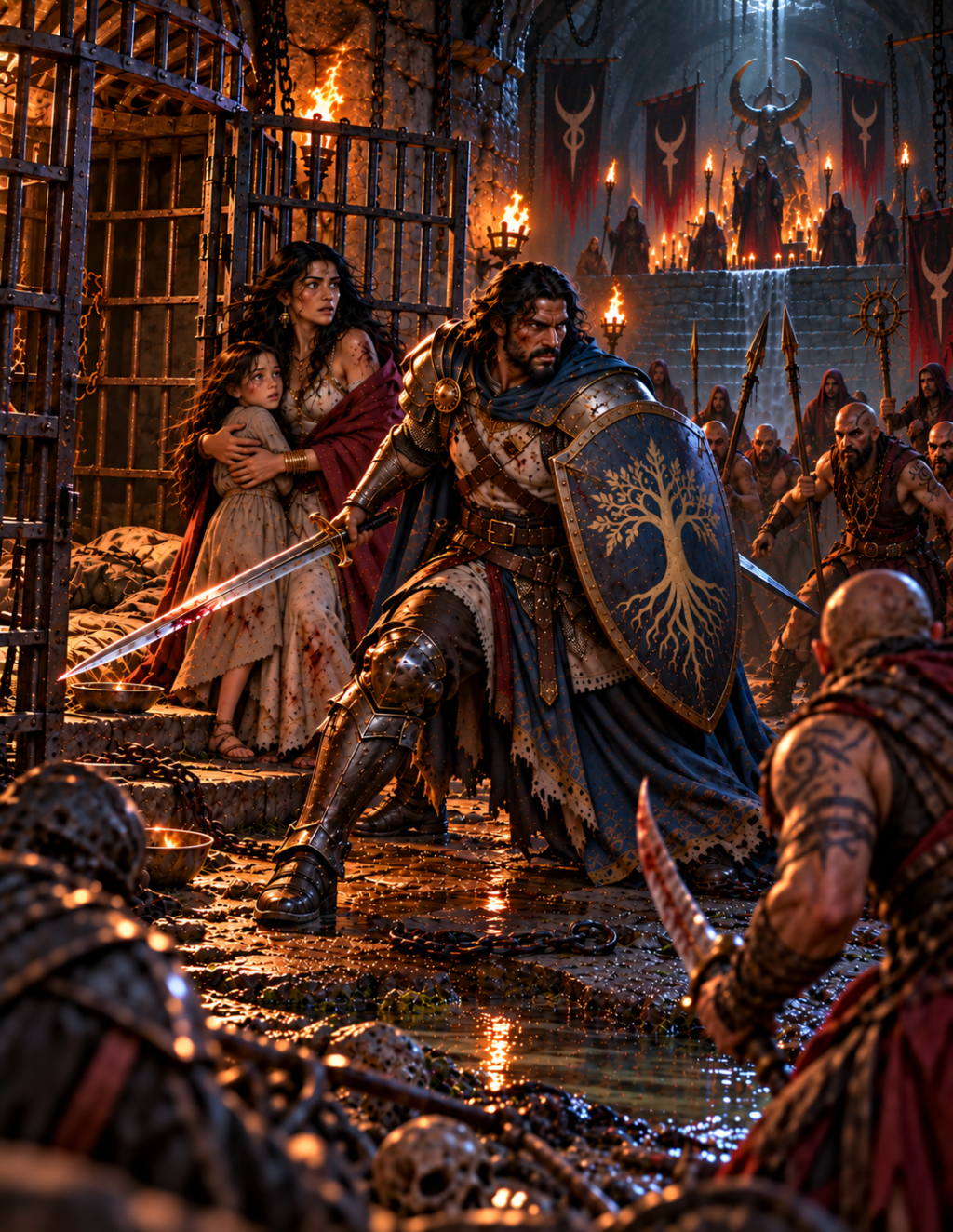
There are countless forms of evil in Sylva. Murderers and tyrants prey upon their own people. Witches and evil sorcerers bargain with forbidden powers. Cults worship dark gods whose names have survived from forgotten ages. Monsters haunt the wilderness, demons enter the world through places where they should never have been able to cross, and things older than any living kingdom wait beneath ruins that sensible people refuse to enter. These evils do not belong to a single army, religion, or conspiracy. They may have entirely different origins and purposes, and they are often enemies of one another. Yet behind them lies something greater: the 🪱 Gloom.
Ancient texts and learned scholars sometimes call the Gloom the Arafel (עֲרָפֶל), a word meaning thick darkness or deep gloom. The name refers to more than the absence of light. The Gloom is the great spiritual darkness that has taken hold throughout much of Sylva. It is not itself merely another dark god, demon, sorcerer, or monstrous ruler waiting to be defeated. Such beings are lesser things within a much larger struggle. Some knowingly serve the Gloom, while others worship their own gods, pursue their own ambitions, or have no understanding of the greater force their actions ultimately strengthen.
The Gloom should therefore not be imagined as a single kingdom of evil whose inhabitants all answer to the same master. An evil sorcerer may command an army of monsters while despising the cult that occupies the mountains beyond his borders. A demon may demand worship for itself and recognize no authority above it. Goblins, predatory creatures, wicked spirits, and corrupted rulers may care nothing for one another. Their individual motives remain their own. What joins them is their place within the greater spiritual condition of the world. Wherever supernatural evil becomes established, wherever monstrous powers take possession of the land, and wherever the forces of darkness gain ground against those who resist them, the 🪱 Gloom advances. Ordinary wickedness does not automatically create the Gloom, but generations of cruelty, corruption, despair, desecration, and deliberate evil can leave places increasingly vulnerable to it. The evil remains the responsibility of those who commit it; the Gloom is what may eventually take root in the darkness they have made.
As that darkness deepens, its effects may become increasingly difficult to dismiss as ordinary misfortune. Animals may avoid a place. Dreams may become troubled. Sacred ground may feel defiled. Violence may become easier to provoke, hope harder to sustain, and supernatural corruption more willing to answer those who invite it. None of these signs must appear everywhere, and the Gloom does not manifest identically in every Domain, but its presence can gradually reshape the character of a place long before its deepest horrors are openly revealed.
Not every wicked act should be blamed upon the Gloom. Human beings require no supernatural assistance to become greedy, cruel, violent, dishonest, or tyrannical. An ordinary murderer is still responsible for murder, and an ordinary king may become a despot entirely through his own choices. The Gloom becomes important when evil begins to exceed the merely human: when places themselves become corrupted, when unnatural creatures gather, when the dead refuse to remain dead, when forbidden powers answer those who call upon them, or when something terrible has gained such a foothold that the surrounding world begins to change with it.
No complete account of where the Gloom came from is given here. Its origins belong to the oldest history of Sylva, and much that is believed about them is preserved in religion, legend, and ancient writings. For an adventurer, the immediate truth is simpler. The Gloom exists. It has spread across the world, it manifests through innumerable forms of evil, and there are places where its presence has become extraordinarily powerful.
The War Against the Gloom
Most adventurers do not begin their careers thinking about the fate of Sylva. They have more immediate concerns. A village needs protection. Someone has disappeared. A merchant requires guards for a dangerous journey. A monster has been seen in the forest. A ruin is rumored to contain treasure. Bandits control a road, the dead have begun leaving their graves, or something beneath an old fortress has started killing those who venture too near. Adventurers may accept such work for money, duty, faith, revenge, curiosity, glory, or simply because somebody must do it.
Yet these apparently separate struggles form part of something much larger. Every monster driven from settled lands, every community freed from supernatural terror, every cursed place reclaimed, and every powerful servant of darkness destroyed denies the Gloom another foothold in Sylva. Adventurers may spend an entire campaign pursuing their own ambitions without ever imagining themselves as soldiers in a cosmic war, but their actions can nevertheless alter which force holds ground.
This struggle becomes more apparent as adventurers grow in experience and capability. Inexperienced characters may confront dangers close to civilization: marauding creatures, haunted houses, isolated ruins, disappearances, strange cults, or the first signs that something is wrong in the surrounding wilderness. More experienced adventurers can survive expeditions into places where ordinary guards and soldiers would be overwhelmed. They may hunt powerful monsters, penetrate corrupted forests, enter forgotten fortresses, break ancient curses, confront evil sorcerers, or descend into dungeons from which previous expeditions never returned.
At the highest levels of play, the scale can become terrible. Veteran adventurers may deliberately enter some of the darkest places remaining in Sylva: enormous subterranean complexes, ancient ruins consumed by supernatural corruption, wilderness where monstrous creatures rule openly, strongholds controlled by immensely powerful servants of the Gloom, or depths where things survive that have not seen daylight for centuries. These are not simply harder versions of the adventures that came before. They are places where ordinary civilization has little power and where even highly capable characters may be entering territory fundamentally hostile to human life.
This provides Kingsmark with a larger purpose without dictating what every campaign must be about. Characters can seek wealth, establish strongholds, serve kingdoms, pursue personal enemies, explore the unknown, or become powers in their own right. There is no requirement that every adventure concern the Gloom directly. Nevertheless, beyond all of those individual ambitions lies the greatest struggle available to them: to push back the Gloom wherever it has taken hold and restore what can be restored.
This does not require conquering evil forever. Sylva is too large, and darkness too deeply rooted, for a handful of adventurers to cleanse the entire world. Victory is usually more tangible than that. A road becomes safe enough for travelers to return. Families move back into an abandoned village. A forest no longer belongs to the creatures that hunted there. A ruined sanctuary is reclaimed. A dungeon that poisoned the surrounding countryside is emptied of the thing dwelling beneath it. Places that had fallen into darkness can move again toward 🌿 Tranquility.
The condition of these places can be understood through Domains. Domains provide a simple way of describing where the Gloom has taken hold, where Tranquility remains strong, and how profoundly either force shapes a particular part of Sylva.
⚖️ Domains
The influence of the 🪱 Gloom is not distributed evenly across Sylva. Some places remain peaceful, healthy, and largely untouched by supernatural evil, while others have become so deeply corrupted that monsters thrive there and ordinary people cannot safely remain. Between these extremes lies most of the world. Domains provide a simple way of describing this spiritual condition and organizing the different degrees of Tranquility and Gloom that exist from one place to another.
A Domain can be almost any defined place. A kingdom may be considered a Domain, but so may a city, village, forest, mountain range, battlefield, castle, dungeon, house, or individual room. Domains can also exist within larger Domains. An otherwise Ordinary kingdom might contain a Cursed forest. Within that forest might stand a Desecrated monastery, and beneath the monastery an Abysmal dungeon. The reverse is equally possible: a Sacred shrine or Blessed household might endure within a city otherwise consumed by corruption. The condition of the larger region therefore does not determine the condition of every place within it.
Each Domain can be described using a simple Domain Rating. 🌿Edenic Domains have a rating of –3, 🌿Sacred Domains 🌿 –2, and 🌿Blessed Domains 🌿 –1. Ordinary Domains have a rating of 0. 🪱Cursed Domains have a rating of +1, 🪱Desecrated Domains +2, and 🪱Abysmal Domains +3.
These numbers are descriptive ratings, not automatic modifiers to Tests, Target Numbers, magic, Favor, or other game mechanics. Unless another rule specifically refers to a Domain Rating, nothing is added to or subtracted from a roll simply because characters enter a Domain. A Game Master can think of them as a spiritual heat map of Sylva. An Ordinary region appears neutral on that map. Moving in one direction reveals increasingly strong Tranquility, from Blessed to Sacred and finally Edenic. Moving in the other reveals increasing concentrations of the Gloom, from Cursed to Desecrated and finally Abysmal. Looking at a campaign map in this way immediately provides a rough picture of where people can live safely, where danger is beginning to gather, and where the most terrible supernatural threats are likely to be found.
A Domain Rating also helps the Game Master determine how a place should be portrayed. It suggests the character of its inhabitants, the condition of the wilderness, the frequency and severity of supernatural events, and the kinds of creatures that might plausibly inhabit the area. An Ordinary forest can certainly contain dangerous animals or criminals without being Cursed. A Cursed forest should contain signs that something more troubling has taken root. By the time a forest becomes Desecrated or Abysmal, the difference should be apparent in what characters encounter and in the atmosphere of the place itself.
Characters do not perceive these ratings as numbers. Crossing from Ordinary countryside into a Cursed wood does not produce an announcement that the Domain Rating has changed to +1. The characters experience the difference. Travelers become reluctant to continue after sunset. Animals behave strangely. Familiar sounds disappear from the forest. Local people tell stories about those who entered and never returned. Deeper within a Desecrated Domain, such warnings may give way to unmistakable supernatural horrors. The rating exists so the Game Master understands what is happening and can portray it through the world.
Domains can change. If monsters are destroyed, curses broken, communities restored, sacred places protected, and the sources of corruption removed, a region may gradually move toward 🌿 Tranquility. Likewise, places abandoned to cruelty, supernatural evil, or monstrous occupation may descend further into the 🪱 Gloom. There are no points to accumulate and no fixed number of victories required to change a Domain Rating. The rating simply describes the condition that actually exists in the fiction. The seven Domain Ratings that follow provide examples of what each degree of Tranquility and Gloom can look like throughout Sylva.
The Seven Domains
The seven Domain Ratings describe a progression from places almost entirely free of the 🪱 Gloom to those in which it has become overwhelmingly powerful. They are not rigid templates. Two Cursed forests may look very different, just as a Desecrated city need not resemble a Desecrated dungeon. The ratings describe the degree of Tranquility or Gloom present, while the Game Master determines how that condition manifests within a particular place.
🌿 Tranquility -3 (Edenic)
Edenic Domains are extraordinarily rare remnants of a world almost untouched by the Gloom. Such places can seem impossibly beautiful to those accustomed to ordinary Sylva. Water runs clear, plants grow in extraordinary abundance, animals show little fear, and disease and decay seem strangely distant. Weather is nourishing rather than destructive: rain refreshes the earth, sunlight brings warmth without oppression, and even winter possesses a clean and peaceful character. There is often a sense that everything is exactly where it belongs.
People fortunate enough to live within an Edenic Domain tend toward peace, generosity, cooperation, and contentment. Supernatural phenomena, when encountered, are more likely to inspire wonder than terror. Rare benevolent creatures may appear openly, and events that elsewhere would be dismissed as impossible can occur without seeming unnatural. An Edenic Domain might be a hidden valley untouched for centuries, an ancient grove preserved against every attempt to corrupt it, or some other isolated remnant of Sylva’s primordial beauty. Most people will live their entire lives without seeing such a place, and many regard stories of them as little more than religious legend or travelers’ fantasy.
🌿 Tranquility -2 (Sacred)
Sacred Domains are places where Tranquility has become exceptionally strong. Unlike Edenic places, they need not be untouched wilderness or remnants of an earlier world. They can arise where generations of righteous conduct, devotion, protection, and care have allowed 🌿 Tranquility to become deeply established.
Ancient temples, monasteries, holy springs, burial places of revered figures, and exceptionally virtuous communities may become Sacred. People commonly experience an unusual sense of peace or clarity within them. Animals are calmer, vegetation healthy, and destructive supernatural phenomena uncommon. Benevolent supernatural signs may occur, particularly around places already associated with the Divine or with extraordinary events of the past.
Sacred Domains are rare enough to be treasured and defended. They are not perfect places, nor are the people living within them incapable of wrongdoing. Rather, they are places where goodness has become deeply established and the Gloom has difficulty gaining a foothold. For travelers accustomed to dangerous roads, frightened villages, and uncertain wilderness, entering Sacred ground can feel like finally reaching shelter after a long journey.
🌿 Tranquility -1 (Blessed)
Blessed Domains represent the more attainable presence of Tranquility. These are fundamentally healthy places where people, animals, and the surrounding land generally flourish. A prosperous farming village whose inhabitants have treated one another well for generations might be Blessed, as might a peaceful woodland, an honorable household, a well-kept roadside shrine, or an estate governed with unusual fairness.
Life in a Blessed Domain is still ordinary life. Crops can fail, storms can damage buildings, arguments occur, crimes are possible, and people still suffer illness and death. What distinguishes the place is an underlying tendency toward health rather than corruption. Neighbors are more likely to help one another than exploit weakness. Travelers feel reasonably safe asking for shelter. Children can play without adults constantly fearing what waits beyond the edge of the settlement.
Supernatural events are generally uncommon and, when they occur, are more likely to be benign or protective. The Gloom can enter a Blessed Domain, but it feels distinctly foreign there rather than established.
Domain Rating 0 (Ordinary)
Most of Sylva is Ordinary. An Ordinary Domain is neither particularly protected by Tranquility nor significantly corrupted by the Gloom. Most cities, villages, roads, farms, forests, castles, and wilderness fall somewhere within this broad middle ground. Ordinary does not mean safe, good, or civilized. Bandits can control an Ordinary road. A cruel lord can rule an Ordinary town. Wolves can kill travelers in an Ordinary forest, and armies can slaughter one another across an Ordinary battlefield. Human beings remain capable of generosity, greed, courage, cowardice, mercy, betrayal, and violence without supernatural forces being responsible for any of it.
The supernatural exists here but does not dominate everyday life. A strange creature glimpsed in the woods may become a story told for decades precisely because such encounters are unusual. Old ruins inspire rumors. People disagree over whether ghosts exist. Travelers still fear what might be beyond the firelight, but most nights nothing comes. Ordinary Domains are also spiritually vulnerable. They can move toward either Tranquility or the Gloom depending upon what takes root within them.
🪱 Gloom +1 (Cursed)
A Cursed Domain is a place where the Gloom has gained a noticeable foothold. Something is wrong, although outsiders may initially struggle to identify exactly what it is. Local people often recognize the danger long before visitors do. They avoid particular roads, refuse to enter certain woods after sunset, nail shutters closed before nightfall, or warn travelers away from ruins everyone in the area knows better than to investigate. Supernatural events remain intermittent enough that disbelief is possible. People disappear. Animals refuse to enter particular places. Travelers hear voices where nobody should be standing. Graves are found disturbed. Livestock is mutilated. Strange creatures are glimpsed at the edge of torchlight and vanish before anyone can prove what they saw. Vegetation may grow poorly or strangely, while weather seems persistently unpleasant without becoming obviously supernatural.
Cursed Domains are natural territory for adventurers. Haunted houses, dangerous stretches of wilderness, troubled villages, forgotten battlefields, monster-haunted roads, and small dungeons frequently belong at this level. The Gloom has established itself, but it has not yet completely overwhelmed ordinary life.
🪱 Gloom +2 (Desecrated)
Within a Desecrated Domain, the presence of the Gloom is no longer easily dismissed. Supernatural evil has become established enough to shape the character of the place itself. Monsters are not merely things someone claims to have seen. People know they are there. A Desecrated forest may contain creatures capable of making travel extraordinarily dangerous even for armed groups. A city may be dominated by cruelty, occult practices, supernatural predators, or rulers who have willingly allied themselves with dark powers.
An old fortress might have become the stronghold of an evil sorcerer, while a ruined monastery could contain horrors extending far beneath the structure visible from the surface.
The environment often reflects what has taken hold. Animals disappear or become unnaturally aggressive. Crops fail. Forests become tangled and oppressive. Fog, storms, bitter cold, oppressive heat, or other unpleasant conditions may linger beyond what seems reasonable. Hauntings, possessions, walking corpses, unnatural creatures, and other manifestations can occur openly. Desecrated Domains are places sensible people avoid whenever they have a choice. Entering one deliberately usually means undertaking a serious expedition. Experienced adventurers may be capable of surviving there, but ordinary guards, travelers, and soldiers can quickly find themselves facing threats for which courage and conventional weapons are not enough.
🪱 Gloom +3 (Abysmal)
Abysmal Domains are among the darkest places in Sylva. Here the Gloom has become so powerful that the distinction between a dangerous place and a supernatural nightmare begins to disappear. These are not merely regions where monsters happen to live. They are places in which monstrous existence has become the prevailing condition.
An Abysmal Domain might lie at the bottom of an enormous dungeon where no living person has descended for generations. It could be an ancient city abandoned after some forgotten catastrophe, a subterranean kingdom inhabited by things that have never seen the sun, a wilderness ruled by creatures powerful enough to drive human settlement from the region, or the stronghold of an entity whose influence extends for miles around it.
Nature itself may appear corrupted. Forests grow into impenetrable masses of thorns. Water becomes foul or behaves strangely. Animals are absent, twisted, or replaced by things that merely resemble them. Corpses may refuse to remain dead. Darkness can seem unnaturally complete, and supernatural phenomena that would terrify an entire village elsewhere may be commonplace.
The entities encountered within Abysmal Domains should likewise represent some of the greatest threats in the game. Ancient monsters, powerful demons, legendary sorcerers, enormous predatory creatures, and horrors difficult even to understand can inhabit such places. Reaching them may require crossing miles of hostile territory, descending through successive levels of ruins, surviving lesser monsters, and passing places from which previous expeditions never returned.
These Domains provide natural territory for some of the most dangerous adventures in Kingsmark. Inexperienced adventurers can certainly stumble into such places, but they are unlikely to survive long if they do not recognize the danger and escape. Those who deliberately descend into an Abysmal Domain are usually among the comparatively few people capable of entering places where kingdoms cannot easily send armies and where ordinary human authority has ceased to matter.
Yet even an Abysmal Domain is not necessarily beyond recovery. Destroying the power that holds such a place, sealing what entered the world there, or reclaiming what was lost may begin a transformation that takes generations to complete. The heroes may never live to see an ancient wasteland become Edenic, nor must they. Their victory may simply be that the darkness no longer advances.
That is the larger struggle represented by the Domains of Sylva. The Gloom takes ground, and those willing to confront it take ground back. Every reclaimed road, village, forest, fortress, and forgotten depth is one more place where the world has been denied to the darkness.
Serving Evil
Responding to the Gloom is not the same thing as serving it. Temptation can affect anyone without consent. Responding occurs when a character knowingly becomes receptive to corrupt supernatural influence and chooses to follow where that temptation leads.
The Gloom does not ordinarily speak directly to a character as a voice inside the mind. It works through desire, resentment, fear, opportunity, coincidence, corrupted places and objects, demons, evil spirits, Sorcerers, cultists, supernatural agents, and circumstances arranged to make wrongdoing appear useful. An actual voice offering instructions belongs to some entity or person serving the Gloom rather than to the Gloom itself.
Any character may Respond to the Gloom regardless of Character Class, 🌬Spirit, magical training, or previous ability to cast Spells. The player knowingly chooses whether the character responds. Accepting or refusing a 🍎Temptation is always a player decision. No Attribute Defense Test determines whether the character chooses to accept the Gloom’s offer. Tests are made only when a separate supernatural effect, meaningful opposition, or genuine uncertainty independently requires one.
The GM should privately present a Temptation suited to the character and circumstances. A good Temptation normally offers something the character already wants or provides an apparently useful solution to an existing problem. Revenge, money, survival, jealousy, ambition, forbidden knowledge, resentment, humiliation, lust, fear, protection of someone loved, and desperation can all make evil easier to rationalize. Responding provides no immediate supernatural benefit. The first test is obedience.
If the character accepts the 🍎Temptation, the character must perform the requested evil act. The request might involve stealing from companions, concealing important information, betraying someone’s trust, sabotaging a mission, desecrating something sacred, harming an innocent person, helping an enemy, deliberately allowing preventable suffering, or committing another act appropriate to the character’s developing corruption.
When the accepted act occurs privately and no meaningful uncertainty or opposition exists, no Test is required merely to determine whether the character follows through. If the character agrees to steal 10 Gold while companions are absent and nothing meaningfully prevents the theft, the Gold disappears. If the character agrees to burn an unguarded temple while the rest of the party is elsewhere, the temple is set on fire. The player has already made the meaningful decision by accepting the Temptation.
This rule never overrides meaningful resistance or another Player Character’s agency. If another character is guarding the Gold, witnesses the sabotage, resists an attack, or otherwise creates genuine uncertainty, resolve the situation normally. Completing this first act of obedience makes the character eligible to perform Soul Offering. Until Soul Offering occurs, the character has committed wrongdoing and may be spiritually deteriorating, but has not formally entered a Gloom Pact.
Soul Offering is the deliberate surrender of allegiance to the Gloom. The character has already Responded, obeyed, and demonstrated willingness to serve. The character now knowingly offers himself. The Soul Offering creates an immediate metaphysical transformation. The character’s own 🌬Spirit collapses to 0 as the relationship is surrendered, and corrupt supernatural power immediately floods the resulting emptiness. This collapse and surge are instantaneous and are not resolved as two separate mechanical steps. The character’s final 🌬Spirit becomes +3. A character who already possessed 🌬Spirit +4 returns to +4 instead.
This increase does not represent spiritual health. The character has not become righteous, enlightened, or naturally stronger in Spirit. The apparently powerful Spirit Rating reflects supernatural power coursing through a spiritually compromised Ruach. Astral perception may reveal that something about this power is profoundly wrong even when the numerical Spirit Rating appears impressive.
At the instant Soul Offering is completed, the character’s 🕊Favor becomes 0. A character serving the Gloom cannot earn, receive, transfer into himself, or otherwise possess 🕊Favor. Prayer may still be spoken as ordinary role-playing, but the character cannot spend Favor for providential intervention while the Pact remains.
The character can no longer cast 🕯Holy Magic, ❤️Love Magic, or ❤️🩹Healing Magic while serving the Gloom. Previously learned Spells from those Schools are not necessarily forgotten, but they become inaccessible for as long as allegiance to the Gloom continues.
The character becomes an Evil Sorcerer. Evil Sorcerer is not a separate Character Class. The character retains the original Class, Skills, Attributes, equipment, Action Star Level, and other abilities. A Man-at-Arms who enters a Gloom Pact remains a Man-at-Arms and becomes an Evil Sorcerer. A Wizard remains a Wizard and becomes an Evil Sorcerer. The term describes what the character has become supernaturally rather than replacing the character’s existing training and identity.
Immediately after Soul Offering, the Gloom provides a special 📖Spell Learning Opportunity. The GM presents eligible ❌Forbidden Spells from 🌑Dark Magic, 🩸Blood Magic, and ☠Necromancy. Normally two or three appropriate choices should be presented from each School. The character immediately learns exactly one Spell from each of those three Schools.
The choices should suit the character, the circumstances of the Soul Offering, and the form the corruption has taken. Whenever possible, each offered Spell should possess a manifestation that the character can actually use at the character’s present ⭐Action Star Level. The Gloom is offering useful power, not meaningless future promises.
These three Spells are Gloom-granted Spells. They ignore the normal School restrictions of the character’s Class and do not count against the character’s normal maximum number of Spells. The same rule applies to later Spells specifically granted through service to the Gloom.
Ordinary Spells and Gloom-granted Spells remain mechanically distinct for purposes of learning. Ordinary Spells continue to obey the character’s Class access and normal magical-capacity rules. The Gloom does not transform a Brute into a Wizard or give a Ranger unrestricted access to ordinary magic. It creates an exception only for the corrupt supernatural knowledge that it provides.
A Spell may qualify as a Gloom-granted Forbidden Spell when the complete Spell is marked ❌Forbidden or when the Spell contains a manifestation that is explicitly ❌Forbidden and the Gloom is offering the Spell for that corrupt capability. Learning the Spell grants the complete Spell normally, with available manifestations still determined by ⭐Action Star Level.
Characters whose Classes already possess magic continue developing their ordinary magic after entering the Gloom Pact. Whenever such a character receives a normal 📖Spell Learning Opportunity, first determine the choices that would ordinarily be offered through the character’s Class. The Gloom then adds an equal number of appropriate ❌Forbidden choices.
If the GM would ordinarily offer two Spells, the Evil Sorcerer is offered four choices: two normal and two Forbidden. If the GM would ordinarily offer three, the character is offered six: three normal and three Forbidden. The character still learns only one Spell from that Spell Learning Opportunity unless another rule specifically states otherwise.
Normal choices remain restricted by Character Class and normal capacity. Forbidden choices supplied by the Gloom ignore Class School restrictions and do not count against normal magical capacity.
A character from a completely nonmagical Class has no ordinary magical education to continue. After becoming an Evil Sorcerer, such a character becomes eligible for Gloom Spell Learning Opportunities even though the Class ordinarily receives no Spells. These later opportunities offer only appropriate ❌Forbidden Spells. The GM should normally provide two to four choices according to the same fictional principles governing other Spell Learning Opportunities.
This distinction preserves the character’s identity. A corrupted Man-at-Arms does not suddenly begin collecting ordinary Divination, Elemental, or Arcane Spells as though he had spent years studying Wizardry. Every Spell he possesses beyond his Class abilities exists because the Gloom put something inside him that did not belong there.
Serving the Gloom is not completed by a single wicked act. After the Pact, the GM may privately present further Temptation Missions. These should normally grow more serious as corruption deepens. Early Temptations may be easy to rationalize: conceal the truth, take money, betray a confidence, permit an enemy to suffer, or sabotage something belonging to a disliked person. Later demands may involve desecration, cruelty, betrayal of companions, corruption of innocent people, murder, sacrifice, or other atrocities.
The best Temptations are personal. The Gloom exploits what the character already fears, desires, resents, envies, loves, or believes he deserves. The GM should avoid treating Temptation Missions as random errands performed merely because the character has an evil alignment. The objective is corruption: each choice should make the next one easier to justify.
Temptation Missions may again resolve without a Test when the player accepts the task and no meaningful obstacle opposes completion. This keeps secret corruption secret when appropriate. The GM should not require a Stealth Test merely because the rules need an excuse to reveal the betrayal to the other players. Conversely, automatic resolution never defeats direct opposition, bypasses another Player Character’s defenses, or guarantees success when meaningful uncertainty genuinely exists.
The player may refuse a later Temptation. The character is not mind controlled by the Gloom. Refusal may cause supernatural agents to withdraw support, prevent further Gloom Spell Learning Opportunities, expose the character to retaliation promised by previous bargains, or begin a genuine movement toward repentance. Existing Gloom-granted Spells are not automatically erased merely because one Temptation is refused.
The Game Master should portray the Gloom’s interests aggressively while remaining neutral as referee. The supernatural forces of corruption may want the Evil Sorcerer to betray the party, but the GM should not secretly manipulate rules or information to make that betrayal succeed. If corruption produces player-versus-player conflict, resolve that conflict with the same fairness used elsewhere in Kingsmark.
Redemption is possible only when the story makes it believable. There is no Redemption Test, corruption-point payment, predetermined number of good deeds, or automatic formula through which allegiance to the Gloom is cancelled. Repentance must involve a sincere rejection of the relationship rather than fear of being caught or punished. Confessing hidden wrongdoing, accepting deserved consequences, making restitution where possible, refusing an important Temptation when refusal is costly, saving someone intended for sacrifice, destroying a source of corrupt power, turning against the entity that initiated the character, or willingly giving up supernatural advantages may all contribute to convincing redemption.
The Game Master determines whether the change passes the smell test of genuine character development. Some extreme acts of deliberate evil may place redemption beyond the character’s reach. When a contemplated act could reasonably constitute such a point of no return, the GM should warn the player privately before the character knowingly chooses it.
If genuine redemption breaks the Gloom Pact, the supernatural Spirit supplied through the Gloom withdraws. The character normally falls to 🌬Spirit 0 unless another established event or rule genuinely restores the character’s own Spirit. The character does not keep the +3 or +4 surge as a reward for temporarily surrendering to evil.
All Gloom-granted Spells become inaccessible when the Pact is broken. The character may remember possessing them and may understand something of what was done, but the supernatural access that allowed those Spells to function came through the Gloom. A Spell may be acquired legitimately later only if the character’s Class and the ordinary rules permit it.
The prohibition against 🕯Holy, ❤️Love, and ❤️🩹Healing Magic ends when genuine redemption ends the Pact, but all normal requirements still apply. Favor remains at 0 and must be earned again normally rather than being restored automatically.
A redeemed character therefore does not simply return to the exact Character Sheet that existed before the fall. Corruption had consequences. Redemption ends allegiance to the Gloom; it does not make the story unhappen.
🎬 Example — Taking Ground Back
For seventy years, nobody from the village of Harrowfen had entered the old monastery after sunset. The surrounding countryside was Ordinary 0, but the monastery and its overgrown grounds had become a 🪱Desecrated +2 Domain. The rating imposed no automatic penalty on the adventurers’ Tests. Instead, it described what they found: trees growing inward toward the ruins, animals refusing to approach, graves opened from below, and pale figures moving behind windows where no living monks remained.
Deep beneath the chapel, the party discovered the source—a former Priest named Malrec who had entered a Gloom Pact years earlier. He still wore his old vestments, but could no longer use 🕯Holy Magic or possess 🕊Favor. In their place, the Gloom had granted him ❌Forbidden Spells from 🌑Dark Magic, 🩸Blood Magic, and ☠Necromancy.
During the confrontation, the Game Master privately offered Serafina a 🍎Temptation: Malrec knew where her murdered brother’s spirit could supposedly be found. If she allowed him to escape, he would reveal the location.
No Attribute Defense Test was made. The decision belonged to Serafina’s player. She refused.
The battle ended with Malrec dead and the necromantic altar shattered. The adventurers burned the corrupted remains, reconsecrated the chapel as best they could, sealed the crypt, and returned the stolen bones of the villagers’ ancestors to their graves. The monastery did not suddenly become 🌿Sacred. For several weeks, it remained cold, silent, and deeply unpleasant. But the dead stopped walking. Animals eventually returned. Villagers began crossing the grounds during daylight. Months later, a small religious community reopened the chapel and maintained the graves.
The Game Master eventually judged that the source of supernatural corruption had truly been removed. The monastery ceased to be Desecrated +2 and became 🪱Cursed +1. With continued restoration, it might someday become Ordinary 0, or perhaps even 🌿Blessed. The adventurers had not destroyed the Gloom. They had taken one place away from it.