Medical Record
Players record the physical and mental condition of their characters in the section of the 📖Character Bible called the Medical Record which features two distinct Trauma Charts. Kingsmark recognizes two distinct forms of damage—🧠Mental Trauma and 🩸Physical Trauma—and each chart consists of 12 wound boxes, which are divided into four Damage Levels. Physical Trauma is divided into four categories: Minor Wounds, Moderate Wounds, Severe Wounds, and Critical Wounds. Mental Trauma is divided into four mental states: Shaken, Impaired, Unstable, and Broken.
Injuries aren’t just tallied—they’re seen. Early in a fight, damage may be described briefly, but as it accumulates the players should begin to feel the weight of their characters’ injuries. The Game Master might say, “You take a shallow cut,” or “You’re winded by a hit to the ribs,” but as the Trauma Chart fills, wounds should be described with increasing detail and drama.
🎭 Role-Playing Trauma
Trauma is not only a modifier on the 📖Character Bible. It is something that has happened to the character, and the player should portray its effects honestly.
Whenever a character receives 🩸Physical Trauma or 🧠Mental Trauma, consider how that injury or psychological shock would reasonably affect what the character does next. This is especially important during Action Scenes. A wounded or frightened character may retreat, seek cover, call for help, reposition, become more defensive, change tactics, protect an injured body part, hesitate before confronting the source of his fear, rely more heavily upon companions, or attempt to escape entirely.
The player is not required to choose any particular reaction. Trauma affects different people differently. A terrified Thief might flee while a terrified Holy Knight plants his feet and refuses to move. A wounded Barbarian might become more aggressive, while another character with the same wound might withdraw behind the party. A veteran warrior may deliberately ignore his fear or pain because protecting the others matters more to him than his own safety. These are all believable reactions when they fit the character, the Trauma, and the circumstances.
What matters is that Trauma should matter.
Players should not treat an injury or psychological wound as nonexistent simply because its current box carries no Pain or Distress Modifier. Those modifiers represent the point at which Trauma has become severe enough to mechanically degrade performance; they do not represent the point at which the character first notices that he has been stabbed, terrified, burned, grieving, or otherwise harmed.
As Trauma accumulates, its influence on role-playing should normally become more pronounced. 🩸Minor or 🧠Shaken Trauma may produce only a momentary reaction or subtle change in behavior. Moderate or Impaired Trauma should usually become noticeable in the character’s decisions and conduct. Severe or Unstable Trauma should be difficult to ignore and may substantially alter tactics, priorities, or willingness to remain in danger. Critical or Broken Trauma represents catastrophic injury or psychological collapse and is resolved according to the rules for R.A.D.💀.
The Game Master should remind a player when the character’s behavior appears disconnected from significant Trauma, but should not dictate the character’s decisions merely because a particular reaction seems obvious. The player remains the actor portraying the character. The objective is not to punish wounded characters or force everyone to flee. The objective is to make injury, fear, exhaustion, grief, and courage visible in the story.
A hero who continues fighting despite terrible wounds can be dramatically appropriate. The important distinction is between a character courageously fighting through Trauma and a player simply pretending the Trauma never happened.
🩸Physical Trauma Levels
Physical harm is tracked using four wound levels:
- 🩸Minor: Superficial but real injuries such as cuts, bruises, shallow wounds, sprains.
- 🩸Moderate: Serious injuries that impair performance such as deep cuts, cracked bones, heavy bleeding.
- 🩸Severe: Disabling trauma such as broken limbs, punctured organs, massive blood loss.
- 💀Critical: Catastrophic injury such as organ destruction, brain trauma, severed arteries, or massive bodily trauma. A Critical Wound requires a R.A.D.💀 when the actual injury leaves the character’s survival uncertain, according to the Roll Against Death rules.
Wound Severity, Accumulation & Escalation
A successful damaging attack begins with its Base Damage Level. Unless another rule establishes a different procedure, the Damage Level increases by one level for every point by which the attacker’s modified attack result exceeds the attack’s final Target Number. Any applicable Defense Roll, Armor, Critical Threshold, or other Damage modifier is then resolved according to the Attack Sequence. Therefore, a weapon that has a Base Damage Level of “Minor” can escalate to Moderate, Severe or Critical. All characters may only take six Minor wounds, three Moderate wounds, two Severe wounds, and one Critical wound and the Mental Trauma chart follows the same math. If a particular category of wound is filled up then the next wound of that level is automatically escalated to the next wound category. Therefore, a character can take six Minor wounds, but the seventh Minor wound is automatically applied as a Moderate wound.
Pain & Distress Modifiers and Trauma Thresholds
Accumulating Trauma eventually makes a character’s actions more difficult. Physical Trauma imposes Pain Modifiers, while Mental Trauma imposes Distress Modifiers. Each modifier increases the Target Number of all actions attempted by the affected character and reduces the character’s ⏳Initiative Score by the same amount.
During an Opposed Test, apply the affected character’s Pain and Distress to the difficulty of that character’s own action. Pain and Distress increase that character’s Target Number; they do not reduce the character’s dice result. When both characters are attempting actions against one another, calculate each character’s Target Number separately according to the Opposed Test rules. Pain suffered by a defender therefore makes the defender’s own actions more difficult and, when appropriate, makes that defender easier to overcome; it never makes the defender more difficult to hit.
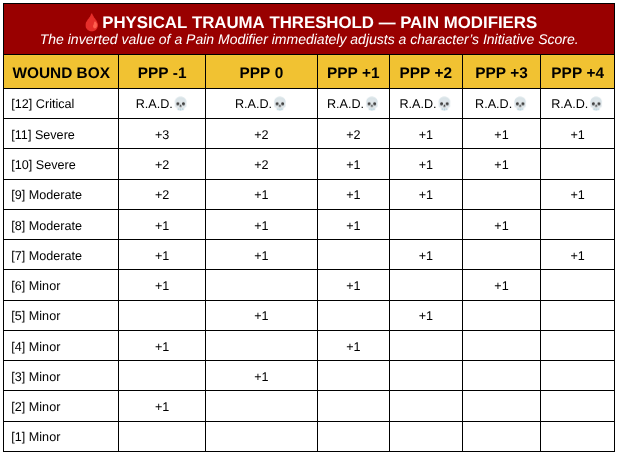
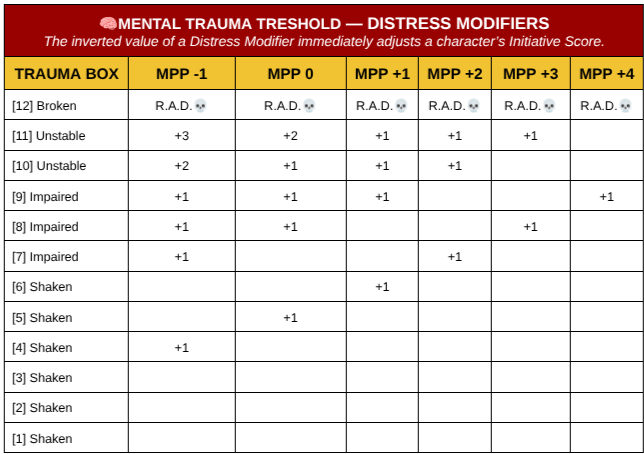
A character’s ability to withstand Trauma depends upon the 🌈Physical Performance PRISM (PPP) and 🌈Mental Performance PRISM (MPP). Characters with higher PRISM ratings can endure greater physical injury or psychological distress before their performance begins to deteriorate. The Physical Trauma Threshold determines when Pain Modifiers are incurred, while the Mental Trauma Threshold determines when Distress Modifiers are incurred.
During character creation, players should locate their character’s current PPP on the Physical Trauma Threshold and MPP on the Mental Trauma Threshold, then record the modifiers associated with the appropriate Trauma boxes. These values should be updated whenever the character’s PPP or MPP changes. Recording them in advance means that when Trauma occurs during play, its consequences can be applied immediately without stopping to recalculate the character’s thresholds. Trauma boxes are associated with specific positions on their respective Trauma Charts. Whenever a character fills a box that carries a modifier, that modifier applies immediately. Modifiers from multiple filled boxes are cumulative. Blank entries impose no additional modifier.
For example, a character with 🌈PPP +1 can sustain three 🩸Minor Physical Wounds without suffering an Injury Modifier. Upon receiving a fourth Minor Wound, the character fills box [4], which imposes +1 Disadvantage. If that character later suffers a 🩸Severe Wound that fills box [10], that wound imposes an additional +1 Pain. The character therefore has a total +2 Pain Modifier. Physical and Mental Trauma accumulate independently but their modifiers combine. If a character is suffering a +2 Pain Modifier and a +1 Distress Modifier, all of the character’s Target Numbers increase by +3.
Pain and Distress Modifiers also reduce ⏳Initiative. Their combined numerical value is subtracted from the character’s ⏳Initiative Score. Thus, +1 Disadvantage imposes −1 ⏳Initiative, +2 imposes −2 ⏳Initiative, and so forth. These changes take effect immediately, including during an encounter.
Box [12] represents the absolute limit of either Trauma scale. Filling box [12] represents 💀Critical Physical Trauma or 💀Broken Mental Trauma. Broken Mental Trauma requires a Roll Against Dissolution. Critical Physical Trauma requires a Roll Against Death only when the actual injury leaves the character’s survival uncertain, as described under Roll Against Death or Dissolution (R.A.D.💀). A Critical injury can therefore be catastrophic without necessarily being immediately life-threatening.
The Trauma Thresholds make investment in a character’s Attributes consequential beyond ordinary skill use. Increasing the physical Attributes contributing to 🌈PPP allows a hero to sustain more punishment before injury begins degrading action and ⏳Initiative. Increasing the mental Attributes contributing to 🌈MPP similarly allows a hero to withstand greater psychological Trauma before suffering comparable penalties.
⚖️ Negative PPP & MPP
It should be exceptionally rare for a hero to possess 🌈PPP -1, 🌈MPP -1, or worse. When a negative PRISM requires a complete Trauma Track, the Game Master should use the published threshold tables rather than extrapolating mechanically from the positive tracks above. For ordinary NPCs, however, the Game Master does not normally need to construct a precise customized Trauma Track. Apply reasonable Pain, Distress, and Initiative modifiers loosely based on these tracks and adjudicate the NPC’s response according to what is actually happening: the severity and accumulation of wounds, terror and Mental Trauma suffered, the enemy’s ⭐Terror Level, the NPC’s training and discipline, supernatural circumstances, and the fiction of the battle. Minor NPCs may panic, flee, surrender, collapse, or become combat-ineffective when that outcome is more reasonable than meticulously tracking every modifier.
Base Damage Level
The Base Damage Level of a spell or weapon represents the Wound Level or Trauma Level an attack is expected to cause on a competent, successful hit. It answers the question: “If the average person that is minimally trained—or that has no training—were to make this attack, what usually happens?” If the attacker achieves the Target Number of the attack then the weapon’s Base Damage Level is applied.
💀Critical Threshold
Critical Threshold is the threshold that determines whether an attack is even allowed to escalate into a Critical wound. It is checked against the modified die result (the die face plus all bonuses), not against the Target Number and not against the margin of success. If the modified die result does not meet or exceed the weapon’s Critical Threshold, the attack may still escalate normally through Minor, Moderate, and Severe damage, but it is capped at Severe and cannot become Critical regardless of how far above the TN the roll lands.
For example, if a weapon has a Base Damage Level of Minor and a Critical Threshold of 12, an attack can only escalate to Critical if the modified die result reaches 12 or higher. If the TN to hit is 7 and the player rolls an 11, the attack succeeds with a +4 margin of success, which is more than enough to escalate the damage from Minor to Critical. However, because the modified die result does not meet the Critical Threshold, the damage instead caps at Severe. If the same roll were a 10 with a +2 modifier, producing a modified die result of 12, the Critical Threshold would be met and Critical escalation would be allowed. In this way, skill and advantage can push an attack into lethal territory, but only when the weapon is physically capable of doing so under those circumstances.
If the Target Number is already higher than the weapon’s Critical Threshold, successfully reaching the Target Number automatically satisfies the Critical Threshold requirement, and damage then escalates normally according to the margin of success. Therefore, if the Target Number is 14, the weapon’s Critical Threshold is 10, and its Base Damage Level is 🩸Moderate, a modified result of 15 escalates the wound to 🩸Severe and a modified result of 16 escalates it to 💀Critical.
This rule creates a clear lethality gate rather than a traditional critical-hit system. Crude improvised weapons can kill, but only under exceptional conditions. Broadswords and axes feel dangerous without always dealing critical wounds. Margin of success still matters for escalation, but it cannot bypass the physical reality of what a weapon can do. With this structure, weapon stat blocks require only two main values—Base Damage Level and Critical Threshold—and all other outcomes emerge naturally from positioning, advantage, and player choice.
Because the Base Target Number is 4, and because escalation from Minor to Critical requires at least +3 levels of escalation, the lowest possible Critical Threshold is 7. A Critical Threshold of 7 therefore means: this is a weapon known to be capable of killing a human being easily with a single well-placed hit. A Critical Threshold can never be lower than 7. Weapons with a Critical Threshold of 7 may omit the statistic, because their damage can escalate normally to Critical without further restriction. At the opposite extreme, a Critical Threshold of 24 represents lethality that is only achievable through Divine Intervention. This is why a character with Strength –3 has a Critical Threshold of 24 when using their bare hands: reaching such a number requires exploding dice, and may demand rolling a 12 twice in a row if no Advantage is present. Death in such cases is possible, but miraculous, accidental, or fated rather than expected.
Critical Threshold Gradient
🏹 7 — Lethal
Easily capable of killing with one hit.
Examples: couched lance, heavy spear, two-handed axe.
⚔️ 9 — Extremely Dangerous
Designed to kill, but slightly less reliable than the most lethal weapons.
Examples: sword, war hammer, mace, falchion, heavy fighting knife, wood axe.
🔨 11 — Dangerous
Capable of lethal strikes, but usually requires precision or force.
Examples: club, hatchet, light hammer, short spear, blacksmith’s hammer.
🔪 12 — Improvised Deadly Weapons
Not designed to kill, but can do so under the right conditions.
Examples: sickle, cleaver, fireplace poker, heavy tool, kitchen knife.
🧹 15 — Typically Non-Lethal Weapons
Lethal outcomes are rare and often accidental.
Examples: walking stick, wooden baton, small club, riding crop, wooden tool handle.
👊 18 — Unlikely to Kill
Death is exceptional and generally unintended.
Examples: fists (average human adult, Strength 0), wooden cup, chair leg, thrown stones.
📖 20 — Barely Capable
Requires extreme circumstance, perfect placement, or sheer misfortune.
Examples: fists (weak character, Strength −1), small household objects, heavy book.
👶 24 — Divine Intervention Only
Lethal only through exploding dice and unmistakable fate.
Examples: pathetic weakling with Strength −3, trivial objects, 3-year-old toddler, angry house cat.
Anatomy
If an attacker does not use an action permitting a declared 🎯Hit Location, determine where a successful attack lands by rolling 1d12. The Game Master may instead determine the location logically when the physical circumstances clearly restrict what could have been struck. If a rolled location is obscured, protected by intervening terrain, outside the attack’s possible path, or otherwise unavailable, reroll it or select a logically available location.
Only an action specifically permitting aimed placement allows the attacking player to choose the Hit Location. Description alone does not. A player may say that his swordsman is trying to strike high, low, viciously, cautiously, or wherever an opening appears, but unless he uses the appropriate aiming action, the exact Hit Location remains subject to the dice and circumstances.
Hit Locations are broad anatomical areas. The severity of the resulting Wound determines the actual injury within that area. A sword striking the Head might produce a shallow scalp wound, a severe facial injury, or a catastrophic injury to the eye or skull depending upon Damage and the circumstances. Follow the Permanent Injury rules whenever the resulting injury actually establishes permanent destruction or loss of function.
HIT LOCATIONS
👨[12]Head
📿[11]Neck
👕[10]Upper Torso
👕[9]Lower Torso, Buttocks & Groin
💪[8]Right Shoulder & Arm
💪[7]Left Shoulder & Arm
✋[6]Right Hand
🤚[5]Left Hand
🦵[4]Right Leg
🦵[3]Left Leg
🦶[2]Right Foot
🦶[1]Left Foot
Falling Damage
A fall threatens 🪨Concussive Physical Trauma according to the distance fallen and the surface struck. Use the following Base Damage Levels:
- Less than 5 feet: ordinarily no wound, unless the character lands upon a dangerous object or surface.
- 5–10 feet: Minor Concussive Wound.
- 11–20 feet: Moderate Concussive Wound.
- 21–40 feet: Severe Concussive Wound.
- 41–80 feet: Critical Concussive Wound.
- More than 80 feet: Critical Concussive Wound, Certain Death, or another consequence determined by the actual circumstances.
A conscious character who can react makes a Falling Defense Test:
1d12 + Physical Performance PRISM + Infantry Athletics
The Target Number is determined by the fall:
- 5–10 feet: TN 6
- 11–20 feet: TN 8
- 21–40 feet: TN 10
- 41–80 feet: TN 12
Meeting the Target Number reduces the fall’s Damage Level by one. Rolling 3 or more points above the Target Number reduces it by one additional level. Falling Defense cannot reduce the fall by more than two Damage Levels. If the final Damage Level is reduced below Minor, the character avoids a Physical Wound but may still land prone, drop carried objects, or suffer another reasonable positional consequence.
A natural 1 is an Epic Failure. The Game Master may increase the Damage Level by one, impose a particularly dangerous hit location, cause the character to drop something important, or apply another consequence directly related to the fall. A character who is unconscious, completely restrained, or otherwise incapable of controlling the fall does not receive a Falling Defense Test.
Armor does not ordinarily protect against falling because the impact affects the entire body. Armor specifically designed to absorb impact may apply. Heavy or rigid armor may instead increase the difficulty when it prevents the character from controlling the landing. Modify the Base Damage Level when the landing surface clearly changes the danger:
- Deep water, a prepared safety net, thick vegetation, or another yielding surface may reduce the Damage Level.
- Stone, jagged rubble, spikes, fire, or another dangerous surface may increase the Damage Level or add another Type of Damage.
- Falling onto another person may injure both characters.
- Attempting to protect a carried person may impose Disadvantage upon the falling character’s Test while granting protection to the person being carried.
If the fall fills Physical Wound box 12, perform R.A.D. normally unless the completed fall constitutes Certain Death.
Types of Damage
Damage is divided into twelve distinct Types according to the force, weapon, substance, or supernatural effect principally responsible for the injury. Damage Type is especially important when determining whether armor, a shield, magical protection, supernatural resistance, environmental protection, or another defense applies against an attack. Two attacks that appear superficially similar may therefore interact very differently with armor because their actual mechanisms of injury are different.
When an effect could reasonably fit more than one Damage Type, the Game Master should determine what is actually causing the injury rather than simply choosing the Type that sounds most similar to the attack’s appearance. A blast of magically propelled air that strikes someone like an invisible battering ram is 🪨Concussive because physical impact is causing the injury. A supernatural scream that tears tissue through destructive vibration is 💨Sonic because sound and vibration themselves are causing the injury. A flaming arrow normally inflicts 🏹Projectiles when the arrow strikes and may subsequently create 🔥Fire exposure if it ignites something. An attack may therefore produce more than one consequence, but each individual source of Damage should have a clear Type.
Armor Ratings are specific to Damage Type. Armor that is excellent against one Type may provide little or no protection against another. Solid plate can be extraordinarily effective against 🏹Projectiles and 🗡️Blades & Spikes while doing nothing to stop 🧠Mental Trauma. Conversely, clothing or padding that provides little protection from a sword may provide useful insulation from a sudden ❄️Cold blast.
Unless a rule specifically states otherwise, Armor Rating represents protection against the immediate damaging exposure. It does not automatically determine what happens afterward. A gambeson may reduce the Damage of a momentary burst of flame and then catch fire. A shield may intercept acid but remain coated in acid afterward. Armor may prevent a quantity of diseased gore from immediately contacting the skin while itself becoming thoroughly contaminated. Continuing exposure, burning equipment, retained heat or cold, soaked clothing, corrosion, contamination, fumes, and similar consequences are resolved according to what subsequently occurs.
🧠 Mental Trauma
🧠Mental Trauma represents psychological and supernatural harm to the mind rather than ordinary physical injury. Terror, overwhelming pain, traumatic experiences, horrifying discoveries, psychological torture, supernatural fear, and the Mental Drain produced by magic may all inflict Mental Trauma. Ordinary physical armor does not protect the mind merely because it covers the body. A helmet, breastplate, or shield therefore normally provides an Armor Rating of 0 against 🧠Mental Trauma. Mental Trauma is resisted through the Mental Trauma rules, including the character’s 🌈Mental Performance PRISM.
Only a spell, enchanted item, supernatural ability, or other rule that explicitly provides protection against Mental Trauma can function as armor against it.
🪨 Concussive
🪨Concussive Damage represents injury caused principally by physical impact, crushing force, acceleration, pressure, or collision. Clubs, maces, hammers, falling rocks, collapsing structures, bodily impacts, crushing machinery, explosions whose principal effect is blast force, telekinetic impacts, earth magic, and similar attacks commonly inflict Concussive Damage.
The important question is whether something physically hits, crushes, slams, or throws the target. The striking object does not necessarily need to be solid. A magical gust or compressed-air cannon capable of striking someone in the chest like an invisible hammer is 🪨Concussive. Likewise, a powerful pressure wave that throws a character backward because of its physical force may be Concussive even though moving air delivered the impact. Armor is generally useful against Concussive Damage because padding, rigid structures, shields, and other defenses can absorb or distribute some of the force. However, even excellent armor may transmit substantial energy into the body beneath it, which is why protection against Concussive Damage is often lower than protection against blades or projectiles.
🏹 Projectiles
🏹Projectile Damage represents injury caused by high-energy missiles whose penetrating ability and impact characteristics make them meaningfully different from ordinary hand-held weapons. Arrows, crossbow bolts, powerful darts, and comparable missile weapons are the primary examples.
Projectile protection is especially important when evaluating armor. A material capable of resisting a sword cut is not necessarily equally capable of stopping a powerful arrow or crossbow bolt. Conversely, rigid armor designed to deflect or resist penetrating missiles may provide exceptional Projectile protection. A thrown object does not automatically become 🏹Projectile Damage merely because it travels through the air. A thrown rock is normally 🪨Concussive, while a thrown knife, spear, or similar hand-thrown penetrating weapon may remain 🗡️Blades & Spikes unless a specific rule states otherwise. The Damage Type describes the relevant injury mechanism and weapon category, not merely the fact that the attack traveled toward its victim.
🗡️ Blades & Spikes
🗡️Blades & Spikes encompasses physical attacks intended primarily to cut, stab, pierce, slash, puncture, tear, or impale through direct weapon contact. Knives, swords, axes, spears, daggers, claws, fangs, spikes, picks, and numerous natural weapons fall within this category.
The category deliberately combines cutting and penetrating hand weapons because Kingsmark does not require a separate Armor Rating for every possible weapon geometry. Individual weapons remain mechanically distinct through their own statistics and special properties. A weapon can nevertheless inflict another Damage Type when used in an unusual manner. Striking someone with the pommel of a sword, for example, may inflict 🪨Concussive rather than 🗡️Blades & Spikes Damage when the attack is explicitly made as a blunt strike.
🔥 Fire
🔥Fire Damage represents damaging heat capable of burning, scorching, igniting, or thermally injuring the target. Open flame, burning oil, flaming weapons, torches, dragon breath, magical fire, fireballs, jets of flame, and comparable effects may inflict Fire Damage.
A 🔥Fire Armor Rating most commonly answers a practical combat question: how much does this armor protect the covered body from the immediate fire attack? If a ball of flame strikes a warrior’s breastplate, a torch is pressed against the armor for a moment, or a dragon releases a short burst of flame, material between the fire and the flesh can provide meaningful protection. A leather glove can protect a hand from momentary flame. A gambeson provides a thermal barrier. A breastplate or shield can prevent direct flame from immediately contacting the covered flesh.
Fire Damage is not limited to momentary attacks. A character can be trapped inside a burning building, fall into a fire, be engulfed in burning oil, or remain exposed to magical flame. In those situations the same Armor Rating may still be relevant, but the duration creates additional consequences. Cloth can ignite. Leather can scorch and burn. Metal can become dangerously hot. Straps can fail. Padding beneath metal can smolder. Fire can spread from one piece of equipment to another.
The Armor Rating therefore represents protection against the immediate damaging exposure, not permanent immunity to fire. A brief burst may be resolved as a single attack; sustained exposure may require additional Damage, equipment consequences, or both for as long as the dangerous circumstances continue.
⚡ Electric
⚡Electric Damage represents electrical current directly harming the body. Lightning, magical electricity, electrical traps, supernatural discharges, and comparable attacks inflict Electric Damage.
Ordinary medieval armor generally provides no dependable Armor Rating against electricity. Whether a particular arrangement of metal, leather, cloth, moisture, grounding, and surrounding materials would improve or worsen an electrical event is too situational to represent as a universal property of ordinary armor.
Specialized enchanted armor, supernatural materials, magical insulation, or equipment specifically designed to resist electricity may possess an ⚡Electric Armor Rating.
❄️ Cold
❄️Cold Damage represents rapid or extreme extraction of heat from the body. It most commonly represents an attack or sudden hazardous exposure rather than the effects of spending hours in ordinary cold weather. Freezing winds produced by magic, supernatural frost, magical ice storms, sudden blasts of intensely cold air, freezing breath weapons, contact with impossibly cold objects, and comparable effects may inflict Cold Damage. A ❄️Cold Armor Rating therefore primarily answers the question: how effectively does this armor protect the covered body from a sudden freezing attack?
Imagine the dramatic effect of a character’s hand, arm, or body being struck by a concentrated freezing blast and rapidly frosting or beginning to freeze. Material between that blast and the body matters. Thick cloth, padding, leather, hide, fur, and other insulating materials can reduce the immediate exposure. An enclosed helmet may protect the head from a brief freezing blast more effectively than an open helmet that leaves the face exposed. Metal requires more care. A solid metal plate may physically interrupt some forms of freezing exposure, but ordinary metal armor is not reliable insulation against intense cold and can itself become dangerously cold. Consequently, metal armor should not automatically receive substantial ❄️Cold protection merely because it blocks the path of the blast. Padding, leather, fur, magical insulation, and other materials specifically capable of slowing heat transfer are generally more useful.
❄️Cold Armor Ratings are not normally intended to measure long-term protection from cold climates. A knight’s breastplate may affect what happens when an ice spell explodes against his chest without making the breastplate suitable winter clothing. Heroes preparing to cross frozen mountains, survive a blizzard, camp in snow, travel through an arctic wilderness, or endure hours of freezing weather should obtain appropriate environmental equipment such as cloaks, fur garments, gloves, insulated boots, blankets, tents, layered winter clothing, and other cold-weather gear. Such equipment may provide little battlefield armor while being vastly more important for surviving prolonged cold.
As with Fire, protection against the initial attack does not mean that armor cannot subsequently become dangerously cold or contribute to continuing exposure.
💨 Sonic
💨Sonic Damage means that sound, destructive vibration, resonance, or a similar oscillating force is itself the principal mechanism injuring the target. Supernatural screams, concentrated sonic blasts, destructive resonance, magically amplified sound, and effects capable of rupturing tissue through vibration may inflict Sonic Damage.
Sonic should not be used merely because an attack creates a loud noise or involves moving air. A compressed-air cannon, magical gust, or pressure blast that strikes the target like an invisible physical object and throws the victim backward is normally 🪨Concussive. A supernatural boom whose destructive sound or vibration damages organs, ruptures tissue, or shakes matter apart is 💨Sonic.
A useful rule is: if the attack would remain physically damaging even if it were completely silent, it is normally 🪨Concussive rather than 💨Sonic. If sound or destructive vibration itself must exist for the attack to injure the target, it is normally 💨Sonic. Ordinary armor generally provides little protection against Sonic Damage because covering the body with leather, mail, or plate does not prevent destructive vibration from reaching the wearer. Equipment specifically designed or enchanted to dampen sound or vibration may provide 💨Sonic Armor Rating.
☀️ Light
☀️Light Damage represents damaging light or light-like energy. It is a broad Damage Type rather than a synonym for holy power. A ☀️Light attack might be generic malicious magical light, concentrated supernatural radiance, a searing beam, a laser-like attack, or genuinely Holy Light. What matters is that damaging light or radiant energy is the principal mechanism of the attack.
The distinction is particularly important when determining whether special defenses apply. Holy Light is ☀️Light Damage, but not all ☀️Light Damage is Holy. A spell, ward, item, creature, or Abjuration effect that specifically protects against Holy Light therefore does not automatically protect against every laser, magical beam, or malicious light effect in existence. Conversely, a defense against ☀️Light generally applies regardless of whether the source is holy, arcane, technological, natural, or otherwise, unless its description establishes a narrower limitation.
Physical protection may also matter when the particular Light attack can actually be intercepted. A solid shield or opaque plate standing between the body and a laser-like beam may provide protection if that equipment possesses a ☀️Light Armor Rating. A supernatural radiance that passes through ordinary matter or attacks the target spiritually may ignore ordinary physical barriers. The individual attack determines how it reaches its victim.
There is no universal Attribute, PRISM, or Skill-based Armor Rating against ☀️Light Damage. A character possesses AR 0 unless armor, a shield, Spell, Abjuration, enchanted item, supernatural ability, environmental barrier, or another rule specifically provides protection against the particular attack.
🌑 Darkness
🌑Darkness Damage represents a destructive manifestation of the same fundamental supernatural energy that technologically advanced cultures would identify as ☢️Radiation. In the medieval world of Sylva, people have no scientific concept of radiation and instead encounter this force through 🌑Dark Magic, curses, supernatural contamination, corrupted artifacts, unnatural creatures, magical anomalies, and other phenomena associated with dark supernatural energy. The relationship is literal within the cosmology of Jack’s Cinematic d12 rather than merely an analogy. 🌑Dark Magic is the magical study and manipulation of this underlying phenomenon, while ☢️Radiation is the scientific description that may be applied to the same phenomenon in technologically advanced settings. Neither interpretation necessarily describes every property of the force completely.
🌑Darkness Damage specifically represents exposure intense or hostile enough to injure a living being. The energy may pass into or through living tissue without behaving like a blade, flame, projectile, or ordinary physical impact. A creature may radiate it, a magical object may contaminate an area with it, a Spell may project or concentrate it, and a curse may expose its victim from within. Ordinary absence of light does not inflict 🌑Darkness Damage. Standing in a dark room is harmless merely because no light is present. Likewise, not every use of 🌑Dark Magic produces damaging radiation exposure. Dark Magic can manipulate the same underlying phenomenon through darkness, fear, curses, concealment, altered emotion, contamination, mutation, and other supernatural expressions without necessarily inflicting 🌑Darkness Damage.
Because the phenomenon behaves like a fictionalized form of ☢️Radiation rather than being limited strictly to real-world radiation physics, its effects can exceed ordinary radiation sickness. Exposure may produce supernatural contamination, physical alteration, strange sensory effects, corruption, mutation, or other changes established by the particular Spell, creature, artifact, environment, or setting. Such mutations may be harmful, neutral, or occasionally advantageous when a rule specifically provides a beneficial result.
There is no universal Attribute, PRISM, or Skill-based Armor Rating against 🌑Darkness Damage. Ordinary armor provides no protection unless its construction or enchantment specifically protects against the exposure involved. Spells, Abjurations, sanctified equipment, enchanted armor, supernatural abilities, environmental protection, and other explicit defenses may provide Armor Rating when their rules state that they do.
☠️ Chemicals & Poisons
☠️Chemicals & Poisons covers harmful substances whose danger comes from chemical, toxic, corrosive, venomous, infectious, contaminating, or similar exposure. Acid, corrosive sprays or mists, toxic substances, poison clouds, venom, dangerous alchemical compounds, diseased fluids, sewage, rotting biological matter, and other contaminants may fall within this category.
This Damage Type includes 💩Filth. Here, Filth does not mean dirt causes ordinary weapon Damage. It represents exposure so foul, diseased, contaminated, or biologically hazardous that the hero risks severe illness.
For 💩Filth, Armor Rating answers one question: does this equipment meaningfully prevent dangerous contact with the Filth?
This may occur far beyond normal combat. A hero might wade through a sewer, crawl through a cesspit, handle plague-ridden remains, or dig through rotting zombie corpses. An ogre might even hurl its own excrement at the party. In such cases, clothing, gloves, boots, armor, masks, shields, and other barriers may limit how much hazardous material reaches the hero.
Coverage matters. Chest plate may block contaminated gore from the skin beneath it but does nothing for bare hands. Heavy boots may protect the feet in sewage but not an uncovered leg above them. An enclosed helmet may protect against a frontal splash while an open helmet leaves the face exposed.
The same applies to acids, corrosives, and contact poisons. A leather glove may protect a hand from a splash. A breastplate may block corrosive spray from the chest. A shield can intercept part of the exposure before it reaches worn armor.
Initial protection does not make the substance vanish. Acid may keep eating through material. Filth may remain on equipment. Poisonous liquid may seep through seams. Contaminated cloth may hold toxins against the skin. Gas may enter through gaps. Removing fouled armor may cause another exposure. Cleaning, decontamination, continued contact, and immersion are therefore separate from the initial Armor Rating.
Because worn layers often form the same physical barrier against the same contaminant, ☠️Chemicals & Poisons uses a special Armor Layering rule: use the best applicable worn Armor Rating for the exposed location instead of adding worn Armor Ratings together. An actively interposed shield may stack because it forms a separate barrier. For example, a gambeson at -1 and plate at -2 provide -2 ☠️Chemicals & Poisons protection, not -3. If a Heavy Reinforced Shield at -2 also intercepts the exposure through Shield Combat, protection can become -4.
The Game Master should always consider how exposure occurs. Armor that stops a poison splash may not protect against poison already swallowed, venom injected by a bite, contamination entering an open wound, or toxic gas inhaled through an unprotected airway.
✨ Arcane/Psychic
✨Arcane/Psychic Damage represents raw supernatural force, direct psychic energy, magical disruption, and other extraordinary attacks that do not appropriately belong to another Damage Type.
This category should not become a universal label for anything magical. A magical flame is still 🔥Fire. Magical lightning is ⚡Electric. A magically hurled boulder is 🪨Concussive. A supernatural freezing blast is ❄️Cold. A malicious beam of magical light is ☀️Light. ✨Arcane/Psychic is used when the damaging force itself is raw magic, psychic power, or another supernatural energy that cannot reasonably be represented by the more specific Damage Types. Ordinary physical armor normally provides no protection against ✨Arcane/Psychic Damage unless the particular effect can physically be intercepted or the equipment specifically possesses an applicable Armor Rating. There is no universal Attribute, PRISM, or Skill-based Armor Rating against ✨Arcane/Psychic Damage. Unless another rule provides protection, a character has AR 0 against it. Spells, Abjurations, enchanted items, supernatural abilities, magical wards, and similar effects may provide protection when their individual rules state that they do.
🛡️Armor
Any armor that protects a character from physical harm—whether leather, mail, plate, or an enchanted linen robe—has an Armor Rating (AR). Armor reduces the Damage Level of an incoming attack by the number of levels shown by its applicable Armor Rating. Armor Rating is specific to Type of Damage. Different armor may protect well against one Damage Type and poorly, or not at all, against another. Every armor piece lists the Damage Types against which it provides protection. An unlisted Damage Type has AR 0 unless another rule states otherwise.
Armor designed to stop arrows, for example, may provide strong protection against 🏹Projectiles while also providing some protection against 🗡️Blades & Spikes or 🪨Concussive Damage. Other materials may resist ☠️Chemicals & Poisons, ❄️Cold, or other Damage Types when their construction logically provides such protection. When armor reduces Damage below 🩸Minor, the attack causes no Physical Wound. The attack may still have fictional effects: an arrow may lodge in armor, a sword may scar a shield, a hammer may stagger someone, or equipment may be damaged. Unless another rule or circumstance causes injury, however, no Physical Wound is recorded.
Armor and Hit Location
Armor protects locations, not characters in the abstract. When an attack hits, determine the Hit Location normally. Only armor physically covering that Hit Location can reduce the attack, and that armor must possess an Armor Rating against the attack’s Type of Damage. Kingsmark uses twelve humanoid Hit Locations:
👨[12] Head
📿[11] Neck
👕[10] Upper Torso
👕[9] Lower Torso, Buttocks & Groin
💪[8] Right Shoulder & Arm
💪[7] Left Shoulder & Arm
✋[6] Right Hand
🤚[5] Left Hand
🦵[4] Right Leg
🦵[3] Left Leg
🦶[2] Right Foot
🦶[1] Left Foot
Upper Torso includes the chest, upper back, ribs, and upper trunk. Lower Torso, Buttocks & Groin includes the abdomen, lower back, pelvis, buttocks, and groin. Each Shoulder & Arm location includes that shoulder and arm but not the hand.
Each Leg includes the thigh and lower leg but not the foot. Never grant armor protection merely because an item belongs to a broad equipment category. Determine what the physical object actually covers.
A right-hand leather glove protects the Right Hand, not the entire Right Shoulder & Arm. A helmet that covers only the Head protects only the Head. Protecting the Neck requires a coif, gorget, collar, or helmet that actually extends over it. Ordinary armor protects only the body it physically covers. Magical, sanctified, supernatural, or otherwise extraordinary armor may provide full-body protection when its rules explicitly say so.
Partial Coverage
The twelve Hit Locations intentionally keep combat manageable rather than dividing the body into dozens of smaller areas. Some armor therefore protects only part of a listed Hit Location. When Hit Location is determined normally by the 1d12 Hit Location table or ordinary physical logic, use the strongest applicable armor protection covering any part of that location. Do not decide afterward that the attack conveniently struck a tiny uncovered gap merely to bypass protection.
More precise positioning may override ordinary Coverage when the attack has legitimately established exactly where it lands. This normally requires 🟠🟠 Aim, the Tiny Target rules, an Execution Position, or another rule that specifically establishes a precise location. For example, a Leather Bracer may list 💪Right Shoulder & Arm because that is one of the game’s twelve Hit Locations even though the bracer covers only part of that area.
An ordinary Right Shoulder & Arm hit receives the bracer’s listed protection. An attacker who uses the proper aiming rules to establish a strike against the uncovered upper arm does not. Likewise, a narrow helmet vision slit, gap between armor components, or similarly small opening is a Tiny Target. Simply saying, “I attack through the gap,” does not bypass armor. This keeps armor physically meaningful without requiring dozens of extra Hit Locations or allowing descriptive narration to become free armor penetration.
Armor Rating Standard
Armor Rating shows Damage Levels removed (listed as negative values in equipment):
AR 0 — No meaningful protection.
The material may cover the location but offers no meaningful protection against that Damage Type.
AR -1 — Significant protection.
Reduces the applicable attack by one Damage Level.
AR -2 — Strong protection.
Reduces the applicable attack by two Damage Levels.
AR -3 — Exceptional mundane protection.
Reduces the applicable attack by three Damage Levels.
AR -3 is the normal maximum for a single mundane protective layer. Greater total protection may result from legitimate layering, shields, magic, extraordinary materials, or equipment specifically allowed to exceed normal mundane limits.
Standard Armor Constructions
The armor values presented in the equipment rules establish the normal benchmarks for creating and judging armor. An Armor Rating applies only against the listed Damage Type. These ratings describe typical examples rather than every possible object made from the same material. Thickness, workmanship, reinforcement, deterioration, and the design of a particular piece may justify different ratings.
Armor Layers
Armor stacks by layer and location, but Armor Ratings do not stack merely because a character can physically strap several pieces together.
Every worn armor item belongs to one of three Armor Layers: Foundation Armor, Main Armor, or Additional Protection. For any specific portion of a Hit Location, a character may normally receive Armor Rating from:
1 Foundation Armor
+ 1 Main Armor
+ 1 Additional Protection
+ 1 Shield, when Shield Combat applies
Only layers that actually cover the struck area and possess Armor Rating against the incoming Damage Type contribute protection. Legitimate Armor Ratings add together. Individual equipment descriptions always override these general rules.
Foundation Armor
Foundation Armor is flexible protection designed or suitable for wearing beneath heavier armor. It may also be worn by itself. Only one Foundation Armor layer normally contributes Armor Rating to a given physical area. Wearing several padded garments does not stack their Armor Ratings unless a specific rule says otherwise.
Main Armor
Main Armor is the character’s principal protective garment or armor construction. Only one Main Armor layer normally contributes Armor Rating to a given area. A character may sometimes be physically capable of putting one Main Armor over another, but their Armor Ratings do not stack merely because both pieces fit.
If a particular combination is intended to function together as layered protection, its equipment description will say so. Players and Game Masters therefore do not need specialized knowledge of historical armor construction. If two pieces are both classified as Main Armor, assume their Ratings do not stack unless Kingsmark specifically creates an exception.
Additional Protection
Additional Protection consists of localized armor pieces designed to be worn alongside Foundation and Main Armor, including:
- Helmets
- Gorgets
- Arm harnesses
- Gauntlets
- Leg harnesses
- Armored footwear
A character may wear several pieces of Additional Protection because they can protect different parts of the body. However, only one Additional Protection layer normally contributes Armor Rating to any particular physical area. Wearing two gauntlets over the same hand or stacking several helmets does not add their Armor Ratings.
If two pieces of Additional Protection are specifically designed to layer over the same area, the equipment description will say so.
Shields as an Armor Layer
A shield is separate from worn armor and may function as an additional Armor Layer when the character uses Shield Combat and the shield actually intercepts the attack.
A shield therefore does not consume the character’s Foundation, Main, or Additional Protection layer. Its applicable Armor Rating may stack with legitimate worn armor protecting the struck Hit Location.
Detailed rules for equipped side, Normal Coverage, opposite-side protection, interception, and Shield Combat appear under 🛡️ Shields later in this chapter.
The Simple Layering Rule
When an attack hits an armored character:
- Determine the Hit Location.
- Determine the attack’s Damage Type.
- Determine which legitimate armor layers cover the struck area.
- Add their applicable Armor Ratings.
- Reduce the attack’s Damage Level by that total.
A character may normally benefit from no more than: 1 Foundation + 1 Main + 1 Additional Protection + 1 Shield over the same physical area. Multiple pieces from the same Armor Layer do not add extra Armor Rating over that area unless an equipment rule specifically says otherwise. This prevents absurd Armor Ratings from simply piling body armor together while still allowing a properly equipped warrior to combine a protective foundation, substantial Main Armor, localized protection, and a shield.
Excessive Armor
A character may wear armor beyond the normal layering structure when physically possible, but excess armor provides no additional Armor Rating unless a specific rule says otherwise. Truly cumbersome equipment may hinder movement, balance, climbing, stealth, fine manipulation, or other physical activity. The Game Master may impose +1 to +7 Disadvantage on appropriate Tests or reduce Speed according to the severity of the interference.
+1 Disadvantage — Noticeably cumbersome.
Movement is somewhat hindered but manageable.
+2 Disadvantage — Seriously restrictive.
Movement is substantially hindered, especially actions requiring agility, speed, flexibility, or bodily freedom.
+3 Disadvantage — Extremely awkward.
Normal movement is severely restricted and many physical actions become difficult.
+4 to +7 Disadvantage — Extraordinary restriction.
The character is so burdened that ordinary physical activity becomes extremely difficult or barely practical.
Speed may also be reduced when the equipment’s bulk, weight, binding, or interference genuinely slows the character.
These penalties are not automatic consequences of wearing armor. Properly assembled armor is fighting equipment and should function accordingly. Legitimate Foundation Armor, Main Armor, Additional Protection, and a shield do not cause penalties merely because the equipment is substantial. Problems arise when the character exceeds the intended layering system, combines armor obstructively, or wears pieces not meant to function together. The Game Master should judge the actual activity: excess armor may matter little while standing guard but become a serious problem when climbing, squeezing through confined spaces, swimming, crawling, attempting acrobatics, moving silently, or performing other actions requiring freedom of movement.
Armor Discomfort
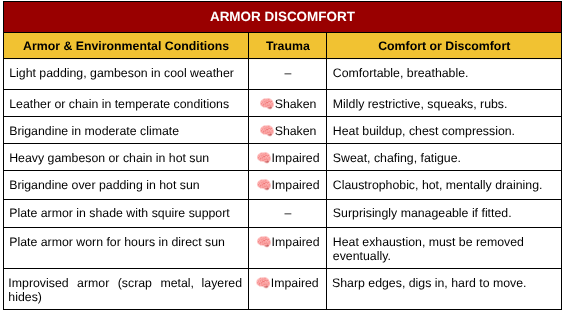
Armor can become physically and psychologically taxing when worn too long under difficult conditions. Heat, exhaustion, restricted movement, pressure, chafing, claustrophobia, poor ventilation, inability to rest comfortably, and similar circumstances may eventually inflict 🧠Mental Trauma according to the Armor Discomfort guidelines. Simply wearing armor does not immediately cause Mental Trauma. Ordinary armor under reasonable conditions does not psychologically injure someone merely by being worn. Armor Discomfort applies only when conditions persist long enough, or become severe enough, to cause genuine physical or psychological distress. The Game Master should consider how long the armor has been worn; temperature and weather; exertion; fit; restricted breathing or movement; whether the armor can be loosened or removed; and whether the situation is severe enough to justify Mental Trauma. Trauma caused solely by Armor Discomfort does not count as exposure toward any 🏅Immunity Badge unless the surrounding circumstances independently qualify as one of the Twelve Horrors.
🎬 Example — Stacking Armor
Determined to confront the Lich-King alone, Kade arrives wearing a quilted gambeson beneath a mail hauberk, brigandine crammed over the mail, a heavy leather coat over the brigandine, pieces of plate strapped across several vulnerable areas, a helmet, metal greaves, and an enormous shield. Kade is apparently attempting to defeat death through wardrobe. His gambeson is legitimate Foundation Armor, but his mail hauberk, brigandine, and heavy leather coat all attempt to provide Main Armor over some of the same areas, so their Armor Ratings do not simply pile together. Only one Main Armor layer contributes AR over a particular portion of his body unless a specific equipment entry permits otherwise, while his legitimate Additional Protection and shield can still contribute normally where their Coverage applies. Unfortunately, all the armor that does not increase Kade’s AR still possesses weight, bulk, straps, heat, and an inconvenient relationship with human anatomy. The Game Master rules that Kade’s absurd arrangement is seriously restrictive, imposing +2 Disadvantage on appropriate 🌈Reflexes PRISM and 🌈Physical Performance PRISM Tests and reducing Speed by 2. Stealth is effectively impossible under the circumstances. After several hours beneath the hot sun, the accumulated heat, exhaustion, restriction, and claustrophobia also inflict 🧠Impaired Mental Trauma according to the Armor Discomfort rules. Kade has therefore discovered an important principle of armor design: wearing more armor is not necessarily the same thing as having more Armor Rating. The Lich-King then attacks with a combination of 🌑Darkness and ✨Arcane/Psychic force. Kade’s mountain of ordinary armor provides no protection merely because there is an impressive amount of it; those supernatural Damage Types use their own applicable defenses. Kade staggers beneath the attack, overheated and exhausted, drops his enormous shield, and discovers that climbing the throne steps may be more difficult than fighting the creature sitting at the top of them. As Kade pauses to wheeze, sweat running beneath his helmet, one of his unnecessary pieces of armor works loose and crashes down the stone steps. He attempts to bend over and retrieve it, discovers that bending over has become more of a philosophical concept than a physical possibility, loses his balance, and collides with a pillar with the sound of a collapsing armory. The Lich-King rests his chin upon one hand and patiently waits for Kade to perish, pass out, or reconsider his equipment choices.
Armor Wear, Damage & Repair
Armor does not use a separate durability track and ordinary battle wear is not counted blow by blow. Scratches, dents, loose straps, torn padding, chipped surfaces, and a few damaged links are normal consequences of use and are usually handled through routine maintenance. After a mission involving significant combat, armor should normally receive cleaning, adjustment, and minor repair before the next mission. Such maintenance does not require the Game Master to track individual impacts. Armor becomes mechanically important to track when its protective structure has actually deteriorated.
Compromised Armor
Armor becomes Compromised when one of the following occurs:
- Repeated 🩸Severe attacks strike the same protected area and cause enough accumulated damage to meaningfully deteriorate that material.
- A 💀Critical attack strikes a location protected by armor, the Damage Type could reasonably damage that material, and the attack actually causes enough structural damage to reduce the armor’s protective effectiveness.
- The armor is struck by an effect specifically capable of destroying or degrading equipment, such as strong acid, intense fire, crushing machinery, or a similar hazard.
- The armor suffers prolonged abuse that would clearly damage it, such as being dragged beneath a wagon, crushed under falling stone, immersed in corrosive liquid, or exposed to sustained supernatural destruction.
- A rule, Spell, creature ability, weapon effect, or other game effect specifically states that armor is damaged.
A qualifying Compromise reduces the armor’s applicable Armor Rating by 1 point in the affected area until repaired. Compromise affects only the Damage Type or Types logically impaired by the damage. It does not automatically reduce every Armor Rating the item possesses.
For example, armor providing AR 3 against a Damage Type becomes AR 2 after one qualifying Compromise, then AR 1 after another. At AR 0, it provides no meaningful protection against that Damage Type until repaired.
As a general rule, each 💀Critical Hit that the armor meaningfully absorbs will reduce the relevant Armor Rating by 1 when the attack actually damages enough of the protective material to reduce its effectiveness. A Critical Hit therefore does not automatically damage every kind of armor in the same way.
Damage Type & Material Interaction
The Game Master should consider what actually happened to the armor. A sword point that pierces a plate breastplate and inflicts a 💀Critical Wound may leave only one narrow opening in the metal. The wearer may have been gravely injured without the breastplate as a whole becoming meaningfully less protective. The same is true of an arrow or crossbow bolt that punches one small hole through plate. A single puncture does not suddenly destroy the protection provided by the rest of the chest piece.
By contrast, a powerful war hammer strike might cave a broad section of plate inward, deform its shape, break fastenings, interfere with movement, or leave a deep depression that prevents the armor from distributing later impacts correctly. Such damage can meaningfully reduce the armor’s effectiveness and therefore justify Compromise.
Other Damage Types may harm armor differently. Strong acid may dissolve or weaken a wide area. Intense 🔥Fire may destroy padding, leather straps, bindings, adhesives, or other vulnerable components even when metal survives. Crushing force may warp rigid armor or destroy supporting structures. Supernatural attacks may affect equipment according to their own rules. The important distinction is between injury to the wearer and structural damage to the armor. They often occur together, but one does not automatically prove the other. A tiny puncture, shallow dent, surface cut, or localized scratch may leave the armor mechanically unchanged. A smashed, torn, burned, dissolved, split, badly deformed, or structurally weakened section usually does not.
Localized Damage
Armor damage is physical and contextual. Damage to one portion of an armor piece does not automatically reduce protection everywhere that item is worn. Several broken links in one small area of a mail shirt may affect only that portion. A puncture in the right side of a breastplate does not reduce protection over the left side merely because both areas belong to the same item.
Conversely, damage to a structurally important component may affect a much larger area. A broken suspension strap may cause a breastplate to hang incorrectly. Destroyed lacing may loosen several rows of lamellar plates. A damaged articulation may prevent an arm or leg harness from remaining correctly positioned. The Game Master determines what has actually been damaged and which Hit Locations or portions of Hit Locations are affected.
Broken Armor
Armor becomes Broken when damage is so extensive that the affected piece can no longer reasonably perform its protective function. Broken armor provides no Armor Rating where it can no longer function until repaired or replaced. An entire item need not always become Broken at once. If only one section has been catastrophically destroyed while the rest remains functional, the Game Master may treat only the affected Coverage as Broken.
Armor Construction Examples
The following examples illustrate how the general degradation rules apply to common armor constructions. They do not replace the rules above.
Padded or Quilted Armor
Padded armor can absorb numerous ordinary impacts without losing protection. It may become Compromised when blades repeatedly cut deeply through its layers, 🔥Fire burns away substantial material, crushing force destroys its padding, or one particularly destructive 🩸Severe or 💀Critical attack tears apart enough of the garment to reduce its protection. Extensive tearing, burning, shredding, or destruction of its supporting structure can make it Broken.
Leather Armor
Leather armor normally survives routine combat with cuts, abrasions, scuffs, and minor strap damage.
A powerful 🩸Severe attack that tears deeply through a broad area, repeated penetration concentrated in one place, substantial 🔥Fire, strong ☠️Chemical exposure, or destruction of important straps may Compromise it. Large tears, extensive burning or corrosion, or failure of the structure holding the armor in place may make it Broken.
Mail can withstand many sword cuts and ordinary weapon strikes with little loss of protection. A few broken links are ordinary repair work. Compromise becomes appropriate when a powerful penetrating or crushing attack bursts enough rings to create a meaningful weakness, repeated 🩸Severe penetrating or crushing blows enlarge an existing damaged area, or a 💀Critical attack causes substantial link failure. Widespread tearing, extensive ring failure, or destruction of the garment’s supporting structure may make it Broken.
Scale or Lamellar Armor
Scale and lamellar armor can withstand many ordinary blows. Individual damaged scales, plates, cords, or laces are normally replaced during maintenance. Compromise may occur when repeated Severe or Critical impacts deform numerous plates, break enough lacing to loosen a section, or cause a significant portion of the armor to separate. Extensive loss of plates, widespread broken lacing, or destruction of the underlying supporting structure may make it Broken.
Plate Armor
Plate is highly resistant to becoming useless through ordinary weapon strikes. It may survive numerous sword blows, arrows, dents, and lesser impacts without losing Armor Rating. A single narrow puncture from a blade, arrow, or bolt does not normally Compromise an entire plate merely because the attack wounded the wearer. Plate is more likely to become Compromised when a 🩸Severe or 💀Critical strike from a war hammer, polearm, lance, crushing impact, or similarly destructive attack badly deforms a substantial area; when repeated heavy blows accumulate comparable damage; when a joint or articulation is crushed so the armor cannot move correctly; when important fastenings fail; or when heat, corrosion, or supernatural destruction substantially weakens the material. Plate should rarely become Broken through ordinary combat alone. Catastrophic crushing, extensive structural failure, destruction of supporting straps or garments, extreme heat, severe corrosion, or several devastating attacks may be required.
Repairing Armor
Repairs restore lost Armor Rating when the damage has been properly corrected. The required Skill, tools, materials, workspace, and time depend upon the armor and the nature of the damage. Replacing a few mail links may be straightforward for someone with the proper equipment, while restoring a crushed breastplate, rebuilding burned padding, replacing elaborate lamellar lacing, or repairing supernatural armor may require considerably greater resources. Routine maintenance handles ordinary wear. Compromised or Broken armor requires actual repair before its lost protection returns.
🛡️Shields
A shield performs two different defensive functions in Kingsmark:
- It is a tool used for Shield Combat.
- When it physically intercepts an attack, it functions as an additional Armor Layer between the attack and the character.
These functions are related but mechanically distinct. A shield does not automatically provide its Armor Rating merely because the character possesses one. The defender must use Shield Combat, the shield must be ready, and it must actually be capable of intercepting the attack.
Equipping a Shield
A shield occupies one hand unless a specific item or rule states otherwise. The player should declare whether the shield is equipped on the right side or left side. If no side has been declared, it is considered equipped on the left side. Shield equipment entries present their Hit Location Coverage and Armor Ratings as though the shield were equipped on the left side. When equipped on the right, simply reverse all right-side and left-side Hit Locations and their corresponding Armor Ratings. A shield naturally protects the side on which it is equipped more effectively than the opposite side. Whenever a shield provides Coverage to a Hit Location on the opposite side of the body, reduce the shield’s applicable Armor Rating by 1, to a minimum of AR 0. This reduction affects only the shield. Worn armor protecting that Hit Location continues to function normally. Central Hit Locations receive the shield’s listed Armor Rating unless the individual shield entry states otherwise.
Shield Combat & Armor Rating
A shield’s Armor Rating applies only when the shield actually intercepts the attack. Resolve shield protection through the normal Attack Sequence:
- Resolve the attack roll normally.
- If the defender is eligible for a Defense Roll and chooses Shield Combat, resolve that Defense Roll.
- Calculate Damage escalation and apply the weapon’s Critical Threshold.
- Apply any Damage reduction specifically allowed by the Defense Roll.
- Determine the Hit Location.
- Determine whether the shield actually intercepted the attack.
- If it did and the shield possesses Armor Rating against that Damage Type, apply the shield’s Armor Rating.
- Apply any worn armor physically protecting the struck Hit Location.
A shield functions as an additional Armor Layer when it successfully intercepts an attack. It does not replace worn armor or alter the normal Attack Sequence. For example, a warrior uses a Medium Shield providing 🗡️Blades & Spikes AR 2 to defend against a sword strike. In melee combat, the Shield Combat Defense Roll determines whether the attack hits; it does not separately reduce Damage. If the attack hits and the shield physically intercepts the blow, its Armor Rating reduces Damage by two levels. Any remaining Damage may then be reduced by legitimate worn armor covering the struck Hit Location. Against ranged attacks, a successful Shield Combat Defense Roll can reduce Damage before the shield’s Armor Rating is applied. If all applicable reductions take Damage below 🩸Minor, the attack causes no Physical Wound. This is intentionally powerful. A substantial shield deliberately placed between a weapon and the body should usually be safer than allowing the weapon to strike worn armor directly.
Shield Coverage
Shield Coverage depends upon the shield’s size and construction and is specified in its equipment entry. Every shield lists its Normal Coverage, representing the Hit Locations it naturally protects while held in an ordinary fighting position. Listed Coverage limits protection, although shields can move. Shields move. A defender may raise a shield toward the Head, lower it toward a Leg, turn it toward an incoming projectile, or sweep it across the body when such movement is physically plausible. The equipped side matters most when the defender attempts to intercept an attack near the limits of that Coverage. A shield held on the left naturally favors the left side. Bringing it across to a covered right-side location may require more favorable positioning, particularly when the attack comes from the defender’s right.
Shield Coverage should not become a geometry exercise. When interception is uncertain, the player briefly explains how the shield is being brought between the attack and the character. The Game Master considers the shield’s size, equipped side, direction of attack, positioning, awareness, available movement, and circumstances, then determines whether interception is physically possible. A shield cannot provide Armor Rating against an attack it could not reasonably intercept. This commonly includes:
- attacks from behind;
- attacks the defender is unaware of;
- attacks occurring while the shield cannot be brought into position;
- attacks against locations physically beyond the shield’s possible protection;
- or situations in which another rule prevents Shield Combat.
A shield also provides no protection when it has been dropped, is Broken, is not ready for use, or otherwise cannot function as a shield.
Shields as Weapons
A shield may also be used aggressively. A character may slam, shove, pin, crowd, drive, or otherwise manipulate an opponent with a shield whenever the action makes physical sense. When the shield is particularly well suited to the attempted action—such as intercepting a charging opponent, driving someone backward, forcing someone away from a doorway, or using a large shield to control space—the Game Master may grant −1 Advantage to the appropriate Test. This is not an automatic bonus to every Shield Combat action. It applies only when the shield’s physical properties genuinely make the attempted action easier. Conversely, a shield may impose +1 Disadvantage when its bulk genuinely interferes with another activity. A large shield might hinder climbing, squeezing through a narrow opening, acrobatics, delicate manipulation, or another action requiring considerable bodily freedom or both hands. Do not apply Disadvantage merely because a character carries a shield. Shields are equipment intended for warfare and adventuring. The penalty exists only when their physical bulk actually matters.
Shield Wear & Damage
Shields are built to be struck. Do not Compromise a shield merely because it blocks several attacks. Sword cuts, dents, scratches, embedded arrows, chipped edges, splintered faces, and similar battle damage are ordinary consequences of use and are normally handled through routine repair. Shields nevertheless receive more direct punishment than worn armor because the wielder deliberately places them in the path of incoming attacks.
Compromised Shields
A shield becomes Compromised when its protective ability has clearly declined. A Compromised shield loses 1 point of applicable Armor Rating until repaired. When damage clearly affects only part of the shield, the Game Master may limit the reduction to the Coverage that depends upon that damaged portion. Examples include:
- boards beginning to split apart;
- a substantial portion of the rim being destroyed;
- major cracks around the boss or grip;
- serious deformation of metal reinforcement;
- loosened or partly torn straps;
- or other structural damage that makes the shield less effective or more difficult to control.
A 💀Critical attack that the shield meaningfully absorbs will often Compromise it by 1 Armor Rating when the attack actually causes enough structural damage to reduce the shield’s protective effectiveness. A Critical Hit does not automatically destroy a shield. A sword point or arrow may create one narrow hole while leaving the shield fully useful. By contrast, a Critical axe strike might split several boards, while a war hammer or mace could crush the boss, deform reinforcement, or damage the grip assembly badly enough to reduce protection. Damage Type and construction matter.
A sturdy shield may survive many sword blows while becoming badly scarred. Arrows may pierce the face without destroying its structure. Heavy axes can split boards or sever rims. War hammers and maces can crush bosses, warp reinforcement, or damage grips. Poleaxes, halberds, and other powerful weapons may tear apart edges or drive structural cracks through the shield. Fire can char or burn away wooden construction. Strong acid may destroy wood, hide, glue, nails, rivets, straps, or metal fittings. Extraordinary punishment may also Compromise or destroy a shield rapidly, including being crushed beneath falling stone, pinned under a wagon, struck by siege weapons, trampled by an enormous creature, or exposed to sustained supernatural destruction.
Broken Shields
A shield becomes Broken when it is no longer practically capable of functioning as a shield. A Broken shield provides no Armor Rating and ordinarily cannot be used for Shield Combat until repaired or replaced. The Game Master does not need to count impacts. Ask: Can this object still be held securely and placed between the character and an incoming attack as a substantial protective barrier? If yes, it is not Broken. A shield can look terrible—scarred, dented, pierced, splintered, blood-soaked, and bristling with broken arrows—and remain entirely usable. A shield becomes Broken when something structurally important has failed: it splits apart, collapses around the grip, loses the handle or straps required to control it, has a large portion of its face smashed away, or becomes so extensively warped, burned, dissolved, or shattered that it no longer presents a meaningful barrier. A shield that absorbs a devastating attack and remains usable has done exactly what a shield is supposed to do. Destruction should follow from actual structural failure, not merely from the fact that the attack was powerful.
Creating Unlisted Armor
When creating armor not already listed in the equipment rules, begin with the physical object rather than its desired statistics. First, determine exactly which Hit Locations the item covers. Next, determine its construction and compare it with the Standard Armor Constructions. Assign Armor Ratings only against Damage Types that the item can physically and reasonably resist. If the armor protects only part of one of Kingsmark’s twelve Hit Locations, list that Hit Location as its ordinary Coverage and describe the item’s physical limitation. The Partial Coverage rules handle attacks that specifically establish an uncovered portion. Then assign the item to the appropriate Armor Layer:
- Foundation Armor
- Main Armor
- Additional Protection
If the item is a shield, use the shield rules instead. Consider whether the item is intended to function with armor worn above or beneath it. Legitimate layered armor can be extremely effective because applicable Armor Ratings add together, but multiple pieces from the same Armor Layer do not stack unless a specific equipment rule creates an exception. Finally, determine Cost and Availability by comparing the quantity and quality of material, workmanship, fitting, rarity, and specialized labor required with similar listed equipment. Do not increase an item’s Coverage merely because doing so would make it more convenient. Armor protects what it physically covers unless magical, supernatural, or other extraordinary properties explicitly state otherwise.
💋 Hotness Bonus
A 💋Hotness Bonus represents the situational social advantage an attractive adult woman may gain by deliberately using revealing, provocative, or sexually suggestive presentation to influence someone who finds her attractive. It is not mind control, does not replace role-playing, and does not make every observer susceptible. The target must also be capable of attraction to her and reasonably susceptible under the circumstances.
Hotness Bonus normally applies as situational Advantage during 🗨️Dialog Scenes involving:
- 💋 Flirtation or seduction.
- 💋 Persuasion or bargaining in which attraction could realistically influence the other person.
- 💋 Deliberate social distraction.
- 💋 Drawing or holding someone’s attention.
- 💋 Encouraging an attracted person to approach, linger, boast, show off, reveal information, 💋 take a foolish risk, or underestimate her.
- 💋 Negotiation when personal attraction could reasonably soften the target’s position.
- 💋 Creating a distraction immediately before combat.
- 💋 Manipulating an enemy into watching her rather than another member of the party.
- 💋 Provoking an attracted and poorly disciplined opponent into reckless behavior.
- 💋 Concealing hostile intent behind flirtation or apparent vulnerability when the circumstances support it.
- 💋 Feigning romantic or sexual interest to encourage an attracted person to lower their guard or become less suspicious.
The existing Kingsmark distinction still applies: Attractiveness determines appearance; Social Skills determine deliberate influence. A Hotness Bonus therefore normally modifies the appropriate social interaction rather than replacing the character’s Social Skills.
Hotness Ratings
- 💋 -1 Advantage — Provocative: An armored bra, skimpy armored short skirt, revealing warrior harness, low-cut or very revealing battle attire, or a comparable deliberately sexy presentation.
- 💋 -2 Advantage — Extremely Revealing: An armored bikini bottom, a complete armored-bikini presentation, or similarly extreme battle attire.
- 💋 -3 Advantage — Scandalously Revealing: Clothing or an outfit so minimal that the overall presentation is barely distinguishable from being disrobed for purposes of deliberately exploiting sexual attraction. -3 is the maximum Hotness Bonus obtainable from clothing or worn garments.
- 💋 -4 Advantage — Disrobed: Deliberately disrobing to exploit sexual attraction is an exceptional circumstance rather than ordinary clothing and can provide -4 Advantage when the target is actually susceptible.
Hotness Bonuses from multiple garments do not stack beyond -3. The -4 Disrobed bonus is an explicit exception to the normal -3 maximum obtainable from clothing.
Susceptibility
A 💋Hotness Bonus applies only when attraction actually matters. The Game Master should consider the target rather than assuming that every male reacts identically. Human enemies and other humanoids of Level 3 / Terror 3 or higher are normally too experienced, disciplined, or dangerous to suffer a Hotness Bonus merely because an attractive woman is provocatively dressed. An individual exception may exist when such a character is specifically established as unusually lustful, undisciplined, infatuated, intoxicated, or otherwise susceptible. Lower-Level opponents may be considerably easier to distract or manipulate, but the bonus is never automatic when the fiction makes attraction irrelevant.
Many non-Human humanoids may find one or more Human Types attractive. Species alone therefore does not determine susceptibility.
A target may also be entirely unaffected because of sexual preference, personal loyalty, discipline, religious conviction, cultural standards, professional training, existing hostility, immediate mortal danger, or simple lack of interest. A highly disciplined religious guard might regard sudden disrobing as offensive or disgraceful rather than enticing; another man might be stunned into staring. The Game Master portrays the individual.
👙Hotness in Combat
Revealing armor creates a deliberate tradeoff. A warrior sacrifices Coverage in exchange for mobility, appearance, and the possibility of social or psychological leverage.
A 💋Hotness Bonus does not impose a universal combat penalty upon male enemies. Instead, it can provide Advantage when the woman actually attempts something that exploits attraction: distracting a guard before drawing a weapon, persuading an enemy to come closer, inducing a sentry to lower his suspicion, encouraging a boastful fighter to underestimate her, holding someone’s gaze while an ally moves into position, or provoking an undisciplined opponent into making a foolish decision.
Once blades are swinging, attraction does not automatically make attacks miss. The character must still exploit it through an appropriate action or 🗨️Dialog Scene interaction. This is particularly appropriate for characters such as thieves, spies, assassins, performers, courtiers, and Kunoichi (female ninja) who deliberately weaponize appearance, charm, apparent vulnerability, or flirtation before violence begins.
Unwanted Attention
A Hotness Bonus can attract attention the character did not intend to receive. An attractive woman dressed provocatively may be stared at, approached, flirted with, propositioned, remembered, followed, challenged, underestimated, or otherwise singled out by susceptible people. That attention is a narrative consequence, not permission for the Game Master to remove the character’s agency. An obnoxious lunkhead may decide that the beautiful warrior in the armored bikini deserves his attention; she remains entirely free to reject him, humiliate him, walk away, threaten him, or cut him down.
The central principle is simple: revealing armor provides less physical Coverage because it physically covers less of the body, while deliberate sexual presentation can sometimes provide social Advantage against susceptible observers. Neither benefit nor drawback exists independently of the circumstances.
🎯 Multiple Hit Locations
Most successful attacks strike one 🎯Hit Location and produce one Damage result. Multiple Hit Locations are intended to occur in combat when the attack genuinely supports them, but they are not something that must be checked for after every ordinary hit. Unless one of the following circumstances applies, determine one Hit Location and resolve the attack normally.
An attack may strike multiple Hit Locations when:
- The Action being used specifically attacks, strikes, or threatens multiple targets or Hit Locations.
- The attack reaches a 💀Critical Damage Level after the Defense Roll but before 🛡Armor is applied, and the weapon, direction of attack, positions of the combatants, and trajectory clearly indicate that the attack continues from one Hit Location into another.
- Even without 💀Critical Damage, the established physical nature of the attack makes multiple Hit Locations undeniable rather than merely possible. An explosion engulfing much of a body, a whip visibly lashing across or wrapping around multiple parts of the body, a collapsing object covering several locations, or another similarly broad attack may qualify.
A 💀Critical result does not automatically create multiple Hit Locations. It merely makes such an injury possible when the attack’s actual path supports it. A sword thrust into an unobstructed abdomen normally remains one 👕Lower Torso hit even when it causes 💀Critical Damage. A sword driven through one leg and into the other, a spear passing through an intervening arm and entering the torso, or a downward weapon strike continuing from the head into the shoulder may affect two locations because the weapon’s path actually crosses them. Consider what the weapon physically is and what it is doing—not whether it possesses a special game statistic permitting multiple hits.
Likewise, the fact that an attack could conceivably have touched another body part is not enough. Non-Critical attacks should affect multiple locations only when doing otherwise would contradict the established event. This standard is intentionally stricter than simple possibility. A player cannot say that his sword “also catches the arm,” that his arrow “passes through into the chest,” or that his attack follows some especially favorable trajectory merely to gain another wound or avoid armor. Player description does not establish additional Hit Locations any more than ordinary description allows a player to select the original Hit Location. The Game Master determines additional locations from the Action being used and the physical circumstances already established in the scene.
When one Damage result affects multiple locations, do not apply the full Damage Level to every location. For purposes of dividing that single result, treat 🩸Minor as 1 Damage Point, 🩸Moderate as 2, 🩸Severe as 3, and 💀Critical as 4. The total number of Damage Points cannot increase merely because more than one location was struck.
First establish which locations the attack actually strikes and the path or pattern of the attack. Do this before considering which locations possess better or worse 🛡Armor. Then distribute the Damage Points according to what physically happened.
When one location clearly suffers the main impact and the others are secondary contacts, penetrations, or continuations, each secondary location normally receives 1 Damage Point and the primary location receives the remaining points. Thus, a 💀Critical sword thrust that passes completely through one 🦵Leg and only sticks into the other may cause 🩸Severe Damage to the first Leg and 🩸Minor Damage to the second. A 🩸Severe attack continuing from one significant location into a second would normally become 🩸Moderate and 🩸Minor.
When two or more locations clearly receive approximately comparable portions of the attack, divide the Damage Points as evenly as possible. A 💀Critical impact that substantially strikes two locations may therefore become two 🩸Moderate Damage results. A nunchaku attack in which one part of the weapon strikes an upraised ✋Hand while another part of the same motion lands solidly across the 👨Head could justify such a division if neither impact is clearly secondary. Likewise, a broad crushing blow that catches the 💪Shoulder & Arm and 👕Upper Torso with approximately equal force may reasonably divide its Damage between both locations rather than assigning nearly all of it to one.
The attacker does not choose whichever distribution is mechanically most favorable. Determine whether there is a primary impact, which locations are secondary, and whether the force was meaningfully shared from the established motion of the attack. The description of the attack, direction of travel, position of the target, and actual way the weapon contacts the body should guide this determination. When the evidence does not clearly justify multiple locations, use one Hit Location. When it establishes multiple locations but does not establish an unequal primary and secondary impact, divide the Damage as evenly as possible. If an indivisible remainder exists, assign it to the primary Hit Location; if there truly is no distinguishable primary location, determine which otherwise-equivalent location receives the remainder randomly. Do not invent a primary location afterward merely because one location has weaker armor or would produce a more useful injury.
Every mechanically affected Hit Location must receive at least 1 Damage Point. A single Damage result therefore cannot produce more Physical Wounds than it possesses Damage Points. 🩸Moderate Damage can produce at most two 🩸Minor wounds, 🩸Severe can affect at most three locations, and 💀Critical can affect at most four. An attack may physically brush, splash, graze, or contact additional areas, but those contacts produce no separate Physical Wound unless at least 1 Damage Point can be assigned to them. Such incidental contact may still be mentioned descriptively without creating another recorded wound. An Action that creates several completely separate attacks or Damage results resolves each of those results separately rather than combining all of them into one Damage pool.
After the Damage Points have been distributed, convert each portion back into its Damage Level and resolve 🛡Armor separately for every Hit Location struck. Armor protects locations rather than the character in the abstract, so only the Armor Rating actually protecting that particular location against the relevant Type of Damage reduces that portion of the attack. Do not total the target’s armor, average armor across the affected locations, or apply one location’s protection to another. A heavily armored location may therefore stop its portion of the attack while an adjacent, lightly protected location is still wounded by its own portion. If armor reduces a location’s portion below 🩸Minor, that location suffers no Physical Wound.
When later Hit Locations depend upon the attack physically passing through an earlier location, resolve those locations in trajectory order. If protection on an earlier location completely stops its assigned Damage by reducing it below 🩸Minor, the weapon does not continue through that protected location into later locations whose only justification was penetration through it. Those later penetration-dependent hits are lost. This does not cancel other portions of an attack that reached their locations independently, such as different parts of an explosion or separate projectiles generated by an Action. The question is whether the later hit depended upon the earlier penetration or had an independent path to its target. Multiple Hit Locations should therefore follow the event rather than manufacture it. A 💀Critical hit creates the opportunity for a sword, spear, hammer, arrow, bullet, nunchaku, or virtually any other suitable weapon to produce a realistic path through more than one part of the body. Broad attacks may make multiple locations unavoidable even without a Critical result, and particular Actions may deliberately produce attacks against several locations or targets. In every case, establish what the attack physically did, conserve the original Damage, apply 🛡Armor separately to each affected location, and resolve only those additional wounds that the Action and the established physical circumstances actually justify.
Recording Damage
When a wound has a corresponding modifier it means that all actions will have that modifier applied. It also means that players should logically adjust how their character acts or behaves according to the location and severity of the wound. Additionally, the Game Master should consider any appropriate additional effects, such as the character’s Speed being affected. The letter “P” in parentheses (P) is used to notate permanent trauma. The examples of permanent injuries are representative rather than exhaustive; the Game Master determines the permanent consequence appropriate to the injury.
Permanent Wounds
Permanent injuries are campaign scars, not extra damage. Surviving a Severe or Critical wound does not guarantee full recovery. Poor care, infection, or overwhelming trauma can leave lasting conditions that permanently alter how a character moves, fights, and lives. Survival is possible—but it always has a cost. Permanent wounds should emerge from the fiction and matter in play. Reduced movement, higher Target Numbers for exertion, impaired senses, visible disfigurement, or reliance on prosthetics are not penalties—they are continuity. These effects turn near-death moments into long-term story consequences that shape identity: the veteran who limps, the marksman with one eye, the fighter who lives with pain. For the Game Master, permanent injuries set tone and pacing. They slow reckless play, justify downtime, and give weight to medical scenes. If a permanent wound feels like bookkeeping, it’s being used wrong. It should create obstacles, force adaptation, and follow the character for the rest of the campaign.
🩸Minor — Never Permanent
Minor damage includes superficial injuries such as bruises, scrapes, shallow cuts, and minor sprains. These injuries heal fully with time and require no serious medical intervention. They cause no lasting impairment, never justify prosthetics, and should not create permanent mechanical effects. Minor damage only matters when it escalates into higher damage levels and is otherwise always temporary.
🩸Moderate — Usually Not Permanent
Moderate damage includes deeper cuts, cracked bones, torn muscle, and notable blood loss. These injuries usually heal completely but require proper medical care and recovery measured in weeks or months. Permanent effects are possible but uncommon, typically resulting from poor treatment, infection, or repeated trauma. When present, they are minor, such as stiffness, chronic pain, reduced flexibility, or scarring. Prosthetics are rarely justified at this level.
🩸Severe — Life-Altering Permanent Injuries
Severe damage covers disabling trauma such as broken limbs, punctured organs, crushed joints, and massive blood loss. Serious medical intervention is mandatory, often involving surgery or extended care. Recovery is long, frequently lasting months, with expected functional impairment. Permanent damage is common, including reduced mobility, nerve damage, chronic pain, organ impairment, or partial loss of function. Prosthetics may be required, especially after catastrophic joint or nerve damage.
💀Critical — Always Permanent Damage
Critical damage represents catastrophic, near-fatal injuries such as organ destruction, traumatic brain injury, severed arteries, or amputation. Survival is uncertain and requires immediate skilled medical care. Recovery is measured in months or years, and permanent impairment is expected. Survivors often suffer limb loss, paralysis, sensory loss, cognitive impairment, or dependence on assistive devices. A full recovery should be treated as a rare exception, justified only by extraordinary care, rare magic, or significant narrative weight.
Permanent Injuries & Mental Trauma
Permanent physical injuries may also cause 🧠Mental Trauma. The Mental Trauma listed with each injury represents the normal psychological severity and recovery progression associated with that specific injury. These durations are guidelines rather than universal rules for a Trauma Level. The Game Master may shorten, extend, or otherwise alter the progression according to the circumstances of the injury, the character’s experiences, successful ❤️Healing Scenes, adaptation, regained independence, relationships, spiritual development, or other events that logically affect recovery.
Recovery does not require the character to forget the injury, cease grieving what was lost, or return emotionally to exactly who they were before. A hero may adapt successfully while still carrying sorrow, frustration, altered habits, or a changed sense of identity. Likewise, setbacks may occur when the injury causes new limitations, humiliation, dependence, pain, or frightening reminders of the original event. These developments can reasonably slow or temporarily reverse recovery when the fiction supports it.
Trauma caused by other events may have entirely different durations even when it has the same Trauma Level.
Internal Permanent Injury Examples
🫀Cardiac Weakness
Typical Causes: Severe illness, damage to the heart, prolonged malnutrition, poisoning, or complications from major blood loss.
Impact Upon Gameplay: Extended exertion tests +1 TN; forced marches risk Weary; extreme exertion or sudden stress may trigger symptoms. 🧠Impaired (6 months, then Shaken for 6 months)
Immediate Effects: Sudden dizziness, weakness, or chest tightness; +2 TN to physical actions for the remainder of the Scene when triggered by extreme exertion or stress; the character may be forced to stop and recover for one Turn.
🫁 Reduced Lung Capacity
Typical Causes: Severe respiratory illness, prolonged smoke inhalation, chest trauma, lung infection, or scarring from fire or toxic fumes.
Impact Upon Gameplay: Running/climbing tests +1 TN; smoke/fog impose an extra +1 TN; breath-hold time halved. 🧠Impaired (6 months, then Shaken for 6 months)
Immediate Effects: Coughing fit or breath panic; +2 TN to actions requiring speech, sprinting, or sustained exertion for the remainder of the Scene; may lose one Turn in smoke or choking conditions.
💧Compromised Kidney Function
Typical Causes: Severe dehydration, poisoning, infection, crushing injury, or exposure to certain toxic substances.
Impact Upon Gameplay: Dehydration progresses faster; poison and drug recovery +1 TN. 🧠Impaired (6 months, then Shaken for 6 months)
Immediate Effects: Cramping, weakness, or nausea; +1 TN to exertion tests for the remainder of the Scene when severely dehydrated; the character may immediately become Weary under extreme dehydration (Game Master’s discretion).
☠Liver Damage
Typical Causes: Poisoning, prolonged heavy alcohol use, severe infection, toxic substances, or abdominal injury.
Impact Upon Gameplay: Recovery from poisons +1 TN; fatigue accrues faster on long journeys or missions. 🧠Impaired (6 months, then Shaken for 6 months)
Immediate Effects: Dizziness, nausea, weakness, or shaking hands; when exposed to toxins, apply +1 TN to all actions for the remainder of the Scene; failure of a poison recovery test may escalate the consequences one level (Game Master’s discretion).
🩸Chronic Anemia
Typical Causes: Severe or repeated blood loss, chronic illness, malnutrition, or damage affecting blood production.
Impact Upon Gameplay: Physical Performance tests +1 TN after the first Scene of exertion unless the character rests or receives appropriate treatment. 🧠Shaken (6 months, then fades)
Immediate Effects: Lightheadedness and rapid fatigue; after any burst of exertion, apply +2 TN to the next physical action; pushing beyond this may immediately cause Weary (Game Master’s discretion).
🤕Post-Sepsis Weakness / Chronic Pain
Typical Causes: Survival of severe infection or sepsis, major wounds, nerve damage, extensive scarring, or lasting complications from catastrophic illness.
Impact Upon Gameplay: On a long travel day, roll 1d12; on 1–2 gain Weary. Medicine, adequate rest, or other appropriate treatment may suppress this effect (Game Master’s discretion). 🧠Impaired (1 year, then Shaken for 1 year, then fades)
Immediate Effects: Weakness or a severe pain flare; +1 TN to physical actions for the remainder of the Scene; sprinting, climbing, or fighting through the episode imposes +2 TN to the next exertion test.
External Permanent Injury Examples
🖐Loss of Hand
Impact: Tasks needing two hands are not possible without adaptation; two-handed weapons/tools unusable without a rig; climbing/grappling at +2 TN unless adapted. 🧠Impaired (6 months, then Shaken for 6 months)
Immediate Effects: Drop held item; immediate shock; heavy bleeding unless treated; +2 TN to all actions until first aid is applied (Game Master’s discretion if R.A.D. is triggered by blood loss).
🦶Loss of Foot
Impact: Base travel pace −25%; sprinting/jumping +2 TN; stairs/balance +2 TN; peg or brace reduces some penalties. 🧠Impaired (6 months, then Shaken for 6 months)
Immediate Effects: Fall prone; severe bleeding and pain; movement is reduced immediately; +2 TN to all physical actions until stabilized; may require immediate R.A.D. depending on blood loss.
👁Loss of Eyeball
Impact: Aimed ranged fire +1 TN; long-range perception +1 TN; depth-dependent maneuvers +1 TN. 🧠Impaired (1 year, then Shaken for 1 year)
Immediate Effects: Blood and disorientation; +2 TN to all actions for the remainder of the Scene; lose one Turn if the injury occurs mid-combat (Game Master’s discretion).
👂Loss of Ear
Impact: Hearing-based detection +1 TN; pinpointing direction of sound harder; “whisper reads” +1 TN in noise. 🧠Shaken (6 months)
Immediate Effects: Ringing and vertigo; +1 TN to all actions for the remainder of the Scene; ranged attacks may take an extra +1 TN until the character regains orientation.
💪Loss of Arm
Impact: Two-handed tasks are impossible without adaptation or suitable prosthetic; climbing is restricted; weapons, tools, and other activities requiring both arms cannot be used in their ordinary manner. 🧠Unstable (1 year, then Impaired for 1 year, then Shaken for 1 year)
Immediate Effects: Massive blood loss; immediate shock; drop held items; +2 TN to all actions until stabilized; likely immediate R.A.D. check (Game Master’s discretion).
🦵Loss of Leg
Impact: Base pace −50%; most athletic stunts +2 TN; a suitable prosthetic, mount, or other appropriate means of mobility can offset some of these limitations. 🧠Unstable (1 year, then Impaired for 1 year, then Shaken for 1 year)
Immediate Effects: Collapse; massive blood loss and shock; the character is prone and effectively immobile without help; likely immediate R.A.D. check (Game Master’s discretion).
🤕Severe Facial Disfigurement
Impact: Social checks may be +1 TN depending upon the culture and circumstances; masks or hoods may conceal the disfigurement; the character’s appearance may provoke fear, revulsion, sympathy, curiosity, or other reactions at the Game Master’s discretion. 🧠Unstable (1 year, then Impaired for 1 year, then Shaken for 1 year)
Immediate Effects: Pain and shock; impaired vision/tearing; +1 TN to actions requiring sight or speech for the remainder of the Scene; if acids/burns are active, +2 TN until treated.
🔥Severe Multi-Site Burns
Impact: Flexibility reduced; armor comfort issues; prolonged exertion tests +1 TN; heat/cold sensitivity. 🧠Impaired (1 year, then Shaken for 1 year, then fades)
Immediate Effects: Shock and high infection risk; +2 TN to physical actions for the remainder of the Scene; if the character continues strenuous activity, they risk immediate Weary and possibly R.A.D. depending on extent (Game Master’s discretion).
Cyborgs & Disfigurement
Permanent injuries are among the most serious consequences of violence. A character may survive a battle but leave it missing a hand, foot, eye, ear, arm, leg, or some other part of the body. Severe burns and facial injuries can likewise permanently alter a character. These consequences do not disappear when the 🎬Scene ends. The wound must heal, the character must adapt to any permanent loss of function, and the experience may also leave lasting 🧠Mental Trauma.
The loss of a body part imposes whatever physical limitations logically follow from that injury. A missing eye affects vision and depth perception; a missing hand prevents ordinary two-handed tasks; and loss of a leg drastically restricts movement until the character learns to compensate. These limitations remain after the original wound has healed unless adaptation, equipment, magic, or a prosthetic restores some portion of the lost function.
A prosthetic is an artificial replacement for a missing or impaired part of the body. In Kingsmark, ordinary prosthetics are crude by modern standards and are usually constructed from wood, leather, cloth, bone, horn, and metal. A wooden leg may allow an amputee to stand and walk again. A hook or fitted tool may restore some practical functions of a missing hand. Braces, splints, artificial feet, masks, false eyes, and specially constructed attachments may likewise compensate for permanent injuries. Their effectiveness depends upon craftsmanship, fit, training, and what the character is attempting.
An ordinary prosthetic does not create ⚙️Cyborg Condition merely because it replaces part of the body. A wooden leg, hook, artificial hand, or other mundane device that restores an approximation of ordinary function carries no Cyborg Condition Cost.
⚙️Cyborg Condition becomes mechanically important when a prosthetic is magically enhanced beyond ordinary biological capability. A wooden hand animated by enchantment might grip with supernatural Strength. A metal eye containing an enchanted crystal might see in darkness. An artificial leg carved with runes might permit extraordinary leaps. A hook might retract, reshape itself, cling to stone, or strike with unnatural force. Once a prosthetic begins granting abilities beyond what the character’s natural body could ordinarily accomplish, it has become an augmentation.
The term cyborg is deliberately broad in Kingsmark. A medieval adventurer with a wooden leg is not a technological cyborg in the modern scientific sense. However, when that artificial limb becomes permanently integrated with the character and magically performs beyond natural human capability, the distinction becomes mechanically similar to cybernetic augmentation: part of the character’s ordinary biological function has been replaced or surpassed by an artificial system.
⚙️CYBORG CONDITION COST
- Minor Augmentations: small magical sensory enhancement .1; improved grip, balance, precision, or movement beyond ordinary capability .1 to .2; minor enchanted functions that provide a real mechanical advantage .1 to .2.
- Moderate Augmentations: enchanted artificial eyes or ears .2 to .4; magically enhanced hands or feet .2 to .4; artificial organs or replacement parts performing beyond ordinary biological capability .3 to .7; substantial sensory or physical enhancements .3 to .5.
- Major Augmentations: magically enhanced artificial arms or legs .4 to .8; major increases to Strength, Speed, Dexterity, or perception .5 to 1.0; deeply integrated magical mechanisms .7 to 1.0; enchanted prosthetics containing powerful built-in weapons or extraordinary supernatural capabilities 1.0 or more.
These values are benchmarks rather than a universal catalogue. The Game Master assigns a Cost according to how extensively an augmentation exceeds ordinary biological capability. Particularly powerful enchantments may exceed a Cost of 1.0, while modest improvements may cost only .1 or .2. Multiple enhancements incorporated into the same prosthetic may each contribute to its total Cost. An artificial arm might restore ordinary arm function at no Cost while an enchanted grip, supernatural Dexterity, and a concealed magical weapon each contribute additional ⚙️Cyborg Condition Cost.
Track these values cumulatively. Whenever a character’s total ⚙️Cyborg Condition Cost reaches .5 or higher, it is treated as the next whole number for purposes of 🌬️Spirit. A character may possess up to .4 Cyborg Condition without losing Spirit. A total from .5 through 1.4 reduces Spirit by 1; 1.5 through 2.4 reduces Spirit by 2; and so forth. Cyborg Condition changes whenever qualifying magical augmentations are added, removed, destroyed, or substantially altered.
Each point of 🌬️Spirit lost through ⚙️Cyborg Condition represents the increasing replacement or supernatural augmentation of the character’s natural biological capabilities. Extraordinary artificial Strength, unnatural senses, impossible movement, magically animated limbs, and similar advantages therefore carry a cost. The character may become considerably more capable, but deliberately exceeding the natural body gradually affects one of the character’s fundamental Attributes.
In Sylva, true ⚙️Cyborg Condition should be unusual. Ordinary prosthetics are far more common than magically augmented ones. A veteran with a peg leg, a pirate with a hook, or an adventurer wearing an artificial hand is not automatically paying a Spirit penalty. Cyborg Condition begins when magic turns crude replacement into supernatural augmentation.
🎬Example — Prosthetics & Cyborg Condition
Lira loses her left arm during a brutal battle. After surviving the injury and completing her recovery, a skilled craftsman constructs a leather-and-wood prosthetic arm fitted with a simple metal hand. It allows her to brace objects and perform several tasks that had become impossible, but it does not provide capabilities beyond those of an ordinary human arm. It therefore carries no ⚙️Cyborg Condition Cost.
Years later, Lira encounters a wizard-smith who engraves the artificial hand with enchanted runes. The fingers can now close with extraordinary force, allowing Lira to crush objects that an ordinary hand could not. The enhancement is assigned a .2 ⚙️Cyborg Condition Cost. Later, an enchanted crystal is incorporated into the arm that allows Lira to feel vibrations through stone, adding another .3 Cost. Her total Cyborg Condition has now reached .5, reducing her 🌬️Spirit by 1. The wooden arm itself never imposed the penalty. The magical augmentation beyond natural biological capability did.
Radiation & Toxicity
🌑Dark Magic and ☢️Radiation are two ways of understanding the same fundamental supernatural phenomenon. The people of Sylva encounter and manipulate this force through magic and may describe its manifestations as dark power, cursed energy, supernatural contamination, corruption, or other culturally appropriate terms. They possess no scientific concept of radiation. In a technologically advanced setting using ⭐Jack’s Cinematic d12 dice rules, the same underlying phenomenon may instead be detected, measured, studied, and described as ☢️Radiation.
The phenomenon should be understood as a fictionalized form of radiation rather than a requirement to reproduce real-world nuclear physics exactly. Like radiation in science fiction, post-apocalyptic fiction, superhero stories, and supernatural horror, exposure can produce effects beyond ordinary radiation sickness. Depending upon the source and rules involved, it may cause burns, illness, tissue destruction, contamination, strange perceptions, supernatural corruption, mutation, or lasting physical changes. Mutations are not automatically detrimental; a specific effect may produce an advantageous adaptation, extraordinary ability, unusual resistance, or another beneficial change.
🌑Dark Magic is the School concerned with magical manipulation of this phenomenon. Not every Dark Spell simply irradiates its target or inflicts 🌑Darkness Damage. The same underlying force may instead manifest through supernatural darkness, fear, secrecy, curses, psychological pressure, concealment, corrupted emotion, mutation, or other effects described by the Spell. This does not mean that 🌑Dark Magic or ☢️Radiation is inherently evil or identical to the 🪱Gloom. Dark Magic is a School of Magic, and many of its workings do not serve the Gloom at all. Service to the 🪱Gloom is a separate supernatural relationship established by the Gloom rules and by manifestations specifically marked 🪱Serves the Gloom.
☠️Chemicals & Poisons represent another class of environmental danger. They can be swallowed, inhaled, injected, absorbed through the skin, or introduced through a wound. Their effects range from temporary intoxication and nausea to hallucinations, paralysis, organ failure, and death. Unlike an ordinary weapon strike, poisoning frequently attacks both the body and mind over time.
Resisting Poison & Toxicity
Every poison or toxin has a Base TN representing how difficult it is for the body to withstand the exposure. The character rolls 1d12 + Stamina against this TN. Hitting the Target Number reduces the listed 🩸Physical Trauma by one level, and each point rolled beyond the Target Number reduces it by one additional level. Exposure Scaling increases the TN when a greater quantity is consumed or when exposure continues.
When a poison also threatens 🧠Mental Trauma, resolve that effect separately from its Physical Trauma. The character rolls 1d12 + 🌈Mental Performance PRISM against the Target Number established by the threatened Mental Trauma Level. Meeting the Target Number reduces the Mental Trauma by one Damage Level, and each point above the Target Number reduces it by one additional Damage Level. Failure inflicts the initial Mental Trauma without reduction.
The mind and body therefore resist poisoning independently. A character might physically withstand a hallucinogenic poison while becoming psychologically overwhelmed by its effects, or remain mentally composed while the body fails. 🌈Mental Performance PRISM does not automatically reduce the Mental Trauma before this Test.
Not every poison inflicts both kinds of Trauma. A corrosive substance might devastate the body without directly attacking the mind, while a hallucinogenic plant might cause relatively little physical injury but produce serious Mental Trauma. Temporary intoxication can also impose penalties without necessarily causing a lasting mental wound.
The duration of any Trauma depends upon what caused it. A 🧠Shaken result from momentary intoxication might disappear within hours, while Shaken Trauma caused by another event could persist for days or longer. Likewise, two 🩸Minor Wounds need not heal at identical rates simply because they occupy the same Trauma Level. The Trauma Level describes severity, while the injury, poison, disease, or psychological experience determines duration and recovery.
☠️Filth, Disease & Contamination
Filth can present two different threats. Exposure to sewage, decomposing bodies, infected wounds, spoiled food, stagnant water, or other contamination may threaten the body, requiring a Stamina test against infection or sickness. Particularly revolting exposure may simultaneously threaten the mind, potentially invoking Contamination and Revulsion from the Twelve Horrors and requiring the normal 🌈MPP resistance procedure.
The Game Master determines the severity according to exposure. Merely smelling a decomposing corpse might provoke revulsion without threatening infection, while crawling through a corpse-filled sewer with open wounds could threaten both. Continued exposure may require additional tests or increase the TN. Cleaning wounds, washing contaminated equipment, leaving the affected environment, obtaining medical treatment, or using appropriate magic can prevent further escalation.
🌑Dark Magic & ☢️Radiation
Dark Magic/Radiation is particularly dangerous because exposure may continue without an obvious attack. Cursed earth, magical anomalies, corrupted artifacts, ancient ruins, supernatural fallout, or concentrations of the 🪱Gloom may irradiate anyone who remains nearby. Depending upon intensity and duration, exposure can cause nausea, exhaustion, burns, bleeding, hair loss, organ damage, disfigurement, mutation, and death. The body normally resists Dark Magic/Radiation with Stamina. Rather than creating a separate collection of Attribute penalties, exposure inflicts 🩸Physical Trauma through the normal damage system. Mild or brief exposure may cause Minor Trauma, while prolonged or intense exposure can escalate through Moderate and Severe to Critical. Continued exposure may increase the TN or require repeated resistance tests. Dark Magic can also attack the mind. Witnessing unnatural bodily changes, feeling an alien presence within one’s flesh, experiencing impossible visions, or recognizing the influence of the 🪱Gloom may inflict separate 🧠Mental Trauma. Such Trauma is resisted with 🌈MPP rather than Stamina and may fall under one of the Twelve Horrors, particularly The Supernatural and Unnatural, Madness or Enlightenment, Contamination and Revulsion, or Possession and Mind Invasion.
☠️Poison & Toxin Examples
🍺Beer / Small Ale: Ordinary consumption generally requires no test. Heavy drinking can eventually cause vomiting, unconsciousness, or Physical Trauma.
Physical Trauma: None under ordinary consumption; 🩸Minor at dangerous levels of intoxication.
Mental Trauma: None; intoxication may temporarily reduce Discipline or Dexterity.
Base TN: 4 when consumed heavily enough to require a resistance test.
Exposure Scaling: +1 TN per 32 oz consumed within 1 hour.
Primary Effects: Mild intoxication; −1 Discipline or Dexterity while significantly intoxicated.
🍺🍷Ale / Common Wine: Moderate drinking ordinarily causes no Trauma. The listed statistics apply when consumption becomes excessive enough to threaten the character physically.
Physical Trauma: 🩸Minor when consumed to dangerous intoxication.
Mental Trauma: None under ordinary intoxication.
Base TN: 5
Exposure Scaling: +1 TN per 24 oz consumed within 1 hour.
Primary Effects: −1 Discipline and −1 Dexterity while intoxicated; nausea or vomiting with excessive consumption.
🍷Strong Wine: Mental Trauma from intoxication normally fades when the disturbing psychological effects pass.
Physical Trauma: 🩸Minor
Mental Trauma: 🧠Shaken only if severe intoxication produces frightening confusion, loss of control, or distress.
Base TN: 6
Exposure Scaling: +1 TN per 16 oz consumed within 1 hour.
Primary Effects: −1 Stamina, −1 Discipline; nausea, poor coordination, and possible vomiting.
☕Spoiled or Contaminated Drink: Symptoms may be delayed. Continued dehydration can worsen the Physical Trauma independently of the original poisoning.
Physical Trauma: 🩸Moderate
Mental Trauma: None normally; 🧠Shaken may occur during particularly violent sickness or discovery of deliberate poisoning.
Base TN: 7
Exposure Scaling: +1 TN per substantial serving.
Primary Effects: Cramps, vomiting, diarrhea, fever, weakness, and dehydration.
🍄Poisonous Mushrooms: Different poisonous mushrooms vary enormously; the Game Master should determine the exact effects when the specimen is established.
Physical Trauma: 🩸Moderate to 🩸Severe, depending upon species and quantity.
Mental Trauma: 🧠Shaken or 🧠Impaired if the poison causes delirium or hallucinations.
Base TN: 7–9
Exposure Scaling: +1 TN for each additional substantial portion.
Primary Effects: Vomiting, abdominal pain, weakness, confusion, hallucinations, or organ damage.
🌿Henbane: The Physical and Mental Trauma are resisted separately.
Physical Trauma: 🩸Moderate
Mental Trauma: 🧠Impaired
Base TN: 8
Exposure Scaling: +1 TN with each additional significant dose.
Primary Effects: Confusion, agitation, delirium, hallucinations, impaired coordination, and potentially dangerous bodily effects.
🫐 Belladonna — Deadly Nightshade: The hallucinations and profound delirium make belladonna especially capable of attacking both body and mind.
Physical Trauma: 🩸Severe
Mental Trauma: 🧠Impaired
Base TN: 9
Exposure Scaling: +1 TN per additional significant dose.
Primary Effects: Dilated pupils, rapid heartbeat, confusion, delirium, hallucinations, and potentially fatal poisoning.
🪻Aconite — Monkshood/Wolfsbane: Particularly appropriate as an intentional poison because even relatively small quantities can be extremely dangerous.
Physical Trauma: 🩸Severe
Mental Trauma: 🧠Shaken when the victim experiences severe disorientation or terror associated with the poisoning.
Base TN: 9
Exposure Scaling: +1 TN with additional exposure.
Primary Effects: Numbness, vomiting, weakness, dangerous disruption of the heart, and eventual collapse.
⚗️Arsenic: A surviving character may suffer permanent internal injuries depending upon the severity and duration of the poisoning.
Physical Trauma: 💀Critical
Mental Trauma: None inherently; 🧠Shaken or worse may result from the circumstances surrounding deliberate poisoning rather than from arsenic itself.
Base TN: 9
Exposure Scaling: +2 TN with each additional significant dose.
Primary Effects: Severe abdominal pain, vomiting, diarrhea, weakness, circulatory collapse, and organ damage.
🌿Hemlock: The psychological horror comes principally from remaining conscious while control of the body progressively disappears.
Physical Trauma: 💀Critical
Mental Trauma: 🧠Shaken; potentially 🧠Impaired if the character remains conscious while progressive paralysis develops.
Base TN: 10
Exposure Scaling: +1 TN with each additional significant dose.
Primary Effects: Progressive muscular weakness and paralysis eventually threatening respiration.
🧪Corrosive Acid: Unlike an ingested poison, armor, clothing, washing, and immediate treatment may substantially alter exposure.
Physical Trauma: 🩸Severe; potentially 💀Critical with extensive exposure.
Mental Trauma: 🧠Shaken to 🧠Unstable depending upon the pain, disfigurement, and circumstances.
Base TN: 10
Exposure Scaling: Determined by concentration, quantity, and duration of contact.
Primary Effects: Immediate burns, extreme pain, tissue destruction, and possible permanent disfigurement.
☠️Assassin’s Draught: A deliberately compounded poison intended to kill rather than incapacitate. Its precise ingredients vary by region, poisoner, and available materials. The victim’s realization that they have been deliberately poisoned may contribute to the Mental Trauma.
Physical Trauma: 💀Critical
Mental Trauma: 🧠Impaired
Base TN: 11
Exposure Scaling: +2 TN per additional dose.
Primary Effects: Violent sickness, confusion, progressive weakness, organ failure, and eventual collapse.
Creating Dangerous Substances
These examples are benchmarks rather than an exhaustive catalog of every poison, toxin, intoxicant, or corrosive substance found in Kingsmark. The Game Master may create additional substances by comparing their danger, onset, symptoms, Trauma, and exposure scaling to the examples above. Exact effects may also vary with concentration, preparation, dose, method of exposure, and the victim’s circumstances. A substance applied to a weapon, swallowed in food, inhaled as vapor, or absorbed through damaged skin may behave differently even when the underlying poison is the same. When uncertainty exists, use the closest comparable example, adjust the Base TN and consequences only as needed, and keep the resulting danger consistent with what the substance is actually capable of doing.
🧠Mental Trauma Levels
Mental Trauma represents the character’s shaken nerves, terror, grief, or disorientation. Each box of 🧠Mental Trauma, and especially its accumulation, is a cue to the player-actor: it is a signal to adjust how their character thinks, reacts, or speaks.
Every box of Mental Trauma calls for some narrative update to how the character is feeling mentally. That could mean nervous ticks, hesitation, paranoia, emotional withdrawal, agitation, dread, or another reaction appropriate to the source of the Trauma.
Unstable Mental Trauma accumulation may result in breakdowns, irrational decisions, fleeing the battlefield in terror, suicide attempts, or bizarre coping mechanisms. Each character has 12 Mental Trauma boxes. Traumatic backstory events or shocking discoveries during play can inflict this type of damage. Every filled box represents a growing crack in the mind. Mental harm is tracked using four trauma levels:
- 🧠Shaken: Brief psychological stress such as shock, fear, revulsion, or acute anxiety. The character remains functional but is rattled, distracted, or emotionally unsettled.
- 🧠Impaired: Ongoing psychological strain that degrades performance, such as persistent fear, intrusive thoughts, heightened anxiety, emotional numbness, or difficulty concentrating.
- 🧠Unstable: Severe mental disruption including panic attacks, dissociation, paranoia, emotional volatility, or loss of emotional regulation that significantly interferes with decision-making and action.
- 💀Broken: Psychological collapse such as catatonia, uncontrollable panic, dissociative shutdown, suicidal despair, or complete inability to function coherently under stress.
These levels describe diminished mental capacity, not specific emotions. Fear, grief, rage, despair, and confusion are expressions of mental harm, not the harm itself. Mental wounds can result from: witnessing extreme violence, supernatural horror, psychic or magical attacks, overwhelming stress, moral collapse or betrayal. Mental harm affects decision-making, control, and behavior just as physical harm affects action and mobility.
The Game Master judges when a character has witnessed or endured something so horrific, sorrowful, or revolting that the character receives Mental Trauma. Shaken and Impaired can fade with rest, relaxation and personal care. However, the most severe forms of Mental Trauma cannot be healed so easily. Unstable and Broken trauma represent deep scars on the spiritual and mental aspects of the person’s soul, and such internal wounds may fade only through:
- Thoughtful role-playing where the character wrestles with trauma,
- Great victories that reshape the character’s outlook,
- Epic story arcs that grant closure or redemption.
And even then, some scars may never fade. Mental Trauma can remain with a character for years or even for the entire campaign, shaping who they become. A character who reaches [12] 💀Broken Mental Trauma immediately performs a Roll Against Dissolution (R.A.D.💀). The result determines whether the character suffers temporary collapse, unconsciousness, catastrophic psychological damage, removal from player control, self-destruction, death, or another appropriate consequence.
Defense Against Mental Trauma
When a character is threatened with 🧠Mental Trauma, the Game Master determines the initial Trauma Level according to the event: 🧠Shaken, 🧠Impaired, 🧠Unstable, or 💀Broken. That Trauma Level establishes the Target Number of the resistance Test.
The character rolls:
1d12 + 🌈Mental Performance PRISM
The character’s Pain Modifier, Distress Modifier, Advantage, Disadvantage, and any other applicable circumstances modify the Target Number normally.
Meeting the Target Number reduces the threatened Mental Trauma by one Damage Level. Each point by which the result exceeds the Target Number reduces it by one additional Damage Level. If the Trauma is reduced below 🧠Shaken, the character suffers no Mental Trauma from the event. Failing the Test means the character suffers the initial Mental Trauma without reduction.
The 🌈Mental Performance PRISM represents the character’s immediate capacity to process, withstand, and recover from psychological pressure through the resistance roll. It also determines when accumulated Mental Trauma begins imposing Distress Modifiers through the Mental Trauma Threshold.
Characters possess twelve 🧠Mental Trauma boxes divided among four escalating states: Shaken, Impaired, Unstable, and Broken. Filling a box records an actual psychological injury. If every box belonging to the resulting Trauma Level is already filled, escalate the Trauma according to the ordinary Trauma accumulation rules. Reaching box [12] 💀Broken immediately requires R.A.D.💀. Mental Trauma that does not reach Broken persists and recovers according to its cause, severity, and the applicable Healing Scene.
Going Through Hell
Heroes who live by the sword, descend into forgotten places, confront the 🪱Gloom, and stand between ordinary people and terrible things will inevitably witness events capable of damaging the mind. Mental Trauma may arise from the Twelve Horrors, twelve categories of psychological experience tracked separately in the character’s 📖Character Bible.
New characters are especially susceptible because they have yet to become hardened by the horrors of adventuring. If a player has sincerely developed a backstory involving prior exposure to one or more of the Twelve Horrors, the Game Master may record 1 or 2 appropriate Horror experiences on the character’s Medical Record.
At the beginning of each player character’s ⏸Turn, the Game Master should ask, “Has this character experienced one of the Twelve Horrors since their last Turn?” When a qualifying event has occurred, determine the initial Mental Trauma Level from the examples provided for that Horror and judge its severity according to the circumstances:
🧠Shaken: TN 6
🧠Impaired: TN 8
🧠Unstable: TN 10
💀Broken: TN 12
The threatened character rolls: 1d12 + 🌈Mental Performance PRISM
Meeting the Target Number reduces the threatened Mental Trauma by one Damage Level. Each point above the Target Number reduces it by one additional Damage Level. If the Trauma is reduced below 🧠Shaken, the character suffers no Mental Trauma from the event. Failure means the character suffers the initial Trauma Level without reduction.
Apply Pain, Distress, Advantage, Disadvantage, magical protection, and other applicable modifiers according to their own rules. 🌈Mental Performance PRISM is added to the resistance roll and determines the character’s Mental Trauma Threshold. It does not automatically reduce the Trauma Level before the roll.
For example, a character with 🌈Mental Performance PRISM +1 encounters something the Game Master determines threatens 🧠Unstable Mental Trauma at TN 10. The player rolls 1d12 +1. A final result below 10 means the character suffers 🧠Unstable Mental Trauma. A result of 10 reduces it to 🧠Impaired. A result of 11 reduces it to 🧠Shaken. A result of 12 or higher reduces it completely. The character’s Mental Performance protects the character through one transparent resistance procedure rather than through both automatic reduction and a roll.
Mental Trauma persists for as long as its source logically warrants. A 🧠Shaken condition might disappear when a battle ends, persist for several hours, or remain for days, while 🧠Impaired or 🧠Unstable Trauma may endure for months or years depending upon what caused it. The Trauma Level describes the severity of the psychological injury; its source determines how long it lasts and how recovery occurs. 💀Broken Trauma is different: reaching Broken immediately triggers R.A.D.💀, as the character has reached the catastrophic limit of psychological endurance.
🧠Mental Trauma should not be reserved for scripted story moments. Whenever something horrifying, revolting, devastating, or psychologically overwhelming occurs, the Game Master should consider whether a Mental Trauma roll is appropriate. During an Action Scene, use the beginning of each character’s Turn to review what that character has experienced since their previous Turn and determine whether anything psychologically taxing was overlooked. Outside Action Scenes, this judgment should occur continuously as events unfold. Players and Game Masters should keep 📖Character Bibles and Medical Records current, because surviving trauma changes a character—and surviving the same kind of trauma repeatedly can eventually change them permanently.
The Twelve Horrors & Immunity Badges
🪦 1 — Sorrow of Death
🧠Shaken (TN 6): Seeing a comrade or enemy killed in combat.
🧠Impaired (TN 8): Watching someone burn, be crushed, or die screaming nearby.
🧠Unstable (TN 10): Forced to watch repeated executions or mass killings up close.
💀Broken (TN 12): Witnessing the helpless death of a loved one or sworn companion.
🏅Immunity Badge: Bearer of the Last Breath They have stood beside the dying so often that death no longer unmoors them.
🧸 2 — Death of the Innocent
🧠Shaken (TN 6): Discovering dead civilians or animals after the fact.
🧠Impaired (TN 8): Watching innocents die while unable to intervene.
🧠Unstable (TN 10): Causing deaths through failure or misjudgment.
💀Broken (TN 12): Direct responsibility for the slaughter of innocents or children.
🏅Immunity Badge: Witness Without Tears The grief remains—but it no longer paralyzes action.
🐍 3 — Betrayal, Treachery, and Infiltration
🧠Shaken (TN 6): Learning an ally or authority figure betrayed the group.
🧠Impaired (TN 8): Being personally deceived or set up by someone trusted.
🧠Unstable (TN 10): Betrayal resulting in death, capture, or ruin of comrades.
💀Broken (TN 12): Betrayal by a loved one or mentor destroying core loyalties.
🏅Immunity Badge: The Unbetrayable Trust was shattered once. It will not shatter again.
👁️ 4 — Torture and Mutilation (Witnessed)
🧠Shaken (TN 6): Seeing mutilated bodies or signs of torture.
🧠Impaired (TN 8): Witnessing active torture or experimentation.
🧠Unstable (TN 10): Prolonged exposure to torture chambers or vivisection.
💀Broken (TN 12): Forced to observe the torture of someone personally important.
🏅Immunity Badge: Stone-Eyed Observer They can look upon horrors without flinching—or turning away.
⛓️ 5 — Torture and Mutilation (Endured)
🧠Shaken (TN 6): Painful interrogation or rough handling.
🧠Impaired (TN 8): Sustained physical abuse or controlled torture.
🧠Unstable (TN 10): Extended torture causing loss of bodily autonomy.
💀Broken (TN 12): Torture intended to break identity and will.
🏅Immunity Badge: The Unbroken Will Pain failed to erase who they are.
👻 6 — The Supernatural and Unnatural
🧠Shaken (TN 6): First sight of an undead creature or abomination.
🧠Impaired (TN 8): Close encounter that defies reality.
🧠Unstable (TN 10): Repeated exposure or direct interaction.
💀Broken (TN 12): Revelation that such entities dominate reality.
🏅Immunity Badge: Gaze-Hardened The impossible has lost its power to stun.
🌀 7 — Madness or Enlightenment
🧠Shaken (TN 6): Reading disturbing heretical texts or symbols.
🧠Impaired (TN 8): Learning truths that contradict core beliefs.
🧠Unstable (TN 10): Understanding cosmic truths that undermine meaning.
💀Broken (TN 12): Realizing existence itself is hostile or false.
🏅Immunity Badge: Mind Beyond the Veil They have seen truths that unravel others—and endured.
🙏 8 — Loss of Faith
🧠Shaken (TN 6): Seeing a holy site damaged or defiled.
🧠Impaired (TN 8): Witnessing sacred figures fall or fail.
🧠Unstable (TN 10): Repeated proof faith offers no protection.
💀Broken (TN 12): Total collapse of belief with no replacement.
🏅Immunity Badge: Faithless, Not Fallen Belief may be gone, but purpose remains.
🪞 9 — Guilt and Self-Betrayal
🧠Shaken (TN 6): Killing in morally ambiguous circumstances.
🧠Impaired (TN 8): Killing someone later revealed innocent.
🧠Unstable (TN 10): Repeated violations of personal or religious codes.
💀Broken (TN 12): Committing an unforgivable act by one’s own standards.
🏅Immunity Badge: The Self-Judged
They live with what they’ve done—and do not lie to themselves.
🤢 10 — Contamination and Revulsion
🧠Shaken (TN 6): Exposure to the sorrowful sight of plague victims or grotesque infection.
🧠Impaired (TN 8): Witnessing bodies rot or transform.
🧠Unstable (TN 10): Immersion in environments of decay or infestation.
💀Broken (TN 12): Belief that one’s body is irreversibly corrupted.
🏅Immunity Badge: The Unsullied Flesh
Rot and corruption no longer command panic.
🔒 11 — Isolation, Abandonment, and Imprisonment
🧠Shaken (TN 6): Becoming unexpectedly isolated from allies while threatened, lost, trapped, or otherwise vulnerable.
🧠Impaired (TN 8): Prolonged isolation or confinement.
🧠Unstable (TN 10): Extended solitary confinement with sensory deprivation.
💀Broken (TN 12): Total loss of self due to isolation.
🏅Immunity Badge: Alone and Still Standing Silence did not erase them.
🪱 12 — Possession and Mind Invasion
🧠Shaken (TN 6): Hearing whispers or sensing an external presence.
🧠Impaired (TN 8): Intrusive thoughts or alien perceptions.
🧠Unstable (TN 10): Partial possession or shared vision.
💀Broken (TN 12): Complete mental collapse under the Gloom’s will.
🏅Immunity Badge: Mind Fortress
Their thoughts are no longer an open door.
🏅Strengthening the Mind
Repeated exposure to horror can harden the mind, but only when the character survives that exposure without being psychologically shattered. Each time a character encounters 🧠Mental Trauma from one of the Twelve Horrors, make a note of it if the character successfully resists it, or reduces the trauma to 🧠Shaken or 🧠Impaired. After facing qualifying Trauma from the same category three separate times—and proving that the mind can successfully reduce or nullify it—the character earns that category’s 🏅Immunity Badge and becomes immune to further Mental Trauma from it. Each qualifying exposure must arise from a separate traumatic event; multiple horrors witnessed during the same incident count as a single exposure to that category. An Immunity Badge represents psychological callusing, not indifference. The 🏅Bearer of the Last Breath may still mourn the dead. 🏅Witness Without Tears may hate those who murder the innocent more fiercely than ever. 🏅Gaze-Hardened does not cease believing that supernatural horrors are abominations—what has changed is their ability to function in their presence. The horror has struck the character’s mind repeatedly and failed to destroy it—it no longer imposes Mental Trauma.
There is, however, another possible outcome. If a character suffers 🧠Unstable or 💀Broken Trauma from a category before earning its 🏅Immunity Badge, the mind does not harden—it fractures. The character develops a permanent psychological condition associated with that category and can no longer earn ordinary immunity to it simply through three exposures. Receiving 🧠Unstable or 💀Broken Trauma from one of the Twelve Horrors does not count toward achieving an immunity. The nature of the condition should reflect what happened: betrayal might produce pathological distrust; prolonged imprisonment might produce terror of confinement; supernatural horror might leave compulsions, nightmares, or persistent fear; possession might permanently alter the character’s relationship with their own thoughts.
These conditions cannot simply be waited out. Permanent psychological wounds require story resolution through meaningful choices, relationships, confrontation, redemption, spiritual development, decisive victories, or complete character arcs. Some may eventually be overcome; others may become permanent parts of the character. The distinction is deliberate. Lesser trauma can create veterans. Severe trauma can create scars. The Game Master should therefore record psychological experiences with the same seriousness given to physical wounds. Over the course of a campaign, the character’s collection of 🏅Immunity Badges and permanent psychological conditions becomes a history of what they have endured.
🎬EXAMPLE — Badge Earned: Witness Without Tears
The third time Elias encountered the slaughter of innocents, he did not look away. Bodies lay throughout the ruined chapel, including children beneath fallen beams. The sight still sickened him, but this was the third time he had suffered Shaken or Impaired Trauma from Death of the Innocent without psychologically breaking. Elias therefore earned the 🏅Witness Without Tears Immunity Badge. He was not colder—only steadier. He covered the bodies, helped the survivors, and turned toward those responsible. From then on, such suffering could still anger or grieve him, but it could no longer inflict Mental Trauma.
Battlefield Terror and Morale
Combatants do not automatically fight until killed. When something occurs that could reasonably make trained combatants reconsider continuing, the Game Master may call for a Morale Test. Combatants remain subject to the Twelve Horrors during Action Scenes. If an event qualifies as one of those Horrors, make the normal Horror Test and apply any resulting Mental Trauma. Do not also make a separate Morale Test. Professional soldiers and other experienced combatants are accustomed to ordinary battlefield violence. Routine injuries, bloodshed, and deaths do not require extra Tests merely because they occur during combat. Extraordinary events may qualify normally, including:
- An enemy displaying overwhelming physical or supernatural power.
- Several allies being killed or incapacitated rapidly.
- Extraordinary mutilation or similarly horrifying violence.
- A supposedly manageable opponent proving far more dangerous than expected.
- A leader being killed.
- Becoming surrounded, trapped, abandoned, or obviously outmatched.
- A terrifying act deliberately used as part of an Intimidation attempt.
Breaking an Enemy’s Will to Fight
Mental Trauma can change whether an NPC is willing or able to continue fighting. When an NPC becomes 🧠Unstable or 💀Broken during combat, the Game Master should immediately consider whether the NPC has a believable reason to remain.
An NPC without a compelling reason may retreat, surrender, refuse to advance, seek safety, or otherwise escape the immediate threat. One with a powerful reason may continue fighting under the normal effects of the Trauma. Such reasons may include protecting loved ones, having no escape, believing surrender means certain death, or defending something considered more important than survival.
Deliberate Terror
A character may deliberately exploit a horrifying act to intimidate surviving opponents. Resolve the horrifying event first using the normal Twelve Horrors rules. The character may then make an Intimidation attempt against witnesses who perceived it, provided a clear demand is communicated or demonstrated, such as surrender, flee, drop your weapons, or stand aside.
The act does not cause additional Mental Trauma merely because it is also used for Intimidation. Resolve the Horror once. The Game Master then judges the NPC’s response from the Intimidation result, Mental Trauma, Discipline, circumstances, loyalties, available escape routes, and reason for continuing the fight.
🕶️Badass Armor
Physical armor blocks applicable forms of Physical Trauma. Mental Trauma is normally resisted through a Mental Trauma Test: 1d12 + 🌈Mental Performance PRISM. Certain spells, enchanted items, supernatural protections, or extraordinary effects may additionally provide 🕶️Badass Armor.
🕶️Badass Armor reduces the initial Mental Trauma Level before the resistance Test. It represents the character’s ability to shrug off hallucinations, ignore emotional manipulation, suppress panic, or otherwise act like nothing’s wrong because, “He’s a #@!ing Badass.” Apply the protection specifically granted by the spell, item, or ability. A rating of −1 reduces the incoming Mental Trauma by one Damage Level, −2 reduces it by two, and so forth. If this reduces the Trauma below 🧠Shaken, no resistance Test is required because no Mental Trauma remains. For example, a character wearing an item providing 🕶️Badass Armor −3 completely blocks 🧠Unstable Mental Trauma. The same protection reduces 💀Broken Mental Trauma to 🧠Shaken, after which the character makes the normal Mental Trauma Test against TN 6. 🌈Mental Performance PRISM is not 🕶️Badass Armor. It is added to the subsequent Mental Trauma resistance roll and determines the character’s Mental Trauma Threshold (Distress Modifiers).
Enchanted Items that grant 🕶️Badass Armor are typically items that perfectly fit with the character’s style and magnify it, such as an enchanted robe that’s perfect for a prophet character. The rule is that it’s something that the character has to wear, which could be a trophy, jewelry, medal of valor, cloak, war paint, handkerchief, or even a particularly impressive hat.
Some Game Masters may even allow absurd items to grant 🕶️Badass Armor, just for the sake of hilarity, such as clown wigs, noses or shoes, a pair of underwear—but regardless of the item, it is a rule that the item must be mentioned by the player or Game Master as “clearly visible in the scene” at the moment that the Mental Trauma is resisted. For example, “My character stands there in stone-faced silence, looking at the terrifying entity as if it means nothing to him, and he simply rolls up the sleeves of his crimson red coat.”
Finally, it is also a rule that any game taking place in a time period during or after the 12th century, must include the possibility of finding a pair of Ass™ Brand Sunglasses featuring the logo of a donkey (also called an “ass” in the English language). If the timeline is modern or futuristic, the sunglasses are often described as “cheap” or “inexpensive” but stylish, and they are always “Made in China” (or similar people, if such people exist in your game world). The “Made in China” rule for these enchanted sunglasses is not an insult; it pays respect to the fact that the earliest known sun-protective eyewear came from China in the 12th century, where “dark clouds” (Ai Tai)—flat panes of smoky quartz—were used both to reduce glare and conceal judges’ expressions in court. This isn’t a precise “invention date,” but it’s a clear early usage of tinted lenses for eye protection from China.
In modern times, inexpensive sunglasses “Made in China” have protected the eyes of many people, and helped badasses look even more badass, while wisely saving money. Ass™ Brand Sunglasses, also known as “cool Ass™ sunglasses,” grant the wearer 🕶️Badass Armor −3 and can absorb a total of 10 points of Mental Trauma protection before breaking. Each Trauma Level prevented consumes one point of this protection: reducing 🧠Shaken to nothing consumes 1 point, reducing 🧠Impaired to nothing consumes 2 points, reducing 🧠Unstable to nothing consumes 3 points, and reducing 💀Broken to 🧠Shaken consumes 3 points. If fewer than 3 points of protection remain, the sunglasses reduce the incoming Mental Trauma only by the number of points remaining, after which they break. This enchanted item also grants the wearer a powerful −3 modifier for detecting the evil intentions of anyone they look at—a nod to the fact that the earliest sunglasses in human history were worn by judges in the courts of ancient China.
Ass™ Brand Sunglasses 🕶️“What’s on your face?”
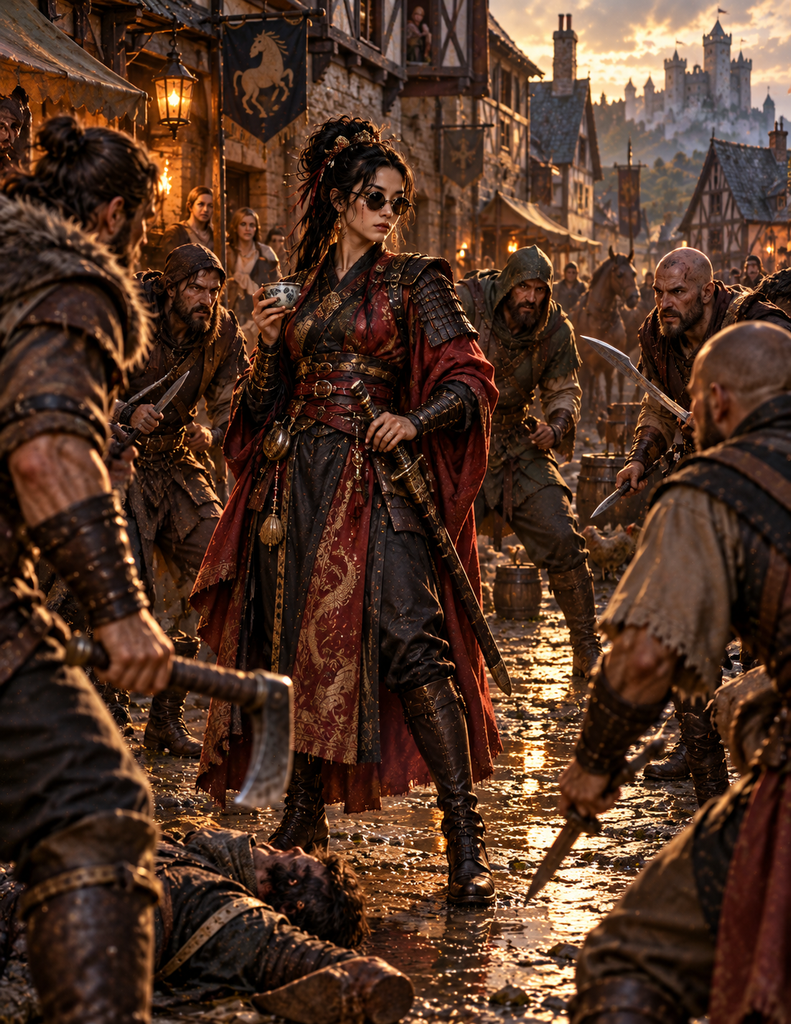
Roll Against Death or Dissolution (R.A.D.💀)
When a character receives a Critical Wound and survival remains uncertain, the player must perform a Roll Against Death. When a character receives Broken Mental Trauma, the player must Roll Against Dissolution. This moment represents a dramatic turning point in which the character’s fate genuinely hangs in the balance. Each Trauma chart has its own R.A.D. table, and the player rolls 1d12 to determine the outcome.
R.A.D. is not a universal protection against death. Do not perform R.A.D. when a rule establishes Certain Death, because no meaningful uncertainty remains. Do not perform R.A.D. when a rule imposes Fatal Bleeding, because that condition already provides its own consequence and opportunity for intervention. R.A.D. is also unnecessary when death has occurred through circumstances that no Human body could survive, such as complete bodily destruction.
A declared hit location does not automatically bypass R.A.D. An arrow described as striking the head, a blade entering the chest, or a hammer striking the skull may still produce an uncertain Critical Wound. Only the actual consequence established by the attack and the surrounding circumstances determines whether the result is an ordinary Critical Wound, Fatal Bleeding, or Certain Death. The Game Master has final authority over unusual circumstances but should apply these distinctions consistently to player characters, allies, enemies, and other NPCs.
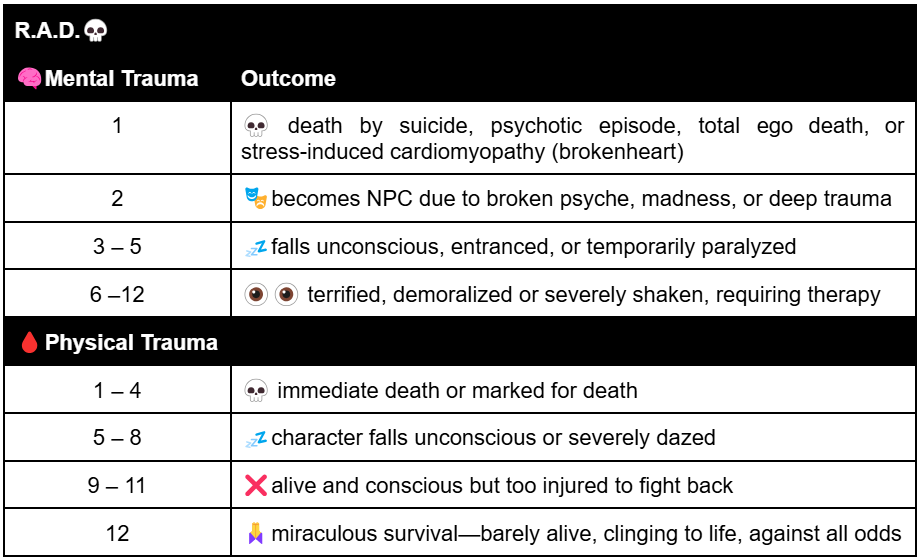
Marked for Death
When a character is reduced to the point of making a Roll Against Death (R.A.D.), the result normally determines whether life continues or ends. However, if the R.A.D. result is 1–4, and the player does not have a backup character ready, the Game Master may invoke the Marked for Death rule. A character who is Marked for Death does not die immediately. Instead, they survive by the narrowest possible margin—unconscious in the mud, breathing through shattered ribs, clinging to life by stubborn will alone. The injury is catastrophic and irreversible. Survival is temporary, not a victory.
Once Marked for Death, the Game Master must clearly inform the player that the character will die either by the end of the current game session or at some point during the next session. The exact moment is at the Game Master’s discretion and should serve the narrative. This may take the form of worsening wounds, sudden collapse, final acts of heroism, or quiet deterioration. The purpose of this rule is practical and narrative. It gives the table time to introduce a replacement character organically, allows the doomed character a final presence in the story, and avoids abrupt removal that can sour the session. The player is expected to arrive at the next session with a new character prepared.
Marked for Death is not a second chance—it is a reprieve. The story has already claimed the character. The only question remaining is how their end will be remembered.
🪄Spell Caster’s Fate
When a spellcaster reaches 💀Broken Mental Trauma as the direct result of casting a Spell, magical backlash, ritual failure, arcane overload, or another effect caused by channeling magic, use the Spell Caster’s Fate R.A.D. results instead of the ordinary Mental Trauma results. Broken Trauma caused by fear, grief, torture, violence, or other non-magical experiences uses the ordinary Roll Against Dissolution.
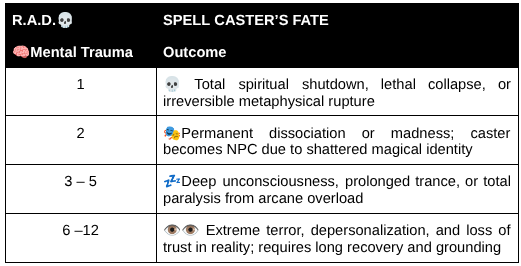
Death & Trauma
Death is permanent by default in Kingsmark. A character who dies does not ordinarily return because the player spent months developing them, because the party lacks a replacement, or because their death occurred earlier than expected. R.A.D.💀 and Marked for Death provide the opportunities that exist between catastrophic Trauma and final death. Once those possibilities have been resolved and the character dies, their story has ended. This does not mean the player’s involvement in the campaign ends. Players should be prepared for the possibility of character death, particularly when undertaking dangerous contracts, confronting powerful enemies, or deliberately accepting extraordinary risks. A replacement character can enter the story as soon as the Game Master can introduce them naturally. For campaigns in which death is expected to be a serious possibility, players may create a second character in advance or the GM may keep several suitable characters available so that a death does not force someone to spend the remainder of the session watching everyone else play.
A replacement character should enter the campaign through the fiction rather than simply appearing because an empty seat needs to be filled. They might be another adventurer seeking work, a surviving prisoner rescued during the mission, a mercenary already known to the party, a relative or companion of the dead character, someone sent by an employer, or a person encountered naturally during the continuing adventure. The Game Master should favor an introduction that gets the player back into the game reasonably quickly rather than requiring perfect circumstances that may not occur for several sessions. The death itself should remain part of the campaign. Equipment must be recovered or abandoned. Bodies may be buried, burned, returned home, left where they fell, or lost entirely. Families may need to be informed. Employers may owe the dead character money. Companions may inherit possessions, fulfill promises, seek vengeance, arrange religious rites, or decide that the contract responsible for the death is no longer worth completing. A character may disappear from the 📖Character Bible, but they should not disappear from the history of the people who knew them.
Witnessing the death of a companion can also cause Mental Trauma. The Game Master determines the appropriate Trauma Level according to the circumstances and resolves it through the normal rules in Going Through Hell. A peaceful death after a long illness is psychologically different from watching a close friend be torn apart by a monster. Relationship matters as well. The death of a stranger, an acquaintance, a trusted companion, a sibling, a spouse, or one’s own child should not automatically produce the same psychological response. The GM establishes the Trauma according to what the character actually experienced, and the character’s Mental Performance determines how well they withstand it.
The resulting Mental Trauma belongs to the surviving character and may continue long after the dead character has been replaced at the table. Grief, guilt, anger, fear, nightmares, religious doubt, desire for vengeance, or other reactions can become material for later ❤️Healing Scenes and character development. Severe experiences may leave Permanent Psychological Conditions according to the Mental Trauma rules. Death therefore has consequences without requiring the campaign to stop because someone died. A dead character should not automatically be replaced by someone who exists merely to reproduce the same abilities, personality, relationships, and role in the party. The replacement is a new person entering an ongoing story. They may change how the group fights, what skills it possesses, whom it trusts, and how its members relate to one another. The party that continues after losing one of its original members should not necessarily be identical to the party that entered the dungeon. Character death should ultimately possess the same continuity as every other consequence in Kingsmark. The character was wounded, reached the limits of what their body or mind could survive, and died. The survivors remember it. The world reacts to it. Someone new eventually joins them. The campaign continues, but the death remains part of what happened.
👻 Incorporeal Entities and Trauma
An incorporeal entity has no physical body and therefore has no 🩸Physical Trauma track. It does not make R.A.D. rolls because there is no living physical body undergoing catastrophic bodily injury. An incorporeal entity that possesses a conscious mind uses the ordinary 12-box 🧠Mental Trauma track. Mental Trauma represents damage or disruption to the conscious entity itself. Magic, Astral Combat, holy supernatural effects, and other abilities capable of directly affecting an incorporeal entity may inflict 🧠Mental Trauma upon it. Ordinary physical attacks cannot. As Mental Trauma accumulates, an incorporeal entity may become visibly unstable, disrupted, or begin to fade. These are descriptions of its deteriorating manifestation, not a separate type of Trauma or an additional Trauma track. When an incorporeal entity reaches 💀Dissolution, its coherent manifestation ends and it is Dispersed. Dispersal does not necessarily mean that the Ruach has been destroyed. Whether the entity can eventually return depends upon its nature and any supernatural condition, Domain, Anchor, or Binding Condition sustaining it.
Inflicting Mental Trauma on Incorporeal Entities
An incorporeal entity can suffer Mental Trauma when it is confronted with something genuinely capable of threatening, destabilizing, or breaking the consciousness that sustains it. This may include confronting a Wraith with the truth about its death, its murderer, its own guilt, the destruction or loss of something central to its obsession, a terrifying holy manifestation, or another revelation or experience that directly attacks its identity or state of mind.
When such a confrontation succeeds, the Game Master determines the threatened Mental Trauma according to how profoundly the event affects the entity:
🧠Shaken — Disturbing or threatening. The confrontation unsettles the entity, challenges its confidence, or forces it to acknowledge something it would rather avoid.
🧠Impaired — Deeply disturbing. The confrontation directly attacks an important belief, obsession, memory, fear, or emotional attachment sustaining the entity.
🧠Unstable — Devastating. The entity is confronted with a truth, revelation, loss, or supernatural experience that strikes at the foundation of its identity or the reason it continues to exist in its present state.
💀Broken — Existentially overwhelming. The confrontation completely shatters the entity’s understanding of itself or destroys the psychological foundation sustaining its manifestation. Broken should be reserved for extraordinary circumstances and should never result from an ordinary successful Social Skill Test alone.
The entity resists the threatened Trauma normally using its MPP and the appropriate TN for the severity involved. Record any resulting Trauma on its ordinary Mental Trauma track and apply Distress normally.
A clever argument by itself is not a weapon against the dead. The character must discover or create something that would genuinely matter to that particular entity. A successful roll determines whether the character uses that truth or circumstance effectively; it does not make an insignificant statement psychologically devastating.
Resolving an entity’s Anchor, Binding Condition, or other supernatural condition remains separate from inflicting Mental Trauma. If that condition is resolved, the entity may be permanently released even if its Mental Trauma track is not filled. Likewise, breaking or dispersing its current manifestation through Mental Trauma does not necessarily resolve the condition that caused it to exist.