

Scenes and Scene Boundaries
A Scene is a continuous period of focused play involving one immediate situation, location, objective, or conflict. A Scene begins when the players direct their attention toward that situation and ends when the immediate situation has been resolved, abandoned, or meaningfully interrupted. A new Scene normally begins when one or more of the following occurs:
- The characters move to a substantially different location.
- A meaningful amount of time passes.
- The immediate objective changes.
- The active conflict or conversation is resolved.
- The story shifts its attention to different characters or events.
- A clear narrative transition occurs, such as later that night, the following morning, or after three days of travel.
A change of room, speaker, opponent, or tactical position does not automatically end a Scene. Moving from a fortress cellar into its adjoining passage during the same escape normally remains part of the same Scene. A negotiation that becomes a fight may change from a Dialog Scene into an Action Scene without necessarily ending effects that persist for the Scene.
An Action Scene begins when immediate danger requires ⏳Initiative, Turns, and Action Points. It ends when immediate danger has passed and turn-by-turn timing is no longer necessary. If combat becomes a pursuit, the Action Scene may continue as a Chase Scene without resetting ⏳Initiative, durations, or other continuing effects unless a rule specifically says otherwise.
A Dialog Scene begins when conversation can meaningfully alter what another character does, believes, reveals, permits, or agrees to. It ends when the negotiation, interrogation, argument, or exchange reaches a meaningful resolution or is interrupted by a substantially different situation.
A Travel Scene may encompass a continuous journey between meaningful locations. Brief conversations, meals, pauses, and ordinary obstacles do not necessarily divide one journey into several Scenes.
The Game Master determines Scene boundaries according to the fiction, but may not declare additional Scene endings solely to trigger Bleeding, repeat damage, refresh an ability, shorten a duration, or produce another mechanical advantage or penalty. When a rule depends upon objective time, changing Scenes does not reset or accelerate that time. If uncertainty exists, treat uninterrupted action in the same location and pursuing the same immediate objective as one Scene.
Dialog Scenes
Scenes in which conversation, persuasion, negotiation, deception, or the exchange of information becomes important are called Dialog Scenes. A Dialog Scene occurs when what one character says may meaningfully change what another character does, believes, reveals, permits, or agrees to. Convincing a suspicious guard to open a gate, negotiating payment for dangerous work, persuading a frightened witness to speak, bargaining with a merchant, gaining an audience with a noble, seducing someone, calming an angry crowd, or convincing a prisoner to cooperate can all become Dialog Scenes when the outcome matters and is genuinely uncertain.
Ordinary conversation does not require dice. Characters are free to speak, ask questions, exchange information, make reasonable requests, and interact naturally without turning every conversation into a test. A roll becomes appropriate when another character has a meaningful reason to resist and the outcome cannot simply be determined from the circumstances. The player should first establish what the character wants and describe the general approach being taken. A player does not need to possess the eloquence, confidence, charm, or negotiating ability of the character being portrayed. It is enough to explain the substance of the approach: offering payment, appealing to friendship, invoking duty, promising protection, threatening consequences, flattering someone’s pride, or presenting an argument. The player’s choices establish the approach; the character’s abilities determine how effectively that approach is carried out. When one character attempts to influence another, both characters make an opposed test using:
1d12 + Influence & Allure PRISM + Social Skills
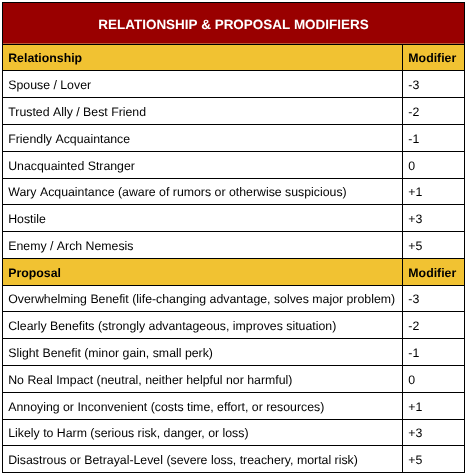
Relationship & Proposal Modifiers
Relationship: Spouse / Lover, –3. Trusted Ally / Best Friend, –2. Friendly Acquaintance, –1. Unacquainted Stranger, 0. Wary Acquaintance (aware of rumors or otherwise suspicious), +1. Hostile, +3. Enemy / Arch Nemesis, +5.
Proposal: Overwhelming Benefit (life-changing advantage, solves major problem), –3. Clearly Benefits (strongly advantageous, improves situation), –2. Slight Benefit (minor gain, small perk), –1. No Real Impact (neutral, neither helpful nor harmful), 0. Annoying or Inconvenient (costs time, effort, or resources), +1. Likely to Harm (serious risk, danger, or loss), +3. Disastrous or Betrayal-Level (severe loss, treachery, mortal risk), +5.
The character attempting the influence rolls to determine the effectiveness of the appeal, while the resisting character rolls to establish the base Target Number. Player Characters and Nonplayer Characters use the same procedure. The appropriate Relationship and Proposal modifiers are then applied to the Target Number, and the influencing character’s result is compared against that final TN. If the influencing character’s result equals or exceeds the modified Target Number, the attempt succeeds. Otherwise, the attempt fails.
The difficulty of persuasion depends upon more than personal ability. Two factors are especially important: the relationship between the characters and the nature of the proposal itself. A trusted friend is generally easier to persuade than a hostile enemy, while asking someone to accept a minor inconvenience is considerably easier than asking that person to risk imprisonment, ruin, betrayal, or death. These considerations modify the Target Number. The opponent’s dice result establishes the base Target Number, after which the appropriate Relationship and Proposal modifiers are applied to that TN. Favorable circumstances reduce the Target Number, while unfavorable circumstances increase it.
The Relationship modifier reflects how the resisting character presently regards the person attempting to influence them. This should be based upon the relationship that actually exists in the fiction rather than merely the label that seems most convenient. A stranger who has just saved someone’s child may already be treated more favorably than an ordinary stranger, while an old friend recently discovered in a serious betrayal may no longer deserve the benefit normally associated with friendship. Relationships can therefore change over the course of a campaign as characters earn trust, inspire affection, accumulate grudges, betray allies, or establish reputations.
The Proposal modifier reflects what the resisting character is actually being asked to accept. The GM should judge the proposal from that character’s perspective, not from the perspective of the player making the request. Fifty silver pieces may be an overwhelming benefit to an impoverished laborer and nearly meaningless to a wealthy lord. Likewise, revealing a secret may seem harmless to one person but constitute an act of treason to another. Relationship and Proposal modifiers normally apply together, allowing the same request to produce very different resistance depending upon who makes it, what is being offered, and what the other character stands to gain or lose.
Other circumstances may occasionally justify an additional modifier when they materially change the situation. Privacy may make someone more willing to discuss a dangerous secret, while an audience of servants or soldiers may make the same admission considerably more difficult. Recent assistance, humiliation, fear, prejudice, intoxication, an outstanding debt, or compelling evidence may also alter the exchange. Such modifiers should represent circumstances that genuinely matter rather than becoming an accumulation of minor details. The Relationship and Proposal modifiers already account for most of what determines whether another person is willing to cooperate. A successful Social Skills test does not grant control over another character’s mind. Some requests remain outside what a person could realistically be persuaded to do under the existing circumstances. A stranger cannot ordinarily convince a king to surrender his crown simply through an extraordinary roll, nor can a few flattering words normally persuade a devoted parent to murder a child. The circumstances would first have to change enough for the proposal itself to become conceivable. Dice resolve uncertainty within the boundaries of believable behavior; they do not erase motives, loyalties, fears, convictions, or common sense.
Success should therefore be interpreted according to what the influencer was actually trying to accomplish. A guard might allow the party through a gate, a merchant might accept better terms, a frightened witness might finally speak, or an enemy might agree to a temporary truce. Failure likewise does not require immediate hostility. The merchant may simply refuse the offer, the witness may remain silent, or the guard may insist upon proper authorization. What matters is that the result changes or settles the social situation in a manner consistent with the characters, the circumstances, and what was actually at stake.
Choosing the Right Skill
Dialog Scenes often draw upon more than one Skill, particularly when persuasion, deception, evidence, and specialized knowledge intersect. Social Skills and Deceit handle the direct contest between characters, while Investigation and other relevant Skills can establish facts, expose contradictions, or provide leverage that changes the course of the conversation.
Social Skills governs persuasion, negotiation, diplomacy, bargaining, leadership, seduction, interrogation, and other attempts to influence another person. These tests use 1d12 + Influence & Allure PRISM + Social Skills. During an interrogation, Social Skills is used to obtain cooperation: persuading a prisoner to answer questions, convincing a witness to reveal something dangerous, negotiating an exchange of information, or applying social pressure to someone who would prefer to remain silent.
Deceit governs both deliberate deception and the recognition of deliberate deception, using 1d12 + Influence & Allure PRISM + Deceit. It covers lies, bluffs, false identities, concealed motives, feigned emotions, misleading statements, and cover stories. During questioning, Deceit determines whether a false account remains convincing or whether another character recognizes the deception. An interrogation may therefore move naturally between Social Skills and Deceit as the interrogator seeks cooperation and evaluates the answers received.
Investigation, using 1d12 + Mental Performance PRISM + Investigation, is especially useful when testimony can be compared with evidence or with other statements. It can identify contradictions, connect apparently unrelated details, reconstruct events, and determine which portions of an account deserve closer attention. A suspect’s account of entering through the front door may conflict with footprints beneath a broken window; two witnesses may give incompatible descriptions of the same event; or a document may contradict the dates provided during questioning. Such discoveries give the interrogator concrete information to pursue. Other Skills can provide the same kind of advantage whenever the conversation touches upon their areas of expertise.
Scholarship can test claims involving history, languages, law, geography, politics, cultures, heraldry, genealogy, and other learned subjects. A supposed noble may reveal ignorance of his claimed family history, an official may cite a law that does not exist, or someone’s account of an ancient event may conflict with what a scholar knows of the period.
Medicine can evaluate claims concerning wounds, disease, poisoning, death, and physical condition. The appearance of a corpse may conflict with the alleged time of death, an injury may not have been caused in the manner described, or symptoms may contradict the illness someone claims to suffer.
Survival can test accounts involving wilderness travel, tracking, terrain, weather, animals, hunting, navigation, and campsites. Mud on a traveler’s boots, the condition of his horse, tracks outside a settlement, or his description of a supposedly traveled route may contradict his account.
Alchemy can evaluate claims involving poisons, antidotes, herbs, minerals, medicines, acids, solvents, incendiary substances, reagents, and other unusual compounds. An alchemist may recognize that a poison could not have produced the symptoms being described, that a supposed antidote would have been useless, or that an unfamiliar substance could not have been prepared as claimed.
Underworld applies when the conversation concerns criminal society. Knowledge of criminal organizations, reputations, hierarchies, signs, customs, illicit markets, and unwritten rules can expose weaknesses in someone’s claimed identity or account. A supposed member of a notorious band may use the wrong terminology, name someone who could not hold the position claimed, or propose a transaction that no experienced smuggler would conduct in that manner. Underworld can also indicate how criminals are best approached, what they value, and what behavior is likely to gain or lose their cooperation.
Spiritual Practices serves this purpose when claims concern the character’s own religious, spiritual, or magical tradition. Familiarity with its teachings, rituals, prayers, symbols, prohibitions, and practices may expose errors in someone’s account or claimed identity. Occult Knowledge applies instead to unfamiliar supernatural phenomena: curses, hauntings, magical artifacts, supernatural creatures, forbidden practices, strange rituals, and other manifestations beyond the character’s own tradition.
These Skills are particularly useful because an effective Dialog Scene can develop from the information they provide. Investigation may expose a contradiction in a suspect’s testimony.
Medicine may demonstrate that his description of a victim’s death cannot be correct. Underworld may reveal that the criminal organization he claims to serve does not operate as described. Deceit can then be used when the character attempts to determine whether the suspect is deliberately maintaining a false account, while Social Skills can turn the accumulated evidence into pressure, negotiation, or an offer of cooperation.
A character may therefore attack a difficult conversation from several directions without the Skills becoming interchangeable. Social Skills influences people. Deceit handles deliberate deception. Investigation assembles evidence and exposes inconsistencies. Other Skills contribute whatever knowledge or expertise they actually govern. In a Dialog Scene, the value of knowing something is often not merely that the character possesses the information, but that the information can be brought into the conversation at exactly the right moment.
Deception & Lie Detection
Deception is a deliberate attempt to cause another person to believe something that the deceiver knows, suspects, or intends to present falsely. It may take the form of an outright lie, a carefully constructed half-truth, a false identity, a rehearsed explanation, feigned ignorance, concealed motives, misleading behavior, or an attempt to direct attention away from something important. Whenever one character deliberately attempts to deceive another and the outcome is uncertain enough to matter, Deceit governs the attempt. Lie detection is not a separate Skill. It is the defensive and perceptive use of Deceit, representing familiarity with the methods by which people construct and maintain deception. A practiced deceiver understands the importance of consistency, timing, confidence, emotional presentation, plausible detail, and avoiding unnecessary claims. Those same abilities can help a character recognize when someone else appears to be deliberately manipulating them. This does not mean that every skilled liar is infallibly perceptive, but it allows the same body of experience to govern both creating deception and attempting to penetrate it.
When one character deliberately deceives another and the other character attempts to recognize the deception, both make an opposed test using: 1d12 + Influence & Allure PRISM + Deceit
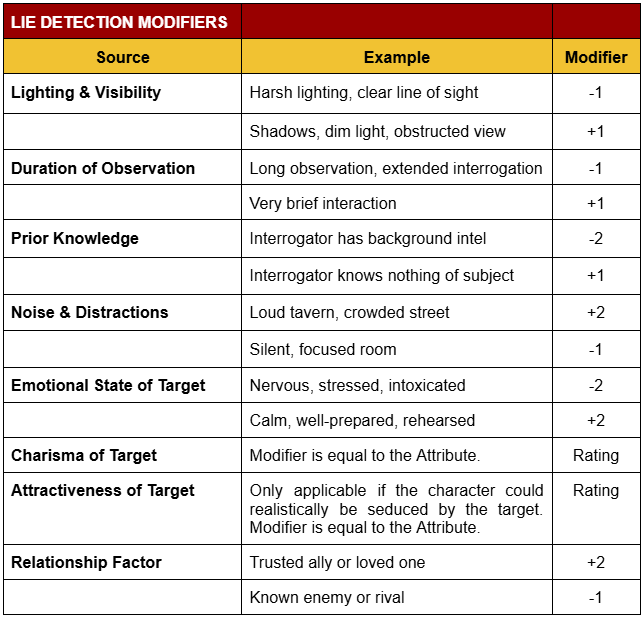
The deceiver’s dice result establishes the observer’s base Target Number, which is then adjusted by the applicable Lie Detection Modifiers. The deceiver’s result represents the believability and consistency of the deception, while the observer’s result represents the ability to recognize signs that something is being deliberately concealed, fabricated, distorted, or manipulated. Player Characters and Nonplayer Characters use the same procedure. If the observer’s result equals or exceeds the modified Target Number, the deception is penetrated. Otherwise, the deception holds.
A lie-detection test should normally have a specific subject. Characters do not simply enter a room and roll Deceit to determine which people are lying about anything whatsoever. The observer must have something to evaluate: a statement, denial, explanation, claimed identity, suspicious reaction, apparent emotion, or other meaningful behavior. Suspicion may arise naturally from the circumstances, from evidence already discovered, from contradictions in testimony, or simply because the character has good reason not to trust the person speaking. The test then determines whether the character can penetrate the particular deception being attempted.
Circumstances can make deception considerably easier or harder to maintain. A liar observed closely for an extended period has more opportunities to contradict himself than someone who exchanges only a few words with a stranger. Prior knowledge gives an observer facts against which a story can be compared. Stress may make maintaining a fabricated account more difficult, while preparation and rehearsal can make deception considerably more convincing. Noise, poor visibility, emotional relationships, personal charisma, and attraction may likewise influence how effectively another person can be read.
The Lie Detection Modifiers represent circumstances that make deception easier or harder to penetrate. The deceiver’s dice result establishes the observer’s base Target Number, after which the appropriate Lie Detection Modifiers are applied to that TN. Conditions that make deception easier to detect reduce the Target Number, while conditions that make deception harder to detect increase it. Harsh lighting and prolonged observation, for example, reduce the TN because they provide more opportunity to notice revealing behavior. A brief encounter in dim conditions increases the TN because the observer has much less information from which to recognize deception.
Several modifiers may apply simultaneously when the circumstances genuinely warrant them, but the GM should avoid searching for every conceivable advantage or disadvantage simply to accumulate numbers. The table represents significant conditions. A crowded tavern may genuinely make another person difficult to observe, while the fact that someone occasionally glances toward the door probably does not deserve an additional modifier of its own. Such details are better used in describing the scene and interpreting the result.
What Lie Detection Reveals
A successful lie-detection test reveals deliberate deception, not the hidden truth behind it. This distinction is essential. If a prisoner says, “I have never been inside the ruined monastery,” successfully penetrating his Deceit can reveal that the denial is deliberately false or misleading. It does not reveal what he did inside the monastery, when he was there, whom he met, or what he is attempting to conceal. Those facts must still be discovered through questioning, investigation, evidence, or other appropriate means. The degree by which the observer wins can influence how clearly the deception manifests itself. A narrow victory may produce a strong impression that the statement is deliberately misleading. A more decisive victory may allow the GM to identify where the deception appears weakest: the speaker hesitates whenever a particular person is mentioned, carefully avoids answering one part of the question, repeatedly returns to an apparently rehearsed phrase, or becomes noticeably guarded when the conversation approaches a particular subject. Greater success provides better insight into the deception, but it should never create information the character has no means of knowing.
For example, an observer who decisively recognizes that a merchant is lying about where he obtained a jeweled dagger might notice that the merchant becomes evasive whenever the northern road is mentioned. That can provide a useful lead. It does not justify telling the player that the merchant murdered a traveler three nights earlier and stole the dagger from the corpse unless something in the conversation or existing evidence could actually support that conclusion. Lie detection exposes the cracks in a false story; discovering what lies behind those cracks remains part of the adventure.
Failure works according to the same principle. Failing to penetrate a deception does not necessarily mean the observer becomes convinced that the statement is true. A suspicious character may remain suspicious. The failed test means that the observer has been unable to identify reliable signs that the person is deliberately deceiving them. The character may continue investigating, seek evidence elsewhere, question another witness, or simply refuse to trust the speaker. Deceit determines whether the deception is successfully penetrated; it does not dictate every belief the observer must subsequently hold.
Truth, Error, and Deception
A statement can be false without being a lie. Deceit concerns deliberate deception, making the speaker’s knowledge and intention important. Suppose a traveler says that a company of soldiers passed through the village on Tuesday. If the soldiers actually passed through on Tuesday and the traveler reports what he witnessed, there is no deception to detect. If they passed through on Wednesday but the traveler has genuinely confused the days, his statement is false, but he is still not lying. A Deceit test cannot expose an intentional deception that does not exist. Investigation, Scholarship, or other evidence might establish that the date is wrong, but that discovery does not transform an honest mistake into a lie.
If the traveler knows the soldiers arrived Wednesday but deliberately says Tuesday because he is attempting to conceal their movements, the statement becomes a deception. Deceit can now be used to penetrate it. Half-truths operate in the same manner. Someone may answer, “I did not kill the man,” while deliberately concealing that he hired someone else to do it. The literal statement may be true, but the speaker is nevertheless attempting to create a false conclusion. Deceit concerns the attempt to mislead, not merely whether an individual sentence could survive a lawyer’s examination of its wording. This distinction also explains why other Skills remain valuable during Dialog Scenes. Investigation may establish that testimony contradicts evidence. Medicine may reveal that someone’s description of a wound is impossible. Survival may establish that a claimed journey could not have followed the route described. Scholarship may expose a fabricated historical claim, while Alchemy may contradict a story involving poison. None of these discoveries automatically establishes deliberate deception. They establish facts against which the speaker’s account can be tested, often giving characters exactly the evidence they need to begin probing for a lie.
🎬 Example — Detecting a Lie
Alaric questions a merchant whose wagon was seen near an abandoned chapel on the night that several villagers disappeared. The merchant admits traveling along the road but insists that he never approached the chapel. Earlier investigation has already established that wagon tracks matching the unusual width of his cart left the road and entered the chapel grounds. Alaric therefore has a concrete reason to scrutinize the denial. When Alaric asks whether the merchant took his wagon onto the chapel grounds, the merchant answers, “No. I stayed on the road the entire night.” Because the merchant is deliberately lying, the two make an opposed Deceit test. Alaric rolls 1d12 (7) + Influence & Allure PRISM +3 + Deceit +3 = 13. The merchant rolls 1d12 (8) + Influence & Allure PRISM +2 + Deceit +3 = 13. The merchant’s result of 13 establishes Alaric’s base Target Number of 13. The circumstances then modify that TN. Alaric possesses background information from the wagon tracks, applying the Prior Knowledge modifier of –2, and has had the merchant under extended observation, applying another –1. With Charisma 0, the merchant receives no Charisma modifier. The total –3 Lie Detection Modifier reduces Alaric’s Target Number from 13 to 10. Alaric’s result of 13 therefore exceeds TN 10 by 3 points. The GM describes what Alaric perceives rather than simply announcing, “He’s lying.” The merchant speaks confidently about traveling along the road and readily answers questions about where he came from, but his manner changes whenever Alaric mentions the chapel. His answers become more deliberate, and he carefully repeats that the wagon “never left the road.” Combined with the successful Deceit test, Alaric recognizes that the merchant is deliberately attempting to conceal his connection to the chapel. The 3-point margin does not reveal what actually happened there. Alaric does not know whether the merchant entered the chapel, met someone there, delivered something, participated in the villagers’ disappearance, or merely witnessed something he is afraid to reveal. He has penetrated the deception, but he has not discovered the hidden truth. Alaric now has a weakness in the merchant’s story that he can exploit. He might confront him with the wagon tracks, continue questioning him about the chapel, offer protection in exchange for cooperation, or investigate the chapel itself. The successful Deceit test has not solved the mystery; it has revealed which thread Alaric should pull next.
Interrogations
An interrogation is an extended Dialog Scene in which one character deliberately questions another in an attempt to obtain information that the other person may be unwilling to provide. The person being questioned may refuse to cooperate, conceal particular facts, provide misleading answers, tell outright lies, or mix truth and deception together. Unlike a simple request for information, an interrogation often develops over several exchanges as the interrogator learns what the subject knows, identifies weaknesses in the story, introduces evidence, changes tactics, and attempts to overcome resistance.
Interrogation is not a separate Skill or special type of test. Instead, it brings together the ordinary rules for Dialog Scenes, Deceit, Investigation, and whatever specialized knowledge is relevant to the subject being discussed. The Skill used at any particular moment depends upon what the interrogator is actually attempting to accomplish. An interrogator attempting to persuade a prisoner to cooperate uses Social Skills. An interrogator attempting to determine whether an answer is deliberately deceptive uses Deceit. A character comparing several statements against physical evidence may use Investigation, while Scholarship, Medicine, Survival, Alchemy, Underworld, Spiritual Practices, or Occult Knowledge may become relevant when the questioning concerns those subjects.
This means that an interrogation should not ordinarily consist of repeatedly rolling the same Skill until someone succeeds. The conversation itself determines what happens next. Questions produce answers. Answers may expose inconsistencies. Evidence may contradict those answers. A detected lie may reveal which subject the prisoner is particularly determined to conceal. An offer of protection may make cooperation more attractive. As the situation changes, different Skills become appropriate and the modifiers affecting subsequent tests may change with it.
Questioning and Cooperation
When the primary obstacle is that the subject does not want to provide information, the interrogator uses: 1d12 + Influence & Allure PRISM + Social Skills
The subject resists with: 1d12 + Influence & Allure PRISM + Social Skills
The ordinary Relationship & Proposal Modifiers apply. Relationship and Proposal are especially important because interrogation is ultimately an attempt to persuade someone that answering is preferable to remaining silent. A friendly witness being asked to describe a suspicious stranger presents very different resistance from a captured bandit being asked to betray the location of his companions.
The interrogator’s approach determines what the proposal actually is. Offering money, promising protection, appealing to loyalty, offering mercy, invoking duty, threatening believable consequences, or demonstrating that continued resistance is pointless can all change what cooperation means to the person being questioned. A prisoner who would never betray his companions merely because someone demands it might reconsider when shown convincing evidence that those companions have already abandoned him.
A successful Social Skills test means that the interrogator obtains the degree of cooperation realistically possible under the circumstances. It does not necessarily mean that the subject reveals everything known. If the request concerned the identity of a contact, success resolves that request. Discovering where the contact lives, who employs him, what he intends to do next, and what other secrets the prisoner possesses may require further questioning. Interrogation should proceed through meaningful subjects and decisions rather than treating a single successful roll as permission to empty an NPC’s mind.
Evaluating the Answers
Obtaining an answer and believing the answer are separate matters. A cooperative character can be mistaken, while an apparently cooperative character can deliberately provide false information. When the interrogator suspects deliberate deception, Deceit is used according to the normal lie-detection rules.
An interrogator should also make use of information already available. Investigation is particularly valuable because interrogation often produces multiple statements that can be compared against one another and against physical evidence. A suspect who changes the time at which he claims to have arrived, contradicts another witness, or describes events that do not agree with evidence found at the scene may expose an inconsistency even if his behavior itself reveals nothing.
Specialized Skills can perform the same function when the testimony concerns subjects the interrogator understands. Medicine may reveal that a prisoner’s account of an injury does not match the wound. Survival may establish that the route he claims to have traveled would have been impassable. Alchemy may expose an impossible description of a poison.
Scholarship may reveal that a supposed legal authority, historical event, noble lineage, or foreign custom has been misrepresented. Underworld may expose errors concerning criminal organizations or practices. Spiritual Practices and Occult Knowledge can similarly test claims involving religion, magic, curses, supernatural creatures, rituals, or forbidden practices.
Such discoveries do not automatically prove that the person is lying. They give the interrogator something much more useful: a specific weakness in the account. The interrogator can then return to that weakness.
Evidence and Leverage
Evidence can transform an interrogation because it changes what the person being questioned believes the interrogator already knows. A suspect may confidently deny visiting a particular house until confronted with a witness who saw him enter. A captured thief may insist that he knows nothing about a burglary until an object stolen during the crime is placed on the table. A cultist may maintain an elaborate false story until the interrogator correctly identifies the significance of a symbol found among his possessions.
Evidence does not automatically compel confession, but it can change the circumstances of subsequent tests. Prior knowledge may reduce the observer’s Target Number through the Lie Detection Modifiers, while compelling evidence may change the nature of a proposal under the Relationship & Proposal Modifiers. “Tell us what happened” may initially offer the prisoner little reason to cooperate. “We already know you were there, but you can still explain why before your companions place all the blame on you” is a materially different situation.
The GM should apply such changes because something meaningful has happened within the scene, not merely because several rolls have occurred. Interrogations become more interesting when characters create advantages through discovery and good decisions rather than receiving automatic bonuses for spending enough time questioning someone.
Extended Interrogations
Long interrogations can unfold through several exchanges without requiring a formal round structure. The interrogator may begin with broad questions, establish what the subject claims happened, compare the account with known facts, pursue contradictions, detect deliberate deception, reveal evidence, and then use newly discovered leverage to seek cooperation.
The subject may also adapt. Once a lie has been detected, the subject may abandon it and offer a different explanation. A prisoner who realizes that the interrogator possesses evidence may become more cooperative, invent a new story, refuse to answer further questions, attempt to bargain, or reveal one secret in order to protect another. Dialog Scenes remain exchanges between characters rather than static obstacles waiting to be defeated.
Repeated rolls should therefore occur only when the fictional situation has meaningfully changed. Simply asking the same question again does not normally justify another Social Skills or Deceit test. A new approach, new evidence, a discovered contradiction, a changed proposal, or some other significant development can create a new situation and therefore justify another test.
🎬 Example — Interrogating a Suspect
Alaric questions a captured smuggler suspected of supplying an isolated cult. The smuggler claims that he merely transports untaxed wine and has never dealt with the cult. Alaric has already examined the man’s wagon and found pale clay packed beneath the wheels and fragments of unusual black wax among the cargo. Alaric first uses Investigation to compare the smuggler’s story with the evidence. The GM considers how difficult it would be to recognize the significance of the clay. The difference is not obvious to an untrained observer, but someone carefully examining the evidence could reasonably distinguish the pale clay from the soil found along the northern road. The GM therefore sets the test at TN 7 (Reasonable). Alaric rolls 1d12 (7) + Mental Performance PRISM +3 + Investigation +2 = 12. His result of 12 exceeds TN 7 by 5 points. Alaric recognizes that the pale clay does not match the northern road the smuggler claims to have traveled. Instead, it resembles the distinctive soil found near the abandoned sanctuary. Alaric has not proven that the smuggler is lying, but he has discovered a meaningful contradiction in the story. Alaric asks directly, “Did your wagon go to the sanctuary?” The smuggler answers, “No. I’ve never taken that wagon anywhere near it.” Because the smuggler is deliberately lying, the exchange becomes an opposed Deceit test. Alaric rolls 1d12 (8) + Influence & Allure PRISM +3 + Deceit +2 = 13. The smuggler rolls 1d12 (6) + Influence & Allure PRISM +2 + Deceit +3 = 11. The smuggler’s 11 establishes Alaric’s base Target Number. The circumstances then modify that TN. Because Alaric already possesses evidence contradicting the smuggler’s account, the GM applies Prior Knowledge: Interrogator has background intel (–2). Alaric has also been questioning him long enough for Long observation, extended interrogation (–1) to apply. The smuggler has Charisma 0, so Charisma adds no further modifier. The total –3 modifier reduces the TN from 11 to 8. Alaric’s final result of 13 exceeds TN 8 by 5 points, allowing him to penetrate the smuggler’s deception.
The GM tells Alaric that the denial is deliberate.
The smuggler answers too quickly when the sanctuary is mentioned, then begins adding unnecessary details about the northern road. Alaric does not yet know why the wagon went to the sanctuary or what it carried there, but he now knows that this particular denial is false. Alaric changes tactics. He places one of the fragments of black wax on the table and says, “You can keep pretending you were never there, or you can explain why this was in your wagon before the city watch decides you belong to the cult.” Alaric is now trying to obtain cooperation, so the exchange becomes an opposed Social Skills test. Alaric rolls 1d12 (6) + Influence & Allure PRISM +3 + Social Skills +3 = 12. The smuggler rolls 1d12 (5) + Influence & Allure PRISM +2 + Social Skills +1 = 8.
Their relationship is Hostile, applying +3 to the Target Number, but Alaric’s proposal offers the smuggler a meaningful opportunity to separate himself from the cult before the authorities assume the worst. The GM judges this a Clearly Benefits proposal (–2). Together, these produce a net +1 modifier. The smuggler’s result of 8 therefore establishes a final Target Number of 9. Alaric’s 12 exceeds TN 9 by 3 points. The GM describes the result: the smuggler stares at the black wax for several seconds, then finally says, “I don’t belong to them. I only made deliveries.” He admits that he took supplies to the sanctuary twice but insists that he never entered the lower chambers. Alaric has gained cooperation, but he has not emptied the man’s mind of every secret. He now has new information, a new claim to evaluate, and a new direction for the interrogation. The scene has advanced because Investigation exposed a contradiction, Deceit penetrated the lie, and Social Skills turned that advantage into cooperation.
Resolving Dialog Scenes
Dialog Scenes follow the same principle as other uncertain actions in Kingsmark: the dice determine how well a character performs an action, while circumstances determine what that success can realistically achieve. Social Skills, Deceit, Investigation, and specialized knowledge can reveal opportunities, overcome resistance, expose lies, and establish facts, but none gives supernatural control over another person’s mind.
A successful Social Skills test means the character made an effective argument, appeal, offer, threat, negotiation, or other approach. The resulting cooperation must still make sense for the person being influenced. A guard might overlook a minor violation, a frightened witness may reveal what was seen, a merchant may accept worse terms, or a prisoner may decide cooperation offers the best chance of survival. Some convictions, loyalties, fears, duties, and desires remain beyond what one conversation can realistically change.
Failure also need not cause hostility or the opposite result. A merchant may simply keep the original price. A guard may remain cordial while refusing entry. A prisoner may refuse to speak. Failure should follow from the situation rather than from an assumption that every social test creates an extreme outcome.
Deceit has similar limits. Detecting deception means the observer recognizes an attempt to mislead, but it does not reveal hidden thoughts, memories, motives, or unknown facts. A character may realize a witness lied about where he spent the night without knowing where he actually went. Likewise, failing to detect a lie does not force belief; the character simply lacks enough insight to prove deception.
Knowledge and investigative Skills should be read according to what they establish. Investigation can expose contradictions and connect evidence. Scholarship can disprove historical, legal, political, linguistic, or cultural claims. Medicine can contradict an account of wounds, illness, poisoning, or death. Survival can expose errors involving tracks, terrain, travel, animals, or wilderness conditions. Alchemy can test claims about substances and compounds. Other Skills provide similar insight within their fields. Proving a statement wrong does not prove why it is wrong; the speaker may be mistaken, ignorant, confused, misinformed, or lying.
The GM should describe results in terms of what the character can reasonably perceive, conclude, or accomplish. Instead of saying only that a roll succeeded, explain what changed. A suspect becomes careful when a name is mentioned. A noble who refused an appeal begins asking about terms. A witness contradicts something said earlier. A scholar notices that a merchant’s story contains an impossible historical detail. These observations give players something to act on and let Dialog Scenes grow naturally from one decision to the next.
Player Agency
Social abilities remain meaningful against Player Characters, but they do not remove the player’s authority over the character. An NPC may succeed on a Social Skills test against a Player Character, showing that the argument is persuasive, credible, appealing, intimidating, or otherwise well delivered. The GM should describe that impression and provide the information needed to portray it. The final decision remains with the player.
If a captured noble successfully pleads for mercy, the GM might explain that the plea seems sincere, the bargain appears useful, or killing him now would seem needlessly cruel. The player still decides whether the character accepts. Social abilities therefore affect Player Characters without dictating their loyalties, beliefs, emotions, or actions.
The same principle applies to NPC deception. The GM need not say, “You believe him.” Instead, the character finds no convincing sign of deceit. The player may still distrust the NPC, investigate further, demand evidence, or refuse to act. The failed test removes certainty, not agency.
Consequences Beyond the Scene
Dialog Scenes can matter long after the conversation ends. Characters remember how they were treated. A merchant bargained with fairly may be easier to approach later. A prisoner who was promised protection and received it may become a useful source. A noble publicly humiliated may remember the insult for years. A criminal whose lie was exposed may become more cautious. Friendships, rivalries, reputations, debts, favors, grudges, and betrayals can all alter future Dialog Scenes.
The GM should let these consequences emerge naturally rather than treating each conversation as isolated. The Relationship modifiers in Dialog Scenes provide a simple mechanical expression of that history. Today’s stranger may become tomorrow’s acquaintance, friend, rival, or enemy because of what happened in play.
Dialog Scenes are not contests where one character rolls to control another. They resolve uncertainty when people themselves are the obstacle, opportunity, or source of information. Social Skills can influence willingness. Deceit can create or expose lies. Investigation can reveal contradictions. Knowledge and practical Skills can test claims against what a character knows. Evidence and changing circumstances can reshape an interrogation or negotiation.
Used together, these rules let conversation matter without replacing roleplaying. Players decide what their characters say, want, reveal, ask, and attempt. Their abilities and the dice determine how well those choices work. The result is a Dialog Scene where words, knowledge, trust, evidence, and deception can matter as much as weapons.