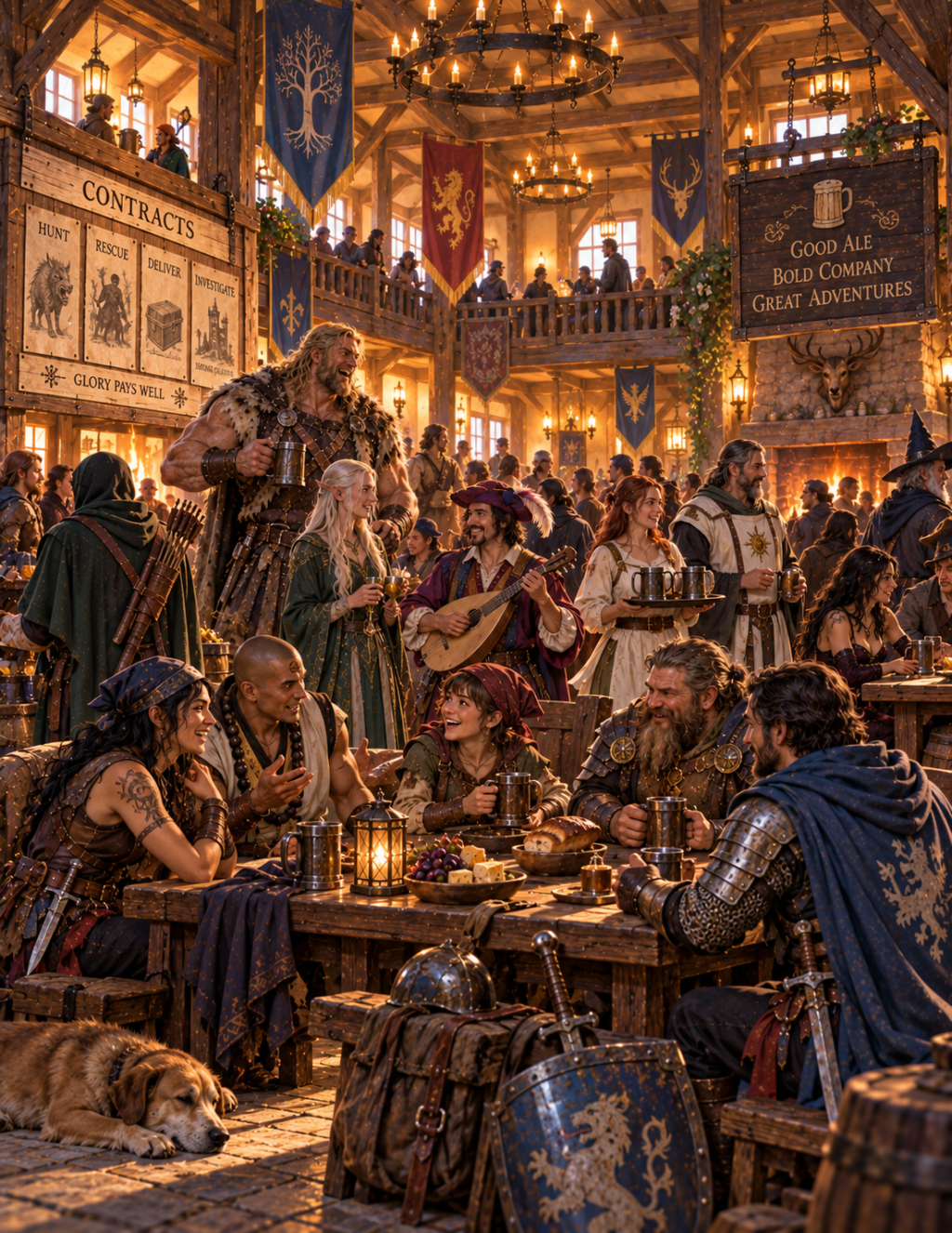
Adventurers in Kingsmark rarely survive for long as isolated wanderers. Dangerous work favors adventuring parties whose members possess different talents and compensate for one another’s weaknesses. A typical party consists of three to six characters brought together by employment, friendship, family, allegiance, necessity, shared enemies, religious duty, wealth, or some other believable reason. No particular combination of Character Classes is required, but a varied party is considerably better prepared for the unknown.
A standard Kingsmark campaign begins in the year 1200. Each Player Character has decided, for whatever reason, to try adventuring and has made his way to an adventurers’ tavern, where contracts are advertised and companions can be found. Poverty, revenge, curiosity, duty, wanderlust, disgrace, ambition, treasure, faith, or simply the desire for an exciting life can bring someone to such a place.
The official Game Master’s Guide, 🍺The Tavern, begins new characters in Willowcreek, a town in the Kingdom of Aldren. The customary meeting place is Rusty’s, an adventurers’ tavern where “Adventurers Wanted” notices advertise contracts and other notices allow would-be adventurers to seek party members. Characters may be foreigners or inhabitants of nearby kingdoms, but they do not ordinarily live in Willowcreek itself. Most arrive as strangers, join others seeking dangerous work, and form a party around a particular contract.
Contracts provide one of the most common foundations for adventure. Villages may hire adventurers to kill dangerous creatures, merchants may seek escorts, nobles may require discreet investigators, temples may need armed assistance, and families may offer everything they possess to recover someone who has disappeared. Adventures may also begin through rumors, proclamations, messengers, guilds, military officers, travelers, religious institutions, or simple chance.
Not every adventure begins because someone offers payment. Characters may encounter trouble while traveling, pursue enemies, investigate mysteries, receive summonses, or simply decide that something they have witnessed cannot safely be ignored. Problems that are ignored continue developing. Bandits become stronger, missing people may die, monsters move to new hunting grounds, and local disputes may become wars.
The wilderness is equally capable of producing adventure. A wounded traveler, overturned wagon, smoke beyond the hills, strange animal tracks, abandoned settlement, or inexplicable light in a distant forest can begin an adventure without anyone formally assigning it.
Players are encouraged to create and maintain at least two characters so that death, injury, retirement, or absence does not remove a player from the campaign. Only one Player Character per player is normally active at a time, excluding animal companions and similar dependents. Inactive characters remain wherever circumstances reasonably place them until they return to active play.
An adventuring party is therefore defined by shared purpose rather than permanent membership in an institution. Members may come and go as circumstances change, while surviving companions gradually develop friendships, rivalries, reputations, enemies, allies, obligations, and a shared history.
🫀 Determining Human Type
Players normally choose their Human Type. A player who prefers to leave the decision to fate may roll 1d12. This distribution reflects the relative populations of Sylva, with Common Humans being by far the most numerous.
1–6: 🧑Common Human; 7–8: ⛏️Dwarf; 9–10: 🧝Elf; 11: 🧒Qatan; 12: 💪Human Giant.
🎭 Choosing a Character Class
Players normally choose their Character Class. A player who prefers to leave the decision to fate may roll 2d12 and consult the table below. The character must still satisfy all Human Type, gender, and Required Attribute restrictions of the resulting class. If the character cannot legally select the result, roll again.
2: 🔮Prophet; 3: 🪶Shaman; 4: 🧙Witch; 5: 🧙♂️Wizard; 6: 🕯️Priest; 7: 🛡️Holy Knight; 8: ❤🩹Healer; 9: 🎶Minstrel; 10: 🥋Monk; 11: 🥷Ninja; 12: 🗝️Thief; 13: ⚔️Man-at-Arms; 14: 🏹Ranger; 15: 🎯Monster Hunter; 16: 😡Barbarian; 17: 🐺Beast Master; 18: 💪Brute; 19: ⚔️Man-at-Arms; 20: 🏹Ranger; 21: 🎯Monster Hunter; 22: 😡Barbarian; 23: 🗝️Thief; 24: Man-at-Arms
🎒 Basic Adventuring Equipment
Ordinary clothing, a backpack, bedroll, waterskin, fire-starting tools, basic provisions, personal containers, and routine equipment-maintenance items are assumed. Starting Equipment therefore lists only weapons, armor, professional tools, and other possessions particularly relevant to the Character Class. Kingsmark does not normally require players to track every arrow, ration, strip of cloth, candle, cup of water, whetstone, or other minor consumable. Adventurers are assumed to restock ordinary supplies when they have reasonable access to settlements, merchants, camps, patrons, or their own stores. Likewise, an archer who has prepared for an expedition is generally assumed to carry enough normal ammunition for ordinary adventuring unless circumstances make that assumption unreasonable.
This follows the cinematic approach used throughout the game. Most action films do not stop every few minutes to inventory each pistol magazine, shotgun shell, or meal unless running out of ammunition or supplies is important to the scene. Kingsmark treats common adventuring gear the same way. The purpose of equipment rules is to create meaningful choices, not routine bookkeeping. That changes when limited supplies are part of the danger. If characters are trapped deep underground, crossing a desert, besieged in a fortress, stranded at sea, cut off behind enemy lines, or attempting a long wilderness expedition, then arrows, food, water, medicine, lamp oil, torches, and similar resources may become important. The Game Master may begin tracking them because scarcity itself has become part of the Mission’s challenge.
The same principle applies to unusual or valuable supplies. Rare alchemical compounds, special ammunition, magical items, expensive medicines, unique tools, explosives, sacred materials, or anything difficult to replace should be tracked whenever their limited quantity matters. Ordinary gear is abstracted until the story gives everyone a reason to care about exactly how much remains.
A useful rule of thumb is simple: if running out would create an interesting problem, track it. If it would only create paperwork, assume the adventurers brought enough.
⚔️ Man-at-Arms [1]
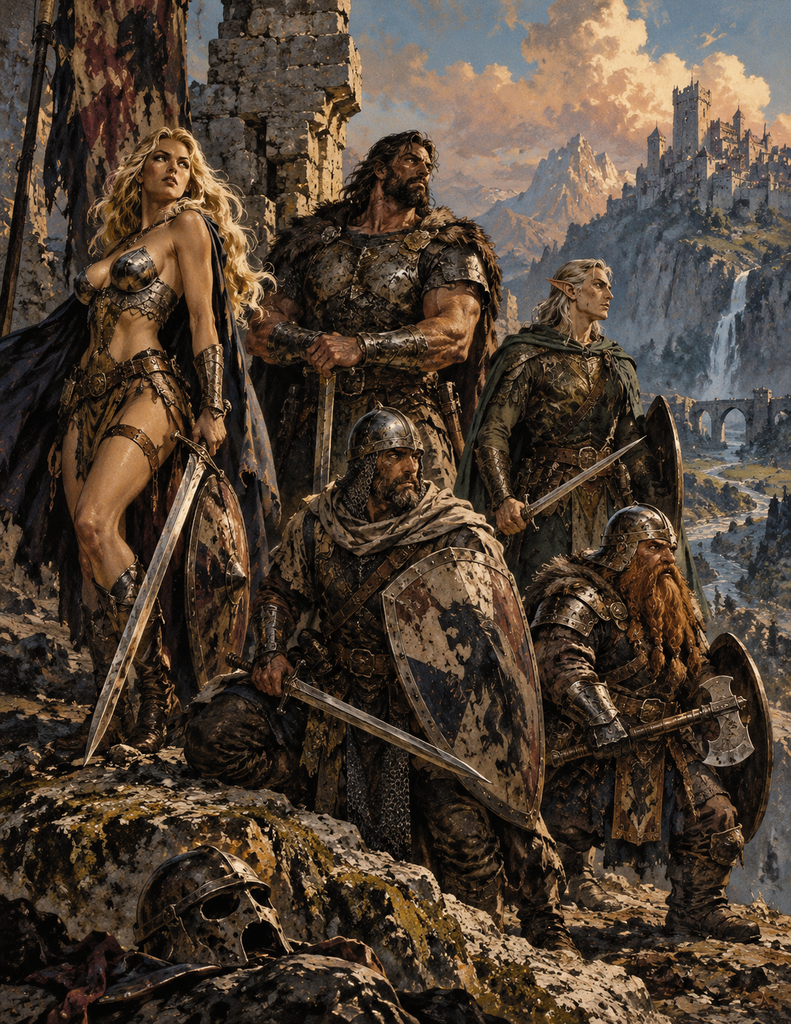
The Man-at-Arms is a professional warrior trained to fight with the weapons and armor of war. Historically, the term referred to a heavily armed fighting man serving in the retinue of a lord, military household, or mercenary force. Knights were men-at-arms, but not every man-at-arms was a knight. In Kingsmark, the class represents the seasoned warrior whose principal profession is armed combat rather than a particular social rank. A Man-at-Arms brings dependable martial expertise to an adventuring party. He is comfortable fighting in armor, engaging enemies at close quarters, holding confined passages, protecting less combat-oriented companions, and confronting opponents that cannot simply be avoided. His training is not dependent upon a particular weapon and may include swords, spears, polearms, axes, maces, shields, bows, wrestling, or mounted combat.
Military experience also provides practical knowledge of camps, watches, patrols, defensive positions, marching, military equipment, and the behavior of armed men. When an expedition enters hostile territory, expects an ambush, or finds itself trapped in a killing ground, the Man-at-Arms contributes the experience of someone for whom organized violence is a practiced profession.
Qatan are restricted from selecting this class; traditional Qatan warfare emphasizes light armor, ranged weapons, daggers, and staves rather than the heavy military equipment of the Man-at-Arms. Female Men-at-Arms, commonly called Shieldmaidens, often emphasize psychological tactics, mobility, and throwing weapons, and archery, over direct contests of strength. Some deliberately exploit beauty, revealing dress, taunting, or apparent vulnerability to distract and mislead opponents, with scant armor sometimes serving this strategy rather than providing meaningful protection. A Shieldmaiden typically seeks to control distance, provoke mistakes, and strike from an advantage, avoiding prolonged armed or unarmed combat whenever possible.
Required Attributes
Discipline +1 [TAB]
Strength +1 [TAB]
Stamina +1 [TAB]
Agility +1
Dexterity +1
Perception +1 [TAB]
Skills — Additional Starting Skill Points 7
Armed Combat +1
Unarmed Combat +1
Shield Combat +1
Infantry Athletics +1
Man Skills +1
Starting Equipment
One martial melee weapon
Dagger
Shield
Mail hauberk
Padded armor worn beneath the mail
Helmet
A Man-at-Arms whose primary weapon requires two hands may exchange the shield for an appropriate secondary weapon or comparable item of military equipment.
💪 Brute [2]
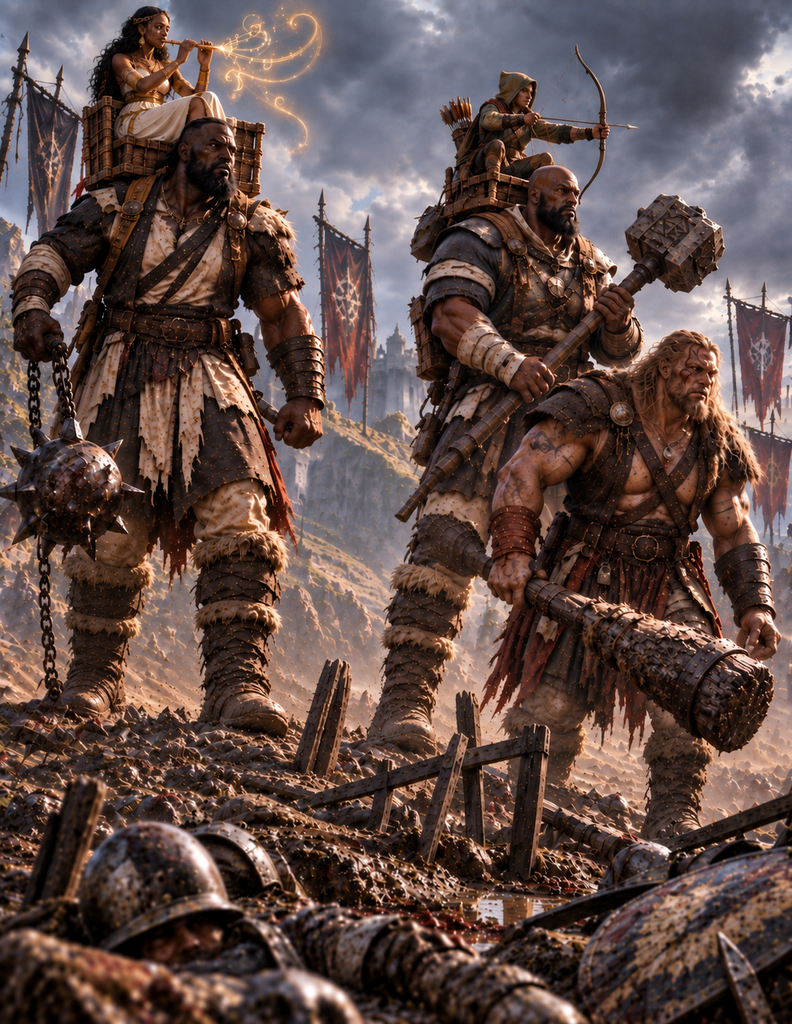
The Brute, sometimes called a Wrestler, is a battlefield shock warrior found exclusively among Human Giants. Where the Man-at-Arms relies upon disciplined weapon training, the Brute exploits extraordinary size, strength, and mass. Brutes crash into enemy formations, batter aside defenses, and physically overpower opponents through wrestling, grappling, tackles, throws, shoves, and devastating strikes.
Brutes also favor heavy crushing weapons such as clubs, maces, war hammers, heavy staves, and morning stars, allowing their tremendous strength to make every blow potentially catastrophic. They wear armor suited to violent movement and close combat, commonly combining thick gambesons, leather, mail, helmets, gauntlets, and strategically placed metal reinforcement.
Some Brutes participate in an ancient partnership between Human Giants and the Qatan. A purpose-built basket, saddle, or harness allows an adult Qatan to ride high upon the Giant’s back and fight from an elevated position. Qatan Rangers may fire bows over their carrier’s shoulders, Minstrels may support the battle through performance, while spellcasters employ magic as the Brute provides protection and mobility.
Only male Human Giants may select the Brute. Female Human Giants may instead select Man-at-Arms, Holy Knight, Barbarian, Ranger, Ninja, or Monster Hunter for physically focused combat roles.
Required Attributes
Strength +3 [TAB]
Stamina +2 [TAB]
Agility +1 [TAB]
Skills — Additional Starting Skill Points 7
Unarmed Combat +2
Armed Combat +1
Infantry Athletics +2
Starting Equipment
One heavy crushing weapon: great club, mace, war hammer, morning star, or comparable Giant weapon
One secondary melee weapon
Reinforced gambeson
Leather armor with metal reinforcement or mail
Helmet
Heavy gauntlets
😡 Barbarian [3]
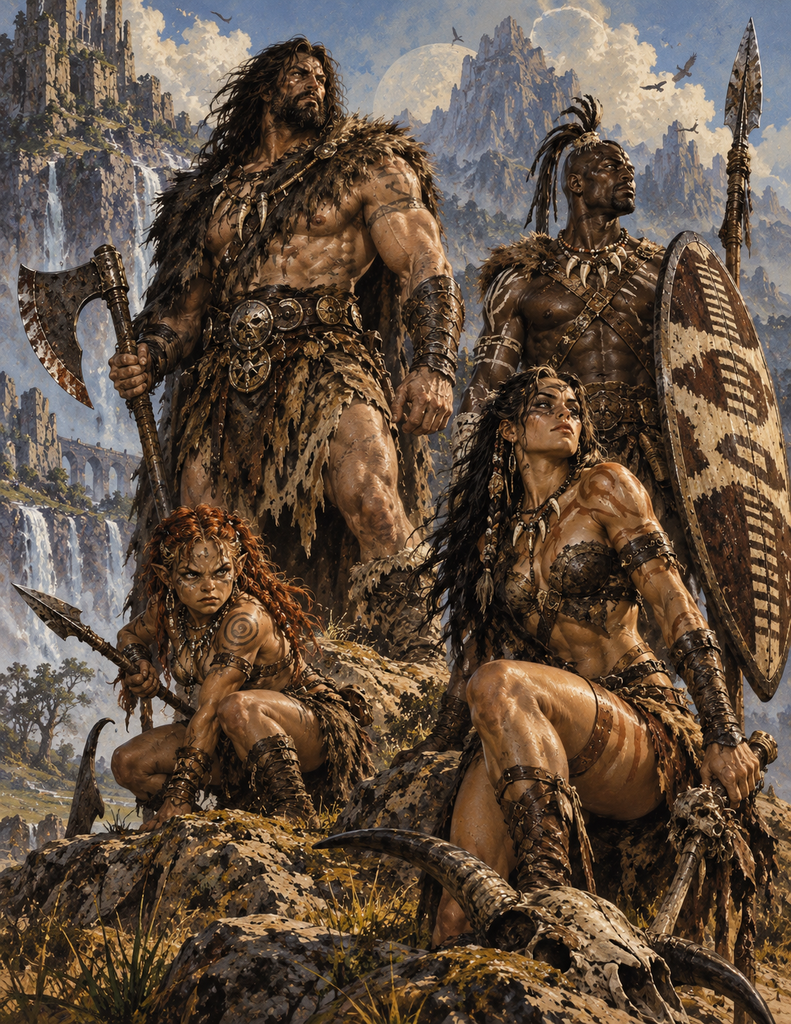
The Barbarian is a warrior from a people living beyond, or largely outside, settled kingdoms and their institutions. The term describes the primitive-warrior archetype, not a specific culture or ethnicity. Barbarians may come from seafaring raiders, nomadic horse peoples, forest tribes, desert clans, mountain strongholds, or distant hunting societies. Unlike the drilled Man-at-Arms, the Barbarian is shaped by hunting, raiding, tribal war, harsh travel, contests of strength, and survival in unforgiving lands. Barbarians are aggressive, powerful fighters who may use axes, swords, spears, clubs, bows, shields, or weapons native to their homeland. Outside combat, they can hunt, navigate wilderness, endure hunger and harsh weather, spot natural hazards, and survive where civilization offers little help.
Elves and Dwarves cannot select this class because no primitive Elven or Dwarven cultures exist in enough numbers to produce Barbarians. Qatan Barbarians come from the rare primitive Qatan culture described in The World Book; most other Qetanim possess technology comparable to Dwarves, who are themselves decades ahead of ordinary Humans, while some Qatan societies are more advanced still. Human Giants lack a separate civilization and usually live among ordinary Humans, so Giants from primitive Human societies may become Barbarians. Because males perform most fighting in such societies, female Barbarians are allowed but rare.
😡 𝐏𝐫𝐢𝐦𝐚𝐥 𝐑𝐚𝐠𝐞
During an Action Scene, a Barbarian may enter Primal Rage and ignore Pain Modifiers from Physical Wounds. While raging, he cannot use Defensive Stance, willingly retreat, hide, perform careful tasks, or take actions requiring calm focus while an enemy remains an immediate threat. He must use his Turns to attack, pursue, grapple, intimidate, or otherwise press an enemy whenever reasonably possible. Ending Primal Rage while an enemy remains an immediate threat requires a successful Discipline Defense Test against TN 10. Otherwise, it ends freely once the danger passes. Primal Rage does not heal or prevent Physical Wounds and cannot stop an otherwise fatal injury. When it ends, all Pain Modifiers return. Rage represents a trained state of extreme combat arousal. Breathing changes, adrenaline surges, pain fades, hesitation vanishes, and self-preservation gives way to aggression. To an observer, this may appear as screaming fury, eerie calm, ritual chanting, animal-like behavior, or a refusal to acknowledge injury. Different Barbarian cultures cultivate Rage through war cries, breathing methods, ancestral rites, rhythmic movement, conditioning, or traditions passed from warrior to warrior. Rage does not make the Barbarian invulnerable or erase his wounds. It lets him keep functioning through pain, fear, and punishment that might stop another fighter. When the Rage ends, the body has still suffered everything inflicted upon it.
Required Attributes
Strength +1 [TAB]
Stamina +1 [TAB]
Agility +1 [TAB]
Perception +1
Skills — Additional Starting Skill Points 8
Armed Combat +1
Unarmed Combat +1
Infantry Athletics +1
Survival +1
Starting Equipment
One martial melee weapon appropriate to the character’s homeland
One secondary weapon
Hunting knife
Light or medium shield
Leather or hide armor
Hunting and wilderness supplies
50 feet of rope
A Barbarian may exchange the shield or armor for a bow with arrows, throwing weapons, or similar equipment suited to the character’s homeland and fighting tradition.
🎯 Monster Hunter [4]
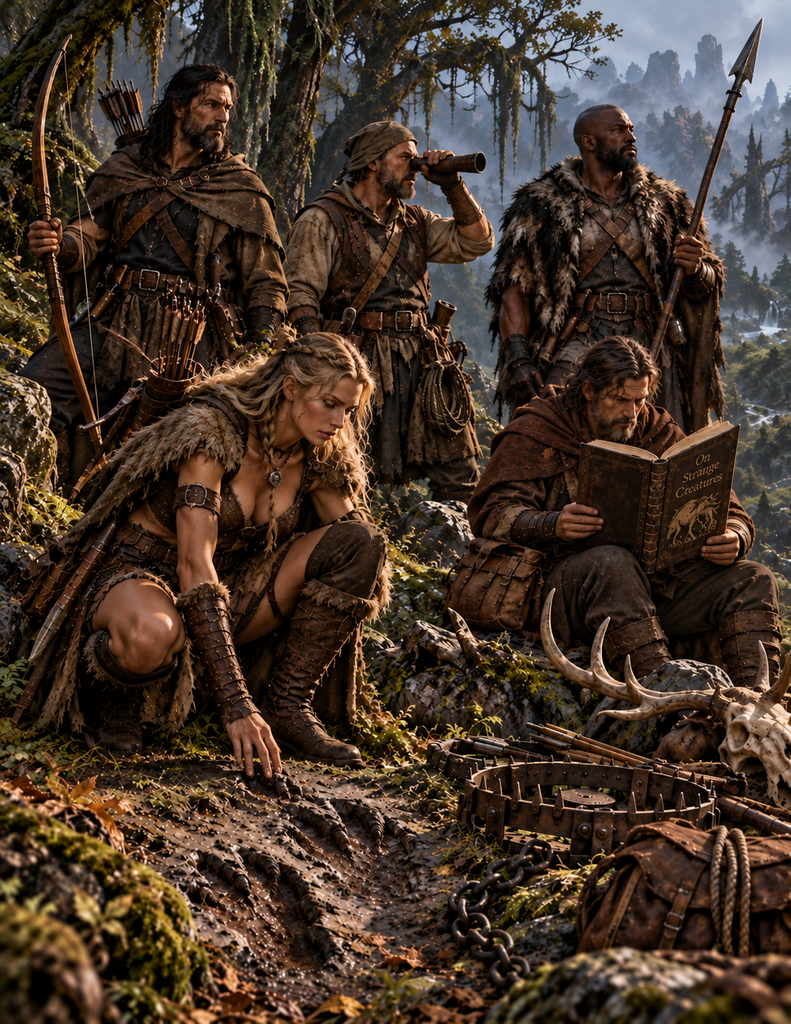
The Monster Hunter is an experienced hunter who has decided that the skills used to stalk ordinary animals might also be sufficient to hunt the far more dangerous creatures of Sylva. Unlike the Ranger, Beast Master, or other magically gifted wilderness adventurers, there is nothing inherently supernatural about the Monster Hunter. Most begin as ordinary woodsmen, trappers, game hunters, poachers, or professional hunters who already know how to follow tracks, approach prey without being noticed, construct traps, survive away from settlements, and kill animals with a well-placed arrow. At some point, however, the Monster Hunter decides to pursue considerably more dangerous prey. The reasons vary. Some have encountered monsters personally, while others grew up listening to frightening campfire stories, local legends, and grandmother’s tales about creatures supposedly lurking beyond the firelight. A prospective Monster Hunter may possess little more supernatural education than such folklore, supplemented perhaps by an old book describing strange beasts and cryptids. The profession consequently attracts a peculiar combination of competence and overconfidence. A beginning Monster Hunter is not necessarily a celebrated slayer of monsters; he is a capable hunter who believes he can become one. Those who survive long enough may eventually earn formidable reputations as professional Monster Hunters. Those who badly overestimate what hunting deer has taught them about hunting trolls provide new campfire stories for everyone else.
All Human Types and genders may select this class, and Monster Hunters are found among every people. Dwarves are less likely to begin as ordinary hunters seeking a career change, as their subterranean communities rely heavily upon cultivated fungi, livestock, trade, and other underground food sources rather than hunting wild game. Elves are commonly vegetarian, vegan, or pescatarian and likewise rarely hunt animals for food. Dwarven, Elven, and Qatan Monster Hunters are therefore more likely to begin their adventuring careers already experienced with monstrous prey, rather than ordinary hunters seeking their first monster kill. Qetanim produce more dedicated Monster Hunters than any other people, and their traps, strategies, and methods for defeating creatures many times their size are renowned throughout Sylva.
Required Attributes
Stamina +1
Perception +2 [TAB]
Agility +1 [TAB]
Dexterity +1 [TAB]
Wisdom +1 [TAB]
Skills — Additional Starting Skill Points 5
Archery +2
Survival +2
Cloak & Dagger +1
Mechanisms +1
Occult Knowledge +1
Starting Equipment
Hunting bow & quiver with 20 arrows
Hunting knife
Short sword or hand axe
Leather armor
Hunting and trapping supplies
50 feet of rope
Small hammer
Field dressing and skinning tools
Small collection of notes, folklore, or writings concerning monsters
🐺 Beast Master [5]
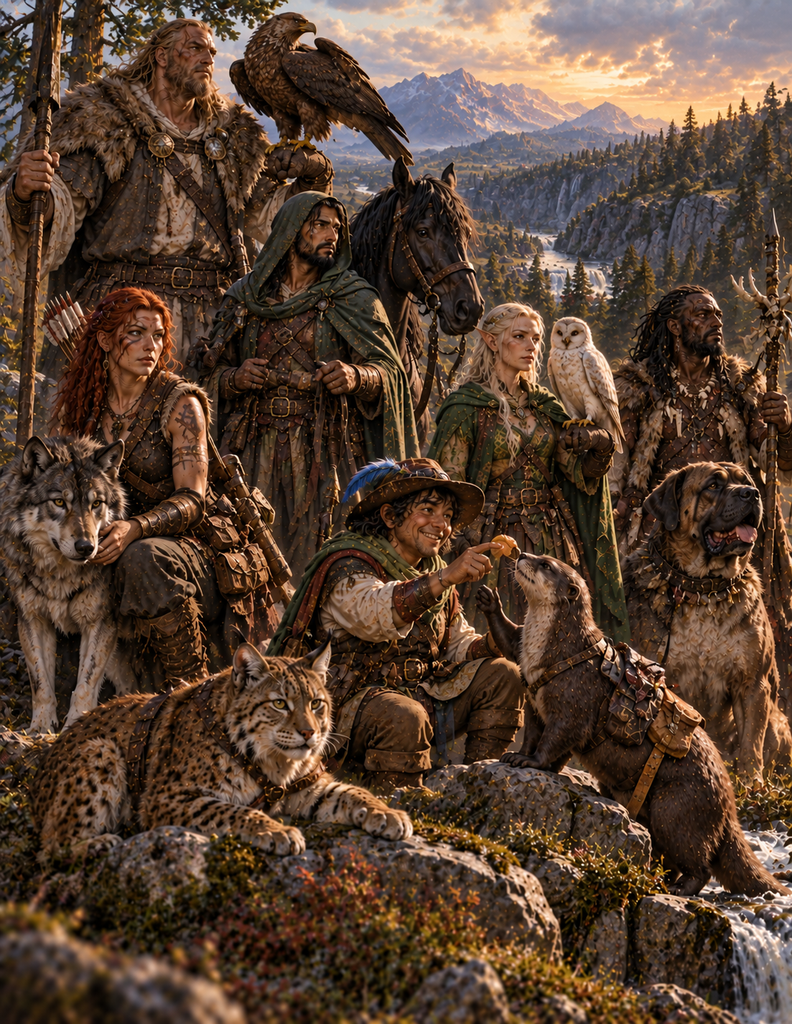
The Beast Master possesses an extraordinary affinity with animals. Hunters, handlers, shepherds, falconers, stablemen, and wilderness travelers may all develop close relationships with particular animals, but the Beast Master’s connection goes considerably further. Animals often respond to the Beast Master with unusual trust, and the character learns to understand their behavior, needs, fears, and capabilities with remarkable precision. A Beast Master commonly adventures alongside one or more animal companions. These are not disposable equipment or creatures summoned merely to fight. They are living companions with their own instincts and abilities. Depending upon culture, environment, and circumstance, a Beast Master might travel with a dog, wolf, horse, bird of prey, great cat, bear, or another suitable animal. The Beast Master can employ animals for tracking, scouting, hunting, guarding, carrying, pursuit, combat, or other tasks appropriate to the creature. The Beast Master’s magic strengthens this relationship rather than replacing practical animal handling. The class may learn any Spell bearing the 🐺Animal tag, allowing Beast Masters from different cultures and environments to develop very different supernatural relationships with the creatures around them.
Beast Masters among the Qetanim often train sturdy ponies, donkeys, reindeer, exceptionally large dogs, and similar animals as mounts for themselves or other Qetanim. Because the Qetanim are much lighter than ordinary Humans and do not typically wear heavy armor, several animals too small for a Human rider can carry them realistically. Magical animal handling can overcome temperament or training problems, but it does not ignore anatomy; the animal must still be physically capable of carrying the rider, equipment, saddle, and supplies safely.
All Human Types and genders may select this class, with slightly more male Beast Masters than female. They are very rare among Dwarves, whose subterranean culture provides relatively little opportunity for keeping or working closely with animals; Dwarven pets are typically small creatures suited to underground life. Most Beast Masters are Anashim, often serving alongside trained animals in war. Qetanim and Elven Beast Masters are also relatively common, although their traditions tend to emphasize companionship, hunting, travel, communication, and cooperation with animals rather than their use in warfare.
Required Attributes
Charisma +2 [TAB]
Wisdom +1 [TAB]
Perception +1 [TAB]
Agility +1
Spirit +2 [TAB]
Skills — Additional Starting Skill Points 6
Survival +2
Mounts +1
Medicine +1
Armed Combat +1
Spiritual Practices +1
🐺 Magic
A Beast Master may learn any Spell bearing the 🐺Animal tag.
Starting Equipment
One practical melee weapon
Hunting knife
Short bow & quiver with 20 arrows
Leather armor
Animal handling and grooming supplies
Feed appropriate to the animal companion
50 feet of rope
Blanket or covering appropriate to the animal companion
🏹 Ranger [6]
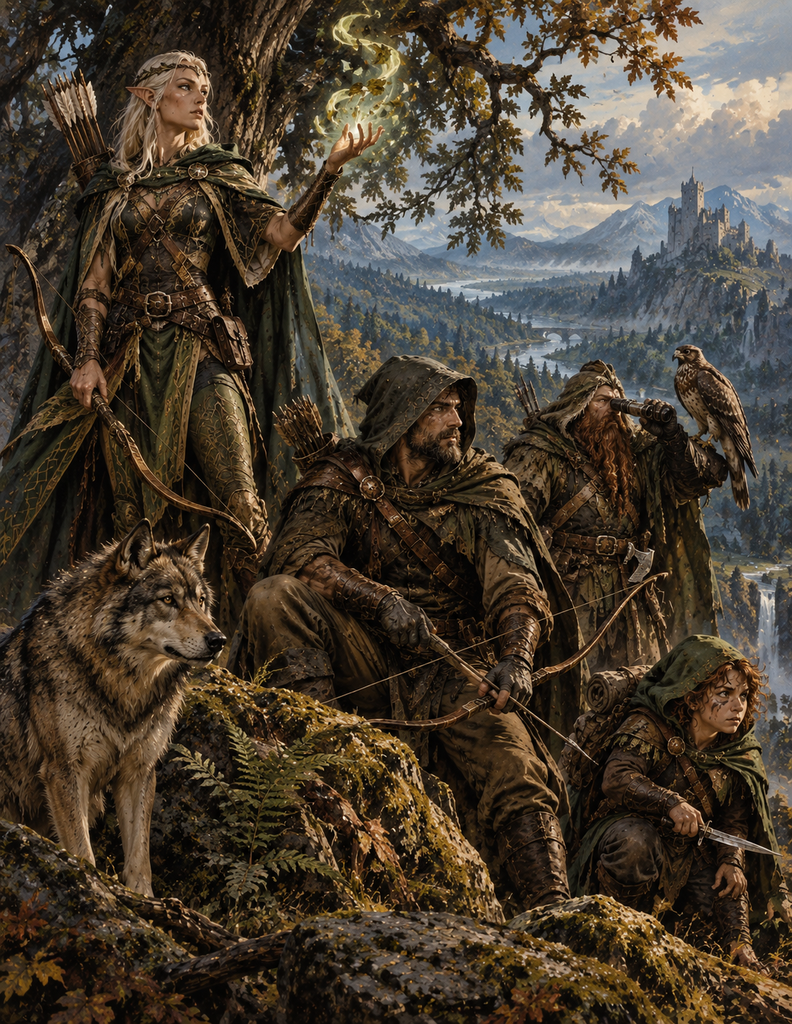
The Ranger is an elite wilderness warrior, scout, and tracker trained to operate far beyond the safety and support of settled communities or conventional armies. Most Rangers begin as soldiers whose unusual combination of martial talent, wilderness aptitude, perception, and magical ability marks them for specialized training. Militaries throughout Sylva actively seek such individuals, recognizing their extraordinary value as scouts, pathfinders, infiltrators, raiders, and reconnaissance specialists.
Rangers are trained to survive for extended periods beyond friendly lines, sometimes operating alone and sometimes as members of small assault teams entrusted with missions ordinary soldiers cannot easily accomplish. They may scout enemy positions, cross seemingly impassable country, guide troops through hostile territory, pursue fleeing enemies, conduct raids, carry messages through contested lands, or observe an enemy without being detected. A Ranger must therefore be capable of fighting without immediate support while also finding food, shelter, water, safe routes, and concealed places to rest. Their limited but genuine magic is integrated into this specialized military training, enhancing wilderness travel, supernatural tracking, interaction with animals, protection, concealment, and combat rather than replacing practical skill.
All Human Types and genders may select this class. Female Rangers are exceedingly rare among Anashim and are most often found among Elyonim and Qetanim, followed by Tzurim and Gibborim. Human Giants require at least 2 Creation Favor from Burdens to satisfy this Class’s starting Attribute requirements. A Ranger is distinct from the Monster Hunter—another archery-focused class—in that Rangers are typically individuals whose magical abilities were identified during military training or service in an army, after which they received specialized training to become elite scouts. Rangers are also distinct from a Shaman who happens to use a bow and arrow because a Ranger’s magic is integrated directly into specialized military, scouting, survival, and combat training, whereas a Shaman’s magic develops from spiritual traditions and practices rather than military training.
Required Attributes
Stamina +1 [TAB]
Perception +2 [TAB]
Agility +1 [TAB]
Dexterity +1
Wisdom +1 [TAB]
Spirit +2
Skills — Additional Starting Skill Points 6
Survival +2
Archery +1
Armed Combat +1
Infantry Athletics +1
Cloak & Dagger +1
Schools of Magic
🌿Nature Magic
❤🩹Healing Magic
🔮Divination Magic
🛡Abjuration Magic
🎶Minstrel’s Magic
🚪Summoning Magic
🥋Martial Adept Magic
Starting Equipment
Hunting bow & quiver with 20 arrows
One practical melee weapon
Hunting knife
Leather armor
Hunting and trapping supplies
50 feet of rope
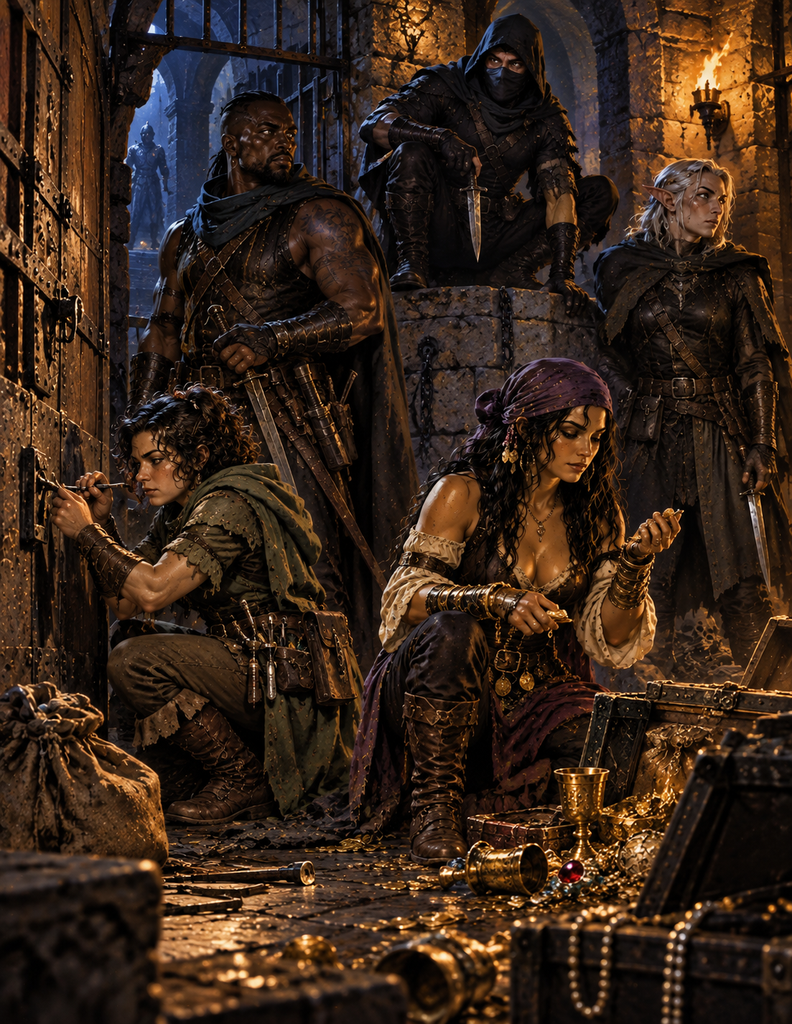
🗝️ Thief [7]
The Thief is a specialist in stealth, infiltration, burglary, locks, traps, deception, and the practical techniques of entering places where he is not supposed to be. Some Thieves are professional criminals, while others are scouts, spies, smugglers, tomb robbers, treasure hunters, former street thieves, locksmiths, security specialists, or adventurers who simply discovered that locked doors and guarded rooms frequently stand between a party and its objective.
A capable Thief contributes far more than the ability to steal. He can move quietly, hide, recognize and manipulate mechanisms, bypass locks, identify traps, investigate suspicious objects, navigate criminal circles, observe guarded locations, and approach problems through secrecy rather than direct confrontation. When the party needs someone to enter a guarded building, inspect a trapped passage, acquire information discreetly, discover a weakness in a secure location, or determine what lies beyond a locked door, the Thief possesses the appropriate training.
The Thief is a completely nonmagical Class. His effectiveness comes from Dexterity, Agility, perception, nerve, preparation, specialized tools, deception, technical knowledge, and extensive practical experience.
All Human Types and genders may select this class. Thieves rarely introduce themselves as thieves, instead using respectable titles such as Locksmith, Master of Devices, Master of Defenses, or Fortification Master. Actual criminal Thieves are most common among the Anashim. Among Elves, Dwarves, Qetanim, and Gibborim, the class more commonly represents legitimate specialists in locks, traps, infiltration, defensive mechanisms, and discovering weaknesses in secure places. Elven societies provide comparatively little opportunity or tolerance for professional theft; Dwarven culture places particularly strong emphasis upon discipline, craft, property, and personal honor; and the close-knit, secretive communities of the Qetanim make habitual theft from one’s neighbors both difficult and socially dangerous. Criminal Thieves are also uncommon among the Gibborim, who are poorly suited to concealment and clandestine entry and, when inclined toward criminal acquisition, are considerably more likely to take something by force. An Anashim Thief, by contrast, is more likely to be an actual burglar, smuggler, tomb robber, or other professional criminal—or simply an unfortunate locksmith looking for a more profitable career.
Required Attributes
Dexterity +2 [TAB]
Agility +1 [TAB]
Perception +1 [TAB]
Intelligence +1
Charisma +1
Skills — Additional Starting Skill Points 5
Thievery +2
Cloak & Dagger +2
Mechanisms +1
Underworld +1
Armed Combat +1
Starting Equipment
Dagger
Short sword
Leather armor
Lockpicks and other Thievery tools
Chalk
Small mirror
Hooded lantern & oil
Small pry bar
Grappling hook
50 feet of rope
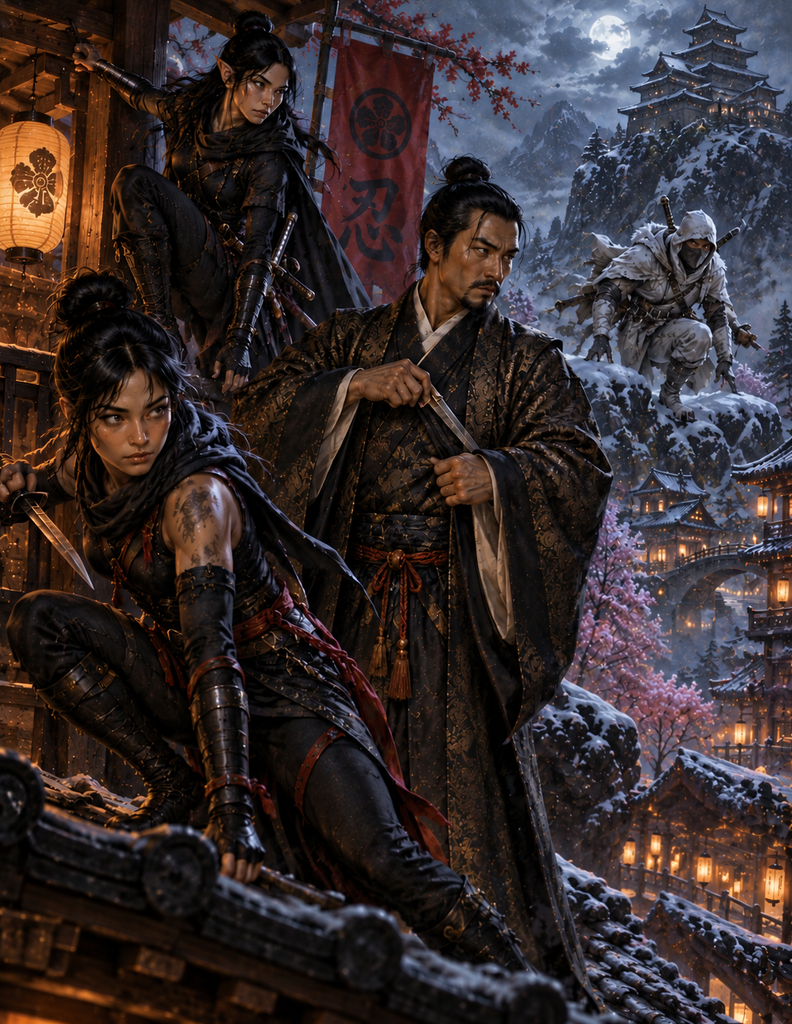
🥷 Ninja [8]
The Ninja is a highly trained specialist in infiltration, espionage, assassination, reconnaissance, deception, and escape. Ninja training combines physical conditioning, stealth, climbing, disguise, observation, unconventional weapons, and disciplined combat techniques intended to accomplish an objective without becoming trapped in a conventional battle. A Ninja is therefore most effective when allowed to choose when, where, and how an encounter occurs.
The Ninja’s training also extends into the supernatural. A minimum 🌬Spirit +2 is required, reflecting spiritual disciplines capable of producing abilities that appear impossible to outsiders. Magic supplements the Ninja’s core purpose: infiltration, deception, extraordinary movement, assassination, reconnaissance, and escape.
All Human Types and genders may select this class, provided the character can satisfy its demanding Attribute requirements. Human Giants require at least 1 Creation Favor from Burdens to satisfy this Class’s starting Attribute requirements. A female ninja is called a Kunoichi, and they are usually much more reliant on stealth, deception, disguise, infiltration, and surprise than direct physical confrontation.
Required Attributes
Agility +2 [TAB]
Dexterity +2 [TAB]
Perception +1 [TAB]
Discipline +1 [TAB]
Spirit +2
Skills — Additional Starting Skill Points 5
Cloak & Dagger +2
Infantry Athletics +2
Armed Combat +1
Unarmed Combat +1
Thievery +1
Schools of Magic
🥋Martial Adept Magic
🧠Psychic Magic
🔥Elemental Magic
🌀Illusion Magic
🌿Nature Magic
🌑Dark Magic
Starting Equipment
Ninjatō or comparable short sword
Dagger
Several throwing weapons
Climbing tools
Grappling hook
50 feet of rope
Dark, flexible clothing suitable for stealth
Small disguise kit
🥷 Ninja Clans
Ninja training varies by Clan. Each preserves methods developed for espionage, infiltration, assassination, reconnaissance, combat, or survival. Every Ninja retains the Class’s normal Schools of Magic; Clan neither adds Schools nor restricts which of them the Ninja may learn.
Instead, Clan reflects specialized training completed before adventuring. Its benefits are added to ordinary Starting Skills and Starting Spells. A Clan-granted Spell does not reduce normal Starting Spells and may grant a specific Spell outside the Ninja’s Schools without granting access to that School. Such Spells count toward Maximum Magical Capacity.
Choose a Clan or roll 1d12.
1–3 — 🌹 Crimson Veil Clan
Crimson Veil Ninja train as actors, courtiers, entertainers, seducers, servants, and social infiltrators. They master posture, voice, expression, costume, manners, and attraction to enter places unreachable by climbing walls. A Crimson Veil Ninja gains −1 Advantage on ⚒Social Skills Tests and begins with two additional Spells: 🎶Glamour 85 and one ❤️Love Magic Spell chosen by the player. These are Clan exceptions and do not grant general access to 🎶Minstrel’s Magic or ❤️Love Magic.
4–6 — ⚡ Storm Dragon Clan
Storm Dragon Ninja train in supernatural techniques using fire, smoke, wind, water, ice, earth, lightning, weather, and the surrounding environment. Their magic serves both battle and infiltration by hiding movement, dividing enemies, opening escape routes, setting fires, breaking formations, and turning terrain against pursuers. A Storm Dragon Ninja begins with two additional 🔥Elemental Magic Spells chosen by the player. They do not replace ordinary Starting Spells but count toward Maximum Magical Capacity.
7–8 — 🗡 Iron Shadow Clan
Iron Shadow Ninja spend less training on magic and far more on combat. Swordsmanship, grappling, striking, conditioning, pain tolerance, sparring, and drills dominate their education. An Iron Shadow Ninja begins with 2 XP already earned and invests 1 XP in ⚒Armed Combat and 1 XP in ⚒Unarmed Combat, increasing each by +1. These increases may exceed the normal Character Creation limit when needed. The 2 XP are lifetime XP, leaving only 48 XP before the 50 XP maximum.
9–10 — 🐍 Venom Lotus Clan
Venom Lotus Ninja specialize in poisons, venoms, medicines, narcotics, herbs, corrosives, poisoned weapons, and antidotes. A Venom Lotus Ninja begins with 🌿Poison / Corrosion 58 as an additional Spell and ⚒Alchemy +1 as Clan training, having earned and invested 1 XP at character creation. The character also receives a poisoner’s kit with ordinary tools for preparing, storing, identifying, and administering poisons and antidotes. Poison / Corrosion counts toward Maximum Magical Capacity.
11–12 — 🌙 Ghost Moon Clan
Ghost Moon Ninja specialize in reconnaissance and infiltration, learning what lies ahead before anyone realizes they are present. Their training stresses surveillance, night operations, concealed approaches, locating guards, traps and hidden entrances, memorizing routines, and penetrating defended sites unseen. A Ghost Moon Ninja begins with 🔮Reveal Hidden 51 and 🌀Disguise 208 as additional Spells and gains −1 Advantage on Perception Tests during deliberate reconnaissance to locate guards, traps, hidden entrances, concealed creatures, ambush positions, or other security measures. Reveal Hidden is a Clan exception and does not grant general access to 🔮Divination Magic.
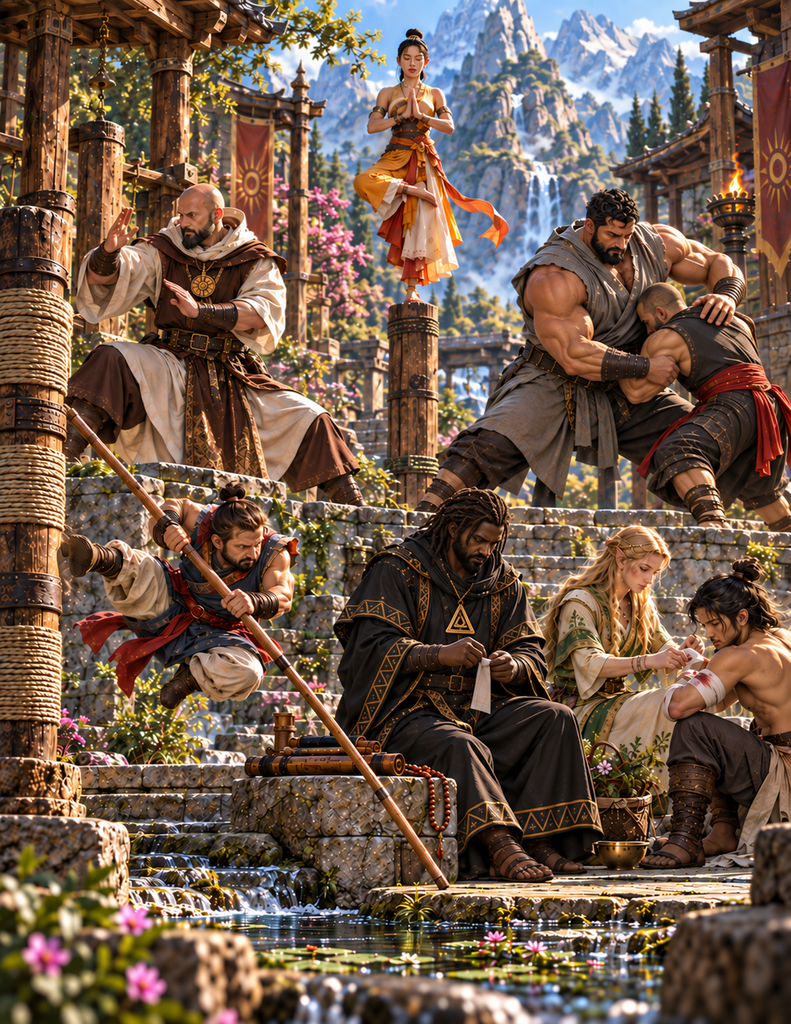
🥋 Monk [9]
The Monk is a disciplined martial artist whose body and mind have been developed through years of physical conditioning, contemplation, spiritual practice, and rigorous training. Monks learn to fight effectively without depending upon armor or heavy weapons, using speed, balance, precision, leverage, throws, strikes, and extraordinary control of their own bodies. A Monk requires 🌬Spirit +2 because the class pursues abilities beyond ordinary athletic achievement. Monastic disciplines can produce extraordinary feats of bodily control, concentration, perception, resistance, healing, and supernatural martial skill. The Monk gives the party a highly mobile combatant, disciplined mystic, and spiritually resilient adventurer whose most important weapons travel with the character everywhere.
All Human Types and genders may select this Class. Qatan Monks favor the bō staff, using it to vault, deliver powerful strikes, and leverage larger opponents into trips and throws; their short reach limits Unarmed Combat. Gibborim favor wrestling and throwing techniques and are generally less proficient in Armed Combat than other warrior Monks. Human Giants require at least 1 Creation Favor from Burdens to meet this Class’s starting Attribute requirements.
Monastic Traditions
Every Monk possesses access to 🥋Martial Adept Magic and 🌬Astral Magic. These form the supernatural foundation of the Class. The Monk’s religious or monastic tradition completes the character’s available Schools. When the Game Master provides 📖Spell Learning Opportunities to a Monk, roughly half of the Spells offered and ultimately learned should normally come from 🥋Martial Adept Magic. The remaining opportunities may develop among the other Schools available through the Monk’s tradition. This preserves the Monk as a supernatural martial artist even when the religious tradition provides access to a broad range of additional magic. Choose one of the following traditions:
🥋 The Way of the Empty Hand — 🥋Martial Adept, 🌬Astral, 🧠Psychic, 🛡Abjuration, and 🔮Divination Magic.
🕯 The Covenant — 🥋Martial Adept, 🌬Astral, 🕯Holy, 🛡Abjuration, and ❤️🩹Healing Magic.
🔆 The Sun & Shield — 🥋Martial Adept, 🌬Astral, 🕯Holy, 🔮Divination, and 🛡Abjuration Magic.
🪷 The Path of the One — 🥋Martial Adept, 🌬Astral, 🕯Holy, 🧠Psychic, and 🔮Divination Magic.
🌿 Sylvara — 🥋Martial Adept, 🌬Astral, ❤️Love, ❤️🩹Healing, and 🌿Nature Magic.
🪶 Peoples of the Wild — 🥋Martial Adept, 🌬Astral, 🌿Nature, 🚪Summoning, and 🔮Divination Magic.
⚒ Sacred Forge — 🥋Martial Adept, 🌬Astral, 🛡Abjuration, and 🔥Elemental Magic.
🌙 Keepers of the Veil — 🥋Martial Adept, 🌬Astral, 🔮Divination, and 🌙Dream Magic.
The number of Schools does not determine the strength of the Monk. A tradition with four Schools produces a more concentrated repertoire, while a tradition with five provides greater variety among secondary magical development. The center of the Class remains 🥋Martial Adept Magic and the disciplined development of body and spirit. The Monk’s tradition describes customary supernatural training rather than imposing additional weapon or armor restrictions. Most Monks favor unarmed combat or lightweight, flexible weapons and protection because mobility and bodily control are central to their training, but individual monasteries may develop distinctive traditions involving staffs, swords, bows, spears, wrestling, flexible weapons, paired weapons, or other culturally appropriate arms.
Required Attributes
Agility +2 [TAB]
Discipline +2 [TAB]
Stamina +1 [TAB]
Perception +1
Spirit +2 [TAB]
Skills — Additional Starting Skill Points 6
Unarmed Combat +2
Infantry Athletics +1
Spiritual Practices +1
Armed Combat +1
Occult Knowledge +1
Schools of Magic
🥋Martial Adept Magic
🌬Astral Magic
The Monk’s additional Schools are determined by the character’s chosen Monastic Tradition, as described above.
Starting Equipment
Bō staff or quarterstaff
Dagger
Prayer or meditation beads
Monastic Life & Adventuring
Monks are not necessarily cloistered ascetics who spend their entire lives behind monastery walls. Some belong to large religious houses, mountain retreats, desert hermitages, temple schools, martial brotherhoods, wandering orders, or small communities built around a single teacher. Others may have trained privately under one master and never lived in a formal monastery at all. What unites them is disciplined practice rather than architecture. A Monk’s training is expected to shape daily life through exercise, meditation, prayer, fasting, study, controlled breathing, repetitive forms, sparring, ritual, or other practices suited to the character’s tradition.
A Monk may become an adventurer for many reasons. A monastery might send a student to recover a relic, investigate a supernatural threat, protect pilgrims, carry a message, repay a debt, or gain experience beyond the safety of the school. Another Monk may leave voluntarily after completing formal training, seeking a teacher believed dead, pursuing a personal vow, following a prophetic dream, or trying to test whether years of discipline can survive contact with the wider world. Some Monks are exiles, reformers, failed students, survivors of destroyed orders, or wandering teachers with no intention of returning home.
This gives Monks strong reasons to adventure without requiring every character to behave like a serene mystic. Discipline does not mean passivity. A Monk may be stern, humorous, impatient, compassionate, competitive, severe, curious, proud, or humble. What matters is that the character has been trained to bring the body, mind, and spirit under deliberate control.
In play, this discipline should be visible even outside combat. A Monk may rise before the rest of the party to practice forms, spend a quiet hour in meditation, maintain strict habits around food or sleep, study an opponent’s movement, or treat physical hardship as something to be endured rather than complained about. None of these habits grant automatic bonuses unless a rule says so, but they help make the Class feel distinct.
Monastic traditions may also differ sharply in philosophy. One school may teach withdrawal from worldly desire, another sacred service, another harmony with nature, another mastery of thought, and another perfection through combat. Two Monks can therefore share the same Class while disagreeing profoundly about what discipline is ultimately for.
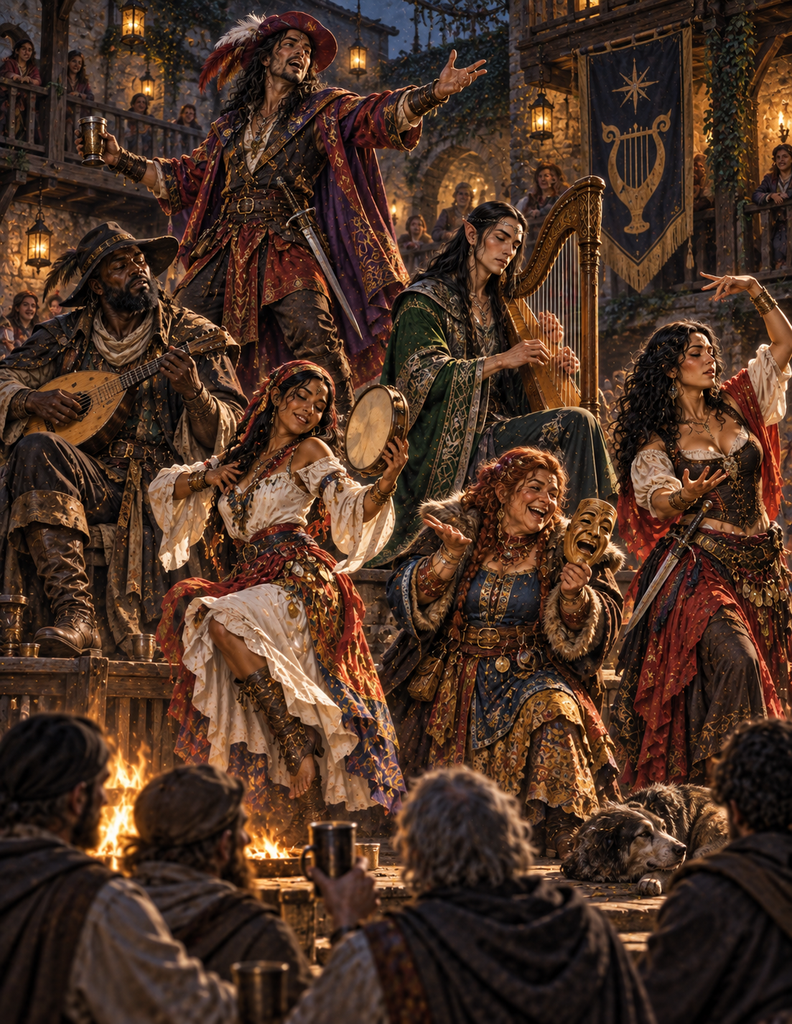
🎶 Minstrel [10]
The Minstrel is a professional performer, storyteller, musician, entertainer, and social adventurer whose talents can open doors that weapons cannot. Minstrels travel between villages, towns, castles, courts, taverns, festivals, military camps, and adventuring parties, carrying songs, stories, rumors, news, legends, and entertainment from one community to another. A Minstrel requires 🌬Spirit +2. Through supernatural performance, the class can influence emotions, strengthen companions, inspire courage, affect relationships, captivate audiences, and turn music or storytelling into genuine magical power.
The Minstrel is particularly valuable when an adventuring party must negotiate, gather information, improve morale, entertain a suspicious audience, influence a crowd, establish friendly relations, or discover what people are saying. A skilled Minstrel may be remembered in communities long after the rest of the party has departed, and songs concerning an adventuring party’s victories or disasters can contribute considerably to its reputation.
All Human Types and genders may select this class. It is most popular among the Anashim (Ordinary Humans), Qetanim (Little Humans) and Elyonim (Perfected Humans), and least popular among the Gibborim (Human Giants) and Tzurim (Hardy Humans), but they have their singers, musicians, poets and actors too.
Required Attributes
Charisma +2 [TAB]
Dexterity +1 [TAB]
Intelligence +1
Perception +1
Spirit +2 [TAB]
Skills — Additional Starting Skill Points 5
Spiritual Practices +2
Social Skills +2
Scholarship +1
Underworld +1
Armed Combat +1
Schools of Magic
🎶Minstrel’s Magic
❤Love Magic
🦁Leadership Magic
Starting Equipment
One musical instrument appropriate to the character
Dagger
Performance clothing
Writing materials
Collection of songs, stories, poems, or other performance material
Maintenance supplies appropriate to the character’s instrument
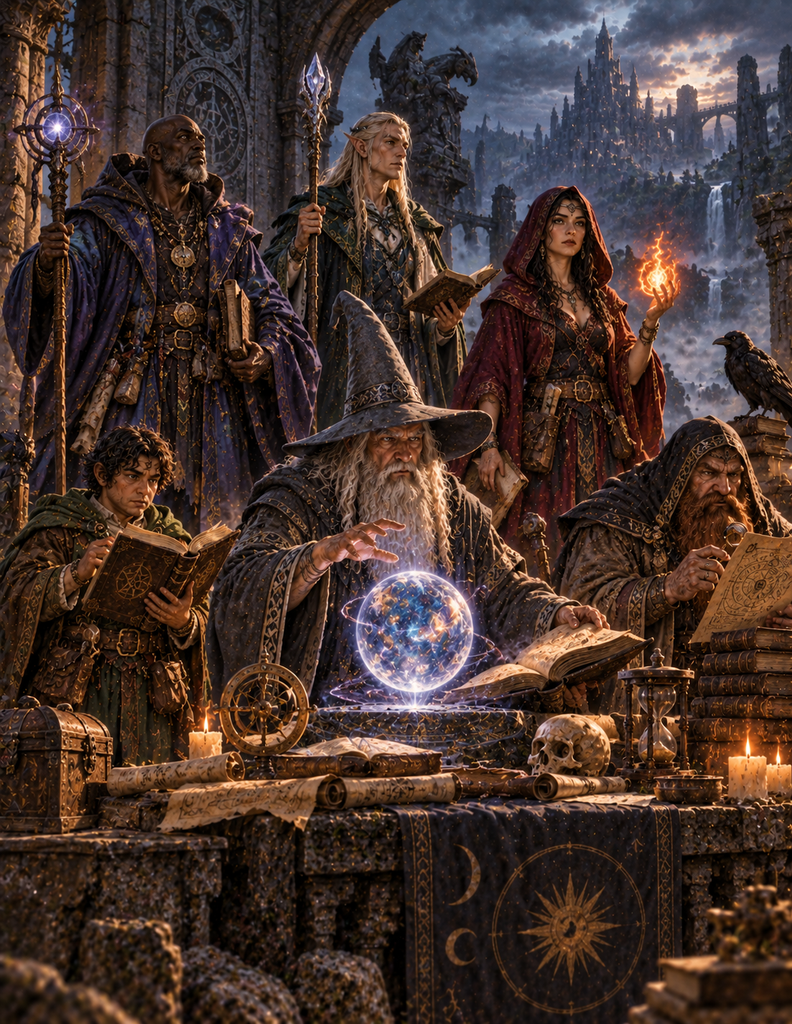
🧙♂️ Wizard [11]
The Wizard possesses the broadest potential magical repertoire of any Character Class. This breadth does not mean that every Wizard knows the same Spells. Individual Wizards develop very different repertoires according to their teachers, discoveries, interests, experiences, and 📖Spell Learning Opportunities.
The Wizard is a dedicated practitioner of learned magic. Unlike characters who supplement another profession with supernatural abilities, the Wizard makes the study and practice of magic the central discipline of his life. Wizards investigate magical principles, study Spells, collect occult writings, seek knowledgeable teachers, experiment with rituals, and pursue supernatural knowledge wherever it can be found.
All Human Types and genders may select this class, but it is typically held by males. A female wizard may be referred to as a sorceress, wizard or wizardress.
Required Attributes
Spirit +3 or +4 [TAB]
Intelligence +2 [TAB]
Discipline +1 [TAB]
Wisdom +1 [TAB]
Skills — Additional Starting Skill Points 6
Spiritual Practices +2
Occult Knowledge +2
Scholarship +1
Alchemy +1
Schools of Magic
All Schools of Magic except 🕯Holy Magic.
Starting Equipment
Spellbook
One practical melee weapon
Writing materials
Small collection of magical or scholarly reference works
Ritual implements
Containers for magical components
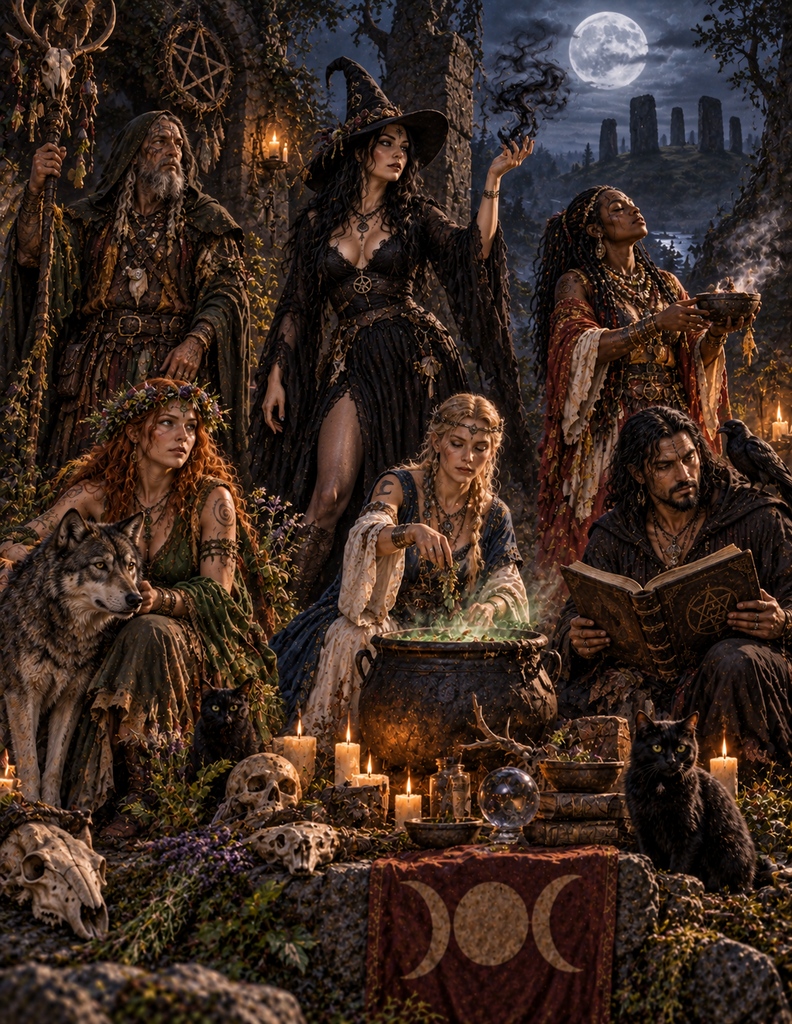
🧙 Witch [12]
The Witch is a practitioner of traditional magic whose knowledge is commonly transmitted through mentorship, family traditions, local customs, old writings, personal experimentation, and direct encounters with the supernatural. Witches frequently develop their craft outside formal institutions, combining practical knowledge of the natural world with rituals, charms, healing, spirits, divination, and other forms of magic.
Individual Witches develop very different magical repertoires according to tradition, mentors, discoveries, interests, and 📖Spell Learning Opportunities. One Witch may become renowned for healing and protective charms, another for spirits and divination, and another for command of nature or the elements.
All Human Types and genders may select this class; Witch describes a magical tradition rather than a gender, however, most witches are female.
Required Attributes
Spirit +3 or +4 [TAB]
Wisdom +2 [TAB]
Discipline +1 [TAB]
Perception +1
Skills — Additional Starting Skill Points 6
Spiritual Practices +2
Occult Knowledge +2
Survival +1
Alchemy +1
Schools of Magic
🌿Nature Magic
🔥Elemental Magic
❤🩹Healing Magic
❤Love Magic
🚪Summoning Magic
🌬Astral Magic
🛡Abjuration Magic
🔮Divination Magic
✨Arcane Magic
🧠Psychic Magic
🌙Dream Magic
💍Enchantment
Starting Equipment
Dagger
Staff or walking stick
Journal or personal book of magical knowledge
Ritual implements
Herbs and other natural materials
Small containers for magical components
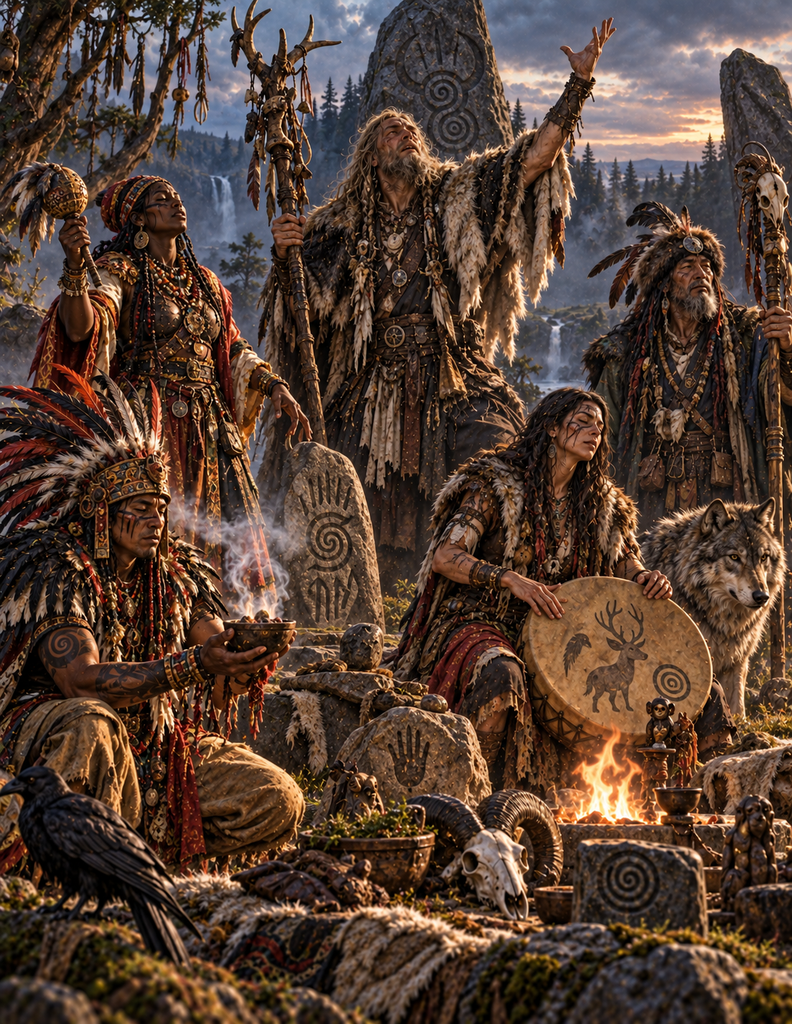
🪶 Shaman [13]
The Shaman is a spiritual practitioner whose magic is rooted in direct interaction with spirits, dreams, visions, animals, ancestors, natural forces, sacred places, healing, ceremony, and the unseen world. Shamanic traditions vary enormously between cultures, but commonly employ trance, song, rhythm, drumming, dance, fasting, meditation, sacred objects, ordeal, dreams, altered states of consciousness, and journeys into supernatural realms. The Shaman is therefore not simply a tribal Wizard. A Wizard normally approaches magic as a broad body of supernatural knowledge to be studied and mastered. A Shaman’s repertoire develops through relationships and experiences: spirits encountered, dreams received, illnesses treated, ceremonies performed, teachers and ancestors consulted, sacred places visited, animals observed, ordeals survived, and journeys into the unseen world. Historical and traditional shamanic practices vary too greatly for every Shaman to possess the same abilities. Some emphasize healing; others divination, spirits, ancestors, hunting, animals, weather, dreams, protection, ritual performance, harmful sorcery, or ecstatic journeys. Kingsmark represents this diversity through broad School access combined with strongly guided 📖Spell Learning Opportunities. When companions encounter an unknown spirit, disturbing vision, haunted location, supernatural illness, strange omen, unusual dream, sacred place, or passage into the Astral Plane, the Shaman commonly serves as investigator, protector, healer, visionary, and intermediary between worlds.
All Human Types and genders may select this Class. The prevalence of male and female Shamans varies considerably between cultures and individual traditions.
Required Attributes
Spirit +3 or +4 [TAB]
Wisdom +2 [TAB]
Discipline +1 [TAB]
Perception +1
Stamina +1 [TAB]
Skills — Additional Starting Skill Points 6
Spiritual Practices +2
Occult Knowledge +2
Survival +1
Medicine +1
Starting Equipment
Staff
Dagger
Ritual or ceremonial clothing
Sacred or ceremonial objects
Herbs and medicinal supplies
Ritual implements
Small containers for magical components
Spirit Guides / Totems
Every Shaman knows 🌿Nature, 🎶Minstrel’s, 🌬Astral, 🚪Summoning, 🌙Dream, and 🔮Divination Magic. These six Schools form the core of Shamanic practice: nature, animals, ritual performance, spirits, supernatural journeys, dreams, visions, omens, and hidden knowledge. Every Shaman also has a Spirit Guide or Totem granting two additional Schools, one Gift, and one Burden. Choose one or roll 2d12, add the dice together, and consult the result below.
2 — 🐍 Snake — Snake Eyes
Additional Schools: ❤️🩹Healing Magic and 🦋Transformation Magic.
Snake embodies poison and medicine, hidden knowledge, shedding and renewal, transformation, patience, and survival. Snake Shamans often come across as sinister even when they are not: unnervingly still, difficult to read, comfortable with venom, death, secrecy, and subjects others avoid. Some deserve the reputation; others merely look dangerous. Gift: −2 Advantage on Stamina Tests against poison and venom and −1 Advantage on Medicine or ❤️🩹Healing Spellcasting used to treat poison, venom, toxic contamination, or biological corruption. Burden: In genuinely freezing conditions, suffer +1 Disadvantage on 🌈Physical Performance and 🌈Reflexes Tests until warmed. Cool weather does not trigger this.
3 — 🕷 Spider
Additional Schools: 🌀Illusion Magic and 🌑Dark Magic.
Spider embodies patience, traps, ambush, and manipulation. Gift: −1 Advantage on Tests to build or conceal traps, prepare ambushes, restrain an already Grappled creature, or detect movement through prepared alarms such as thread, wire, hanging objects, marked boundaries, or magical warnings. Burden: After preparing a trap or ambush for a specific enemy, direct attacks against it suffer +2 Disadvantage until it enters the position, discovers the trap, begins escaping, or the preparation becomes useless.
4 — 🦂 Scorpion
Additional Schools: 🥋Martial Adept Magic and 🌑Dark Magic.
Scorpion embodies venom, patience, retaliation, and hidden danger. Gift: Once per ⏸Turn, when a hostile creature within melee reach inflicts Physical Trauma upon the Shaman, his next attack, Grapple, or harmful Spellcasting Test against it before the end of his next Turn gains −1 Advantage. Burden: While that opportunity remains, attacks or hostile Spells against another enemy suffer +1 Disadvantage. This ends if the attacker becomes helpless, unreachable, ceases hostility, or a greater immediate threat appears.
5 — 🦇 Bat
Additional Schools: 🌑Dark Magic and 🌀Illusion Magic.
Bat embodies darkness, caves, sound, nocturnal travel, and navigation without sight. Gift: Within 10 yards, locate moving or noise-producing creatures and major obstacles by reflected sound. Darkness, blindness, smoke, fog, and purely visual Illusions do not block this when enough sound exists. It does not reveal color, writing, facial detail, silent creatures, or objects through walls. Burden: After suffering 💨Sonic Damage or a very loud close-range concussive sound, suffer +2 Disadvantage on Perception and Spellcasting Tests until the end of the next ⏸Turn.
6 — 🦈 Shark
Additional Schools: 🔥Elemental Magic and 🌑Dark Magic.
Shark embodies water, blood, motion, predation, and aggression. Gift: −1 Advantage on attacks against a creature already suffering a Physical Wound. Ordinary swimming imposes no movement-related Disadvantage. Burden: When a hostile creature within 10 yards visibly suffers 🩸Severe or 💀Critical Trauma, make a Discipline Test at TN 8 before abandoning pursuit that Scene. On failure, unrelated actions suffer +1 Disadvantage until it escapes, becomes helpless, ceases hostility, or a greater threat appears.
7 — 🐆 Jaguar
Additional Schools: 🥋Martial Adept Magic and 🦋Transformation Magic.
Jaguar embodies solitary predation, stealth, territory, climbing, and sudden violence. Gift: −2 Advantage on the first attack made from genuine concealment each 🎬Scene and −1 Advantage on climbing and jumping Tests. Burden: After an enemy inflicts 🩸Severe or 💀Critical Physical Trauma, fleeing it while it remains an immediate threat requires a Discipline Test at TN 8. On failure, retreat actions suffer +2 Disadvantage for the rest of the Turn.
8 — 🐊 Gator
Additional Schools: 🔥Elemental Magic and 🥋Martial Adept Magic.
Gator embodies stillness, swamps, ambush, stubbornness, and sudden violence. Gift: If the Shaman has not moved since the end of his previous Turn, his first Grapple or melee attack before moving gains −1 Advantage. Mud, marsh, shallow water, and similar wet terrain impose no ordinary movement Disadvantage. Burden: After beginning a Grapple, chase, or assault against an enemy, changing targets while it remains an immediate threat requires a Discipline Test at TN 8. On failure, attacks against another target suffer +2 Disadvantage for the rest of the Turn.
9 — 🦝 Raccoon
Additional Schools: 🌀Illusion Magic and 💍Enchantment.
Raccoon embodies curiosity, clever hands, theft, puzzles, hidden mechanisms, and forbidden containers. Gift: −1 Advantage on Mechanisms Tests to bypass locks, traps, hidden catches, or protected containers and on Thievery Tests to palm, conceal, or steal small objects. Burden: Abandoning an accessible locked, trapped, secret, or unusually protected container without investigating requires a Discipline Test at TN 8. On failure, unrelated actions suffer +1 Disadvantage while it remains accessible and unexplored. Immediate danger suspends this Burden.
10 — 🦉 Owl
Additional Schools: 🧠Psychic Magic and 🛡Abjuration Magic.
Owl embodies silence, night, vigilance, patience, and observation. Gift: Natural darkness, moonlight, starlight, and similar dim light impose no sight-based Disadvantage, though absolute or magical darkness still blocks sight. Also gain −1 Advantage on Perception Tests to detect concealed movement in natural dimness. Burden: Strong unobstructed sunlight imposes +1 Disadvantage on sight-based Perception and visually targeted Spellcasting Tests. Shade, buildings, forests, heavy clouds, and indoor light remove it.
11 — 🐦⬛ Raven
Additional Schools: 🧠Psychic Magic and 🌀Illusion Magic.
Raven embodies omens, death, secrets, memory, curiosity, and hidden knowledge. Gift: Once per 🎬Scene after witnessing a death, supernatural omen, revealed secret, catastrophic failure, or hidden discovery, ask the GM: “What important detail is being overlooked?”, “What did this reveal?”, or “What nearby person or thing is most strongly connected to this?” The answer must be truthful if a meaningful clue or supernatural connection exists. Burden: Unexplained omens, mysterious corpses, secret messages, or hidden discoveries impose +1 Disadvantage on unrelated actions until investigated. Immediate danger suspends this Burden.
12 — 🐻 Bear
Additional Schools: ❤️🩹Healing Magic and 🥋Martial Adept Magic.
Bear embodies healing, endurance, protection, strength, and violent defense. Gift: When a visible ally within 10 yards suffers 🩸Moderate or worse Physical Trauma from an enemy, gain −1 Advantage on Healing Spellcasting for that ally and on Unarmed Combat, Grapple, carrying, dragging, shielding, or rescue actions used to protect him. Burden: While an ally within 10 yards suffers 🩸Severe or 💀Critical Trauma and remains in immediate danger, actions meant to abandon him or flee suffer +2 Disadvantage.
13 — 🐺 Wolf
Additional Schools: 🦋Transformation Magic and 🧠Psychic Magic.
Wolf embodies the pack, hunting, loyalty, territory, and coordinated violence. Every Wolf Shaman learns 🦋Shape Self 175 without using a Starting Spell selection, though it counts toward Maximum Magical Capacity; at Power 3, he may always become an ordinary wolf. Gift: −1 Advantage when tracking with an ally, locating a separated party member, or attacking an enemy already engaged in melee with an accepted companion. Burden: Knowingly abandoning a threatened pack member suffers +2 Disadvantage while meaningful aid remains possible.
14 — 🐺 Coyote
Additional Schools: 🎲Chaos Magick and 🌀Illusion Magic.
Coyote embodies trickery, improvisation, audacity, reversals, and surviving bad ideas. Gift: Once per 🎬Scene after failing a Test other than 💀R.A.D., reroll the d12 with the same modifiers. The second roll stands, and a natural 1 is an Epic Failure. Burden: If the reroll also fails, the GM adds one reasonable complication such as dropped gear, unwanted attention, worse positioning, a blocked escape, or accidental involvement of another person.
15 — 🐕 Dog
Additional Schools: 🛡Abjuration Magic and 🦁Leadership Magic.
Dog embodies loyalty, guardianship, trust, vigilance, companionship, and stubborn devotion to those placed under his protection. Gift: −1 Advantage on 🛡Abjuration Spellcasting used to protect an accepted companion and on Perception Tests made to detect an immediate threat specifically directed toward someone the Shaman has accepted as his companion or charge. Burden: Actions whose primary purpose is knowingly betraying an accepted companion, breaking a freely given promise of protection, or abandoning someone specifically entrusted to the Shaman’s care suffer +2 Disadvantage. This does not prevent retreating together, changing a plan, or refusing obligations the Shaman never accepted.
16 — 🐈 Cat
Additional Schools: 🌀Illusion Magic and 🦋Transformation Magic.
Cat embodies grace, secrecy, balance, independence, cleanliness, escape, curiosity, and the refusal to remain where someone else intends to keep her. Gift: −1 Advantage on Infantry Athletics Tests involving balance, controlled falls, narrow surfaces, squeezing through confined openings, or similar feats of feline agility, and on Tests made specifically to escape Grapples, bindings, cages, or other physical restraint. Burden: After becoming substantially covered in blood, sewage, excrement, carrion, or comparable filth, Spellcasting suffers +1 Disadvantage until the Shaman spends at least 10 minutes cleaning himself by whatever reasonable means are available. Ordinary dust, rain, or road mud does not trigger this.
17 — 🐀 Rat
Additional Schools: ⚙Technomancy and 🌀Illusion Magic.
Rat embodies survival in civilization’s forgotten places: ruins, machinery, sewers, tunnels, refuse, crowds, and contaminated environments. Gift: −1 Advantage on Survival and Cloak & Dagger Tests in cities, ruins, sewers, tunnels, abandoned structures, industrial areas, or refuse sites, and −1 Advantage on Stamina Tests against disease or contamination from filth, sewage, spoiled material, or vermin. Burden: In a broad exposed area with no meaningful cover, concealment, structure, vegetation, terrain feature, or hiding place within 10 yards, suffer +1 Disadvantage on Discipline and Spellcasting Tests.
18 — 🐁 Mouse
Additional Schools: ❤️🩹Healing Magic and 💍Enchantment.
Mouse embodies resourcefulness, preparation, overlooked details, useful scraps, small solutions, caution, and the wisdom of surviving problems larger creatures try to overpower. Gift: Once per 🎬Scene, when a noncombat Test normally requires a small mundane tool or common material the Shaman lacks, he may identify a plausible substitute among his carried odds and ends or the immediate environment. If appropriate material actually exists, ignore the first +1 Disadvantage caused solely by using improvised equipment. Burden: Direct attacks or harmful Spellcasting against a creature that has neither attacked nor presented an immediate physical threat to the Shaman or his companions during the Scene suffer +1 Disadvantage.
19 — 🐬 Dolphin
Additional Schools: 🔥Elemental Magic and ❤️Love Magic.
Dolphin embodies the sea, intelligence, play, rescue, communication, companionship, curiosity, and the refusal to leave someone helpless beneath the water. Gift: The Shaman can hold his breath for twice the normal duration and gains −1 Advantage on Swimming Tests made to locate, reach, rescue, tow, or protect another creature in dangerous water. Burden: When a visible companion within reasonable reach fails a Swimming Test, begins drowning, or becomes helpless in the water, unrelated actions suffer +2 Disadvantage while meaningful rescue remains possible. The Shaman is not required to attempt a rescue that would obviously accomplish nothing except adding another victim.
20 — 🦬 Buffalo
Additional Schools: ❤️🩹Healing Magic and 🦁Leadership Magic.
Buffalo embodies provision, endurance, medicine, generosity, communal survival, hard work, and strength spent for the benefit of others. Gift: −1 Advantage on Medicine, Survival, or Social Skills Tests whose immediate purpose is sustaining, treating, supplying, encouraging, or organizing an injured, exhausted, hungry, frightened, or otherwise struggling companion, and on Stamina Tests made to carry or drag an injured person. Burden: After refusing a sincere request for serious aid that the Shaman could reasonably provide without abandoning an equally serious duty or placing others in clearly disproportionate danger, Spellcasting suffers +1 Disadvantage until he provides meaningful aid or makes reasonable restitution.
21 — 🦁 Lion
Additional Schools: 🦁Leadership Magic and 🥋Martial Adept Magic.
Lion embodies courage, pride, authority, family, coordinated defense, visible strength, and the expectation that others take heart when their leader refuses to cower. Gift: Accepted allies within 5 yards who can see or hear the conscious Lion Shaman gain −1 Advantage on Discipline Tests against fear or intimidation. A character cannot benefit from more than one Lion Shaman at a time. Burden: After a hostile creature publicly challenges, humiliates, or openly threatens the Shaman before witnesses, actions whose primary purpose is submissive retreat or appeasement suffer +2 Disadvantage until he meaningfully answers the challenge or the Scene ends. Tactical withdrawal to protect others is not submission.
22 — 🐎 Horse
Additional Schools: ❤️🩹Healing Magic and 🦋Transformation Magic.
Horse embodies freedom, endurance, travel, open country, speed, strength, fertility, and the powerful instinct to escape anything that tries to confine or control her. Gift: −1 Advantage on Infantry Athletics, Mounts, and Stamina Tests whose primary purpose is prolonged travel, running pursuit, escape, forced marching, or enduring the physical demands of a journey. Burden: While Grappled, bound, chained, caged, pinned, or otherwise physically restrained against his will, the Shaman suffers +1 Disadvantage on Discipline and Spellcasting Tests. If completely immobilized, the penalty becomes +2. Ordinary indoor spaces, crowds, and voluntarily remaining in one place do not trigger this Burden.
23 — 🕊 Dove
Additional Schools: ❤️Love Magic and 🛡Abjuration Magic.
Dove embodies peace, mediation, mercy, protection, reconciliation, mourning, and the difficult work of ending violence without simply defeating whoever began it. Gift: −1 Advantage on Social Skills and ❤️Love or 🛡Abjuration Spellcasting when the immediate purpose is securing a truce or surrender, calming active hostility, preventing a fight, or protecting someone without harming the aggressor. Burden: Direct attacks and harmful Spellcasting against a creature that has neither inflicted Physical harm nor presented a credible immediate threat of such harm during the Scene suffer +2 Disadvantage. Dove does not forbid self-defense or the defense of others once violence has genuinely become imminent.
24 — 🦅 Eagle Monotheist
Additional Schools: 🕯Holy Magic and 🛡Abjuration Magic.
Eagle Shamans believe the Great Spirit is Supreme Creator; Eagle and the Sun are sacred symbols, not gods. Other spirits are lesser created beings. Gift: −1 Advantage on 🕯Holy and 🛡Abjuration Spellcasting Tests against demons, possession, undead, servants of the 🪱Gloom, or hostile spirits. Burden: After 1 continuous hour without meaningful access to open sky, Spellcasting suffers +1 Disadvantage; after 12 hours, +2. Ten continuous minutes beneath open sky removes the penalty.
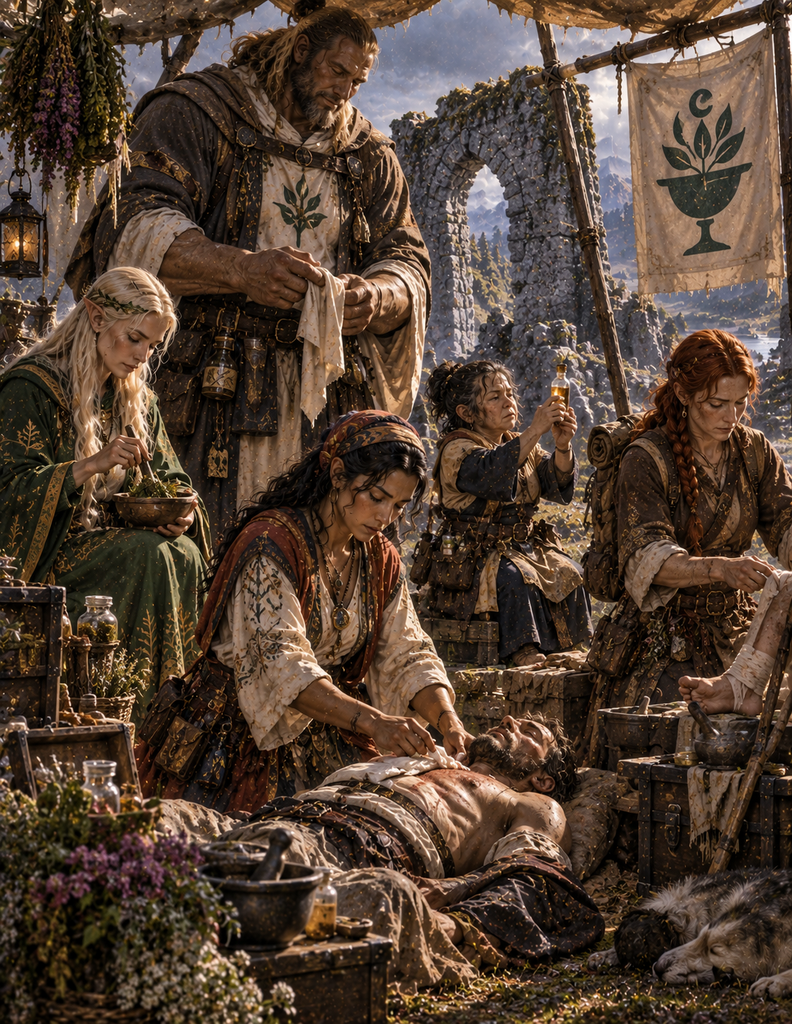
❤🩹 Healer [14]
The Healer is a specialist in keeping people alive. Healers combine practical medical knowledge with supernatural abilities capable of treating injuries and afflictions that would otherwise leave an adventurer disabled or dead. Some learn their profession through physicians, apothecaries, midwives, military surgeons, monasteries, temples, family traditions, or experienced village healers. Others develop their abilities through less formal traditions, but all Healers share an unusual dedication to preserving life and restoring the injured.
A Healer requires 🌬Spirit +2. Supernatural healing, compassion, restoration, and protection complement the class’s practical medical training without requiring membership in any particular religion or magical tradition. In dangerous adventures, the Healer is the party’s combat medic, capable of intervening when wounds, poison, disease, exposure, or supernatural harm threaten a companion far from civilization.
The Healer is particularly valuable because magical restoration does not eliminate the importance of practical medicine. Stabilizing an injured companion, recognizing illness, treating wounds, controlling bleeding, preparing medicines, and caring for someone during recovery remain essential skills. A capable Healer therefore contributes both during immediate emergencies and throughout the longer process of recovery.
All Human Types and genders may select this class but it is most popular among the Elyonim (Elves) and Qetanim.
Required Attributes
Spirit +2 [TAB]
Wisdom +2 [TAB]
Dexterity +1 [TAB]
Intelligence +1
Discipline +1
Skills — Additional Starting Skill Points 6
Medicine +2
Alchemy +1
Spiritual Practices +1
Scholarship +1
Social Skills +1
Schools of Magic
❤️🩹Healing Magic
❤️Love Magic
The Healer’s additional Schools are determined by the character’s chosen Healer Tradition, as described below.
Starting Equipment
Dagger
Healer’s bag
Bandages and clean cloth
Needles and thread
Medical knife and small surgical tools
Medicinal herbs and preparations
Mortar and pestle
Soap and other wound-cleaning supplies
Healer Traditions
Every Healer possesses ❤️🩹Healing Magic and ❤️Love Magic. These form the supernatural foundation of the Class. The character’s healing tradition determines the additional Schools available. Roughly half of the Healer’s developing repertoire should normally come from ❤️🩹Healing or ❤️Love Magic, with Healing receiving particular attention. The remaining 📖Spell Learning Opportunities express how the particular Healer understands illness, restoration, suffering, protection, and the supernatural. Choose one of the following traditions:
🕯 Sacred Healer — ❤️🩹Healing, ❤️Love, 🌿Nature, 🛡Abjuration, 🌬Astral, and 🕯Holy Magic.
Sacred Healers arise within the Covenant, Sun & Shield, and Path of the One. Their supernatural healing is understood as service to the Creator and the preservation of life. Holy Magic expresses the sacred character of the vocation, while Abjuration provides protection and cleansing.
🌿 Sylvaran Healer — ❤️🩹Healing, ❤️Love, 🌿Nature, 🛡Abjuration, 🌬Astral, and 🧠Psychic Magic.
Sylvaran Healers understand restoration through the relationships among body, mind, spirit, emotion, natural remedies, living cycles, and the surrounding world. Psychic Magic provides additional possibilities involving consciousness, perception, emotion, and mental suffering.
🪶 Spirit Healer — ❤️🩹Healing, ❤️Love, 🌿Nature, 🌬Astral, 🚪Summoning, & 🛡Abjuration Magic.
Spirit Healers are common within the Peoples of the Wild and other traditions in which illness may possess physical, emotional, environmental, ancestral, or spiritual dimensions. Summoning allows interaction with supernatural beings associated with a patient’s condition, while Astral and Abjuration Magic address dangers extending beyond the physical Body.
🎶 Healing Voice — ❤️🩹Healing, ❤️Love, 🎶Minstrel’s, 🧠Psychic, and 🌬Astral Magic.
Healing Voice is a method of healing rather than a religion. Its practitioners use song, rhythm, storytelling, guided breathing, recitation, lamentation, encouragement, emotional expression, conversation, and communal performance as vehicles for restoration.
The tradition can therefore arise inside many different institutions. A Healing Voice practitioner might be trained in a temple hospice, monastic infirmary, religious choir, healing house, village ceremonial tradition, family lineage, school of medicine, military healing corps, community of midwives, mourning tradition, traveling performance tradition, or entirely secular therapeutic practice. Religious affiliation and Healing Voice training are separate matters. A member of the 🕎Covenant, 🔆Sun & Shield, 🪷Path of the One, 🌿Sylvaran religion, 🪶Peoples of the Wild, an ancestor tradition, another religion, or no religion at all may practice Healing Voice when the character’s actual training supports it.
Belonging to a monotheistic religion does not automatically add 🕯Holy Magic to the Healing Voice tradition. A Healer who wishes to practice Holy Magic through a specifically sacred healing vocation should select 🕯Sacred Healer instead. Conversely, a Healing Voice practitioner may be deeply religious without possessing Holy Magic because the supernatural method taught through the character’s Healer vocation is performance, emotion, consciousness, and spiritual experience rather than priestly sacred authority.
🎶Minstrel’s Magic allows healing and encouragement to operate through performance, while 🧠Psychic Magic gives the tradition particular strength when suffering involves fear, memory, consciousness, emotional distress, or the relationship between mind and Body. 🌬Astral Magic addresses spiritual experiences and disturbances that extend beyond ordinary physical medicine.
With only five Schools, Healing Voice is deliberately more concentrated than several other Healer traditions. The character remains a Healer first: roughly half of the developing repertoire should normally remain ❤️🩹Healing or ❤️Love Magic.
🕯️ Priest [15]
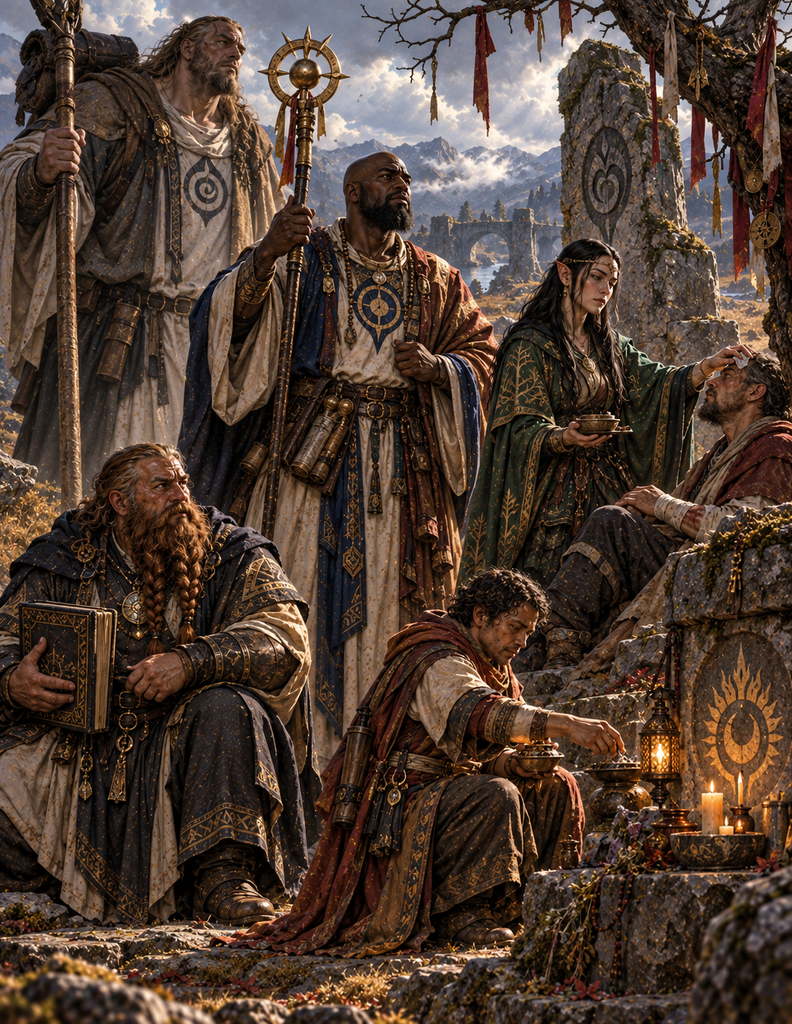
The Priest is a religious specialist belonging to one of Sylva’s three monotheistic traditions: 👁The Covenant, 🔆Sun & Shield, or 🪷Path of the One. These traditions differ considerably in theology, ritual, organization, culture, law, and religious practice, but all direct their worship toward one Creator and provide the sacred vocation necessary for 🕯Holy Magic.
Priests conduct ceremonies, preserve religious teachings, counsel believers, tend sacred places, minister to communities, teach, pray, perform sacred rites, and confront supernatural forces that fall within the responsibilities of their faith. Some belong to large religious institutions, while others serve isolated communities, monasteries, military forces, noble households, shrines, hospices, schools, or wandering congregations.
The Priest requires 🌬Spirit +3, representing the exceptional spiritual capacity necessary for the vocation. Priestly magic protects against supernatural corruption, strengthens courage and conviction, restores the wounded, protects communities, and ministers to human relationships and the heart. Healing remains only one part of a broader sacred ministry.
Priests are not required to be passive or defenseless. The Covenant, Sun & Shield, and Path of the One differ in their attitudes toward weapons, armor, warfare, wealth, marriage, political authority, and the proper responsibilities of religious officials. A Priest’s appearance, equipment, behavior, and obligations should reflect the particular tradition and institution being served.
All Human Types may select this class; gender eligibility is determined by the religion and priesthood the character serves but most priesthoods are typically male.
Required Attributes
Spirit +3 [TAB]
Wisdom +2 [TAB]
Discipline +2 [TAB]
Charisma +1 [TAB]
Skills — Additional Starting Skill Points 6
Spiritual Practices +2
Scholarship +1
Social Skills +1
Occult Knowledge +1
Medicine +1
Schools of Magic
🕯Holy Magic
🛡Abjuration Magic
🦁Leadership Magic
❤🩹Healing Magic
❤Love Magic
Starting Equipment
Religious symbol
Ceremonial vestments appropriate to the character’s religion
Religious text or collection of teachings
Staff, mace, or other weapon permitted by the character’s religion
Writing materials
Ceremonial or ritual implements
🔮 Prophet [16]
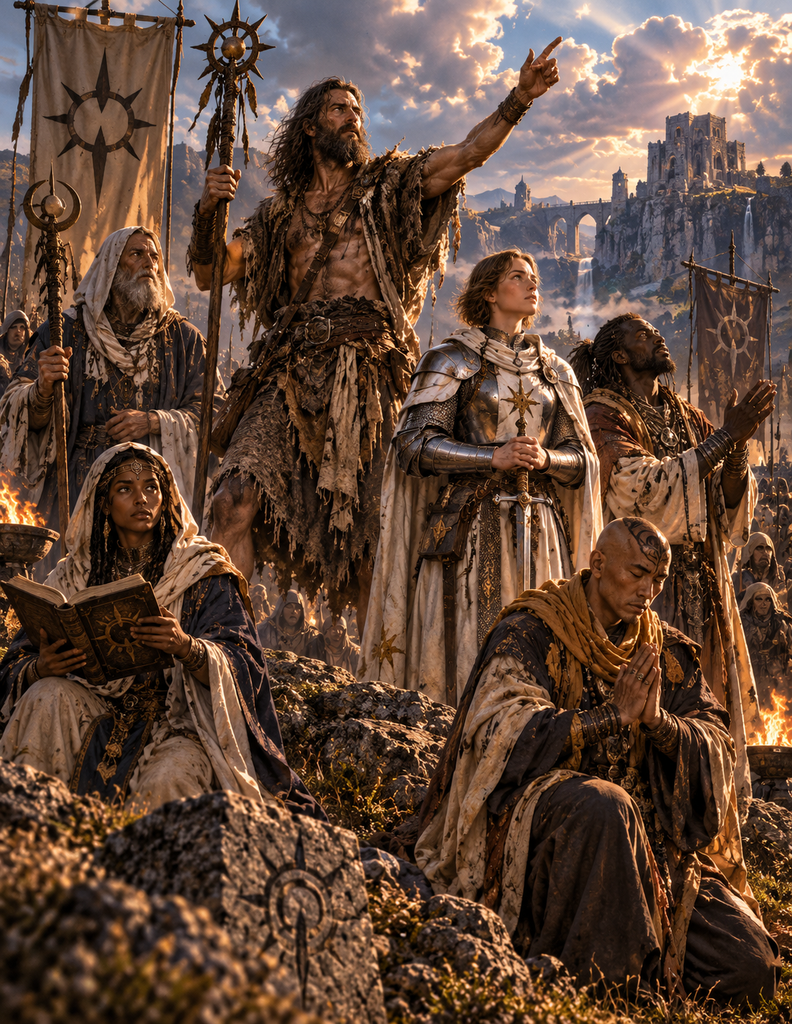
The Prophet is an exceptionally rare spiritual figure belonging to one of Sylva’s three monotheistic traditions: 👁The Covenant, 🔆Sun & Shield, or 🪷Path of the One. A Prophet receives visions, revelations, dreams, warnings, signs, or other supernatural knowledge concerning events beyond ordinary Human perception. Unlike a Priest, whose authority normally arises through religious office, education, ordination, or service within an established institution, a Prophet’s defining characteristic is direct supernatural revelation. A Prophet may belong to an established religious institution, challenge its leaders, arise unexpectedly from ordinary life, wander without formal office, or become recognized only after revelations prove impossible to ignore. Institutional authority is unnecessary, but the Class remains rooted in monotheistic devotion to the Creator.
A Prophet requires the extraordinary Rating of 🌬Spirit +4. Such characters possess unusual spiritual sensitivity and may receive information through visions, dreams, omens, voices, symbolic experiences, sudden understanding, supernatural signs, or other manifestations appropriate to the circumstances. These revelations do not make the Prophet omniscient. They provide supernatural information through the character’s Spells, experiences, and abilities rather than allowing the player to demand answers to anything. The Prophet is exceptional in the manner individual Spells are acquired. The player does not select the Prophet’s individual Spells. The Game Master determines them through revelation with knowledge of circumstances and events that may lie ahead. If an approaching adventure concerns undead creatures particularly vulnerable to fire, for example, a Prophet might receive an appropriate 🔥Elemental Spell without being told why that revelation will later matter. The player must still recognize the significance of what has been given and decide when and how to use it.
The Prophet’s normal Schools, Magical Capacity, available Power, and other magical rules still apply. Revelation determines which eligible Spells enter the repertoire; it does not grant unrestricted access to the entire Spellbook.
Prophets frequently become important beyond the immediate concerns of an adventuring party. Their warnings may concern rulers, wars, disasters, supernatural threats, religious corruption, judgment, or events whose significance is not immediately understood. Some are welcomed as holy figures, others dismissed as lunatics or troublemakers, and still others attract powerful enemies who would prefer their revelations remain unheard.
All Human Types and genders may select this class; a female character is called a Prophetess.
Required Attributes
Spirit +4 [TAB]
Discipline +2 [TAB]
Wisdom +2 [TAB]
Charisma +1 [TAB]
Skills — Additional Starting Skill Points 6
Spiritual Practices +2
Occult Knowledge +1
Social Skills +2
Scholarship +1
Schools of Magic
🕯Holy Magic
🔮Divination Magic
🦁Leadership Magic
🛡Abjuration Magic
🔥Elemental Magic
❤🩹Healing Magic
❤Love Magic
Starting Equipment
Staff or walking stick
Dagger
Religious or prophetic symbol
Religious text, personal journal, or collection of revelations
Writing materials
Simple ceremonial or ritual implement
🛡️ Holy Knight [17]
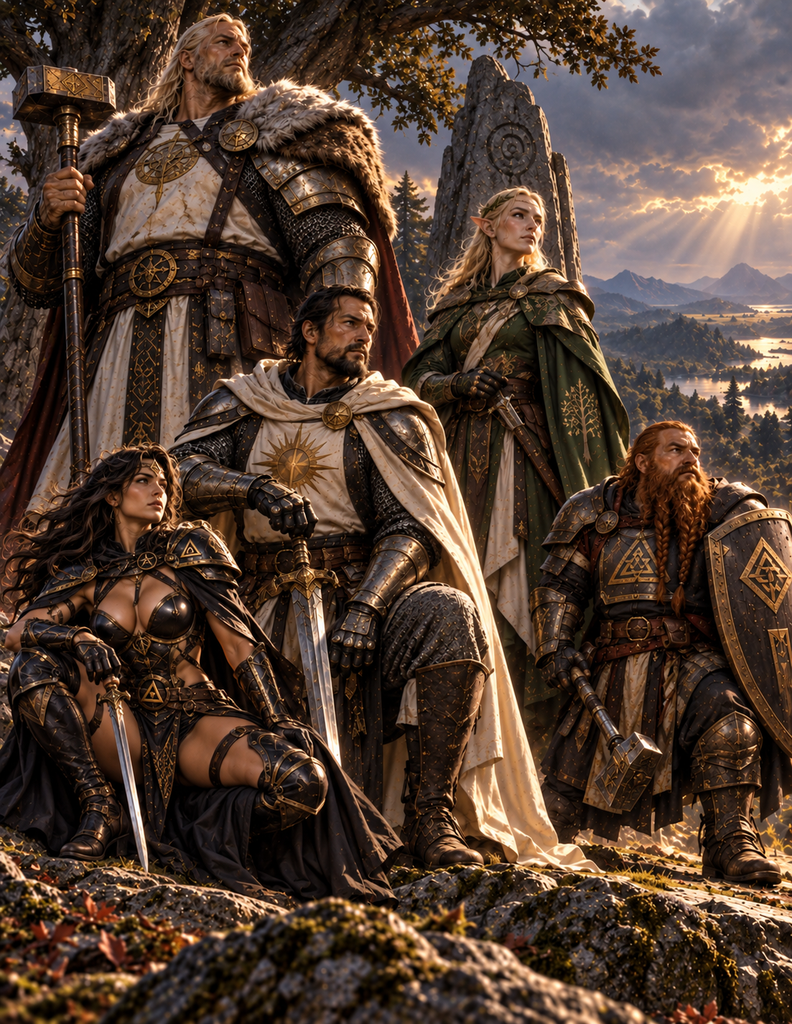
The Holy Knight is a professional warrior belonging to one of Sylva’s three monotheistic traditions: 👁The Covenant, 🔆Sun & Shield, or 🪷Path of the One. The Class represents a martial vocation in which military training is inseparable from sacred duty and devotion to the Creator. Holy Knights may serve religious orders, temples, rulers, communities, pilgrims, sacred institutions, or causes sanctioned by their faith. Some are formally knighted members of established orders, while others hold equivalent positions within cultures that use different titles. What distinguishes the Holy Knight from the Man-at-Arms is not social rank but the combination of professional combat training, spiritual discipline, and supernatural power. A minimum 🌬Spirit +2 is required because the Holy Knight’s vocation extends beyond ordinary military service. Sacred magic strengthens martial ability, spiritual resistance, leadership, protection of others, limited healing, and the ability to confront supernatural evil. A Man-at-Arms may be equally comfortable fighting ordinary soldiers, but the Holy Knight is specifically prepared to advance when the enemy is cursed, profane, demonic, spiritually corrupting, or otherwise supernatural. Holy Knights are expected to conduct themselves according to the religious obligations of the faith or holy order they serve. Those obligations vary considerably among the Covenant, Sun & Shield, Path of the One, and the particular institutions operating within those traditions. A Holy Knight therefore need not conform to one personality, culture, fighting style, political allegiance, or religious institution merely because the character belongs to this Class.
Qatan are restricted from selecting this class; heavy armor and knightly weapons are not part of traditional Qatan warrior culture. Gender eligibility may be determined by the religion or holy order the character serves.
Required Attributes
Spirit +2 [TAB]
Strength +1 [TAB]
Stamina +1 [TAB]
Discipline +2 [TAB]
Charisma +1
Skills — Additional Starting Skill Points 5
Armed Combat +2
Shield Combat +1
Infantry Athletics +1
Spiritual Practices +2
Occult Knowledge +1
Schools of Magic
🦁Leadership Magic
🥋Martial Adept Magic
🕯Holy Magic
❤🩹Healing Magic
❤Love Magic
Starting Equipment
One knightly melee weapon
Dagger
Shield
Mail hauberk
Padded armor worn beneath the mail
Helmet
Sacred symbol or emblem of the character’s faith or holy order