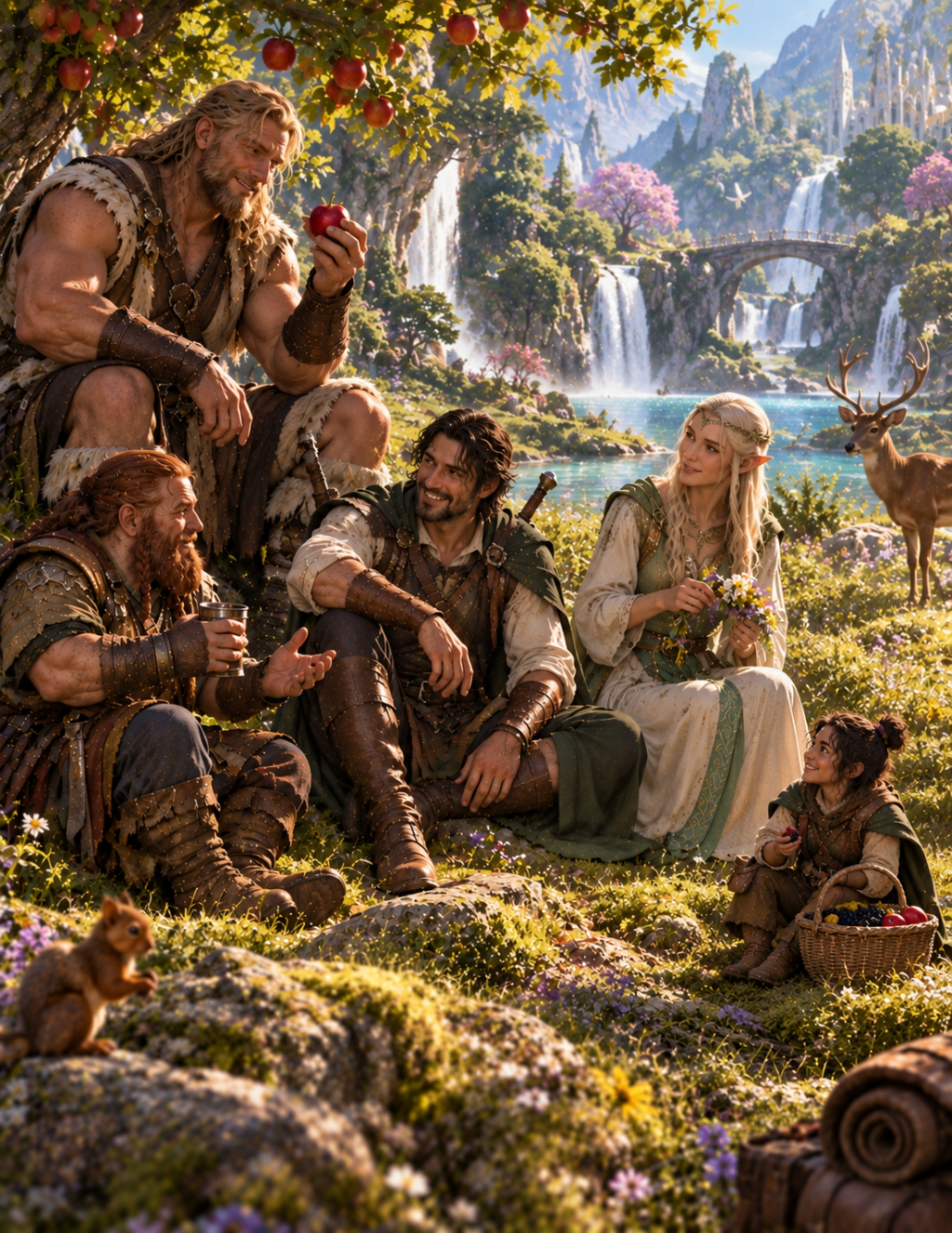
Humankind in Sylva exists in several distinct forms. Though their differences in stature, appearance, temperament, and natural aptitude can be considerable, they are all human. A Common Human, Giant Human, Little Human, Human Elf, or Human Dwarf is not a different order of creation, but a different expression of humanity. Human Type determines a character’s starting 💪Attribute Ratings and the maximum ratings those Attributes can eventually reach. The Human Type Base Ratings represent broad physical and psychological tendencies rather than determining an individual’s personality, morality, occupation, or destiny.
These forms of humanity have existed beside one another for so long that most peoples of Sylva regard them as ordinary parts of the human world. Kingdoms may contain several Human Types living under the same laws, serving in the same armies, worshiping in the same temples, trading in the same markets, and belonging to the same families through marriage and ancestry. In some regions one Human Type may be common while another is rare enough to draw attention, but rarity does not make that person less human.
Kingsmark does not establish one absolute account of where the Human Types came from. Creation stories, tribal histories, religious traditions, and learned theories differ widely across Sylva. One of the most common beliefs holds that the Human Elves were the earliest form of humanity and that the other Human Types appeared later through divine design, adaptation, ancient bloodlines, supernatural events, or causes now lost to history. Other traditions reject this entirely and claim different first peoples, separate acts of creation, or forgotten ages in which humankind took forms no longer seen. The rules leave these questions open so that the truth may remain uncertain, disputed, or specific to the Game Master’s Sylva.
Every Human Type has a Base Rating and a maximum rating for each Attribute. During Character Creation, the character begins with the appropriate Human Type Base Ratings and then spends Character Points to increase them. No Attribute may exceed the maximum shown for that Human Type and gender. Unless modified by Human Type, the normal human maximum is +4.
Human Types can intermarry and produce children. For game purposes, however, a character always belongs mechanically to one distinct Human Type. A child of mixed Human Type ancestry uses the Base Ratings, maximums, and other mechanical traits of only one Human Type rather than averaging or combining them. This keeps the rules clear and prevents the creation of hybrid Attribute packages. The other side of the character’s ancestry may still be visible in non-mechanical ways. A Human Dwarf with Elven ancestry might have unusually fine features or elongated ears; a Common Human with Giant ancestry might be exceptionally broad-framed; an Elf with Qatan ancestry might be shorter than most Elves. Such traits may shape appearance and family history, but they do not alter the character’s Human Type mechanics.
Human Type does not determine ethnicity or complexion. Each Human Type appears among multiple peoples of Sylva with different skin tones, facial features, hair textures, eye colors, languages, and cultures. Elves, Dwarves, Qetanim, Giants, and Common Humans may therefore look very different from one region of Sylva to another. Human Type describes physiology; culture and ancestry determine the enormous variety found within it.
Anashim (Ordinary Humans)
Homo sapiens sapiens
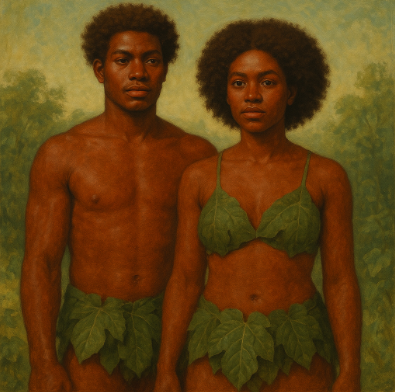
The Anashim are Ordinary Humans and provide the baseline against which the other human types are measured. They are the most numerous and widespread people of Sylva, inhabiting kingdoms, villages, cities, wilderness settlements, islands, mountains, and nearly every other region in which human civilization has taken root. Because they are found almost everywhere, no single culture, kingdom, language, religion, or way of life can be called uniquely Anashim. Their communities range from isolated farming villages to great cities whose streets contain people from every Human Type.
The Ordinary Human male represents the median human form. Every Attribute begins at 0: Spirit, Discipline, Intelligence, Perception, Wisdom, Charisma, Attractiveness, Strength, Stamina, Agility, Speed, and Dexterity. He therefore possesses no inherent advantage or disadvantage and succeeds according to his training, experience, equipment, circumstances, and choices. This makes the Anashim especially useful for players who want the character’s abilities to arise primarily from Character Class, Skills, upbringing, and personal development rather than strong biological extremes.
The Ordinary Human female shares the same fundamental adaptability but has different natural tendencies. She receives +1 Charisma and +2 Attractiveness, offset by –2 Strength and –1 Speed. These differences represent average biological distinctions between the sexes within the game. They establish different starting tendencies and natural maximums without determining an individual woman’s personality, training, profession, or accomplishments.
Their greatest advantage is not specialization but adaptability. Anashim possess neither the tremendous size of the Gibborim nor the diminutive proportions of the Qetanim. They lack some of the unusual qualities associated with Elves and Dwarves, but are correspondingly less constrained by them. They are at home almost anywhere human civilization can exist, and generations of migration, conquest, trade, marriage, pilgrimage, and exploration have carried Anashim into nearly every corner of the known world.
This broad distribution also means Anashim are often the Human Type against which local customs are unconsciously measured. In some lands they form the overwhelming majority; elsewhere they live beside Elves, Dwarves, Qetanim, or Gibborim and may themselves be the minority. An Anashim traveler can therefore seem utterly ordinary in one kingdom and distinctly foreign in the next—not because of Human Type, but because of language, dress, religion, manners, ancestry, or homeland.
Anashim have produced saints and tyrants, conquerors and liberators, sages and fools, peasants and kings. Nothing inherent in their Human Type determines what they will become. Their defining characteristic is possibility.
Gibborim (Giant Humans)
Homo sapiens magnus
The Gibborim, or Giant Humans, are the largest of the human types, commonly standing between 6’7″ and 8′ tall, with exceptionally large individuals approaching nine feet. They possess recognizably human proportions and physiology, but on a tremendous scale.
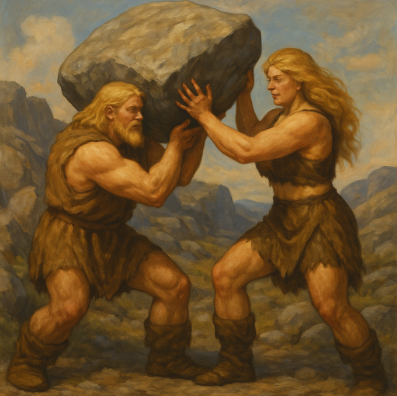
A male Gibbor gains +3 Strength, offset by –1 Stamina, –2 Agility, –2 Speed, and –1 Dexterity. His enormous frame allows feats of physical power beyond those of most Anashim, but the same mass makes rapid movement and delicate manipulation more difficult. Female Gibborim are similarly immense, though their Attribute tendencies differ. A female Gibbor receives +1 Charisma, +1 Attractiveness, and +1 Strength, offset by –1 Stamina, –2 Agility, –2 Speed, and –1 Dexterity. Their extraordinary stature makes them imposing even when they have no intention of intimidation.
The world itself presents difficulties for Gibborim. Beds, doors, furniture, armor, horses, wagons, clothing, tools, and buildings made for Anashim may be inconvenient or completely unusable. Equipment intended specifically for a Gibbor can require considerably more material and may be difficult to obtain outside regions accustomed to their presence. Long journeys can be awkward for the same reason: cramped inns, narrow bridges, overloaded boats, undersized mounts, and low-ceilinged ruins may all become practical problems before any enemy appears.
Their size naturally favors professions in which physical power matters. Gibborim can become formidable Men-at-Arms, Barbarians, Brutes, Rangers, Beast Masters, and other physically oriented adventurers. Their limitations should arise from the actual demands of a Character Class rather than from the assumption that great size makes them unintelligent or spiritually deficient. A Gibbor is perfectly capable of wisdom, learning, devotion, artistry, or cunning.
Different peoples of Sylva regard the Gibborim differently. In one kingdom they may be honored as warriors and guardians; elsewhere they may be feared as dangerous outsiders. Gibborim are comparatively rare, however, and do not constitute one of Sylva’s great population centers. Most live scattered among other human peoples or within small families and enclaves, although a few isolated settlements have been built on proportions better suited to their enormous bodies. Such places often feature broad doors, reinforced floors, massive furniture, oversized tools, and streets wide enough for several Gibborim to move comfortably side by side.
Whatever their culture, the presence of a Gibbor is difficult to ignore. A Giant Human occupies more space, carries more weight, strikes harder, and must constantly negotiate a civilization largely constructed for smaller people. Their great strength is an advantage, but being enormous is not simply a collection of bonuses. It changes how a character physically experiences the world.
Qetanim (Little Humans)
Homo sapiens minoris
The Qetanim, or Little Humans, are the smallest human type, generally standing between 3 and 4½ feet tall. They possess recognizably human anatomy but tend toward shorter limbs, smaller frames, and proportionately larger heads. Their small bodies sacrifice physical power and speed while favoring intelligence, judgment, and social aptitude. A male Qatan gains +2 Intelligence, +2 Wisdom, and +1 Charisma, offset by –2 Attractiveness, –2 Strength, –1 Stamina, –1 Agility, and –2 Speed. He is therefore poorly suited to contests of raw strength but exceptionally capable in situations requiring thought, judgment, or persuasion. A female Qatan gains +2 Intelligence, +2 Wisdom, +2 Charisma, and +1 Attractiveness, offset by –3 Strength, –1 Stamina, –1 Agility, and –3 Speed. Like male Qetanim, she must contend with a world whose weapons, buildings, animals, tools, and dangers were generally designed around people considerably larger than herself.
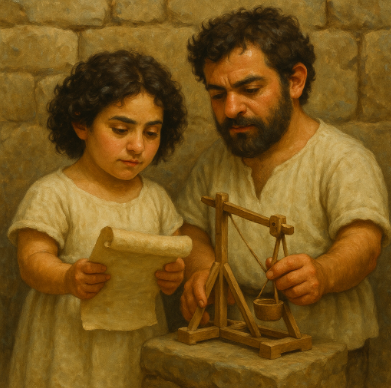
Qetanim can pursue many Character Classes, although their physical limitations make some paths considerably more difficult than others. They are naturally well suited to occupations that reward intelligence, wisdom, communication, scholarship, healing, planning, or magic. Their small size can also provide important practical advantages in concealment and infiltration, although these advantages arise from their stature and circumstances rather than from superior Agility or Speed. A Qatan adventurer survives by understanding the advantages of being small rather than attempting to behave like a miniature Gibbor. Their stature creates practical advantages as well. Qetanim can hide behind objects that provide little cover to larger humans, pass through confined spaces, use smaller quantities of material, and inhabit spaces inaccessible to ordinary people. Conversely, they have shorter reach, carry less weight, struggle with equipment made for Anashim, and may find ordinary obstacles disproportionately formidable. Qatan cultures vary throughout Sylva, but many share a strong tradition of secrecy, concealment, and defensive planning. Qetanim understand that their small bodies place them at a serious disadvantage if larger and more numerous peoples discover an undefended settlement. Their villages are therefore often difficult to find even when they exist close to traveled country. Buildings may be hidden among vegetation or terrain, while a considerable portion of a settlement may extend underground. Shallow tunnels frequently connect homes, storehouses, workshops, and neighboring communities, allowing Qetanim to travel without exposing themselves upon ordinary roads. Waterways are likewise prized because boats leave fewer tracks than travelers moving over land. These practices have encouraged ingenious architecture, storage, transportation, engineering, and defense, but Qetanim remain culturally diverse. A Qatan kingdom, forest settlement, river community, monastery, hidden village, or cosmopolitan enclave may differ enormously from another. A Qatan raised in a royal court, forest village, mountain settlement, monastery, criminal quarter, or isolated farming community will be shaped by that society just as any other human would. The Qetanim demonstrate one of the central truths of Sylva: physical size and human significance are not the same thing. A person who can be lifted bodily by a Gibbor may nevertheless possess the intelligence, courage, magic, faith, or cunning upon which the fate of a kingdom depends.
Elyonim (Perfected Humans)
Homo sapiens elyonis
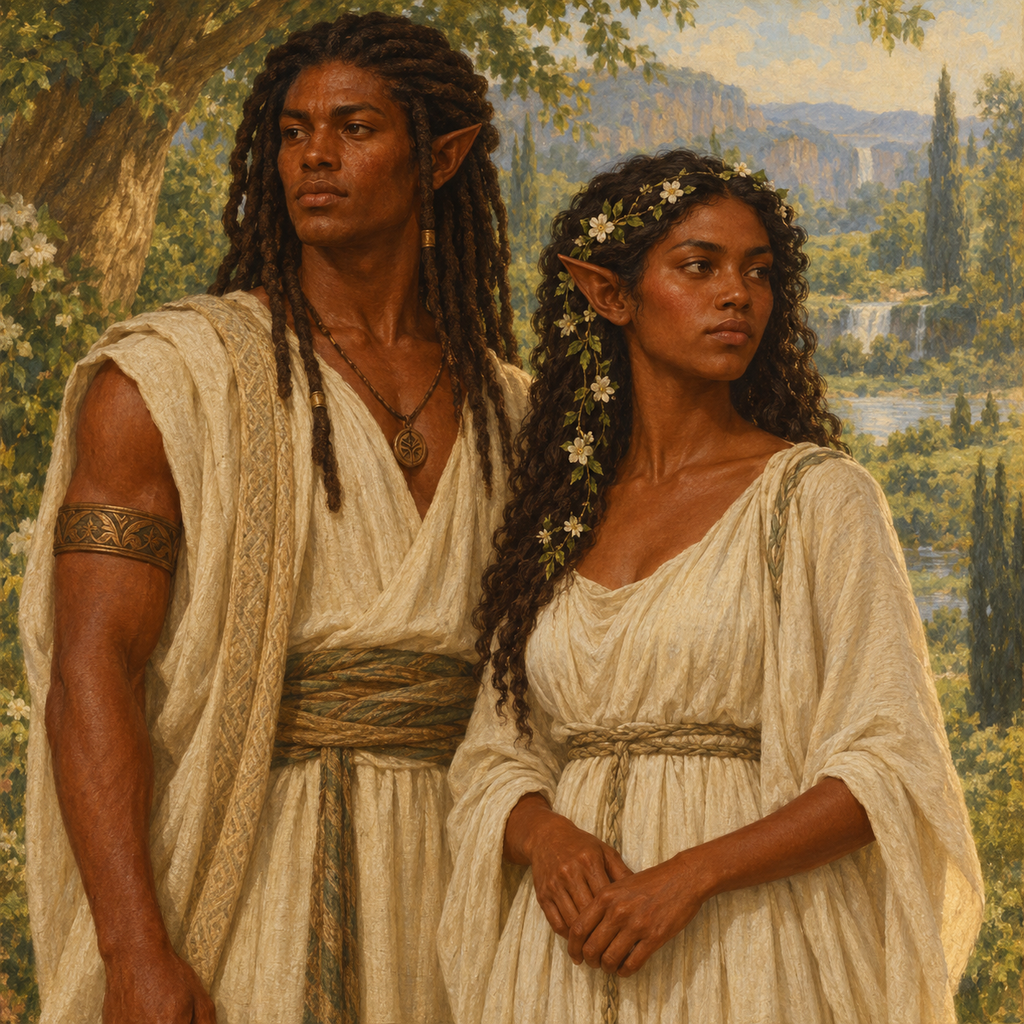
The Elyonim, commonly called Elves, are a rare human type distinguished by slender bodies, fine features, pointed ears, graceful movement, and extraordinary longevity. Though different enough in appearance that some Anashim regard them almost as another kind of being, Elves are human. They are an ancient branch of humankind, not a separate supernatural species.
Elves tend to be slightly taller and much leaner than Anashim, with long limbs and little tendency toward heavy musculature. Their movements possess a natural precision that can make even an untrained Elf seem poised. Their fine features are generally considered attractive by Anashim, especially among female Elves, though beauty should not be confused with social charm.
Both male and female Elves suffer −1 Charisma, reflecting an aloof, restrained, highly composed manner that other peoples may find difficult to relate to. They can seem distant, overly formal, emotionally reserved, or simply strange even when they mean no offense.
Male Elves have +1 Intelligence, +1 Perception, +1 Wisdom, −1 Charisma, +1 Attractiveness, −1 Strength, +1 Agility, +1 Speed, and +1 Dexterity. Female Elves have +1 Intelligence, +1 Perception, +1 Wisdom, −1 Charisma, +3 Attractiveness, −2 Strength, +1 Agility, +1 Speed, and +1 Dexterity. Their strengths therefore favor mental acuity, beauty, grace, speed, and precision over raw power.
Elves mature more slowly than Anashim and can live forever if disease, violence, or misfortune does not kill them. They are ageless, not invulnerable. Their longevity does not make them automatically wise, but it gives them remarkable personal memory. An Elf may remember events that occurred centuries before an Anashim adventurer was born.
Elyonim also possess deep certainty concerning reincarnation. To them, rebirth is not merely a theological theory but part of their understanding of life, death, memory, and the human soul. Elven cultures and religions may explain reincarnation differently, but its reality is widely accepted among them.
Elves also share an unusually close relationship with wilderness and supernatural beings. Where many Anashim dismiss fairies, spirits, haunted groves, and ancient powers as superstition, Elves have lived beside such things for generations. Even an ordinary Elf may know warnings, customs, songs, and traditions concerning forces other peoples have forgotten.
Elyonim are not one nation, culture, religion, or personality. An Elf may be devout or irreligious, civilized or wild, compassionate or cruel, scholarly or ignorant. What unites them is ancestry and physiology: they are a long-lived, refined expression of humanity whose experience of time and the supernatural differs sharply from that of most other humans.
Tzurim (Hardy Humans)
Homo sapiens montanus
The Tzurim, commonly called Dwarves, are a short, broad, heavily built human type adapted to strenuous labor and life in mountainous and subterranean environments. They generally stand between 4 and 5 feet tall, but their compact stature is deceptive. Broad skeletons, dense musculature, powerful torsos, thick limbs, and large hands make Dwarves far heavier and stronger than their height suggests. Male Dwarves commonly grow substantial facial hair, and beards hold cultural importance among many—but not all—Dwarven peoples.
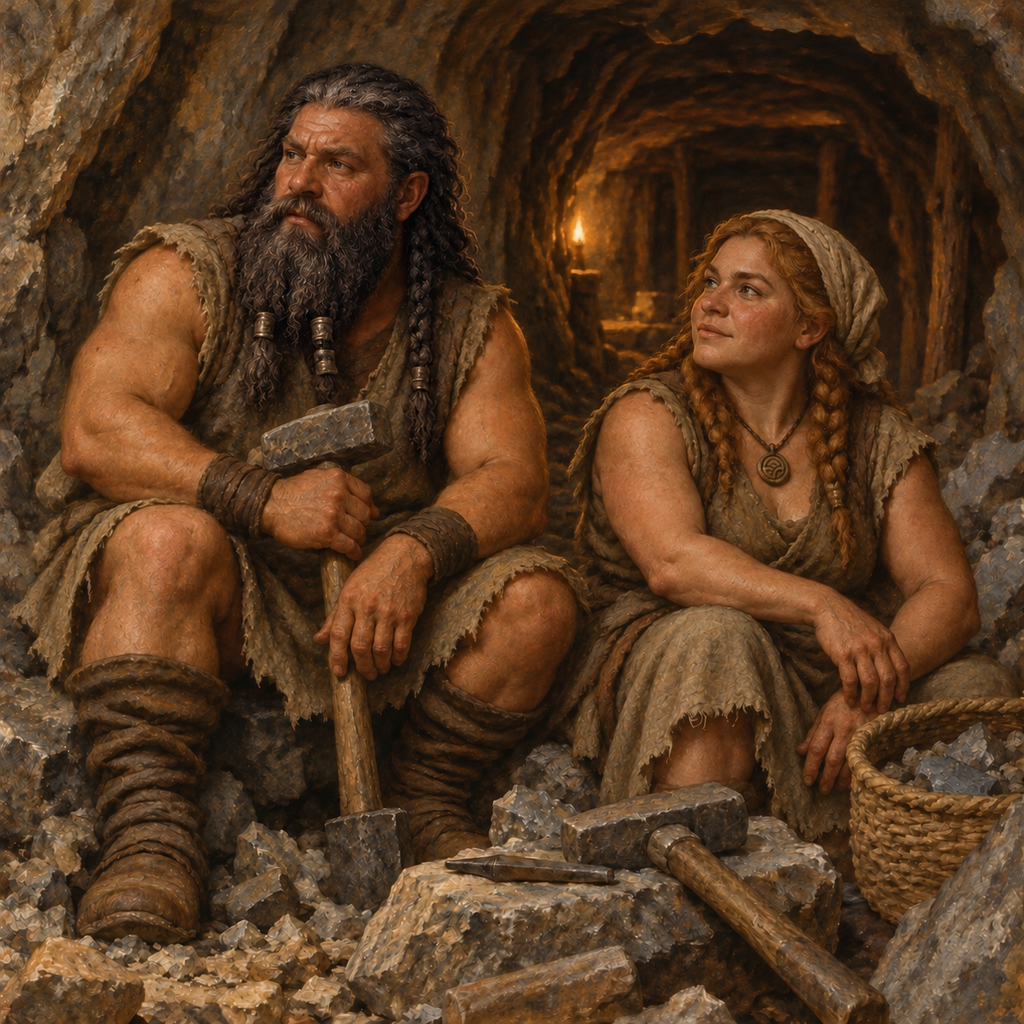
Male Dwarves have +1 Discipline, −1 Attractiveness, +2 Strength, +1 Stamina, −1 Agility, and −2 Speed. Female Dwarves have +1 Discipline, +1 Charisma, +1 Attractiveness, +1 Stamina, −1 Agility, and −2 Speed. Their modifiers emphasize discipline and endurance, with male Dwarves also possessing exceptional compact strength, while their proportions reduce Agility and especially Speed.
Tzurim are the great subterranean people of Sylva. Although some live on the surface or among Anashim, their ancestral strongholds, cities, mines, fortresses, roads, and settlements are closely tied to mountains and the inhabited depths beneath them. Generations spent underground have given many Dwarven cultures remarkable practical knowledge of stone. An experienced Dwarf might recognize unstable rock, strange workmanship, altered caverns, or construction from another age. This is cultural knowledge, not a magical ability. Dwarven histories also preserve accounts of creatures and places beneath the mountains that many surface peoples dismiss as legend. Halls have been abandoned after miners opened passages that should have remained sealed, and ancient roads descend farther than any living Dwarf knows.
Their physiques favor Character Classes that benefit from endurance and strength. Dwarves make formidable Men-at-Arms, Holy Knights, Rangers, and other adventurers expected to withstand heavy punishment. Their shorter legs make them slower than most Anashim in open movement, though their compact stature can help in tunnels, fortifications, and other confined spaces.
Dwarven craftsmanship is famous throughout much of Sylva, especially in stone, metal, weapons, armor, masonry, and mining. This does not mean every Dwarf is a smith or miner. Craftsmanship belongs to particular cultures and families rather than appearing instinctively in every Tzur.
The Tzurim are not a single nation or culture. Different communities possess their own rulers, customs, religions, feuds, and ties to neighboring peoples. Many Dwarven cultures nevertheless value competence, reliability, craftsmanship, memory, and enduring obligations. Life beneath mountains punishes carelessness, and work begun by one generation may be completed by another. The Tzurim embody a different expression of human strength than the Gibborim: Giants tower over the world; Dwarves endure beneath its weight.
Human-Type Traits
The five Human Types of Sylva differ in more than appearance and Attribute Base Ratings. Differences in size, senses, lifespan, physiology, and experience may let one Human Type do things another cannot. These traits are deliberately simple. Unless stated otherwise, they do not grant extra Character Points, Skill Points, Advantage, or roll bonuses. A Human-Type Trait usually changes what a character can perceive, endure, or reasonably do rather than adding another number to the character sheet.
🧑 Anashim — Adaptable
Anashim have no extraordinary senses, unusual size, ageless lifespan, or other innate ability shared by every member of their Human Type. Their distinction is diversity. Anashim cultures have adapted to nearly every climate, landscape, occupation, and way of life in Sylva.
At character creation, an Anashim may place discretionary Character Points and Skill Points wherever the Class and normal creation rules allow. There is no extra restriction or required Human-Type specialization. Adaptable grants no additional points; Anashim flexibility is already reflected in how freely the character can be built.
🧝 Elyonim — Death Is Not the End
Elyonim are ageless and know with certainty that death is not the end. Every Elyon therefore begins with the 🏅 Bearer of the Last Breath Immunity Badge for 🪦 Sorrow of Death. This does not make Elves indifferent to death. They mourn, grieve, fear painful deaths, and may desperately wish to live. The difference is that death itself does not unmoor them as it does shorter-lived Humans. An Elyon does not suffer Mental Trauma from events belonging specifically to 🪦 Sorrow of Death.
This immunity applies only to that Horror. Death may still cause 🧠Mental Trauma under another of the Twelve Horrors, such as 🧸Death of the Innocent, 🐍Betrayal, 🪞Guilt and Self-Betrayal, or another fitting category.
Other Human Types do not gain this Immunity merely by learning that Elyonim are certain that reincarnation is a fact, speaking with an Elf who remembers another life, accepting reincarnation as a belief, or becoming intellectually convinced that death is not the end. Knowledge and psychological immunity are not the same.
Elyonim possess this trait because certainty of reincarnation has been part of their people’s direct experience for generations. Counseling, study, religious instruction, or reassurance does not itself award an Immunity Badge. Badges are gained only through the normal Immunity Badge rules unless a Human-Type Trait explicitly says otherwise.
⛏️ Dwarves — Eyes of the Deep
Dwarves are well adapted to the dim underground environments in which much of their civilization developed. Dim light does not penalize a Dwarf’s vision. This does not allow sight in complete darkness; some light must be present. Eyes of the Deep is heightened low-light vision, not magical darkvision. A Dwarf can therefore function normally by weak torchlight, distant firelight, moonlight, faint underground glow, and similar lighting that would hinder ordinary Human sight.
🏡 Qatan — Eyes of the Hidden Ways
Generations spent living and traveling through concealed settlements, shallow underground passages, tunnels, and other dim places have made Qatan highly capable in low light. Dim light does not penalize a Qatan’s vision. Like Dwarves, Qatan cannot see in total darkness. Some light must be present.
Small Stature
A Qatan’s small body can fit where larger Humans cannot. Whenever an opening, hiding place, tunnel, crawlspace, cover, or similar space can reasonably hold a Qatan but not an ordinary Human, the Qatan may use it without a special bonus or extra rule. Small Stature does not automatically make a Qatan stealthy. A Qatan stomping through dry leaves while singing can still be heard. The trait means only that size matters when size logically matters.
🗿 Human Giants — Make Way!
Human Giants are extraordinarily large even by Human standards. Their size affects the world without needing a special roll every time it matters. A Human Giant can reach, lift, carry, look over, step across, or interact with things beyond the scale of an ordinary Human. The Game Master should treat the Giant’s actual size as part of the fiction rather than requiring an arbitrary bonus to prove that a very large person can do what a smaller person cannot.
📢 Make Way!
When a Human Giant forcefully orders ordinary people aside and they have no compelling reason to stand firm, they move. No roll is required. A crowded market parts. Tavern patrons clear a doorway. Bystanders step aside. A nervous porter yields. Ordinary townspeople generally do not choose to learn what happens when an angry Giant keeps walking.
📢 Make Way! is not mind control and does not mimic Command Magic. It cannot force someone to betray an obligation, abandon an important goal, enter danger, surrender, flee battle, or obey beyond getting out of the Giant’s immediate path.
A guard holding a gate may refuse. A warrior deliberately blocking the Giant may refuse. An enemy defending a companion may refuse. A fanatic, monster, equally imposing creature, or anyone with a strong reason to remain may refuse. When there is real doubt about whether someone yields, resolve the situation normally.
Long Reach
A Human Giant’s reach is likewise real. The Giant may reach objects, ledges, people, and other things the Game Master judges reasonably within reach without making an ordinary Human perform the same feat. Long Reach does not grant free attacks, extra Action Points, extra Interceptions, or a larger combat zone unless another rule says so. It represents physical scale without changing the Action Scene economy.
Cultural Training
Human Type does not determine what a character knows. Culture, upbringing, and experience do. Two characters of the same Human Type may therefore begin play with very different Skills because they grew up in different regions, households, trades, religions, or social classes. Some Human Types are associated with particular traditions of education and practical training. A character raised within such a culture is encouraged to reflect that upbringing when spending starting Skill Points, but gains no free Skill Points or automatic Skill Ratings unless a rule says otherwise. These traditions are meant to help players imagine where a character came from, not to force every member of a Human Type into the same mold.
Qatan communities have a strong tradition of mechanical ingenuity. Hidden settlements, concealed entrances, locks, traps, waterworks, ventilation, underground passages, and devices built to help small populations survive unseen have made ⚒Mechanisms especially common among Qatan. A Qatan raised in traditional Qatan society will often possess ⚒Mechanisms, but the player is not required to buy it. A Qatan raised in a fishing village, noble household, temple, military camp, or Anashim city may have learned something entirely different.
Dwarven cultures likewise value craftsmanship, construction, mining, engineering, and the knowledge needed to maintain large underground settlements. ⚒Mechanisms and ⚒Man Skills are therefore common among Dwarves. Whether a particular Dwarf has either depends on upbringing, work, and interests. A Dwarf born to merchants might instead develop Social Skills or Underworld knowledge, while one raised by priests might devote more attention to Spiritual Practices.
The same principle applies elsewhere. An Elyon raised in an old scholarly community may favor ⚒Scholarship or ⚒Occult Knowledge, while another raised in the wilderness may instead know ⚒Survival, ⚒Archery, or ⚒Spiritual Practices. A Gibbor from a military culture may be trained in ⚒Armed Combat, ⚒Shield Combat, or ⚒Man Skills, while one raised among healers, traders, or scribes may possess none of those. Anashim are so widespread that almost any Skill tradition can be found among them somewhere in Sylva.
Culture can also cross Human-Type lines. A Dwarf raised from infancy in a Qatan settlement may learn Qatan customs and practical habits. An Anashim child raised among Elyonim may absorb Elven etiquette, stories, and spiritual assumptions. A Gibbor adopted into a Dwarven clan may know underground work far better than a Dwarf raised in a coastal city. The important question is not merely, “What Human Type is this character?” but also, “Who raised him, where did he grow up, and what did people around him expect him to learn?”
Migration, marriage, trade, conquest, exile, and apprenticeship constantly blur these cultural boundaries. A family may preserve old customs for generations after moving to a new land, or abandon them within a single generation. Border towns and great cities may develop mixed traditions that no single Human Type can claim as its own. An adventurer may even acquire new cultural habits later in life after years spent among another people.
This means cultural background can help explain unusual Skill choices rather than restrict them. A player who wants a Dwarf scholar, a Qatan sailor, an Elyon blacksmith, or a Gibbor physician does not need special permission merely because that path is uncommon. The character’s history should explain the choice, and the normal Character Creation rules handle the mechanics. These are cultural tendencies, not biological abilities. A Qatan does not understand machines merely by being Qatan, nor does every Dwarf know how to mine, forge, build, or repair. Players decide how closely their characters follow—or depart from—the traditions that shaped them.