Adventuring is dangerous, uncertain work, but it can also be extraordinarily profitable. A successful adventuring party may earn in a few days what an ordinary laborer could not hope to save in months or years. That possibility is part of what draws people onto the road. There are ruins to explore, creatures to hunt, people to rescue, treasures to recover, roads to reopen, mysteries to solve, and wealthy patrons willing to pay capable people to do what ordinary guards, soldiers, laborers, and officials cannot.
Adventurers earn money primarily through contracts, bounties, treasure, salvage, and the sale of valuables recovered during their travels. Some also practice ordinary trades between adventures, but the adventurer’s profession exists because dangerous work can offer extraordinary rewards. The greater an adventurer’s reputation becomes, the more consequential and lucrative that work can become.
⚔️The Adventurer’s Trade
An adventurer is an independent professional who accepts dangerous, unusual, distant, uncertain, or politically inconvenient work. A village may need someone to discover what is opening graves in its cemetery. A merchant may need guards for a caravan crossing dangerous country. A lord may need an outlaw stronghold destroyed without committing soldiers needed elsewhere. A temple may need a stolen relic recovered. A kingdom may need a mountain pass reopened, an ancient ruin investigated, or a creature slain that ordinary forces have failed to stop.
Adventurers commonly form parties because the work rewards different abilities. A warrior, healer, thief, ranger, and Wizard can solve problems together that none of them could reliably handle alone. Many parties begin as strangers gathered around a single contract and remain together because they discover that they work well as a team.
Adventuring is an established profession throughout much of Sylva. People understand what adventurers are, even if opinions about them vary considerably. To one person, adventurers are wandering heroes. To another, they are dangerous mercenaries with unusually good stories. To rulers, merchants, temples, villages, and other employers, however, they serve a practical purpose: adventurers can be sent where ordinary institutions cannot easily go.
The job described in a contract is not always the adventure that follows. A simple escort may reveal that something has driven the local bandits from their territory. Missing livestock may lead to an ancient ruin. A suspected murderer may prove to be something that is not Human at all. Contracts provide a reason to begin an adventure; they do not determine what the party will discover.
🍺Adventurers’ Taverns & Contracts
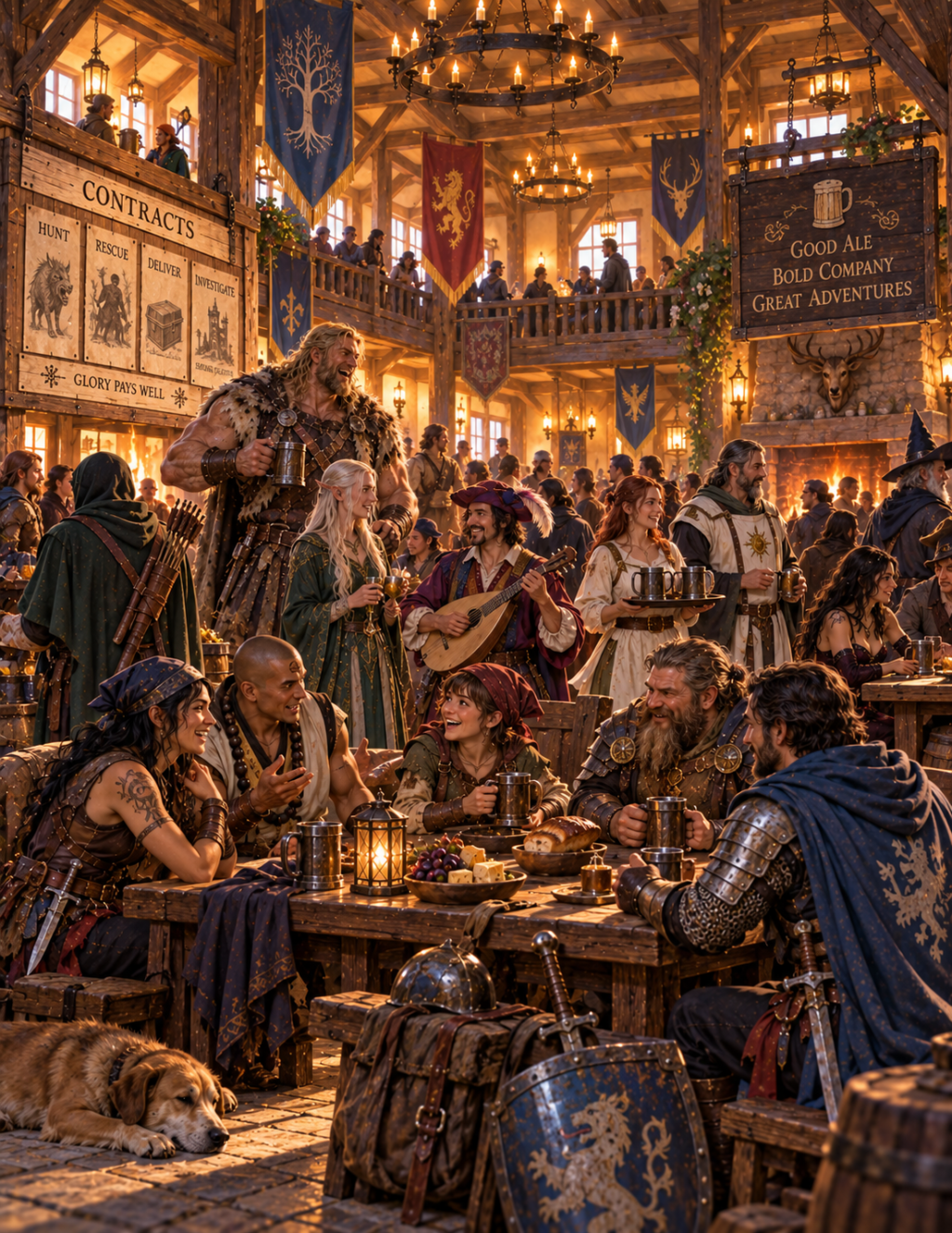
Throughout much of Sylva, certain taverns are known as adventurers’ taverns. These establishments serve the ordinary purposes of an inn or tavern, but they are also recognized gathering places for adventurers, employers, messengers, guides, mercenaries, travelers, and others involved in dangerous work. Their most recognizable feature is usually the contract board. A contract board may contain offers from villages, merchants, nobles, temples, guilds, military officers, wealthy families, or anyone else prepared to pay adventurers. Notices seeking additional party members may hang beside them. A newly arrived adventurer can therefore enter a town knowing where dangerous work is likely to be found, while an employer knows where to advertise when ordinary help will not suffice.
In places where adventuring is formally recognized, an adventurers’ tavern may operate under royal, noble, civic, guild, or other lawful authority. Contracts can be witnessed and recorded there, and payment for serious work may be deposited with a bank or other trusted institution before the contract is posted. This protects both parties. Adventurers know that the promised money exists, while the employer knows that payment will not be released merely because someone claims the work was completed.
Good contracts therefore state a clear completion condition whenever possible. An employer might require the safe arrival of a caravan, the return of a missing person, the capture of a named outlaw, the recovery of a stolen object, recognizable proof that a dangerous creature has been killed, or confirmation that a road has been made safe. Some situations are too uncertain for perfect terms, but experienced adventurers quickly learn the value of knowing exactly what they are being paid to accomplish. Not every contract is posted in a tavern. Successful parties may eventually receive messengers, invitations, sealed letters, private audiences, or direct requests from powerful patrons. Nor does every adventure begin with a contract at all. Adventurers can pursue rumors, explore ruins, hunt enemies, seek treasure, intervene in local problems, or follow their own ambitions. The contract system makes adventuring a profession; it does not place a boundary around adventure.
👑King’s Contracts
The most prestigious class of professional work is traditionally known as a King’s Contract. Despite the name, a King’s Contract does not have to be issued by a king. The term refers to work of sufficient importance, danger, expense, or consequence that it is entrusted only to adventurers with an established reputation.
King’s Contracts become available at ⭐⭐⭐ Level 3. Reaching that level means that a character is no longer merely an experienced adventurer. He has become eligible for King’s Contracts and possesses the adventuring experience expected for work in which failure may have serious consequences. Whether particular employers know his reputation depends upon what they know about his career. A King’s Contract might come from a ruler, noble house, military commander, wealthy guild, temple, city government, great merchant, bank, foreign envoy, or coalition of communities. What distinguishes the contract is not the title of the employer but the importance of the assignment and the caliber of adventurer expected to undertake it. Level 3 is only the entrance to this world. ⭐⭐⭐⭐ Level 4 adventurers may be sought by name when ordinary adventurers, soldiers, investigators, or previous expeditions have failed. ⭐⭐⭐⭐⭐ Level 5 adventurers have legendary reputations. Their assignments may involve wars, sieges, named dragons, lost kingdoms, ancient powers, enormous expeditions, or events capable of changing the history of entire regions.
The rewards escalate accordingly. A King’s Contract may offer substantial Gold as well as salvage rights, transportation, horses, provisions, guides, specialists, soldiers, legal authority, access to forbidden places, audiences with rulers, rights to captured property, land, titles, rare knowledge, or other privileges that cannot simply be purchased in a market. At the highest levels, the resources placed at the party’s disposal may be as extraordinary as the task itself.
🪙Coinage
Money in Sylva is deliberately simple. Coins vary in appearance from kingdom to kingdom, but ordinary play does not require adventurers to calculate exchange rates between dozens of currencies. Coins of acceptable weight and metal are generally treated according to denomination.
10 Copper = 1 Silver. 10 Silver = 1 Gold. Therefore, 1 Gold = 100 Copper
Copper is the money of everyday life. Meals, drinks, inexpensive lodging, minor supplies, and small purchases are commonly measured in Copper. Silver represents more substantial commerce: wages, provisions, tools, services, better lodging, livestock, and other noticeable expenses. Gold is serious money. Valuable weapons, armor, horses, exceptional services, major purchases, substantial rewards, and the dealings of wealthy merchants, nobles, and successful adventurers are commonly measured in Gold. This scale matters more than memorizing every price. A few Copper should feel ordinary. Several Silver should feel meaningful. Several Gold should feel like real money. A successful contract can materially improve an adventurer’s circumstances, while a major King’s Contract can create life-changing wealth.
💰What Money Can Buy
Kingsmark does not require detailed medieval economic simulation. Prices vary by region, season, settlement, and circumstance, while specific costs appear in ⚖The Marketplace: The Fantasy Adventurer’s Guide to Equipment & Commerce. The Player’s Handbook instead establishes the meaning of the denominations. Copper handles ordinary expenses such as food, drink, inexpensive accommodation, household goods, and minor supplies. Silver becomes important for better equipment, professional services, large quantities of provisions, valuable tools, livestock, and travel. Gold is used when the purchase itself is significant: quality weapons and armor, horses, rare goods, valuable property, and expensive services.
Successful adventurers may move rapidly between these economic worlds. A new adventurer may still care about the cost of a bed and hot meal. An established one may invest Gold on equipment and travel without hesitation. A legendary adventurer may instead ask whether he can finance an expedition, maintain a stronghold, equip retainers, hire specialists, or support soldiers in the field. The Marketplace provides the numbers; this section provides their meaning.
💎Payment, Treasure & Salvage
A contract’s payment is only one way an adventuring party earns wealth. Parties may collect bounties, discover treasure, sell valuables, recover abandoned property, receive gifts, or claim salvage rights granted by their work. Sometimes the treasure recovered is worth far more than the promised payment. This makes contract terms important. One patron might offer 20 Gold while claiming every object recovered from a tomb. Another might offer 10 Gold but allow the party to keep everything except one named relic. Depending upon what lies inside, the second contract may prove more valuable.
A contract can distinguish between payment, salvage, and reserved property. Payment is the promised reward when the completion conditions are satisfied. Salvage is recovered property the party may keep. Reserved property consists of specific objects belonging to the employer or another recognized owner. Additional terms may provide lodging, transportation, provisions, guides, healing, equipment, legal authority, or other aid.
These terms matter more as contracts grow in scale. A village investigating trouble in its cemetery may offer a small purse, meals, and lodging. A kingdom hiring legendary adventurers to hunt a named dragon might provide soldiers, scouts, engineers, specialized weapons, supply wagons, legal authority, and a negotiated share of the hoard. Both are contracts, but they operate at very different levels of the adventuring profession. Parties decide among themselves how earnings are divided. Equal shares are common, but Kingsmark requires no specific arrangement. Unless the contract states otherwise, the listed reward is normally payment to the party as a whole rather than the same payment to every member.
⭐Contracts & Action Star Level
For play, contracts can be rated by the Action Star Levels of the adventurers usually trusted to take them. This does not promise a balanced encounter or make lower-level dangers harmless. A sword is still a sword, an ambush is still dangerous, and even simple work can go badly. The rating instead reflects the scale and burden of the job. Distance, uncertainty, politics, expected opposition, independence, failure, resources, and the employer’s trust can all affect the level.
A Level 1 contract asks whether a new party can solve a dangerous local problem. Level 2 work assumes the party can act as independent professionals. A Level 3 King’s Contract means major groups now trust the party with serious goals, money, privileges, and resources. Levels 4 and 5 push that much farther.
- Level 0 characters are unproven adventurers taking their first real missions. These may be unstarred or ⭐ Level 1 work an employer is willing to risk on a new party.
- ⭐ Level 1 contracts suit proven but inexperienced adventurers and often involve local trouble with limited stakes.
- ⭐⭐ Level 2 contracts are serious professional work where employers expect the party to act alone and face major danger.
- ⭐⭐⭐ Level 3 begins King’s Contracts. The party now has enough reputation for important assignments involving people, communities, routes, groups, or interests.
- ⭐⭐⭐⭐ Level 4 contracts are elite work. Powerful patrons may seek specific adventurers because others failed or because the task is too dangerous, strange, secret, or important for ordinary professionals.
- ⭐⭐⭐⭐⭐ Level 5 contracts are legendary. The party may command soldiers, join sieges, hunt named monsters, enter places few living people have seen, face threats to whole regions, or take part in events that become part of Sylva’s history.
Advancement is therefore not just about fighting larger groups of enemies. As adventurers rise, the world gives them greater duties, resources, mysteries, and choices.
📜Example Contracts
The following contracts show the kinds of work adventurers may face as their reputations grow. Payments are examples, not fixed prices. A poor village and a rich merchant may offer very different rewards for equally dangerous work, while salvage rights, supplies, travel, favors, legal power, and other benefits can greatly change a contract’s value. Unless stated otherwise, the listed payment is for the whole party.
These are adventure seeds, not complete scenarios. Each gives the basic shape of a job: who wants something done, what must be solved, what risks may arise, and what reward is offered. The Game Master can turn one into a short mission, a longer investigation, or the start of a larger campaign. Creatures, places, patrons, deadlines, rewards, and hidden facts can all change while keeping the same scale. A missing caravan might become a lost patrol. A monster hunt might become a rescue. A simple escort job might uncover a plot.
Contracts also show how the world reacts to the party’s reputation. New adventurers usually receive local work. Proven parties may handle regional threats, while famous veterans may draw patrons dealing with kingdoms, armies, ancient dangers, and great fortunes.
⭐ Cemetery Disturbance 💰 1–2 Gold
Someone has been opening graves in the cemetery outside a small town. At first, the locals blamed grave robbers, but several bodies appear to have been removed without valuables being taken. A shepherd has since reported seeing someone walking among the graves after midnight. The town offers a modest reward for discovering what is happening and putting an end to it. The cemetery contains enough possibilities that the contract need not immediately become a fight. The party might question witnesses, examine opened graves, follow tracks, inspect the cemetery during daylight, and return after dark. The culprit could be a handful of Zombies or Skeleton Warriors, a Ghost bound to an improperly disturbed grave, a grave robber concealing something worse, or a living person using local superstition to frighten witnesses away. This is appropriate Level 1 work because the problem is local, the employer does not yet know exactly what is happening, and a newly established adventuring party can reasonably be trusted to investigate it. That does not make it safe. A careless adventurer can still die in a dark cemetery.
🎁Additional Terms: Meals and modest lodging while the investigation continues.
⭐The Miller’s Daughter 💰 1–3 Gold
A miller’s teenage daughter disappeared while gathering berries near the forest road. She was expected home before sunset, and a search by neighbors found her basket beside a stream several miles from town. Rain is expected by morning and may destroy whatever tracks remain. The family cannot afford a great reward, but neighbors have contributed money and the local tavern keeper has added enough to make the search worth posting. The party must find the girl’s trail, determine whether she wandered away or was taken, and return her alive if possible. What begins as a missing-person search could lead to an outlaw’s hideout, a Goblin scout camp, an abandoned forester’s cottage, an animal den, or something stranger discovered deeper in the woods. The girl may also have fled from something she saw rather than something that captured her, allowing the rescue to reveal a larger problem for a future contract. The urgency makes the adventure exciting without making the characters responsible for an entire region. Success matters enormously to the people involved even though the rest of Sylva will never hear about it.
🎁Additional Terms: Local volunteers can describe the forest and provide food, lanterns, blankets, and other ordinary supplies for the search.
⭐⭐ Caravan Through Blackwood 💰 4–8 Gold
A merchant caravan must cross several days of sparsely settled woodland before reaching the next major market town. Another caravan was robbed along the route two weeks ago, and travelers have since reported smoke from camps deeper in the forest. The employer is not hiring the adventurers merely to walk beside the wagons. The party is responsible for getting the caravan, its drivers, and its cargo safely to the destination. That may require choosing campsites, scouting dangerous stretches of road, organizing watches, negotiating with suspicious travelers, responding to blocked roads, and deciding whether an apparent obstacle is an accident or the beginning of an ambush. Bandits are the obvious danger, but the contract can become more complicated. The attackers may have been displaced by Goblins, driven from their old territory by a larger predator, or working with someone who knows exactly what the caravan carries. The party may discover that somebody among the travelers has been secretly communicating with the attackers. This is Level 2 work because several lives and a valuable cargo have been placed entirely in the party’s hands for several days. The employer expects professional judgment rather than constant instructions.
🪙Salvage: Ordinary weapons, equipment, and valuables taken from attackers, unless ownership can reasonably be established.
🎁Additional Terms: Food and transportation with the caravan during the contract.
⭐⭐ The Redknife Hideout 💰 6–10 Gold
The Redknives have turned an abandoned watchtower into a fortified base from which they rob travelers and demand illegal tolls from nearby villages. Local authorities know approximately where the hideout is but cannot spare enough soldiers to search the hills while protecting the settlements. The contract requires the adventurers to break the Redknives as an organized threat: locate their hideout, capture or kill their leadership, and end their ability to operate in the area. The Redknives use sentries, concealed approaches, bows, alarms, escape routes, and prisoners as leverage. A frontal assault is possible, but reconnaissance, infiltration, deception, nighttime movement, negotiation, or turning gang members against one another may work better. The party must decide how to overcome a defended position rather than simply survive a fight.
🪙Salvage: Coin and property belonging to the Redknives may be claimed, but identifiable stolen property must be returned.
🎁Additional Terms: Additional bounty for named leaders captured alive.
⭐⭐ The Sunken Crypt 💰 5–8 Gold
A partially collapsed crypt has been discovered beneath an abandoned monastery. Two treasure seekers entered before anyone could stop them. One returned badly injured and refuses to describe what happened below. The other never returned. A patron wants an inscribed silver reliquary mentioned in surviving monastery records. The party is contracted to enter the crypt, recover it, and determine what happened to the missing explorer. The crypt may contain Skeleton Warriors, Zombies, Giant Spiders, Constructs, traps, flooded chambers, unstable masonry, poisonous growths, or creatures that entered long after the monastery was abandoned. Exploration is as important as combat. The adventurers must manage light, equipment, routes of retreat, uncertain passages, and the temptation to continue exploring after finding their objective. The patron wants the reliquary, but the party may keep other unclaimed treasure discovered below.
🪙Salvage: All unclaimed treasure and valuables discovered within the crypt.
🔒Reserved Property: The inscribed silver reliquary.
🎁Additional Terms: A bonus if the missing explorer is returned alive.
⭐⭐⭐ The Black Pass 💰 30–50 Gold 👑
The Black Pass is the only reliable road through mountains separating two heavily populated regions. Three merchant caravans have disappeared there during the past month. A patrol of twelve soldiers sent to investigate also vanished. Travelers have abandoned the road, grain prices are climbing, and winter will soon make alternative routes nearly impossible. The contract does not ask the party merely to investigate. The Black Pass must be reopened. The adventurers must discover what controls the route, determine what happened to the missing patrol and caravans, and remove the threat sufficiently for normal traffic to resume. Possibilities include a Goblin stronghold, a Troll and its followers, fortified outlaws, a dangerous mountain creature, or something awakened beneath the pass. This is a King’s Contract because entire communities, trade routes, food supplies, and military movement depend upon success. The employer therefore provides resources beyond those of an ordinary contract. The party may receive maps, pack animals, cold-weather supplies, guides, and authority to request reasonable local assistance. Soldiers can secure the road once the adventurers break the principal threat.
🪙Salvage: Enemy coin, weapons, equipment, and unclaimed valuables discovered while clearing the pass.
🔒Reserved Property: Identifiable merchant cargo and military property belonging to the missing patrol.
🎁Additional Terms: Transportation and expedition supplies provided. Additional bounty for each missing soldier or caravan survivor returned alive.
⭐⭐⭐ The Fallen Fortress 💰 40–60 Gold 👑
Decades ago, a border fortress was abandoned after a fire destroyed much of its interior. Changing political conditions have suddenly made the ruin important again. Scouts report that an enemy force is moving toward the region, and if the fortress can be made defensible before that force arrives, it will control the only practical route through the surrounding valley. There is one problem: the scouts sent inside did not return. The party is commissioned to enter the fortress ahead of the army, discover what now occupies it, recover the royal standard and sealed military archive believed to remain beneath the keep, and make the stronghold safe enough for engineers and soldiers to enter. The adventurers are not expected to rebuild the fortress themselves. Their job is to solve the problem that prevents an army from using it. Whatever lives inside should make the fortress more than another bandit hideout. The lower chambers might contain something awakened by the original fire, a nest of creatures that has spread through forgotten tunnels, undead soldiers still defending orders issued generations ago, or evidence that the fortress was abandoned for reasons deliberately omitted from official history. Military engineers and a body of soldiers wait outside the danger zone for the party’s signal. Once the adventurers secure the fortress, hundreds of people may move in behind them and transform the ruin into an active military position. The characters can therefore see immediately that their actions have changed the strategic map.
🪙Salvage: Unclaimed treasure discovered within the fortress and ordinary property belonging to hostile occupants.
🔒Reserved Property: The royal standard, sealed military archive, military stores, and objects bearing recognizable ownership of the Crown.
🎁Additional Terms: Horses, provisions, maps, and military transportation provided. Engineers and soldiers are available once the party declares an area secure.
⭐⭐⭐⭐ The City Beneath the Glacier 💰 75–100 Gold 👑
Far beyond the settled valleys, an expedition searching for an old mountain route discovered something impossible beneath a retreating glacier: enormous stone doors carved into the mountainside, leading downward into a city buried beneath the ice. The expedition entered. Three days later, a single member returned. She remembers almost nothing about what happened below. A coalition of wealthy patrons commissions the adventuring party to reach the site, locate any survivors, determine what lies beneath the glacier, and return with evidence of what the expedition discovered. The party may be accompanied as far as the entrance by guides, laborers, translators, scholars, and guards, but nobody can tell the adventurers what awaits them inside. The city should feel like a genuine wonder of Sylva rather than simply another dungeon. Streets may disappear beneath translucent walls of ancient ice. Enormous chambers may contain architecture unlike that of any known kingdom. Doors may have remained sealed for thousands of years. Strange mechanisms may still function. The party may discover evidence that whoever built the city understood the world very differently from the people living in Sylva today. The contract is Level 4 because there is no established procedure for accomplishing it. Previous explorers have already failed, the destination itself is extraordinarily dangerous, and the patrons require adventurers capable of making important decisions without knowing what they will encounter.
🪙Salvage: Ordinary valuables discovered during the expedition, subject to the reserved discoveries below.
🔒Reserved Property: Records, inscriptions, maps, artifacts, or other discoveries specifically related to identifying the city’s builders and history. Particularly extraordinary discoveries may require separate negotiation.
🎁Additional Terms: Expedition supplies, mountain guides, pack animals, translators, scholars, and transportation provided. The party receives first access to the site and may negotiate future exploration rights if the expedition succeeds.
⭐⭐⭐⭐ The Vampire of Seven Houses 💰 100–150 Gold 👑
Members of several powerful families have died under strange circumstances during the past year. Others have disappeared. Servants whisper about relatives who no longer appear during daylight, private gatherings held after midnight, and household members whose personalities changed almost overnight. A previous investigation ended when its chief investigator murdered two assistants and disappeared. Someone with considerable authority now believes that a Vampire has infiltrated the city’s nobility. The adventuring party is sought because the investigation can no longer be trusted to ordinary authorities. The Vampire may have servants among the city watch, agents within noble households, enthralled officials, and victims who protect it willingly. Some may themselves need rescuing. The party must identify the Vampire, uncover the network protecting it, discover where it hides, and destroy it. This may require entering noble estates, questioning politically protected people, searching crypts, following financial records, breaking enchantments, and determining which allies can be trusted. Once the Vampire learns who the adventurers are, the investigation becomes a contest between intelligent adversaries. This is Level 4 work because violence alone cannot solve the problem. The party receives unusual freedom to investigate people ordinary guards could never touch, but using that authority recklessly could create powerful enemies.
🪙Salvage: Coin, valuables, and unclaimed property belonging personally to the Vampire.
🔒Reserved Property: Identifiable property stolen from victims or noble households must be returned when ownership can be established.
🎁Additional Terms: Sealed authority to enter restricted properties when justified by the investigation, access to official records, discreet assistance from trusted officers, and a substantial bounty for rescuing important missing persons alive.
⭐⭐⭐⭐⭐ Break the Siege of Vareth 💰 200–300 Gold 👑
The fortress-city of Vareth has been under siege for nearly two months. Its outer villages have fallen, its river crossing is controlled by the enemy, and enormous siege engines are being assembled beyond the walls. A relief army has arrived but cannot attack without exposing itself to disaster. The adventurers are not being hired as four more soldiers. They are being given command of three hundred. Scouts have discovered an old mountain road capable of placing a force behind the enemy position. The route is narrow, partially collapsed, and passes through territory abandoned for generations. If the adventurers can lead the force through the mountains, descend behind the besieging army, destroy its siege engines, and seize the bridge, Vareth’s defenders can attack from the walls while the relief army advances from the opposite side. The party must make decisions normally entrusted to commanders. They may organize scouts, assign soldiers to objectives, choose when to advance, and alter the plan when the enemy responds. The larger battle provides the setting while the characters undertake decisive actions. Their soldiers can hold positions, fight enemy troops, protect routes, or create openings while the adventurers confront enemy champions, sabotage siege engines, capture commanders, break supernatural defenses, or personally seize the decisive objective. If they succeed, thousands of soldiers may fight differently because of their decisions.
🪙Salvage: Personal spoils captured during the operation according to the laws and customs governing the campaign.
🔒Reserved Property: Military stores, siege equipment, captured standards, official correspondence, and strategic documents belong to the army.
🎁Additional Terms: Temporary military command, three hundred soldiers, scouts, engineers, supplies, horses, military intelligence, and authority appropriate to the operation. Extraordinary success may result in land, military honors, noble recognition, or permanent command privileges.
⭐⭐⭐⭐⭐The Dragon of Mount Arak 💰 300–500 Gold 👑
The dragon Azhurath has returned. Its name appears in chronicles more than two centuries old. It destroyed three fortified settlements before disappearing into the mountains, and the last expedition that attempted to locate its lair never returned. For generations, people argued over whether Azhurath was dead. Then it descended from Mount Arak and destroyed a fortified manor in a single attack. This is not a contract to send four adventurers into the mountains and hope they can somehow kill a dragon alone. A kingdom is preparing a dragon hunt, and the adventuring party has been chosen to lead its decisive element. Eighty soldiers, hunters, scouts, engineers, teamsters, and siege crews are placed at the party’s disposal. Heavy ballistae designed for dragon warfare must be hauled into the mountains and positioned where they can actually strike the creature. Scouts must locate Azhurath without drawing it toward the expedition. The party must study its movements, find its lair, determine where it can be engaged, protect the weapon crews, and devise a plan for killing a creature that can choose when and where it fights. Azhurath is not simply an unusually powerful monster. It is an historical creature known by name. Its habits, wounds, territory, intelligence, and previous encounters can be researched. People have built weapons specifically to kill its kind, and those weapons still require extraordinary courage and planning to use. If Azhurath has a hoard, ownership of that hoard is negotiated before anyone leaves. No sensible adventurer agrees to hunt a legendary dragon and waits until afterward to discover who believes the treasure belongs to them.
🪙Salvage: A negotiated share of Azhurath’s hoard and valuable remains, in addition to the guaranteed payment.
🔒Reserved Property: Identifiable royal treasures, sacred relics, or historically documented property may be specifically reserved before the expedition begins.
🎁Additional Terms: Eighty personnel, siege weapons, engineers, scouts, horses, wagons, provisions, healers, and military transportation. Successful dragon slayers may receive land, titles, heraldic honors, or other rewards appropriate to a deed that will be remembered for generations.
⭐⭐⭐⭐⭐The Dead Kingdom 💰 500+ Gold 👑
Beyond the eastern frontier lies a kingdom whose roads end abruptly on old maps. More than a century ago, messengers stopped coming from it. Refugees spoke of darkness spreading across the countryside, abandoned towns, and people fleeing from something they could not adequately describe. Neighboring rulers closed the roads. Settlements nearest the frontier were eventually abandoned. For generations, the region remained hidden behind an unnatural gloom through which expeditions rarely returned. Now the darkness is receding. A ruler intends to discover what remains before rival kingdoms do. The adventuring party is offered command of an expedition consisting of soldiers, scouts, priests, healers, engineers, translators, cartographers, laborers, wagons, animals, and enough supplies to remain beyond the frontier for months. The objective cannot be reduced to retrieving a single object. The party must cross the old border, establish a secure route, determine whether anyone still lives within the lost kingdom, identify what destroyed or transformed it, and decide whether a larger expedition can safely follow. They may discover ruined cities, isolated descendants of survivors, abandoned castles, unfamiliar creatures, forgotten roads, corrupted wilderness, or entire communities that have developed without contact with the outside world. Some discoveries may be valuable enough to cause political conflict once news reaches home. At Level 5, an expedition can itself become a campaign. The characters are not merely exploring the map. They are determining what will be written onto it.
🪙Salvage: Broad rights to ordinary unclaimed treasure and valuables discovered during exploration.
🔒Reserved Property: Major royal archives, regalia, diplomatic records, and other objects whose ownership could affect claims over the lost kingdom.
🎁Additional Terms: Command of the expedition and its personnel, extensive supplies, wagons, animals, specialists, military protection, replacement equipment, and authority to establish temporary camps or fortified outposts. Successful exploration may result in land grants, exclusive exploration rights, ownership of an established outpost, or a share in future expeditions.
⭐⭐⭐⭐⭐The Mouth of the Gloom 💰 500+ Gold 👑
A Gloom Domain has begun to spread. First, a few farms were abandoned. Then an entire village emptied overnight. Forest trails changed. Animals fled. Scouts reported places absent from their maps and distant lights moving where no settlement existed. Now several communities have been evacuated, and the Domain still expands. An army holds the perimeter but cannot solve the problem by marching inside. Patrols lose their way. Messengers disappear. Soldiers suffer nightmares before crossing the boundary. Priests and scholars believe the corruption is anchored deep within the region, but nobody knows where. The party is commissioned to enter the Domain, locate the source, determine what sustains it, and end the threat if possible. Outside, soldiers hold the perimeter, refugees need shelter, scouts watch for changes, priests slow the corruption, and messengers carry reports. All of this supports a handful of legendary adventurers attempting what an army cannot. Inside, the party may find corrupted settlements, altered wilderness, servants of the Gloom, hidden survivors, and Domains nested within the larger Domain. Ending the threat may require more than killing a creature. The characters may need to learn what happened, form alliances, recover something lost, or face a choice with consequences beyond survival. If they succeed, returning refugees may never know what happened at the Domain’s heart. They will know the names of those who entered it.
🪙Salvage: Broad rights to unclaimed valuables recovered from hostile forces or abandoned locations, subject to identifiable ownership.
🔒Reserved Property: Specific sacred, royal, or historically important objects named in the contract.
🎁Additional Terms: Horses, supplies, healers, scouts, specialists, military support near the Domain, archive access, and authority to request major aid from participating settlements and institutions. Success may also bring land, titles, lasting privileges, or gifts unavailable through ordinary commerce.
🏰 When Gold Is No Longer Enough
Early in an adventurer’s career, money can transform their circumstances. A successful contract pays for better equipment, lodging, supplies, travel, healing, and freedom to choose what comes next. Eventually, another purse of Gold may no longer be the most interesting reward a powerful patron can offer. Land, a fortified manor, a Wizard’s tower, a ship, trading privileges, exploration rights, forbidden libraries, rare magical knowledge, political influence, command authority, or a captured stronghold may become far more valuable. Legendary adventurers may also invest wealth on larger goals: hiring retainers, maintaining estates, financing expeditions, building fortifications, supporting soldiers, sponsoring temples, equipping followers, and funding projects unimaginable early in their careers. This does not mean every Level 5 character automatically receives a castle or commands an army. It means such things have entered the scale of play. A character who once counted Copper for a meal may later negotiate the cost of feeding three hundred soldiers. At the highest levels, wealth stops merely changing what an adventurer can buy and begins changing what he can do. Rules for strongholds, retainers, soldiers, armies, construction, and other large-scale play appear in 🍺The Tavern.
🧭 Adventure Beyond Contracts
Contracts provide money, direction, and opportunity, but adventurers need not wait beside a tavern board for employment. They can pursue rumors, explore forgotten places, hunt enemies, seek magical knowledge, search for treasure, aid people who cannot pay, follow religious or personal duties, establish strongholds, investigate mysteries, or travel toward something on the map nobody they know has seen. At higher levels, characters may increasingly create their own objectives. A legendary party does not need a king to commission an expedition into an unknown continent. If they have the wealth, reputation, allies, and will to organize it themselves, they can go. Money is one reason to adventure. It is not the only reason.