

⭐Action Star Level represents the maturity and stature of a character’s adventuring career. It describes the progression from someone who has never proven himself on an adventure to an experienced professional and, eventually, a legendary adventurer whose deeds may become part of history. A character’s ⭐Action Star Level is determined by the amount of XP he has invested in his Skills and Attributes.
⭐Experience Points measure development earned through adventuring, while Skills and Attributes describe what a character is capable of doing. Time represents the years of life in which experience, training, recovery, study, and practice occur. Accomplishments are what earn XP through play, while Reputation describes how much other people know about those accomplishments.
These elements help describe what an adventurer’s career looks like, but they are not additional requirements for advancement. ⭐Action Star Level itself advances at the invested-XP thresholds described below. For this reason, Action Star Level does not measure someone’s entire worth or professional ability. A sixty-year-old physician might begin at Level 0 despite possessing extraordinary Medicine. He may have spent forty years treating patients without ever entering a dungeon, accepting a dangerous contract, exploring hostile wilderness, or fighting for his life. He is an accomplished physician, but an unproven adventurer.
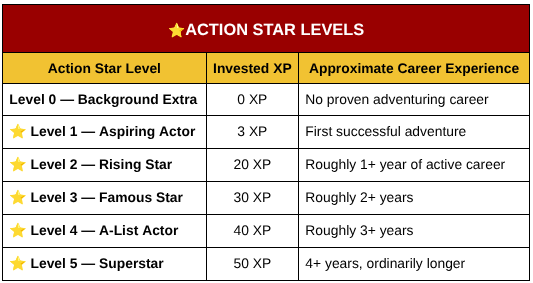
Likewise, two adventurers of the same Action Star Level need not possess similar Skills. A Level 4 Wizard, Level 4 Thief, and Level 4 Man-at-Arms may be extraordinary for completely different reasons. Since Level 0 is only for tutorial purposes it isn’t considered a real “Action Star Level.” There are five Action Star Levels:
These names describe increasingly extraordinary adventuring careers. They do not require characters to be literal actors, nor does a “Famous Star” necessarily have to be famous. They are referred to as “Action Star Levels” because ⭐Jack’s Cinematic d12 approaches tabletop role-playing not merely as collaborative storytelling, but as collaborative movie-making and scriptwriting, in which the players portray the stars of an unfolding cinematic adventure.
⚔️ Becoming an Action Star
A character advances by developing both ability and experience. XP is earned through meaningful accomplishments during adventures and is then invested in Skills and Attributes. The required XP must be invested before it counts toward ⭐Action Star Level; unspent XP does not count. When a character reaches the required amount of invested XP, he advances to the corresponding ⭐Action Star Level.
Because XP is earned through accomplishments, there is no need for the Game Master to judge the character’s career a second time before allowing advancement. The adventures that produced the XP have already established the experience upon which the new level is based.
Different careers can therefore produce the same Action Star Level through very different experiences. A soldier might develop during an unusually intense war. A Ranger might spend years exploring dangerous wilderness without participating in a major battle. A Thief might build his career through infiltration, deception, burglary, and escape. A Wizard might combine dangerous expeditions with long periods of magical study.
The approximate years associated with each Action Star Level are career benchmarks rather than additional requirements. The Game Master should use Advancing Time when appropriate so that training, recovery, travel, study, and ordinary life can occur between adventures. This allows the passage of a character’s life to remain believable without creating another collection of points, mandatory mission counts, or a second advancement system.
Earn XP through accomplishments, invest it in the character, and the corresponding Action Star Level is gained.
🗓️ The Years of an Adventuring Career
Action Star Level represents more than the number of gaming sessions that have occurred. It represents a career unfolding through the character’s actual life. These are guidelines, not stopwatches.
Four years should not be understood to mean that four years of doing something automatically makes a person legendary. In real life, mastery of demanding professions can require many years or even decades. The four-year progression represents the unusually intense life of a successful adventurer who repeatedly faces difficult situations, trains between missions, survives serious danger, and accumulates extraordinary accomplishments.
Exceptional circumstances can compress experience. A character who spends a year in nearly continuous warfare may encounter more danger and make more consequential decisions than another character encounters during several quieter years. Conversely, an adventurer who accepts only occasional contracts might take considerably longer to reach the same career stature. The passage of time described here occurs inside the world, not around the gaming table.
A group playing every week does not need to spend four real-world years reaching Level 5. As explained under 📅Advancing Time, weeks, seasons, months, or years can pass between adventures. Twenty-five gaming sessions might depict five years of a character’s life.
The purpose of these benchmarks is not to delay advancement. It is to ensure that when a character eventually becomes legendary, he has accumulated something worth calling a career.
🌟 What the Levels Mean
Action Star Levels describe broad stages of adventuring experience. They do not dictate personality, profession, age, wealth, or fame. A young character may advance unusually quickly through extraordinary circumstances, while an elderly character may remain Level 0 because adventuring has never been part of his life.
Level 0 — Background Extra: Capable but Unproven
Every new adventurer begins at Level 0. Level 0 does not mean incompetent, helpless, or untrained. A Level 0 character might already be an accomplished blacksmith, physician, hunter, scholar, sailor, soldier, magician, thief, or martial artist. He has the Attributes and Skills established during character creation and may be exceptionally capable in his field. What he lacks is proven adventuring experience. He has not yet established that he can apply those abilities while exploring dangerous places, pursuing uncertain objectives, confronting hostile opposition, and dealing with consequences beyond his control. A newly trained soldier before his first field experience provides a useful comparison. Training may have made him capable. The field has not yet tested him. Level 0 therefore means: Capable, perhaps highly trained, but unproven as an adventurer.
⭐ Level 1 — Aspiring Actor: Proven
A character reaches ⭐ Level 1 after crossing the boundary between preparation and genuine experience. He has completed his first genuine adventure and earned and invested the required 3 XP. Whatever his previous training, he has now faced real uncertainty and learned what it means to function when something meaningful is at stake. Plans have met reality. Decisions have carried consequences. He has had to act without knowing exactly what would happen next. This is why a character’s first mission is always worth 3 XP. It marks the moment when theory becomes experience and confidence is tested against danger, fear, confusion, and uncertainty. Level 1 does not make the character a veteran. One successful mission cannot provide the judgment accumulated through years of experience. But he is no longer merely someone trained for dangerous conditions. He has faced them and understands, at least in part, how differently a situation feels when failure can injure someone, ruin a mission, or cost a life. The distinction is simple:
Level 0: “I have been trained to do this.”
Level 1: “I have actually done this.”
⭐ Level 2 — Rising Star: Experienced
By ⭐ Level 2, adventuring has ceased to be an experiment and has become a genuine part of the character’s profession and life. The character has accumulated 20 invested XP, ordinarily accompanied by roughly a year or more of adventures, training, travel, recovery, and practical experience. He has succeeded more than once, made mistakes, encountered situations training failed to anticipate, and developed judgment through experience. This is the transition from proven beginner to established practitioner. A Level 2 adventurer has begun to recognize patterns before they fully develop. He knows when a situation feels wrong, when a simple plan needs a backup, when supplies are running low, when an enemy is trying to lure the party forward, or when pressing an advantage would be less wise than withdrawing. These instincts are not supernatural. They come from surviving enough difficult situations to remember what went wrong before. A Level 2 adventurer need not be famous, nor must his accomplishments already be extraordinary by historical standards. What matters is that other experienced people can reasonably regard him as someone who knows what he is doing. He is no longer learning what it means to become an adventurer. He is one.
⭐ Level 3 — Famous Star: Veteran / Mastery
⭐ Level 3 represents a major threshold in an adventurer’s career. The character has accumulated 30 invested XP and ordinarily at least a couple of years of serious adventuring experience. He has progressed beyond simply knowing his profession. Repeated exposure to danger and uncertainty has developed the judgment necessary to apply his abilities when circumstances refuse to cooperate. This is where an adventurer has attained genuine professional mastery.
That does not mean that every Skill he possesses has been mastered, nor that he has nothing left to learn. It means that his overall ability to practice his profession under real conditions has matured to the point that difficult independent work can reasonably be entrusted to him.
For this reason, Level 3 is the threshold at which an adventurer becomes eligible for King’s Contracts. A king, general, noble, or other powerful patron is no longer gambling on promising beginners. He is employing a proven veteran with a substantial record behind him. A Level 3 character has become the sort of adventurer whom other professionals take seriously.
⭐ Level 4 — A-List Actor: Elite
By ⭐ Level 4, the character is exceptional even among experienced adventurers. He has accumulated 40 invested XP, ordinarily across at least three years of active career development, and his accomplishments distinguish him from people who are merely competent professionals. He has repeatedly demonstrated unusual ability, judgment, resilience, or effectiveness under difficult conditions. Level 4 represents the transition from veteran to elite.
This does not require a particular accomplishment.
One Level 4 adventurer might have survived extraordinary military campaigns. Another might have penetrated places nobody else could reach. Another might be responsible for solving mysteries, defeating monsters, recovering lost artifacts, or completing seemingly impossible contracts. Powerful people may seek such adventurers specifically because ordinary professionals have already failed—or because the consequences of failure are too serious to entrust the task to anyone less accomplished. Among adventurers, a Level 4 character stands out.
⭐ Level 5 — Superstar: Legendary
⭐ Level 5 is the summit of numerical character advancement. The character has invested the full 50 XP available during his lifetime and ordinarily possesses at least four years of serious adventuring experience—often considerably more. Because those 50 XP were earned through meaningful accomplishments, reaching this point represents an extraordinary body of adventuring experience. Level 5 represents legendary stature.
That does not necessarily mean everyone in Sylva knows the character’s name. It means that his career has reached the highest stature represented by the Action Star Level system. His deeds might become chronicles, military histories, tavern stories, religious accounts, professional lore, or songs. Some legendary careers may instead remain deliberately concealed.
When a character earns and invests his fiftieth XP, he reaches Level 5. A Level 5 adventurer has reached the point where future generations might tell stories about what happened during his lifetime.
🗡️ Capability, Mastery, Renown & Legend
It is tempting to imagine that exceptional ability, professional mastery, fame, and historical greatness all arrive at approximately the same time. Real careers show otherwise.
Miyamoto Musashi provides a particularly useful example.
In The Book of Five Rings, Musashi wrote that he fought his first duel at thirteen, another at sixteen, and later traveled through the provinces testing himself against other martial artists. He claimed that by approximately age twenty-nine he had fought more than sixty contests without defeat. By almost any reasonable standard, such a record—if we take Musashi’s retrospective account as his own description of his career—would already indicate extraordinary capability and accomplishment. Yet Musashi himself made a striking distinction. Looking back after turning thirty, he wrote that his victories did not mean that he had mastered strategy. He considered whether natural ability, circumstance, or deficiencies in his opponents had contributed to his success. He continued studying and practicing, and placed his deeper realization of the Way much later, around the age of fifty.
His own account therefore separates things that a roleplaying game can easily collapse together: being capable, proving that capability, becoming highly experienced, approaching mastery, becoming renowned, and eventually becoming a historical legend.
A character can be dangerous before he is experienced. He can be experienced before he approaches mastery. He can become famous before he believes he has mastered his profession. And historical legend may emerge only when an entire career is viewed in retrospect.
The medieval knight William Marshal illustrates the same principle across a very different life. He spent years being prepared for the profession of arms before becoming a knight at roughly twenty years old. Knighthood did not mark the end of his development. It marked the beginning of decades of tournaments, warfare, service to powerful rulers, command, political responsibility, and accomplishments that eventually produced an extraordinary historical reputation.
These examples should not be converted into rigid formulas. An adventurer does not need Musashi’s number of contests or Marshal’s decades of service to qualify for a particular level. Their usefulness is in demonstrating a broader truth: Training, capability, experience, mastery, renown, and legend are related, but they are not the same thing.
⭐Action Star Level describes where an adventurer stands along that larger career journey.
📣Accomplishment Is Not Reputation
Action Star Level measures the career itself, not how effectively that career has been advertised. A Level 4 Holy Knight might be celebrated across several kingdoms. People recognize his heraldry, children know stories about his victories, and nobles compete for his assistance. A Level 4 Ninja might be equally accomplished while deliberately ensuring that almost nobody knows who he is. Both can be Level 4. Reputation can have enormous consequences. A famous adventurer may receive better contracts, gain audiences with powerful people, attract followers, intimidate enemies, or discover that old deeds have created new allies and rivals. An adventurer with a concealed identity may receive none of those benefits—but may possess the considerable advantage of remaining unknown. Likewise, fame cannot substitute for accomplishment. A heavily promoted fraud does not become a Level 4 adventurer because everyone believes exaggerated stories about him. The cinematic names Famous Star, A-List Actor, and Superstar describe stages of an increasingly exceptional career. They are not literal fame requirements.
🏆 The Road to Legendary Status
There is no universal checklist for becoming legendary. A great explorer and a great warrior need not accomplish remotely similar things. A Wizard, Thief, Ranger, Holy Knight, Healer, Ninja, or Barbarian may reach Level 5 through entirely different careers. Requiring every legendary adventurer to kill a dragon, win a war, save a kingdom, or complete a predetermined number of contracts would make the levels less meaningful rather than more realistic. Real careers demonstrate enormous variation.
Audie Murphy accumulated an extraordinary record during only a few years of military service in the Second World War, participating in numerous campaigns and receiving the Medal of Honor among many other decorations. His career demonstrates how unusually intense circumstances can compress an enormous amount of consequential experience into a comparatively short period.
Bass Reeves, by contrast, served as a Deputy U.S. Marshal for more than three decades. Contemporary reporting credited him with thousands of arrests. His reputation emerged through the cumulative weight of dangerous professional work repeated over many years.
One career was extraordinarily compressed. The other was extraordinarily long. Together they demonstrate that extraordinary careers do not unfold according to a single timetable. One adventurer may accumulate tremendous experience during several intensely dangerous years, while another reaches the same stature through a much longer career of intermittent adventures. The approximate years associated with Action Star Levels therefore provide believable career benchmarks without becoming additional advancement requirements. The calendar does not create a legend. The adventures that earned those 50 XP do.
🛑 Level 5 — The End of XP
Reaching ⭐ Level 5 marks the end of numerical character advancement. Once a character has earned and invested the maximum 50 XP, he never earns XP again. There is no Level 6 waiting beyond Superstar, and years of additional adventuring do not allow Skills and Attributes to increase without limit. This ceiling preserves the scale of the game. A legendary adventurer can be extraordinarily capable without eventually becoming so numerically powerful that uncertainty disappears. Difficult tasks remain difficult. Monsters remain dangerous. A castle full of armed soldiers remains a serious obstacle. Wilderness, distance, injury, and the unknown can continue to matter.
Most importantly: The end of XP advancement is not the end of character advancement.
A Level 5 character may have decades of life ahead of him. He can continue accumulating experience in the ordinary meaning of the word. He can learn secrets, acquire possessions, establish relationships, make enemies, discover unknown places, exercise authority, and accomplish things far greater than anything he achieved while earning his first 50 XP. His numbers have reached their limit. His story has not.
⚔️ A Legendary Adventurer Can Keep Adventuring
Nothing about reaching Level 5 requires a character to retire from adventuring. A legendary party can continue exploring dungeons, crossing dangerous wilderness, hunting monsters, investigating ruins, infiltrating castles, sailing unknown seas, searching for lost civilizations, accepting contracts, recovering artifacts, and venturing into places from which other explorers never returned. The campaign does not need to continually invent greater numerical threats simply because the characters have reached the height of their careers.
A dungeon does not have to become irrelevant because the party is legendary. A dangerous mountain range does not need to be replaced by another dimension. Every monster does not need to become more powerful than the last monster.
Sylva itself should remain capable of containing mysteries, dangers, and places worth exploring. The scale of an adventure can certainly increase. A young party might rescue several villagers from a monster, while a legendary party might be asked to enter an ancient fortress whose contents could decide a war. But escalation is an option, not an obligation.
A Level 5 adventurer can still hear a rumor about a forgotten doorway beneath an abandoned monastery, gather his equipment, and decide that he wants to know what is down there. If that remains the kind of game the players enjoy, adventuring can continue indefinitely.
🏰 From Adventurer to Patron
Other characters may eventually discover that success has changed their relationship with the world. Early in his career, an adventurer takes contracts from people with problems, money, and influence. Eventually, he may become one of those people.
The Wizard who once accepted contracts to recover lost books might build a tower and hire younger adventurers to search for magical texts on his behalf. A warrior might construct a castle, employ retainers, and field a small army. A Holy Knight might establish an order. A Priest might found a temple. A Ranger might finance expeditions into unexplored wilderness. A Thief might develop a network of agents, informants, and specialists.
A successful adventurer might purchase land, govern territory, build fortifications, commission magical research, establish a school, hire mercenaries, wage war, finance explorers, or involve himself in the struggles of kingdoms. Wealth, reputation, and authority create responsibilities as well as opportunities. Employees must be paid, allies must be protected, rivals may become jealous, borders may need defending, and valuable holdings can attract thieves, monsters, political enemies, or ambitious neighbors.
He might even decide that after spending half his life exploring other people’s dungeons, he wants one of his own. Workers, miners, masons, engineers, craftsmen, and other specialists can be hired to excavate underground chambers for a treasury, laboratory, archive, prison, refuge, headquarters, tomb, hidden sanctuary, or whatever other purpose the character can afford. Building such a place can itself become an adventure when workers uncover forgotten ruins, sealed passages, buried relics, strange foundations, or something beneath the earth that was better left undisturbed.
This creates a natural reversal of the contract system. The character who once stood before the board in a tavern deciding which contract to accept may eventually write: Experienced adventuring party required. Payment deposited with the bank.
The players can decide which problems their characters still handle personally and which are entrusted to employees, soldiers, specialists, or younger adventurers. This also gives retired allies, former hirelings, apprentices, relatives, and trusted NPCs meaningful roles in the growing world around the characters.
High-level play therefore does not have to mean abandoning adventure for administration. A character can own a castle and still enter dungeons. He can command soldiers and still personally hunt a monster. He can rule territory and still disappear into the wilderness for three months because something there needs his attention. Ownership and authority create new sources of adventure rather than replacing the old ones.
🍺The Tavern: High-Level Play
The possibilities introduced here are supported more fully in 🍺The Tavern: The Game Master’s Guide to Heroic Fantasy Adventure. The Tavern provides rules and prices for high-level undertakings such as building castles and fortifications, constructing Wizard’s towers and other strongholds, hiring retainers and specialists, recruiting and maintaining soldiers, fielding armies, purchasing major construction projects, excavating personal dungeons, and engaging in large-scale battles. These systems allow the scope of a campaign to expand without requiring Kingsmark to become a detailed wargame or kingdom-management game.
When armies clash, large-scale battle rules can determine what happens to the larger forces while the ordinary rules continue following the player characters themselves. The adventurers might breach a gate, assassinate an enemy commander, destroy a siege engine, defend a bridge, kill a monster loose on the battlefield, or undertake some other mission whose outcome affects the battle around them. The army remains an army. The heroes remain heroes. Groups that have no interest in this kind of play can ignore these systems entirely and continue adventuring.
🏛️ Beyond Level 5: Legacy
Once numerical advancement ends, progress can be measured by what the character does with the person he has become.
A Level 5 adventurer can continue acquiring wealth, artifacts, knowledge, property, allies, followers, students, political influence, territory, enemies, responsibilities, and discoveries. None requires another XP threshold.
A Wizard might found a school whose teachings survive for centuries. A warrior might establish an order. An explorer might map an unknown continent. A ruler might found a dynasty. A Priest might build an institution that continues long after his death. An adventuring party might establish a tradition that inspires generations of younger adventurers.
Eventually, the character may become part of Sylva’s history.
Future adventurers might visit the castle he built, study the book he wrote, serve the order he founded, explore the dungeon he commissioned, fight over the kingdom he established—or accept a contract caused by something he did fifty years earlier.
That is another kind of advancement, and unlike XP, it has no numerical ceiling.
At low levels, characters build themselves. At high levels, they begin building things that outlive them.