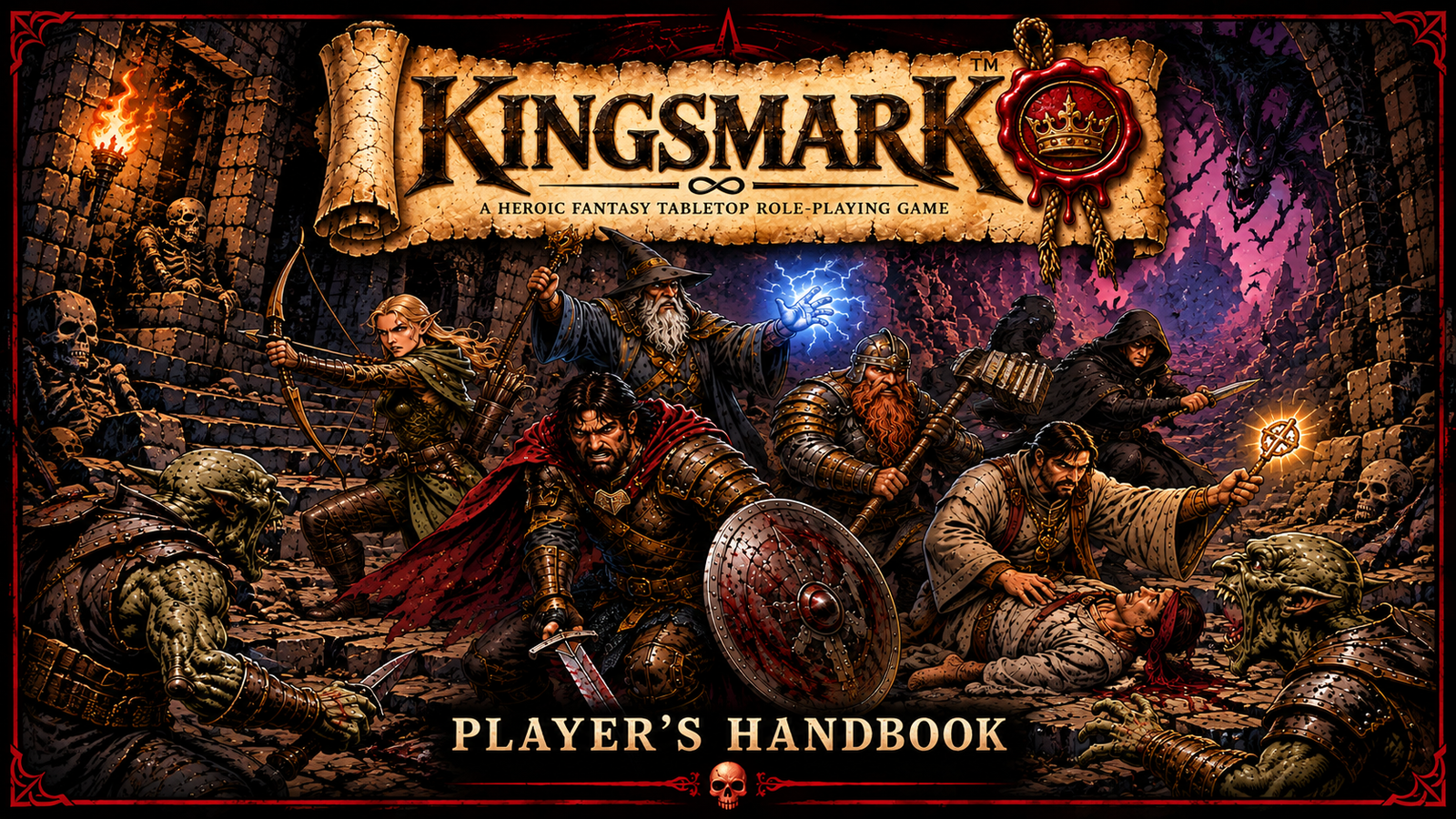
A Heroic Fantasy Tabletop Role-Playing Game for Mature Audiences
Welcome to 👑Kingsmark, a medieval heroic fantasy tabletop role-playing game powered by ⭐Jack’s Cinematic d12 (JCd12). Enter a world of dangerous adventures, desperate battles, ancient magic, sinister cults, supernatural horrors, and hard-won survival. Become a warrior, a Thief, a Wizard, a Ranger, or another extraordinary adventurer whose decisions shape an unfolding story.
Kingsmark brings together cinematic action, detailed character development, challenging encounters, and meaningful consequences. Battles are dangerous, diplomacy matters, magic has a price, and adventurers are more than collections of numbers on a character sheet. Discover the twelve pillars of Kingsmark below, each introducing an important part of the game with links to the complete Player’s Handbook chapters, which you can read online for free.
🎲 Jack’s Cinematic d12 — One Die, Endless Possibilities
At the heart of Kingsmark is ⭐Jack’s Cinematic d12, a role-playing system built around the twelve-sided die. When the outcome of an important action is uncertain, a player rolls 1d12 and applies the appropriate character abilities against a Target Number (TN). Many Tests combine a 🌈Attribute PRISM with a relevant ⚒Skill. The mathematics are straightforward, allowing players to concentrate on their characters and the unfolding adventure rather than constantly consulting complicated formulas.
Kingsmark also features exploding dice. Rolling a natural 12 can lead to additional rolls, making extraordinary outcomes possible when the dice cooperate. A Ranger tracking a dangerous creature through the wilderness, a Thief attempting to slip past an alert sentry, and a Wizard employing supernatural knowledge all operate within the same underlying system. The circumstances and abilities differ, but the principles remain consistent.
The foundations of JCd12 are explained in Chapter 1 — 💪Attributes, Chapter 2 — 🌈Attribute PRISMs, and Chapter 3 — ⚒Skills. Together, these chapters explain how character abilities contribute to Tests and how the twelve-sided die resolves uncertain outcomes.
💪 Twelve Attributes, Five PRISMs, and Twenty-Four Skills
Every adventurer is a distinct individual, possessing particular strengths, weaknesses, talents, and limitations. Kingsmark represents these characteristics through twelve 💪Attributes, organized into five 🌈Attribute PRISMs, together with twenty-four ⚒Skills. Your character’s abilities influence everything from physical exertion and perception to social interaction, intellectual challenges, and spiritual matters.
A powerful warrior might possess impressive physical capabilities but struggle with delicate tasks. A scholarly magician might understand obscure supernatural phenomena while lacking the strength or stamina to endure prolonged physical hardship. A resourceful adventurer might compensate for personal limitations through training, preparation, and cooperation. These differences help establish each character’s identity and influence how they approach the challenges of adventuring.
The five 🌈Attribute PRISMs organize related Attributes into useful measurements of character performance, while ⚒Skills represent more specialized knowledge and capabilities. This combination allows characters to develop recognizable identities beyond their chosen Character Class. The twelve Attributes also provide one of Kingsmark’s defining connections to its namesake die: twelve fundamental characteristics and twelve faces upon which so many adventures depend.
Readers interested in developing their characters’ capabilities can explore the individual characteristics in Chapter 1 — 💪Attributes, learn how related abilities are organized in Chapter 2 — 🌈Attribute PRISMs, and examine the specialized capabilities available through Chapter 3 — ⚒Skills.
🎭 Seventeen Character Classes — Choose Your Calling
Kingsmark offers seventeen 🎭Character Classes, representing a wide variety of heroic, dangerous, mysterious, and sometimes unconventional professions. Take up arms as a Man-at-Arms, become a Brute, Barbarian, or Monster Hunter, or explore the wilderness as a Ranger or Beast Master. Rely on subtlety and specialized training as a Thief or Ninja, or pursue disciplined mastery as a Monk.
Characters drawn toward music, knowledge, and supernatural power may become Minstrels, Wizards, Witches, or Shamans. Others may pursue vocations as Healers, Priests or Priestesses, Prophets or Prophetesses, or Holy Knights. Each Class provides a distinctive foundation for adventuring, but it does not dictate a character’s personality, morality, ambitions, or life story.
A Thief might be a selfish criminal or a resourceful investigator. A Man-at-Arms might serve a kingdom, work as a mercenary, or protect a small community. A Wizard might pursue knowledge for noble reasons or become consumed by dangerous ambitions. Two characters belonging to the same Class may have entirely different motivations, personalities, and approaches to their profession.
Your choices determine who the character becomes. You can explore all seventeen professions, discover their requirements and capabilities, and choose the calling that best suits the adventurer you want to portray in Chapter 9 — 🎭Character Class.
🫀 Five Human Types — Five Different Perspectives
Sylva is inhabited by several Human Types, each presenting different possibilities for character creation and role-playing. Kingsmark features five: Anashim (Ordinary Humans), Tzurim (Dwarves), Elyonim (Elves), Qatan (Little Humans), and Gibborim (Giants). Each possesses distinctive physical characteristics and offers different opportunities for portraying a character within the fantasy world.
The Anashim, ordinary Humans, are familiar in stature and physical characteristics, providing enormous freedom for portraying different personalities, occupations, cultures, and ambitions. The Tzurim, or Dwarves, are smaller, sturdier peoples whose physical characteristics and limitations distinguish them from ordinary Humans. The Elyonim, or Elves, possess long histories, cultures, and distinctive characteristics that offer opportunities for characters with unusual perspectives on the world.
The Qatan, or Little Humans, are small-statured people who must navigate a world where ordinary equipment, architecture, animals, and physical obstacles can present substantially different challenges. The Gibborim, or Giants, are exceptionally large Humans whose size and capabilities influence their interactions with the world around them. Human Type affects important aspects of character creation, including physical limitations and other characteristics described in the rules.
However, Human Type is not personality. Not every Dwarf needs to be a miner, not every Elf needs to be an archer, not every Giant needs to be a warrior, and not every Qatan needs to be a Thief. Kingsmark encourages players to create individuals rather than stereotypes, allowing Human Type to influence a character’s experiences without defining every aspect of their identity. All five peoples and their characteristics are explained in Chapter 8 — 🫀Human Type.
✍ Character Creation — Build Someone Worth Remembering
A memorable adventurer is more than a collection of abilities and equipment. Who are they? Where did they come from? What do they fear, whom do they love, and what do they hope to accomplish? What might they sacrifice to achieve their ambitions? Kingsmark encourages players to consider these questions while developing characters who have meaningful reasons to participate in adventures.
The game provides six steps of ✍Character Creation, guiding players through the process of developing an adventurer who is mechanically complete and personally interesting. You’ll select your Human Type and Character Class, establish your abilities and Skills, make relevant character choices, determine starting resources, and develop your character’s identity and history. The process brings together the information recorded in your 📖Character Bible, Kingsmark’s character record.
A good character should provide the Game Master with opportunities to create interesting adventures. An estranged family member, an unpaid debt, a mysterious discovery, a personal enemy, or an ambitious life goal might eventually become central to an entire campaign. You can create a character with an elaborate history or begin with a simple concept and discover their personality through play.
If you would rather start adventuring immediately, Kingsmark also provides four ready-made Player Characters in 📎 Appendix C — Characters. When you’re ready to create your own adventurer, Chapter 17 — ✍Character Creation provides the complete procedures for bringing that character to life.
▶️ Cinematic Action — More Than One Hundred Possibilities
Combat should be exciting because of the decisions players make, not merely because they roll high numbers. Kingsmark uses Action Points (AP) to represent how much a character can accomplish during a Turn, with different Actions requiring different expenditures of time and effort. The game includes approximately 108 example Actions, covering an extensive range of activities for combat and other action-oriented situations. Characters can move, attack, defend, maneuver, assist their allies, and employ numerous specialized techniques.
Imagine confronting a powerful enemy inside a ruined fortress. Your companion is wounded, the enemy controls the narrow passage leading to safety, and another adventurer is attempting to reach a more advantageous position. Do you attack immediately, attempt to help your injured companion, change your position, or defend against the enemy’s next strike? Perhaps you attempt something unexpected that could change the circumstances of the encounter entirely.
Kingsmark provides mechanical structure for resolving such situations while allowing players to propose actions beyond those specifically described in the book. The Game Master interprets unfamiliar actions according to the game’s established principles, allowing creativity without abandoning consistency. The result is a system intended to reward tactical thinking, teamwork, improvisation, and dramatic decision-making.
The procedures governing Action Points, Turns, and other action-oriented mechanics are explained in Chapter 11 — ▶️Action Scenes. Players and Game Masters can also consult Chapter 12 — 🎬Example Actions and the extensive reference material in 📎 Appendix A — Actions to explore the possibilities available during play.
💥 Damage, Defense, and the Consequences of Violence
In Kingsmark, surviving a battle does not necessarily mean emerging unharmed. ⭐Jack’s Cinematic d12 does not use conventional hit points. Instead, characters suffer specific 🩸Physical Wounds representing the injuries they experience. A violent encounter can produce consequences that remain relevant after the immediate danger has passed, making decisions about combat, defense, and survival especially important.
The game also tracks 🧠Mental Trauma, representing the psychological harm associated with terrifying experiences, violence, supernatural horrors, and other traumatic events. These systems make combat a matter of risk rather than merely an exercise in reducing an opponent’s numerical reserves. A victorious adventurer might still need medical attention, while a character who survives a horrifying encounter could carry mental consequences into subsequent adventures.
Defensive decisions, protective equipment, medical treatment, and opportunities for recovery therefore matter. Kingsmark also provides dedicated rules for ❤️Healing Scenes, allowing injury and recovery to become meaningful parts of a character’s continuing story. A badly wounded warrior might require an extended period of treatment, while a frightened adventurer may recover through restorative experiences and the support of trusted companions.
This approach gives Game Masters opportunities to create adventures in which danger feels dangerous and survival feels significant. The rules governing attacks, defenses, armor, injuries, and their consequences are presented in Chapter 13 — 💥Damage & Defense, while Chapter 14 — ❤️Healing Scenes explains the procedures for recovering from physical and mental harm.
🗨️ Dialog Scenes — Words Can Change the World
Not every conflict is settled with steel, and not every victory requires violence. Kingsmark recognizes that conversation, negotiation, persuasion, deception, intimidation, and other social interactions can be essential parts of an adventure. A successful negotiation might prevent a dangerous battle, uncover valuable information, establish a new alliance, or change the direction of an entire campaign.
Perhaps an adventuring party seeks employment from a wealthy merchant. The merchant knows more than he admits, and the proposed payment hardly justifies the danger. One character attempts to negotiate better terms, another questions the merchant’s account, and a third watches his reactions, hoping to determine whether he is concealing something important. The encounter could end in a profitable agreement, a dangerous misunderstanding, or the discovery of an entirely different adventure.
Kingsmark addresses these interactions through 🗨️Dialog Scenes. The Players decide what their characters say and attempt to accomplish, while the Game Master portrays the other participants and adjudicates the encounter. Characters’ abilities matter, but so do circumstances, motivations, relationships, and decisions.
You don’t need professional acting experience to participate. You can speak directly as your character, describe the general substance of their words, or combine both methods. A memorable conversation can be every bit as exciting as a dangerous battle, especially when the participants have competing interests and the outcome matters to the developing story. The rules governing these interactions are presented in Chapter 10 — 🗨️Dialog Scenes.
📜 Magic — Twenty-Four Schools, 219 Spells
Magic transforms the possibilities of fantasy adventure. Kingsmark features twenty-four Schools of Magic and a complete collection of 219 Spells, presented in the companion volume 📜The Spellbook. Magical characters can employ supernatural abilities for a wide variety of purposes, including confronting enemies, influencing their surroundings, protecting companions, exploring mysteries, and recovering from injuries. Different Character Classes approach magic through different abilities, traditions, and forms of supernatural practice.
However, magical power carries consequences. Kingsmark’s 📜Magic System includes different levels of Power and the possibility of 🧠Mental Drain, making the use of extraordinary abilities a decision with meaningful risks. Characters must consider not only what they hope to accomplish through magic, but also the consequences of attempting to exercise supernatural power.
The world also contains darker supernatural forces. 🪱The Gloom represents a profound danger within Kingsmark’s supernatural setting, introducing themes of temptation, forbidden power, and the consequences of choices. Characters who pursue dangerous supernatural practices may discover that the benefits of forbidden magic carry a terrible price.
The Player’s Handbook provides the magic rules and selected complete Spells needed to begin playing, while the separate 📜Spellbook expands those resources into the full system. A new player need only understand the magic relevant to their chosen character, exploring the remaining Schools and Spells as curiosity and experience develop. Readers can study the underlying mechanics in Chapter 15 — 📜Magic System and learn about forbidden supernatural influences in Chapter 16 — 🪱The Gloom.
10. ⭐ Experience and Advancement — Become an Action Star
Adventurers are shaped by their experiences. Kingsmark uses ⭐Experience Points and ⭐Action Star Levels to represent advancement as characters survive challenges, develop capabilities, and become more accomplished individuals. The game features Action Star Levels from 0 through 5, emphasizing meaningful development within a comparatively restrained progression system. Characters do not need to advance through dozens of increasingly inflated levels to become remarkable.
Instead, their abilities, accomplishments, reputations, and personal histories develop through continuing adventures. A beginning adventurer might be inexperienced, uncertain, and poorly equipped. Over time, that same person could become a respected warrior, an accomplished explorer, a formidable magician, or another figure whose actions influence the world around them.
Yet experience does not remove every danger. An accomplished adventurer can still make disastrous decisions, suffer serious injuries, or encounter threats beyond their abilities. Advancement should expand what characters are capable of accomplishing without making every ordinary danger irrelevant, preserving both the excitement of achievement and the consequences of poor decisions.
The procedures governing character experience and the accumulation of XP are explained in Chapter 4 — ⭐Experience Points, while Chapter 5 — ⭐Action Star Level explains how characters progress through the game’s six levels of advancement.
💰 Earnings, Equipment, and 🕊Favor
An adventurer’s success isn’t measured by combat ability alone. Money, equipment, resources, reputation, and spiritual matters can all influence the direction of a campaign. Kingsmark includes rules for 💰Earnings, reflecting the material rewards and financial considerations associated with adventuring. Characters may pursue contracts, purchase equipment, acquire supplies, and attempt to improve their circumstances through the risks they take.
A successful expedition might provide enough money to obtain better armor, purchase a mount, replace damaged equipment, or prepare for a more ambitious journey. Such rewards can influence a character’s decisions, particularly when resources are limited and every purchase involves competing priorities. Equipment is more than decoration, since the weapons, armor, and other possessions an adventurer carries can significantly affect their opportunities and capabilities.
However, material wealth is only one consideration. Kingsmark also features 🕊Favor Points, a distinct resource associated with aspects of the game’s spiritual mechanics. The relationship between material ambition, personal convictions, supernatural power, and other character priorities can provide opportunities for meaningful role-playing.
The rules governing spiritual Favor are presented in Chapter 6 — 🕊Favor Points, while Chapter 7 — 💰Earnings explains the financial aspects of adventuring. The Player’s Handbook also contains the equipment and resources necessary to begin playing, including 📎 Appendix E — Equipment. Players seeking a more extensive catalog of weapons, armor, goods, services, and commerce can explore ⚖️The Marketplace, a companion volume dedicated to those subjects.
🍺 Game Mastering — Bring the Adventure to Life
Every Kingsmark adventure needs someone willing to open the door to an imaginary world. That person is the Game Master, who serves as the chief storyteller, portraying the world and its inhabitants, introducing conflicts, presenting dangers, and adjudicating the consequences of the Players’ decisions. The GM establishes the circumstances of an adventure, but the participants determine how their characters respond to the opportunities and challenges they encounter.
Imagine describing a lonely roadside tavern during a violent thunderstorm. A frightened traveler arrives carrying an unfamiliar object, and moments later, armed strangers enter and begin searching the room. The adventurers must decide whether to become involved. Will they protect the traveler, question the newcomers, attempt to avoid trouble, or discover that the situation is considerably more complicated than it first appeared?
The Game Master establishes the situation, but the Players determine how their characters respond. Running a tabletop role-playing game involves storytelling, improvisation, preparation, and an understanding of the rules. These abilities develop through experience, and nobody needs to begin as an expert. The most important part of Game Mastering is providing an engaging world in which the Players’ decisions have meaningful consequences.
Kingsmark’s Player’s Handbook contains the foundation for creating characters and running adventures. It also provides ready-made Player Characters in 📎 Appendix C — Characters and an introductory adventure in 📎 Appendix D — Dungeon, allowing new Game Masters to practice the mechanics with prepared material.
The 🕯Introduction explains the basic structure of the game, while 🍺Adventurers’ Tavern introduces the experience of playing Kingsmark. The companion volume 🍺The Tavern expands the Game Master’s resources with material devoted to designing and running adventures, dungeons, contracts, and campaigns. Whether you’re preparing your first session or you’ve been running tabletop games for decades, Kingsmark provides a system through which you can bring your own adventures to life.
👑 Your Adventure Begins Here
You now know the twelve major features that help define Kingsmark, but reading about a tabletop role-playing game is only the beginning. The real experience happens when adventurers gather, the Game Master introduces a situation, and the Players begin making decisions. You might become the hero of a kingdom, the discoverer of a lost civilization, the survivor of a terrifying supernatural encounter, or simply a wandering adventurer trying to earn enough money to survive another winter.
Your character’s future will depend upon the decisions you make, the companions you trust, the risks you accept, and the consequences of your actions. Each adventure presents opportunities for achievement, failure, sacrifice, discovery, and personal development. The world provides the setting and the Game Master introduces the challenges, but the Players determine how their characters confront them.
If you’re interested in exploring the possibilities, begin by discovering the seventeen professions in Chapter 9 — 🎭Character Class and the five Human Types in Chapter 8 — 🫀Human Type. When you’re ready to create an original adventurer, follow the six steps presented in Chapter 17 — ✍Character Creation.
You can also begin playing immediately with the four ready-made adventurers in 📎 Appendix C — Characters and the introductory adventure in 📎 Appendix D — Dungeon. The entire Player’s Handbook is available online for free, allowing you to study the rules chapter by chapter. Readers who prefer a complete downloadable edition can also purchase the professionally formatted, 556-page 👑Kingsmark Player’s Handbook PDF, containing everything needed to begin playing.
Welcome to the world of Sylva. Your story is waiting.