All player character tests in Kingsmark use a 1d12 dice roll plus the character’s appropriate 💪Attribute, 🌈Attribute PRISM, or 🌈Attribute PRISM + ⚒Skill, or 🌈Attribute PRISM + ⚒Skill + 💪Attribute. When an action depends primarily upon a single natural ability, the Game Master may call for an appropriate 💪Attribute Test. When an action draws upon several related abilities but does not require specialized training, the Game Master may call for an appropriate 🌈Attribute PRISM Test. When properly performing the action ordinarily requires training, practice, or specialized knowledge, the Game Master calls for a ⚒Skill Test using the Skill associated with the appropriate 🌈Attribute PRISM. A character with a Skill Rating of 0 has no meaningful training in that Skill, but this does not necessarily prevent the character from attempting an action associated with it. If an untrained person could reasonably attempt the task, the character rolls 1d12 + the Skill’s associated 🌈Attribute PRISM against a Realism Target Number determined by the Game Master. The character simply receives no Skill modifier. Some actions, however, require specialized knowledge or techniques that an untrained person could not reasonably possess; in those circumstances, the Game Master may determine that the action cannot be attempted without the appropriate Skill or some other believable source of knowledge.
UNSKILLED CHARACTER SKILL TEST
1d12 + Attribute PRISM
against Realism Target Number 7–12+
A high Target Number does not make impossible knowledge possible. If an action requires specialized knowledge or techniques the character does not possess, the Game Master may rule that the action cannot be attempted without the appropriate Skill or another believable source of knowledge, regardless of the character’s ability to roll an Exploding Die.
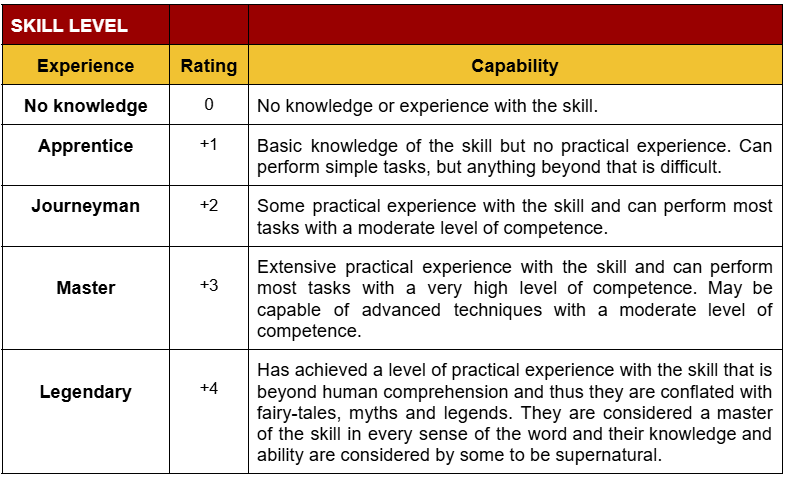
Characters have a variety of skills that they can learn and improve throughout their adventures. Each ⚒Skill is associated with an 🌈Attribute PRISM, which determines a character’s natural aptitude for that ⚒Skill. A character’s proficiency in a ⚒Skill normally ranges from 0 to +4. A rating of 0 represents no meaningful training in the Skill, while +4 represents the highest degree of mastery normally attainable. A character with Skill 0 may still attempt many actions associated with that Skill using only the corresponding 🌈Attribute PRISM, provided the action does not require knowledge or techniques that an untrained person could not reasonably possess. As characters increase their skill ratings by investing ⭐Experience Points, they become more capable and efficient, allowing them to overcome greater challenges and accomplish feats that were once impossible. While the 🌈Attribute PRISM quantifies the mental, physical and spiritual characteristics that are typically involved in doing an action, possessing actual knowledge of how to properly perform the action is a considerable bonus. Kingsmark primarily relies on the following formula to determine the success or failure of an action:
SKILL TEST
1d12 + Attribute PRISM + Skill
against a Realism Target Number determined by the Game Master
Target Numbers
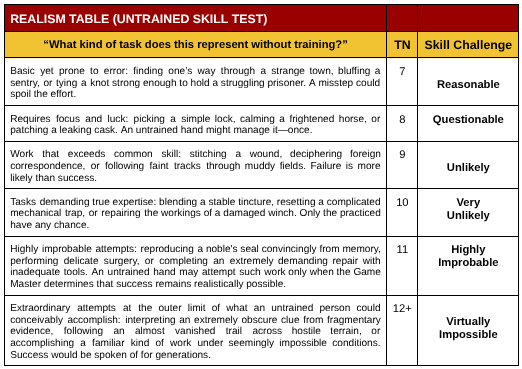
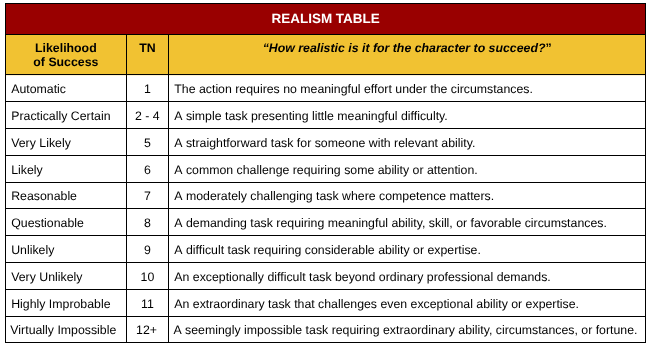
Player characters aim toward a Realism Target Number—often simply called the Target Number (TN)—whenever they make a Test. The TN is the number the character’s final result must meet or exceed for the Test to succeed. Most beginning characters will make important Skill Tests with an Attribute PRISM of approximately +1 or +2 and a Skill Rating of approximately +1 or +2. A TN of 8 (Questionable) therefore represents a useful benchmark for an action in which competence matters but failure remains a serious possibility. The question is rarely whether a trained rider can simply sit upon a horse; it is whether he can control a frightened mount while racing down a rain-soaked road with armed pursuers close behind.
The Realism Table gives guidance on what different TNs mean. At the lowest end, TN 1 is “Automatic.” If the character wants to open a door that isn’t locked, they don’t roll dice at all. TN 2–4 (“Practically Certain”) covers actions that only fail through distraction or stress. Riding a horse for a mile on a calm day might be TN 4, but the GM usually won’t even ask for a roll unless it happens during a chase scene or with arrows whizzing overhead. TN 5–6 represent things that are “Very Likely” or simply “Likely” for capable characters. A trained fighter landing a clean punch on an unskilled opponent might be TN 5. Scaling a wall in broad daylight while no one is chasing you could be TN 6.
At TN 7, the action has moved into Reasonable territory: a moderately challenging task where competence matters. TN 8 (Questionable) represents a demanding task requiring meaningful ability, Skill, or favorable circumstances. TN 9 (Unlikely) represents a difficult task requiring considerable ability or expertise. Darkness, time pressure, poor tools, hostile opposition, injury, and other complications can raise an otherwise manageable action into these higher levels of difficulty. TN 10 (Very Unlikely) represents an exceptionally difficult task beyond ordinary professional demands, while TN 11 (Highly Improbable) represents an extraordinary task that challenges even exceptional ability or expertise. TN 12+ (Virtually Impossible) represents a seemingly impossible task requiring extraordinary ability, circumstances, or fortune.
By using the Realism Target Number, the system keeps rolls fast and easy to adjudicate. Players quickly understand the scale: TN 4–6 represents routine challenges in stressful play, TN 7–9 represents serious but achievable challenges, TN 10–11 represents extraordinary difficulty, and TN 12+ is the realm of legends. This approach also ensures that the dice stay meaningful: the TN tells you not just what to roll, but how incredible your character will look if they succeed.
🎬Example — Determining Realism
Consider a tense moment inside a half-collapsed stone chapel. Rain leaks through the broken roof, dripping steadily onto shattered pews and scattered rubble. A hostile man moves between the pillars, partially obscured by shadow and hanging cloth banners. He is armed with a sword and knows he is being hunted. Marcus, a Man-at-Arms, advances carefully with his bow ready. When the enemy suddenly bolts from cover, Marcus draws and releases an arrow. The GM pauses to assess realism. The target is moving, the light is poor, and pillars, banners, and debris interfere with the shot. Under ideal conditions, hitting a clear, stationary target at this distance might be TN 6 (Likely). Given the circumstances, the GM judges the shot to be TN 9 (Unlikely).
Impossible Target Numbers
The Target Number (TN) represents the difficulty of an action. Most uncertain actions fall somewhere on the Realism Table, but circumstances can sometimes push a Target Number beyond 12. When the task before a character is so daunting that an ordinary d12 result cannot succeed, Kingsmark handles the possibility through Exploding Dice. When a player rolls a 12, the die explodes—meaning that the player rolls again and adds the new result to the first. This can push the result beyond the normal limit of the die, allowing a character to succeed against Target Numbers greater than 12.
If a player rolls two 12s in succession, it is deemed Divine Intervention: something wondrous—and unmistakably authored by God—occurs. Arrows find their mark through storm and smoke, an enemy changes his allegiance, or a sword shatters chains meant to hold an innocent. If, by the rarest stroke of fortune, a player rolls three 12s in a row, not only does a Divine Intervention event occur, but all of the character’s non-permanent Physical and Mental Trauma is immediately healed. In such moments, even the hardened unbeliever can only stare in disbelief—while the faithful know Heaven itself has briefly touched the battlefield.
Rolling 1
When a player rolls a 1 on a d12, the result is an Epic Fail—a moment when fate, misjudgment, or sheer bad luck turns dramatically against the character. This isn’t just a miss or mistake; it’s a turning point that complicates the story in meaningful ways. An Epic Fail should never feel random or cruel, but it should matter. The world responds harshly, the dice speak with weight, and the table remembers the outcome. The consequences of rolling a 1 depend upon what is actually at stake in the Scene, not simply upon the Target Number. A difficult action may have relatively minor consequences for failure, while a more ordinary action performed in a desperate situation may have disastrous consequences. An Epic Fail might result in a dropped tool, a broken weapon, a wounded ally, lost evidence, an unintended alarm, exposure, or some other consequence appropriate to what the character was attempting. Handled well, an Epic Fail becomes a moment of legend—a scar the players will never forget.
Guidelines for the Game Master:
- Keep It Plausible. The failure should make sense within the fiction. Ask yourself, “What’s the most believable way this could go wrong?”
- Match the Tone. Epic Fails should reflect the grim and dramatic tone of the world—harsh, but never slapstick.
- Match the Consequence to the Stakes. A high Target Number indicates that an action is difficult; it does not automatically mean that failure should harm more people. The consequences of an Epic Fail should arise from what is actually at stake in the Scene. A failed attempt to disarm a trapped doorway might endanger the entire party standing nearby, while an equally difficult attempt to pick a tiny lock might affect only the character attempting it.
- Turn Pain Into Story. Use failure to deepen tension or character development. A failure that tests faith, courage, or loyalty is far more memorable than one that merely inflicts damage.
But where do we begin? The Base Target Number represents the difficulty of an action under neutral, controlled, and reasonable conditions—before stress, danger, environmental factors, or narrative pressure are applied. It answers a simple question: What would this task require if nothing were actively working for or against the character? In practice, the Base TN is the GM’s starting point, usually set at TN 4, which represents an action that is practically certain for a capable person acting calmly and without interference.
Base Target Number
Using a Base Target Number provides a more disciplined and transparent method of determining difficulty. Rather than inventing a final TN from scratch, the GM begins at TN 4 and then layers modifiers based on realism: time pressure, visibility, weather, opposition, fatigue, wounds, equipment quality, social tension, Gloom influence, and so on. Throughout this book are tables of modifiers that exist specifically to adjust the Base TN upward or downward in a consistent way. The final Target Number is therefore not arbitrary—it is the sum of concrete fictional factors acting upon an otherwise manageable task.
This approach reinforces the grounded tone of Kingsmark. Most actions are not heroic by default; they become heroic because circumstances make them dangerous, desperate, or uncertain. A calm shot at a stationary target may remain close to the Base TN. The same shot, taken while wounded, under fire, in darkness, during a storm, rapidly escalates into TN 8, 9, or beyond. The Base Target Number keeps the system honest: difficulty emerges from the world, not from whim.
Advantage & Disadvantage
Advantage and Disadvantage represent situational factors that make an action meaningfully easier or harder by directly modifying the Target Number. Advantage reduces the TN, while Disadvantage increases it. These modifiers usually range from ±1 to ±3, with values beyond that (±4 or more) reserved for truly extreme conditions. Unlike bonuses to the roll itself, TN modifiers change the nature of the challenge, not the character’s competence.
Advantage (-1, -2, -3, etc.) reflects leverage: superior positioning, preparation, surprise, excellent tools, favorable terrain, clear information, or moral authority. An archer firing from concealment, a negotiator armed with damning evidence, or a scout moving through familiar terrain may all gain Advantage. Disadvantage (+1, +2, +3, etc.) represents friction: darkness, chaos, injury, fear, hostile crowds, poor footing, time pressure, or conflicting goals. A wounded character sprinting uphill in the rain while pursued is operating under clear Disadvantage.
Multiple sources of Advantage or Disadvantage can stack, but the GM should always pause to ask whether they represent genuinely different pressures. The goal is not to bury the roll under math, but to express the fiction cleanly. In extreme cases, overwhelming Advantage may reduce a TN to the point where no roll is required, while overwhelming Disadvantage may push a TN beyond 12, forcing reliance on Exploding Dice and fate itself. Used properly, Advantage and Disadvantage keep the focus where it belongs: on the situation, the choices made, and the cost of acting in a harsh and unforgiving world.
Defender’s Hindrance = Attacker’s Advantage
When a defender’s physical circumstances make it unusually difficult to move, parry, duck, lean, turn, or otherwise defend against an attack, the attacker gains Advantage. This Advantage reduces the attacker’s Target Number. Use the following table when no more specific rule already determines the modifier.
0 Advantage — Normal Defense: The defender has no unusual restriction upon movement or defense. The defender can normally move, parry, duck, lean, turn, or otherwise defend. Merely standing in the open without cover does not make the defender unusually easy to hit.
−1 Advantage — Slightly Hindered: The defender has a minor but meaningful restriction upon defensive movement. Examples include one foot caught in a bear trap while the defender can still pivot on the other leg; standing ankle-deep in thick mud; or being pressed against a wall with somewhat restricted lateral movement.
−2 Advantage — Substantially Hindered: The defender’s ability to move defensively is substantially restricted. Examples include both feet stuck in deep quicksand or heavy mud; one leg firmly trapped while the defender must remain standing; or fighting inside a small space that substantially restricts normal defensive movement.
−3 Advantage — Severely Hindered: The defender has very little freedom of defensive movement but can still deliberately defend. Examples include both legs being immobilized while the upper body remains free; being wedged tightly between obstacles; or being entangled or pinned in a position permitting only limited upper-body defense.
−4 Advantage — Almost Unable to Defend: The defender is substantially immobilized but retains enough movement to make a limited deliberate defense. Examples include the body being immobilized except for limited movement of the arms or torso; being tightly entangled; or being trapped waist-deep in a rigid opening. If the defender cannot make a deliberate defense at all, do not use −4 Advantage; use the rules for attacking a defender who cannot make a Defense Roll.
Small Space: A small space is a narrow, low, crowded, or confined area that substantially prevents the normal defensive movement appropriate to the attack. Examples include a narrow crawlspace, packed closet, cramped tunnel, or space between closely placed obstacles. Merely being indoors or standing in a small room does not qualify unless the available space actually restricts movement.
Apply Defender’s Hindrance only when the physical restriction logically affects defense against the particular attack. Do not grant Attacker’s Advantage merely because the defender lacks cover; no cover is a normal +0 condition. For ranged attacks, determine separately whether the hindrance makes the target easier to hit, impairs the defender’s subsequent Defense Test, or genuinely does both. Do not automatically apply the same condition twice. Do not stack Defender’s Disadvantage with another modifier representing the same physical restriction. When a more specific rule establishes the modifier for a condition, use the more specific rule.
These modifiers represent the defender’s reduced ability to defend and therefore apply only when the hindrance logically affects the particular attack. A trapped foot may provide Advantage to a nearby swordsman because the defender cannot maneuver normally, but it does not necessarily provide the same Advantage to a distant archer merely because the defender cannot move his feet. The Game Master should consider how the particular hindrance affects the particular attack.
Likewise, confinement may affect different actions differently. A cramped space that prevents a defender from stepping away from a sword thrust may grant the attacker Advantage, while that same cramped space might impose separate Disadvantage upon the defender when he attempts to swing a large weapon. Apply the actual physical circumstances rather than assuming that one modifier affects every action equally.
For ranged attacks, distinguish between making the target easier to hit and making the target less capable of actively defending after the shot is made. A physical hindrance may affect the attacker’s Target Number, the defender’s subsequent Defense Test, or both when the circumstances genuinely interfere with both. Do not automatically apply the same modifier twice merely because the same condition is involved. Do not apply this table in addition to another modifier representing the same physical hindrance. If a more specific rule already determines the Advantage or Disadvantage created by the condition, use the more specific rule instead.
Advantage & Disadvantage in Opposed Tests
During an Opposed Test, one character’s result establishes another character’s Base Target Number. Apply the acting character’s Advantage and Disadvantage to that Base Target Number after the opposing result is known. Advantage reduces the number the acting character must meet; Disadvantage increases it. Never add Advantage to the die roll or subtract Disadvantage from the die roll.
When both characters are attempting actions against one another, calculate each character’s Target Number separately. For example, Aric and Bren exchange melee attacks. Aric rolls 9 and Bren rolls 8. Aric has +1 Pain, so Aric must meet TN 9: Bren’s result of 8 plus 1 Pain. Aric’s result of 9 succeeds. Bren has no Pain or Distress and would need to meet Aric’s result of 9. Bren’s result of 8 fails. If Bren had +2 Pain, Bren’s own Target Number would become 11, but Aric’s Target Number would remain 9. Each character’s condition makes that character’s own action harder; it does not alter the number appearing on either die.
When only one character is attempting to influence, attack, restrain, or otherwise act upon another, calculate only the acting character’s final Target Number unless the rule gives the resisting character a separate Defense Test. Any Pain, Distress, Advantage, or Disadvantage affecting that later Defense Test is applied to the defender’s Target Number normally.
Advantage Belonging to an Opponent
Advantage always represents a circumstance that helps a character, while Disadvantage represents a circumstance that hinders a character. When one character is acting directly against another, an opponent’s Advantage therefore functions as Disadvantage for the acting character, while an opponent’s Disadvantage functions as Advantage for the acting character. For example, if an attacker shoots at a defender who has 2 points of Advantage from good cover, that cover creates 2 points of Disadvantage for the attacker and raises the attacker’s Target Number by 2. If the defender instead suffers 1 point of Disadvantage because he is exposed and unable to move effectively, the attacker gains the corresponding 1 point of Advantage and reduces his Target Number by 1.
Do not reverse the meanings of Advantage and Disadvantage. Advantage always helps the character who possesses itr; Disadvantage always hinders that character. When necessary, simply translate the opponent’s favorable or unfavorable circumstances onto the acting character before calculating the final Target Number.
🎬Example — Advantage & Disadvantage
June aims her bow at the target. The GM declares, “Your Base Target Number is 4, and the target is close range (+0 Disadvantage) but the target is moving (+2 Disadvantage) and the rain is reducing visibility (+1 Disadvantage). However, you are braced and calm, because you used two Action Points to aim (–1 Advantage). That brings the final Target Number to 6 (Likely). Go ahead and roll your 1d12 + Reflexes PRISM + Archery.”
⚒️24 Skills
Kingsmark uses 24 broad ⚒️Skills rather than an exhaustive list for every activity. Skills represent training and experience important enough to improve a character’s chances of surviving danger and achieving objectives. A party with complementary skills can travel faster, avoid danger, uncover secrets, reach difficult places, survive hostile environments, and solve problems without brute force. Every ⚒️Skill is associated with a 🌈Attribute PRISM, representing the related 💪Attributes most important to that Skill.
🌈 Physical Performance PRISM
Armed Combat – Covers fighting with handheld melee weapons such as swords, axes, spears, maces, clubs, knives, and staffs. It is used to attack and defend when appropriately armed. Armed Combat reflects reach, timing, footwork, weapon control, parrying, and exploiting openings in close combat.
Unarmed Combat – Handles fighting without weapons, including punches, kicks, grappling, wrestling, throws, and holds. It is used offensively and defensively when relying primarily upon the body. It is especially valuable when disarmed, captured, fighting in confined quarters, or trying to subdue someone without lethal force.
Infantry Athletics – Measures practical physical movement through dangerous environments: running, jumping, climbing, vaulting, balancing, rolling, controlled falls, crossing unstable surfaces, and overcoming obstacles. In combat, it is used to dodge ranged attacks when avoiding the projectile is possible. During travel on foot, it also helps determine travel times and the party’s ability to evade unwanted random encounters.
Swimming – Applies to movement and survival in water, including swimming through currents, diving, remaining afloat while exhausted, holding one’s breath, reaching a drowning companion, and crossing bodies of water without a boat. It becomes vital around flooded passages, shipwrecks, underground waterways, and strong currents.
Man Skills – Reflects practical competence in strenuous trades and physical labor, including carpentry, masonry, mining, blacksmithing, farming, logging, digging, construction, and heavy repairs. It may allow a character to shore up a passage, repair a wagon, reinforce a door, recognize poor workmanship, or improvise useful structures.
🌈 Reflexes PRISM
Shield Combat – Focuses on specialized training in active defense with a shield. When appropriately equipped, a character may use Shield Combat to defend against attacks when circumstances allow. It reflects the timing and coordination needed to intercept blows and missiles, maintain coverage, and bring the shield into position. Simply carrying a shield does not provide the same defensive options.
Archery – Governs the use of bows, crossbows, blowguns, slingshots, and similar aimed projectile weapons in hunting and combat. It includes judging distance, leading moving targets, accounting for the flight of arrows, bolts, and darts, firing accurately under pressure, and maintaining the weapon and ammunition.
Throwing Weapons – Handles weapons propelled directly by hand, including knives, axes, darts, javelins, spears, stones, slings, and similar missiles. It reflects accuracy, timing, distance judgment, and striking moving targets. Such weapons are often easier to carry, conceal, improvise, or recover than bows.
Cloak & Dagger – Encompasses stealth, infiltration, disguise, concealment, covert movement, and escape. It is used to slip past guards, follow someone unnoticed, hide from pursuers, disguise one’s identity, evade surveillance, or enter and leave places unseen. It does not cover picking pockets, locks, or mechanical traps.
Mounts – Covers riding and controlling horses and other mounts, including difficult terrain, frightened animals, mounted combat, pursuit, escape, and difficult maneuvers. When traveling on horseback, Mounts helps determine travel times and the party’s ability to evade unwanted random encounters.
Driver – Applies to animal-drawn vehicles such as carts, wagons, and sledges. It includes controlling draft animals, handling poor roads, sharp turns, steep grades, and preventing overturns. During travel, Driver helps determine travel times and the party’s ability to evade unwanted random encounters.
Seamanship – Deals with boats and sailing vessels, including rowing, sailing, rigging, knots, winds, currents, navigation, and control in dangerous conditions. During water travel, Seamanship helps determine travel times and the party’s ability to evade unwanted random encounters.
Thievery – Concerns manual deception and illicit dexterity, including picking pockets, cutting purses, palming or planting objects, sleight of hand, concealing small items, and cheating through physical manipulation. It does not cover stealth or disguise, which belong to Cloak & Dagger, or locks and mechanical traps, which belong to Mechanisms.
Mechanisms – Covers understanding and manipulating practical mechanical devices. It includes locks and the construction, manipulation, and disarming of mechanical traps, along with winches, pulleys, counterweights, lifts, cranes, drawbridges, portcullises, mills, mechanical doors, and siege mechanisms. Unlike Thievery, it concerns understanding and controlling the device itself.
🌈 Influence & Allure PRISM
Social Skills – Encompasses understanding and influencing people or animals through social interaction. It includes persuasion, negotiation, diplomacy, leadership, seduction, interrogation, bargaining, etiquette, reading dispositions, calming fear or hostility, and gaining cooperation. With animals, it may calm, approach, handle, or gain trust within realistic limits. Mounts governs riding and controlling mounts. Social Skills does not cover deliberate lying, which belongs to Deceit.
Deceit – Measures a character’s ability to create, maintain, recognize, and penetrate deliberate deception. It includes lying, bluffing, misdirection, false identities, feigned emotions, cover stories, concealed motives, and recognizing similar deception in others.
Underworld – Describes practical knowledge of criminal society and how to move through it without attracting the wrong attention. It covers the customs, reputations, hierarchies, contacts, signs, and unwritten rules of thieves, smugglers, fences, pirates, bandits, illicit merchants, and other criminals. It can help locate stolen-goods buyers, identify criminal authority, obtain forbidden goods or information, or conduct illicit business safely.
🌈 Spirituality PRISM
Spiritual Practices – Reflects practical mastery of the character’s own religious, spiritual, or magical tradition. It includes that tradition’s teachings, rituals, prayers, ceremonies, supernatural practices, symbols, prohibitions, and methods. When a character can cast spells through that tradition, Spiritual Practices also governs that spellcasting. Mastery of one’s own path does not imply broad knowledge of unfamiliar traditions.
Occult Knowledge – Covers knowledge of strange, supernatural, magical, and forbidden phenomena beyond the character’s own traditions. It includes curses, hauntings, supernatural creatures, magical artifacts, occult symbols, unfamiliar rituals, forbidden practices, otherworldly phenomena, and related legends. It may reveal what happened at a desecrated shrine, identify an unnatural creature, explain a strange symbol, or expose a supernatural cause behind an apparently mundane problem.
🌈 Mental Performance PRISM
Scholarship – Encompasses formal learning in subjects preserved through books, manuscripts, instruction, and learned tradition. It includes history, languages, literature, law, philosophy, mathematics, geography, politics, cultures, heraldry, genealogy, and similar subjects. Scholarship can identify inscriptions, noble arms, legal customs, maps, historical facts, foreign artifacts, archaic language, unfamiliar customs, and other scholarly clues.
Medicine – Covers treatment of wounds, injuries, diseases, poisoning, and other physical ailments using the medical knowledge of the world of Kingsmark. It includes stopping bleeding, dressing wounds, setting bones, treating burns, recognizing symptoms, caring for the sick, performing period-appropriate surgery, and judging whether someone can continue traveling. Medicine can also identify causes of death, poisoning, disease, unusual injuries, and needed care.
Survival – Deals with staying alive and functional away from settlements. It includes tracking, hunting, trapping, fishing, foraging, camping, fire-making, shelter construction, finding water, land navigation, natural hazards, weather, terrain, and animal signs. Survival can prevent a party from becoming lost, hungry, exposed, or needlessly vulnerable while revealing tracks, campsites, disturbed vegetation, and other wilderness evidence.
Alchemy – Focuses on identifying, preparing, refining, and using unusual substances and compounds. It includes herbs, minerals, reagents, poisons, antidotes, acids, solvents, dyes, medicines, incendiaries, distillation, fermentation, and related mixtures. Alchemy can identify unknown substances, detect poison, prepare useful compounds, neutralize hazards, exploit rare materials, and determine which mixtures are safe or unstable.
Investigation – Centers on deliberate searches for information and assembling scattered evidence into meaningful conclusions. It includes searching rooms and bodies, finding concealed objects or compartments, examining documents, comparing testimony, studying evidence, reconstructing events, recognizing patterns, and judging which details matter. Investigation is used when an answer must be discovered through careful examination and reasoning. A good investigator does more than notice clues; they determine what those clues imply and what questions should be asked next.
Using Man Skills
Man Skills represent practical competence in the strenuous trades and forms of physical labor upon which life in Sylva depends. The Skill includes carpentry, masonry, mining, blacksmithing, farming, logging, construction, digging, heavy repairs, and similar work requiring a combination of physical strength, endurance, practical experience, and familiarity with tools. It reflects knowing not merely how to work hard, but how to work effectively: where to place a brace, how to judge a load, which tool is appropriate, when a structure is likely to fail, and how to avoid wasting effort. Man Skills is not limited to a particular gender. The name describes the practical, laboring skills by which human beings build, repair, cultivate, excavate, reinforce, and physically reshape the world around them. Any character may possess or develop Man Skills. A farmer, mason, miner, smith, carpenter, laborer, soldier, or adventurer may all rely upon it in different ways.
During an adventure, Man Skills becomes useful whenever practical labor can solve a problem. A character might reinforce a damaged door before an attack, shore up an unstable tunnel, repair the wooden frame of a wagon, construct a barricade, break through masonry without bringing the ceiling down, recognize that a timber bridge is unsafe, improvise a crude shelter before a storm, clear fallen debris, repair damaged fortifications, or determine how much work will be required to open a collapsed passage.
The Skill may also provide useful judgment before the work begins. A character with Man Skills might recognize that a wall is load-bearing, estimate how long a repair will take, identify poor workmanship, determine whether available lumber is strong enough, or realize that brute force would make the situation worse. In such cases, Man Skills is doing more than adding muscle; it represents practical understanding born from labor and experience.
A character attempting such an action normally rolls 1d12 + 🌈Physical Performance PRISM + Man Skills against a Realism Target Number determined by the Game Master. Ordinary labor does not require a roll merely because it involves tools. A competent person cutting firewood, digging a routine trench, or hammering a simple stake into the ground simply does it. A Skill Test becomes appropriate when the work is difficult, dangerous, time-sensitive, unusually demanding, technically awkward, or important to the outcome of the adventure.
Success may mean more than simply finishing the job. It might reduce the time required, prevent structural damage, conserve materials, create a stronger barricade, keep a passage from collapsing, or reveal a safer and more efficient way to solve the problem. Failure should likewise reflect the circumstances: lost time, damaged tools, wasted materials, a weakened structure, or another believable consequence rather than automatic disaster.
COMMON APPLICATIONS
- Construction & Carpentry: Barricades, timber repairs, scaffolding, wooden structures, doors, braces, and supports.
- Masonry & Excavation: Stonework, mining, quarrying, digging, clearing collapses, and recognizing unstable construction.
- Blacksmithing & Heavy Repair: Forging and repairing ordinary metal goods, repairing wagons or agricultural equipment, and performing other demanding work involving iron and tools.
- Agriculture & Practical Labor: Farming, irrigation, harvesting, clearing land, moving heavy materials, and similar work.
- Emergency Work: Fighting fires, reinforcing structures, clearing wreckage, controlling flooding, and performing urgent physical repairs.
Crafting, Alchemy & Item Creation
Characters may sometimes create, repair, alter, or improvise useful objects during play. Kingsmark does not require a separate crafting subsystem for every trade. Crafting uses the same Skill Test rules as any other uncertain action. The player describes what the character is attempting to make, repair, or modify. The Game Master determines whether the task is possible, what tools, materials, workspace, and time it requires, and whether failure matters enough to require a roll. If so, the GM selects the Skill that best represents the work and assigns a Realism Target Number.
Man Skills governs strenuous crafts and construction such as blacksmithing, carpentry, masonry, and heavy repairs. Mechanisms governs locks, traps, lifts, counterweights, drawbridges, winches, pulleys, and other mechanical devices. Alchemy governs compounds, reagents, medicines, poisons, antidotes, acids, incendiaries, dyes, solvents, and similar substances. Medicine may govern treatments whose effectiveness depends mainly upon medical knowledge rather than alchemical manufacture. Proper tools, good materials, adequate time, a suitable workshop, useful plans, or skilled assistance may provide Advantage, reducing the Realism Target Number. Poor materials, improvised tools, limited time, dangerous conditions, unfamiliar construction, or working while wounded or threatened may impose Disadvantage, increasing the Realism Target Number.
Some projects cannot reasonably be completed with one roll. Forging a sword, rebuilding a wagon, constructing an elaborate trap, or producing a difficult alchemical preparation may require hours or days. Larger undertakings may be divided into meaningful stages, each resolved only when failure would matter. The goal is not repeated rolling until success, but allowing time, resources, preparation, and mistakes to matter. Failure should produce fitting consequences. Materials may be wasted, more time may be needed, a repair may prove unreliable, a trap may endanger its maker, an alchemical preparation may spoil, or a missing tool or ingredient may become apparent. Dangerous work may also cause injury or another immediate hazard.
Rare materials can become adventure goals. An alchemical preparation might require a mineral found only in a dangerous cavern, venom from an unusual creature, or an herb growing in a remote marsh. Restoring an ancient mechanism may require a missing component or lost plans from the ruins where it was built. Crafting can therefore create objectives and choices rather than becoming an isolated minigame. As a general rule, the Game Master should ask three questions: Can the character reasonably make or repair this? What does the attempt require? What happens if it fails? Once those questions are answered, the ordinary Skill Test rules handle the rest.
Understanding Languages
Languages are not individual Skills and do not have Skill Ratings. A character records the languages they know as part of their background. A character who knows a language can ordinarily speak and understand it without making a Skill Test. If the character is literate in that language, they can likewise read and write its ordinary forms without rolling. The languages spoken throughout Sylva belong to its peoples, kingdoms, cultures, and history. Some languages are widespread across large regions, while others may belong primarily to a particular kingdom, people, religious tradition, scholarly community, or isolated population. Related languages may share words or forms while remaining sufficiently different that knowing one does not automatically grant fluency in another.
A character’s background determines which languages they reasonably know. Someone raised among speakers of two languages may know both. A merchant who has spent years trading across a border may have learned the language of his customers. A scholar, priest, diplomat, sailor, traveler, or former prisoner might have acquired additional languages through education or experience.
The Game Master should allow languages that reasonably follow from the character’s history rather than requiring characters to purchase separate linguistic Skills. All languages in the fictional world of Sylva are real languages spoken by Earthlings, except languages spoken by evil creatures. The ancient civilizations of Elves, Dwarves, and Qatan preserve several historical languages as living tongues, including languages that Earthlings now consider ancient or extinct. Players who wish to do so can therefore actually study their Hero’s language and incorporate real words, phrases, or even entire conversations into play.
Knowing a language does not mean understanding every form it has ever taken. Ancient manuscripts, obsolete vocabulary, unusual dialects, damaged inscriptions, specialized religious terminology, legal documents, coded writing, or texts written centuries earlier may require knowledge beyond ordinary fluency. When such knowledge is important and the outcome is uncertain, the Game Master may call for a Scholarship Test:
1d12 + 🌈Mental Performance PRISM + Scholarship
against a Realism Target Number determined by the Game Master
The Game Master should consider what the character already knows before setting the Target Number. A character fluent in the language may recognize most of an archaic document but struggle with several obsolete expressions. A scholar who has studied the history of the region may recognize those expressions immediately. Someone who does not know the language at all may be unable to translate it without a dictionary, teacher, related language, magical assistance, or some other believable source of information.
Language should create opportunities for communication, investigation, diplomacy, deception, and discovery without turning ordinary conversation into a succession of dice rolls. If a character knows the language and ordinary communication is all that is required, no roll is necessary.
DECIPHERING DIFFICULT LANGUAGE
- Ordinary Use: No roll required when the character knows the language.
- Unfamiliar Dialect or Specialized Vocabulary: The Game Master may call for a Scholarship Test when misunderstanding would matter.
- Archaic or Damaged Text: A Scholarship Test may be required to reconstruct obsolete, incomplete, or difficult wording.
- Ancient or Extremely Obscure Language: Understanding the text may require specialized knowledge, reference materials, another speaker, magical assistance, or some other believable source of information before a test is even possible.
The Realism Target Number is determined normally according to the difficulty of the particular task.
🎬Example — Understanding Archaic Languages
Karolyn’s background establishes that she grew up in a coastal city and speaks the language commonly used by the sailors and merchants of that region. She does not need to make a Skill Test simply to speak, read, or understand the language. While investigating an abandoned seaside temple, however, Karolyn discovers a weathered letter written in a centuries-old form of the same language. She can recognize much of it, but several obsolete expressions prevent her from understanding the writer’s warning. Because the difficulty comes from the age and unusual form of the writing rather than ordinary fluency, the Game Master calls for a Scholarship Test and sets the appropriate Realism Target Number. Karolyn rolls 1d12 + 🌈Mental Performance PRISM + Scholarship. On a success, she determines that the letter warns of an ambush awaiting travelers farther along the coast. Had Karolyn discovered an ordinary contemporary letter written in the same language, no roll would have been required.