From the journal of Osric Wulfricson, a hunter of Dunmere in the Kingdom of Aldren, Winter, 1200.
My bow is leaning against the wall beside the bed, my pack is open on the floor, and I have checked my arrows three times even though I know perfectly well that there are twenty of them. Tomorrow morning I leave Willowcreek with seven other adventurers, and unless something changes between now and sunrise, I suppose that means I am finally one of them. Two days ago I had never accepted a contract in my life.
I came here because I decided I was going to become a Monster Hunter. I have been saying that rather confidently whenever anyone asks what I do, although I am beginning to appreciate that a man ought perhaps to kill at least one monster before becoming too particular about the title.
I have killed deer, boar, foxes, wolves, and enough rabbits that I stopped counting years ago. I can follow a wounded stag over hard ground, tell from a track whether an animal is walking or running, build a snare, sleep beneath a tree without freezing, and put an arrow through something considerably smaller than a man’s chest. None of that seems unimportant. It is simply not the same as killing a Troll.
At least I do not imagine that it is.
Most of what I know about monsters comes from stories. My grandmother knew dozens of them and insisted that several were true. Hunters hear things in winter camps. Travelers tell better stories after their third drink. I once spent nearly half a month’s wages on an old book containing drawings of creatures that the author claimed inhabited the wild places of Sylva. Half the drawings looked ridiculous. Unfortunately, the other half looked convincing enough that I have remembered them ever since. Perhaps that is how Monster Hunters begin.
A man spends years learning how to hunt things that exist, reads too much about things that perhaps exist, and eventually decides he would rather find out than keep wondering. That is what brought me to Willowcreek. Tonight, somebody has actually hired me to find out.
Willowcreek is not nearly as large as I imagined. I had heard the name so often that I expected walls, towers, crowded streets, and perhaps ten thousand people. Instead, it is a prosperous little town of perhaps a thousand souls, surrounded by farms and crossed by enough travelers that the streets seem busier than the population ought to allow.
Three roads meet here, and there is steady traffic moving between the surrounding country and the larger settlements beyond it. Wagons come and go throughout the day. There are stables, smithies, workshops, storehouses, inns, and more places to buy provisions than I expected. You can hear accents from places I have never visited and occasionally see people whose homelands must be very far away indeed.
But the reason I came was Rusty’s.
The first time I heard about the place was from a fur trader who passed through our country two winters ago. I told him that I intended to hunt stranger things than foxes someday, and he laughed and said, “Then go to Willowcreek. Find Rusty’s.” He did not explain much more than that.
Apparently he did not need to.
I asked directions shortly after arriving, and the stable boy knew exactly what I meant. So did the innkeeper. Neither of them spoke about Rusty’s as though it were remarkable. They spoke about it the way people speak of something that has simply always been there. The tavern itself bears the recognized mark of an adventurers’ house near its entrance, a metal badge granted under royal authority. I had seen drawings of such marks but never one hanging above an actual door. It means that contracts may lawfully be advertised there, that agreements can be witnessed and recorded, and that employers know they are dealing through an establishment expected to follow the customary procedures. I stood outside staring at the badge long enough that a woman passing behind me asked whether I intended to go inside or worship it.
I went inside.
Rusty’s was not what I expected either.
There were tables everywhere on the first floor, and additional seating upstairs where people could look down over part of the room. Fires burned in two hearths. Lamps and candles provided enough light to see where one was going without illuminating every corner. Some tables seemed almost deliberately hidden in shadow, perfect for lovers, private conversations, and probably business that benefited from being nobody else’s concern. Music came from somewhere ahead.
There were ordinary townspeople, travelers, merchants, women dressed for an evening out, women plainly looking for prosperous company, and others whose profession did not require much guessing. Mixed among them were the people I had actually come to see.
Adventurers.
I knew immediately that I had found the right place. I had enough money to eat, drink modestly, and sleep at the inn for several nights, but not enough to behave like a man who had already earned his fortune. I ordered a plate of stew and bread, bought one drink, and made it last considerably longer than the serving girl expected.
She was beautiful. That did not help.
She wore a dark green dress and had the sort of easy manner that made me suspect she had watched a thousand young men arrive at Rusty’s trying very hard to look as though they belonged there.
“What brings you to Willowcreek?” she asked.
“Work.”
“What sort?”
“Monster hunting.”
She looked at me for a moment.
“Have you killed many?”
I took a drink.
“Not around here.”
She laughed and went to another table.
I spent the next hour pretending I had meant to answer that way.
There was more to look at than I could properly take in. An Elf woman was playing music at one end of the room while conversation continued around her, though I noticed that whenever she began something particularly good, people actually stopped talking. Near one hearth sat a Dwarf woman with three merchants. A Qatan moved between tables carrying a bow that looked enormous beside him but did not appear awkward in his hands. Upstairs, two men in mail were arguing over a map.
Then a giant came through the door.
I had seen giants before, but never indoors at such close quarters. He was built like somebody had taken an ordinary man and decided there was no reason to stop. People moved their chairs without being asked. He crossed the room, greeted someone he knew, and sat on a heavy bench near the wall that looked as though it had been made specifically with people like him in mind.
No one else seemed particularly impressed.
I was beginning to understand that Rusty’s was a place where staring marked a man as inexperienced. The walls were almost as interesting as the patrons. Old weapons, maps, shields, painted likenesses, letters, bits of armor, strange objects, and relics from expeditions covered large sections of them. Some were accompanied by names I recognized. Others meant nothing to me but clearly meant something to the older patrons.
There was a cracked shield above one fireplace bearing the faded device of an adventure party I had heard about since childhood.
The Black Hounds.
According to the stories, five of them entered the ruins beneath Hallow Tor and only two returned. One of those two was Gerrant Vale, who later became famous for hunting creatures that nested beneath old settlements. I had read about him. I stood there looking at his shield until someone behind me said, “It didn’t happen the way they tell it.” I turned around. The man speaking was perhaps fifty, broad through the shoulders, with an old scar pulling one side of his mouth downward. He wore no armor, but everything about him suggested that he had spent a great deal of his life in it.
“You knew him?” I asked.
“I knew one of the men who didn’t come back.”
That ended whatever foolish thing I had been about to say. Later I asked whether his party needed another hunter. He asked what I had hunted. I told him.
“Deer?”
“Yes.”
“Boar?”
“Yes.”
“Wolves?”
“A few.”
“Then you’re a hunter.”
“I mean to hunt monsters.”
He looked at me for so long that I began to regret speaking.
“Then hunt one.”
He turned back to his companions. I wish I could say that I answered with something clever. I did not.
A different man was kinder. He had overheard enough of the conversation to know what had happened and waved me over when I returned to my table. He was missing two fingers from his left hand and claimed he had lost them to something that lived in flooded ruins far to the north.
He told me not to let the other man’s manner bother me.
“Everyone in here had a first job,” he said. “The important thing is making sure you also have a second.”
He asked whether I knew how to track. I said yes.
“Good. Just remember that a monster isn’t necessarily an animal. Some know you’re following them. Some know enough to make you follow where they want.”
That was the first useful thing anyone had told me all evening. After that I mostly listened.
At one table, men spoke about a fortress in the mountains where something had been seen walking along the battlements after midnight. Somewhere behind me, a woman described an expedition beneath a ruined city where three men vanished without anyone hearing them scream. Someone mentioned a Wizard who had once burned a creature alive on a bridge and nearly burned the bridge with it.
I could not tell which stories were true. I did not care. I sat in the dim light, slowly finishing my drink, listening to people discuss places I had never seen and things I had never fought, and I remember thinking that I wanted this more than I had ever wanted anything. Someday, I thought, somebody might sit in Rusty’s and tell one of my stories.
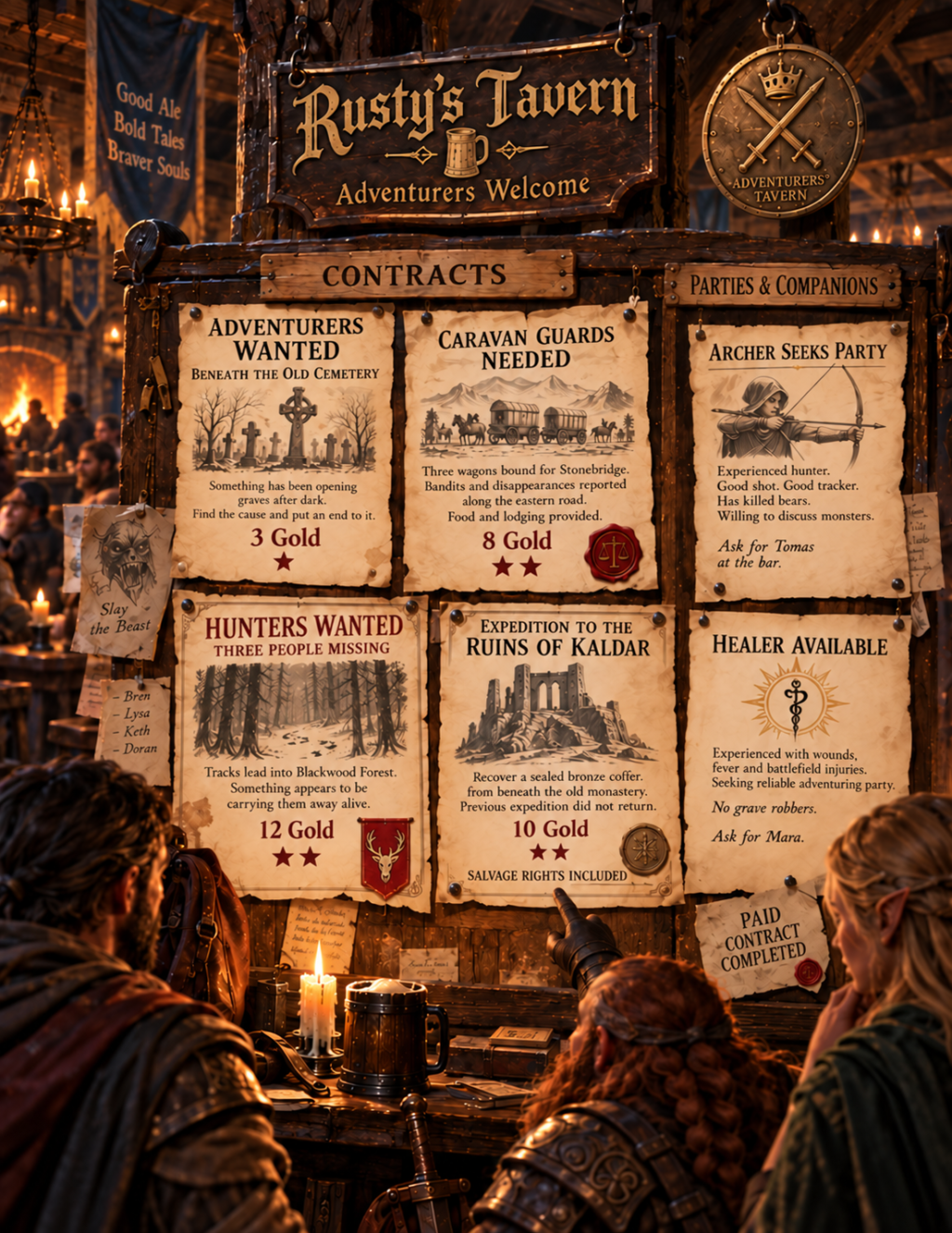
Before leaving that first night, I found the boards.
I had noticed people standing around them when I entered, but I had been too busy trying not to look like a country boy seeing his first adventurers’ tavern to investigate. There were several, each crowded with parchment. One carried contracts offering paid work. Another was devoted to people seeking companions.
The second one fascinated me almost as much as anything else in Rusty’s. Some notices were nothing more than names written on scraps of parchment.
Sword. Shield. Three years’ military service. Seeking paid expedition. Ask for Toman.
Others were far more elaborate. People who traveled frequently sometimes carried professionally made notices with them. An artist would draw the adventurer’s likeness, usually armed and dressed as he wished prospective companions to imagine him, and a scrivener would add several lines beneath it. Because the notices were meant to be reused, none named a particular town.
MARCUS VENN 🤺 MAN-AT-ARMS
Experienced soldier and horseman. Seeking companions for paid expeditions.
Currently in town. I will return here nightly until suitable companions are found.
One fellow had apparently instructed the artist to depict him standing on the body of an enormous serpent. I looked at the portrait, then found the man himself drinking at a nearby table.
The serpent had been generous to him. I had nothing like that.
I found a scrap of parchment provided beside the board and wrote my name, followed by 🎯Monster Hunter, then listed archery, tracking, trapping, and wilderness travel. I considered adding knowledge of monsters but decided there were probably enough people in the room capable of discovering how little of that knowledge I possessed.
While I was pinning it to the board, a young man beside me said, “Monster Hunter?”
I turned, expecting another interrogation.
He was perhaps my age, perhaps a few years older, thin, clean-shaven, and dressed more like a scholar than an adventurer. A staff leaned against the wall beside him, and he carried a leather-bound book under one arm.
“Yes.”
“What sort?”
“What sort of monster?”
“What sort of Hunter?”
I did not know there were enough varieties to justify the question.
“The sort that hunts monsters.”
He considered that and nodded as though I had given a satisfactory answer.
“I’m a 🧙♂️Wizard.”
That changed everything. I had spoken to priests before and once watched a village healer perform something I still cannot explain, but I had never simply stood beside a Wizard and had him introduce himself as though he were a cooper.
“What can you do?”
He smiled.
“What can you hunt?”
I liked him immediately.
His name was Anselm Eberhard. He had studied magic for years under an old scholar who lived several days east of Willowcreek and had finally decided that books could only teach him so much. More importantly, he told me, there were forms of magical knowledge that could not simply be purchased.
“Some spells are known only by particular teachers. Others survive in old manuscripts. Some have been lost altogether except for copies no one has found yet.”
“So you came here looking for them?”
“I came here looking for people willing to go where they might be.”
That sounded considerably more impressive than my reason for coming. Then I discovered that Eberhard had never completed a contract either.
“You’ve never been on an adventure?”
“No.”
“Never fought a monster?”
“No.”
“Been inside a dungeon?”
“No.”
I stared at him. He stared back.
“At least I didn’t put Monster Slaying Wizard on my notice.”
We ended up drinking together until considerably later than I intended.
By the time we left, we had agreed to meet at Rusty’s the following evening and try to find companions together. Somehow having two inexperienced men looking for a party felt substantially more respectable than having one. I spent most of the next day wandering Willowcreek, purchasing a few things I probably did not need and resisting several things I certainly did not need. I returned to Rusty’s early.
Eberhard was already there. He had found us a soldier.
Bram was a ⚔Man-at-Arms, perhaps twenty-five, with cropped brown hair, a mail hauberk, a shield, and the irritating composure of someone who had already been in actual fights. A border dispute had recently ended the military employment that had carried him through most of his adult life. He had never worked as an adventurer, but he had marched, camped, guarded roads, fought armed men, and seen enough blood that neither Eberhard nor I could pretend we had comparable experience. He looked over my bow, asked what I could hit with it, and seemed satisfied with my answer.
Then he looked at Eberhard.
“What can you do?”
Eberhard began explaining magic. Bram stopped him.
“I mean if somebody runs at you with an axe.”
Eberhard tapped his staff against the floor.
“I attempt to prevent that from happening.”
Bram nodded slowly.
“We’ll work on it.”
The fourth member joined us because he overheard an argument about roads. His name was Pell, a Qatan 🏹Ranger. I had seen Qatan before, although rarely, and I had never met one carrying himself quite like Pell. He was small enough that Bram could probably have lifted him with one arm, but there was nothing childlike about him. His bow was proportioned to him, his clothing was made for travel, and he had the weathered look of someone who had spent more nights beneath trees than roofs. Eberhard had unfolded a map and was trying to determine which road led toward several of the contracts posted that evening. Pell looked over his shoulder.
“That bridge is gone.”
Eberhard looked at the map.
“It is drawn here.”
“It was drawn there before the spring floods.”
“How do you know?”
“I crossed what was left of it six days ago.”
That was enough for me. A man who knew which bridges still existed seemed worth having around.
The Giant joined us somewhat differently.
His name was Garran, and by the time he approached our table I recognized him as the man I had stared at the previous evening. Up close he was even larger. His shoulders seemed nearly wide enough to obstruct a doorway, and he carried a heavy iron-headed mace that I suspected I would have difficulty swinging with both hands. He had heard that four newcomers were trying to assemble an expedition. Bram looked him up and down.
“You fight?”
Garran looked at Bram’s mace, which hung from his belt and suddenly appeared very small.
“When necessary.”
“What are you trained as?”
“A 💪Brute.”
I had heard of Giant Brutes. I had imagined the name was an insult used by people fighting them.
Apparently not.
Garran explained little more. He wrestled, fought with heavy weapons, and had worked as hired muscle on caravans and river barges but wanted better-paying work. He spoke softly enough that I had to lean closer to hear him, which was not how I had imagined a man his size would speak. By then there were five of us, and I began to feel that we were becoming something real.
The Elf joined after she finished playing.
Her name was Elyra. She was the musician I had listened to the previous night, and Eberhard somehow found the courage to speak to her before I did. She was a 🎶Minstrel, not merely an entertainer, and when Eberhard asked why someone who could earn money in a room like Rusty’s wanted to travel with five men planning to walk into dangerous places, she looked at him as though the answer were obvious.
“Because I am tired of singing about things other people saw.”
That was the best reason any of us had given. She had traveled farther than the rest of us, knew songs and stories from kingdoms I had never visited, and could speak to strangers without making every sentence sound like an interrogation. Within ten minutes she had somehow become the person asking the questions we should have been asking all along. What sort of work did we want? How long were we prepared to travel? Did anyone own a horse? Could Garran even ride an ordinary horse? He could not. Who could cook? Pell raised his hand. Who had medical training? Nobody.
“That,” Elyra said, “seems unwise.”
We found our ❤🩹Healer less than an hour later.
Her name was Marta, a Dwarf woman with thick black hair tied behind her head and a leather satchel full of bandages, herbs, bottles, instruments, and several objects I preferred not to inspect closely while eating. She listened to our proposal with an expression suggesting that she was evaluating livestock.
“So none of you has done this before?”
Bram raised a finger.
“I’ve fought.”
“In an adventuring party?”
“No.”
“Then none of you has done this before.”
She looked at Garran.
“You bleed like everyone else?”
“I have so far.”
She nodded.
“Good. Giants who believe otherwise are exhausting.”
Marta joined.
The eighth man introduced himself as Corren.
I still do not know whether Corren was looking for us or simply realized that seven people preparing to go somewhere dangerous represented an opportunity. He was lean, well dressed without appearing wealthy, and possessed the irritating habit of smiling whenever someone asked a question he did not intend to answer.
“What do you do?” Bram asked.
“Locks.”
“What about them?”
“I open them.”
“Professionally?”
“When possible.”
He also understood traps, could move quietly, knew something of concealed passages, and claimed familiarity with “certain people whose friendship is easier to acquire if one does not ask what they do for a living.”
I asked Eberhard quietly whether Corren was a 🗝Thief.
Corren, standing six feet away, said, “Yes.”
So there were eight of us.
That was when we finally approached the contract board as a party rather than eight individuals hoping someone else would tell us what to do.
There were enough contracts being offered to “brave adventurers” to make choosing difficult.
A merchant wanted protection along the northern road. A farmer offered payment for whatever was taking sheep from enclosed fields. Someone sought armed men to accompany a surveyor into old mining country. Another notice concerned two travelers who had failed to arrive at a neighboring settlement. One wealthy family offered payment for the recovery of property stolen several months earlier.
Then Elyra found the one that held us.
An old fortified waystation stood two days from Willowcreek along a road no longer heavily traveled. It had been abandoned for years after changing roads made it unnecessary. The land belonged to a local gentleman named Master Harod Vey, who had recently sent two men to inspect the property because he intended either to restore it or salvage its stone.
They found evidence that someone had been living there. One of the men refused to enter.
The other did.
He came back out less than ten minutes later and would say only that they should leave. Master Vey wanted a locked iron-bound coffer recovered from an upstairs chamber where family papers had supposedly remained since the place was abandoned. He also wanted to know who—or what—had occupied his property. The notice offered payment for “the recovery of the coffer” and allowed the contracted party to “keep ordinary abandoned property or salvage not specifically claimed” by Vey.
Corren read that portion twice.
Pell studied the location.
Bram asked how defensible the structure was.
Eberhard wanted to know how old it was.
Marta wanted to know what had happened to the man who went inside.
Garran wanted to know whether the staircase would hold him.
I wanted to know what had frightened a grown man badly enough that he refused to explain it.
Elyra looked around at all of us.
“This one?”
Nobody said no.
So we took the notice to the woman at Rusty’s who handled contracts. She did not hand us money, wish us luck, or declare us adventurers. She simply told us where Master Vey could be found and said that if we wanted the contract, we would first speak with the man who was paying for it.
Master Harod Vey was staying at the Willow Inn, which was fortunate because that was where I had taken a room. We found him downstairs at a table near the window, eating his supper with an older servant beside him. I had imagined that anyone offering an adventuring contract would look mysterious or desperate. Vey looked like a prosperous landowner who was irritated that a problem had interrupted his other business. He was perhaps fifty, well dressed without being extravagant, with gray beginning to show in his beard. When we told him we had come from Rusty’s regarding his contract, he looked over the eight of us carefully and asked whether we had worked together before.
Elyra answered that we had not. He then asked whether any of us had previously undertaken contracted adventuring work. There was an uncomfortable silence until Bram explained that he had military experience. Vey looked at the rest of us again and said, “So this would be your first.”
I expected that to end the conversation, but apparently every experienced adventurer must have been inexperienced at some point, and Master Vey was offering enough money to attract people like us without offering enough to interest the veterans I had seen at Rusty’s. He spread a rough map across the table and showed us the road. The old waystation stood nearly two days to the northwest, although Pell said we could probably reach it before nightfall on the second day if the weather remained good. The place had once protected a road through the surrounding country, but a newer road farther south had gradually taken most traffic away from it. Vey’s grandfather had acquired the property with several surrounding parcels, and no one had lived there permanently for more than twenty years.
The coffer he wanted was supposed to be in a small chamber on the upper floor. It was iron-bound oak, heavy enough that he recommended two men carry it, and marked with his family’s device. The papers inside concerned old property claims and were of no value to us, although apparently they were valuable enough to send eight armed strangers after them. He warned us that anything bearing the same family device belonged to him as well. Other abandoned possessions in the waystation were ours if we wanted them. Corren asked precisely what constituted an abandoned possession, and Master Vey answered, “If you have to ask whether you’re stealing it from me, you probably are.”
Corren smiled and said that this was sufficiently clear.
Bram was less interested in salvage. He wanted to know about the building itself: how many entrances it had, whether the walls were intact, whether the old gate could still be closed, and whether Vey knew of any cellar or underground passage. Vey knew of a cellar but no passage. Pell asked about water nearby, the condition of the road, and how much surrounding woodland had reclaimed the old fields. Eberhard wanted to know the age of the structure and whether anyone had ever reported anything supernatural there. Vey said not to his knowledge. I asked whether his men had found tracks. He said they had found signs of a fire, discarded bones, and what appeared to be footprints, but neither man had examined them closely. Marta asked the question I had nearly forgotten. “The man who went inside. What happened to him?”
“Nothing,” Vey said.
“Nothing?”
“He came back out.”
“I understand that. What condition was he in?”
Vey thought about it. “Frightened.”
“Injured?”
“No.”
“Bleeding?”
“No.”
“Confused? Feverish? Sick afterward?”
“No. Frightened.”
“What did he see?”
“He will not tell me.”
That answer made everyone at the table quieter. I asked whether we could speak with him ourselves. Vey said the man had returned to his village the previous morning and had no intention of approaching the waystation again.
Garran, who had remained silent through most of the conversation, finally asked whether the upper floor and staircase were stone or timber. Vey said the outer structure was stone but much of the interior was timber. Garran looked down at himself, then at the map, and said, “I may remain downstairs.”
It took me a moment to realize he was making a joke.
The payment was enough that even divided eight ways I could live on my share for some time, especially if we found anything worth salvaging. Vey would pay a small portion when we departed and the remainder upon delivery of the coffer. If the waystation was occupied, he wanted to know by whom and whether they presented an ongoing danger. He did not require us to kill anyone merely for being there. If they were travelers sheltering in an abandoned building, we were to leave them alone. If they were bandits, dangerous creatures, or something else that threatened his land or the nearby road, he wanted the problem dealt with if we could reasonably do so.
Bram made Vey repeat the last part and seemed pleased with the words “if reasonably possible.”
He told Eberhard and me afterward that any employer who insisted eight strangers swear to die over an old box should be invited to retrieve it himself.
Elyra handled most of the discussion over the final terms. I had expected Bram to do it because he was the closest thing we had to an experienced fighting man, but Elyra had an effortless way of asking for something without making it sound like a demand. By the time we were finished, Vey had agreed to provide provisions for the outward journey in addition to the original payment.
We returned to Rusty’s with him, where the agreement was recorded and witnessed. His notice was marked as taken, our names were entered with the contract, and the woman handling the ledger collected the customary fee from Vey. The entire procedure took only a few minutes.
I cannot adequately explain how it felt to watch my name being written down.
Nobody sounded a horn. Nobody applauded. The people drinking nearby barely noticed. The serving women continued carrying plates and cups. Someone upstairs laughed loudly at something I could not hear, and the musicians were preparing for another set. The woman at the ledger finished writing our names, dried the ink, and asked the next person what he wanted. Apparently people become adventurers at Rusty’s every week. To me, it felt as though something enormous had happened.
We celebrated anyway. Eberhard bought the first round, although he complained afterward that Garran’s drink ought to count as two. Garran responded by ordering enough food for three men and eating nearly all of it. Marta told us that if anyone arrived at the meeting place drunk in the morning, she would not waste medicine curing the consequences. Corren disappeared sometime during the second round and returned perhaps ten minutes later. Bram asked where he had gone. Corren said, “Out.” Bram asked what he had been doing. Corren answered, “Returning.”
I am beginning to understand that conversations with Corren tend to end this way.
Elyra eventually went to play, and for the first time I watched her knowing that the woman on the little stage would be walking beside us tomorrow. She performed a song about a group of soldiers trapped through winter in a mountain fort. I had heard another version when I was a boy, but hers was better, and by the final verse most of Rusty’s had quieted enough to listen. It occurred to me then that if we found anything extraordinary at the old waystation, she might someday make a song of it. I wondered whether she would use our real names. I also wondered whether a man had to do something particularly heroic before a Minstrel considered him worth mentioning.
The old adventurer who had spoken to me the previous night was there again. I saw him near the fireplace while I was helping Eberhard decide how much food we ought to carry. He noticed me, then looked around the table at Bram, Pell, Garran, Marta, Corren, and the empty chair where Elyra had been sitting. I expected him to say something. Instead, he raised his cup slightly and gave me a nod.
It meant more to me than it probably should have.
Bram eventually announced that we had celebrated enough and started asking what everyone intended to bring. That turned into our first argument. I had purchased extra rope, another blanket, a small hatchet, two additional knives, enough dried meat for several days, a little sack of salt, three candles, fishing line, spare bowstrings, a cooking cup, a sharpening stone, and several iron spikes because I had once read that iron spikes were indispensable when exploring ruins. Bram asked what I intended to do with the spikes. I said I did not know yet, which he claimed proved his point. Pell sided with him and said that anything I carried for two days had better justify its weight. Garran offered to carry the things we decided were useful, but Bram said that was not the lesson I needed to learn.
Eberhard had the opposite problem. He seemed to believe that because he possessed magic, ordinary preparation was somehow less important. He had books, parchment, ink, ritual materials, his staff, and enough personal equipment to survive comfortably at an inn. Pell asked what he planned to eat the second day. Eberhard said we had provisions. Pell asked what he planned to eat if we were gone five days. Eberhard said we were supposed to be gone four. Pell looked at me and said, “You see the problem.” For the first time since arriving in Willowcreek, I was not the least experienced-looking person at the table.
By the time we separated for the night, we had agreed to meet shortly after sunrise near the northwestern road. Pell wanted an early start. Bram wanted everyone rested. Marta wanted everyone sober. Corren wanted to know whether Master Vey’s advance payment was technically ours if we decided not to go, which produced such immediate hostility from the rest of us that he admitted he was joking. I think he was joking.
Now I am back in my room at the Willow Inn. The building has gone mostly quiet, although I can still hear voices below and an occasional wagon passing outside. My equipment is spread across the floor because Bram’s comments convinced me to unpack everything and decide whether I truly need it. I have removed one blanket and the fishing line. I am keeping the iron spikes. A man should be permitted at least one foolish decision on his first expedition.
Looking at my equipment tonight feels different from looking at it yesterday. I have carried this bow through forests for years. The knife beside it has skinned more animals than I could count. I know how to use everything I am taking. Yet tomorrow those familiar things are going somewhere unfamiliar, and for the first time I may have to depend upon them against something I do not understand.
That frightens me more than I admitted at Rusty’s.
I keep thinking about the man Master Vey sent into the waystation. He walked inside voluntarily, remained there less than ten minutes, came back uninjured, and refuses to say what he saw. Perhaps there is a perfectly ordinary explanation. Bandits would be dangerous enough. A pack of wild dogs nesting inside could frighten someone who was not accustomed to animals. The bones they found may have come from someone’s supper. The footprints may belong to travelers using the place for shelter. There may be nothing there by the time we arrive.
But I hope there is.
I feel somewhat ashamed writing that. Whatever frightened that man may be dangerous, and if it is dangerous, one of us could be injured or killed. I understand that more clearly tonight than I did when I left home. I have spent two evenings listening to people at Rusty’s talk about companions who did not return. The broken shield above the fireplace belonged to a real man. The missing fingers on the old adventurer’s hand did not grow back when his story ended. Bram has seen men die. Marta carries instruments designed for injuries I would prefer not to imagine. There is nothing pretend about any of this.
I still hope there is something at the waystation. I did not come all this way to retrieve an old man’s papers from an empty building. Perhaps that is foolishness. Perhaps every Monster Hunter begins with some of it and those who live long enough learn to lose it.
I have thought several times tonight about Gerrant Vale and the Black Hounds. When I was younger, the stories made men like him seem as though they had always been adventurers. I never imagined Gerrant buying his first rope, wondering whether his companions liked him, or lying awake the night before his first expedition wondering whether he was as capable as he had told everyone he was. Famous men enter stories after they have already done the things that made them famous. Nobody tells you about the evening before.
Maybe there was a night when Gerrant Vale had never killed a monster either.
Two days ago I arrived in Willowcreek alone. Last night I met Eberhard. Tonight there are eight of us. A Hunter who has never hunted a monster, a Wizard who has never been on an expedition, a soldier looking for a different kind of war, a Qatan Ranger who seems to know every road worth knowing, a Giant Brute who could probably break me in half, an Elf Minstrel searching for stories of her own, a Dwarf Healer who already regards the rest of us as patients waiting to happen, and a man who opens locks professionally but would apparently prefer that nobody think too hard about why.
Tomorrow morning we leave Willowcreek together.
I came here calling myself a Monster Hunter. Tomorrow, perhaps, I find out whether I have any right to.