What is Kingsmark?
👑Kingsmark™ is a medieval heroic fantasy tabletop role-playing game of dangerous adventures, desperate battles, ancient magic, and hard-won survival. Players take on the roles of warriors, thieves, priests, rangers, wizards, mercenaries, and other adventurers who enter a world filled with monsters, lost treasures, feuding kingdoms, sinister cults, supernatural evils, and places where sensible people know better than to travel.
The Game Master (GM) serves as the chief storyteller, portraying the world and its inhabitants, presenting situations and adversaries, and interpreting the consequences of the players’ decisions. Twelve-sided dice are used whenever the outcome of an important action is uncertain. The other players each portray a character whose abilities, ambitions, loyalties, wounds, mistakes, and victories gradually create a story that belongs to the entire group.
Kingsmark is designed around ⭐Jack’s Cinematic d12 (JCd12), a rules system built to produce fast-moving, dangerous, cinematic adventures without reducing characters to reservoirs of abstract hit points. Instead of a number, combatants keep track of specific 🩸Physical Wounds. Characters may be wounded, crippled, exhausted, frightened, overwhelmed, or killed, and surviving a battle does not necessarily mean walking away from it unharmed. JCd12 also tracks 🧠Mental Trauma, representing the psychological harm a character can suffer from terror, violence, supernatural encounters, and other horrifying experiences. A character may therefore survive an adventure physically intact while carrying lasting mental consequences from what they experienced.
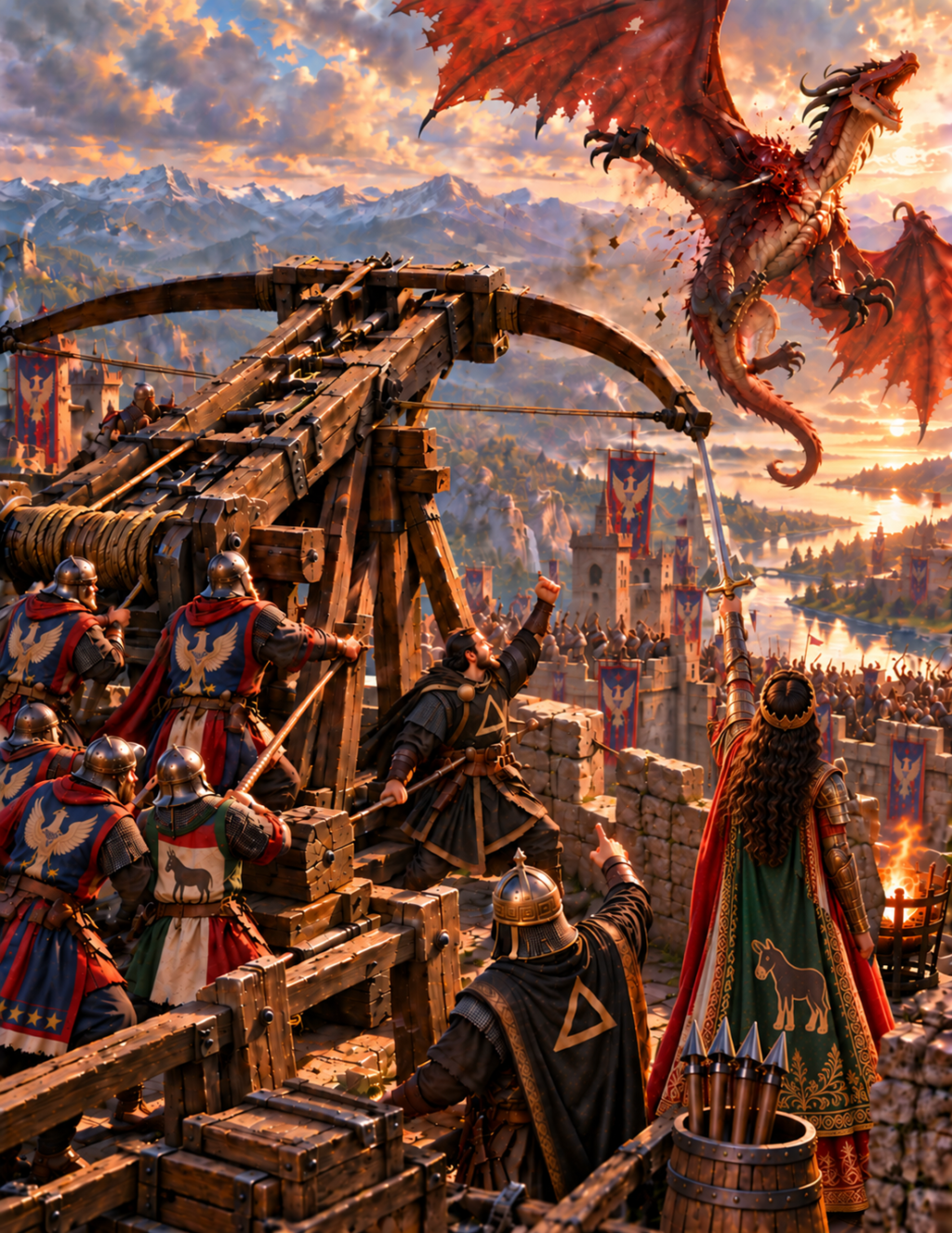
The world of Kingsmark draws upon the imagery and atmosphere of medieval fantasy: fortified cities and lonely villages, castles overlooking contested lands, dangerous roads through enormous forests, remote monasteries, ancient tombs, underground ruins, battlefields, mountain passes, ancient temples, and wilderness stretching far beyond the protection of civilization. Human kingdoms struggle against one another even while creatures out of legend threaten their borders. Goblins raid isolated settlements. Trolls haunt roads and bridges. The dead refuse to remain buried. Evil Sorcerers pursue powers that wiser people fear. Dragons, demons, hags, vampires, strange beasts, and other horrors may wait beyond the next hill—or beneath the streets of an apparently peaceful town.
Kingsmark does not assume that encounters are balanced according to the abilities of the player characters. The Game Master determines what inhabits a location, how numerous the opposition is, and how dangerous it should reasonably be based upon the circumstances of the world rather than the level or capabilities of the adventuring party. Consequently, characters may encounter opponents they cannot reasonably defeat in direct combat. Gathering information, assessing danger, choosing an approach, preparing for an encounter, and deciding whether to fight at all are therefore meaningful parts of play.
Adventure is likewise not confined to killing monsters and collecting treasure. Characters may become involved in wars, feuds, criminal conspiracies, religious conflicts, investigations, political intrigues, sieges, assassinations, wilderness expeditions, rescues, hunts, mysteries, and struggles over land, wealth, power, and loyalty. A party of adventurers might protect a village during one adventure, hunt an outlaw during the next, explore a buried city afterward, and eventually find itself deciding the fate of a kingdom.
Much of adventuring life in Kingsmark revolves around Contracts: paid missions offered to adventurers willing to face dangers that ordinary soldiers, guards, travelers, and villagers cannot—or will not—face. A Contract might call upon an adventuring party to hunt a dangerous creature, rescue captives, escort travelers, recover something lost, investigate a mystery, protect a settlement, or venture into unexplored territory. Contracts provide opportunities for adventure, but accepting one does not guarantee that the adventurers are powerful enough to survive it.
The name “Kingsmark” comes from an ancient symbol of royal authority known as the 👑King’s Mark, a term with two closely related meanings. Most adventurers know it as the distinctive wax seal pressed upon a King’s Contract—a prestigious, exceptionally high-paying Contract issued under the authority of a king and ordinarily entrusted only to proven heroes of ⭐Action Star Level 3 or higher. To receive a Contract bearing a King’s Mark means that the Crown itself has need of the party, and that failure may carry consequences far beyond the loss of a reward, whereas completing the Contract may bring extraordinary wealth, royal favor, prestige, lands, titles, or opportunities ordinarily beyond the reach of even successful adventurers. The older meaning is considerably more mysterious. Certain royal bloodlines inherit a distinctive birthmark known as the King’s Mark, traditionally regarded as proof of direct royal descent. In ancient times, before reliable records and other methods of establishing parentage, the appearance of the Mark upon a royal child was accepted as evidence that the child was truly an heir of the bloodline and possessed a legitimate claim to the throne. Thus the King’s Mark may appear upon parchment or the robe of the flesh: one summons proven heroes into the service of a king; the other may reveal that someone carries the blood of kings.
Magic exists, but it belongs to the same dangerous world as everything else. The supernatural should feel supernatural. A magician is not merely an ordinary soldier whose weapon happens to be a spell. Magic may require knowledge, preparation, ritual, unusual materials, sacred objects, spoken invocations, gestures, or circumstances that cannot simply be produced at will. Its lesser manifestations may be subtle enough to leave witnesses wondering what actually happened, while its greatest manifestations can become unmistakable violations of the ordinary world. Magic is powerful precisely because the extraordinary has not become ordinary.
Kingsmark also assumes that actions have consequences. Enemies who escape may return. Allies who are betrayed may remember. Missions that are ignored do not patiently wait for the heroes to arrive. A village left undefended may be destroyed. A criminal organization left unopposed may grow stronger. A defeated warlord may have friends, heirs, soldiers, or creditors. The Game Master is encouraged to allow events to continue beyond the immediate presence of the player characters so that their decisions genuinely change the campaign.
The world does not guarantee fairness, safety, victory, or survival. Characters are expected to face circumstances in which courage matters because retreat is reasonable, loyalty matters because betrayal is tempting, and victory matters because defeat has consequences.
This does not mean that Kingsmark is a game of hopelessness. Quite the opposite. Darkness gives heroism something meaningful to oppose. A torch matters because the dungeon is dark. A fortified village matters because something terrible is outside its walls. Friendship matters because companions can die. Mercy matters because cruelty is possible. Courage matters because characters have something to fear.
At its heart, Kingsmark is a game about adventure, choice, consequence, and survival in a dangerous medieval fantasy world. It is intended for players who want swords and sorcery to feel dangerous again; who want monsters to inspire caution rather than calculations about encounter balance; and who want their decisions to leave permanent marks upon the campaign. The world offers no guarantees.
What Is a TTRPG?
A Tabletop Role-Playing Game—often shortened to TTRPG—is part storytelling, part strategy, and part shared imagination. It is not a video game, not a board game, and not a scripted performance, though it borrows something from each. A TTRPG is a conversation shaped by rules, dice, and imagination—a story built together by everyone at the table. At its simplest, one person serves as the Game Master (or GM), describing the world, playing the roles of its inhabitants, and presenting challenges. The other players each control a single character—an adventurer, soldier, scholar, or wanderer—who lives in that world. The GM describes what’s happening: a crumbling monastery cloaked in fog, a merchant begging for help, the howl of something unseen in the trees. The players respond by declaring what their characters do: perhaps they investigate, pray, hide, or draw their weapons. When the outcome of an action is uncertain, dice are rolled to decide success or failure.
The results are interpreted through story, not spreadsheets. If you leap across a rooftop and roll well, you might land safely and impress onlookers. Roll poorly, and you may crash through the tiles, discover something hidden below, or injure yourself. The dice provide uncertainty; the players and GM provide meaning. Unlike most games, there is no single “winner.” The goal is to experience a living story. Sometimes the group succeeds through courage and cleverness; sometimes they fail spectacularly—but even failure can make the story richer. Every session feels like writing a chapter of a novel together, with the dice deciding the twists. There are many ways to play, ranging from pure imagination to full tabletop immersion:
- 🎭 Theater of the Mind: Nothing is needed but your voices and imagination. The GM describes the scene, players respond in character, and everything unfolds in conversation. This is the purest and oldest form of role-playing—perfect for storytelling and drama.
- ✍️🪙🧌Sketch and Tokens: Many groups like a simple hand-drawn map on paper or a whiteboard, with coins, tokens, or miniatures representing characters and monsters. It keeps positioning clear while preserving imagination.
- 🗺🧌🏰🕯🎵🖼 Full Table Experience: Some tables embrace the spectacle—detailed maps, painted miniatures, terrain pieces, candles, soundtracks, even projected visuals. These tools don’t change the rules; they just make the world feel tangible. The more physical detail, the more cinematic the experience.
No matter the setup, the magic of a TTRPG lies in collaboration. Players describe their actions and choices; the GM reacts and weaves the consequences. Everyone builds the story together through imagination and emotion, creating a shared experience that exists only at that table. When played well, it feels less like a game and more like shared storytelling—part play, part dream, and part exploration of what courage, fear, and hope look like in the face of darkness. That is the heart of Kingsmark: not rolling dice to win, but stepping into the candlelit world and asking, what would I do if this were real?
What Do You Need to Play?
At its heart, Kingsmark is intentionally minimalist. To begin, each participant needs a 1d12 (twelve-sided die), each player needs a 📖Character Bible for recording details about their character, and everyone needs an imagination ready to bring this medieval fantasy world to life. 📖Character Bibles—printed or digital—are essential for tracking not only skills and 💪Attribute Ratings, but also elements like vows, traumas, and moral convictions. The Game Master guides the session. Their role is to describe the setting, embody non-player characters, and manage tension.
A group of three to six players plus one GM is ideal, though larger or smaller groups are possible. Each player controls a protagonist in the story, shaping events through decisions and risks that echo across the campaign.
Though not required, props and tools add to the immersion. A whiteboard or chalkboard can track the time of day, objectives, or lingering effects. Index cards or scraps of parchment can be handed out as in-world letters, contracts, or cryptic clues. Players may want a sketchpad or blank notebook for maps, plans, or notes, while tokens, miniatures, or even coins can mark positions during tactical encounters.
Game Masters are encouraged to prepare handouts—such as written contracts, wanted posters, letters, proclamations, cryptic messages, or copies of battlefield maps. These props enrich the world and give players something tangible to hold. In truth, creativity doesn’t need to be expensive. Even simple items—a candle on the table, a scrawled note, a token moved across paper—can pull everyone deeper into the setting.
Ultimately, the most important tools are not physical at all. What drives Kingsmark is imagination, courage, and a willingness to enter a world where candlelight falters, shadows breathe, and the fate of nations can rest on a whispered word or a single blade stroke. With these, Kingsmark becomes more than rules—it becomes an experience. One of the distinctive design choices behind Kingsmark is that the complete game line is divided among several books rather than forcing every subject into a single enormous volume. This Player’s Handbook contains the core rules, essential equipment, selected complete Spell descriptions, and other material necessary to create characters and begin playing. The supplemental books greatly expand those resources. ⚖️The Marketplace contains the complete equipment and commerce catalog, while 📜The Spellbook contains the complete magic system and collection of 219 Spells.
This division allows several books to be used simultaneously at the table. While one player is looking up combat rules, conditions, or available actions in 👑Kingsmark, another can browse the much larger selection of weapons, armor, tools, mounts, goods, and services in ⚖️The Marketplace, while a magician consults the complete magical reference in 📜The Spellbook. The Game Master can likewise keep specialized reference material separate from the core rules. The Player’s Handbook remains independently useful rather than becoming merely an index to material contained elsewhere, while the supplemental volumes provide substantially greater depth for players and Game Masters who want it. 📜The Spellbook uses the standard Spell format and reference system of ⭐Jack’s Cinematic d12 (JCd12), allowing its magic system to remain consistent with other compatible JCd12 games and adaptations. There are six core books:
- 👑Kingsmark: Player’s Handbook — A Complete Guide to Heroic Fantasy Adventure. The core rules for creating characters, adventuring, exploration, combat, dialog, healing, advancement, and heroic fantasy play.
- ⚖️The Marketplace: The Fantasy Adventurer’s Guide to Equipment & Commerce — Weapons, armor, adventuring equipment, goods, services, trade, prices, and the economy of the medieval fantasy world.
- 📜The Spellbook: A Complete Fantasy Magic System — The complete fantasy magic system for Kingsmark and compatible JCd12 games, including Schools of Magic, spellcasting rules, magical traditions, and the complete collection of spells.
- 🧌The Bestiary: Encyclopedia of Fantasy Monsters — Creatures, monsters, fantastic beasts, cryptids, supernatural entities, and other adversaries that adventurers may encounter.
- 🧭The World Book: A Complete Guide to the Medieval Fantasy World of Sylva — Sylva’s geography, history, kingdoms, peoples, cultures, religions, factions, wilderness, legendary places, and lore.
- 🍺The Tavern: The Game Master’s Guide to Heroic Fantasy Adventure — The Game Master’s Guide to creating and running adventures, dungeons, contracts, campaigns, and the world behind the screen, including introductory Level 0–1 adventures.
👑Kingsmark: Player’s Handbook contains enough equipment and magic to create characters and begin playing without requiring another volume. Players who want the complete equipment catalog should use ⚖️The Marketplace, while players of magical characters will gain the greatest benefit from 📜The Spellbook, which contains the complete collection of 219 Spells and the expanded rules and material devoted specifically to magic. 🧌The Bestiary, 🧭The World Book, and 🍺The Tavern are primarily intended for the Game Master. With these six books, Game Masters have everything needed to create original adventures of their own. Those who prefer published content can instead run official adventure books, which carry characters from approximately Level 2 through Level 5 before leading into advanced campaigns and end-game adventures.
📖 Learning the Rules
👑Kingsmark: Player’s Handbook is a massive game book, but it is not necessary to memorize a large book before playing the game. The easiest way to learn the rules is concept by concept, beginning with the small number of rules that actually make the game run.
💪Attributes are straightforward. 🌈Attribute PRISMs are straightforward. ⚒️Skills are straightforward. ⭐Action Star Levels are easy to understand. The basic dice formulas are deliberately simple. Once a player understands which Attribute PRISM and Skill apply to an action, most Tests amount to rolling a d12, adding the appropriate ratings, and comparing the result to a Target Number or an opponent’s result.
⏳Initiative, ⏸Turns, and Action Points are similarly intended to become routine very quickly. A character receives Action Points according to Speed and spends them upon actions. Most actions cost 1, 2, or 4 Action Points. After playing through a few Turns, this should require very little thought.
Do not mistake the size of 👑Kingsmark for the amount of information that must be memorized. A substantial portion of the book consists of options, examples, explanations, reference material, special situations, and procedures that only become relevant when something particular happens during an adventure. You need to understand how the ruleset works. You do not need to memorize everything the game contains.
Learn the Core Rules First
The most important rules to understand are the ones that repeatedly answer these questions:
- What can my character do?
- What do I roll?
- What is the Target Number?
- How much of my Turn does this action occupy?
- Did the action succeed?
- If somebody was attacked, what happened to him?
- If somebody suffered Trauma, what does that now mean?
Those questions form the practical core of Kingsmark.
The most complicated parts of the game are not 💪Attributes, ⚒️Skills, ⭐Action Star Levels, or the basic dice formulas. Greater attention should instead be given to ▶️Action Scenes; melee and ranged combat; Advantage and Disadvantage; 💥Damage escalation; Hit Location; 🛡Armor; 🩸Physical Trauma; 🧠Mental Trauma; Pain and Distress; R.A.D.💀; Healing; and, for characters who practice magic, spellcasting and Mental Drain. These systems contain more steps because they are modeling situations in which the details matter. Fortunately, they do not all need to be learned at once.
⚔️ Learn by Fighting Someone
One of the fastest ways to learn Kingsmark is to create a simple melee character and fight one of the NPCs provided in the Appendix of 👑Kingsmark. Do not worry about creating an adventure. This is practice. Put the two characters several yards apart. Roll ⏳Initiative. Determine their Action Points. Move them together. Attack. Defend. Try a few different melee actions. Let somebody get hit. Determine the Damage Level, roll Hit Location, apply 🛡Armor, record the 🩸Physical Trauma, apply Pain, and continue fighting long enough to see how an injury changes the scene.
Then do it again.
During the second fight, deliberately try actions you ignored the first time. Reposition. Take a Defensive Stance. Attempt a maneuver. Call for help. Use terrain. Have an injured character change tactics rather than fighting as though nothing happened. A short practice fight will teach many of the game’s most frequently used procedures faster than repeatedly reading those procedures in isolation. Once ordinary melee feels comfortable, add a ranged combatant. After that, add a spellcaster. Then introduce Mental Trauma, unusual terrain, armor differences, or more complicated actions. Learn the ruleset in layers rather than attempting to master everything simultaneously.
🎬 Understand the Actions; Do Not Memorize the Catalog
The 🎬Example Actions chapter is an important reference. Players and Game Masters should understand what 🟡Flair Actions, 🟠🟠Swift Actions, and 🔴🔴🔴🔴Starring Actions represent, how Action Point costs work, and how actions interact with Tests, positioning, combat, and the fiction. It is useful to become familiar with the kinds of actions available. It is especially useful to understand more consequential procedures such as defensive actions, tactical movement and positioning, grappling and control, helping another character, combat first aid, psychological warfare, and other actions that frequently change what happens during a dangerous 🎬Scene. It is not necessary to memorize the entire catalog. The chapter is a menu and reference, not a list of commands from which players must choose. A player may describe something entirely reasonable that is not listed there. The Game Master can determine how much of the Turn it occupies and which rule or Test resolves it. During play, keep the Action list readily available. It is likely to become one of the most frequently referenced parts of 👑Kingsmark.
📚 What You Will Actually Look Up
Even experienced players and Game Masters will sometimes consult the rules. That is expected. The most useful material to keep readily accessible during play will generally include:
- The Action list and Action Point costs.
- Target Numbers and Advantage/Disadvantage tables.
- The ordinary melee and ranged combat procedures.
- 💥Damage, Critical Thresholds, Hit Location table, and 🛡Armor.
- The 🩸Physical Trauma and 🧠Mental Trauma tracks.
- Pain and Distress.
- R.A.D.💀.
- Common Healing procedures.
- Spellcasting and Mental Drain when magicians are present.
- Any unusual rule particularly relevant to the current Scene.
Reference material exists because understanding how a ruleset works is much more important than memorizing every table, number, and special case contained within it.
📜 You Do Not Need to Memorize 219 Spells
📜The Spellbook: A Complete Fantasy Magic System contains 219 spells expressed in 872 unique miracles. Nobody is expected to memorize them. A player portraying a magician should understand how spellcasting works and should become familiar with the spells his own character actually knows and regularly uses. Knowing the entire spellbook would provide little practical advantage at the table. Treat 📜The Spellbook like a magician’s library. Explore it when choosing or learning magic. Reference a spell when necessary. Learn the handful of spells your character uses frequently through ordinary play. The Game Master does not need to memorize 219 spells either. The Game Master needs to understand the rules governing magic well enough to adjudicate what happens when somebody casts one.
⚖️The Marketplace Is a Catalog
The same principle applies to ⚖️The Marketplace: The Fantasy Adventurer’s Guide to Equipment & Commerce. The book may contain an enormous selection of weapons, armor, clothing, tools, animals, services, food, lodging, medicines, adventuring supplies, and other things people can purchase in Sylva. It is a catalog. Nobody needs to read a catalog from beginning to end before playing the game, and certainly nobody needs to memorize it. When your character wants a horse, look at horses. When your character has finally earned enough money for better armor, look at armor. When the party is preparing for a winter expedition, look at the equipment that matters to a winter expedition. Use ⚖️The Marketplace when shopping becomes part of the adventure.
🧌 The Bestiary Is Also a Reference
The Game Master does not need to memorize 🧌The Bestiary: Encyclopedia of Fantasy Monsters. Before an adventure, read the entries for creatures that are likely to appear. Understand what makes those particular creatures dangerous, unusual, frightening, intelligent, or tactically interesting. If the adventure contains Goblins, learn the Goblins. If it contains a Wraith, learn the Wraith. There is no advantage in memorizing the statistics of creatures that will not appear tonight. What matters is that when a creature enters the story, the Game Master understands enough about that creature to portray it intelligently and use its important rules correctly. Moreover, a creative Game Master can create dozens of hours of gameplay with just the NPCs in this book, so reading 🧌The Bestiary is not a priority.
🧭 Learn the World as You Need It
The same principle applies to 🧭The World Book: A Complete Guide to the Medieval Fantasy World of Sylva. A player does not need to memorize the history, geography, cultures, religions, kingdoms, roads, settlements, wilderness, politics, and mysteries of an entire world before portraying one person who lives there. Learn the parts of Sylva that matter to your character and the current adventure. The Game Master should know the immediate setting more thoroughly: where the party is, what surrounds it, what people there generally know, and which locations or events are likely to become relevant. The rest of The World Book remains available when the adventure travels somewhere new. Much like The Bestiary, The World Book is optional. Kingsmark does not require adventures to take place on Sylva. Game Masters are free to use the ruleset with their own fantasy worlds or other settings of their choosing. 🧭The World Book provides the official setting for those who wish to adventure there.
🍺 The Game Master’s Reference
🍺The Tavern: The Game Master’s Guide to Heroic Fantasy Adventure is intended specifically for the Game Master. Players are not expected to study it in order to understand the basic game. The Game Master should become familiar with the portions of 🍺The Tavern that govern preparing adventures, adjudicating situations, portraying the world, running NPCs, managing contracts and rewards, and handling the other responsibilities that belong primarily to the Game Master. As with every other book in the game, familiarity is more valuable than attempted memorization.
🎲 When Are You Ready to Play?
You are ready to play Kingsmark with friends or family when you understand the basic dice mechanic, can read a 📖Character Bible, understand ⏳Initiative and Action Points, can resolve an ordinary Test, and can work through a basic combat encounter with 👑Kingsmark: Player’s Handbook beside you. You do not need to:
- Perform every procedure from memory.
- Know what every Skill does.
- Know every combat maneuver.
- Know every monster.
- Know every spell.
- Know every weapon or piece of armor.
- Know every Healing treatment.
- Remember every unusual rule.
You should be able to find those things when they become relevant. If you can take several characters through a simple fight against an NPC, determine who acts when, resolve their actions, determine whether attacks hit, calculate the resulting Damage, apply protection, and correctly record Trauma, you already understand a substantial portion of what is necessary to begin running the game. The rest becomes easier through play. Your first adventure is also practice. So is your second.
🎥 The Game Master’s Real Job
The Game Master’s most important skill is not memorization. It is maintaining the relationship between the fictional situation and the rules. The Game Master should be able to listen to what the players say their characters are doing, determine whether a Test is necessary, select the appropriate procedure, and apply the consequences honestly. NPCs and creatures should behave according to what they know and want. Changing circumstances should matter. Intelligent plans should matter. Bad decisions should matter. The dice should matter. When uncertain about an uncommon rule, look it up. When an obscure question would stop the game for an unreasonable amount of time, make the most reasonable temporary ruling available, continue the Scene, and verify the actual rule afterward. Rules fluency develops through use.
🎟️ Running Kingsmark Professionally
Running a game for paying customers demands a higher level of preparation than running a game around the kitchen table. A professional Game Master still does not need to memorize all six core books. Professional preparation should instead concentrate upon fluency. A professional Game Master should be able to run the procedures that occur repeatedly without continually stopping the game to rediscover how they work.
In particular, the professional Game Master should be comfortable with:
- ⏳Initiative and Action Points.
- Ordinary Tests and Target Numbers.
- Advantage and Disadvantage.
- Common Actions.
- Melee and ranged combat.
- 💥Damage and Critical Thresholds.
- Hit Location and 🛡Armor.
- 🩸Physical and 🧠Mental Trauma.
- Pain and Distress.
- Basic Healing procedures.
- Spellcasting and Mental Drain when magic will feature prominently in the game.
The best preparation for that level of fluency is not reading the same chapter ten times. Playtesting is more valuable once the rules have been read and understood. Run melee fights. Run ranged fights. Run an armored character against different Damage Types. Inflict several levels of Trauma. Run somebody to R.A.D.💀. Practice Mental Trauma. Run a magician through repeated spellcasting and Mental Drain. Practice unusual Actions. Run encounters containing retreat, pursuit, surprise, positioning, Healing, negotiation, and environmental complications.
Whenever 👑Kingsmark repeatedly has to be consulted for the same ordinary procedure, that procedure deserves more practice. A professional Game Master should also know the adventure being sold. Read it completely. Know the important NPCs, likely encounters, clues, locations, hazards, and creatures. Prepare the specific rules most likely to appear. The standard is not perfection. The standard is that paying players should reasonably feel that the person running the game knows the game. A Game Master is approaching professional readiness when he can:
- Run several representative practice encounters accurately.
- Keep an Action Scene moving without repeatedly losing the procedure.
- Find uncommon rules quickly when necessary.
- Adjudicate unexpected player ideas consistently.
- Portray the prepared adventure confidently.
- Recover smoothly when players do something unexpected.
- Explain the basic rules clearly to a new player.
- Correct a mistaken ruling without allowing the mistake to derail the session.
If ordinary combat still requires repeatedly reconstructing the basic procedure from 👑Kingsmark, practice more before selling tickets to sit at your table.
⚖️ Game Master Adjudication
No roleplaying game can contain a specific rule for everything that might happen during an adventure. Kingsmark provides rules for situations that benefit from consistent mechanical treatment, but players are free to attempt things the rules never specifically anticipated. Adventures may also introduce objects, creatures, hazards, locations, circumstances, and interactions that do not have individual statistics printed anywhere in the six core books. The Game Master is expected to adjudicate these situations.
To adjudicate means to consider the relevant facts and make a ruling. In Kingsmark, adjudication is the Game Master’s responsibility to apply the existing rules, logic, realism, established fiction, and reasonable judgment to determine what happens when no explicit rule provides the complete answer.
A missing rule is therefore not a reason to stop the game.
If a hero wants to do something reasonable and no Action describes it perfectly, determine which existing mechanic comes closest and resolve it. If an adventure says that a room is an armory, the room contains the sorts of weapons, armor, racks, tools, oil, whetstones, spare parts, and military equipment that logically belong in that armory. The Game Master does not need a published statistics block for every hammer, helmet, barrel, rope, stool, or iron spike before those things can exist. Likewise, if the party enters a kitchen, stable, blacksmith’s workshop, monastery, ship, dungeon storeroom, nobleman’s bedchamber, or village market, ordinary objects appropriate to that location can exist whether or not the adventure individually lists them.
📖 Use the Rules Before Inventing New Rules
Adjudication does not mean ignoring the rules. First determine whether Kingsmark already provides a relevant rule. Use established Damage Types, Skills, Actions, Target Numbers, Trauma rules, equipment statistics, spell rules, movement rules, and other mechanics whenever they reasonably apply. Do not invent a new subsystem merely because the exact situation has never appeared before.
If an existing rule solves most of the problem, use it and adjudicate only the uncertain portion.
Suppose a hero wants to swing from a chandelier and kick an enemy through a window. Kingsmark may not contain an Action named Swing From Chandelier and Kick Enemy Through Window. It does not need one. Determine the appropriate Action cost, Skill or Attribute involved, establish a reasonable TN or opposed Test, and resolve the consequences according to the existing rules for movement, attacks, falling, Damage, and the physical circumstances.
🧠 Use Logic & Realism
When no explicit answer exists, ask what would reasonably happen within the established world.
Consider the character’s abilities, the environment, available equipment, distance, time, physical obstacles, NPC knowledge, and the established facts of the adventure. Extraordinary things may be possible in a fantasy world, but fantasy does not require abandoning cause and effect.
Do not require a Test for something that should simply work. A competent warrior does not roll to pick up a sword. A character does not make a Strength Test to open an ordinary unlocked door. Tests become appropriate when uncertainty, difficulty, danger, opposition, pressure, or meaningful consequences make the outcome genuinely uncertain. When a Test is appropriate, select the Attribute, PRISM, Skill, and Target Number that best represent the situation. When several choices are reasonable, choose the one that most closely represents what the character is actually attempting.
🎭 Improvise What the World Requires
The Game Master has authority to create reasonable details that the adventure requires.
If an unnamed guard needs statistics, use an appropriate existing NPC as a model and adjust what is necessary. If the heroes find an ordinary tool not listed in ⚖️The Marketplace, estimate its price and properties by comparison with similar goods. If an adventure establishes that a chest contains an old military sword but does not identify the exact model, select an appropriate sword. If weather, architecture, local customs, or ordinary human behavior become relevant, establish reasonable details consistent with the setting. Do not halt an adventure merely because a book failed to specify something that can reasonably be determined. This principle applies equally to human and AI Game Masters.
An AI Game Master should not respond that it cannot continue because an incidental object, NPC statistic, environmental detail, or exact situation is absent from the supplied rules. It should distinguish between a genuinely necessary missing rule and an ordinary gap that a competent Game Master is expected to adjudicate.
⚖️ Be Consistent, But Keep Playing
A ruling made during play does not need to become a permanent new rule. When an unusual situation requires an immediate decision, make the most reasonable ruling available and continue the adventure. If the same situation becomes common, record the ruling or consult the books afterward and establish a consistent approach. If a previous ruling was mistaken, correct it when appropriate rather than twisting later rulings merely to preserve an error.
The purpose of adjudication is not unlimited Game Master authority. It is to allow a living world to function beyond the exact sentences printed in a rulebook. Know the rules. Apply them faithfully. Fill reasonable gaps with logic. Make a ruling. Then keep the adventure moving.
🧠 Learn Concepts, Reference Details
The goal is simple: understand the core rules, practice the procedures, know your character, know tonight’s adventure, and know where to find everything else. Kingsmark contains a great deal because an adventure can contain a great deal. The existence of rules for wounds, terror, magic, equipment, monsters, unusual combat maneuvers, Healing, exploration, social situations, and hundreds of other possibilities does not mean all of those rules must be held in your head simultaneously. Learn what happens often. Practice what is complicated. Look up what is rare. Then play.
What Gameplay Should Feel Like?
Playing Kingsmark should feel like stepping into a painting of the High Middle Ages—a world of torchlit castles and creeping fog, mail-clad knights and ancient forests, faith and fear, civilization and wilderness. The goal is not to drown in arithmetic or wade through endless tables, but to breathe life into a medieval world of swords and sorcery filled with danger, mystery, and adventure. Kingsmark favors story over statistics—decisions, not decimals. The rules exist to serve the moment, not to slow it down, and players are encouraged to act boldly rather than pause to calculate every fraction of advantage.
The Game Master serves as narrator and world-builder, describing not just what happens, but how it feels. A tavern should smell of smoke and rain; a temple should echo with dripping water and fading hymns. Players, in turn, respond not only with actions but with tone and detail: the soldier who kicks open a door in anger, the priest who whispers a prayer before entering a crypt, the scholar who hesitates before reading a forbidden name aloud.
The world of Kingsmark exists in a constant tension between 🌿Tranquility and the 🪱Gloom.
- 🌿Tranquility is not merely comfort or calm—it is the natural harmony that arises when humanity lives according to divine order. It manifests when people act uprightly, pursue justice, and honor the architect of creation. In such places, goodness has a measurable presence, and even the air seems lighter. Just as righteous deeds—or mitzvot—are said to influence the world for the better, so too does virtue shape the environment. When Tranquility is strong, the land itself reflects it: gardens flourish, the stars shine clearly, and wondrous beings of light—creatures reminiscent of an Edenic age long forgotten—may appear. The higher the Tranquility, the closer the world feels to what it was meant to be: peaceful and beautiful.
- 🪱️The Gloom (Arafel) is alien darkness, not mere shadow; it is a living corruption, an otherworldly blight that seeps into the world wherever righteousness weakens. It feeds upon despair, deceit, and cruelty, swelling in strength as faith and conscience decay. When men and women turn against what is good, their wickedness becomes nourishment for the Gloom, thickening its hold on both land and soul. Entire villages may grow dim and joyless under its influence, their people moving like sleepwalkers through a fog of moral decay. Yet the Gloom is not a passive force—it hungers. It whispers to the weary and tempts the proud, promising power, comfort, or revenge. Its influence seeps into thoughts, urging compromise and corruption one small choice at a time. The more one gives in, the more the Gloom gathers around them, until it becomes hard to tell where the person ends and the darkness begins. In scenes touched by the Gloom, the air itself feels heavier. Candles dim without reason. The wind carries voices that should not exist. Shadows stretch too far and cling too long. Horror is not born of mere gore or cheap spectacle, but of quiet realization—the dread that the world is unraveling because humanity itself has invited an unnatural darkness in.
Game Masters are encouraged to make every session feel like it belongs to that age. Immerse yourself in the history and imagery of the High Middle Ages, particularly the 13th century—read about castles and walled towns, monasteries, guilds, medieval warfare, pilgrimage, agriculture, trade, and the daily lives of knights, clergy, merchants, craftsmen, and peasants. Study the clothing, weapons, and armor of the period: mail hauberks, surcoats, great helms, shields, swords, spears, axes, bows, and crossbows.
Although Kingsmark is fantasy rather than historical reconstruction, Earth between roughly 1100 and 1350 provides its visual and technological foundation. Understanding that world can help you imagine the texture of Kingsmark: the tolling of monastery bells, the smoke rising from village hearths, the clatter of hooves on a cobbled street, and the weight of oiled chainmail beneath a woolen cloak.
For visual and emotional inspiration, look to works that capture a world that feels old, dangerous, beautiful, and only partially tamed. Films such as The Lord of the Rings and Willow provide useful examples of medieval fantasy brought to life, while historical films, documentaries, museums, manuscripts, and archaeological reconstructions can provide a more grounded understanding of the period beneath the fantasy. Look especially at how people dressed, traveled, worked, worshiped, fought, ate, slept, and endured the seasons. The objective is not perfect historical accuracy, but enough authenticity that the fantastic elements of Kingsmark intrude upon a world that otherwise feels tangible and believable.
Likewise, medieval history itself provides abundant inspiration for the atmosphere and emotional stakes of Kingsmark. Feuds between noble houses, sieges, disputed successions, religious conflicts, famine, outlawry, pilgrimage, raids, and struggles between rulers and their vassals provide conflicts requiring no supernatural explanation at all. A campaign should contain ordinary human ambitions and cruelties alongside the horrors of the Gloom. The supernatural becomes more disturbing when it enters a world already populated by recognizable human concerns: loyalty and betrayal, honor and vengeance, faith and doubt, greed and sacrifice.
Combat, when it comes, should feel desperate and cinematic rather than mechanical. Duels beneath castle walls, arrows falling among advancing soldiers, shields splintering beneath axes, desperate fighting in torchlit corridors—these are the moments when fear and courage meet. The rules exist to guide the story, not to interrupt it. Each roll of the dice should heighten tension, not slow it down. And horror—true horror—is about tone, not volume. Let the unnatural feel possible before it becomes undeniable. Use restraint. A single bloodstain on a monastery wall can say more than a field of corpses. The longer the players go without seeing the creature, the more real it becomes in their minds. Every session is a dance between light and dark, courage and fear, beauty and decay.
The Game Master and players shape the story together through description, decisions, imagination, and consequence. Whether you play with only your voices and a few dice, or with detailed maps, candles, and miniatures arranged across the table, the purpose is the same: to create a story that feels real enough to touch.
If you allow yourself to lean into the history, atmosphere, and emotion—the ringing of steel, the creak of timber gates, the smell of woodsmoke, the flicker of candlelight across ancient stone—you’ll find yourself transported. That is what Kingsmark should feel like: a medieval world of swords and sorcery made tangible, where civilization ends at the edge of the torchlight and something may already be watching from beyond it.
🎬Example — You Have Unlimited Options
The adventuring party has accepted a Contract to find three villagers who disappeared along an old forest road. The Game Master describes cold rain falling through the trees as the party discovers an overturned cart beside the trail. One wheel is shattered, blood stains the mud, and something heavy has been dragged into the forest. Marcus, playing a Ranger named Aldric, says, “I examine the ground and try to determine what happened.”
The GM decides the signs are difficult but readable and calls for an ⚒️Investigation Test, TN 8.
Marcus checks Aldric’s Character Sheet. His Test is 1d12 + 🌈Mental Performance PRISM + ⚒️Investigation. Aldric has 🌈Mental Performance +2 and ⚒️Investigation +1, so Marcus rolls 1d12 + 3.
The d12 comes up 7.
7 + 2 + 1 = 10. Success!
The GM explains that Aldric finds several human footprints around the cart, along with scuff marks showing that someone struggled here. More disturbing are enormous three-toed tracks pressed deep into the mud. They disappear into the forest beside a broad drag trail. Elena, playing the Priestess Miriam, suggests following cautiously rather than charging ahead. The party follows the tracks for twenty minutes until the GM tells them they hear harsh voices beyond the trees. “I want to creep forward without being noticed,” Marcus says. The GM calls for a ⚒️Cloak & Dagger Skill Test, TN 7. Aldric rolls 1d12 + 🌈Reflexes PRISM +2 + ⚒️Cloak & Dagger +2. His Ratings give him +4. Marcus rolls a 4.
4 + 4 = 8. Success!
Aldric slips between the wet trees and gets close enough to see two surviving villagers tied beside a ruined shrine. A troll is arguing with three goblins over which captive belongs to whom. There is no sign of the third villager. Nothing in the rules guarantees that this is a fair fight.
The players quietly discuss their options. They could attack immediately, retreat for help, create a distraction, negotiate, lure some of the creatures away, search for the missing villager, or attempt a rescue without fighting at all. They are not choosing from a menu. If they can imagine another reasonable course of action, they can attempt that instead. Marcus decides Aldric will circle behind the shrine while Miriam deliberately steps onto the road and calls out to the creatures. The goblins turn toward her. The troll does not. It sniffs the air, slowly turns its head toward Aldric’s hiding place, and reaches for its axe.
The GM looks at Marcus and asks the question at the heart of 👑Kingsmark: “What do you do?”