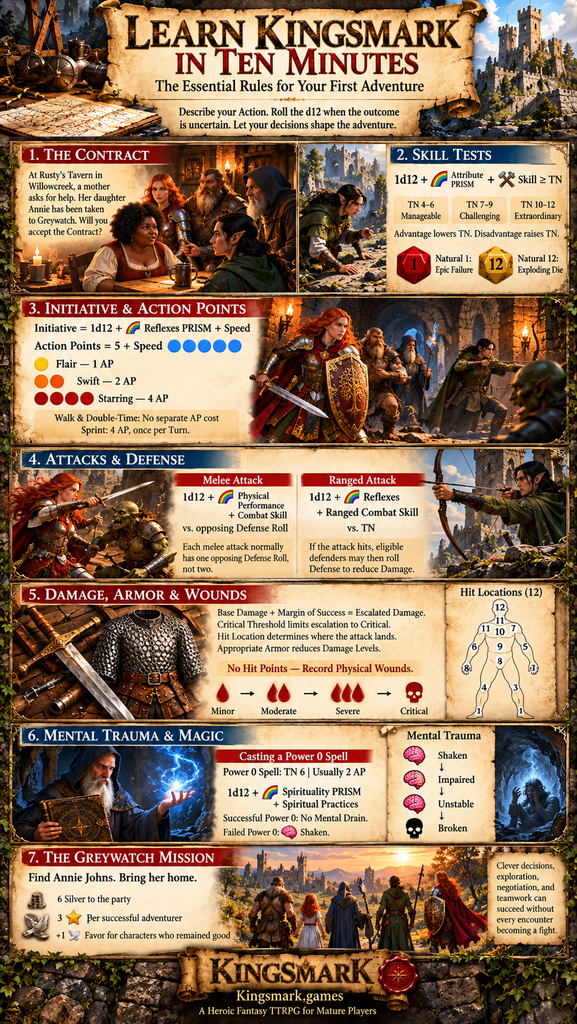
⏳ Learn Kingsmark in Ten Minutes
An Easy Guide for D&D Players and Dungeon Masters to Start Playing Kingsmark
Learn the essential rules of a heroic fantasy tabletop role-playing game by following an adventure into the ruins of Greywatch.
You don’t need to spend days studying rules before playing 👑Kingsmark. Although the First Edition Player’s Handbook contains 556 pages, the essential mechanics can be introduced in approximately ten minutes. You need to understand how characters attempt actions, how dice determine success, how combat works, and what happens when somebody gets hurt. Everything else can be learned as your adventures develop.
Kingsmark is a heroic fantasy tabletop role-playing game powered by ⭐Jack’s Cinematic d12 (JCd12), an original system built around a twelve-sided die, cinematic action, believable consequences, and creative freedom. One person serves as the Game Master (GM), describing the world, portraying its inhabitants, and interpreting the rules. The other players portray adventurers who make decisions, explore dangerous places, confront enemies, and determine the direction of the story.
The easiest way to understand these mechanics is to experience them through a miniature adventure. We’ll use a hypothetical version of Someone Didn’t Come Home, the introductory Mission found in 📎Appendix D — Dungeon of the complete Kingsmark Player’s Handbook. Along the way, you’ll learn the most frequently used rules and discover how they work together during an ordinary gaming session.
🍺 Your First Adventure Begins at Rusty’s
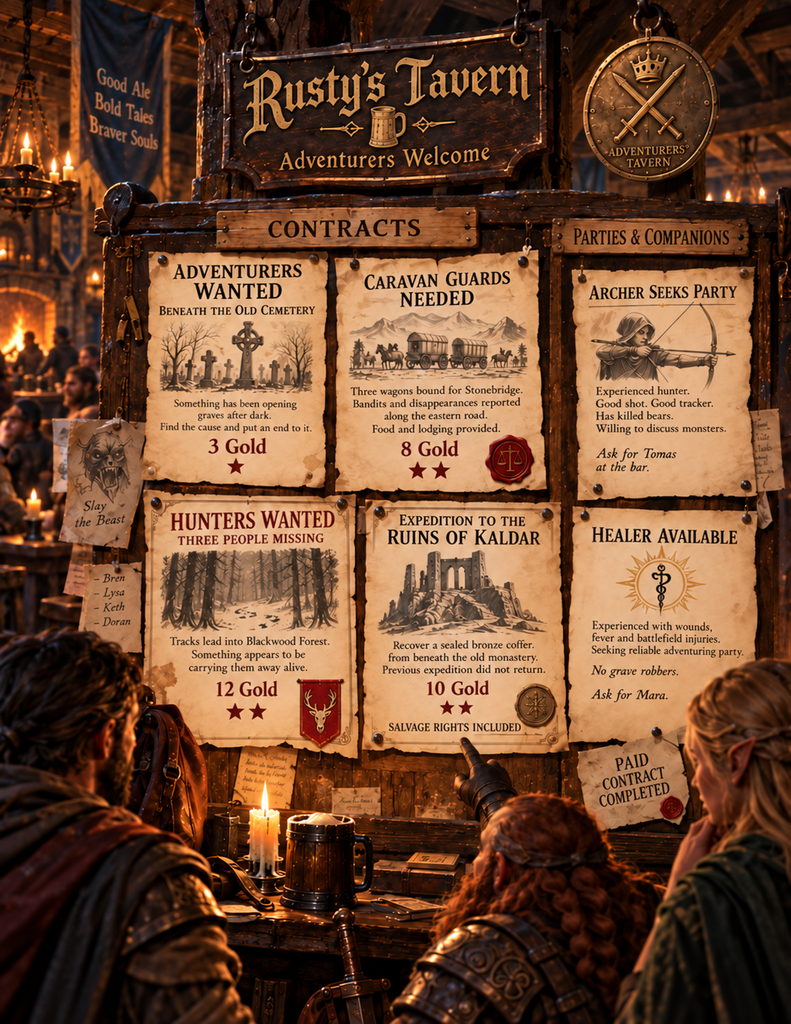
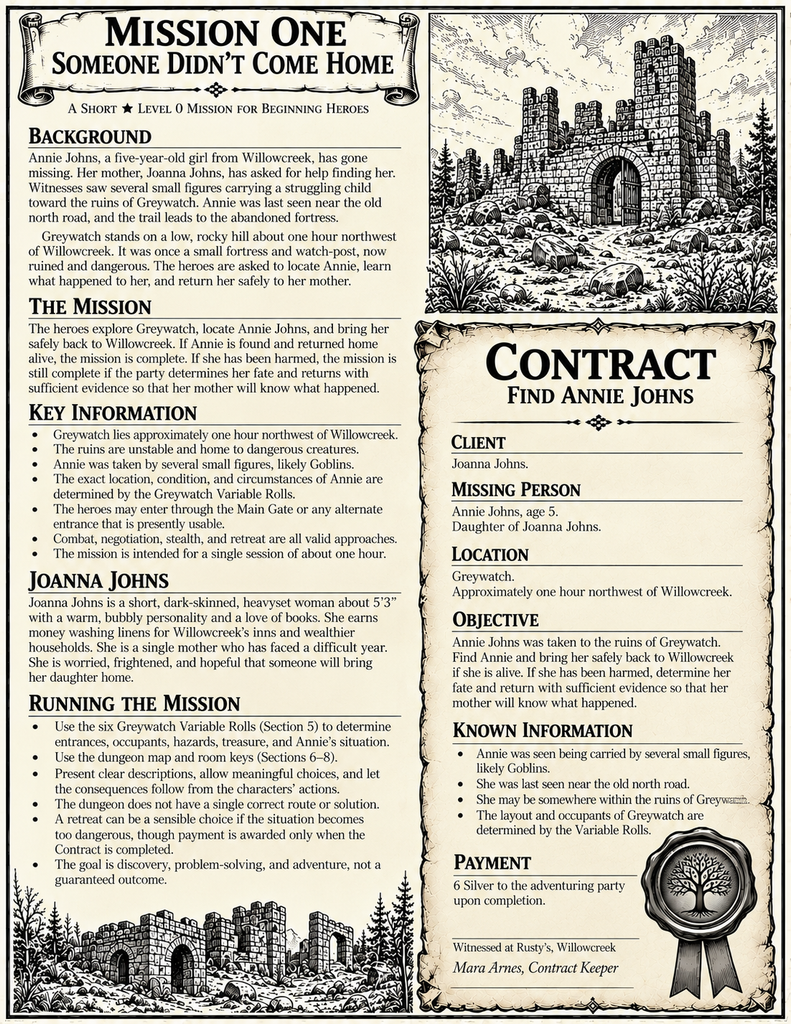
Imagine arriving at Rusty’s Adventurers’ Tavern in Willowcreek, a prosperous settlement in the Kingdom of Aldren. A desperate mother named Joanna Johns is searching for her missing five-year-old daughter, Annie. Witnesses spotted several small figures carrying a struggling child toward Greywatch, an abandoned fortress surrounded by marshland. Joanna has managed to raise six Silver pieces as a reward for anyone brave enough to bring her daughter home.
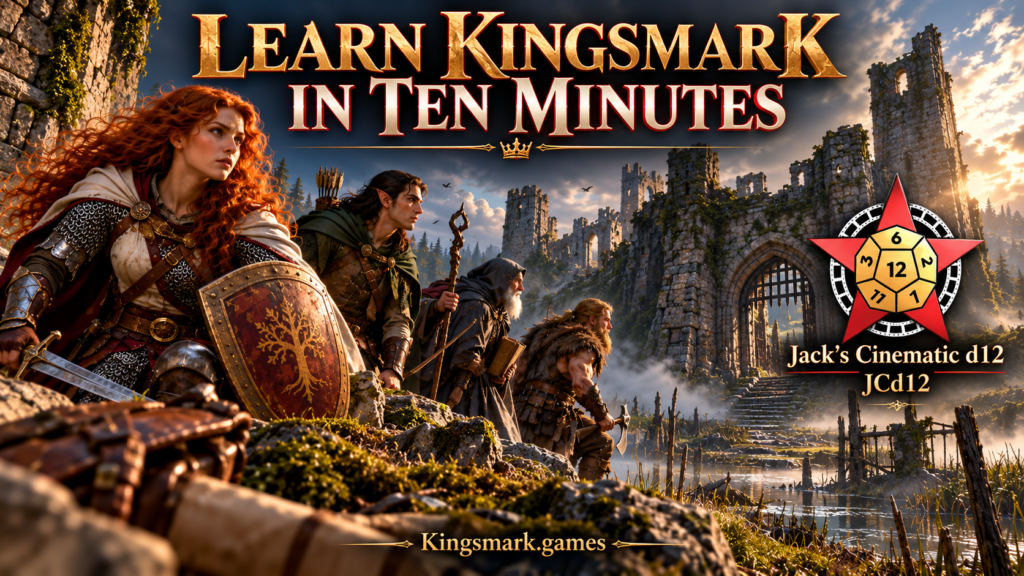
Your adventuring party accepts the Contract. The handbook provides four ready-made ⭐Level 0 characters in 📎Appendix C — Characters: Nosaj, a 🧙♂️Wizard; Ari, a 🏹Ranger; Lady Juliet, a 🛡Holy Knight; and Kashar, a 😡Barbarian. Each already has a completed 📖Character Bible containing his or her Attributes, Skills, equipment, weapons, and other essential information.
You can choose one of these adventurers without first learning the game’s complete 🎭Character Creation process. For now, familiarize yourself with your character’s strongest abilities, weapons, armor, and any spells you can cast. The GM describes Joanna’s situation, and the players decide what their characters do next.
That is the fundamental structure of Kingsmark: the GM describes the situation, the players decide what their characters attempt, and the rules resolve uncertain outcomes.
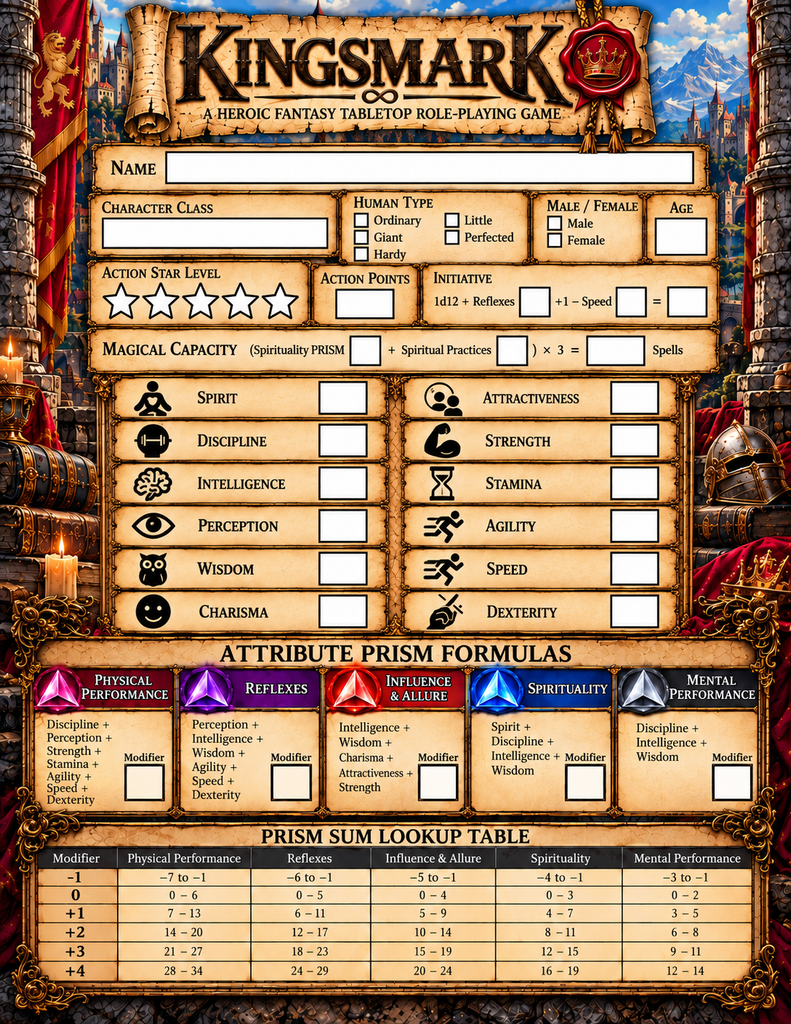
🎲 Your First Dice Roll
Before leaving Willowcreek, the adventurers examine evidence found along the road. A scrap of Annie’s clothing lies near several footprints, suggesting that the kidnappers struggled to control her. One player announces that Nosaj, the 🧙♂️Wizard, wants to examine the signs and reconstruct what happened.
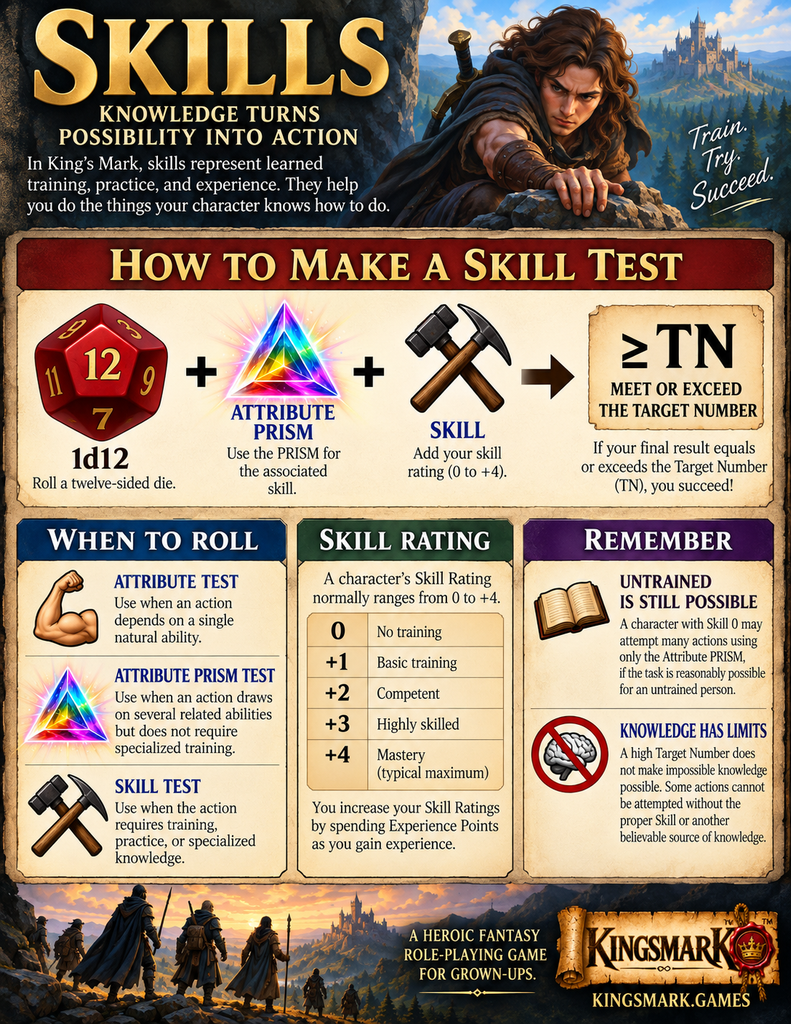
The GM calls for an ⚒Investigation Skill Test with a Target Number (TN) of 8. Kingsmark’s standard Skill Test formula is:
🎲 1d12 + 🌈Attribute PRISM + ⚒Skill = Result
Nosaj has 🌈Mental Performance PRISM +2 and ⚒Investigation +1. He rolls a 6 on his twelve-sided die, producing a final result of 9. Because 9 meets or exceeds TN 8, the Test succeeds.
The GM explains that Nosaj discovers signs of several captors dragging a struggling child toward the ruins. The evidence provides useful information, allowing the party to make a more informed decision about its approach.
Target Numbers represent difficulty. TN 4–6 generally describes manageable challenges under pressure, TN 7–9 covers increasingly difficult tasks, and TN 10–12 represents extraordinary difficulty. Characters succeed whenever their modified result equals or exceeds the required TN.
Circumstances also matter. Advantage lowers the Target Number, making success easier, while Disadvantage raises it, making success harder. Good equipment, preparation, favorable positioning, darkness, injury, and dangerous terrain can all change the difficulty without changing the character’s actual Skill Rating.
⭐Jack’s Cinematic d12 also features Exploding Dice. Rolling a natural 12 allows you to roll again and add the new result, potentially achieving extraordinary success. Two consecutive natural 12s produce Divine Intervention, while a natural 1 causes an Epic Failure with consequences appropriate to the situation.
You now understand the principal dice mechanic used throughout Kingsmark.
🗣️ Talking Is Part of the Adventure
Your party might question Joanna, interview witnesses, purchase equipment, or negotiate with somebody who knows about Greywatch. These conversations are called 🗣️Dialog Scenes when the exchange can meaningfully influence another character’s decisions or reveal important information. You describe what your character says, what you want to accomplish, and how you approach the conversation.
Ordinary conversation requires no dice. Joanna has every reason to tell you what she knows about Annie’s disappearance, so the GM simply portrays her and answers your questions. But persuading a suspicious witness to reveal dangerous information or convincing a hostile creature to cooperate may require a Test.
Persuasion normally uses 1d12 + 🌈Influence & Allure PRISM + ⚒Social Skills, opposed by another character’s corresponding result. The character’s relationship with the speaker and the nature of the proposal modify the difficulty. A reasonable offer to a friendly acquaintance is different from asking a bitter enemy to betray his companions.
Players do not need to deliver magnificent speeches to portray persuasive characters. Explain your intended argument or offer, and allow your character’s abilities to determine how effectively it is presented. Chapter 10 — 🗣️Dialog Scenes provides the complete procedures.
Joanna Johns — Hired Driver and Single Mother
Joanna is a short, dark-skinned woman, about 5’3″, heavyset, warm, cheerful, and far more likely to greet someone with a smile than a complaint. She is also an avid reader whenever work and motherhood allow it. Joanna is a single mother raising Annie, her five-year-old redheaded daughter. The much lighter complexion of her daughter suggests mixed ancestry or adoption, but most people are too polite to ask and simply know her as Joanna’s daughter. Joanna earns their living as a hired driver through The Mud Hen Livery (6), carrying passengers, luggage, messages, and small loads around Willowcreek and to nearby farms and settlements by horse and wagon. At the beginning of the Greywatch story, Annie has been kidnapped and clues point toward the ruins. Joanna has little money and no influence, but she will spend what she has to get her daughter back. She trusts Sister Cassia and knows Mara well enough to ask her for help finding adventurers. Joanna saw Annie being carried away but was unable to reach her before the kidnappers disappeared into the countryside. The experience left her with 🧠Impaired Mental Trauma from category #11 🔒 Isolation, Abandonment, and Imprisonment, centered upon the helpless terror of being separated from her daughter and knowing Annie is somewhere she cannot reach.
🏰 Exploring Greywatch
After traveling northwest through marshy countryside, the party arrives at Greywatch. Broken walls rise from the mist, an abandoned tower overlooks the old road, and dark passages descend beneath foundations considerably older than the fortress itself. The adventurers must decide how to approach the ruins, what equipment to prepare, and whether to enter openly or investigate the surroundings first.
Exploration uses the same rules you’ve already learned. Characters may search for tracks, examine suspicious masonry, climb obstacles, listen for enemies, or investigate possible traps. Some activities require Skill Tests, while others succeed automatically when the character possesses the necessary abilities, equipment, and opportunity.
Suppose the party discovers signs of a possible tripwire. The GM can apply Greywatch’s hazard rules, allowing a character to search using 1d12 + 🌈Mental Performance PRISM + ⚒Cloak & Dagger against the appropriate discovery TN. Finding a trap does not automatically disable it; the characters still need to decide how to avoid, disarm, or otherwise deal with the danger.
The players might extinguish their torches, approach through another entrance, or attempt to lure enemies outside. These decisions matter because Greywatch is a persistent location inhabited by creatures with their own motivations. Monsters do not automatically wait in their rooms until the heroes arrive.
In Kingsmark, players can attempt anything their characters could reasonably accomplish. The approximately 108 Actions described in the handbook provide rules and examples, not restrictions upon imagination.
▶️ When Danger Begins: Initiative & Action Points
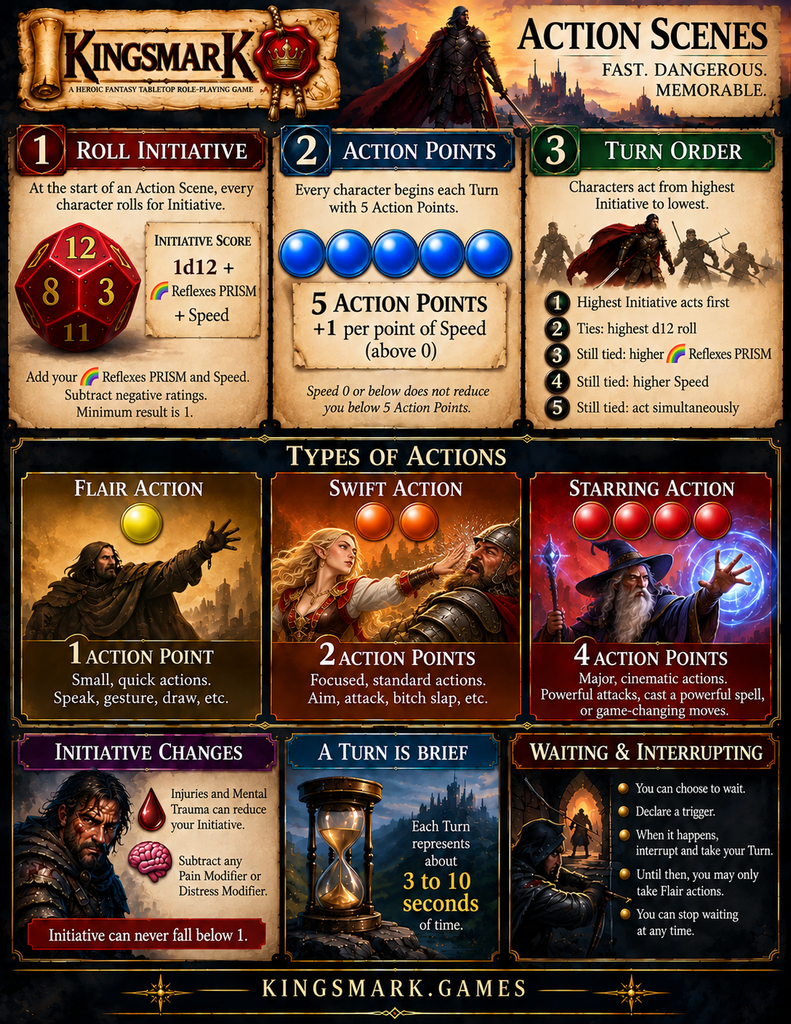
Imagine the adventurers entering a ruined chamber when a Goblin suddenly emerges from the darkness with a drawn weapon. Immediate danger begins an ▶️Action Scene, and the GM establishes ⏳Initiative to determine the Turn Order.
⏳ Initiative = 1d12 + 🌈Reflexes PRISM + Speed
Everyone acts from highest to lowest Initiative. Each character normally rolls Initiative once at the beginning of the Action Scene, and that order continues through subsequent Rounds unless circumstances alter somebody’s Initiative Score. A ▶️Combat Round represents approximately 3–10 seconds of overlapping cinematic action.
Characters also receive Action Points (AP), which determine what they can accomplish during their Turns.
🔵 Action Points = 5 + Speed
A character with Speed +1 receives 6 AP, while somebody with Speed −1 receives 4 AP. Ordinary actions fall into three categories: 🟡Flair Actions cost 1 AP, 🟠🟠Swift Actions cost 2 AP, and 🔴🔴🔴🔴Starring Actions cost 4 AP.
For example, a warrior with 6 AP could draw a sword for 1 AP, attack an enemy for 2 AP, and Dive for Cover for another 2 AP. That combination costs 5 AP, leaving 1 AP available for another appropriate action. Walking and Double-Time movement have no separate AP cost, while Sprinting costs 4 AP and is limited to once per Turn.
Players decide which actions make sense, then spend the necessary Action Points. The individual Actions in Chapter 12 — 🎬Example Actions explain their requirements and mechanical consequences. For a detailed explanation of the turn structure, consult ▶️Combat Round Sequence in Kingsmark.
⚔️ Your First Sword Fight
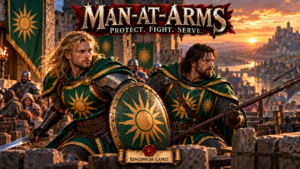
Lady Juliet, a🛡Holy Knight of 👁The Covenant, advances to protect her companions while the Goblin raises its weapon. She spends 🟠🟠2 Action Points to make an ordinary melee attack. Both combatants roll 1d12 + 🌈Physical Performance PRISM + the appropriate Combat Skill, with the defender’s result establishing the attacker’s Base Target Number.
Imagine Juliet’s modified attack result is 9 and the Goblin’s Defense Roll produces 8. Assuming no additional modifiers apply, Juliet succeeds by 1. That difference is called the margin of success, and it helps determine how serious the resulting injury becomes.
An ordinary ranged attack works differently. An archer rolls 1d12 + 🌈Reflexes PRISM + the appropriate ranged-combat Skill against a Realism Target Number determined by range and circumstances. If the arrow hits, an eligible defender can then attempt one Defense Roll to reduce its Damage.
An important distinction is that melee combat normally uses one opposed exchange, while ranged combat can involve an attack Test followed by a separate defensive reaction. The defender does not simply make unlimited Defense Rolls against the same attack.
Attacks can also involve positioning, aiming, grappling, disarming, or other cinematic maneuvers. Those techniques become easier to understand after practicing an ordinary attack. Chapter 11 — ▶️Action Scenes and Chapter 12 — 🎬Example Actions explain the more advanced possibilities.

💥 Damage, Armor & Physical Wounds
Kingsmark does not use conventional Hit Points. Characters suffer 🩸Physical Wounds that represent actual injuries, ranging from relatively minor harm to catastrophic bodily trauma.
Every weapon has a Base Damage Level. A successful attack increases that level by one category for every point of success above the final Target Number, although reaching 💀Critical also requires meeting the weapon’s Critical Threshold.
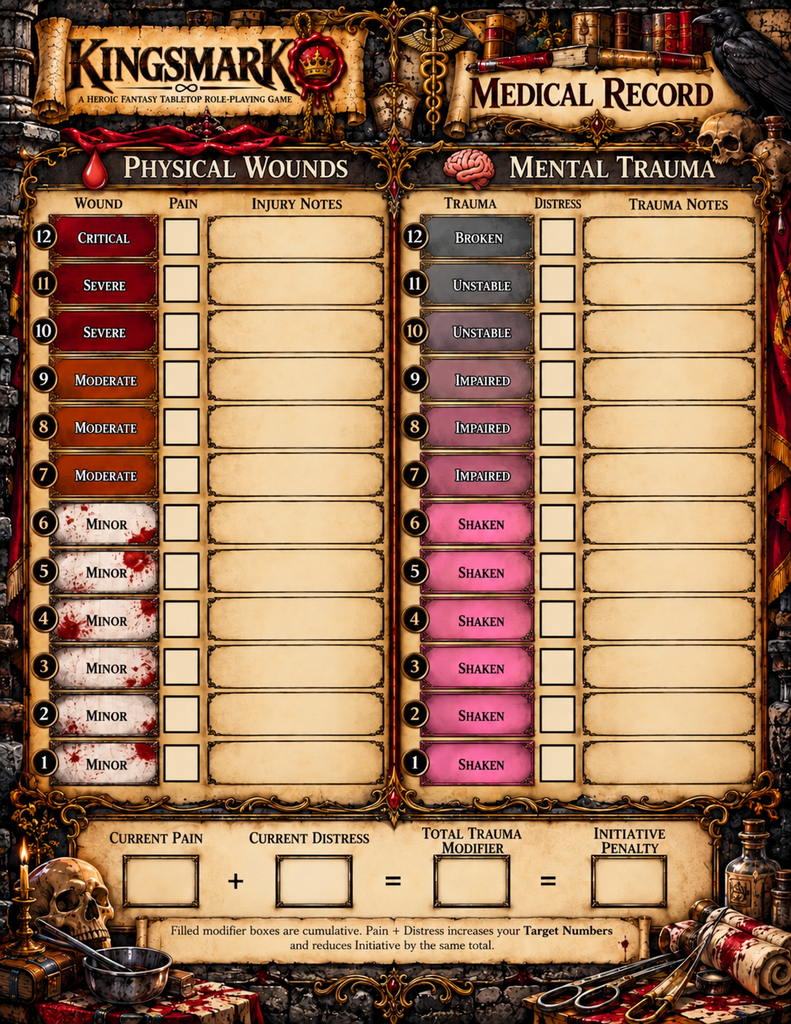
Return to Juliet’s sword attack. Suppose her weapon has 🩸Moderate Base Damage, and she succeeds by 1. Her attack escalates to 🩸Severe before Armor, and a Hit Location roll of 8 indicates the Goblin’s 💪Right Shoulder & Arm.
If the Goblin wears armor protecting that location with an applicable 🛡Armor Rating of −1 against the sword’s Damage Type, the injury is reduced one level to 🩸Moderate. The GM records that Wound in the Goblin’s Medical Record, taking account of any resulting Pain or physical limitation.
Physical Trauma uses four levels: 🩸Minor, 🩸Moderate, 🩸Severe, and 💀Critical. Mental Trauma uses corresponding levels of 🧠Shaken, 🧠Impaired, 🧠Unstable, and 💀Broken. The accumulation of these conditions can create Pain and Distress Modifiers that make actions more difficult and reduce Initiative.
Mental Trauma is appropriate when characters actually experience something sufficiently horrifying. Encountering a frightening supernatural manifestation in Greywatch might justify a Mental Trauma Test, but an ordinary dangerous encounter does not automatically require one.
Injuries remain meaningful after combat. Emergency first aid can stop bleeding or stabilize a wounded companion, but recovering from Physical Trauma ordinarily requires appropriate ❤️Healing Scenes and Recovery Time. Chapter 13 — 💥Damage & Defense and Chapter 14 — ❤️Healing Scenes explain these systems in detail.
📜 Your First Magic Spell
Magic follows the same fundamental principle of rolling a d12 against a Target Number. Spellcasters use 1d12 + 🌈Spirituality PRISM + ⚒Spiritual Practices, with the spell’s Power Level determining its difficulty. The four ordinary Power Levels have TNs of 6, 8, 10, and 12, although ⭐Level 0 magicians can cast their known spells only at Power 0.
Imagine Nosaj, the 🧙♂️Wizard, examining a chamber where strange coldness and unnatural movement suggest a supernatural disturbance. He casts his Power 0 Detect spell, attempting to sense whether magic is present. With 🌈Spirituality +2 and ⚒Spiritual Practices +2, a d12 roll of 4 produces a result of 8, successfully meeting TN 6.
Power 0 spells normally cost 🟠🟠2 AP during an Action Scene. Successful Power 0 casting causes no 🧠Mental Drain, while failure inflicts 🧠Shaken Trauma. More powerful spells can accomplish extraordinary miracles, but the mental risks increase considerably.
For your first adventure, learn the spells your own character knows. Chapter 15 — 📜Magic System explains casting requirements, supernatural defenses, Power Levels, and Mental Drain.
🕊️ Completing Your First Contract
After exploring the ruins, overcoming whatever dangers emerge, and finding Annie, the party must bring her safely back to Willowcreek. Perhaps the adventurers fought a Goblin, rescued her from a locked Storehouse, avoided a Spider, or negotiated their way through danger. Greywatch’s randomized Mission Variables make different outcomes possible, and the characters do not need to explore every room to succeed.
Returning Annie alive completes the first Contract. The party receives the promised 6 💰Silver, each successful adventurer earns 3 ⭐Experience Points, and characters who remained on the side of good receive the ordinary +1 🕊Favor. Their decisions also establish the continuing state of Greywatch, including which creatures survived, what routes were discovered, and what dangers remain.
Your party has now experienced the central mechanics of Kingsmark: exploration, conversation, Skill Tests, Target Numbers, Action Points, combat, damage, and possibly magic. You can continue into Greywatch’s second Mission, investigate another Contract, or begin developing your own adventures. The more frequently you play, the more naturally these rules become part of your imagination.
👑 Begin Playing Kingsmark
Everything necessary for your first campaign is contained in the Player’s Handbook. Appendix C supplies four ready-made adventurers, Appendix D supplies Willowcreek and Greywatch, and Appendix B provides the creatures that may appear during your Missions. The other chapters explain the rules whenever a particular situation requires them.
You can read the complete Player’s Handbook online at Kingsmark.games, download the official Character Bible sheets for free, or purchase the complete First Edition PDF on itch.io. These resources provide everything needed to turn your first ten minutes of learning into many hours of heroic fantasy adventure.
A small Contract involving a missing child might be the beginning of something extraordinary. Perhaps your adventurers eventually become famous Monster Hunters, celebrated warriors, powerful magicians, or heroes summoned before a king. Perhaps the mysteries beneath Greywatch lead somewhere nobody expected.
The adventure begins when the Game Master describes the world and asks a simple question:
What do you do?
— John Alan Martinson, Creator of 👑Kingsmark
Kingsmark.games — A Heroic Fantasy TTRPG for Mature Players.
About The Author