
⚔️ Man-at-Arms & Shieldmaidens 💋
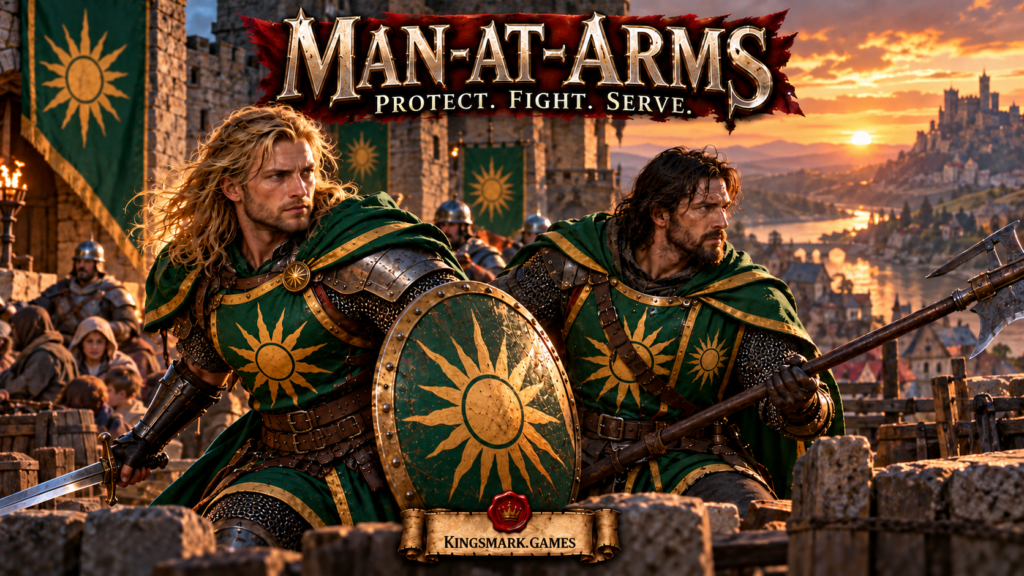
Real Heroes, Legendary Warriors, and Battlefield Tactics in Kingsmark
Discover the extraordinary courage of medieval knights, female warriors, American Medal of Honor recipients, and a Mexican Marine who gave his life fighting organized crime. Learn how to create and play a formidable ⚔Man-at-Arms in Kingsmark—and how to pursue a real career protecting others.
The Soldier Who Walked Back into the Fire
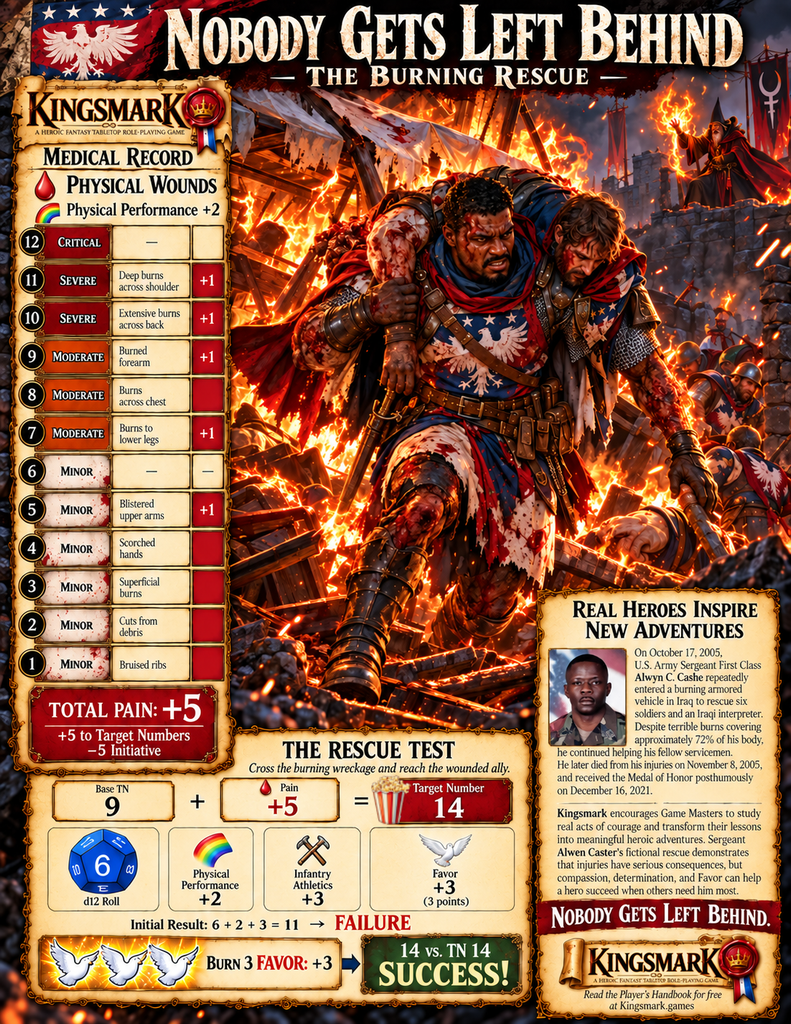
On October 17, 2005, an American armored fighting vehicle was engulfed in flames near Samarra, Iraq. An enemy attack had disabled the vehicle, ignited its fuel, and trapped several soldiers inside. Sergeant First Class Alwyn Cashe escaped the burning vehicle, but instead of running to safety, he turned back toward the 🔥🔥🔥 flames 🔥🔥🔥 because his men were still inside.
Cashe helped pull the driver from the wreckage, and during the rescue, his 🔥🔥⛽ fuel-soaked uniform 👕 caught fire 🔥🔥. He suffered terrible burns, yet he continued returning to the vehicle, helping more soldiers escape even as enemy gunfire swept the area. He could have stopped after saving one man, or after saving several, or when his own injuries became almost unbearable. He kept going 💪, saving 7 men 🪖🪖🪖🪖🪖🪖🪖 because other men were counting on him.
This was not a scene from a fantasy novel or an action movie. It happened, and the United States Army has preserved the extraordinary account of his actions. We will return to Sergeant Cashe, because his story reveals something important about the kind of warrior we are discussing.
The greatest Man-at-Arms is not necessarily the strongest person on the battlefield. Sometimes, the greatest warrior is the one who refuses to abandon somebody else.
What Is a Man-at-Arms?
Throughout medieval history, a man-at-arms was a professional warrior equipped and trained for military service. Many were knights, but knighthood was not a prerequisite; experienced soldiers could serve noble households, garrisons, armies, and mercenary forces without possessing aristocratic titles. Their profession required more than courage or the ability to swing a sword. They needed discipline, endurance, practical knowledge, and the ability to fight effectively alongside other armed men.
A medieval Man-at-Arms might serve as a bodyguard, escort merchants through dangerous territory, defend a castle, patrol hostile countryside, or participate in a military campaign. He might be a respected veteran, a penniless professional soldier, a wealthy household retainer, or a mercenary whose loyalty depended upon the terms of his contract. The distinction between these warriors was often not their equipment, but their experience, reputation, and sense of responsibility. Some served honorable causes, while others fought for employers whose ambitions were considerably less admirable.
In Kingsmark, the ⚔️Man-at-Arms represents this professional tradition. Unlike the 😡Barbarian, whose ferocity is a defining feature, or the 💪Brute, whose physical power can overwhelm opponents, the ⚔️Man-at-Arms excels through disciplined combat training and military experience. Unlike the 🛡Holy Knight, the ⚔️Man-at-Arms does not require supernatural power or religious devotion. His profession is warfare, and his greatest asset is knowing how to fight intelligently.
He understands weapons, shields, armor, marching, watches, defensive positions, military equipment, and the habits of dangerous people. He is comfortable fighting in confined spaces, facing armed opponents, protecting companions, and taking responsibility when an expedition encounters serious resistance. He can become a deadly swordsman, a defensive specialist, a capable wrestler, an accomplished archer, or a versatile professional with experience in several weapons.
Most importantly, the class does not demand a particular personality or moral code. Your ⚔️Man-at-Arms might be a humble village defender, an ambitious tournament fighter, a hardened mercenary, or a retired officer seeking adventure. He might be courageous, frightened, compassionate, arrogant, honorable, or deeply troubled by his past. Military training provides his foundation, but the person you create determines what he does with it.

⚔️ Shieldmaidens: The Female Men-at-Arms
Women who belong to this character class are commonly called ⚔️Shieldmaidens in the 👑Kingsmark Player’s Handbook. The name draws inspiration from the shieldmaidens of Norse literature, although the historical evidence concerning particular female Viking warriors is a separate and sometimes disputed subject. In Kingsmark, a Shieldmaiden is a female professional warrior with the same fundamental capacity to develop martial expertise as her male counterparts. Her equipment, methods, personality, and appearance can vary enormously.
The Player’s Handbook describes a particularly interesting tradition among Shieldmaidens: emphasizing mobility, psychological tactics, throwing weapons, and archery rather than relying exclusively upon contests of physical strength. Some deliberately employ 💋 beauty, revealing clothing, teasing, insults, apparent vulnerability, or theatrical displays to manipulate an opponent’s expectations. Others wear heavy armor, carry shields, command soldiers, and fight with the uncompromising professionalism of a veteran infantryman. These are different approaches to warfare, not restrictions imposed upon female characters.
Consider a beautiful ⚔️Shieldmaiden who appears to be an easy opponent because she is lightly armored and carries a comparatively small weapon. A careless enemy might interpret her appearance as weakness, only to discover that she is exceptionally agile, skillful at controlling distance, and quick to exploit a mistake. Another Shieldmaiden might find such theatrics ridiculous and prefer the reassuring weight of a mail hauberk, a reliable spear, and a disciplined defensive formation.
Kingsmark proudly embraces the seductive power of feminine beauty through its 💋Hotness Bonus, allowing a beautiful warrior to exploit attraction, distract susceptible enemies, encourage foolish decisions, or manipulate an opponent into underestimating her. Actions such as Feint, Battle Cry, Tactical Movement, and various forms of deception provide the mechanical foundation for her battlefield tactics, while 🌈Influence & Allure, ⚒Social Skills, and situational 💋Hotness Advantage can make her charm a formidable weapon. The player describes what the Shieldmaiden actually does, and the Game Master applies the appropriate rules and circumstances rather than assuming every enemy is helpless before a pretty face.

And Kingsmark doesn’t shy away from sexy fantasy armor! Sylva’s armorers offer everything from 👙Chainmail Bras and polished Plate Armored Bras to skimpy armored short skirts, revealing warrior harnesses, armored bikini bottoms, and provocative thigh-high boots. These aren’t merely decorative costumes: the Player’s Handbook provides actual Armor Ratings, Hit Location Coverage, and 💋Hotness Ratings, with provocative outfits offering −1 Advantage, extremely revealing attire offering −2, and scandalously revealing clothing potentially reaching −3 against susceptible observers. Of course, showing more skin means exposing more of the body to danger, creating an entertaining tactical tradeoff between physical protection and the social advantages of looking absolutely spectacular.
A Shieldmaiden can be a seductress, battlefield commander, mercenary, bodyguard, former outlaw, or devoted protector of her family. She might resemble a glamorous fantasy warrior whose beauty is every bit as memorable as her swordsmanship, or a thoroughly practical medieval soldier covered in mud, sweat, and armor. Kingsmark gives players the freedom to embrace either fantasy—or combine them into a beautiful, disciplined warrior who knows exactly when to use her sword, her shield, her intelligence, or her irresistible charm. What makes her a true Shieldmaiden is that she has deliberately chosen the profession of arms and possesses the training to make that choice meaningful. In Kingsmark, she doesn’t have to choose between being beautiful and being dangerous.
William Marshal: The Knight Who Became a Kingdom’s Protector
William Marshal, 1st Earl of Pembroke, lived from approximately 1146 to 1219 and became one of the most celebrated knights of medieval England. His career included tournament fighting, service to several kings, military campaigns, political intrigue, and extraordinary changes in fortune. His reputation grew from his accomplishments in an era when personal courage, horsemanship, weapons training, and the ability to survive dangerous encounters could determine a professional warrior’s future.
Marshal’s tournament career is particularly fascinating for Kingsmark players. Medieval tournaments could involve organized combat between groups of mounted warriors, dangerous captures, considerable financial rewards, and the opportunity to establish a reputation. Success depended upon experience, cooperation, the ability to recognize vulnerable opponents, and the judgment to avoid being captured yourself. A successful tournament fighter was not necessarily the strongest participant, but often the person who understood the unfolding contest better than his rivals.
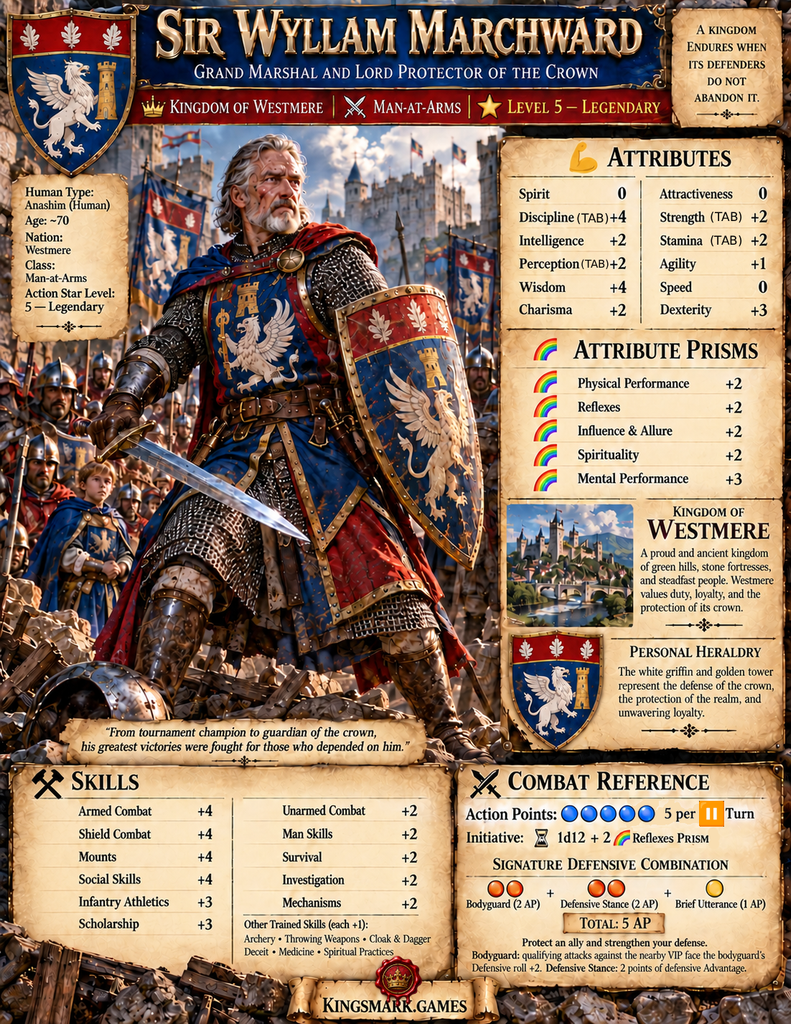
Marshal eventually became one of the most powerful men in England, but his most consequential military service occurred near the end of his life. When King John died in 1216, the English monarchy faced a dangerous rebellion and a rival claim supported by Prince Louis of France. Marshal became regent for the young King Henry III and assumed responsibility for defending the royal cause during an exceptionally uncertain period.
In May 1217, the elderly Marshal helped lead a force to relieve Lincoln, where royalist defenders remained under siege. The Battle of Lincoln became a decisive victory that helped preserve Henry III’s throne. Marshal’s success involved much more than personally confronting enemies: he organized military resources, maintained political alliances, and accepted enormous responsibility when his country faced possible defeat.
For a Kingsmark Man-at-Arms, William Marshal offers several possible character arcs. You might begin as an ambitious young professional earning money through dangerous contracts, then become a respected veteran whose experience allows him to command other warriors. Perhaps your character discovers that personal glory becomes less important with age, while defending a family, community, or kingdom becomes increasingly meaningful.
The career of a Man-at-Arms need not end with superior swordsmanship. He might eventually become somebody whose judgment determines whether an army fights, retreats, negotiates, or survives.
Nicola de la Haye: The Woman Who Held Lincoln Castle
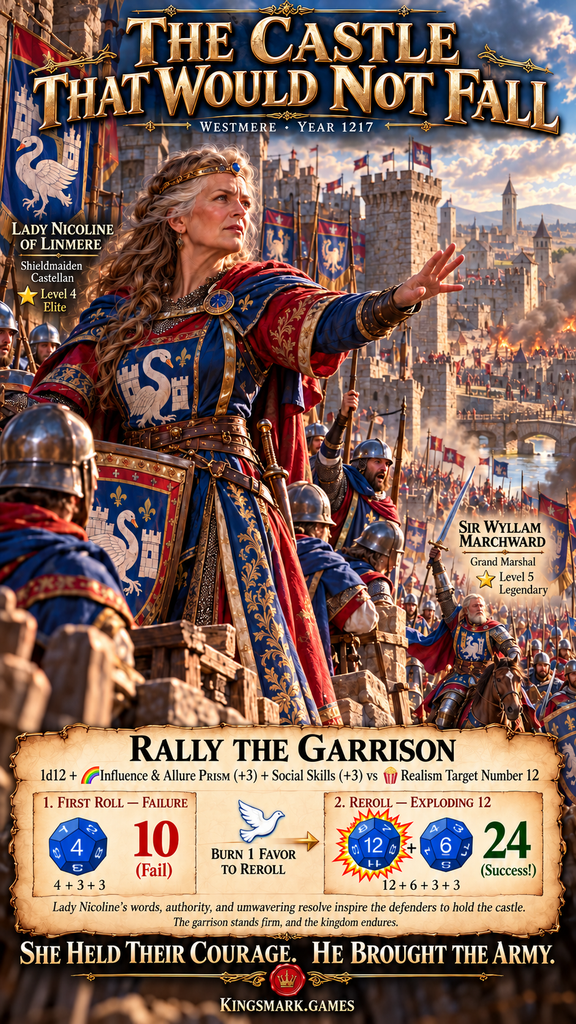
While William Marshal was organizing the relief of Lincoln, another remarkable figure was defending its castle. Nicola de la Haye was a medieval English noblewoman who exercised substantial authority as castellan and sheriff, responsibilities that placed military resources and political obligations under her control. Her story demonstrates that medieval warfare was not exclusively the domain of men and that military leadership often involved tremendous administrative and personal responsibility.
Nicola had already defended Lincoln Castle during an earlier siege in 1191. Decades later, she remained responsible for the stronghold during the civil war surrounding Henry III’s succession. By 1217, she was an elderly woman facing an exceptionally dangerous political situation, yet she continued to maintain the castle’s defenses while forces supporting Prince Louis controlled much of the surrounding city.
The castle’s survival mattered because its defenders prevented the besieging army from securing the entire position. When William Marshal’s forces arrived, the royalists were able to attack the besiegers, helping bring about a decisive victory. Lincoln Castle’s own historical account recognizes Nicola’s leadership in these defenses.
We do not need to imagine Nicola personally slaughtering enemies with a sword to appreciate her accomplishments. Her documented role was already extraordinary: she maintained a strategically important defensive position under conditions in which failure could have ruined the royalist cause. Leadership, persistence, organization, and courage made her one of the most important participants in the defense.
A Kingsmark Shieldmaiden inspired by Nicola might specialize in fortifications, battlefield coordination, military logistics, and protecting vulnerable people. She might be older, experienced, and perfectly capable of directing younger warriors who possess more physical strength but considerably less judgment. Her greatest ability might be recognizing the importance of a position that everyone else considers impossible to hold.
William Marshal and Nicola de la Haye together illustrate an important military principle: heroic individuals can accomplish remarkable things, but organized warriors achieve even greater results by cooperating.
Audie Murphy: The Soldier Who Refused to Retreat
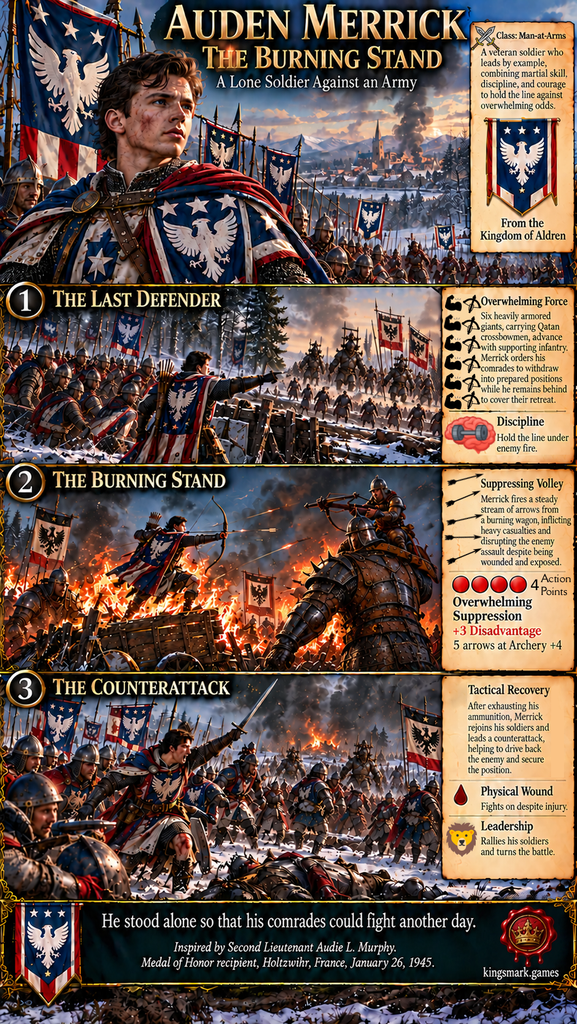
On January 26, 1945, near Holtzwihr, France, American soldiers faced an attack supported by German tanks and infantry. Second Lieutenant Audie Murphy, commanding Company B of the 15th Infantry Regiment, was responsible for men whose survival depended upon immediate decisions. The German attack threatened to overwhelm the American position, and Murphy ordered his soldiers to withdraw to prepared positions in nearby woods.
Murphy remained forward, directing artillery fire against the advancing enemy. One of the American tank destroyers was hit and began burning, creating a dangerous obstacle that could explode. As the enemy continued advancing, Murphy climbed onto the damaged vehicle and began firing its .50-caliber machine gun.
He fought from this exposed position while continuing to communicate with friendly artillery. The enemy attacked repeatedly, and Murphy remained under intense fire as he worked to disrupt their advance. Eventually, after exhausting the ammunition available to him, he withdrew and helped organize his soldiers for a counterattack.
Murphy’s actions earned him the Medal of Honor, and the Congressional Medal of Honor Society preserves the official citation. The account is astonishing, but its tactical lesson is sometimes overlooked. Murphy’s first responsibility was not to remain standing in front of the enemy for personal glory; it was to get his soldiers into a position where they had a better chance of surviving.
His courage also did not make him immune to the psychological consequences of war. Murphy later spoke publicly about the difficulties he experienced after combat, reminding us that extraordinary battlefield accomplishments do not erase trauma. A soldier can demonstrate remarkable courage while carrying psychological injuries that remain long after the fighting has ended.
A Kingsmark Man-at-Arms inspired by Murphy might be exceptionally dangerous in combat yet deeply concerned for the people under his command. He might learn to value defensive positions, reconnaissance, prepared retreats, and the conservation of resources. His character development could explore the difficulty of surviving terrible experiences while trying to remain a decent human being.
Murphy’s story teaches that retreating is not necessarily cowardice. Sometimes the bravest person on the battlefield is the one who knows when others must fall back—and volunteers to protect them while they do.

John Chapman: Alone Against the Enemy on Takur Ghar
The snow-covered mountain of Takur Ghar in Afghanistan became the scene of one of the most extraordinary documented battles involving an American special operations soldier. On March 4, 2002, Technical Sergeant John A. Chapman was serving as a United States Air Force Combat Controller attached to a Navy SEAL reconnaissance team. Combat Controllers are highly trained specialists who can operate with ground forces while coordinating aircraft, air support, and other complex battlefield activities.
During the mission, the team’s helicopter encountered intense enemy resistance while attempting to land on the mountain. Navy SEAL Neil Roberts fell from the helicopter as it came under attack, and the surviving team members faced an agonizing decision. They returned toward a heavily defended enemy position to attempt a rescue, fully aware that they were moving into danger.
Chapman was among the first warriors to attack the enemy positions after the team returned. He advanced through deep snow under fire and assaulted a fortified position, overcoming the defenders. He then moved toward another enemy emplacement and was severely wounded while attacking it.
His teammates believed he had been killed, and the surviving team withdrew under fire. Yet Chapman was still alive. In one of the most extraordinary developments of the battle, he regained the ability to fight and continued resisting enemy forces alone on the mountaintop.
Enemy fighters remained in fortified positions, and another American helicopter carrying a rescue force was approaching the mountain. Chapman continued engaging enemy personnel despite his wounds, helping disrupt threats to the arriving force. He was eventually killed, but his final actions became a remarkable example of courage under circumstances almost beyond comprehension.
The Congressional Medal of Honor Society’s account describes his extraordinary conduct, for which he was posthumously awarded the Medal of Honor on August 22, 2018. The National Museum of the United States Air Force also explains the broader Battle of Takur Ghar, often called Roberts Ridge. These accounts reveal how a relatively small number of people faced overwhelming danger during a complicated rescue operation.
What makes Chapman’s story especially unusual is that surveillance aircraft recorded parts of the battle. The imagery later helped investigators reconstruct his actions, including the fighting that continued after his teammates believed him dead. Readers can actually watch the released footage and examine the events that contributed to his Medal of Honor recognition.
Watch the actual battle: John A. Chapman Medal of Honor action — released U.S. Air Force surveillance footage. The video contains real combat imagery, not a reenactment, and has no synchronized battlefield sound.
Chapman’s heroism is inspiring because it demonstrates initiative, determination, technical competence, and an extraordinary commitment to fellow servicemembers. His example also illustrates why military professionals must train for difficult decisions, not merely develop physical strength. He had to act within an exceptionally dangerous situation, under tremendous pressure, while the survival of other soldiers was at stake.
For a Kingsmark Man-at-Arms, the lesson is that an experienced warrior does not become useless when the original plan fails. He assesses what remains possible, recognizes immediate threats, and uses the abilities still available to him. Sometimes the most important contribution a character can make is buying precious time for other people.
Leigh Ann Hester: A Modern Shieldmaiden
On March 20, 2005, an American military police unit was escorting a convoy near Salman Pak, Iraq, when enemy forces launched an ambush. The attackers occupied positions from which they could threaten the convoy and the soldiers responsible for its protection. Among the defenders was Sergeant Leigh Ann Hester, a member of the Kentucky National Guard’s 617th Military Police Company.
Hester and her fellow soldiers responded decisively to the attack. Rather than allowing the convoy to remain exposed, the military police positioned themselves between the attackers and the vehicles they were protecting. Hester then participated in an aggressive counterattack against enemy positions alongside Staff Sergeant Timothy Nein and other members of the unit.
The engagement lasted approximately thirty minutes and ended with the attackers defeated. Hester received the Silver Star, becoming the first woman to earn that decoration for direct combat action against an enemy. The Kentucky National Guard’s historical account preserves the details of the engagement and the recognition given to the soldiers involved.
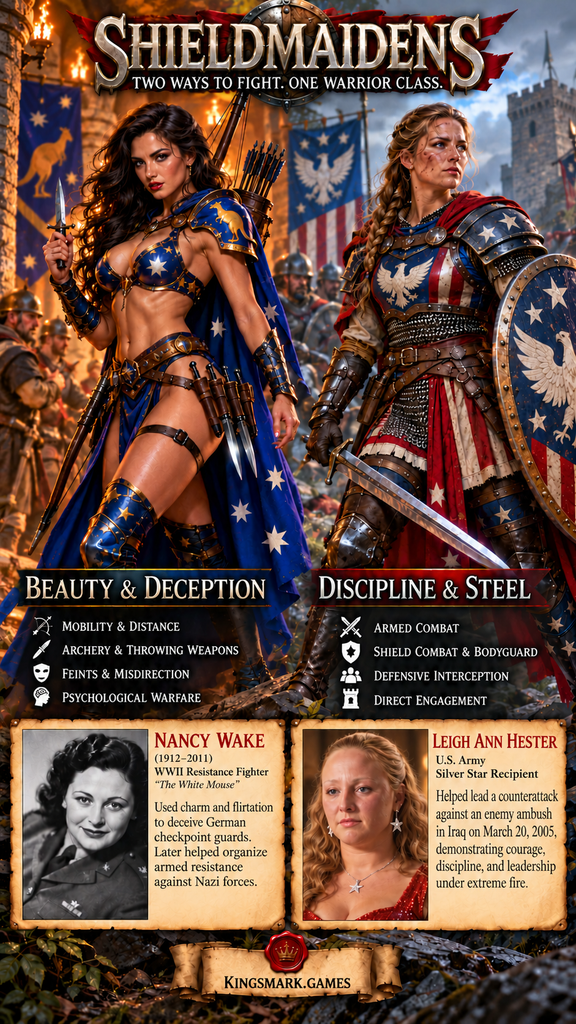
There is no need to invent a story about Hester defeating opponents through feminine charm or provocative clothing. Her real accomplishments involved weapons proficiency, courage, teamwork, and practical battlefield judgment. She demonstrated that a professional woman warrior could respond to a dangerous ambush with the same discipline and competence expected of any well-trained soldier.
For players creating Shieldmaidens, this is an especially valuable example. A female character may use attractiveness, deception, or mobility as tactical tools, but she should never be reduced to those characteristics. She can also be an intimidating, heavily armed veteran who has earned respect by repeatedly proving herself under dangerous conditions.
Hester’s example suggests an excellent character concept: a Shieldmaiden who is less interested in being admired than in ensuring everyone under her protection returns alive. She fights professionally, gives clear commands, and never confuses an impressive appearance with genuine competence. When others underestimate her, she does not need to argue about her abilities; her conduct demonstrates them.
Melquisedet Angulo Córdova: The Mexican Marine Who Gave His Life Fighting Organized Crime
On December 16, 2009, Mexican naval forces conducted an operation against members of the Beltrán Leyva criminal organization in Cuernavaca, Morelos. The operation targeted one of Mexico’s most dangerous organized-crime leaders, Arturo Beltrán Leyva, and resulted in an intense armed confrontation. Among the Mexican Marines participating was Tercer Maestre Melquisedet Angulo Córdova, a member of the Navy’s special forces.
Angulo was thirty years old and had served in the Armada de México since August 26, 1998. He had devoted more than eleven years of his life to naval service, acquiring experience within an institution whose missions included protecting Mexico’s security and confronting heavily armed criminal organizations. During the Cuernavaca operation, he was fatally wounded while performing his duties.
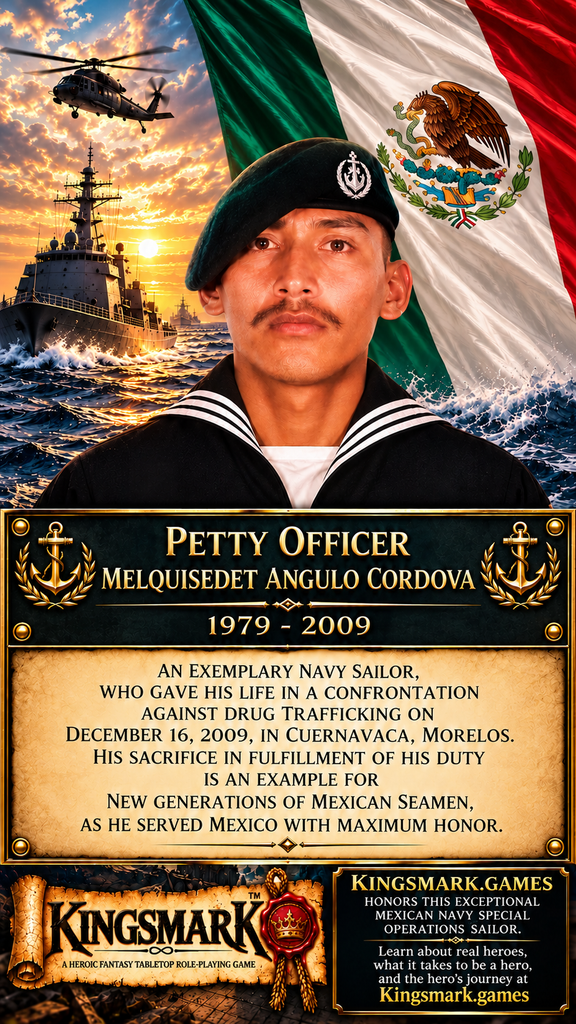
Mexico’s Secretaría de Marina publicly identified Angulo and honored his service in an official communiqué dated December 17, 2009. The confrontation resulted in the death of Arturo Beltrán Leyva and several other armed members of the criminal organization. The Navy reported that two additional naval personnel had been wounded.
On December 19, Mexican naval commanders assembled for a ceremony honoring their fallen comrade. Senior officers stood guard beside Angulo’s coffin, and the institution publicly acknowledged the sacrifice he had made. The Navy’s account of the ceremony records that he left behind two very young children.
Imagine what those children had lost. Their father had been a professional servicemember who participated in a dangerous operation against organized crime, and now he would never return home. Whatever public recognition accompanied his funeral, it could not replace the father whose presence his family would miss for the rest of their lives.
Then the tragedy became even worse.
Shortly after Angulo’s death, armed criminals murdered his mother, two siblings, and an aunt in Tabasco. Mexican authorities subsequently reported arrests connected to the killings and identified individuals allegedly involved in arranging the attack. The Secretaría de la Defensa Nacional’s December 22, 2009 announcement documents the authorities’ response.
This was not a medieval tale about imaginary villains. It was a modern tragedy involving real people whose families suffered catastrophic losses because of organized criminal violence. The consequences of such violence extend far beyond confrontations between armed men; they affect children, parents, siblings, communities, and ordinary citizens who simply wish to live peacefully.
Angulo’s service offers a powerful inspiration for a Kingsmark Man-at-Arms. The character might come from a community terrorized by bandits, violent gangs, or a criminal organization whose influence corrupts local authorities. Instead of becoming another criminal, he chooses a profession through which he can defend others and confront the dangers threatening his home.
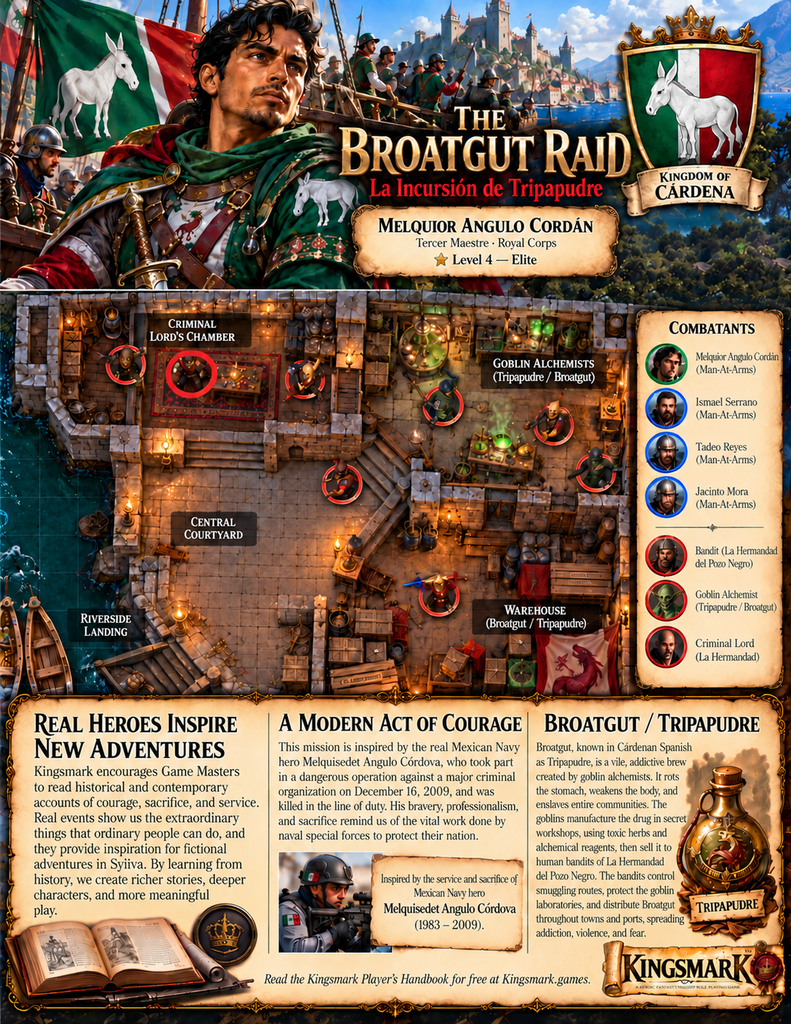
There is also an important distinction between lawful service and personal vengeance. A professional warrior acting to protect a community must possess the discipline to distinguish dangerous criminals from innocent people and to act under legitimate authority. The duty to protect civilians is not fulfilled by abandoning the very principles that make their protection worthwhile.
Melquisedet Angulo Córdova deserves to be remembered as more than a name in a report about a cartel operation. He was a Marine, a professional, and a father whose service cost him his life. His story reminds us why the struggle against organized crime is ultimately about the lives and futures of ordinary families.
Alwyn Cashe: The Soldier Who Would Not Abandon His Men
We began with Sergeant First Class Alwyn Cashe standing beside a burning armored vehicle. By the time the encounter ended, he had helped rescue six American soldiers and an Iraqi interpreter from the wreckage. His burns covered approximately seventy-two percent of his body, and his condition was critical.
Yet even after the immediate rescue, Cashe remained concerned about the other wounded men. When evacuation helicopters arrived, he refused to leave before the other casualties received attention. The official United States Army account describes a soldier whose determination to protect his companions continued despite terrible personal suffering.
Cashe died from his injuries on November 8, 2005. Years later, his actions received additional recognition when he was posthumously awarded the Medal of Honor on December 16, 2021. His family accepted the honor on behalf of a man who had already demonstrated, through his actions, what military comradeship could mean at its most extreme.
What makes this story extraordinary is not simply the number of people he helped rescue. It is the repeated decision to return to danger after he already knew how terrible the consequences could be. Many stories about courage concern a single sudden action, but Cashe demonstrated sustained selflessness through a sequence of decisions made under extreme physical suffering.
The people he rescued were not game pieces, and the tragedy cannot be reduced to a clever battlefield tactic. They were human beings whose lives mattered to him, and his actions gave them a chance to survive. His courage also came at an irreversible cost to himself and his family.
A Man-at-Arms inspired by Cashe might be the kind of character who regards every adventuring companion as somebody personally entrusted to his care. He could be stern, rough, impatient, or difficult to impress, yet utterly dependable when danger threatens. His heroism would emerge through decisions, not through speeches about honor.
The simplest possible expression of that philosophy is also one of the strongest: Nobody gets left behind.
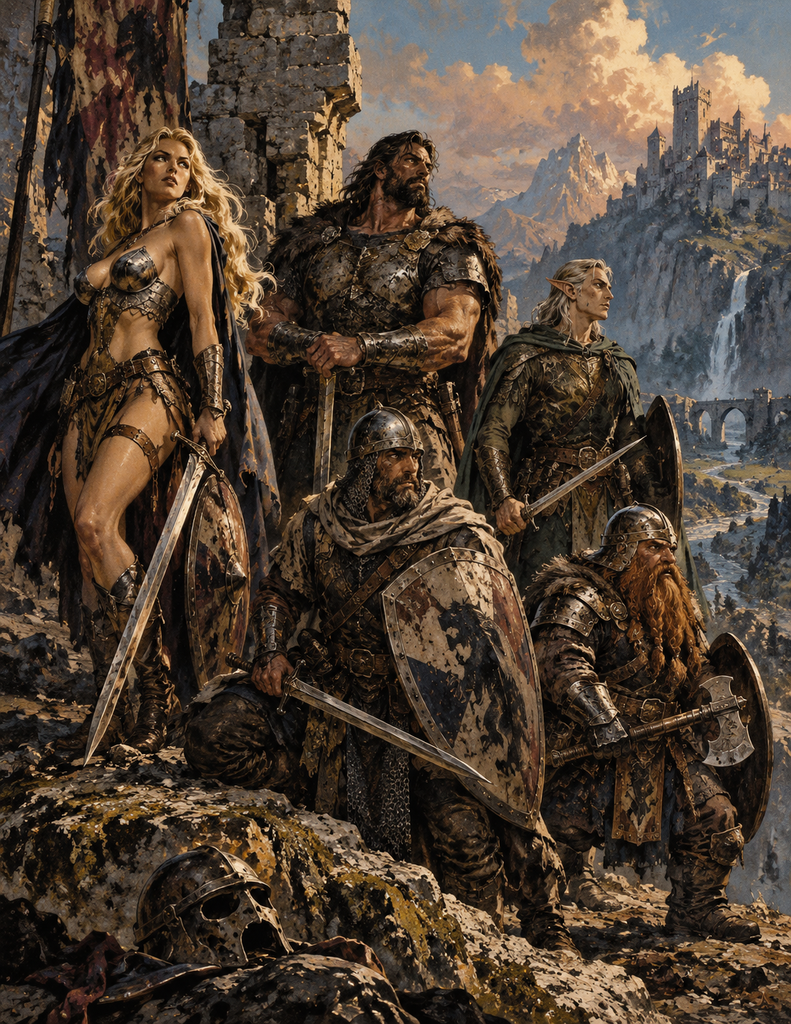
Creating Your ⚔️ Man-at-Arms in Kingsmark
Kingsmark’s Player’s Handbook establishes the Man-at-Arms as a trained professional rather than an exclusive social caste. The class requires Discipline +1, Strength +1, Stamina +1, Agility +1, Dexterity +1, and Perception +1, with the Trained Attribute Bonuses indicated for Discipline, Strength, Stamina, and Perception. Those prerequisites create a foundation combining physical capability, military awareness, and the ability to function under pressure.
The starting Skills include ⚒Armed Combat +1, ⚒Unarmed Combat +1, ⚒Shield Combat +1, ⚒Infantry Athletics +1, and ⚒Man Skills +1, along with seven Additional Starting Skill Points. These are not arbitrary decorations on a character sheet; they establish a warrior trained to fight with weapons, defend with shields, grapple or strike when necessary, maneuver through physical challenges, and understand practical masculine occupations and experience. Your subsequent choices determine whether the character specializes or develops a broader collection of useful military skills.
Standard starting equipment includes a martial melee weapon, dagger, shield, mail hauberk, padded armor worn beneath the mail, and a helmet. A warrior whose primary weapon requires two hands may exchange the shield for an appropriate secondary weapon or comparable military equipment. The character begins prepared for serious armed encounters, although equipment quality, coverage, damage types, and actual combat decisions remain important.
Consider the difference between five possible Man-at-Arms characters. One is a professional bodyguard whose primary concern is keeping a vulnerable person alive; another is a tournament fighter determined to establish a prestigious reputation. A third is an experienced mercenary motivated by money, a fourth is a Shieldmaiden whose beauty and agility conceal exceptional fighting skill, and the fifth is a former soldier whose experiences have inspired a personal vow never to abandon innocent people.
All five belong to the same class, yet they can feel completely different at the table. Their priorities determine which weapons they carry, which Skills they improve, what contracts they accept, and how they behave when violence becomes unavoidable. Their personalities and histories also determine whether they become trusted companions or dangerous liabilities.
The strongest character concepts connect professional competence to some meaningful personal ambition. Your warrior might want to earn enough money to purchase a home, rescue relatives, establish a mercenary troop, defend a village, or obtain the respect of a particular noble household. Those ambitions transform combat training into something personally significant.
Understanding Action Points and Battlefield Decisions
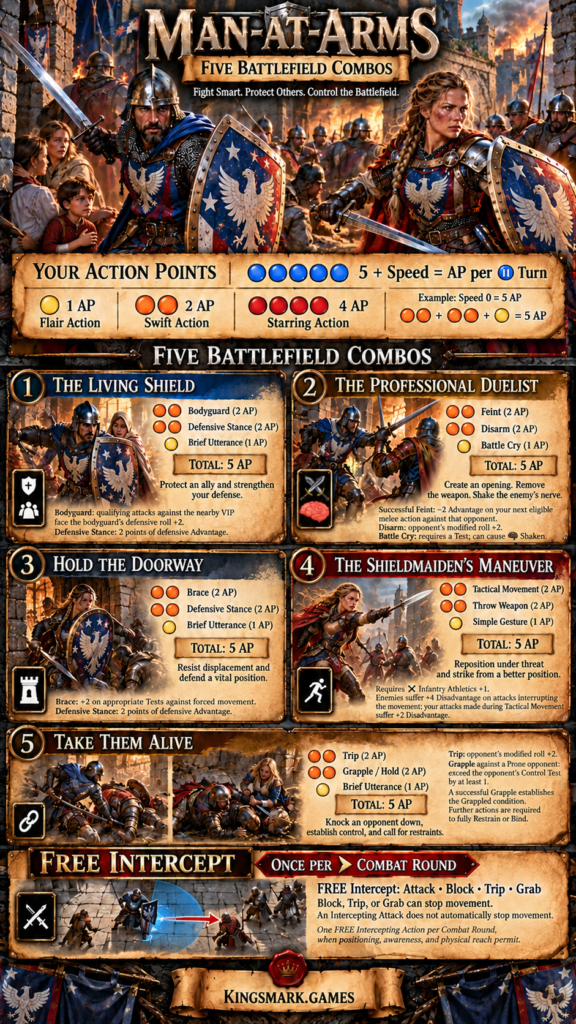
Kingsmark uses ⭐Jack’s Cinematic d12, with Action Points controlling the amount of meaningful activity a character can perform during a ⏸Turn. A character normally receives five Action Points, modified directly by Speed, so a warrior with Speed 0 receives five AP while a warrior with Speed +2 receives seven. The most common costs are 🟡Flair Actions requiring 1 AP, 🟠🟠Swift Actions requiring 2 AP, and 🔴🔴🔴🔴Starring Actions requiring 4 AP.
A warrior with five AP can perform two 2-AP actions and one 1-AP action, or one 4-AP action followed by one 1-AP action. This might mean defending and attacking in the same Turn, attempting two different offensive maneuvers, or devoting substantial effort to a single complicated feat. Ordinary Walk or Double-Time movement can be FREE when compatible with the other actions, while Sprinting requires four AP.
A beginning player may assume that the best strategy is to attack as frequently as possible. Against weak opponents, repeated attacks might be effective, but against dangerous enemies that approach can leave the character exposed, surrounded, or unable to protect companions. Experienced players recognize that positioning, defensive preparation, control maneuvers, and the timing of an engagement can be more valuable than another offensive roll.
The Man-at-Arms should therefore think like a professional responsible for accomplishing an objective. Perhaps the mission is to escape a burning building, rescue a wounded companion, hold a bridge, arrest a criminal, or prevent hostile soldiers from reaching an important prisoner. The objective determines which actions matter, and the most appropriate action may not involve injuring anyone.
The Living Shield: Protecting Companions
One of the most useful defensive abilities available through the ordinary action system is 🟠🟠Bodyguard, a 2-AP action. The warrior positions himself to protect a nearby companion designated as the VIP, and qualifying armed or unarmed attacks against that person must contend with the bodyguard’s defensive roll +2. The protection remains active until the beginning of the bodyguard’s next Turn, provided he stays close enough and physically capable of intervening.
This allows a Man-at-Arms to take responsibility for a Healer, Wizard, wounded companion, important prisoner, or frightened civilian. A heavily armed soldier standing between an attacker and a vulnerable ally can make an enormous difference, especially when a defensive position prevents enemies from approaching from several directions. Bodyguard is not magical protection, however, and it does not help when the defender is too far away, cannot perceive the attack, or has moved somewhere that makes intervention impossible.
A particularly reliable combination is 🟠🟠Bodyguard (2 AP), 🟠🟠Defensive Stance (2 AP), and 🟡Brief Utterance (1 AP). Bodyguard makes the warrior responsible for protecting the nearby VIP, while Defensive Stance grants two points of defensive Advantage until the beginning of the warrior’s next Turn. The Brief Utterance can provide a concise instruction, warning, or command without wasting the remaining Action Point.
The important lesson is that defense can be an active contribution to victory. If an enemy requires three Turns to reach a vulnerable ally because a Man-at-Arms controls the approach, the defender may accomplish more than somebody who merely inflicts another Wound. Protecting the right person at the right moment can change the outcome of an entire encounter.
Hold the Line: Terrain, Shields, and Interception
Terrain is one of the Man-at-Arms’ greatest allies. A narrow doorway prevents several enemies from surrounding a lone defender, while a staircase, bridge, passageway, or defensive barricade can force attackers to approach through limited space. A warrior who understands the physical arrangement of a battlefield can turn a dangerous encounter into a manageable defensive problem.
Kingsmark allows each character one FREE Intercepting Action per ▶️Combat Round when an enemy’s movement genuinely crosses a position the character can immediately interfere with. Depending upon the circumstances, the interceptor may Attack, Block, Trip, or Grab the moving opponent. A successful Block stops movement, a successful Trip knocks the target Prone and ends its movement, and a successful Grab establishes a Grapple and stops the target.
An Intercepting Attack may inflict Damage but does not automatically stop movement. The distinction matters because striking a charging opponent and physically preventing the opponent from passing are not necessarily the same accomplishment. Interception also requires awareness, physical reach, and a realistic opportunity, so standing somewhere nearby does not grant unlimited FREE attacks.
A shield contributes further defensive possibilities when the character can actually bring it between the attack and an appropriate Hit Location. Kingsmark distinguishes armor coverage and applicable Armor Ratings, meaning the direction of an attack, the shield’s position, and the damage type all matter. A warrior who allows opponents to surround him may lose the benefit of controlling which attacks his shield can intercept.
Another useful defensive action is 🟠🟠Brace, which grants +2 on appropriate Tests against being pushed, pulled, knocked Prone, overrun, or forcibly displaced. It does not provide a general bonus against ordinary weapon attacks and ends if the character voluntarily moves from the braced position. Combining Brace with Defensive Stance can make sense when the immediate objective is preventing enemies from forcing the defender away from an important location.
This is precisely the sort of military problem associated with castle defense and professional infantry. The warrior’s objective may be to remain in place, not to pursue fleeing enemies or inflict the greatest possible number of injuries. William Marshal and Nicola de la Haye remind us that control of an important position can have consequences far beyond a single duel.
Defeat an Opponent Without Killing Him
A Man-at-Arms who understands only how to kill is considerably less versatile than one who understands how to control a dangerous encounter. Kingsmark provides numerous actions for taking weapons away, knocking opponents down, pushing them away from vulnerable people, and physically restraining them. These maneuvers are especially valuable when the objective is rescuing a hostage, arresting someone, preventing an enemy from escaping, or ending a confrontation without unnecessary killing.
🟠🟠Disarm is an opposed maneuver with a Target Number equal to the opponent’s modified roll +2. If successful, the opponent loses the held weapon, which lands nearby unless the attacker’s margin sends it farther away. Removing a sword from an enemy’s hand can be more useful than striking an armored torso, particularly when the enemy is still dangerous but does not need to die.
🟠🟠Trip, Sweep or Takedown also requires overcoming the opponent’s modified roll +2. A successful maneuver knocks the opponent Prone, disrupting movement and making continued physical control easier. 🟠🟠Push Back uses the opponent’s modified roll +1 and can force an enemy away from a doorway, a wounded ally, or another important position.
Grappling offers another avenue for control, although it requires an appropriate Control Test and sufficient physical leverage. A successful Grapple does not automatically make an opponent helpless, completely immobilized, or safely tied up. Establishing a Grapple, advancing to Restraint, and completing Bindings are distinct accomplishments with their own rules and prerequisites.
These actions reward players who think about what they actually want to achieve. If the enemy is a confused guard, frightened civilian, dishonorable rival, or criminal who possesses valuable information, capturing him may produce a much better story than killing him. Combat becomes richer when victory has more than one possible meaning.
The Shieldmaiden’s Advantage: Mobility and Psychological Warfare
A Shieldmaiden who prefers speed and precision can become an especially interesting combatant. ⚒Infantry Athletics provides access to 🟠🟠Tactical Movement / Boxer’s Footwork once the character meets the +1 Skill requirement. This allows rapid movement using practiced footwork, making interruption attacks significantly more difficult while imposing a penalty upon attacks attempted during that movement.
Specifically, enemies suffer +4 Disadvantage when attempting to hit the moving character through an interruption, while attacks made by the character during Tactical Movement suffer +2 Disadvantage. The action costs two AP and does not magically prevent every form of attack. It provides a meaningful tradeoff between moving through danger and maintaining offensive precision.
A mobile Shieldmaiden might use throwing weapons, deliberately change position, or work with a heavily armored companion who attracts the enemy’s attention. She can exploit distance, cover, and the opponent’s inability to watch multiple threats simultaneously. The effectiveness of this style comes from understanding the encounter’s geometry rather than relying upon an imaginary female-specific combat bonus.
Psychological tactics offer additional opportunities. 🟡Battle Cry can attempt to inflict 🧠Shaken Mental Trauma through a threatening display, using the appropriate Physical Performance or Influence & Allure method. A striking appearance, deliberate taunt, intimidating gesture, or unexpected display of confidence may contribute to the fictional presentation, but the action must still satisfy its normal Test and circumstances.
The Shieldmaiden’s defining advantage may therefore be flexibility. She can fight like a conventional soldier when necessary, switch to ranged attacks when a direct engagement becomes unfavorable, and use social or psychological techniques when a hostile opponent is vulnerable to distraction. The best players will choose a style that reflects the character’s training and personality rather than mechanically repeating the same maneuver.
Five Useful ⚔️ Man-at-Arms Action Combinations
The following combinations assume a warrior with Speed 0 and five Action Points. They are not exclusive class abilities; they are examples of how an experienced Man-at-Arms can use the actions already available in the Player’s Handbook. Each sequence assumes the character possesses the necessary equipment, position, Skill prerequisites, and realistic opportunity.
The Living Shield — 5 AP. Perform 🟠🟠Bodyguard (2 AP), 🟠🟠Defensive Stance (2 AP), and 🟡Brief Utterance (1 AP). This is ideal when protecting a Healer, Wizard, wounded ally, or important civilian near the front line. The warrior defends the VIP while preparing to withstand appropriate attacks and issuing one brief instruction.
The Professional Duelist — 5 AP. Perform 🟠🟠Feint (2 AP), 🟠🟠Disarm (2 AP), and 🟡Battle Cry (1 AP). Feint requires beating the opponent’s result +1, and success grants −2 Advantage on the next eligible melee action against that opponent before the end of the warrior’s next Turn. If the follow-up Disarm succeeds, the enemy loses the weapon, while the Battle Cry provides a separate opportunity to threaten the enemy’s nerve.
Hold the Doorway — 5 AP. Perform 🟠🟠Brace (2 AP), 🟠🟠Defensive Stance (2 AP), and 🟡Brief Utterance (1 AP). The character prepares to resist forced displacement while maintaining an improved deliberate defense against applicable attacks. If an enemy subsequently attempts to pass through the defended position, the warrior may also have an opportunity to use his one FREE Intercepting Action for that Combat Round.
The Shieldmaiden’s Maneuver — 5 AP. Perform 🟠🟠Tactical Movement (2 AP), 🟠🟠Throw Weapon or Object (2 AP), and 🟡Brief Utterance or Simple Gesture (1 AP). The maneuver allows a properly trained Shieldmaiden to reposition while making interruption attacks more difficult, then employ an available throwing weapon when the action’s positioning and readiness requirements are satisfied. If the attack is made during Tactical Movement, the movement’s +2 attack Disadvantage applies.
Take Them Alive — 5 AP. Perform 🟠🟠Trip (2 AP), 🟠🟠Grapple (2 AP), and 🟡Brief Utterance (1 AP). A successful Trip places the enemy Prone, making an appropriate Grapple easier to establish under the physical-control rules. The final AP can be used to tell an ally to bring restraints, warn others not to attack, or demand that the remaining opponents surrender.
These combinations demonstrate the importance of recognizing the purpose of a Turn. Defending somebody, creating an opening, holding terrain, moving intelligently, or restraining an opponent may be more valuable than maximizing immediate damage. With a little experience, players can create their own combinations appropriate to the circumstances and their characters’ developing abilities.
Honor, 🕊️Favor, and the Psychological Cost of Warfare
A professional soldier is not automatically a good person. History contains courageous warriors who served cruel rulers, skilled mercenaries who committed terrible crimes, and ordinary military personnel who demonstrated extraordinary mercy. The distinction between competence and righteousness matters because Kingsmark allows characters to possess impressive abilities without guaranteeing that their choices are honorable.
A Man-at-Arms might accept a contract to protect a corrupt nobleman and later discover that his employer is responsible for atrocities. A Shieldmaiden might capture an enemy who previously murdered one of her friends, then face a difficult decision concerning that prisoner’s fate. These are opportunities for meaningful character development because the correct decision may conflict with anger, fear, professional loyalty, or personal ambition.
Kingsmark’s 🕊️Favor system connects heroic choices with the character’s continuing moral alignment. A character who remains on the side of good throughout a completed mission may gain Favor, subject to the rules and limits established in the Player’s Handbook. Favor does not accumulate automatically every time somebody performs an isolated good deed; the larger course of the mission matters.
Warfare also carries psychological consequences. Murphy’s postwar struggles, the losses endured by military families, and the terrible sacrifices described in these historical accounts remind us that combat is not merely an exciting series of victories. Kingsmark’s 🧠Mental Trauma system provides one means of depicting fear, distress, and psychological pressure alongside 🩸Physical Wounds.
A compelling Man-at-Arms might begin with the confidence of somebody who has won many battles, then discover that surviving a terrible event changes his understanding of courage. Perhaps he becomes more cautious, develops compassion for frightened recruits, or grows determined to prevent companions from making the same mistakes he once made. His adventures can explore professional mastery alongside moral and personal growth.
🎬 Example — The Last Defenders
The year is 1200, and a raiding force has attacked a fortified village in the Kingdom of Aldren. Smoke rises from a burning storehouse while terrified villagers retreat through a narrow gateway. Inside the entrance, a young Healer named Miriam is attending to a badly wounded merchant who cannot walk without assistance.
Standing between the Healer and the attackers are two professional warriors: Garran, a heavily armored Man-at-Arms carrying a sword and shield, and Sabine, a Shieldmaiden armed with a shortsword and several throwing knives. Both have Speed 0 and receive five Action Points on each Turn. Their mission is not to defeat the entire raiding force; they need to protect Miriam and the wounded merchant long enough for the other villagers to escape.
Garran declares 🟠🟠Bodyguard, spending 2 AP to protect Miriam, followed by 🟠🟠Defensive Stance for another 2 AP. With his remaining 🟡1 AP, he shouts a brief instruction for Sabine to watch the open flank. His defensive position will make qualifying attacks against Miriam contend with his defensive roll +2, provided he remains physically capable of intervening.
Sabine sees a raider trying to move around the barricade, where a second approach leads behind Garran. She uses 🟠🟠Tactical Movement to cross the threatened space while employing trained footwork, followed by 🟠🟠Throw Weapon to hurl a readied knife at an exposed attacker. The throw fails to stop the enemy, demonstrating that even a skilled warrior cannot depend upon every action succeeding.
The raider continues forward and attempts to pass Garran’s threatened position. Garran uses his one FREE Intercepting Action for the Combat Round, choosing Block rather than a damaging strike because his immediate objective is to prevent passage. The opposing rolls are resolved, and Garran wins the interception, stopping the raider’s movement at the gateway.
Another enemy appears behind the first, making it clear that the warriors cannot hold the position indefinitely. Sabine notices that the wounded merchant is now ready to be carried, while Garran realizes that remaining to kill more raiders will accomplish nothing if the civilians cannot escape. He shouts for Miriam to move, and the Shieldmaiden turns to cover the withdrawal rather than pursuing an injured enemy.
The villagers reach the interior passage and begin closing the gate. Garran withdraws deliberately when an enemy is positioned to interfere, using the appropriate 🟠🟠Withdraw action rather than assuming he can simply walk away without consequence. Sabine remains nearby to protect the retreat, and both warriors escape through the narrowing opening as the gate is barred behind them.
The adventurers have inflicted relatively little damage compared with what they might have achieved in a reckless battle. Nevertheless, their defense has succeeded because the Healer, the wounded merchant, and the escaping villagers are alive. When the Game Master asks what they intend to do next, Garran answers that they must organize the remaining defenders before the raiders find another entrance.
Sabine wipes the blood from her shortsword and looks toward the frightened families gathered behind the gate. She knows the attackers will return, but she also knows something more important: the people have defenders who understand their responsibilities. Whatever happens in the next battle, these warriors have already given the village something it desperately needed—time.
Could You Become a Real-Life Man-at-Arms?
Perhaps the stories of William Marshal, Nicola de la Haye, Audie Murphy, John Chapman, Leigh Ann Hester, Melquisedet Angulo Córdova, and Alwyn Cashe have inspired you to create a memorable character in Kingsmark. That is one reason we tell these stories. Yet some readers may discover that they want something more: a real profession in which courage, discipline, physical training, and the protection of others become part of everyday life.
The obvious modern equivalents of the Man-at-Arms include professional military service, law enforcement, executive protection, specialized rescue, and certain forms of private security contracting. Each profession involves different qualifications and responsibilities, but all can provide opportunities to develop practical skills while serving others. If one of these careers interests you, there are straightforward ways to begin investigating it.
🇲🇽 How to Join the Mexican Marines
Mexico’s Marines belong to the Infantería de Marina, a component of the Armada de México operating under the Secretaría de Marina (SEMAR). Mexican naval personnel perform a variety of missions, including maritime security, protection of strategic facilities, disaster response, and operations against organized crime under lawful government authority. Marines may serve in conventional units, security assignments, or other specialized positions according to their training, qualifications, and the institution’s needs.
Start with the official Secretaría de Marina recruitment page, which provides current requirements, application documents, and contact information. The Navy’s September 2026 recruitment notice specifies Mexican nationality by birth, medical and psychometric examinations, minimum heights of 1.63 meters for men and 1.55 meters for women, and a body mass index of 18.5 to 24.9. Specific vacancies may impose additional age, education, occupational, and fitness requirements, so applicants should verify the current announcement for the role they want.
Applicants should prepare their birth certificate, CURP, voter identification or applicable receipt, proof of address, tax registration, relevant military-service documentation, photographs, and other materials required by the current notice. The official page lists the complete documentation requirements, including the number of copies and the circumstances in which particular documents apply. Candidates also undergo screening for medical fitness, criminal history, and suitability for naval service.
For recruitment inquiries, SEMAR lists the telephone number 55 56 24 65 00, with recruitment extensions available on its official page. Its published contact information also includes direcoper.reclutamiento@semar.gob.mx for Mexico City recruitment inquiries. An applicant should ask specifically about Infantería de Marina vacancies and whether a particular opening leads to the desired military specialty.
The next step is to follow instructions from an authorized naval recruitment office. This may involve presenting identification and documents, completing physical measurements and medical evaluations, undergoing psychometric screening, and demonstrating the qualifications required for the available vacancy. Successful admission is followed by the training and assignment process applicable to the candidate’s position.
Recruitment is free. SEMAR explicitly warns that it does not employ outside recruiters or intermediaries who can obtain enlistment in exchange for money. Anyone promising to secure a military position through a private payment, social-media message, or unofficial representative should be treated with suspicion; consult the Navy’s official recruitment-fraud warning.
What If You Are Not Yet a Mexican Citizen?
This distinction is especially important for foreigners who admire the Mexican Marines and might consider becoming Mexican citizens specifically to serve. Under Article 51 of Mexico’s current Ley Orgánica de la Armada de México, active naval service requires a person to be Mexican by birth and not possess another nationality. Simply immigrating to Mexico and obtaining a certificate of naturalization does not satisfy the Mexican-by-birth requirement.
Mexico’s Constitution recognizes citizenship through both birth and naturalization, but these legal categories are different. Article 30 recognizes certain people born outside Mexico as Mexican by birth, including those born to a Mexican mother or father. Consequently, someone born abroad with a Mexican parent may already qualify as Mexican by birth even if the necessary documents have not yet been registered or obtained.
If that describes you, begin by contacting a Mexican consulate or the appropriate civil registry to establish your nationality and obtain the required documents. You should then ask SEMAR directly about its rules concerning additional nationality, proof of status, and eligibility for military service. Do not assume that possessing a Mexican passport—or obtaining citizenship through naturalization—automatically makes you eligible for the Marines.
Foreigners who have no basis for Mexican nationality by birth can investigate Mexican naturalization through the Secretaría de Relaciones Exteriores, but they should understand that naturalization alone does not open the ordinary path into the Armada de México. They may instead find opportunities through lawful civilian security work, emergency services, humanitarian rescue, technical occupations, or other professions consistent with their immigration status. Anyone considering such a major life decision should obtain official confirmation of eligibility before investing in specialized military preparation.
🇺🇸 How to Join the United States Armed Forces
For readers interested in American military service, the process begins with an official recruiter. The United States government’s military enlistment guide explains the citizenship or residency rules, educational qualifications, age limits, medical examinations, physical requirements, and Armed Services Vocational Aptitude Battery. It also provides official recruiting contacts for the Army, Marine Corps, Navy, Air Force, Coast Guard, and Space Force.
Those drawn to the story of John Chapman may want to investigate the Air Force Combat Control career field. Combat Controllers undergo exceptionally demanding selection and training because their work can combine ground operations with sophisticated air-control responsibilities. Eligibility to enter the Air Force does not guarantee selection for Combat Control or any other specialized assignment.
Other readers may be more interested in infantry, military police, security forces, rescue, combat medicine, intelligence, or engineering. These fields require different aptitudes and can produce very different professional experiences. A recruiter can explain which opportunities are currently available and what the applicant must accomplish to qualify.
Police Officers, Bodyguards, and Professional Protectors
Military service is not the only career inspired by the Man-at-Arms. Police officers, investigators, and specialized law-enforcement personnel may spend their careers protecting vulnerable people, arresting dangerous suspects, preserving evidence, and responding to serious emergencies. The path generally involves meeting local hiring requirements, passing background and medical examinations, completing academy training, and developing the judgment required to exercise legal authority responsibly.
Professional bodyguards, often called executive protection agents or close protection operatives, protect individuals who may face elevated security risks. Their work involves planning, situational awareness, transportation, communication, emergency response, and the ability to recognize problems before they become confrontations. Requirements depend on the country and jurisdiction; for example, the United Kingdom has a formal Security Industry Authority qualification and licensing process for close protection.
Another especially meaningful possibility is helping recover missing or abducted children. Law-enforcement investigators, missing-person specialists, licensed private investigators, and organizations assisting families can contribute to locating endangered children and supporting lawful recovery efforts. The National Center for Missing & Exploited Children offers career opportunities in case management and other specialties devoted to finding missing children and reducing child exploitation.
Child recovery work requires particular care because custody disputes, international abductions, and criminal investigations involve legal authority and sensitive evidence. A person cannot simply declare themselves a recovery agent and seize a child; legitimate work must comply with the applicable laws and coordinate with responsible authorities. For somebody whose personal motivation is protecting children, investigative training, law enforcement, and accredited child-protection organizations offer serious avenues to explore.
Mercenaries and Private Military Contractors
The historical Man-at-Arms could earn his living as a mercenary, and professional contract security work still exists today. Modern private military and security contractors may provide armed protection, guard facilities, escort personnel, train security forces, or perform related services under contractual arrangements. Many positions require previous military or law-enforcement experience, specialized qualifications, and authorization to work in the relevant jurisdiction.
However, a legitimate private security contractor is not automatically a mercenary under international law. The International Committee of the Red Cross explains that the legal definition of a mercenary is narrower than the popular meaning of the word, while contractors working near armed conflict remain subject to significant legal obligations. Anybody considering this field should research employers carefully, establish the legality of the proposed work, and understand the protections and responsibilities applicable to the assignment.
Finally, there are rescue professions in which protecting lives is the central mission rather than an occasional responsibility. Firefighters, emergency medical personnel, search-and-rescue specialists, disaster responders, and humanitarian relief workers regularly enter difficult environments to help people who cannot escape danger on their own. Their training, discipline, and willingness to assist strangers embody many of the same qualities we admire in great professional warriors.
If these stories have inspired you, take that inspiration seriously. Search for an official recruiter, examine the qualifications for the career that interests you, and begin learning what its training and responsibilities actually require. Whether you dream of serving in the Mexican Marines, becoming an American soldier, protecting civilians as a police officer, locating abducted children, or rescuing people during disasters, a meaningful professional path begins with preparation and a willingness to accept responsibility.
And if your adventures begin in the fictional world of Sylva, create a ⚔️Man-at-Arms or Shieldmaiden worthy of the people whose stories inspired you. Give that character convictions, ambitions, weaknesses, hard-earned skills, and companions worth protecting. Remember William Marshal and Nicola de la Haye at Lincoln, Audie Murphy at Holtzwihr, Leigh Ann Hester in Iraq, John Chapman on Takur Ghar, Melquisedet Angulo Córdova in Cuernavaca, and Alwyn Cashe returning to a burning vehicle.
The world will always need people willing to protect others. Whether your battlefield exists in Kingsmark or your responsibilities belong to the real world, decide what kind of person you intend to become—and begin preparing to live up to that decision.
About The Author