▶️Combat Round Sequence in 👑Kingsmark
— Initiative, Action Points & Turn Order
Learn how combat rounds work in Kingsmark, including d12 Initiative rolls, Action Point costs, Turn Order, movement, and tactical decisions during combat.
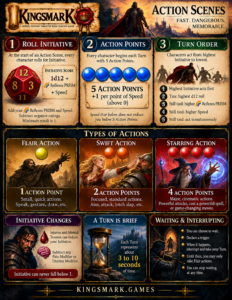
Combat in Kingsmark follows a structured sequence designed to keep battles fast-moving, cinematic, and understandable. Rather than constantly recalculating Initiative or allowing combat to become an endless exchange of isolated attacks, the game establishes a Turn Order and maintains it throughout the Action Scene.
A typical ▶️Combat Round represents approximately 3–10 seconds of action. Although players take their ⏸Turns individually for practical reasons, their characters are understood to be moving, fighting, reacting, and making decisions during overlapping moments of the same violent encounter.
The rules are presented in Chapter 11 — ▶️Action Scenes.
⏳Rolling Initiative and Establishing Turn Order
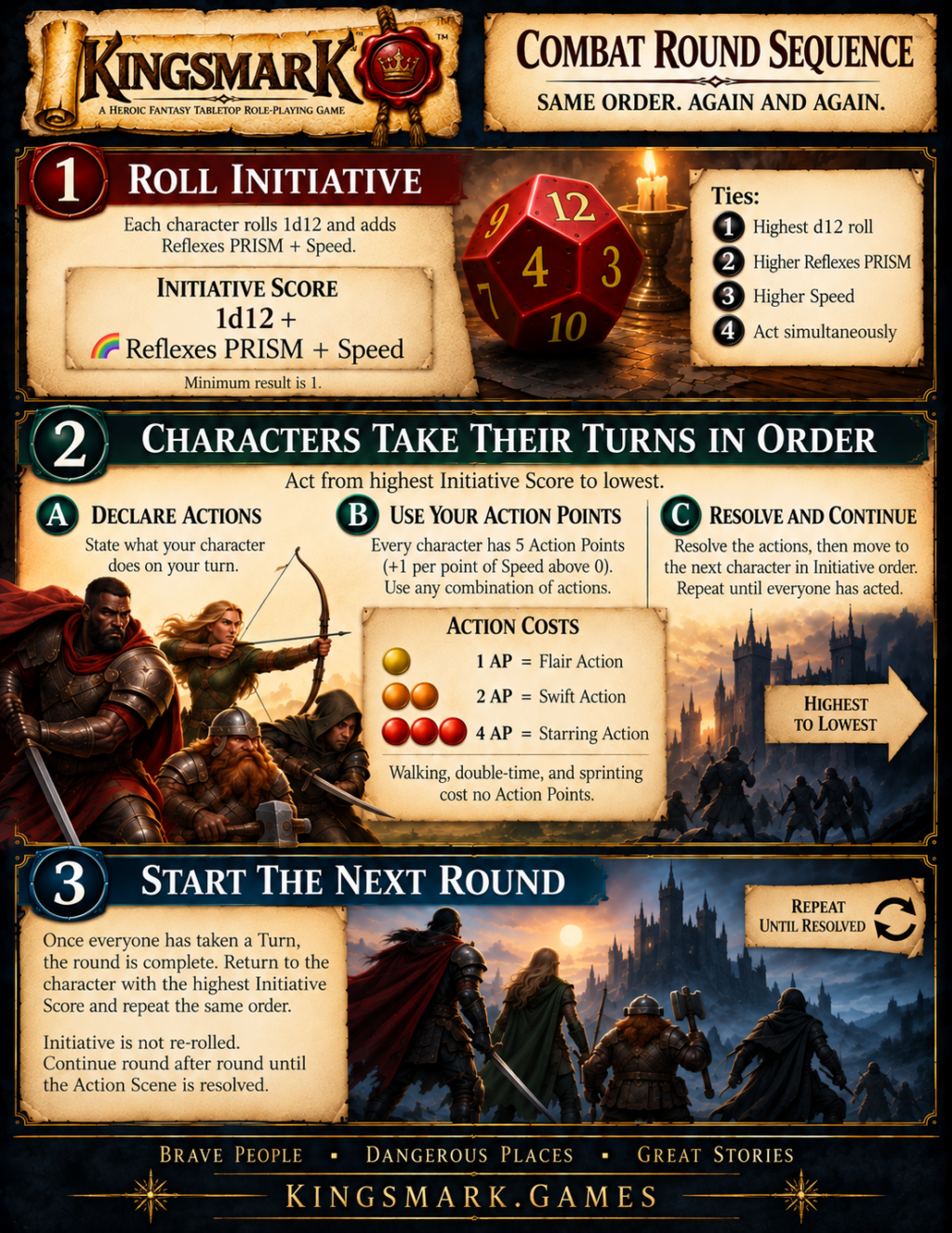
At the beginning of an Action Scene, every participating character determines an ⏳Initiative Score using 1d12 + 🌈Reflexes PRISM + Speed. Positive Attribute Ratings increase the result, while negative ratings reduce it. Initiative can never fall below 1.
The character with the highest Initiative acts first, followed by the others in descending order. When two characters have identical scores, compare their original d12 rolls. If these also match, the character with the higher 🌈Reflexes PRISM acts first, followed by higher Speed. If everything remains tied, their actions occur simultaneously.
Initiative is normally rolled only once per Action Scene. When the next Combat Round begins, the same Turn Order repeats unless something has changed a character’s Initiative Score.
🔵Action Points Determine What Characters Can Do
Every character normally begins each ⏸Turn with 🔵🔵🔵🔵🔵 5 Action Points, modified directly by their Speed Attribute. Speed +2 provides seven Action Points, while Speed −2 provides three. Characters cannot receive fewer than one Action Point per Turn.
Action Points represent the amount of acting time available during a Turn, not physical energy or magical power. Characters may perform any combination of eligible actions they can afford.
A 🟡Flair Action costs 1 Action Point and includes quick activities such as drawing accessible equipment, making a brief statement, or gesturing. An 🟠🟠Swift Action costs 2 Action Points and includes ordinary melee attacks, aiming, grappling, and numerous combat maneuvers. A 🔴🔴🔴🔴Starring Action costs 4 Action Points and includes demanding activities such as Sprinting or complicated maneuvers.
Walking and Double-Time movement have no separate Action Point cost because they occur alongside other activities. Sprinting costs 4 Action Points and can occur only once per Turn. Characters must possess enough Action Points to pay an action’s entire cost, and unused points normally disappear when the Turn ends.
For a comprehensive selection of possible actions, consult Chapter 12 — 🎬Example Actions.
⏸Resolving Turns and Beginning Another Round
When a character’s Turn arrives, the player declares the intended actions, spends the appropriate Action Points, and resolves any necessary Tests. The Game Master then proceeds to the next character in Initiative order.
After everyone has completed one Turn, the ▶️Combat Round ends. The next Round begins with the character currently possessing the highest Initiative. Nobody rolls Initiative again simply because another Round has begun.
Characters may also enter Laying in Wait, delaying their Turn until an appropriate opportunity arises. An interrupting character must announce the interruption after the triggering action is declared but before its dice are rolled or automatic consequences occur. This allows tactical decisions such as protecting an ally before an enemy’s attack resolves.
Initiative can nevertheless change during combat. Accumulated 🩸Pain and 🧠Distress reduce a character’s Initiative Score immediately. A wounded combatant might consequently act later in the Turn Order, although an Initiative change never grants a second Turn or erases one already completed. These consequences are explained further in Chapter 13 — 💥Damage & Defense.
🎬Example — Ambush at the Merchant’s Crossing
Three armed brigands ambush a merchant caravan traveling toward Greywatch. Sera, an Elf Ranger, steps forward with her sword while Garran, an armored warrior, remains beside the frightened merchant.
The Game Master calls for ⏳Initiative. Sera rolls 8, adding 🌈Reflexes PRISM +2 and Speed +1, producing Initiative 11. Garran rolls 9, adding Reflexes +1 and Speed 0, producing Initiative 10. The brigand captain rolls 9, adding Reflexes 0 and Speed +1, also producing Initiative 10.
Garran and the captain have identical Initiative Scores and original dice rolls. However, Garran’s higher Reflexes PRISM breaks the tie. The Turn Order becomes Sera, Garran, and then the captain.
Sera possesses 6 Action Points because her Speed is +1. She advances at Double-Time without a separate Action Point cost, draws her sword with 🟡1 Action Point, attempts an 🟠🟠2-Action-Point melee attack, and spends 🟠🟠2 more upon Defensive Stance. She has spent five Action Points and cannot carry her unused point into the next Turn.
Garran possesses five Action Points but suspects that the captain intends to attack the merchant. Rather than acting immediately, he enters Laying in Wait and declares that he will intervene if the captain attacks his employer.
The captain announces an attack against the merchant. Before the attack roll, Garran declares his interruption and spends 🟠🟠2 Action Points upon Bodyguard. Because he is already beside the merchant and physically capable of intervening, the captain’s attack must now contend with Garran’s defensive roll +2. The Game Master resolves the attack accordingly.
Once every participant has completed a Turn, the Round ends. No new Initiative rolls are made. Sera acts first again, followed by Garran and the captain, unless injuries or other effects change their scores.
What began as a straightforward roadside ambush has become a tactical confrontation involving movement, coordinated defense, resource management, and perfectly timed intervention. Each Round brings new decisions without requiring the players to rebuild the Turn Order from scratch.
About The Author