▶️Action Scenes & Combat Rules
— Initiative, Action Points & Creative Actions
How Initiative, Combat Turns, Swift Actions, Starring Actions, movement, and tactical interruptions work in Kingsmark’s cinematic d12 combat system.
Combat in Kingsmark is designed around a simple principle. Characters should be able to attempt the extraordinary, ridiculous, terrifying, and sometimes hilarious things that people do in action movies, rather than endlessly repeating, “I attack.”
A warrior might disarm an opponent, a Thief might dive behind furniture, a Wizard might unleash a devastating Spell, or a Minstrel might humiliate an enemy with an open-handed bitch slap. A sufficiently powerful Giant can even pick up an incapacitated opponent and swing the body around like an enormous club. These are not merely colorful descriptions. Kingsmark provides mechanical rules for resolving such actions, including their timing, difficulty, and consequences.
The foundation is explained in Chapter 11 — ▶️Action Scenes, while Chapter 12 — 🎬Example Actions provides an extensive catalog of possibilities.
⏳Initiative, Turn Order & Action Points
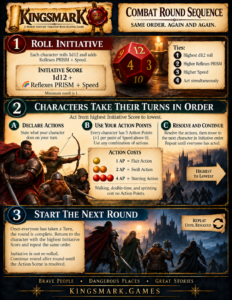
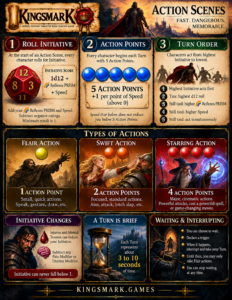
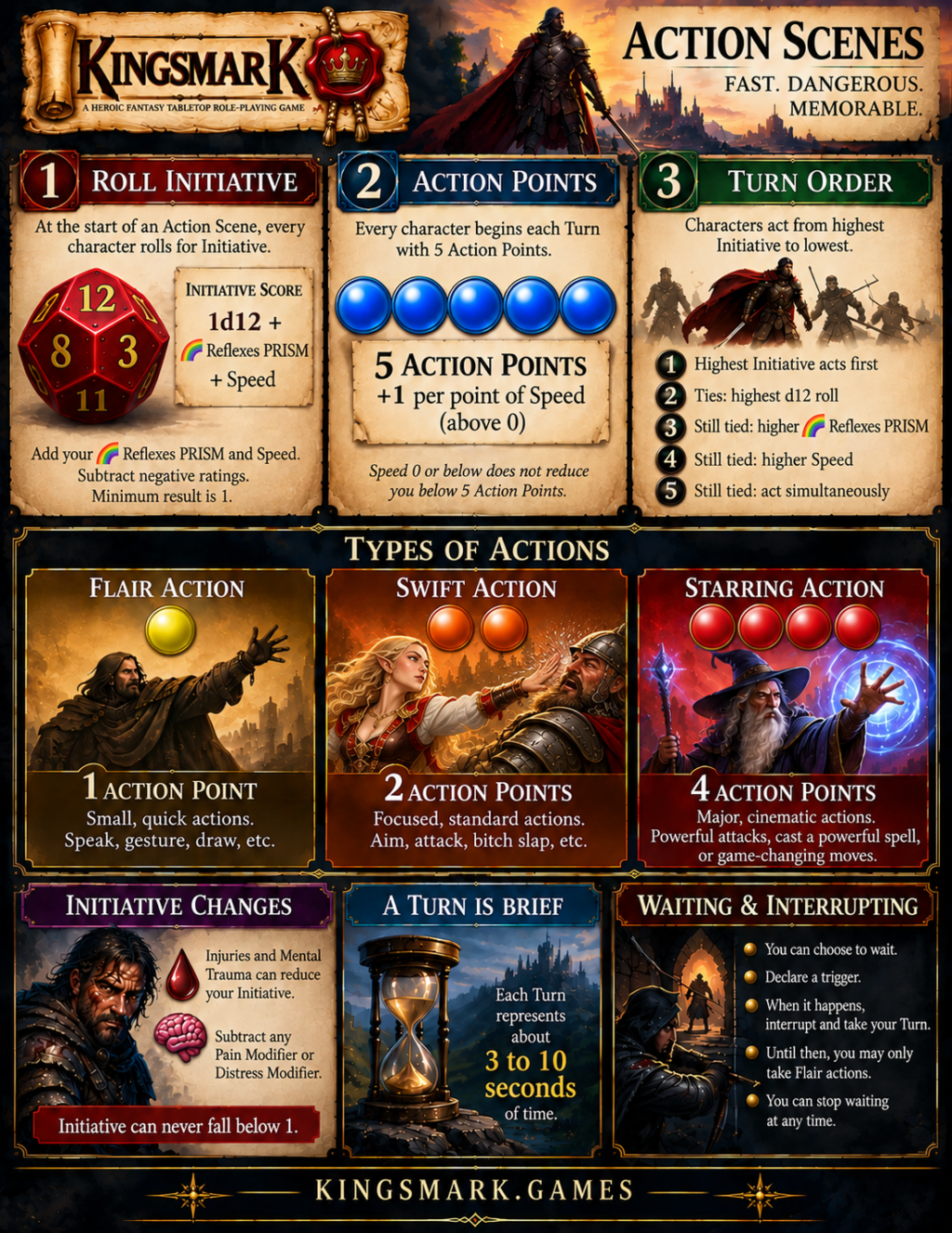
When an Action Scene begins, each participant rolls 1d12 + 🌈Reflexes PRISM + Speed to determine their ⏳Initiative Score. Characters act from highest to lowest Initiative. Ties are resolved by comparing the original d12 rolls, followed by Reflexes PRISM and Speed. Completely tied characters act simultaneously.
Initiative is normally rolled only once. When everyone has completed a ⏸Turn, a new ▶️Combat Round begins using the established order. Each Combat Round represents approximately 3–10 seconds of overlapping cinematic action, rather than everyone standing motionless while waiting for someone else to finish.
Every character normally receives 🔵🔵🔵🔵🔵 5 Action Points per Turn, modified directly by Speed. Someone with Speed +2 receives seven Action Points, while Speed −2 provides only three. These points measure how much acting time a character can devote to different activities.
Actions generally fall into three categories. 🟡Flair Actions cost one Action Point and cover quick gestures, brief remarks, or drawing accessible equipment. 🟠🟠Swift Actions cost two and include ordinary attacks, aiming, grappling, defensive maneuvers, and numerous specialized techniques. 🔴🔴🔴🔴Starring Actions cost four and represent substantial commitments such as Sprinting, complicated maneuvers, or particularly demanding activities.
Walking and Double-Time movement have no separate Action Point cost because they occur alongside other activities. Sprinting costs four Action Points and is limited to once per Turn.
⚔️Combat Is More Than Swinging a Sword
Kingsmark includes well over a hundred example Actions, ranging from practical battlefield maneuvers to outright psychological warfare. 🟠🟠Insulting/Embarrassing Strike allows a character to humiliate an opponent rather than physically injure him. A successful strike inflicts 🧠Shaken Mental Trauma without escalating according to the margin of success.
Players might describe slapping an arrogant knight, flicking an opponent’s nose, or slicing a button from someone’s clothing. The objective is to demonstrate that the character could have inflicted a serious injury but deliberately chose humiliation instead.
Other possibilities include 🟠🟠Teabag, a deliberately vulgar dominance display over an incapacitated opponent that can psychologically affect hostile witnesses. A powerful Giant might use 🟠🟠Wield Incapacitated Body as Improvised Weapon, while a magician could develop the 🎶Minstrel’s Magic Spell Look Cool, making an already intimidating display of composure even more impressive.
Not every victory requires killing an opponent. Sometimes embarrassment, intimidation, positioning, deception, or control accomplishes more than another sword strike. Kingsmark’s 💥Damage & Defense rules also ensure that actual injuries carry consequences.
⏸Waiting, Interrupting & Changing Initiative
Characters can choose to delay their Turns by entering Laying in Wait, optionally declaring a trigger. When the triggering event is declared, they may interrupt before the corresponding dice roll or automatic consequence occurs. While waiting, they cannot move or attack, although limited Flair Actions remain possible.
Injuries also affect timing. Accumulated 🩸Pain and 🧠Distress reduce Initiative immediately, potentially changing the remaining Turn Order. However, a character never receives more than one Turn per Round merely because Initiative changes.
These rules reward characters who pay attention to what their opponents are doing rather than simply waiting for their next attack.
🎬Example — The Ballad of Sartina
In a crowded tavern outside Greywatch, a beautiful blonde Elf Minstrel named Sartina confronts three drunken mercenaries threatening the innkeeper. A crimson scarf hangs around her neck, decorated with thirteen tiny silver stitches. Her lute rests against a nearby table.
When violence becomes inevitable, Sartina rolls 8 for Initiative. Her 🌈Reflexes PRISM +2 and Speed +1 produce Initiative 11. The mercenary captain achieves Initiative 8, so Sartina acts first. Her Speed +1 also gives her 6 Action Points.
Rather than drawing a sword, Sartina advances toward the captain and spends 🟠🟠2 Action Points upon an Insulting/Embarrassing Strike. She delivers a spectacular open-handed slap across his face. Her modified Unarmed Combat result is 10 against his opposing result of 7. The strike succeeds, inflicting 🧠Shaken Mental Trauma rather than a Physical Wound.
With four Action Points remaining, Sartina performs 🔴🔴🔴🔴Intentional Coolness. She slowly straightens her crimson scarf, brushes an imaginary speck of dust from her sleeve, and smiles at the other two mercenaries. Her Social Skills Test produces 11, exceeding one observer’s Discipline result of 7. That mercenary also suffers 🧠Shaken Mental Trauma.
The captain stands humiliated, the other mercenaries hesitate, and Sartina remains completely composed. She has spent all six Action Points without inflicting a single Physical Wound. Whether the confrontation ends peacefully now depends upon what the opponents decide to do next.
Two meaningful actions have transformed an ordinary tavern confrontation into a memorable scene. Sartina could have attacked with a weapon, but chose something far more personal. And somewhere beneath the tavern’s noisy rafters, a new song has already begun to write itself.
About The Author