✨Spellcasting in Kingsmark
How Magic, Power Levels, and Mental Drain Work
Learn the Kingsmark RPG spellcasting rules, including d12 Spellcasting Tests, supernatural resistance, magical damage, Casting Methods, and the consequences of powerful magic.
Magic in Kingsmark allows characters to accomplish things that should be impossible according to the ordinary laws of nature. A magician might conjure fire, influence another person’s mind, heal terrible injuries, communicate with spirits, or perform miracles that challenge reality itself. However, supernatural power comes with consequences, and even an accomplished magician must consider whether a particular spell is worth the risk.
Unlike RPGs that rely upon spell slots or mana points, Kingsmark emphasizes magical knowledge, casting difficulty, supernatural resistance, and 🧠Mental Drain. The basic mechanics remain consistent across its 24 Schools of Magic, allowing players to learn one procedure and apply it to hundreds of different supernatural manifestations. The complete rules are explained in Chapter 15: 📜Magic System.
Choosing a Spell and Its Power Level
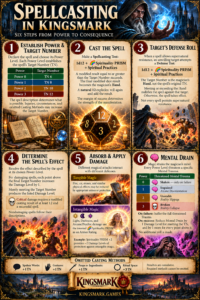
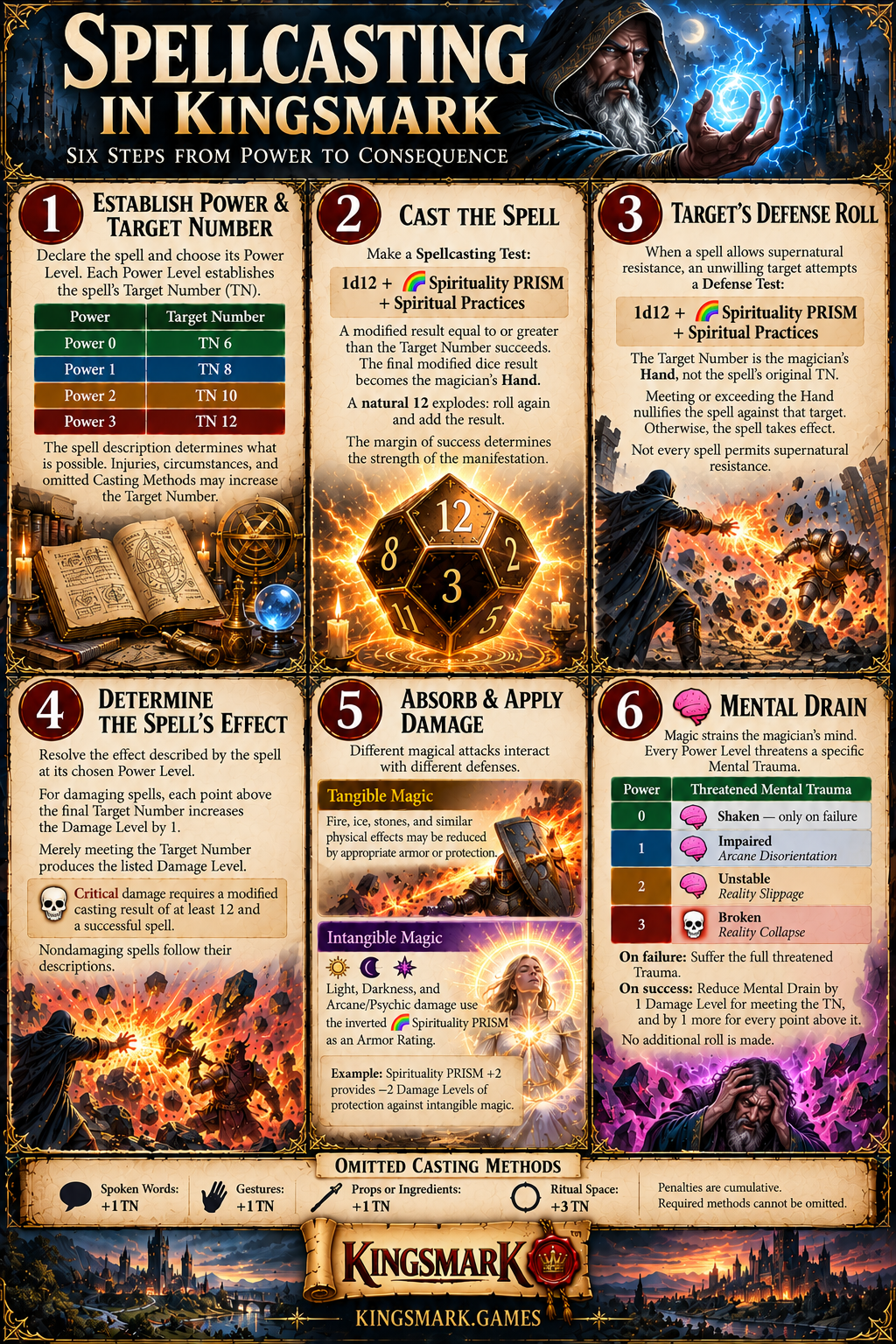
Every spell can possess up to four Power Levels, representing increasingly extraordinary manifestations. Power 0 (Coincidental) has TN 6, Power 1 (Lesser) has TN 8, Power 2 (Greater) has TN 10, and Power 3 (Supreme) has TN 12. The spell description establishes exactly what each manifestation can accomplish, whether increasing its destructive power, range, duration, number of targets, or supernatural capabilities.
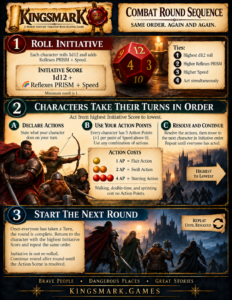
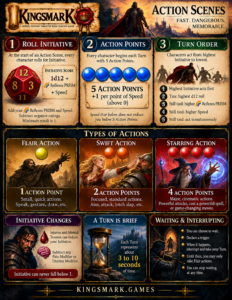
The magician must know the spell and possess sufficient ⭐Action Star Level to perform its chosen Power. Normally, Power 0 costs 🟠🟠2 Action Points, while Powers 1–3 cost 🔴🔴🔴🔴4 Action Points, unless the individual spell specifies otherwise.
To perform the spell, make a Spellcasting Test: 1d12 + 🌈Spirituality PRISM + ⚒Spiritual Practices. If the modified result equals or exceeds the Target Number, the spell succeeds. The final modified result becomes the magician’s Hand. A natural 12 explodes, allowing another roll to be added to the result.
Supernatural Resistance and Magical Damage
When a spell permits supernatural resistance, an unwilling target makes a Defense Test using 1d12 + 🌈Spirituality PRISM + ⚒Spiritual Practices. The target must equal or exceed the magician’s Hand, not the spell’s original Target Number. Successful resistance nullifies the spell against that target. Not every spell permits resistance, particularly those affecting willing recipients or the environment.
For damaging spells, every point above the final casting Target Number increases the spell’s listed Damage Level by one. However, a damaging spell cannot escalate to 💀Critical unless its successful modified casting result also reaches the Critical Threshold of 12. The applicable protections are considered after the Damage Level has been determined.
Magical damage can be tangible or intangible. Supernatural fire, ice, and hurled stones produce physical effects against which suitable armor may provide protection. Intangible ☀️Light, 🌑Darkness, and ✨Arcane/Psychic attacks instead use the inverted 🌈Spirituality PRISM as an Armor Rating. A character possessing 🌈Spirituality PRISM +2 therefore receives −2 Damage Levels of protection against those intangible forces. See Chapter 13: 💥Damage & Defense.
Casting Methods and 🧠Mental Drain
Magic is traditionally performed through 🗣Spoken Words, 👐Gestures, 🪄Props or Ingredients, and sometimes an ⭕Ritual Space. Omitting an optional listed method increases the casting Target Number: +1 for each of the first three methods and +3 for Ritual Space. These penalties accumulate, while explicitly Required methods cannot be omitted.
Every spell also threatens psychological consequences called 🧠Mental Drain. Power 0 causes 🧠Shaken Trauma only when casting fails. Power 1 threatens 🧠Impaired Trauma, Power 2 threatens 🧠Unstable Trauma, and Power 3 threatens 💀Broken Trauma.
Failure inflicts the full threatened Trauma. Success reduces the threatened severity by one Damage Level for meeting the Target Number, then another for each point above it. No separate Mental Drain resistance roll is made. An exceptionally successful magician may therefore perform tremendous magic without suffering Mental Trauma, while an unsuccessful attempt risks catastrophic psychological consequences.
These risks help make magic a meaningful choice. A magician might possess sufficient knowledge to perform another miracle while recognizing that doing so could endanger their mind.
🎬Example: The Burning Gate of Greywatch
During an attack upon Greywatch, a Wizard named Seraphine discovers several enemy warriors advancing through a narrow stone passage. She decides to cast the Power 2 manifestation of 🔥Fire, creating a Wall of Fire across their path. The spell has TN 10 and requires 🗣Spoken Words, 👐Gestures, and 🪄Props or Ingredients, all of which she performs.
Seraphine possesses 🌈Spirituality PRISM +1 and ⚒Spiritual Practices +1. She rolls 9 on her d12, producing 9 + 1 + 1 = 11. Her spell succeeds, and her Hand becomes 11. Because she exceeds TN 10 by one point, the Wall of Fire’s listed 🩸Moderate Damage can increase to 🩸Severe.
One armored warrior attempts to force his way through the burning barrier. He rolls 7, adding 🌈Spirituality PRISM +1 and ⚒Spiritual Practices 0, producing 8. Because he fails to equal Seraphine’s Hand of 11, he suffers the fire’s effect, subject to any applicable protection.
Finally, Seraphine determines her 🧠Mental Drain. Power 2 normally threatens 🧠Unstable Trauma. Meeting TN 10 reduces this to 🧠Impaired, and exceeding it by one additional point reduces it again to 🧠Shaken.
The spell has successfully protected her companions, but Seraphine staggers backward, trembling and momentarily disoriented by the supernatural strain. She remains capable of performing magic, yet another attempt may carry serious consequences. Victory has been achieved, but supernatural power has demanded its price.
About The Author